Articles that inspire and inform!
Publisher of POLIS LLC
Address: 190000, Saint Petersburg,
35/15 Kazanskaya Street
Publisher of POLIS LLC
Address: 190000, Saint Petersburg,
35/15 Kazanskaya Street

No 1, April 2025 16+
http://episs.ru
ISSN 3033-7674 (Online), ISSN 3033-7666 (Print)
CERTIFICATE OF THE FEDERAL SERVICE FOR SUPERVISION IN THE FIELD OF COMMUNICATIONS,
INFORMATION TECHNOLOGY AND MASS COMMUNICATIONS (ROSKOMNADZOR)
Эл No ФС77-87449
ELECTRONIC PERIODICAL SCIENTIFIC PUBLICATION (ST. PETERSBURG, RUSSIA)
The journal is registered and published in Russia
The journal publishes articles in all scientific fields
The journal is published in Russian
All articles are peer-reviewed
Free access to the electronic version of the journal
By sending an article to the editorial board, the Author confirms its uniqueness and bears full responsibility for it
Editorial staff
Editor-in-Chief
Vorontsov Vladimir Valentinovich
Executive Secretary
Kholmanskikh Maria Viktorovna
Managing Editor
Ivanov Maxim Dmitrievich
Reviewers
Dimitrienko Andrey Igorevich,
Ph.D., Academician I.P. PavlovFirst St. Petersburg State Medical University
Pyrkh Andrey Ivanovich, Ph.D., St. Petersburg State University
_____________________________________________________________________________
Contacts
 190031, Russia, St. Petersburg, Kazanskaya str., 35, lit. A, apt. 15
 +7 931 712-95-96
 nxxivek@inbox.ru
_____________________________________________________________________________
© Founder: Polis Ltd (ОГРН 1097847170871)
190031, St. Petersburg, ext. Ter. Admiralteysky Municipal District, Kazanskaya St., 35, lit. A, apt. 15
Contents
From Editorial Board……………..……………….………………………………………………3
Kildeev, Adel
Artificial intelligence as a human servant or vice versa: legal aspects..…………………………………………………………..……………….4
Dubkova, Anastasia Mikhailovna
Russian culture as a product of history in the views of V. V. Kozhinov…..…..……………………………………………………………..….11
Koroleva Yu. A.
The influence of the Internet on the information security of children….….……………..…………………………..…………………………23
(Lea) Gabriela Gavrilov
The October 1917 Revolution in international commercial relations……..………………..………………………………………………….40
Vorontsov, Vladimir V.
The “Russian” Eagle series of the Korean Empire coins….…………….73
FROM THE EDITORS
Dear colleagues, dear readers and future authors!
It is with great joy and excitement that we present to you the first issue of our scientific journal. This event marks the beginning of a new stage in scientific communication and knowledge exchange. We strive to create a platform where scientists, researchers and specialists from different fields can share their discoveries, ideas and achievements.
Our journal is open for the publication of high-quality scientific articles, reviews and studies that will contribute to the development of science and technology. We are confident that thanks to your contribution and cooperation, our journal will become an important source of information for the scientific community.
We look forward to fruitful cooperation with you and invite everyone who seeks to contribute to the development of science to take an active part. We wish you success in your scientific activities and hope that our journal will become a reliable partner and source of inspiration for you.
Sincerely,
Editorial Board of the journal “Scientific Platform XXI Century”
УДК: 347.73
ARTIFICIAL INTELLIGENCE
AS A HUMAN SERVANT OR VICE VERSA:
LEGAL ASPECTS
Kildeev Adel
Zhdanov A. Leningrad State University (1990)
Philosophiæ Doctor in Law
ORCID: 009-0001-2211-4944
Abstract: This article examines the problems of artificial intelligence and its legal status, analyzes various positions of legal scholars on this issue and legislative regulation. Objective: to consider in a critical aspect scientific approaches to determining the legal status of artificial intelligence (AI) both in our country and abroad. Methodological basis: the method of comparative analysis. Results: Russian and foreign concepts of the legal status of artificial intelligence are considered. Conclusions: AI and robots are objects of law, but not subjects, attempts to give them the status of an individual, animal or legal entity are unreasonable and ridiculous. To determine the status of AI and robots, the status of a slave, enshrined in the basis of civil law – Roman law, is best suited, of course, subject to a certain modification of it.
Keywords: Robots, robotics, artificial intelligence, intellectual property, copyright, legal personality, legal status, Roman law, slave, court.
The topic of artificial intelligence and its application in all spheres of life is one of the most relevant now. The Internet is filled with photos and videos generated by artificial intelligence (AI or AI in English transcription), which are no longer inferior in quality to professional photos and clips. Artificial photos, videos, songs, lyrics, translations of texts generated by AI – this flurry has hit our consciousness quite recently. Are we ready for AI and will we be able to control artificial intelligence? Or will the gloomy predictions of science fiction writers come true and we will face the dark times of slavery under the heel of machines?
Stargate will be created in the United States, whose task will be to develop artificial intelligence infrastructure, US President Donald Trump announced along with the heads of OpenAI Sam Altman, SoftBank Masayoshi Son and Oracle Larry Ellison. According to Trump, Stargate will be “the largest AI infrastructure project in history”; will build “physical and virtual infrastructure to support the next generation of artificial intelligence,” including data centers across the United States. The first data center is already under construction in Texas. The three companies will invest $100 billion in the project, investments will increase to $500 billion in the coming years, and 100,000 new jobs will be created in the United States. Artificial intelligence requires a huge amount of infrastructure, power, computer chips, data centers, Sam Altman said in a recent interview, so it is necessary to create all this in the United States in order to maintain leadership in technology.[1]
On January 20, 2025, the Chinese company DeepSeek released the DeepSeek R1-Zero and DeepSeek R1 models. The DeepSeek neural network is based on a large open-source language model and is available in Russian. “In January 2025, DeepSeek unveiled its flagship model, the DeepSeek-R1, which is comparable in capabilities to cutting-edge developments such as OpenAI’s GPT-4o and o1. However, its training was much cheaper – about $6 million, which is several times lower than the cost of GPT-4, the development of which in 2023 required $100 million,” comments Kirill Pshinnik, co-founder and CEO of the Zerocoder online university.[2]
On January 30, 2025, Alibaba Group Holding Ltd. unveiled an updated Qwen 2.5 Max AI model, stating that it outperforms Meta* (Llama) and DeepSeek (V3) solutions in key performance tests. According to the official statement, the company’s new development has shown a world-class level in a number of independent tests.[3]
There is a struggle of global corporations for the consumer, more and more new AI models will be released on the market, more and more advanced and cheaper. Shares of AI chip manufacturers are collapsing, investors are at a loss: which technologies are more profitable to invest in?
Governments around the world understand the need to regulate AI. At the AI Action Summit in Paris, which ended on February 11, 2025, 58 countries signed a declaration on the “open”, “inclusive” and “ethical” development of AI (Russia did not participate in the Summit for obvious political reasons). The Summit was a significant event, bringing together representatives of states, international organisations and leading companies to discuss the future of artificial intelligence. The event was organised by France and India, which called for global cooperation in the field of AI.
One of the important points of the declaration was the commitment to “make artificial intelligence sustainable for people and the planet.” In this regard, the summit announced the creation of the Observatory of the Energy Impact of Artificial Intelligence, which will operate under the auspices of the International Energy Agency (IEA). The Coalition for Sustainable AI was also established, which will include leading companies in the sector.
However, the UK and the United States did not sign the declaration. On the UK side, Prime Minister Keir Starmer’s spokesman explained the refusal to sign, citing national interests. “We only join initiatives that are in the interests of the UK,” he said. U.S. officials did not provide official reasons for not signing the declaration. But from the rostrum of the Paris summit, Donald Trump’s administration’s special envoy, Vice President J.D. Vance, criticized excessive regulation of AI, saying that “over-intervention could kill an emerging industry.” The refusal of the United States and the United Kingdom to sign the declaration illustrates the existing differences in approaches to regulating AI.
Let’s go back to the roots. Robert Heinlein, Isaac Asimov, Philip K. Dick, Stanislaw Lem, Arthur C. Clarke, the Strugatsky brothers – this is an incomplete list of science fiction writers who considered the problems of coexistence between humans and artificial intelligence in their works. It should be noted that the writers have thoroughly studied almost all aspects of such interaction from the point of view of psychology, sociology, and cybernetics. Hollywood, European cinema, and our own have repeatedly exaggerated this topic, giving either an idealistic and tearful approach (the films “Artificial Intelligence” or “Bicentennial Man”), or a harshly post-apocalyptic one (the Terminator franchise film), or a comedy one (the series “Love, Death + Robots”, “The Anna Nikolaevna Project”, “Better Than People”).
And what do lawyers think about AI? Someone considers the applied aspects of AI borrowing other people’s works as copyright infringement, quite reasonably believing that “since artificial intelligence is not a source of new content, but only serves as a tool in the hands of the user, then in fact it is the user who infringes these copyrights.”[4]
Someone is already actively using AI in jurisprudence and promoting its further application[5]. Canada and Quebec have gone further than many countries in regulating AI and defining ethical and legal norms for its use[6], limiting the use of AI in the judicial system in some way[7]. Moreover, the Federal Court of Canada has banned its judges from using AI in decision-making[8].
And how do Russian lawyers see the problem of the legal status and regulation of AI? A detailed analysis of this issue is given in the article “Legal Status of Artificial Intelligence” by A.V. Afanasyevskaya, Ph.D.: “Several concepts on this problem have been formed in domestic legislation. The first of them proposed to equate the status of AI with the status of an individual, thereby extending to him the entire range of rights and obligations regulated by the current legislation. Supporters of the second concept believe that it is necessary to equate the status of robotics with the civil status of animals. The third concept is based on the idea that proposes to use the analogy of legal regulation of the status of a legal entity in civil law relations to solve this problem. Today, the most acceptable in terms of features and specifics, according to the domestic legislator, is to equate the status of AI with the status of a legal entity. For these purposes, the legislator has developed a package of amendments, it is proposed to include in the Civil Code of the Russian Federation a special chapter devoted to these issues, with the following wording: “A robotic agent (robot agent) is a robot that, by the will of the owner and by virtue of design features, is intended to participate in civil turnover. This agent has separate property and is responsible for all his obligations, can acquire and exercise civil rights and bear civil obligations on his own behalf, be a plaintiff and a defendant in court.”[9]
Similar positions are set forth in a number of works by other lawyers-scientists, for example, in the article by I.R. Begichev and Z.I. Khisamova “Artificial Intelligence and Robotics: Theoretical and Legal Problems of Differentiation of the Conceptual Apparatus”. The authors, highlighting in great detail the features of a robot and AI, rightly note that “other concepts (“robot as an animal”, “robot as a person”, “robot as a legal entity”) also have a number of shortcomings, including, in particular, complication of legal regulation, problems with rethinking the basic values of society, an attempt to evade responsibility by “replacing the object”, etc. [10]Similar points of view are contained in the article by Doctor of Law A.V. Popova “New Subjects of the Information Society and the Society of Knowledge: On the Issue of Legal Regulation”, which believes that “a robotic device or an industrial robotic line is an unconditional object of civil law relations, including intellectual property rights, but an industrial robot, a robot agent, a robot serving a robot, depending on the use of AI in it, can also be a special subject of law with limited legal capacity”[11]. Interesting aspects of this complex problem are raised in the article by D.Y. Mikhailov and Doctor of Law A.V. Popova “Legal Regulation of Artificial Intelligence – Dehumanization of Law?”: “If some people still do not have full legal capacity due to sexual, racial or other discrimination, then the question of whether an electronic person should have legal capacity, independently make decisions and be responsible for them is relevant.”[12]
In my opinion, when determining the legal status of AI, it is time for us to return to the basics of our civil law – Roman law.
A slave (servus) was outside of political society and was not a subject of law, according to Roman law he was considered a thing. In the sphere of property, the slave acted as an instrumentum vocale (“speaking instrument”). The ability of a slave to perform legal actions (but only in favor of the master) was derived from the legal capacity of the latter, that is, as if such actions were performed by a slave-owner, while the master did not bear any responsibility for the obligations of slaves. was modified, and slaveholders became liable for the obligations of slaves arising in the process of carrying out their economic activities on behalf of their masters. Peculium is a separate property allocated to a slave by the master for independent management, part of the income from which the slave had to contribute to the master. Since the economic activity was carried out by the slave on his own initiative and in his own interests, and the peculium legally belonged to the master, he was responsible for the obligations of the slave within the boundaries of the peculium[13].
Of course, the full application of the doctrines of Roman law to the status of AI is impossible without their modernization, but the main thing in the doctrine is that a slave is considered a thing, just as AI is a thing, and not a person or an animal, which some researchers write about completely thoughtlessly. I am afraid that they would never have been able to pass the Roman law exam to my favorite professor V.A. Musin[14] with such doubtful knowledge. Well, what legal capacity can a “smart” speaker or iron have? What personal rights and obligations can a toaster or refrigerator have? What is the legal responsibility of a copier? Why are a donkey and a smart electric car animals? How to impute rape to a vibrator? What are the alimony obligations of the meat grinder?
We live in a changing and crazy world where dehumanization is in full swing. The largest transnational corporations promote their latest technologies that displace people from production and from life in general. It is more profitable to pay a person unemployment benefits than to provide him with a skilled job. Because his work is already occupied by a robot AI. According to analysts’ forecasts, in the next 10-15 years, about half, if not more, of jobs will be lost to people, the work will be done by robots, the place of writers, translators, journalists, teachers, actors will be taken by AI, robotic doctors will treat people, and robotic lawyers will sue among themselves. I am exaggerating a little, of course, but the general picture of the future world, outlined by the world backstage (oligarchs), is already quite visible. We must ask ourselves the question: why do we live in this world and what do we strive for? What is the main value? A person and his happiness or making a profit by any means with the accumulation of these capitals in the hands of a handful of unscrupulous oligarchs? The illusion of AI controllability has already begun to fade, and numerous cases of machine disobedience are no longer a secret. The same applies to the dehumanization of law, the admission of AI into the process of lawmaking, judicial activities and the execution of court decisions is completely unacceptable, in my opinion, at least for the time being.
In conclusion, I would like to cite an excerpt from my favorite fantasy story by Gordon Dixon, “Punch Cards Don’t Discuss”, in which AI, by its mistake and organic idiocy, sentences to death a reader who did not turn in Robert Louis Stevenson’s book “Kidnapped” to the library on time:
“The State of Illinois.
Extremely urgent!
I, Hubert Daniel Willikens, Governor of the State of Illinois, who by virtue of the power given to me to pardon persons who, in my deep conviction, have been convicted too cruelly and deserve pardon, hereby pronounce the pardon of Walter A. Child (A. Walter), who is now in prison as a result of a wrongful conviction for a crime of which he is absolutely innocent, absolving him of all such guilt. According to this pardon, Walter A. Child (A. Walter) is to be released from custody…
Interdepartmental Relations Service.
Please do not bend, crumple or fold the punched card.
Content: Failure to comply with the rules for sending documents.
Where: In the office of Governor Hubert Daniel Willikens.
Regard: “Pardon of Walter A. Child on July 1, 1987.”
Dear Mr. Chief of Staff,
You forgot to put the outgoing number on the said document. We ask you to re-transfer this document to the punched card on Form 876, the only one that allows you to put the designation “extremely urgent” on the document. Form 876 must be signed by your superior.
The Bureau of the Interdepartmental Liaison Service was opened on Wednesday, 5 July 1987.
Warning: If you fail to submit your Form 876 document, you may be prosecuted for non-compliance.”[15]
Do you want to live in such a world? I don’t! And think about why on all submarines, airplanes and spacecraft, command and control systems are repeatedly duplicated, and if possible mechanically.
References
1. Afanasyevskaya A.V. Legal status of artificial intelligence. / Bulletin of the Saratov State Law Academy, No 4 (141) 2021, p.90.
2. Begishev I.R., Khisamova Z.I. Artificial intelligence and robotics: theoretical and legal problems of differentiation of the conceptual apparatus. Bulletin of the Udmurt University, vol.30, issue 5, 2020, p.711.
3. Grimm, D.D. Lectures on the Dogme of Roman Law (Fifth Edition, St. Petersburg, 1916). Reprint. Moscow, Zertsalo Publishing House, 2003.
4. Dixon, Gordon. Punch Cards Do Not Discuss / Electronic Library LitMir https://litmir.club/br/?b=58580
5. Artificial Intelligence and Copyright – Who Will Win?/ An article without the author’s name on the website “IT Lawyers | SHEVTSOV.RU
https://shewzov.ru/articles/artificial-intelligence-and-copyright-who-will-win/
6. Mikhailov D.Yu., Popova A.V. Legal Regulation of Artificial Intelligence – Dehumanization of Law? Education and Law No 8, 2020, p.269.
7. DeepSeek neural network: what it can do, how to use, a description of the artificial intelligence model / RIA Novosti. 20:24 31.01.2025.
Electronic resource: https://ria.ru/20250131/deepseek-1996714057.html
8. Popova A.V. New Subjects of the Information Society and the Society of Knowledge: On the Issue of Normative Legal Regulation. Zhurnal Rossiyskogo Prava, No 11, 2018.
9. Trump announced the largest AI project in history | Open Systems Publishing House.
Electronic resource: https://www.osp.ru/articles/2024/0127/13059137
10. Alibaba claims superiority of its new AI model over DeepSeek and Meta* / AI, services and apps / iXBT Live. Electronic resource: https://www.ixbt.com/live/sw/alibaba-zayavila-o-prevoshodstve-svoey-novoy-ai-modeli-nad-razrabotkami-deepseek-i-meta.html
11. Federal Court bans its judges from using AI in decisions in wake of U.S. controversy / The Globe and Mail, January 9th 2024.
https://www.theglobeandmail.com/canada/article-ai-canada-federal-court-judges/
12. Generative AI in the Legal Profession / Harvard Law School Center on the Legal Profession, 2022
https://clp.law.harvard.edu/knowledge-hub/magazine/issues/generative-ai-in-the-legal-profession/
13. Guidelines for the Use of Artificial Intelligence in Canadian Courts. Guidelines for the Use of Artificial Intelligence in Canadian Courts. Prepared by Martin Felsky, Ph.D., J.D., and Professor Karen Eltis for the Canadian Judicial Council First Edition, September 2024.
https://cjc-ccm.ca/sites/default/files/documents/2024/AI%20Guidelines%20-%20FINAL%20-%202024-09%20-%20EN.pdf
14. Legal framework for artificial intelligence: Where do we stand in Canada and Quebec? November 10th, 2023| Langlois Lawyers
https://langlois.ca/en/insights/legal-framework-for-artificial-intelligence-where-do-we-stand-in-canada-and-quebec
CULTURAL STUDIES
UDC 008:001.8
RUSSIAN CULTURE AS A PRODUCT OF HISTORY
IN THE VIEWS OF V. V. KOZHINOV
Dubkova Anastasia Mikhailovna
2nd year Master’s student
Faculty of Law
Saint-Petersburg University of Humanities and Social Sciences
nastja_post@mail.ru
ORCID: 0009-0001-1500-8799
Abstract. The article examines the views on Russian culture and the role of Russia in the modern world of the outstanding educator, historian, philosopher and publicist Vadim Valerianovich Kozhinov (1930 – 2001). The author touches upon the issues of total suppression of Russian self-consciousness and Russian self-identity in the era of totalitarianism, when V. V. Kozhinov’s views were formed, and Kozhinov’s role in the revival of Russian culture and Russian thought. Agreeing with V. V. Kozhinov, the author comes to the conclusion about the uniqueness of Russian culture and that the Western model of society is unacceptable for Russia.
Keywords: Russian people, mentality, society, historical path, cultural values, intelligentsia, Western society, communal consciousness, individualization.
Introduction
Vadim Valerianovich Kozhinov (1930 – 2001) left a mark on Russian culture primarily as an outstanding literary critic, historian, philosopher, and publicist. He played a decisive role in the life and spiritual formation of many people in our country. The works of Vadim Valerianovich, especially the latest ones on the history of Russia, are extremely relevant for any thinking person, and you constantly return to them – bright articles and books. They reveal the pain and problems of today.
Vadim Valerianovich loved literature and sincerely admired people who seemed talented to him. He did a lot to popularize young or undeservedly forgotten authors. The most striking examples are the philosopher Mikhail Bakhtin and the poet Nikolai Rubtsov, once consigned to oblivion and literally “rediscovered” by them.
Kozhinov published 118 articles and 30 books on Russian literature, history, and philosophy. He is known primarily as the author of fundamental historical and historiosophical works: “Russia. The Twentieth Century”, “The History of Russia and the Russian Word”, “Great Creativity. The Great Victory”, “Victories and Troubles of Russia”. His position is completely understandable from them. Speaking from a patriotic position, he sought to prove that Russia has its own historical path, which is different from the path of the “West” and the path of the “East”, that Russia has its own original culture, and attempts to impose on Russia a mentality and a foreign culture alien to its people could never and will never be crowned with success.
Kozhinov gave an ideological outlet to the ideas of understanding Russia, which in the nineteenth century were first hesitantly raised by the Slavophiles, then continued the Russian religious renaissance, but also rather sluggishly. In the Soviet era, this topic was completely prohibited, and with the beginning of the so-called “perestroika” in the late 80s of the last century, when, against the background of the collapsing Soviet Union, the question of the historical path of our country arose again, it was Kozhinov who tried to fill this vacuum.
Kozhinov cannot be called a Slavophile. But the words of Valentin Oskotsky[16] about Kozhinov’s “Eurasianism” cannot be recognized as correct either. Kozhinov himself said: “I do not belong to any trends.”[17] It can be said unequivocally that Kozhinov was against the imposition of the so-called liberal or Western idea of development on Russia, which was developed from the late 80s to the end of the 90s by the ruling elite of the USSR (and then in Russia). Vadim Valerianovich warned that the West imposes its so-called “cultural values” on us not so that “barbarian Russia” joins the “European culture” and “rises from its knees”, but on the contrary, in order to “bring Russia to its knees” and destroy its own culture. As Felix Kuznetsov said, “I think that it was from the acquaintance with Vadim (Kozhinov – A.V.) my journey back to Russia, to the Russian, patriotic idea, began. Before that, I was, so to speak, more liberal.”[18]
Kozhinov’s book “Victories and Troubles of Russia”, published by the publishing house “Algorithm” in 1999 and has survived many reprints, is mainly devoted to Russian culture. But it also touches on many other, broader topics that are inextricably linked with Russian culture, its emergence, formation and development. This work of Vadim Valerianovich is, as it were, a summary and generalization of the views of this outstanding person.
Formation of V. V. Kozhinov’s views
Kozhinov’s work “Victories and Troubles of Russia” has a subtitle: “Russian Culture as a Creature of History”.
It would seem that the culture of any nation is a product of its history, and there is nothing surprising in this. But we must understand in what era Vadim Valerianovich lived, and how his views were formed. He was born in 1930, in an era when the Soviet totalitarian regime suppressed everything Russian, when Pushkin, Dostoevsky, Rozanov were banned, when Orthodox churches and shrines were destroyed and destroyed, and when the word “Russian” was almost a curse word. Everything that had been achieved by the thousand-year history of our country was vilified, and the words “Mother Russia” could only be pronounced in a mocking context.
On February 5, 1931, J. V. Stalin published the following reasoning: “The history of old Russia (its entire history in general) consisted, among other things, in the fact that it was constantly beaten… The Mongol khans were beating. The Turkish Beks were beating. The Swedish feudal lords were beating. They were beaten by the Polish-Lithuanian lords.”[19] In his report to the Sixteenth Party Congress (June 27, 1930), he devoted an entire section to exposing the “deviation towards Great-Russian chauvinism”: “It is not difficult to understand that this deviation reflects the desire of the moribund classes of the formerly ruling Great Russian nation to regain their lost privileges. Hence the danger of Great Russian chauvinism as the main danger.” [20] The editor-in-chief of the newspaper “Izvestia” N.I. Bukharin in an article dated January 21, 1936 writes that “the Russians were the nation of the Oblomovs, and the word “Russian” was synonymous with the gendarme.”[21] Russian historical figures Alexander Nevsky, Minin and Pozharsky, Peter I, Suvorov were called exclusively derogatory names.
In 1932, an “opera” based on the play “Bogatyrs” by Demyan Pridvorov-Bedny was staged on the stage of the Chamber Theater in Moscow, which was an unparalleled mockery of the “golden age” of Russia, Grand Duke Vladimir Svyatoslavich, his glorious heroes and the Baptism of Russia. The magazine “Worker and Theater”, choking with delight, wrote: “The performance has a number of bold projections into the present, which increases the political effectiveness of the play. Epic heroes act as a gendarme secret police. Prince Vladimir himself… by the end of the performance, he takes on the image of the penultimate Tsar-Derzhimorda.”[22]
However, starting from 1934, the attitude towards Russians in the USSR began to change unexpectedly for the better, and soon the whole country was delighted with the apotheosis film poems “Peter the Great” (1937), “Alexander Nevsky” (1938), “Minin and Pozharsky” (1939), “Suvorov” (1940).
On February 14, 1936, Bukharin published a “repentant” article in Izvestia, which he edited, on the subject of slander against the Russian people. “In the autumn of 1936, the Bulgakov’ house was struck by the defeat of the “Bogatyrs” in the Chamber Theater because of the “mockery of the baptism of Russia”.[23] In 1937, the year of Pushkin’s death was solemnly celebrated, and in the same year the Christmas tree was again allowed, calling it “New Year’s”.
It should also be recalled that in 1929-1930 most of the most prominent historians of Russia of different generations were arrested on charges of “monarchist conspiracy” and other similar sins: S. V. Bakhrushin, S. K. Bogoyavlensky, S. B. Veselovsky, Y. V. Gautier, B. D. Grekov, V. G. Druzhinin, A. I. Zaozersky, N. P. (not to be confused with D. S.) Likhachev, M. K. Lyubavsky, V. I. Picheta, S. F. Platonov, S. V. Rozhdestvensky, B. A. Romanov, E. V. Tarle, L. V. Cherepnin, A. I. Yakovlev and many others. But just a few years later, all of them – with the exception of Lyubavsky, Platonov and Rozhdestvensky, who, alas, did not live to see their release – not only returned to work, but were soon awarded the highest honors and awards. To this it should be added that almost all the “accusers” of S. F. Platonov and others, beginning with the militant Marxist historians G. S. Friedland and M. M. Tsvibak and ending with the leaders of the OGPU and the Central Control Commission of the All-Union Communist Party (Bolsheviks) Y. S. Agranov and Y. H. Peters, were repressed in 1937-1938. A truly symbolic act was the republication in the same 1937 of the main work of the main accused, S. F. Platonov, who died in 1933, and the election in 1939 of recent “enemies”, Y. V. Gautier as a full member and S. V. Bakhrushin as a corresponding member of the Academy of Sciences[24].
V. V. Kozhinov explains Stalin’s turn towards the “rehabilitation” of the historical past in the following way: after Hitler came to power in Germany in 1933, the Nazi Führer said: “The goal of all politics is one thing: to regain political power,” and then “the seizure of new living space in the East and its merciless Germanization.”[25] “Realizing that the brewing war would essentially be a war not of fascism against Bolshevism, but of Germany against Russia, Stalin naturally began to think about the need to “mobilize” Russia, and not Bolshevism. Apparently, this was the main reason for Stalin’s support for the “restoration” that in one way or another, but naturally, took place in the 1930s in the very existence of the country.[26]
Let us now turn to another problem—the scientific and technological development of the country. On November 30, 1932, Stalin’s following judgments about Russia were published: “… Our country was extremely backward… We follow the United States because it is a country that stands high scientifically and technologically. We would like the people of America to be our teachers in science and technology, and we to be their students.”[27]
Realizing that our scientific and technical thought before the seizure of power by the Communists was no worse than in the West, Kozhinov notes the turn of the authorities in the late 1930s to the Russian scientific and technical potential, which had previously been mercilessly suppressed. The most prominent scientists (A. N. Tupolev, S. P. Korolev, G. A. Ostroumov, and others) were thrown into prisons, and only before the war were they transferred from the camps to freedom or left in a state of slavery as prisoners, but they were allowed to work in their specialty.
For example, on June 7, 1938, Sergei Pavlovich Korolev was arrested. During the investigation, he was announced: “Our country does not need all your pyrotechnics and fireworks and are even dangerous.” In the spring of 1939, Sergei Pavlovich was sent to Kolyma, where he would carry wheelbarrows with gold-bearing sand in the Maldyak camp.
However, already on June 13, 1939, when he had not yet reached the camp, the “case” was reviewed; in November, Korolev was sent back to Moscow, and soon he began working in the design bureau subordinate to the NKVD, although still on the problems of jet aviation, and not cosmonautics (according to Korolev’s own words, it was only from 1943 that he was “able to work a little again” in his true field).
From the information published to date, it is not entirely clear why in 1939 there was an unexpected turn in the fate of S. P. Korolev, but there are still sufficient grounds to believe that this was caused by the first successes in the creation of jet engines in the West, as a result of which the authorities realized the significance of Korolev’s “fireworks”.
And now “on February 9, 1946, Stalin declared: “… Particular attention will be paid to… for the extensive construction of all kinds of research institutes that can enable science to develop its forces. I have no doubt that if we provide due assistance to our scientists, they will be able not only to catch up, but also to surpass the achievements of science outside our country in the near future” (vol. 16, p. 15).
The “forecast” turned out to be surprisingly correct: just eight years later, in 1954, the first nuclear power plant in world history began operating in the USSR and the first jet passenger airliner Tu-104 was created, in 1957 the first artificial Earth satellite entered orbit, in 1961 the first manned flight into space took place[28].
In short, both the victory in the Great Patriotic War and the primary achievements in scientific and technological development were due to the overcoming of the “denial” of Russia with its “accursed past” – an overcoming that began in the mid-1930s and continued in the post-war period.
This was the basis for the worldview of Kozhinov, who was a true patriot of our Motherland.
Geographical theory of V. V. Kozhinov
Kozhinov believes that Russia was not in the same conditions in its historical development compared to European peoples.
“More than half of the territory of the Russian Federation is located a little south or even north of the 60th parallel of northern latitude, that is, in a geographical zone that, in general, is considered unsuitable for the “normal” life and activity of people.[29] On the basis of this, he concludes about the uniqueness of the highly developed civilization that appeared in such northern latitudes: “the statehood and civilization of Rus, formed a millennium ago near the 60th parallel of northern latitude and in the zone of continental climate, is indeed a unique phenomenon; If we put the question “theoretically”, it should not have happened at all, because nothing like this has taken place in other similar territories of the planet. Meanwhile, in judgments about Russia, the unique conditions in which it was formed and developed are rarely taken into account, especially when it comes to certain “advantages” of Western countries in comparison with Russia.[30]
He believes that the point is not only that Russia created its civilization and culture in the climate of the 60th parallel (moreover, continental), that is, not so far from the Arctic Circle. No less significant is the fact that such important cities of Russia as Smolensk, Moscow, Vladimir, Nizhny Novgorod, Kazan, Ufa, Chelyabinsk, Omsk, Novosibirsk, Krasnoyarsk, etc., are located approximately on the 55th parallel, and in Western Europe, in addition to the Scandinavian countries, there is only Scotland, also “insulated” by the Gulf Stream, to the north of this parallel. As for the United States, its entire territory (except for almost deserted Alaska) is located south of 50 degrees, while even the southern center of Russia, Kiev, is located north of this degree.
Russia was formed in a space that was radically different from the space in which the civilizations of Western Europe and the United States developed, and it is not only a matter of geographical, but also geopolitical differences. Thus, the enormous advantages of waterways, especially the ice-free seas (and oceans) that wash the territories of Great Britain, France, the Netherlands, Germany, etc., as well as the United States, are the basis of geopolitical “superiority.”
Kozhinov also answers the question of why the territories of Asia, Africa and America, located to the south of Western countries (including the United States), in the tropical zone, clearly and in many respects “lagged behind” Western civilization. He gives the most concise answer to this question as follows. If in the Arctic (or at least close to it) geographical zone, enormous efforts were required for the elementary survival of people and their activities, in fact, were limited to these efforts, then in the tropical zone, where, in particular, the land bears fruit all year round and there is no need for labor-intensive dwellings and clothing that protect from the winter cold, survival was given as if “for free”. and there was no urgent stimulus for the development of material civilization. And the countries of the West, located mainly between the 50th and 40th parallels, represented, from this point of view, a kind of “golden mean” between the North and the South.
Vadim Valerianovich gives us an answer to the question of why such a highly developed civilization as the Russian civilization was formed in such northern latitudes. He takes it for granted. As a result of the work and high culture of the Russian people. At the same time, he never refers to God, since in his writings he carefully avoids this topic.
Russia and Asia according to V. V. Kozhinov
In the era of the 90s, Vadim Valerianovich repeatedly encountered the opinion of opponents of our Motherland, who argued that Russia was a colonial power, and all the Asian peoples that were part of our country were enslaved by the Russians. In response to this, Kozhinov writes: “Russia began to annex the territories of Asia (that is, the Trans-Urals) only at the end of the XVI century, but the joint history of the Eastern Europeans-Slavs and Asian peoples began eight centuries earlier, at the time of the very emergence of the state of Rus. For many peoples of Asia then led a nomadic way of life and constantly moved along the vast plain stretching from the Altai to the Carpathians, often entering the borders of Russia. Their relations with the Eastern Slavs were diverse, ranging from fierce battles to quite peaceful cooperation. How complex these relations were is evident from the fact that one or another warring Russian prince often invited the help of the Polovtsians, who came in the middle of the 11th century from the Trans-Urals and settled in the southern Russian steppes. Moreover, even earlier, in the 9th-10th centuries, Russia entered into complex relations with other Asian peoples – the Khazars, Bulgars, Pechenegs, Torks, etc.[31]”
On the other hand, Kozhinov entered into polemics with the ideologists of “Westernism” of the time (E. T. Gaidar and others), who proposed to “change the main vector” and “abandon” everything “Asiatic” in Russia[32]. Having visited the Asian part of Russia at the beginning of the 20th century, the British statesman George Curzon, who ruled India from 1899 to 1905 (with the title of “Viceroy”), wrote: “Russia undoubtedly has a remarkable gift for winning the loyalty and even friendship of those whom she has subjugated by force… The Russian fraternizes in the full sense of the word… He does not shy away from social and family contact with alien and inferior races,” which “the British have never been capable of,” Kozhinov said[33].
Kozhinov considers the temporary conquest of Russia by the Mongols in the 13th century to be a positive factor for the formation of centralized Russian statehood, since the Mongol yoke united the Russian lands to unite against a common enemy[34].
Kozhinov on Russian Society and the Concept of “Intelligentsia”
Kozhinov believed that the main difference between Russia and the West was that it lacked, or at least very poorly developed, society as an independent and, to a certain extent, self-sufficient phenomenon of the country’s existence. In the West, in addition to the state and the people, there is a society that, despite the fact that it includes various or even opposing forces, at the right moment is able to appear on the historical arena as a powerful force that has absorbed the predominant part of the country’s citizens and a more or less unified force capable of forcing both the government and the population as a whole to reckon with itself.
This assertion aroused objections or even bewilderment, because not only in our country, but also in the West, it is believed that it was precisely the USSR that was characterized by “communalism” and “collectivism”, constantly and vividly expressed in direct relationships between people, while the people of the West are much more focused on their own, private, personal interests; they are much more characterized by all kinds of “individualism”.
However, Vadim Valerianovich believed that the society existing in Western countries not only does not oppose the private, personal – in the final analysis, “egoistic” – interests of its members, but proceeds entirely from them. It appears as a powerful cohesive force precisely when the actions of the government or any part of the country’s population threaten the personal interests of the majority.
He gave an example: during the US war in Indochina, which began in 1964 and lasted about ten years, American society came to the conclusion that this war did not meet the interests of its members and, in fact, had no prospects, organized mass protests and forced the authorities to stop it.
He cited many similar examples of the “victories” of society over the government in Western countries. For example, in 1958, General de Gaulle was elected President of France, and in 1965 he was re-elected for a second seven-year term. Under him, the country largely revived its status as a great power, but it was for “pragmatic” reasons that de Gaulle, who was considered the “father of the nation”, was actually overthrown by French society during a referendum on April 28, 1969.
Referring to the French ambassador to Russia, Maurice Palaeologus, Kozhinov said that the state institutions of Russia that existed from 1906 to 1917 (namely, the State Duma and political parties) in fact expressed the will not of a “society” uniting the majority of the population, but of the intelligentsia, this specific Russian phenomenon.
The intelligentsia is a purely Russian phenomenon; even the term itself, although it comes from a Latin word, has been borrowed by other languages from Russian. Intellectuals are often considered to be all people of “intellectual labor,” but in reality they belong only to those who in one way or another are politically and ideologically active (and, of course, have a lively and constant interest in politics, etc.); they do form a kind of society within Russia. of the society that exists in the West and whose co-members at the right moment are the prevailing or even absolute majority of the country’s population. It may be objected that we will still “catch up” with the West, and the minority of the population, which is the intelligentsia, will become the majority[35].
However, Western society, as Kozhinov believed, is a completely different phenomenon from our intelligentsia; among other things, belonging to it in no way implies involvement in politics, ideology, etc., because, as already mentioned, this society is based on purely private, and ultimately “egoistic“ , the interests of its members, who are united in opposing any political and other tendencies only insofar as these tendencies cause or are capable of causing damage to their own personal existence.
In Kozhinov’s opinion, it could be argued with good reason that in Russia (at least as of 1999) the creation of a society of the Western type was unthinkable. For after all, the Russian intelligentsia “society” – for all its piety before the West – has always brought to the fore not so much the interests of its members as the interests of the “people” (albeit differently understood by various intellectual trends), that is, it has, to use a fashionable term, a completely different mentality than Western society.
Kozhinov’s evidence
Russia’s inability to follow the Western path
As an example of the incompatibility of Russian and Western cultures, Kozhinov cited post-war Japan. In 1945, this country was occupied by Allied forces, and the Americans tried to impose a Western way of life on the Japanese people.
The Japanese economy is fundamentally and profoundly unique, Kozhinov wrote. It is often said that the Japanese are very, even extremely extensive, borrowing Western inventions, know-how, technological ideas, etc. But all this can ultimately be borrowed by people from any country.
In a multifaceted study written in 1985 by a number of foreign experts, which was published in our country in 1989 under the title “How Japanese Enterprises Work”, it is unequivocally stated that the “application of American management methods” begun in Japan after 1945 turned out to be unsuccessful. And by 1956, “the main features of the Japanese system of government… The most important of these are the system of lifetime employment and the process of collective decision-making” (p. Elsewhere in this study, it is said that “individualism pushes the American to start his own business and to erect a psychological barrier around himself that allows him to demonstrate self-confidence to others,” while “the ideal canonized by Japanese culture is interdependence, not individualism” (pp. 55, 66).
All this is based on centuries-old national traditions: “In examining the sources of Japanese management philosophy, we must turn to the Tokugawa era (which began in 1603), when Japanese culture finally reached its classical expression… The best traditions of Zen Buddhism are still preserved in the consciousness of the Japanese.” And these traditions were “necessary to interpret and improve… in accordance with the needs of industrial development… The Appeal of the Political Elite to Certain Elements of the Feudal Heritage … a key factor in the modern development of Japan” (ibid., pp. 38-39).
This “appeal” to the “feudal legacy” was carried out with such consistency that the popular reporter Vladimir Tsvetov, who had been in Japan since the 1960s and spent a total of eight years there, stated in his book “The Fifteenth Stone of the Ryoanji Garden” (1977): “In July 1986, the Law on the Movement of Labor Force came into force in Japan. You get acquainted with it, and the pictures of Russian serfdom described in the history textbook appear in your memory” (p. 360).
It is extremely important to emphasize that in creating their flourishing economy, the Japanese not only continued centuries-old traditions, but literally revived and resurrected these traditions.
Isamu Yamashita, chairman of one of the largest Japanese corporations, Mitsui Zosen, told about this: “After World War II, the spirit of the village community, which had existed for many centuries, began to deteriorate. Then we revived the old community at our industrial enterprises… First of all, we managers have a responsibility to preserve community life… Reproduced in the city… The communal spirit is exported back to the village during the summer and winter “exodus” of the city dwellers, galvanizes the communal consciousness there, and as a result receives an additional impetus itself” (pp. 36, 47).
In this regard, V. Tsvetov admitted that in the end he “realized how right the Japanese managers were when they likened to alchemists those Western journalists, economists, sociologists who tried to look for the key to the faster Japanese rates of economic growth and labor productivity than in other developed capitalist countries, the reasons for the higher quality of products” (p. The decisive role, as it became clear, is played not by technology, but by the fundamental foundations of national existence.
And it must be said with all certainty that Japan, if we put the question seriously, has by no means “overtaken” the United States (and the West as a whole). For the very thesis “to catch up and overtake” is only a primitive propaganda cliché. a situation that is completely inapplicable to the most complex development of the economy (not to mention human existence as a whole). It is impossible to “overtake” in the economy, more significant success can only be achieved on a different, one’s own path.
Of Japan, we can even say that it is not moving “forward” with the United States, but “backward”; It is no accident that Japanese economists constantly recall the “feudal legacy”. And the development of the Japanese economy clearly shows that the Western economy, entirely based on the “individual”, on the main content of the “bill of rights”, turned out to be less capable of growth and improvement than the “communal” Japanese economy.
The achievements of the Japanese are so impressive that the author of the preface to the Russian edition of the book “How Japanese Enterprises Work”, Prof. D. N. Bobryshev, said: “The initial socio-cultural conditions in our national economy are more adapted to the perception of Japanese methods and approaches than, say, American ones, with their strict focus on individualization, strict prudence, and personal career” (p. 7).
Conclusion
Of course, in many respects one can argue with Vadim Valerianovich, but one thing is certain. He loved his Motherland and loved his people. What did he want to say with his works? “The proposal to “transplant” the Japanese “model” into Russia, which is rooted in a completely different history, is without a doubt as utopian as the current experiments to transplant the Western model[36].
The main conclusions that Vadim Valerianovich Kozhinov wanted to bring to the current generation are:
1. The Russian people are not “backward” in comparison with the “European” peoples.
2. Russian culture is unique.
3. Russian culture is a treasury of world culture.
References
1. V.V.Kozhinov. Russia’s Victories and Misfortunes. Conclusion. http://e-libra.ru/read/145276-pobedy-i-bedy-rossii.html
2. V.V.Kozhinov. Between the state and the people. An attempt at impartial reflection on the intelligentsia. (Moscow Magazine, 1998, No 6, pp. 124–137)
3. V.V. Kozhinov. Russia, XX century, book 1, M. Eksmo-Press
4. E.T. Gaidar. The State and Evolution. Moscow, 1995.
5. Smelyansky A. Mikhail Bulgakov in the Art Theater. Moscow, 1989
6. Emelyanov Y. V. Notes on Bukharin. Revolution. History. Personality. Moscow, 1989.
7. I.V. Stalin. Collected Works. vol. 12, 13, Moscow, 1951.
8. “Izvestia”, January 21, 1936.
9. Zhurnal “Rabochiy i teatr”, 1934, No 1.
10. Brachev V. S. “The Case” of Academician S. F. Platonov. Voprosy istorii, 1989, No5, pp. 117-129.
11. Perchenok F. F. Akademiya nauk na “velikom perelom” [The Academy of Sciences at the “Great Turning Point”]. “Links”. Historical Almanac. Vol. 1. Moscow, 1991, pp. 163-236.
12. “Top Secret! Only for the command!” Documents and materials. Moscow, 1967
13. Journal Hall. Valentin Oskotsky. What inheritance do we refuse? http://magazines.russ.ru/voplit/2001/6/oso.html
14. Russian binding. Vadim Valerianovich Kozhinov. http://www.pereplet.ru/avtori/kozhinov.html
15. Russian binding. Alexander Dorin. Vadim is necessary. http://www.pereplet.ru/text/dorin25ynv02.htm
УДК 004+659.4
BBK 60.524
THE INFLUENCE OF THE INTERNET
ON THE INFORMATION SECURITY OF CHILDREN
Koroleva Yu. A.
S. Yu. Witte Moscow University (2023)
E-mail: felo@inbox.ru
Abstract. The article discusses the current problems of information security of children in the Internet space. Close attention is paid to the risks faced by teenagers on the Internet. The types of common Internet crimes are disclosed in detail. The author analyzes the legal norms of Federal Law No. 436-ФЗ dated 29.12.2010 “On the protection of children from information that harms their health and development”. In the context of the escalation of the hybrid warfare waged by Western countries against Russia, solving the problems faced by children on the Internet is becoming a priority task for the state. The article shows the methods of the cyber warfare being waged by the West, the goals that the US political and financial elite sets for themselves by unleashing this war on the Internet, and the threats that this warfare brings to Russian children. The article examines the huge impact of social networks on teenagers and demonstrates how the United States and its allies use social networks for destructive purposes.
Using the example of China, the author shows how the Chinese authorities achieve the information security of children on the Internet, and the ways invented by teenagers to circumvent parental control and censorship. The article presents regulations in the field of information security of children in recent years, reflecting the realities of the modern era, and analyzes in detail the mechanisms of implementation of state policy in this area in modern conditions. At the end of the article, statistics are provided on how much time teenagers spend on the Internet a day, how many percent of them view prohibited content, how many percent of this content creates, etc.
The purpose of the article is to characterize the national sources of legal regulation of ensuring the information security of minors on the Internet, to analyze their current state and the task of developing legislation on ensuring the information security of children on the Internet.
Keywords: information security of children, Internet crimes, online risks, social networks, ensuring the safety of children on the Internet, Internet fraud, cyberbullying, Internet manipulation, cyberattack, hybrid warfare, cyberwarfare, tolerance, Internet propaganda, Internet censorship, foreign agent, Internet addiction, protection of children on the Internet.
Some 20 years ago, the video industry had just begun to switch from the VHS format to DVD, there were cassette audio tape recorders, and mobile phones were push-button, and the newly appeared smartphones were bought exclusively as a fashion gadget because of the fashionable touch screen. No one imagined that they could be used not only as a phone with a camera function. Since then, a real revolution has taken place in the field of communications and information technology. Now it is difficult to imagine a person without a smartphone or tablet connected to the global information and telecommunications network Internet. The smartphone combines not only the functions of a universal communicator. Thanks to the Internet, it has become a pocket computer that has replaced not only newspapers, television, and radio, but even credit cards and money.
20 years ago, the main means of information were printed publications, television and radio, and the main means of communication was verbal communication by phone. In the modern era, the Internet has almost completely replaced the entire information space. TV channels and print media have gone to the global network, an endless number of Internet media, blog platforms and video hosting have appeared. In the field of communications, verbal communication has been replaced by social networks and instant messengers. The very nature of communication between people has undergone radical changes. Telephone conversations have been replaced by short written messages, and the main flow of information has turned into sending printed posts, photos and videos to each other. Webinars and conference calls have become very popular, replacing face-to-face training and educational programs.
The general availability of the Internet is ensured, firstly, by the high technical level of modern gadgets, affordable conditions for their purchase, from sparing prices to acceptable terms of purchase on credit or in installments, and, secondly, by low prices for Internet traffic, as well as the availability of free wi-fi in fast food establishments, cafes and transport.
Of the 147 million population of Russia, 30.2 million people are minors (20.6 percent), of which 27 million people (89.4 percent) are active Internet users[37]. As a rule, this age category is much better adapted to the technical innovations of the modern era than the older generation, including their parents and school teachers. As a result, it is adept at circumventing restrictive measures such as parental controls, website blockings and other tricks that parents use to protect their children from inappropriate content on the Internet. At the same time, due to their age, minors are deprived of the opportunity to independently critically assess the information obtained through information and telecommunication networks, and thus risk finding themselves in an unsafe environment. The instability of the emotional sphere, the low level of criticality of perception and processing of the information flow by children and adolescents indicate that it is children and adolescents who are at potential risk for negative impact and Internet manipulation with subsequent involvement in destructive activities.
What are the threats posed by the Internet to minors?
The report of the International Organization for Economic Cooperation and Development (OECD) for 2010 – 2011 “Protecting children on the Internet: risks faced by children on the Internet, and policies for their protection”[38] lists three categories of the main online risks for children. They can be conventionally called everyday risks.
The first is pornography, cyberbullying, and online harassment.
Federal Law No. 436-FZ of 29.12.2010 “On the Protection of Children from Information Harmful to Their Health and Development” as amended on 28.04.2023 (hereinafter referred to as Federal Law No. 436-FZ) gives the following definition of pornographic information (Clause 8 of Article 2): “information presented in the form of naturalistic images or descriptions of human genitals and (or) sexual intercourse or an act of a sexual nature comparable to sexual intercourse, including such an action committed against an animal.”
Child pornography in Russia includes only photo and video images showing the genitals of real children and acts of a sexual nature with their participation. Sexual exploitation does not at all mean the obligatory sexual intercourse of an adult with a child – it is enough to involve children in the commission of certain actions understood by law as sexual (depraved), including “non-contact”. It is not uncommon for minors (in the vast majority of cases teenagers) to post sexualized images of themselves on the Internet, as a rule, in search of additional popularity (the so-called “sexting”). As a result, the exploitation of interest in sex with minors actually remains poorly punished – textual descriptions of sex with children, as well as non-documentary (fiction) images of characters with underage features (works of artists, anime, hentai, etc.) do not belong to child pornography. Also, at present, according to Russian law, it is impossible to classify as child pornography images where adult characters are given the image of minors (for example, high school students).
Cyberbullying and cyber-attack are forms of bullying or harassment using electronic means. Cyberbullying and cyberbullying are also known as online bullying. It is becoming more common, especially among adolescents and the younger generation, due to the development of communication technologies and the increased use of such technologies by young people. Cyberbullying is when someone, usually a teenager, bullies others online and in other digital spaces, especially on social media sites. Harmful bullying behaviour can include spreading rumours, threats, sexual remarks, divulging the victim’s personal information, or inciting hatred. Bullying or harassment can be identified by repetitive behavior and intent to cause harm.
Cyberbullying is often similar to traditional bullying, with some notable differences. Victims of cyberbullying may not know the identity of their bully or why the bully is harassing them based on the online nature of the interaction. Harassment can have far-reaching consequences for the victim, as the content used to harass the victim can easily spread to many people and often remains available long after the initial incident.
Other studies have shown a spike in cyberbullying during the COVID-19 pandemic, with many young people and adults quarantined at home and, as a result, went online more often than before the pandemic. For example, an adult study published in The Journal of Social Psychology (USA, 2021) found a statistically significant increase in attitudes towards cyberbullying, as well as abusive cyberbullying behaviour[39].
The second category of the main online risks for minors includes the risks associated with Internet marketing and fraudulent transactions.
Internet fraud is a type of fraud or deception in the field of cybercrime that uses the Internet and can involve withholding information or providing knowingly false information in order to defraud victims of money or property. Internet fraud is not considered a separate crime, but covers a range of illegal actions committed in cyberspace. However, it is distinguished from theft, since in this case the victim voluntarily and knowingly provides the offender with information, money or property. It is also different in that it involves criminals who are separated in time and space.
According to the FBI’s 2017 Internet Crime Report, the U.S. Internet Crime Complaint Center (IC-3) received approximately 300,000 complaints. In 2017, victims lost more than $1.4 billion to online scams[40]. According to a study conducted by the Center for Strategic and International Studies (CSIS) and McAfee, cybercrime costs the global economy $600 billion, which is 0.8% of the total global GDP.[41] Internet fraud comes in many forms. It ranges from email spam to online fraud. Internet fraud can take place even if it is partially based on the use of Internet services and is primarily or entirely based on Internet use.
This is not a complete list of types of Internet fraud.
Charity fraud is the use of deception to extract money from people who believe they are donating to charity. Often, individuals or groups provide false information, claiming to be or affiliated with a charity (usually a foundation) and then asking potential donors to donate to that defunct charity. Charity fraud includes not only fictitious charities, but also fraudulent business practices. These deceptive actions by businesses can include accepting donations without using the funds for their intended purpose or collecting funds under the false pretense of need.
Online ticket fraud. A type of online marketing scam is the offer of tickets to popular events such as concerts, shows, and sporting events. Tickets are fake or simply not delivered.
Store gift card fraud. As retailers and other businesses become increasingly concerned about what they can do to prevent the use of gift cards purchased using stolen credit card numbers, cybercriminals have recently focused on the use of fraudulent gift cards. In particular, malicious hackers have tried to get their hands on information regarding gift cards that have been issued but not sold. Some of the ways gift card data is stolen include the use of automated bots that carry out a brute force attack on the systems of the retail stores in which they are stored. First, the hackers steal gift card details, check the existing balance through the retailer’s online service, and then try to use these funds to purchase products or resell them on a third-party website. In cases of resale of gift cards, attackers take the balance in cash, which can also be used as a method of money laundering. This harms customer perception of gift cards, the retailer’s brand, and can cost the retailer hundreds of thousands in revenue. Another way gift card fraud is to steal a person’s credit card information to purchase brand-new gift cards.
Fraud in online sales. A scammer uses the World Wide Web to advertise non-existent goods or services. Payment is made remotely, but the product or service never arrives at the buyer. The methods that these scammers use are that they offer products at very low prices and require payments to be made via electronic funds transfers with 100% prepayment. Scammers use stores that do not exist in reality. Such fake stores, on behalf of which the attackers act, exist on social networks virtually. This is done primarily because there are a lot of social networks, and their number is growing every day. Such fly-by-night stores hold only a couple of sales, then the scammers leave and close the site. Usually, the way to spot these fake stores is to look for online reviews. If they don’t have reviews, then they’re most likely fake. Similar schemes are used when selling through online auction platforms such as eBay.
Often, scammers attract their victims online with clickbait. Clickbait is an enticing, flashy text link or thumbnail of a link designed to attract attention and entice users to click on that link and read, view, or listen to a related piece of online content that is usually deceptive, sensational, or otherwise misleading. Clickbait headlines tend to add an element of dishonesty by using decoys that do not accurately reflect the content being delivered. The suffix “-bait” draws an analogy with fishing, where the hook is disguised with a lure, giving the fish the impression that it is a desirable thing to swallow.
The third category of the main online risks for minors includes risks related to the confidentiality of personal data, including the use of social networks without understanding the possible consequences.
On their social media profiles, minors tend to disclose their personal information (e.g., birthday, email address, home address, hometown, phone number, and relationship status). This personal information can be used by fraudsters to steal users’ personal data, and posting such information on social media makes it much easier for fraudsters to gain control over it.
В упомянутом мною отчёте Организации экономического сотрудничества и развития (OECD) перечислены далеко не все категории рисков информационной безопасности, угрожающих детям в сети Интернет. Отчёт перечисляет риски, которые можно назвать бытовыми, вне поля зрения остались важные политические риски, связанные с агрессивной политикой США, стремящихся к тотальной мировой гегемонии.
After the defeat of the USSR in the Cold War and the collapse of the Soviet Union in 1991, the political and financial elites of the United States and their junior partners in Western Europe tried to turn the former Soviet republics into their semi-colonies, staging “color” revolutions, infiltrating the economies of these states and creating puppet regimes in these countries with the help of political technologies. They managed to fully implement this in the Baltic countries, in Georgia, Moldova and, by 2014, in Ukraine. In all these countries, fierce anti-Russian propaganda has been deployed, and young people are indoctrinated with the image of Russia as an enemy from childhood. This is due to the fact that the West in the 1990s failed in its attempts to dismember Russia and turn it into a raw material appendage of the “developed countries” piece by piece. The United States and its junior partners in Europe have again returned to an aggressive policy towards our country, unleashing a hybrid war against Russia and Belarus.
According to the definition proposed by Frank Hoffman[42], hybrid warfare is a military-political strategy that combines traditional warfare, irregular warfare and cyber warfare with other methods of influence, such as fake news, diplomatic pressure, funding of anti-government organizations and foreign interference in elections. From the point of view of children’s information security, the greatest danger is the cyber war being waged against our country, anti-Russian propaganda and the spread of fake news (so-called “stuffing”) on the Internet.
What is meant by cyber war? There is considerable debate among experts about the definition of cyberwar, if such a concept exists. According to one point of view, this term is used incorrectly, since today no cyberattack can be called a war. An alternative view is that it is an appropriate name for cyberattacks that cause physical damage to people and objects in the real world. Cyber warfare is the use of cyber attacks against an enemy state that cause damage comparable to a real war or disrupt vital computer systems. Possible targets could be espionage, sabotage, propaganda, manipulation of public opinion, and economic warfare.
Young people, and especially teenagers, on the one hand, are the most energetic part of the population, and on the other hand, they are especially susceptible to the influence of Internet propaganda. The United States and its partners pay special attention to social networks as a powerful unifying force for young people. Suffice it to cite the example of North African and Middle Eastern countries during the so-called “Arab Spring” of 2010, when externally imposed uprisings and revolutions took place in Tunisia, Egypt and Yemen; and in Libya, Yemen and Syria, bloody civil wars broke out in addition. All these events began with social networks, with the help of which experienced overseas puppeteers gathered young people in the main squares of the capitals of these states to organize riots and armed uprisings. In 2011-2013, civil disobedience actions were organized in Russia through social networks in exactly the same way, which, according to the minimum program, were supposed to cause destabilization of the situation and mass riots in the country, and according to the maximum program, to overthrow the existing constitutional order. It was thanks to social networks that the United States managed to stage a coup d’état in Ukraine in 2014, which brought to power a pro-Western openly anti-Russian regime, which resulted in the war in Donbass that broke out at the same time and a special military operation by Russian troops on the territory of Ukraine that began in 2022.
Another danger that awaits minors on the Internet is the Western propaganda of the false concept of tolerance.
Tolerance in sociology is when a person allows, allows, or accepts an action, idea, object, or person that he or she does not like or agree with.
Political scientist Andrew R. Murphy explains, “We can improve our understanding by defining ‘tolerance’ as the totality of social or political actions, and ‘tolerance’ as the totality of social relations.”[43] The Random House dictionary defines tolerance as “a fair, objective and lenient attitude towards those whose opinions, beliefs, customs, racial or ethnic origin, etc., differ from their own.”[44] Both of these concepts contain the idea of otherness – a state of dissimilarity. In some cases, tolerance has been seen as a “vicious virtue” because it concerns the acceptance of things that are better overcome. Thus, tolerance cannot be defined as is a universal good, and many of its uses and uses remain controversial.
In pursuit of their destructive goals, the political and financial elite of the United States replaces the vague concept of tolerance with the imposition of false ideas about what is good and what is bad on Internet users. For example, the propaganda of national and racial tolerance ultimately boils down to a complete rejection of patriotism and national self-identity, while calls for the establishment of representative democracy are aimed at arousing the population against the existing government and overthrowing legitimate ones. Governments. In 1991, the head of the Rockefeller banking house, David Rockefeller Sr., clearly formulated the goals pursued by this type of propaganda: “The supranational sovereignty of the intellectual elite and the world’s bankers is undoubtedly preferable to the national self-determination practiced in past centuries.”[45]
Back in 1975, the U.S. National Security Council passed an unprecedented piece of legislation known as NSSM-200: “Memorandum 200 on the National Security Study: The Implications of Global Population Growth for U.S. Security and Interests Abroad.”[46] The main meaning of the memorandum is that the United States, in order to ensure its well-being and prosperity associated with access to sources of mineral raw materials, should do everything possible to reduce the population in countries rich in natural resources. The unprecedented nature of this act lies in the fact that the United States, discarding demagogic slogans about democracy and human rights, openly declared the goals of its foreign policy: interference in the internal affairs of sovereign states and the organization of genocide for its own benefit. Over the past half century, the US foreign policy doctrine has not undergone significant changes. The methods by which the United States achieves depopulation, that is, a stable decrease in the population both on the planet as a whole and in specific regions, are not the topic of this article. But one of the components of the depopulation process – a decrease in the birth rate – is achieved by changing values and transforming the institution of the family. And in this process, destructive forces are actively using the Internet. Under the guise of tolerance in the sexual sphere, there is a real popularization of homosexual relations and same-sex marriages. Child-free ideas are spreading. There is blatant propaganda of sex reassignment surgery. More and more new forms of non-traditional sexual identification are being invented, such as, for example, genderqueer or people with a non-binary gender identity, agender (i.e. asexual people), bissu (all gender aspects combined into a single person), butch and fem (active and passive lesbians), gendervaig (non-binary gender not defined by words due to its status neuro-different), demiboi (gender identity that is both male and genderless), demigirl (gender identity that is both female and genderless), xenogender (gender that cannot be limited by human understanding of gender), neuter (having one non-binary neutral gender identity: not female, not male, and not mixed), and a host of others that raise doubts about the mental state of the inventors of this. The unifying factor for these groups is that these people cannot create offspring. Propaganda of all this is designed mainly for a minor audience, as the most vulnerable part of Internet users. It is designed for the unstable psyche of the child and is designed to form in him the desire for non-traditional sexual self-identification, rejection of generally accepted family values or the desire to change gender.
According to Part 2 of Article 5 of the Federal Law of 29.12.2010 N 436-FZ (as amended on 28.04.2023) “On the Protection of Children from Information Harmful to Their Health and Development”, content containing information of a pornographic nature, containing an image or description of sexual violence; denying family values and forming disrespect for parents and (or) other family members; promoting or demonstrating non-traditional sexual relations and (or) preferences; promoting pedophilia; capable of causing children to want to change their gender – refers to information prohibited for distribution among children.
According to the definition given in Federal Law No 436-FZ, “information security of children is a state of protection of children, in which there is no risk associated with the infliction of harm to their health and (or) physical, mental, spiritual, moral development by information”. It is quite obvious that it is extremely difficult for the Russian legislator to fight so many Internet risks that threaten the information security of children. Federal Law No. 436-FZ lists the types of information that are harmful to the health or development of children (Article 5). He divides such information into 2 types: 1) information prohibited for distribution among children, and 2) information the distribution of which among children of certain age categories is restricted. The law also classifies information products into 5 categories depending on the age of the child (Article 6): 1) information products for children under the age of 6 years; 2) for children who have reached the age of 6 years; 3) under 12 years of age, 4) under 16 years of age, and 5) information products prohibited for children. The law lists the requirements for the circulation of information products, the procedure for their examination, establishes the procedure for state and public control and indicates that violation of the legislation on the protection of children from information harmful to their health and (or) development entails liability in accordance with the legislation of the Russian Federation, implying criminal and administrative sanctions for violators.
The imperfection of this law lies in the fact that it is addressed to producers of information products located in Russia and falling under its jurisdiction. But the vast majority of malicious content creators on the Internet are registered on foreign domains and are physically located abroad, or use a proxy server that acts on behalf of the client when making a request, masking the true origin of the request to the resource server as much as possible. In addition, the classification of information products by age categories with mandatory signs of information products (0+, 6+, 12+, 16+ years) is not intended for children and is not a detailed characteristic of an information product, but is a signal to parents that it contains information that may pose a certain threat to the child. It must be admitted that neither parents nor teachers are able to fully control the information consumed by children. The law does not apply to information distributed in instant messengers, forums and chats, as well as advertising posted on the network. From all this, the conclusion suggests itself that protection against information disseminated on the Internet that is harmful to the health and development of children is practically not regulated by law.
If we turn to foreign experience, the People’s Republic of China has achieved the highest indicators in the field of information protection of children on the Internet. However, we must not forget that the PRC is a totalitarian state, and the information protection of children is carried out there within the framework of general political censorship sanctioned by the Communist Party of China (CCP). capable of reaching a wide audience. This includes television, print media, radio, film, theater, text messaging, instant messaging, video games, literature, and the internet. In 2003, the Golden Shield project, a system for filtering Internet content, was put into operation in China. This system includes such subsystems as a security management system, an offense reporting system, an exit and input control system, an information monitoring system, and a traffic management system. The “golden shield” is one of the components of the so-called “e-government”. It automatically blocks web pages for keywords related to state security, as well as a “blacklist” of site addresses. It filters websites that the Chinese authorities consider anti-communist, including sites dedicated to religious content, news sources that cover topics deemed defamatory of China, and websites that contain anything that the Chinese authorities deem obscene or pornographic. Websites that are dedicated to criminal activity or are deemed subversive. Most websites and blogs experience frequent or constant outages. A recent large-scale study published in 2021 found that more than 311,000 domain names have been blocked. Of these, 41,000 were blocked by accident. [47]The banned sites include YouTube (since March 2009), Facebook (since July 2009), Twitter, Instagram, Dropbox, Foursquare and Flickr, and the Google search engine. Chinese counterparts have been created instead of the blocked popular Western Internet services. According to the NGO Reporters Without Borders, there are more than 2,800 text messaging surveillance centers in China. Shanghai and Beijing risk being disconnected from the text messaging service if they are found to have sent “illegal or unhealthy” content.
However, Chinese teenagers have found a way to circumvent even such strict censorship. In the early 2000s, Taiwanese fans of the popular online game Audition Online came up with a way to encode Chinese characters. To encode a word, traditional Chinese characters, Japanese script, pinyin, Latin alphabet, and emojis are randomly combined, separated, and rearranged in combination with Arabic numerals. This type of writing was called the “Martian language”. The term came from the 2001 Hong Kong comedy Shaolin Football, in which a character named Sing says to another character, “Go back to Mars. The earth is so dangerous.” In 2007, the Martian language began to take root in mainland China. The first to learn the Martian language were mostly teenage netizens. They use it in their nicknames, short messages, and chats to show off their personality. Later, they discovered that their teachers and parents did not understand their new language, which quickly became their secret code for communicating with each other. Chinese online bloggers have followed the trend of using the Martian language as they have found that their blog posts written in the new language can easily get through the internet censorship systems that are currently based on text-matching techniques. The Martian language has become so popular in cyberspace that software has been created to translate from Chinese to Martian.
The example I have given shows, firstly, that neither prohibitive measures nor the strictest censorship are able to completely protect children from prohibited content, and, secondly, that children will always find a way to circumvent parental and pedagogical control.
A system of political Internet censorship and website filtering exists all over the world, and especially in the United States and Western countries. Since the early 2000s and in connection with the conduct of the Russian armed forces in Ukraine since February 24, 2022, the United States, EU countries, Japan, Australia and New Zealand have blocked the Internet broadcasting of Russian media: TV channels Channel One, Russia 1, NTV, Russia Today (RT International), RT France, RT America, RT UK, RTD, Sputnik, Russia RTR / RTR Planeta, Russia 24, International TV Center, RT Balkan, Oriental Review, Tsargrad, Katehon, the online magazine New Eastern Outlook, the news agencies Southern Front, News Front, Inforos and in general all Internet sites that, in the opinion of the West, reflect the official political position of the Russian leadership. In March. by decision of the European authorities, the regional Internet registry RIPE NCC, which distributes IP addresses in Europe, refused to serve Russian telecommunications companies Rostelecom and Megafon and issue them new IP addresses and ASNs. In 2022-2023, YouTube video hosting blocked all channels associated with RT and Sputnik in Europe, NTV channels are blocked in more than 70 countries, the Ruptly channel is blocked, the channels of the State Television and Radio Fund: “Soviet television. Gosteleradiofond” and “Soviet Radio. Gosteleradiofond, the channels of the Aurora news agency – Radio Aurora and Radio Yunost, the Duma TV channel owned by the State Duma, the account of the Orthodox TV channel Spas and the account of the LenTV24 TV channel were blocked due to the “broadcast of events dedicated to Victory Day.” On June 25, 2022, almost 500 allegedly pro-Russian channels with an audience of over 15 million people were blocked following an appeal from the SBU. On March 11, 2022, all Russian channels associated with the state around the world were blocked. 2022 г
At the same time, after February 24, 2022, the American multinational holding company Meta Platforms, which owns the social networks Facebook and Instagram, lifted restrictions on users regarding the so-called “hate speech” against Russians, refusing to ban the slogans “Death to the Russian occupiers!”. Company spokesman Andy Stone confirmed this information and stressed in a statement that the phrase “death to Russian invaders” is now the norm for social networks[48]. Emails to content moderators indicate that Meta has also temporarily allowed some posts calling for the death of Russian President Vladimir Putin and Belarusian President Alexander Lukashenko. In [49]response, Roskomnadzor blocked the social network Facebook on March 4, 2022, and Instagram on March 14. On March 5, 2022, Twitter was blocked by the decision of the Prosecutor General’s Office of Russia. I have already pointed out the huge role that social networks play in the lives of minors, and how destructive Western politicians take advantage of this. In November 2013, with the help of social networks, teenagers stupefied by anti-Russian propaganda – participants of the Euromaidan – gathered on Independence Square in Kiev to speak out against the legitimately elected President of Ukraine. The weather was cold, and these children, in order to warm up, jumped on the spot and frantically shouted: “Whoever does not jump is a Moskal!” Everyone remembers how the Euromaidan ended: with bloody clashes on the square and an anti-constitutional coup that brought to power in 2014 a pro-American openly anti-Russian regime. And the same teenagers began to shout completely different slogans: “Muscovites to knives!”, “Moskalyaku to gilyaku!” (i.e. to the gallows). American puppeteers tried to organize exactly the same riots in Moscow, and the gathering on Bolotnaya Square was also organized through social networks.
These events were financed from abroad, and an important role in them was played by anti-constitutional propaganda and agitation carried out by the so-called “independent” media, non-profit organizations, foundations and individuals, whose activities were paid for by the governments and structures of states unfriendly to Russia. In 2012-2022, Russia adopted legislative acts that introduced the legal status of “foreign agent” in relation to these persons. There was nothing new in world practice in such a status. In the United States, a similar law was passed back in 1938 under the name of the Foreign Agents Registration Act (FARA). According to this law, a foreign agent is not a spy, but a lobbyist who acts in the interests of a foreign state and receives money from abroad for his work. It can be both individuals and legal entities. Foreign agents are required to register with the U.S. Department of Justice in this status. If they fail to do so, the US authorities must prove the need to include them in the list of foreign agents. For this, it is sufficient that the organization or individual is directly managed by a foreign state or organization. Violation of this law is punishable by up to 5 years in prison. Following the passage of the Lobbying Act of 1995, the law was narrowed to include lobbyists who advocate only for the political interests of foreign governments, while economic lobbyists are registered under the Lobbying Act.
A foreign agent (foreign agent) in Russia is a person who has received support and (or) is under foreign influence in other forms and carries out political activities, purposeful collection of information in the field of military, military-technical activities of the Russian Federation, distribution of messages and materials intended for an unlimited number of persons and (or) participation in the creation of such messages and materials, other types of activities, the types of which are established by Federal Law of 14.07.2022 N 255-FZ (as amended on 24.07.2023) “On Control over the Activities of Persons Under Foreign Influence”. In fact, this is not just a lobbyist, but an agent of influence, although according to the definition given in the law, the boundaries between these concepts are blurred. The legal status of a foreign agent is officially assigned by the Ministry of Justice of the Russian Federation and imposes a number of restrictions on the activities of a person or organization. According to the law, foreign agents are required to indicate their status in all publications in the media and on the Internet. The form of the instruction and the place of its placement are determined by the editorial board independently. The absence of such an instruction is a violation and the mass media may be issued a written warning in accordance with Article 16 of the Law of the Russian Federation of 27.12.1991 No 2124-1 “On Mass Media”. Administrative liability is also provided in the form of a fine in accordance with Article 13.15 of the Code of Administrative Offenses of the Russian Federation. The foreign agent itself must label its materials as follows: “This material (information) (produced, distributed and (or) sent) by the foreign agent (name or full name) or relates to the activities of a foreign agent (name or full name).” Foreign agents are required to report their status when applying to public authorities, and are also deprived of the right to teach and participate in election campaigns. Foreign agents in Russia are divided into five groups:
1. NPOs – Non-Profit Organizations (Federal Law of July 20, 2012 No. 121-FZ “On Amendments to Certain Legislative Acts of the Russian Federation in Part of Regulating the Activities of Non-Profit Organizations Performing the Functions of a Foreign Agent”). By the Decree of the Government of the Russian Federation of October 26, 2012 No. 1101 of Moscow “On the Unified Automated Information System “Unified Register of Domain Names, Indexes of Pages of Sites in the Information and Telecommunication Network “Internet” and Network Addresses Allowing to Identify Sites in the Information and Telecommunication Network “Internet” Containing Information Whose Distribution is Prohibited in the Russian Federation” the Register of Sites Distributing Prohibited in the Internet Russia. The Federal Service for Supervision of Communications, Information Technology and Mass Media (Roskomnadzor) was entrusted with maintaining the Register.
Order of Roskomnadzor dated 27.02.2023 No 25 “On Approval of the Criteria for Evaluating Materials and (or) Information Necessary for the Federal Service for Supervision of Communications, Information Technology and Mass Media to Make Decisions That Are the Grounds for the Inclusion of Domain Names and (or) Indexes of Pages of Sites in the Information and Telecommunication Network “Internet”, as well as Network Addresses Allowing to Identify Sites in the Information and Telecommunication Network “Internet”, An expanded list of criteria for assessing information prohibited in Russia was approved in the unified automated information system “Unified Register of Domain Names, Indexes of Pages of Sites in the Information and Telecommunication Network “Internet” and Network Addresses Allowing to Identify Sites in the Information and Telecommunication Network “Internet” Containing Information Whose Distribution is Prohibited in the Russian Federation. The preventive task of these regulations is to achieve a safe information environment without the use of punishment.
2. Mass media (Federal Law of November 25, 2017 No 327-FZ “On Amendments to Articles 10.4 and 15.3 of the Federal Law “On Information, Information Technologies and Information Protection” and Article 6 of the Law of the Russian Federation “On Mass Media”). The recognition of media as foreign agents is somewhat different from the existing rules for NGOs. This status is granted to Russian, not foreign non-profit organizations. The situation with the media is different. The Ministry of Justice can recognize as a foreign agent any media outlet that receives funding from abroad from the authorities of another state, organizations, citizens or Russian organizations that receive money from foreign sources. The law was adopted as a response to the US Department of Justice’s demand in 2017 to recognize the Russian channels Russia Today and Sputnik as foreign agents.
3. Individuals – media (Federal Law of 02.12.2019 No 426-FZ “On Amendments to the Law of the Russian Federation “On Mass Media” and the Federal Law “On Information, Information Technologies and Information Protection”). In the law, an individual who disseminates messages and materials that are created by a foreign media outlet performing the functions of a foreign agent, or a Russian legal entity established by a foreign media outlet performing the functions of a foreign agent, or participating in the creation of these messages and materials, can be recognized as performing the functions of a foreign agent if he receives funds or other property from foreign states, their state bodies, international and foreign organizations, foreign citizens, stateless persons or persons authorized by them, foreign media performing the functions of a foreign agent, Russian legal entities established by foreign media performing the functions of a foreign agent, Russian legal entities receiving funds or other property from these sources, or from Russian legal entities, established by such foreign media.
4. Individuals who are not media outlets (Federal Law of December 30, 2020 No 481-FZ “On the Establishment of Additional Measures to Counter Threats to National Security”). An individual, regardless of his/her citizenship or in the absence thereof, may be recognized as an individual performing the functions of a foreign agent if he/she carries out political activities and/or purposeful collection of information in the military, and non-governmental activities in the territory of the Russian Federation, its state bodies, international or foreign organizations, foreign citizens or stateless persons (hereinafter referred to as the “foreign source”). military-technical activities of the Russian Federation, which, if obtained by a foreign source, can be used against the security of Russia (in the absence of signs of crimes provided for in Articles 275 and 276 of the Criminal Code of the Russian Federation), in connection with the influence exerted on it by a foreign source or by citizens of the Russian Federation, Russian organizations acting in the interests of a foreign source, expressed in support of these types of activities (including provision of funds, other property or organizational and methodological assistance. Such persons are included in a separate Register of Individual Foreign Agents, which differs from the Register of Individual Media Entities.
5. Unregistered public associations, i.e. public associations financed from abroad, which operate without acquiring the rights and obligations of a legal entity.
According to paragraph 9 of part 2 of article 5 of the Federal Law of 29.12.2010 N 436-FZ (as amended on 28.04.2023) “On the protection of children from information harmful to their health and development”, information contained in information products produced by a foreign agent is classified as information prohibited for distribution among children.
Returning to this law, I would like to note with regret that it is more declarative than practical, and it has absolutely not developed a mechanism for the information protection of children on the Internet. The laws and by-laws I have listed above over the past 10 years, which make it possible to block websites that are extremist in nature, promote hatred of Russia, call for mass riots, etc., have been much more useful in this area. The Concept of Information Security of Children in the Russian Federation, adopted by the Decree of the Government of the Russian Federation of April 28, 2023 No 1105-r, lists among the basic principles of ensuring the information security of children the preservation and strengthening of traditional values, countering the spread of destructive information; the need to form children’s ability to navigate in the modern information environment; education of children’s skills of independent and critical thinking; teaching children information security issues; ensuring wide access for children to the historical and cultural heritage of Russia through the use of modern means of mass communication; the formation of an objective idea of Russian culture in children as an integral part of world civilization and other measures that seem easy to implement, but are unlikely to fully take into account the mentality of modern children. Social networks, online computer games, the opportunity to join any, even the most taboo information in society with the help of the Internet, seem to have been deliberately created for teenagers whose psyche has not yet been formed, because children of this age (12-16 years old) have a desire to escape from reality into virtual space, fantasize, a tendency to pass off wishful thinking as reality, etc. who can use them to become anyone in his virtual world. Thanks to modern gadgets, children do not part with the Internet at home and during breaks at school, in transport, in catering establishments and even on the street. Most Russian children go online uncontrollably. About 80% of children in Russia access the Internet through separate computers in their rooms or through smartphones. More than 80% of Russian teenagers have a profile on social networks, and every sixth of them has more than 100 friends. More than half of Internet users under the age of 14 view sites with inappropriate content, 19% observe scenes of violence, and 16% are fond of gambling. Approximately one-third of the malicious software that currently exists is created by children and teenagers. About 25% of Russian children are addicted to the Internet, almost 85% spend all their free time on the Internet, more than 6 hours a day, and everyone believes that the Internet has practically no negative impact on health.
Taking into account the data of these statistics and the trend towards a constant increase in Internet risks, the legislator needs to continue to improve the regulatory framework for the information protection of children on the Internet. Perhaps a special law is needed to protect children from information that is harmful to their health and development on the Internet.
References
https://elar.urfu.ru/bitstream/10995/59153/1/978-5-91256-403-1_2018_080.pdf?ysclid=llz2yywcrr625643572
HISTORY
УДК 94(47).084
THE OCTOBER REVOLUTION OF 1917
IN INTERNATIONAL TRADE AND INDUSTRIAL RELATIONS[50]
Gavrilova Liya Gabriela
Emerson College, Boston, Massachusetts (1996)
Journalism (Master’s)
Catholic University, Washington, DC+
University of Warsaw, Poland (1983 – 1984)
Political Science / Economics (Bachelor’s Degree)
ggavrilov100@yahoo.com
http://orcid.org/0009-0008-9246-9646
© Translated from English. V. V. Vorontsov. Oct. 2024
Abstract. The author, American historian Gabriela Gavrilova, examines the economic policies of the Soviet government, which used the tactics of “War Communism” (1918-1921) to eliminate domestic Russian entrepreneurs and subordinate the Russian economy to the trusts and syndicates under its control, and then proclaimed the “New Economic Policy” (NEP) of 1921-1929 to transfer key industries—the “commanding heights” of the Soviet economy—to the titans of Western capitalism in the the form of concessions – private business contracts that are outside the framework of official interstate trade relations. Soviet electrical, agricultural, oil, gold, coal, metallurgical, and numerous other trusts were created and headed by Western trade agents. These trusts then began to award large concession contracts to Western corporations, which not only made a profit but also paid royalties to the Soviet government. Avoiding ideological clichés as distractions from reality, and going beyond the study of official interstate trade relations, the author devotes his work to large commercial contracts concluded for decades directly between private Western corporations and the Soviet government, which, as a rule, were not included in official statistics.
Key words: concessions, trusts, commercial contracts, Soviet government, foreign capital, transnational corporations.
A study of the mass of unpublished commercial correspondence between U.S. corporations and Soviet Russia[51] leads to the conclusion that the real story is fundamentally at odds with the diplomatic and political records. Instead of the mortal enemies that the U.S. and Russia have consistently declared themselves, since the usurpation of power by the Bolsheviks in 1917, we see vigorous commercial activity showing that many of the largest U.S. multinational companies have quickly become best friends Soviet Russia; although this friendship was not on an equal footing. By focusing on the vast construction, industrial, chemical, agricultural, and resource concessions obtained by Western, particularly American, companies under the Soviet regime’s foreign trade monopoly—instead of the diplomatic notes constantly discussed in the press—this study fundamentally changes our understanding of the nature of U.S. relations with Russia and modern history.
Discarding ideology as hypocritical and outright false, this study does not consider American liberal democracy, “free market” capitalism, as opposed to Marxism-Leninism, as unworthy of attention. Likewise, Soviet Marxism-Leninism, which poured anti-capitalist bile and claimed to defend the international working class by allowing the West’s biggest capitalists and their companies to establish and run Soviet industrial trusts – the “commanding heights” of the Soviet economy – is seen solely as one of the greatest propaganda campaigns in history (in which the West was complicit). Focusing on ideological statements or maintaining the belief that political decisions are based on moral conviction simply obfuscates the real events and the true political goals behind them.
The volume, intensity, and sustainability of Western commercial involvement in the Soviet command economy speak for themselves and reveal the true purpose behind the public criticism of the Soviets propagated by our media for more than a century: money.
At the turn of the 20th century, Russia was the largest single market in the world, and the Bolsheviks, once they seized the wealth that belonged to the Russian monarchy, became the richest revolutionary regime in history. This fact alone should stimulate much more journalistic and historical research than has been produced in the last century.
With a fortune amassed over three centuries of ancestral rule across a vast swath of Eurasia, Tsar Nicholas II (1868-1918) had an estimated $300 billion at the time of his overthrow in February 1917. The government of the Russian Empire was the richest administration in terms of material resources in the world, owning thousands of square miles of land rich in forests, minerals, and farmland.
The basis of the Tsar’s wealth was more than 250,966 square miles (65 million hectares) of land owned by the Imperial House, including regions rich in gold, silver, iron ore, and lithium. Already producing two million tons of coal a year, the Romanov-owned mines of the Kuznetsk Basin near the southwestern Altai region of Siberia stretched over ten thousand square miles and contained 450 billion tons of recoverable coal. controlling stakes in these mines, but the Romanovs stood in their way[52].
The Romanov family also owned land in Transbaikalia. This region remains rich in forests, deposits of uranium, fluorite, gold, copper, molybdenum, titanium, silver, lead, zirconium, tungsten, tin ore, lithium, zinc, iron ore, coal and natural gas. Before the October Revolution, only the gold, silver, copper, coal and lead mines of Altai and Transbaikalia provided an annual income of 6-7 million rubles[53].
Russia’s main and most profitable export, grain, competed with American wheat on the world market. Grown and harvested on land under the monarchical system, the profits of this huge business were inviolable for foreign firms. From 1861 until the outbreak of World War I, Russia supplied almost a third of the world’s wheat[54]. In 1913, Russia produced 1,027.7 million bushels of wheat for the world market (compared to U.S. production of 763.4 in the same year), [55]at a price of 0.78 cents per bushel, the value of this industry was $801.6 million[56] that year alone. By 1917, the price of a bushel had risen to $2.12[57] due to war inflation.
Much of the war industry was also under state control, accounting for more than 4 percent of industrial production in 1913, far more than 1 percent in France and 1-2 percent in Britain[58].
The Russian monarchy also owned 85 percent of Russia’s vast forests.
Russian oil exports competed with[59] Rockefeller’s Standard Oil, which was losing rich markets in Europe and Asia due to the superior quality of Russian oil and lower transportation costs.
These riches alone were a good reason for the overthrow of the monarchy by the Bolsheviks, who, having seized control of the Russian state in October 1917, instantly became the owners of the world’s largest resources.
Moreover, Russia’s emerging economy was on the cusp of an economic boom that began with the completion of the Trans-Siberian Railway in 1916. The two-continental country covered 1/5 of the Earth’s land and occupied a uniquely advantageous geotrade position between the Baltic Sea, Scandinavia, Europe, the Mediterranean, the Black and Caspian Seas, Persia, India, Northern China, the Pacific Ocean, Japan and the overwhelming part of the Arctic Ocean. With rail transport linking the Baltic Sea to the Sea of Japan, all of Russia and its rich resources became open to the greatest trade traffic the world had ever known, and Russia was poised to become a commercial colossus.
“By 1948,” the French economist Edmond Théry reported in 1913, “the population of Russia will be 343.9 million”—three times that of Germany, six times that of Great Britain, and eight times that of France. “If things continue between 1912 and 1950 as they did between 1900 and 1912,” he reasoned, “Russia will dominate Europe by the middle of this century, politically, economically, and [60] [61]financially.”
But all this came to an abrupt end when, in 1918, the Soviet government established the world’s first complete state monopoly of foreign trade.
The Soviet monopoly on trade, the result of the forced nationalization of the entire economy – equivalent to a hostile takeover of[62] all private enterprises in the country – was proclaimed on April 22, 1918. As part of the policy of “War Communism,” which included a ban on private enterprise and military control of the railways[63], the Soviet monopoly on trade immediately made the Bolshevik regime the largest buyer (and seller) in the world.
Having forcibly seized all the enterprises in Russia, the caustic “anti-capitalist” Bolsheviks immediately reorganized these former private enterprises into the most predatory capitalist institutions that had recently been banned in the United States under antitrust laws—trusts, syndicates, and monopolies. Now that all the enterprises of the Russian Empire had been taken under the control of the government, the Bolshevik regime immediately allowed some of the largest foreign multinational companies to participate in the organization and management of these industrial trusts, consisting of property, equipment, and even employees of their former competitors.
The official reason for the forced nationalization, reorganization, and unprecedented centralization of the economy announced by the Bolsheviks was to prevent the exploitation of Russia by foreign firms. However, it was these largest foreign firms that quickly entered the Soviet economy. Of the 50 largest American corporations in 1917, between 1920 and 1928, at least 27 quietly began to participate in the management of Soviet industrial trusts (Table 1).
Some, such as International Harvester, Westinghouse, General Electric, and Singer Sewing Machine, already had facilities in Tsarist Russia and continued to do business with the Soviets.
Those marked with an asterisk (*) were involved in the Soviet economy between 1917 and 1933 and later.
Table 1[64]
| № | Company | Branch | Current state
Company |
| 1 | U.S. Steel* | Steel | Exists |
| 2 | American Telephone & Telegraph (AT&T)* | Telecommunications | Exists |
| 3 | Standard Oil of N.J.* | Oil & Gas Production | Exists |
| 4 | Bethlehem Steel* | Steel | Exists, has expanded |
| 5 | Armour & Co.* | Food | Exists, has expanded |
| 6 | Swift & Co.* | Food | Exists, has expanded |
| 7 | International Harvester* | Production of agricultural machinery and trucks | Exists, has expanded |
| 8 | E.I. DuPont de Nemours* | Chemical industry | Exists |
| 9 | Midvale Steel & Ordnance | Steel | Acquired Bethlehem Steel
(1923) |
| 10 | U.S. Rubber | Rubber production | Renamed Uniroyal (1964) |
| 11 | General Electric* | Diversified Corporation | Exists |
| 12 | International Mercantile Marine | Shipping | Renamed U.S. Lines (1943) |
| 13 | American Smelting & Refining* | Mining | Exists, has expanded |
| 14 | Anaconda Copper Mining* | Mining | Exists, has expanded |
| 15 | Standard Oil (N.Y.) (Mobil)* | Oil & Gas Production | Renamed Mobil (1966) |
| 16 | Phelps Dodge | Mining | Exists, has expanded |
| 17 | Singer Manufacturing* | Textile industry | Exists, has expanded |
| 18 | Jones & Laughlin Steel | Steel | Exists, has expanded |
| 19 | Westinghouse Electric* | Diversified Energy Corporation | Exists |
| 20 | American Tobacco* | Tobacco | Exists, has expanded |
| 21 | Ford Motor* | Automotive | Exists |
| 22 | Union Carbide* | Chemical industry | Exists |
| 23 | Cambria Steel | Steel | Acquired Bethlehem Steel
(1923) |
| 24 | Pacific Gas & Electric | Sale and delivery of electricity and natural gas to consumers | Exists |
| 25 | B.F. Goodrich | Rubber production | Exists, has expanded |
| 26 | Central Leather | Leather | Liquidated (1953) |
| 27 | Kennecott Copper* | Mining | Exists, has expanded |
| 28 | Pullman* | Railway wagons and transport operation | Divided (1943)
exists, has expanded |
| 29 | Pennsylvania RR | Transcontinental freight and passenger rail transportation | Exists, has expanded |
| 30 | Consolidation Coal | Mining | Bankrupt (1932) |
| 31 | American Sugar Refining* | Sugar processing | Exists, has expanded |
| 32 | Chile Copper | Mining | Acquired by Atlantic Richfield (1929) |
| 33 | Cities Service | Oil & Gas Production | Renamed Citgo (1965) |
| 34 | General Motors* | Automotive | Exists |
| 35 | American Can | Packaging material | Exists, has expanded |
| 36 | Sears, Roebuck | Retail | Exists |
| 37 | Texas Company (Texaco) | Oil & Gas Production | Renamed to Texaco |
| 38 | American Car & Foundry* | Railway Equipment | Renamed ACF Industries (1955) |
| 39 | Standard Oil (Calif.) | Oil & Gas Production | Exists |
| 40 | Standard Oil (Ind.) | Oil & Gas Production | Exists |
| 41 | Magnolia Petroleum (Mobil) | Oil & Gas Production | Acquired by Standard Oil (N.Y.) (1925) |
| 42 | American Woolen* | Textile industry | Acquired by Textron (1955) |
| 43 | Pittsburgh Coal | Mining | Liquidated (1966) |
| 44 | Willys-Overland | Automotive | Reorganized (1936) |
| 45 | Corn Products Refining | Food | Merged with Corn Products Co. (1958) |
| 46 | Republic Iron & Steel | Steel | Exists, has expanded |
| 47 | United Fruit (through RCA)* | Food | Exists, has expanded |
| 48 | Liggett & Myers Tobacco* | Tobacco | Exists, has expanded |
| 49 | Virgina Carolina Chemical (Mobil) | Chemical industry | Acquired by Mobil (1963) |
| 50 | Aluminum Co. of America (ALCOA)* | Metallurgy, aluminum production | Exists |
Concessions = the largest and repeated state contracts concluded exclusively with Western firms
In addition to being the world’s largest buyer (and seller) and controlling one of the richest and largest state territories on the planet, the Soviet regime quickly became the largest and most prolific source of government contracts for Western companies.
On December 14, 1917, just six weeks after the October Revolution, at the time of the creation of the Supreme Council of National Economy (VSNKh),[65] the All-Russian Central Executive Committee drew up plans for the creation of industrial, agricultural, logging and mining concessions[66], which it intended to offer to Western companies, deliberately excluding local enterprises, which were banned. It was decided that concessions would become a means of representing resources Russia to Western companies[67]. This move, which was in line with the German September Program[68], placed the Russian economy at the disposal of foreign multinational corporations.
After the destruction of the free market that existed in the Russian Empire under “War Communism” (1918-1921) was completed, and the former private enterprises were nationalized and transferred to trusts and syndicates, the Soviet regime invited the titans of Western capitalism to participate in the exploitation of the now Soviet-controlled Russian economy through state concessions. These concessions, in turn, were supposed to provide the young regime with income, royalties, and vital covert political support from corporations involved in Soviet Russia’s industrial development, which began as part of Lenin’s electrification campaign and continued for twelve “five-year plans” until 1990.
At that time, the U.S. government stepped aside with a policy of non-recognition of the Soviet regime, which proceeded from the conviction that “the existing regime in Russia is based on a total denial of the principles of honor and good faith, as well as all customs and agreements that underpin the structure of international law — in short, on the denial of all principles on which harmonious and trusting relations can be built.” The U.S. could not find “any common ground, on which they could stand with a power whose conceptions of international relations are as alien to their own as they are utterly contrary to their notions of morality.”[69] Leaving businessmen. The mission, which arrived in July 1917 with the aim of keeping Russia out of the European war, quickly moved after the October Revolution under the leadership of Raymond Robins to use the Bolshevik agenda for the commercial benefit of the United States[70]. Unmoved by any moral considerations, the head of the Red Cross, Raymond Robins, remained in Russia until July 1918, meeting daily with both Lenin and Trotsky. testing their loyalty to the United States, as well as their willingness and ability to control vast areas of Russia in order to work with American corporations. The leading firms represented in the Mission continued to do business in Soviet Russia for decades[71].
The Mission to Russia was organized by J. P. Morgan’s partner (Jr.) Henry P. Davidson, who coordinated its activities from New York, while the Mission was headed from July to November 1917 by William Boyce Thompson, chairman of the Federal Reserve Bank of New York and tycoon of the Anaconda Copper Company, after whom copper magnate Raymond Robins took over. According to Robins’ testimony during the U.S. Senate hearings on Bolshevik propaganda in 1919, the head of the Red Cross worked with Lenin in 1917-1918 to modify various Soviet decrees to, among other things, reduce their negative impact on American business in Russia. For example, the Nationalization Decree was amended to exclude certain U.S. companies with commercial ownership in Russia, such as the International Harvester plant in Lyubertsy[72].
Russian-American businessman Alexander Gumberg[73], a representative of the industrial purchasing agents of Perelstrous & Storm[74] and translator for the Mission, whose brother Zorin had worked with Lenin and Trotsky at Smolny, returned to Soviet Russia in 1923 as head of the All-Russian Textile Syndicate (ARTS). During the 1920s, in partnership with the National City Bank, also part of the Red Cross Mission, Gumberg established branches of the Soviet Textile Trust in New York for the purchases of American cotton. Leon Trotsky worked with Gumberg on the émigré bulletin when they both lived in Manhattan in 1916-1917.
Another member, Boris Reinstein, a pharmacist from Buffalo who had close ties to the American oil magnate Armand Hammer, became Lenin’s personal secretary[75].
Despite such notable people, events, and circumstances, the American Red Cross Mission to Russia (1917-1918) has been ignored by historians—with the exception of George F. Kennan’s book Russia Emerging from the War: Soviet-American Relations, 1917-1920 (1956). The American Red Cross Mission with the Root Mission before it and the Stevens Railroad Mission after it laid the foundation for U.S.-Soviet commercial and political relations, which changed little over the next seventy years[76].
Lenin’s “Plan for Russian-American Trade Relations”
Lenin [77]presented the plan to Robins in May 1918, and Robins brought it back to the United States when he returned from Soviet Russia, and gave it to President Wilson. While the president is said to have ignored Lenin’s plan, the titans of American business did not. as evidenced by the volume of concession offers under the plan, which were made by American firms.
Lenin’s Plan for Russian-American Trade Relations states:
«… In nationalizing foreign trade, the Government of [Soviet] Russia has the right to buy goods where it deems it necessary and to sell them where it deems it most advantageous to itself. On this basis, it is possible to conclude trade agreements and transactions on a case-by-case basis, regardless of the amount. Not on the basis of any written concessions, but on the basis of a business agreement. … As a security for payment for goods imported into Russia, America could be granted the privilege of participating in certain construction enterprises, such as: the construction of electric power plants on the Volkhov and Svir, the construction of a canal that will connect the Solovetsky Islands[78] with Petrograd, the development of the waterways of the Donbas and the Volga-Don Canal, the development of coal mines, the exploitation of the seal fishery on the Commander Islands, the timber industry in Southern Kamchatka. the construction of railways from Irkutsk to Bodaibo on the Rion River, Nikolaevsk-on-Amur – Grafskaya, Olga Bay, Verkhneudinsk – Urga, etc. The United States could also participate on a large scale in the development of some known vast agricultural areas, introducing modern methods, receiving in return most of the products…”[79]
While the U.S. president did not formally respond to Lenin’s plan, American firms did. The Volkhov and Nizhne-Svirskaya power plants were built and equipped by American firms. The former imperial coal mines in Kuzbass, the Tsar’s largest and richest landed estate, became the “American Autonomous Industrial Colony” in 1921 under the administration of American trade union leader Bill Heywood. Rich in gold, silver, coal, iron ore, and lithium, also included a 36.8-square-mile site for agricultural production. By 1928, American agricultural experts were running two of Stalin’s largest collective farms, “Camel” and “Giant,” [80]and between 1927 and 1929, during Stalin’s collectivization campaign, U.S. agricultural machinery was supplied to more than $43.5 million[81]. Moreover, American agricultural experts, including former head of the U.S. Department of Agriculture, Milburn Wilson, served on the board of directors of Soviet Grain trust and advised Stalin during the failed collectivization campaign[82].
Within a year of its establishment in 1919 as the unofficial embassy and commercial trade organization of the diplomatically unrecognized Soviet Russia, the Russian Soviet Government Bureau — with an office in the heart of Manhattan — received representatives from more than a thousand American firms, including the Morgan Guaranty Trust, who applied to enter the Soviet market. After the dissolution of the Russian Soviet Government Bureau in 1920, the American magnate Armand Hammer took over its work and until 1923 was Lenin’s appointed intermediary of 38 international companies in their relations with the USSR. In 1924, the Soviet-American corporation Amtorg Inc. was founded in Manhattan by merging Armand Hammer’s Allied American Corporation (Alamerico) with Products Exchange Corporation (Prodexco) and Arcos-America Inc. (Rus. Amtorg). Like its sister organization, ARCOS Ltd. in London, Amtorg had exclusive rights to buy American products and sell Russian resources to American firms.
During the sixteen-year diplomatic rift between the United States government and the Soviet Union, American and other Western firms became “an integral part of the planned organization of the [Soviet] government.”[83]
By 1922, International General Electric, Siemens, Swedish GE (ASEA), German GE (AEG), Radio Corporation of America (RCA), and other Western electrical engineering firms had founded and filled the boards of directors of Soviet electric trusts—trusts made up of former private enterprises owned by domestic and foreign competitors of these multinational corporations.
That year, with Lenin’s proclamation of an electrification campaign, they received contracts from the Soviet government to design, build and equip a network of thirty of the largest regional power plants at that time, including ten large hydroelectric power plants. The most powerful hydroelectric power plant, Dneprostroi, at a cost of more than 400 million dollars, was built under the direction of the American engineer Colonel Hugh L. Cooper, who had previously built the Wilson Dam. The plant also supplied nine huge turbines, but other American companies also participated in the economic boom of the Soviet Five-Year Plan. Cooper and members of his team were even awarded the Order of the Red Star[84] “for their merits in strengthening the defense capability of the socialist community.”
Lenin’s electrification campaign (1921-1929) was organized with the aim of creating the necessary capacity of affordable electricity in kWh within Russia to provide electricity for future Western industrial enterprises designed, built and equipped within the framework of the First Five-Year Plan (1928-1933).
After seven years of building power plants in strategically important economic regions of the country, the Supreme Council of the National Economy (VSNKh) appointed the Chicago-based architectural firm Freyn Company as a technical consultant in the field of metallurgical industry to the Soviet State Institute for the Design of Metallurgical Plants (Gipromez) on the directive of the General Secretary of the Communist Party Joseph Stalin[85]. On August 4, 1928, The New York Times reported[86]: “Mr. Frayn has also succeeded in organizing the creation of a special Russian branch of the Freyn Company, which will operate as an integral part of Gipromez.” In 1930, Frayn began work “on construction contracts worth more than $100 million” (about $1.86 trillion in 2024 dollars).
A year after working with American steel plant designers, Stalin announced the 1st Five-Year Plan, which focused on the construction of steel and tractor plants and related projects. With a capital investment of 64 billion rubles[87] (32.960 billion in 1928 dollars), [88]the First Soviet Five-Year Plan marked the beginning of the largest economic project in history, the construction and equipping of which was to be carried out by almost exclusively Western firms. In an article announcing the start of the sale, Amtorg’s commercial news outlet, the Soviet Union Review, gave Western firms the opportunity to remove all their competitors from the concession market[89].
That year, the American architectural firm Albert Kahn Associates won an “initial order” of $2.8 billion (in 1928 dollars) to design all or part of the 500 industrial projects envisaged in the 1st and 2nd Five-Year Plans[90]. All of these projects will be implemented, in whole or in part, by Western firms and then equipped with Western equipment, which will then require contracts with the West for maintenance and even for the training of Soviet engineers in the United States. Both Frayn and Kahn became members of the board of the State Institute for the Design of Metallurgical Plants (Gipromez), and Kahn’s chief engineer, George C. Scrimgeour, was appointed chairman of the State Design and Construction Bureau of the Supreme Council of the National Economy (Gosproektstroy)[91] government.” He had the power of confiscation and expropriation; And the American architect was the chairman of his design and construction bureau.
From 1923 to July 1930, the Soviet regime purchased $518 million worth of U.S. goods and services ($9,634,800,000 in 2024 dollars). According to Amtorg, trade between the U.S. and the USSR was expected to grow to $200 million in the third year of the first five-year plan alone[92]. Had the disastrous Stalinist agricultural collectivization, which was advised and provided for by American agricultural specialists and agricultural machinery companies, not for a devastating famine, this figure could have been reached.
However, thanks to the Soviet First Five-Year Plan and agricultural collectivization, U.S. exports to the Soviet Union jumped from $88.1 million in 1928 to $138.8 million by 1930 and $103.7 million in 1931. This was about 214 percent more than exports before 1914[93].
However, the prominence of the Five-Year Plan was not due to the large volume of trade it generated for Western firms during the dark years of the Great Depression. News articles did not always pay attention to the fact that, according to the U.S. Chamber of Commerce data for January-June 1930, the Soviet regime was the sixth best buyer of U.S. products. that Soviet Russia ranked first as a buyer of U.S. agricultural machinery, or that it was the third largest foreign buyer of U.S. industrial machinery and the fifth largest buyer of U.S. mining and quarrying equipment, the fourth largest buyer of electrical equipment, the fourth largest buyer of metalworking equipment, the second largest buyer of U.S. construction machinery, the leading buyer of air compressors, and purchased American cotton[94] $262,700,000 during a massive global economic downturn and devastating famine in Ukraine and the Caucasus.
The Western media only shed light on the intention during the Five-Year Plan to increase the output of heavy industry by an impressive 350% between 1928 and 1933[95] and the intention in the process of Collectivization to increase grain production by 70% in just one year from 1929 to 1930, and not on how this would be achieved (through contracts with Western firms and massive purchases from them). However, the fact that the capital investments budgeted by the Soviet government in the First Five-Year Plan budget of 64,000,000,000 rubles [96] [97](about $32.9 billion in 1928) were more than five times the pre-war GDP of Russia, And much of this money was allocated or already sent to American engineering and heavy industrial companies[98], which meant that almost everything produced had to be exported and sold on the world market to collect cash to pay Western firms for equipment, licenses for production processes and services purchased to fulfill the Plan. In this sense, the First (and subsequent) Five-Year Plans were nothing more than an endless cycle of development and accumulation Debt.
Lack of diplomatic recognition:
exclusivity, secrecy and unregulated trading
The fact that all of this multibillion-dollar trade took place in the absence of diplomatic recognition from the U.S. makes it all the more remarkable. The U.S. government refused to recognize the Soviet regime for sixteen years, from the October Revolution of 1917 to the end of 1933, because of ideological differences. Yet, during these sixteen key years – key to the survival of the Bolshevik regime, which fiercely propagated its hatred of international capitalism – the largest American multinationals (as well as other Western multinationals) enjoyed some of the most grandiose contracts in their corporate history under the Lenin and then Stalin regimes. Western companies also participated in the formation and operation of Soviet industrial trusts, the “commanding heights” of the Soviet economy.
This was a truly revolutionary part of the October Revolution of 1917. The Soviet regime and its usurpation of control over the entire Russian economy through nationalization, the prohibition of domestic entrepreneurship to cleanse the domestic economy of competition, the reorganization of nationalized domestic enterprises into trusts and syndicates not only provided Western multinationals with a huge market for government contracts, but also cheap and abundant resources. Russian goods and resources were purchased for monetary units, now devoid of international value, and at prices determined by the state. The non-convertibility of the Soviet ruble essentially reduced trade between the Soviet regime and multinational firms to barter. It also made it possible to hide the exact value of the transaction for all but the parties involved. Since all resources and goods (except those produced under Western concessions) were collected by state trade organizations at fixed prices set by the state (usually at or below cost), Russian goods were now used to pay for Western equipment, goods, and maintenance, rather than to enrich the Soviet people[99]. It was a system of complete subordination of the Soviet-Russian economy in order to enrich Western transnational corporations, carried out under the guise of the anti-capitalist ideology of Marxism-Leninism.
Exclusivity
In the absence of diplomatic recognition, the major contracts concluded between American firms and the Soviet regime were negotiated independently, outside the framework of traditional trade relations regulated by the government. These firms had to be able to negotiate directly with the Soviet regime—without a trade treaty establishing mutual rights and regulating the terms of the deal, without credit financing by the United States of the Soviets’ purchases of their products and services, or consulates to help find commercial opportunities in the Soviet market, arrange acquaintances with Soviet trade representatives, provide interpreters, and so on. attributes meant that a U.S. firm wishing to enter the Soviet market had to have the financial power to provide these usual conveniences on its own. These factors made trading with the Soviets an exclusive blue-chip game that occupied the “commanding heights” of Western capitalism.
Secrecy
It also meant that trade between U.S. firms and the Soviet regime was unregulated and completely private/secret, unless one of the parties decided to say so openly.
Since trade between the United States and the USSR was not protected by any trade treaty, was not supported by consulates, etc., it was carried out outside the sphere of activity of the US government. U.S. firms dealt directly with the Soviet regime and its organizations. Each firm negotiated its own contract, regardless of any strategy or goal of the U.S. government, which usually accompanies commercial relations once diplomatic relations have been established. This means that firms such as International General Electric, Standard Oil, International Harvester, and many others were essentially allowed during the first sixteen years of the Soviet regime to act on behalf of the U.S. government and the American people.
Trade between the Bolshevik regime and U.S. firms was carried out by four New York corporations run by the Soviet government:
Amtorg Trading Corporation, 165 Broadway Street, New York, was an American corporation that represented the major trusts, syndicates, trade agencies, and other Soviet economic organizations (with the exception of the All-Russian Textile Syndicate and cooperative organizations). Amtorg was the official sales agent of the People’s Commissariat for Foreign Trade in Moscow. sent by Moscow to direct its operations[100]. In 1927-28, Amtorg purchased $33,100,000 worth of industrial equipment, agricultural machinery, nonferrous metals, etc., from American firms, a 27 percent increase over the previous year.
The All-Russian Textile Syndicate (ARTS), New York, 39 Broadway, was an American corporation that purchased $54.3 million worth of American cotton in 1927-28, a 23 percent increase over the previous year. It was headed by the American Alexander Gumberg, who was an interpreter at the American Red Cross Mission in Russia in 1917-1918.
Selskosoyuz-America, 90 West Street of New York, represented Soviet agricultural production cooperatives and purchased $5,400,000 worth of goods from American firms in 1927-28.
Centrosoyuz-America, 17 Battery Place, New York, represented the Union of Consumer Cooperatives. In 1927-28, the turnover of this company was $800,000.
The total purchases of these four firms in the United States amounted to $93,600,000 (about $1,740,960,000 in 2024 prices) in registered trade relations during the first year of the 1st Five-Year Plan (1928). This did not include trade carried out by those American firms that had entered into direct contracts with the Soviet regime.
Outside this unique trading structure, by virtue of special agreements, there were several American firms that did business directly with the Soviet regime:
• The New York branch of Standard Oil Co. (in 1927, John D. Rockefeller lent the Oil Syndicate of the USSR (Soviet Naphtha Syndicate) $10 million to improve the oil fields of Batumi and Grozny);[101]
• Lena Goldfields Co. (British-American mining corporation);
• Allied American Corporation (Armand Hammer);
• Harriman Guaranty Trust-Tschemo AG;
• Russian-American Compressed Gas Co.;
• Freyn Engineering, Inc. of Chicago (architects);
• Albert Kahn Architectural Associates, Inc. (initial contract for $2.4 billion);
• Eitingon-Schild Co. (furriers);
• Hugh L. Cooper, Inc. (civil engineer for the $400 million Dniprostroy Hydroelectric Power Dam);
• Alcan Hirsch (chief consulting engineer of the Soviet Chemical Syndicate, (in 1933 alone, he supervised the import of chemical equipment from the United States in the amount of 2 million dollars).
In 1922, the American Bill Shatov was appointed “coordinator” of the American Autonomous Industrial Colony of the Kuzbass Coal Region, which was engaged in the development of the former tsarist mines in Kuzbass. The American colony reconstructed several mines, built and put into operation the first chemical processing plant in Russia, and organized an industrial agricultural farm. Shatov was also deputy chairman of the “State Association for the Trade of Petroleum Products for the By [102]1927, the People’s Commissariat of Railways (People’s Commissariat of Railways) appointed Shatov deputy People’s Commissar responsible for the construction of the Turkestan-Siberian Railway (Turksib).[103] The length of Turksib was 2,375 km (1,476 mi), which was one of the largest infrastructure projects of the First Five-Year Plan.
Under Shatov’s leadership, the construction of the Turkestan-Siberian Railway cost about 162 million rubles ($82.6 million in 1927). Like the capitalists, whom he said he hated, Shatov cut wages in the spring of 1928 and then increased the working day to 10 hours in February 1929[104]. Despite wage cuts (and famine), the Bolshevik regime allocated generous funds for the purchase of Western equipment[105]. Shatov spent $2 million on American steam excavators, pneumatic drills, compressors, motorized cranes, excavators, stone crushers, concrete mixers, and other foreign construction equipment[106].
Unregulated trading
Without a trade treaty establishing reciprocal rights and regulating the terms of trade, every foreign firm entering into a concession contract was free to negotiate an independent and private agreement with the Soviet regime. While firms had enormous financial resources, the Soviets controlled the vast natural resources obtained by nationalizing all property and enterprises of the Russian Empire. As stated in Lenin’s “Plan for U.S.-Soviet Economic Cooperation,” the Soviet regime paid for foreign goods and services by selling resources to Russia.
The sale of goods to pay for industrial equipment is a characteristic colonial method of international trade, especially because commodity prices depend on Western commodity markets such as the Chicago Mercantile Exchange (CBOT), the world’s oldest futures and options exchange[107].
The four main resources that the Soviets sold to raise cash to pay Western firms were grain, timber, coal, and oil.
Under Lenin’s plan, the young Soviet regime offered American firms a share in the Soviet management of the huge Russian market—an inexhaustible opportunity for American capital to replace the large military orders of World War I. As soon as the titans of American business became financially involved in the Soviet economy, diplomatic recognition of the USSR became redundant. Moreover, recognition would bring an element of transparency to their activities. American multinational corporations were able to provide private loans to the Soviets for the mass purchase of their products, and private loans were private. If the Soviet regime had been recognized, U.S. (taxpayer) loans would have made the U.S.-Soviet trade process subject to public scrutiny. In fact, the U.S. government stood quietly on the sidelines while the largest and most powerful U.S. companies financially cooperated with the Soviet regime — in private, outside of traditional trade relations, and in a way that avoided public scrutiny. This initial sixteen-year relationship between the United States and the USSR was then conducted without the main tool of foreign policy: diplomacy. Due to the non-recognition of the Soviet regime by the United States, diplomatic channels did not exist between 1917 and 1933. The astonishing commercial relations that took place at this time were conducted not through U.S. government officials and their Soviet counterparts, but privately and independently, between the owners and representatives of American multinational companies and the Soviet regime. The first sixteen years of relations between the United States and the USSR were in fact exclusively commercial relations.
Why was there no consumer market?
In fact, there was not a single branch of the Soviet economy that was not touched by the largest Western firms, with one notable exception: consumer goods.
During the nearly seventy-four years (1917-1991) of the Soviet Union’s existence, it was widely believed that Soviet Russia had retreated from international trade, especially with the capitalist West. Soviet Russia was considered a closed market, isolated from Western firms.
Tomáš Evan’s 2014 work Chapters of European Economic History (p. 61), which is often quoted and recited on websites including Wikipedia and other publications, states: “Revolutionary Russia completely fell out of the world economy and locked itself in an isolation that had not been broken until hostilities with other countries during World War II [1939-1945].”
A number of factors contributed to the spread of these lies:
• The public bile of the Soviet regime against capitalism.
• Lack of a consumer market.
• The refusal of the U.S. government to grant official diplomatic recognition to the Soviet regime for sixteen years (until 1933).
• Inconvertibility of the Soviet ruble.
• Soviet people were forbidden to leave the Soviet Union, contact with Western citizens and culture; Except for capitalist business organizations such as trusts, syndicates, and production processes such as assembly line, mass production, Fordism, Taylorism, etc.
• The secrecy with which Western firms participated in the Soviet economy.
The Soviet market was not intended for broad free enterprise; not because of any anti-capitalist beliefs, but in order to ensure that all the resources of Soviet Russia would be used for domestic industrialization (carried out by Western firms) or sold on the cheap on the world market. The highly centralized Soviet command economy was designed to sustain and enrich Western industrial economies by selling Russia’s resources at the lowest possible price to foreign firms and sending hard currency derived from export sales back to foreign countries to purchase their goods and services. The consumer market would require too much of Russia’s own resources, intended exclusively for export, and domestic demand for these resources would raise their price. Moreover, the consumer market would be too obvious an endorsement of capitalism to lend credibility to the Marxist-Leninist ideology used to explain other important policy decisions.
Consumer goods, all but the most basic ones, create a market that is too ungoverned (“free enterprise”) that can allow hundreds of thousands of competitors to gain access to this new system of neocolonialism. Also, the consumer market would create a demand for labor that is outside of state control (wage increases), take too much capital out of state control, and compete with foreign concession projects. The Soviet economy was not designed to be a market open to every entrepreneur with a new idea, capable of generating new projects and competition for Russia’s resources and infrastructure, which could challenge the established dominance of Western multinational companies.
Soviet monopoly on trade = industrial market, previously monopolized for American companies threatened by US antitrust laws
The revolution in international trade wrought by the Soviet regime occurred shortly after the passage of the Sherman Act of 1890, the Clayton Act of 1914, and the Federal Trade Commission Act of 1914, which prohibited price fixing, cartels, and other collusive practices that substantially reduced competition and created monopolies. These statutes, collectively known as the U.S. antitrust laws, prohibited monopolization, which caused damage with its consequences in the form of economic stagnation. Many of the largest U.S. multinational companies that flocked to the revolutionary Soviet market, such as Standard Oil, were also corporations threatened by U.S. antitrust laws and growing sentiment against the giant companies that had made exceptional profits from war production during the unprecedented carnage of World War I[108].
The Soviet market was not only organized according to the very paradigms of monopoly capitalism – trusts and syndicates, banned in the United States – but also free from representative democracy and competing firms that could protest against their predatory activities; as it happened in the United States. Just one signature on a contract with the Soviet regime, and Russia’s enslaved market was theirs.
The lack of official diplomatic recognition also required that companies wishing to do business with the Soviet government be able to arrange private credit for the Soviet regime[109]. As long as the Soviet regime remained diplomatically unrecognized, the U.S. government could not provide the credit it approved to the Soviets to buy goods and services from American firms, as is usually done after a country’s government receives diplomatic recognition. In 1927, John D. Rockefeller’s Standard Oil Company granted the Soviet Naphtha Syndicate a $10 million loan to improve the situation in Batumi and Grozny in exchange for the use of the Batumi Oil Refinery for 6 years[110]. for both the Soviet regime and the United States, as both Great Britain (under the Anglo-Soviet trade agreement) and Germany (under the Treaty of Rapallo of 1922) offered loans to the Soviet government to purchase goods and services from their firms. The financial stress of selling resources in a severely subdued commodity market during the Great Depression (1929-1939) to pay for massive purchases of Western products as part of the First Five-Year Plan and the collectivization campaign (1928-1940) forced the Soviet regime to triple and account for the proposed sales of inputs, especially grain, in order to keep up with the payment schedule to American creditors. When grain exports had to be increased to pay American creditors during the famine caused by the U.S.-recommended collectivization campaign, which resulted in 5.7[111] to 8.7[112] [113]million deaths, this factor, although apparently never discussed publicly, led to the decision in 1933 to grant official diplomatic recognition by the U.S. government to the Soviet regime. Shortly after the recognition was granted, the Export-Import Bank was established to process loans to the Soviet regime. purchases of the Soviet Union (and other countries) from American firms[114].
Under the Soviet monopoly on trade, centralized control of the Russian economy passed to multinational companies as soon as they became Soviet “state contractors.” Since the Soviet market was devoid of internal competition and organized into state industrial trusts, as soon as foreign firms became part of the Soviet industrial trust, they enjoyed the monopoly belonging to this trust.
The Soviet regime was also financially and materially responsible for the entire spectrum of the supply chain (at state prices): transportation, warehousing, procurement of raw materials and, most importantly, labor, which it also effectively nationalized and was responsible for paying wages. These privileges that the Soviet regime offered to Western corporations were quite unique in the history of international commercial trade.
No customs duties
Customs duties or import/export duties are taxes levied on imports or exports and are designed to protect domestic industries from foreign manufacturers who can flood the country with imported goods and destroy nascent domestic businesses. This is where the word “protectionism” comes from in relation to international trade.
Mass-produced multinational companies need open world markets to maintain the flow of goods and profits, however, when foreign countries resort to “protectionism” by imposing tariffs on imported products or on exported products, making them more expensive to protect domestic industry or resources, the world market shrinks. As soon as the domestic markets of multinational companies are saturated, or even earlier, they need foreign markets to maintain a stable profit margin and suppress any emerging competition.
Since the Soviet regime had destroyed all domestic enterprises, there was no need to impose tariffs on foreign imports to protect domestic industry, which would not have existed without the participation of Western firms. If Soviet trusts were in fact “Soviet” and not filled with foreign capital, customs and import duties would be necessary. The inability to impose duties on foreign goods also deprived the Soviet government of a source of income, which further impoverished the population of the USSR.
Export duties can also be imposed on domestic resources such as platinum, oil, timber, grain, etc., to keep enough of them domestically to maintain both economic viability and domestic resource security. Export duties were to be imposed on Soviet resources in order to keep enough of these resources domestically to maintain a healthy domestic economy and for the comfort and well-being of Soviet citizens.
The Soviet Union also avoided export duties. In fact, the Soviet Union sold its resources, such as grain, timber, and oil, in such large quantities, and often at or below cost[115], that its own population was forced to do without them.
Inconvertibility of the Soviet ruble[116]
The ruble has been used in Russian territories since the 14th century[117] and is the second oldest monetary unit after the pound sterling[118], which is still in circulation. Originally not minted as a unit of account, the ruble became a circulating coin in 1704, just before the creation of the Russian Empire. The first paper ruble was issued in 1769[119].
After the abolition of serfdom in 1861 and the removal of most restrictions on credit and investment activities, Russian society turned to capitalism, and the value of the ruble became one of the key parameters of everyday life. However, nationalists complained that the international exchange rate (set by Western banks) was a form of dependence on Western financial institutions, which affected the amount of income received from grain exports. and external debt service costs. In 1839, the silver standard of the Russian ruble was established, but in 1897 the ruble was put on the gold standard Pravilova, Ekaterina, The Ruble: A Political History (2023), Oxford Univ. Press, p. 6[120]. The monetary reform of 1895-1897, led by Finance Minister Sergei Witte, freed the ruble from silver and pegged it instead to gold. when it became clear that Russia’s own gold resources were almost limitless. Established by a tsarist decree in violation of all legislative procedures and called a “monetary coup”, the transition to gold protected the ruble exchange rate from constant fluctuations, strengthened the ruble in the world market and increased foreign investment in Russia.
At the beginning of the October Revolution, Lenin declared that the ruble was a weapon of class struggle used to expropriate wealth from the enemies of the working people. However, the revolution in finance did not take place[121]. Instead, the Bolshevik regime imposed on Russia a grotesque violation of international trade precedent.
While War Communism (1918-1921) wiped the Russian ruble off the world trade board, the monetary reform of 1921-1924 allowed the Soviet regime to embrace Keynesian economics (before it became popular in the West), allowing the government to print money without backing it with gold in the Treasury, essentially creating fiat money[122]. (The minting of Soviet coins was even transferred under contract to the British Royal Mint). The more rubles the Soviets printed, the less they were worth, and in the 1920s, inflation in Soviet Russia became rampant.
According to the American journalist H. R. Knickerbocker, who visited Soviet Russia in 1931:
“In the first year of the [first] five-year plan, the currency rose by a third with a new issue of 638,000,000 rubles. In the first eleven months of the second year of the plan, the money supply increased by another eighty percent compared to the previous year, with a new issue of 1,762,000,000 rubles. In the twenty-three months from October 1928 to September 1930, the money supply increased two and a half times, with a total new issue of 2,400,000,000 rubles.
… [This] phenomenon has never before been observed in a country’s monetary system, not even in Germany during its astronomical inflation. Whole series of banknotes are issued, all with the same serial number. Up to 1000 one-, three- or five-ruble banknotes are issued, each with the same number. … The amount of money in circulation has already increased by 250 percent. … Since 1928, the standard of living has declined by at least 60 percent, even with twice the cost of money. The Soviet Union sells products abroad at a price below cost. Nevertheless, it must be admitted that the value of the ruble is so uncertain and so far below its face value that there can be no accuracy in estimating its real value.”[123]
“Coincidentally,” this Soviet policy directly reflected the policy of the German agent Alexander Gelfand (Parvus), who advised Lenin to destroy the value of the ruble and its credibility[124]. It is also believed that this led to the dismissal of the People’s Commissar of Finance N. P. Bryukhanov and the chairman of the board of the State Bank G. Pyatakov in 1930[125].
The deliberate destruction of the value of the ruble ensured that transactions between foreign firms and Soviet foreign trade organizations would be conducted in foreign currency (or some abstract unit of value, usually barter) and would not use an explicit exchange rate[126].
According to the report of the staff of the International Monetary Fund “The Soviet Price System and the Exchange Rate of the Ruble” (1950):
“In view of the method of pricing in the USSR and the fact that domestic prices are ‘protected’ from external influence, any similarity between the price models in the USSR and in other countries cannot be anything but a mere coincidence. A single exchange rate was not applied to foreign trade operations. The [Soviet] exchange rate, in fact, does not matter in foreign trade operations. It in no way serves as a guide in making foreign trade decisions. If it were used for this purpose, it would have to be made at a price that the ruble exchange rate does not correspond to.
The only use of the official exchange rate in the USSR was the conversion of foreign exchange reserves into rubles in order to make them an item formally comparable to other items in the balance sheet of the State Bank. The official exchange rate does not reflect the average value of the ruble. While the official exchange rate of the ruble is irrelevant in foreign trade transactions, it is important in transactions with foreigners who buy consumer goods and services within the USSR at retail prices and pay in rubles. …
In fact, after July 1, 1950, only one exchange rate was set for the Soviet currency, 4 rubles to 1 U.S. dollar. Prior to June 30, 1950, there were two exchange rates: one official, 4 rubles to the U.S. dollar, which was derived from the declared gold content of the ruble, and the other preferential, 6 rubles to the U.S. dollar, which was called the “diplomatic” exchange rate[127]. However, the existence of two exchange rates did not necessarily mean that there was a correspondence between exchange rates and prices in the USSR and abroad; nor did it prove that decisions regarding individual international transactions were based on prices in the USSR and abroad. Even an approximate correspondence between exchange rates and price levels in the USSR and abroad could only assume, but not prove, that exchange rates actually applied to individual Soviet international transactions. In fact, there was no such correspondence.”
In this document, IMF staff conclude that “the official exchange rate of the ruble does not matter for the purposes of foreign trade.”
Any aspect of commercial transactions between the Soviets and the multinational corporations was excluded from the traditional global capitalist system, with the exception of two crucial points: the cost of foreign products, licenses, and services, and the price paid for Soviet resources on the international market, both of which were determined by Western financial markets; and none of them worked in favor of the Soviets.
As part of the campaign of “War Communism” (1918-1921) to deconstruct (through nationalization) and reorganize existing enterprises into industrial trusts and syndicates, both domestic and export pricing—instead of being formed naturally in the market—was completely subordinated to state regulation. Within the country, official price lists were drawn up with fixed prices for all goods and services, which were declared mandatory and not subject to change. This method of pricing was similar to the one used by capitalist countries in wartime under the conditions of the “war economy”. And it further limited the opportunities for domestic entrepreneurs.
In capitalist countries that have not gone through a “war economy,” the difference between wholesale and retail prices does not differ much from country to country. This facilitates the use of common exchange rates in economic relations between countries. However, the comparative range of prices for the USSR was large, which made it almost impossible to determine the foreign value of the Soviet currency. Since the ruble was not a subject of trade on the international market, its value could be arbitrarily fixed. By abandoning the convertibility of the ruble, the Soviet regime further undermined Russia’s ability to participate in foreign trade without benefiting from it. As the American journalist H. R. Knickerbocker described during his stay in Soviet Russia in his report on the First Five-Year Plan:
“Instead of paying for each ton of imports of a ton [or more] of exports, as the Soviet government is forced to do today, it could pay in its own currency and have a margin, like every bourgeois country that can maneuver when its foreign trade is slightly out of balance.”[128]
The Soviet monopoly of foreign trade was a system in which Russian resources, agricultural products, and other goods were “bought” (perhaps a more appropriate definition would be “taken”) by state-owned export organizations such as Amtorg and ARKOS at delivery prices. Soviet foreign trade organizations received Soviet products for export at cost. Prices for exported inputs and goods were then arbitrarily negotiated by state export organizations and Western firms with which they negotiated; And, as a rule, they were kept secret. It was not only a system akin to neocolonialism, it was an advanced neocolonialism. The Soviet regime extracted Russia’s resources, paid its own organizations and workers as little as possible, and then sold these products and resources privately or on the world market at the lowest possible price. The money received from these sales was not reinvested in the Soviet economy, but was used to buy Western goods, so that the Soviet treasury practically did not accumulate Western currency. Meanwhile, the Soviet economy served as an internally controlled market (devoid of competition) for the open expansion of Western industrial firms. This was the revolution in international trade advocated in Lenin’s Plan for American-Soviet Economic Cooperation. For the first time in history, every contract concluded with a foreign firm could be individually negotiated, all prices would be negotiable and kept secret, and would have nothing to do with supply and demand in the international capitalist system. The only factor influencing would be the relative bargaining power of the parties to a particular private trade agreement.
Lenin and the Bolsheviks claimed to be building a new society created for the working class. Their eloquent and emotional appeals to the “masses” were aimed at enlisting the tacit support of the majority of the Russian public and diverting attention from the real end results of their actions. It will be a new economy run by workers and created for workers. It was heralded as a solution to the growing concentration of power by the titans of industry and finance capital and their domination of governments and society.
The German socio-economic theory of Marxism was used as a justification for the decisions of the Bolsheviks affecting the Russian economy, society and the individual. When politics and Marxist theory could not come to an agreement, “Leninism” arose as an “interpretation” of Marxist theory, and the departure from Marxism was explained by the transition to the establishment of communism.
However, Marxism (like any ideology put forward by any government) was used to divert attention from the underlying motives of the decisions that led to the unprecedented strengthening of the state. This structural concentration led to the absorption of all Russian industry and resources by trusts and syndicates during “War Communism” (1918-1921). The centralized command economy was designed – not to protect Russia from exploitation by Western capitalist corporations, as the leading Bolsheviks claimed, but to create a neocolonial system in which Russia, its market, its people and its resources were held captive by them. Russia’s territorial size, unprecedented quantity and quality of resources, incomparable geo-commercial position, and a developing economy on the verge of expanding into Asia, India, the Middle East, Persia, the Mediterranean, and Europe thanks to the completion of the Trans-Siberian Railway, made Russia a desirable (and strategically necessary) target for the West, first for Germany under its September Program, and then, at the end of World War I, for the Allies.
The Soviet economy under Bolshevik rule was a revolution in international trade due to the following factors:
• All internal entrepreneurial competition was methodically eradicated and declared illegal, the punishment for disobedience was forced relocation, forced labor or death.
• The Soviet economy was from the beginning oriented towards exclusivity: open only to the titans of Western capitalism involved in the “commanding heights” of industry (who had the financial power to participate in the unregulated market and provided private financial loans to the Soviet regime until 1933).
• The Soviet economy not only allowed, but also provided, pre-organized industrial trusts and syndicates—banned in the United States by the U.S. antitrust laws of 1890 and 1914—at the disposal of the titans of Western industry.
• The Soviet trade monopoly created a single buyer/seller for the entire Soviet economy.
• The Soviet state, having a monopoly on foreign trade and control over the entire Soviet economy through its trusts and syndicates, transferred this monopoly control to Western firms through concession contracts and participation in Soviet trusts and syndicates.
• The Soviet economy was an “open door” that provided equal (but exclusive) access to the titans of Western industry, regardless of national origin. (The “open door” here refers to the “open door” policy of the United States, which was originally applied to China in 1899, designed to prevent the creation of exclusive “spheres of influence” by the imperialist powers, as happened in China in the 19th and early 20th centuries, which prevented the United States (as a latecomer to the division among the imperialists) from selling its products on the Chinese market. which was dominated by the “spheres of influence” of Great Britain, Germany, France and other countries.
• The non-convertible ruble: The removal of the ruble from the world currency exchange created a system of trade outside the global capitalist system, reducing each of the hundreds of concession contracts with Western firms to barter (which prevents posterity from knowing the exact figures of the transactions).
• The Soviet state trade monopoly created a system that bought its own products and resources at state prices (usually at cost) and sold them on the international market to private foreign firms or domestic state-owned enterprises at prices that were completely arbitrary, independent of the official exchange rate. It was an advanced neocolonial trading system designed to siphon Russian resources to the West and open up the Soviet industrial market to Western corporations for exploitation, while avoiding costly foreign occupation and the perceived loss of sovereignty.
• Absence of import and export customs duties and duties on the products of foreign companies involved in deliveries to the Soviet market. As the Soviet state destroyed domestic industry, there were no domestic firms that could be protected from the influx of Western industrial, agricultural, automotive, aviation, chemical, food, mining, manufacturing (and later office) equipment, goods, services, licenses, and patents.
• The developing economy of the Russian Empire, its unprecedented geo-commercial position between Europe, the Mediterranean, Persia, India, all of Asia, and much of the Arctic, its abundant and high-quality resources, and its 180 million people transformed itself from a threat to Western dominance in world trade into a controlled exclusive market that could be used to enrich Western corporations[129].
Some of the major consequences of this revolution in international commercial relations are:
• The economic benefits of this exclusive system all but guaranteed that those foreign companies that were allowed to enter it would gain the additional financial power gained by monopolizing their respective branch of the Soviet industrial market, monopolizing their domestic markets (through mergers and acquisitions) – and since this would be considered a policy of an unruly foreign regime, as well as, in fact, a secret, no one in the Western domestic market would be able to In [130]other words, the power that these firms acquired by dominating foreign markets was legitimately used to maintain dominance in the Western market.
• Russophobia served the purpose of keeping the Soviet Russian market closed to anyone who was not part of the exclusive commercial club of the financial and business elite. It created universities without Russian departments. It kept the number of people studying in Russian at a minimum. She kept trips to Russia to a minimum. It left journalists without real sources from which to draw reliable information. And it kept the world population in the dark about the commercial forces involved in managing the national economies of other countries, in stifling their economic development and keeping the “underdeveloped” countries in an underdeveloped state.
• The nationalization of industry cost the Bolshevik government 1,210,000,000 rubles, most of which was spent on political measures; primarily on the accommodation of Red Army soldiers in the most troubled factories[131], which suggests that this was not as cordially received by the Russian workers as most history books (Western and Soviet) would have us believe.
• Destruction of the nascent Russian economy.
• The immeasurable destruction of global human potential through the suppression of competition and invention, not only in Soviet Russia, but in all countries where Western firms gained the upper hand in trade through these methods.
Foreign participation in Soviet industrial corporations
As soon as the Bolsheviks seized power in October 1917, they immediately set to work dismantling the Russian economy. Under the guise of building socialism, Bolshevism called for a rigidly centralized economy. Using German Marxism as the basis for all economic and social policy decisions, Lenin argued that by destroying capitalism within Russia and all domestic entrepreneurs, by outlawing entrepreneurship and private property, he was purging Russia of all inequality in preparation for socialism, which would lead to a communist society where real democracy would flourish.
However, it was not a matter of the promised end result of a better life for Soviet citizens (which received the most press coverage, both in Soviet Russia and abroad), but in the dismantling of the nascent Russian economy and its reconstruction into centrally controlled industrial trusts and syndicates, where the state dictated what was to be produced, bought domestic products at prices set by the state in non-convertible currency, and seized a complete monopoly on trade with the Soviet Union. foreign firms.
During the “War Communism”, which was initiated in June 1918 by the Supreme Council of National Economy (VSNKh), the Bolshevik regime forcibly nationalized all enterprises and property. Enterprises were purged of their owners with the promise of workers that they would manage the enterprises and manage them independently, within the framework of a system of equality. However, the former owners were quickly replaced by government representatives instead of workers; They explained this by the fact that the workers were “inefficient”. Each enterprise was placed in a centralized economic system according to the industry; That is, all enterprises engaged in the production of electrical appliances were organized into the Main Electrotechnical Directorate (Glavelectro) of the Supreme Council of the National Economy of the USSR, all oil-producing enterprises were organized into the Oil Syndicate (Petrosyndicate) of the USSR, etc. In fact, the Bolsheviks carried out hostile takeovers of all domestic and some foreign enterprises and united them into state monopolies.
Scholarly works on the Soviet economic system rarely, if ever, mention the industrial trusts and syndicates within which nationalized enterprises were organized. Centralized, under the control of the government, trusts, and syndicates, industries such as heavy industry, chemical production, mining, energy, agriculture, and transportation constituted the “commanding heights”—as Lenin called them—economies. Trusts and syndicates also organized and directed the production and consumption of their respective industries within the framework of the “command economy.” This type of intensive central economic organization was usually present only in the economies of states experiencing total war. The consolidation of industrial trusts allowed the Soviet regime to control all aspects of the Russian economy for three years (1918-1921). This in itself was revolutionary in the history of the economy, especially in an area covering 1/5 of the Earth’s land area, which is still unrivaled in resources. However, an Internet search for “Soviet Industrial Trust” in the Encyclopedia Britannica yields no results. There are three paragraphs of vague explanation on Encylcopdia.com. Wikipedia is uncharacteristically silent. None of JSTOR’s scientific articles contain anything about Soviet industrial trusts.
Soviet industrial trusts were the key to the development of the socialist economic system, the most revolutionary economic experiment in human history; So why are they treated as if they never existed?
This may be because, while the U.S. and other countries publicly denounced the barbarity of the Soviet regime and refused diplomatic recognition because of ideological differences, the founders and board members of Soviet industrial trusts—the core of the Soviet economy—were not only among the Fortune 100[132] largest companies in the world by revenue (for the 1920s), but were also the same firms. that supported the economies of Western democracies:
The Metal Trust (Metallostroy)[133] was affiliated with Harriman-Guaranty Trust-Tschemo AG.
The “Oil Syndicate of the USSR” (Oil Syndicate) received a $10 million loan from Rockefeller’s Standard Oil in 1927.
The chief consultant of the Chemical Syndicate (Chemsyndicate) was the American chemist Alkan Hirsch. In 1932, $2 million worth of American chemical equipment was imported into the Soviet Union. In 1933, at the height of the famine, another $500,000 worth of equipment was imported[134]. Chemical giant DuPont built chemical plants as part of the First Five-Year Plan.
The State Institute for the Design of Metallurgical Plants (Gipromez) had direct contracts with Freyn Co., Inc. of Chicago and the American firm Albert Kahn Architectural Assoc. worth more than $2.8 billion (in 1928 dollars) for the design, construction and equipping of more than 500 industrial enterprises within the framework of the 1st and 2nd five-year plans[135].
The State Design and Construction Bureau of the Supreme Council of National Economy (Gosproektstroy) was headed by the American chief engineer of Albert Kahn Assoc, George C. Scrimgeour.
The All-Russian Textile Syndicate (VTC) was headed by former members of the American Red Cross Mission (1917-1918) Alexander Gumberg, Thomas Thacher, and Chase National Bank vice president Reeve Schley, who in 1923 banded together to establish and finance WTC offices in New York City, which bought American cotton[136] [137], and the list goes on.
U.S. Companies Seek Foreign Markets to Monopolize
In the U.S., many of the most powerful corporations that emerged after the Second Industrial Revolution (1870) banded together in trusts to control prices, market share, and/or create a monopoly in order to eliminate (and destroy) competition and thereby obtain higher prices for their products, reduce the competitive need for research and development, innovation, quality control, customer satisfaction, and employee welfare. Trusts also threatened to lead to national economic stagnation by suppressing competition and discouraging innovation. Trusts have been the tools of the most powerful corporations to maintain and expand their influence over the market and, more importantly, over government and society through ever-increasing financial power—to the detriment of employees, consumers, representative government, and the national and global economic system.
As a result, trusts were banned[138] by the U.S. Congress under the Sherman Act of 1890, the Clayton Act of 1914, and the Federal Trade Commission Act of 1914. U.S. companies that were the subject of antitrust investigations included Swift & Co. (Meatpacking) in 1905, John D. Rockefeller’s Standard Oil of New Jersey in 1911, and the American Tobacco Company also in 1911. aluminum) in 1945 and E. I. Du Pont de Nemours & Co. (chemical industry) in 1956, as well as many others who were charged and/or found guilty of conspiring to control the U.S. market. It is no coincidence that these powerful American firms (and many others) were also represented in the American Red Cross Mission in Russia (1917-1918) they created, and then in the boards of Soviet industrial trusts in the 1920s. Taken away from their owners, the former enterprises of the Russian domestic economy were organized into trusts, and these trusts were grouped into syndicates, which were then transferred to the largest Western transnational corporations in the form of concessions and/or membership in the boards of these trusts. Some nationalized foreign enterprises were returned to their original owners as concessions; This time, the Soviet government (the Soviet people) paid for the replacement of obsolete and damaged equipment, since these objects were now considered state property, but leased for 99 years under a lease agreement of a transnational corporation, under which it could receive unlimited profits.
Standard Oil and Royal Dutch Shell bought up the property of Russian oil companies during nationalization, and then, during the 1922 Genoa Conference, fought over who would get the lion’s share of the Soviet oil industry. Later, the Soviets changed their own property laws to guarantee such foreign firms exemption from nationalization and a 99-year lease on plots of land, such as the Gigant collective farm. an area in the Rostov region the size of the state of Rhode Island, which was ruled by American agricultural specialists and representatives of agro-engineering companies in the period from 1928 to 1933[139].
Soviet authorities,
superior to Soviet trusts and syndicates
The Politburo (Politburo) was the highest political organ of the Central Committee of the Soviet Communist Party. The first Politburo consisted of seven members representing the political elite of Soviet Russia: Vladimir Lenin, Grigory Zinoviev, Lev Kamenev, Leon Trotsky, Joseph Stalin, Grigory Sokolnikov, and Andrei Bubnov.
The Council of People’s Commissars, the Council of People’s Commissars, was the highest executive body of power from 1917 to 1946. It consisted of commissioners for agriculture, education, finance, communications, foreign affairs, etc.
The Supreme Council of National Economy (VSNKh) was established on December 5, 1917 by a decree of the Council of People’s Commissars (Sovnarkom) and the All-Russian Central Executive Committee of Soviets. Its stated purpose was “to plan the organization of the country’s economic life and the financial resources of the government.”[140] In 1928, at the beginning of the First Five-Year Plan, the Construction Committee of the Supreme Council of the National Economy was created, headed by George C. Scrimgur, chief engineer of the American firm Albert Kahn Architectural Assoc., to design, build, and equip about 500 industrial facilities. Kahn’s contract was for $2.8 billion in “initial orders” for the 1st and 2nd Five-Year Plans[141].
GOSPLAN, the State Planning Committee, functioned from 1921 to 1991. The main task of the State Planning Committee was to create and administer subsequent five-year plans governing the Soviet Russian economy.
The 1st five-year plan provided for capital investments of more than 2.7 billion rubles in steel mills, equipment and technical assistance and almost 300 million rubles in ore mining[142].
References
1. Krechetnikov, Artem (7 July 2016). Ruble: one name for 700 years and 21 more facts. BBC News Russian Service. Archived from the original on 10 July 2018. Retrieved 31 October 2018.
2. Borah, William. “The Soviet Government” Senator William Borah, Congressional Record—Senate, 73rd Congress, 3rd Session, 3 March 1931, p. 7039.
3. Brinton, Maurice (1970). The Bolsheviks and Workers’ Control: The State and Counter Revolution. London: Solidarity.
4. Bron, Saul G., ‘Soviet Economic Development and American Business’, (1930) Horace Liveright, New York.
5. “Collectivization and Industrialization”. Library of Congress. Retrieved 17 April 2014.
6. Davies, Robert W.; Wheatcroft, Stephen G. (2010). The Industrialization of Soviet Russia Volume 5: The Years of Hunger. Palgrave Macmillan. p. 415. doi: 10.1057/ 9780230273979. ISBN 9780230238558.
7. Delisle, Jason; Papagianis, Christopher, 29 March 2012. “Critics of the Export–Import Bank Have a New Weapon at Their Disposal: Fair-Value Accounting”. – Economic Policies for the 21st Century. The Manhattan Institute.
8. Dorn, Harold. Hugh Lincoln Cooper and the First Détente, Technology and Culture, Vol. 20, No. 2 (Apr. 1979), Johns Hopkins University Press, pp. 322-347.
9. Engelbrecht, Helmuth Carol, Hanighen, F. C. (1934). Merchants of Death: A Study of the International Armament Industry.
10. Falkus, M.E., Russia and the International Wheat Trade 1861-1914, Economica, 1966.
11. Gilbert, Charles, American Financing of World War 1, (1970), Westport, CT, Greenwood Publishing Corp.
12. Hirsch, Alcan. Industrialized Russia. (1934).
13. Hulse, James W. The Forming of the Communist International. (1964) Stanford, CA: Stanford University Press.
14. International Monetary Fund Staff Papers: Volume 1, No. 2 , The Soviet Price System and the Ruble Exchange Rate, 1 Jan 1950, eISBN: 9781451971422, IMF eLibrary, https://www.elibrary.imf.org/view/journals/024/1950/002/article-A002-en.xml
15. Knickerbocker, H.R., The Soviet Five Year Plan and its Effect on World Trade, (1931) London.
16. Libbey, James, K., Alexander Gumber & Soviet American Relations 1917-1933, (1977).
17. Manaev, G., Was Nicolas II Really One of the Richest Men in History?, Russia Beyond, (July 2018), https://www.rbth.com /history/328825-was-nicholas-ii-richest-man-world
18. Montefiore, Simon Sebag, Stalin: The Court of the Red Tsar, (2004), New York, Knopf.
19. O’Connor, Marion A., World Wheat Supplies 1865-1913, Unpublished discussion Paper No. 12, (1970), Princeton, NJ.
20. Owen, Thomas C., Russian Corporate Capitalism from Peter the Great to Perestroika, (1995), New York, Oxford University Press.
21. Payne, Matthew, Stalin’s Railroad: Turk sib and the Building of Socialism, State Archive of the Russian Federation, University of Pittsburgh Press, (2001).
22. Pravilova, Ekaterina, The Ruble: A Political History (2023), Oxford Univ. Press.
23. Ropes, Ernest C., “The Shape of United States-Soviet Trade, Past and Future,” (Aug. 1944), The Slavonic and East European Review, Vol. 22.
Rosefielde, Steven (Sep 1996). “Stalinism in Post-Communist Perspective: New Evidence on Killings, Forced Labour and Economic Growth in the 1930s”. Europe-Asia Studies. 48 (6): 959–987. doi:10.1080/09668139608412393.
24. Rozengoltz, A. R. “Foreign Trade Policy of the USSR”, Speech made by People’s Commissar for Foreign Trade Arkady Pavlovich Rozengoltz as reported in the Soviet Union Review, Vol. XI, No. 6, June 1933, pp. 123-127.
Russian ruble facts. Archived from original 5 February 2022. Retrieved 5 February 2022.
25. “Shatoff Made Assistant Railroad Commissar,” Miscellaneous News, February 1932, Soviet Union Review, P. 45.
26. Soviet Union Review, November 1928, Vol. VI, No. 11, “The New Concession Policy of the USSR,” Soviet Union Information Bureau of the Soviet Trade Delegation in Washington, D.C., pp.159-163.
27. Soviet Union Review, Vol. V. No. 7-8, July 1927.
28. Strong, Anna Louise, “THE ANARCHIST WHO BUILDS AN EMPIRE; Bill Shatoff, Agitator in America, Is Driving a Railway Through a Desert to Make New Wealth for Russia.” The New York Times, 9 March 1930.
29. Sutton, Anthony, Western Technology and Soviet Economic Development, 1917–1930. Stanford, CA, Hoover Institution (1968).
30. Sutton, Anthony, Western Technology and Soviet Economic Development, 1930–1945. Stanford, Calif.: Hoover Institution (1971).
31. “U.S. Anarchist to Rail Magnate: A Russian Story,” Daily Tribune (Chicago, 12 March 1928), p. 15.
32. Wolowyna, Oleh (Oct 2020). “A Demographic Framework for the 1932–1934 Famine in the Soviet Union”. Journal of Genocide Research. 23 (4): 501–526. doi:10.1080/14623528.2020.1834
AUXILIARY HISTORICAL DISCIPLINES
NUMISMATICS
УДК 737.11 УДК 94(519) УДК 93/94
THE “RUSSIAN” EAGLE SERIES OF THE KOREAN EMPIRE COINS
Vorontsov, Vladimir Valentinovich
Saint Petersburg State University (1992)
The Russian Presidential North-Western
Academy of Public Administration (1999)
voronbon@mail.ru
ORCHID 0000-0003-0120-6134
Abstract. In this article, the author examines the issue of rare coins of the Korean Empire of the late 19th – early 20th centuries, which depict a heraldic eagle. Western researchers consider this eagle to be the coat of arms of the Russian Empire, placed on Korean coins, since in the specified era, Russia allegedly “dominated” Korea and even “occupied” it. Critically approaching such statements, the author asks two questions: 1) if Russia “dominated” Korea and even issued its money, then why are they not included in domestic coin catalogs and 2) was Korea actually under Russian rule at that time? Answering these questions, the author gives a historical essay on Korea in the specified era with a description of its monetary systems, and dwells in detail on the origin of coins depicting the heraldic eagle with an analysis of each of the symbols located on them. Based on primary sources – data from East Asian banks, mints and auctions, the author, for the first time in numismatics, presents a complete catalogue of these coins with photographs of all types, including specimens unknown to Western cataloguers.
Keywords: Monetary Systems of Joseon, Gwangmu, Rare Korean “Eagle” Сoins, Eagle Series, Russian Occupation, Russian Domination, Russo-Korean Bank, Fun, Chon, Jeon, Whan, Warn, Ree, Yang, Niang, Korean Empire Won, Gojong of Korea, Korean Empire Currency, Kir Alexeievich Alexeiev, Yi Yong-ik, Daehan, Sang Pyong Tong Bo Coins.
PREFACE
In 1945, a member of the American occupation forces in Japan named Norman Jacobs was sent by his superiors to the Japanese mint in Osaka to confiscate the stocks of coins and medals made of precious metals stored there and, melting them down into ingots, send them to the United States. Jacobs was not interested in medals. But he understood something about coins. An interest in numismatics was instilled in him in his youth by an employee of a Chinese laundry in the neighborhood. The Chinese explained to the boy that the average person can put such a seemingly inconspicuous coin into the washing machine, by selling it at auction, the Chinese will be able to buy several laundries for himself. The thirst for collecting took possession of young Norman. In search of change, he went around one seller after another. And then fate smiled on him. It ended up at the central mint in the occupied country.
While serving in Tokyo as part of the occupation forces, Jacobs spent hours sorting through coins and paper bills that flowed like a river into his hands, and he was assisted in determining their value and rarity by a certain Isao Gunji, the curator of the coin department of the Bank of Japan. Norman’s collection grew by leaps and bounds.
Jacobs managed to smuggle home with unseen military cargo a fair amount of rare coins and samples stored at the mint. Otherwise, they would have been melted down by the American military authorities anyway. Some of them, thanks to Jacobs, have survived in a single copy.
Norman Jacobs’ collection of Japanese and Korean coins, consisting of 366 lots, was sold on September 8, 2011 through the Heritage Auction Galleries for $6.8 million. According to Cristiano Birrenbach, executive vice president of international numismatics at Heritage, high grade coins – especially those with a grade of MS-65 and above – brought premiums “never before seen in the market, akin to those that are usually associated with high grade U.S. coins,” “Just when we thought the world coin market can’t get any better, this auction came along and happily proved us wrong,” he said[143].
Among these rarest coins, three were sold on a topic of interest to us:
1) Korea, 6th year of Gwangmu (1902), copper coin with a face value of 1 chon, “Russian domination”, sold for 149,500 dollars (Fig. 1).
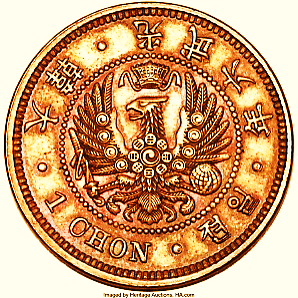
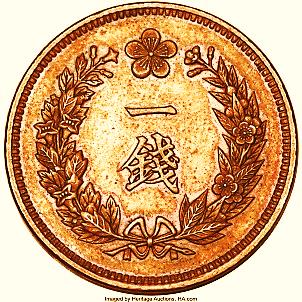
Fig. 1. The Korean Empire. 1 chon. Copper. Gwangmu, 6 years old (1902). “Eagle Series”.
© 2011 Heritage Auctions (photo)
2) Korea, 7th year of Gwangmu (1903), copper 10 won, “Russian domination”, not listed in Krause’s catalogue, sold for 103,500 dollars (Fig. 2).
3) Korea, 6th year of Gwangmu (1902), copper 20 won, “Russian domination”, sold for 115,000 dollars.
INTRODUCTION
What is the subject of Russian numismatics? It is quite difficult to answer this seemingly simple question. At first glance, the answer is obvious: these are the issues of coins that performed the functions of money, which were issued by coin lords – first by Russian monarchs, and after them by the RSFSR, the Soviet Union and the Russian Federation. But many exceptions immediately arise from this rule. Suffice it to recall that in 1997 – 2015, modern Russian metal money, although they were legal tender, issued by the Bank of Russia on its own behalf, and not on behalf of the state, they did not have the words “Russian Federation” on them and did not have the state emblem. At the same time, it should be noted that the Bank of Russia has been officially the central bank of the Russian Federation only since 2002 and, according to the law, “the state is not responsible for the obligations of the Bank of Russia, and the Bank of Russia is not responsible for the obligations of the state”.[144] Therefore, it is quite difficult to call these round metal objects “coins” in the literal sense of the word.
Russian numismatics include, for example, iron tokens of 1916, issued by the German military command in the western territories of Russia occupied during World War I; copper bonds of 1918, minted from the coils of the distillery during the Civil War by the Armavir branch of the State Bank; round silver ingots of the St. Petersburg Mint of the late XIX – early XX centuries with the image of the state eagle; etc.
Coins minted by our monarchs in foreign languages for Prussia, Finland, Poland, etc., when they were part of the Russian Empire, have an absolutely fair attitude to Russian numismatics. A. A. Ilyin was convinced that the coins of Red Russia, after its capture by the Polish king Casimir III in the XIV century, with legends in Latin MONETA RVSSIAE “cannot remain aloof from Russian numismatics, since they bear the name of Russia.”[145] Even the coins of the Georgian Tsar Erekle II of 1781 with Arabic inscriptions and the image of the Russian double-headed eagle, which he minted on coins without the permission of Empress Catherine II, in order to create the impression of the Persian Shah and the Turkish Sultan that Georgia was under the protection and patronage of Russia, belong to Russian numismatics.
The catalog of V. V. Bitkin[146] includes in Russian numismatics coins of Iranian cities of the XVIII century with the countermark of the Russian eagle, coins of the Bukhara Emirate dependent on Russia and the Khanate of Khiva without any countermarks, “siege” coins of the city of Zamość of 1813, minted by the Poles besieged by the Russian army – allies of Napoleon, coins of the Free City of Krakow, which was never part of Russia at all, but in 1835 minted a series of coins on the model of those which Russia issued for the part of Poland that belonged to it, and so on and so forth.
With such a variety of numismatic items, sometimes having an indirect or even dubious relationship to Russia, it seems rather strange that domestic catalogs pass over in complete silence the issue of coins of the Korean Empire (then still a unified state) of 1899 – 1903 with the image of the crowned heraldic Eagle on them “Russian Domination” in Korea and even the “Russian Occupation” of Korea. Usually in catalogs it is called “A series of coins with the image of an eagle” (cor. 독수리 문양 주화 시리즈), “Eagle Series” or “Eagle Coins”.
Does this issue belong to Russian numismatics? Let’s open the world’s largest catalog of Krause coins in the section “Korea. Russian Domination” and read the description:
“Korea in the days of Tsarist Russia experimented with its own coins; In this era, on March 1, 1898, the Russian Financial Consultant in Korea Alexeyev founded the First Asian Branch of the Russian-Korean Bank and authorized the issue of a set of new Korean coins with a crowned quasi-eagle in the Russian style (Sic!!– author). In 1904, the British-Japanese confrontation with Russia and the Russo-Japanese War put an end to the experiment with the minting of Russian coins.”[147] We will not touch on the reliability of this information yet, but if we take this description literally, the coins of the “Eagle” series may well be attributed to Russian numismatics.
The American auction house Heritage Auctions explains the emergence of a series of Korean coins with the “Russian Eagle” as follows: “The strengthening of Russian influence in Korea in 1896-1904 led to the fact that a fairly large number of coins of regular mintage of three types were issued. Few of them were put into circulation, and very few survived. This Russian threat was eliminated by the Russo-Japanese War of 1904-05, and Japan established a protectorate over Korea until the end of World War II. During the Russian rule, gold coins were not minted, and this specimen (10 won copper coin of 1903, Fig. 2 – author) is a test model of coins that were going to be minted from gold.”[148]
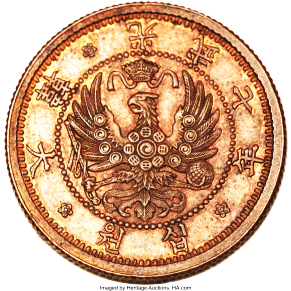
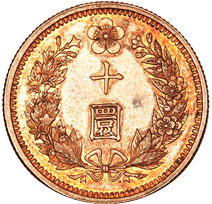
Fig. 2. The Korean Empire. Gwangmu. “Eagle Series”. Pattern 10 won 1903. Copper
© 2011 Heritage Auctions (photo)
Unfortunately, for Western researchers, any economic and political relations of Russia with other countries are considered only as “domination” and “occupation”, and the real occupation of Korea by Japan in 1904 is called “the elimination of the Russian threat”. In accordance with this trend, the international numismatic portal Numista calls the period of minting of the series of Korean coins “Eagle” the era of “Russian Occupation”, and the heraldic eagle depicted on them – “Crowned Russian imperial eagle”, [149]although we see that the Eagle on the coin is single-headed, not double-headed (Fig. 3).
Fig. 3. The Korean Empire. Gwangmu. “Eagle Series”. 1/2 won 1901. Silver
© 2010 Krause Publications (photo)
Some domestic numismatists go even further in their fantasies on this topic. I will quote a couple of them:
“Russia did not have the right to issue coins with its coat of arms for circulation on the territory of another independent state, but nevertheless considered it necessary to indicate its presence. Probably, this is why a “European” eagle with a local “Korean” flavor appeared on the obverse.[150] “It is not known where these coins were minted, but the surviving samples, with their characteristic minting technology, may indirectly point to the St. Petersburg Mint.”[151]
Let’s not ask ourselves how a “European” eagle with a “Korean flavor” can “indicate the presence” of the Russian Empire, and what kind of “characteristic minting technology” can “indirectly indicate” the St. Petersburg Mint, but let’s study the topic.
HISTORICAL ESSAY
The last quarter of the 19th century and the first decade of the 20th century in Korean history were a turbulent era. A small kingdom on the periphery of East Asia, which had lived from time immemorial according to medieval laws, was a vassal of the Chinese Empire, adhered to a policy of strict isolation from the outside world and did not know wars with external enemies for more than two hundred years. And suddenly it was plunged into a whirlpool of reforms, uprisings and wars, from a vassal of China, a small country turned into an independent empire for several years, and just as suddenly completely lost its independence, becoming a colony of Japan.
The system of Korea’s vassalage to China was called Sade, which is conventionally translated as “Service to the Great”.[152] Although vassal is not quite an accurate name. This relationship was rather reminiscent of the relationship between a patron and a client. The Chinese emperor confirmed the king proclaimed by the Koreans themselves on the throne, and the king had to regularly send envoys with symbolic tribute to the imperial court. The emperor responded by gifting ambassadors and allowing them to trade in China. China did not interfere in the internal affairs of Korea, but was forced to provide it with military assistance as its outpost in the northeast in the event of an attack by external enemies. This allowed the short-sighted Korean authorities to naively rely on their suzerain and not spend money on maintaining the army. Therefore, in the early 1890s, the army of 15 million Korea consisted of only 5000 soldiers[153].
In 1392, the Yi dynasty came to power in Korea. It decided to change the name of the country from Goryeo (hanja 高麗), from which the word “Korea” derives, to “Joseon” (hanja 朝鮮) – “Morning freshness”, known from ancient Chinese chronicles. The Chinese emperor approved a new name, which existed until 1897. Currently, Joseon is the self-designation of North Korea – the DPRK.
From time immemorial, China has been considered by Koreans to be the sacred center of civilization. Korea adopted from it the doctrine of the “Confucian world order” and the “Eastern Tao” (traditional Confucian ethics and political system). Every person claiming to be educated had to speak Chinese fluently, and exams for government positions were taken exclusively in the Chinese literary language. Despite the fact that in the 1440s, Joseon created its own Korean script, hangul, until the end of the XIX century, only Chinese characters – hanja were used in document circulation and in legends on coins. They also served to convey the actual Korean words.
In the 19th century, the economic and military expansion of the colonial powers put an end to the power of Korea’s suzerain, the Chinese Empire. China was defeated by Great Britain and France in the First (1839-1842) and Second Opium Wars (1853-1860), as a result of which it was forced to sign unequal treaties with the colonial powers[154], according to which it opened its ports to foreigners for trade, granted them the right of extraterritoriality. which provides for foreign residents to be subject to the laws of their own consular courts, rather than the Chinese legal system, and most-favored-nation status. Since the Chinese showed little interest in Western goods, and accepted only silver as payment for their tea and silk, Great Britain flooded China with thousands of tons of Bengal opium produced in the Indian colonies in order to achieve a positive trade balance with China. The government institutions of China were filled with foreign, mainly British “advisers” who managed concessions, customs duties and other state revenues and plundered the country as they wished.
In 1863, the 11-year-old King Gojong ascended the Korean throne[155] , whose name is associated with more than half a century of subsequent Korean history. The throne fell on him like snow on his head. He came from a side branch of the ruling Yi dynasty, and was not the eldest, but only the third son in the family. But he could not take the throne, because according to Korean law, the new king must be younger than the deceased, and he was older than him. The question of why the throne was taken not by his first son, but by the third, could only be answered by the Grand Queen Dowager Hyoyu, who chose the heir. For a country riddled with nepotism and corruption, this was quite commonplace. Gojong was a weak-willed person who easily fell under the influence of others. In his early years as regent for the minor Gojong, the kingdom was ruled by his father, Yi Ha-eung, better known by his title “Daewongun” (lit. “Head of the Great Court” – this term referred to any person who was not a king himself, but whose son took the throne)[156]. The catastrophic events that took place in China, including the First and Second Opium Wars, strengthened its determination to isolate Korea from the rest of the world. Daewongun’s foreign policy was quite simple, as Cumings describes it: “no treaties, no trade, no Catholics, no West, and no Japan.”[157]
In 1866, the Daewongun married Gojong to a girl from a noble but poor family, later known as the ” Queen Min “, thinking that the quiet village modest woman would not get involved in politics. But he miscalculated. After becoming Gojong’s wife, Queen Min turned into an energetic and domineering woman. In 1873, having united with the political enemies of Daewongun, she removed him from power and began to rule the country herself, becoming a “gray cardinal” under a weak-willed husband. Unlike the Daewongun, Queen Min did not refuse to cooperate with foreigners, but on the contrary, she concluded treaties with them, invited them to government positions, while pitting groups representing different countries against each other, thinking in this way to preserve the threatened independence of the country. She called this policy “to fight barbarians with the forces of other barbarians” (“barbarians” were considered all nations except Koreans and Chinese). The Queen’s political intrigues ended in tears. In her royal palace, she was brutally murdered by the Japanese.
Western countries twice – in 1866 by France and in 1871 by the United States – exerted armed pressure on Korea, trying to force it to abandon its isolationist policy. However, the Daewongun rejected their demands. To achieve their goals, the imperialists decided to use a new aggressor state located right here in the Asia-Pacific region. This was Japan, which after the coup d’etat in 1868 embarked on the path of reorganizing the economy, army and way of life along Western lines, calling the coup the “Meiji Restoration.”[158] Japan itself signed unequal treaties with imperialist powers in the 1850s, which hurt the pride of the Japanese elite and forced it to change power in the country. The new government sought to catch up with the advanced Western countries in terms of industrial and especially military development in order to annul these enslaving treaties and become a colonial power itself. The United States and Great Britain naively considered Japan an obedient tool in their hands, generously distributing loans and arming it against Russia, China and other countries that had their own interests in the Far East. Having accumulated enormous military-industrial potential, three-quarters of a century later the militaristic Japanese Empire would strike at its “patrons”, destroying the American fleet in Pearl Harbor and conquering the colonies of the “allies” in East Asia, to which they would respond with the barbaric nuclear bombing of Hiroshima and Nagasaki.
Japan has long hatched plans to turn Joseon into its colony on the continent. The debate on the conquest of Korea was held in the Japanese government from 1868 to 1873, and the arguments against the invasion were presented in October 1873 by one of the “three most prominent heroes of the restoration”, Okubo Toshimichi, who argued that action against Korea was premature, since Japan was in the stage of modernization and an invasion would cost it too much. The Japanese limited themselves to a military provocation (“Ganghwa Island incident” September 20, 1875). Without inventing anything new, they did everything according to the scheme of their predecessors, the French and Americans. They entered Korean territorial waters, knowing that Joseon’s artillery had been ordered to fire on any foreign warship. Obsolete Korean guns could not cause any harm to the Japanese. But the very fact of the shelling was interpreted as aggressive actions by Korea and gave a reason to start hostilities. After capturing several forts and the island of Ganghwa, the Japanese demanded that the Korean government, in addition to apologizing for the shelling of their ship, conclude a trade treaty between the two countries. On February 26, 1876, the Korean government decided to meet this demand in the hope of importing more modern weapons to protect the country from any future invasions. Obviously, there was no understanding of the inequalities inherent in the terms of the agreement. It was the first of many unequal treaties naively signed by Korea. According to it, Joseon was declared an “independent state”, opened three ports to Japan for trade – Busan, Incheon and Wonsan, and granted the right of extraterritoriality to those Japanese merchants and officials who came to live in the newly opened ports. It was the same system whereby foreign merchants suspected of committing a crime were to be tried in the open ports by their own countrymen according to the laws of their own country, effectively leaving them completely unpunished. The most famous economic disparity of the treaty was its tariff system, under which there was a complete moratorium on the imposition of duties on Japanese goods imported into Korea, while Korean goods exported to Japan were subject to a 5 percent duty. Joseon was forced to sign similar treaties in the 1880s with other foreign powers.
On July 23, 1882, the deposed Daewongun raised a military mutiny in Seoul, which had an anti-Japanese character and was directed against Queen Min (the “Imo Incident”). The rioters killed many government officials, destroyed the homes of dignitaries, and occupied one of the five royal palaces of Changdeokgung. They also attacked members of the Japanese diplomatic mission. The Japanese ambassador, Hanabusa Yoshimoto, barely managed to escape aboard a British warship. During the day, several Japanese were killed, including military adviser Horimoto Reizo. The next day, July 24, the rebels broke into the main royal palace of Gyeongbokgung, where they found and lynched the Minister of War, Min Gyeom-ho, as well as several other high-ranking officials, including Yi Choe-heung, the elder brother of the Daewongun, and attempted to assassinate Queen Min by reaching the royal chambers. However, the queen managed to escape, dressed as an ordinary court lady. She was carried on her back by a faithful servant who claimed to be her sister. Daewongun again came to power for 33 days, and the queen turned to China for military assistance.
About 4,500 Chinese soldiers under the command of General Wu Changqing arrived in Korea on warships and landed in Incheon. Chinese troops quickly crushed the uprising and were then stationed at various points throughout Seoul. After that, Daewongun was invited to the headquarters of the Chinese troops, where he was treacherously captured and secretly sent to China. He was taken to a city about 100 kilometers southwest of Beijing, where he was kept in a single room under strict supervision for three years. After this incident, China restored its suzerainty over Korea. King Gojong could no longer appoint diplomats and conclude international agreements without China’s approval. In October 1882, the two countries signed a treaty under which Korea was dependent on China and granted Chinese merchants the right to freely conduct land and sea trade within Korean borders, as well as granting China unilateral privileges of extraterritoriality in civil and criminal matters. Although the agreement allowed Koreans to trade on a reciprocal basis in Beijing, it was not an international treaty, but was actually issued as an instruction to a vassal.
In addition to the deployment of Chinese troops, in December 1882, two special advisers on foreign affairs representing Chinese interests were sent to Korea, one of whom was the German Paul Georg von Möllendorff, a man close to the “yellow Bismarck” – the head of the government of the Chinese Empire, Li Hongzhang[159]. Möllendorff was the first foreigner to serve the King of Joseon, he adopted the Sino-Korean name Mok Indeok (hanja 穆麟德, Chinese (Mandarin): Mù Líndé – “imperturbable German”) and liked Gojong so much that he entrusted him with a lot of the most responsible duties. Möllendorff organized and headed the Korean Maritime Customs Service, which accounted for approximately 15% of the total revenue of Joseon’s budget. As Deputy Minister of Foreign Affairs of Joseon, he was directly involved in the preparation and conclusion of international agreements, including the Seoul Treaty of Amity and Trade between Joseon and Russia on July 7, [160]1884, or in other words, the Gyeongsong Mint (Hangul 전원국),[161] which was supposed to reform the Korean monetary system and begin issuing modern coins made of precious metals.
The state of the Joseon monetary system at that time was deplorable. For centuries, there was no minted coin in Korea. Coins have been produced by casting since ancient times. The metal was melted and poured into molds. In an intermediate stage of manufacture, the blanks were attached to long casting rods. After being removed from these “trees”, they were finished by trimming the edges with a file and, in some cases, passing through a bath of water and sand for polishing. Therefore, the popular Korean name for them was yeopjeon, which means “leaf coin”. The official name of the monetary unit was mun. It was denoted by the Chinese character 文 and corresponded to the Chinese small coin “сash” (pinyin: wén). In 1633, King Injo introduced copper muns with the inscription on the obverse 常平通寶 (hanja “Sangpyeong Tongbo”) – Fig. 4. “Tongbo” 通寶 means “money” in Korean, and “Sangpyeong” 常平 – “always the same” – is the name of the state institution that was engaged in the storage of grain. Grain was stored in good harvest years to be distributed in lean years – thus creating “always the same” condition. Indeed, over the 250 years of its existence, the mun has always had approximately the same weight of 2.8–3.2 g and a diameter of 22–24 mm and was made of copper or an alloy containing copper: bronze or brass.
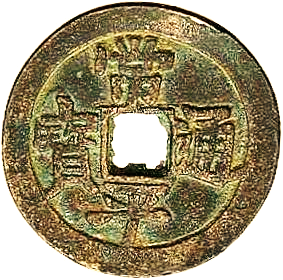
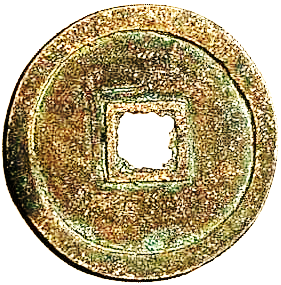
Fig. 4. Joseon. 1 mun 1633 Sangpyeong Tongbo. King Injo. Copper.
© Numista (photo)
From 1678, Sangpyeong Tongbo coins were issued regularly until 1892. On the first issues, the reverse was clean (Fig. 4), on all subsequent issues in different variations there was the designation of the mint, the number of the workshop, the counter for batches of products, the denomination and other symbols. Coins were issued from copper and bronze in denominations of 1, 3, 5 and, less frequently, 10 and 100 mun. Yeopjeons were not cast from precious metals. Coin production was carried out by 52 mints and smelters scattered throughout Korea. In addition to a large number of governmental, provincial, township, and military mints, many Sangpyeong Tongbo coins were privately cast. There are estimated to be more than 5,000 varieties of Sangpyeong Tongbo coins, many of which have yet to be published. Alan Craig reports that there were 3,137 different types of coins on display at the Bank of Korea[162]. Most privately cast coins have a rough appearance with fuzzy symbols and a blackish hue.
Obviously, such money, if suitable for domestic petty trade, was completely unsuitable for foreign trade operations. Foreign trading partners demanded that the Korean government pay for goods with full-fledged silver and gold coins.
An attempt to cast a new type of coins was made by the Joseon government in 1882-1883. Unlike copper yeopjeons, these coins were made of silver and no longer had a square hole in the center (Figs. 5, 6). There were no silver mines in Korea, and silver had to be imported for the production of coins.
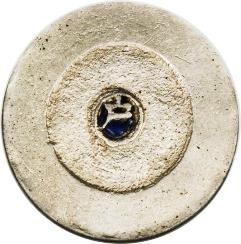
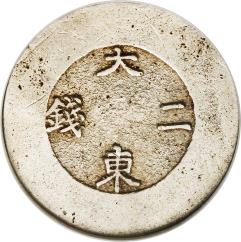
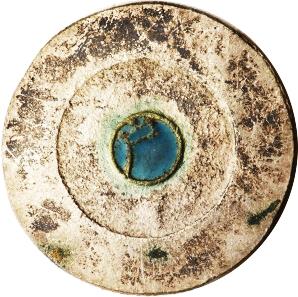
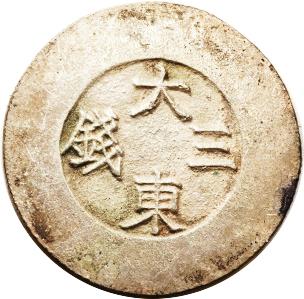
Fig. 5. Joseon. 2 chon 1882-1883 Fig. 6. Joseon. 3 chon 1882-1883
Silver, 7,1 г., ⌀ 28 mm Silver, 10,6 г., ⌀ 33 mm
© Numista (photo) © Numista (photo)
The monetary unit was chon (this word is translated as “small coin”). Coins were issued in denominations of 1 chon, 2 and 3 chon weighing 3.4, 7.1 and 10.6 g, respectively (Fig. 5, 6). The hieroglyph chon (戔 – “small”) was placed on the reverse to the left of the center of the coin, on the right horizontally the number “one” (一), “two” (二) or “three” (三) depending on the value of the coin), and at the bottom is “East” (東). It was read “Tae Dong” – “Great East” or “Great Eastern” – another of the many self-names of Korea. The coins themselves received the colloquial name Taedongchon – “chon of the Grand East”. On the obverse was placed the hieroglyph 戶 “Ho” – the sign of the Ministry of Finance. It was placed in a circle in the middle of the obverse and surrounded by colored enamel (blue, green or black).
Due to the rise in the price of silver, their real value quickly exceeded the nominal value. The coins simply disappeared from circulation, as the population preferred not to spend them, but to store them in order to sell them in the future, taking advantage of the rise in the price of the metal[163]. Therefore, in June 1883, the issue of these coins was stopped.
In the same year, the above-mentioned Central Mint (Gyeongseong Mint) was established in Seoul under the leadership of Möllendorff. This institution was removed from the control of the Ministry of Finance. It was under the jurisdiction of the royal court, and the income from the issue of money went not to the Ministry of Finance, but directly to the palace treasury. He controlled the issuance of yeopjeons, which continued to be cast throughout the country, which until 1892 officially remained the main currency of the country. The main obstacle to maintaining a gold or silver standard system was Korea’s severe shortage of precious metals. The minting and circulation of coins of the modern type began as a result of Möllendorff’s acquisition of coin-making machines in Germany in 1883[164]. However, the first Korean minted coins should not be considered coins of the modern type, but the 5-mun Sanpyeong Tongbo issued on these machines in 1884.
The Korean government was under severe fiscal pressure due to chronic financial difficulties and new fiscal expenditures, such as the cost of sending overseas missions, the cost of opening the port cities of Busan, Wonsan, and Incheon, and the construction of new military installations. In order to patch up the holes in the budget, in 1884 it began minting an inferior brass Sangpyeong Tongbo coin with a face value of 5 mun. These 5 mun had not a square, but a round hole in the center (Fig. 7). Despite the declared value being five times more expensive than an ordinary mun, this coin was only 2 times heavier than it (Figs. 7 and 8 show the comparative size of a new minted 5-mun coin and a full-fledged 5-mun cast yeopjeon). The population refused to accept it at a nominal price, and the low purchasing power of the new coin gave rise to a new round of inflation[165].
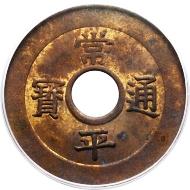
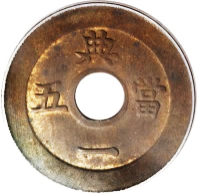
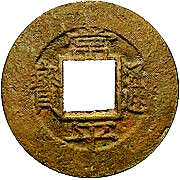
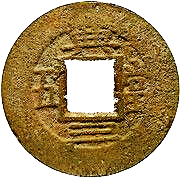
Fig. 7. Joseon. 5 mun 1884 minted by machine. Fig. 8. Joseon. 5 mun 1883 Yeopjeon.
Brass Bronze, 10.8 g, ⌀ 32 mm, thickness 2 mm
© 2011 Heritage Auctions (photo) © Numista (photo)
In 1881-1884, a group of young Korean officials, including the future leader of the “Kapsin Coup” Kim Okkyun, were officially sent to Japan under the guise of familiarizing themselves with the results of the Industrial Revolution, which this country achieved during the Meiji Restoration. In fact, they had to find out whether Japan was preparing an attack on Korea. There they saw that Japan, which the Korean government considered a barbarian nation, had made a huge leap forward in progress and had become a much stronger country than Joseon. After arriving in Tokyo, they met with various influential Japanese politicians. They convinced them that Japanese help would have to be used to modernize the Korean economy, and that the only way out of stagnation was to forcibly destroy the current Conservative Party at court. The Japanese statesman Inoue Kaoru promised Kim Okkyun 3,000,000 Japanese yen if Kim got the Korean Emperor Gojong to “carry out reforms.” In short, Kim and his comrades were simply recruited by the Japanese and, returning to their homeland, decided to make a revolution.
The outbreak of the Sino-French War in Annam in 1884 seemed to be a favorable moment for them, when China was forced to transfer troops from Korea to Annam, leaving only a garrison of 1500 soldiers under the command of General Yuan Shikai in Seoul. Enlisting the support of the Japanese mission, on December 4, 1884, the conspirators led by Kim Okkyun and the director of the General Postal Administration, Hong Yeong-sik, at a banquet held to mark the opening of the new national post office, King Gojong was captured and imprisoned by Japanese diplomatic guards in the small Gyoengu Palace. They then killed and wounded several high-ranking officials. After the coup, they formed a new government and adopted a 14-point program of radical reforms (Kapsin Coup[166]). Queen Min, faced with a threat to her power, secretly requested military intervention from the Chinese. Even before the reforms were made public, within three days the coup was crushed by Yuan Shikai’s Chinese troops, who attacked and routed the Japanese soldiers and restored power to the pro-Chinese party. In the ensuing battle, Hong Yong-sik was killed, the Japanese diplomatic building was burned down, and forty Japanese soldiers were killed. The surviving Korean coup leaders, including Kim Okkyun, fled to Japan.
After the suppression of the rebellion, King Gojong annulled the reforms proclaimed by the coup leaders. In January 1885, the Japanese sent two battalions and seven warships to Korea. Under pressure from the armed force, the Korean government signed a treaty with Japan on January 9, 1885 (the Hanson Treaty), which restored diplomatic relations between the two countries. China, weakened by the war with the French, also signed a peace treaty with the Japanese on May 31, 1885 (the Tientsin Convention), under which both sides undertook to withdraw expeditionary forces from Korea and not to bring them there without prior notice to the other side. The exceptions were the garrison of the Chinese resident general in Korea, Yuan Shikai, stationed in Seoul, and the Japanese soldiers guarding the diplomatic mission. King Gojong was advised to hire military instructors from a third country to create and train the Joseon army. Both sides had Great Britain in mind, but Gojong, fearing to fall under even greater oppression by the now arrogant British imperialists, turned his gaze to a non-aggressive Russia.
Diplomatic relations, extraterritoriality and consular jurisdiction for Russian subjects were established by the Seoul Treaty of 1884 between the Russian Empire and Joseon (the Russian mission in Seoul was opened in 1885). Since 1860, the countries had a common border along the Tumen River, but did not enter into direct relations, although Russia was eyeing Korea in order to organize an ice-free port for its navy on its territory. Möllendorff wanted to stabilize Korea, a traditional hotbed of disagreement between China and Japan, through closer ties with Russia as a “third power.” As early as 1884, with the consent and support of Gojon, he conducted secret negotiations with Russian representatives in Japan to conclude a secret agreement with Russia. This was Korea’s first attempt to conclude a secret Korean-Russian treaty. (In fact, Gojong had been nurturing this idea even before Möllendorff). Under this agreement, Joseon granted Russia the allotment of a coastal concession for the organization of an anchor, never completely ice-free anchorage for a large fleet in Yongheung Bay (Wonsan, Lazarev Port), and Russia undertook to create a professional army in Korea and sent instructor officers and non-commissioned officers to Joseon. The British government was alarmed by rumors of a secret agreement between Russia and Korea. On April 15, 1885, the British fleet unexpectedly attacked and occupied the Korean island of Geomundo. The island was seized in order to establish a British transshipment port in the Far East outside of China in the event of a war with Russia and to reduce the detrimental impact of China’s eventual neutrality. Russia has threatened to occupy part of Korea in response to the UK’s actions. After receiving assurances from the Russians that they would not occupy any part of Korea, the British evacuated.
Li Hongzhang was furious to learn of his protégé Möllendorff’s role in the story, and demanded his return to China. In order to conceal his participation in the failed enterprise and to prevent the intervention of the imperialist powers, Gojong dismissed Möllendorf from all his posts.
After the resignation of Möllendorff, the mints of Korea began to be gradually filled with Japanese employees. In November 1886, the Gyeongseong Mint was moved to a new building near the South Grand Gate of Seoul (Namidaemun). Möllendorff was no longer there, but three German technicians were still on the staff. Under far-fetched pretexts, these three were fired, and three Japanese from the mint in Osaka were hired to replace them. By the end of 1887, there were more than 20 Japanese in the state. As early as 1883, the Jeongwangkuk Mint was founded in Incheon, a port open to foreigners. In foreign trade operations, the expansion of the Japanese currency intensified. If at first, the Mexican dollar was accepted as a trade coin for paying customs duties in open ports, as everywhere in East Asia, then the Japanese yen gradually began to replace it.
Japan’s influence in the financial sphere was enormous. It is not surprising that the first trial and all subsequent Korean coins of Gojong simply copied the design and parameters of Japanese coins (an example in Figs. 9 and 10).
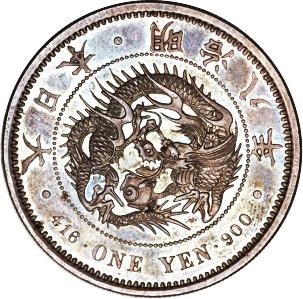
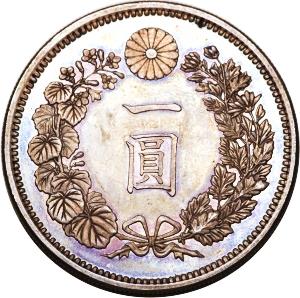
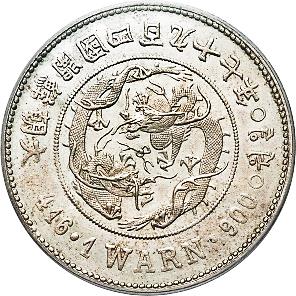
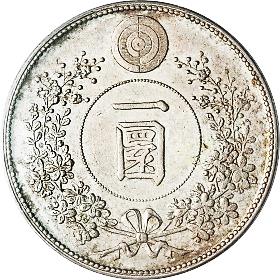
Fig. 9. Japan. 1 Yen 1876 Silver. 26.96 g Fig. 10. Joseon. 1 Warn 1888 Silver. 26.95 g
⌀ 38.6 mm, thickness 2.5 mm ⌀ 38 mm, thickness 2.5 mm
Medalists N. Kano, T. Masuda and H. Ishii © Heritage Auctions (photo)
© Heritage Auctions (photo)
On the obverse of Japanese coins (Fig. 8), in the center, in a circle of beads, a dragon was depicted as the emblem of the Emperor of Japan, with a circumferential inscription 年八治明 · 本日大 (The Eighth Year of Meiji (1876) “Great Japan”), bottom in English · 416 · ONE YEN · 900 · (weight 416 grains · ONE YEN · 900 fineness of silver). On the reverse, in the center vertically, the denomination: 一 (“one”) 圓 (“circle”), framed by a wreath of paulownia branches (heart-shaped leaves) and chrysanthemums (right), in the center at the top a chrysanthemum flower (imperial seal).
Until 1897, Korean coins were dated according to the “Keguk era” – the chronology starting from the year of the founding of Joseon (1392). The words 開國 “Ke Guk” are translated as “Foundation of the country”. On the obverse of the coins (Fig. 9), in the center, in a circle of beads, there are two “playing dragons”, the personal emblem of the king, at the top along the circle in hanja hieroglyphs there is the inscription 大朝鮮 開國四百九十五年 (“Great Joseon. Ke Guk 495” – 1886), at the bottom in English • 416 • 1 WARN • 900 ○ (weight 416 grains · 1 WARN · 900 fineness of silver), on the right on Hangul ○ 일원○ (“one round”). On the reverse, in the center, vertically, there is a denomination framed by a wreath: 一 (“one”) 圜 (“round”), in the center at the top is the sign Yin-Yang (in Korean, Um-Yang), otherwise called by the Koreans Daegeuk (“the origin of everything in the Universe”).
The hieroglyph 圓 or 圜 has the original meaning of “circle”, “round”. On coins, it denoted the main monetary unit of the state: in China the yuan, in Japan the yen, in Korea the won (in this case translated into English by the word warn).
In the process of monetary reforms of the 1880s and early 1900s, Korean monetary units and their names on coins were constantly changing. Especially in the transcription into English.
In 1885, a trial silver coin was issued in denomination of 1 yang (兩)[167], a multiple of ⅕ of the Japanese yen (5.2 g, pure silver content 4.16 g).).
In 1886 and 1888, an attempt was made to create a monetary system with the basic unit – the won. The won was then written in English as WARN, 圜. The warn was fully equivalent to the Japanese yen (416 grains or 26.95 g of 900 fineness silver) – Fig. 9 and 10. Warn was divided into 5 niang (26.95 g, 兩) and 1000 mun (文). A series of test coins was minted: gold 20 warn, 10 warn, 5 warn, 2 warn and 1 warn; silver 1 warn (Fig. 10), 5 niang, 2 niang, 1 niang and ½ niang; copper 20 mun, 10 mun, 2 mun and 1 mun. Of these coin denominations, only the 1 warn, 10 mun and 5 mun were put into circulation, and only after 1891. Since the new mint equipment was not very suitable for punching the central holes in the coins, the old-style mun design was eventually abandoned (Figs. 11, 12). Although mintage figures for the 5 and 10 mun were not published, the total value of the coins issued was about 2,800 warn. It is known that 1,300 silver warn were minted. The monetary system turned out to be rather cumbersome, the coins were poorly received by the population and were soon withdrawn from circulation.
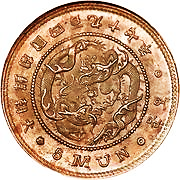
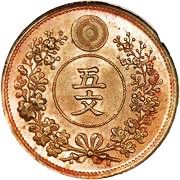
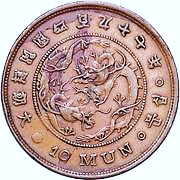
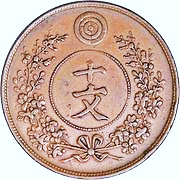
Fig. 11. Joseon. 5 mun 1888 Copper. 3.25 g, ⌀ 21.7 mm Fig. 12. Joseon. 10 mun 1888 Copper. 6.5 g, ⌀ 27.5 mm
© Heritage Auctions (photo) © Heritage Auctions (photo)
In 1892, King Gojong signed the “New Money Ordinance,” and the monetary system began to function according to the silver standard. At this time, An Kyung-so, the director of the Central Mint, traveled to Japan and received a loan on the condition that he receive ¼ of the profits from minting, and also attracted Japanese engineers to produce modern coins. The Japanese firm Osaka Copper Works, anticipating a profit from minting, proposed to the Korean government to transfer the Central Mint to the port city of Incheon. Incheon was chosen by the Japanese because it was easier to ship mint machines and coin mugs from Japan than to Seoul, the equipment for which was not available in Korea. The new mint in Incheon (仁川典局), fully staffed by Japanese specialists from the Copper Plant and the Japanese Mint in Osaka, began operations in November 1892. The main monetary unit was the yang (YANG, 兩), divided into 100 fun (written in English on coins as FUN, and on postage stamps as POON, the hanja character 分). 5 yang was equal to 1 won or whan (WHAN, 圜). The intermediate monetary unit was the jeon (JEON / CHON, 戔 – hieroglyph for “small”), equal to ⅟10 of the yang. The chon itself was never minted, but served as an auxiliary monetary unit when writing the denomination on the current coin of ¼ yang, equal to 25 fun – “2 jeon 5 fun” (Fig. 13).
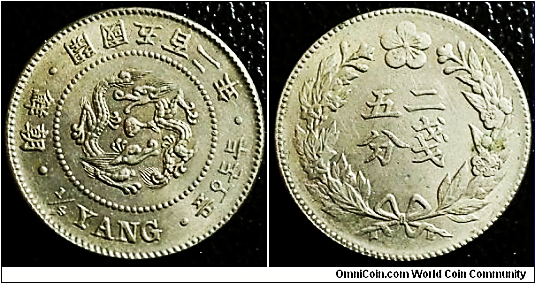
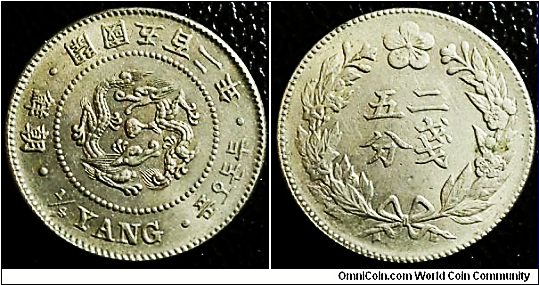
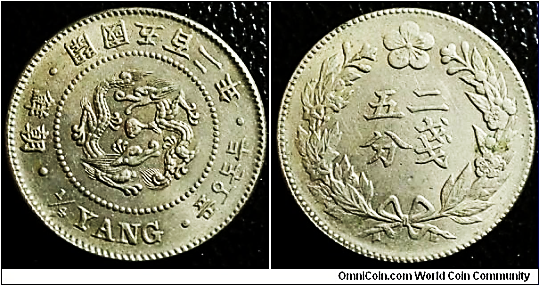
五 二
分 戔
5 2
FUN JEON
Fig. 13. ¼ yang, 1893
In 1901, Korea switched to the gold standard, and from 1902 the main monetary unit was the won (WON, 圜), which was divided into 100 chon (CHON, 錢 is another hieroglyph: “small coin” in contrast to the hieroglyph on previous coins 戔 “small”) and 1000 ree (REE / RI, 厘). The ree were not minted, but were used to denote the value of postage stamps. The chon was devalued against the won by half compared to the previous monetary system. According to the old system, 5 yang was equal to 1 whan (won), and 10 jeon (chon) were equal to 1 yang, therefore, 1 whan (won) was equal to 50 jeon (chon). Now the won included 100 chon. This was the last monetary system of independent Korea. In 1910, Japan annexed Korea and introduced the Japanese currency, the yen, on its territory.
Warn, Whan and Won, designated by the same hieroglyph 圜, are different transcriptions in English letters of the monetary unit that we call “won”. The coin nominally weighed 416 grains or 26.96 grams (24.26 grams of pure silver), which corresponded to 1.5 grams of gold. When the won was switched to the gold standard in 1902, the gold content of the won was reduced to 0.75 grams. But since 1907 it was reduced to 16.2 g in won (only ½ won coins weighing 10.13 g with a pure silver content of 8.1 g were issued from silver). Large 900 silver coins with a denomination of 1 won ceased to be issued after the introduction of the gold standard.
NIANG and YANG (hieroglyph 兩) denoted the same monetary unit, which we call “yang“. The coin was ⅕ won and weighed 5.2 grams. The pure silver content was 4.16 g.
The monetary systems of Korea looked like this:
1886-1891
1 yang (兩, NIANG) = ⅕ won (圜, WARN) = 200 mun (文, MUN).
1 won (圜, WARN) = 5 yang (兩, NIANG) = 1000 mun (文, MUN).
1892-1901
1 yang (兩, YANG) = ⅕ won (圜, WHAN) = 10 jeon (戔 – the character for “small”, JEON / CHON, not minted) = 100 fun (分, FUN / POON).
1 won (圜, WHAN) = 5 yang (兩, YANG) = 50 jeon (戔, JEON/CHON, not minted) = 500 fun (分, FUN/POON).
1902-1910
1 won (圜, WON) = 100 chon (錢 – the character for “small coin”, CHEUN / CHON) = 1000 ree (厘, REE / RI, not minted).
The silver standard existed in Korea from 1892 to 1901, and the first coins were supposed to enter circulation at the end of 1892.
The denominations of the coins and their composition were as follows: 1 fun (brass), 5 fun (copper), ¼ yang (originally a copper-nickel alloy, and later copper clad with silver), 1 yang (5.2 g, 80% silver) and 5 yang (90% silver). It was possible to produce in sufficient quantities, only 19,923 pieces were minted. The first coins were minted on December 4, 1892, but were not put into circulation until August 20, 1894. This was due to the fact that the name of the country appeared on the obverse of the coins as “Great Joseon” (大朝鮮), which outraged the Chinese Resident General in Seoul, Yuan Shikai. The word 大 – “Great” could only refer to the Chinese Empire, and Joseon, as its tributary, had no right to such an epithet. As a result, this word had to be removed from the coins of 1893 and 1894. Only after the Chinese entered the war with Japan and lost it, the mint again issued coins with “Great Joseon” (Fig. 14, 15). The sharp fall in nickel prices made it extremely profitable to mint copper-nickel ¼ yang coins. They were immediately counterfeited on an industrial scale in Japan and smuggled into Korea, which caused a wave of mistrust among the population towards the new coins.
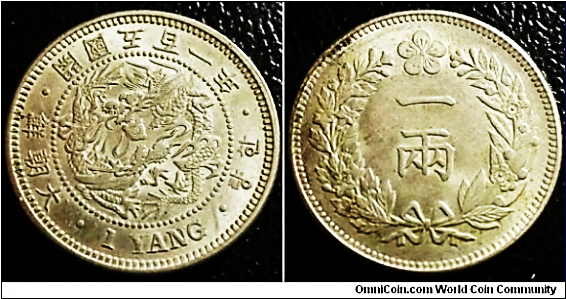
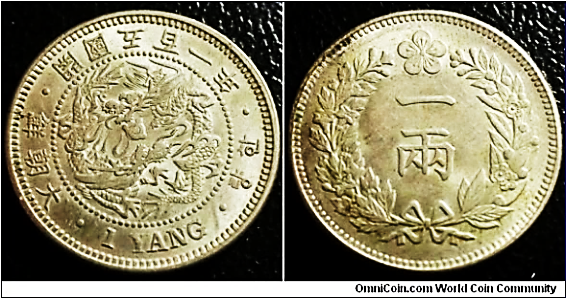
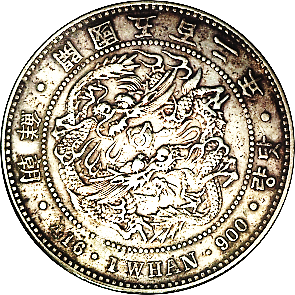
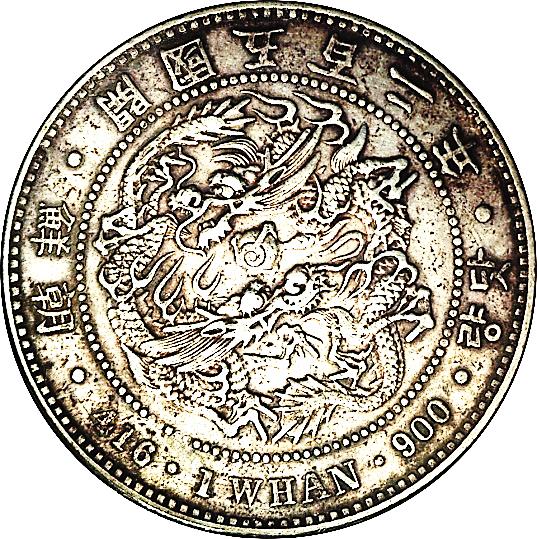
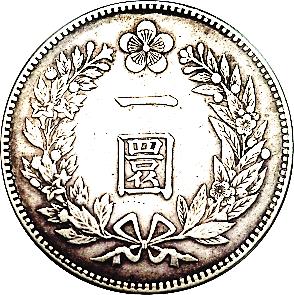
Fig. 14. 1 Yang. 1892. On the obverse Fig. 15. 1 Whan 1893. On the obverse on the left
left at 9 o’clock 鮮朝大 “Great Joseon” for 9 hours 鮮 朝 “Joseon” without the epithet “Great”
© Korean type set (photo) © Heritage Auctions (photo)
At this time, new cataclysms struck Korea.
After the conclusion of the Tianjin Convention of 1885, Japan built up its army and methodically modernized its military industry. Preparations for a major war with China were in full swing.
In 1893-1894, a peasant uprising led by the religious sect Donghak broke out in Joseon.
On March 28, 1894, on the territory of China in Shanghai, a Japanese agent, the leader of the “coup of the year Kapsin” Kim Okkyun was killed by four shots from a revolver (Fig. 16). His murderer, Hong Jong-u, was not punished, but was simply exiled by the Chinese authorities to his homeland in Korea, where King Gojong immediately appointed him to a government position. The body of Kim Okkyun, whom he killed, was also brought to Korea, over whom, as a traitor to the motherland, a posthumous trial was arranged. He was sentenced to be dismembered, the body of the traitor Kim, cut into eight pieces, was sent to each of the eight provinces of Joseon, and the head was placed on Mount Cheongyesan, towering over Seoul. In the context of international political tensions, this event had a great resonance. The Japanese call the assassination of Kim Okkyun one of the events that pushed Japan into the First Sino-Japanese War. As a pretext for war, it was, of course, difficult to use. But a pretext was soon found.
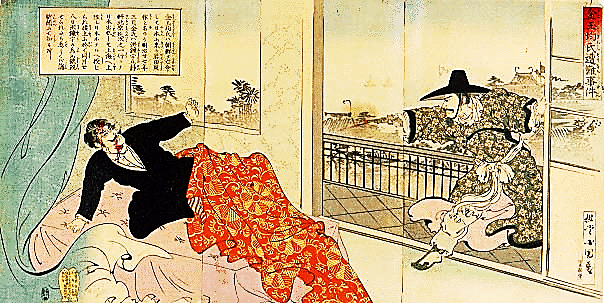
Fig. 16. Utagawa Kokunimasa. 1894. Assassination of Kim Okkyun
Nishiki-e Collection, Joseon Era, Vault of Tokyo University Keizai
In the spring of 1894, the Donghak rebellion in Korea reached unprecedented proportions. Government troops suffered defeat after defeat, and on June 1, the Korean government requested China’s help in suppressing the uprising. In accordance with the obligations of the Tianjin Convention, the Chinese government informed the Japanese of its military operation. Upon receiving the notification, the Government of Japan reacted immediately. The pre-prepared army landed on June 8 in the port of Incheon, which was closest to Seoul. On July 23, Japanese troops entered Seoul, stormed the royal palace of Gyeongbokgung, killing about 70 people, and made Gojong their hostage. The government, consisting of relatives of Queen Min, was disbanded, and a new pro-Japanese puppet government was formed, headed by Kim Hong-jip. The supreme power was accepted by Daewongun, who dreamed of cracking down on his political opponents. On July 25, under the dictation of his new masters, Daewongun notified the Chinese side of the severance of Korea’s “vassal relations” with China and “authorized” the Japanese army to expel the Chinese from Korea. The lack of professional experience among the Chinese military leaders and the poor training of the soldiers immediately led to a series of major defeats for the Chinese army. In the autumn of 1894, the Japanese drove it out of Korea, and the war moved to Chinese territory. The Japanese captured Taiwan and southern Manchuria, during the capture of Lüshun (Port Arthur) massacred the entire population of the city.
Realizing China’s complete inability to continue the war, Li Hongzhang was forced to sign the Shimonoseki Peace Treaty with Japan (March 30, 1895), according to which China ceded to Japan the island of Taiwan, the Penghu archipelago and the Liaodong Peninsula, paid a huge indemnity and forever renounced sovereignty over Korea.
Immediately after the Japanese occupation of Seoul, the puppet government of Kim Hong-jip launched a series of reforms based on an initial bill introduced by Japanese Ambassador Otori Keisuke (“Reforms of the Year of Kabo”). These reforms, which had the character of modernization, rebuilt the governing bodies and economy of Korea according to the Japanese model. First of all, the Central Mint and revenues from customs were withdrawn from the Department of the Royal Household. The minted coins of the 1892 model were finally put into circulation. The Japanese yen was allowed to circulate in Joseon. The palace guard, reorganized in 1894, remained under the control of American military instructors invited to Korea in 1888 to teach at a new military school, and two battalions of the Seoul garrison were placed under the command of Japanese officers at 6% for five years secured by income from Korean customs. In exchange for the loan, Japan received a number of concessions, in particular, for the construction of the Busan-Seoul railway, for the development of mines, etc. We must not forget that Japan itself was in credit slavery to financial tycoons from Great Britain and the United States, and robbing Korea was the most effective way for it to pay interest on loans. As the Russian envoy to Korea, Karl Ivanovich Weber, wrote: “The first article of the Sino-Japanese treaty again confirmed the independence of Korea; Meanwhile, it probably did not often experience such a vile yoke and such attempts on its own autocracy as in the second half of 1894 and in 1895. However, it is impossible not to do justice to the Japanese that they have indeed introduced some improvements in administration, established control over finances, reorganized the police, etc.; but their activities were too feverish, sometimes even naïve; moreover, the abrupt implementation of reforms only poorly disguised their efforts to strengthen their power and influence in the country in order to exploit it as thoroughly as possible in their own favor. Their despotism was not destined to last very long.”[168]
Alarmed by Japan’s invasion of the Asian mainland, the Russian Empire, with the support of France and Germany, demanded that Japan withdraw its troops from the Liaodong Peninsula. Otherwise, the three powers threatened to start military operations against it (“Tripartite Intervention”). Under pressure, Japan was forced to give up the Liaodong Peninsula and began withdrawing troops on May 5, 1895. The Russian Empire began to consider Lüshun (Port Arthur) and Dalian (Dalian) located on Liaodong as ice-free ports in the Pacific Ocean for the deployment of the navy. On June 3, 1896, Russia and China signed the Treaty of Aigun, which implied joint military action against Japan in the event of an attack on either side, as well as on Korea. In addition, Russia received a concession for the construction of the strategically important Chita-Vladivostok railway (Chinese Eastern Railway) through the territory of Manchuria belonging to China. In agreement with Li Hongzhang, in December 1897, Russian warships anchored in the roadstead in Port Arthur. And on March 27, 1898, Russia and China signed the Russian-Chinese Convention in Beijing, according to which Port Arthur and Dalny with adjacent territories were leased to Russia for a period of 25 years. The news that Russia had received the Liaodong Peninsula, which Japan had been forced to relinquish, led to an increase in the militarization of Japan, this time directed against Russia.
In Korea, Japan’s rejection of Liaodong was perceived as a sign of its weakness. Queen Min and her entourage now saw liberation from Japanese domination only in Russia. In June-July 1895, the most odious pro-Japanese ministers were expelled from the government, who were replaced by others who adhered to a pro-Russian orientation. However, the Russian government did not show political activity in the Korean question. doctors, engineers and other specialists. Even a personal letter from Gojong in June 1895 with a request to “restrain the enslaving force” of Japan and “support a weak Korea” was not [169]answered.
The Japanese government, feeling a threat to its influence in Korea, decided to take unprecedented measures. It organized the assassination of the head of the anti-Japanese party, Queen Min. The conspiracy was led by the new Japanese envoy to Korea, Lieutenant General Miura Goro. An accomplice was a hater of Queen Daewongun, who on August 16, 1895, personally signed an oath that he would contribute to her removal. On October 8, 1895, Japanese and Korean soldiers trained by them, led by Miura, dressed in civilian clothes, entered the Gyeongbokgung Palace and staged a real massacre there (Fig. 17). Since none of the attackers knew the queen by sight, they killed all the women by throwing them down the stairs and throwing them out of the windows, and then kicking them to death. The queen was found in the chambers, knocked to the floor, the murderer thrust a sword into her chest three times and cut off her head. After that, the queen’s body was dragged out into the courtyard, poured with oil and burned.
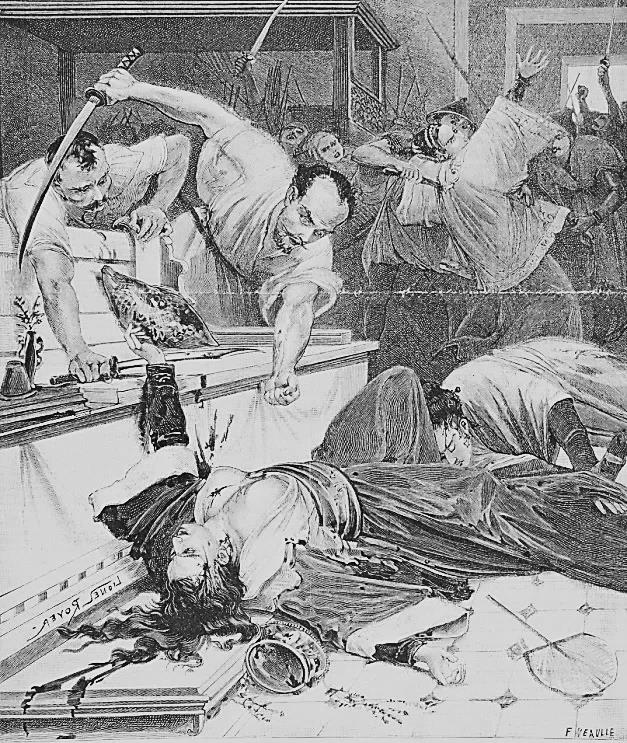
Fig. 17. Assassins’ attack on the Queen of Korea.
Illustration from the weekly Le Journal illustré (France), October 27, 1895.
The intimidated Gojong again became a hostage in his palace, fearing that he could be killed at any moment as his wife. The newly formed puppet government of Kim Hong-jip, at the behest of the Japanese, began to carry out another round of reforms, which were openly mocking the people of Korea and their culture. which was called santo (hangul 상투). The hair collected in this way was supported on the head by a traditional mangyeong headband (hangul 망건). A haircut was regarded as sacrilege, a violation of filial piety, since hair was considered a “gift from parents”. The new decree banned the wearing of beards, santios and mangyongs, as well as smoking pipes. Moreover, it was carried out in the most offensive way: soldiers grabbed men right on the street and forcibly cut their hair. The murder of the “mother of the country” – Queen Min and new odious decrees overflowed the cup of patience of the Koreans. Uprisings broke out throughout the country. The Japanese were killed, the pro-Japanese government lost control over entire provinces, taxes did not go to the treasury.
On February 11, 1896, having secretly corresponded with the Consul General of Russia K. I. Weber, Gojong with his favorite Princess Om and Crown Prince Sunjong in two women’s palanquins (the female ones were not inspected by the Japanese), escaped from the Gyeongbokgung Palace and took refuge in the building of the Russian mission, which was guarded by 160 Russian guardsmen of the naval crew from the cruiser Admiral Nakhimov. The situation in the country immediately changed. Gojong dissolved the government and sentenced Kim Hong-jip and other pro-Japanese ministers to death. The body of the executed Kim Hong-jip was chopped up and sent in parts to each of the 8 provinces of Joseon. The decrees of the pro-Japanese government, including those on hairstyles, were canceled.
Gojong lived in the Russian mission for more than a year. The new government he formed was also located there. It was impossible to call it completely pro-Russian. Groups of corrupt officials took the side of the power that paid more. Nevertheless, on the whole, it was anti-Japanese, and Gojong expected some more decisive measures from Russia to ensure his personal safety and restore the country’s economic development. However, Russia did not take any measures in this regard. In order to contact the Russian government, Gojong sent Minister Plenipotentiary Min Young-hwan to Moscow for the coronation of Nicholas II. On May 22, 1896, Min received an audience with the Russian Emperor, then visited St. Petersburg. There he met with the Minister of Foreign Affairs, Prince Lobanov-Rostovsky, and conveyed to him five requests of the Korean government: to send a reliable guard to protect the king until the Korean army was reformed; military instructors; councillors: one for the royal court to be close to the king; one for ministries; for the management of mines, railways, etc.; to lay telegraph lines between Russia and Korea on terms favorable to both sides; to provide a loan of 3 million yen to repay Japan’s debt. Lobanov replied that it would be impossible to ensure the protection of the Korean king because of predictable conflicts with the British or Germans, but agreed to send a financial agent to pay off the debt, establish telegraph lines and send military instructors. Despite the fact that Russia showed a half-hearted response to Korea, Min brought 13 Russian military instructors to Korea.
Exceptionally favorable circumstances for Russia, when it could completely take control of the situation in Korea, were not used by the Russian government. Russia, adhering to the principle of “non-interference in the internal affairs of Korea”, did not derive any benefits for itself from this. It was unable to obtain important concessions for the construction of railways, the laying of telegraph lines and the development of deposits. Their receipt was constantly blocked by supporters of the Americans in the government, and the Russian plenipotentiary representative in Korea, K. I. Weber, despite his proximity to Gojong, did not have the necessary abilities to overcome their resistance. Revenues from customs duties and duties since 1893 were in the hands of the British financier General Commissioner of Customs, John McLeavy Brown. And since customs represented the most significant source of income for the Korean treasury, Brown was the de facto financial adviser to the Korean court, having the right of personal access to the king.
Kojong’s flight to the Russian mission seriously worried not only the Japanese, but also their British-American curators. “Heavy artillery” was sent directly from the United States to Korea – foreign agents Seo Jae-pil and Yun Chi-ho. The first of them, Seo Jae-pil, was trained in Japan in his youth, then he was the youngest of the participants in the “Kapsin coup”. After its suppression, he fled to Japan, from there he moved to the United States, where he continued his studies, married the niece of US President James Buchanan, received American citizenship and even changed his name to European Philip Jaisohn. Despite the fact that Gojong declared an amnesty for the participants in the coup d’état, Seo was not going to return to his homeland. However, the owners had other plans for him, and he had to part with a carefree life in America. Together with a lesser American agent, Yun Chi-ho, in April 1896, they began to publish the newspaper “Dongnip Sinmun” in Seoul (the second name in English is Independent), where they published anti-Russian and anti-government articles that in every possible way discredited the king’s stay in the Russian mission. The most cynical thing was that they organized the financing of this anti-government newspaper at the expense of the government itself. Then, without any hesitation, this newspaper was headed by the US envoy to Korea, Horace Newton Allen. In July 1896, Seo Jae-pil created the so-called “Independence Club”, which was supposed to raise funds for the construction of the Arch of Independence, but in fact, thanks to the clever demagogy of its creators, it turned into a broad anti-Russian and anti-government movement, which was called the “Independence Society”.
Pushed by its Anglo-American masters and regarding Russia’s indecisive position on the Korean issue as weakness, the Society organized a series of large-scale anti-Russian pickets and rallies in Seoul, demanding that Gojong leave the Russian mission. On February 20, 1897, under external pressure, Gojong moved to the palace, but not back to Gyeongbokgung, but to present-day Deoksugung, which was smaller but within walking distance of the Russian mission.
Realizing that in the new conditions it was possible to completely lose its positions in Korea, the government of the Russian Empire decided to change its passivity to more active actions. Evidence of this departure from the previous policy of non-interference in the affairs of Korea was the appointment of Alexei Nikolaevich Speyer to the post of Russian envoy to Korea on September 7, 1897 instead of Weber. From the moment he arrived in Seoul, Speyer made it clear that he had been sent to give a new impetus to Russian policy toward Korea. Together with him, a new batch of Russian military instructors arrived in Seoul.
In order to rid Korea of credit slavery to Japan, it was decided to grant Gojong’s request and provide him with a loan of 3 million yen to pay off Japan’s debt. To service the loan, it was necessary to create a credit institution in Seoul, which was supposed to be called the Russian-Korean Bank. But to be sure that the Korean government would be able to make payments on the loan, it was necessary to send a financial adviser to the court of Gojong. But not a simple adviser, but one who could snatch from the hands of the Briton McLevy Brown the main source of income for the treasury – maritime customs.
On May 21, 1897, the Minister of Finance of Russia, Sergei Yulievich Witte, gave his consent to the appointment of a Russian financial adviser to the Korean court. His candidacy for this post was Kir Alekseyevich Alexeyev, the head of the office of the Department of Customs Duties of the Ministry of Finance, whose task, thus, was the careful but steady transfer of the Korean customs administration into the hands of Russia. As Ven. Nicholas of Japan wrote about Alexeyev: “He is a positive phenomenon: he can say by heart the entire financial list for the year, he can dictate papers to three scribes at once, while talking to a stranger, he can play on two chessboards by heart, without confusing the moves at all. At the same time, he is a very sympathetic person, fascinating in conversation, speaking like a book, frank.”[170] In order not to arouse suspicion among the British and Americans about the true purpose of Alexeyev’s arrival in Seoul, he was sent there as an agent of the Russian Ministry of Finance[171], which the ministry often sent to other countries.
October 5, 1897[172] Alexeyev, together with his secretary Garfield, came to Seoul and was immediately received by the king, with whom he had a secret conversation. However, his inauguration was postponed, as Gojong decided to assume the title of emperor and make profound and rather significant changes in the international status of Korea.
On October 12, 1897, Gojong was solemnly crowned with the imperial crown. At the same time, Gojong himself took a new “imperial” name Gwangmu (hanja 光武, lit. “shining and martial”). Korea from Joseon was renamed Dae Han (hanja 大韓), that is, “Great Han”. into which the Korean Peninsula was divided, the supposed ancestors of the Koreans. Interestingly, in the modern era, when Korea is divided into North and South, North Korea has the self-name Joseon, and South Korea is called Dae Han. That is, North Korea considers itself the heir of traditional Korean culture, before its Europeanization, and South Korea is the successor of a state with a higher status, that is, a sovereign empire.
Since Gojong had now become an emperor, and in the East the “emperor” was not just the head of state, it was a sacred figure reflecting the new heavenly world order, a new chronology was introduced. Instead of the “Keguk era” – the chronology, which began with the year of the founding of Joseon (1392), the ” Gwangmu era” was introduced, beginning in the first year of Gojong’s reign as emperor. Thus, the year 1897, or the 506th year of Keguk, was declared the 1st year of Gwangmu.
The design of Korean coins has generally remained the same. The changes affected only the legend on the obverse. They reflect the change of the name of the country and the change of dating (Figures 17A are the old legend and 17B are the new legend).
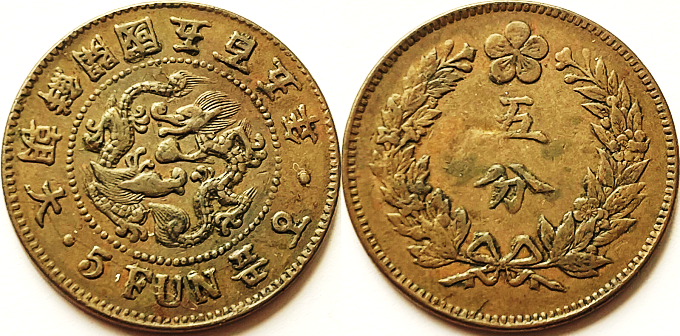
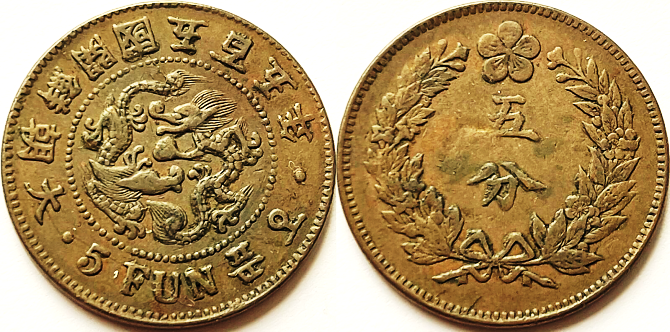
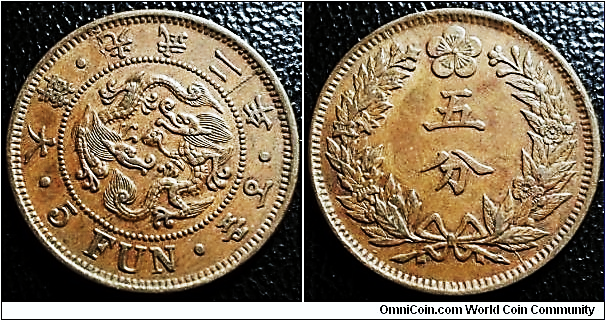
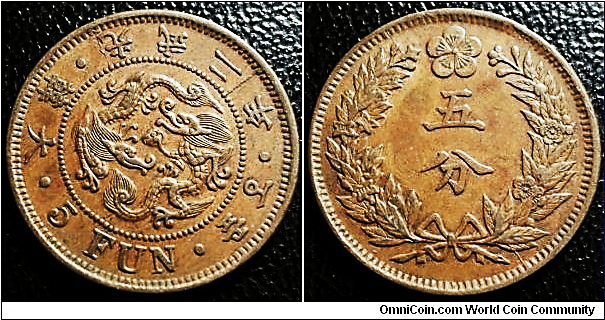
Fig. 17A. 5 Fun 1896 Fig. 17B. 5 Fun 1898
On the obverse at the top: • 大朝鮮 開國五百五年 • Top obverse: • 大韓 • 光武二年 •
Translation: Great Joseon. Ke Guk 505 Translation: The Great Han. Gwangmu 2 Year
After the celebrations on the occasion of his new status, Gojong received Alekseyev in private several times. The emperor liked him for his refined manners, erudition and business qualities. Alexeyev, having familiarized himself by that time with the accounting records of MacLeavy Brown, found out that he uncontrollably used the interest due to the treasury on the current account of state revenues, and, writing out money for the payment of Korean debts, speculated in millions of sums, sometimes for several months. For example, in 1896, having written out 1 million yen to pay off part of Japan’s debt on the 3 million loan of 1895, he uncontrollably disposed of this million for 4 months. Upon learning of this, Gojong was furious and demanded the immediate dismissal of McLevy Brown and the appointment of Alexeyev in his place.
But firing Brown turned out to be a matter of incredible difficulty. In the British Mission, Kojong’s order provoked an immediate response. The British consul general in Seoul, John Jordan, attacked Kojong with intimidation, hinting at the use of naval artillery by the British against Korea in the event of Brown’s dismissal. At the same time, the pro-British Minister of Foreign Affairs of Korea, Min Chun Mook, found all sorts of tricks to prevent the termination of the contract with McLeavy Brown. Only after the Russian envoy A. N. Speyer persuaded Gojong to dismiss Min Chun Muk and appoint a pro-Russian minister, Cho Byung-sik, in his place, the latter signed an agreement with Alexeyev on November 5, 1897 appointing him chief adviser to the Ministry of Finance and Commissar General of the Customs Department.
Despite the fact that China lost the war with Japan and was forced to give up suzerainty over Korea, the Korean customs department for some reason remained subordinate to the General Commissioner of Chinese Customs, Robert Hart, a compatriot of McLeavy Brown. Hart ordered Brown to completely ignore Alexeyev’s appointment and refuse to hand over cases to him. At the same time, Jordan overpowered Kojon with threats on behalf of the British government. In this situation, Speyer compromised. Brown remained in the customs department, but under Alexeev, while resigning as an adviser to the Ministry of Finance. On December 14, 1897, Brown signed a memorandum on his subordination to Alexeev and the withdrawal of Korean customs from the jurisdiction of Robert Hart. Thus, the budget of the Korean Ministry of Finance passed into the hands of Alexeyev. This was not the entire budget of Korea. As I have already said, a significant part of the income was withdrawn from the jurisdiction of the Ministry of Finance and was in the hands of the Ministry of the Court, which was headed by Lee Young-ik at that time, but we will talk about it later.
British banking houses were by no means going to let even such a small thing as the Korean budget and customs out of their hands. The news of the creation of the Russian-Korean Bank added fuel to the fire. S. Yu. Witte hesitated for a long time whether it should be established. Having worked all his life as a railway manager and rising to the position of Minister of Railways, he got to the influential post of Minister of Finance only thanks to the clever intrigues of international financiers, in whose circles his wife Mathilde moved. There he was in the wrong place. For example, when Witte carried out the monetary reform of 1897 in Russia on the advice of the American banker John Pierpont Morgan to establish a gold standard, Witte devalued the Russian ruble by a third and increased the public debt by 53%. At heart, Sergei Yulievich remained a railway worker. It was not for nothing that he took such patronage of the Chinese-Eastern Railway (CER), for the lending and servicing of which the Russian-Chinese Bank was created in 1895. In the spring of 1897, Witte decided to try to obtain further railway concessions from China. In May of the same year, bypassing official diplomatic channels and the Minister of Foreign Affairs, he sent the chairman of the board of the Russian-Chinese Bank, Prince Esper Ukhtomsky, to Beijing. Witte instructed Ukhtomsky to “probe” Li Hongzhang for the construction and acquisition of rights to a railway line running from the Chinese Eastern Railway to the south to the Yellow Sea. Ukhtomsky’s private visit caused such irritation in the “Yellow Bismarck” Li Hongzhang that he categorically refused to consider the possibility of any new concessions. The failure of Ukhtomsky’s mission in China led Comrade (as the post of Deputy Minister of Finance Peter Mikhailovich Romanov was called) to the idea of the possibility of building a railway line to the Yellow Sea through Korea. In a letter to Witte, he explained his position as follows:
«… at present, the Chinese would hardly allow us to reach one of the ports of the Liaodong Peninsula by rail, as they understand that this would completely put Beijing at our mercy; on the other hand, they would not object much to the construction of a railway from Bodong through Kirin to one of the ports of the Liaodong Peninsula. Or other Korean ports, as this would protect them from any takeover of Korea by the Japanese. In order for us to get such permission from Korea, we first need to ensure influence over its financial affairs, so we do not need to avoid financial sacrifices, because our investment will be returned a hundredfold in the near future.”[173]
Romanov’s arguments were quite convincing, since on October 28, 1897, Witte finally approved the creation of the Russo-Korean Bank. From the above words of Romanov, it is clear that such an institution should be considered as another flexible instrument created by Witte under his new program of Far Eastern expansion. On December 5, 1897, according to the report of the Minister of Finance Witte, Emperor Nicholas II approved the Charter of the Joint-Stock Company under the name “Russo-Korean Bank” (in Latin the name was written Russo-Korean Bank, not Russian-Korean Bank). The founders of the Russo-Korean Bank were: the above-mentioned Prince Esper Esperovich Ukhtomsky; Member of the Board of Directors of JSC Saint Petersburg International Commercial Bank Fyodor Karlovich Nothaft; Chairman of the Board of JSC “Vladikavkaz Railway” and Vice-Chairman of JSC CER Stanislav Ippolitovich Kerbedz; Member of the Board of Directors of the Russian-Chinese Bank Alexander Frantsovich Kokh; Interestingly[174], the board of directors of the newly created bank was almost identical to the board of directors of the Russian-Chinese Bank, established in December 1895. The authorized capital of the Russo-Korean Bank was 500 thousand rubles. The main office was located in St. Petersburg. in Seoul, where S. B. Gabriel and V. M. Koreilin were appointed co-managers.
When discussing in the Ministry of Finance of Russia the question of the main goals of the creation of the Russo-Korean Bank, one of its founders, A.Y. Rotstein, considering it unprofitable for the Russian-Chinese Bank to take any serious part in the political combinations of the Russian government in Korea, believed that it was the Russo-Korean Bank, and not a branch of the Russian-Chinese Bank, that should have served as an instrument for transferring a loan to the Korean government from the funds of the Chinese Eastern Railway, i.e., in fact from the sums of the state treasury[175]Alexeyev’s unexpectedly rapid success, what seemed to be achievable at the cost of long, cautious efforts without any particular hope of success, was accomplished in the shortest possible time and as if by itself: Russia became formally the master of Korean finances, and it had only to develop its success unceasingly. which kept their branches in two main (open) ports – Busan and Incheon[176].
As of the end of 1897, there was only one properly Korean bank in Korea, the [177] Hanseong Eun-heng, which had been founded a few months earlier, on February 19, 1897. The bank was successful because, despite lending money at twice the rate at which it borrowed it, the bank’s interest rates were much lower than those of Japanese and English banks. According to anecdotal history, the first property that the bank used as collateral for the loan was a donkey. The bank’s employees were faced with the task of feeding and taking care of their collateral, since the loan had expired. It was impossible to rely on the reliability of such a bank, since its predecessor, the Joseon Eun-heng, established in 1896, had already collapsed by that time.
The other three banks with branches in Korea belonged to the states hostile to Russia – Japan and Great Britain. In Korea, there was a branch of the largest British bank in East Asia, The Hongkong and Shanghai Banking Corporation, and branches of two Japanese banks: Daiichi Ginko, Japan’s first joint-stock bank, in Incheon and Busan, and Yuhachi Ginko in Incheon. But all these branches were located in peripheral cities. The rumor that the Russians were allowed to open their own bank in the capital of Korea, Seoul, excited foreign bankers and consolidated them in the fight against Russia.
The dominant bank in the Korean economy was Japan’s Daiichi Ginko. When Japan switched to the gold standard in 1897, it retired its 1 yen silver coins. Since they were used for international trade in Korea, there was some confusion among the Japanese, who were actively establishing commercial affairs there. Daiichi Ginko Bank presented the arguments of entrepreneurs to the Ministry of Finance of Japan. As a result, some withdrawn coins were reminted (to prevent re-exchange for gold at the Japanese Mint) and allowed to circulate in Korea and other Asian regions where Japan had interests. In this way, Japan has been able to expand its presence in Asian markets at a fraction of the cost. Having become the chief adviser to the Ministry of Finance of Korea, Alexeyev resolutely opposed the circulation of reminted Japanese yen in Korea. The Japanese ambassador in St. Petersburg immediately protested against the appointment of Alexyeev to the post of chief financial adviser, motivating this by the violation of treaties between Japan and Russia regarding non-interference in the internal affairs of Korea.
On March 1, 1898, the branch of the Russian-Korean Bank in Seoul was opened. Japanese, British and American diplomats sent a joint note of protest to the Russian envoy in Korea, Speyer, against the opening of the branch. But this was just a non-binding formality. The main blow against Russia was prepared by its enemies through the notorious “Independence Society”. to publish provocative “open letters” to the government, clearly misleading readers and sowing panic among ordinary people. From the very first lines, these “letters” contained deliberately false information. “The public,” the newspaper wrote, “was informed that the Finance Department had withdrawn government money deposits from two local Korean banks and deposited them in the Russo-Korean Bank.” [178]Although we saw that there was only one local bank in Korea, and all that could be extracted from it was a donkey that had not been redeemed from the pledge. that your department has transferred a large sum of money from the treasury vault to the vault of the Russian Bank. In addition, the said bank was authorized to collect and pay all government revenues for the Finance Department. This is a matter for people, and they need to know the facts of the case. If these rumors are true, we must assume that the Russo-Korean Bank is in fact our treasury, and your department will be only a nominal head. We hope this is not true, but after hearing such rumours, we, in the sense of our moral obligations which we have to the Government, are deeply interested and anxious to know the exact relations and privileges which the said bank has received from the Government[179].” In addition to this, a petition was drawn up in the British Mission on behalf of the Society on February 20, 1898, which stated that “the transfer of the financial and military departments of the empire to foreigners and the actual granting of supreme leadership of the empire’s domestic and foreign policy to one foreign power is not in accordance with the principle of Korean independence.”[180]
Against the backdrop of hysteria whipped up in the press, from February 21, 1898, activists of the Society organized numerous rallies in Seoul, at which crowds of ordinary people were told that predatory Russia was trying to “take possession of the money of Koreans, turn them into slaves and send them to the construction of the Trans-Siberian Railway.”[181] Korean officials collaborating with Russia were accused of selling their homeland and openly demanded their deaths. On February 22, 1898, assassins attacked the head of the pro-Russian party, the interpreter of the Russian mission, Kim Hong Nyuk, and only thanks to the intervention of Chinese workers from the British mission, he miraculously survived. After Speyer demanded that Gojon come to the Russian mission and apologize for this incident, the leaders of the Society stirred up a wave of nationalist rallies and outrages. Bribed by the British, officials of the Korean Ministry of Foreign Affairs went to an unprecedented action: they went on strike, refusing to obey the “Russian puppet” Min Chun Muk. The culmination of the events was a truly unprecedented mass anti-Russian political demonstration organized by the Society on March 10, 1898 in front of the Gojong Palace, to which a crowd of about 10 thousand people was herded.
All this coincided with an unexpected U-turn in the Far Eastern policy of the Russian government. Russian Foreign Minister Mikhail Nikolayevich Muravyov managed to do what Witte failed to do – to persuade Li Hongzhang to lease to Russia – not only the land allocation for the railway in Chinese Manchuria, but also part of the Liaodong Peninsula with the cities of Lüshun (Port Arthur) and Dalian (Dalniy). On December 15, 1897, the Russian naval squadron set out on a roadstead in Port Arthur. Russia was acquiring the long-awaited ice-free port for the Pacific Fleet. Since Liaodong was occupied by Japan during the Sino-Japanese War, and only the “triple intervention” of Russia, France and Germany forced it to withdraw its troops from there in 1895, the threat of war with Japan, from which Korea was now also taken away, became real. Great Britain could be drawn into this war on the side of Japan, whose interests in Korea were also violated. Considering that Russia was not ready to wage war at this stage, and that the acquisition of Port Arthur was more important for it than economic expansion in Korea, the Russian government decided not to escalate the confrontation and make concessions to hostile countries on the Korean issue, withdrawing military instructors and a financial adviser from Seoul.
On March 7, 1898, Speyer addressed an official letter to Gojong, in which the question was raised whether the emperor considered it expedient to continue in their posts as a Russian financial adviser and military instructors. On March 12, the Korean government sent Speyer a formal reply that it accepted his proposal to recall the Russian military instructors and K. A. Alexeyev.
Alexeev settled accounts with the Korean government on March 20, handing it 1,278,122 yen against receipt (at the time of his assumption of office, the total amount of funds left in the treasury by McLevy Brown was about 23 thousand yen). Here I would like to note that some researchers, publishing works concerning the income and expenditure part of the customs budget of Korea in the 1890s, make the same mistake. which is called “won“. As I have already pointed out, the currency of Korea at that time was not the won, but the silver yang (兩, YANG). Until October 1, 1897, the yang was pegged to the Japanese yen at the rate of 5 yen = 1 yen. After Japan’s transition to the gold standard on October 1, 1897, the yen was devalued by half, and the exchange rate of the silver yen against the Japanese yen became dependent on the difference in the price of gold and silver. Western financiers often used the word DOLLAR in relation to the currency in which the budget of the Korean customs was calculated. Some researchers mistranslate this word as “won“, but in fact in this case it means the Japanese yen.
Since the tasks for which the Russo-Korean Bank was created disappeared by themselves, on April 8, 1898, the branch of this bank in Seoul was closed, and by the end of the month its employees vacated the rented building. In my work, I gave an exhaustive list of operations for which this bank was created. It was not engaged in the issue of paper or metal money, although according to the charter it had the right to do so with the permission of the Korean[182] government. The statements found in the works of some authors that the Russo-Korean Bank minted Korean coins with the Eagle are nothing more than the fruit of the authors’ imagination.
The head of the Independence Society, Seo Jae-pil, returned to the United States in April 1898. The hosts considered that he had completed his task. The “society” was headed by his younger comrade Yun Chi-ho, who continued to play the revolution. The “society” began to demand the introduction of a representative body of power, organized rallies and riots on the streets of Seoul, which by the end of 1898 grew into real armed clashes with government forces. But when the Society began to demand the termination of all contracts and concessions with foreigners, hurting the interests of their Anglo-American-Japanese patrons, they themselves became alarmed and gave the Society to Gojong to be torn to pieces. The “society” was dispersed, the leaders were executed and thrown into prison, the most successful of them fled abroad. The mouthpiece of the opposition, the Society’s newspaper, the Tongnip Sinmun (Independent), was cynically sold by the U.S. envoy, Horace Newton Allen, to the Korean government, and it was instantly shut down.
K. A. Alexeyev was sent as an agent of the Russian Ministry of Finance to Yokohama. There he humorously told Reverend Nicholas of Japan “a lot of interesting things about Korea; for example, that “in Korea, the first swindler…, stealing the state, is the King himself; Sometimes he is delighted when an official deftly steals from the treasury.” When Alexeyev managed the finances there, and the ministers were not allowed to steal, some complained to the King about this, and he himself instructed how to swindle money from Alexeyev, and so on.”[183]
From the middle of 1898, Russian influence in Korea began to weaken.
After Alexeyev’s resignation as chief commissioner of customs, McLeavy Brown was rehired by the Korean government. Now no one prevented him from deftly using his powers to make the maritime customs independent of the Ministry of Finance. He openly pursued a pro-British and Japanese policy. Brown agreed to the free circulation of Japanese silver coins, extended the right of the Japanese Daiichi Ginko Bank to receive customs duties, and also allowed the circulation of credit notes issued by the Daiichi Ginko Bank. Thus, Japan owes much to Brown for building a solid base in this area. Brown’s pro-Japanese policy coincided with British foreign policy. They worked in close partnership on all issues, especially in blocking the Russian and French loan in 1901. Brown defended the rights of England and Japan, while Britain and Japan gave him full support. In conclusion, Brown, as counselor and commissioner general of customs, played an active role in the penetration of these countries into the Korean economy. This ran counter to the goals of the Korean government, which hired foreign advisers to modernize the country while maintaining its economic independence.
In the late 1890s, Yi Young-ik became Gojong’s absolute favorite (Fig. 18). Lee was born in North Hamgyong, and due to the geographical location of this province on the border with Russia, he learned Russian, gaining an advantage that served him well after Gojong’s flight to the Russian mission[184]. Being a minor official, during the king’s stay in the Russian mission, he began to enjoy such favor from Gojong that he was soon appointed administrator of his personal property and treasury, which were in the Department of the Court. Possessing all the qualities of a cunning courtier and a skillful schemer, Yi Young-ik was able to defeat all his rivals and soon reached unprecedented heights, becoming the most important Korean nobleman and keeper of the imperial seal.
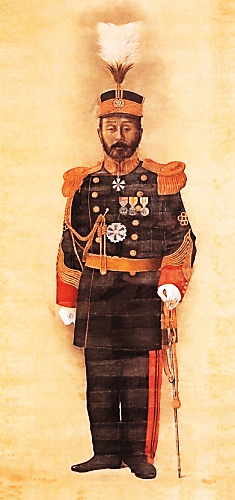
Fig. 18. Minister of Finance of the Korean Empire and Director of the Central Mint Yi Young-ik
Fragment of a ceremonial portrait. National Folk Museum of Korea
At the disposal of the Department of the Court, i.e., practically under the control of Yi Young-ik, were the most profitable sources of tax revenue. After persuading Gojong to repeal the provisions of the “Kabo Year Reforms” to bring the taxation system under the full control of the Ministry of Finance, Yi Young-ik transferred to the Office of the Court the revenues from the monopoly on the sale of ginseng, tax revenues from mines and the lease of state land, etc. Huge undocumented sums on a Korean scale, received mainly as bribes from those wishing to get a position in the state apparatus, ended up at the personal disposal of Yi Young-ik.
On November 29, 1897, Yi, while remaining the manager of the Mint Department, was appointed head of the Jeonghwan Division of the Ministry of Finance, which was responsible for issuing money, and director of the Central Mint. On December 3, 1897, he was also appointed in charge of all mining operations in Korea. During his tenure in these positions, an exemplary sericulture workshop was created to teach modern methods of silk weaving. Yi established industrial training centers in each province and tried to train modern engineers in dyeing, weaving, papermaking, silversmithing, and woodworking. He also founded a porcelain company in Seoul and built an arms factory. In addition, in 1898, he introduced a modern lithographic printing machine for the production of postage stamps, trademarks, and banknotes. In 1900, Yi was appointed hyopang (deputy) minister of finance, and in 1902 he was appointed minister of finance. All Korean coins were minted under his direction or under a license issued by him.
At the turn of the 19th and 20th centuries, due to a sharp drop in the price of nickel on the world market, the copper-nickel quarter of the jan coin was the only minted coin that did not contain the intrinsic value of the metal, so its production was profitable. The cost of making a quarter coin was only 5 puns, which was ridiculously low compared to its face value of 25 puns. As more and more coin-minting equipment appeared, more and more institutions received minting licenses from Yi Young-ik, but all the coins they produced were quarter-yang coins. The spread of mints that cast Sangpyeong Dongbo was revived.
Silver or copper coins soon ceased to be minted in Korea—silver for international trade was imported from Mexico and Japan, while domestic transactions were made primarily in copper-nickel coins or various forms of credit designed to eliminate the need for coinage (paper money was still used in limited use). Most quarter-yang coins were dated 1898 (2nd year of Gwangmu: 光武二年); The stamps were used until they wore out, then they were replaced with stamps with the same date. Official stamps were rented out to licensees and even non-licensees. The Japanese minted counterfeit copper-nickel coins for distribution in Korea at their mints, then smuggled 150 minting machines into Korea and minted them directly in the country. Therefore, some unofficial issues could not be distinguished from real coins. The government was eventually forced to recognize counterfeits as legal tender and divided the copper-nickel coins into three classes: official, Class A counterfeits, and Class B counterfeits, which were accepted for payment at different rates. Even “official” issues were accepted for payment below par, as the market was overflowing with counterfeit coins. In the end, copper-nickel coins accounted for more than half of the total circulating money supply. The withdrawal of these coins from circulation became a problem for the Japanese after the occupation of Korea in the initial period of 1904-1910. The Japanese divided quarter-coins into three classes and exchanged them at the following rate. Class A (甲) was exchanged at face value (2 chon 5 fun). Class B (乙) coins with a denomination of 2 chon 5 fun were exchanged for the price of 1 chon, while class C (丙)[185] was not exchangeable.
Local banks and quasi-state firms tried to introduce paper money, but the population did not accept it. Daiichi Ginko Bank, wishing to buy up as many silver yen coins as possible withdrawn from circulation, asked the Japanese government to allow the issuance of credit notes in Korea (national banks lost the right to issue banknotes in Japan in 1885). Permission was granted, and the first issues of 1, 5 and 10 yen notes, printed at the Japanese Ministry of Finance Printing House, were issued in May 1902. They were eagerly received in the southern ports, but rejected in Seoul and Incheon due to the opposition of Yi Young-ik.
In 1898, Gojong ordered the closure of the Central Mint in Incheon and, in order to take it out of Japanese control, moved it to Yongsan on the southern outskirts of Seoul, closer to his center of government. Construction of the Yongsan Mint was completed in September 1900. On May 22, 1901, Gojong issued Imperial Decree No 4, promulgating the “Regulations on Currency Circulation” (hanja 貨幣條例). Yi Young-ik embarked on radical measures to implement financial reform. One of the measures was the announcement of the introduction of the gold standard, a ban from September 11, 1902. for the credit notes of the Daiichi Ginko Bank and the introduction of coins of a new design, which began to be minted as early as 1901.
Since 1902, the main monetary unit of Korea has been the gold won (圜, WON) with a nominal gold content of 0.75 grams instead of the silver yang (兩, YANG). One won was divided into 100 jeon (錢 – the hieroglyph for “small coin”, CHON) and 1000 ree (厘, RI / REE). The design of the new coins generally did not differ from the coins of the 1892-1901 model. However, on the obverse of the coins, in the center of the circle of beads, instead of “playing dragons”, there appeared a completely new pattern – the heraldic Eagle. These coins are the subject of this study.
COIN DESCRIPTION
Trial coins of the new design were born in preparation for the reform even before the official decree of Gojong was issued.
The first such coin was a test coin dated the 3rd year of Gwangmu (光武三年,1899) with a denomination of half dollar (Fig. 19). Which mint minted it has not yet been established[186]. It is not in Krause’s catalog. At the Hwadong Coin Auction (Seoul) in 1995, a copy of this coin was sold for 4 million 700 thousand South Korean won[187].
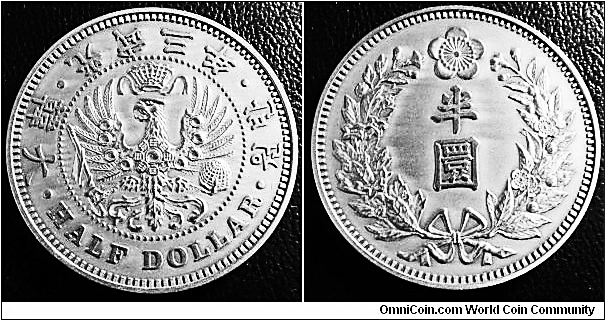
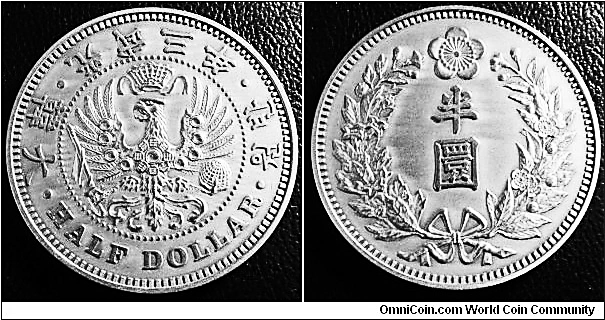
Fig. 19. Half Dollar pattern coin. 3rd year of Gwang Mu (1899).
The hieroglyph 圜 on the reverse represents DOLLAR
The appearance of such an unusual denomination is associated by some researchers with the Korean government’s attempt to create its own silver trade coin capable of replacing the Mexican dollar and the Japanese yen[188]. However, this assumption is erroneous. With the transition to the gold standard, silver trade coins turned into an analogue of credit notes. Due to the widespread introduction of the gold standard, the price of silver in relation to gold fell steadily and rapidly, and the issuer had to exchange any credit money for gold at face value without restriction, so the minting of a silver trade coin would lead to a financial catastrophe for the issuer. The name of the monetary unit in English did not matter for the domestic market, since Koreans learned to read only hanju and hangul in their sodan-schools. On hanja, the denomination was denoted by the numeral and hieroglyph 圜, and on Hangul by the sign 원, which in Korean were always pronounced “won”, regardless of its English name. As we have seen, coins of previous issues with this denomination were duplicated in English as WARN and WHAN.
On the Korean postal stamps of 1903, also with the image of the heraldic Eagle, in Latin transcription, the value of the stamp in won is duplicated for foreigners by the dollar sign $ (Fig. 20).
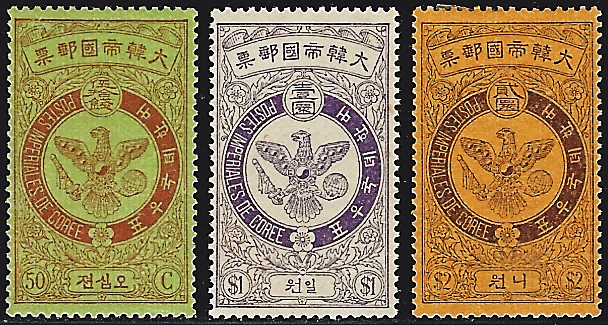
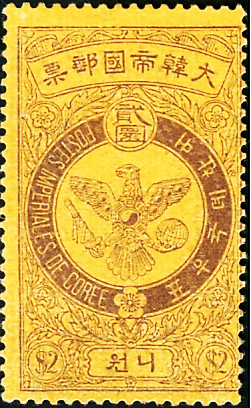
Fig. 20. Postage stamps of the Korean Empire with the heraldic Eagle of 1903.
The cost in won is duplicated in Latin by the dollar sign $
The next coin in this series was the 20 won test coin of the 4th year Gwang Mu (光武四年,1900). For the first time since 1885, it did not have an English denomination. Judging by the absence of an English legend, Yi Young-ik and his subordinates responsible for minting coins have not yet decided on the answer to the question of how the name of the new currency will be written in English. but it is identical to the 20 won coin of the 6th year Gwang Mu (光武六年, 1902) shown in Fig. 21. All coins of large denominations (5, 10 and 20 won) of subsequent years were also minted without an English legend.
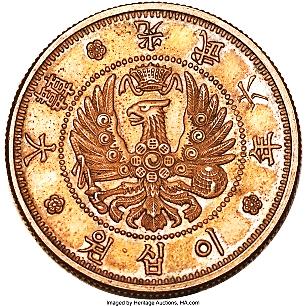
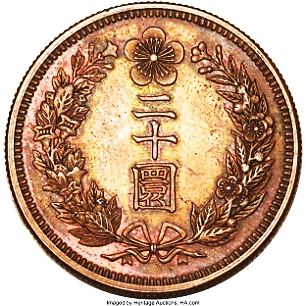
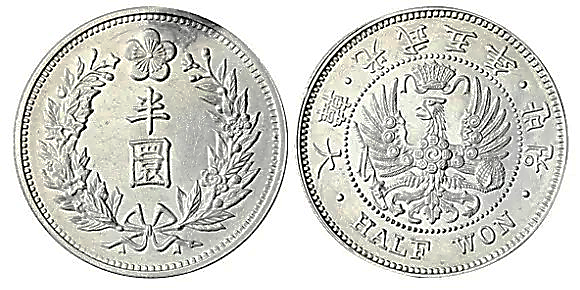
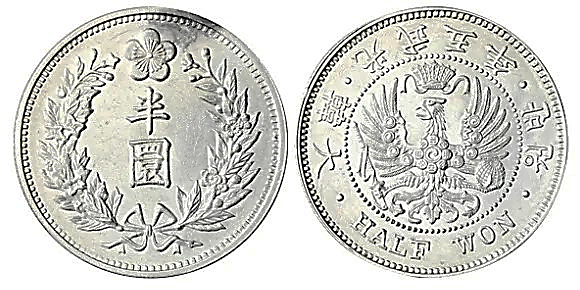
Fig. 21. 20 won pattern coin Copper Fig. 22. Half Won. The 5th Year of Gwang Mu (1901)
The 6th Year of Gwang Mu (1902) Silver 0.800
There is no legend in English The hieroglyph 圜 on the reverse stands for WON
Eventually, the new monetary unit, which we call “won”, was given the English name WON on the regular minted coin of ½ won issued in the following year, the 5th year of Gwang Mu (光武五年, 1901) (Fig. 22). This name had already been used in the previous year, 1900, when a series of postage stamps was printed, the value of which was indicated in the new monetary units: won (hangul 원, hanja 圓, English abbreviation WN), chon (hangul 전, hanja 戔 – the character for “small”, English CHEUN) and ri (hangul 리, hanja 厘, English REE, abbreviation RE) – Figs. 23-25. The denomination Ri also appears on one of the stamps with the heraldic eagle of 1903 (Fig. 26).
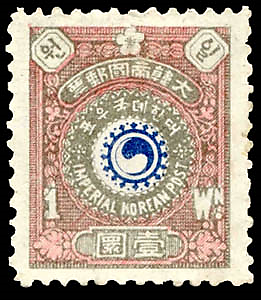
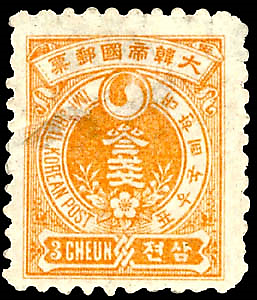
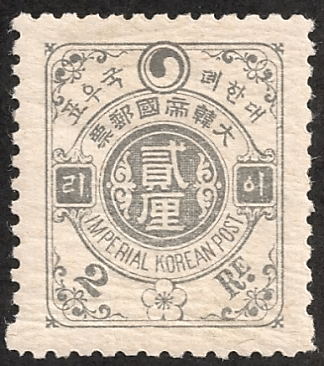
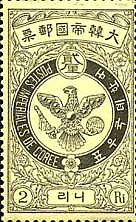 Fig. 23. Postage stamp Fig.24. Postage stamp Fig.25. Postage stamp Fig.26. Postage stamp
at a price of 1 won. 1900 price 3 chon. 1900 at a price of 2 ri. 1900 at a price of 2 ri. 1903
The hieroglyph 厘 (“ri”) is written in exactly the same way as the hieroglyph for the Japanese token coin rin, equal to ⅟10 of the sen and ⅟1000 of the yen. And since the monetary system of Korea fully corresponded to the Japanese one, the ratio of the new Korean money to each other was as follows:
1 won (원/圓 /WON) = 100 chon ( 전/ 钱/ CHON) = 1000 ri (リ/厘 /REE)
Small coins expressed in ri were never minted, since the value of the metal in the coin would exceed the value of the coins themselves.
The Chinese character “jeon” on the 1900 postage stamp was written as on the “old-style” coin with a face value of ¼ yang: 戔 “small” (Fig. 24). But in Korean, “chon” was written 전- in the same way as on the coins of 1902 (Fig. 27) and on the postage stamp of 1900 (Fig. 26). It was also written in Korean on the stamp of 1903 (Fig. 28). But on the coins of 1902 and stamps of 1903, the Chinese character “chon” is different: 錢 “small coin”, as in the Japanese sen small change coin. The change of the hieroglyph was due to the fact that the average person could distinguish the “new pattern” chongs, equal to ⅟100 won (which corresponded to Japanese sen, equal to ⅟100 of the yen), from the “old-style” chons, which cost twice as much. In English, the denomination “chon” on the 1902 1 chon and 5 chon coins was transformed from CHEUN (as the name was written on the 1900 stamps) to CHON (Fig. 27).
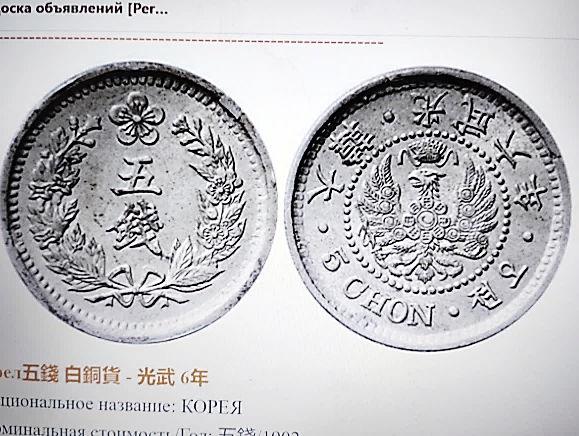
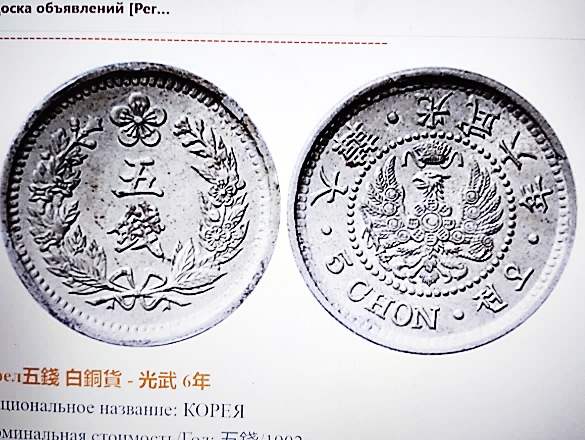
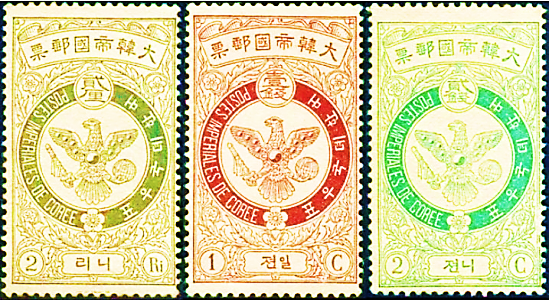
Fig. 27. Copper-nickel 5 chons. The 6th Year Fig.28. Postage stamp with a price of 1 chon. 1903
of Gwang Mu (1902)
The full series of coins of the new design was supposed to look like this: ½ chon (copper, 3.4 g, ⌀ 21.9 mm), 1 chon (copper. 6.8 g, ⌀ 28 mm), 5 chon (copper-nickel alloy, 4.3 – 4.7 g, ⌀ 20.8 mm), 10 chon (silver 0.800, 2.7 g, ⌀ 17.6 mm), 20 chon (silver 0.800, 5.4 g, ⌀ 22.8 mm), ½ won (silver 0.800, 13.5 g, ⌀ 30.9 mm), 5 won (0.900 gold, 4.1666 g, ⌀ 17 mm), 10 won (gold 0.900, 8.3333 g, ⌀ 21.2 mm) and 20 won (gold 0.900, 16.667 g, ⌀ 28.8 mm). However, a full-fledged series of coins was minted only after the transformation of Korea into a protectorate of Japan in 1905, the closure of all Korean mints and the transfer of minting to Osaka, Japan. The Japanese, of course, removed the eagle from the obverse and returned the “playing dragons”.
Coins with the eagle were issued in only 7 denominations (the Bank of Korea counts half dollars and half won as one denomination): 1 chon (copper), 5 chon (copper-nickel alloy), 20 chon (0.800 silver), half dollar/half won (0.800 silver), 5, 10 and 20 won (pattern coins of copper and gilded copper – models of pieces that were to be minted from gold). All coins were minted at the Yongsan Mint. Only small coins of 1 chon, 5 chon, and half won were put into circulation. According to the Bank of Korea, from 1901 to 1904, the Yongsan Mint issued a total of 915,000 silver half won coins with the date of the 5th year of Gwang Mu (光武五年, 1901), 126,000 copper-nickel 5 chon coins with the date of the 6th year of Gwang Mu (光武六年, 1902), and 981,000 one chon copper coins with the date of the 6th year of Gwang Mu (光武六年, 1902). Krause’s catalog gives other figures. Although in practice, Korean mints never minted coins with future dates, but on the contrary, when minting a new batch of coins of a certain type that was trusted by the population, the stamps of previous years with the corresponding old dates were reproduced. Krause gives the following number of coins minted: 3,001,000 pieces of one-chon coins, 2,800,000 pieces of five-chon coins and 1,831,000 pieces of half-won.
Due to lack of funds, the mint could not issue gold coins, and only a few copper-gilded test coins have survived. Trial coins of five won and a silver coin of twenty jeon, despite the existing information about their minting, have not yet been seen in physical terms.
The Bank of Korea summarizes all known coins with the eagle in the table below (Table 1).
Tab. 1. Yongsan Mint Eagle Coin Chart[189]
Legend
R: Rare
R2: Very rare
R3: Extremely rare
R4: 11~20 pieces
R5: 6 ~10 pieces
R6: 3~5 pieces
R7: 1~2 pieces
| Year \ Denomination
Gwang Mu \ CE |
一錢
1 chon |
五錢
5 chon |
二十錢
20 chon |
半圜
½ Dollar or ½ won |
五圜
5 won |
十圜
10 won |
二十圜
20 won |
| 3rd(光武三年)1899 | R5 | ||||||
| 4th(光武四年)1900 | R7 | ||||||
| 5th(光武五年)1901 | R3 | R6 | |||||
| 6th(光武六年)1902 | R3 | R2 | exists hypothetically | exists hypothetically | R6 | ||
| 7th(光武七年)1903 | exists hypothetically | R5 |
With the exception of the eagle located in the center of the obverse instead of the “playing dragons”, the design of the new coins generally did not differ from the coins of the 1892-1901 model. The prototypes were made at the mint in Osaka by the Japanese court metal engraver Natsuo Kano together with Tomoo Masuda, who worked on the design, and Hyoka Ishii, who specialized in calligraphy[190].
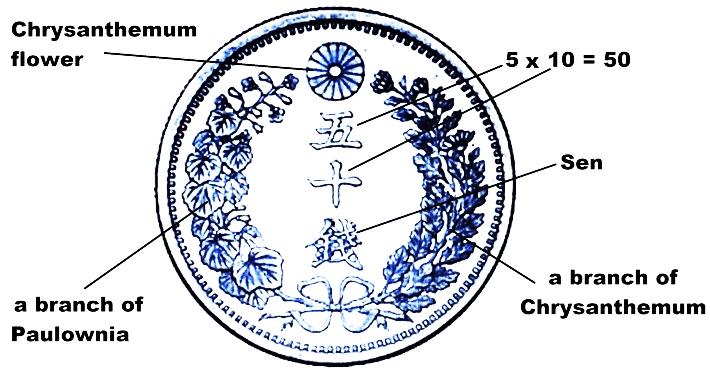
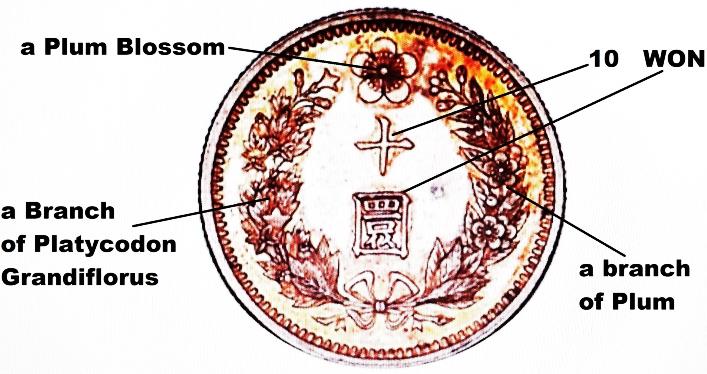
Fig. 28. Reverse of the Japanese 50 Sen 1876 coin. Fig. 29. Reverse of the 10 Won Korean coin. 1903.
Denomination surrounded by wreath from the branches Denomination surrounded by wreath from
from paulownia (left), and chrysanthemum (right) the branches of platycodon (left) and plum (right)
Stylized chrysanthemum flower above Plum blossom above
The reverse of Japanese and Korean coins is of the same type (Fig. 28 and 29). In the center, hanja hieroglyphs are the denomination of the coin. In the center at the top is a stylized flower bud. To the left and to the right of the denomination along the edge of the coin there are two branches of flowering plants, connected at the bottom by a ribbon tied in a bow. The differences between the coins are in the varieties of plants and the symbols that these plants are.
On the Japanese coin, in the center at the top, there is a chrysanthemum flower (the coat of arms and seal of the Emperor of Japan). To the left of the denomination is a branch of a paulownia flower (heart-shaped leaves), to the right is a branch of a chrysanthemum flower.
On the Korean coin, to the left of the denomination there is a branch of platycodon grandiflorus (Chinese bellflower), to the right is a branch of a plum. At the top in the center there is an open calyx of a 5-petal plum blossom, in each of the petals of which we see four stamens characteristic of this plant (Fig. 29, 31). In 1892, the plum blossom replaced the “symbol of the great principles Taegeuk” or “Yin-Yang” on the coins, which had previously been something like the national emblem of Joseon (Fig. 30). With the proclamation of the empire in 1897, the plum blossom received the Korean name ” Ihwamun ” (hangul 이화문), on the hanja 李花紋 – “the seal of the House of Yi”. but also on postage stamps and orders, as well as on the facades of public buildings. In numismatic catalogs, the name of this emblem is found as “the state seal of Korea”, but this name does not correspond to reality.
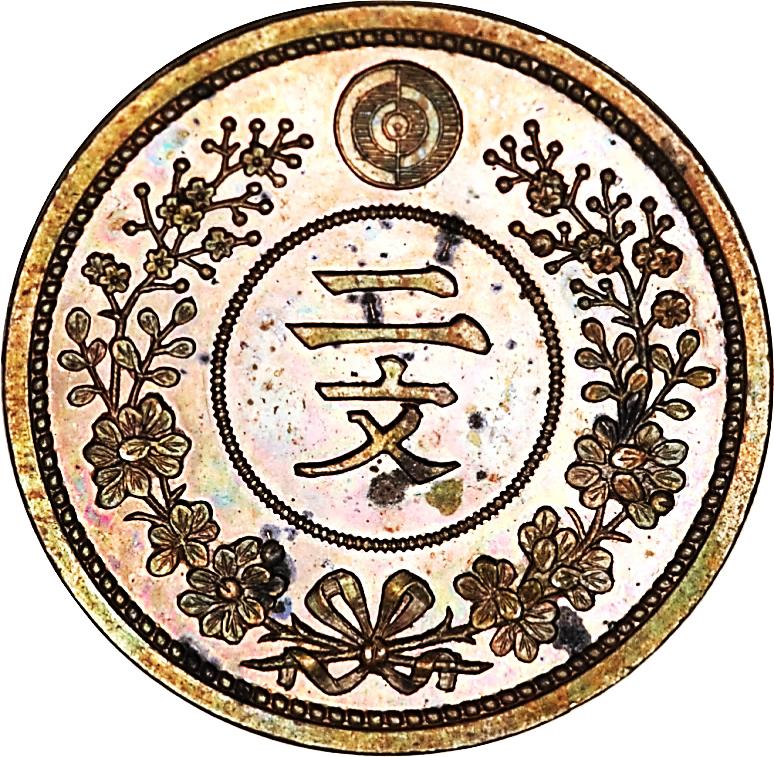
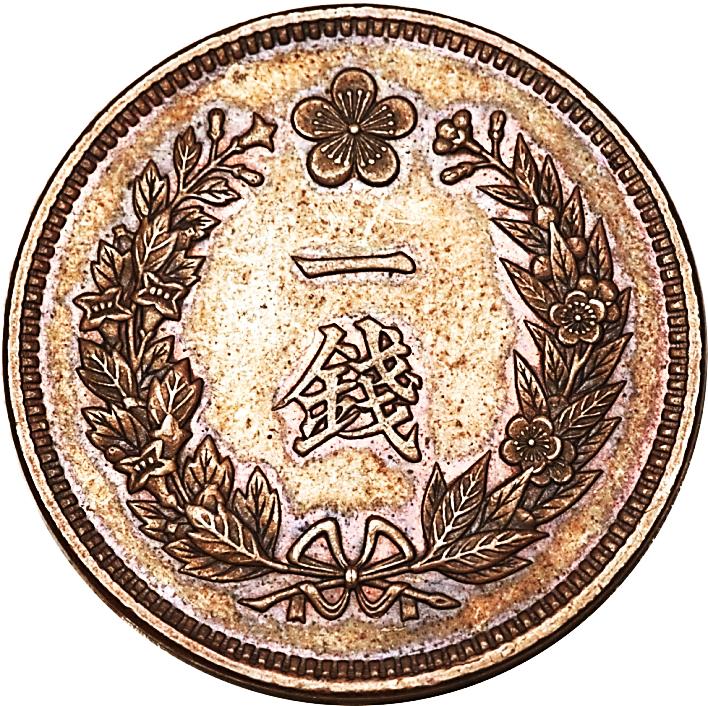
Fig.30. Yin-Yang symbol on the 2 mun coin of 1886. Fig. 31. The flower ” Ihwamun ” on the 1 chon coin of
1902
The Ihwamun plum blossom should not be confused with the current symbol of South Korea – the Hibiscus syriacus flower or the ” Rose of Sharon “, which in Korean is called “mugunghwa” (hangul 무궁화). Mugunghwa became the national flower of Korea in 1910-1945 during the Japanese occupation, when it symbolized the struggle for Korea’s independence from the Japanese colonizers.
To read the reverse of Korean coins, it is enough to know the Chinese numerals and hieroglyphs of hanja, denoting monetary units (tables 2 and 3). The number was always placed on top, the name of the monetary unit under it (see Fig. 29). The translation of the denominations on the reverse of the coins is given in Table 4.
Tab. 2. Chinese numerals
| ½ | 1 | 2 | 3 | 4 | 5 | 6 | 7 | 8 | 9 | 10 | 20 |
| 半 | 一 | 二 | 三 | 四 | 五 | 六 | 七 | 八 | 九 | 十 | 二
十 |
Tab. 3. Money units (hanja)
| WON / DOLLAR | CHON |
| 圜 | 錢 |
Tab. 4. Denominations of coins on the reverse side
| 一
錢 |
五
錢 |
二
十 錢 |
半
圜 |
半
圜 |
五
圜 |
十
圜 |
二
十 圜 |
| 1
chon |
5
chon |
20
chon |
½
dollar |
½
won |
5
won |
10
won |
20
won |
In the center of the obverse, in a circle of beads, there is an image of an eagle with raised wings. The head is turned to the left. The eagle holds a sword in one paw, in the other of the globe. Above the head of the eagle is a crown. Along the edge of the coin there is a circular legend. On small coins with a face value of 1 chon to ½ won, there is a legend in three languages: hieroglyphs Hanja, Korean Hangul and in English (Fig. 30). 10 and 20 won) – only on hanja and hangul (Fig. 31). Hanja is inscribed on 1) the name of the country 大韓 (“Tae Han”) – “Great Han” or “Great Korea”; 2) the year of the reign of Emperor Gwang Mu, when the coin was minted. For example, the 6th year of Gwang Mu (1902 according to our chronology), as in Figures 30 and 31: 光武六年, where 光武 is “Gwang Mu”, 六 is the number “6”, 年 is the word “year”. The numbers can be found in Table 2, the full dates of Gwang Mu in Table 1.
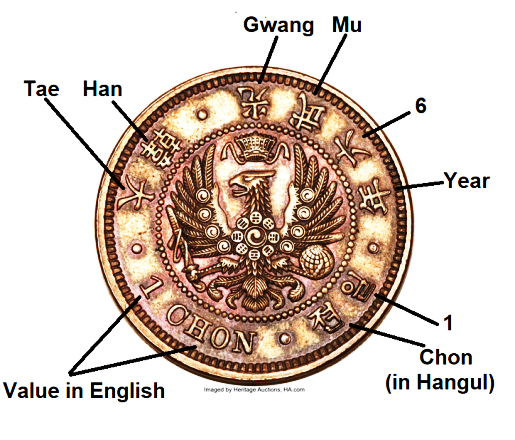
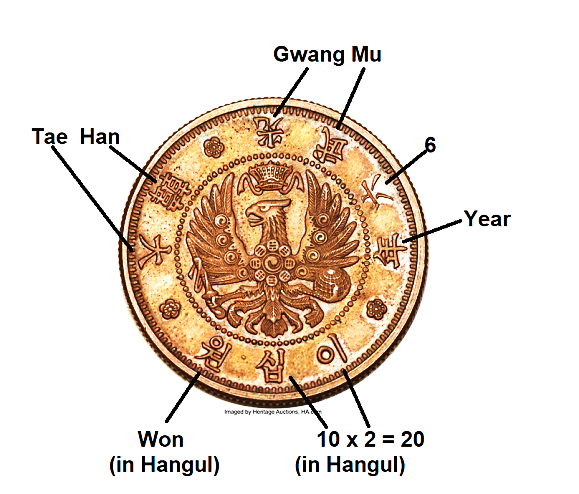
Fig. 30. Obverse of the 1 chon 1902 Fig. 31. Obverse of the 20 won 1902
The denomination of the coin is written in English and in Hangul. A breakdown of the denominations is given in Table 5.
Tab. 5. Denominations of coins on the obverse
| Denomination | Hangul | English |
| 1 chon | 젼일 | 1 CHON |
| 5 chon | 젼오 | 5 CHON |
| 20 chon | 젼십이 | 20 CHON |
| Half dollar | 원반 | HALF DOLLAR |
| Half won | 원반 | HALF WON |
| 5 won | 원오 | – |
| 10 won | 원십 | – |
| 20 won | 원십이 | – |
Now let’s move on to the main topic of this study – the heraldic Eagle. As we have seen, this Eagle was depicted not only on coins, but also on postage stamps as the state symbol of the “Great Han”. In addition, the image of a bird of prey – an eagle, a hawk or a falcon – can be seen on the Cheungjang Military Order established by Gojong on April 17, 1901 (Fig. 32).
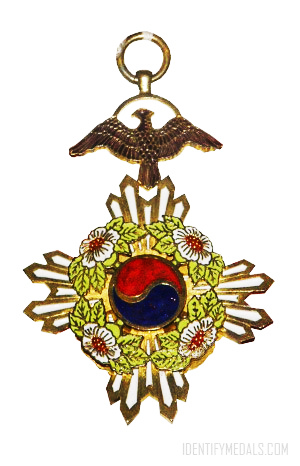
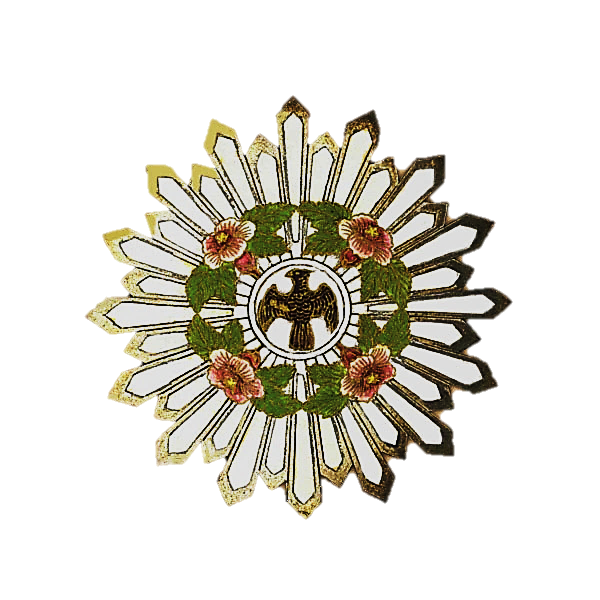
Fig. 32. Cheungjang Order of Distinguished Military Service
Established by Emperor Gwang Mu on April 17, 1901.
South Korea, which considers itself the successor of the “Great Han”, uses coats of arms, emblems and their derivatives inherited from the era of the Korean Empire as state symbols. The eagle emblem is currently used by the Republic of Korea Air Force (Figure 33), the National Police Agency (Figure 34), the Coast Guard (Figure 35) and the Korea Fire Agency (Figure 36). Strictly speaking, the only eagle of these birds is a symbol of the Air Force, the rest of the birds are not eagles. The symbol of the National Police Department is the Pacific Steller’s sea eagle, the Coast Guard is the white-tailed eagle, and the National Fire Department is the bird hawk, but the eagle has become the standard image of a bird of prey, which is why many people consider all of these birds to be eagles. The name of the T-50 Golden Eagle supersonic trainer aircraft of the Korean Air Force also comes from the English phrase “Golden Eagle”.
Fig. 33. Emblem of the Republic of Korea Air Force Fig. 34. Emblem of the Korea National
Police Agency

Fig. 35. Emblem of the Republic of Korea Coast Guard Fig. 36. Emblem of the Korea Fire Agency
The Chinese character 鷹 has several translations, including “Falcon”, “Eagle” and “Hawk”. The point is not which bird of prey is the symbol of a particular state institution in South Korea, but that they all go back to a single source – the State Coat of Arms of the Korean Empire.
It was officially approved by Emperor Gwang Mu in 1902 as the “National Seal” (i.e. coat of arms) of the Korean Empire (hanja 大韓帝國國章), although it appeared on coins and in the design of orders, as we can see, much earlier. In 1903, some changes were made to it, and it began to look as a whole as in Figure 37.
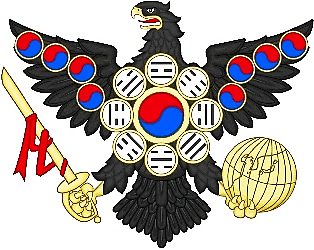
Fig. 37. Coat of arms of the Korean Empire in the 1903 edition (armiger – Emperor of Korea) [191]
Due to the fact that any bird of prey in Korean was called an “eagle”, and, for example, for a falcon there was only a name borrowed from English 팔콘 (falcon), it is possible to establish which of these birds was the Korean coat of arms only from translated materials. And translators interpret this bird either as a falcon or an eagle – depending on how it is beneficial to them.
Perhaps only the Koreans themselves know that they once had an imperial coat of arms. They call it the Golden Eagle, less often the Falcon. The Japanese arrogantly deny the existence of not only state symbols, but also the very existence of the Korean Empire, and interpret its coat of arms not as an imperial symbol, but exclusively as a drawing of a goshawk, “copied from the Japanese stamp of 1875” (Fig. 38).
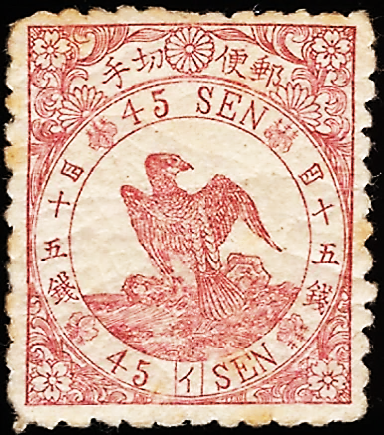
Fig. 38. Japanese postage stamp of the 1875 “Birds” series
with the image of a goshawk
© solbery.com (photo)
Western philatelists and numismatists are characterized by their attitude towards the imperial coat of arms of Greater Korea, which can be called damnatio memoriae (“curse of memory”) in Latin, as if it had never existed at all: “It is anything but a coat of arms. Most likely, it is a falcon, but maybe it is the emblem of the Russian-Korean Bank or a copy of the “Russian” eagle, or maybe a bird, the image of which is placed just for beauty.” I do not know what this marginal position is connected with, but it testifies to the complete incompetence and professional unsuitability of those who adhere to it.
It is sad that foreign classifiers are not able, consciously or due to a lack of basic education, to distinguish the state emblem with all its attributes compiled according to the rules of heraldry from a simple image of a wading bird. Only in one thing they are undoubtedly right: there is a “Russian trace” here. The State Eagle of the Russian Empire was indeed taken as a model of the Korean coat of arms (Fig. 39, 40). Emperor Gojong sincerely sympathized with Russia, since it was the only power that in the most difficult moment extended a helping hand to him, without demanding anything in return. In general, Gojong loved to talk with Russian diplomats and military men, to listen to stories about Russia, about its customs and symbols. He liked the bearing and military awards of Russian officers, the devotion to them of the Korean guards, whom they taught in the art of war. And, of course, due to the Eastern mentality, Gojong was flattered to bear the title of “emperor”, equal to the title of the Russian monarch, and to have a coat of arms modeled on the one that seemed to him the most ambitious of all the imperial coats of arms.
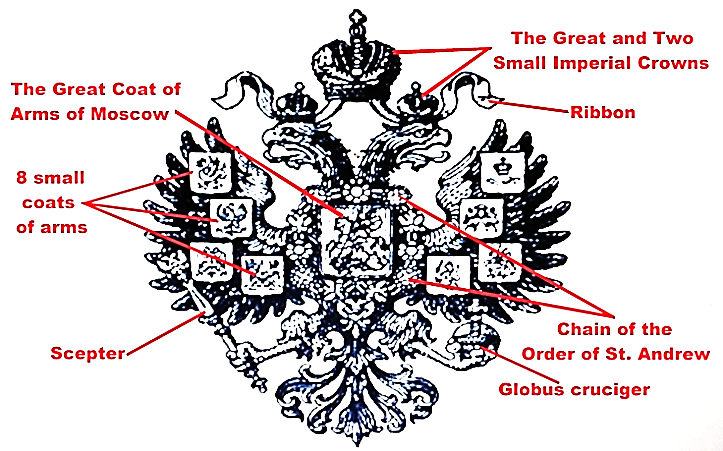
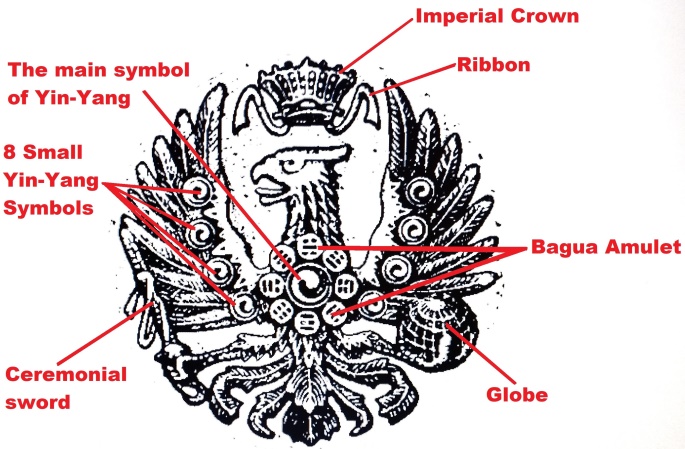
Fig. 39. Russian State Eagle Fig. 40. The Imperial Coat of Arms of Great Korea
State credit note 50 rubles 1899 20 won coin 1902
In Figures 39 and 40 we can see that the Korean heraldic Eagle is formed according to the same principle as the Russian one. The wings of the Eagle are raised up, on the chest there is a large coat of arms, on the wings there are four smaller coats of arms, in one paw of the eagle there is a round object, in the other oblong, the eagle is crowned with a large crown with a waving ribbon. But the Eagles are not identical. The Russian Eagle is two-headed with three crowns, the Korean Eagle is single-headed, and the crown is one. All the attributes of the Korean Eagle are purely traditional and Confucian. The Russian Eagle clutches a scepter and an orb in its paws, as symbols of the monarch’s power. The symbols of the power of the Korean emperor are different. In his left paw, the Eagle holds a globe on which the outlines of China, Japan, Russia and Korea itself are visible, which emphasizes the equality of the Tae Han Empire with these world empires (Fig. 37). In his right paw, the Eagle holds a ceremonial Korean straight sword with a round guard and a round pommel, which is called “Ingeom”. The sword is in a sheath, a cord or belt is attached to the pommel of the handle, because the Korean sword is adapted to be carried in the hand with the cutting edge down, unlike Japanese swords, which are worn on the belt. The cord is wrapped around the scabbard of the sword. “Ingeom” is considered the “sword of the Tiger”; it was intended for ceremonial purposes rather than for use on the battlefield. During the Joseon and Tae Han era, from 1392 to 1910, the royal court believed that this sword could ward off evil, prevent disasters, and allow people to live in peace.
On the chest of the Russian Eagle there is the coat of arms of Moscow, framed by the chain of the Order of St. George. Andrew the First-Called. In the center of the figure of the Korean Eagle is the symbol of the “Great Principles of Daegeuk” or Yin-Yang, framed by an amulet of eight trigrams “Bagua” (Fig. 41). Eight smaller Yin-Yang signs are located on the wings of the Eagle – 4 on each (Fig. 42).
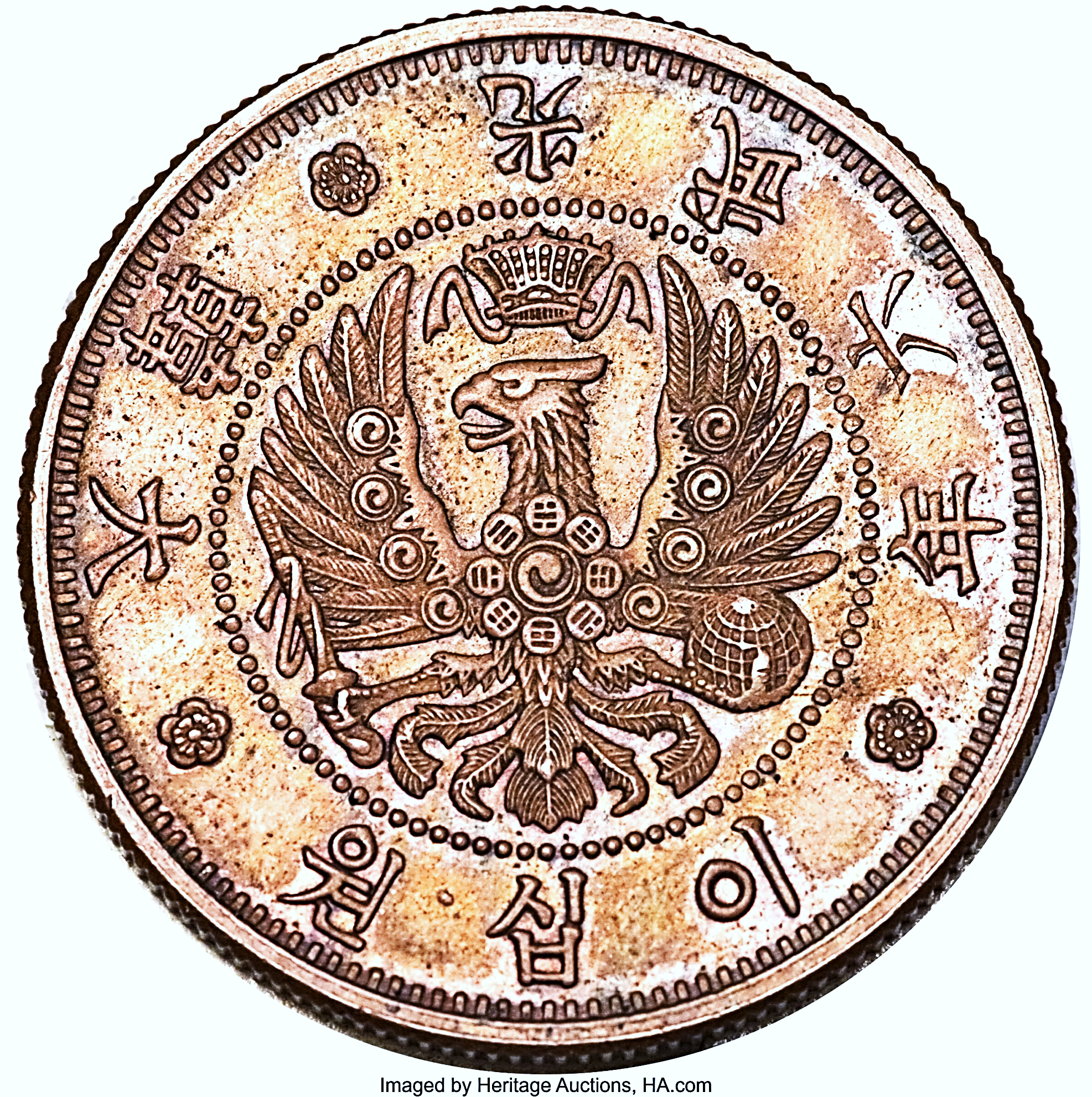
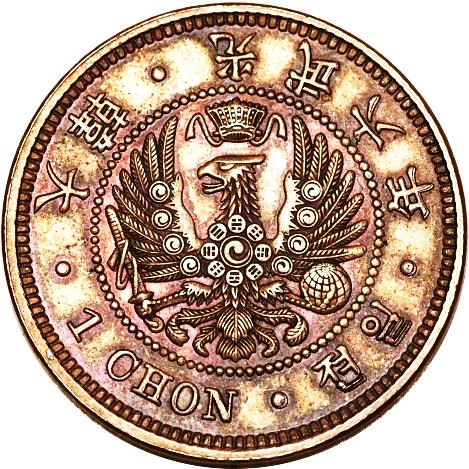
Fig. 41. Yin-Yang symbol surrounded by Fig. 42. Yin-Yang signs on the chest
eight trigrams (Bagua) on the breast of the Eagle and the wings of the Eagle
Yin-Yang (Um-Yang in Korean) is a term for the main opposites of the Universe, for example, light and dark, strong and weak, male and female, heat and cold, day and night, etc., as well as a symbol of the “Great Principles of Daegeuk” – the main cosmic driving forces, as the root causes of constant variability in nature. In Chinese cosmology, the universe is created from the primordial chaos of material energy, organized into cycles of Yin and Yang, form and matter. “Yin” is inherently retracting, passive, and squeezing, while “Yang” is repulsive, active, and expansive. In principle, this dichotomy manifests itself in one form or another in everything in nature—in patterns of change and difference, such as biological and seasonal cycles, the evolution of the landscape over days, weeks, years, and epochs (the original meaning of these words is the shadow of a north-facing hill and the brightness of a south-facing hill), gender (female and male), as well as the formation of the character of individuals, and the great arc of socio-political history in disorder and order.
A trigram (hanja 卦 “gua”) is a symbol consisting of three lines. Each of the three lines in a trigram can be either a continuous “—” or a broken “- -” in the middle. The solid line symbolizes Yang and the broken line symbolizes Yin. There are eight possible combinations of these components of the trigram, and these combinations are known as the “eight trigrams” or 八卦 (“Ba-Gua”) in Chinese. Bagua is a set of symbols designed to illustrate the nature of reality, which is made up of mutually opposing forces that reinforce each other. In the old days, people believed that the bagua amulet could ward off bad influences and ward off evil spirits. For this reason, it was not uncommon for people to wear the bagua amulet on their chests. Families often nailed bagua-style amulets to the beam of the roof of their house or to the top of the gate, and sailors attached them to a high place on their boat.
The bagua amulet surrounding the central Yin-Yang symbol on the Eagle consists of eight trigrams arranged in sequence, as in Figure 41. The layout of the bagua trigrams on the eagle’s chest (starting at 12 o’clock clockwise) is shown in Table 6:
Table 6. Arrangement of trigrams on the chest of the Eagle, starting from the top
clockwise
| Sign | Name
(hanja) |
Element | Animal | Cardinal point
(“Early Heaven” by Fuxi) |
Body Part | Family |
| ☵ | 坎 | Water | pig | West | ear | middle son |
| ☳ | 震 | Thunder and Lightning | dragon | Northeast | feet | senior
son |
| ☶ | 艮 | Mountain | dog | Northwest | hand | youngest son |
| ☱ | 兌 | Pond / Lake | sheep | South-east | lips | youngest daughter |
| ☲ | 離 | Fire | Pheasant | East | eye | middle daughter |
| ☷ | 坤 | Earth | cow | North | stomach | mother |
| ☴ | 巽 | Wind | hen | Southwest | legs | eldest daughter |
| ☰ | 乾 | Sky | horse | South | head | father |
In the Joseon era, Korea did not have any state symbols. It had no anthem, no coat of arms, no flag. From the point of view of heraldry, it simply did not exist. When the Japanese designed the first Korean coins in the 1880s, they inserted the only symbol familiar to Koreans on the reverse of their chrysanthemum flower, the Yin-Yang sign. At that time, it looked like a disk consisting of four concentric rings, divided in the middle into two parts, the right of which was a negative reflection of the left (Fig. 43).
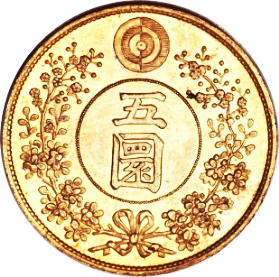
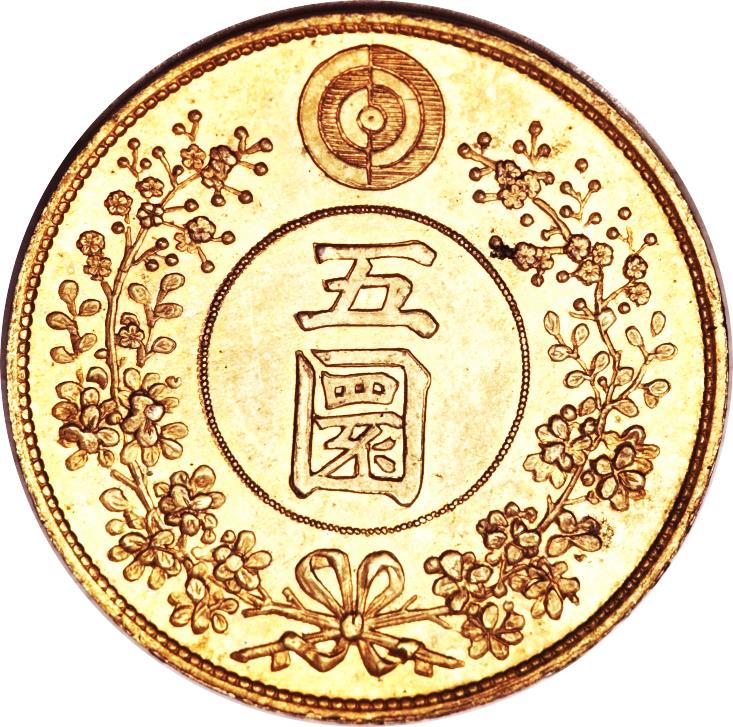
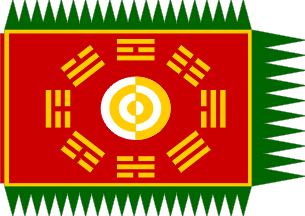
Fig. 43. Yin-Yang sign on the reverse Fig.44. Flag of Korea of the 1882 model
Pattern coin of 5 varnas 1886
This emblem appeared on the national flag of Korea approved in 1882 (Fig. 44), thus becoming the national emblem of Korea. The flag consisted of red cloth decorated with a Yin-Yang of yellow and white rings, surrounded by eight yellow trigrams (Bagua) and framed by a border of green triangles. In the 1890s, the Yin-Yang sign changed several times until it took the form of a disk divided into two equal parts in the form of a comma, red and blue (Fig. 45). In this approximate form, it migrated to coins with an eagle (Fig. 46).

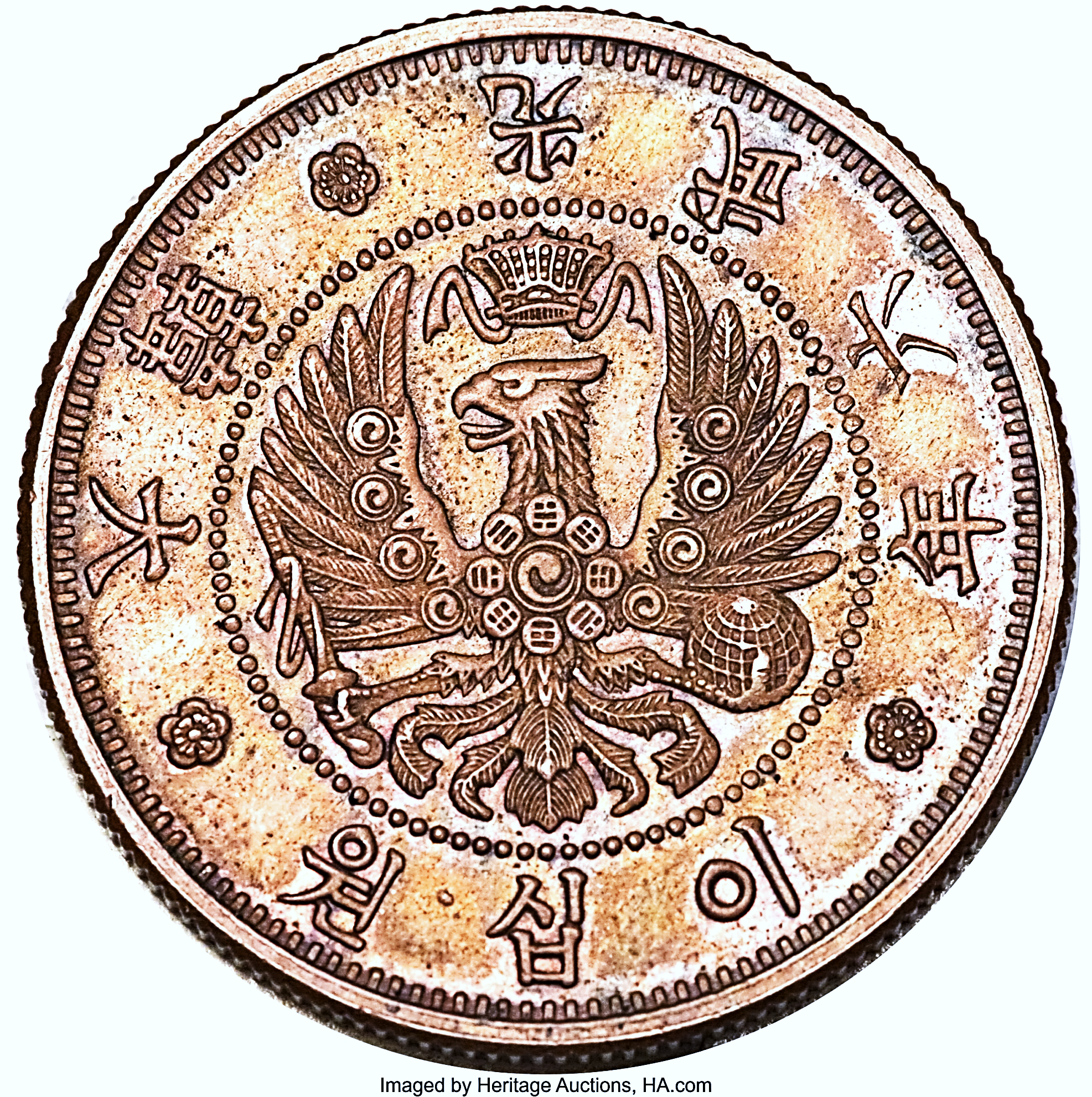
Fig. 45. Yin-Yang sign of the late 1890s – early 1900s. Fig.46. Yin-Yang sign on coins with the Eagle
The central Yin-Yang symbol on the Eagle’s chest represented Korea as a whole. The eight smaller Yin-Yang signs on the eagle’s wings represented the eight provinces that were part of the Korean Empire.
Above the eagle’s head on the coins is the Imperial Crown of Gojong, strongly stylized in the “European” manner (Fig. 47). The imperial crown was a type of ceremonial crown worn by high-ranking officials. It consisted of a top hat covered with a cup of black silk and a cap decorated with gold lines, the number of which indicated rank. The cap was pierced with a gold needle with purple tassels (Fig. 48, 49).
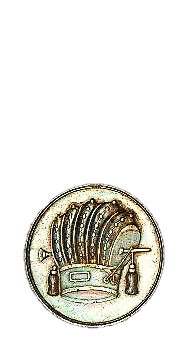
Fig.47. Crown on coins with an eagle Fig. 48. Imperial Crown
on the jubilee medal of 1901,
Dedicated to the 50th Anniversary of Gojong
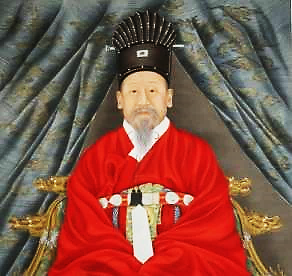
Fig. 49. Portrait of Emperor Gwangmu (Gojong) wearing a crown
The images of the eagle on the coins are not identical. The obverse on each coin was minted with an individual stamp, so the Eagles on the coins are different from each other. In addition to some differences in the head and neck shape of eagles, differences in the size of the Yin-Yang and Bagua on the chest, the shape of the crowns and the size of the globe, there are significant differences according to which they can be divided into three types: Type I, Type II and Type III (Figs. 50, 51, 52).
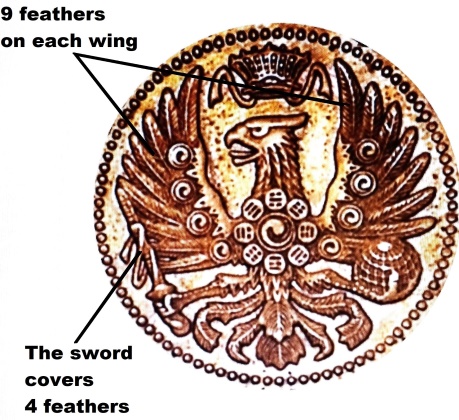
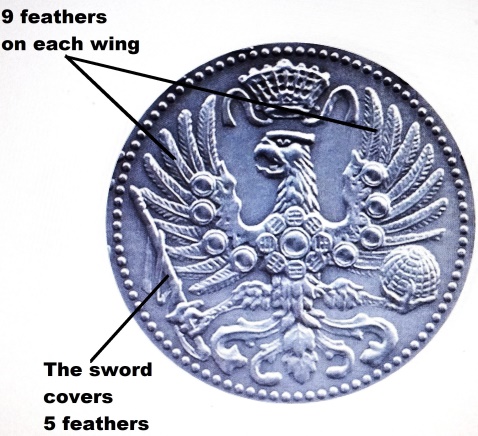
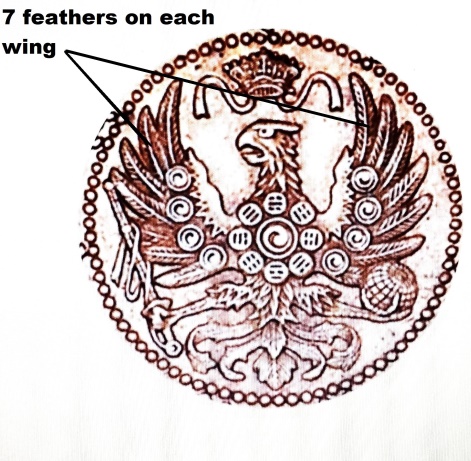
Fig. 50. Type I Fig.51. Type II Fig. 52. Type III. 5 chon 1902,
1 chon 1902, 20 won 1902 1/2 dollar 1899, 1/2 won 1901 10 won 1901 and 1903
Besides some differences in the shape of the eagles’ heads and necks, the sizes of the Yin-Yang and Bagua on the chest, the shape of the crowns, and the size of the globe, the significant differences between Types I and II and Type III are that (first) Types I and II eagles have 9 feathers on each wing, while Type III eagles have 7 feathers on each wing. The second difference between Types I and II is in the size of the sword. The sword of Type I eagles is a short ceremonial sword “ingyom”, its length is 4 lower feathers on the wing (Fig. 53). Type II and Type III eagles have a long and narrow sword with a round pommel, which is called “sa-ingyom”, or “Sword of the Four Tigers” (Fig. 54). Its length is 4 lower feathers on the wing of a Type III eagle and 5 lower feathers on the wing of a Type II eagle.
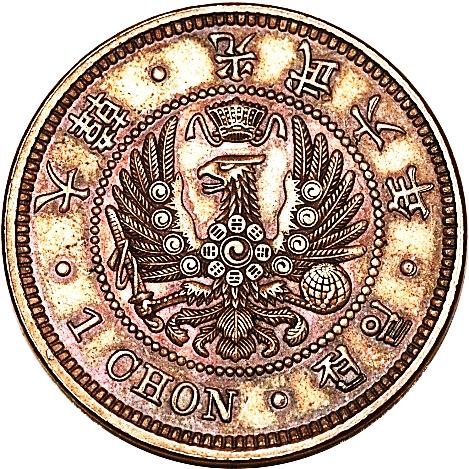
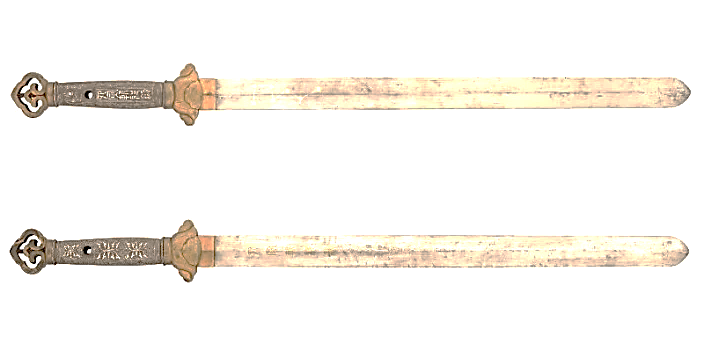
Fig. 53. Ingeom or Tiger Sword (Type I)
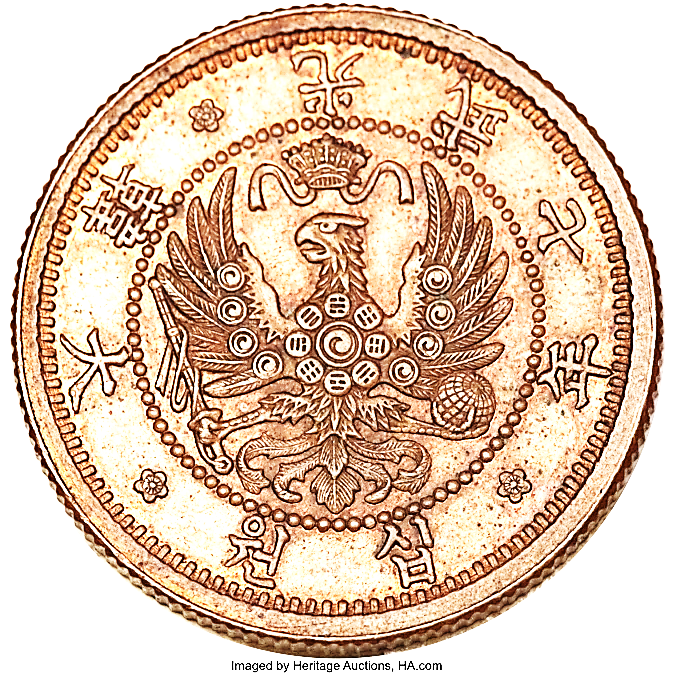
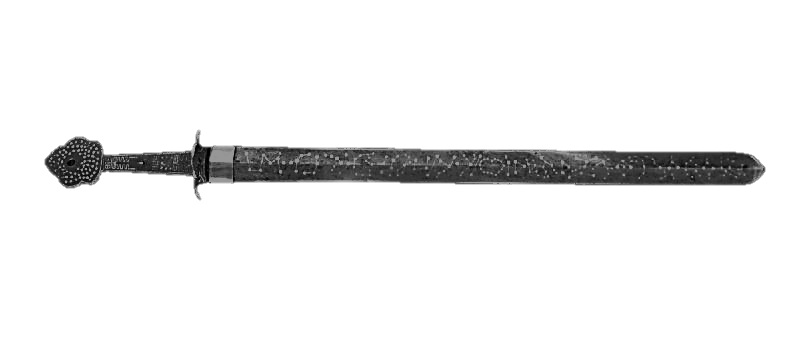
Fig. 54. Sa-Ingeom or Sword of the Four Tigers (Types II and III)
Type I eagle coins include 1 chon 1902, 20 won 1902, Type II – 1/2 dollar 1899, 1/2 won 1901, Type III – 5 chon 1902, 10 won 1901 and 1903.
The 1, 5, 20 chon and half won coins have a smooth edge. Coins of large denominations, ½, 5, 10 and 20 won, have a ribbed edge (Fig. 55, 56).
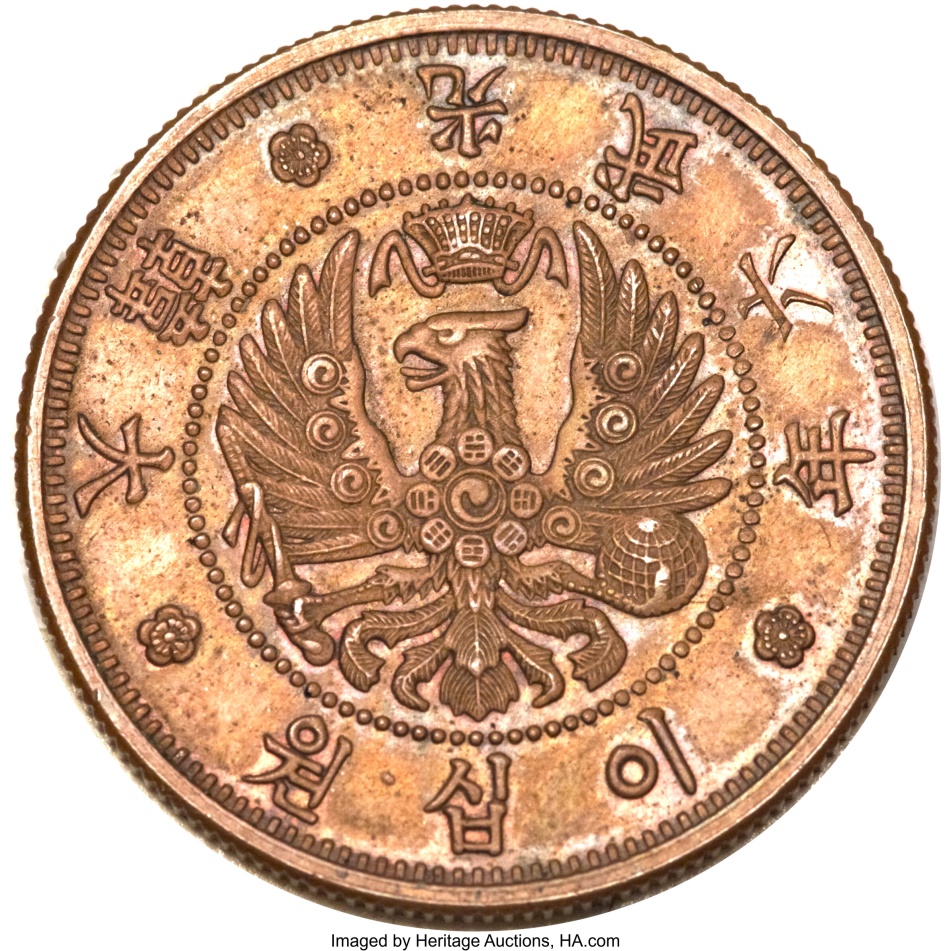
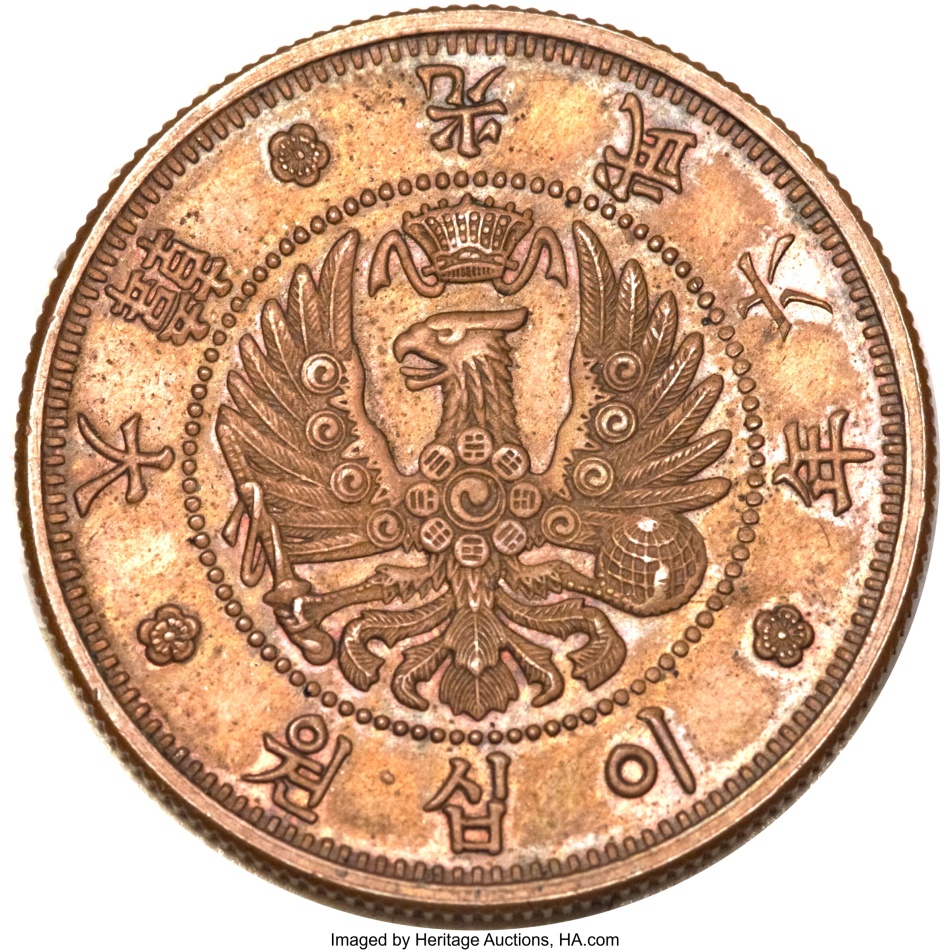
Fig. 55. Edge of a 20 won 1902

Fig. 56. Edge of the Half Won coin of 1901
COIN CATALOG
Note: for coins, the existence of which is doubtful today, only a drawing of the proposed reverse is given.
Abbreviations in column “List”
SC – Standard Circulation (Coin of standard circulation or regular minting).
PC – Pattern Coin.
Table A. Regular minting coins
| List | No
Krause |
Denomi-nation / circulation | A.D.
Year of Gwangmu |
Obverse | Reverse | Metal | Diameter, weight, thickness | Auction prices /
notes |
| SC01 | KM# 1121 | 1 CHON
一 錢 According to the Krause catalog[192] 3,001,000 pcs. According to the Bank of Korea [193] 981,000 pcs. |
1902
光武六年 6 |
Crowned Korean imperial Type I Eagle with the symbols of the elements Water, Heaven, Thunder, Wind, Mountain, Earth, Lake, and Fire, in the middle surrounding a Yin and Yang sign, as well as four Yin and Yang signs on each wing Above margin in hanja characters: •大韓 • 光武六年• Translation: • Great Han • Gwang Mu 6 year• Below English and Korean Hangul denomination: • 1 CHON•일젼• |
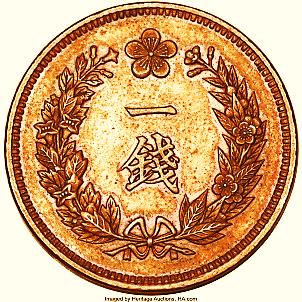
Denomination (in hanja text) 一 1 錢 chon surrounded by wreath from the branches of platycodon grandiflorus (left) and plum (right) Plum flower Ihwamun above |
Cu 98%
Sn 1% Zn 1% |
⌀ 28 mm
6,8 g[194] |
Heritage Auctions,
Sept. 8, 2011[195] (from the collection of Norman Jacobs) MS65 $ 149 500 R3 rarity according to the Bank of Korea |
| SC02 | KM#
1122 |
5
CHON 五 錢 According to the Krause catalog 2,800,000 pcs. According to the Bank of Korea 126,000 pcs. |
1902
光武六年 6 |
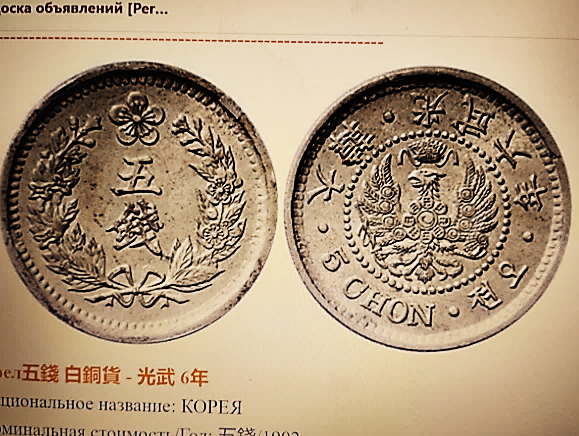
Crowned Korean imperial Type III Eagle with the symbols of the elements Water, Heaven, Thunder, Wind, Mountain, Earth, Lake, and Fire, in the middle surrounding a Yin and Yang sign, as well as four Yin and Yang signs on each wing Above legend in hanja characters: •大韓 • 光武六年• Translation: • Great Han • Gwang Mu 6 year• Below English and Korean Hangul denomination: •5 CHON •오젼• |
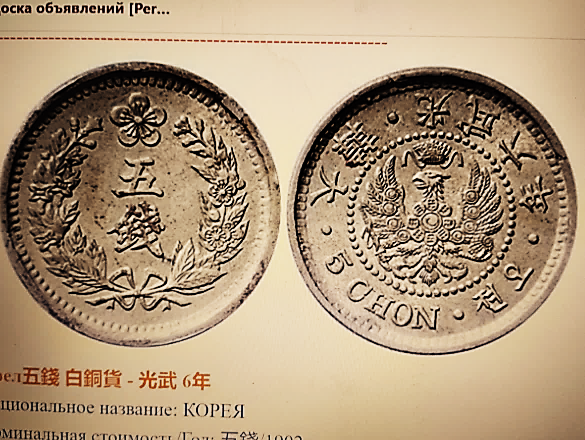
Denomination (in hanja text): 五 5 錢 chon surrounded by wreath from the branches of platycodon grandiflorus (left) and plum (right) Plum flower Ihwamun above |
Copper–
Nickel alloy Cu 75% Ni 25% |
⌀ 20,7 мм
4,3-4,7 g[196] |
Harry Reid Auction, 2011
XF45 $ 118 800 Rarity of R2 according to the Bank of Korea |
| SC03 | KM# 1123 | HALF WON
半 圜 According to the Krause catalog 1,831,000 pcs. According to the Bank of Korea 915,000 pcs. |
1901
光武五年 5 |
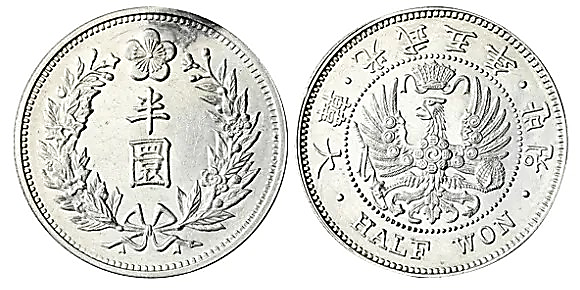
Crowned Korean imperial Type II Eagle with the symbols of the elements Water, Heaven, Thunder, Wind, Mountain, Earth, Lake, and Fire, in the middle surrounding a Yin and Yang sign, as well as four Yin and Yang signs on each wing Above legend in hanja characters: •大韓 •光武五年• Translation: • Great Han • Gwang Mu 5 year• and Korean Hangul denomination: •반원• “1/2 won” Below English denomination: •HALF WON• |
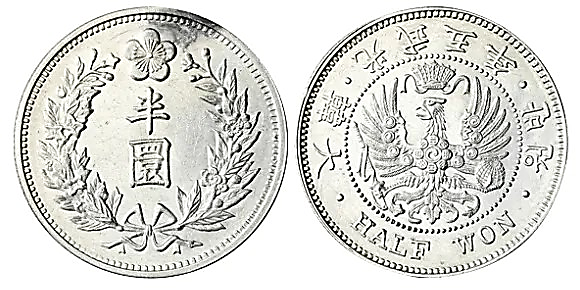
Denomination (in hanja text): 半 half 圜 Round Coin surrounded by wreath from the branches of platycodon grandiflorus (left) and plum (right) Plum flower Ihwamun above |
Silver
Ag 0.800 0.3472 oz |
⌀ 30,9 mm
13,5 g Thickness 2 mm |
Stack’s Bowers 2021[197]
AU-58 $ 57 600. R3 rarity according to the Bank of Korea |
Table B. Pattern coins and coins in other metals
| № | №
Krause |
Par | A.D.
Year of Gwangmu |
Obverse | Reverse | Metal | Diameter, weight, thickness | Auction prices /
rarity |
| PC01 | – | HALF
DOLLAR 半 圜 |
1899
光武三年 3 |
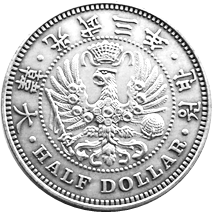
Crowned Korean imperial Type II Eagle with the symbols of the elements Water, Heaven, Thunder, Wind, Mountain, Earth, Lake, and Fire, in the middle surrounding a Yin and Yang sign, as well as four Yin and Yang signs on each wing Above legend in hanja characters: •大韓 •光武三年• Translation • Great Han • Gwang Mu 3 year• At right Hangul denomination: •반원• Translation: “Half a Round Coin” At the bottom is the denomination in English: •HALF DOLLAR• |
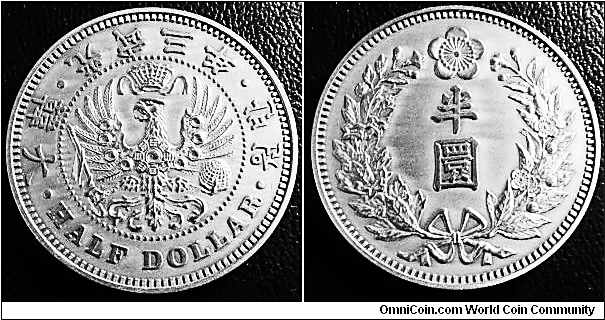
Denomination (in hanja text): 半 half 圜 “Round Coin” surrounded by wreath from the branches of platycodon grandiflorus (left) and plum (right) Plum flower Ihwamun above |
Silver
Ag 0.800 |
⌀ 30,9 mm 13,5 g
Thickness 2 mm |
Hwadong Coin Auction 1995
7,400,000 won[198] Rarity of R5 according to the Bank of Korea |
| PC02 | – | 20
WON 二 十 圜 |
1900
光武四年 4 |
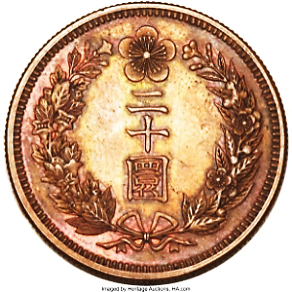 |
Copper | Rarity of R7 according to the Bank of Korea | ||
| РС03 | Pn33 | 5 WON
五 圜 |
1901
光武五年 5 |
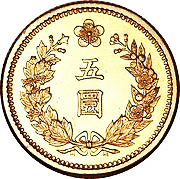 |
Copper | It is known only by its number in the Krause catalog | ||
| РС04 | Pn34 | 10 WON
十 圜 |
1901
光武五年 5 |
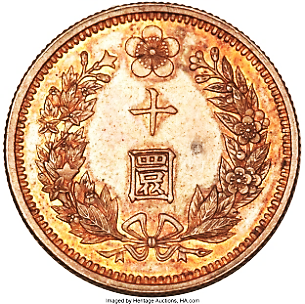 |
Copper | ⌀ 21.2 mm | R6 rarity according to the Bank of Korea | |
| РС05 | – | 10 WON 十 圜 | 1901
光武五年 5 |
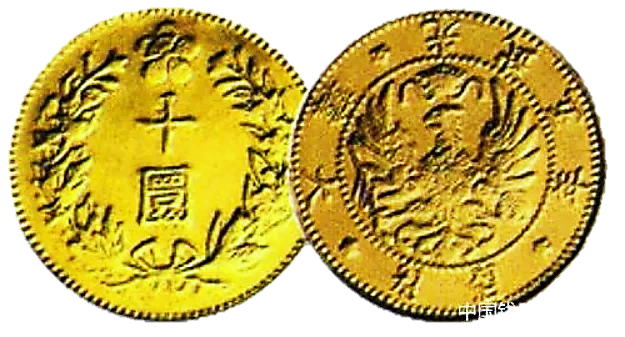
Obverse. Crowned Korean imperial Type II Eagle with the symbols of the elements Water, Heaven, Thunder, Wind, Mountain, Earth, Lake, and Fire, in the middle surrounding a Yin and Yang sign, as well as four Yin and Yang signs on each wing Above legend in hanja characters:
At the bottom is the denomination in Korean Hangul script:
Grooved headband. |
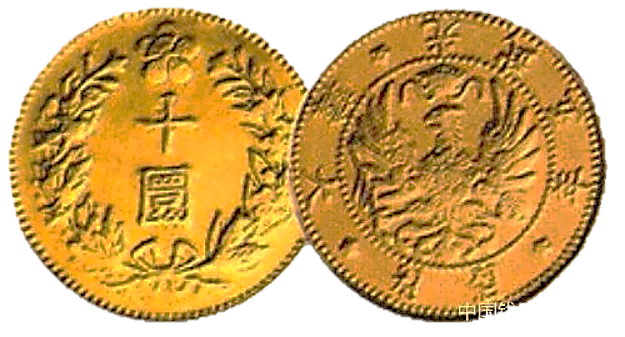
Reverse. Denomination (in hanja text): 十 ten 圜 won surrounded by wreath from the branches of platycodon grandiflorus (left) and plum (right). Plum flower Ihwamun above. |
Gold plated
cooper |
⌀ 21.2 mm | R6 rarity according to the Bank of Korea |
| РС06 | – | 20 CHON十
錢 |
1902
光武六年 6 |
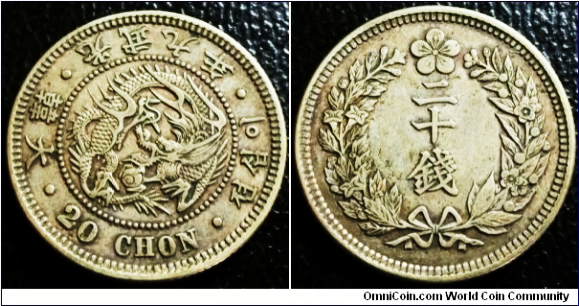 |
Silver
Ag 0.800 |
⌀ 22.8 mm
5,4 g Thickness 1,5 mm |
The Bank of Korea has information that such a coin was minted. But the coin itself has not survived | |
| РС07 | – | 5 WON
五 圜 |
1902
光武六年 6 |
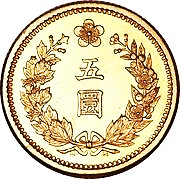 |
Copper | The Bank of Korea has information that such a coin was minted. But the coin itself has not survived | ||
| РС08 | – | 10 WON
十 圜 |
1902
光武六年 6 |
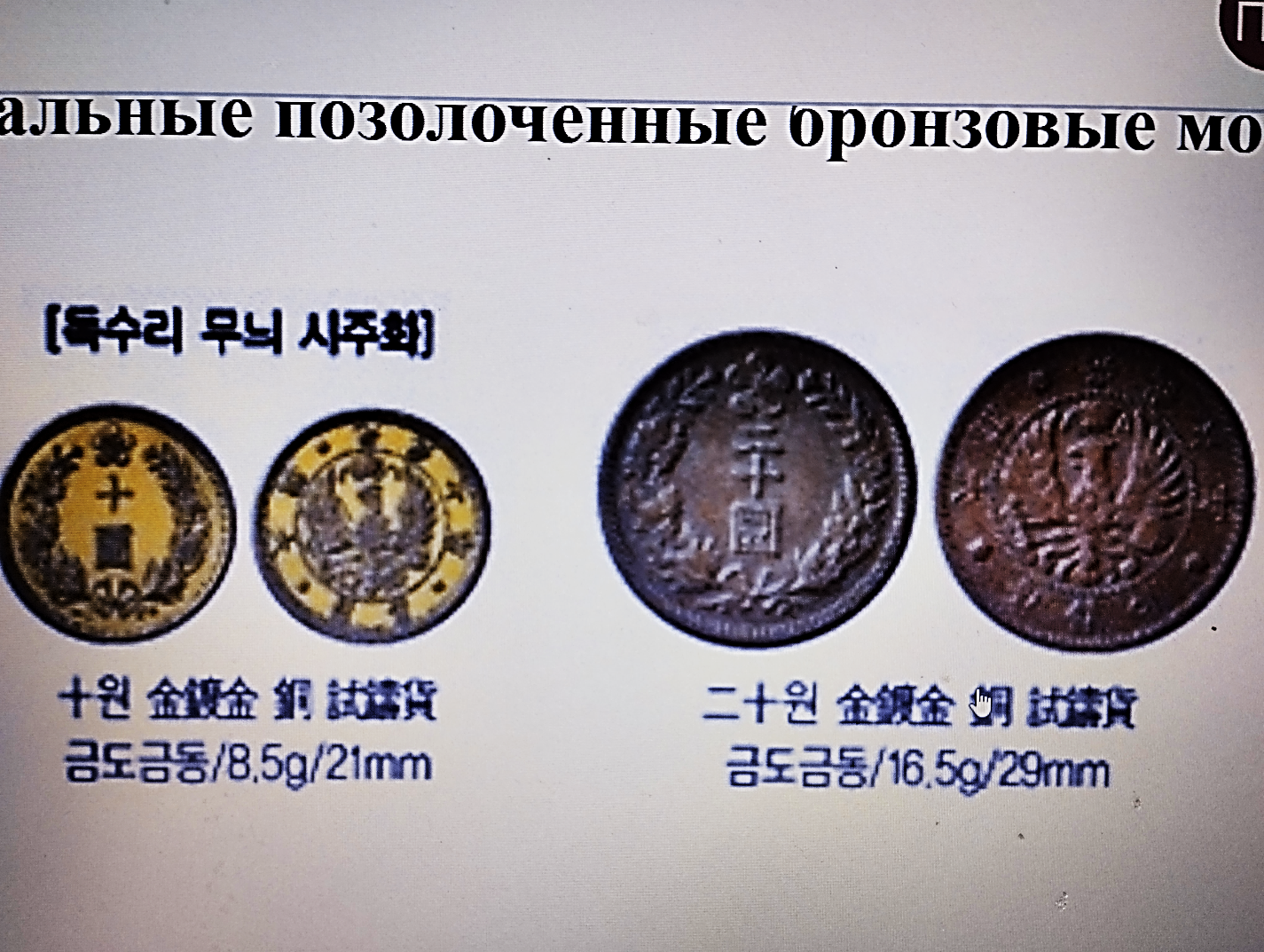
Crowned Korean imperial Type ? Eagle with the symbols of the elements Water, Heaven, Thunder, Wind, Mountain, Earth, Lake, and Fire, in the middle surrounding a Yin and Yang sign, as well as four Yin and Yang signs on each wing Above legend in hanja characters:
• Great Han • Gwang Mu 6 year• Below English and Korean Hangul denomination:
|
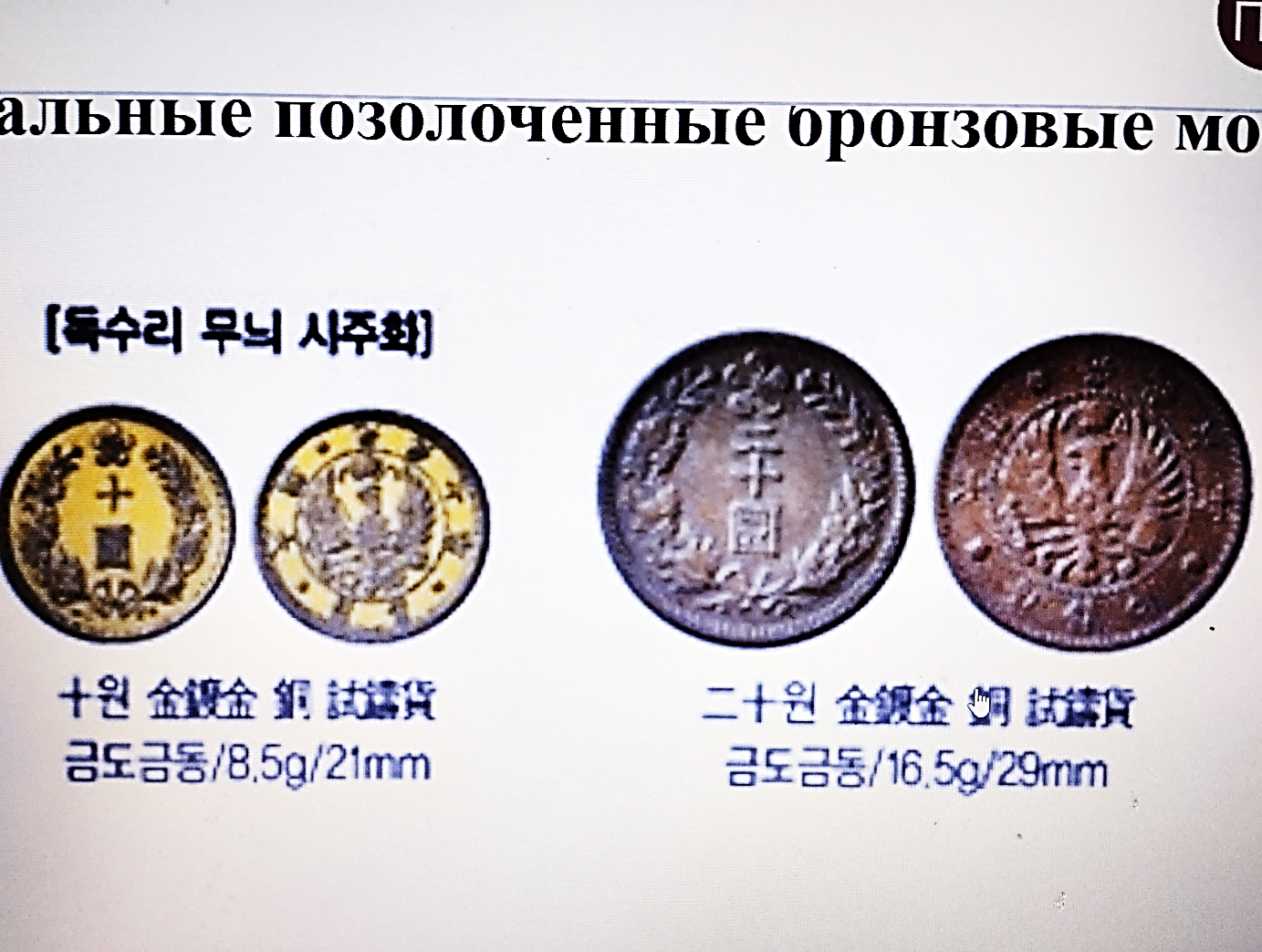
Denomination (in hanja text): 十 ten 圜 won surrounded by wreath from the branches of platycodon grandiflorus (left) and plum (right). Plum flower Ihwamun above |
Gold plated cooper | ⌀21 mm | |
| РС09 | Pn35 | 20 WON
二 十 圜 |
1902
光武六年 6 |
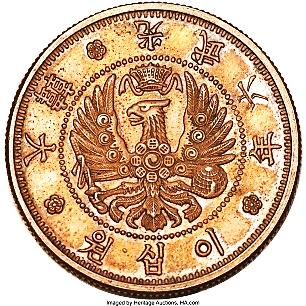
Crowned Korean imperial Type I Eagle with the symbols of the elements Water, Heaven, Thunder, Wind, Mountain, Earth, Lake, and Fire, in the middle surrounding a Yin and Yang sign, as well as four Yin and Yang signs on each wing Above legend in hanja characters: 大韓
At the bottom is the denomination in Korean Hangul script
|
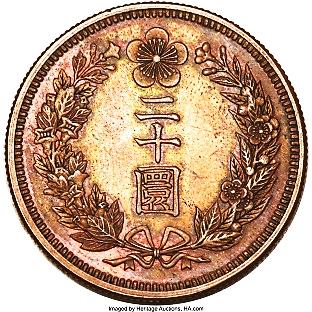
Denomination (in hanja text): 二 十 twenty 圜 won surrounded by wreath from the branches of platycodon grandiflorus (left) and plum (right). Plum flower Ihwamun above |
Cooper | ⌀ 29 mm | Heritage Auctions, Sept. 8, 2011[199]
(from the collection of Norman Jacobs) MS64 $ 115 000 R6 rarity according to the Bank of Korea |
| РС10 | Pn36 | 20 WON
二 十 圜 |
1902
光武六年 6 |
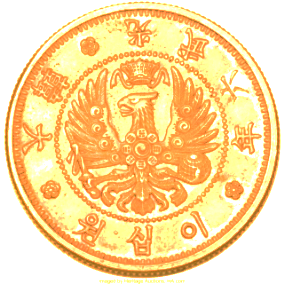
Crowned Korean imperial Type I Eagle with the symbols of the elements Water, Heaven, Thunder, Wind, Mountain, Earth, Lake, and Fire, in the middle surrounding a Yin and Yang sign, as well as four Yin and Yang signs on each wing Above legend in hanja characters:
Translation:
At the bottom is the denomination in Korean Hangul script
|
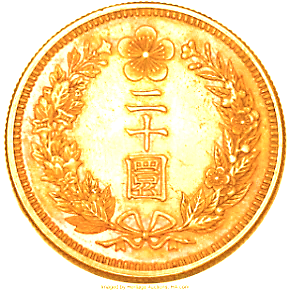
Denomination (in hanja text): 二 十 twenty 圜 won surrounded by wreath from the branches of platycodon grandiflorus (left) and plum (right). Plum flower Ihwamun above |
Gold plated cooper | ⌀ 28.8 mm | The only known specimen is in the Bank of Korea Museum |
| РС11 | Pn37 | 5 WON
五 圜 |
1903
光武七年 7 |
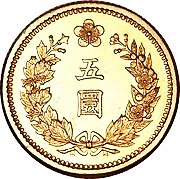 |
Copper | The Bank of Korea has information that such a coin was minted. But the coin itself has not survived | ||
| РС12 | Pn38 | 5 WON
五 圜 |
1903
光武七年 7 |
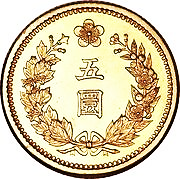 |
Gold plated cooper | It is known only by its number in the Krause catalog | ||
| РС13 | –[200] | 10 WON
十 圜 |
1903
光武七年 7 |
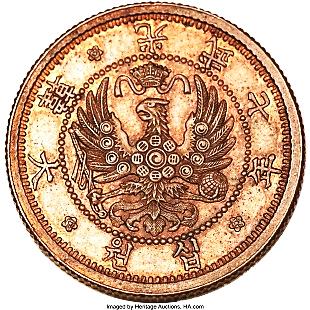
Crowned Korean imperial Type III Eagle with the symbols of the elements Water, Heaven, Thunder, Wind, Mountain, Earth, Lake, and Fire, in the middle surrounding a Yin and Yang sign, as well as four Yin and Yang signs on each wing Above legend in hanja characters:
Translation:
At the bottom is the denomination in Korean Hangul script
|
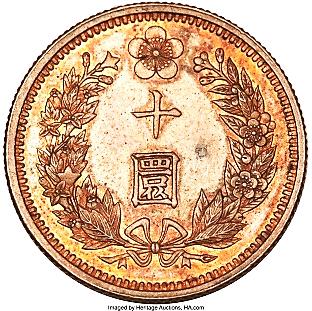
Denomination (in hanja text): 十 ten 圜 won surrounded by wreath from the branches of platycodon grandiflorus (left) and plum (right). Plum flower Ihwamun above |
Copper | ⌀ 21.2 mm | Heritage Auctions, Sept. 8, 2011[201]
(from the collection of Norman Jacobs) MS64 $ 103 500 Rarity of R5 according to the Bank of Korea |
CONCLUSION
The monetary reform carried out by Yi Young-ik was doomed to failure from the very beginning. Coins of the old designs, even the Sangpyeong Dongbo, were not withdrawn from circulation and were not exchanged for new coins with the Eagle, remaining legal tender. There was no gold in the treasury to back the gold standard. Yi Young-ik, on behalf of the government, distributed concessions for mines, the construction of railways, for the purchase of ginseng to American and Japanese companies, took endless loans, gradually turning Korea into a semi-colony of foreign states, the absolute leader among which was Japan. The lion’s share of the money received from loans and concessions went to exorbitant expenses of the imperial court and ended up in the pockets of dishonest officials.
The Japanese bank Daiichi Ginko, whose Korean branches accounted for 60% of the funds in the accounts of Korean government agencies, actually appropriated the functions of the state bank of Korea. In 1899-1904, he was the main creditor of the Korean government.
The Japanese government itself could no longer control the flow of counterfeits made in Japan by individuals and entire corporations. Nickel was openly imported into Korea for the manufacture of counterfeit coins, which were brought into the country in finished form by almost every Japanese steamer that arrived. In November 1902, the Japanese government banned the production of Korean coins in their country and their import into Korea. Korean customs were given the right to prosecute Japanese people caught importing counterfeits. During 1902, 3.5 million counterfeit nickel coins were confiscated by customs[202].
Yi Young-ik’s ban on Daiichi Ginko Bank credit notes of September 11, 1902 lasted only a few months until January 8, 1903. Unlike the Korean coin, which was constantly depreciating, these bonds could be exchanged for Japanese yen at a stable rate, and thus they gained even greater strength as public confidence in its issuance grew. All more or less large trade transactions were made only in Japanese money.
According to the “Regulations on Monetary Circulation” of May 22, 1901, approved by the Imperial Decree of Gojong No 4, the exchange rate of the Korean won against the Japanese yen was set at 1:1. But already in 1902, when new coins with the Eagle were put into circulation, the value of the won fell to 0.56 Japanese yen[203], and the fall continued. The minting of these coins was to be backed by gold, for which the new coins were to be freely exchanged. There was no gold in the treasury, so after 1902 the regular minting of coins with the Eagle stopped. And what had already been minted was simply washed away by a flood of old and counterfeit nickel money and money surrogates.
In February 1904, Japan attacked the Russian fleet in Port Arthur (Manchuria) and Incheon (Korea). The Russo-Japanese War began. Although Korea declared neutrality in the Russo-Japanese War, on February 9, 1904, Japanese troops entered Seoul, as they had done at the beginning of the Sino-Japanese War, and kidnapped several pro-Russian figures in Korea, including Yi Young-ik. On August 22, 1904, the “temporary” Korean Foreign Minister was forced to sign a protocol that effectively deprived Korea of sovereignty in international relations and financial matters. This protocol obliged Korea to attract financial and diplomatic advisers appointed by Japan. In addition, the protocol obliged Korea to consult with Japan before concluding treaties with foreign powers, as well as before granting concessions or concluding contracts with foreigners. With Japan’s victory in 1905, its plans to destroy Korea as a sovereign state no longer had any obstacles. The United States finally stopped breaking the comedy and openly agreed to the handover of Korea to Japan in the Taft-Katsura Memorandum of July 1905. They recognized Japan’s right to take appropriate measures to “direct, control, and protect” Korea, and Japan in return recognized America’s “right” to the Philippines. On November 17, 1905, the “Eulsa Treaty” was forcibly concluded between the puppet pro-Japanese government of Korea and Japan, as a result of which Korea was deprived of its national sovereignty under the so-called Japanese protectorate. Emperor Gojong refused to sign it. On July 20, 1907, Gojong was deposed. He spent the rest of his life imprisoned in his palace Deoksugung, where he had moved from the Russian mission. The Japanese placed his mentally retarded son Sunjong on the throne, who was forced to sign the Treaty of Accession of Korea to Japan on August 22, 1910. As a state, Korea ceased to exist even nominally.
In 1904, the Japanese Ministry of Finance sent Megata Tanetaro to Korea as a financial adviser. One of his first measures was to close all mints in Korea and initiate monetary reform. First of all, this meant the withdrawal of copper-nickel coins from circulation. In November 1904, the Central Mint in Yongsan was closed, and all its machines and tools were taken to Osaka. Licensed and unofficial coinage was also reduced.
In 1905, the Osaka Mint began issuing Korean coins in a completely new series, almost exactly modeled after Japanese coins (even using the same blanks). The eagle disappeared from them forever. Old coins were withdrawn from circulation and exchanged for new ones at different rates. First of all, the population was obliged to hand over coins with the Eagle, as Japan sought to do away with the memories of the state symbols of the Korean Empire. They were accepted at the most favorable rate, so that the population would definitely pass them. In August 1909, the Japanese banned the use of all Korean postage stamps. The fate of coins with the Eagle pattern is even more tragic. 12 tons of coins were sold as scrap metal to a Japanese company and melted down. The Japanese meticulously destroyed single specimens. Only a few of these coins remain, which is why they are so expensive at auctions. Coin stamps were also destroyed, so copies of these coins that sometimes appear on the market are not made with the original stamps, and do not have numismatic value. Until now, Eagle coins have not been classified, and the present work is to date the first and only scientific classification of them.
In any case, I have tried to answer all the questions related to these coins. They were not minted by the Russian-Korean Bank. State Councilor K. A. Alekseyev did not head this bank. They were not minted at the St. Petersburg Mint. These coins were the official state issue of coins of the Emperor of Korea Gwangmu (Gojong). All of them were minted at the Yongsan Mint (Seoul). The eagle on the coins is not the emblem of the Russian-Korean Bank or an abstract “eagle in the Russian style”. It is the national emblem of the Korean Empire. There has never been any Russian occupation and Russian domination over Korea. And whether these coins belong to Russian numismatics, let the numismatic community decide.
References
https://www.bok.or.kr/eng/singl/crrncySearchEng/view.do?crrncySn=40&menuNo=400391&nationEngCd=0123&listType=G&korAt=Y&crrncyStleenCd=02&crrncyKndEnCd=01&searchCnd=1&searchKwd=&pageIndex=2
https://www.bok.or.kr/eng/singl/crrncySearchEng/view.do?crrncySn=39&menuNo=400391&nationEngCd=0123&listType=G&korAt=Y&crrncyStleenCd=02&crrncyKndEnCd=01&searchCnd=1&searchKwd=&pageIndex=2
Electronic resource: https://koreanmedals.com/empire-orders-found-in-pictures/
31. Dr. Norman Jacobs Collection of Korean and Japanese Coins to debut in Heritage September 2011 Long Beach Auction / Heritage Auctions. Press Release – December 1, 2010. Electronic resource: https://coins.ha.com/heritage-auctions-press-releases-and-news/dr.-norman-jacobs-collection-of-korean-and-japanese-coins-to-debut-in-heritage-september-2011-long-beach-auction.s?releaseId=1939
https://dspace.ewha.ac.kr/handle/2015.oak/182912
https://en.namu.wiki/w/검독수리?from=국가수리#국가수리
https://www.koreatimes.co.kr/opinion/20220306/the-short-lived-russo-korean-bank-of-1898
https://ia801206.us.archive.org/4/items/NPDP18971225/NPDP18971225_text.pdf
https://www.coinworld.com/news/world-coins/jacobs-collection-stuns-nets-6-8-million.html
https://n.news.naver.com/mnews/article/032/0000063380?sid=102
https://m.cafe.daum.net/coreahistech/M5JA/795?listURI=%2Fcoreahistech%2FM5JA
https://www.kci.go.kr/kciportal/ci/sereArticleSearch/ciSereArtiView.kci?sereArticleSearchBean.artiId=ART002688497
《韓國의貨幣》,韓國銀行1994年版 (The National Currency of Korea, Bank of Korea Annual Publication, Seoul, 1994. Chinese).
References (Russian)
1. Федеральный закон Российской Федерации от 10 июля 2002 года № 86-ФЗ «О Центральном банке Российской Федерации (Банке России)».
2. Устав Русско-Корейского банка / Полное собрание законов Российской Империи. Собрание третье. Том XVII. 1897 год. СПб, 1900, с. 671. № 14747.
3. Биткин В.В. Сводный каталог монет России. Ч. 1 – 2. Изд. Юнона-Монета. Киев, 2003.
4. Вебер, К. И. Записка о Корее до 1898-го года и после, составлена в 1903 г. во время пребывания в Сеуле в связи с торжествами по случаю 40-летия восшествия Коджона на престол. Впервые опубликована полностью в альманахе «Рос. корееведение». Вып. 2. М., 2001. Электронный ресурс: https://koryo-saram.ru/k-i-veber-zapiska-o-koree-do-1898-go-goda-i-posle/
5. Гамильтон, А. Корея. Перевод с английского. СПб, Военная типография (в здании Главного штаба), 1904.
6. Дневники святителя Николая Японского. Том ΙII. Санкт-Петербург, Гиперион, 2004.
7. Ильин А. А. Классификация русских удельных монет. Выпуск первый. Ленинград, 1940.
8. Корея. История её, политическое устройство, экономическое положение, торговля и промышленность. Издание редакции «Нового журнала иностранной литературы» (Ф. И. Булгакова). ППб, типография А. С. Суворина. 1904.
9. Кужельный О. Монеты Русско-Корейского банка в Корейской Империи. Электронный ресурс: https://vk.com/@numisma_diagnosis-monety-russko-koreiskogo-banka-v-koreiskoi-imperii
10. Курбанов С. О. История Кореи с древности до начала XXI века. 3-е изд., исправленное. Изд-во СПб университета, 2018.
11. Монеты «Русской» Кореи 1902 года./ Коллекционирование как хобби. 5 фев 2022. Электронный ресурс: https://vk.com/wall-142563041_7933
12. Пак Б. Д. Россия и Корея. М., ИВ РАН, 2004.
13. Романов Б.А. Россия в Манчжурии. 1892-1906. Ленинград, 1928.
14. Сувиров Н. И. Корея. Страна и её история последнего времени. СПб, изд. книжного маг. К. Фельдман, 1904.
15. Тихонов В.М., Кан Мангиль. История Кореи: В 2 т. Т. 1: С древнейших времен до 1904 г. / Ред., сост. хрон. табл., сост. указателя Т. М. Симбирцева. (Orientalia et Classica: Труды Института восточных культур и античности: вып. 41.) М.: Наталис, 2011.
16. Хабибуллина Э.К., Абульханова М.С. Русско-Корейский банк: неудавшаяся попытка контроля корейских финансов в к. XIX в. // Корееведение в России: направление и развитие. 2023. Т. 4. № 4. С. 128–134.

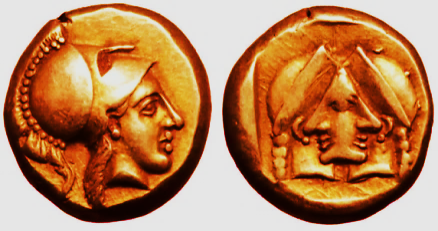
No 1, April 2025
E-mail: nxxivek@inbox.ru
ISSN 3033-7674 (Online), ISSN 3033-7666 (Print)
Electronic Scientific Periodical (St. Petersburg, Russia)
Certificate of the Federal Service for Supervision of Communications, Information Technology and Mass Media (Roskomnadzor)
Эл No ФС77-87449
The journal is registered and published in Russia. The journal publishes articles from all over the world and in all branches of science. The journal is published in Russian.
Articles are accepted daily.
Frequency: as the material is typed.
All articles are peer-reviewed
Each author receives a free certificate of publication.
Free access to the electronic version of the magazine.
By sending an article to the editorial board, the author confirms its uniqueness and bears full responsibility for it for the possible consequences of copyright infringement
Editorial Group
Editor-in-Chief
Vorontsov Vladimir Valentinovich
Executive Secretary
Kholmanskikh Maria Viktorovna
Managing Editor
Ivanov Maxim Dmitrievich
Reviewers
Dimitrienko Andrey Igorevich,
Ph.D., First St. Petersburg State Medical University named after Academician I.P. Pavlov
Pyrkh Andrey Ivanovich,
Ph.D., St. Petersburg State University
_____________________________________________________________________________
Contacts
 190031, Russia, St. Petersburg, Kazanskaya str., 35, lit. A, apt. 15
 +7 931 712-95-96
 nxxivek@inbox.ru
_____________________________________________________________________________
© Founder: Polis Ltd (OGRN 1097847170871)
190031, St. Petersburg, ext. Ter. Admiralteysky Municipal District, Kazanskaya St., 35, lit. A, apt. 15

Electronic resource: https://ria.ru/20250131/deepseek-1996714057.html ↑
https://web.archive.org/web/20220311105026/https://www.bbcrussian.com/russian/news-60699063 ↑
timesmachine.nytimes.com/timesmachine /1928/08/04/109858507.html?pageNumber=25 ↑
Since 1934, the U.S. Export-Import Bank (EXIM) has provided U.S. taxpayer funds for foreign purchases of U.S. capital goods and related services, guaranteeing or insuring loans to international buyers. EXIM is an independent agency of the executive branch and the official export credit agency of the United States. EXIM assumes credit and government risks that the private sector is unable or unwilling to take.
“A report by the National Bureau of Economic Research’s Debbie Lucas of the Massachusetts Institute of Technology said that the long-term EXIM loan guarantee program actually provides guarantees [to foreign buyers] at a loss to taxpayers, not a profit. Moreover, this analysis shows that EXIM loan guarantees are provided on sufficiently generous terms that [foreign] borrowers receive subsidies of about 1% of the loan amount. That means taxpayers will have to pay $200 million for the $21 billion in loans the bank will make in 2012.” (Jason Delisle; Christopher Papagianis, 29 March 2012. “Critics of the Export–Import Bank Have a New Weapon at Their Disposal: Fair-Value Accounting”. – Economic Policies for the 21st Century. The Manhattan Institute). ↑
https://www.elibrary.imf.org/view/journals/024/1950/002/article-A002-en.xml ↑
https://en.numista.com/catalogue/pieces24481.html ↑
https://www.koreatimes.co.kr/opinion/20220306/the-short-lived-russo-korean-bank-of-1898 ↑
https://koreanmedals.com/empire-orders-found-in-pictures/ ↑
(The famous mint of the “Korean Empire” Yongsan mints coins – Daily Headlines. 2017-12-01 Published in History by Taoxin). (Chinese). Electronic resource https://kknews.cc/history/mebnkmg.html ↑
https://m.cafe.daum.net/coreahistech/M5JA/795?listURI=%2Fcoreahistech%2FM5JA ↑
(The famous mint of the “Korean Empire” Yongsan mints coins – Daily Headlines. 2017-12-01 Published in History by Taoxin). (Chinese). Electronic resource https://kknews.cc/history/mebnkmg.html ↑
Электронный ресурс: https://koreanmedals.com/orders-of-the-korean-empire/ ↑
https://m.cafe.daum.net/coreahistech/M5JA/795?listURI=%2Fcoreahistech%2FM5JA ↑

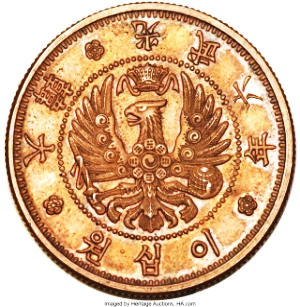 大韓
大韓 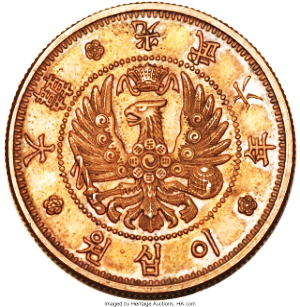 光武五年
光武五年 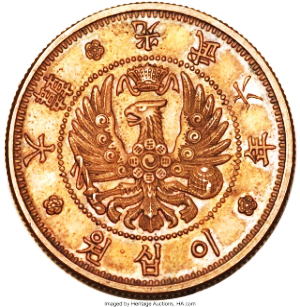 Translation:
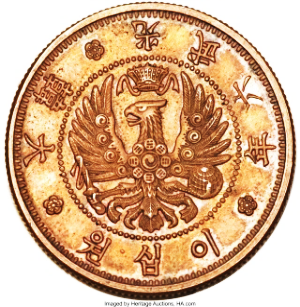 Great Han
 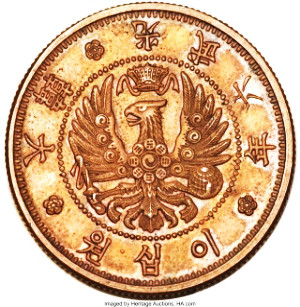 Gwang Mu 5 year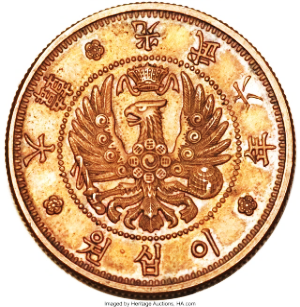
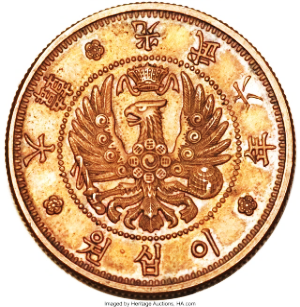 십원
십원 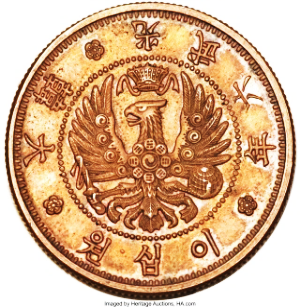 (“10 won”).
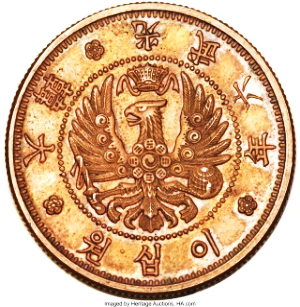 大韓
大韓 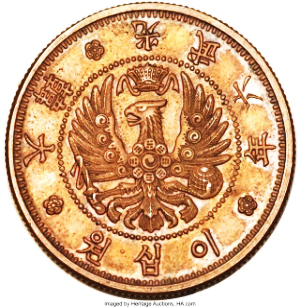 光武六年
光武六年 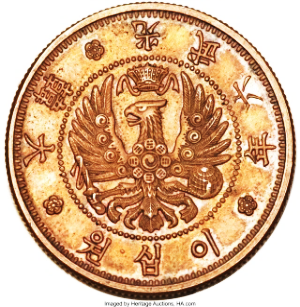 Translation:
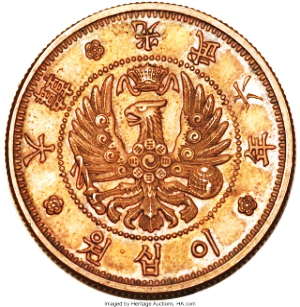 십원
십원 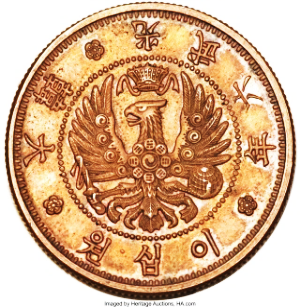 («10 won»)
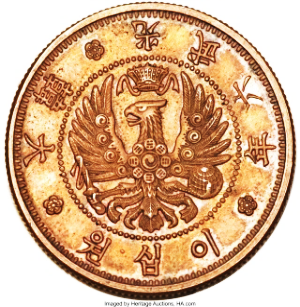 光武六年
光武六年 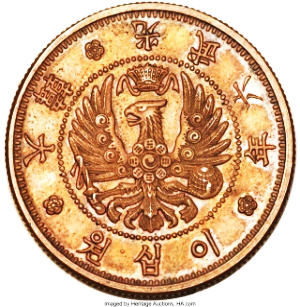
 Translation
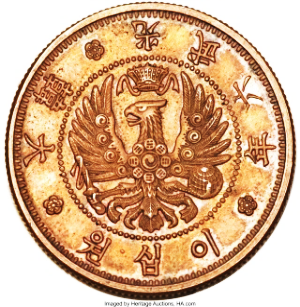 Great Han
 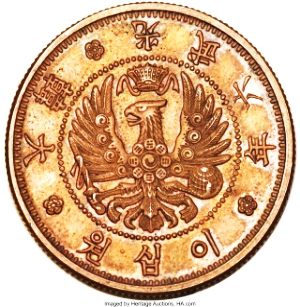 Gwang Mu 6 year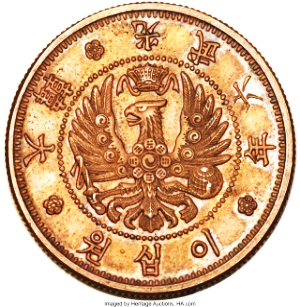
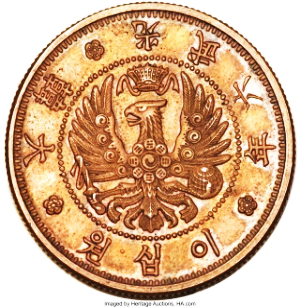 이십원
이십원 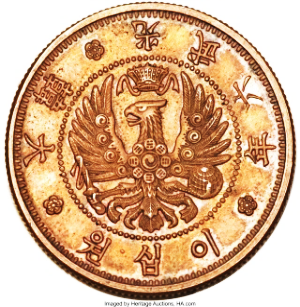 («20 won»).
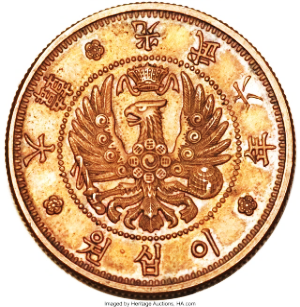 大韓
大韓 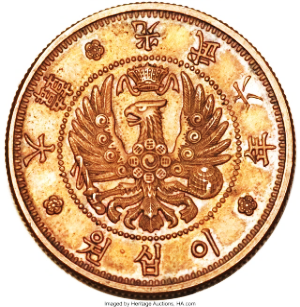 光武六年
光武六年 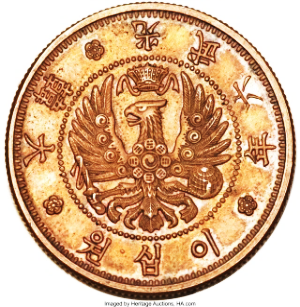
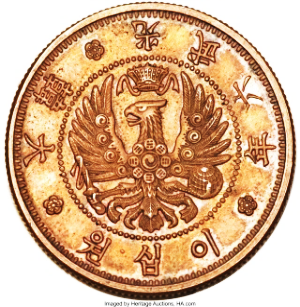 Great Han
 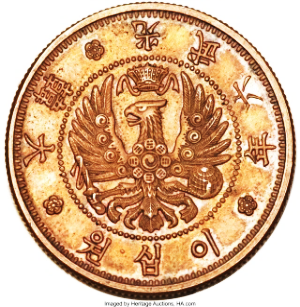 Gwang Mu 6 year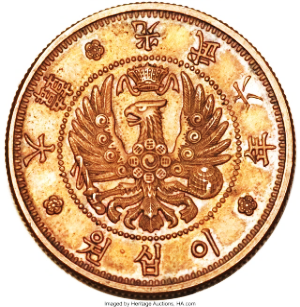
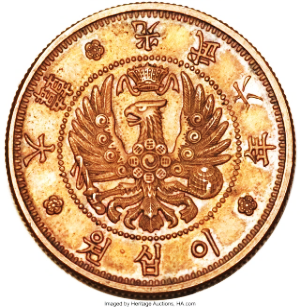 이십원
이십원 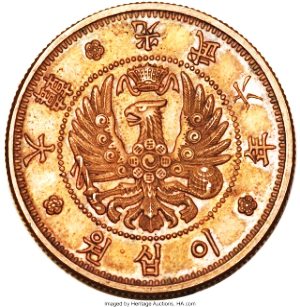 («20 won»). Fluted bezel
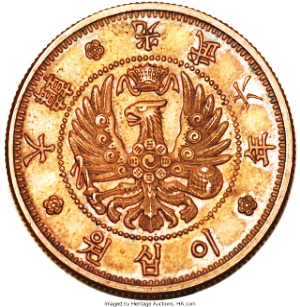 大韓
大韓 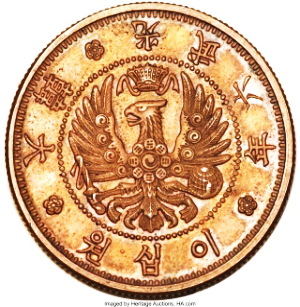 光武七年
光武七年 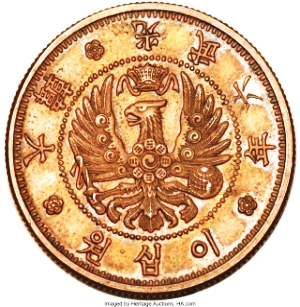
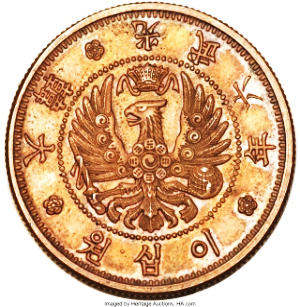 Great Han
 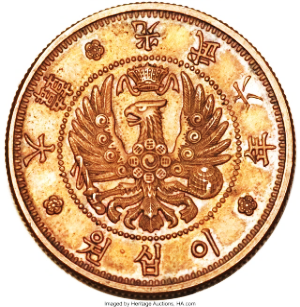 Gwang Mu 7 year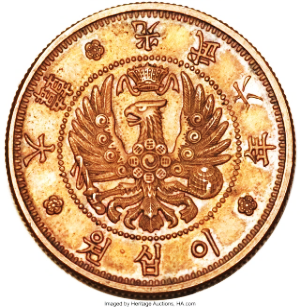
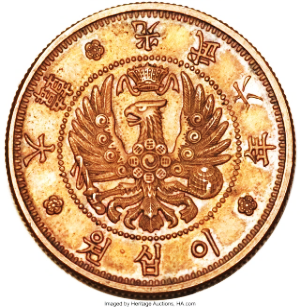 십원
십원 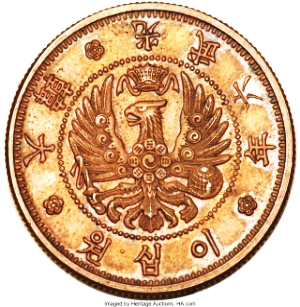 («10 won»). Fluted bezel