Articles that inspire and inform!
Publisher of POLIS LLC
Address: 190000, Saint Petersburg,
35/15 Kazanskaya Street
Publisher of POLIS LLC
Address: 190000, Saint Petersburg,
35/15 Kazanskaya Street



ISSN 3033-7666 (Print)
ISSN 3033-7674 (Online)
No 2 (11), February 2026
CERTIFICATE OF THE FEDERAL SERVICE FOR SUPERVISION IN THE FIELD OF COMMUNICATIONS,
INFORMATION TECHNOLOGY AND MASS COMMUNICATIONS (ROSKOMNADZOR)
Эл № ФС77-87449
SCIENTIFIC PERIODICAL EDITION (ST. PETERSBURG, RUSSIA)
16+
The journal is registered and published in Russia
The journal publishes articles in all scientific fields
The journal is published in Russian and English
All articles are peer-reviewed
Free access to the electronic version of the journal
By sending an article to the editorial board, the Author confirms its uniqueness and bears full responsibility for it
Editorial staff
Editor-in-Chief
Vorontsov, Vladimir Valentinovich
Managing Editor
Ivanov, Maxim Dmitrievich
Executive Secretary
Kholmanskikh, Maria Viktorovna
Reviewers
Pyrkh, Andrey Ivanovich,
Ph.D., St. Petersburg State University
Dimitrienko, Andrey Igorevich,
Ph.D., First St. Petersburg State Medical University named after Academician I.P. Pavlov
_____________________________________________________________________________
Contacts
 190031, Russia, St. Petersburg, Kazanskaya str., 35, lit. A, apt. 15
 +7 931 712-95-96
 nxxivek@inbox.ru
_____________________________________________________________________________
© Founder: Limited Liability Company “Polis” (OGRN 1097847170871)
190031, St. Petersburg, ext. Ter. Admiralteysky Municipal District, Kazanskaya St., 35, lit. A, apt. 15
Contents
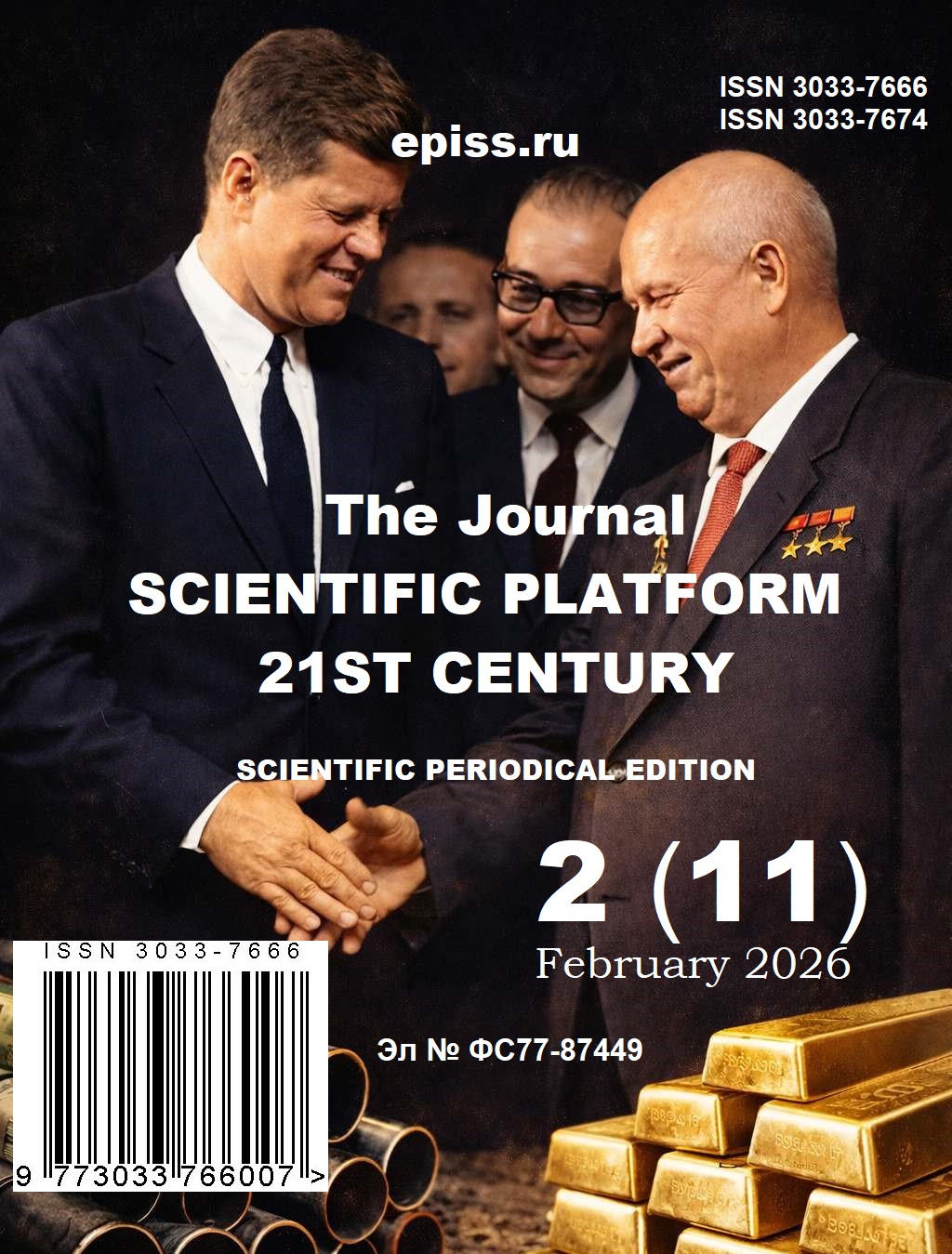
Cover image generated by LLM GPT-5, copyright ©: Adel Kildeev © 2026, Adel Kildeev © 2026, permission to use the images by the journal has been obtained.
From Editorial Board…………………………………………………………..………3
Vorontsov, Vladimir Valentinovich. Critical analysis of publications of Ancient Russian chronicles translated into modern Russian…………………………………….4
Gabriela Gavrilov. Western-Soviet Commercial Relations 1960-1990 and the growing Soviet debt to the West, Part 1: the 1960S..…………..……………..………..55
Sapego Olga Vasilevna.Stalking-silent threat: historical excursus and modern solutions……………………………………….……………………………..…………70
Adel Kildeev Two Lawsuits against Bit Tech (Meta, Snapchat. Google): How parallel lawsuits in the United States destroyed the Defendants’ defense strategy..…………………………………………………………………………….…………82
FROM THE EDITORIAL BOARD
The world is changing faster than law, economics, and science can comprehend it. Technology creates new forms of power, platforms shape behavior, and responsibility for the consequences of these processes is increasingly blurred or delayed.
The journal “Scientific Platform XXI Century” was created as a response to this gap. In recent months, the publication’s basic infrastructure has been established: the official website of the journal has been launched, the editorial and review model has been established, and a bilingual publication format (Russian and English) has been established. The journal functions as an open scientific platform with access to electronic versions of articles.
The journal has received international ISSN registration and is in the process of being included in the Russian Science Citation Index (RSCI), with subsequent expansion of the index. However, something else is fundamentally important to us. We do not view the journal as a tool for publishing texts. We view it as a space for the formation of meaning. The journal’s themes are determined not by disciplines, but by problems: law in the context of technological transformation, the responsibility of digital platforms, the economics of real assets and resources, and the limits of technological intervention in human life. We consciously support an interdisciplinary approach, uniting law, economics, history, technology, and philosophy in a single research field.
The journal’s editorial board is open to collaboration with authors capable of offering original ideas, formulating problems, and engaging with material at the level of analysis rather than compilation.
We are interested in publications that:
– formulate a position,
– develop scholarly discussion,
– go beyond formulaic academic writing.
The journal “Scientific Platform 21st Century” is not an archive of texts. It is an attempt to build the intellectual infrastructure of the times in which we live.
Vladimir Valentinovich Vorontsov,
Editor-in-Chief of the journal
UDC 811.161, UDC 94(47).02
A CRITICAL ANALYSIS OF PUBLICATIONS
OF OLD RUSSIAN CHRONICLES
TRANSLATED INTO MODERN RUSSIAN
Vorontsov, Vladimir V.
Saint Petersburg State University (1992)
The Russian Presidential North-Western
Academy of Public Administration (1999)
bras@mail.ru
ORCHID 0000-0003-0120-6134
Abstract. The article by Vladimir Vorontsov is devoted to a critical analysis of the practice of publishing and translating Old Russian chronicles into modern Russian. The author questions established textual and translation approaches, including orthographic modernization, the compilation of variant readings from various manuscripts, and interpretive translation. Based on a comparison of photocopies of original chronicle manuscripts, facsimile sources, diplomatic transcriptions, and classical editions, the presence of systematic discrepancies between the manuscript text and its “prepared” versions is demonstrated.
Particular attention is given to the analysis of key lexemes and ethnonyms, as well as to the reconstruction of the genealogy of interpretative errors in historiography. The author argues that a number of translation decisions, enshrined in the academic tradition, lead to a distortion of the semantic structure of the source. This paper proposes a revision of the methodological foundations of the textual preparation of chronicles and calls for a maximally neutral, formalized approach to translation, based on direct work with manuscript sources.
This article is of significance for source studies, historical philology, and the historiography of Ancient Rus’, stimulating discussion about the limits of acceptable editorial intervention and the status of translation as a scholarly tool.
Key words. Russian chronicles, Rus’ chronicles, Primary Chronicle, Laurentian Codex of 1377, Hypatian Codex, Novgorod First Chronicle, Radziwiłł (Königsberg) Chronicle, V. N. Tatishchev, G. F. Miller, N. M. Karamzin, D.S. Likhachev, O. V. Tvorogov, A. A. Shakhmatov, V. Panov, A. S. Klevanov, M. D. Prisyolkov, Varangians, Rus’, Rurik, Chuds, Slovens, Krivichs, Meryans, Ves (Weś), Khazars, taxation unit, plough, sokha, szeląg, vevertitsa; textual criticism; source studies; historical philology; translation of Old Russian texts; orthographic modernization; diplomatic transcription; facsimile; ethnonyms; semantic interpretation; editorial intervention; historiography of medieval Rus’.
There are no authorities in science.
The only authority is truth.
INTRODUCTION
GENERAL OVERVIEW OF PUBLICATIONS
Since 1841, the Complete Collection of Russian Chronicles (PSRL) has been published in Russia. In addition, since the middle of the 18th century, medieval Russian chronicles have been published in separate editions, both included in the PSRL and outside it. According to the statement of the editorial board of the PSRL, the texts of the chronicles are published in the original, with discrepancies according to various lists, but without translation and commentary. However, in reality, the vast majority of the original chronicles have never been published. All of them, with rare exceptions, were subjected to unceremonious editing during the “preparation of the text for publication.”
Back in the 18th century, the compilers began to edit the originals and publish the chronicles in a spelling system that did not correspond to the original, adapting the texts to their modern spelling rules. This practice has been preserved to the present day. As a rule, letters written above the line, abbreviations under the diacritical symbols “titlo” were removed from the text and obsolete letters s, ѡ, ѿ, ꙋ, ꙗ, ѧ, ѫ, ѥ, ѩ, ѭ, ѯ, ѱ were cut out, and after the reform spelling of 1917/1918 (with some exceptions) also ѳ, ѵ, ɪ, ѣ. The authors arbitrarily replaced these letters are letters in their alphabet. The pinnacle of text emasculation was the removal of hard marks at the end of words, and in some editions – even in the middle of a word, although in ancient times the letter ъ denoted a very real sound – an ultrashort vowel [o]. For example, B. A. Rybakov, B. D. Grekov, and others. Soviet historians, in their works full of quotations from the chronicles, threw out ъ, ѣ and ь from the text wherever possible. If we consider that in the Middle Ages there were no spelling rules as such, and the same word could be written in completely different letters, corrections made by modern authors could turn this word into a completely different meaning.
The disadvantage of such editing is that if one letter is incorrectly replaced by another, the word can acquire a completely different meaning. And if you insert the outermost letters incorrectly, you may get another word instead of one. This is especially true for words whose meaning has changed or even been lost over hundreds of years. A person who knows the language does not need such an emasculation of the text. He will read it in the original without transcription. And a layman still won’t be able to read it, no matter what letters it is written in. Therefore, replacing the spelling of the original raises a reasonable question: what audience is this publication intended for? Not to mention deep doubts about the conformity of the edited text with the original and the need to constantly check the facsimile or photograph of the original in this regard.
Medieval chronicle monuments reproducing the text of a previously created chronicle (protograph), made not by its author, are commonly referred to as apographers. The chronicles are far from identical in content. Historical information about the same event contained in different chronicles may differ significantly or completely contradict each other. These nuances are commonly referred to as “discrepancies.” When publishing, scientists cleverly speculate on this, passing off texts with different readings for different chronicles, or for different lists of the same chronicle, depending on what is beneficial to them. The printed version, as a rule, includes the text that the author of the publication passes off as the only correct one, and discrepancies are marked with small footnotes, which are arranged in such numbers that the reader ceases to pay attention to them. In other words, none of the medieval Russian chronicles was published in the form in which it exists in the original. This is the second significant drawback of the publications of the Russian chronicles.
A pleasant exception is the publication of the Laurentian Codex and the Suzdal Chronicle, which was prepared before the revolution of 1917, but took place only in 1926-1928, with a continuation according to the Academic apographer[1], as well as the Hypatian Codex in 1923[2]. They almost completely correspond to the manuscripts.
You can literally count the facsimile editions of the originals on your fingers. Only 4 chronicles were awarded this honor: Hypatian Codex[3], Laurentian Codex[4], Novgorod First Chronicle[5], and Radziwiłł (Königsberg) Chronicle[6]. Moreover, the first two were not published in their entirety, but only the Primary Chronicle or ’Tale of Bygone Years’ (Old Russian: Повѣсть времѧньныхъ лѣтъ, commonly transcribed Povest’ Vremennykh Let (PVL)). There are also rare colorful facsimile editions of the Illustrated Chronicle of Ivan the Terrible or Tsar-Kniga. But the Tsar-Kniga itself has artistic rather than scientific significance.
The Laurentian Chronicle is available online in the original on the website of the Russian National Library “The Laurentian Codex of 1377. Electronic presentation of the handwritten monument.”[7] The Hypatian Codex has been digitized on the “Hypatian Codex | National Electronic Library – Book Monuments” website[8]. The placement of these monuments with a detailed description can be considered a great achievement of modern science.
But, most surprisingly, so far none of the chronicles has been fully translated into modern Russian. In general, even fewer translations of the chronicles have been published than facsimile copies of the originals. The overwhelming majority of the population of our country, who do not speak Old Russian and Church Slavonic, cannot get acquainted with the Old Russian chronicles, the main and most important written source on Russian history, only because neither the Academy of Sciences nor the official scientific community considered it necessary to translate the chronicles.
But even those translations that have been published are far from perfect. Only selected chronicles were translated, and only in parts. As I have already noted, neither the Archeographic Commission nor the Academy of Sciences were at all concerned with translations of medieval Russian chronicles. They were published at their own expense by the translators themselves. Until 1950, there were only two publications, one before the revolution and the other under Soviet rule. In 1871, A. S. Klevanov published at his own expense a translation of the initial code of the Laurentian Codex (before 1110) with a continuation of the Hypatian Codex (from 1111 to 1200) and an account of further events in southwestern Russia (Galician–Volhynian Chronicle) from 1201 to 1305.[9] The next edition took place only 65 years later: in 1936, the non-governmental publishing house Academia published the collection “Ancient Russian Chronicles” translated by V. Panov[10]. He included the same monuments with abbreviations – the initial code before 1110 – the text edited by A. A. Shakhmatov in the book: “The Primary Chronicle”, volume I, Petrograd 1916 (under the heading “Chronicle of Nestor”), the Kiev Chronicle from 1111 to 1200 and the Galician–Volhynian Chronicle from 1201 to 1291 according to the Hypatian apographer, published in the II volume of the PSRL, 2nd ed. St. Petersburg, 1908.
It was only in 1950 that the Academy of Sciences of the USSR finally published, under its banner, a translation of the Laurentian Codex, but not in its entirety, but only the initial set – the Primary Chronicle – up to 1110, with a continuation about the events of 1111-1117 according to the Hypatian apographer[11]. The author of the text, translation, variant readings, articles and commentary was D. S. Likhachev[12]. 47 years later, in 1997, in volume 1 of the book series “Library of the Literature of Ancient Rus'”, a PVL on the Hypatian Codex, covering events up to 1117, was published with a parallel translation by O. V. Tvorogov[13]. In volume 5 of the same series, another excerpt from the Hypatian Chronicle was published – the Galician–Volhynian Chronicle from 1201 to 1292, translated by O. P. Likhacheva[14]. The so-called “Northern Russian Chronicle Compilation of 1472” and “Independent Church Chronicle Compilation of the 1480s” published in volume 7 of the same series. They are not original medieval monuments, but rather a compilation of several chronicle copies, combined with “reconstructions” of ancient texts. Finally, in 2017, the Laurentian Codex was published in G.M. Prokhorov’s translation[15]. This is the most recent publication.
Not counting the translations of chronicle fragments describing individual historical events scattered across various collections (these are usually called “chronicle stories”) and the PVL editions in retellings for children and for elementary readers, this is an exhaustive list of published translations of medieval chronicles into modern Russian. Of these, only one—namely, D.S. Likhachev’s translation of the Primary Chronicle “according to the Laurentian Codex”—has been reprinted multiple times[16]. Therefore, it is considered almost a “classic” and is constantly cited in the works of historians. The abundance of citations from D.S. Likhachev’s translation in our scholarly literature is not due to the fact that his translation is professional and fully faithful to the original, but rather to its widespread circulation. I will analyze the quality of his translation in as much detail as possible.
1. TEXT PREPARATION METHODS.
STAGE ONE. CHANGING SPELLING
The translator’s task is to convey the text of the literary work they are translating as accurately as possible, both in form and content, without making their own corrections, additions, or “improvements.”
However, the chronicles were translated quite differently. The first stage was the so-called “text preparation.” The “prepared” original text was published alongside the translation so that readers could compare their correspondence. The original text was broken into individual words and sentences, punctuation marks were added, and direct speech was highlighted, as in the medieval original, punctuation was arbitrary, and words were usually not even separated by spaces. Then the text was transliterated, that is, converted into a modern orthographic system. The letters s, ꙋ, ѡ, ѿ, ꙗ, ѧ, ѫ, ѥ, ѩ, ѭ, ѯ, ѱ, which had existed before the introduction of the civil script in 1708/1710, were removed and replaced with the letters of the post-reform alphabet. For example, ꙗ, ѩ, and ѧ were replaced by the letter я; letters ѫ and ꙋ by the letter “у“, ѭ by the letter “ю“, etc. After the spelling reform of 1917/1918, the abolished letters i, ѣ, ѳ, and ѵ were also removed from medieval texts. The letter “i” was replaced by “и“, “ѣ” by “е“, “ѳ” by “ф” or “т“, depending on the word (Ѳеодоръ – Фёдор, ѳеатръ – театр, etc.). The editor himself decided which letters to remove and which to leave in the text.
The general rule for transliterating medieval texts was formulated in an academic publication by O. V. Tvorogov only in 1978: “The text has been rendered with orthographic simplifications: words that were abbreviated in the manuscript have been fully reproduced, letters that are no longer used (“Small Yus,” “Fita,” “Izhitsa,” etc.) have been replaced with the corresponding letters of the modern alphabet, the letters “ъ”, “ь,” and “ѣ” are preserved in all cases.”[17]
Why it was decided to keep the letters ъ and “b” is more or less clear. They have been preserved in the modern alphabet, although in ancient times ъ meant an ultrashort sound [o], and ь – an ultrashort [ɛ]. It is not entirely clear why they decided to keep the letter “ѣ” (“Yat”), which was universally replaced by “e” by spelling reform. I have not found any explanation for why she was awarded such a great honor. This letter was removed from the Russian alphabet on the grounds that the pronunciation of e and ѣ at the time of the reform of 1917/1918 allegedly had almost no differences. However, judging by the surviving evidence, this was not the case. For example, Deputy of the State Duma V. V. Shulgin, in his memoirs of the first audience with Nicholas II in 1907, writes about the peculiarities of the Emperor’s pronunciation as follows:
“Having bypassed everyone, the Emperor went to the middle of the semicircle and made a short speech. I don’t remember the whole of his speech, but I clearly remember the end of it:
– Благодарю вас за то, что вы мужественно отстаиваете те устои, при которых Россия росла и крѣпла…
(– Thank you for courageously defending the foundations under which Russia grew and strengthened.…)
The Emperor spoke softly, but very clearly and clearly. His voice was low, rather thick, and his accent was slightly tinged with foreign languages. He didn’t pronounce “ѣ” much, why did the last word sound not like “крѣпла” (strengthened), but almost like “крепла”.”[18]
General Yu. N. Danilov noted the same features in the speech of Nicholas II: “in the speech of Emperor Nicholas, a barely perceptible foreign accent was heard, which became more noticeable when he pronounced words with the Russian letter “Yat”.”[19]
Based on these testimonies, e and ѣ denoted different sounds after all, if they were distinguished by ear. However, the modern letter e itself can denote completely different sounds depending on the position in the word: [jɛ], [ɛ], [i], and even [ɨ] after the hard consonants ж, ц, ш (жевать, целовать, шептать) (chew, kiss, whisper). At the same time, the “e” sound itself does not exist. From the point of view of transliteration, there is no point in leaving the letter ѣ in the text. Even to distinguish homoforms. There are too few of them. I can only recall one pair: ” ѣсть ” (to eat) and ” есть ” (form of the verb “to be” 3rd person singular present tense).
But when transliterating the letters “Izhitsa” and “Uk” (“Unik”), which are derived from the Greek “upsilon”, the editors of the text were completely confused. The fact is that in the Middle Ages, Izhitsa was written in the same way as the Greek Upsilon – у. It was used mainly in words borrowed from Greek. At the beginning of a word and between consonant letters, it denoted the sound [i]. For example, Егупетъ – Египет (Egypt). And between the vowels – [v]. For example, Еуангелиѥ – Евангелие (Gospel). According to the rules of medieval spelling, the Cyrillic letter “у” was designated by the digraph “оу” (Omicron-Upsilon, Church Slavonic Уникъ “Unik”). In the text, the letter o was often dropped from this digraph. In Skoropis (a type of Cyrillic handwriting script) and the Cyrillic semi-uncial script, the y was placed on top of the o, resulting in the ligature Ꙋ (Church Slavonic Ꙋкъ “Uk”). Thus, the same sign, y, came to represent two different letters. To distinguish them, the lower tail of the Izhitsa was cut off, giving it the appearance of the Latin ѵ, while the upsilon remained in the y form. It came to represent the [u] sound exclusively. However, in the medieval Russian chronicles of the 14th–16th centuries, which we are discussing, this transformation had not yet occurred. In the text of the PVL, where the chronicler quotes the Byzantine chronicle of George Hamartolos, when transliterating the words Суриꙗ, Асурѧне, Вифунию, Старую Фругию, Купръ, Великаꙗ Скуфь, etc., they should be written as ” Сирия, Асиряне, Вифинию, Старую Фригию, Кипръ, Великая Скифь.” However, in absolutely all transliterations of the originals in the chronicle publications, we see an inappropriate letter у in place of the modern и letter.
In turn, the digraph “ оу “, which was considered a single letter and denoted the sound [u], is somehow left unchanged during transliteration. Instead of words like “учитель”, they write “оучитель”, instead of “Синеусъ” they write “Синеоусъ” instead of “утвердити” they write “оутвердити” and so on. This creates the impression that this is precisely how people spoke in ancient times, which is not true. Such selective transliteration appears, to put it mildly, unprofessional, and from a textual perception perspective, it’s a caricature.
2. TEXT PREPARATION METHODS.
STAGE TWO. CONTENT EDITING
But the “preparation of the text” of the chronicle for translation did not end with transliteration. Instead of simply translating the text of the manuscript into modern Russian, editing of its contents began. No one wanted to be just a translator. It was necessary to declare himself as a major scientist, combining a philologist, historian, paleographer, literary critic, etc. In addition, everyone wanted to surpass the chronicler and correct his “mistakes.” Words and whole fragments from other chronicle monuments, as well as “semantic corrections”[20], were necessarily inserted into the text of the chronicle. The comments provided quasi-scientific explanations as to why the chronicler wrote incorrectly and why the translator corrected it. And sometimes there were no comments at all. As a result, the reader received a distorted text that did not correspond to the original literary monument, and a translation of this distorted text.
In the article “An Archaeographic Review of the lists of the Primary Chronicle”, D. S. Likhachev sharply criticized his predecessors, who considered the publication of the Primary Chronicle to be “flawed” based on only one of the well-known apographers, for example, Laurentian. In their opinion, the text of the Laurentian Chronicle is not, on the one hand, the original, author’s text of the PVL (it dates back to 1377, i.e. according to their assumptions, it is more than two hundred and fifty years away from the time of compilation of the PVL), but, on the other hand, it cannot give an idea of the full richness of the contents of all its numerous apographers[21]. That is why they constantly compiled fragments from various chronicles, and supplemented some places with their own fantasies, calling them “scientific reconstruction” of the text. D. S. Likhachev dwells on two examples.
In 1876, L. I. Leibovich attempted to create a “combined text” of the Primary Chronicle “based on all published apographers of the chronicle”[22]. Striving for the greatest possible completeness, L. I. Leibovich combined into a single text all the information from all the apographers of the PVL published by 1876. This text mechanically combines mutually exclusive statements by chroniclers of different eras and different beliefs, reliable information with the fantastic, and connects the obviously incompatible, resulting in the occasional disruption of the integrity and logic of the chronicle narrative. Despite this, L. I. Leibovich’s work lacked a unifying principle, even a mechanical unification of the various texts, and was executed in a rather sloppy manner. It is completely impossible to use L. I. Leibovich’s text today.
Another attempt to create a “stable” text of the Primary Chronicle was made by A. A. Shakhmatov. He pursued a different goal than L. I. Leibovich—to reconstruct the text of the PVL only in its original three editions. However, the text published by A. A. Shakhmatov[23] is largely hypothetical. What we have here is nothing more than an illustration of A. A. Shakhmatov’s own research. A. A. Shakhmatov himself protested against the use of the reconstructions he published as historical sources[24].
In contrast to L. I. Leibovich and A. A. Shakhmatov, D. S. Likhachev presents his version of the PVL as the only correct one. He states: “We are publishing not a ‘combined text’ ‘from all manuscripts’ or a hypothetical reconstruction of the original text, but the actual text that has come down to us in the Laurentian Codex. All the most valuable elements contained in the other manuscripts of the PVL, which supplement, clarify, or contradict the main text we are publishing, are presented by us with explanations in the commentaries. The commentaries, therefore, serve in this edition not only to clarify the text but also to supplement it.”[25]
In fact, Dmitry Sergeevich is lying. His text “The Primary Chronicle according to the Laurentian Codex of 1377” is similarly edited and does not correspond to the text of the Laurentian Codex, as we will now see.
3. THE PRIMARY CHRONICLE (PVL) AND THE LAURENTIAN CODEX
The Primary Chronicle or the Chronicle of bygone years (PVL) is usually called the chronicle, which is appropriately titled (Old Russian “Се повѣсти времѧньнꙑхъ лѣ, ѿкуду есть пошла Рускаꙗ zемлѧ” “This is a description of each year, how our state appeared and where the name of the Russian Land came from,” or similarly); it embraces events up to the second decade of the 12th century and is contained at the beginning of most of the annals of the 14th – 17th centuries. In the oldest codices, one common text is kept fairly stable; in the later ones, it is either shortened and randomly inserted, or combined with another Kiev chronicle codex and the ancient Novgorod news[26].
The Laurentian Codex is the oldest surviving chronicle manuscript. The time of its creation and one of the authors are precisely known to us from the colophon on the last pages (Fig. 1): “And I, an insignificant, unworthy, and sinful servant of God, monk Laurentius, began writing these books, called the Chronicle, on January 14, the day of remembrance of our holy fathers, killed in Sinai and Raithu. I present this to Grand Duke Dmitry Konstantinovich. I write with the blessing of the holy bishop Dionysius. And I finished writing on March 20, the day of remembrance of our holy fathers, who were killed by the Saracens in the monastery of Saint Sava. In the year 6885.” The year 6885 from the Creation of the World is usually translated into the current chronology of the Birth of Christ, as 1377. The Codex got its name from the monk Laurentius.
Fig. 1. Laurentian Codex, reverse of folio 172. Autograph of the monk Laurentius:
и а́zъ худꙑи недостоинꙑи и
многогрѣшнꙑи рабъ бжии
лаврентеи мни Началъ ѥ
“And I, an insignificant, unworthy and sinful servant of God, Laurentius the monk, began…”
The manuscript is a parchment book in large quadrangles, containing 173 folios. Several leaves of the manuscript are missing (gaps between folios 9 and 10, after folio 169, and after folio 170). The leaves are bound into 24 quire-books, the usual number of leaves per quire-book being 8 (there are deviations). However, at the end of the manuscript, the regular structure of the quire-books is disrupted: several leaves have been cut off and replaced with others, glued on the folds (insert folios 157, 161, 167). Up to folio 40, the writing is in a continuous line, and from folio 40 until the end of the manuscript, it is in two columns. The first 40 leaves are written in medium-sized uncial script. On the reverse of folio 40, starting from line 9, a different handwriting begins – semi-uncial, smaller, less meticulous, and in different ink. It is believed to be the handwriting of Laurentius himself (his colophon is written in it). This semi-uncial script, continuing to the end of the manuscript, is interspersed in three places (f. 157, on the verso of 161, the bottom 10 lines, and f. 167) with further small uncial script of varying sizes and different handwritings.
Monk Laurentius calls himself a copyist of other, older chronicle collections. Historians believe the chronicle was copied from three different sources. The first, which we call the Primary Chronicle (folio1 rev. – 96), first recounts the legendary biblical events of how Noah’s sons divided the Earth among themselves after the flood. It then moves on to a description of the origins and dispersal of Japheth’s descendants, dwelling in detail on the Slavs. It then cites legends about the Khazar tribute and the founding of Kiev. The dated section begins with the year 6360 from the Creation of the World (852 AD) and ends after the article for the year 6618 (1110) with a colophon in which Abbot Sylvester, presumably the copyist and editor of the PVL, reports that this chronicler wrote (i.e., the PVL) during the reign of Prince Vladimir, who ruled in Kiev, in the year 6624 (1116). From the 78th to the 85th leaf is placed the so-called “Instruction of Vladimir Monomachos”, which is not found in any of the other chronicles. The second part of the Laurentian Codex (pp. 96–118) describes events in Southern Rus’ from 6619 (1111) to 6669 (1161), and the third (pp. 118–172 rev.) concerns mainly events in the North-East of Rus’ from 6672 (1164). The narrative in the chronicle extends up to 6813 (1305).
Missing leaves: between folios 9 and 10 – 6 folios missing with text from 6406 (898) – 6429 (921); after folio 169 – 4-6 leaves missing with text from 6771 (1263) – 6791 (1283); after folio 170 – 1 sheet missing with text from 6796 (1288) – 6802 (1294).
D.S. Likhachev begins to make mistakes in the translation, beginning with the commentary on the colophon of the monk Laurentius. Announcing the completion of his work, Laurentius asks not to judge him harshly if he has made mistakes:
И нъıнѣ гс̑да ѡц҃и и браꙗ. ѡже сѧ гдѣ буду ѡписалъ . или переписалъ или недописалъ . чтите исправливаꙗ Ба҃ дѣлѧ . а не клените . zанеже книгъı ветшанъı . а оумъ молодъ . не дошелъ.[27]
The translation here is obvious: “And now, gentlemen, fathers and brothers, if I have written myself somewhere, or written too much, or did not finish, do me the honor of correcting, for God’s sake, and do not scold, because the books are ancient, but the mind is young, has not reached.” Laurentius, as a copyist, warns that the books are old, and he might not understand something in them due to his youth.
However, D. S. Likhachev translates the definition of “ветшанъı” related to the word “books” not in the medieval meaning of “old, ancient”, but in the modern meaning of “dilapidated”, that is, they have lost their original qualities. He does this in order to confirm his rather strange thoughts about the state of the sources (Likhachev has one source), from which Laurentius copied his manuscript. Here is what Dmitry Sergeyevich writes: “The dilapidation of the chronicle, from which Laurentius made his parchment list, was considerable: there was no end to the events of 898 in it. and the following years, until 922, there was no account from 1263 – from the middle of the biography of Prince Alexander Nevsky – and until 1283, there was no text from 1288 to the middle of the narrative of 1294. Lavrentius had to make passes in all these places.”[28].
It’s unclear why Dmitry Sergeyevich’s imagination ran wild like this. It’s perfectly clear that Laurentius originally omitted no years from his narrative. Otherwise, the text would have broken off mid-page, not ended precisely at the end of the verso, all three times. And Laurentius undoubtedly would have made notes explaining why he omitted years. We don’t know how many times Laurentius’ chronicle was bound and rebound before it came into the possession of A. I. Musin-Pushkin in the 1790s, nor how many pages were lost. According to expert opinion, the binding of the manuscript is not original; its design and decoration date it to the 15th – early 16th centuries. On the 10th page, in the upper margin, in cursive handwriting from the late 17th – early 19th centuries, is the inscription “Here are not many folios” (Russian “Здѣ много листовъ нѣтъ” – Fig. 2). The manuscript has been edited several times, with pages removed and pasted in; some pages may be inserted. Experts from the National Library of Russia, as I noted above, attribute the missing years to the loss of 11 to 13 pages from the manuscript.
Fig. 2. Laurentian Chronicle, f. 10. Notes in handwriting from the late 17th – early 19th centuries about the shortage of sheets
Unfortunately, this is not the only case where D.S. Likhachev incorrectly translates a single word, which radically changes the meaning of a sentence, does not understand the context, has no idea about the history of the manuscript, which is attached in written form to the storage unit in the library, and gives free rein to his imagination.
4. DISTORTION OF THE TEXT OF THE LAURENTIAN CHRONICLE
Now let’s turn directly to D.S. Likhachev’s translation of the Chronicle’s text.
For example, let’s take the chronicle entry on one of the most significant events in our early history—the legend of the summoning of the Varangians and the “beginning of Rus’.” In his 1950 edition of “The Primary Chronicle according to the Laurentian Codex,” Dmitry Sergeevich first presents the chronicle’s text, or rather, what he presents as its text, and then his own translation. We read the text and translation under the year 6370 from the Creation of the World (862 AD). I’ve highlighted in bold words that are not found in the actual original Laurentian Codex:
«Въ лѣто 6370. Изъгнаша варяги за море, и не даша имъ дани, и почаша сами в собѣ володѣти, и не бѣ в нихъ правды, и въста родъ на родъ, и быша в них усобицѣ, и воевати почаша сами на ся. И рѣша сами в себѣ: „ Поищемъ собѣ князя, иже бы володѣлъ нами и судилъ по праву”. И идоша за море къ варягомъ, к руси. Сице бо ся зваху тьи варязи русь, яко се друзии зовутся свие, друзии же урмане, анъгляне, друзии гъте, тако и си. Рѣша русь, чюдь, словѣни, и кривичи и вси; „Земля наша велика и обилна, а наряда в ней нѣтъ. Да поидѣте княжитъ и володѣти нами”. И изъбрашася 3 братья с роды своими, пояша по собѣ всю русь, и придоша; старѣйший, Рюрикъ, сѣде Новѣгородѣ, а другий, Синеусъ, на Бѣлѣ-озерѣ, а третий Изборьстѣ, Труворъ. И от тѣхъ варягъ прозвася Руская земля»[29].
D.S. Likhachev offers us this translation of this passage:
“In the year 6370. They drove the Varangians overseas and did not pay them tribute, and began to rule over themselves. But there was no truth among them, and clans rose against clans, and they waged strife and began to fight among themselves. And they said to themselves: ‘Let us seek a prince who will rule over us and judge us by law.’ And they went overseas to the Varangians, to the Rus’. Those Varangians were called Rus’, just as others are called Swedes, and others Normans and Angles, and still others Gotlanders—those were their names. The Chud, Slavs, Krivichi, and Ves’ said to the Rus’: ‘Our land is great and abundant, but there is no order in it. Come and reign over us.'” “And three brothers were elected with their clans and took with them all of Rus’, and came to the Slavs, and the eldest, Rurik, sat in Novgorod, and the second, Sineus, in Beloozero, and the third, Truvor, in Izborsk. And from those Varangians the Russian land was named.”[30]
Please note that in D.S. Likhachev’s translation, Rurik and his brothers “came to the Slavs.” His own “original” version doesn’t mention any Slavs. In D.S. Likhachev’s second edition of 1996, the Slavs disappear from the translation.
Now let’s turn to the actual original Laurentian Chronicle, according to the 1377 manuscript. I’ll provide a color photograph of the 7th folio of this manuscript (Fig. 3). It’s immediately obvious that the date of the Varangians’ invocation and the “beginning of Rus'” is not 6370, as D.S. Likhachev puts it, but 6369 from the Creation of the World, i.e., 861 CE:
in year 6 3 6 9
ↆ ↆ ↆ ↆ ↆ ↆ
Fig. 3. Laurentian Codex, 1377 (RNL, F.n.IV.2), f. 7
Text broken down into individual words and sentences with punctuation marks:
Въ лѣ҂ꙅтѯѳ
Иzъгнаша варѧги zа море и не даша имъ дани. И почаша сами в собѣ володѣти. И не бѣ в нихъ првдꙑ, и въста родъ на родъ, быша в ни оусобицѣ, и воевати почаша сами на сѧ. Рѣша сами в себѣ: «Поищемъ собѣ кнѧzѧ, иже бꙑ володѣлъ нами и судилъ по праву. Идаша zа море къ варѧгомъ к Русɪ. Сице бо сѧ zваху тьи варѧzи суть, ꙗко се друzии zъвутсѧ свое, друzии же оурмане, анъглѧне, друzıи гъте, тако и си. Рѣша Русь чюдь, словѣни и кривичи: «Всѧ zемлѧ наша велика и ѡбилна, а нарѧда в неи нѣтъ. Да поидѣте кнѧжитъ и володѣти н ми». И иzъбрашасѧ г братьꙗ с родꙑ своими, поꙗша по собѣ всю русь, и придоша. Старѣишии Рюрикъ. А другии, Синеоусъ – на Бѣлѣ-ѡzерѣ, а третии – Иzборьстѣ, Труворъ. Ѿ тѣхъ проzвасѧ Рускаꙗ zемлѧ.
The passage is translated as follows: “In the year 6369. They drove the Varangians overseas and did not give them tribute. And they had no justice, and clans rose against clans, they had strife, and began to fight among themselves. They said to themselves: “Let us seek a prince who would rule over us and judge by law. So they went overseas to the Varangians, to the Rus’. For so were those Varangians called, as others are called Swedes, others Urmans, Angles, others Goths; so were they. The Chud, Slovenes, and Krivichi said to the Rus’: “Our whole land is great and abundant, but there is no state structure in it. Come and reign over us and rule over us.” And three brothers with their clans were elected, taking with them all of Rus’, and they came. The eldest Rurik. Another, Sineus, was on Beloozero, and the third, Truvor, was in Izborsk. The Russian land got its name from them.”
In historical scholarship, the date of the “beginning of Rus'” is generally accepted to be 6370/862. This date appears in most Russian chronicles. But as a translator, Likhachev shouldn’t be interested in other chronicles. He’s translating the Laurentian Codex. And yet, we see that the Laurentian Codex gives a different year: 6369/861. This doesn’t bother Dmitry Sergeyevich in the least, and he calmly substitutes 6370 for 6369 in both the translation and the original. Moreover, in his commentary, he doesn’t even bother to explain why he did this. Such an approach to his work cannot be called professional.
It should be noted that the date 6369 (861) is not a mistake by the chronicler. In the “Chronicle of Polish, Lithuanian, Samogitian, and All Rus'” by the Polish chronicler M. Stryjkowski (1582), the date of the Varangian invocation is also 861, not 862. Stryjkowski, however, believes that 861 corresponds to the year 6370 from the creation of the world, “according to the Russian reckoning.”[31]. The event that occurred 20 years later—the campaign of Rurik’s successor, Prince Oleg, from Novgorod to the south and his capture of Kiev—is also dated by the Laurentian Chronicle not by 6390 (882), as other chronicles do, but by 6389 (881). This confusion of dates is, in fact, not surprising. The year in Ancient Rus’ did not begin on January 1st, but began differently in different eras. It could begin on September 1st (as was the custom in Byzantium), or on March 1st. Moreover, the year in Rus’ that began six months after the Byzantine September New Year was called the March year. However, the New Year could also begin six months earlier than the September New Year. At that time, it was considered a year according to the Ultra-March calendar. Which of these three calendars—September, March, or Ultra-March—the chronicler used is quite difficult to determine. Therefore, if the chronicler’s year is different from the one considered correct by modern historians, this does not mean the chronicler made a mistake. The translator’s task is to accurately translate both the text and the date, not to correct them, as D.S. Likhachev does. It is precisely because of such corrections that it becomes impossible to understand the calendar the chronicler used and to establish the exact date of the event described.
Now let’s look at the text itself.
D.S. Likhachev’s most common error is the mistranslation of interlingual homonyms. He always translates words that are identical in spelling or pronunciation in Old and Modern Russian but have completely different meanings with their modern meanings, leaving them untranslated. I’ve already mentioned that he incorrectly interprets the Old Russian word “ветхии”, “ветшанъıи”, which is translated into modern terms as “old,” “former,” or “ancient” in the context of the colophon of the Laurentian Codex as “ветхий”, meaning “having fallen into disrepair,” and based on this, draws the false conclusion that the chronicler copied it from manuscripts so “dilapidated” that he was forced to omit several decades from the narrative.
In the passage I cited above about the calling of the Varangians, Dmitry Sergeyevich translates the phrase “И не бѣ в нихъ првдꙑ as “and there was no truth in them”, although the word “првдꙑ” in this context means “justice”, “order based on justice” ; and the sentence is translated as “and there was no justice among them.”
In the sentence “Всѧ zемлѧ наша велика и ѡбилна, а нарѧда в неи нѣтъ,” in this context, the word “нарѧда” does not denote “order” in the broad sense of the word, as Dmitry Sergeyevich translates, but “state structure.” Commentators on the 2012 edition of D.S. Likhachev’s translation defend Dmitry Sergeyevich, explaining: “At the same time, the words “there is no order in it” are a tribute to the traditional translation. In Laur. and Hypat. “[It reads] ‘order,’ that is, ‘state structure.'” Here, I think, additional commentary is needed. And what is a “traditional translation”? Since when has making incorrect translations become a tradition in academic science? After all, we are talking about the translation of the main written source on the ancient history of our country! It wouldn’t occur to anyone to translate the airplane control manual incorrectly!
We’ll see later that D.S. Likhachev faces exactly the same problems with the translation of the word “ꙗzъıкъ” (Old Russian for “people”), which he translates literally as “language.”
But we’ll discuss this later. First, let’s note how liberally Dmitry Sergeyevich treats the original text, inserting words that aren’t there at his own discretion, and conversely, removing words from the text and replacing them with others.
According to Likhachev’s “translation,” the original reads: “And three brothers were elected with their clans, and they took with them all of Rus’, and came to the Slavs, and the eldest, Rurik, sat in Novgorod, and the second, Sineus, sat at Beloozero, and the third, Truvor, sat at Izborsk.” In fact, there are no Slavs or Novgorod mentioned. The original text reads: “And three brothers were elected with their clans, taking with them all of Rus’, and came. The eldest, Rurik. And the second, Sineus, sat at Beloozero, and the third, Truvor, sat at Izborsk.” As I already mentioned, Dmitry Sergeyevich removed the Slavs in the second edition. It’s not hard to guess where these Slavs came from. They “accidentally” migrated into D.S. Likhachev’s Laurentian Codex, from another, later one—the Hypatian Codex, (c. 1425) and the Radziwill Chronicle. However, in those, the place of Rurik’s initial reign is named not as Novgorod, but as an entirely different city—Ladoga (Fig. 4A). According to those same chronicles, Novgorod was founded by Rurik only two years after his calling (Fig. 4B).
|
Translation: And three brothers were chosen, along with their clans, and they took with them all of Rus’, and came first to the Slavs. And they built the city of Ladoga. And the eldest, Rurik, settled in Ladoga. And another, Sineus, on Beloozero. And the third, Truvor, in Izborsk. And from these Varangians the Russian land was named… |
Translation: Two years later, Sineus and his brother Truvor died. Rurik assumed complete power. He came to Ilmer and built a city on the Volkhov River, calling it Novgorod. He then took up his princely reign. |
Fig. 4А Fig. 4B
PVL of Hypatian Codex. Archaeographic Commission publication. St. Petersburg, 1871. P. 14
Where did D. S. Likhachev get the phrase “and the elder Rurik sat in Novgorod”? In a footnote about variant readings, he writes: “Added from T.”[32] By T, Dmitry Sergeyevich means the Trinity apographer or Trinity Chronicle, the original of which burned during the 1812 fire in Moscow, and is known only in the reconstruction by M. D. Prisyolkov.[33] However, even this reconstruction does not say that Rurik “sat in Novgorod.” Here is a quote from it: «И изъбрашася 3 братеники с роды своими и пояша по собѣ всю Русь. И придоша старѣишии Рюрикъ, а другии Синеоусъ на Бѣлѣ озерѣ, а третии во Изборстѣи Труворъ»[34] (“And three brothers with their families were chosen and took charge of all of Rus’. And the elder Rurik came, and the others Sineous at Beloozero, and the third Truvor at Izborsk”). N. M. Karamzin, who saw the Trinity Chronicle before it burned, writes the following (1816): “In the Pushkin parchment apographer by Nestor (this is how Karamzin calls the Laurentian Codex, after the name of its owner, A. I. Musin-Pushkin – V.V.): the eldest Rurik came… and another Sineus to Beloozero, and a third to Izborsk Truvor. The name of the place where Rurik reigned is omitted; in Trinity Chronicle (which is worthy of note) also”[35].
Despite this evidence, D.S. Likhachev continues to assert in his explanatory article that the Trinity Chronicle contains information about Rurik coming to rule in Novgorod, and as “proof” of the accuracy of his insertion, he asserts that “the Laurentian Codex leaves a blank space after the word ‘Rurik’.”[36]. He claims that this blank space was specifically left for the words “sat in Novgorod.” But if we look at the original Laurentian Codex (Figure 5), we see that there are no blank spaces after the word “Rurik” (I’ve highlighted the word “Rurik” with a light background).
Fig. 5. Laurentian Codex of 1377 (RNL, F.n.IV.2), f. 7
Translation:
“…by us. And three brothers with their families were elected, took all of Rus’ with them, and came. The eldest, Rurik, and the second, Sineus on Beloozero, and the third, Truvor, in Izborsk.
The Russian land was named after them.”
The word “Rurik” is highlighted.
The Primary Chronicle devotes considerable attention to listing the peoples who settled in Europe and who “sits” where. At the very beginning of the manuscript, the chronicler recounts how Noah’s three sons—Shem, Japheth, and Ham—divided the Earth among themselves. Japheth was given Europe and part of Asia by lot. The chronicler then lists the peoples who “sit” in Japheth’s portion:
в Афетовѣ же части сѣдѧть Русь . Чюдь. и вси ꙗzъıци . Мерѧ . Мурома Весь Моръдва . Заволочьскаꙗ Чюдь . Пермь Печера Ꙗмь . Оугра Литва . Зимѣгола Корсь . Сѣтьгола Любь Лѧхове же и Пруси Чюдь пресѣдѧть к мор Варѧжьскому по сему же морю сѣдѧть Варѧzи сѣмо ко въстоку до предѣла Симова . по т[о]муже морю сѣдѧть къ западу до землѣ Агнѧнски и до Волошьски. Афетово бо и то колѣно Варzи Свеи . Оурмане [Готе] Русь . Агнѧне Галичане . Волъхва Римлѧне Нѣмци . Корлѧzи Веньдици Фрѧгове и прочии…[37]
D. S. Likhachev translates this passage as follows: “In the lands of Japheth live the Russians, the Chud, and all sorts of peoples: the Merya, the Muroma, the Ves’, the Mordvins, the Zavolochye Chud, the Permians, the Pecherians, the Yemians, the Ugras, the Litva, the Zimigola, the Korsians, the Letgolas, and the Libyans. The Poles, Prussians, and the Chud live near the Varangian Sea. The Varangians live along this sea: from here to the east—to the borders of Shem, and they live along the same sea to the west—to the English and Wallachian lands. The descendants of Japheth also include the Varangians, Swedes, Normans, Goths, Rus’, Angles, Gauls, Wallachians, Romans, Germans, Korlyazians, Venetians, Genoese, and others…”[38]
The highlighted phrase (Old Russian: “Русь . Чюдь. и вси ꙗzъıци”) is translated incorrectly by D.S. Likhachev. Dmitry Sergeyevich simply mechanically translates ethnonyms with whatever words come to mind, completely unaware of the meaning of the phrase being translated. Translating the ethnonym Русь (“Rus”) as “Russians” is completely inappropriate here, and the word “вси” certainly does not denote the adjective “all sorts.” “Rus'” here refers to an independent ethnopolitical group, community, or tribe, which had not yet formed the backbone of the Old Russian people, distinct from the Chud and listed secondarily in the group of Varangian peoples. And the word “вси” is translated not as “all sorts,” but as “all in aggregate”—named tribes or peoples (“ꙗzъıци “), an exhaustive list of which is provided by the chronicler.
The translation by A. S. Klevanov (1871) is much closer to the truth in meaning: “In the domain of Japheth live: Rus, Chud and all its tribes: Merya, Muroma, Ves, Mordva, Chud, which lives beyond Volok, Perm, Pechera, Yam, Ugra, Litva. Zimigola, Kors, Setgola, Lyub. And the Poles (Lyakhs) and Prussians of the Chud tribe live on the shores of the Varangian (Baltic) Sea. Around this same sea live the Varangians in an easterly direction to the borders of Shem’s domain, and to the west, along the same sea. Their dwellings extend to the land of the Angles and to Italy. To the descendants of Japheth belong: the Varangians, the Swedes. Norwegians, Rus, Englishmen, Galicians (Gauls?), Wallachians (Italians), Romans, Nemtsi, Carlosi (Courlanders?), Wends, Fryags and others”[39].
According to S. N. Klevanov translation, despite some outdated words and expressions, in any case, it becomes clear why it is after the ethnonym “Chud” (Чюдь) that the chronicler begins to list Finno-Ugric and Baltic ethnonyms. He believes that chud is the collective name of the Finno–Ugric and Baltic tribes, and not the name of a separate tribe. Just like the Varangians (Варѧzи) is the collective name of the North Germanic peoples, including the Angles, and the Volokhs (Волъхва) of the Romance. The category of “Nemtsi” (Нѣмци), apparently, includes those European peoples whose chronicler cannot accurately determine the degree of mutual kinship. The fact that Chud is the collective name of the Finno–Ugric ethnic group is indirectly proved by the fact that the chronicler, telling on the pages of his work where each individual Finnish tribe “sits”, does not mention a word where exactly the Chud settled (assuming that this is a separate tribe): «н Бѣлѣѡzерѣ сѣдѧть Весь а на Ростовьскомъ ѡzерѣ Мерѧ а на Клещинѣ ѡzерѣ Мерѧ же . [а] А по Ѡцѣ рѣцѣ где потече в Волгу же. Мурома ꙗzъıкъ свои и Черемиси свои ꙗzъıкъ. Моръдва свои ꙗzъıкъ»[40]. (“The Ves live on Beloozero, and the Merya live on Lake Rostov, and the Merya live on Lake Kleshchino. And along the Oka River, where it flows into the Volga, the Muroma are a separate people, the Cheremis are a separate people, and the Mordvins are a separate people.”) The location of the Chud is not specified because Chud is the name for all of these tribes collectively.
If “Chud” is a collective ethnonym, it becomes clear why Chud is listed first in the following passage: а се суть инии ꙗzъıци . иже дань дають Руси . Чюдь : Мерѧ .Весь . Мурома . Черемись . Моръдва . Пермь . Печера Ꙗмь . Литва . Зимигола Корсь . Норова . Либь . си суть свои ꙗzъıкъ . имуще ѿ колена Афетова иже жоуть въ странахъ полунощнъıхъ[41]. A translation with the following punctuation suggests itself here: “And these are other peoples who pay tribute to the Rus’. Chud: Merya, Ves’, Muroma, Cheremis, Mordvins, Perm, Pechera, Yam’, Litva, Zemigola, Kors, Norova, Lib’. They are a separate people, descended from the tribe of Aphet, who live in the northern countries.”
I would like to immediately note that D.S. Likhachev, following A.S. Klevanov, translates both of these passages incorrectly. I am not referring to the punctuation emphasizing the word “Chud,” but to the very literalism I have already mentioned. Likhachev gives the following translation: “The Ves reside on Beloozero, and the Merya on Lake Rostov, and the Merya on Lake Kleshchino as well. And along the Oka River, where it flows into the Volga, are the Muroma, who speak their own language, and the Cheremis, who speak their own language, and the Mordvins, who speak their own language”; “And here are other peoples who pay tribute to Rus’: the Chud, the Merya, the Ves, the Muroma, the Cheremis, the Mordvins, the Perm, the Pechera, the Yam, the Litva, the Zimigola, the Kors, the Narva, the Livonians—these speak their own languages; they are the descendants of Japheth, living in the northern countries.”
For some reason, in different places, D. S. Likhachev translates the same word ꙗzъıкъ (plural ꙗzъıци) with words that differ completely in meaning. He translates the phrase “а се суть инии ꙗzъıци” to “and these are other peoples.” And the phrase “си суть свои ꙗzъıкъ” translates as “these speak their own languages.” However, the sentence structures and words they are composed of are completely identical. Се / си is the subject, expressed in the case of се by the demonstrative pronoun “these,” and in the case of си by the demonstrative pronoun “these,” which functions as the personal pronoun ” they.” Суть is a simple verbal predicate expressed by the verb bundle “to be” of the present tense, which is not translated or rarely translated into the verb “is” in modern Russian. Ꙗzъıци / ꙗzъıкъ is the nominal part of a compound nominal predicate, expressed by a noun in the nominative case. In both cases, it refers to the word “people”/”nation,” an ethnic community speaking a common language, but not the language itself. In the phrase “свои ꙗzъıкъ,” the word “свои” is not a possessive pronoun, but an adjective meaning “independent,” “separate.”
Unlike D.S. Likhachev and A.S. Klevanov, the third translator of the Laurentian Chronicle, V. Panov (1936), correctly translates these passages in meaning: “on Beloozero sits Ves’, on Rostov Lake sits Merya, and on Kleshchino Lake sits Merya. And along the Oka River, where it flows into the Volga, there is a separate people – Muroma, a separate people – Cheremisa, and a separate people – Mordvins”; “And here are other peoples who pay tribute to Rus: Chud, Merya, Ves’, Muroma, Cheremisa, Mordvins, Perm, Pechora, Yam, Litva, Zimgol, Kors, Noroma, Libya: these peoples are from the tribe of Apheth, living in the countries of the North.”[42]
Thus, D.S. Likhachev and A.S. Klevanov’s translations of this passage are erroneous.
But let’s return to the ethnonym “Chud.” According to the Laurentian Chronicle, three peoples invited the Varangians to rule over them: the Chud, the Slovenes, and the Krivichi. If we accept A.S. Klevanov’s assumption that “Chud” is the chronicler’s collective name for the Finno-Ugric and Baltic tribes, then it becomes clear why, in the invitation to the Varangians, along with two Slavic tribes—the Slovenes and the Krivichi—only one Finnish people—the Chud—is mentioned. This general name also encompasses other Finnish tribes. The chronicler also describes in the same article about the invitation to the Varangians what other peoples were under the rule of Rurik, Sineus, and Truvor: «по дву же лѣту . Синеоусъ оумре . а братъ его Труворъ . и приꙗ власть Рюрикъ . и раздаꙗ мужемъ своимъ градъı . ѡвому Полотескъ ѡвому Ростовъ другому Бѣлоѡzеро . и по тѣмъ городомъ суть находнци Варѧzи а перьвии насельници в Новѣгородѣ Словѣне . [въ] Полотьски Кривичи . в Ростовѣ Мерѧ в Бѣлѣѡzерѣ Весь . в Муромѣ Мурома . и тѣми всѣми ѡбладаше Рюрикъ.[43] — “Two years later, Sineus and his brother Truvor died, and Rurik assumed power. He distributed cities among his men: Polotsk to one, Rostov to another, and Beloozero to another. And in those cities, the Varangians—newcomers—were the natives: Novgorod—Slovenes, Polotsk—Krivichi, Rostov—Merya, Beloozero—Ves’, and Murom—Muroma—and Rurik ruled over them all.”
I would like to note in passing that D. S. Likhachev, as always, does not bother to translate the word “находнци” (Old Rus. “newcomers”, “aliens”, modern Rus. “пришельцы”, “чужаки”), but simply prints the transcription: “находники”. This word is incomprehensible to a modern Russian person. Apparently, so that the reader who does not speak the Old Russian language can guess for himself what this means. Similarly, in his translation by V. Panov (1936), the characterization of the ” перьвии насельници ” (Old Rus. “those who founded and inhabit the city”, in a nutshell: “the indigenous population”, not “the first settlers”, modern Russian “коренное население”) literally translates to “первые населенцы”, which looks illiterate in modern Russian.
5. THE ETHNONYM VES’.
AN EXAMPLE OF MULTIPLE DISTORTION OF THE ORIGINAL TEXT
According to most chronicles, Rurik died in 6387 (879). Before his death, he entrusted his power and his young son Igor to his relative Oleg. According to the Laurentian Codex, two years later, in 6389 (881), Oleg launched a campaign from Novgorod to the south, captured Smolensk and Lyubech, and took Kiev, making it his capital—the “mother of Russian cities” (Fig. 6). D.S. Likhachev again gives a different date, inconsistent with the Laurentian Codex: 6390 (882).
in year 6 3 8 9
ↆ ↆ ↆ ↆ ↆ ↆ
Fig. 6. Laurentian Codex of 1377 (RNL, F.n.IV.2), f. 8
въ лѣ҂ꙅтпѳ
оиде Ѡлегъ по имъ воꙗ многи варѧги чюдь словѣ
ни мерю и всѣ кривичи и приде къ смолень
ску съ кривичи и приꙗ градъ и посади мужь сво
Let’s take a look at the tribes that comprise Oleg’s army: “In the year 6389. Oleg set out, accompanied by numerous troops: the Varangians, the Chud, the Slovenes, the Merya, and all the Krivichi, and he came to Smolensk with the Krivichi, took the city, and installed his men,” etc. The words “and all the Krivichi” I’ve highlighted are not the first time they appear in the chronicle. In the entry for the year 6367 (859), even before Rurik’s summoning, there are lines (Fig. 7) that translate as follows: “In the year 6367. The Varangians received tribute from overseas from the Slovenes, the Merya, and all the Krivichi.”
Fig. 7. Laurentian Codex of 1377 (RNL, F.n.IV.2), f. 7
въ лѣ . ҂ꙅ . т . ѯ҃ . z҃ ჻
[и]маху дань Варѧzи изъ zаморьꙗ . на Чюди и на Сл
овѣне . на Мери и на всѣхъ Кривичѣхъ . а Коzари и…
What does the phrase “all the Krivichi” mean? The answer is given in the undated section of the Laurentian Codex, which describes the dispersal of the Slavs: «сѣли суть Словѣни по Дунаеви . гдѣ есть нъıне Оугорьска zемлѧ . и Болгарьска ѿ тѣхъ Словѣнъ раzидошасѧ по zемлѣ. и проzвашасѧ именъı своими . гдѣ сѣдше на которомъ мѣстѣ»[44]… «Словѣне пришедше и сѣдоша по Днѣпру и нарекошасѧ Полѧне . а друzии Древлѧне zане сѣдоша в лѣсѣ . а друzии сѣдоша межю Припетью и Двиною. и нарекошасѧ Дреговичи [инии сѣдоша на Двинѣ и нарекоша Полочане] рѣчьки ради ꙗже втечеть въ Двину. имѧнемъ Полота . ѿ сеꙗ проzвашасѧ Полочане»[45]. «…ѿ нихъ же Кривичи же сѣдѧть на верхъ Волги . а на верх Двинъı и на верхъ Днѣпра . ихже градъ есть Смоленскъ[46].
“…the Slavs settled along the Danube, where the Hungarian and Bulgarian lands are now. From those Slavs, they dispersed throughout the land and were called by their own names, depending on where they settled.” “The Slavs who came and settled along the Dnieper were called Polyans, and others, Drevlyans, because they settled in the forests, and others settled between the Pripyat and Dvina and called themselves Dregovichs, others settled along the Dvina and called themselves Polotsk residents, after the river that flows into the Dvina, named Polot.” “From them [came] the Krivichi, who live in the upper reaches of the Volga, and in the upper reaches of the Dvina, and in the upper reaches of the Dnieper, and their city is Smolensk.”
Thus, we learn that the Krivichi were divided into three parts, which settled over a significant territory: the upper Volga, the upper Dvina, and the upper Dnieper. The chronicler refers to these three parts collectively as “all the Krivichi.”
In the article for the year 6367 (859), D.S. Likhachev correctly translates the passage: “The Varangians from overseas exacted tribute from the Chud, the Slavs, the Merya, and all the Krivichi.”[47] This is a rather rare case in Russian historiography, as, beginning in the second half of the 19th century, scholars began to outright falsify the original chronicle texts, replacing the word все (“all”) in the phrase “all the Krivichi” and other places where tribes and peoples are listed with the name of the Finnish tribe весь (Ves’) in the “original” publications.
Let me remind you that the chronicler attributes the entire tribe to the Chud, that is, the Finno-Ugric and Baltic tribes, and names Beloozero as their place of settlement. In the chronicles, Ves’ is always written with the letter “е” (Весь) and only in this singular nominative form. In the dated part of the PVL, this form appears only in the Hypatian Codex, in the article on Oleg’s campaign against Kiev. Judging by the way it is written, it seems the chronicler initially intended to write всѣ кривичи (all the Krivichi), but for some reason changed his mind and, instead of placing a crossbar on the letter ѣ in the pronoun ” всѣ,” wrote the letter e above it, creating the ethnonym Ves’ (Весь) (Fig. 8).
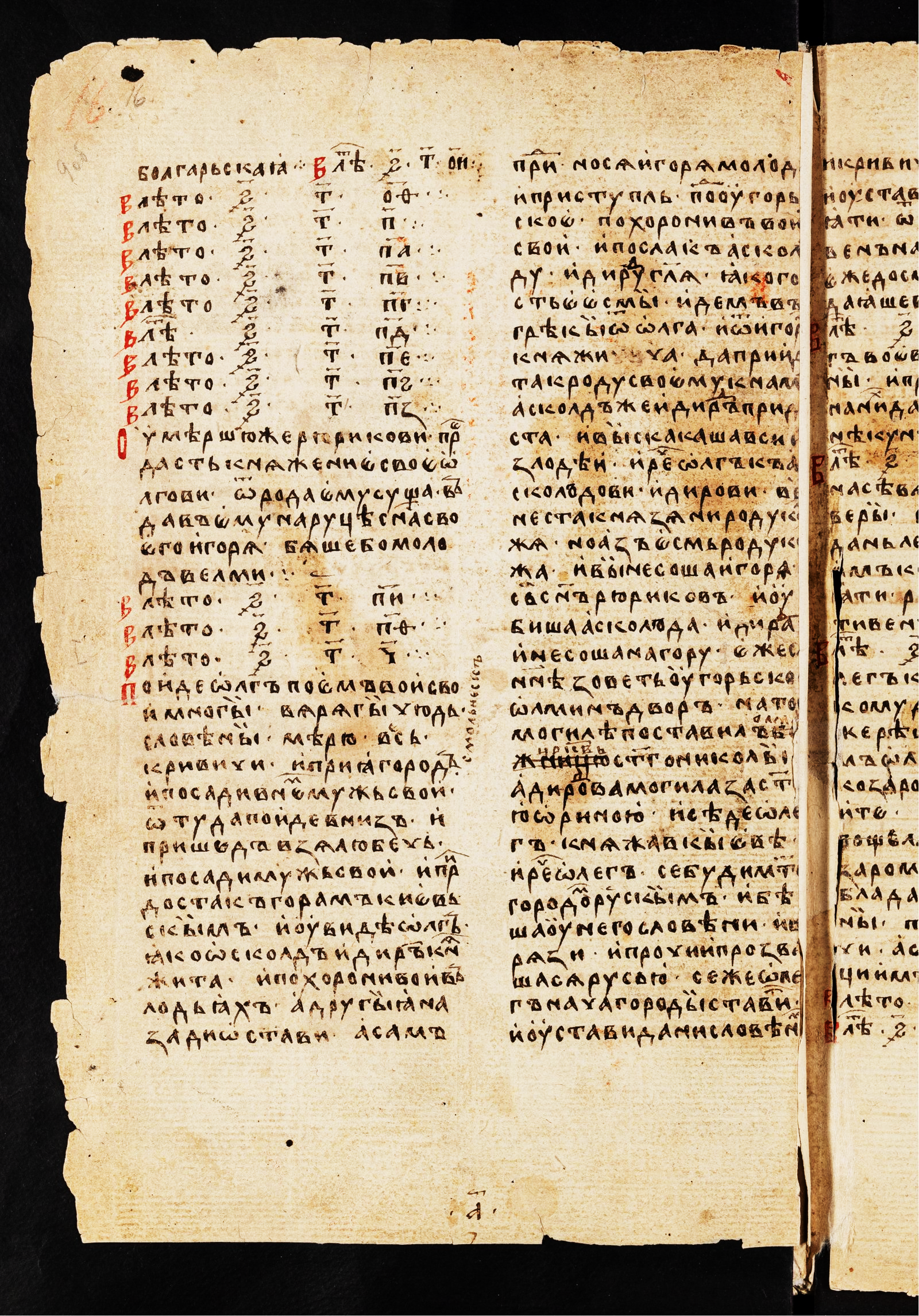
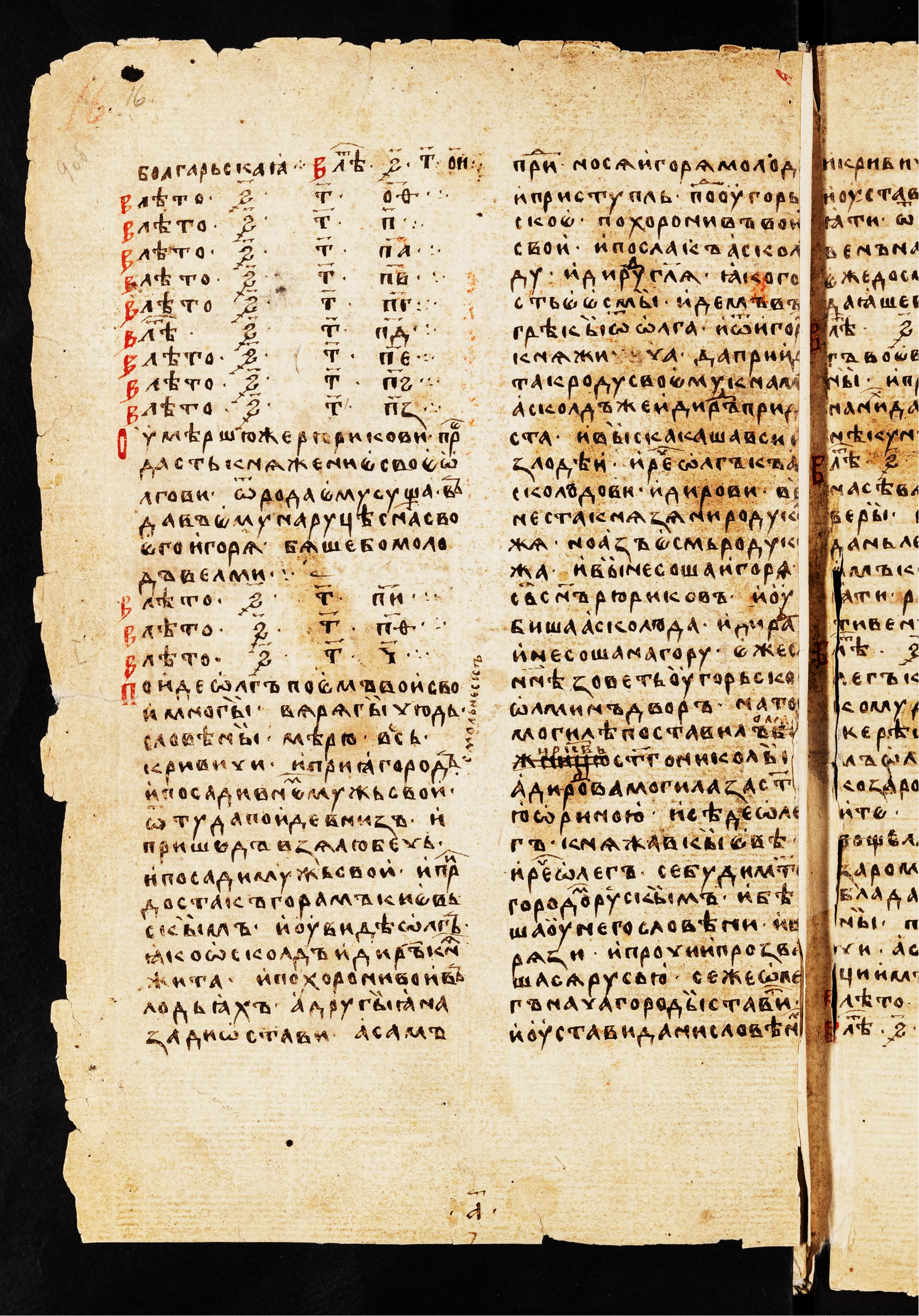
Fig. 8. The Hypatian Codex. Russian Academy of Sciences Library. Filing code НИОР 16.4.4.,
reverse of folio 9.
The word Ves’ is written with a letter in bold: всь
The Laurentian Codex and Radziwill Chronicle do not mention the ethnonym Ves’ in the dated portions.
Nevertheless, when publishing the text of the Laurentian Chronicle in the 2nd and 3rd editions of Volume I of the PSRL (1872 and 1897), the editor-in-chief of the edition, A. F. Bychkov, in the article under year 6367 (859), attempts to transform the pronoun “всѣхъ” (“all”) into the ethnonym “Весь” (Ves’) in the non-existent prepositional case form “Всѣхъ.” First, he capitalizes the word, as was customary in the 18th and 19th centuries for proper names, including the names of tribes and peoples. Second, he inserts words (in this case, “[и на]”) that are not in the original, as well as punctuation marks, to separate the pronoun “всѣхъ” from the noun “кривичѣхъ” (Fig. 8).
Fig. 8a. Chronicle according to the Laurentian apographer. 3rd ed. St. Petersburg, 1897. p. 18.
A.F. Bychkov makes the same changes to the articles on the vocation of the Varangians (Fig. 9) and on Oleg’s campaign against Kiev (Fig. 10), in addition, changing the dates of the vocation of the Varangians from 6369 (861) to 6370 (862), and Oleg’s campaign from 6389 (881) for 6390 (882) years.
Fig. 9. Chronicle according to the Laurentian apographer. 2nd ed. St. Petersburg, 1872. pp. 18-19.
The year [Въ лѣто 6370] has been added in square brackets, the conjunction [и] has been added in the bottom line, the pronoun “all” has been replaced by the pseudo-ethnonym “Вси”.
For comparison, the original is shown in Fig. 3
Fig. 10. Chronicle according to the Laurentian apographer. 2nd ed. St. Petersburg, 1872. p. 22.
The year [Въ лѣто 6390] has been added in square brackets.
The pronoun «всѣ» has been replaced by the ethnonym «Весь».
For comparison, the original is shown in Fig. 6
Thus, the ethnonym Ves’ (Весь), used only in the singular, by A. F. Bychkov acquires the plural “Вси” and the plural prepositional form “Всѣхъ” in A.F. Bychkov. Moreover, the text is given out as a chronicle according to the Laurentian Codex.
The Laurentian Chronicle was published twice before A. F. Bychkov. It was first published in 1824 by R. F. Timkovsky. The article about the vocation of the Varangians there fully corresponds to the original:
«Идоша за море къ Варягомъ к Русі; сице бо ся зваху тьи Варязи Русь, яко се друзии зовутся Свое, друзии же Оурмане, Аньгляне, друзіи Гьте; тако и си. Рѣша Руси Чюдь, Словѣни, и Кривичи: вся земля наша велика и ѡбилна, а наряда в ней нѣтъ; да поидѣте княжить и володѣти нами». —”They went across the sea to the Varangians to Russia; these Varangians were called Rus’, as others are called Sveos, others Ourmans, Anglians, Goths; and that’s what these are called. Chud, Slovens, and the Krivichi said to Rus’: our whole land is large and rich, but there is no government in it; come rule and rule over us.”
The first publication with direct speech in quotation marks took place in the first volume of the Complete Collection of Russian Chronicles in 1846 (Fig. 11).
Fig. 11. PSRL, T. I. St. Petersburg, 1846, p. 8.
As we can see, there is no Весь (Ves’) tribe in the dubious form of “Вси” in the text. There is a definitive adjective “whole” (вся), which refers to the noun “land” (земля) There is no union “и” between the words “Кривичи” and “вся“.
Now let us turn to the second oldest chronicle manuscript, the Hypatian Codex (c. 1425 CE). The copyist of the Hypatian Codex was rather careless, there are many blots, corrections, outliers and unnecessary conjunctions “and”. It differs from the Laurentian one in some dates and descriptions of individual events. But the participants in the vocation of the Varangians there are the same as in Lavrentian – Chud, Slovens and Krivichi. Ves’ of them are missing (fig. 12).
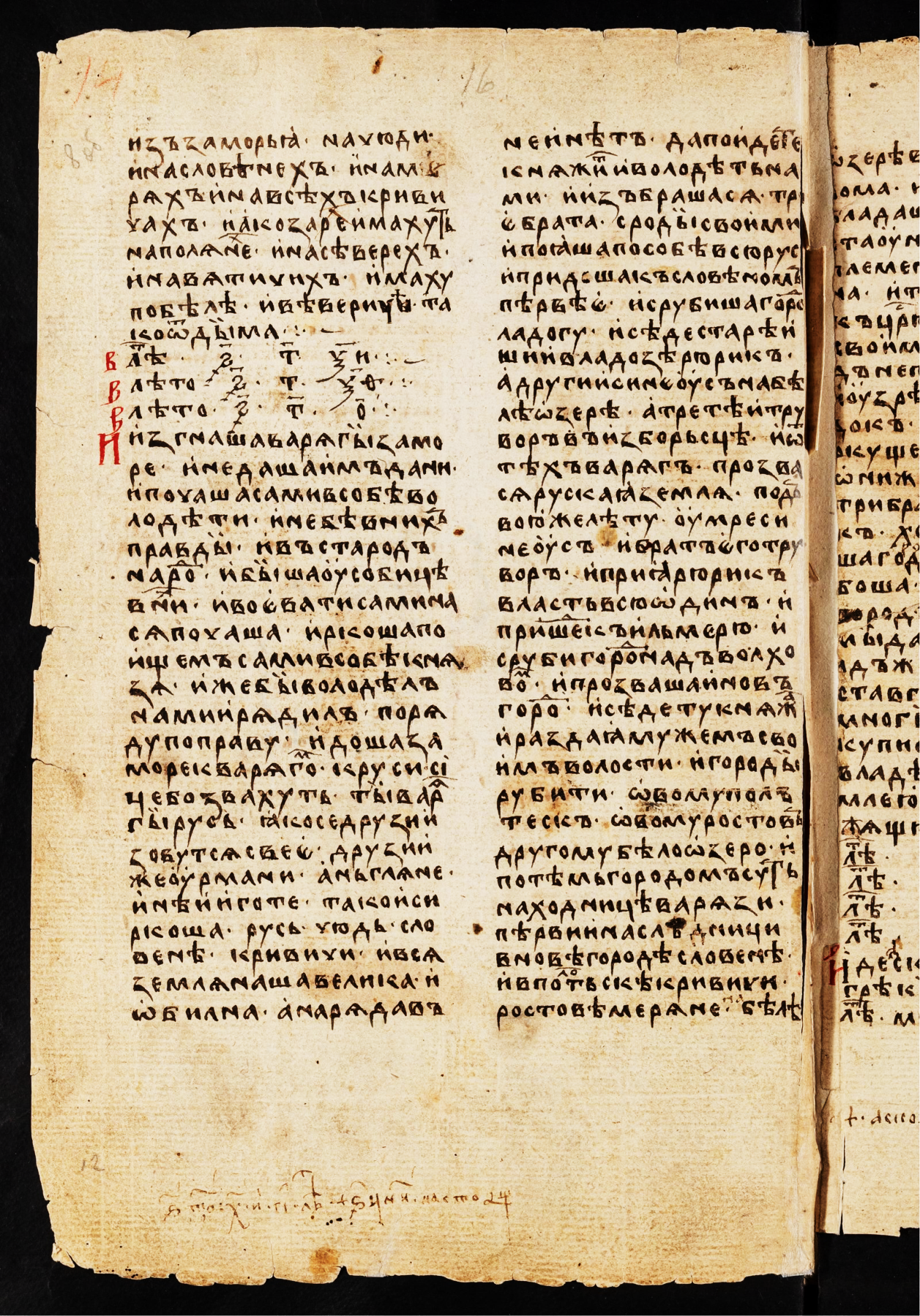
Fig. 12. The Hypatian Codex. Russian Academy of Sciences Library. Filing code НИОР 16.4.4., reverse of folio 8.
Translation:
“… they went across the sea to the Varangians, to Russia. For that is the name of those Varangians – Rus’. As others are called Svei, others are Urmans, Angles, others are Goths, so are these. Chud, Slovens, and Krivichi said to Rus’: “And our whole land is large and abundant, but there is no state order…”
However, in the 1871 edition of the Chronicle of the Ipati List of the Archaeological Commission, edited by S. N. Palauzov, the tribe Ves’ also appears here in the anecdotal form “ Всь ” (Fig. 13).
Fig. 13. The Chronicle according to the Hypatian apographer. Ed. Archeographic. Commissions,
St. Petersburg, 1871. p. 11.
In the Radziwill (Konigsberg) Chronicle (the end of the 15th century), there is no Ves’ tribe among the tribes that summoned the Varangians (Fig. 14).
Fig. 14. The Konigsberg (Radziwill) Chronicle. Library of the Academy of Sciences, 34.5.30, f. ѳ (9)
Broken down into words, punctuation, and highlighting of direct speech, this passage looks like this: «Рѣша роуси чю, и словене, и кривичи, и вси: «Zемлѧ наша велика и wбилна, а нарѧда в неи неъ. Да поидѣе оу на кнжии и володеи…» This passage is translated as follows: “They said to Rus’, and Slovens, and the Krivichi, and all of them collectively: “Our land is large and abundant, but there is no state structure in it. Come take power and govern our people.”
Back in 1767, I. I. Taubert and I. S. Barkov published the Radziwill Chronicle in a civilian font, converting the original into a spelling system of the middle of the XVIII century, threw out archaic letters, divided the text into sentences and words, enclosed direct speech in quotation marks and punctuation marks.[48] (fig. 15):
Fig. 15. The Chronicle of Nestor with his successors according to the Konigsberg apographer, p. 16
But it did not occur to them to translate the definitive pronoun “вси” as the name of the Ves’ tribe (весь). As can be seen in Figure 15, the names of the peoples (Slovens, Krivichi, etc.) Taubert and Barkov are written with a capital letter, and the word “весь” is written in lowercase.
We have already encountered the pronoun “вси” in D. S. Likhachev’s translation when we considered the translation of the phrase «Русь . Чюдь. и вси ꙗzъıци». Then, as we remember, he translated it with the word всякие (“all sorts”). In his edition of The Primary Cronicle according to the Laurentian Codex of 1377, in an article about the vocation of the Varangians, Dmitry Sergeevich, although he convinces us in the Preface that he does not have “a consolidated text” “for all the lists” and not a hypothetical reconstruction of the original text, but a text that actually reached us in the Laurentian Codex,” in fact, replaces the original text with a fragment from the Radziwill Chronicle: “The Russians, the Chuds, the Slovens, and the Krivichs and all sorts: «Рѣша русь, чюдь, словѣни, и кривичи и вси; „Земля наша велика и обилна, а наряда в ней нѣтъ. Да поидѣте княжитъ и володѣти нами”». But even more puzzling is the translation of these two sentences: “The Chud, Slavs, Krivichi, and Ves’ said to the Rus’: ‘Our land is great and abundant, but there is no order in it. Come and reign over us.'” The pronoun “вси,” which he himself translated as всякие (“all sorts“) miraculously becomes the tribe Ves’.
The most puzzling aspect of all these distortions and reworkings of ancient texts is the motive. Why would academic scholars, especially those of such high standing, engage in petty manipulations? For example, what’s the point of persistently inserting the ethnonym Ves’ into chronicles, which doesn’t exist there, and insisting that this is precisely what the chronicler intended? This is done so obsessively that it’s impossible to justify these deliberate actions as “honest errors.”
The answer may lie in the mistake made by the researchers of the annals, which stretches back to the XVIII century, when historical science was still in its infancy in our country. Here is how M. D. Prisyolkov commented on this “conscientious misconception” (posthumous ed., 1950). While reconstructing the burnt-out Trinity Chronicle, he collected bit by bit quotations from it, left by researchers who studied it before the fire of 1812. Commenting on the excerpt he restored from the Trinity apographer about the vocation of the Varangians (“Рѣша Русь, Чюдь, Словѣнѣ, Кривичи и вся“) regarding the phrase “и вся“, he writes the following:
“For some reason, Miller corrected “вси” to “веся” in the printed Konigsberg apographer. Karamzin (vol. I, note 230) also interpreted everything (Radziwill’s apographer) and вся (Lavrentian and Trinity apographers), writing: the ancient chronicler names only the Krivichi, Slavs or Novgorodians, Some and Ves’, who wanted princes”.[49]
It can be assumed that it was precisely due to the lack of competence of the “dinosaurs of Russian history” by G. F. Miller and N. M. Karamzin that this “conscientious misconception” was introduced into Russian historiography.
However, doubts still arise about the “good faith” of this misconception. Before the publication of the Ipatiev Chronicle by S. N. Palauzov in 1871 and the 2nd edition of the Laurentian Chronicle by A. S. Barkov in 1872, no one repeated this “mistake”. In addition, there is a direct “proposal” by academician A. A. Shakhmatov (1916) in certain chronicle articles, instead of the pronouns “вси“, “всѣхъ“, etc., to put the ethnonym Весь (“Ves’”) in a strange and generally unused form of the nominative case “Вьсь“[50].
The revolution that broke out in 1917 and a complete change of priorities in historical science interrupted these philological experiments devoid of common sense, and the odious Вьсь did not manage to become widespread. However, in 1950, D. S. Likhachev began to redraw the original chronicles again.
6. EXAMPLES OF INSUFFICIENT COGNITIVE EXPERIENCE OF TRANSLATORS
Correctly translating chronicle texts requires more than just a good command of the language. It requires a whole range of knowledge. And not just knowledge of history, hagiography, and related disciplines, but also knowledge of economic, religious, international, political, and other relations in the Middle Ages, as well as an understanding of medieval psychology. A thorough understanding of the legal system of medieval society and the meaning of legal terms are essential. In other words, a chronicle translator must possess a comprehensive knowledge of the context described in the source text. Unfortunately, nothing of the sort is evident in published translations.
6.1. A White Veveritsa from Smoke
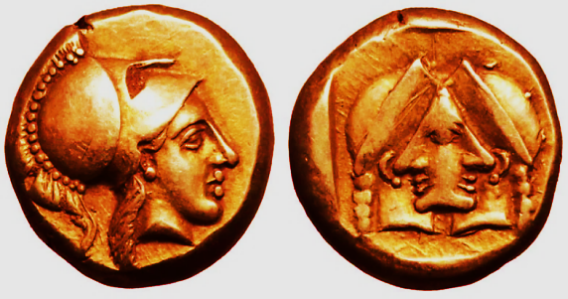
This chapter describes a situation based on a play on words in Old Russian. Chronicles speak of the Varangians collecting tribute from tribes in Eastern Europe in the amount of a “бѣлѣи вѣверицѣ” (transcribed belei veveritse). In Old Russian, this phrase can be read in two ways.
If you read the word “belei” with the letter “i” together in the prepositional case, you get the adjective “belei” (“white”). If you read the word “bele” with the letter “i” separately, you get two words: the noun bele (nominative “bela“) and the conjunction i (“and“).
Either “the Varangians took tribute according to a white veveritsa from the smoke,” in which case there would be one unit of taxation: the white veveritsa.
Or “the Varangians took tribute according to a bela and a veveritsa from the smoke.” In which case there would be two units of taxation: the bela and the veveritsa.
The correct reading of this phrase has been debated among scholars since the 18th century.
Let’s take, for example, the familiar PVL article under the year 6367 (859). Let’s turn to the original text in D.S. Likhachev’s transcription (1950):
«859 Въ лѣто 6367. Имаху дань варязи изъ заморья на чюди и на словѣнех, на мери и на всѣхъ кривичѣхъ. А козари имаху на полянѣх, и на сѣверѣх, и на вятичѣхъ, имаху по бѣлѣ и вѣверицѣ от дыма»[51] (bela and veveritsa from smoke).
Dmitry Sergeevich translates this article as follows:
“859 In the year 6367. The Varangians from overseas collected tribute from the Chud, the Slavs, the Merya, and all the Krivichi, and the Khazars collected a silver coin and a squirrel skin from smoke from the Polyana, the Severians, and the Vyatichi.”[52].
V. Panov (1936) has difficulty translating the “white veveritsa”: “In the year 6367. The Varangians, coming from overseas, collected tribute from the Chud, the Slovenes, the Merya, the Ves, and the Krivichi; and the Khazars collected tribute from the Polyans, the Severians, and the Vyatichi: they collected a “white veveritsa” from smoke.” In his commentary, he nevertheless explains that a veveritsa is a squirrel skin.
A. S. Klevanov (1871) also has a vague translation: “The Varangians, who came from overseas, took tribute from the Chud, Slovenes, Merya, and all the Krivichi; and the Khazars took tribute from the Polyans, Severians, and Vyatichi – a squirrel and a veveritsa skin from each house.”[53]
First, let’s figure out what “from smoke” means. D.S. Likhachev believes that “‘from smoke’ means ‘from each family.'”[54] This is perhaps the most unfounded interpretation. It doesn’t clarify what is meant by the concept of “family.” A.S. Klevanov’s translation of “from each house” is closer to the truth. In fact, “smoke” here refers to a separate household capable of generating income (yard). Eight hundred years later, in 1678-1679, a similar system of taxation of the rural population was introduced throughout Russia, becoming known as “podvornoye oblozheniye” or the tax from the yard (from the word “dvor” (yard) instead of “smoke“).
It is much more difficult to understand what “belei veveritsi” means (nominative belaya veveritsa). Researchers have encountered difficulties interpreting and translating these words since the very beginning of their study of chronicle texts. In the 18th century, when this study began, the word “veveritsa” (вѣверицa) was, in all likelihood, unfamiliar to researchers. For example, in the posthumous first edition of V. N. Tatishchev’s “History of Russia” (Book 2, 1773), edited by G. F. Miller, the word “veveritsa” is printed as северица “severitsa,” and “belaya” (“white” in Russian) or “bela” is transformed into “belka” (“squirrel” in Russian). (Fig. 16).
Fig. 16. Tatishchev V. N. Russian History. Book 2. Publ. Imperial Moscow University. 1773. P. 10.
G. F. Miller himself interpreted this phrase as “tribute was paid according to the vedaga and the veveritsa,” but he placed an asterisk above “vedaga” and added a marginal note: “This word is unclear.” Karamzin (vol. I, commentary 89) noted: “In the Pushkin and printed Nikon apographers: “they paid tribute according to the white veveritsa,” in the Trinity apographer: “they paid tribute according to the bela and the veveritsa.” In note 300 of the same volume I, Karamzin returned to this in the following phrase: “At first the chronicler said that the Khazars imposed tribute on them only in veveritsas.”[55] Because of these contradictions, M. D. Prisyolkov was unable to restore this passage in the Trinity Chronicle.
In short, G. F. Miller and N. M. Karamzin, with their corrections to the text and subjective interpretations of the content in keeping with the traditions of the 18th century, have only added to the confusion, without coming any closer to answering the question of what exactly are the economic units (unit) in which the size of the tribute was measured? Their research has led to a situation that has raised several additional questions. 1) Which is the correct reading: “по бѣлѣи вѣверицѣ” or “по бѣлѣ и вѣверицѣ”? Considering that in chronicles, as a rule, words were written without spaces, the breve was not placed above the letter “й”, and the adjective “бѣлая” in the prepositional case (“бѣлой”) was written “бѣлѣи”, either of these options could theoretically be correct. 2) If the correct reading is the noun “bela”, what does it mean? 3) What is a veveritsa?
Let’s read what D.S. Likhachev wrote on this subject: “по бѣлѣ и вѣверицѣ от дыма. The question of how to read this passage correctly is quite important. It can be read as “by the white squirrel,” and then its meaning will be “by the white (i.e., gray, winter) squirrel.” Squirrel fur is valued only in winter, as it is the most durable. In modern Russian, the adjective “white” eventually supplanted the noun “veveritsa” and itself adopted the noun suffix “belka.” In support of this understanding of the text of the Primary Chronicle, we can cite the following passage from the Laurentian Codex under the year 1068: “by martens and belyu”, while in the Hypatian Codex this passage is understood as “by kuna and skora” (i.e. furs), which indicates that in ancient Rus’ the word “bel” was sometimes understood as “squirrel fur”. However, this passage can also be read as “po bele i veveritse”, which could mean: “by bela (by a white, silver coin) and squirrel”. This interpretation was first proposed in the first half of the 19th century and developed by Academician B.D. Grekov. (…) In our translation, we accept the point of view of B.D. Grekov.”
In the comments to the 2012 reprint of D.S. Likhachev’s translation of the PVL, a group of authors expresses a different point of view: “A more convincing view is that the text should be read as one word (по бѣлѣи вѣверицѣ), since the term “bela” as a monetary unit appears no earlier than the last third of the 13th century. If we consider that “bela” in the chronicle refers not to a coin, but to a squirrel pelt, then an unjustified semantic repetition arises (veveritsa is the same squirrel).”[56]
The correct reading, of course, is “a white veveritsa from smoke.” But for entirely different reasons. The construction of a complex structure incorporating two units of taxation—”bela” and “veveritsa”—is entirely artificial.
6.2. The meaning of the word “veveritsa”
Here we encounter not so much a translation error as literalism, when the primary or most familiar meaning of a word is used in translation instead of the appropriate one, but outright speculation. It’s completely unclear how the context of “they took tribute from the white vevertica from the smoke” implies that veveritsa is squirrel skin. Moreover, this translation has become so ingrained in our scholarly literature that it is considered an axiom requiring no proof. Let’s examine the meaning of the word “veveritsa” in medieval literature, and whether there is even the slightest allusion to squirrel.
1) Unknown animal
Hypatian Codex, 6622 (1114 AD):
«Сему же ми сѧ дивлѧщю, рекоша ми: „Се не дивно; и суть и еще мужи старии ходили zа Югру и zа Самоꙗдь, ꙗко видивше сами на полунощнꙑхъ странахъ, спаде туча, и в тои тучи спаде вѣверица млада, акꙑ топерво рожена, и въzрастъши, и расходитсѧ по zемли, и пакꙑ бываеть другаѧ туча, и спадають оленци мали в нѣи, и въzрастають и расходѧтсѧ по zемли”»[57].
“When I was amazed at this, they said to me: ‘This is not surprising; there are still old men alive who have traveled beyond Yugra and beyond Samoyed and have seen for themselves in the northern lands: a cloud descends, and from that cloud a young veveritsa falls, as if just born, and, having grown up, disperses across the land. And another time there is another cloud, and from it little fawns fall and grow up, and disperse across the land.'”
The first edition of Dahl’s explanatory dictionary (1863) provides precisely this interpretation of “veveritsa”: “Веверица (with two “e“s – V.V.) Veveritsa, feminine. obsolete, unknown animal (Viverra?). Probably a weasel or ermine; but some scientists inappropriately gave the name “veveritsа” to marmots as a generic one.”[58]
From this article, it becomes clear (based on the words “weasel or ermine” and the spelling of “veveritsa” with two “e‘s”) that V. I. Dahl found this obsolete word in the passage from Tatishchev’s “History,” which I placed in Fig. 16. He was clearly unfamiliar with it before this. He confuses marmots with animals called civets or civet cats (Latin: Viverrae), whose family has a Latin name that sounds almost identical to “veveritsa”—Viverridae—but has no relation to “veveritsa.”
The noun “veverichina“, meaning “meat of a veveritsa,” comes from “veveritsa.” In the medieval book “Questioning of Kirik”, with the answers of the Novgorod bishop Nifont (1130-1156), this word is used when the bishop answers the question of what spiritual punishments should be imposed for eating forbidden meat (No. 89)[59]:
«А смердъ дѣлѧ помолвих, иже по селам живоут, а покаютсѧ оу нас, оже-то дроуzии ꙗдѧт вѣверичиноу и ино. – Zле, рече, въ zле ꙗсти давлѥнина; аще бша и вѣверичиноу ꙗли, или ино недавлено, нѣтоу бѣды, вельми льжаѥ»[60].
“And what punishment should be imposed on the smerds,” asked Kirik, “who live in the villages and repent to us that some eat veverichina and the like?” “It is unjust,” (the bishop) replies, “it is impious to eat davlenina (the meat of strangled animals – V.V.). But if they ate strangled meat or similar meat, but not strangled animals, there is no sin on them; they do not deserve condemnation at all.”
2) The fur of some animal, or a skin with fur
Hypatian Codex, 6579 (1071 AD). Text transcribed by O. V. Tvorogov:
«Бывши бо единою скудости вь Ростовьстѣй области, и вьстаста два волъхва от Ярославьля, глаголюща, яко «Вѣ свѣмы, кто обилье держить». И поидоста по Волзѣ, и кдѣ придучи в погость, ту же нарекаста лучьшия жены, глаголюща, яко «Си жито держать, а сии — медъ, а сии рыбы, а сии скору. И привожаху к нима сестры своя, и матери и жены своя. Она же вь мьчтѣ прорѣзавше за плечемь, вынимаста любо жито, любо рыбы, или вѣверицю, и убиваша <…> многы жены, имѣния ихъ имаша собѣ» .
Translation: “There was an unusual famine in the Rostov region, and two sorcerers from Yaroslavl appeared, saying, ‘We both know who’s hiding the supplies.’ So they set off along the Volga, and wherever they arrived at a village, they immediately named noblewomen, saying that one was hiding bread, and another honey, and another fish, and another furs. And they brought their sisters, mothers, and wives to the two of them. The sorcerers, deceiving the people, cut open their backs and took out either bread, or fish, or a pelt, and killed many of the women, taking their property for themselves.”
Here, O. V. Tvorogov translates “veveritsa” as a skin with fur, since earlier, in the list of foodstuffs and goods that, according to the sorcerers, the women were hiding, they were called furs (“skora”). This is perhaps the only place in medieval chronicle literature where the word “veveritsa” can be indirectly identified as a furry pelt. However, this context doesn’t necessarily indicate that it’s a squirrel pelt, and why O. V. Tvorogov translates “veveritsa” as “squirrel” is unclear.
3) Money in general
The most common meaning of the word “veveritsy” in the plural (вѣверицѣ, вѣверичѣ, вьвьриць) was “money.”
In birch bark manuscripts from the early 11th to mid-15th centuries, this word appears only in this meaning (words such as “veksha,” “rezana,” “kuna,” “nogata,” “grivna,” and others are used as names of specific monetary units). birch bark manuscripts are the most authentic written source on the history of medieval Rus’ society and everyday life, as they represent personal and business correspondence, promissory notes, purchase orders, court summonses, etc. “Veveritsy” as a general term for money is a lexical feature of the earliest period of the early Old Russian language[61].
I will cite several examples.
Birch bark manuscript No 246 (stratigraphically until the mid-50s of the 11th century, origin – Smolensk, Polotsk or Vitebsk).
«ѿ жировита къ стоѧнови како ту оу мене и чьстьное дрѣво възъмъ и вевериць ми не присълещи то девѧтое лето а не присълещими полоу пѧт гривьн а хоцоу ти вроути въ тѧ лоуцьшаго новъгорожѧнина посъли же добръмь».
Translation: “From Zhirovit to Stoyan. It’s been nine years since you swore to me on the cross (or: took the cross) and haven’t sent me money (вевериць). If you don’t send me four and a half grivnas, then I intend to confiscate the goods of a noble Novgorodian for your guilt. So send voluntarily.”[62]
Birch bark manuscript No 1002. Novgorod, 1120s–1150s. Transcription by A. A. Zaliznyak, broken down into words:
«…на чьлѧди вьвьричь не платиле 5 на дьсѧте гривьно. Ѧ ныньково ѧли по коунь на ньдьлоу. А ныны …»
Translation: “He didn’t give money (вьвьричь) for the slaves—fifteen grivnas. And now they’ve taken a kuna a week. And now…”[63]
Birch bark manuscript No 1004. Second quarter – mid-12th century.
The text, transcribed by A. A. Zaliznyak, is divided into words as follows:
«Ѿ Лоукы къ ѿтьцеви. То ти не въдало наïмить, ïже то мѧ везель, на кожахъ вевѣрице, а продалъ ти есемо емоу на 6-сти ногатъ сковородъ — то ти пълънѣ 2е. А iдеть ти во лодие съ товаромо. Воземи же ó него 2е гривене. Али ти сѧ ïзмотаеть, а моловиво емоу, поусти же ï во три».
Translation: “From Luka to my father. The hired hand who was carrying me owes me money (вевѣрице). He didn’t pay for the hides, and I sold him six nogat’s worth of frying pans—a full two grivnas in total. And he’s sailing on a ship with the goods. Take the two grivnas from him. And if he denies it, confront him with it and make him owe three grivnas.”[64]
In addition to birch bark letters, the word “veveritsas” as a general designation of money can be found in a variety of sources.
For example, in the inscription from St. George’s Cathedral of the Novgorod Yuriev Monastery (1119-1120). The inscription is on the wall of the cathedral’s staircase tower; discovered by T. V. Rozhdestvenskaya in 1992, the inscription was covered with ancient plaster dating back to the time of the cathedral’s construction (1119-1120); hence its dating.
4-line text: «вѣвериць три | на десѧте | гривьнѣ | и рѣзана».
Translation: “The money (вѣвериць) is thirteen grivnas and rezana.” (…)
The word “veveritsy” (вѣвериць) appears in the same meaning that is known from birch bark manuscripts: “money”[65].
In the same sense, this word appears in the “Questioning of Kirik” with the answers of the Novgorod bishop Nifont (1130-1156): «А за оупокои сице велѧше слоужити сорокоустьѥ… А испрашаи, рече, или самъ разоумѣи, коли ти дати вѣверицѣ»[66].
Translation: “And for the repose, they tell you to serve Sorokoust (Funeral Acolouthia)… but ask,” he says, “or think for yourself, since they gave you the money (вѣверицѣ)”.
4). The name of the monetary unit
In addition to the general designation of money, the word “veveritsa” was used to designate a specific monetary unit.
It is mentioned, for example, in Article 42 of the Short Edition of the Russkaya Pravda, which describes the “Pokon Virny” (11th cetntury) — an institution that determined the amount of the in-kind or monetary fee in favor of collectors of court fees and fines (viras): «а вирнику ѯ гривенъ и і рѣзанъ и в҃і вѣверици, а передѣ гривна», i.e. “to the collector, 60 grivnas, 10 rezans, and 12 vevertitsas, and upon entry, a grivna.” The insignificant value of this unit is evident from the “Questioning of Kirik,” according to which a church candle cost a vevertitsa: «а ѥже бы елико субботъ внимати за того и до сорочинъ, обаче много бваѥть свечь и вевериць м҃ »[67], i.e. on the candles on the fortieth Day after death, putting a veveritsa for each one, they need 40 veveritsas.
The use of the word “veveritsas” as a general term for money is a sign of antiquity: it is found only in the pre-Mongol period. Business correspondence between medieval Rus’ residents, contained in birch bark manuscripts, as well as the discovery of numerous hoards of silver coins and ingots, indicate that Ancient Rus’ had developed commodity-money relations and a common, stable monetary system, which N. P. Bauer tentatively calls “kuna’s system” after the denomination of the basic monetary unit, the kuna. The monetary units mentioned in the documents (veveritsas, vekshas, rezanas, kunas, nogatas, grivnas) were not hypothetical animal skins, but actual metal coins and ingots. Arabic dirhams were in circulation, imitations of which were also minted in the Khazar Khaganate and Volga Bulgaria. According to the Historical Literature, the Khazars’ subjects in the second half of the 9th century included the Vyatichs, Drevlyans, Polyans, Severians, Radimichs, and other East Slavic ethnic groups, who later united under Rus’ rule. N. P. Bauer equates the kuna specifically with the Arab silver dirham. Coins of lower denominations are considered fractions of the dirham. The veveritsa was the smallest unit in this system. In the 12th century, it changed its name to veksha, but not in all monuments. There are cases where both the old and new names were used simultaneously.[68] According to N. P. Bauer, during the period we are describing (late 9th – early 10th centuries), the relationship between monetary units was as follows:
9th century
Kuna (dirham, weight standard 2.86 g silver) = 2 rezanas (1.48 g silver) = 4 vevertsas.
The weight standard of a vevertsa was 0.72 g silver.
10th century
Nogata (full-fine dirham, 2.46 g silver) = 1.5 kunas (base dirham, 1.97 g) = 2.5 rezanas (0.98 g) = 5 vevertsas (0.49 g).
Grivna of kunas (49.25 g silver) = 20 nogatas = 25 kunas = 50 rezanas = 100 vevertsas.
The weight standard of a vevertsy was 0.49 g silver.[69]
5) Small coin
In the Pandects of Nikon of the Black Mountain, a vast compilation of conciliar and patristic canons, disciplinary and penitential regulations, and the like, translated from Greek into Old Russian in the 12th century, the word “veveritsa” is used to denote copper Byzantine coins of completely different denominations from different eras: Nummios (Νούμμος), Follis (= 40 Nummios, Φόλλις)[70] and Lepta (according to Epiphanius of Cyprus (367–403), ½ Follis, Λεπτόν)[71]. In this context, the lexeme “veveritsa” can be interpreted as simply “small coin.”
From all of the above, the following conclusion can be drawn. The word “veveritsa” acquired the meaning of “squirrel” or “squirrel skin” no earlier than the late 19th century (even the first edition of V. I. Dahl’s dictionary from 1863 does not include this meaning). This translation of the word “veveritsa” into modern language is completely artificial. The word “veveritsa” is not found in authentic written sources from the Middle Ages in the specific meaning of “squirrel”.
6.3. Technical characteristics and relative cost of squirrel pelts
From a purely economic perspective, could a squirrel pelt, for which we are so eagerly being sold as a veveritsa, have served as a taxable unit? To answer this question, a basic understanding of economics and at least a basic understanding of commodity science are sufficient. Judging by numerous studies, most of them proceed from the unfounded assumption that all squirrel pelts are identical and have the same value. However, D.S. Likhachev does qualify this by stating that he is referring to “white (i.e., rather than gray, winter) squirrel fur. Only winter squirrel fur is valued, as it is the most durable.”[72]
In fact, the most valuable squirrel pelts are considered to be Grade I pelts, which have a dark, rather than white, gray-blue hair coat, without brown guard hairs. Grade I pelts are those harvested in winter, meaning they are full-haired, with a mature, lush winter coat, tall, dense, shiny guard hairs, and dense, matted down. Pelts harvested in late autumn or early winter are classified as Grade II pelts, as their winter coat has not yet fully developed, and the guard hairs and down have not yet reached their full height. Pelts from most fur-bearing animal species harvested in the second half of autumn, when they are completely cleared of summer hair or when a limited amount remains on the sides, head, or limbs, are classified as Grade III pelts. At this time, the winter coat has reached no more than two-thirds of its full height. The guard hairs are dense but short, and the down is still poorly developed. If the price of a Grade I pelt is taken as 100%, then the price of Grade II pelts is 80%, and that of Grade III pelts is 50%. Furthermore, pelts can vary greatly in price depending on their size. For large pelts, the price is set at 100%, for medium pelts at 75%, and for small pelts at 50%. Pelts from the same species can vary greatly in hair color and have significant price differences. Squirrel pelts are also priced according to their ridge. A ridge is a set of commercial properties characteristic of pelts from a particular species of animal, harvested in a given region, and differing from pelts of the same species from other regions. Furthermore, all pelts are classified as normal or defective. Standard pelts are those free of any defects in the hair or flesh, or those with minor defects that do not reduce the pelt’s quality after processing, i.e., in the semi-finished product. Such defects are not considered defects and are considered acceptable. Pelts with minor defects are valued at 90% of the corresponding grade (i.e., with a 10% discount), pelts with moderate defects at 75% (a 25% discount), and pelts with major defects at 50%. Many additional criteria contribute to the price of a semi-finished product. An important factor in the evaluation is whether the pelt is dressed or undressed, meaning a pelt removed from the animal’s carcass that has not been processed.
Unlike Soviet scientists, Sigismund von Herberstein, a German diplomat of the 1st half of the 16th century, who twice visited the embassy in the Russian state and lived in Moscow for 9 months in 1526, studied the market conditions well. His book “Notes on Moscow Affairs” (1549)[73] is one of the most reliable and competent foreign Renaissance sources on the history of our country. Here is what he writes about squirrel furs: “Squirrel skins are also delivered from different places, the widest from the Siberian region, and those that are nobler than all others – from Shuwaii, not far from Kazan, and in addition, from Perm’, Vyatka, Ustyug and Vologda, from where they are brought (in large numbers, also turned out) always tied in bundles of ten pieces. In each bundle, two of the best are called personal (litzschna), three, a few worse, are called red (crasna), four are tinted (pocrasna), one, the last, is called dairy (moloischna), it is the cheapest of all. Each of them can be bought for one or two dengas.”[74] The denga in 1526 was a silver coin weighing 0.37 – 0.38 g. In addition to the difference in the grades of semi–finished fur products, Herberstein reports on the traditional methods of their forgery: “They (skins – V. V.) have some signs near the head and tail, by which it is possible to recognize whether the animals were caught at the right time. Because as soon as they are caught, they are skinned, and the fur is turned out so that the hair does not get worn out and does not get worse. If an animal is caught at the wrong time and its fur lacks the proper natural color, they pull out the hairs from its head and tail, which serve as a sign, so that it cannot be known that the animal was caught at the wrong time, and thus deceive customers”[75].
In recent history, there has been an example of in-kind taxation, the amount of which was calculated in squirrel skins. In 1921, when the Bolsheviks completely destroyed the economy of post-revolutionary Russia, and as a result of hyperinflation, monetary circulation in the country almost stopped, they tried to impose an in-kind tax on the rural population. Natural taxes on dairy products, horticultural and melon products, wool, tobacco, honey and wax, meat taxes, poultry taxes from poultry farmers, etc. were established. We are interested in the Decree of the Council of People’s Commissars of the RSFSR of August 25, 1921 on the in-kind tax on furs. It concerned only hunters and trappers[76]. It concerned only hunters and trappers. The tax was levied on citizens who owned hunting rifles and other hunting implements and lived in both commercial and non-commercial and semi-commercial areas. The Decree immediately specified the requirements for semi-finished fur products: furs were accepted for tax payment only fresh, full-fledged, full-haired, not fine, corresponding to the usual sorting of original raw materials containing, including the head, 50% of the first, 35% of the second and 15% of the third grade. The tax collection system was complex and led to high costs. Each hunter located in a non-commercial area was required to deliver 7 skins, in a semi-commercial area – 14 and in a commercial area – 21 skins of squirrels or other animals according to replacement standards according to the table of equivalents.[77]
This table is of particular interest because it gives an idea of the value of the skins of different commercial animals in relation to each other. I’ll give it in full:
“The amount of tax is calculated in squirrel skins. Suppliers of furs are given the right to replace squirrels with skins of other animals based on the following proportion: instead of 1000 squirrels — 15 leopards, 175 badgers, 7000 chipmunks, 25 wolves, 17 otters, 100 ermines, 1250 white hares, 900 rusak hares, 1750 cuffs of hares (southern), 200 columns, 175 korsaks, 40 steppe cats, 20 soft martens, 35 mountain martens, 875 weasels, 15 foxes (light), 9 medium-sized foxes, 4 dark foxes, 20 red foxes, 35 light steppe foxes, 140 gray foxes (karaganok), 12 brown bears, 8 black bears, 4 white bears, 58 minks, 5 blue foxes, 21 white foxes, 1000 carriers (transportation), 25 wolverines, 15 lynx, 9 kidas sables, 5 light fur sables, 3 medium-colored sables (natural), 1 dark sable, 350 large marmots, 160 large tarbagans, 18,000 ground squirrels, 3,500 sandstone ground squirrels (large), 355 seals, 88 black (large) polecats, 300 white (large) polecats.”[78]
In the 18th century, when medieval Russian chronicles began to appear in print and a widespread fascination with ancient Russian history began, the so-called “fur theory of money” emerged among amateur historians, which also became widely accepted by official historians. According to this theory, all monetary units of Ancient Rus’ were made from the pelts of fur-bearing animals. In addition to the vevertsa, which V. N. Tatishchev considered to be the skin of a weasel or ermine, supporters of the “fur theory” considered the kuna to be the skin of a marten, the nogata to be a “sable skin with four legs” (!), the grivna to be a “skin with a mane”, the mortka (mordka) to be the head (muzzle) from the skin of an animal (!), the rezana to be a “cut skin” (!), etc. Despite the obvious artificiality of these etymologies, they were remembered in Soviet times, and they began to enjoy popularity again, as in the 18th century.
But let’s return to the table of equivalents for semi-finished fur products. From it, we can estimate the value of other furs that proponents of the “fur theory of money” present as equivalents for monetary units, using squirrel pelts as the unit of measurement:
1 weasel = 1.14 squirrels;
1 mountain marten = 28.5 squirrels;
1 soft marten = 50 squirrels;
1 sable kidas = 111 squirrels;
1 light-colored sable = 200 squirrels;
1 medium-colored sable (natural) = 333 squirrels;
1 dark sable = 1000 squirrels.
As you can see, these proportions do not correspond to the ratio of the ancient Russian monetary units of the 9th – 10th century, expressed in silver, where the kuna was equal to 4 veveritsas:
1 veveritsa = ½ rezana = ¼ kuna = ⅕ nogata = ⅟100 grivna;
1 rezana = 2 veveritsas;
1 kuna = 4 veveritsas;
1 nogata = 5 veveritsas;
1 grivna = 100 veveritsas.
To understand the value of fur in today’s terms, let’s look at the 2025 procurement prices for animal pelts in Krasnoyarsk region (Table 1). Current fur-bearing animal populations in Siberia roughly correspond to those in Eastern Europe 1,100 years ago.
Table 1. Prices for fur reception in Krasnoyarsk in 2025-2026[79]
| Assortment of fur raw materials | Head | Maximum
estimated value, rubles |
Additional requirements
for raw material procurement |
|---|---|---|---|
| Sable skins (all ridges except Amur) | 7 color;
1st grade; normal. |
20 250 | Unacceptable:
defective, autumn, damaged by moth and carpet beetle larvae, rotten, with a greasy sooty smell; less voluminous hair – 30% discount, low-haired – 50% discount. |
| Skins of forest and mountain martens | 1st grade; normal
male female |
2 500 1 650 |
Adoptive:
1st-2nd grade |
| Squirrel skins (all ridges) | 1st grade; normal. | 180 | Unacceptable:
damaged by moth and carpet beetle larvae, rotten, tailless; |
| Ermine skins | 1st grade; normal; large | 100 | Adoptive:
I; large, medium |
I would like to point out that the price of a marten’s skin is significantly influenced, in addition to other characteristics, by the sex of the animal.
I’ve provided all this information for general information purposes, since, judging by the majority of scholarly articles on the Varangian tribute, their authors have no idea what the squirrel skins with which their articles are so abundant are. For example, G. M. Prokhorov, the author of the most recent translation of the Laurentian Codex (2017), asserts that the tribute to the Varangians “по бѣлѣи вѣверицѣ от дыма” is nothing more than “by the white skin of a squirrel from smoke,” and even “concludes” that “it seems to me that we should finally return to this traditional understanding of the text!”[80]
Let’s ask ourselves: could the annual tribute “from smoke,” that is, from a full-fledged farm, have amounted to the equivalent of a squirrel pelt, valued at the paltry sum of 180 rubles? Considering the cheapness of squirrel pelts, one might follow K. Zuckerman in asking another question. If the Varangians had indeed begun to receive a squirrel pelt “from smoke” or “from a man”, what would these professional warriors, unconnected to commerce, have done with mountains of fur garments? At what price would they have been able to sell them? Was there any economic rationale for exporting them? What foreign market would have been able to absorb them?[81]
In historical literature, one can find quotes from the “Notes” of the secretary of the Arab embassy to the ruler of Volga Bulgaria in 921-923, Ahmed ibn Fadlan, where he also speaks of the tribute the Slavs allegedly paid to the Khazars. In A.P. Kovalevsky’s translation (1956), this passage reads: “The king of the Slavs bears the tribute he pays to the king of the Khazars, from each house in his state—a sable skin.” However, the word “as-sakaliba,” which A.P. Kovalevsky translates as “Slavs,” in this context refers to the Volga Bulgars, not the Slavs, as he himself states in his commentary. The tribute paid to the Khazars by the “king” of the Volga Bulgars, according to Ahmed ibn Fadlan—a sable pelt “from every house in the state”—seems exorbitant, especially if one considers a sable to be equivalent to 1,000 squirrels. It should be noted that the reliability of medieval Arabic writers’ accounts is highly questionable. Furthermore, accurately translating medieval Arabic texts is even more difficult than translating Old Russian ones.
It must not be forgotten that the works of medieval authors, whether Arabic or Russian, are not precise financial and political reports based on official documents and personal participation in diplomatic work and economic transactions, such as, for example, the “Notes” of S. Herberstein, but descriptive works based on oral tradition or written sources, the reliability of which can be quite conditional.
I’d like to briefly summarize.
1) White squirrel pelts do not exist. The rarest exception is the albino squirrel.
2) The darkest winter squirrel pelt is considered the most valuable, contrary to D.S. Likhachev’s contrary assertion.
3) Squirrel pelts vary significantly in price depending on the criteria listed above, and are unknown as a measure of value in medieval sources.
6.4. A szeląg from a ralo
In addition to the veveritsa, the PVL mentions another payment unit in which the Slavic tribute to the Khazars was calculated: the szeląg (Old Russian: щълѧгъ, щьлѧгъ, or щѣлѧгъ), which was collected “from the ralo”. Let’s take the Hypatian Codex (Figs. 17, 18).
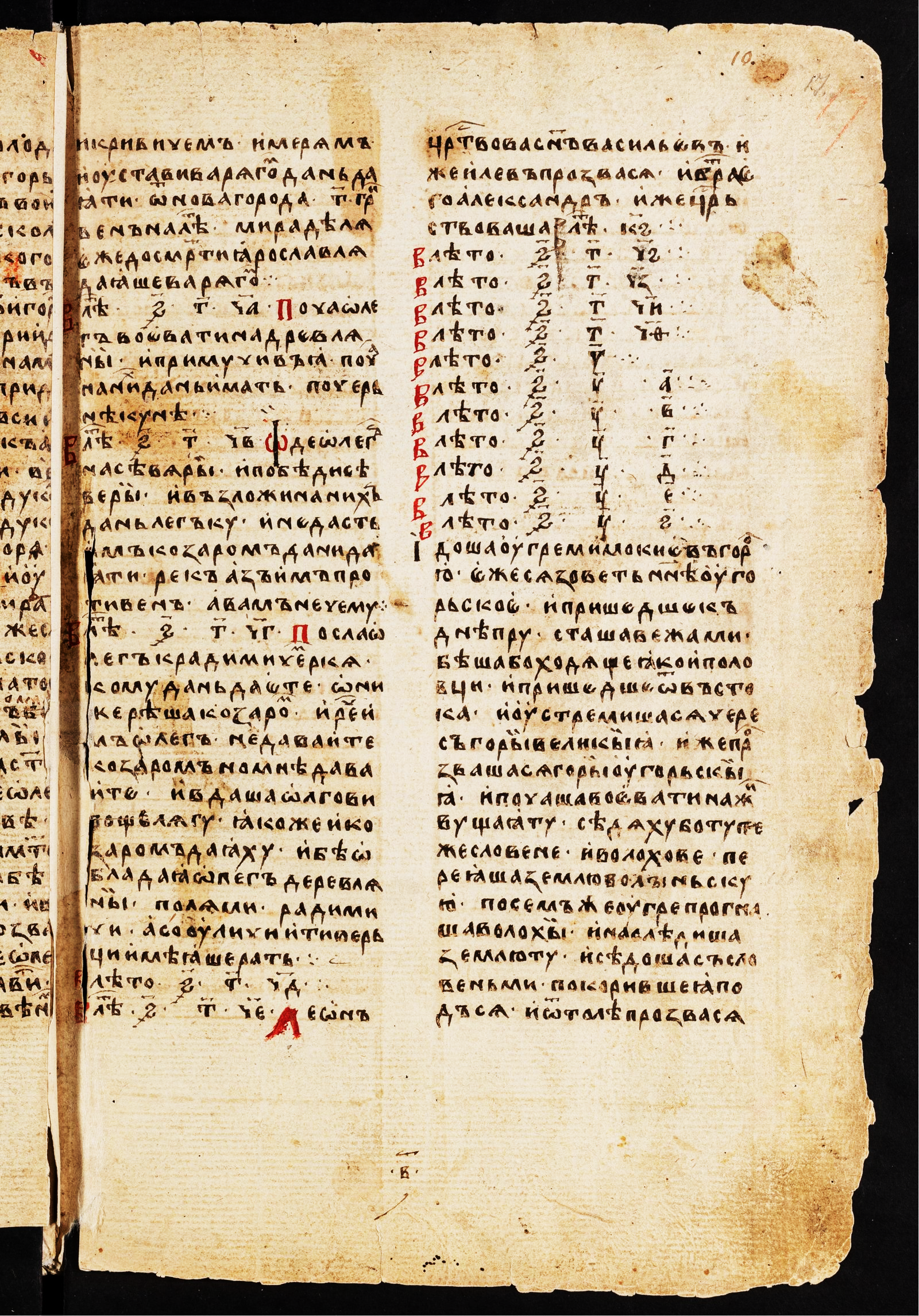
Fig. 17. The Hypatian Codex. Russian Academy of Sciences Library. Filing code НИОР 16.4.4., p. 10.
Article 6393 (885)
Translation: “In the year 6393 (885). Oleg sent to the Radimichs, asking: “To whom do you give tribute?” They answered: “To the Khazars.” And Oleg said to them: “Do not give tribute to the Khazars, but give it to me.” And they gave Oleg a szeląg, as they had given to the Khazars.”
Fig. 18. The Primary Chronicle according to the Hypatian Codex. Photolithograph.
Published by the Archaeological Com. St. Petersburg, 1871. P. 48.
Article for the year 6472 (964).
In 6472 (964), Rurik’s grandson, Prince Svyatoslav Igorevich, undertook his first campaign: «И иде на Оку рѣку и на Волгу, и налѣзе вятичи и рече имъ: «Кому дань даете?» Они же ркоша: “Козаром по щелягу от рала даем”» (transcription by O. V. Tvorogov)[82]. Translation: “And he went to the Oka River and to the Volga, and rode upon the Vyatichs, and asked them: “To whom do you give tribute?” They answered: “We give a szeląg from a ralo to the Khazars.”
Both D. S. Likhachev and O. V. Tvorogov translate the word “from the ralo” not as “from the ralo”, but as “from the sokha.” Naturally, they’re not referring to plowing implements. They’re referring to a late medieval unit of payment called a “sokha.” But here they’re clearly anachronistic. The first mention of “sokha” as a legal term is in the Chronicle of Avraamka (1495), in the entry for the year 6916 (1408). There, the Golden Horde’s beklarbek, Edigu, reproaches the Moscow prince Vasily Dmitrievich for evading paying tribute to the Horde in every possible way: «а что твои приказы и грамоты твои к намъ, то еси намъ все лгалъ; а что еси ималъ въ твоей дерьжавѣ съ всякого улуса съ дву сохъ рубль, и пакы тое серебро гдѣ ся дѣваеть?»[83] Translation: “And what about your admonitions and your letters to us? You always lied to us; and what did you take from each ulus in your realm, a ruble for every two sokha, and where did that money go?”
In legal documents, the sokha appears in the Charter of Veliky Novgorod granting a year’s worth of “Black Forest” tax from the Novotorzhsky volosts to Grand Prince Vasily Vasilyevich, dated 1437/1448 or 1456–1461:
“
”[84]
Translation: “And the Grand Duke’s tax collectors in all the Novotorzhsky volosts are to take, as was the custom in the old days, a new grivna per sokha, and the prince’s scribe a mortka (a small unit of account and currency – V.V.) per sokha. And per sokha, two horses and a third trace horse; and a tanner’s vat per sokha; a seine per sokha; a store per sokha; a plow per two sokhas; a blacksmith per sokha; four horseless (farms?) per sokha; a boat per two sokhas; a tsren (cauldron for boiling salt) per two sokhas. And whoever sits on the half-plough (a tenant who gives half of his income to the owner) is to take from him a half-sokha.”
The grivna was a high-purity silver ingot used to settle large transactions. Beginning in the last quarter of the 13th century, such ingots were referred to as rubles in birch bark documents, and half-ruble ingots as poltins. Both these terms—grivna and ruble—meant the same thing[85]. Until the end of the 14th century, the weight of the Novgorod silver grivna-ruble was equal to 197 grams, but around 1389 it was reduced to 184 grams, a weight norm that remained until 1446/47[86]. In 1420, Novgorod began minting its own coin, the “denga,” which weighed 0.80 grams of high-purity silver. Along with the 184-gram ruble ingot, a counting monetary ruble was introduced, equal to 216 Novgorod dengas. It was called the “new ruble” or “new grivna” and weighed 172.80 grams[87]. In 1446/47, the production of payment bullion coins ceased. The “old” (Old Russian: ветхие) grivna ingots, weighing 184 grams, were withdrawn from circulation and melted down into coins. The “new grivna,” weighing 172.80 grams, now remained the only unit of account.
Thus, in 1408, the estimated tax was 184 grams of silver per two sokhas, while in the mid-15th century, the actual tax, “black pine forest,” was 172.80 grams of silver per sokhas.
The “mortka,” which the prince’s scribe received per sokha, weighed 0.50 grams of silver, according to data from 1404. The Novgorod grivna (“old,” 184 grams) was equal to 364 mortkas.[88]. By 1494, the weight of the mortka had dropped to 0.40 grams[89].
Now let’s try to figure out what the “szeląg” (щеляг) was, which the Khazars were paid “from the ralo.”
According to D.S. Likhachev, “The szeląg is a coin whose exact meaning and origin are unclear. This coin is mentioned again in 964. Apparently, this is a Polish coin (cf. Lithuanian szillings, Anglo-Saxon scilling, Gothic skilliggs, Polish sze1ag). Collecting tribute from the Radimichs and Vyatichs with the Polish coin “szeląg” is obviously a conjecture of the chronicler (since Radim and Vyatko, the ancestors of the princes of the Radimichs and Vyatichs, were “from the Lyakh clan!”). In fact, archaeologists have not found any szelągs in the territories of these tribes”[90].
I immediately want to object to D.S. Likhachev. The coin with the colloquial name “szeląg” began to be issued in Poland only in 1578, 200 years after the writing of the Laurentian Codex, and the chronicler could not have used its name for “speculation” in 1377.
It’s not entirely clear why D. S. Likhachev considers the word szeląg (щелѧгъ) to be Polish. This name is entirely consistent with common Slavic word-formation norms. In the 9th and 10th centuries, this word was even pronounced in Old Russian exactly the same as the Polish szeląg. The Polish letter ą before g sounds like a nasal [ɔɲ] or [ɔ̃]. The Old Russian letter ѧ (yus small) also conveyed a nasalized back vowel [ɔ̃] (like the French “on” in “bombon” or the Polish ą in “kąt”). The word щелѧгъ/szeląg is, by sound, an almost exact transcription of the Old High German Scilling and German Schilling (schilling) – the name of a monetary unit of the Carolingian coinage. The schilling, in turn, was a Germanized version of the Roman coin “solidus”. From 743 AD, it was equal to 1/20 of a pound and was divided into 12 denarii (pfennigs). Since Charlemagne’s monetary reform of 796, the schilling has become widespread not only in Charlemagne’s empire, but also in Italy, France, England (from the 11th century), the German states, and other Western European countries, including the Baltic crusaders.
Whether the chronicle’s word “szeląg” denoted a monetary shilling or something else is a matter of debate. A. P. Novosel’tsev (1990) puts forward an alternative theory. In the Khazar Khaganate, the king and his entourage converted to Judaism, and trade was entirely in the hands of Jewish merchants living in all the country’s cities. The main currency of Khazaria—”the Arab dirham and its variations, minted in independent or semi-independent states of North Africa, Central Asia, and Iran… was called (by Jewish merchants) ‘sheleg’ (‘white’, ‘silver’), and this currency is mentioned in the Historical Literature for Khazar possessions in the lands of the Eastern Slavs.”[91]
K. Zuckerman (2018) objects to this. He draws a curious parallel between the tribute levied by the Radimichs and Vyatichs on the Khazars and the tax levied by the Saxons on the Polabian Slavs, as found in the Slavic Chronicle of Helmold of Bosau (1160s). Zuckerman cites three passages from the Chronicle, as revised by him from L. V. Razumovskaya’s Latin translation. The first two passages (I. a. and I. b.) date from the 10th century; the third (II.), essentially identical, concerns the levies for the benefit of a bishop, imposed by Helmold’s contemporary, Duke Henry the Lion of Saxony and Bavaria (d. 1180):
«I. a. Dabatur autem pontifici annuum de omni Wagirorum sive Obotritorum
terra tributum, quod scilicet pro decima imputabatur, de quolibet aratro mensura grani et XL resticuli lini, et XII nummi puri argenti. Ad hoc unus nummus, pretium colligentis. Slavicum vero aratrum par boum aut unus conficit equus (I, 12, p. 25).
Every year, a tithe, considered a tribute, was paid to the bishop from all the lands of the Vagrians and Bodrichs: from each plough, according to the grain yield, 40 bundles of flax, and 12 coins of pure silver; in addition, one coin as a reward for the harvesters. A Slavic plow was equivalent to a pair of oxen or one horse (cf. Helmold, 1963: 55).
I. b. Est apud Obotritos pontificale tributum, quod pro decimo imputatur, de quolibet scilicet aratro, quod duobus bobus aut uno constat equo, mensura grani et XL restes lini et XII nummi probatae monetae; praeterea unus nummus, qui debetur colligenti (I, 14, p. 28).
The Bodrichs have a tithe tax paid to the bishop, namely, from each plough, which consists of two oxen or one horse, one measure of grain, 40 bundles of flax and 12 coins of official minting are paid; in addition, one coin is due to the collector (cf. Helmold, 1963: 58).
II. Et precepit dux Slavis, qui remanserant in terra Wagirorum, Polaborum, Obotritorum, Kicinorum, ut solverent reditus episcopales, qui solvuntur apud Polanos atque Pomeranos, hoc est de aratro tres modios siliginis et duodecim nummos monetae publicae. Modius autem Slavorum vocatur lingua eorum ‘curitce’. Porro Slavicum aratrum perficitur duobus bobus et totidem equis (I, 88, p. 174).
The Duke ordered the Slavs who remained in the lands of the Vagrians, Polabians, Bodrichs, and Khizhans to pay the bishop’s dues, as the Polonians and Pomeranians did: 3 modii of rye and 12 state-issued coins per plough. A modii is called a korets in the Slavic language. A Slavic plow consists of two oxen and the same number of horses (cf. Helmold, 1963: 200)».[92]
By the 12 “state-minted silver coins” I’ve highlighted in the text, K. Zuckerman means 12 denarii (pfennigs), which make up the shilling, a monetary unit. K. Zuckerman then cites the hypothesis of A. V. Komar (2011), according to which “The origin of the taxation system with a unit of 1 shilling of silver per plough should be associated with the ancient Saxon society, from where this tradition spread to England and the Baltic Slavs, after which it was borrowed by Rus’ in the tenth century”. According to this hypothesis, the emergence of the shilling as a unit of silver is not associated with Charlemagne’s reform, but with a certain “Salic solidus,” and it weighed only 16.38 g, fitting perfectly into the system of ancient Russian weights (two 8.19 g weights). From this follows the conclusion: “Archaeology leaves no doubt that the system of counting in the weighted shilling was widespread in Rus’ in the 10th – early 11th centuries, before the appearance of its own kuno-rezana’s monetary system.”[93]
I won’t discuss the veracity of all these hypotheses, as this is not the topic of my paper. I’ll simply summarize the opinions to understand the value of the “szeląg” collected “from the ralo,” expressed in grams of silver. If the “szeląg” is a dirham, its weight ranges from 2.86 grams of silver in the 9th century to 2.46 grams in the 10th. If it is a shilling, then, according to A. V. Komar, its weight was 16.38 grams of silver. Neither the first nor the second figure compares with the actual payment of 172.80 grams of silver per sokha, according to the Charter of Veliky Novgorod, for the “Black Forest” tax “according to the new grivna.” This means that D. S. Likhachev and O. V. Tvorogov’s translation of the chronicle tax unit “ralo” as “sokha” is completely incorrect. Firstly, the “sokha” was a very large unit, recognized in the 15th century as the main measure for assessing taxes and duties. And secondly, as is clearly evident from the Novgorod Charter, it was not constant and was not tied to the area of a specific plot of cultivated land, but was extended to enterprises, industries, property, etc. In the 13th, 14th, and 15th centuries, all lands in northeastern Rus’, urban and non-urban, reported, i.e., described and measured when describing them for tax collection and assessing duties, were divided: 1) into chets and sokhas, 2) into vyts and obzhas, and 3) into kosts[94].
At the end of the 15th century, after the conquest of Novgorod by Grand Prince Ivan Vasilyevich, we see repeated changes in the measurement of Novgorod sokhas; thus, in one Novgorod census book, a sokha is allocated 3 obzhas, and an obzha is allocated four korobs or eight chets, therefore, a sokha is allocated 24 chets, while in another Novgorod census book, a sokha is allocated 126 chets or quarters; then we encounter 30 chets in a Novgorod sokha; we encounter the same inconsistency in the measurement of ploughs in other Russian possessions[95].
“Ralo” is an archaic tax unit from the pre-Mongol era, and one can only speculate what it represented. A hypothetical analogy could be found in the tax collections with the Latin name “aratrum” from Helmold’s Chronicle (which L. V. Razumovskaya tentatively translates as “plough”). In any case, the translation of the tax unit “ralo” by the medieval legal term “sokha,” as D. S. Likhachev and O. V. Tvorogov do, is incorrect.
CONCLUSIONS
I’ve touched on the translations of only a few articles in the dated section of the Primary Chronicle. A full study of the translations would result in a multi-volume work, far exceeding the two-volume set published by D.S. Likhachev in 1950. However, the material I’ve presented in this article is sufficient to draw a preliminary conclusion.
The task of a text translator is to convey the content of a text in one language using the means of another. However, as we can see, none of the scholars wanted to be a simple translator. Each strove to be, at a minimum, a co-author of the chronicler and even to improve on his work. But even in those parts of the chronicles that researchers have not managed to distort beyond recognition, their translation into modern languages is not distinguished by accuracy. In translations of Old Russian chronicles, we can see a whole host of translation errors: 1) insufficient proficiency in the original language; 2) insufficient cognitive experience, i.e., a lack of knowledge of the surrounding reality described in the source text; 3) inattention to the system of meanings contained in the text, i.e., a misunderstanding of what the author is saying about the subject; 4) an inability to discern the individual style of the author of the original speech work.
I would also like to say a few words about the “classical” translation of the Primary Chronicle by D.S. Likhachev. The text he published under the title “The Primary Chronicle according to the Laurentian Codex of 1377” bears no relation to the original chronicle. It is a completely different chronicle, inconsistent with the Laurentian Codex, which D. S. Likhachev haphazardly assembled from fragments he found attractive in various chronicles, without any criteria. The Old Russian text itself is translated unprofessionally, with gross translation errors, distorted dates, and the addition of toponyms and ethnonyms not found in the original. I would not recommend using this translation for scholarly purposes.
Translating chronicles into modern Russian requires a fundamentally different approach. First and foremost, the translator must have a completely neutral attitude toward the text. They should not add names that aren’t there, change words or dates, or revise phrases at their own discretion. The translator’s task is to translate the text verbatim, not to attempt to co-author it. Secondly, the translation must be literate. If a toponym or ethnonym is unknown, don’t translate it with the first similar name from a modern language that comes along. If a lexical unit from a language that’s obscure is encountered, don’t search for equivalents in modern agnonyms. In general, one should not undertake the translation of a historical text unless they have the necessary professional knowledge.
The conclusion I can draw is not comforting. To date, there is not a single professional scientific translation into modern Russian of any of the ancient Russian chronicles. And this is a great tragedy for the Russian historical and philological science.
References
https://expositions.nlr.ru/LaurentianCodex/index.php
https://www.sibpush.ru/zagot/price.html
UDC: 339.9 (47+57) “1960”
WESTERN-SOVIET COMMERCIAL RELATIONS 1960-1990
AND THE GROWING SOVIET DEBT TO THE WEST
PART 1: THE 1960S
Gabriela Gavrilov
Emerson College, Boston, Massachusetts (1996)
MA Journalism
Catholic University, Washington, D.C. (1985) +
University of Warsaw, Poland (1983 – 1984)
BA Political Science / Economics
ggavrilov100@yahoo.com
http://orcid.org/0009-0008-9246-9646
Abstract. This article examines Western–Soviet commercial relations in the 1960s, focusing on government-backed export credits, technology transfers, and the early accumulation of Soviet external debt. Drawing primarily on declassified CIA economic intelligence reports, it demonstrates how large-scale imports of Western industrial plants and equipment transformed Soviet trade practices from cash and barter to systemic credit dependence. The article forms the first part of a three-part series analyzing the financial mechanisms that ultimately undermined the Soviet economic system.
Keywords. Soviet debt; Cold War economics; export credits; technology transfer; CIA economic intelligence; Western-Soviet trade; industrial imports; dual-use technology.
There is no such thing as free cheese —
it exists only in a mousetrap.
Russian proverb
Introduction
This is a new cycle of articles of the author, Gabriela Gavrilov, on the Soviet debt to the West countries during the 1960s, 1970s, and 1980s, which will eventually explain the financial reasons behind the Soviet Union’s fall. The current article is devoted to Western-Soviet commercial relations in 1960s.
The Cold War was an intense, decades-long (1947–1991) nuclear and conventional weapons competition between the US and USSR. Publicly driven by ideologies and the doctrine of Mutual Assured Destruction (MAD), both sides built massive arsenals to deter attack from the other, resulting in severe economic strain, bloody proxy wars, and global fear of nuclear annihilation. A significant beneficiary of this prolonged confrontation was the industrial sector, particularly firms engaged in supplying technology, equipment, and know-how to both blocs. In the interest of brevity, this article will be limited to the 1960s.[96]
To establish the context of the long-standing hostility between the Western countries, especially the United States, and the Soviet Union and Bloc countries, the 1960s were characterized by continued intense political and ideological polarization between the US and its allies and Soviet Russia and its allies. Globally publicized events included:
US Annual Military Spending (1960–1969) (US $ Billions)
1960: $47.35
1961: $49.88
1962: $54.65
1963: $54.56
1964: $53.43
1965: $54.56
1966: $66.44
1967: $78.40
1968: $84.33
1969: $84.99
Total (1960-1969): $647.74 billion[100]
Nevertheless, according to now declassified CIA reports from that era:
During the 1960s, the Soviet Union was increasingly offered government-backed credits by West European nations and Japan to finance its purchase of technology, licenses and know-how from Western firms. Coordinated by Western governments, these credits (derived from taxpayer funds) were often provided at below-market interest rates[101] and were used to pay for an increasing array of electronics & communications, ships & marine equipment, mining, metallurgical, chemical, oil, gas & pipeline equipment, motor vehicle manufacturing plants and equipment and other dual-use technology (dual-use industrial technology) critical to maintain and enhance modern military prowess. The acceptance of Western credits, however, increase Soviet debt burden to Western financial institutions and eventually lead to the Fall of Communism (as will be covered in an upcoming article “Western-Soviet Commercial Relations 1980-1991”.)
During the first four decades of the Soviet Union’s existence, the USSR conducted virtually all its commercial transactions with the West on a cash basis[102] or barter. The upsurge in imports of Western plants and equipment during the 1960s, however, not only made it unfeasible for the Soviet Union to supply buy-back products to all of the Western companies whose equipment or plant it purchased—such as the some 234 chemical plants, equipment and technology contracts won by elite Western firms for delivery to the Soviet Union between 1957 and mid-1963 alone[103]–but quickly increased its indebtedness to the West, which reached US$1 billion[104] by 1969. To maintain access to the Soviet market, Western governments quickly stepped in to provide taxpayer funds to the Soviet Union, in the form of government-backed credits, to keep their elite firms sustained with sufficient market industrial share and lucrative contracts.
Italy
The agreement to build the FIAT plant in Toliatti, USSR, was signed on May 4, 1966, in Turin, Italy, by FIAT CEO Vittorio Valletta and the Soviet Minister of Automobile Industry. The contract established the construction of the VAZ plant (Volga Automobile Works) to produce popular, affordable cars, with construction beginning shortly after in early 1967.
In 1967, the Italian government provided a loan of up to $300 million with liberal ten-year credits at 6% interest, v. the (then) current 8% commercial rate to cover Soviet purchases of equipment and technology for the construction of the massive FIAT automobile plant at Toliattigrad (VAZ), built between 1966 and 1970 in collaboration with Fiat. As the largest car plant in Russia, it produced over 16 million vehicles, significantly contributing to the motorization of the Soviet Union. The total project value was estimated at between $650 million and $887 million. In January 1968, Pirelli concluded a $50 million deal to make rubber parts for the Fiats.[105]
The US Export-Import Bank also supplied a $50 million loan to Italy, to finance US machine tools that were to be used in the Italian-built Soviet plant. An October 1966 article in Forbes, stated that, “Three quarters of the machinery that FIAT installs for the Russians will come from the United States, either directly or indirectly through European subsidiaries and licensees of American firms. It will really be the United States that puts the Russians on wheels.”[106]
Japan
In 1968, the Japanese government financed a five-year $133 million credit loan at 5.8% to the Soviet government to purchase Japanese firms’ equipment for the development of Siberian timberlands, taking repayment in timber deliveries under the Japanese-Soviet Timber Agreements of that year.[107] According to a 1968 article in TIME Magazine, “In addition, a consortium of 13 Japanese companies, including such big trading firms as Mitsui and Mitsubishi, will be allowed to sell $30 million worth of consumer goods to Russian settlers in Siberia. As repayment of the loan and to cover its interest, the Russians over a five-year period will ship 8,020,000 cubic feet of timber to Japan.”[108]
France and the UK
According to a Confidential CIA report (declassified and released in 2011):
In May 1965 the French Commissariat a l’Energie Atomique (CEA) and the Soviet State Committee for the Application of Atomic Energy signed an agreement for cooperation in nuclear energy. A practical result of these negotiations was the French undertaking to install a bubble chamber at Serpukhov—the Soviet high energy research institute—in return for the right to have some 50 French scientists work with the large particle accelerator there. This stationing of a large group of Western scientists is the USSR for an extended period of time constituted unique precedent. Under this arrangement, however, the Soviets obtained—at practically no cost sophisticated research device worth approximately $10 million.
While the venture was hardly a “unique precedent”, except in the eyes of the public, the return on that $10 million investment would be in Western government contracts to ‘keep up with Soviet military advances made in the field of nuclear fusion’.
In 1969, the French government signed a major trade and economic cooperation agreement, the French-Soviet Cooperation Agreements, promising the “easiest credit terms” and aiming to double trade over a five-year period. This Scientific & Technical Cooperation (STC) built on 1966 agreements which included joint projects in color television (SECAM), nuclear energy, and space exploration.[109]
A Five-Year Trade Agreement signed on May 24, 1959, and enacted in 1960, became the primary framework for UK-Soviet trade during the 1960s, for both consumer goods and industrial machinery.[110] Throughout the late 1960s, both the UK and France extended large credit lines to the Soviet Union for purchasing chemical plants, textile machinery, and other industrial technology. These Western European nations allowed “swing credits”—overdraft facilities that permitted the Soviets to temporarily finance trade deficits.[111]
Germany
During the 1960s, West Germany and the Soviet Union maintained significant, expanding trade despite lacking formal, comprehensive trade agreements after 1963. The vastness of Russia’s energy reserves became apparent in the 1960s. While the U.S. pressured West Germany to veto oil-for-pipe contracts in 1962, this energy project set the stage for later, massive, long-term cooperation that cemented the Soviet-German economic relationship. Key trade revolved around importing Soviet oil and raw materials in exchange for Western technology, culminating in pivotal “pipe-for-oil” deals that established durable, long-term energy infrastructure.
Between 1959 and 1962, West Germany firms such as Mannesmann and Thyssen sold approximately 600,000 tons of large-diameter pipes to the Soviet Union. Under US pressure, NATO established an embargo between 1962 and 1966 intended to stop these shipments, however, some orders (e.g., 163,000 tons in 1963) were already in process and continued and West German firms remained key suppliers of specialized, large-diameter steel pipe crucial for the construction of Soviet pipelines such as the Druzhba pipeline.
The NATO embargo notwithstanding, during the Seventh Five-Year Plan (1959–1965) (actually seven-year plan), West Germany and Sweden together supplied at least 40% of the Soviet Union’s total requirements for large-diameter pipes. Following the lifting of the embargo in 1966, Germany continued to be a primary source for Soviet energy infrastructure, cementing the “pipes for gas” relationship.
Sweden
Under a 1947 agreement, the Swedish government had given the Soviet government one billion in Swedish Kroner credit over a 5-year period to purchase Swedish products. In 1968, the first connection between the Eastern and Western natural gas systems was built, between Austria and Czechoslovakia (Bratstvo pipeline).
During the 1960s, the USSR made significant and ongoing purchases from Sweden, largely focused on industrial modernization, raw material processing, and energy infrastructure. These imports were facilitated by trade agreements that encouraged the exchange of Soviet raw materials (like oil) for Swedish manufactured goods.
The Soviet Union placed substantial orders for Swedish machinery to support industrial development. This included specialized equipment for mining, forestry, and, importantly, the forestry-related pulp and paper industry. Sweden supplied the Soviet Union with industrial steel, including wide steel pipes, which were crucial for developing the Soviet natural gas pipeline network. Sweden also sold the Soviet Union specialized vessels, including trawlers and cargo ships.[112]
The USSR imported equipment for hydropower and thermal power stations from Sweden, as well as chemical products, ball bearings, and high-precision optical equipment. These purchases were often part of a broader, long-term trade arrangement where Sweden, a strong industrial nation, acted as a key supplier of advanced technology and machinery to the USSR during the Cold War.
United States
Between 1957 and mid-1963 alone, US and West European firms sold over $1.3 billion worth of chemical plants and related equipment to the Soviet Union in “known values from ‘selected contracts’” listed in a secret CIA Economic Intelligence Report of April 1964. This would be equivalent to about $14.3 billion in todays’ values.
In 1963–1964, the Soviet Union purchased over $100 million of US wheat, with licenses approved for up to $390 million in grain and related agricultural products during that period. While smaller, sporadic purchases continued, large-scale, consistent, and “massive” US grain buying by the Soviet Union did not become a regular feature of international trade until 1972.[113]
Known Value of Western Firms’ Sales to the Soviet Union
Following is a verbatim chart taken from a declassified Secret CIA Intelligence memorandum, Soviet Indebtedness to the West (ER IM 70-163), November 1970 (released as sanitized March 10, 2010):
Had Finnish-Soviet trade been included the figures would have quadrupled or more. Finland, through Scientific Technical Cooperation (STC) agreements (covered in my previous article)[114] became a primary trade partner with the Soviet Union, funneling technology, electronics and cables (especially Nokia) as well as ships to the USSR under a post war reparations agreement.
The following tables are reproduced verbatim from declassified CIA economic intelligence memoranda. While many sections remain redacted, even the sanitized versions clearly illustrate the scale, sectoral diversity, and military relevance of Western technology transfers to the USSR.
|
May 1967 CIA Report on 1967 Sales of Western Plants and Equipment to the Soviet Union (5 Months) NOT INCLUDING FINLAND (2 full Pages Censored before being Released in 1999) |
||||||
| Industry | Company* & Creditor(s) | Selling Country | Value (US Millions) | Remarks | ADDITION TO THE CIA CHART
Military Application |
|
| A. | Chemical & Petrochemical | |||||
| 2″ SPACE BLANKED OUT | ||||||
| B. | Oil Refinery & Pipeline Equipment | |||||
| 40,000 tons of steel pipe, diameter 1,020mm | Undisclosed | Sweden | Undisclosed | “Will sell in 1967.” | ||
| C. | Metalworking & Metallurgy | |||||
| High Carbon, High Speed Machine Drills, Metal Cutting Bits, and Various Machine Tools | Undisclosed | Sweden | Undisclosed | High-carbon, high-speed steel (HSS) metal cutting bits are used by the military for machining durable materials in manufacturing, maintenance, and repair. Their toughness, wear resistance, and ability to withstand high temperatures make them ideal for the demands of military applications, particularly in the aerospace and defense sectors. | ||
| .5 ” SPACE BLANKED OUT | ||||||
| D. | Food Processing | |||||
| Grape Juice Factory | Undisclosed | France | $0.8 | Production September 1968. | N/A | |
| Milk Packaging Equipment | Undisclosed | Sweden | $1.0 | N/A | ||
| E. | Paper & Pulp Industry | |||||
| NONE | ||||||
| F. | Textile Manufacturing | |||||
| Textile Plant to Produce Cold Weather Fabrics | Undisclosed | France | Undisclosed | 7-Year Credit from date of delivery. | ||
| Shirt plant, 8 million/year | Undisclosed | Italy | $1.5 | N/A | ||
| H. | Electronics | |||||
| Color TV Pilot Plant – 6,000 picture tubes a year | ||||||
| Ancillary Equipment for Olivetti Computer to Rationalize Flow of Agricultural Spare Parts | Undisclosed | France | $4.50 | |||
| 2 Olivetti Data Processor Model GE 115 | Undisclosed | Italy | $0.3 | The 1966 Olivetti Programma 101 computer had significant military applications for the U.S. armed forces, particularly during the Vietnam War. While it was not a hardened military computer, for its portability and programming capabilities made it useful for specific, on-site calculations. The U.S. Air Force utilized the Programma 101 for critical targeting calculations for B-52 Stratofortress bombers. It was used as part of a larger system to compute coordinates for ground-directed bombing. This enabled the air force to rapidly perform complex arithmetic needed for accurate bombing missions. In addition to direct military use, the P101 was purchased by NASA for the Apollo 11 moon landing program. In this capacity, it was used by a military-civilian entity for applications that were highly relevant to national defense and the Cold War’s space race. NASA used the machines for a variety of critical tasks, including Mapping lunar trajectories, Calculating coordinates for the lunar landing, Determining flight path corrections for the mission. | ||
| 1 Electronic Data Processor Model G 425 | Undisclosed | Italy | $0.6 | Olivetti Data Processor Model GE 115 was a second-generation, commercial business computer originally released in the mid-1960s to handle tasks like payroll, accounting, and inventory. The Olivetti GE 115 was designed for businesses and competed with other commercial mainframes of the era, not military-grade hardware. | ||
| 2 SDS 910 (US) Computers | Undisclosed | Italy | $0.8 | While no evidence exists for a military computer called the “Electronic Data Processor Model G 425,” the search results indicate that the military did use the Bendix G-15, a contemporary computer with similar alphanumeric designations. A military version of the G-15 could have been used for calculating and plotting missile trajectories. The Bendix G-15 featured a combination digital computer and digital differential analyzer (DDA), allowing it to process both general-purpose calculations and specialized differential equations. This would have been useful for calculating complex flight paths. | ||
| I. | Automotive | Undisclosed | United States | $0.6 | The SDS 910 was used in missile checkout and seismic data reduction, among other military-related applications. As a member of the Scientific Data Systems (SDS) 900 series of computers in the 1960s, its uses were part of broader applications in fields like defense technology and scientific analysis. | |
| Equipment and Technology for Modernizing the Moskovich Plant | ||||||
| J. | Ships & Marine Equipment | Undisclosed | France | $50.0 | 8.5 Year Credit; Agreement in Principal Only | Originally built by Ford Motor Company (US) in 1929. |
| 4 – 2,600 ton Fully Automated Fish Processing and Refrigeration Vessels | ||||||
| K. | Other | Undisclosed | Netherlands | Undisclosed | N/A | |
| Plant for the Double Distillation of Water to be used in Blood Plasma Plant | ||||||
| Printing Equipment, two-8 Color Rotary Printing Presses, Photo engraving equipment, Newspaper Conveyor Belts and Electronic Meters | Undisclosed | Austria | Undisclosed | N/A | ||
| 3 Installations for Production of Aerosol Containers | Undisclosed | France | $2.0 | Helps Disseminate Soviet Propaganda | ||
| Undisclosed | Italy | $5.5 | Delivery early 1968. | Military uses for aerosol containers range from battlefield applications like non-lethal crowd control and tactical screening to essential support functions such as large-scale pest control, equipment maintenance, and fire suppression. | ||
| Electrolytic Condenser | Undisclosed | Italy | $0.8 | Electrolytic condensers in military applications serve crucial roles in power supplies, filtering, energy storage, and signal coupling for aircraft, ground vehicles, and radar systems. They are designed to meet specific requirements, such as high-temperature operation, resistance to vibration and shock, high capacitance retention at low temperatures, and hermetic sealing to prevent electrolyte dry-out, replacing less reliable components like wet tantalum capacitors. | ||
| 8″ SPACE BLANKED OUT through 2 FULL PAGES | ||||||
| 5 Month TOTAL | $68.4 | |||||
According to a November 1970 CIA Memorandum, Soviet indebtedness to the West, accrued from medium- and long-term credits, had grown rapidly during the late 1960s, from about $50 million to $380 million in the seven years 1959-1965, and then rose to almost $1.2 billion in the four years 1966-1969. Between 1959 and 1965, trade with the West as a whole grew at the annual rate of nearly 11%, exceeding $5 billion in 1965. Following crop failures in 1963 and 1965, the Soviet Union began using Western credit to buy grain from Canada and the US. Between 1965 and 1969, Soviet long-term debt to the West rose by some $800 million, growing to roughly $1.6 billion by the end of 1970[115] (equivalent to approximately $13.37 billion in 2026).
As the hard currency trade deficit increased to an average of $350 million a year, the Soviet Union resorted to gold sales, averaging more than $500 million in annual gold sales between 1963 and 1965. Soviet gold reserves fell by more than $1 billion during 1963-1965 reaching a low of about $1 billion by the end of 1965.[116]
This created a self-reinforcing cycle: credit-financed imports expanded industrial capacity but failed to generate sufficient hard-currency exports, forcing increased reliance on gold sales and further borrowing.
Nevertheless, machinery and equipment imports, especially pipeline equipment, from the developed West surpassed their earlier high level in 1966 and increased to a new high of $670 million in 1967.[117]
The growing debt and depletion of gold reserves did not stop Soviet government from continuing and even greatly increasing its imports of industrial plants and equipment from Western firms as will be discussed in the following article focusing on the 1970s.
TO BE CONTINUED
References:
Electronic resource: World Military Expenditures 1969, US Arms Control and Disarmament Agency, https://2009-2017.state.gov/documents/organization/185679.pdf
Electronic resource: https://www.sas.upenn.edu/~dludden/USmilitarybudget02a.htm#:~:text=Subsequent%20Buildups%20and%20Retrenchments,but%20the%20decline%20during%20the
Electronic resource: https://www.macrotrends.net/global-metrics/countries/HIC/high-income/military-spending-defense-budget#:~:text=Table_title:%20Military%20Spending/Defense%20Budget%201960%2D2024%20Table_content:%20header:,%7C%20:%20$69.80B%20%7C%20:%206.63%25%20%7C
Secret CIA Intelligence Memorandum, (Nov. 1970). Soviet Indebtedness to the West. Declassified in Part- Sanitized Copy Approved for Release, March 10, 2010.
Secret CIA Economic Intelligence Report, (April 1964). “Selected Soviet Contracts for Chemical Equipment and Technology”. CIA/RR ER 64-9, Released as Sanitized 1998.
No Author (February 23, 1968). Trade: Italy to Russia, TIME.
No Author (Oct. 1, 1966). To Russia—Without Love, Forbes, pp. 19-20.
Sumiye O. McGuire (May 1990). Soviet-Japanese Economic Relations, RAND, Santa Monica, The Rand Corp.
Electronic resource: No Author (Sept. 13, 1968). Japan: Eyes on Siberia, TIME. https://time.com/archive/6632800/japan-eyes-on-siberia/
Electronic resource: Confidential CIA Intelligence Memorandum, (January 1972). Soviet-French Economic Cooperation, ER-IM 72-10. Sanitized approved for Release, Jan. 18, 2011. https://www.cia.gov/readingroom/docs/CIA-RDP85T00875R001700030010-6.pdf
Electronic resource: For the Text of the Treaty (in English): https://treaties.fcdo.gov.uk/data/Library2/pdf/1960-TS0034.pdf
Electronic resource: Confidential CIA Intelligence Memorandum, (January 1972). Soviet-French Economic Cooperation, ER-IM 72-10. Sanitized approved for Release, Jan. 18, 2011.
Electronic resource: Riitta Hjerppe (No Date). Economic History of Sweden, Economic History Assoc., University of Helsinki, https://eh.net/encyclopedia/an-economic-history-of-finland/#:~:text=Exports%20and%2C%20accordingly%2C%20the%20structure,the%20government%20in%20the%201950s
Electronic resource: Confidential CIA Memorandum, (Aug. 28, 1964), US Sales of Wheat to the Soviet Union as Related to the US Taxpayer, https://www.cia.gov/readingroom/docs/DOC_0000969853.pdf
Gabriela Gavrilov. Russian Emerging Economy and American Oligarchs. Scientific Platform XXI Century, # 9 (December 2025), pp.21-43, www.episs.ru
Secret CIA Intelligence Memorandum (November 1970), Soviet Indebtedness to the West, ER IM 70-163, Declassified, Sanitized released March 10, 2012.
UDC: 343.9:343.4
STALKING-SILENT THREAT: HISTORICAL EXCURSUS AND MODERN SOLUTIONS
Sapego Olga Vasilevna
A.Y. Sukharev Moscow Academy of
the Investigative Committee of the Russian Federation
Senior Lecturer of the Department of Civil Law Disciplines
of the Faculty of Investigator Training
Email: olgasapego546@gmail.com
Abstract: The article provides a comprehensive analysis of stalking as a socially dangerous phenomenon combining psychological, criminological and legal dimensions. It examines the historical origins of obsessive pursuit, its reflection in literature, and the evolution of criminal law regulation in foreign jurisdictions. Particular attention is paid to the absence of a specific criminal law provision on stalking in the Russian Federation, which significantly limits the protection of victims and the prevention of more serious violent crimes. The author analyses existing civil law remedies and demonstrates their practical ineffectiveness. Modern forms of cyberstalking in the context of digitalisation are explored, along with a psychiatric typology of stalkers. The paper concludes that it is necessary to introduce administrative and criminal liability for stalking, combined with medical and rehabilitative measures.
Keywords: crime, hatred, obsessive attention, stalking, stalker, cyberstalking, personality disorder.
The reason for writing the article was the circumstances related to the rejection of draft laws on countering stalking (stalking (obsessive pursuit)) by introducing administrative and then criminal liability for stalking, including a restraining order. In the article, we will consider the origin and development of this stalking, its historical examples and modern manifestations, since it is not only a psychological phenomenon, but also a serious threat to personal security, which requires attention and appropriate measures.
1.1. Materials and methods are represented by an appeal to the modern doctrine of civil, administrative and criminal law, historical events of obsessive persecution, manifestations of stalking in the practice of applying criminal legislation, as well as the complex use of such general scientific methods as dialectics, logic, comparison, comparison, induction, deduction, generalization, division and the following special scientific methods of cognition: comparative-legal, formal-logical, systemic and structural.
1.2. Results of the study. The analysis of the history of stalking, as well as the current legislation from the point of view of the consequences of unlawful stalking (obsessive pursuit), has shown the expediency of criminalizing “stalking”. Namely, the need to apply administrative and criminal legislation, since persecution is supplemented by harassment, the use of violence, as well as other kinds of deviant behavior commission of grave and especially grave crimes. And in this regard, a draft criminal law norm is proposed, providing for responsibility for these actions.
At first, just messages. Then there are likes from anonymous accounts. Then there were “chance meetings” near the house. And then there are new pages: gifts at the door, threats: “if you don’t answer, I’ll come”, full awareness of the actions of the object of desire and demonstration of his control.
A person wakes up in anxiety, changes the route, phone number, address. He looks around. Your whole world narrows down to one thought: “just don’t collide.”
This is what stalking is – obsessive attention or stalking. It destroys the sense of security. Gradually. Persistently. Steadily.
And if we turn to the origin of the word stalking, it comes from the English “stalking”, which means “to sneak up” or “secretly pursue”. It entered the Russian language through the story of the brothers Arkady and Boris Strugatsky “Roadside Picnic” (1972), based on which in 1979 the director A. Tarkovsky shot the film “Stalker”, where this was the name of a person who secretly penetrates into a dangerous, anomalous zone for the sake of prey.
The term “stalking”, as indicated in the article by E.G. Starorublenkova and V.L. Samutkin “Stalking: Obsessive Pursuit Syndrome”, was introduced into scientific use in 1921 by the French psychiatrist, Doctor of Medicine Gaëtan Gassian de Clérambault, who described it in the treatise “Love Psychosis”. One of the historical facts cited by de Clérambault is the case of a French noble lady in her fifties who fell in love with King George V of England. The reason for such confidence was the signs allegedly given by him, which, in her opinion, were made by raising and lowering the curtains in the windows of the palace, which the lady interpreted as mysterious messages of love. In order to be closer to her beloved, the lady set up a tent near Buckingham Palace, guarding the king daily at the gates of the palace, thus creating great problems for the French and English police.
Later, the British writer Iain McWewsan first described the case of stalking, having got the idea from de Clérambault. He reflected this idea in the novel “Immortal Love”, in which the main character was pursued by a young man with Clérambault syndrome (erotic delusions are a type of disorder in which a person has an obsessive and unfounded belief that another person has a feeling of love for him).
Stalking as a type of behavior has always existed, and we are certainly not dealing with a new phenomenon, but we are currently seeing a decrease in tolerance for this type of behavior. Examples of stalking can be found in ancient literature: suffice it to recall Hellenistic poetry, for example, the idyll of Theocritus “The Cyclops”, where a rude ogre is depicted as a shepherd, hopelessly in love with the nymph Galatea, whose behavior contains elements of stalking.[118]
Meanwhile, the theme of stalking is also described in Russian classical literature by the writer A.I. Kuprin. When reading the story “The Garnet Bracelet”, the question arises: is this a story about the great love of a man for a woman or about selfishness and stalking?
And this story was not a creative fiction, but based on a real story. A.I. Kuprin wrote this story in 1910, while living in Odessa, where he often visited the doctor L.Y. Maizels and heard the sad story of the telegraph official P.P. Zhelty, who was hopelessly, touchingly and selflessly in love with the wife of D.N. Lyubimov (who later became the governor of the city of Vilna). And this story is confirmed by the memoirs of Lev Lyubimov in his memoirs “In a Foreign Land”:
“In the period between the first and second marriages, my mother began to receive letters, the author of which, without naming himself and emphasizing that the difference in social status does not allow him to count on reciprocity, declares his love to her. These letters were kept in my family for a long time…
An anonymous lover, as it turned out later, Zhelty (in Kuprin’s story “The Garnet Bracelet” – Zheltkov) wrote that he served at the telegraph office… In one letter, he said that under the guise of a floor polisher, he entered my mother’s apartment, and described the situation. The tone of the messages was sometimes high-minded, sometimes grumpy. Sometimes he was angry with my mother, sometimes he thanked her, although she did not react in any way to his explanations…
At first, these letters amused everyone, but then… My mother stopped reading them, and only my grandmother laughed for a long time, opening another message from a telegraph operator in love in the morning. And then the denouement happened: an anonymous correspondent sent my mother a garnet bracelet. My uncle and father went to Yellow. All this took place not in a Black Sea city, as in Kuprin’s, but in St. Petersburg. But Zhelty, like Zheltkov, really lived on the sixth floor… huddled in a squalid attic. He was caught composing another message. Like Kuprin’s Shein, my father was more silent during the explanation, looking “with bewilderment and greedy, serious curiosity into the face of this strange man.” My father told me that he felt in Zheltoy some kind of mystery, the flame of genuine selfless passion. My uncle, again like Kuprin’s Nikolai Nikolayevich, was hot-tempered, unnecessarily harsh. Yellow accepted the bracelet and sullenly promised not to write to my mother again. And that was the end of it. In any case, we know nothing about his further fate.”[119]
In his “Garnet Bracelet” A.I. Kuprin describes Zheltkov’s unrequited love in its highest manifestation for Princess Vera Sheina. He has been bombarding her with love letters for 7 years.
Meanwhile, reading this work, we only admired the desperation and power of Zheltkov’s love. However, A.I. Kuprin nevertheless showed how unpleasant these letters were to Vera and asked himself and the reader: “Did Zheltkov really not think about what this threatens his beloved? Didn’t he really think how Vera would explain the appearance of her garnet bracelet? Zheltkov knows that his beloved is married, moreover, Zheltkov’s social position will not allow him to simply approach the princess, let alone talk to her.”
His own desire (to give Vera something important to him) turns out to be more important than possible troubles in Vera’s own life. And this is not love, but the satisfaction of one’s own feelings, needs, a selfish desire to possess an object even against the will of the object itself. After all, Zheltkov has never spoken to the object of his passion. Eight years ago, he had seen her in the circus and was fascinated by her beauty. He did not know Vera as a person, she was only an image in his head. But it is not enough for him to love the image, he begins to seek a living woman.[120]
Time passes, epochs change, the attitude to love changes, and already in the 21st century, Zheltkov’s love seems not romantic, but obsessive, from which it is not so easy to get rid of.
And in the 20th century, such “obsessive love” led to tragic events with the subsequent criminalization of this act. Because of a number of high-profile cases against Hollywood actresses: the attempted murder of Theresa Saldana (to whom on 15.03.1982 an obsessive admirer Arthur Richard Jackson inflicted 10 knife wounds in the abdomen after watching the film “Disobedience (1980)”); and the murder of Hollywood actress Rebecca Lucille Schaeffer (who was the victim of persecution for three years and then murdered on 18.07.1989 by an unstable admirer Robert John Bardot, who was infuriated by the sex scenes with the participation of the actress, and through a private detective firm he obtained the address of the actress, went to her house, rang the doorbell and shot her when she opened the door. Schaeffer died at the age of 21) there were laws in America, providing for criminal punishment for persecution.
Norms prohibiting persecution and psychological violence against a person are currently contained in the legislation of many countries.[121]
However, the problem is that it is not always possible to bring the stalker to justice. Unlike many developed countries, stalking is not a criminal offense in Russia. A person can be brought to justice only in those rare cases when he commits some crimes during the persecution. Sometimes it can be:
– threat of murder – Article 119 of the Criminal Code of the Russian Federation,
– violation of privacy – Article 137 of the Criminal Code of the Russian Federation,
– violation of the inviolability of the home – Article 139 of the Criminal Code of the Russian Federation,
– crimes against life and health in the event of the use of violence against the victim of persecution.
And sometimes the most terrible thing happens – the death of a person. Which is what happened on June 07, 2024: motocross coach Dmitry Matveev attacked Anton Yegovtsev, deputy chairman of the Call of the People movement, with a knife at the entrance of a house in Lobnya, Moscow Region, and killed him. This crime was preceded by a conflict between men over Yegovtsev’s wife. Matveev had been in love with her for a long time, pursued the woman for two years. The Yegovtsev spouses have repeatedly appealed to the police with a request to protect them from the persecution of an obsessive admirer of their wife, they changed their place of residence. And on the day of the murder, Yegovtsev and his wife received calls to the duty unit about persecution by Matveev. A criminal case has been initiated against Matveev on the grounds of a crime under Article 105 of the Criminal Code of the Russian Federation (currently suspended in connection with Matveev’s stay in the Special Military Operation Zone (SVO). In connection with the actions of the police, on behalf of the Chairman of the Investigative Committee of Russia A. Bastrykin, a case of negligence was initiated (Article 293 of the Criminal Code of the Russian Federation).[122]
Stalking is not about courtship and love. Stalking is about control, fear, illness and a threat to safety. This is psychological terror. And the main purpose of persecution is to create the illusion of constant presence in the life of the victim, the desire for control, and as a result, to achieve certain actions.
And do not underestimate the danger of stalking, because stalkers are distinguished by a latent readiness to harm the object of their pursuit.
After all, stalking is not a one-time manifestation of interest, but a systematic and often escalated behavior that violates a person’s personal boundaries and invades his privacy. At the same time, the behavior of the stalker itself may seem “innocent” (in particular, a chance meeting, compliments, gifts). But given the repetition and undesirability, such behavior becomes frightening and traumatic.
But not always a separate crime is committed during the persecution, it is extremely rare to prove it, especially when it comes to former partners. A person is actually left without protection and slowly goes crazy.
Meanwhile, ordinary actions that are not prohibited by criminal law in their entirety become illegal. So, if we consider the actions of a man who has been chasing a girl for several weeks: he follows her, looks through the windows while she is in the gym, talks to her, gives her gifts, and considers these actions separately, then there is nothing criminal in them. However, these actions in their totality are a violation of a person’s personal boundaries and an invasion of his privacy.
And given the ongoing globalization, in the context of dependence on digital technologies and social networks, as the Internet and new media spaces spread, new ways of communication are emerging, which, of course, has moved stalking from offline to online.
Every morning of a modern person begins with immersion in the Internet space. We follow the news happening in the world, as well as famous personalities that arouse our interest. We look through new posts, someone writes comments. Sometimes it is very easy to cross the line and not only look at posts, but also start following a person, looking for additional information on him, personal data, and then start chasing offline, creating inconvenience and discomfort, invading personal space, which forms cyberstalking.
In the modern world, stalking actions are impossible without cyberstalking. In reality, persecution occurs after or simultaneously with the collection of information using digital technologies in the media space. The search for information carries an element of some kind of game, the stalker begins to feel like an “agent 007”, excitement arises, he fixates on the victim, invades his personal life, imposing his constant presence in it, and, as a result, disturbs his mental balance, which leads to the most serious consequences.
So, in one of the cases, the husband, using a special application, gained access to the correspondence, telephone conversations of his wife and later was able to hack her page on the social network “Vkontakte”, on which he distributed her intimate photos. It follows from the verdict of the Gagarinsky District Court of Sevastopol dated 07.08.2019 in case No 1-203\2019 that he followed her by such actions. The man was convicted under Article 137, Article 138, Article 271 of the Criminal Code of the Russian Federation. This is a classic example of cyberstalking, but since there is no responsibility for such acts in Russia, the verdict does not contain a description of the “real persecution” that often accompanies such actions.[123]
And taking into account the need for legal regulation of stalking and cyberstalking, in October 2023, the deputies of the State Duma of the Federal Assembly of the Russian Federation V.A. Davankov, S.V. Avksentieva, K.A. Goryacheva submitted to the State Duma for discussion in the draft Federal Law No 452947-8 “On Amendments to the Civil Code of the Russian Federation”. of the Civil Code of the Russian Federation – a provision on the possibility of applying such a method of protection of civil rights as the establishment of a ban on the commission of actions that violate or create a threat of violation of certain rights or encroach or create a threat of encroachment on certain benefits, and paragraph 2 of Article 150 of the Civil Code of the Russian Federation – a provision that intangible benefits belonging to a citizen can be protected, in particular, by establishing a ban on certain actions. In addition, to be supplemented with a new Article 14.1, according to which “if there are grounds, the court may establish a ban on approaching and (or) a ban on other contacts of the offender with a citizen.”[124]
However, by Resolution No 8146-8 of the State Duma dated 03.04.2025, the draft law was rejected with the justification that the projected amendments to Articles 12 and 150 of the Civil Code of the Russian Federation essentially duplicate the current provisions of this Code. According to the current provisions of paragraph three of Article 12 and paragraph 2 of Article 150 of the Civil Code of the Russian Federation, the protection of civil rights can be carried out by suppressing actions that violate the right or create a threat of its violation; Intangible benefits belonging to a citizen can be protected by suppressing or prohibiting actions that violate or create a threat of violation of a personal non-property right or encroach or create a threat of encroachment on an intangible benefit. Also, the courts have the right to apply temporary interim measures, including those prohibiting certain actions related to the subject of the dispute (Article 140 of the Civil Procedure Code, Article 91 of the Arbitration Procedure Code).
Meanwhile, in my opinion, the civil remedy against stalking is ineffective based on the following:
The rules of civil procedural law guarantee the interested person the opportunity to apply to the court for the protection of violated or disputed rights, freedoms and legitimate interests (Article 3 of the Civil Procedure Code of the Russian Federation). However, such an appeal must comply with Article 131 of the Civil Procedure Code of the Russian Federation (“Form and Content of the Statement of Claim”), namely, the statement of claim must contain information about the defendant: for a citizen – last name, first name, patronymic (if any), date and place of birth, place of residence or place of stay, place of work (if known), one of the identifiers (insurance number of an individual personal account, taxpayer identification number, series and number of the document, identification number, the main state registration number of the individual entrepreneur, the series and number of the driver’s license). The provision of such information about the defendant is entrusted to the plaintiff, which in fact is difficult, and sometimes impossible, since it is sometimes impossible for an ordinary person to establish all this data of the stalker for further appeal to the court. At the same time, it should be taken into account that failure to indicate such data, that is, non-compliance with the requirements of Article 131 of the Civil Procedure Code of the Russian Federation, entails liability under Article 136 of the Civil Procedure Code of the Russian Federation – the statement of claim will be left without movement with the provision to the plaintiff of a period during which he will be able to eliminate the circumstances that served as the basis for leaving the claim without action. And if the plaintiff does not eliminate these circumstances (does not indicate all the data about the defendant required in Article 131 of the Civil Procedure Code of the Russian Federation), then the statement of claim will be returned on the basis of Article 136, Part 3 of the Civil Procedure Code of the Russian Federation.
Thus, the plaintiff, not being able to establish the data of the stalker, is actually deprived of the right to apply to the court for the protection of his violated right.
The law provides for an exception for a certain category of cases where the court has the right to accept a claim without information about the defendant. Thus, by virtue of Article 131, Part 2, Clause 3 of the Civil Procedure Code of the Russian Federation, if the plaintiff in a claim for the recovery of debts for payment for premises, a parking space in an apartment building, utilities, contributions for major repairs of the common property of the owners of premises in an apartment building, energy resources is not aware not only of the above information about the defendant, but also of the surname, name, patronymic (if any) of the defendant, the relevant plaintiff has the right to indicate this in the statement of claim and such information along with the above information about the defendant unknown to the plaintiff shall be provided to the court by the bodies specified in this paragraph, as well as by the organization authorized to provide information from the Unified State Register of Real Estate, in the manner prescribed by federal law.
When a citizen suffering from stalking applies for the protection of his rights, the law does not provide for the possibility of the court assisting in the search for such information about the defendant.
In addition, the duration of the procedure for considering civil cases in court (and here it is necessary to take into account not only the consideration of the case by the court of first instance, but also the appeal and cassation hearing) also provides an opportunity for the stalker to have a serious impact on the victim, to create a direct threat to physical and psychological safety.
Therefore, a civil remedy against stalking cannot serve as an effective and effective tool for protection against stalking. In the context of ineffective protection and suppression of stalking, there are administrative or criminal measures of protection with the active participation of state administrative resources (in particular, the identification of the stalker and the suppression of his actions).
And such an initiative to establish criminal and administrative liability for stalking was undertaken in December 2024 by deputies of the State Duma of the Federal Assembly of the Russian Federation V.A. Davankov, S.V. Avksentieva, K.A. Goryacheva, who submitted to the State Duma for discussion the draft Federal Law No795873-8 “On Countering Intrusive Stalking”. However, after preliminary consideration, on 16.01.2025, this bill was returned.
Again, on 24.12.2025, the draft Federal Law No 1107423-8 “On Countering Stalking (obsessive pursuit)” was again submitted to the State Duma for discussion.[125] However, again, after preliminary consideration, on 28.01.2026, this bill was returned.
Thus, this bill provides mechanisms for combating such an offense and enshrines the basic concepts. Thus, according to the bill, stalking (obsessive pursuit) is understood as certain actions that will cause mental suffering and fears for one’s safety (as well as for the safety of one’s loved ones), provided that they continued after the offender was warned about the need to stop doing so.
In particular, such actions include:
– constant deliberate surveillance or waiting for the victim in places of his daily life;
– systematic deliberate attempts to start communication with him/her (including by means of phone calls, messages, postal correspondence, sending gifts, etc.);
– use of the victim’s personal data to order goods, works or services, or to execute correspondence in his name.
Mechanisms for establishing a protection order are provided. Thus, in case of intrusive persecution, the court will be able to decide on the application of such a measure, which serves to restrict access to the victim. The procedure for establishing a warrant is described in this draft.
The following provisions are also provided: the victim can apply to the court for the establishment of a protection order. The court conducts the necessary verification of the circumstances and makes a decision (and if there is sufficient information, it can establish such an order before the application is considered). The decision to establish a warrant comes into force from the date of its adoption and is executed by the authorized bodies. The victim has the right to compensation for moral and material damage. The persecutor is put on a preventive register for the duration of the warrant. Supervision over them is carried out in accordance with the norms of the Administrative Procedure Code of the Russian Federation.
This mechanism implies a ban on the offender from approaching the victim at a certain distance, as well as from visiting places of his daily life and other ways to get in touch with him. At the same time, in case of violation of the protection order, the court is obliged to decide on bringing the guilty person to justice.
It is likely that this bill will be finalized and again sent for discussion to the State Duma, since social relations already exist, and there is no regulatory regulation of stalking yet.
“Life is always ahead of law” is a common legal axiom that means that social relations develop faster than the legislator has time to regulate them.
The topic of stalking has been discussed in society not for years, but for decades. The Internet and artificial intelligence give rise to new forms and opportunities for stalking. And the problem of stalking is already of concern not only to legislators and law enforcement officers, but also to the world medical community, in particular psychiatrists, since stalkers, violating personal boundaries and persecuting, often believe in the reciprocity of feelings. However, such behavior goes beyond the norm and is a borderline mental personality disorder.
According to the Center for Forensic Psychiatry of the American Psychiatric Association for 2001, stalkers are divided into 5 groups (which can be either isolated or combined)
Types of stalkers (by targets):
– “Outcasts” (persecution of employers, former spouses (partners). There is a history of breaking strong symbiotic relationships with mother, friends or loss of stability in working relationships. There are opposing tendencies to re-merge in order to “get everything back” and revenge for the breakup. The feeling of separation is accompanied by powerful frustration, anger, jealousy, and revenge. half of this category had a personality disorder (antisocial HR, narcissistic HR, histrionic HR or a combination thereof) with signs of delusional ideas;
– “requiring close relationships”. This type “demands” a close relationship with his victim, believing that between him and the victim “true” love will make the victim “unique” qualities. In the clinical picture, delusional ideas of erotic content were observed (love is “eternal” and mutual). This group is represented, mainly about 60%), by psychotic stalkers who have been diagnosed with schizophrenia, manic psychosis, delusional disorder with erotomania. The remaining 40% are personality disorders with signs of hypomanicism. Often the ideas of close relationships go hand in hand with the ideas of jealousy and rage caused by rejection on the part of the victim.
– “insolvent”. This is the type of stalker who is critical of the fact that the victim does not reciprocate their claims on them and hope that they will “win” the victim’s trust and reciprocity, which will lead to their intimacy. This group is represented by persons with limited intellectual abilities, unformed flirting and courtship skills. They have a craving for fixation on the victim, but there is no “madness” in this, since there is no certainty in the reciprocity of feelings. Unlike the previous type, they do not idealize the victim and do not endow him with “unique” properties, limiting himself to the potential attractiveness of the victim as a partner;
– “vindictive” (vendetta, revenge, displaced aggression). This type of stalker tracks down their prey with the aim of intimidating and causing suffering. In the clinical picture, there is a feeling of resentment, envy and aggression, which can be directed at a specific goal, but in most cases this is an accidental victim (who has something that the stalker does not have or has lost). For example, a stalker may persecute a doctor whose fault he believes his child died, or persecute a successful manager out of jealousy and resentment that he was fired. This category is also presented to persons with personality pathology;
– “predator (hunter)”. These are the most criminalized stalkers, preparing a crime (planning, thinking about it, fantasizing), capable of kidnapping, stubbornly chasing and mocking the victim. They experience pleasure from inflicting pain and suffering, revel in a sense of omnipotence (God complex). This behavior continues until arrest, since they themselves are unable to inhibit their impulses. In the clinical picture of such persons, pronounced sociopathy (antisocial personality disorder in its extreme form, sometimes bordering on psychotic disorders), hypomanicism, lack of empathy and criticism of one’s behavior, sexual disorders of the perverse spectrum are observed.
Stalkers who are based on psychotic pathology must necessarily receive drug therapy and opportunities (preferably) psychotherapy.
In Russian psychiatry, this issue is also investigated, and in this regard, the opinion of the Russian scientist V.V. Gorinov (Doctor of Medical Sciences, Professor, Head of the Department of Psychogeny and Personality Disorders of the Serbsky State Scientific Center for Social and Forensic Psychiatry), who in the article “Hate crimes and crimes of “stalkers” (psychological and psychiatric aspect)” indicated that “stalkers” are an atypical group of criminals: They are young, often use psychoactive substances, in childhood they had a behavior disorder with a tendency to disturb public order. Compared to psychiatric patients, “stalkers” are twice as likely to have a history of violent convictions and are more likely to have substance abuse disorders. The life history of “stalkers” is the life story of both a criminal and a mentally ill person. To some extent, this refers to the peculiarities of their behavior and psychopathology.
Researchers (4,5,7) believe that appropriate legal sanctions combined with treatment are effective ways to stop persecution. Most outcast “stalkers” refrain from persecution under threat of persecution, and appropriate supportive and directive therapeutic relationships, usually with psychiatric professionals, can be helpful. “Stalkers” who demand intimacy always need psychiatric intervention.[126]
In the context of the attempts to criminalize stalking, the repeated discussion by the State Duma of bills on this issue, it is still necessary to pay closer attention to the legislator and amend the current criminal and administrative legislation in order to suppress stalking. At the same time, taking into account the possibility of receiving drug therapy or psychotherapy when brought to justice.
In our opinion, the problem of stalking requires special attention from the state and society. And despite the existence of civil law norms designed to protect citizens from persecution, practice shows that such measures are not always effective.
And in this regard, radical measures should be taken to eradicate stalking, including by establishing criminal and administrative liability for such acts. Separate the corpus delicti or offense and include it in the appropriate code and provide for the possibility of receiving drug therapy or psychotherapy when brought to justice.
References
https://www.consultant.ru/document/cons_doc_LAW_381390/
UDC: 347.78:004.8
TWO LAWSUITS AGAINST BIG TECH (META[127], SNAPCHAT, GOOGLE): HOW PARALLEL LAWSUITS IN THE UNITED STATES DESTROYED THE DEFENDANTS’ DEFENSE STRATEGY
Kildeev Adel
Zhdanov A. Leningrad State University (1990)
Philosophiæ Doctor in Law
ORCID: 0009-0001-2211-4944
Abstract. The article analyzes parallel lawsuits in the United States against the largest digital platforms (Meta, Snapchat, Google, TikTok) related to harm to the mental health of underage users. It is shown that these cases develop in various procedural forms, including federal multidistrict proceedings (MDL) and individual claims in state courts, but together form a single legal effect. Particular attention is paid to the court ruling of the California court, which rejected key defense arguments based on §230 of the Communications Decency Act and the First Amendment to the US Constitution.
It is substantiated that the subject of judicial review is not the publication activity and content of third parties, but the algorithmic and interface elements of digital platforms as objects that can cause predictable harm. The conclusion is made about the shift of responsibility to the framework of the classical doctrines of tort law of the US states and about the potential applicability of the formed judicial logic to civil liability cases of developers of artificial intelligence systems.
Keywords. Tort law; liability for defective products; digital platforms; algorithms; social networks; negligence; cause-and-effect relationship; § 230 of the Communication Decency Act; First Amendment to the U.S. Constitution; MDL; civil liability; Judicial practice of the United States.
In preparing the article, the author used generative AI systems, including, but not limited to: ChatGPT-5, Grok, Gemini. Language models were used by the author exclusively as auxiliary tools for analytical verification; the sources of the research are the normative acts and judicial practice of the United States. All legal positions, conclusions and interpretations contained in the article are the result of the author’s independent scientific work.
Chapter 1. Introduction
I have detailed Disney and WBD’s lawsuits against Midjourney for copyright infringement and the lawsuit filed by the parents of teenage Raine v. OpenAI & Altman, who committed suicide. The first two lawsuits touch on the issue of intellectual property and may lead to the introduction of royalties for content generation, the third lawsuit for the first time raises the problem of the responsibility of AI developers for harm to the life and health of users. All three cases form a new legal framework for regulating artificial intelligence.[128]
In 2023-2025, a number of lawsuits were initiated in the United States of America against major digital platforms, including Meta, Snapchat, Google (YouTube), and TikTok, related to the alleged negative impact of digital products on the mental health of minors. In academic publications and expert commentaries, these processes are often described as a single large-scale litigation conflict or as a direct consequence of the federal Multidistrict Litigation (MDL) procedure. Such an interpretation, however, does not reflect the actual procedural configuration of the disputes under consideration and leads to methodological simplifications. In fact, several separate litigation proceedings are developing in parallel with respect to these defendants, considered in different jurisdictions and based on different legal models of liability. These processes do not form a single case and are not in relations of procedural subordination but are partially based on a common evidentiary and expert base. Such a combination of independent but interrelated processes forms a cumulative procedural effect that significantly increases the legal risks for the defendants.
Judicial pressure on the largest digital platforms in the United States is formed in three independent procedural areas: federal (MDL), state (individual tort claims) and institutional (public law federal claims). The purpose of this article is to analyze this multi-level procedural structure and to identify how the cumulative effect of parallel litigation has led to the transformation and actual decrease in the effectiveness of traditional strategies for the procedural protection of defendants.
In 2022, a lawsuit was filed against the information platforms Meta[129], Snapchat and Google in the Federal Court for the Northern District of California (Case 4:22-MD-03047), the further procedural development of this dispute was carried out within the framework of the MDL procedure, during which the federal court considered issues of liability on the merits, including the applicability of section 230 of the Communications Integrity Act and constitutional guarantees of free speech.[130] At the same time, the plaintiff filed an independent lawsuit in the Superior Court of California, County of Los Angeles (Case 22STCV21355). In this case, the court dismissed the defendants’ request for a simplified decision, after which the parties reached an amicable agreement on the eve of the trial by jury. [131] While a settlement in state court does not create prejudicial effects on the federal court, it serves as an indicator of the substantive vulnerability of defendants’ defensive position and transforms the dynamics of federal litigation, especially in an MDL setting.
The significance of these lawsuits lies not in their procedural complexity, but in the substantive transformation of the claims presented: for the first time, Big Tech found itself in the position of potential liability for the properties of the design of its products. It was this circumstance, and not formal procedural factors, that predetermined the decision of the defendants to conclude an amicable agreement before the case was considered by the jury.
Chapter 2. Contents of a Complaint filed in federal court
Figure 1. First and last pages of the Complaint
This statement of claim is a large and well-prepared legal document consisting of 287 pages of text and a significant number of images incorporated into the text of the statement of claim. The lawsuit immediately states the subject of the lawsuit: SOCIAL MEDIA ADOLESCENT ADDICTION/PERSONAL INJURY, PRODUCTS LIABILITY LITIGATION. And this is not a single lawsuit, but a class action (MASTER COMPLAINT), that is, other plaintiffs can join this lawsuit without filing their own separate lawsuits.
Given that Internet access to U.S. court records from Russia may be limited due to U.S. government sanctions and the importance of legal language to understanding the case, here are excerpts from the lawsuit (translated by Microsoft translation service):
«I. INTRODUCTION
1. American children are experiencing an unprecedented mental health crisis caused by the defendants’ addicted and dangerous social media products.
2. Over the past decade, Americans’ engagement with social media has grown exponentially, especially among our nation’s youth. This explosive growth in usage is not an accident.
This is the result of the defendants’ studied attempts to encourage young people to use their products – Instagram, Facebook, TikTok, Snapchat and YouTube – compulsively. Borrowing heavily from the behavioral and neurobiological techniques used by slot machines and used by the cigarette industry, the defendants consciously incorporated a number of design features into their products aimed at maximizing youth engagement to increase advertising revenue. Defendants know that children are at a developmental stage that makes them particularly vulnerable to the dependent effects of these traits. Defendants still target them to make additional profits.
3. The shortcomings of the defendants’ products vary depending on the platform, but they all exploit children and teenagers. These include, but are not limited to, an algorithmically generated, infinite feed so that users scroll in an induced “flow state”; “intermittent variable rewards” that manage the delivery of dopamine to enhance use; “trophies” to encourage overuse; metrics and graphs for using social comparisons; Constant notices that encourage repeated account checks due to production instability; insufficient, inherently illusory age verification protocols; and insufficient tools for parents to create the illusion of control.
4. The ubiquity of the defendants’ products in the lives and palms of our children, as well as the subsequent harm to them, can hardly be overestimated. Today, more than a third of 13- to 17-year-olds report using one of the accused’s apps “almost constantly” and admit it’s “too much.” However, more than half of these children report that they would find it difficult to reduce their use of social media. Instead of injecting coins into machines, children feed the platforms of the accused with an endless supply of attention, time, and data.
5. The election of the defendants brought exceptional corporate profits – and led to a huge tragedy. The suicide rate among young people has risen by an alarming 57%. Emergency room visits for anxiety disorders increased by 117%. In the decade leading up to 2020, the number of high school students reporting persistent sadness and hopelessness increased by 40%, and the number of those who attempted suicide increased by 36%. In 2019, one in five high school girls made a suicide plan. In 2021, one in three girls seriously considered a suicide attempt. Children, their parents, and caregivers across the country are struggling with the serious, long-term effects of anxiety, depression, addiction, eating disorders, self-harm, suicidal thoughts, and the loss of the ability to outlive their child.
6. This lawsuit is a continuation of a growing body of scientific research, including internal (previously hidden) research by the defendants, that draws a direct line between the defendants’ conscious, conscious design decisions and the youth mental health crisis sweeping our country.
Instagram, Facebook[132], TikTok, Snapchat and YouTube have changed the way our children think, feel and behave. Scattered “likes” replaced the intimacy of teenage friendships. Mindless scrolling has supplanted the creativity of the game and sports. Although the products of the accused are presented as “social,” they have contributed in a variety of ways to alienation, dissociation, and a host of subsequent mental and physical traumas.
7. The U.S. Surgeon General recently explained that children’s fight against big tech companies is “just an unfair fight.” “You have some of the best designers and product developers in the world who have created these products so that people make the most of their time on these platforms. And if we tell a child: use willpower to control how much time you spend, you’re putting the child up against the greatest product designers in the world.”
8. Over the past year, hundreds of personal injury harm lawsuits have been filed in courts across the country, alleging that defendants have misdesigned their platforms – in predictably dangerous ways and in violation of basic care duties – to cause harmful, unhealthy, and compulsive use in children. The plaintiffs in these cases are young people across the country whose sinking into the emptiness of social media has resulted in serious and sometimes fatal harm, as well as their parents and caregivers. The defendants are multibillion-dollar corporations that have developed dangerous products that hopelessly outperform parents’ fight for the health and safety of their children.
9. Plaintiffs file this primary complaint (personal injury complaint) (the “Claim”) as an administrative tool to set forth possible claims and facts that individual plaintiffs may assert in this class action against defendants. Unless otherwise indicated, plaintiffs make accusations about themselves based on personal knowledge, and charges based on information and beliefs usually obtained during the investigations of their lawyers.
* * *
10. Over the past decade, Defendants have relentlessly pursued a growth strategy at all costs, recklessly ignoring the impact of their products on children’s mental and physical health and well-being. In the race for a “valuable but untapped” market for teens and tweens users, each of the defendants has developed product features that promote repetitive and unsupervised use by children.
11. Adolescents and children are central to the defendants’ business models. These age groups are closely connected to the Internet, more often have accounts in social networks and more often devote their free time to using social networks. In addition, young people influence the behavior of their parents and younger siblings. As one defendant put it, “losing the teen presence in the U.S.” would mean “losing the pipeline” to growth. A few weeks later, the U.S. Surgeon General issued a recommendation “to underscore the urgent need to address the youth mental health crisis.” In a harsh criticism of the attack on our children, the Surgeon General acknowledged the defendants’ dangerous product intentions and the defendants’ denial of responsibility for the harm caused:
In these digital public spaces, which are privately owned and usually run for profit, there can be a tension between what’s best for a tech company and what’s best for an individual user or society. Business models are often built around maximizing user engagement, rather than protecting user health and ensuring safe and healthy user interactions.
[Tech companies] must take responsibility for creating a safe digital environment for children and young people. Today, most companies are not transparent about the impact of their products, making it difficult for parents and young people to make informed decisions, and for researchers to identify problems and solutions.
17. The statements of the Surgeon General were subsequently supported by President Biden himself. In his State of the Union addresses for 2022 and 2023, the president called on the country to “hold social media accountable for the national experiment they are conducting on our children for profit.” In a column dated January 11, 2023, President Biden emphasized this point: “The risks that Big Tech poses to ordinary Americans are obvious. The president noted that “millions of young people are facing bullying, violence, trauma and mental health” because of the defendants’ behavior and products, and reiterated that “we must hold social media companies accountable” for their role in this crisis.
18. These statements by President Biden and the Surgeon General are consistent with a significant body of peer-reviewed scientific literature documenting the harmful effects of the defendants’ apps on our children, including the various injuries sustained by the plaintiffs. This body of research shows that the defendants’ defectively designed products can cause the harms that plaintiffs experience: addiction, compulsive use, anxiety, depression, eating disorders, body dysmorphia, self-harm, sexual exploitation, suicidal ideation, other serious illnesses and injuries, and suicide. Overall, the rate of these disorders has increased significantly due to the widespread use of the respondents’ products by children in this country and around the world.
19. Defendants knew or should have known about the risks of such addiction – which at least one respondent euphemistically refers to as “problematic use”. They could change products to avoid harm. They could have warned the public and plaintiffs of the danger. Instead, the defendants put growth first.
20. Plaintiffs seek to recover damages from defendants and hold them accountable for personal injuries caused by their misconduct. This conduct includes: (a) developing defective products that cause serious injury to users; (b) insufficient warning of serious and reasonably foreseeable health risks from the use of the products; (c) failing to exercise reasonable care in, inter alia, the development, design, management, operation, testing, production, labeling, marketing, advertising, promotion, control, sale, supply and distribution of their products; and (d) regarding Meta’s willful concealment, misrepresentation, and obstruction of public awareness of the serious health risks of users of its products.
21. This action is brought on behalf of children who have suffered personal injuries – and in the event of death – personal representatives of their property (“Plaintiffs”) – due to their use of the products of the Defendants and, where applicable, their parents, guardians, spouses, children, siblings and immediate relatives who have suffered loss of the community or the Consortium and other injuries as a result of harm to the Plaintiffs (“Consortium Plaintiffs”) who are filing a short complaint form.
In accordance with the pending court order, all charges set forth in this action are deemed to have been admitted in any brief form of action against the defendants named therein.
22. The plaintiffs suffered various personal injuries due to the use of the defendants’ products. The plaintiffs and plaintiffs of the consortium suffered as a direct and immediate result of the defendants’ misconduct. These injuries include pain, suffering, disability, mutilation, disfigurement, death, increased risk of injury and other serious illnesses, loss of enjoyment of life, loss of community, aggravation or activation of pre-existing diseases, scarring, inconvenience, medical and treatment costs, loss of wages and disability, and other economic and non-economic losses (in particular any injuries identified in the summary complaint form). These losses are often permanent and ongoing in nature.
23. The plaintiffs expressly refute any contracts which they may have entered into with any of the defendants, or which the defendants may claim to have entered into with them before reaching the age of majority, because they did not have legal capacity to contract.”[133]
The plaintiff provides medical evidence of his claim in the statement of claim:
“2. Children are uniquely vulnerable to harm from defendants’ apps.
62. Young people are not only the most lucrative market for defendants, but they are also the most vulnerable to harm caused by defendants’ products.
63. “Everyone by nature responds to social approval.” Unlike adults, who “tend to have a fixed sense of self that relies less on peer feedback,” teens are in a “period of personal and social identity formation” that is now “dependent on social media.”
64. In order to understand the impact of responder apps on young people, it is helpful to understand some of the basics of the human brain.
65. The frontal lobes of the brain—especially the prefrontal cortex—control higher-order cognitive functions. This area of the brain plays a central role in planning and executive decision-making, including risk and reward assessment. It also helps suppress impulsive actions and “regulate emotional responses to social rewards.”
Figure 2. Medical evidence in the Complaint
The plaintiff firmly states:
“3. The defendants developed their apps to attract and engage young people.
76. Instagram, Facebook, TikTok, Snap, and YouTube use a variety of similarly flawed and dangerous features of products that are designed to encourage more use by young people—creating an unreasonable risk of compulsive use and addiction.44 For example, all five apps collect user data and use this information to generate and promote algorithmically tailored “feeds” of photos and videos.
And all five include ways to express and gain approval, such as likes, hearts, comments, shares, or shares. This section explains the psychological and social mechanisms used by these and other product defects.”
Chapter 3. Claims and legal grounds for action
The claims in KGM v. Meta, Snapchat, Google are being heard by the Federal District Court for the Northern District of California in multidistrict proceedings (MDL) pursuant to 28 U.S.C. § 1407.[134] At the same time, despite the federal procedural form of consideration, the claims filed by the plaintiffs are not based on federal substantive rules, but arise from the tort and consumer laws of the states. By virtue of the doctrine of Erie Railroad Co. v. Tompkins, the federal court in such cases applies the substantive law of the states in compliance with the federal rules of procedure.[135]
Procedural issues in the case are governed by the Federal Rules of Civil Procedure, including the requirements for the content of the statement of claim and the grounds for its dismissal at an early stage (Rule 8, Rule 12(b)(6)).[136] At the same time, the legal qualification of the filed claims is carried out on the basis of the common law of the states, primarily California, which is due to the place of centralized consideration of the MDL and the location of the key defendants.
As the main legal basis, the plaintiffs refer to the doctrine of product liability formulated in Restatement (Second) of Torts § 402A and developed in Restatement (Third) of Torts: Products Liability § 2.[137] Under these provisions, the manufacturer is liable if a product is defective in design or does not contain adequate warnings of reasonably foreseeable risks, and such risks could be mitigated by a reasonably feasible alternative design. The lawsuit argues that the defendants’ digital platforms can be considered “products” within the meaning of this doctrine, and algorithmic and interface solutions as elements of their design.
The plaintiffs qualify as design defects, in particular, algorithmically generated infinite content feeds, variable reward mechanisms, social metric systems (likes, ratings, followers), intrusive notifications, as well as formal and ineffective age verification mechanisms. According to the plaintiffs, these elements create an unreasonable and predictable risk of compulsive and addictive behavior in underage users, which allows them to be considered as a design defect in the sense of product liability.
At the same time, there are claims for failure to warn based on the same Restatement (Third) of Torts: Products Liability § 2. The plaintiffs point out that the defendants knew or should have known about the serious risks to the mental and physical health of minors, but did not disclose this information to users and their parents, did not warn about the possible consequences of using the products and, on the contrary, created the illusion of their safety and control.
In addition, the claim contains claims based on the doctrine of negligence, built on the classical model of American tort law, including the existence of a duty of care, breach, causation and damages. The plaintiffs allege that the defendants violated the duty of reasonable care in developing, testing, operating, and modifying their platforms by prioritizing increased engagement and advertising revenue over the safety of underage users. A key element of these requirements is the foreseeability test, which has traditionally been applied by state courts.
With respect to individual defendants, most notably Meta, the plaintiffs also invoke California unfair business practices, including California Business and Professions Code § 17200 and § 17500, which prohibit misleading business practices and false advertising.[138] Under these provisions, it is alleged that the defendants misrepresented the safety information of their products, created the illusion of effective parental controls, and concealed significant information about the health risks of underage users.
Thus, in the federal procedural form of consideration of the case, the substantive basis of the claim is a set of norms of tort and consumer law of the states, the application of which within the framework of multi-district proceedings potentially requires a complex analysis of the applicable law (choice-of-law analysis) in relation to various groups of plaintiffs. This circumstance is of fundamental importance for assessing the stability of the stated claims and predetermines the key role of the legal position of the defense, to the analysis of which it is advisable to proceed further.
Chapter 4. Additional Grounds for Civil Liability of the Defendants
4.1. Negligence
The defendants violated the duty of care to minor users under the Common Law of the United States, Restatement (Second) of Torts §§ 281, 282, 284, 302, 302B and Restatement (Third) of Torts: Liability for Physical and Emotional Harm § 7.
The defendants violated this duty by knowingly designing, implementing, and operating social media products with known addictive and dangerous characteristics, failing to provide adequate child protection measures, and failing to warn of known and foreseeable risks.
These actions are in a direct causal relationship with the harm caused to the Plaintiffs, including serious mental harm and death.
4.2. Negligent Undertaking
The defendants voluntarily assumed obligations to ensure the safety of minors, publicly declaring the existence of moderation, content filtering and other protective measures.
In accordance with Restatement (Second) of Torts § 323 and § 324A, a person who voluntarily assumed an obligation is liable for its negligent performance if such performance increased the risk of harm or created a false sense of security among the victims.
The defendants fulfilled these obligations formally and ineffectively, which directly contributed to the occurrence of damage.
4.3. Unfair and Deceptive Trade Practices
The Defendants’ actions constitute unfair and deceptive trade practices prohibited by 15 U.S.C. § 45(a) (Federal Trade Commission Act) and state consumer protection laws, including, but not limited to,
Cal. Bus. & Prof. Code §§ 17200–17210 (Unfair Competition Law) и
Cal. Civ. Code §§ 1750–1784 (Consumer Legal Remedies Act).
The defendants misled users and their legal representatives about the security of their products, hid significant risks, and commercially promoted platforms to minors without disclosing critical information.
4.4. Fraudulent Concealment and Misrepresentation
The defendants deliberately concealed and misrepresented material facts regarding the addictive nature of their products, the extent of the exploitation of minors, and the ineffectiveness of their stated protective mechanisms.
These actions are subject to the rules of the US state tort law on fraud (Common Law Fraud), Restatement (Second) of Torts §§ 525-549, as well as § 551, which establishes the obligation to disclose material facts in the presence of exclusive knowledge and foreseeable trust on the part of the victims.
4.5. Related Norms for the Protection of Minors (in Justification of Illegality and Causality)
The illegality of the Defendants’ behavior and the nature of the damage caused are confirmed, among other things, by the following federal norms:
4.6. Injunctive and Equitable Relief
Pursuant to 28 U.S.C. §§ 2201-2202 (Declaratory Judgment Act), 15 U.S.C. § 45(b) and principles of equity, Plaintiffs may seek injunctive relief, removal of hazardous characteristics of Defendants’ products, and other legal and equivalent relief.
Thus, the conduct of the Defendants constitutes a combination of negligence, negligence of a voluntarily assumed duty, unfair and deceptive trade practices, as well as deliberate concealment of material facts, which creates an independent and sufficient basis for civil liability and the application of injunctive relief.
Taking into account the established facts, the legal qualification of the actions of the Defendants and the nature of the harm caused, the Plaintiffs reasonably demand the application of a combination of compensatory, punitive and preventive legal remedies permissible under the civil and federal laws of the United States.
5.1. Compensatory Damages
The plaintiffs claim compensation damages in an amount sufficient to compensate for the damage caused, including physical, mental and emotional damage, economic losses, medical and rehabilitation costs, and other provable losses.
The legal possibility of recovering compensatory damages arises from the norms of the tort law of the US states and the general principles of civil liability enshrined in the Restatement (Second) of Torts.[139]
5.2. Штрафные (карательные) убытки (Punitive Damages)
С учётом сознательного, системного и социально опасного характера поведения Ответчиков, Истцы требуют взыскания штрафных (карательных) убытков, направленных на наказание и предотвращение аналогичных нарушений в будущем.
Взыскание punitive damages допустимо при доказанности злонамеренного безразличия (reckless disregard) к безопасности потерпевших, что соответствует подходу, закреплённому в Restatement (Second) of Torts § 908 и судебной практике США.[140]
5.3. Injunctive Relief
Plaintiffs are seeking injunctive relief aimed at eliminating sources of ongoing and future harm, including:
The legal possibility of applying an injunction is based on the Declaratory Judgment Act and the principles of the law of equity, which allow for the intervention of the court in the presence of irreparable harm and the public significance of the violations.[141]
5.4. Declaratory Relief
The Plaintiffs seek a judgment establishing the wrongfulness of the Defendants’ conduct, including an admission of negligence, unfair trade practices, and willful concealment of material facts.
A declarative decision is necessary to restore legal certainty and prevent the recurrence of similar violations.[142]
5.5. Disgorgement/Restitution
The Plaintiffs demand disgorgement of profits received by the Defendants as a result of unfair and deceptive practices, as well as the use of restitution as a measure to restore justice.
This measure directly follows from § 5 of the Federal Trade Commission Act and judicial practice in cases of systemic violations of consumer rights.[143]
5.6. Judicial Oversight and Independent Audit
Given the systemic nature of the violations identified, the Plaintiffs seek judicial oversight of the implementation of the measures ordered, including:
Such measures are in line with the practice of applying extended remedies for mass and structural violations.
5.7. Reimbursement of legal costs
Plaintiffs seek legal costs, including legal fees, expert fees, and other costs, in accordance with applicable federal and state law.[144]
The required measures of legal protection are not punitive and declarative, but systemic and preventive in nature and are aimed at eliminating sources of harm, restoring violated rights and protecting public interests, primarily the rights and safety of minors.
6. California Court Ruling
Fig.3 First page of the California Court’s ruling
In view of the fact that a significant part of the materials of the federal process is filed under seal, this article uses as the main source of analysis the available ruling of the court of the State of California, in which the court gave a detailed assessment of the essentially same legal arguments of the defendants. And given the fact that access to court materials may be limited to users from Russia due to the imposed sanctions, I give the text of the court ruling in my translation.
22STCV21355 November 5, 2025
CHRISTINA ARLINGTON SMITH INDIVIDUALLY AND AS
SUCCESSOR-IN-INTEREST TO LALANI WALTON,
DECEASED, et al. vs TIKTOK INC., et al.
3:58 PM
Judge: Honorable Carolyn B. Kuhl CSR: None
Judicial Assistant: L. Ennis ERM: None
Courtroom Assistant: M. Miro Deputy Sheriff: None
Minute Order Page 1 of 11
APPEARANCES:
For Plaintiff(s): No Appearances
For Defendant(s): No Appearances
NATURE OF PROCEEDINGS: Ruling on Submitted Matter [P.F., et al. v. Meta Platforms,
Inc., et al. 23SMCV03371]
The Court, having taken the matters under submission on 10/28/2025 on case 23SMCV03371, now rules as follows:
Meta’s Motion for Summary Judgment, or, in the Alternative, for Summary Adjudication (K.G.M.)
Court’s Ruling: The Motion is denied.
Meta moves for summary judgment as to K.G.M. Alternatively, Meta moves for summary adjudication of K.G.M.’s claims against Meta for (1) negligence and (2) negligent failure to warn. After filing the Motion, Meta filed a “First Supplemental Memorandum of Points and Authorities” (Meta’s Supp. Mem.). Herein, the court relies on and (where necessary) cites this supplemental memorandum.
Before addressing Meta’s request for summary judgment/adjudication as to entire causes of action, the court must first reject Meta’s improper attempt to have this court adjudicate issues regarding particular “injuries,” particular “features,” or particular “warnings.” Meta has requested adjudication as to 20 different injuries, features or warnings. For example, Meta seeks a ruling finding that “Plaintiff’s claims of harm from recommended content are inextricably tied to third-party content and Meta’s publishing activities and are therefore barred by Section 230 of the Communications Decency Act or the First Amendment to the U.S. Constitution.” (See Defs’ Not. Mot., at p. iii.) Meta’s request is improper under California procedural law. A party cannot move for summary adjudication of an issue within a cause of action when adjudication of that issue would not completely dispose of that cause of action. (See, e.g., Belio v. Panorama Optics, Inc. (1995) 33 Cal.App.4th 1096, 1103.) As the Code of Civil Procedure makes clear, “[a] motion for summary adjudication shall be granted only if it completely disposes of a cause of action, an affirmative defense, a claim for damages, or an issue of duty.” (Code Civ. Proc., § 437c, subd. (f)(1).)
Meta raises four main arguments in support of its claim that K.G.M.’s claims fail. First, Meta argues that Section 230 bars K.G.M.’s claims. Meta essentially re-litigates questions that were decided by this court when it ruled on Defendants’ pleading challenges. The court directs the reader to this court’s rulings as to Section 230. (See Ruling on Defendants’ Demurrer to Master Complaint and Three Short Form Complaints, Oct. 13, 2023 [an 89-page order addressing, inter alia, Defendants’ argument that Section 230 bars Plaintiffs’ claims in their entirety]; see also Court Ruling on Defendants’ Motion to Strike Third-Party Misconduct and Online Challenge Allegations from Identified Short-Form Complaints, July 19, 2024 [order addressing which types of features on the platforms cannot, as a result of Section 230, serve as a basis for Defendants’ liability].) Here, Meta has failed to present new argument or new authority persuading this court that it should revise its prior conclusions.
Meta argues that K.G.M.’s claims impermissibly seek to hold Meta liable as a publisher for harms stemming from the third-party content on Meta’s platforms. For example, Meta argues that K.G.M. cannot assert liability based on the “infinite scroll” design feature because this feature merely led Plaintiff to watch content. (See Meta’s Supp. Mem, at pp. 9-10.) However, the fact that a design feature like “infinite scroll” impelled a user to continue to consume content that proved harmful does not mean that there can be no liability for harm arising from the design feature itself. (See Ruling on Defendants’ Demurrer to Master Complaint and Three Short Form Complaints, Oct. 13, 2023, at p. 59 [harm from “infinite scroll” feature may give rise to a cause of action that is not barred by Section 230].) Here, there is evidence suggesting that the design feature of “infinite scroll” itself harmed K.G.M. Meta does not dispute that K.G.M. has testified that she suffered harm from using the “infinite scroll” feature. (See Meta’s Resp. K.G.M.’s Sep. St., at p. 113, Pl’s Fact No. 225.) Moreover, Meta does not object to this specific testimony. (See Def’s Objs., at p. 6, Obj. 13.) This evidence is sufficient to preclude a conclusion that there is no disputed question of fact as to whether K.G.M.’s claims are based on harm stemming from third-party content. Meta’s Section 230 argument does not justify an order granting the Motion.
Meta again argues, as it did in briefing the Defendants’ Motion to Strike certain allegations from particular Short-Form Complaints, that the “gravamen” of the claims asserted is injury caused by content of social media services. (See Court Ruling on Defendants’ Motion to Strike Third-Party Misconduct and Online Challenge Allegations from Identified Short-Form Complaints, July 19, 2024, at p. 24.) As discussed above, Meta certainly may argue to the jury that K.G.M.’s injuries were caused by content she viewed. But Plaintiff has presented evidence that features of Instagram that draw the user into compulsive viewing of content were a substantial factor in causing her harm. Courts have repeatedly “rejected use of a ‘but-for’ test that would provide immunity under [Section 230] solely because a cause of action would not otherwise have accrued but for the third-party content.” (Lee v. Amazon.com, Inc. (2022) 76 Cal.App.5th 200, 256.)
For similar reasons, K.G.M.’s testimony that she used Instagram and not Facebook because she liked the content she saw on Instagram does not require that the court (or the jury) ignore other evidence regarding K.G.M.’s usage of Instagram. The reason why K.G.M. initially used Instagram may be relevant to the cause of K.G.M.’s injury, but there also is evidence that the manner in which Instagram interacted with K.G.M. over time – the features that affected her continued use of the social media platform – contributed to K.G.M.’s injury.
Meta’s second argument is that the First Amendment bars K.G.M.’s claims because those claims “directly target Meta’s protected expressive activity—its choices about how to organize and present third-party speech—and would force Meta to alter the ways in which it curates and organizes content.” (Meta’s Supp. Mem., at p. 12.) This court already has considered Meta’s arguments based on the United States Supreme Court decision in Moody v. NetChoice, LLC (2024) 602 U.S. 707. As previously explained, “the allegedly addictive features of Defendants’ platforms (such as endless scroll) cannot be analogized to how a publisher chooses to make a compilation of information but rather are based on harm allegedly caused by design features that affect how Plaintiffs interact with the platforms regardless of the nature of the third-party content viewed.” (Ruling on Defendants’ Demurrer to Identified Amended Short-Form Complaints, Jan. 8. 2025, at p. 15, internal citations and quotation marks omitted.) As with the Section 230 argument, Meta claims that the First Amendment bars K.G.M.’s claims because it is the third-party content that caused K.G.M.’s harms. But, again, there is evidence in the record that K.G.M. was harmed by design features. The cause of K.G.M.’s harms is a disputed factual question that must be resolved by the jury.
Meta’s third main argument is that K.G.M. cannot prove the elements of her claim. With respect to the negligence cause of action, this argument is a restatement of Meta’s argument that K.G.M. is unable to show that design features caused her harm. As explained above, there is a factual dispute as to whether the design features caused K.G.M.’s harm. As for the claim for negligent failure to warn, Meta argues that the claim fails because K.G.M. cannot show that her harms would have been avoided or lessened had Meta issued the requested warnings. Meta notes that K.G.M. did not read Instagram’s terms of service before creating Instagram accounts. But K.G.M.’s claim also deals with the nature of the warnings. K.G.M. does not assert that Meta should have simply provided warnings hidden in the text of Instagram’s terms of service.
Plaintiffs’ “warnings expert” has offered his opinion that warnings should be “large” and “prominently placed.” (Meta’s Resp. Pl’s Sep. St., at pp. 62-63, Pl’s Fact No. 52.) It is undisputed that “[n]either K.G.M. nor her mother ever saw any statements or warnings about the safety of Instagram … .” (Meta’s Resp. Pl’s Sep. St., at pp. 122-123, Pl’s Fact No. 272.) The following fact is also undisputed:
K.G.M.’s mother only learned of the dangers of social media from a “60 Minutes” program long after her daughter had been using the apps. She testified that had she known of the harms earlier, she “would have neve given K.G.M. a phone and things would be different.”
(Meta’s Resp. Pl’s Sep. St., at p. 123, Pl’s Fact No. 273, internal brackets omitted.) Clearly, there are disputed questions of fact.
Meta’s fourth argument is that certain Meta-affiliated Defendants should be dismissed from this litigation because they had no involvement in K.G.M.’s injuries. Meta claims:
Only Meta Platforms, Inc. operates Instagram. SS ¶ 59. The other Meta Defendants—Meta Payments Inc. f/k/a Facebook Payments Inc., Siculus LLC f/k/a Siculus, Inc., Facebook Operations, LLC, Meta Platforms Technologies, LLC f/k/a Facebook Technologies, LLC, Facebook Holdings, LLC, and Instagram LLC (the “Non-Operating Defendants”)—do not. SS ¶¶ 60–62.
(Meta’s Supp. Mem., at p. 20.) In support of this argument, Meta cites to its own Responses and Objections to Plaintiffs’ Rule 30(b)(6) Written Questions to Meta Defendants. (Simonsen Decl. Ex. 8.) Plaintiff objects to this proffered evidence on the grounds that the person who verified the responses for Meta does not claim to have personal knowledge of the facts set forth in the Rule 30(b)(6) responses, and that Plaintiff has not had an opportunity to test the responses by cross examination in a deposition.
The court sustains the Plaintiff’s objection. Under California law, a party may not offer its own interrogatory responses as evidence – those responses only may be used to impeach the party that answered the interrogatories.
At the trial or any other hearing in the action, so far as admissible under the rules of evidence, the propounding party or any party other than the responding party may use any answer or part of an answer to an interrogatory only against the responding party.” (Code Civ. Proc., § 2030.410, italics added.) Thus, the responding party may not use its own interrogatory responses in its own favor. The trial court did not abuse its discretion in sustaining plaintiff’s objection to defendant’s use of its own interrogatory responses as evidence supporting its statement of undisputed facts.
(Great American Ins. Cos. v. Gordon Trucking, Inc. (2008) 165 Cal.App.4th 445, 450.)
At oral argument, Meta’s counsel argued that responses to a deposition by written questions conducted under Federal Rule of Civil Procedure section 31 should be treated like testimony given in a deposition rather than like interrogatory responses. Counsel cited in support of this proposition United States v. Salim (1988) 855 F.2d 944 (Salim). In that case, the court considered whether Federal Rule of Civil Procedure 15 allowed the submission in a criminal proceeding of a deposition conducted by French authorities. The court described the deposition taken in France as similar to a deposition on written questions conducted pursuant to Federal Rule of Civil Procedure 31. The court further noted that Rule 31 allows the submission of both direct and cross-examination questions in writing. (Id. at p. 951.) It was important to the court’s determination that the foreign deposition testimony was admissible in the criminal trial that the party who opposed admission of the evidence had had “ample opportunity to pose new questions to the witness after reviewing her responses to the earlier ones.” (Id. at p. 954.)
In the current posture of this case, this court did not supervise the discovery that Plaintiffs were allowed to take of Meta (the MDL court supervised that discovery), and the court is unaware of whether Plaintiffs had the opportunity to follow-up on the responses to the deposition by written questions in order to pose additional questions and to probe the reliability of Meta’s written responses. Further, unlike the circumstances in Salim, where the foreign deposition involved an identified individual, the testimony at issue here was taken pursuant to Federal Rule of Civil Procedure section 31(a)(4) – questions directed to an organization in accordance with Rule 30(b)(6) – and Meta was required to designate a person to testify about information known or reasonably available to the organization. Plaintiff objects that the person who verified the interrogatory responses did not claim personal knowledge. The Declaration verifying the responses was signed by Nicole Lopez, but nothing in the excerpt provided with Meta’s Motion indicates the title of the witness or gives any assurance that she possessed the requisite information necessary to qualify as a witness pursuant to Rule 30(b)(6), as required by Rule 31(a)(4). The court sustains Plaintiff’s objection to Exhibit 8 to the Simonsen Declaration.
Meta’s Motion for Summary Judgment as to the Meta-affiliated Defendants is therefore denied.
Defendants YouTube, LLC and Google LLC’s Motion for Summary Judgment, or, in the Alternative, for Summary Adjudication on Plaintiff K.G.M.’s Remaining Causes of Action
Court’s Ruling: The Motion is denied.
Google moves for summary judgment or summary adjudication as to K.G.M.’s remaining causes of action for negligence and negligent failure to warn. Google also moves for “summary adjudication” of the following four allegedly wrongful acts committed by Google:
1. Exposing Plaintiff to third-party content that she found objectionable via comments, content recommendations, and Autoplay;
2. Providing to Plaintiff the ability to receive (or not receive) comments and/or likes from third parties on her YouTube videos;
3. Presenting curated YouTube feeds that Plaintiff used to watch videos; and
4. Failing to implement “stricter age restrictions” on YouTube.
After filing the Motion, Google filed an Amended Memorandum of Points and Authorities (Google’s Am. Mem.). Herein, the court relies on and (where necessary) cites this amended memorandum.
As explained above in connection with Meta’s Motion, a request for this court to enter summary adjudication as to discrete issues (i.e., whether Google caused K.G.M. legally cognizable harm by presenting curated YouTube feeds) is procedurally improper. A party cannot move for summary adjudication of an issue within a cause of action when adjudication of that issue would not completely dispose of that cause of action. (See, e.g., Belio v. Panorama Optics, Inc. (1995) 33 Cal.App.4th 1096, 1103.) As the Code of Civil Procedure makes clear,
“[a] motion for summary adjudication shall be granted only if it completely disposes of a cause of action, an affirmative defense, a claim for damages, or an issue of duty.” (Code Civ. Proc., § 437c, subd. (f)(1).)
Google’s principal argument is that K.G.M.’s claims fail because they are barred by Section 230 and the First Amendment. In short, Google argues this court should conclude that there is no disputed question of material fact as to whether K.G.M. was harmed by design features, or instead harmed by non-actionable third-party content.
The parameters of the restrictions required by Section 230 and the First Amendment have been analyzed previously by this court and are outlined again above in discussing Meta’s Motion for Summary Judgment. K.G.M. has introduced evidence that her use of YouTube’s design features caused her harm. K.G.M. testified that she used YouTube, and that she believes that YouTube “contributed to [her] social media addiction.” (Olson Decl., Ex. 1, at 248:22-25.) She testified that YouTube’s “autoplay” feature contributed to her social media addiction. (Olson Decl., Ex. 1, at 249:16-20.) K.G.M. has testified that social media use “contributed to [her] anxiety and [her] depression and caused [her] to feel more insecure about [herself].” (Olson Decl., Ex. 1, at 252:3-5.) Moreover, K.G.M., like other Plaintiffs, also relies on evidence submitted by expert witness Bagot, who concludes that certain design features on Google’s platform YouTube were capable of causing the type of mental harms allegedly suffered by K.G.M. (See, e.g., Olson Decl., Ex. 37, at 62:7-15; see also Bagot Gen. Causation Rept., at p. 51 [addressing how “autoplay” contributes to a social media platform’s addictive nature].)
Although Google has challenged the admissibly of Bagot’s general causation testimony, this court has determined that Bagot may testify at trial. Ultimately, the critical question of causation is one that must be determined by the jury.
Google’s second principal argument is similar to its first. Google argues that K.G.M. “fails to carry her burden of creating a jury issue on causation.” (Google’s Am. Mem., at p. 21.)
Google is correct that “[t]he causation issues in this case are undeniably complex.” (Google’s Am. Mem., at p. 21.) Those “causation issues” must be resolved by a jury after all admissible evidence is presented at trial. Again, this court has already rejected Defendants’ argument that Bagot cannot provide testimony regarding causation at trial.
Google argues that the failure to warn claim fails because K.G.M. is unable to present any evidence to show that any warning would have prevented the harm suffered by K.G.M. However, this issue also must be decided by the jury. The following is undisputed for the purposes of this motion:
K.G.M.’s mother only learned of the dangers of social media from a “60 Minutes” program long after her daughter had been using the apps. She testified “I was not aware, I didn’t know if there was any dangers,” “I didn’t realize the harm it could do,” and that had she known of the harms earlier, she “would have never given K.G.M. a phone and things would be different.”
(YouTube’s Resp. Pl’s Sep. St., at p. 136, Pl’s Fact No. 226, internal brackets omitted.)
Motion for Summary Judgment or, in the Alternative, Summary Adjudication (filed by ByteDance against K.G.M.)
Court’s Ruling: The Motion is denied.
ByteDance moves for summary judgment or summary adjudication as to K.G.M.’s claims for negligence and negligent failure to warn relating to his use of TikTok.
As noted above in regard to the motions filed by other Defendants, this court cannot resolve discrete “issues.” This court can only grant the Motion if it determines that one or more of K.G.M.’s causes of action fail.
ByteDance argues that K.G.M.’s claims fail as a matter of law because there is no factual dispute that TikTok’s design features did not cause K.G.M. harm. In making this argument,
ByteDance suggests that the expert testimony of Bagot (1) is inadmissible, and (2) insufficiently demonstrates TikTok’s liability. This court has already determined that Bagot may provide causation testimony. Moreover, whether Bagot’s opinions regarding whether TikTok is capable of causing K.G.M.’s harms are sufficient to prove liability at trial is a factual question that must be determined by the jury. Testimony by Bagot as to design features that were employed on TikTok as well as on other social media platforms is directly relevant to the question of whether those design features cause the type of harms allegedly suffered by K.G.M. here. There is no dispute that K.G.M., when using TikTok, was exposed to these features. Indeed, it is undisputed here that K.G.M. has claimed that she was harmed from design features on TikTok, such as “endless scrolling.” (ByteDance’s Resp. Pl’s Sep. St., at p. 82, Pl’s Fact No. 164.) K.G.M. testified that TikTok’s endless scrolling feature made TikTok addictive and interfered with K.G.M.’s sleep. (ByteDance’s Resp. Pl’s Sep. St., at p. 82, Pl’s Fact No. 165.) The jury must therefore determine whether these design features on TikTok were the cause of K.G.M.’s harm.
Moreover, because the question of whether TikTok’s design features caused K.G.M.’s harm must be resolved by the jury, this court cannot grant summary adjudication under Section 230 or the First Amendment.
ByteDance insists that it could not be liable because K.G.M. already suffered mental health harms before she began using TikTok. However, the question of whether subsequent TikTok use contributed to or increased such harms is a factual question for the jury. The complicated factual question of whether TikTok’s design features were a substantial cause of any of K.G.M.’s harms cannot be decided by way of summary judgment.
ByteDance also argues that K.G.M.’s claim for negligent failure to warn fails. In short, ByteDance argues that K.G.M. cannot show that the failure to warn actually caused K.G.M.’s harms stemming from use of TikTok. This issue cannot be resolved through summary judgment. ByteDance stresses the fact that neither K.G.M. nor her mother read TikTok’s terms of service or privacy policy. But a claim for failure to warn might still be valid even if a harmed minor’s parents did not read certain documents issued by the defendant. K.G.M.’s expert has offered testimony suggesting that any warning from ByteDance, in order to be effective, could not merely be included among the text of TikTok’s terms of service. (See ByteDance’s Rep. Pl’s Sep. St., at p. 90, Pl’s Fact No. 183.) Here, ByteDance does not dispute that it failed to issue certain warnings, such as a warning that a minor’s use of TikTok’s endless scroll feature could cause certain mental health harm. A trier of fact might conclude from the available evidence that, if ByteDance had issued such warnings, such warnings may have served to eventually alert K.G.M. and/or her mother about the dangers associated with K.G.M.’s use of TikTok.
Defendant Snap Inc.’s Motion for Summary Judgment, or, in the Alternative, Summary Adjudication
Court’s Ruling: The Motion is denied.
Snap moves for summary judgment and/or adjudication on three grounds: (1) K.G.M. does not have admissible expert evidence showing that her use of Snapchat caused her alleged injuries; (2) K.G.M.’s experts’ opinions cannot support causation, even if admissible, because of the many other documented causes of K.G.M.’s claimed injuries; and (3) K.G.M.’s claims are preempted by Section 230, and barred by the First Amendment Before addressing these three arguments, the court must again make clear that it can only grant summary adjudication as to an entire cause of action. The court must therefore reject Snap’s invitation to adjudicate “aspects of K.G.M.’s claims.” (Snap’s Supp. Not. Mot., at p. 2.)
As explained above in connection with other Defendants’ motions, such a request is procedurally improper. Harm from one design feature on a social media platform does not give rise to a “separate and distinct cause of action” from a claim for harm caused by another design feature of that same social media platform.
The first, second, and third arguments made by Snap can be summarized together as follows: Snap believes that there is no evidence to show that Snapchat’s design features caused K.G.M.’s injuries. Snap’s Motion is denied because K.G.M. has submitted evidence to dispute Snap’s factual claims. It is undisputed that K.G.M. used Snapchat. And K.G.M.’s expert has concluded that Snapchat’s design features can cause the types of harms suffered by K.G.M. “In her general causation report, Dr. Bagot offers the opinion that Snapchat employs features such as intermittent reinforcement mechanisms (including Snap streaks), ephemeral messaging, infinite scroll, and appearance-altering filters and lenses that are specifically designed to maximize adolescent engagement, promote appearance-based social comparison, and increase the risk of psychiatric harms including anxiety, eating disorders, and compulsive use.” (Snap’s Reply Pl’s Sep. St., at p. 141, Pl’s Fact No. 222.) Because there is evidence that (1) K.G.M. used Snapchat,
and (2) Snapchat’s design features caused the types of harms allegedly suffered by K.G.M., a trier of fact could conclude that Snapchat’s design features caused K.G.M.’s alleged harms.
Snap’s causation arguments do not bar Plaintiff’s claims from proceeding to trial. Snap again argues that Section 230 and the First Amendment bar its liability. But these arguments already have been addressed by the court. In the Ruling on Defendants’ Demurrer to Master Complaint and Three Short Form Complaints, Oct. 13, 2023, the court affirmed that liability could be premised on appearance-altering tools and reward systems designed to keep users checking social media sites in ways that contribute to social pressure and anxiety. (Ruling, Oct. 13, 2023, at p. 60.) Snap cites the Ninth Circuit’s recent ruling in NetChoice, LLC .v Bonta (9th Cir. 2025) 152, F.4th 1002, 1016-1017 (NetChoice v. Bonta), as authority in support of its position. That case found that state legislation prohibiting social media platforms from displaying the number of likes that a user’s post has received regulated the content of a social media provider’s speech, and that regulation of “the like-count default setting is not the least restrictive way to advance California’s interest in protecting minors’ mental health.” (Id. at p. 19.) But in this litigation Plaintiffs have not sought to ban Snap from displaying the number of likes and have not premised liability on such display. Rather, Plaintiffs premise liability on notification features that allegedly manipulate the time spent by Plaintiffs on a Defendant’s social media platform. Nothing in the Ninth Circuit’s decision in NetChoice v. Bonta persuades this court that its prior rulings on the applicability of the First Amendment to the claims alleged in this case were incorrect.
A copy of this minute order will append to the following coordinated cases under JCCP5255:
22STCV21355 and 23SMCV03371.»[145]
The lawsuits against Meta[146], Snapchat, Google and TikTok indicate a qualitative shift in the legal regulation of digital platforms in the United States. For the first time, social media companies have found themselves in a situation in which their traditional strategy of procedural protection—based on references to Section 230 of the Communications Decency Act and the First Amendment to the U.S. Constitution—has ceased to serve as a universal immunity from civil liability.
Despite reaching a settlement with the plaintiff in California state court, the federal multidistrict (MDL) proceeding retains its own procedural existence and can continue regardless of the outcome of the case at the state level. The settlement agreement does not create prejudicial consequences for the federal court, but it has an important substantive significance: the defendants’ refusal to bring the case to the jury in the face of the rejection of their key motions objectively indicates the vulnerability of the defensive position and transforms the balance of procedural risks within the MDL.
The court ruling of the court of the state of California actually disavowed the basic concept of protecting Big Tech, based on the presentation of algorithmic and interface solutions as a form of protected “speech” or as a derivative of third-party content. Capable of causing foreseeable harm to underage users. The question of the causal relationship and the reality of the damage, as well as the issue of adequate compensation, was recognized by the court as controversial and subject to resolution by a jury.
Thus, these cases form a fundamentally new model of civil liability of digital platforms, within which it becomes impossible to “hide behind an algorithm”. This finding has implications far beyond the social media debate. Similar logic applies to companies developing and implementing artificial intelligence systems, including in cases considered by the author in previous studies. An algorithm, as an element of product design, does not eliminate the developer’s responsibility for foreseeable harm. In the context of emerging judicial practice, it is the data, architecture and functional solutions of the product that become a source of legal risk, for which companies will have to answer within the framework of the classical doctrines of tort law and the doctrine of products liability doctrine.
Postscript / Addendum (March 27, 2026): Jury Verdict in KGM v. Meta et al.
After the completion of this paper on January 27, 2026, a jury verdict was rendered in the case analyzed herein—KGM v. Meta Platforms, Inc., et al.—within the coordinated social media addiction litigation in the Superior Court of California, County of Los Angeles.
The jury found Meta Platforms and Google liable for harm suffered by the plaintiff, awarding damages on the basis of negligence and causation. Importantly, the case did not turn on the content of third-party speech, but on the design and functionality of the platforms themselves.
The findings reflect that the defendants’ product architecture—specifically, engagement-driven features such as algorithmic content delivery, infinite scrolling mechanisms, and other behavioral reinforcement systems—constituted a substantial factor in causing harm. The jury further accepted that such risks were foreseeable and not adequately mitigated or disclosed.
This development provides direct empirical confirmation of the central thesis advanced in this paper: namely, that U.S. litigation against digital platforms is undergoing a structural transition from content-based immunity toward design-based liability.
As demonstrated by the outcome in KGM, traditional defenses grounded in Section 230 of the Communications Decency Act and the First Amendment are increasingly insufficient where plaintiffs successfully frame claims in terms of product design, foreseeability of harm, and failure to warn.
Accordingly, the doctrinal trajectory identified in this paper—namely, the shift from “platform” to “engineered environment” as the relevant legal category—can now be observed not only at the level of pleadings and procedural strategy, but also in jury determinations on the merits.
The significance of this development lies not merely in the outcome of a single case, but in the transformation of the legal architecture governing digital platforms. What was previously argued as a theoretical requalification of liability has now been affirmed in practice.
This confirms that the analytical framework proposed in this paper possesses not only explanatory, but also predictive value.
References
Kildeev A.Kh. Disney and Warner Brothers Discovery lawsuits against Midjourney and Matthew and Maria Raine v. OpenAI and Sam Altman and their implications for the AI industry. Scientific Platform “21 CENTURY” journal, # 4, July 2025, www.episs.ru.
Electronic resource: TikTok settles just before social media addiction trial to begin https://www.bbc.com/news/articles/c24g8v6qr1mo, Request date-27.01.2026; Snap settles social media addiction lawsuit ahead of trial https://www.bbc.com/news/articles/c62ndl2ydzxo Request date-27.01.2026.
28 U.S.C. § 1407 — Multidistrict litigation.
Erie Railroad Co. v. Tompkins, 304 U.S. 64 (1938).
Federal Rules of Civil Procedure (Rules 8, 12(b)(6)).
Restatement (Second) of Torts § 402A; Restatement (Third) of Torts: Products Liability § 2.
California Business and Professions Code §§ 17200, 17500.
Restatement (Second) of Torts. § 901–§ 924. — St. Paul : American Law Institute, 1979.
Restatement (Second) of Torts. § 908. — St. Paul : American Law Institute, 1979.
Declaratory Judgment Act : 28 U.S.C. §§ 2201–2202.
Federal Trade Commission Act : 15 U.S.C. § 45(a), (b).
Federal Rules of Civil Procedure. Rule 54(d).
Electronic resource: extension://mjdgandcagmikhlbjnilkmfnjeamfikk/https://www.courthousenews.com/wp-content/uploads/2025/11/social-media-lawsuits-kgm-motion-denied.pdf?utm_source=chatgpt.com, Accessed on 28.01.2026.


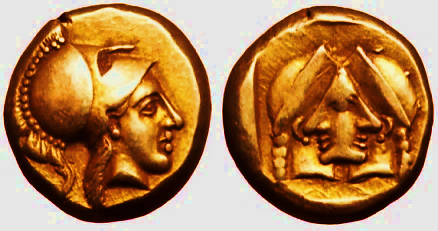
ISSN 3033-7666 (Print)
ISSN 3033-7674 (Online)
No 2 (11), February 2026
Scientific Periodical (St. Petersburg, Russia)
Certificate of the Federal Service for Supervision of Communications, Information Technology and Mass Media (Roskomnadzor)
Эл № ФС77-87449
The journal is registered and published in Russia. The journal publishes articles from all over the world and in all branches of science. The journal is published in Russian.
Articles are accepted daily.
Frequency of releases: once a month.
All articles are peer-reviewed
Each author receives a free certificate of publication.
Free access to the electronic version of the magazine.
By sending an article to the editorial board, the author confirms its uniqueness and bears full responsibility for it for the possible consequences of copyright infringement
Editorial Board
Editor-in-Chief
Vorontsov Vladimir Valentinovich
Managing Editor
Ivanov Maxim Dmitrievich
Executive Secretary
Kholmanskikh Maria Viktorovna
Reviewers
Dimitrienko Andrey Igorevich,
Ph.D., Academician I.P. Pavlov First St. Petersburg State Medical University
Pyrkh Andrey Ivanovich,
Ph.D., St. Petersburg State University
_____________________________________________________________________________
Contacts
 190031, Russia, St. Petersburg, Kazanskaya str., 35, lit. A, apt. 15
 +7 931 712-95-96
 nxxivek@inbox.ru
_____________________________________________________________________________
© Founder: Limited Liability Company “Polis” (OGRN 1097847170871)
190031, St. Petersburg, ext. Ter. Admiralteysky Municipal District, Kazanskaya St., 35, lit. A, apt. 15
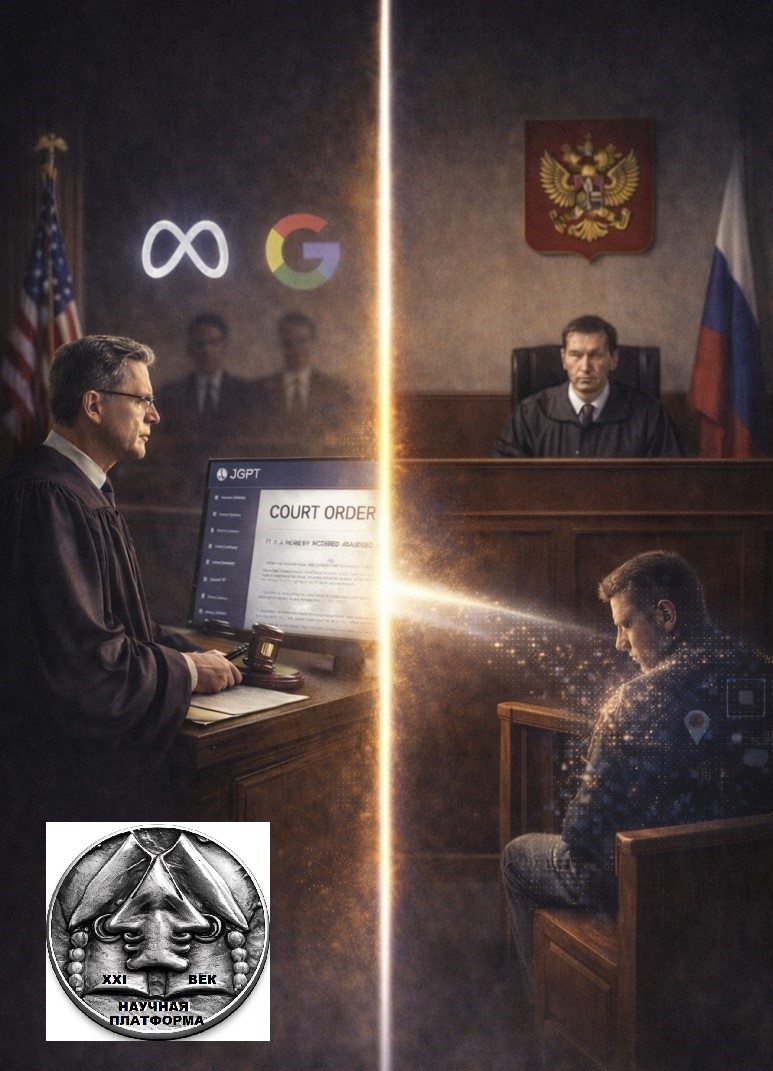
Лаврентьевская летопись [Текст]: факсимильное издание / Институт русской литературы (Пушкинский Дом) РАН Российской академии наук, Российская национальная библиотека. — Санкт-Петербург: Росток, 2017. ↑
Радзивиловская летопись: Текст. Исследование. Описание миниатюр / Отв. ред. М. В. Кукушкина. СПб.: Глагол; М.: Искусство, 1994. Кн. 1-2. (в Кн. 1 — полное факсимильное цветное воспроизведение памятника, в Кн. 2 — полная транскрипция текста, статьи Г. М. Прохорова и Б. А. Рыбакова, искусствоведческое описание всех миниатюр). ↑
https://kp.rusneb.ru/item/material/ipatevskaya-letopis ↑
Повесть временных лет. Подготовка текста О. В. Творогова, перевод Д. С. Лихачева / Памятники литературы Древней Руси. Начало русской литературы. XI — нач. XII в. М., «Худож. лит.», 1978. С. 23-278.
Повесть временных лет. Под ред. В. П. Адриановой-Перетц. Подг. текста, и перевод Д. С. Лихачева. 2-е изд. СПб, «Наука», 1996.
Повесть временных лет. Перевод Д. С. Лихачева, О. В. Творогова. СПб, Вита Нова, 2012. ↑
Также: Въпрашание Кюриково // Калайдович, К. Памятники российской словесности XII века / изданные с объяснением, вариантами и образцами почерков. — Москва : в типографии Семена Селивановскаго, 1821. — с. 191. ↑
Also: Вопросы Кирика, Саввы и Илии, с ответами Нифонта, епископа новгородского, и других иерархических лиц // Памятники древнерусского канонического права / [Ред. А.С. Павлов]. – 2-е изд. – Санкт-Петербург : Тип. М.А. Александрова, 1908. / Ч. 1. (Памятники XI-XV в.). – 1908. – 1466 с. и стб. разд. паг. (Русская историческая библиотека, изданная Императорской Археографической комиссией Т. 6). – С. 24. ↑
