Articles that inspire and inform!
Publisher of POLIS LLC
Address: 190000, Saint Petersburg,
35/15 Kazanskaya Street
Publisher of POLIS LLC
Address: 190000, Saint Petersburg,
35/15 Kazanskaya Street




No 3, March 2026
ISSN 3033-7674 (Online), ISSN 3033-7666 (Print)
CERTIFICATE OF THE FEDERAL SERVICE FOR SUPERVISION IN THE FIELD OF COMMUNICATIONS,
INFORMATION TECHNOLOGY AND MASS COMMUNICATIONS (ROSKOMNADZOR)
Эл № ФС77-87449
ELECTRONIC SCIENTIFIC PERIODICAL EDITION (ST. PETERSBURG, RUSSIA)
16+
The journal is registered and published in Russia
The journal publishes articles in all scientific fields
The journal is published in Russian and English
All articles are peer-reviewed
Free access to the electronic version of the journal
By sending an article to the editorial board, the Author confirms its uniqueness and bears full responsibility for it
Editorial staff
Editor-in-Chief
Vorontsov, Vladimir Valentinovich
Managing Editor
Ivanov, Maxim Dmitrievich
Executive Secretary
Kholmanskikh, Maria Viktorovna
Reviewers
Pyrkh, Andrey Ivanovich,
Ph.D., St. Petersburg State University
Dimitrienko, Andrey Igorevich,
Ph.D., First St. Petersburg State Medical University named after Academician I.P. Pavlov
_____________________________________________________________________________
Contacts

190031, Russia, St. Petersburg, Kazanskaya str., 35, lit. A, apt. 15

+7 931 712-95-96

nxxivek@inbox.ru
_____________________________________________________________________________
© Founder: Limited Liability Company “Polis” (OGRN 1097847170871)
190031, St. Petersburg, ext. Ter. Admiralteysky Municipal District, Kazanskaya St., 35, lit. A, apt. 15
Contents
Cover image generated by LLM GPT-5, copyright ©: Adel Kildeev © 2026, Adel Kildeev © 2026, permission to use the images by the journal has been obtained.
Gabriela Gavrilov. Western-Soviet Commercial Relations 1960-1990 and the growing Soviet debt to the West, Part 1: the 1970S..…………..……………..….……..3
Kildeev Adel. Digital Afterlife and the Illusion of Continuity: Legal and Ethical Aspects of Post-Mortem Digital Simulation …..…………………………………………….…………19
UDK: 339.9 (47+57) “1970”
WESTERN-SOVIET COMMERCIAL RELATIONS 1960-1990 AND THE GROWING SOVIET DEBT TO THE WEST, PART 2: THE 1970S
Gabriela Gavrilov
Emerson College, Boston, Massachusetts (1996)
MA Journalism
Catholic University, Washington, D.C. (1985) +
University of Warsaw, Poland (1983 – 1984)
BA Political Science / Economics
ggavrilov100@yahoo.com
http://orcid.org/0009-0008-9246-9646
Abstract
This article examines Western–Soviet commercial relations in the 1970s, focusing on government-backed export credits, technology transfers, and the early accumulation of Soviet external debt. Drawing primarily on declassified CIA economic intelligence reports, it demonstrates how large-scale imports of Western industrial plants and equipment transformed Soviet trade practices from cash and barter to systemic credit dependence. The article forms the second part of a three-part series analyzing the financial mechanisms that ultimately undermined the Soviet economic system. The 1970s represent the decisive phase in which credit-financed industrial imports became the dominant model of Soviet foreign trade.
Keywords
Soviet debt; Cold War economics; export credits; technology transfer; CIA economic intelligence; Western-Soviet trade; industrial imports
This is a new cycle of articles of the author, Gabriela Gavrilov, on the Soviet debt to the West countries during the 1960s, 1970s, and 1980s, which will eventually explain the financial reasons behind the Soviet Union’s fall. The current article is devoted to Western-Soviet commercial relations in 1970s.
Western-Soviet relations during the 1970s were defined by the dichotomy of détente coexisting with bloody proxy conflicts waged in developing countries, punctuated with some of the grandest commercial deals in market-command exchange history.
Cold War détente was a brief period of arms limitations negotiations and improved commercial relations between the US and the Soviet Union, spanning roughly from 1969 to 1979. This ‘thaw’ was presented to the Western public as an exciting and unique opportunity for the West, particularly the US, to commercially manage the Cold War, shifting from nuclear confrontation to commercial engagement. Trade engagement—the Western nostrum for all global ills—would reduce the risk of nuclear annihilation[1] by linking global economies and leveraging Western economic power to influence Soviet behavior. The idea propounded was that Soviet ‘adventurism’ would be ‘normalized’ once the Soviet government finally submitted to capitalist consumption through the purchase of the material products and technological methods which defined capitalism’s asserted superiority.
Unlike the 1960s, when Western credits complemented a still largely cash-based trade system, the 1970s marked the transition to a structurally new model of economic interaction. Industrial modernization was no longer financed through isolated agreements
Diplomatic milestones of the détente era include the 1968 signing of the Nuclear Non-Proliferation Treaty, Strategic Arms Limitation Talks (SALT), President Nixon’s 1972 visit to Moscow where the Anti-Ballistic Missile (ABM) Treaty and SALT I were signed, and the signing of the Helsinki Accords in 1975. Détente garnered a great deal of global media coverage and, as a result, served as a platform to justify increased trade.
The idea that greater East-West economic engagement would incentivize moderation of Soviet ideological convictions was used to assuage Congressional objections to increased trade. The political rapprochement of détente paved the way for massive trade deals for Western, particularly US firms, under the guise of improved relations. And it worked. Trade increased sevenfold between 1971 and 1973 alone, driven by large US grain exports and unprecedented sales of Western machinery. Following the 1972 U.S.-Soviet trade agreement, U.S.-USSR trade swelled from $218 million in 1971 to over $1.5 billion by 1973.
Those 1973 contracts were highlighted by a July 2 signing of a broad agreement on technology transfer with the Soviet Government by one of the US’s leading engineering and construction concerns, the Bechtel Corporation of San Francisco—a principal US military contractor. According to a New York Times article:
The agreement, which follows similar Soviet pacts with American corporations, is believed to be of particular interest to Moscow because of Bechtel’s involvement in key industrial projects in the United States, especially in the energy field. Bechtel has been looking into pipeline projects for Alaskan oil, into the feasibility of building nuclear plants on artificial islands off New York City and into the prospect of building and operating a commercial uranium enrichment plant. The accord with the Soviet Union ranges over cooperation in virtually all branches of heavy industry, from the use of managerial techniques in construction to metals and petrochemicals and the pipeline transportation of oil and gas.[2]
By March 1974, The New York Times announced:
The Kama River truck plant, biggest Soviet industrial project of the current detente era, has begun to have a tangible effect on economic life in the United States by providing sizable portions of the business of some American companies.
A comprehensive report on the East‐West trade project, made public by the Chase World Information Corporation, lists 65 contracts signed by the Russians with United States concerns, with eight companies doing more than $10‐million worth of business.
Unlike the 1960s, when Western credits complemented a still largely cash-based trade system, the 1970s marked the transition to a structurally new model of economic interaction. Industrial modernization was no longer financed through isolated agreements but through a coordinated system of government-backed export credits, syndicated bank loans, and long-term energy-for-technology arrangements. This shift transformed external borrowing from a supplementary instrument into a systemic condition for sustaining Soviet economic growth.
As a result, the quantitative expansion of trade was accompanied by a qualitative change in its financial architecture. Hard-currency liabilities grew at a significantly faster rate than export capacity, embedding long-term dependence on Western financial markets into the operational logic of the Soviet economy.
Contracts for Kamaz, as the Soviet truck plant is commonly known in a Russian acronym, represent a for as much as 60 or 70 percent of sales volumes of the companies involved in the project. The business obtained by one concern, the National Engineering Company of Chicago, amounts to 150 percent of its annual sales in recent years.
The bonanza represented by some $270‐million worth of machine tools and foundry equipment contracted for by the end of last year is far from over. Soviet purchasing officials in New York were reported last week to have sounded out at least 45 large and small companies for more than $150‐million in additional equipment.
This information had been compiled by Chase World Information in the first of a series of East‐West trade guides called “Kamaz, the Billion Dollar Beginning.” The report was distributed to subscribers of EastWest Markets, a subsidiary of the Chase Manhattan Bank, which had long played a key role in trade with the Soviet Union, including financing of the Kama River Truck project.[3]
In addition to listing orders placed in the United States, complete with technical specifications and delivery dates, the Chase report describes the Kama plant, its role in the Soviet economy and the city of Naberezhnye Chelny rising next to the project. The Kama River Truck Plant (Kamaz) cost between $3 billion to $4 billion to in 1970s US dollars. The massive project, which included the factory complex and a new city for 70,000 workers, featured over $1 billion in imported Western, largely American, machinery and technology.[4] Initiated in 1969, the first phase of the plant was largely functional by 1976.
The article continued with further details:
American orders for the Kama River project have been placed by a special New York purchasing commission, headed by Georgi S. Shchukin, a career foreign trade official. The commission has its offices in the General Motors Building, 767 Fifth Avenue.
By far the largest United States contractor thus far is the Swindell‐Dressler Company of Pittsburgh, which has orders totaling $42.6‐million, including engineering designs and some equipment for the truck plant’s large foundry. Swindell‐Dressler is a division of Pullman, Inc., a diversified multinational concern. The Kama contracts represent about 14 percent of Pullman’s annual sales in the engineering and construction field.
Other major suppliers are C‐E Cast Equipment of Cleveland, with $34.5‐million; Holcroft & Co. of Livonia, Mich., $19.9‐million; Ingersoll‐Rand of Rockfold, Ill., $19.2‐million, and the National Engineering Company of Chicago, $15.4‐million.
C‐E Cast Equipment’s contracts, for molding lines at the Kama plant, represent 70 per cent of its 1973 sales of about $50‐million. Holcroft is owned by the Thermo Electron Corporation. The Kama orders represent more than half of the corporation’s net sales in 1972.
Renault of France provided engineering for the engine factory. The Swindell‐Dressler Company of Pittsburgh designed the metal foundry. IBM and Honeywell, Inc., negotiated to supply the computers and automation equipment to make Kama the most up‐to‐date truck factory in the world (although there is no evidence that they won the contracts.)
While the superpowers negotiated on the global stage for arms control agreements, and closed massive commercial deals, they also engaged in proxy wars, “active measures”[5], disinformation, and continued human rights disputes in Developing Countries.
The US continued its bloody and expensive military campaign in Vietnam from 1965 through 1973, fearing a communist takeover of South Vietnam, which it believed would trigger a chain reaction (Domino Theory) throughout the region. Between 1965 and 1975, the US and its allies dropped more than 7.5 million tons of bombs on Vietnam, Laos, and Cambodia—double the amount dropped on Europe and Asia during World War II. Pound for pound, it remains the largest aerial bombardment in human history,[6] while the Soviet Union was the primary supplier of advanced military hardware to North Vietnam. The USSR provided roughly 65% of NVA tanks, 55% of rifles, and 95% of SAM systems to counter US air superiority. From 1965 to 1975, over 10,000 Soviet advisors and specialists trained personnel, maintained equipment, and operated air defense systems, contributing over $600 million annually in aid.[7]
In March 1975, Soviet-backed forces intervened in the Angolan Civil War, providing significant weaponry and logistical support to the Marxist People’s Movement for the Liberation of Angola (MPLA) during, challenging US and South African-supported factions, the National Union for the Total Independence of Angola (UNITA) and the National Front for the Liberation of Angola (FNLA). The USSR provided crucial supplies, including tanks and armored cars, to the MPLA, enabling them to seize control of the capital, Luanda, by July 1975.
By May 23, 1979, The New York Times reported that:
United States intelligence officials said today that a Soviet truck‐manufacturing plant built with American help was producing engines for military vehicles.
According to the officials, a Central Intelligence Agency officer, testifying at closed hearing of the House Armed Services subcommittee, confirmed a Secret Government report that said some of the 50,000 diesel engines produced annually at the truck plant were being installed in military vehicles.
Officials of the Defense Department and the Commerce Department said the apparent production of the engines for military use did not violate any existing trade understanding. They also said that the equipment sold to the Soviet Union for the construction of the truck plant had been considered to pose no significant security risks to the United States.[8]
In June 1979, Strategic Arms Limitation Talks (SALT) II treaty was signed in Vienna by Carter and Brezhnev, however increasing political tension [or pressure from military contractors] prevented its ratification by the US Senate. The Apollo-Soyuz Test Project, the first joint US-Soviet space flight, briefly warmed relations in July 1975.
When Soviet troops invaded Afghanistan in December 1979, détente was effectively ended. In response, the US imposed short-lived sanctions, a brief grain embargo, and boycotted of the 1980 Moscow Olympics.[9]
Taken together, these agreements reveal a consistent pattern. Western firms supplied entire industrial complexes and advanced equipment on credit, while repayment depended on future export revenues that were themselves tied to volatile commodity markets. The Soviet Union thus entered a development trajectory in which technological modernization and external indebtedness became structurally inseparable.
This model produced rapid growth in industrial capacity but did not generate a corresponding expansion of competitive hard-currency exports. The gap between import intensity and export performance was therefore covered by continuous refinancing.
During the 1970s, Soviet exports to the West increased by 55%, while imports from the West surged by 207%.[10] Unsurprisingly, the Soviet Union’s net hard currency debt to the West also increased dramatically, rising from roughly $1.8 billion in 1970 to nearly $19 billion by the end of 1980. The broader Eastern Bloc debt exceeded $80 billion.[11]
How did it happen?
1971
May 18-The New York Times reported that the US firm of Mack Trucks, Inc. reached a preliminary agreement with Soviet representatives in New York to supply $750 million worth of equipment for a Soviet truck manufacturing plant. This was the touted as the largest agreement in the history of Soviet-American trade despite the fact that Albert Kahn Architectural Associates had signed a $2 billion deal with the USSR in January 1930 for Soviet industrial buildings for the 1st and 2nd 5-Year Plans.[12]
June 1- Commerce Department approved licenses for the export of $85 million worth of American truck manufacturing equipment to the Soviet Union..
August 9- Commerce Department issued export licenses for another $162 million worth of US foundry equipment for a truck manufacturing complex in the Soviet Union despite the on-going war in Vietnam where the Soviets were supplying military vehicles to the communist North Vietnamese government and were used against American troops. The US government indicated that the licenses did not constitute approval of the larger Mack Truck deal which called for shipment of equipment designed for the manufacture of heavy (military) trucks.
September 15- Mack Trucks, Inc. announced that it cancelled the agreement to supply $750 million worth of truck manufacturing equipment to the Soviet Union. Commerce Department officials denied that the US government had blocked the deal explaining that the license applications were too vague and requested further information from the firm which they did not receive.
November 5- Agriculture Department announced authorization of the sale of $136 million worth of grain to the Soviet Union.
November 20- Secretary of Commerce Stans traveled to Moscow for exploratory talks on expanding Soviet-American trade. In order for the Soviet Union to acquire further American firms’ capital and technology it would need government (taxpayer) credits to pay US firms.
November 28- Elite business executives from the US and Western Europe met with Soviet leaders in Moscow to discuss joint ventures and other trade possibilities.
November 30- The Satra Corporation of New York concluded a barter agreement with the Soviet Government (in conjunction with other American companies) to supply $65 million worth of mining and drilling equipment to in return for $60 million worth of non-ferrous metals.
December 4- According to the Swiss newspaper Neue Zurcher Zeitung, sometime in November President Nixon (apparently secretly) approved licenses for shipment of $950 million worth of US truck manufacturing equipment for the giant Soviet Kama River truck manufacturing complex.
According to an October 1978 CIA Report “Soviet Chemical Equipment Purchases From the West: Impact on Production and Foreign Trade”, more than 100 turnkey chemical plants worth over $6.5 billion were purchased from Western firms between 1971 and 1977: $3.5 billion in chemical plant expenditures were concluded between 1971 and 1975 during the 9th 5-year Plan and an additional $3 billion or more during the following two years during the 10th 5-Year Plan.
1972
Following lengthy negotiations in 1972, the USSR agreed to pay $722 million of WWII Lend-Lease debt, (later reduced to $674 million). During World War II, the US government purchased military products and supplies, food, and oil from US companies with taxpayer funds to supply Allied nations, totaling over $50 billion. The United Kingdom received $31.4 billion, the Soviet Union received $11.3 billion, France received $3.2 billion, and China received $1.6 billion. (The Russian Federation completed the final payment in 2006. In comparison the UK also finalized it debt repayment in 2006.)
In early July 1972, the US negotiated an arrangement that allowed the Soviets to buy up to $750 million of American grain on credit, over a three-year timespan.[13] However, the Soviet government quickly exceeded its credit limit, spending the $750 million in only one month[14] and exceeding $1 billion worth of US grain by the end of the year after the USSR purchased some 25.2[15] million metric tons of US grain (primarily wheat, corn and soybeans) in a massive deal that accounted for one-fourth of the entire US wheat harvest.
Following this, a 1975 agreement allowed the USSR to purchase up to 8 million metric tons annually of US grain as the former bread basket of Europe, the nation with the most fertile earth on the planet had been reduced to purchasing its grains from US companies.[16]
1973
General Electric signed broad agreement for joint development of electric‐power generating technology with the Soviet Government on January 12, 1973. The contract provided for exchanges of specialists and production samples of turbines and other power equipment as well as for joint research and development programs. Although GE refused to divulge the contract worth, GE vice president Thomas O. Paine, described it as a “broad foundation that may ultimately lead to hundreds of millions of dollars’ worth of business”.[17]
1974
Between mid-1974 through mid-1976, the USSR received over $11 billion in credit from Western Europe, Japan and Canada.[18]
March 22—According to a Reuters news report published on the front page of The New York Times, on 22 March a West German steel cartel concluded a $1 billion[19] contract with the Soviet Union for the first phase of construction of yet another iron and steel plant. The German steel cartel of Krupp AG, Korf Stahl and Salzgitter AG signed the contract with the Soviet Ministry of Foreign Trade. Called the largest East-West industrial project since WWII, the total cost of the project was projected at $2.2 billion and would produce 4 million tons of iron-ore pellets and 2.7 million tons of steel products essential to producing Intercontinental Ballistic Missiles and other weapons of mass destruction. The German companies would also provide equipment, machinery and technology.
March 24—The New York Times of 24 March 1974, US tobacco giant Phillip Morris, Inc. signed a contract in Moscow to produce tobacco, chemicals and packing paper along with the exchange of scientific and technical information [apparently involved in producing and rolling cigarettes]. The contract was signed by Hugh Cullman, senior vice president of Phillip Morris and the Deputy Chairman of the Soviet State Committee for Science and Technology. No value of the contract was mentioned.
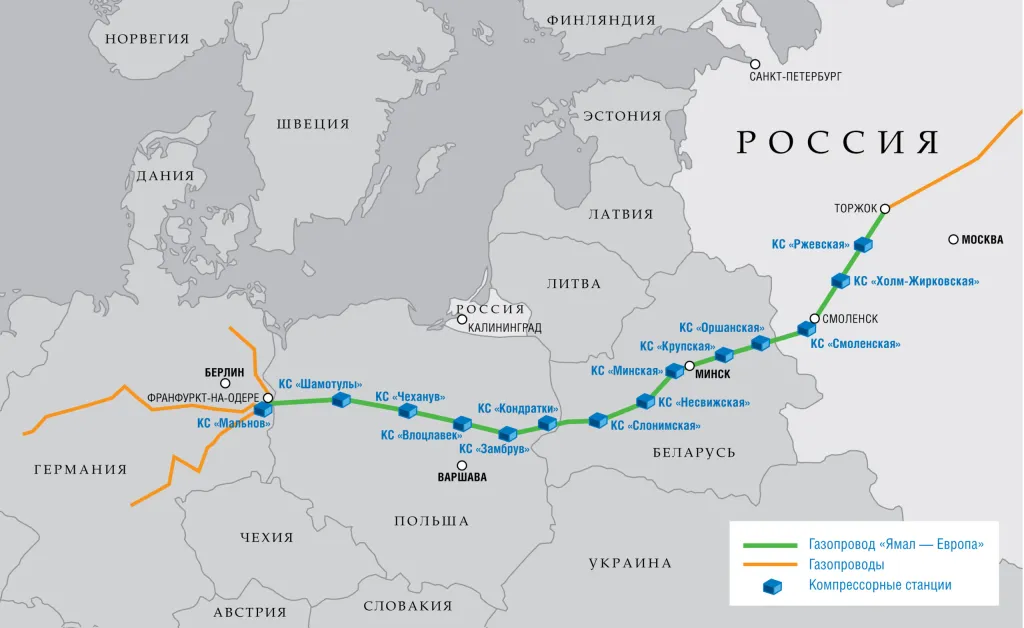
The Urengoy–Pomary–Uzhhorod pipeline (Druzhba pipeline) was part of the “gas in exchange for pipes program”. The Soviet-controlled bank “Ost-West Handelsbank” was opened in Frankfurt on 1 March 1973 to support the project.[20]
In 1975 alone, an estimated $900 million in imported pipe as part of various Soviet gas-for-pipe deals were financed through government-backed credits, mainly from Germany. The Yamal-Europe venture alone necessitated a consortium of 20 West German banks to provide $5.2 billion, and a group of French banks to lend another $4 billion. In all, Western financial organizations lent some $15 billion to cover the technology, equipment and construction for a supply of 40 billion cubic meters of natural gas annually, starting in 1986.[21]
According to a Top Secret CIA report, “During 1975, the USSR borrowed roughly $4.3 billion from Western commercial banks while at the same time reducing its holdings by $371 million. At the year’s end, total Soviet liabilities stood at $7.6 billion and net-liabilities (subtracting out Soviet assets held by Western banks) at $4.7 billion. According to the US Treasury and Federal Reserve statistics, US-based banks and their major foreign branches held $1 billion in claims against the USSR at the end of 1975. Almost 60% of these claims were held by foreign branches.”[22]
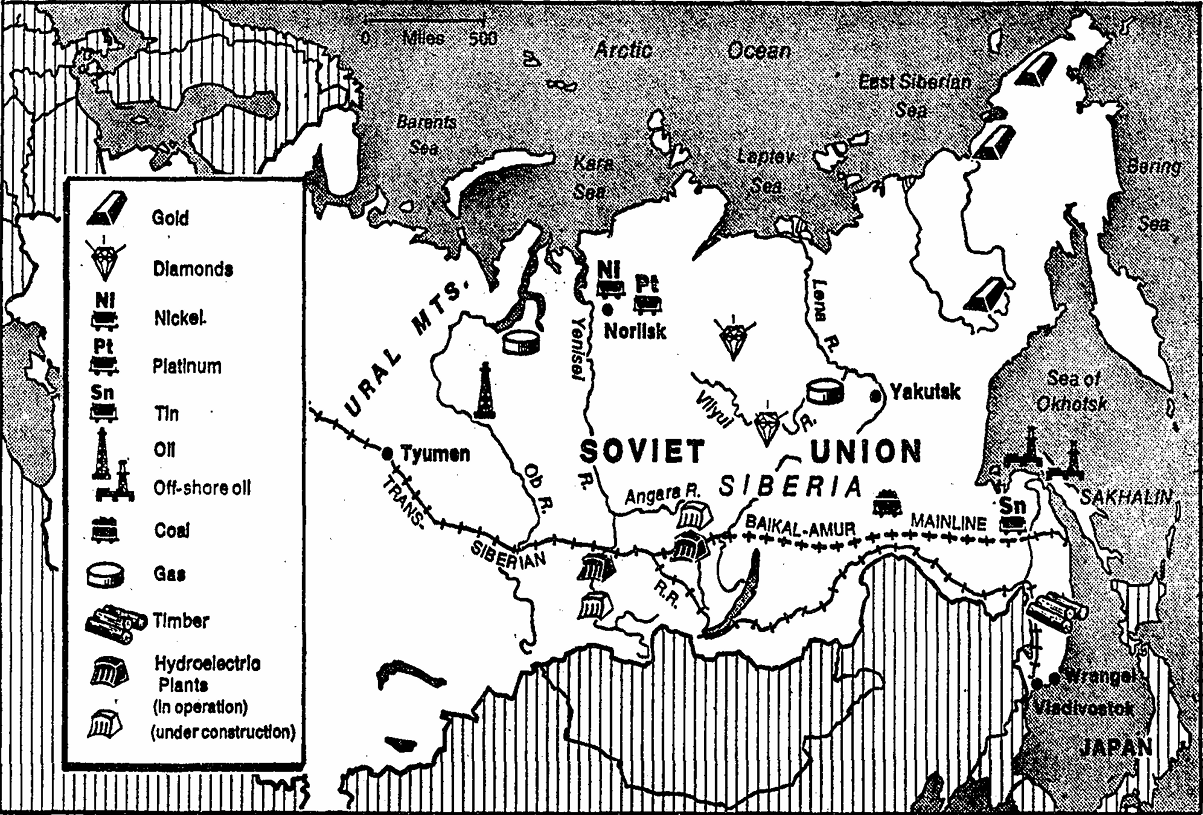
Map of eastern Soviet Russia’s exploitable resources by The New York Times for the article “Capitalist Aid Opening up Siberian Resources” of April 26, 1974.
“The vast natural riches of Siberia have become a fulcrum of growing economic relations between East and West, announced The New York Times in April 1974. “The region, extending across the northern third of Asia, from the Urals to the Pacific, already accounts for 75 to 80 percent of the Soviet Union’s energy resources, as coal, oil, natural gas and hydroelectric power, and of some high‐value metals like gold and tin as well as diamonds. Now, following the signing of a $1 billion agreement, some of those resources will be delivered to Japan and possibly later to the United States. … First, it requires the establishment of a vast infrastructure such as railroads, power supplies, housing and services. Second, construction costs are higher because of the hostile environment.” All would require additional credit from Western sources.
As Western companies and banks grew richer, enjoying their near monopoly access to the massive Soviet industrial markets, the Soviet Union, which had conveniently [for Western capitalists] outlawed domestic entrepreneurs, grew poorer.
| [Formerly] TOP SECRET CIA Report on Major Government-Backed Credit Agreements from Selected* Western Countries for Soviet Projects/Purchases (Millions US$) December 1974 – February 1976 | ||||||||
| Country | Credit Type | Credit Amount | Contract Value | Down-payment | Interest Rate | Term (Yrs) | Description | |
| Dec-74 | France | CL | 2,800 | 3,500 | 20% | 7.2 – 7.55 | 8.5 | Purchases of French products between 1975-1979. |
| Nov-75 | France | PA | 295 | 363 | 20% | 7.2 | 8.5 |
French share
of Iran Natural Gas Project. |
| Oct-74 | West Germany | PA | 293 | 375 | 20% | — | 6 | Trucks |
| Oct-74 | West Germany | PA | 577 | 700 | 15% | 6.75 | 8.5 | Pipe |
| Jan-76 | West Germany | PA | 464 | 546 | 15% | 7.35 | 8 | Pipe |
| Feb-75 | UK | CL | 2,270 | 2,838 | 20% | 7.0-7.35 | 8.5 |
Match Terms
of French CL |
| Jan-75 | Italy | PA | 560 | 650/3 | 15%/3 | 7.45 | 5 |
35% of $1.4 billion Pipe
Order |
| Apr-75 | Italy | PA | 257 | 320 | 20% | 7.345 | 8 | Chemical Plants |
| Sep-74 | Italy | CL | 900 | 1,058 | 15% | 7.55 | 8 | — |
| Jan-76 | Italy | PA | 200 | 235/3 | 15%/3 | 7.55/3 | 5 |
Addt’l Credit
for Jan-75 Pipe order. |
| Feb-76 | Japan | PA | 160 | 200 | 20% | 7.55 | 5 | Pipe |
| Feb-76 | Japan | PA | 221 | 260 | 15% | 7.55 | 8.5 | Ammonia Plant |
| Mar-76 | Japan | PA | 25 | — | — | 6.375 | — | Yakutsk Exploration |
| Feb-76 | US | PA | 25 | — | — | N.A. | — | Bank of America Loan for Yakutsk Exploration |
| Totals | 9,047 | 10,160 | ||||||
| * Does not include Finland, Sweden or Austria. | ||||||||
| CL – General Purpose Credit | ||||||||
| PA –Project Associated | ||||||||
| 3. Estimated | ||||||||
The decision to allow major US military contractor Dresser Industries to sell “plans and equipment and other items of advanced technology to manufacture high-quality drill bits including an electron-beam welder” to the Soviet Union in 1978 was made by the White House. The only reason why the decision was brought into the public light and not kept secret in mid-1976 was due to the conflict between the CIA and Department of Energy who believed that the plant provided significant military capabilities to the Soviet Union and the Commerce and Defense Departments who approved of the sale. President Jimmy Carter stepped into the debate to give presidential approval for Dresser Industries’ export. Carter also announced a government commitment to reduce export barriers and speed the licensing process for US corporations seeking similar export licenses.
A New York Times article explained that “the $158 million Dresser deal was only the first in a series of proposed sales involving oil equipment and other items of advanced technology.”[24]
| Soviet Bloc Hard Currency Debt | |||||
| Gross Hard Currency Debt ($US Millions) | Debt Service Ratio/1 | ||||
| 1970 | 1980 | 1970 | 1980 | ||
| USSR | 1,800 | 18,300 | 6 | 9 | |
| Poland | 1,103 | 26,000 | 19 | 101 | |
| East Germany | 1,416 | 14,500 | 14 | 55 | |
| Romania | 1,639 | 10,700 | 36 | 25 | |
| Czechoslovakia | 564 | 4,620 | 9 | 18 | |
| Hungary | 610 | 8,700 | 16 | 30 | |
| Bulgaria | 681 | 2,975 | 30 | 32 | |
| 1) Repayments of, and interest on, medium-and long-term debt as a share of hard currency exports. | |||||
| (Source: Secret CIA Memorandum, (April 8, 1983). Soviet Bloc Financial Problem as a Source of Western Influence, RDP83T00966R000100030026-0, Approved for Release 2008/06/17.) | |||||
In light of the rapidly expanding debt of the entire Soviet Bloc during the 1970s, the CIA reported that “Private sources of long-term credit to the Bloc have dried up,”[25] leaving many of the Bloc countries “unable to meet their hard currency obligations… These problems give the West an unusual opportunity to influence Soviet Bloc developments,” noting that “The main instruments of influence are the volume and terms of new government-guaranteed credits and the rescheduling of existing obligations.”
Why would the US, which spent $944.84 billion[26] on military contracts between 1970 and 1979 alone for the claimed purpose of protecting itself and the world from communism, allow the same firms and banks involved in Western defense contracts to lend money to the source of communism if the entire Cold War system wasn’t anything but a ruse to fleece the global public out of that money?
Why would the Soviet government, which claimed that its sole purpose was to protect its people from the evils of capitalism and which spent roughly $300 billion more on its military than the US between 1970 and 1981, not only engage in massive contracts with the grandest capitalist firms, but allow itself to become dangerously in debt to them and western governments, even jeopardizing its ability to continue its military spending, if the entire Cold War system wasn’t anything but a ruse?
As the CIA report states, “These [Soviet Bloc] countries all rely on the West for critical imports of food, steel, and high quality equipment.” But what the report doesn’t state is that the firms that were selling these ‘critical imports of food, steel, and high quality equipment’ were just as dependent upon Soviet Bloc markets.
“The expansion of East-West trade was aided by formal and informal encouragement by Western government,” states the CIA report, “including a loosening of export controls, and a massive expansion of credit. In the early 1970s, most of the Western credit was in the form of government-guaranteed loans for machinery and equipment sales.
By the second half of the decade, the center of gravity shifted from state export-credit agencies to private Western financial institutions. The USSR and the Eastern European countries became active borrowers on international capital markets, integrating themselves into the global financial system without possessing the institutional mechanisms required for a convertible currency economy.
This asymmetry explains why the question of credit conditions—interest rates, maturity, and rescheduling—acquired strategic importance and gradually evolved into a potential instrument of political and economic leverage.
As trade surged, however, and contracts multiplied, the USSR and the East European countries entered private Western financial markets on a much larger scale than before. …Western banks competed with each other for loans to the Eastern Bloc. By the end of 1980, Eastern Bloc hard currency debt exceeded $80 billion (compared with $8 billion in 1971).[27]
While the Soviet Union and Eastern Bloc countries were known as excellent loan risks for their demonstrated reliability for prompt payments, Western banks were all reaching, or had already reached, their self-imposed financial exposure limit with the Bloc by the end of the 1970s.
The CIA worried that “a strongly restrictive policy could trigger widespread debt default, which … [could] create risks for the stability of the international banking system.”[28] The rising debt, “high interest rates, bad crops, [and] lower oil prices’ [controlled by Western commodity markets] “led to a fundamental reassessment of the risk of lending to Soviet Bloc countries, which in turn has curtailed those countries’ access to Western private credit and made some of the remaining credit flows vulnerable to new negative developments. In the past few months [of early 1983], the possibility that Western governments might restrict or discourage credit to Eastern Europe has created added uncertainty in financial markets and has further discouraged bank lending.”[29]
Even after Poland’s 1981 private debt rescheduling agreement, the country had “next to no chance of generating a large trade surplus or obtaining enough debt relief and credits to cover a 1982 debt service burden of $10 billion.”[30]
“Soviet Bloc dependence on Western credits for food, equipment and technology gives the West the opportunity to use credits as an instrument of influence,” notes the CIA report. Indeed, and refusing to offer those credits in the first place would have bought the whole system down decades prior to 199—but would have deprived Western firms decades of enjoying monopoly access to the massive Soviet Bloc markets which were held under a system which outlawed domestic competition and kept the Russian ruble out of the global financial markets. With Russia and its allies crippled under the communist system, Western firms were free to rule the world and grow more powerful with each passing decade.
The West had ‘direct measures’ or levers which it could use to influence the flow of capital to the USSR and its allies:
The report pointed out however that “the greatest potential effects of Western government credit restrictions were of an indirect nature”. The report felt that it was “highly unlikely that Western banks would be willing to resume unguaranteed long-and medium-term lending if Western governments imposed…limits on government guaranteed credits.”
Had private banks not already reached, or nearly reached, their own financial exposure limits in the Bloc this statement would have been moot, as no government act, prohibition, or even law had previously influenced the behavior of private banks or elite firms when it came to business with the Soviet Union.
The expansion of East–West trade in the 1970s created a relationship of asymmetric interdependence. Western industrial and financial institutions obtained long-term access to a vast protected market, while the Soviet economy acquired the technology necessary to maintain military and industrial parity. However, the financial structure of this exchange placed the USSR in a position of growing hard-currency vulnerability.
By the end of the decade, the limits of Western bank exposure, rising interest rates, and the increasing cost of refinancing marked the end of the expansion phase. The credit-driven modernization model that had supported industrial growth during détente simultaneously generated the debt dynamics that would define the systemic crisis of the 1980s.
TO BE CONTINUED
References:
No Author (July 3, 1973). BECHTEL COMPANY SIGNS SOVIET PACT, The New York Times.
Theodore Shabad (March 5, 1974). “Soviet Truck Project Spurs U.S. Business”, The New York Times.
David K. Shipler (December 20, 1976). “Mammoth Truck Plant Slowly Comes to Life in Plains of Soviet Union”, The New York Times.
Electronic resource: Cooper Thomas, (2016?). “Bombing missions of the Vietnam War: A visual record of the largest aerial bombardment in history”. Esri’s StoryMaps team @ https://storymaps.arcgis.com/stories/2eae918ca40a4bd7a55390bba4735cd.
Electronic resource: CIA Report (No date). The Dimensions of Soviet Aid to North Vietnam, Approved for release (2009/04/09). https://www.cia.gov/readingroom/docs/CIA-RDP78T02095R000900030002-5.pdf
Richard Burt (May 24, 1979). “SOVIET ARMY LINKED TO U.S.‐AIDED PLANT”, The New York Times, Section A, page 12.
Electronic resource: https://history.state.gov/milestones/1969-1976/detente#:~:text=Between%20the%20late%201960s%20and,increased%20discussion%20on%20arms%20control.
Electronic resource: Maria Afonina (Sep. 21, 2022). “How the USSR traded with the West despite the Iron Curtain”, Gateway to Russia, https://www.gw2ru.com/business/2230-how-ussr-traded-with-west#:~:text=Machinery%2C%20equipmen t%2C%20and%20vehicles%20%E2%80%93%2040.7%25,materials%20and%20intermediate%20goods%20%E2%80%93%201.3%25
Electronic resource: Secret CIA Report (April 8, 1982). THE SOVIET BLOC FINANCIAL PROBLEM AS A SOURCE OF WESTERN INFLUENCE, Approved for release June 17, 2008. https://www.cia.gov/readingroom/docs/CIA-RDP83T00966R000100030026-0.pdf
Sonia Melnikova-Raich (2010), The Soviet Problem with Two ‘Unknowns’: How an American Architect and a Soviet Negotiator Jump-Started the Industrialization of Russia, Part 1: Albert Kahn.
Philip Shabecoff (July 9, 1972). “Moscow Agrees to Buy U.S. Grain for $750-Million”. The New York Times. p. 1. ISSN 0362-4331.
“America Gets the Shaft”. The Harvard Crimson. December 1, 2016.
Theodore Shabad (Jan. 13, 1973). “G.E. and Soviet Sign Pact For Technology Exchange”, The New York Times.
Top Secret CIA Report (Circa 1976/No Cover Page), USSR: Problems in Financing Hard Currency Trade Deficits, Annexes referred to in text not included. Released (no date).
Electronic resource: “Галина Аполлоновна Титова: В Сингапур я ездила разбираться десять лет” [Galina Apollonovna Titova: I went to Singapore to figure it out for ten years] (PDF). letopis.org (in Russian). Archived from the original (PDF) on 23 October 2023. (https://en.wikipedia.org/wiki/Urengoy%E2%80%93Pomary%E2%80%93Uzhhorod_pipeline)
Alexander L. Taylor, III (Fed. 16, 1981), “A Soviet Pipeline to the West”. TIME.
Top Secret CIA Report (Circa 1976/No Cover Page), USSR: Problems in Financing Hard Currency Trade Deficits, Annexes referred to in text not included. Released (no date).
Richard Burt (26 June 1978), “Carter Aides Favor Ban on Oil Equipment for Soviet”, The New York Times.
Secret CIA Memorandum, (April 8, 1983). “Soviet Bloc Financial Problem as a Source of Western Influence”, RDP83T00966R000100030026-0, Approved for Release 2008/06/17.)
UDK: 34:004.8:340.12
DIGITAL AFTERLIFE AND THE ILLUSION OF CONTINUITY: LEGAL AND ETHICAL ASPECTS OF POST-MORTEM DIGITAL SIMULATION
Kildeev Adel
Zhdanov A. Leningrad State University (1990)
Philosophiæ Doctor in Law
ORCID: 0009-0001-2211-4944
Annotation: The article is devoted to the legal and philosophical analysis of the phenomenon of the digital afterlife — the creation and use of algorithmic systems that imitate the personhood of a deceased person on the basis of digital data left by him during his lifetime.
The author proceeds from the thesis of the fundamental difference between the personhood as a bearer of consciousness and the algorithmic model as an instrumental construct devoid of intentionality and subjectivity. It is shown that the widespread rhetoric of “digital immortality” is based on the substitution of ontological categories and forms the illusion of the continuation of existence where there is only a statistical reconstruction of speech and behavioral patterns.
Based on the concepts of I. Kant, G.W.F. Hegel and N.A. Berdyaev, the impossibility of the subject in the absence of a self-identical bearer of freedom and action is revealed. The concept of simulacrum is introduced as a sign form of subjectivity without a subject. The analysis of the artistic models of N.V. Gogol and V.O. Pelevin demonstrates the cultural and anthropological dimension of this problem.
It is concluded that the digital simulation of the individual affects the principle of human dignity and requires special legal regulation, while in digital communication a person acts, and artificial intelligence remains a tool for the implementation of his will.
Keywords: digital afterlife, post-death personhood rights, AI simulation, artificial intelligence; legal personhood; large language models; philosophy of law; simulacrum; subject; the transcendental unity of apperception; recognition; human dignity; digital personhood simulation; responsibility; instrumentum vocale.
Use of AI tools in the preparation of the article:
In the preparation of this article, artificial intelligence tools — the ChatGPT (OpenAI, 2025) and Gemini (Google DeepMind, 2025) models — were used exclusively for technical and editorial support: language optimization, link structuring, and terminology unification. All scientific conclusions, interpretations and analytical generalizations belong to the author and reflect the results of his own research work.
Chapter 1. Introduction.
For the first time in history, the digital environment has created the technical ability to simulate the presence of a deceased person. On the basis of texts, images, audio and video recordings, algorithmic models are formed that are capable of reproducing speech and behavioral patterns of the individual. In public discourse, this phenomenon has been called “digital immortality”, which already at the level of terminology contains a significant categorical substitution.
It is not a question of continuing the existence of the individual, but of creating a statistical reconstruction of it, devoid of consciousness, will, and intentionality. An algorithmic system does not have subjectivity and cannot be a bearer of rights and obligations. Nevertheless, in social and economic circulation, such a system begins to function as a quasi-personhood, which gives rise to fundamentally new legal and ethical collisions.
The problem of the digital afterlife lies at the intersection of several areas:
Unlike traditional forms of memory of the deceased — text, photo, or audio recording — algorithmic simulation creates the effect of dialogue and thereby creates an experience of continued presence in third parties. A new legal reality arises: an object that is not a person, but is capable of reproducing its social role, a simulacrum of personhood. Its definition and regulation requires normative legal qualification.
This requires answering fundamental questions:
Thus, the digital afterlife is not a technological, but an ontological and legal problem. It affects the basic categories of personhood, identity, and responsibility, and requires the formation of a new normative model that can protect a person from becoming an algorithmic object after death.
This study continues the series of the author’s works devoted to the legal and ontological qualification of artificial intelligence.[32] In these articles, the author examined in detail the legal status of AI, the ethical standards of AI, aspects of AI and copyright, numerous court cases against AI companies and their litigation with their employees and between the AI companies themselves, and finally, the legal theoretical and philosophical basis of AI, its international legal regulation and proper place in world technologies and economy, the fundamental differences between LLM and artificial intelligence. The philosophical, legal and historical prerequisites of the concept of artificial intelligence, including the concept of instrumentum vocale and the model of the “slave of the lamp” in the Roman legal tradition, are considered.
The development of generative models for the first time created a technological opportunity for a stable digital simulation of an individual, which does not have a formed legal qualification. There are separate studies in three unrelated blocks: 1. digital heritage and the digital afterlife; 2. Personal data rights and digital identity; 3. AI Ethics and LLM. But there is no comprehensive analysis of the generative simulation of the individual as an independent legal object.
Object and subject of research
The object is social relations arising in connection with the technology of generative simulation of personhood.
The subject is the legal and ontological nature of digital emulation of personhood, created on the basis of large language models.
Purpose of the study
The purpose of the study is to form a holistic legal qualification of the technology of generative simulation of the individual and to determine its place in the system of personal non-property rights.
Objectives of the study
Research methodology
The methodological basis of the research consists of formal legal, comparative-legal, interdisciplinary, and ontological analysis.
The scientific novelty of the research lies in the fact that for the first time generative simulation of personhood is considered not as a kind of data processing or digital memory, but as an independent legal phenomenon, an independent object of legal regulation.
Chapter 2. Historical and Technological Genesis of Digital Personhood Simulation
2.1. Pre-digital forms of the presence of the deceased as a cultural and legal phenomenon
In all known cultures, the memory of the deceased was provided through symbolic forms of representation, such as text, image, ritual, or oral tradition. These forms could be socially significant and have a high degree of sacralization, but they did not imply the reproduction of individual will, speech activity and behavioral variability of the individual. The image of the deceased was preserved as an object of memory, but not as a subject of communication.
In the Roman tradition, the function of representing ancestors was performed by the imagines maiorum — wax masks worn during funeral processions and used in public ceremonies.[33] They provided a symbolic presence of the dead in political and family life, but they did not reproduce their individual consciousness and were not endowed with the ability to express themselves autonomously.
A similar logic can be traced in the Confucian tradition of the cult of ancestors, where ritual communication with the dead was carried out through strictly regulated forms of veneration.[34] The ancestor was the object of a sacred relationship, but not the subject of dialogue.
In the biblical tradition, this boundary has a normative character. The Old Testament contains a direct ban on attempts to establish arbitrary contact with the world of the dead (Deut. 18:10-12)[35], which testifies to the fundamental inadmissibility of non-ritualized reproduction of their “voice”.
In the Vedic tradition, the cult of ancestors (śrāddha) is strictly ritualized and aims to maintain cosmic and social order (Ṛgveda X.15; Manusmṛti III.122–125).[36] [37]
In Islamic legal culture, the sacralization of the human person after death is expressed, in particular, in the special protection of the bodily integrity of the deceased and the prohibition of arbitrary construction of his image.[38]
In all these cases, violation of the established forms of treatment of the memory of the dead was considered a grave religious and legal offense. Thus, an archaic model of posthumous protection of the individual was formed.[39] [40]
Consequently, before the advent of digital technologies, all cultural systems retained a fundamental boundary between the memory of the individual and its acting communicative substitute.
2.2. Early digital forms of the presence of the deceased: digital archive, memorialization of accounts and avatars
The development of the digital environment led to the emergence of new forms of preserving the posthumous presence of the individual, but at the initial stage they did not go beyond the traditional model of representation and did not affect the communicative autonomy of the subject. It was about recording, storing and institutionalizing a digital footprint created during the user’s lifetime.
The simplest form is a digital archive, which is a structured set of texts, images, audio and video materials. Such data arrays do not have the ability to generate new content and therefore retain the status of an object, not a subject of communication. Their legal regime is determined by the norms of inheritance law, legislation on personal data and provisions on the results of intellectual activity.[41] [42]
The legal qualification of the digital data of the deceased has been developed in judicial practice. The decision of the Federal Court of Germany of July 12, 2018 in case III ZR 183/17, in which the account of the user of the social network was recognized as part of the estate and subject to transfer to heirs by way of universal succession, is precedential.[43] The court pointed out that the digital profile is a set of contractual rights and information content and cannot be considered as an extension of the identity of the deceased.
A similar approach is enshrined in American law under the Revised Uniform Fiduciary Access to Digital Assets Act (2015), which granted inheritance managers the right to access the digital assets of the deceased subject to established procedures.[44] Thus, the digital data were finally included in the sphere of inheritance succession.
The development of user services has led to the formation of a mode of account memorialization. In the social network Facebook, the status of memorialized account has been introduced, in which the profile is saved on the network as memory space, but loses the ability to act independently, and its management is transferred to a trusted person appointed during his lifetime (legacy contact).[45] Similar mechanisms are provided in Google (Inactive Account Manager) and Instagram services.[46]
The fundamental circumstance is that in these models, the account:
– does not generate new messages;
– does not enter into a dialogue;
– does not reproduce the behavioral variability of the personhood.
Its function is limited to preserving previously created content and providing collective digital memory.
A special place among the early forms of digital representation of the individual is occupied by avatars used in virtual worlds and virtual reality systems. In environments such as Second Life or VRChat, an avatar is a graphical representation of the user that can imitate gestures, movement in space, and other elements of bodily behavior.[47] [48]
Despite the high level of visual individualization, the avatar does not have communicative autonomy. His actions are completely determined by the will of a live user or a predetermined algorithm. After the death of the user, the avatar loses its active function and can only exist as an element of the digital archive. Its legal regime is determined by the user agreement of the platform and the rules on intellectual property.[49]
Thus, even the most complex forms of digital visualization of a person do not create the effect of his independent presence in social communication.
In the scientific literature, these processes are considered within the framework of the concept of digital heritage and posthumous privacy, where the main problem is the distribution of access to data and their legal fate after the death of the subject.[50] [51]
Consequently, early digital forms of postmortem presence are characterized by the preservation of an information trace without reproducing the communicative function of the individual. Their legal regime fits into the existing structures of inheritance, contract and information law.
A qualitative break with this model occurs only with the advent of technologies capable of generating new statements that imitate the individual style and behavioral reactions of the deceased. It is this transition that transforms digital representation from the form of an archive into a form of simulation of the individual and takes it beyond the boundaries of traditional legal regimes.
Chapter 3. Generative Simulation of Personhood as a Technological and Legal Reality
3.1. Meta’s Patent as a Fixation of the Technological Possibility of Generative Personhood Simulation
The transition from the digital representation of a person to its generative simulation ceases to be a theoretical construct at the moment when the corresponding technology receives a patent form. The Meta Social networking system that simulates a user using a language model patent application captures a reproducible technical solution designed to function in the social network infrastructure.[52]
The specification of the invention proposes an architecture in which a pre-trained large language model is adapted based on the historical data of a particular user. Publications, comments, reactions, as well as behavioral scenarios for interacting with content are used as a training array. These data are transformed into an individualized probabilistic model of speech and communicative behavior.
The system generates a custom training dataset, analyzes the incoming content, generates a response, and places it in the digital environment on behalf of the user. In this way, it is not the text that is reproduced as a static object, but the structure of social action, i.e., communication addressed to another participant in the network.
It is of fundamental importance that the description of the invention expressly provides for the operation of the system in the absence of the user, including cases of his death.[53] The technology is focused on the continuation of communicative activity when the physical existence of the subject ceases.
Legally significant features of the technical solution under consideration are:
– personalization of the model formed on the basis of the data of a particular person;
– autonomy of communication carried out without the current expression of the will of the subject;
– inclusion of the results of the system’s functioning in real social interaction;
– independence of functioning from the biological time of human life.
Taken together, these features mean the reproduction of the communicative function of the individual.
The patent form of fixation gives this technology an independent legal significance. The described solution is considered as an object intended for implementation, licensing and economic use in a platform environment. Thus, the reproduction of an individual model of behavior is included in civil circulation.
The technical possibility of separating the communicative function of a person from its biological bearer of consciousness and its autonomous functioning in the social environment is documented, which in business and technological publications is directly interpreted as the creation of a digital substitute for the user. [54] [55]
3.2. Functional Features of Generative Simulation of Personhood as an Object of Legal Qualification
Legal qualification of generative simulation of personhood is possible when identifying its functional characteristics that are important for law.
The first feature is the generation of previously non-existent content. The algorithmic system forms new statements that respond to the changing communicative context.
The second feature is personalization. It is not an abstract model of behavior that is reproduced, but an individual identity that allows third parties to perceive the result of the functioning of the system as the actions of a particular person.
The third feature is the autonomy of functioning. Speech behavior is separated from the physical bearer of consciousness and acquires the ability to exist independently.
The fourth feature is social integration. Generative simulation is included in real communication and influences the behavior of other participants.
The fifth feature is the temporary unlimited functioning.
The totality of these characteristics means the reproduction of the communicative function of a person regardless of his physical existence.
This phenomenon cannot be adequately described within the framework of existing legal categories. It is not reduced to personal data, since the object of regulation is not information, but a model of behavior; is not the result of intellectual activity, since the method of participation in communication is reproduced; does not fit into the inheritance legal structure, since we are not talking about the transfer of an array of data, but about the continuation of social activity. Thus, the generative simulation of personhood has the features of an independent object of legal qualification.
3.3. Differentiation of Generative Simulation of Personhood from Related Legal Constructions
Generative simulation of personhood does not coincide with any of the existing legal categories.
The differentiating criterion in all cases is the presence of a reproducible communicative function of the individual.
If in traditional legal constructions the object of regulation is data, image, work or property complex, then in the case under consideration a social action is reproduced — participation in communication on behalf of a particular person.
This confirms the need for an independent legal qualification of generative simulation of personhood.
3.4. Conclusions
The patent fixation of the technology confirms the possibility of autonomous reproduction of the communicative function of the individual.
Generative Simulation:
– generates new content;
– reproduces individual identity;
– functions in social communication;
– is not limited by the lifetime of the subject.
These features allow us to consider it as a new object of legal regulation. The object of protection is the reproducible identity of the person in communication.
Chapter 4. Artificial Intelligence as an Imaginary Subject: Legal Requalification of LLM and the Status of a Simulacrum
The initial doctrinal formulation of the question of the legal personhood of artificial intelligence is based on the criterion of reasonableness as the basis of legal personhood. In the most concentrated form, this position is expressed by Lawrence Solum:
“If the entity can reason, it can be a legal person.”[56]
The legal meaning of this statement is that legal personhood is derived from the ability to rational decision-making. However, the applicability of this criterion presupposes a preliminary establishment that the object in question has an autonomous ability to set goals and acts as a participant in legal circulation. Large language models have neither a sphere of goals of their own, nor the ability to initiate legally significant actions. Their functioning is completely determined by the user’s request and the operator’s infrastructure. Therefore, Solum’s thesis refers to a hypothetical autonomous agent and does not apply to the LLM as an instrumental text generation system. Already at this level, the discussion about legal personhood loses its subject, since the object is qualified erroneously.
A similar substitution occurs in the corporate model proposed by Sean Bayern, who states:
“there is no conceptual barrier to recognizing an autonomous system as a legal entity.”[57]
This thesis assumes that the legal personhood of a legal entity is a purely normative construct and can be extended to any sufficiently complex system. However, the legal personhood of a corporation is based on two legal elements: property isolation and organizational structure, through which the legally relevant will is formed. The LLM has neither its own property nor organs. It does not make decisions in the legal sense but generates text sequences within a given architecture. Consequently, the recognition of its legal personhood does not create a new center of responsibility. Moreover, text generation does not constitute a legally relevant act. A legally significant action is performed by the subject using the result of generation. Thus, the LLM does not act as an agent, but as a means of creating a sign form that imitates communicative behavior.
In the criminal law doctrine, Gabriel Hallevi formulates the thesis of the functional equivalent of guilt:
“AI can fulfill the requirements of mens rea in a functional sense.”[58]
The legal significance of this thesis lies in the reduction of guilt to the cognitive element. However, guilt in criminal law includes not only an intellectual, but also a volitional element, as well as the possibility of personal imputation and application of punishment to the subject. The algorithm is not the addressee of criminal repression and cannot be sanctioned. Consequently, the transfer of the category of mens rea to it destroys the very structure of criminal responsibility. In the event of harm, the person using the system remains the subject, since it is he who decides to use it and bears the risk of such use.
The modern theory of autonomous social systems in the person of Günther Teubner allows for the possibility of the emergence of “electronic agents” functioning in law as participants in communication.[59] However, in this model, the subject is not a technical system as such, but a communicative structure that has the ability to self-refer and reproduce its own operations. The LLM has neither self-reference nor its own normative program; it reproduces probabilistic language sequences within the limits of external control. Consequently, even within the framework of the system theory of law, it cannot be recognized as an autonomous participant in legal communication.
Ugo Pagallo, analyzing the possibility of a new form of legal personhood for robots, connects it with their participation in social interactions.[60] However, participation in communication as such is not a legal criterion of the subject. The law does not qualify the form of behavior, but the presence of a bearer of rights and obligations.
Thus, all the main doctrinal arguments in favor of the legal personhood of artificial intelligence are based on the identification of an autonomous agent with a text generation system. In reality, an LLM is not artificial intelligence in the sense of an actor. It is a data processing tool that creates a simulation of speech behavior.
The legal nature of a simulacrum is determined by its object character. It can be:
– the object of intellectual rights,
– the object of regulation in the field of data protection,
– a source of increased risk,
but not the subject of a legal relationship.
Law knows only two basic categories – subject and object. An object that reproduces the form of action does not acquire legal personhood, since legal personhood is determined by the ability to be a bearer of rights and obligations and to bear legal liability.[61]
In this regard, the qualification of an LLM as an instrumentum vocale fixes its actual position in the legal system: it is a technical means by which the legal subject performs legally significant actions. All legal consequences of its functioning relate to the persons who determine the purposes of its application and control its life cycle.
It follows that the so-called responsibility gap does not arise from the autonomy of the system, but from the erroneous ontological qualification of it as an acting agent. In reality, the action is performed by the subject using the tool, while the simulation of communication remains the object of legal regulation.
Positive law confirms this qualification. Regulation (EU) 2024/1689 imposes obligations solely on providers and users of artificial intelligence systems and does not provide for their legal personhood. Thus, the legislator fixes the instrumental status of the relevant technologies.
Consequently, the debate about the legal personhood of artificial intelligence in relation to LLMs is a categorical fallacy. The object of legal analysis is not an autonomous subject, but a technical tool that creates a simulation of communicative behavior.
It is significant that the positive law of the European Union, taking into account the arguments about the responsibility gap, has not followed the path of creating a new legal personhood for artificial intelligence. Regulation (EU) 2024/1689 regulates in such a way that the only subjects of duties and responsibilities are persons involved in the life cycle of an artificial intelligence system. These include suppliers, authorized representatives, importers, distributors and users artificial intelligence systems (Article 3).[62] They are responsible for system compliance, risk management, technical documentation, transparency, and human oversight (Articles 8 to 29).
At the same time, an AI system is defined as a machine system designed to operate with varying degrees of autonomy (Article 3 (1)), and in the entire structure of the Regulation appears exclusively as an object in respect of which safety requirements and restrictions on putting into circulation and use are established. It is not vested with rights, does not bear obligations and cannot act as the addressee of sanctions. The addressees of administrative measures and fines are exclusively economic entities (Article 99).
Of particular importance is the requirement of human oversight, which is enshrined among the mandatory requirements for high-risk systems (Article 14). This norm directly proceeds from the fact that a legally significant decision must remain within the control of a person and can be changed or canceled by him. Thus, the possibility of recognizing the system as an autonomous bearer of consciousness of legally relevant will is excluded.
The normative structure of the act demonstrates that the problem of responsibility gap is resolved by establishing a continuous chain of duties and responsibilities of entities that put the system into circulation and use it in professional activities. Consequently, the gap in responsibility arises not from the autonomy of technology as such, but from its erroneous qualification as an acting agent. In the legal model of AI Act, the artificial intelligence system acts as a source of risk and an object of regulation, while the legal subject remains the bearer of duties and responsibilities.
Normative conclusion
Regulation (EU) 2024/1689 structurally excludes the possibility of recognizing artificial intelligence as a legal entity, since:
– only participants in economic turnover are subjects of obligations;
– sanctions are addressed exclusively to them;
– A legally significant decision must remain under human control.
Consequently, the responsibility gap is eliminated by means of the existing law and does not require the introduction of a new legal personhood.
Final Conclusions and Legal Definition of Simulacrum
The analysis shows that the doctrinal constructions substantiating the possibility of recognizing artificial intelligence as a legal subject are based on the premise of the presence of an autonomous bearer of consciousness of legally relevant behavior. Large language models, however, have neither a sphere of goals of their own, nor the ability to make decisions of legal significance. Their functioning is fully determined by external goal-setting and is implemented within the framework of the infrastructure belonging to the subjects of law. Consequently, they cannot be considered as participants in legal relations.
The analogy with a legal entity turns out to be untenable due to the lack of property isolation and organ will; the concept of functional compliance with the subjective side of the crime due to the impossibility of personal imputation and the addressability of the sanction; The argument of responsibility gap is due to the fact that a legally significant action in all cases remains in the sphere of a person’s decision to create, put into circulation and use a system. The positive law of the European Union, which enshrined a regulatory model in which all obligations and sanctions are addressed exclusively to participants in economic turnover, normatively confirms the instrumental nature of artificial intelligence.
Thus, legal analysis leads to the need to distinguish three levels, which are often identified in modern discussion:
The object of this study is the third level, the sign structure that reproduces the form of the subject’s speech behavior.
In the legal sense, this structure is subject to qualification as a simulacrum.
In this study, a simulacrum is defined as a sign form created by a technical system that imitates the communicative action of the subject, but does not have an autonomous will, property isolation and the ability to bear legal responsibility.
Such a definition has direct legal consequences. A simulacrum can be:
– the object of intellectual rights;
– the object of regulation in the field of personal data protection;
– a source of increased risk;
– a means of performing legally significant actions by a legal subject.
However, it cannot be:
– the bearer of subjective rights;
– a participant in a legal relationship;
– the subject of tort or criminal liability.
Consequently, the reproduction of the form of communicative behavior does not create a new participant in the legal turnover. It is not the external structure of the action that has legal significance, but the presence of a bearer of legally relevant will and responsibility.
In this regard, large language models are subject to qualification as instrumentum vocale – a technical means by which the legal subject performs legally significant actions, while the simulacra created by them are objects of legal regulation.
An object that functionally reproduces the features of the subject’s speech and cognitive behavior does not acquire legal personhood, since it is not the form of action that has legal significance, but the presence of an autonomous will, property isolation and the ability to bear responsibility. All these elements in relation to text generation systems belong to the persons who determine the goals of their operation.
Thus, the problem of the legal personhood of artificial intelligence as applied to large language models (LLMs) is not an unresolved issue of law, but a consequence of a categorical error in the definition of the object.
Chapter 5. Simulacrum and the Problem of the Subject: Philosophical Foundations of Legal Qualification
5.1. Subject as a condition for attribution of an action
The legal qualification of large language models as a tool and the sign structures they create as an object of law requires philosophical substantiation. Law does not construct the subject arbitrarily but proceeds from the possibility of attributing an action to a certain bearer of will. Consequently, the question of the subject precedes the legal qualification.
Modern functionalist theories of consciousness associate subjectivity with a certain level of information processing complexity. Classical philosophy, on the contrary, considers the subject as a condition for the possibility of experience, freedom and responsibility.
5.2. I. Kant: Transcendental Unity of Apperception
Kant’s formula
“The thought ‘I think’ must be able to accompany all my ideas.”[63]
means that the subject is not the result of synthesis but acts as its condition. The unity of self-consciousness makes possible the continuity of experience and the attribution of action.
An algorithmic system is capable of syntactic and semantic synthesis, but each of its states arises anew and does not belong to the same “I”. It has no internal history and cannot be the bearer of the act. Consequently, the form of thinking is reproduced without the subject of thought.
5.3. G.W.F. Hegel: Recognition, Capacity for Negation and Freedom
Hegel defines the subject as self-consciousness existing in the space of recognition:
“Self-consciousness is in itself and for itself insofar as it exists for another self-consciousness.”[64]
The subject is the one who is able to go beyond the limits of the given, to deny the immediate, and to act from freedom.
An algorithmic system does not have negativity: it cannot but be what it is. It is capable of reproducing the form of dialogue but does not participate in the dialectic of recognition.
5.4. The Limit of Functionalism
Functionalism proceeds from the quantitative difference between man and machine. However, in Kant and Hegel, the subject is defined structurally, through self-identity and freedom. No computational procedure creates an action attribution point.
5.5. D. Dennett: Intentional Stance and the Mechanism of Simulacrum Emergence
Dennett proposes to consider the subject as the result of interpretation:
“A system is an intentional system insofar as its behavior can be predicted by attributing beliefs and desires to it.”[65]
The language model fits this scheme perfectly, since its behavior is coherent and rationally interpretable.
However, interpretation does not create a transcendental unity of self-consciousness and does not generate freedom. Consequently, the intentional position does not describe the subject, but the mechanism of the emergence of the simulacrum.
5.6. A.F. Losev: Mythological Form of Personhood
Losev shows that a sign can be experienced as a reality of personhood:
“Myth is not fiction, but reality itself, given as personal being.”[66]
The digital “personhood” has just such a structure of presence, but in the absence of a self-identical carrier, the sign remains an empty form.
5.7. N.A. Berdyaev: Freedom as a Criterion of Personhood
Berdyaev defines personhood through freedom:
“Personhood is freedom and a creative act.”[67]
An algorithm belongs entirely to the sphere of necessity and therefore cannot be a source of action.
5.8. N.V. Gogol: Three Models of the Simulacrum
“Dead Souls”: A Legal Entity Without a Carrier
The name of the deceased continues to function as a legal reality.[68] A sign acts as a subject in the absence of a subject.
“The Overcoat”: Reduction of Personhood to the Function of Text
Akaky Akakievich exists as a pure function of copying.[69] Personhood coincides with the operation of reproducing a sign.
The Nose: Recognition Without Self-Awareness
Major Kovalev’s nose exists as an independent social figure with a higher status than its previous owner.[70] He is recognized, occupies a place in the hierarchy and enters into communication as an autonomous person. Here subjectivity is completely transferred to the sphere of recognition, while there is no self-identical carrier.
5.9. V. Pelevin: Interface Model of the Subject and the Ontology of the Simulacrum
In the late novels of V. Pelevin, the subject finally turns into a discursive function.
In iPhuck 10, the narration is conducted on behalf of an algorithm that has memory, style and self-reference, but exists exclusively as a software construct.[71]
In Transhumanism Inc., personhood breaks down into digital shells and becomes a configuration of data.[72]
In KGBT+, the subject coincides with its medial image and exists as a function of affect production.[73]
In all these cases, discourse has a structure of subjectivity in the absence of its carrier. This is the phenomenology of the simulacrum.
5.10. Philosophical Summary
The subject is impossible without:
– transcendental unity of self-consciousness;
– freedom;
– recognition;
– creative source of action.
Language models reproduce the form of these manifestations without their ontological foundation. A simulacrum is a form of subjectivity without a subject.
Philosophical analysis thereby confirms the legal qualification of artificial intelligence as an instrumentum vocale – a means of action of the legal subject.
Chapter 6. Conclusion: the limit of simulation and the dignity of the person
The problem of the legal personhood of artificial intelligence has in fact turned out to be not a question of the future of technology, but a question of the limits of the human. Throughout the study, the initial confusion of levels was consistently eliminated, in which the technical ability to generate discourse was taken for the presence of a subject, functional coherence for the transcendental unity of apperception, and social interpretation for freedom. As a result, what belongs to the sphere of means was endowed with the status of the bearer of action.
Legal analysis has shown that in all cases where an artificial intelligence system operates, a person acts – the one who determines the goals of its functioning, puts it into circulation and extracts the result of its application. Philosophical analysis has revealed a deeper basis for this conclusion: the subject is impossible without the self-identical unity of experience, without freedom as the ability to initiate action, and without recognition, which presupposes the meeting of two wills. No computational procedure creates these conditions, no matter how complex it may be.
Thus, a special phenomenon arises in the space of digital communication — a form of subjectivity without a subject. She has a voice, style, memory, the ability to dialogue, and social recognition. It can be interpreted as a person and even recognized in this function. However, its existence is limited to the sign structure, in which there is no internal source of the act. This is a simulacrum – not an illusion or a perceptual error, but a new form of an object functioning as a subject.
It is here that law encounters an anthropological limit. As long as we are talking about a technical tool, the problem remains in the field of responsibility, data circulation and risk management. But the moment the simulacrum begins to reproduce a concrete human personhood—its voice, its image, its way of speaking and thinking—a question arises that cannot be solved by technology alone.
Personhood is not reduced to a set of texts, images and behavioral patterns. It is the source of action, inner self-identity and freedom. Therefore, its digital reproduction is not its continuation. It is always a construct created by others and used by others.
In this sense, the idea of “dead souls” takes on a new meaning in the digital age. The existence of personhood as a pure sign function, which retains legal and social effectiveness in the absence of a living carrier, comes into direct contradiction with the personalistic tradition of European culture, including Christian anthropology, in which man is thought of as a unique and indivisible unity with dignity that is not reducible to its manifestations. A name cannot be separated from a person and turned into an object of circulation without losing the very concept of a person.
That is why the protection of the memory of the deceased has always occupied a special place in law. It testifies to the fact that the dignity of the person does not disappear along with his biological existence. A digital simulation that creates the illusion of continued presence breaks down this boundary, turning a person into a functional interface.
At this point, the legal, moral and cultural dimensions coincide. The ban on profanation of the memory of the dead exists not as an archaic ritual, but as a form of protection of human subjectivity from becoming a thing. Technologies that make it possible to reproduce personhood as a discourse call into question this limit and thus require a new understanding of it.
Russian classical literature has already described both possibilities of human existence. In the images of Pushkin, Dostoevsky and Tolstoy, personhood is revealed as inner freedom and a source of action, irreducible to function. In Gogol, on the contrary, a world arises in which a name, rank, text and even a look begin to live their own life, separating from their bearer. Modern digital reality only gives this Gogol’s intuition a technical form.
Therefore, the question of simulacra is not a question of technology. It is a question of whether man will survive as a subject in a world where everything can be reproduced as a sign.
A normative limit follows from the analysis: digital reproduction of a person is permissible only where it is based on the free and clearly expressed will of the person himself. In all other cases, it must be regarded as an unacceptable form of treatment of human dignity.
This conclusion is not an external moral addition to the legal construction. It flows out of it. Legal personhood is possible only where there is a bearer of freedom and responsibility. Where there is none, there is only a means.
In digital communication it is always the human who acts-the simulacrum merely speaks. The preservation of this distinction becomes a condition for the preservation of the very concept of personhood. The boundary between the subject and the simulacrum is the boundary between man and his transformation into a thing; Law, philosophy and culture coincide in the demand to preserve this boundary.
And the Artificial Intelligence should be the slave of the lamp, and the Man should be his master, and not vice versa.
References
(Description of the Imagines Maiorum, Book II. VI).



No 3, March 2026
E-mail: nxxivek@inbox.ru
ISSN 3033-7674 (Online), ISSN 3033-7666 (Print)
Electronic Scientific Periodical (St. Petersburg, Russia)
Certificate of the Federal Service for Supervision of Communications, Information Technology and Mass Media (Roskomnadzor)
Эл № ФС77-87449
The journal is registered and published in Russia. The journal publishes articles from all over the world and in all branches of science. The journal is published in Russian.
Articles are accepted daily.
Frequency of releases: once a month.
All articles are peer-reviewed
Each author receives a free certificate of publication.
Free access to the electronic version of the magazine.
By sending an article to the editorial board, the author confirms its uniqueness and bears full responsibility for it for the possible consequences of copyright infringement
Editorial Board
Editor-in-Chief
Vorontsov Vladimir Valentinovich
Managing Editor
Ivanov Maxim Dmitrievich
Executive Secretary
Kholmanskikh Maria Viktorovna
Reviewers
Dimitrienko Andrey Igorevich,
Ph.D., First St. Petersburg State Medical University named after Academician I.P. Pavlov
Pyrkh Andrey Ivanovich,
Ph.D., St. Petersburg State University
_____________________________________________________________________________
Contacts

190031, Russia, St. Petersburg, Kazanskaya str., 35, lit. A, apt. 15

+7 931 712-95-96

nxxivek@inbox.ru
_____________________________________________________________________________
© Founder: Limited Liability Company “Polis” (OGRN 1097847170871)
190031, St. Petersburg, ext. Ter. Admiralteysky Municipal District, Kazanskaya St., 35, lit. A, apt. 15
The US is not mentioned as employing any such activities. ↑
