Articles that inspire and inform!
Publisher of POLIS LLC
Address: 190000, Saint Petersburg,
35/15 Kazanskaya Street
Publisher of POLIS LLC
Address: 190000, Saint Petersburg,
35/15 Kazanskaya Street

THE GREAT EXPERIMENT IN INDUSTRIAL FARMING: SOVIET COLLECTIVIZATION & US AGRICULTURAL ADVISORS
(Lea) Gabriela Gavrilov
Emerson College, Boston, Massachusetts (1996)
MA Journalism
Catholic University, Washington, D.C. (1985) +
University of Warsaw, Poland (1983 – 1984)
BA Political Science / Economics
ggavrilov100@yahoo.com
http://orcid.org/0009-0008-9246-9646
Abstract. The author explores one of the most hidden and shocking secrets of our history – the causes of the famine in the 1930s in the USSR. For many years, all historians blamed the ill-conceived policy of collectivization and Stalin personally, who thereby decided to pacify the rebellious peasantry. Ukrainian pseudo-historians accuse Stalin of genocide of only Ukrainians, although even more residents of the Volga region, the Caucasus and Kazakhstan died of starvation. Without whitewashing Stalin, who made serious miscalculations in the agrarian policy and the policy of forced collectivization, the author proves, based on historical documents, that the main cause of the famine of the 1930s was the adventurism of American agricultural advisers, who used in the USSR untested agricultural equipment (tractors, combines, mechanical plows, etc.), which did not prove itself well in the United States, numerous mechanizations of agricultural work failed in the United States, nevertheless, American advisers criminally continued these experiments in the USSR, which led to millions of deaths from hunger and diseases.
Key words: collectivization, US agricultural advisers, famine, Soviet government, foreign agricultural machinery, grain supplies.
In the process of studying U.S.-Soviet trade agreements during the 1st Five-Year Plan for my recent book , “U.S.-Russian Trade Relations: 1763-1933: The Origins of Russophobia” (to be published in the summer of 2025 in English), I was shocked to learn that in 1929, a group of American agricultural advisers followed more than $43.5 million worth of American agricultural machinery to the Soviet Union.
The American consultants consisted of agricultural technicians from firms that had sold the machinery; the American Marxist Harold Ware, who since 1922 acted as an intermediary in transactions between the Soviet government and American agro-engineering firms; Milburn Wilson, former head of the U.S. Department of Agriculture’s (USDA) Farm Management and Cost Accounting Division; Professor Edward James Stirniman, agricultural engineer at the University of California; and the pioneer of industrial agriculture in the United States, Thomas D. Campbell.
Campbell, who had been receiving millions of dollars from J.P. Morgan since 1917 to create industrial agriculture in the United States, was so badly defeated that by 1928 Morgan and the other bankers who had financed his experiments had withdrawn their support for his company and resigned from the board of directors. The head of the USDA’s cost accounting division, Wilson, took over Campbell’s failed venture, but despite free labor from the University of Montana and funding from the USDA, it also failed. The main reason for the failures in both cases was faulty equipment that could not withstand the harsh conditions of ploughing and sowing virgin land, as well as the fact that mechanical plows were buried too deep in the soil (compared to hand plows packed with animals) and raised clay in which wheat could not grow.
Yet a decade of failed attempts to industrialize U.S. agriculture did not prevent these men from traveling to the USSR to advise the Soviet Grain Trust (Zernotrest) and Stalin himself on the methods and practices of starting industrial agriculture in Soviet Russia—in areas six times the size of the largest of their experimental farms in the United States.
I have long blamed Stalin for the devastating famine of 1930-1933, believing most of the Western media on the subject, who blamed Stalin’s alleged plan to starve recalcitrant ethnic groups into submission to politics. had no political purpose and was a more or less preventable accident caused by uncontrollable corporate greed. While its cause remains man-made, the blame has been shifted from the Soviet regime to Western agro-engineering firms, which, through untried methods and prototype machines, entered the Soviet centralized economy specifically to profit enormously from initiating industrial agriculture in a system devoid of quality control rules, social responsibility, and an unfettered press. A system that was also designed as a captured market for the largest Western firms (details of which are described in my book U.S.-Russia Commercial Relations: 1763-1933). I also suspect that the Soviet Union served as a guinea pig[1] for Western firms because of its political system[2] , which did not hold them accountable for failures, even if they led to debilitating famine that led to millions of deaths, disease, and untold suffering.
The famine of 1930-1933 struck the main grain-producing regions of the Soviet Union, including Ukraine, the Caucasus, the Kuban and Volga regions, Kazakhstan, the Southern Urals and Western Siberia. Often portrayed as a crime against Ukraine alone, it was in fact a crime against the whole of Russia, caused by multinational corporations busy making a profit (225 million rubles only from the purchase of tractors abroad) from the 1st Five-Year Plan and collectivization.
While the causes of the famine, which condemned 50 to 70 million Soviet citizens to starvation and resulted in the death of 5.7[3] to 8.7[4] [5] million people, were spread over various measures, such as the forced collectivization of agriculture (in which Western firms were supposed to have had nothing to do), forced grain procurements, and the reduction of the agricultural labor force during the First Five-Year Plan, in everything I read about the Soviet Union. For decades, I don’t remember a single source mentioning this group of American agricultural advisers, as well as more than $43.5 million worth of U.S. agricultural machinery purchased by Stalin between 1927 and 1929, until I came across some fairly obscure American agricultural magazines.
What is not mentioned in mainstream works on the famine is that the two largest collective farms of this period, Gigant (Sovkhoz 1) and Camel (Sovkhoz 2), were not only fully equipped with American agricultural equipment, but were even run by American advisers. American agricultural machinery broker Harold Ware was in charge of Verblud, a company based near Rostov-on-Don, while Gigant was managed by the former head of farm management and cost accounting at the US Department of Agriculture, Milburn Wilson.
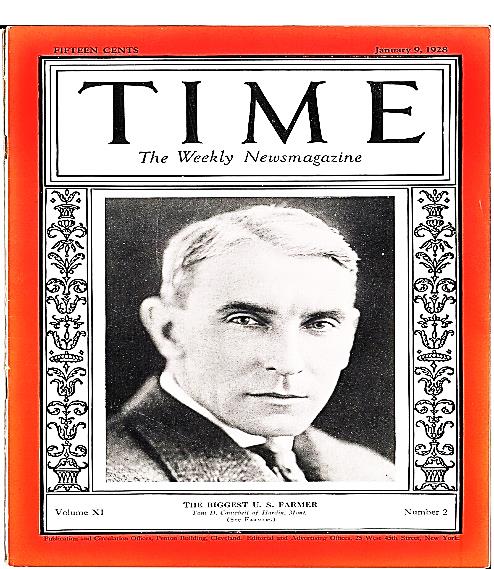
Thomas D. Campbell, U.S. Agriculture Advisory Group Leader
to Stalin’s collectivization campaign of 1929-1932
Cover of TIME magazine (January 9, 1928), public domain.
“Agriculture must be industrialized… The biggest industrial opportunity today is in agriculture. The largest field of activity of technical specialists today is agricultural engineering. In less than 50 years, we’ll have a U.S. Farming Corporation that’s bigger than U.S. Steel [Corp.]… In 20 years, less than 20% of our population will be living on farms.” – Thomas D. Campbell (1928)
Attempts to start industrial agriculture in the United States in the 1920s
Industrial agriculture in America began during World War I, when Thomas David Campbell proposed growing agriculture on a massive scale to support the war effort.[6] Campbell met “Jack,” as he called J. Morgan, Jr., back in 1917, when a bank magnate gave him $2 million to begin cultivating 200,000 acres of land expropriated from the Crow Indian Reservation north of the Big Horn River.
J. Morgan, Jr., head of J.P. Morgan Co., James Stillman[7], president of the Guaranty Trust Company, Charles H. Sabin, former secretary to the president, vice president of J.P. Morgan’s First National Bank and co-founder of the U.S. Federal Reserve Charles D. Norton, and vice president of the Guaranty Trust Company of New York, Francis H. Sisson, founded the Montana Farm Corporation with Thomas Campbell as its general manager.[8],[9]
In 1917, Campbell ordered thirty-four 13-ton Aultman Taylor 30-60 tractors with eight-foot-tall wheels and some of the largest Caterpillar tractors on earth to plow the virgin land of the Indians when there were only about 225,000 tractors in use in the entire U.S.[10] 500 plough bottoms, ten trucks, 33 tractors, 10 binders and 100 wagons for transporting grain.[11] That year I cultivated 7,000 acres. By 1920 I had 50,000 acres of land, a year later 95,000 acres, and by 1923 I had 110,000 acres under cultivation.”[12]
In the first year alone, Campbell spent more than a million dollars on equipment, tools, and supplies. The rest of the money was used to purchase seeds, store grain, barracks, kitchen and canteens, and store fuel and a general machine shop.[13] Wells were dug, roads were built, buildings were erected and supplies were delivered. Most of the equipment was out of order, as much of it was in the experimental stage. Repairs were slow, and many parts had to be made in the field. Campbell even joked that “Bailing wire was jokingly referred to as the company’s seal because it was the most common replacement for broken and missing parts.”[14]
Tractors and harvesters easily got stuck in the mud and were often left standing in the fields for days before they could be freed. At one point, fifty-two railroad cars were needed to transport machinery and equipment from one site to another because most of them broke down.[15] Four years later, despite massive financial support from some of the nation’s leading bankers, the board members decided that the Montana Farming Corporation was not profitable and would never be profitable, and voted to cease operations. Most of the losses were attributed to [American taxpayers] as part of the war effort, and those that could not be attributed to the U.S. government, have been reimbursed through income tax refunds.[16]
Campbell admitted, “We found that the deep ploughing done by these heavy new machines, which were much stronger than horses, dried out the soil and made it vulnerable to wind erosion.”[17] Campbell and massive experimental equipment eventually dried up all of those acres, and the wheat didn’t grow. The devastation of 110,000 acres of once-virgin Native American land was extensive.
“Jack didn’t want to pay the money back,” Campbell muttered. “He told me to keep the money and continue to run my own farm, so I organized the Campbell Farming Corporation in 1922 and kept 75% of the property. I eliminated the payment of dividends to managers who were 25% minority owners,[18] eliminated employee camps, and moved from biennial steaming to year three, exponentially increasing work and land use.”
Campbell was determined to prove that mechanized agriculture was more economical; that wage and management farms will supplant farms based on family labor; and that he can produce one million bushels of grain in one year. He began using International Harvester tractors, as well as Caterpillars and Case, any company that gave him a machine for testing. He reduced his workforce to about 20 year-round employees and reduced labor costs per acre. But his industrial agriculture still did not work. Unreliable equipment caused too many delays, and yields never reached expectations.
However, because of his relationship with J. Morgan, Jr., sent him to Russia to advise Joseph Stalin on the systematization of the organization of millions of acres of agricultural production and the mechanization of Soviet state farms.[19]
The former head of the U.S. Department of Agriculture, Milburn Wilson, continued to work for Montana Farming Corp. after Campbell’s departure and later started his own agricultural project. As the head of the Industrial Agricultural Experiment, Wilson received $100,000 in financial backing from John D. Rockefeller, Jr., along with farm equipment companies. Fairway Farms Corporation was founded in Montana around the same time as the Campbell Farming Corporation in 1924. to ensure efficient production” and “to organize farms on a more profitable basis”.[20]
Unlike Campbell Farming Corp., which hired employees, Wilson’s Fairway Farm Corporation allowed private farmers to farm the land under contract, but on the condition that the corporation would own a mortgage on the land. Fairway Farms was also assisted in the development of agricultural plans by the Department of Farm Management of the Montana College of Agriculture. Instead of annual cash payments, the Fairway contract stipulated that all income from the farm as a unit, stock, grain, or leased land was “gross income,” which was to be owned by the corporation, from which all taxes, insurance, mortgage interest, advances, and operating expenses were deducted.[21] The amount remaining after deductions, the “net profit”, was then held in trust by the Corporation until the accumulated funds amounted to 25% of the purchase price. At the conclusion of the contract, the lessee agreed on a plan for the organization and operation of the farm, which included the most efficient methods of production and selection of enterprises. in which the corporation was listed as a beneficiary.[22] This operational plan was remarkably similar to the Model Soviet Collective Farm Treaty, adopted by the Soviet Agricultural Trust on Wilson’s advice in 1929.
Although it was not a USDA project, the U.S. Bureau of Agricultural Economics provided services and advice to the corporation because it functioned as “a demonstration of the results of research on agricultural types and the organization of profitable farms in the Northwest Spring Wheat Belt.” The corporation’s plans were based on information contained in the Agricultural Forecast (1926) issued by the U.S. Department of Agriculture.[23]
Fairway farms were not favourably received by neighbouring communities, who disagreed with the method of combining small plots into industrial farms, arguing that they could become super-marginal with the introduction of new methods seeking to increase productivity per worker.
Wilson and his team tried to turn their Rosebud farm into a model corn growing location that could compete with the corn crop in the Midwest. After consolidating 220 acres, they planted corn. Wilson explained, “We fenced it off and harvested it with the hogs, and by the end of the first year, we had a profit of $850 after how we sold fattened pigs.”[24] Fat pigs were the result of an industrial experiment growing corn in the United States.
The following year, their farmer was forced to take a job at a local mill to make ends meet. In 1927, their farmer, following their plan, planted 118 acres of wheat, 242 acres of corn, and 33 acres of oats. As before, two wagons with pigs were brought in for harvesting, but due to the fall in pig prices in the fall, they lost money. The following year, precipitation was poorly distributed and led to a complete crop failure.[25]
Wilson’s Cloverleaf Farm in north-central Montana. It all started in 1925 with a tenant who planted 400 acres of spring wheat, oats, barley, and corn, but due to mechanical failures, he planted behind schedule, and hot winds damaged the young crops in the summer. Although the rains were average, they fell at the wrong time for these crops, and yields were low.[26]
The third farm that Wilson used as the basis for the report for the Stalin Grain Trust (Grain Trust) was the Lone Warrior Farm, also called Brockton’s Farm, as the nearby town was called. This land, located on the Fort Peck Reservation, was part of Tom Campbell’s Montana Farm Corporation from 1917 to 1922. In the spring of 1925, Fairway Farms bought two lots from the Bureau of Indian Affairs for $8.43 an acre, while similar land in the country sold for more than twice as much.[27] Wilson and his team ordered two more International Harvester tractors, but the company was so overwhelmed with orders that they didn’t receive them until the end of the year, when it was too late to use them.[28] It took several years to prepare all the fields for cultivation, and by the end of 1926 they owed the bank $10,000 and were almost forced to sell the farm and abandon the experiment, but the Rockefeller Foundation shelled them out another $25,000 so they were able to continue. In 1927, yields were again low due to “poorly distributed rainfall.” In 1928, they entered into an agreement with the Montana State University Experiment Station. which, in exchange for research on experimental tractors, provided Fairway Farms with unpaid student labor and supervision of experimental tests of the use of machinery and combinations of crops. Gun dealers were asked to borrow machines for experimental purposes, which many did.[29] By 1929, after twelve years of failed experiments with industrial agriculture, they planned to plant 1,400 acres of wheat and nearly 850 acres of corn, flax, oats, and barley,[30] but the experiments were never self-sufficient and depended on their ties to federal agencies.[31] The state of Montana even had to pay Wilson’s assistant’s expenses, and the Bureau of Agricultural Economics had to pay Wilson’s expenses.[32]
The Division of Land Economics negotiated contracts, and the Division of Farm Management prepared plans and estimates for each of the farms. In the fall of 1926, Wilson and his team approached the Anaconda Copper Mine Corporation[33] in Butte, in which Rockefeller was interested, and received additional support.[34]
Finally, in 1929, Wilson hoped to turn things around as long as the weather was favorable and hog prices held until he and his team were sent to the Soviet Union to advise the Soviet Union on industrial farming practices.
With such a dismal track record in industrial agriculture, these American agricultural engineers were sent to the Soviet Union to give expert advice on large-scale agriculture in an area about ten times the area they had tried unsuccessfully to cultivate for more than a decade, and where the success or failure of the experiment would affect the lives of one hundred and seventy million people.
Why American Corporations Needed a Huge Foreign Market for Agricultural Machinery
At the turn of the 20th century, the Holt Manufacturing Company of Stockton, California, produced a range of continuous tractors. Holt tractors gained popularity in World War I as artillery tractors. Despite U.S. neutrality, Holt Manufacturing Co. sent 1,200 tractors to England, France, and Russia for “agricultural purposes,” which sent the tractors directly to the front, where they were used to transport artillery and supplies.[35] Over the next four years, the Holt tractor became the main artillery tractor in the European war, used to tow heavy artillery up to the 9.2-inch howitzer.[36] About 2000 Holt 75s, along with 698 Holt 120s and 63 Holt 60s, were used for military purposes during the war. French Schneider CA1 and Saint-Chamond and even German A7V tanks were based on Holt tractors[37].
Holt’s planned expansion to meet further military needs was abruptly interrupted when the war ended in November 1918, and Holt was left with heavy war tractors that were not suitable for America’s small farms. The company’s situation worsened when artillery tractors were returned from Europe, resulting in lower prices for new machinery and unsold Holt inventory.[38]In 1925, [39] Holt and C.L. Best Co. merged to form Caterpillar.
Another international economic factor played a role here. The post-war economy slowed down, and heavy machinery and weapons manufacturers (any businesses with a large foundry) that had record production and profits during World War I were looking for new and lucrative markets for their huge products. Since they already owned huge forges where steel was melted and cast for artillery, tanks, and ships, they could easily convert their large factories to produce agricultural machinery, tractors, and spare parts; Slashing swords into plowshares, so to speak.
But in the 1920s, large American agrimachinery firms were frustrated that the American agricultural market could not take advantage of their heavy equipment. Why couldn’t they sell their equipment to the American market? Because American farms were still small enterprises and did not have the financial ability to buy large and expensive new machines, and they were not interested in doing so.
The problem (for agricultural engineering companies) has its roots in a series of American homestead laws between 1862 and 1916. In the 1860s, in an effort to displace the Native American population and prevent the arrival of French, Spanish, or any other imperialist settlers, the U.S. organized a federal land grant that gave settlers tracts of up to 160 acres. By 1916, this area increased to 640 acres. In all, more than 270 million acres of land, or nearly 10% of the total U.S. area, were given to 1.6 million settlers.[40] Now that the threat of invasion by natives, French, and Spanish into the U.S. had passed, these small, family-owned farms became an obstacle to large agribusiness, which needed a market with farms large and wealthy enough to buy their massive machinery.
Such was the situation west of the Mississippi. The land in the northeast was too diverse and the growing season too short to offer a viable large-scale agricultural market.
South of the Mason Dixon Line, where the rains fell, the soil and land were suitable for large-scale agriculture, it was the country’s most rural region.[41] From the Potomac River in the nation’s capital to the shores of the Gulf of Mexico, the land had remained unchanged since the late 1870s; it was a land of scarce capital and abundant labor. Southerners still planted and harvested their traditional crops of cotton, tobacco, rice, and sugarcane with mules and muscle.[42] Overall, while American farmers brought 50 percent more produce to market in 1928 than in 1900, industrial production doubled and doubled over the same period. Machinery led to remarkable productivity in all other sectors, but U.S. agriculture refused to modernize. By 1925, a fully assembled Ford Model T rolled off the ever-moving assembly line of the Henry Ford Highland Park plant every ten seconds. Just ten years earlier, it took fourteen hours to assemble one car.[43] But agriculture in the U.S. still continued to exist in the 19th century, forcing American multinational companies with huge foundries to sell their most advanced equipment outside the U.S. until the American crop was forced to consolidate (in the 1930s and 1940s).
U.S. agricultural machinery manufacturers produced giant agricultural machinery for Argentina, Canada, and the Soviet Union, while very few of their largest machines had a market in the U.S. that still relied on horses and wage laborers.[44] That is why bankers such as J.P. Morgan[45] , who had financial ties to International Harvester and other agricultural firms, decided to argue that family farms should be replaced by industrial farms large enough to justify the purchase of a significant amount of their equipment.[46]
Enter Soviet Russia
Tsarist Russia issued decrees similar to the American homestead laws, such as the Stolypin Reform of 1911, which granted land to settlers and established millions of small family farms throughout Russia’s vast landscape to populate remote areas and prevent settlement by rival nationalities. Moreover, Lenin’s Land Decree of 1917 divided large estates into smaller holdings. as in the US, these millions of small family farms were now on the path to profit (publicly referred to as “progress”). Unable to forcibly collectivize U.S. agriculture (for the time being), the big agrimachinery firms turned their attention to the Bolshevik regime’s monopoly control of Russia’s agricultural market. They found in General Secretary Stalin a man willing to force the Soviet people to consolidate their lands, eliminate fences, barns, houses, and ban the use of ploughing horses to create massive, uninterrupted collective farms—and become The leading consumer of Western heavy equipment, too large and expensive for the individual American farmer.
Tractor Testing Act
There was another reason why American agricultural machinery manufacturers sought to sell their equipment in foreign markets. As early as 1919, the State of Nebraska passed the Tractor Testing Act, known as the List 85 of the 37th Session of the House of Representatives (Chapter 218, Laws of the State of Nebraska, 1919), which went into effect on July 15, 1919, and was enacted to encourage the production and sale of improved types of tractors and to promote more successful the use of a tractor in agriculture.[47] The Testing Act grew out of the uncontrolled sale of tractors during the First World War, when there were virtually no laws governing standards or guaranteeing even minimal quality. In response to so many low-quality tractors being sold, the Testing Act required all manufacturers planning to sell their machines in the state to first submit their tractors to the University of Nebraska for testing and prove that the company had an adequate supply of spare parts for repairs. This law is believed to have set America’s first standards for farm implements.[48] but he put a serious obstacle in front of all the engineering companies that refused to spend money on real field trials – which take years – before starting to sell their products, until Comrade Stalin was kind enough to offer his country as our guinea pig.[49] These giant Soviet farms were supposed to be huge experimental stations where they could test their most radical ideas to increase agricultural production, because much of what they wanted to learn simply could not be tried in the U.S. for three main reasons: it would have cost too much; there wasn’t a large enough agricultural site with so many private family farms along the way. Both American farmers and the American public at large would be alarmed by the consequences of such experiments. After spending a few months in the Soviet Union, they could try out their ideas to make sure they were viable and bring the improved version back to America.[50]
The U.S. experience in large-scale agricultural production and agribusiness management in the 1920s was largely theoretical. The largest farm in the U.S. was Tom Campbell’s farm (110,000 acres), but it was a garden compared to The Giant (642,000) and Camel (375,000 acres). Despite the dubious past of these American agricultural advisers, the Soviets fulfilled their obligations 100 percent. By the spring of 1930, Stalin had already placed orders for more than $65 million worth of equipment, and much of this equipment had never been tested or used in real conditions.
In January 1928, before the Five-Year Plan began, the Soviet government purchased 1,058 Kletrak tractors from the Cleveland Tractor Company in Ohio. Then, in June of that year, Amtorg, the Soviet clearing house for the purchase of American products in New York, ordered another 6,750 John Deere and International Harvester tractors from Hercules Motor Corp, as well as 2700 engines for heavy trucks. In 1928, however, there were only 53 state-owned grain farms in the Soviet Union, covering an area of seven million acres.[51] The rest of the country was cultivated by independent farmers, the vast majority of whom did not have the money needed to absorb so much expensive American machinery.
Why would Stalin dare to buy so many of the largest and most expensive agricultural machines that had never been used on the U.S. market?
Germany also participated in the Soviet collectivization campaign through its main arms manufacturer, Friedrich Krupp AG. Krupp had already established a 120,000-acre industrial farm in the Caucasus in 1922 [52] , just after the Treaty of Rapallo. In December 1928, another, more comprehensive agreement was reportedly signed between the Soviet government and German industrialists, which stipulated that the leading arms manufacturer in Europe, Friedrich Krupp Ag, the manufacturer of Europe’s first Mercedes Benz car, and another European arms manufacturer, Rheinmetall Ag, will organize Soviet collective farms and supply them with tractors. And there were rumors that the Soviets were paying these German companies $2 billion for this equipment and engineering services.[53] This was the market that these German corporations claimed as a result of the restrictions placed on Germany by the Treaty of Versailles, although there were reports that war production had resumed as early as 1921, and definitely since Adolf Hitler’s Reich acquired a controlling stake in the company in 1925.
The First Five-Year Plan and Collectivization
The capital investments laid down by the Soviet government in the budget for the first five-year plan (1929-1933) amounted to 64 billion rubles.[54][55] (about $32.9 billion in 1928). At that time, the gross domestic product (GDP) of the United States was $79.4 billion[56]. This meant that Stalin obliged Soviet society to spend an amount equal to almost half of U.S. GDP, whereas in the previous few years Russia’s GDP had been only about 30% of that of Great Britain.[57] Britain’s GDP was about £4.8 billion (about $23 billion), divided by 30 percent, meaning that Russia’s GDP was only $6.9 billion. The jump to $32.8 billion in spending required an almost fivefold jump in total output.
Much of this money has been directed to, or has already flowed, to U.S. engineering and heavy industry companies.[58] Prime Minister Stalin obliged the Russian people, as prescribed in accordance with the adoption of the Five-Year Plan, to purchase huge quantities of Western goods and services necessary for the fulfillment of the plan and collectivization. This meant that Russia’s natural resources had to be sold on the world market in order to obtain the funds to pay for these services and equipment in a timely manner. Soviet heavy industry was supposed to demonstrate a 350% increase in production.[59] Grain, oil, coal, timber, sugar, copper, manganese, iron, tin, gold, silver, etc., all these resources would have to be sold on the world market in order to obtain the capital due to American and Western European companies.
In the absence of an industrial economy during the first five-year period and the refusal of loans from foreign governments, the only way to pay for contracts for Western equipment and technical assistance was to increase foreign exchange earnings by significantly increasing grain sales abroad. Since hard currency revenues largely determined the amount of Western goods and services that the Soviet regime could purchase, increased sales of Soviet resources on the world market were in the interest of foreign firms seeking to sell their equipment to the Soviet market. This is where American agricultural advisers came to the rescue and why they were potentially the most important (and destructive) of all the foreign engineers who came to Russia in the 1920s and 1930s.
Shortly after U.S. agricultural advisers presented a plan to establish industrial agriculture in the Soviet Union, the First Five-Year Plan was revised with a 50 percent increase in production targets for exports overall.[60] Without a significant jump in wheat production and export sales by a fixed minimum number of bushels, the Soviets would not have been able to raise the capital needed to make payments to Western firms, especially in the absence of a trade treaty between the U.S. and the Soviet Union. General Electric, International Harvester, Caterpillar, Ford Motor Co., and dozens of other Western multinationals counted on U.S. advisers to push through agricultural reforms to ensure that Soviet Russia met its private financial obligations to them in a timely manner.
The Soviet regime based its ability to pay Western firms for the private loans they provided for the massive industrialization projects spanning the First Five-Year Plan mainly on its ability to produce 16.5 million metric tons of grain over the next four years. The main goals of agriculture for 1930 and 1931 were to produce 1.7 million tons of marketable grain in 1930 and 2.25 million tons in 1931.[61] The collectivization plan was based on exponentially growing yields through an annual increase in acreage, which would provide a cumulative surplus of grain for sale on the world market.
The grain will be sold to grain-importing countries such as the United Kingdom, Germany, Austria and Italy, and this revenue will be used to reimburse Western firms for design/construction costs, equipment, materials and technical assistance contracts. While other income-generating resources such as furs and oil would have contributed, without a developed industrial base or long-term loans backed by the U.S. government, grain would have become Russia’s largest agricultural commodity in the early 1930s – at least that was the plan.
After selling about $48 million worth of U.S. agricultural machinery between 1927 and 1929, U.S. agrimachinery firms, along with American pioneers of industrial agriculture, traveled to Soviet Russia in 1929 to advise Stalin and the Soviet Grain Trust (Zernotrest) on a large-scale plan to collectivize Russian agriculture and establish industrial agriculture in the Soviet Union. Six months after the arrival of a team of American advisers, and just weeks after they submitted their plan to the Soviet Grain Trust, the Soviet collectivization campaign (and dekulakization) was added to the First Five-Year Plan. In 1930, the Soviet government adopted a law on the harvest of grain: “To organize a network of state farms (state collective farms) on uncultivated lands in the RSFSR and Ukraine, which were to produce about 16.5 million metric tons of marketable grain within four years.”[62]
According to V. Ladyzhinsky’s 1938 article “Soviet State Farms: Experience in Large-Scale Socialist Farming”, the Bolsheviks expropriated private land plots in Russia and distributed the land to the peasants. The system of large-scale farming, which accounted for one-third of the agricultural area of European Russia, was abolished, and after the October Revolution of 1917 Russia became a country of small peasant farmers. This was a temporary truth.
It can be argued that Lenin’s Land Decree of 1917, which distributed the land of the monarchy to the peasants of Russia, was designed to enlist the support of his young regime, and was never meant to be permanent. If the peasants had had the opportunity to read Lenin’s works before the revolution, they would have known that their control over agricultural land would be short-lived. By February 1919, Lenin had issued a new Decree on Land, which legitimized the existence of state farms and defined their main function as the construction of a “single agricultural economy” that replaced individual farming, in order to: a) “maximum growth of production by increasing agricultural productivity and expanding sown areas; b) creation of conditions for a complete transition to a collectivist system of agriculture; c) organization and development of cultural agronomic centers.[63] Thus, two years after Lenin called on the Russian peasants to take possession of the landlords’ lands, he ordered them to transfer all their land to the state farms.
The history of the organization of state farms in the Soviet Union falls into two main stages; the period from 1919 to 1928, when the sovkhozes were relatively small units organized on former estates, and the period beginning in June 1928, when the Soviet government embarked on a program of creating huge, fully mechanized collective farms (kolkhozes), while accumulating a sufficient number of foreign tractors to equip the new large farms.
Import of American tractors to Soviet Russia in 1921-1933
From the beginning of the 20th century until the outbreak of World War I, Imperial Russia spent about $60 million a year on foreign agricultural machinery.[64] The largest recipient of this money was the American firm International Harvester, which had a near-monopoly on the agricultural market of the Russian Empire. As discussed in detail in the book U.S.-Russian Trade Relations 1763-1933, Robert S. McCormick of the McCormick family, which owned International Harvester, was appointed U.S. ambassador to Russia between 1902 and 1905 to push for the removal of Russian tariffs on foreign imports agricultural machinery.
As tariffs were to be renewed in 1910, IH decided to establish a factory in the Russian Empire.
On February 10, 1909, George Perkins, a partner of J. Morgan and founder of the IH company, appealed to Washington to provide “friendly help and assistance” in efforts to “accelerate the approval of the charter” for the creation of an International Combine Plant in the Russian Empire. By February 19, U.S. Ambassador Rockhill was “instructed to use his official good offices to assist” in the approval by the Tsar of the Russian commercial charter of the International Harvester Company.[65]
In July 1909, Cyrus McCormick met with the Ministers of Agriculture, Finance, and Trade to find out whether the Tsarist government would grant the International Harvester Company special exemptions, such as exemption from tariffs on machinery and low duties on imported parts for the duration of the plant’s construction, followed by low tariffs on parts that could not be manufactured in Russia, tax exemptions, and the imposition of “general duties” on those who could not be manufactured in Russia. who was “only an importer”.[66] The reaction was positive. In August, the outdated New York Air Brake plant in Lyubertsy, near Moscow, was bought. The plant was an American supplier of air brakes for Pullman cars, supplied for the now almost completed Trans-Siberian Railway and put up for sale by owner Charles R. Crane[67] , its own production base will become insurance in case of the expected end of tariff exemptions for imported agricultural machinery.[68]
In 1910, the Chicago Record Herald newspaper published the headline: “Factory in Russia to Produce Chicago Equipment”:
Berlin, December 3, 1910 – The International Combine Company’s business in Russia has grown so large that the company has recently established a factory in the village of Lyubertsy near Moscow to produce binders, reapers, lawn mowers, engines and other agricultural machinery.[69]
Commercial relations between International Harvester and Russia continued well into World War I, when Cyrus McCormick, Jr. became a member of the American International Corporation in 1915, a firm formed by leading American bankers and industrialists who sought to capitalize on the participation of European firms in the Great War and invest in overseas projects, especially in China and Russia.
As soon as the February Revolution of 1917 overthrew Tsar Nicholas II, McCormick accompanied former Secretary of State Elihu Root on Root’s mission to Russia. As an experienced administrator of U.S. territorial possessions such as the Philippines and Puerto Rico, Root’s official goal was to pressure Russia to remain in the war against Germany.
McCormick remained in Russia after Mission Root left and joined the newly arrived American Red Cross mission in Russia. Organized by J.P. Morgan partner Henry. Davidson, the American Red Cross mission to Russia consisted of approximately twenty-five captains of American industry (and 7 doctors) who traveled to revolutionary Russia in early 1917 under the guise of the Red Cross to discuss commercial trade with the Provisional Government. and after October 1917, with the Bolsheviks (both U.S. missions are discussed in detail in U.S.-Russian Commercial Relations 1763-1933 (2025)).
According to a 1919 U.S. Senate hearing on Bolshevik propaganda, the head of the Red Cross mission in Russia, Raymond Robins, successfully negotiated with Lenin to release the International Harvester plant in Lubertzi from nationalization. After hearing the complaints of the Russian manager of the IH, Robins, in his capacity as head of the American Red Cross mission in Russia, met with Lenin on the matter.
I went to Lenin and said, “Now there is a capitalist enterprise, an American capitalist enterprise, which is doing business in Russia for the purpose of making money, but in your formula, for the purpose of exploiting Russia. But it happens, Commissar, that we deliver commodities, produce a product which is of primary economic necessity to the agrarian people, i.e., agricultural machinery. Your decree, if carried out now, will destroy this organization. As far as I know, International Harvester Co. is the best agricultural machinery manufacturing organization in the world. I’ve heard that they have the best brains not only for manufacturing, but also for marketing. I’m not going to argue with you about that. You have to cooperate with America. You can’t get a ton of space on any vessel in a U.S. port, and you can’t get a dollar of bridge credit between the time of shipment and until the raw materials for payment are returned. You cannot get a ton of space on any American ship for industrial material, if this can be successful: fully support in America that an existing enterprise, which produces the main product for the economic life of Russia 18 versts from Moscow, cannot continue production because of your socialist decrees. I will not argue. I’ll just leave it up to you.
The fact is that a representative of the Soviet Council came there and confered with the representatives of the Harvester Company, and Mr. McAllister came back to my office and said that he had a perfectly satisfactory agreement with them regarding the implementation of the workers’ decree, and that everything was going satisfactorily. When I left Russia, these gentlemen approached me with this statement, and I brought the information to the International Harvester Co. and passed it on to Mr. Edgar Bancroft, who met me on the train to Chicago on his way to Washington, calling for co-operation, credit, and business opportunities under the Bolshevik Government in Russia six months after I had done so. how this government got to work.
I want to say further that in my daily work there were constant changes in these decrees, which showed, in my opinion, the possibility of working with the Soviet government.
In addition to using the American Red Cross as a cover for negotiations on exemptions for individual American firms, Robins threatened Lenin with refusal to give Russian resources space on international cargo ships if he did not release the International Harvester plant in Luberti from nationalization (while all Russian entrepreneurs were banned from entering Soviet Russia, and their enterprises were merged into trusts, and then transferred to Western firms). Who Robins really represented in these negotiations with Lenin (and Trotsky) remains to be seen. Some have suggested that it was the State Department, but I vote for the bank that manages the Red Cross mission in Russia, J.P. Morgan, especially since IH was under the House of Morgan financial umbrella.
In 1919, the Supreme Economic Council (VSNKh) also signed a contract with American automaker Henry Ford for the mass supply of Ford tractors. Bolshevik Russia suddenly became the greatest client of the great capitalist Henry Ford. The contract stipulated that until 1922, Russia would import more than 25,000 Fordson tractors from the United States and the Ford plant in Cork, Ireland. The Fordson Tractor Model F 1919, with large spoked wheels and beveled studs, claimed to be able to maintain traction in the ubiquitous Russian mud.
U.S. Department of Agriculture (USDA) economist Dana G. Dalrymple in her 1964 article ” The American Tractor Comes to Soviet Agriculture” explains that American collectivization advocate Harold M. “Ware saw the possibilities of using tractors to reorganize Soviet agriculture and received enough money to ship twenty Case tractors with equipment in the spring of 1922.[70] In the fall of that year, the Jewish United Distribution Service also purchased eighty-six John Deere tractors for resettlement work under the direction of Dr. Joseph A. Rosen. Rosen was a well-known American agronomist and colonization specialist who, as director of the American-Jewish United Agricultural Corporation, directed agricultural settlement projects for 250,000 Russian Jews after the October Revolution. led the management of approximately $16 million provided by the American-Jewish Joint Agricultural Corporation.[71]
The first direct batch of 200 Fordson tractors was shipped in 1923.[72] Over the next few years, an increasing number of machines were exported, and by 1926, Soviet orders had been placed for 24,600 American machines. One shipment from the Ford River Rouge plant carried 1,930 tractors. By 1927, Ford boasted that 85 percent of the trucks and tractors in Russia were made by Ford; of the 5,700 tractors owned by the Ukrainian government, 5,520 were owned by Fordson.[73] In February 1927, an article titled “Tractors Purchased by Amtorg for the Soviet Union” in the Economic Review of the Soviet Union stated: “More than 98 percent of the tractors are American-made.”
According to Dalrymple, by 1931, the Soviets were spending $400 million a year on agricultural machinery. By 1934, the number of foreign tractors in the Soviet Union had increased to more than 200,000, and the increase in the number of tractors led to a catastrophic transformation of the social and economic structure—the collectivization of agriculture. “This technology, however, did not come from Russia,” he explained, “it came almost entirely from the United States.”
The following diagram from Dalrymple’s article does not take into account that the Ford plant in Cork, Ireland, had been supplying Ford tractors to Soviet Russia since 1923, and that International Harvester continued to operate its Lyubertsy plant long after Lenin’s nationalization of Russian domestic enterprises. Moreover, the International Harvester plant in Stalingrad (by 1930) and the Ford plants in Nizhny Novgorod (Gorky, GAZ) and Chelyabinsk Caterpillar by 1932 were producing tractors domestically under US licenses.
Table 1. Export of tractors from the USA to the USSR
In units per calendar year
Year/Total/Wheeled/Tracked
Source: Compiled on the basis of annual issues
Foreign Commerce and Navigation US, U.S. Department of Commerce.
The intermediary in the transactions between American agro-engineering firms and the Soviet government was the Amtorg Trading Corporation, the first trade mission of the Soviet Union in the United States, created in New York in 1924 by the merger of Armand Hammer’s Allied American Corporation (Alamerico) with the Products Exchange Corporation (Prodexco) and Arcos-America Inc. (“Amtorg” was the American branch of the All-Russian Cooperative Society, ARCOS, also known as the “Russian House” or “Soviet House” in Britain, founded in London in 1921.
According to Amtorg chairman Saul G. Bron in 1930:
Between 1927 and 1929, Stalin purchased more than $43.5 million worth of agricultural machinery, which “indicates the tremendous importance that recent advances in centralized agriculture in the USSR can have for the United States. The United States continues to be the main supplier of tractors to the Soviet Union, and will account for more than three-quarters of the sixty thousand tractors that will be used on Soviet farms this spring.[74] Beginning in the summer of 1929, the Amtorg Trading Corporation purchased more than 20,000 tractors from the USSR for shipment to the USSR. The cost of these tractors was 30 million dollars, and we hope that they will arrive in time for the spring sowing campaign. In addition, 17,000 plows, 2,000 grain seeders for sowing machines and 18,000 special seeders for cotton and corn were purchased. International Harvester Company, John Deere Company, Caterpillar Company, Allis-Chalmers Company, Case Tractor Company, Massey-Harris Company, and Cleveland Tractor Company. Plows were also purchased from Oliver Farm Equipment Company and B.F. Avery & Sons.
Bron went on to explain that:
The study of the import of Soviet goods into this country presents considerable difficulties due to the fact that some goods of Soviet origin come through Germany and other European countries and therefore do not appear in customs reports either as Soviet exports to the United States or as imports from the Soviet Union.
In 1928, Caterpillar Co. acquired Russell Grader Manufacturing Co. and began selling tractors and graders to the Soviet Union. By 1929, the Soviet Union had purchased 2,050 Caterpillar machines, [75] quadrupling Caterpillar’s sales to $52.8 million ($96,096,000 in 2024). While Ford’s exports declined (after it built its factories in Nizhny Novgorod (GAZ) and Moscow), International Harvester tractors predominated,[76] followed by John Deere,[77] Case[78] and Allis-Chalmers.[79]
As a result, Calvin B. Hoover in his 1931 book The Economic Life of Soviet Russia reported:
… Agricultural machinery manufacturers were booming, and their shares rose to new records on the New York Stock Exchange.[80]
In February 1930, the new chairman of Amtorg, Pyotr A. Bogdanov, declared: “The five-year plan, according to which the total investment in economic construction will amount to $33 million, prepares the ground for the further development of business relations between the Soviet Union and the United States.” By February 1930, there were about 38,000 tractors in the villages, and another 25,000 were on the way. which represented an investment of 200 million rubles ($102 million in 1930 and $1.856 billion in 2024) in agricultural machinery.[81] Ninety thousand tractors were bought by the Soviet regime, the vast majority of them produced abroad, and the rest were built in foreign-made factories (such as the IH plants in Lyubertitsy and Stalingrad, the Caterpillar plant in Chelyabinsk, and the Ford plants in Gorki and Kharkov) and produced under foreign licenses.[82]
The Kharkov Tractor Plant was designed and built by the New York-based architectural firm Albert Kahn Assoc. for Ford, and then began production of the McCormick-Deering 15/30 International Harvester tractor under license. After the plant opened in 1931, American Communist Fred Beal was appointed director of propaganda and cultural relations in the colony of several hundred foreign workers and specialists, mostly Americans. Germans and Czechoslovaks.
The publication of Amtorg, in conjunction with the Soviet Trade Mission in the United States in Washington, D.C., Overview of the Soviet Union, In the September-October 1930 issue, he declared: “The thousand-year-old boundaries between the holdings of millions of small peasant proprietors have been erased, and modern industrial economy has replaced the primitive individual methods of the past. … More than 82,000 collectives, about six million, or a quarter of all peasant households… are engaged in large-scale cooperative production. … 10 million hectares are allocated exclusively for the production of grain by the huge industrial farms of the Grain Trust (Grain Trust), which is now in charge of 131 large grain farms.”
The Soviet government imported more than half of the more than 100,000 tractors from the United States and initiated “a grandiose construction program in Soviet factories, for which American specialists were invited.”[83] Capital investments in foreign agricultural machinery and implements in 1926-1927 amounted to 988 million rubles and increased to 1404 million rubles ($72.3 billion).[84]) by 1929.[85]
Source: “Tractors in the Soviet Union,” Soviet Union Review, Soviet Trade Delegation/Amtorg, Inc., February 1932, p. 35.
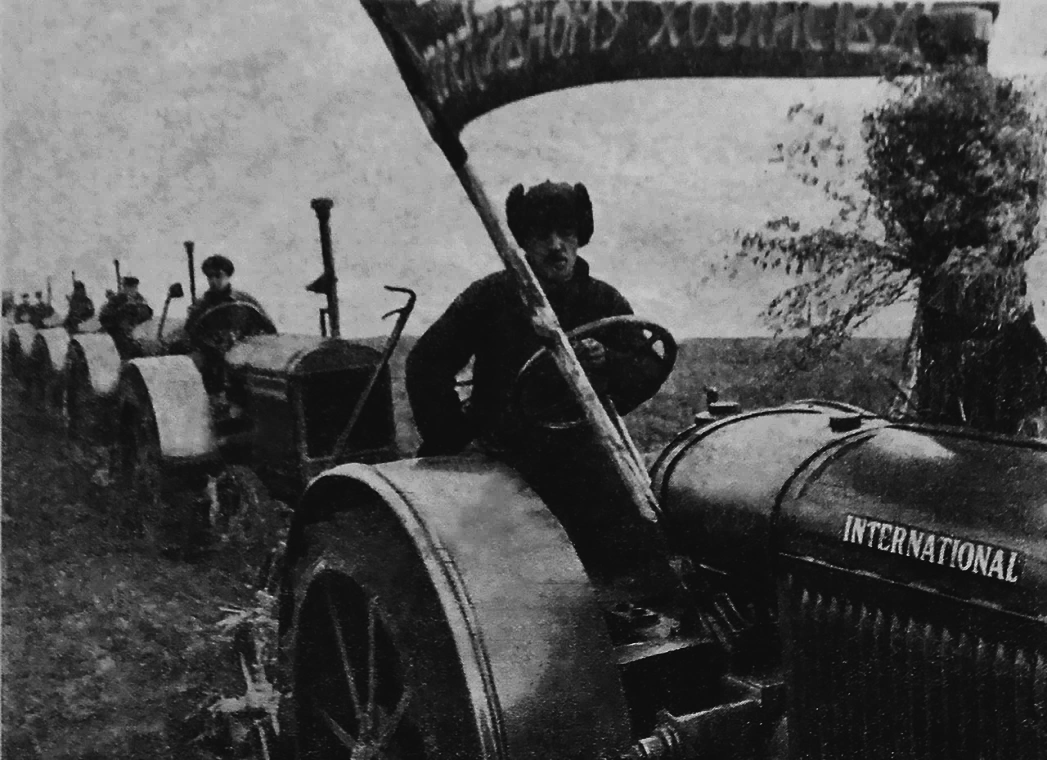
International Harvester, McCormick-Deering 15-30 domestically produced KhTZ 15-30. Ukrainian SSR of 1931.
Even Soviet domestic production provided American firms with significant royalties and income from technical assistance.
Selmashstroy, the only factory of agricultural implements of the 1st five-year plan, built without the involvement of foreign contractors, was nevertheless filled with obsolete American equipment, and its products had previously been purchased in America.[86]
Collectivization: The American Plan for the Industrialization of Soviet Agriculture
In the wake of all these mechanisms, a delegation of American agricultural advisers, led by Hal Ware, Milburn Wilson, and Thomas Campbell, traveled through the vast farmlands of Soviet Russia to meet with Stalin in Moscow in early 1929.[87] In 1929 alone, more than three hundred American agricultural engineers arrived in the Soviet Union to advise the Soviet government on agricultural policy.[88]
The group’s organizer was Harold Ware, a 39-year-old American Marxist who was considered one of the Communist Party’s leading agricultural experts.[89] Ware had been visiting the Soviet Union since 1922 after winning $75,000 in U.S. funding and securing a deal to supply 24 tractors and related equipment from the J.I. Case Farm Implement Co.[90] for sale to the Soviet government. Throughout the 1920s, Ware led groups of American businessmen from agricultural firms in Russia.[91] In the winter of 1928-1929, Ware made a deal with American manufacturers of agricultural equipment to send experimental tractors and implements, along with mechanics, to assemble them in the Soviet Union.[92] Ware also offered Zernostrast to allow him to equip and manage the collective farm with American machines, methods, and specialists.[93]
According to Lement Harris’s book Harold M. Ware (1890-1935): A Pioneer of Agriculture, USA and USS.R.:
The new farm [Ware] was called the Camel State Farm, officially Sovkhoz No 2. The Camel Farm consisted of several units scattered along the railway running east of Rostov-on-Don, covering an area of about 150,000 acres. International Harvester, Caterpillar, Cleveland Tractor Co., Nichols & Shephard, and Massey-Harris (Canada) sent tractors, combines, plows, blades and discs, as well as a full line of dryland grain production equipment. Ware’s most compelling argument[94] was that the Soviets planned to keep a record of the performance of each individual brand and, in the years that followed, to place orders with those companies whose machines were best suited to Soviet conditions.
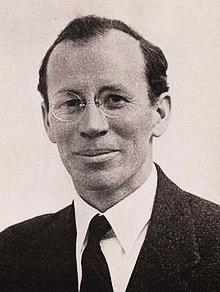
Harold Maskell Ware, circa 1935
The second person in the delegation in 1929 was forty-two-year-old Milburn Lincoln Wilson. In 1924, Wilson joined the U.S. federal government, serving as head of the U.S. Department of Agriculture’s Division of Farm Management and Cost Accounting until 1926. In 1926, he returned to Montana State College to chair the Department of Agricultural Economics, where he began his career and began conducting experiments in industrial agriculture. to conceptually, physically and materially organize a collective farm using American agricultural machinery.[95]
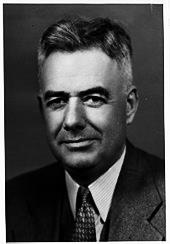
Milburn Lincoln Wilson
Thomas David Campbell, 47, a recipient of funds from J.P. Morgan to launch industrial agriculture in the United States, was also part of a delegation that came to Moscow as a special adviser to Stalin’s first five-year plan in early 1929.[96]
As Deborah Fitzgerald writes in her book Every Farm Is a Factory: The Industrial Ideal in American Agriculture, Milburn L. Wilson consulted the Soviet government for six months on a plan to grow 400,000 acres (161,874 hectares) of wheat.
Edward James Stirniman, an agricultural engineer at the University of California, Berkeley, and Leonard Fletcher, an agricultural engineer at the Caterpillar Tractor Company, spent two years teaching the Soviets how to assemble and operate agricultural machinery.
John C. MacDonald, another Caterpillar engineer, traveled to Soviet state farms, assessing equipment needs for various crops.
Brownlee Davidson, a professor of agricultural engineering at Iowa State College, traveled to the Soviet Jewish State to advise on the suitability of land for agriculture.[97]
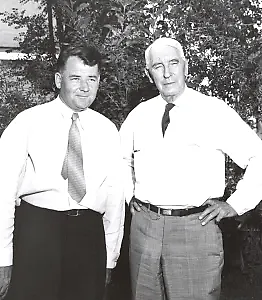
Thomas D. Campbell (right) with Deputy People’s Commissar of Agriculture of Soviet Kazakhstan, circa 1930
Photo courtesy of the Bighorn County History Museum, Hardin, Montana.
Wilson spent 1926-1929 at Thomas Campbell’s Fairway Farms project in Montana, where he collected empirical data correlating farm size and machinery needs.[98] According to Fitzgerald, in the fall of 1928, Hal Ware visited Wilson in Montana, where he was working on an experiment in industrial agriculture, and persuaded him to join him on a trip to the Soviet Union as an expert in farm management, in particular to “figure out how to organize the collective farm physically and conceptually.” Sitting out in a Chicago hotel in the first two In the weeks of December 1929, Wilson, Ware and Riggin, who ran a farm in Brockton, were struggling to figure out how to turn a hundred thousand acres of virgin land into a productive wheat farm.
Fitzgerald explained:
In a report prepared for the Grain Trust, Wilson, Ware, and Riggin argued that the Soviets should adopt much the same system of wheat cultivation that Wilson had urged the farmers of Montana to adopt. They made very minor concessions to the fact that many aspects of the system would have been more difficult to implement in the Soviet Union. Rather, they presented their plan as if it were a strictly technical and almost formulaic problem that could be solved without considering social, psychological, political, or cultural problems at all.
or whether the machines that were sent by American firms were tested and tested and had a sufficient number of spare parts.
From April to October 1929, Wilson spent in Soviet Russia at the invitation of Zernotrest, working out the agricultural part of the Soviet Five-Year Plan.[99] Wilson was already involved in the purchase of Soviet tractors through Zernotrast. In January 1929, Wilson reported to the U.S. Department of Agriculture that the Soviets had purchased 350 Cletrac tractors. In June, while Wilson and U.S. agricultural technicians were advising Soviet agricultural policy, the Soviet trading company in New York, Amtorg, ordered another 6,750 tractors from John Deere and International Harvester. In August, they ordered 1,700 heavy engines from Hercules Motor Corporation and another 708 tractors from Cletrac, and in December another 1000. By August 1930, the Soviet Union had ordered a Caterpillar 60 worth $5 million. The Department of Commerce estimated that between January and March 1930, tractor sales to the Soviet Union amounted to about $20 million. In July of that year, the Soviet government ordered another $40 million in tractors and harvesters[100] for a total of $65 million (about $1.24 billion in 2024) in the first six months of 1930 alone, a boon for American firms in the midst of the Great Depression.
A giant: the world’s largest wheat farm
In the spring and summer of 1929, when Harold Ware was organizing the management of the 150,000-acre (60,703 ha) Grain FarmNo 1 (unofficially named “Camel”), Wilson initiated the largest wheat farm the world had ever seen. Located in the North Caucasus and aptly named The Giant, it had an area of about 1,000 square miles (2,590 square kilometers), with a total of 642,000 acres (259,808 hectares). Rhode Island. The Soviet government invested 27 million rubles in this farm alone, most of which was invested in Western equipment, which numbered 8,000 units.[101] The U.S. plan was to plant 300,000 acres of land in the first year and the rest the following year. The farm was expected to produce more than 4 million bushels of wheat over 3 years at a price of 54 cents per bushel.[102]
Two agricultural engineers from the Caterpillar Tractor Co., Leonard Fletcher and John C. MacDonald, accompanied Wilson and Ware. For two years, Fletcher trained Soviet workers to assemble and operate Caterpillar equipment, while McDonald traveled from one collective farm to another, assessing his company’s needs for Soviet equipment. Caterpillar had already received orders from the Giant collective farm alone for 240 of the largest Caterpillar tractors, 220-wheeled tractors, 330 combines, 500 seeders, 1200 plows, 300 cultivators, 6000 harrows, as well as related consumables, spare parts and tools. The harvesters cost about $3,300 apiece, so the Soviet purchase of $220 gave Caterpillar $726,000 for the harvesters that year alone and only on one of hundreds of farms[103]. Such large orders for Caterpillar during the Great Depression not only rallied the company, but also allowed it to buy out its smaller competitors around the world.[104]
Professor Edward James Stirniman, an agricultural engineer at the University of California, Berkeley, has worked as a field equipment tester in research and development for a number of agricultural machinery companies and was part of a delegation to monitor the performance of American machinery with the aim of making improvements for sale in the American market. As Chief Agricultural Machinery Consultant at Stalin’s second-largest state farm “Camel”, Stirniman was appointed to the board of the Soviet Grain Trust (Zernotrest) to evaluate Wilson and Ware’s reports.[105]
Under Wilson’s leadership, the Gigant State Farm ordered forty tractors, fifty combines, sixty seeders, one hundred plows, forty cultivators, and several hundred disc and toothed harrows from other American companies, which Stirniman was to evaluate.[106] Of the 131 state farms that are part of Zernotrest, only Camel and Gigant provided American companies with unprecedented orders for equipment.
The immensity of the black earth lands of Russia was seven times larger than the area of agricultural land in the United States. The fields stretched in all directions to the horizon. Ten-ton American tractors lined up until the horizon could not move east, until they became larger than specks and then disappeared against the twilight sky before turning to make a second pass. Post-imperial Soviet Russia created a serene time for the commercial trade of American multinationals, despite the fact that for more than a century almost nothing was reported about it.
American advisers organize the Camel factory (Educational and Experimental Grain Farm No 2), February 1929
Located in Rostov Oblast, the North Caucasus region of southern Russia, Camel (Grain Farm No 2) was second in size only to neighboring Gigant (Grain Farm No 1) with a total area of 495,000 acres (200,319 hectares).[107] [108] The camel and its larger brother the Giant were located in the Don River Valley not only because of its very fertile lands, but also to facilitate the transshipment of grain produced in these state farms onto river barges bound for the Sea of Azov, where it could be loaded onto ships bound for the West.
Most of the several hundred American mechanical and agricultural advisers who came to the Soviet Union to advise and organize Stalin’s collectivization campaign worked at Camel Farm at one point or another.[109]
In February 1929, Hal Ware, Guy Riggin, and Milburn Wilson traveled to the Soviet Union to deliver a report to Stalin’s Soviet Grain Trust explaining how to organize Soviet collectivization of agriculture in Russia.[110] Wilson admitted that it was the first time he had set foot on Russian soil. He knew nothing about the country or the people. But they were asked to report to Zernotrest and advise Stalin on how the Soviet government should implement a system of growing wheat identical to the one they had established in the Montana farm project.[111] They made no concessions to Russian culture, nor private property, nor local land needs, nor climate. They simply focused on selling American equipment to the Soviet government through its Grain Trust[112], since without this equipment the report would have been useless.
Professor E.D. Stirniman was a member of the board of directors of Zernotrest from 1929 to 1930 and was appointed chief consultant on agricultural machinery at Camel State Farm No 2, responsible for evaluating the agronomic plan of Ware, Riggin and Wilson.
According to Fitzgerald, the heart of Ware, Riggin, and Wilson’s project, “A Preliminary Plan for the Organization of a Wheat Farm Demonstration Factory for the Grain Trust on Camel North Caucasus, USSR,” was a description of Wilson’s favorite project for American wheat growers: a summer fallow system. Basically, it was a rotational system, the summer fallow system required dividing the land into winter wheat fields, spring wheat fields and summer fallow fields. Wilson recommended this approach as a replacement for continuous wheat cultivation, which tended to reduce soil moisture. The key features of the system were an increase in the area under wheat, a reduction in sowing and plowing due to crop rotation and dependence on equipment for all operations. This system fundamentally changed the way farmers managed their farms. It required not only a large organization of land and seeds, but also machinery, labor, credit, and time.
The difficulty with this type of industrial agriculture, Fitzgerald warned, was that because each element was heavily dependent on all the other elements, a problem in any of them could disrupt the entire system. It is this interdependence between factors that, first, made fussy governance so important in this process, and second, made the Soviet context so risky.[113]
Moreover, while Wilson and Ware’s report was based on experimental farms of no more than 100,000 acres, Soviet farms were more than six times larger, up to 642,000 acres. They explained the nearly sixfold increase in the size of their plan by simply increasing everything in their original equation, ignoring the fact that the larger the plan, the parameters are all the more unreliable. They emphasized land consolidation and changing any traditional crop rotation cycles to the American system to get the most out of the massive new harvesting equipment. They linked wheat yields not only to weather, insects, and seeds, but also redefined agricultural issues to include machinery, labor, credit, and time management.[114] “Obsessive management,” says Fitzgerald, “was critical to the process, and the entire production system was tied to producing as much wheat as possible to keep up with equipment payments.”[115]
The experiment of collectivization was extremely risky for Russia.[116] The Soviet government entered a frenzied cycle of procurement and production ad infinitum[117] , and if it didn’t work, it could (and was) a disaster.
Two months after the American consultants submitted the plan to the Grain Trust, collectivization was included in the first five-year plan
In the spring of 1929, American agricultural engineers and agricultural salesmen were living in the Kremlin, meeting with Stalin before traveling to their posts in the Soviet Union. Most of them went to Camel State Farm 2 in the Caucasus with Harold Ware to organize, consult and supervise the operation of U.S. agricultural machinery.
In September 1929, after spending six months in Soviet Russia in Soviet Russia, Wilson and Ware presented to Zernotrest their plan for the organization of Soviet farmland and grain production based on the methods developed by the Fairway Farms Corporation and the Campbell Farm Corporation. Two months later, in November 1929, the Central Committee of the Communist Party voted to amend the First Five-Year Plan to include an agricultural plan for the collectivization of Russian farms into state-owned enterprises.
Joseph Stalin had previously announced the Soviet collectivization campaign in a speech delivered at a conference of Marxist researchers of agrarian questions on December 27, 1929, and published in an article in the Soviet newspaper Pravda No 309 two days later.
His speech is reproduced below, for it shows that the Soviet agricultural policy was aimed at removing the kulaks (rich peasants) from their power in the production of Russian grain, and that this policy was based on the accumulation of “a sufficient material base… to replace their products with the products of collective farms and state farms.” “Sufficient material base” was Western technology that was supposed to displace the last remaining agricultural entrepreneurs of Russia to Soviet-controlled industrial farms filled with American equipment, where farmers were no longer farmers, but hired workers.
Joseph Stalin’s Speech on Agrarian Policy, December 27, 1929[118]
Comrades, the main fact of our social and economic life at the present moment, a fact which attracts everyone’s attention, is the tremendous growth of the collective-farm movement. A characteristic feature of the work of our Party over the past year is that we… launched an offensive along the entire front against the capitalist elements in the countryside; that this offensive, as you know, has produced and is producing very noticeable and positive results.
What does it mean? This means that we have passed from the policy of restricting the exploitative tendencies of the kulaks to the policy of eliminating the kulaks as a class. This means that we have carried out and continue to carry out one of the decisive turns in our entire policy.
Until recently, the Party pursued a policy of restricting the exploitative tendencies of the kulaks. As you know, this policy was proclaimed at the Eighth Party Congress. This was again announced at the introduction of NEP and at the Eleventh Congress of our Party. We all remember Lenin’s famous letter [in 1922], in which he… Once again, we returned to the need to pursue this policy. Finally, this policy was confirmed by the Fifteenth Congress of our Party. And this is exactly the policy we pursued until recently.
Was this policy correct? Yes, it was absolutely correct at that time. Could we have undertaken such an offensive against the kulaks five or three years ago? Could we have counted on success in such an offensive then? No, we could not. For we would certainly have failed, and our failure would have strengthened the position of the kulaks. Why? Because we did not yet have strongholds in the countryside in the form of a broad network of state farms and collective farms, which could become the basis for a decisive offensive against the kulaks. Because we could not yet replace the capitalist production of the kulaks by the socialist production of collective farms and state farms.
An offensive against the kulaks is a serious matter. It should not be confused with declamations against the kulaks… To begin an offensive against the kulaks means that we must smash the kulaks, liquidate them as a class. To begin an offensive against the kulaks means that we must prepare for it, and then strike a blow at the kulaks, strike so hard that they cannot get to their feet. That is what we Bolsheviks call a real offensive. Could we have undertaken such an offensive five or three years ago with any hope of success? No, we couldn’t.
In fact, in 1927 the kulaks produced more than 600,000,000 poods[119] of grain, of which they sold about 130,000,000 poods outside the countryside. This was a fairly serious force to be reckoned with. How much did our collective farms and state farms produce at that time? About 80,000,000 poods, of which about 35,000,000 poods were sent to the market. Judge for yourselves, could we then replace kulak products and marketable grain with the products and marketable grain of our collective farms and state farms? Obviously, we could not.
What would a decisive offensive against the kulaks mean in such conditions? This would mean inevitable failure, strengthening the position of the kulaks and being left without bread. That is why we could not and should not have undertaken a decisive offensive against the kulaks at that time.
But today? What is the situation now? Today we have a sufficient material base to strike a blow at the kulaks, to break their resistance, to liquidate them as a class, and to replace their products with those of the collective farms and state farms. You know that in 1929 the collective farms and state farms produced not less than 400,000,000 poods of grain (200,000,000 poods less than the gross output of the kulak farms in 1927). You also know that in 1929 the collective farms and state farms produced more than 130,000,000,000 poods of marketable grain. Finally, you know that in 1930 the gross grain output of the collective farms and state farms will amount to not less than 900,000,000 poods. and the production of marketable grain will amount to at least 400 million poods.
Now, as you see, we have the material basis which enables us to replace the products of the kulaks with the products of the collective farms and state farms. That is why our resolute offensive against the kulaks is now having an undoubted success.
That is why we have recently passed from the policy of restricting the exploitative tendencies of the kulaks to the policy of liquidating the kulaks as a class.
And what about the policy of dekulakization? Can we tolerate dekulakization in the areas of complete collectivization? This question has been asked in various circles. A ridiculous question! We could not permit dekulakization as long as we pursued a policy of restricting the exploitative tendencies of the kulaks, as long as we could not pass to a decisive offensive against the kulaks, as long as we could not replace the products of the kulaks with the products of the collective farms and state farms. Correct. But now? Now everything is different. Now we have the opportunity to conduct a decisive offensive against the kulaks, to break their resistance, to liquidate them as a class, and to replace their products with the products of the collective farms and state farms. At the present time, dekulakization is being carried out by the masses of the poor and middle peasants themselves, who are carrying out complete collectivization in practice. Collective farms. Consequently, it is ridiculous and stupid to talk about dekulakization for a long time now. When the head is cut off, you do not mourn the hair…
Without naming a source, Stalin in his speech attributed to the Soviet Union massive purchases of Western, especially American, agricultural machinery—the “material base”—its ability to “replace the kulaks,” and that thanks to these purchases, his “decisive offensive against the kulaks is now an undeniable success.” The destruction of all small forms of private enterprise, this time in agriculture, which would eventually put even food production in Russia under centralized control — and, amazingly, under the control of agricultural trusts headed by representatives of foreign agro-engineering firms and listening to their advice.
Is it any wonder why Soviet Russia fell out of the world’s breadbasket and was forced to spend millions on imported (American) grain for the rest of its existence?[120]
Has this been reported by the Western media over the past 95 years?
A high degree of planning was essential to the American system adopted by[121] Zernotrust. Wilson and Ware’s report stipulated that a standard seasonal program for four hundred plots of land covering 2,500 acres (1,012 hectares) each should be cultivated using an American duck foot cultivator with[122] June 1 to 8. They calculated that it would take eight days and 147 tractor-hours with two tractors for each unit of land. On June 9, the rotary rod, weeder and duck foot must be used for 147 tractor-hours until June 17. From August 10 to August 20, the fields must be cultivated with a disc plough for 292 tractor-hours, three machines per unit of land.[123] The breakdown of even one car would nullify the whole plan.[124]
The breakdowns, however, were not taken into account in the report. Wilson, Riggin, and Ware’s “Standard Land Unit Management and Personnel Plan” required a mobile team of nine to move from one field to another in a fully equipped portable field station. While American farmers visited their fields every day, the new Soviet collective farms were so huge that Wilson, Ware, and Riggin concluded that Soviet farmers should live in the fields until the cultivation of the land was completed.[125] The personnel of each plot of land had to include a manager, a field foreman, a mechanic, a cook, two oilers and three tractor drivers. The new farmers had to act as a fighting unit in a timely manner and with effective movement.[126] Agricultural combat units (brigades), which were required in their report, were to be translated into Russian as “brigade”.
The U.S. report described daily hourly activities: At noon, lunch boxes provided men with hot meals. While they ate, greasers had to lubricate the equipment.[127]
The problem was that this level of system regularity was virtually unattainable in reality, especially with prototype experimental machines and a plan that was also experimental — and failed in the U.S. during experiments that lasted from 1922 to 1929 in significantly smaller areas.
Nevertheless, shortly after Ware, Riggin, and Wilson submitted their final agricultural plan to the Grain Trust in September 1929, the [128] Central Committee of the Soviet Union decided to embark on a nationwide program of accelerated collectivization and dekulakization. This marked the end of the New Economic Policy (NEP), which allowed peasants to sell their surpluses on the open market. In addition, the Soviet Union’s purchases of American tractors doubled from 5,211 in 1928 to 12,571 in 1929, then doubled to 23,101 in 1930 and 23,442 in 1931, until sales plummeted to 33 in 1932 during the famine.
While hundreds of other Americans were building and equipping American tractor factories in Stalingrad, Kharkov, and Chelyabinsk as part of the First Five-Year Plan (detailed in my forthcoming book), Professor Stirniman and Hal Ware worked with Verblud manager Jacob F. Bagmakin to industrialize Soviet agriculture and introduce Henry Ford’s model of efficiency into Soviet teams. Ford’s introduction of the assembly line introduced the concept of a division of labor, where workers were limited to specific tasks.
The camel was separated from the land holdings of thousands of Russian families. Not without a struggle, quaint country houses, barns, schools and churches were demolished to make way for unhindered cultivation. Now all the farm workers (no longer farmers) were gathered in tall, huge, box-like dormitory-style apartment buildings with shared bathrooms and kitchens. The apartments were crammed around the farm’s administrative buildings, the post office and telephone centre, the commissary and the state canteen. An agricultural institute was being built, where the children of agricultural workers studied the operation of agricultural machinery, maintenance and modern farming techniques.
The barracks were planned to be built for the additional workers who crowded the site after their houses were demolished and the land was swallowed up by the Camel.
According to the U.S. Agricultural Plan presented by Wilson, Worth, and Riggin, each event had to follow a strict schedule. There were eight days left to sow the fields. Depending on the amount of cultivated land that had to be sown, they would have to cultivate huge tracts of land twenty-four hours a day with machines.
But many of the machines were experienced, experienced and not subject to any quality control when they entered the Soviet market. They were forbidden to use horses or oxen, but they explained that horses were “useless eaters”[129] and were no longer needed because they had been replaced by foreign machinery. Many of them were driven to the countryside, where they roamed in search of food. they fell ill and died. Their carcasses dotted fields and forests.
Russian agricultural workers were forced to plow the land entangled with bushes, tall grass, stones and trees, foreign machines incapable of performing this task. They are mired in mud or entangled in weeds. Many plows purchased from American companies were untested prototypes, experimental in design, obsolete or defective, and simply could not work when sending hundreds of hectares of virgin land for plowing. Tractors got tangled in weeds, gears jammed and cracked, and when tractor crews asked for spare parts, they were told that there were none.
When the tractors worked, the machines ploughed the land much deeper than their horses and oxen. They had powerful engines, and their large plows lifted the clay under the fertile soil to the top, where it dried up and turned to dust. American industrial farmer Thomas Campbell was already facing the same problem with American machinery at his bankrupt corporation, Montana Farms.[130] The machines dug up clay from under the topsoil so that when the seeds were thrown into the soil, they could not grow, since wheat does not grow in clay.
Days and weeks were lost due to millions of dollars worth of non-working equipment. Crews struggled to pull the weeds out of the gears. Women with hand scythes were sent to walk in front of the machines to cut weeds for the machines, but this slowed down the machines. Others littered fields that had been broken down waiting for spare parts, overgrown with weeds, with cracked gears and wheels stuck in the mud.[131]
Days passed, and the time for spring sowing slipped away.
Tractor crews begged for the animals to be returned to them so they could finish ploughing. The management of the state farm informed them that the animals are now state property and cannot be released without permission.
By the beginning of June 1930, they had not yet sown all the fields. Too many tractors broke down, and workers had to spend more time repairing them than plowing and sowing.
If you plant the grain so late, it won’t be ripe enough to survive the August heat.
When tractor crews began to demand that the animals be returned to them so that they could finish plowing and sow the land, the young collective administrators called them saboteurs. The administrators took to the fields to coax the workers to start the machines, and there was a lot of fierce debate, but in the end, as the machines broke down and even the administrators couldn’t keep them running, they had to go back to using horses to continue working.
When collectivization collapsed, famine broke out between 1932 and 1934, killing between 5.2 and 8.2 million people. Ware, Wilson, Riggin, and Campbell were pointedly silent about their role in implementing Soviet agricultural policy. As Dana Dalrymple described, the severity of the famine was exacerbated by the fact that it was not caused by environmental causes, such as drought or crop failure, but rather by government policy[132]. [133] which was influenced, if not dictated, by American agricultural advisers and the corporations they represented.
The disaster caused by their corporate profit policy was catastrophic, causing immense human suffering and death, and instead of bolstering the USSR’s ability to pay for further American goods, they plunged Soviet Russia into a massive financial crisis.
By 1930, Zernotrest had organized 143 state farms with a sown area of 4,322.5 thousand acres, which during the 1929 harvest yielded 11,800,000 metric tons of marketable grain.[134]
The planting campaign itself was a costly undertaking, requiring more than 120,000 additional tractors in 1931 under the decree, as well as 1,040 additional machine tractors. According to the “Review of the Situation in Agriculture” of the journal “Soviet Union” for April 1931, “the cost of agricultural machinery and implements delivered to the collectives in 1931 would have amounted to “almost 400 million dollars against about 200 million dollars delivered last year. Seven thousand trucks and light vehicles will be sent to the teams. Over “2,000,000 tons of improved and selected seeds will be delivered to the collective farms. In addition, according to the resolution of the 6th All-Union Congress of Soviets of March 8, 1931, “the collectives will be granted loans for a long-term loan of more than half a billion dollars, and the collectives will be paid about 180 million dollars in advance for the contracted harvest.”[135] The fact that these figures were in dollars indicates that the expenses were in dollars.
Six months after the American delegation presented its plan to Zernotrest in September 1929, the chairman of Cernotrest, M. Gerchikov, summed up the situation from a very capitalist point of view:
The question of the optimal size [of the sovkhoz] under Soviet conditions is only a question of the correct arrangement of mechanical force; or the correct configuration of the farm land plots, as well as efficient transportation within the farm. The experience of state farms in the course of almost two years of work has shown that all these tasks can be successfully solved. Moreover, this experience showed very clearly that under the conditions described, the larger the farm, the lower the cost of production.[136]
“The problem of maintaining soil fertility was not given any attention,” explained V. Ladezhinsky, “and with a single-culture system of sowing only wheat, relying on a sufficient amount of precipitation, maximum results were expected. In view of the fact that most of the new cultivated areas were in semi-arid zones, the Soviet Commissar of Agriculture pointed out that under the new system there was a considerable risk of crop failure and that the only possible guarantee against it “is to expand the cultivated area and accumulate stocks of food and seeds.”[137]
Russian agricultural scientists are concerned that the regime is concerned about the purchase of foreign tractors. Ladezhinsky wrote:
Another serious drawback of grain farming was that the tractor was considered as a fetish capable of solving all important tasks related to the development of the state farm, including increasing yields. This oversimplification of the problem has not escaped the attention of experts familiar with semi-arid regions.
Professor Tulaykov noted; “I understand very well that the use of a tractor is an extremely important aspect of the work that we need to pay special attention to. However, it should be emphasized that we are building grain farms not in order to use tractors, but in order to get a certain grain harvest.”
Firstly, the Soviet Union served as a captured market for Western firms, in this case for agro-engineering firms (many of which preferred to send outdated or untested models that could not and did not work as promised), and secondly, the agronomic methods promoted by American advisers were already known as failures in the US on a much smaller scale and where Nobody depended for their survival on the outcome. Imposing such a plan on an entire nation was nothing short of a crime of epic proportions.
In addition, in addition to serving as a lucrative market for heavy equipment when the U.S. market was not yet mature, Soviet grain was to become the main export commodity sold to Western firms for all the industrial equipment needed to transform the Russian economy from a semi-feudal to an industrial one in less than a decade. Collectivization was not easy The consolidation of peasant farms into gigantic state-owned fields was a complete transformation from small-scale private farming to mechanized industrial agriculture controlled by the state. The state controlled what land was ploughed and how, how and when it was sown, how the crops were cared for and how the crops were harvested, all within the framework of a system of scientific farming, albeit experimental, and finally distributed the final agricultural products and where the money from the sale of grain was spent. Most importantly, no domestic agricultural entrepreneur will be allowed to turn into commercial competitors of foreign firms on some of the world’s most fertile lands.
Soviet peasants were forced to give up their lands and farms under conditions of collectivization, as a result of which farmers not only hid their crops, but also slaughtered their livestock so as not to hand them over to state farms. One of the most effective methods of destroying kulak farms – apart from terror, forcible seizure of property and forced resettlement – was tax policy. It was announced that the tax rate for collective farms would be “significantly lower than for individual peasants.” “In collectives, each ruble of gross income will be taxed from three to four kopecks, and income from individual farms will be taxed from four to thirty kopecks per ruble.”[138] Most importantly, the new law applied the tax rate to kulak households “not according to the general norm.” The tax rate for kulak households ranged from 30 to 70 percent.[139] In other words, those peasants who joined the collective system were to be taxed at only 3 to 4 percent, while non-collective kulak farms were to be taxed at 30 to 70 percent. The new law is also intended to encourage “contracts” – a system in which individual peasants and collectives enter into contracts to grow certain crops for sale to the government. for which they receive advance payments and other assistance.[140]
According to the “Model Collective Agreement” published in the May 1931 issue of the “Bulletin of the Soviet Union“, collective farms were bound by contractual obligations for pre-planned volumes of commodity production of grain, which were to be transferred to the state for export. When joining collective farms, peasants were forced not only to hand over livestock, but since collective farms had to be exclusively mechanized (without By decree, most of them were forced to drive their horses (which used to plow the fields, etc.) into the wild, because the collective farms were ordered not to give grain to the former ploughing horses. While Russian horses were turned into wild animals or shot, more than 50,000 tractors were bought from American firms and imported to Soviet Russia, where they were supplied to state farms and collective farms. These tractors remained in state ownership and were only lent to collective farms. Misuse or damage to equipment has become a criminal offense punishable by fines and forced unpaid labor for up to three years.[141]
The system of banning farm animals from entering and replacing them with foreign agricultural machinery worth millions of dollars was most beneficial to none other than the very capitalist firms from which the Soviet government claimed to protect the Soviet people.
The struggle of the collective farm “Camel” with the machines of the United States
U.S. agriculture professor Edward Stirniman of the University of California was appointed head of the Verblud collective farm from 1929 to 1932, while he sat on the board of directors of Zernotrust.[142] An unnamed correspondent of the Izvestia news service[143] conducted the spring sowing campaign of 1931 on an American collective farm to chronicle the third spring sowing campaign of the first five-year plan. Here is their report:
Preparing for the second spring, the “shock workers” of the Experimental Training Farm faced a lot of difficulties. A serious situation developed at the very beginning of our repair campaign. There were no spare parts for the tracks and vehicles. Imported spare parts, we were informed, could not reach us before the end of February [1932].
The heads and shock workers of the central repair shops, looking for a way out, came to the only possible conclusion: do not expect spare parts from America! We mobilize all our resources and produce our own spare parts!
The foundry was equipped in a short time. Four old worn-out lathes were brought from Odessa in addition to the four that we already had. The state farm began serial production of spare parts for tractors. …
Our state farm plans to sow 113,620 acres of its fields and 39,520 acres for collectives this spring. The shock workers undertook to overfulfill this plan by means of socialist competition… pledging to increase its production… [and] reduce the sowing period to one day. Komsomol Section No. 3 undertook to sow 6,000 hectares not allotted to it in the same period and with the same equipment.
Specialists of the shock troops undertook to reduce the sowing period from fifteen to thirteen days.
On April 18, it was reported that the Camel collective farm had completed planting 117,354 acres, 105.6 percent of its program, and had sent its tractor fleet to work for neighboring collective farms. On the same day, its neighbor Gigant (operated by the German arms and agricultural engineering firm Krupp) finished planting 288,000 acres instead of the 265,000 under the program, spending nine days instead of ten, and then putting its tractors and planters at the disposal of its neighbors.
Regardless of whether the reported successes were accurate or not, this report establishes that the spring planting campaign was characterized by excessive energy, broken machines and a shortage of spare parts for foreign machines. If the sowing window had been missed, the young plants would not have had the opportunity to grow enough to withstand the drought and heat of late summer, especially if the seeds were cast on clay dug by machines that dug too deep. The causes of the mass starvation lie at the feet of American firms, which sold more than 100,000 untested and unfinished tractors to the Soviet regime and then sent bankrupt industrial agronomists led by employee J. Morgan Thomas Campbell and former head of the U.S. Department of Agriculture Milburn Wilson advised Stalin on collectivization. It ended in a man-made disaster of epic proportions.
But the world remains silent.
After returning to the U.S. from starving Soviet Russia, Professor E.J. Stirniman[144] was awarded various positions at the Caterpillar Tractor Co. for the next 26 years, from 1932 to 1958.
The End of the New Economic Policy: Curtailing the Threat to Russia’s Grain Production
Until the end of 1929, Russian grain was still produced on private farms throughout the country, and some of the more fortunate farmers became rich. If the Soviet government continued to buy grain from private farmers, there would be a danger of creating a local class of wealthy farmers and grain merchants who would not only receive financial revenues from large government purchases, but would also benefit from the grain shortages that would inevitably hit the local grain market as more and more grain was needed for export. It was these factors that put an end to the domestic economic “liberalism” of the New Economic Policy. In November 1929, the Central Committee decided to accelerate collectivization in the form of collective farms and state farms, declaring that collectivization was “voluntary” and at the same time placed a heavy tax burden on non-collective farms.
With two and a half times the size of the United States and a soil quality that provided the USSR with more than three and a half times more wheat land than the United States[145] , it was not long before many of these wealthy Russian farmers and grain traders accumulated financial and technical resources that could put them in direct competition with foreign agricultural equipment firms. such as International Harvester. Caterpillar, Case and John Deere. Even worse for Western countries, especially for the United States, said Walter Pitkin;[146] Russia would inevitably dominate the world grain market because of its ability to produce far more wheat than America. If that were to happen, Soviet Russia would set world prices for wheat, and the U.S. would be out of competition.[147] This threat would have been real if the Soviet system had not been strengthened enough to keep grain production under control. Thus, while U.S. agricultural advisers were in the Soviet Union to make sure that enough wheat was produced to collect enough hard currency to make timely payments, the U.S. also had to make sure that Russia does not dominate the world grain market.
Is it possible that these people went so far as to shift Russian agricultural production to produce just enough to pay for their equipment, services, and technical assistance, but to prevent Russia from producing enough wheat and to force it to buy from the United States, despite its exceptionally fertile land resources?
Map of black soils (marked in brown)
The Great Depression and Its Impact on Grain Sales in the USSR
The Great Depression (1929–1939) was a period of near-global economic depression that became evident after a significant drop in stock prices in the United States. While banks across the U.S. began to fail in the early spring of 1929, once the big banks became insolvent by the fall, the crisis led to the collapse of the Wall Street stock market on October 24. Recorded international trade fell by more than 50%, and unemployment in the United States rose to 23%.[148] Between 1929 and 1932, global gross domestic product (GDP) fell by about 15%. By comparison, global GDP fell by less than 1% between 2008 and 2009 during the Great Recession.[149] Cities around the world have been hit hard, especially those that depend on heavy industry. In many countries, construction has all but stopped. Farming communities and rural areas have been hit as crop prices have fallen by as much as 60%.[150] Millions of people in the U.S. and Western Europe lost their jobs and were forced to search for food in soup kitchens to survive.
The conventional wisdom on the cause of the Great Depression is the Wall Street stock market crash of October 1929. Others point to overproduction — also known as market saturation — and rising income inequality that contributed to market saturation. Former President Herbert Hoover in his “Memoirs of Herbert Hoover: The Great Depression 1929-1941” accused Germany of consistently refusing to pay reparations while its growing economy was engaged in further war production, while European countries devastated by German occupation during World War I struggled to recover economically, especially France. This refusal by Germany to pay reparations contributed to the decline of the U.S. banking industry due to the declining ability of the Allies to repay war loans.
Whatever the real reasons, the end result has been further consolidation of global corporate giants that have taken advantage of the economic downturn to buy their competitors or simply let them fail. This systematic contraction and consolidation of the economy continues, leaving the giants and pushing aside or absorbing small and medium-sized firms. The Great Depression also led to a decline in global commodity prices, which negatively affected expected revenues from Soviet grain and other inputs, which meant that the Soviet regime would have to sell more grain than planned in order to make payments.
In 1930, when the economic calamity known as the Great Depression devastated the U.S. economy, orders for Soviet equipment organized by representatives of American companies in the Soviet Union continued to flow to equipment manufacturers. Many of the purchases were financed by U.S. banks—in the absence of diplomatic recognition and a formal commercial contract—many of which were interested in agricultural companies that made machinery, such as International Harvester. Morgan. While American farmers were losing their land to the same banks financing the purchase of Soviet machinery, American agricultural equipment companies were receiving unprecedented orders from Canada, Argentina, and Soviet Russia.
However, Soviet Russia’s main export, wheat, fell sharply in price after the U.S. stock market crash of October 1929. A bushel of wheat on the world market peaked at $1.12 in 1928 and reached a price of $1.40 until October 1929, but by March 1930 the price had fallen to 0.96 cents, a decrease of 31.4%. In 1931, the price fell again to 0.33 cents (another 34.3%) and remained low at 0.38 cents in 1932. By 1936, prices had recovered to $1.03. With wheat prices falling by 65.7% in two years and remaining low, Stalin faced at least 50% lower revenues for wheat alone than planned. This meant that Western firms needed about 50% more wheat than planned to make timely payments.
As commodity prices on the world market plummeted, the expected revenues from Soviet resources evaporated. Desperately needed money to pay for huge orders for foreign engineering and engineering was gone. However, contracts for foreign technology and engineering remained at pre-Depression levels, forcing the goals of the Five-Year Plan to increase even further to keep up with international debt payments.
There was pressure to repay Germany the huge short-term loans taken out that year and other loans taken to pay for American equipment in previous years. From 1928 to 1932, shortages in the production of other inputs, such as timber, coal, and cattle, had to be compensated for by exporting more agricultural products.[151]
Admitting the famine would not only be tantamount to declaring bankruptcy in the face of so many foreign loans, but would probably lead to an investigation into its causes. As a member of the Politburo of the XVI convocation S.I. Syrtsov wrote in 1929: “We cannot import grain now, because we have too little hard currency. But even if we had enough currency, we would still not import grain, because it would undermine our credit abroad.”[152]
While the price of wheat on the world market fell to 0.57 cents per bushel in the early 1930s, the cost of a Soviet collective farm to produce a bushel hovered around 0.67 cents.
Being obliged to fulfill Western contracts, Stalin pushed Russia to produce the most. But even though the volume of wheat exports from the Soviet Union in 1933 increased by 35.8% compared to 1932, wheat revenues increased by only 7%.[153] Stalin was more interested in making timely payments to Western firms than in providing the Russian people with food. This clear example of economic imperialism once again confirmed the neocolonial status of Soviet Russia to Western firms.
Meanwhile, multinational companies with access to the Soviet market were able to survive the Great Depression years with some of the largest and most lucrative orders in history. During the Great Depression in 1929, Caterpillar’s sales rose to $52.8 million[154] thanks to its participation in Soviet Russia’s First Five-Year Plan. Albert Kahn Architectural Associates and Freyn Engineering, the two major U.S. firms involved in the design of at least 500 industrial projects under the First Five-Year Plan at a cost of more than $2 billion, experienced their most lucrative years ever. These and other U.S. companies involved in Soviet concessions were heavily invested in the Soviet system; not to mention the British, German and other companies equally involved in this study that did not participate in this study.
Famine in the Soviet Union of 1930-1933[155]:
Not Stalin’s way of acting
In the face of a sharp drop in world grain prices in August 1930, the plan of the Soviet sowing campaign was changed. The schedule, which called for sixteen hours a day with teams of nine, was changed to work around the clock with teams of twenty-four.
Professor Kondratiev, a world-renowned agronomist and founder of the Research Institute of Agricultural Economics, and 25 others were arrested after it became known that his institute had supplied Rykov with materials to attack the pace of the plan.[156]
By the fall of 1931, the costs of the Gigant state farm were about 87 cents per bushel and the Camel 67 cents, while world wheat prices had fallen to 54 cents per bushel. This meant that the Soviet Union, in order to repay its debt to Western firms in a timely manner, would have to sell many times more grain, timber and other natural resources than originally planned. Faced with foreign debts, Stalin enacted increasingly draconian laws against his own people in order to extract more and more resources from Russia to fuel Western firms.
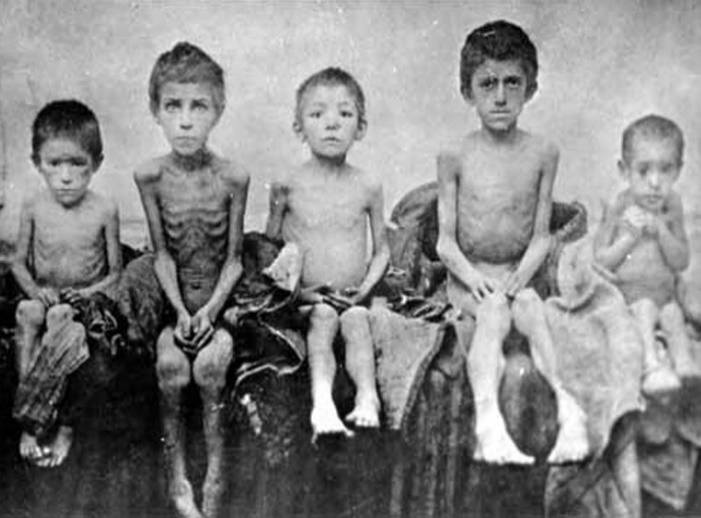
Victims of the Soviet famine of 1930-1933.
In the spring of 1933, the rural population of the black earth strip of the USSR was dying at a rate of 25,000 people a day. The land, which was known throughout the world as the breadbasket of Europe, was devastated by an artificial famine of unprecedented proportions.[157] It is now generally accepted that the Holodomor was “planned by Stalin and his executioners to teach independent Ukrainian farmers a lesson they will not forget.” … Moreover, he was supposed to deal a “crushing blow” to any national aspirations of the Ukrainian people, 80 percent of whom were peasant farmers,[158] and there are websites on this topic. While Stalin is the perfect scapegoat, and it is understandable that the famine was a deliberate policy of genocide that he applied against recalcitrant sections of the population, the devastation and suffering were so widespread that this argument loses its force. When Stalin set his sights on the annihilation of the population, he had no qualms about publicly suppressing even the most brutal policies. that he would destroy the kulaks and many of his other “enemies” without shame. Stalin would hardly have pursued a policy of extermination without announcing it arrogantly. The nature of his power was largely based on his strength. He was even praised for his ruthlessness. The deliberate murder of millions of people without clarifying the reasons was not Stalin’s modus operandi.
On the other hand, the role of American agricultural advisers was hidden. Accounting for the participation of American agromachinery firms in Stalin’s collectivization campaign suggests that the famine was not planned, but was the result of unregulated corporate greed, the inability of the so-called “free press” to do its job, and the use of Judasocratics[159] to govern countries in such a way that more powerful countries (or their largest firms) can take advantage of them.
Stalin’s policy of dekulakization had a significant negative impact on the production of grain and other agricultural products, destroying working farms, handing them over to people who had little experience in agricultural production, and leading to the destruction (sometimes deliberate) of both livestock and grain in order to prevent the state from seizing private property. But these actions were not enough to devastate vast regions of Soviet Russia with such large-scale famine that took place between 1930 and 1933. Drought was mentioned as another possible cause, but it did not affect all regions devastated by the famine, which covered thousands of miles. Drought was also not mentioned as the cause of any difficulties in agriculture in the “Review of the Soviet Union” until December 1931. This is important, because if there were a natural reason to explain the crop failures, it would be discussed in detail in this monthly publication of the Soviet Trade Mission. affecting agriculture, was in the May 1931 article “On the Front of Spring Sowing”, which said: “Although the delay of spring, which was almost a month behind the spring of last year, somewhat delayed the spring sowing campaign, there is no reason to believe that the plans to increase the sown area during the spring sowing of this year will not be fulfilled.”
The fact that the Soviet Union had purchased hundreds of thousands of tractors, combines, and other agricultural machinery from foreign firms (predominantly American and German) and relied on the productivity of these machines to successfully plow vast areas of virgin land after Russian peasants had been forbidden to use their horses, instantly created a dangerous dependence on foreign machinery. Foreign technology brought with it the methods of sowing, sowing and harvesting, which had to be imposed on Russian farmers. These new techniques were introduced by a team of American agricultural engineers in the form of an advisory board to the Grain Trust. These factors were never considered or even mentioned in connection with the catastrophic famine of 1930-1933. The fact that the American Advisory Council on Agriculture, which arrived in the Soviet Union in the spring of 1929, had already failed miserably in its repeated attempts at industrial agriculture in the United States since 1918, should have been a cause for concern for the Soviet regime. But this was never mentioned, despite the fact that there was a lot of evidence of problems faced on the farms in Montana that were run by partner J. Morgan Thomas Campbell, who was a leading adviser to Stalin in his collectivization campaign.
The sale of Russian grain to finance the purchase of foreign technology was nothing new
Russia has traditionally been the breadbasket of Europe, supplying most European countries with cheap grain to feed a growing population. But under the Reich Minister of Finance, Ivan Alekseevich Vishnegradsky, wheat was sold in increasing quantities to finance Russia’s purchases of foreign technology (especially American railway equipment), and this policy also led to a devastating famine in Russia. The famine of 1891-1892 began when the government raised taxes to force peasants to sell more grain to the government for export in the late 1890s. When, in the autumn of 1890 and the spring of 1891, after difficult weather conditions, the grain harvest was not as expected, the farmers and peasants, unaware of the fact that the government had contracts for the sale of vast quantities of grain abroad, relied on the fact that Russia was so vast and the weather so varied, that bad weather in one locality should not be fatal. And technically they were right. The summer of 1891 began in April and turned out to be long and dry. By July, yields were low, but grain exports continued in volumes contracted with foreign governments to pay off debts for the purchase of foreign technologies. With grain products disappearing from the countryside, and peasants and townspeople left without bread and grain, they were forced to slaughter livestock to reduce grain consumption and compensate for the lack of bread and cereals in their diets. Nevertheless, grain exports continued in accordance with the agreements on external contracts.
As the Russian people moved from famine to famine, the imperial government refused to use the word “famine,” instead calling it simply a bad harvest, a crop failure caused by bad weather conditions, and newspapers refrained from reporting on suffering.
Eventually, with more than half a million people dying in the streets, and after a month’s advance warning to merchants so that they could quickly export their reserves and capitalize on profits, the government decided to ban grain exports in mid-August. Finance Minister Ivan Vishnegradsky even opposed this late ban.[160] He was considered the main cause of the disaster, as his policy was to raise consumer taxes in an attempt to force peasants to sell more grain.[161] By the autumn of 1892, Russian grain exports had halved from 418,503,000 to 196,422,000 poods[162], and by 1893 they had risen again to 404,039,000 poods.[163] Cholera epidemics, caused by the weakness of the people during the famine, continued to kill for months after the famine ended. Only later did the causes of the tragedy become known, but the government continued to refuse to openly discuss the full range of causes.
The Soviet regime willingly followed the same disastrous grain policy pursued by Tsarist Russia, never pointing out the imperialist character and disastrous consequences. Why not expose this terrible policy, so much to do with foreign imperialism and the incompetence of tsarism? The younger Soviet generation not only did not realize the dangers of this policy, but also never knew the real reason for the jump in grain production on the part of their supposedly proletarian government. In complete disregard of historical precedents, Stalin accepted American, British, and German advice, credit, and technology, and put Russian agriculture on the path of industrialization, which, in the twelve years of experiments already carried out in the United States, had brought nothing but disaster.
It has been repeatedly asserted that “in the eyes of the Soviet leaders, Russian agriculture was a boundless ocean of small individual peasant farms with backward, medieval technology, in dire need of reform and modern equipment.”[164] However, as Stalin made clear in his December 1929 speech, he did not see the kulaks as backwardness, but as a huge threat to be “smashed.” Prior to collectivization, Russian farmers acted as their own agents and had considerable influence over grain prices, [165] leaving the Soviet government out of the economic equation and increasing their own power, which in a country of such size and with such resources, like Russia, could quickly challenge Western agricultural giants.
Those successful farmers who had bountiful crops and prosperous farms were considered enemies of the state because they competed for state property and could quickly develop into private farming on their own in the rich agricultural atmosphere that Russia’s vast land offered. These successful farmers have been, or will soon be, a threat to state ownership if left unregulated, or worse, will grow and become self-sustaining agribusinesses, as was the case with Russia’s previous oilmen, and threaten the shaky global dominance of Western agricultural leaders. The kulaks had to be eliminated before they became too powerful.
Stalin swore:
“The farmer must be collectivized in order to destroy his individualism, which is anti-communist. It must also be collectivized to increase its production. Its production should be increased so that more grain can be exported. It is necessary to export more grain so that more equipment can be bought. It is necessary to purchase more equipment so that industrial enterprises can start working. Industrial enterprises will increase the industrial population and at the same time provide machines for collective farms, in which the psychology of the industrial worker will be reproduced in the country. So logic works in a circle.”[166]
History unlearned He also runs in circles.[167]
Cover-up continues
When in 1932 a flood of starving people from the Caucasus, Ukraine, and the steppes of Kazakhstan (traditionally the richest agricultural regions) began to arrive in the cities, the Soviet authorities responded by requiring the use of passports for inter-republic travel and banning rail travel. Soviet internal passports were introduced on December 27, 1932. The rural population did not have the right to obtain passports and therefore could not leave their villages without permission. The right to issue passports belonged to the head of the collective farm, and identity documents were kept in the management of collective farms.
Article 58 of the Criminal Code of the RSFSR, which came into force on February 25, 1927 to prosecute those suspected of counter-revolutionary activities, was amended in April 1932, providing for theft on the railways and collective farm property and punishment with “maximum means of social protection, execution by firing squad or, in the presence of mitigating circumstances, imprisonment for a term of not less than ten years” with confiscation of all property. In addition, Regions that did not satisfactorily fulfill procurement plans stopped being supplied with goods. Mass arrests were carried out, as a result of which half of the local party secretaries in the North Caucasus and Ukraine were expelled. All grain without exception was exported, including seeds for next year’s plantings and fodder for livestock. Even the bread that had already been given to agricultural workers as payment for their working days was confiscated and taken away.[168],[169]
To confuse the widening gap between harvests and quotas, party officials began to inflate official grain volumes. While the grain harvest in 1932 barely reached 50 million tons, official government figures claimed that the harvest had reached 69.7 million tons.
Traditionally, the country’s most productive wheat belts — Ukraine, the North Caucasus (including the Don and Kuban), the Volga region, and the steppes of Kazakhstan — were hit by the worst famine Russia has ever known. At least 20 million people were condemned to starvation. The two most affected regions, Ukraine and the North Caucasus, had not only the largest tracts of fertile soil, but also the most favorable climate in the country.[170] According to Davis and Wheatcroft in the series “The Famine Years: Soviet Agriculture, 1931–1933, the Industrialization of Soviet Russia,” Soviet authorities were able to purchase only 4.3 million tons of the 1932 harvest, compared to 7.2 million tons from the 1931 harvest. when the official numbers were hidden. In 1964 the Soviet economist Malafeev admitted that Soviet state grain procurements in 1932 amounted to 18.5 million tons. In the same way, the number of deaths was confused. Officially, according to the workers’ press in the Soviet Union and the “free” press in the West, the tragedy did not exist. Walter Duranty, the Moscow bureau chief of the New York Times, who had been writing about the Soviet Union for fourteen years (1922–1936), was not an aspiring reporter. Nevertheless, for decades he had denied the existence of a three-year famine in the USSR. In 1932, Duranty won the Pulitzer Prize for a series of reports on the Soviet Union denying the existence of the famine, eleven of which were published in June 1931. in the midst of famine.[171]
Having won the Pulitzer Prize for covering the Soviet Union’s first five-year plan, Duranty was considered the leading Western expert on covering the famine. Duranty responded to reports of famine in Ukraine with his article “The Russians are starving, but they are not starving,” and while acknowledging that there was malnutrition in some areas of the USSR, Duranty argued that there was no famine. In Kazakhstan alone, there are now 7 million people.
On February 19, 1933, Stalin ordered the closure of Ukraine’s borders,[172] and the Pulitzer Prize-winning journalist Duranty said nothing. Moreover, the fact that Duranty did not mention the famine helped Franklin Roosevelt make the decision to diplomatically recognize the Soviet Union on November 16, 1933, and conclude a new trade agreement.
Former French Prime Minister Edouard Herriot, who toured Ukraine during his visit to the Soviet Union between August 26 and September 9, 1933, also denied reports of famine and said Soviet Ukraine was “like a garden in full bloom.”[173] Herriot announced to the press that he saw no trace of hunger and that allegations about millions of starving people were being spread by opponents of the Soviet Union. “When someone believes that Ukraine is devastated by hunger, let me shrug my shoulders,” he said. In the September 13, 1933 issue of Pravda, it was reported that Herriot “categorically contradicted the lies of the bourgeois press in connection with the famine in the USSR.”[174]
A month later, William Bullitt and Raymond Moley, assistant secretary of state and representative at the London Economic Conference, successfully negotiated with Soviet Foreign Commissioner Maxim Litvinov about selling Russian wheat on the world market[175] , while millions of Soviet citizens were dying of starvation.
The Soviet system worked at the limit of its capabilities
The rush to pay for American (and other foreign) equipment, technical assistance, materials, shipping, and supplies as part of the unprecedented spending of the First Five-Year Plan, combined with massive purchases of tractors and the reorganization of Russian agriculture under collectivization, pushed the Soviet Russian economy beyond its limits. The collapse of the U.S. stock market on September 29, 1929, and the subsequent depression in Western countries, led to a worldwide drop in commodity prices—the very goods on which the Soviet Union depended to pay for Western imports. As Knickerbocker noted in 1931, “the fact that the prices of everything Russia had to sell fell sharply, while the prices of the things she had to buy remained stable… Forced for the sake of the plan to maintain the import of machinery and industrial equipment at the level of the plan, it was forced to enormously increase its exports in size.” Moreover, the export of wheat and other inputs to Britain, Germany, the United States, and other countries involved in Soviet concessions was only a fraction of what it had just a few years earlier, when the system of concessions and collectivization was planned. The increase in resource exports led to a worldwide protest against Soviet dumping and further lowered the standard of living of the Soviet population.[176] and also led to one of the worst famines in history.
At a time when millions of Russians were suffering from starvation and the Soviet regime was facing a financial crisis, the early 1930s would have been the perfect time for the U.S. or the international community as a group to pressure Soviet Russia to abandon its communist ideology and join the “democratic” community of nations that the world press so often – and still does – lament. But such political/economic pressure has never been applied. Instead, the international community allowed Stalin to demand an increase in grain quotas in order to make timely payments to American and other foreign firms. In fact, it was only when the Soviets, in desperation, began demanding that the U.S. diplomatically recognize the Soviet Union in order to provide the government (taxpayer-funded) with credit for Soviet purchases of American goods and services, that the U.S. government actually did what the Soviets wanted.
According to Knickerbocker,
During this period, the Soviet Union suffered losses of probably 15 percent of its total foreign trade. … The prices that the Soviet Union received during this period for its exports, for almost all raw materials, fell by about 30 percent, while the prices it had to pay for its imports, about 65 percent for machinery and equipment, 35 percent for raw materials, fell by about 15 percent. … Of all the goods that the Soviet Union had to sell, only oil was kept at the level of 1928. Timber, which is now the leading Soviet export, decreased by 30 percent, Bread by 50 percent, Furs by 40 percent, and so on. All countries with predominant commodity exports have suffered the same price declines. But the big difference between these countries and the Soviet Union was that all the others reduced their exports during this loss-making period; only the Soviet Union increased it. It was the only one that had a five-year plan that forced it to maintain imports at the planned level, despite the fact that it was forced to export at a loss to do so. … The Soviet Union increased its imports in value terms by 17 percent, and for this it had to increase their volume by 57 percent.[177]
Under the terms of contracts signed with Western firms.
According to Melnikova-Reich, the Politburo resolution of August 29, 1930 emphasized that “the timely implementation of the mandatory grain quota is of vital importance for the industrial development of our country and, above all, for such industrial giants as Magnitostroi and Chelyabstroy.” The decree was preceded by a letter dated August 24 to V.M. Molotov from Stalin from his country house on the Black Sea, in which he wrote:
Every day we ship 1-1.5 million poods [16-24 thousand] of grain. I think that this is not enough. We must immediately raise the daily export quota to at least 3-4 million poods. Otherwise, we risk being left without our new metallurgical and machine-building plants… In short, we must accelerate grain exports at a breakneck pace.[178]
According to Melnikova-Reich:
On August 20, 1931, the secretary of the Central Committee of the CPC, I. M. Kaganovich, reported to Stalin about a skirmish during a meeting of the Politburo over payments for completed orders and the placement of new orders in the United States, and Stalin asked Stalin for instructions. He also reported that “the Germans easily agreed to a reduction in the interest rate because they were in dire need of our orders.” Stalin replied on August 25 with a telegram:
In view of currency difficulties and unacceptable credit conditions, I propose that new orders be prohibited in America, that all negotiations on new orders which have already begun be terminated, and, where possible, that contracts already agreed upon be terminated and that these contracts be transferred to Europe or to our own factories. I propose not to make exceptions, neither for Magnitostroi, nor for Kuznetsstroy, nor for Kharkovstroy, nor for Dneprostroy, nor for AMO, nor for Avtostroy.
Five days later, on August 25, 1931, Stalin wrote to Kaganovich:
The shortage of foreign currency is not the only problem. The main problem is that if we do not abandon new orders in America on the draconian credit terms that America practices, we may lose the preferential terms that we have secured in Germany, Italy and England (and will provide in France).
Kaganovich replied to Stalin on August 26:
We have received your telegram about orders in America. This resolved the differences even more radically than we thought. We immediately sent a telegram to America to stop all new orders. Tomorrow we will review the portfolio of orders and see which of them can be placed in Europe and which in the USSR.
When in September 1931 Kaganovich reported to Stalin that almost 90 percent of orders for Chelyabstroy could be received in England, the pendulum began to swing in the direction of European firms, not American ones.
According to Melnikova-Reich:
On March 25, 1931, Albert Kahn was in Moscow, negotiating the renewal of the contract, which officially ended on March 1. The negotiations broke down when the Soviets proposed that in the future payments be made not in dollars, but in rubles, which had no value outside the USSR. By 1932, the Soviet government stopped paying foreign firms and workers in hard currency, which led to an outflow of American specialists. On April 29, 1932, Kahn’s unit in Moscow ceased its work, and the personnel returned to America.[179]
The Soviet regime reached its financial limit when some 70 million Soviet citizens were subjected to artificial starvation, a direct result of the exploitation of the Soviet market by American firms.
Both Britain and Germany had trade treaties with the Soviet Union from 1921 and 1922 respectively, which provided state-backed (taxpayer) credit to finance the purchase of goods, services, and materials from their firms.
However, this commercial structure, which favored elite firms with the financial capacity to provide private short-term loans to the Soviet regime, not only allowed American firms to sell substandard products, but also forced the Soviet regime to make payments over a much longer period of time. shorter period of time than if they were provided with long-term government loans. This forced Stalin to sell so much of Russia’s resources (in this case, mostly grain) in order to raise the money in time, which exacerbated the grain shortage caused by faulty equipment and a poorly developed agronomic plan, and led to the starvation and death of millions of Soviet citizens.
This unbridled exploitation of the Soviet market, which led to the weakening of the Soviet government and the death and humiliation of nearly 50 percent of its population in the early 1930s, provided the West with an excellent opportunity to exert further financial and diplomatic pressure on the Soviet regime to insist on a more democratic and free Russian society. The U.S. government under President Franklin D. Roosevelt could have used this moment of crisis to pressure the Soviet regime to abandon its policies, allow its entrepreneurs to participate in its economy, and allow its citizens to finally choose their own type of government in the Constituent Assembly, which the Bolsheviks dissolved in January 1918.
However, this claim was never considered.
Rosengoltz Report
On April 23, 1933, in connection with the 15th anniversary of the Soviet monopoly of foreign trade over Russia, the People’s Commissar for Foreign Trade Arkady Pavlovich Rosengolts made a report on the topic “Foreign Trade Policy of the USSR… before the meeting of foreign trade workers of the USSR.” The report was published in the newspaper Izvestia on April 30 and published as an editorial in the June 1933 Review of the Soviet Union, a publication aimed at the elite of the American business community.
The report was an important milestone in Soviet foreign policy; not only by asking the U.S. government for loans to purchase from U.S. firms, which was not unusual, but also by threatening to cut purchases in the face of a continued lack of U.S. government-backed financial credit and a “normal legal framework for reciprocal trade relations” to ensure “lower prices and lower financing costs” and “improved quality of procured goods.”
This was the first time that the issue of a shortage of quality goods from the United States was raised. The report stated that “8,300,000,000 gold rubles ($4,275,000,1866)” of foreign goods had been imported into the Soviet Union since the Bolshevik takeover of Russia. This huge volume of trade made the Soviet Union an invaluable market for Western firms. “Soviet exports,” Rosengoltz continued, “which are the main source of covering the cost of imports, amounted to 7,200,000,000 rubles, leaving a balance of over a billion rubles,” which the USSR now owed to the leading trading countries—Germany, England, and the United States. Rosengoltz noted: “Some preliminary data give an idea of the cost of imported equipment [excluding technical assistance contracts] for a number of our industrial giants:
• Gorky Automobile Plant [Ford] — over 40 million rubles;
• Stalingrad Tractor Plant [International Harvester] — 35 million rubles;
• Dnipro Hydroelectric Power Plant [Colonel Hugh Cooper, General Electric, Newport News, et al.]— over 30 million rubles;
• the Stalin Automobile Plant (formerly Amo) [American Fiat] — almost 25 million rubles;
• Kaganovich Ball Bearing Plant (Moscow) (owned by Fiat/RIV USA) — more than 20 million rubles;
• Chelyabinsk Tractor Plant [Caterpillar] — 20 million rubles;
• Kharkov Tractor Plant [Ford] – almost 20 million rubles.”
Almost all of these factories were designed by the New York architectural firm of Albert Kahn and Ass., whose leading engineer was a member of the board of directors of the Soviet Architectural Trust.[180]
By November 16, 1933, the U.S. government had officially recognized the Soviet government. Shortly after the recognition was granted, the U.S. Treasury Department lifted restrictions on trade, and on February 2, 1934, the Export-Import Bank was established to finance Soviet purchases of American goods. While the U.S. Export-Import Bank claims that it did not provide loans to the USSR until decades later (during the Kama River truck plant project in 1972), once recognition was granted, the U.S. government was able to offer long-term loans for Soviet purchases of American products and prevent further fiascos, such as the devastating Soviet famine of the early 1930s. which could have destroyed the lucrative relationship between American firms and the Soviet government until 1991.
References
sites.rootsweb.com/~mtygf/county/campbell.htm (2001)
10. David M. Kennedy (1999), Freedom from Fear: The American People in the Depression and War 1929-1945, New York, Oxford University Press.
11. O.W. Sjogren, E.E. Brackett, K.W. Smith, F.R. Nohavetz (1921), Nebraska Tractor Act and Official Tractor Test Regulations, Nebraska Agricultural Experiment Station Historical Circulars 12. https://digitalcommons.unl.edu/hcnaes/12, University of Nebraska.
12. Andrew Miller (2018), “The Secret Genocide of Germany and Russia”, The Trumpet.
13. Sarah Moore (2007), How Hitler Came to Power, Author House.
14. H.R. Knickerbocker (1931), The Soviet Five-Year Plan and Its Impact on World Trade, London.
fred.stlouisfed.org/series/Q0896AUSQ240SNBR
15. Economy_of_the_Soviet_Union#/media/File:USSR_GDP_per_capita.png, 2018.
Knickerbocker, Soviet Five-Year Plan.
16. Grigor R. Suny (1998), Soviet Experiment Russia, the USSR and the Successor States. Oxford University Press. ISBN 978-0195081046. OCLC 434419149.
17. Oleg V. Khlevnyuk (2015), Stalin: A New Biography of the Dictator, London, Yale University Press.
18. Review of the Soviet Union (June 1930), “Yakovlev on the situation in agriculture”.
19. Review of the Soviet Union, “Review of the Situation in Agriculture”, April 1931, vol. IX, No 4. Soviet Information Bureau, Washington, DC.
20. “On the Socialist Plan of Land Organization and Measures for the Transition to Socialist Forms of Land Use”, Collected Laws, I9I9, No 4, Charter 44, Art. 29. Iz, Soviet State Farms I, 21. V. Ladezhinsky, Quarterly Journal of Political Science, vol. 53, No 1 (March 1938), pp. 60-82 https://doi.org/10.2307/2143604
22. “Tractors in the Soviet Union”, Review of the Soviet Union, February 1932.
23. William A. Williams (1952), American-Russian Relations, 1781-1947, Rinehart and Company.
24. Fred W. Carstensen (ed.) (1983), Entrepreneurship in Imperial Russia and the Soviet Union, Princeton Heritage Library, ISBN 9780691641386.
25. William E. Curtis (December 3, 1910), “Factory in Russia for the Manufacture of Chicago Equipment,” Chicago Record Herald.
26. Clarissa S. Ware (November 1, 1922), “In Russia with Western Pioneers,” The Survey,
27. Bruce Bliven (July 22, 1925), “Mr. Ware and the Peasants,” The New Republic.
28. Rosen’s obituary, https://www.jta.org/archive/dr-joseph-rosen-agro-joint-director-who-resettled-250000-jews-in-russia-dies-in-n-y
29. Allan Nevins and Frank E. Hill (1957), Ford, Expansion and Challenge, 1915-1933, New York.
30. Saul, G. Bron (1930), “Soviet Economic Development and American Business,” Horace Livewright, New York.
www.pjstar.com/story/business/2017/01/31/timeline-caterpillar-inc-through-years/22573825007/
31. In 1929 alone, about 6,000 tractors were purchased (Soviet Tractor Purchases, July 11, 1929, Farm Implement News, p. 14).
32. Letter from Paul Wilk, Advertising and Sales Promotion Department, Allis-Chalmers International, Milwaukee, Wisconsin, to Miss Charlotte Peasley, Science Digest, New York, (June 19, 1962).
33. Article “Allis-Chalmers Receives Large Order for Russian Tractor,” Farm Implement News, July 30, 1930.
34. Calvin B. Hoover (1931), Economic Life of Soviet Russia, New York.
Soviet Review (February 1930) “Spring sowing campaign”.
35. “Soviet Review” (May 1930), “Spring Sowing Campaign”.
36. “Review of the Soviet Union” (September-October 1930), “Agricultural Collectives”
37. H.R. Knickerbocker, (1931), The Soviet Five-Year Plan and Its Impact on World Trade, London: John Lane Bodeli Head Ltd.
38. Lement Harris (1978), Harold M. Ware (1890-1935): Pioneer of agriculture, USA and USA. 39. Periodical Bulletin No 30.
archive.org/details/HaroldWareAgriculturalPioneer/page/n23/mode/2u
39. Lement Harris, (1978) Harold M. Ware (1890-1935): Pioneer of agriculture, USA and USSR.
40. Deborah Fitzgerald (2003), “Every Farm is a Factory: An Industrial Ideal in American Agriculture,” (2003) Yale University Press. ISBN 0-300-08813-2.
41. Hiram Drache (1977), “Thomas D. Campbell: The Plough of the Plains”, Agricultural History.
42. Knickerbocker, H.R., The Soviet Five-Year Plan and Its Impact on World Trade, (1931) London.
43. Deborah Fitzgerald (Summer 1996), “Blinded by Technology: American Agriculture in the Soviet Union, 1928-1932,” Agricultural History, Volume 70, No 3, Duke University Press.
44. Fitzgerald, “Every Farm is a Factory“: (Harold M. Ware, M. L. Wilson, and Guy Riggin, “Preliminary Plan for the Organization of a Wheat Farm Demonstration Factory for the Camel North Caucasus Grain Trust, USSR,” February 1929, Box 10, File F-22, MLW.)
history.hanover.edu/courses/excerpts/111stalin.html
coldwarheartland.ku.edu/documents/foes-or-friends)
45. Alanna Demers, (2016), “They Kill Horses, Don’t They?”, Peasant Resistance and Horse Decline in Soviet Russia, Bowling Green State University Graduate College
46. Hiram Drache (1977), Thomas D. Campbell: The Plough of the Plains, Agricultural History.
47. D’Anne R. Prenner (1998), “Stalin and the Italian Woman of 1932-1933 in the Don Region”, Cahiers du Monde Russe.
48. Dana Dalrymple, “The Soviet Famine of 1932-1934,” Soviet Studies 15 (January 1964).
49. Review of the Soviet Union, “Review of the Situation in Agriculture”, April 1931, vol. IX, No 4. Information Bureau of the Soviet Union, Washington, DC.
50. M. Gerchikov (1930), “Results of the Development of the State Grain Farm”, On the Agrarian Front, No 5.
51. I. A. Yakovlev (July 12, 1930), Report before the XVI Congress of the CPSU. ” Economic Life” (Ladezhinsky, V.)
52. “Review of the Soviet Union” (May 1931)
53. On-line archive University of California,
https://oac.cdlib.org/findaid/ark:/13030/c8kw5j8v/admin/#did
54. Richard E. Bell (1961), A Comparison of Agriculture in the United States and the Soviet Union, Cornell University, ERS-Foreign_9.
55. Robert H. Frank and Ben S. Bernanke, (2007). Principles of Macroeconomics (3rd ed.). Boston: McGraw-Hill/Irwin. ISBN 978-0-07-319397-7.
56. Roger Lowenstein (January 14, 2015), “History Repeats Itself,” Wall Street Journal.
57. Willard, W. Cochrane (1958), Prices for Agriculture, Myth and Reality.
mediachecker.wordpress.com/2014/03/25/the-man-made-famine-genocide-in-soviet-ukraine-1932-1933-holodomor/
58. Orlando Figes (1996), People’s Tragedy: A History of the Russian Revolution, New York: Viking.
ru.wikipedia.org/wiki/Russian_famine_of_1891%E2%80%9392#cite_ref-A_People’s_Tragedy,_
59. Smith, S. A., Russia in the Revolution: Empire in Crisis, from 1890 to 1928, (2017) Oxford University Press, 0198734824
60. R. Davis and S. Wheatcroft (2004), “The Years of Famine: Soviet Agriculture, 1931–1933“
Industrialization of Soviet Russia, by Palgrave Macmillan
cla.umn.edu/chgs/holocaust-genocide-education/resource-guides/Holodomor
61. N. Werth, K. Bartoszek, J. Panne, J. Margolin, A. Paczkowski, S. Courtois, (1999), The Black Book of Communism: Crimes, Terror, Repression, Harvard University Press, ISBN 0-674-07608-7.
62. Zaltsman, Neil W., Reform and Revolution: The Life and Times of Raymond Robins (1991).
Knickerbocker, (1931).
63. Sonya Melnikova-Reich, “The Soviet Problem with Two ‘Unknowns’: How an American Architect and a Soviet Negotiator Gave Impetus to the Industrialization of Russia, Part I: Albert Kahn”, 64. Journal of the Society of Industrial Archaeology, vol. 36, No 2 (2010).
65. Anthony Sutton (1971), Western Technology and Soviet Economic Development, 1930-1945, Hoover Institution
archive.org/details/HaroldWareAgriculturalPioneer/page/n23/mode/2u ↑
https://oac.cdlib.org/findaid/ark:/13030/c8kw5j8v/admin/#did ↑