Articles that inspire and inform!
Publisher of POLIS LLC
Address: 190000, Saint Petersburg,
35/15 Kazanskaya Street
Publisher of POLIS LLC
Address: 190000, Saint Petersburg,
35/15 Kazanskaya Street

ISSN 3033-7666 (Print)
ISSN 3033-7674 (Online)
No 5, August 2025
CERTIFICATE OF THE FEDERAL SERVICE FOR SUPERVISION IN THE FIELD OF COMMUNICATIONS, INFORMATION TECHNOLOGY AND MASS COMMUNICATIONS (ROSKOMNADZOR)
El No FS77-87449
ELECTRONIC SCIENTIFIC PERIODICAL (ST. PETERSBURG, RUSSIA)
16+
The journal is registered and published in Russia
The journal publishes articles in all scientific fields
The journal is published in Russian and English
All articles are peer-reviewed
Free access to the electronic version of the journal
By sending an article to the editorial board, the Author confirms its uniqueness and bears full responsibility for it
Editorial staff
Editor-in-Chief
Vorontsov Vladimir Valentinovich
Managing Editor
Ivanov Maxim Dmitrievich
Executive Secretary
Kholmanskikh Maria Viktorovna
Reviewers
Pyrkh Andrey Ivanovich,
Ph.D., St. Petersburg State University
Dimitrienko Andrey Igorevich,
Ph.D., First St. Petersburg State Medical University named after Academician I.P. Pavlov
_____________________________________________________________________________
Contacts
 190031, Russia, St. Petersburg, Kazanskaya str., 35, lit. A, apt. 15
 +7 931 712-95-96
 nxxivek@inbox.ru
_____________________________________________________________________________
© Founder: Limited Liability Company “Polis” (OGRN 1097847170871)
190031, St. Petersburg, ext. Ter. Admiralteysky Municipal District, Kazanskaya St., 35, lit. A, apt. 15
Content
Contents
Kildeev Adel Khanyafievich. X.AI Corp. – X.AI LLC Lawsuits v. Xuechen Li and X.AI Corp. – X.AI LLC vs. OpenAI and Implications for the Artificial Intelligence Industry……………………………………………………………………………….3
Kildeev Adel. X.AI Corp. – X.AI LLC v. Xuechen Li Lawsuits and Xuechen Li and X.AI Corp. – X.AI LLC v. OpenAI Inc. and Implications for the Artificial Intelligence Industry…………………………………………………………………………………….3
Korablin Andrey Vladimirovich. Modern Theories of Conflict Resolution Institutions in Foreign Science……………………………….…………………….38
Korablin Andrey Vladimirovich. Moders Theories of Conflict Resolution Institutions in Foreign Science
………………….…………………………………………………………………..38
Kildeev Adel Khanyafievich. Raymond Robins: Servant of World Monopoly Capital ………………………………………………………….…………………..64
Kildeev Adel. Raymond Robins: Servant of World Monopoly Capital……………………………………………………………………..……….. 64
UDC: 347.73
X.AI CORP-X.AI LLC LAWSUITS V. XUECHEN LI
AND X.AI CORP-X.AI LLC VS. OPENAI
AND IMPLICATIONS FOR THE AI INDUSTRY[1]
Kildeev Adel Khanyafievich
Leningrad State University named after A.A. Zhdanov (1990)
PhD in Law
ORCID: 0009-0001-2211-4944
Abstract: The article analyzes two lawsuits: X.AI Corp.–X.AI LLC v. Xuechen Li and X.AI Corp.–X.AI LLC v. OpenAI Inc. Particular attention is paid to the position of the parties, the possible lines of defense of OpenAI, and the role of individual employees whose actions became the starting point of the proceedings. The relationship between the cases of Li and OpenAI, their potential evolution into the criminal law plane, as well as the consequences for the artificial intelligence industry as a whole are shown. The author concludes that these processes form a new legal landscape for AI regulation, where the issues of intellectual property protection, corporate responsibility and the balance between innovation and competition come to the fore.
Keywords: artificial intelligence; trade secret; litigation; intellectual property; X.AI; OpenAI; legal regulation; corporate responsibility; criminal liability, competition; USA.
When preparing the article, the author used generative AI systems, including, but not limited to: ChatGPT (OpenAI), Gemini (Google), Grok (xAI). All final decisions are made personally by the author
X.AI CORP-X.AI LLC V. XUECHEN LI LAWSUITS AND X.AI CORP-X.AI LLC V. OPENAI INC. AND IMPLICATIONS FOR THE AI INDUSTRY
Kildeev Adel
Zhdanov A. Leningrad State University (1990)
Philosophiæ Doctor in Law
ORCID: 0009-0001-2211-4944
Abstract: The article analyzes two lawsuits: X.AI Corp.–X.AI LLC v. Xuechen Li and X.AI Corp.–X.AI LLC v. OpenAI Inc. Particular attention is paid to the position of the parties, the possible lines of defense of OpenAI, and the roles of individual employees whose actions became the starting point of the proceedings. The relationship between the cases of Li and OpenAI, their potential evolution into the criminal law plane, as well as the consequences for the artificial intelligence industry as a whole are shown. The author concludes that these processes form a new legal landscape for AI regulation, where the issues of intellectual property protection, corporate responsibility and the balance between innovation and competition come to the fore.
Keywords: artificial intelligence; trade secret; litigation; intellectual property; X.AI; OpenAI; legal regulation; corporate responsibility; criminal liability; competition; USA.
When preparing the article, the author used generative AI systems, including, but not limited to: ChatGPT (OpenAI), Gemini (Google), Grok (xAI). All final decisions are made personally by the author
This article is a logical continuation of my previous articles: 1. “Artificial Intelligence as a human servant or vice versa: legal aspects”, published in the first issue of this journal (April 2025), 2. The Ethical Use of Artificial Intelligence: A Global Overview of Principles, Practices, Regulations and Implications”, published in the second issue of the same journal (May 2025). 3. “Artificial Intelligence and Copyright: Legal Aspects”, published in the third issue of the same journal (June 2025). The time for litigation has come.[2]
In a previous article, I detailed Disney and WBD’s lawsuits against Midjourney for copyright infringement and the lawsuit filed by the parents of teenage Raine v. OpenAI & Altman, who committed suicide. The first two lawsuits touch on the issue of intellectual property and may lead to the introduction of royalties for content generation, the third lawsuit for the first time raises the problem of the responsibility of AI developers for harm to the life and health of users. All three cases form a new legal framework for regulating artificial intelligence[3].
On August 28, 2025, Elon Musk’s startup companies X.AI and Corp. X.AI LLC. filed a lawsuit against the company’s former engineer, Xuechen Li, Ph.D., in the U.S. District Court for the Northern District of California in San Francisco (N.D. Cal., Case No 3:25-cv-07292).[4] This court case is one of the first judicial precedents in the field of protection of intellectual property rights to artificial intelligence technologies. The plaintiffs appealed to the federal court with a demand to prohibit the defendant, a Chinese citizen Xuechen Li, who is also a permanent resident of Canada and the United States, from using and distributing information that the plaintiffs qualified as a trade secret and intellectual property.
Given that Internet access to U.S. court records from Russia may be limited due to U.S. government sanctions and the importance of legal language to understanding a court case, here are excerpts from the X.AI lawsuit (translated by Microsoft translation service):
NATURE OF THE ACTION
1. This is a claim alleging that the defendant willfully and maliciously appropriated xAI’s confidential information and trade secrets pursuant to (18 U.S.C. § 1836 et seq.), as well as breach of contract, fraud, and violation of the Computer Data Access Fraud Act (California Penal Code § 502) (see Figure 1).
Plaintiff xAI and its technology
16. xAI entered the market in November 2023 and in two short years, thanks to extensive investments in human capital and technology, has become a leading company in the field of generative artificial intelligence. xAI’s vision is to improve human understanding and capabilities through its advanced artificial intelligence, including the generative AI model xAI Grok. Grok is an outstanding cutting-edge model that represents the cutting edge of AI research and development and pushes the boundaries of what AI can do in many areas. Competing with OpenAI’s ChatGPT, Google’s Gemini, and China’s DeepSeek, xAI’s newest release – Grok 4 – is one of the most, if not the most, advanced and powerful generative AI systems in the world, leading industry benchmarks in reasoning and pre-learning capabilities.
17. Grok 4 is the culmination of years of research and development, as well as billions of dollars in investment. These efforts required the collaboration of highly skilled teams of engineers, scientists, and others working to improve the current state of AI.
18. Grok is a conversational generative AI developed by xAI that is capable of performing a variety of functions, including (a) performing natural language processing tasks, including answering questions, extracting information, creative writing, and assisting with programming, (b) interpreting, editing, and generating images or videos in a variety of styles from whimsical to photorealistic, and (c) generating natural language audio responses in response to the user’s verbal prompts.
19. xAI operates in a fiercely competitive AI model space, with several key players developing cutting-edge AI systems. Direct domestic competitors of xAI include, among others, OpenAI’s ChatGPT, Google’s Gemini, and Anthropic’s Claude.
20. Experts predict that the market value of AI technology will exceed hundreds of billions of dollars this year and more than a trillion dollars by the end of the decade. Moreover, the development of advanced AI models can cost more than hundreds of millions of dollars. As such, maintaining maximum secrecy when developing AI models is crucial.
21. The trajectory of xAI is unprecedented. In just two years, it has delivered arguably the most advanced AI model in the world, including features more innovative and inventive than those offered by its competitors, including OpenAI. xAI innovations are protected by the confidential information and trade secrets of xAI.
22. Trade secrets protect almost all xAI developments — model weights, training data, tuning methods, system hints, know-how, and more. With xAI’s daily innovation advancements, its ability to rely on trade secret protection is critical not only to its competitiveness, but also to its day-to-day operations and the protection of investments in its technology.
Plaintiff xAI Protects Its Confidential Information and Trade Secrets
23. In order to maintain its competitiveness and protect confidential and proprietary information, including trade secrets, xAI has implemented various standard and industry-leading practices, such as: regular security training for all employees; conducting background checks on employees and contractors who may access xAI data; Provide training on secure data development and handling to employees who have access to sensitive data, followed by an assessment to demonstrate understanding. hiring an information security team; Adoption of the NIST 800-171 Rev.3 framework as the basis for internal security standards. achieving SOC 2 Type II compliance; Protect endpoints, including employee devices, with continuous patch maintenance and full disk encryption. and maintaining a formal written information security policy, among other things.
24. In addition, as a condition of employment, xAI requires each employee to enter into an Agreement on the Transfer of Confidential Information and Inventions (the “Agreement”) in the form set forth in Appendix A. The Agreement imposes explicit obligations on xAI employees in relation to Confidential Information. The Agreement defines “Confidential Information” as “any and all confidential knowledge, data, or information” owned by xAI, including most appropriately here:
(a) trade secrets, patented technologies, inventions, masks, ideas, processes, claims, software in source or object code, data, programs, other works of authorship, know-how, improvements, discoveries, developments, designs and methods, and any other work of any nature and all intellectual property rights (as defined below) therein (collectively, the “Inventions”), including all Company Inventions (as defined below); [and]
(g) any other non-public information that a competitor of the Company may use to the detriment of the Company’s competitive competitiveness. (Appendix A ¶ 1.2.)
25. Among other things, the Agreement:
a. Requires the employee to acknowledge that the employment “creates a relationship of trust and trust” with respect to xAI Confidential Information in respect of which the company “has a protected interest” (Appendix A ¶ 1.1);
b. Requires the employee to maintain confidentiality “during and after [
employee] work” and prohibits the disclosure, use, or publication of Confidential Information unless required for the employee’s job or expressly authorized by an xAI officer (ibid., ¶ 1.1);
c. Requires the employee, upon termination, to return “one and all” material containing or revealing Confidential Information, including documents, notes, and devices, together with all copies, as well as “any other material containing or revealing … Confidential Information”. (ibid., ¶ 8);
d. Requires an employee to provide xAI with a computer copy of any Confidential Information stored on personal devices or systems and to “permanently delete and erase” such information from those systems (ibid., ¶ 8);
26. By signing the Agreement, employees agree that “any threat or actual violation” of the Agreement “will constitute immediate and irreparable harm” to xAI. (Id. at ¶ 9.) They also agree that xAI may remedy these violations through injunctive relief, specific enforcement, or equitable relief without bail. (Ibid.)
27. By signing the Agreement, employees also agree that before leaving the company, they will complete and sign a “letter of resignation” from xAI, if requested by [xAI]. (Ibid.)
28. By signing the declaration of termination (“Termination Certificate”) in the form set out in Appendix B, employees confirm that they have complied with all the terms of the Agreement. (Exodus Q, p. 1.) Termination certification also requires departing employees to confirm that they have diligently searched for all xAI documents and returned them to the company. (Ibid.) It provides that “if [the staff member] has used any personal computer, server or electronic mail system to receive, store, view, prepare or transmit … Confidential Information, [employee] agrees to provide the Company with a computer copy of all such Confidential Information, and then permanently delete and delete such Confidential Information from these systems.” (Ibid.). To ensure compliance, the Certification requires the employee to “agree to grant [xAI] access to the [employee’s] system upon reasonable request to ensure that the necessary copying and/or deletion is completed.” (Ibid.).
Employment of the defendant in xAI
29. The Respondent is an experienced researcher in the AI community. He received his PhD in Computer Science from Stanford University in 2024 and is the author of numerous articles related to artificial intelligence published in various scientific journals.
30. On or about 26 February 2024, the Respondent started working at xAI as a member of the Technical Team. The defendant was part of the company’s original group of approximately 20 engineers.
31. The defendant’s responsibilities included the development and training of Grok, an advanced xAI artificial intelligence model. In this role, the responder had access to and responsibility for components throughout the xAI technology stack.
32. In order to carry out its official duties, xAI provided the Respondent with limited and controlled access to its confidential documents and proprietary information. xAI granted this access only for the purpose of enabling the defendant to perform his or her job duties.
33. As a condition for his employment and access to Confidential Information and Trade Secrets, xAI required the Respondent to sign the Agreement, which he signed on 26 February 2024. Appendix A.
34. xAI also granted the Respondent share and share options as part of its compensation package.
35. In order to provide liquidity to its employee shareholders, such as the Respondent, xAI facilitated the purchase of over USD 4.7 million worth of certain shares of the Defendant in June 2025. The defendant received the funds from this sale on July 23, 2025.
36. In an effort to obtain additional liquidity, the Respondent persuaded xAI to facilitate the purchase of more shares from it for an additional US$2.2 million in July 2025. xAI facilitated this transaction for the defendant because xAI valued his contributions and wanted to retain him as a productive and successful employee. The defendant received the funds from this sale on July 25, 2025.
37. In total, the defendant sold about $7 million worth of shares in his company.
The defendant stole confidential information and trade secrets of xAI
38. On 25 July 2025 – the same day it completed its second share sale and held millions in cash – the Respondent betrayed xAI’s trust and faith by intentionally and maliciously copying xAI’s Confidential Information (as defined in the Agreement) and trade secrets from its xAI-issued laptop into one or more physical or online storage systems not owned by xAI, under his personal control (collectively, the “Personal System”).
39. Trade secrets that the defendant has intentionally and maliciously misappropriated include, but are not limited to, advanced AI technologies with features superior to those offered by ChatGPT and other competing products.
40. Trade secrets that the defendant has intentionally and maliciously misappropriated can be exploited by competitors such as OpenAI, at a minimum, to improve competing products such as ChatGPT, with more innovative artificial intelligence and creative xAI features that make Grok one of the most, if not the most, intelligent AI models, undermine the xAI product roadmap, and disrupt its market expansion strategy.
41. Trade secrets that a defendant has intentionally and maliciously appropriated could save OpenAI and other competitors billions of dollars in R&D and years of engineering effort, giving any competitor a potential overwhelming advantage in the race to dominate the AI space.
42. The defendant took serious measures to conceal his illegal actions. It deleted browser history and system logs, renamed files, and compressed them before uploading them to its Personal System.
43. These facts are indisputable as the defendant, in the presence of his lawyer, admitted in the handwritten document he provided to xAI that he had misappropriated xAI’s confidential information and trade secrets and again, in the presence of his lawyer, orally admitted during personal meetings with xAI that he had been involved in such misappropriation and also admitted that he had tried to conceal his theft.
44. This misappropriated Confidential Information and trade secrets have independent economic value in the AI market. The data can be used by xAI competitors such as OpenAI and/or foreign entities to preempt xAI product offerings and market expansion, and to understand and use its current and in-development product features to strengthen proprietary AI models, thereby giving any competitor or organizations with access to data a potentially insurmountable competitive advantage in the AI race.
45. xAI has invested billions of dollars in the development of its intellectual property, including confidential information and trade secrets stolen by the defendant.
46. The Respondent had no legal grounds for copying the company’s data into its Personal System.
Departure of the defendant from xAI
47. On July 28, 2025, three days after uploading xAI’s data to its Personal System and selling approximately US$7 million worth of shares in its company, the defendant abruptly resigned.
48. Prior to its resignation, the Respondent accepted an offer to join xAI’s direct competitor OpenAI with a commencement date of 19 August 2025.
49. As part of the dismissal process from xAI, the Respondent signed the Deed of Dismissal on its last day of employment, 1 August 2025. A true and correct copy of the Act of Termination is attached hereto as Exhibit B.
50. In the Termination Act, the Respondent stated that it had complied with all the terms of the Agreement, which necessarily included its obligations to maintain the confidentiality and security of xAI’s Confidential Information, as well as its obligation to return any xAI Confidential Information in its possession, as well as its obligation to destroy any xAI’s Confidential Information that it downloaded or copied to another custodianship. (Exodus Q, p. 1.)
51. The Respondent also submitted in the Avoidance Act that it had returned all xAI documents, “including, but not limited to, Company files, notes, drawings, records, plans, forecasts, reports, studies, analyses, proposals, agreements, financial information, research and development information, sales and marketing information, customer lists, lead information, sales pipeline reports, sales reports, operational and personnel information, specifications, code, software, databases [and] computer-recorded information.” (Exodus Q, p. 1.)
52. He also stated that he had “conducted a thorough search to find any such documents, property and information” and reiterated his false promise to return and delete any such data, including files that he had uploaded to his Personal System. (Exodus Q, p. 1.)
53. Each of these statements was patently false. Not only did the defendant know that it had not returned or destroy the xAI documents, property, and information in its possession, but it also brazenly absconded with xAI’s confidential information and trade secrets by uploading them to its personal system.
54. The defendant did not simply misrepresent its past compliance in the Avoidance Act. He also falsely promised to protect xAI’s sensitive information in the future while hiding from it. He falsely promised to “keep secret and [] not to disclose, use or publish any confidential company information.” (Exodus Q, p. 1.)
55. He also breached his promise in the Certificate of Avoidance that if he had “used any personal computer, server or email system to receive, store, view, prepare or transmit any information [xAI], including but not limited to Confidential Information, [he] would have provided [xAI] with a computer copy of all such Confidential Information and then permanently delete and delete such Confidential Information from those systems”.
56. And he also reneged on his promise to provide xAI with “access to [its] system pursuant to a reasonable request to ensure that the necessary copying and/or deletion is completed.” (Exodus Q, p. 1.)
57. The defendant never complied with these misguided obligations, but used them to lull xAI’s vigilance into a false sense of security to give it a chance to conceal that it had stolen xAI’s confidential information.
58. In particular, when the Respondent signed the Termination Act, it (1) retained xAI’s Confidential Information in its Personal System while engaging in merger negotiations with the ChatGPT OpenAI manufacturer, a competitor of xAI, and (2) never deleted or made complete of the Confidential Information.
The personal system is available to xAI.
59. The Respondent made false promises in the Termination Act by intentionally deceiving and deceiving xAI, and induced xAI to allow him to leave without any further investigation of his conduct or taking additional steps to protect his Confidential Information, all as part of his plan to breach his obligations to his employer and subsequently cover his tracks.
60. The defendant’s fraudulent scheme worked. Because of the faith and trust that Respondent had as one of xAI’s first employees, xAI reasonably relied on the Respondent’s assurances in the Certificate of Dismissal.
61. xAI has suffered and will continue to suffer due to the Respondent’s actions, including the reduction in the value of its trade secrets, loss of competitive advantage, loss of business and damage to its reputation and goodwill.
xAI discovered the theft of its confidential information by the defendant
62. The Defendant took positive steps to conceal its data breach, xAI discovered the Defendant’s theft of its confidential information and trade secrets on August 11, 2025, during a routine review of the logs of security software designed to detect and prevent data breaches.
63. On the same day, xAI sent a request letter to the defendant by e-mail regarding the theft of company data. The letter to the Respondent stated that xAI had learned that the Respondent had “transferred xAI’s confidential data” to its Personal System in violation of “xAI’s policies and practices, which constitutes a flagrant violation of its legal and contractual obligations to xAI.”
64. xAI’s letter contained a request to return and delete the data. It also requested that the defendant provide a detailed written description of the misappropriated data, a copy of any data still stored in its Personal System, and access to its Personal System. The letter also requested written confirmation as to whether the respondent had made any unauthorized disclosure or use of xAI’s confidential, proprietary or commercial information, and if so, details of such use or disclosure.
65. Instead of immediately providing the requested information, the defendant hired a criminal lawyer and then invited his criminal lawyer to meet with xAI in an attempt to persuade him to avoid consequences for theft.
66. At this face-to-face meeting on August 14, 2025, and a subsequent face-to-face meeting on August 15, 2025, both at the offices of Winston & Strawn, LLP at 255 Shoreline Drive, Suite 520, Redwood City, CA 94065, the defendant, in the presence of his criminal defense attorney, confessed to intentionally seizing xAI files and covering his tracks by deleting his system logs. Rename files and compress them before uploading. He also admitted that he understands the seriousness of his actions. He also provided a handwritten statement with these confessions.
67. During the few days of negotiations between 14 August 2025 and 18 August 2025, the accused, fully represented by the criminal defence as well as the labour lawyer, engaged in even more false assurances, fraud and deception.
68. Following two face-to-face negotiations on Thursday and Friday, 14-15 August 2025, and further negotiations over the weekend, during part of which the Respondent allowed xAI to possess (but not access) two of his personal laptops and his personal mobile phone “as a demonstration of good faith”, on Monday, 18 August 2025, the Respondent once again fraudulently entered into a contract with xAI, this time, “Authorization for Access to Accounts and Personal Devices” (“Authorization”).
69. In this Permission, the Respondent authorized “a forensic investigator or expert firm(s) retained by x.AI and/or Winston & Strawn (the “Expert”) to create a judicial image or copy of the Data in [Respondent’s] Account and on [Respondent’s] Devices for the purposes of investigating [Respondent’s] access, possession, and/or transmission of xAI information, including Related Data.” In the Permission, “Relevant Data” is defined as: “(i) Confidential Information, as defined in the Employee Confidential Information and Inventions Transfer Agreement entered into on February 26, 2024, and (ii) any messages, correspondence, notes, data, records, files, or documents – regardless of form or medium – relating to xAI, xAI competitors, artificial intelligence (“AI”), large language models (“LLMs”), or [Respondent’s] general business, that otherwise do not constitute Confidential Information.”
“Data” was broadly defined as “all information located or stored in an Account or on Devices, and any forensic files or artifacts located in an Account or on a Device, regardless of the file type, content, or format of the information, and including Relevant Data, Personal Data, and any information derived from or related to such data.” including, but not limited to, metadata, logs, system attributes, and any other embedded or related information elements.” And “Account” has been defined as including all other online Li accounts associated with Xuechen Li, including accounts associated with each of the “multiple provided” email addresses of “Xuechen Li” and “related services”.
70. The Permission also provides that Li “understands and agrees that, in connection with the purposes set forth in this Permission, xAI will search for the Data, Account and Devices to search for xAI information, including Relevant Data, and evidence of access, possession and/or transfer of xAI information.”
71. The authorization also provided that if xAI discovers its Confidential Information on any of the Respondent’s devices or in any of the Respondent’s accounts, xAI will be “authorized… delete this Confidential Information from the Account and/or Devices.”
72. In the Authorization, the Respondent stated that it was providing “passwords, credentials, keys, multi-factor authentication information, and other information necessary for full access to [its] Accounts, Devices, and files,” which it agreed “not to change until September 15, 2025 (or such date as xAI completes all forensic investigations […] if later).” “Access” has been defined broadly and includes: “any access of any kind, including: (i) reading, viewing, editing, examining;
(ii) copying (including making a judicial copy); (iii) disclosure, transfer or distribution (but only to the extent necessary to achieve the purpose of this Agreement and subject to any restrictions set forth herein); or (iv) performance”.
73. Relying on the Respondent’s compliance with the Authorization and the appearance of cooperation, xAI refrained at that time from bringing this claim and seeking other extraordinary legal remedies.
74. After the Respondent returned the signed Permission, xAI discovered that the credentials provided by the Respondent in the Permission did not include the password (which was changed by the Respondent on August 11, 2025, after it received a demand letter from xAI) for the critical account to which the Respondent had uploaded xAI’s Confidential Information and Trade Secrets, violating the very purpose of the Permission. which was to allow xAI to “investigate [the defendant’s] access, possession, and/or transmission of xAI information, including relevant data.”
75. In conducting a forensic analysis of the information that could be accessed on the Li’s personal devices provided by xAI, xAI also found that the defendant had a number of other accounts that it did not even disclose, let alone provide passwords, including accounts to which it had uploaded xAI material. This included other accounts with xAI information, including potentially sensitive information.
76. After xAI confronted the defendant about these missed accounts and credentials, the defendant’s attorney simply replied that the defendant did not “remember” the password for the critical account he had changed just seven days ago, nor did he “remember” other accounts even though he had used them recently.
77. Given the ongoing fraud and deception on the part of the Respondent, xAI had no choice but to urgently file a lawsuit to protect its property interests in respect of the Confidential Information and trade secrets misappropriated by the Respondent.”[5]
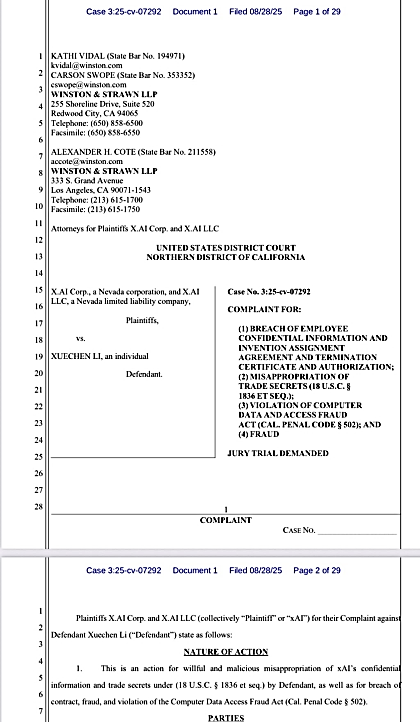
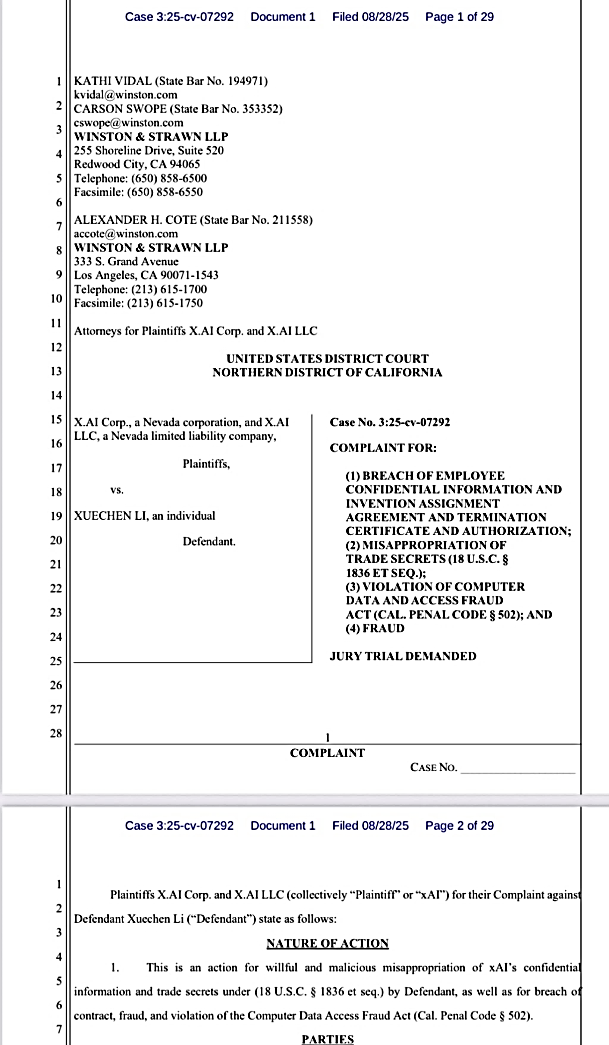
Figure 1. First pages of the statement of claim
LEGAL GROUNDS OF ACTION
CLAIMS
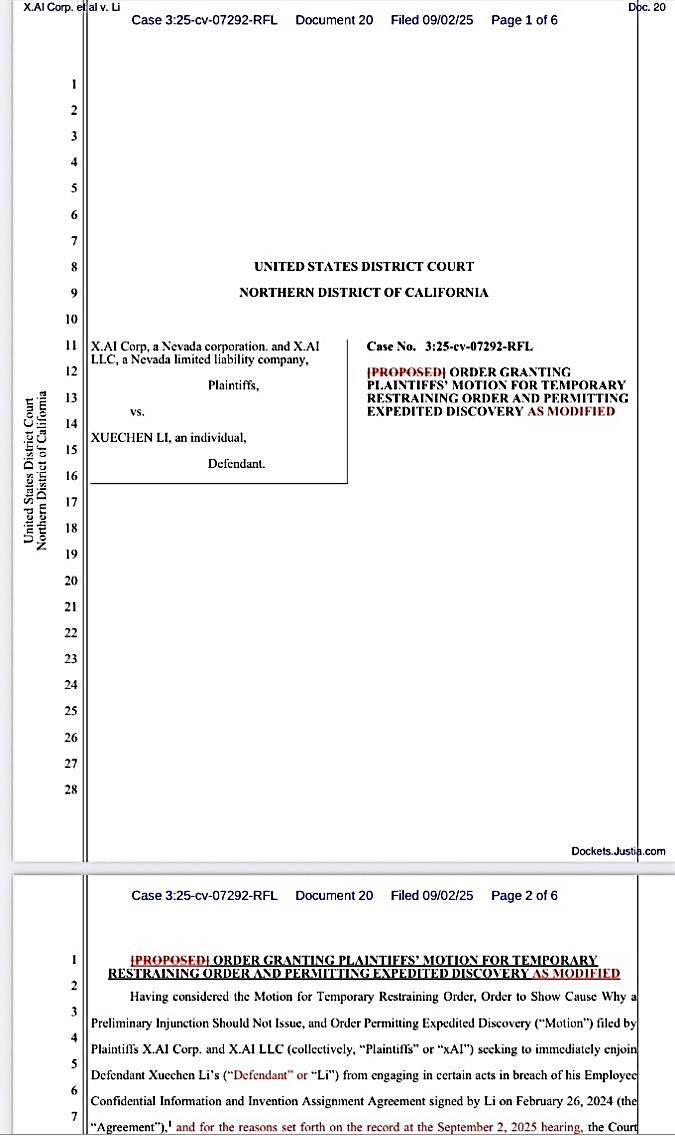
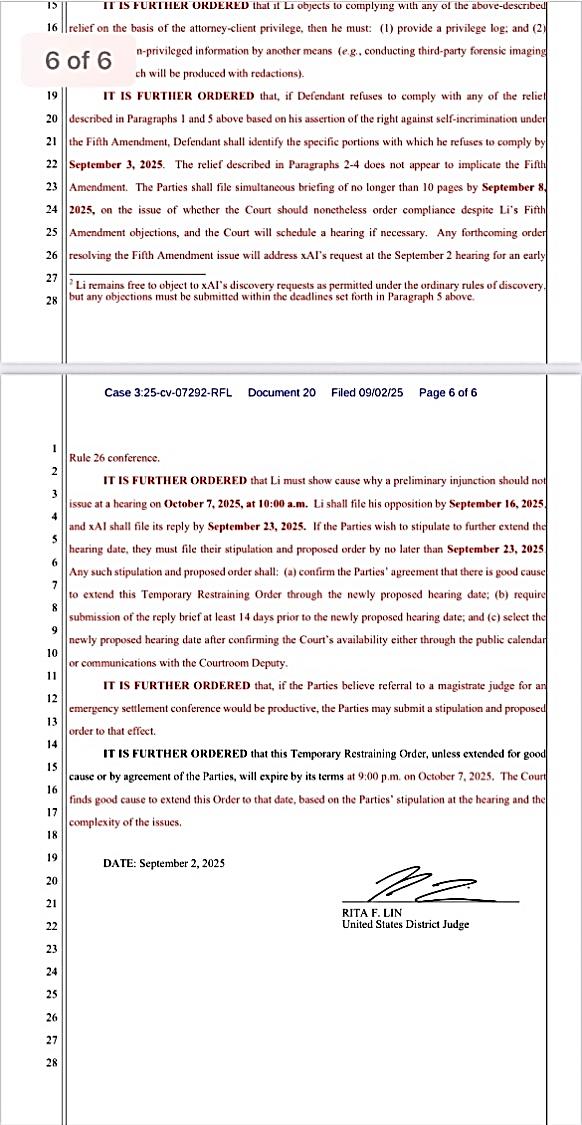
Figure 2. The first and last pages of the court order
Plaintiff xAI applied to the same court for a TRO-temporary restraining order to immediately restrict Lee from accessing, disseminating, and using sensitive information and transferring or discussing generative AI-related technologies with OpenAI or other competitors until XAI certifies that all information in his possession has been destroyed. On September 4, 2025, District Court Judge Rita F. Lin granted the motion (see Figure 2).
Given the importance of the details of the court ruling, here is the full text (translated by Microsoft translation service):
DECISION TO SATISFY THE PLAINTIFFS’ PETITION FOR TEMPORARY
RESTRAINING ORDER AND EXPEDITED DISCLOSURE AUTHORIZATION, AS AMENDED
Having considered the Request for Temporary Restraining Order, the Order Giving Reasons Why Preliminary Injunctive Relief Should Not Be Granted, and the Order to Allow Expedited Disclosure (the “Petition”) filed by Plaintiffs X.AI Corp. and X.AI LLC (collectively, the “Plaintiffs” or “xAI”) seeking to immediately prohibit Respondent Xuechen Li (“Respondent” or “Li”) from engaging in certain acts in violation of its Confidential Information Transfer Agreement Employees and Inventions, signed by Lee on February 26, 2024 (the “Agreement”), and for the reasons set out in the minutes at the hearing on September 2, 2025, the Court considers that the evidence establishes the elements necessary for the issuance of a temporary restraining order and a compelling reason for allowing expedited disclosure.
Accordingly, the Court hereby GRANTS xAI’s request and ORDERS the following damages:
1. Within three working days from the date of issuance of this Order:
a. temporarily relinquish control and access (for up to 14 days to allow forensics to identify, correct, and/or delete xAI’s Confidential Information) to any personal electronic devices (e.g., cellular devices, devices, computers), online storage (e.g., Gmail, Google Drive, iCloud), or other electronic storage devices currently available or in Lee’s possession, storage or control, but he can purchase new devices and create new accounts in the future, provided that nothing is moved there from his existing devices and accounts;
b. return to xAI, through its authorized attorney, all Confidential Information belonging to xAI that is currently in Lee’s possession, custody or control, which exists in any physical form (e.g., notebook, paper files);
c. provide a written statement identifying all personal locations, personal devices, personal accounts, or personal media – physical or electronic – where any Confidential Information belonging to xAI is stored, maintained or accessed;
d. provide, and not modify, within the 14-day period referred to in paragraph (a) above, passwords, credentials, keys, MultiFactor Authentication information, and other information necessary for full access to all devices, repositories, storage media, and accounts listed in paragraph (a); and
e. for any passwords or credentials listed in connection with (a) that the Respondent alleges it has forgotten or is unsure how to easily access, cooperate and work with xAI to reset or recover them and/or otherwise cooperate with xAI as necessary to provide xAI with access to such accounts and devices listed in paragraph (a).
2. Lee, its agents, employees, partners and any other persons acting jointly with or on its behalf are hereby prohibited from:
a. controlling, logging in, or otherwise accessing (except as provided in paragraph 1(e) above) any personal electronic devices (e.g., cellular devices, computers), online storage (e.g., Gmail, Google Drive, iCloud), or other electronic storage devices that are currently available to Respondent or in the possession, custody, or control of Respondent, but may purchase new devices and create new accounts in the future, as long as nothing moves there from his existing devices and accounts;
b. own, use, copy, reproduce, disclose, transfer (including to a third party), distribute or otherwise exploit any Confidential Information (as defined in the Agreement), including xAI files uploaded to its Personal System and any copies, derivatives or materials derived therefrom;
c. destroy, delete, alter, modify or otherwise remove any version (whether paper, native or electronic) of any documents or information stored electronically on any device or account (whether in hard copy or downloaded to any remote storage system, computer, hard drive, server, disk, flash drive, cell phone, CD, DVD, USB drive or any other device, which may be used for electronic storage of data or information) relating to Privacy . Information;
d. dispose, delete, alter, alter, erase, falsify, or destroy any remote storage systems (including cloud storage accounts), computers, hard drives, servers, drives, flash drives, cell phones, CDs, DVDs, USB drives, and any other device that can be used to electronically store data or information that (a) is currently available to or in the possession of the Respondent, guardianship or control; or (b) has been accessed by or in the possession, custody, or control of the Respondent since February 26, 2024, or any data, files, information, forensic remnants, or digital artifacts stored on or within the device;
e. destroy, delete, alter, modify, or otherwise delete any emails sent to or from any email accounts used by the Respondent on or after February 26, 2024, whether in hard copy or downloaded to any computers, laptops, online storage, cloud storage, or electronic storage devices; destroying, deleting, altering, altering, or otherwise deleting any text, electronic publications, or other application messages from any cell phones or devices, computers, laptops, online storage repositories, cloud storage, or electronic storage devices (a) currently available to Respondent or in the possession, custody, or control; or (b) has been available to the Respondent or has been in the possession, custody or control of the Respondent since 26 February 2024; and
g. Breaching, aiding or abetting in breach of any of the terms of the Agreement or the Termination Certificate, as detailed in the Complaint;
3. Lee is hereby prohibited from playing any role or liability in OpenAI or any other xAI competitor relating to generative AI, including but not limited to OpenAI’s ChatGPT, until xAI certifies that all xAI Confidential Information in Lee’s possession, custody or control has been destroyed.
4. Lee is hereby prohibited from making any contact on the subject of generative AI with any officer, director, employee, agent, supplier, consultant or client of OpenAI or any other competitor of xAI until xAI certifies that all xAI Confidential Information in Lee’s possession, custody or control has been deleted.
5. xAI is granted permission to immediately submit an expedited disclosure under a preliminary injunction in this court as follows, and Lee is directed to respond and execute such disclosure as follows:
Lee shall respond to the first set of xAI interviews (attached hereto as Appendix A) under oath within seven days of the effective date of this Order;
b. Lee shall respond to and execute the First Set of xAI Manufacturing Requests (attached to this Exhibit B) within seven days of the effective date of this Order; and
c. Lee shall appear to testify at a time and place mutually agreed upon by the parties, but no later than ten (10) days from the effective date of this Order.
FURTHER RESOLVED, that the accounts and devices subject to the foregoing provisions shall be limited to those accounts and devices that Lee created or accessed on or after the date on which he began working in xAI.
FURTHER RESOLVED, that if Lee objects to any of the foregoing attorney-client privilege remedies, he shall: (1) provide a privilege log; and (2) obtain non-privileged information by other means (e.g., by conducting an independent forensic examination of the devices to be produced through editing).
FURTHER RESOLVED, that if the Respondent refuses to exercise any of the remedies described in paragraphs 1 and 5 above based on its claim of the right not to incriminate itself under the Fifth Amendment, the Respondent shall specify the specific portions it refuses to comply with by September 3, 2025. The judicial protection described in paragraphs 2-4 does not appear to imply the Fifth Amendment. The parties will submit a concurrent briefing of no more than 10 pages, 2025, by Sept. 8 on whether the court should nevertheless issue a compliance order despite Lee’s objections to the Fifth Amendment, and the court will schedule a hearing if necessary. Any pending order addressing the issue of the Fifth Amendment will be considered by xAI’s request at a hearing on September 2 to hold a Rule 26 conference as soon as possible.
FURTHER ORDERED that Lee shall present reasons why a preliminary injunction should not be issued at the hearing on October 7, 2025 at 10:00 a.m. Lee will file its objection by September 16, 2025, and xAI will submit its response by September 23, 2025. If the parties wish to negotiate a further extension of the date of the hearing, they must submit their application and the proposed ruling no later than September 23, 2025.
Any such condition and proposed order must: (a) confirm the agreement of the Parties that there are good reasons for extending this Temporary Restraining Order until the newly proposed date of hearing; (b) require the filing of a brief in reply at least 14 days before the newly proposed date of the hearing; and (c) select a new proposed hearing date upon confirmation of the Court’s availability, either through the public calendar or in communication with the courtroom deputy.
FURTHER DECIDE that, if the Parties consider that recourse to a justice of the peace for an emergency resolution conference would be productive, the Parties may submit a reservation and a proposed ruling on the matter.
FURTHER AGREE that this Temporary Restraining Order, unless extended for good cause or by agreement of the Parties, will expire in accordance with its terms at 9:00 p.m. on October 7, 2025. The Court finds compelling reasons for extending this order to that date, based on the parties’ reservations at the hearings and the complexity of the issues.
DATE: September 2, 2025
RITA F. LIN
U.S. District Judge[6]
Judge Rita F. Lin not only approved the draft order prepared by the plaintiffs’ attorneys, but edited it in detail, introducing time and content restrictions (14-day limit, admission of new accounts, filters by date and privilege, procedure in the event of the 5th Amendment), while maintaining a hard core of prohibitions (work/communication in generative AI until confirmation of the complete deletion of confidential information).
I would like to note the unusualness of the measure. The debate around AI has so far been dominated by civil trade secret lawsuits without such a broad TRO, effectively restricting work activities and even personal communications on the topic of generative AI at a new employer. This is also described by Reuters reports, emphasizing that the order prohibits the work and discussion of technologies in OpenAI until the dispute is resolved on the merits.[7]
Disputes about “code/weights/datasets leakage” in AI are more typical of the usual civil law route (TRO and then preliminary injunction) or parallel criminal investigations into theft and computer fraud. In the same case, the emphasis is on civil TRO as an emergency measure to protect trade secrets, and with atypical broad restrictions, which makes the court order a rare precedent in the context of AI. Legal scholars write about the same thing: the escalation of disputes about AI is pushing the courts to new forms of protection of trade secrets that go beyond the usual wording.
Comparative Analysis: Conclusions of Professor Camilla A. Hrdy and the Case X.AI v.Li
Professor Camilla A. Hrdy[8], in her article “Trade Secrecy Meets Generative AI”, writes: “Generative AI models such as ChatGPT raise new questions for trade secret legislation.
First, the widespread use of generative AI poses new risks to companies’ existing trade secrets. For example, the in-house employees of trade secret owners may accidentally share trade secrets using a generative AI tool such as ChatGPT, which can distribute this information to competitors or third parties. But companies are likely to adapt their risk management strategies, as they did in the face of older information dissemination technologies such as the Internet.
Second, generative AI will enrich the universe of information that can be protected under trade secret law. The trade secret law will be available even for information that is not protected by patent and copyright law. Patent law and copyright law impose requirements on the human creator. But the law on trade secrets does not require a human creator. Thus, results created solely by artificial intelligence that are not subject to patent or copyright protection can be protected as trade secrets.
Third, companies that develop valuable new generative AI tools will be able to rely on trade secrets to protect the technology, even when other forms of IP are not available. Trade secret law, especially when supplemented by restrictive contractual “terms of use,” can protect various types of generative AI-related information, including information that does not comply with copyright or patent protection requirements. While generative AI models would initially benefit from a combination of trade secrets and contract protection, these models are highly vulnerable to “reverse engineering.” For example, OpenAI, the creator of ChatGPT, recently accused the creators of the new “DeepSeek” AI model of “distilling knowledge” to develop their rival system, using the larger, more complex, and more expensive ChatGPT model to create a smaller, simpler, and cheaper model. The Trade Secret Act, while generally permitting reverse engineering, cannot condone such behavior. Courts may interpret these actions as a breach of contract law, as the distillation of knowledge appears to violate OpenAI’s contractual terms of use; In addition, the courts may regard these actions as a violation of federal and state law on trade secrets. In software cases, courts have held that the use of best practices, such as data collection, to access trade secrets constitutes acquisition by “improper means” and therefore misappropriation, especially when contractual terms of use expressly prohibit such conduct. The creators of DeepSeek claim that they independently developed their model, but if this is not the case, the trade secret law may provide an opportunity for legal liability.” [9]
Case X.AI v. v. Li is a vivid illustration of the problems indicated by Professor Hrdy and their comparison allows us to identify a number of patterns.
Thus, an analysis of Professor Hrdy’s findings in comparison with X.AI v. Li demonstrates that trade secret law is undergoing a profound transformation, and classical doctrines need to be revised in light of the challenges posed by generative artificial intelligence.
The position of the Lee defense: analysis and criticism
1. One-sided emphasis on criminal and labor law.
Ms. Li’s defense was organized by two lawyers specializing in criminal law and labor relations, respectively. At the same time, there was no specialist in civil law and civil procedure. Such a distribution of resources was initially erroneous: disputes over trade secrets and violation of NDA obligations are considered primarily in the civil law plane. The absence of a professional in this area deprived the defense of the main tool – the argumentation against the claim of the X.AI.
2. Participation in a meeting with the plaintiff’s lawyers.
An extremely atypical situation is recorded: Lee’s lawyers took part in a meeting with representatives of the X.AI, essentially agreeing with the framework proposed by the plaintiff. As a result, this meeting turned not into negotiations, but into a protocol registration of concessions. Instead of protecting the interests of the client, the position of the corporation was actually legitimized.
3. Full admission of guilt in writing.
In the most fatal step, Li’s lawyers insisted on signing a written acknowledgment of the breach of obligations and the use of the company’s materials. Such a document not only deprived Lee of the opportunity for further defense, but also became direct evidence in the hands of the plaintiff. In a procedural sense, this was tantamount to capitulation even before the start of the trial.
4. Erroneous “removal of responsibility” from lawyers.
In fact, the defense “washed its hands of it”: the actions of the lawyers reduced the case to a mechanical confession, opened access to Li’s personal devices and e-mail, and thereby strengthened the position of the X.AI. Such behavior can be qualified as blatant professional negligence and/or incompetence.
5. The result is defeat before the start of the process.
As a result of the chosen strategy, Lee lost the opportunity to build a defense on the merits: to challenge the concept of “leakage through training”, to refer to the freedom of labor and the right to use general professional skills. His situation turned out to be similar to a number of high-profile cases in other jurisdictions (for example, the case of actor Mikhail Efremov in Russia, where the poor quality of the work of lawyer Pashayev (who was later deprived of the status of a lawyer and convicted of criminal offenses) led to the most difficult outcome.
CRIMINAL LAW ASPECT AND FEDERAL JURISDICTION
Certain actions that go beyond the scope of a civil dispute may result in criminal prosecution under U.S. federal law. Depending on the actual circumstances, the following may be involved in the assessment, in particular:
These offences involve specific intent, factual causation, and other elements (including interstate or international communications). If there are signs of industrial espionage, it is a matter of federal jurisdiction, and the investigation is usually conducted by the FBI under the guidance of the U.S. Department of Justice. In such a situation, in addition to civil consequences, searches, seizure of equipment, summons to a federal grand jury and significant sanctions (fines, confiscation, imprisonment) are possible.
FINDINGS
X.AI LAWSUIT AGAINST OPENAI: BATTLE OF THE AI COLOSSI
This article has already been sent to the editors of the magazine, but on September 24, 2025, Elon Musk’s startup companies X.AI and Corp. X.AI LLC. filed a second lawsuit against Sam Altman’s AI company OPENAI in the Federal District Court for the Northern District of California in San Francisco (N.D. Cal., case No 3:25-cv-08133).[10] The plaintiffs allege that OpenAI “organized a systematic campaign to poach xAI employees with access to Grok’s source code, data center architecture, and research developments.” The plaintiffs claim that OpenAI gained an “unfair competitive advantage” by using illegally extracted secrets. The plaintiffs are represented by the same law firm, Winston & Strawn LLP, as in X.AI v. Li.
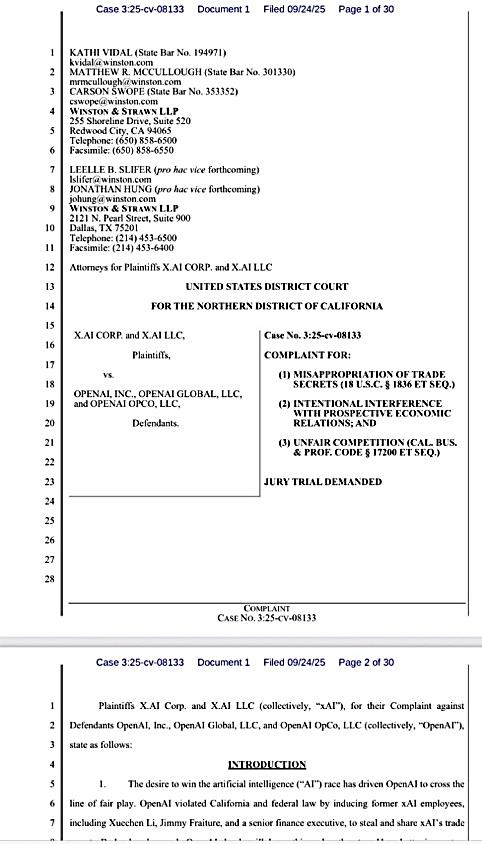
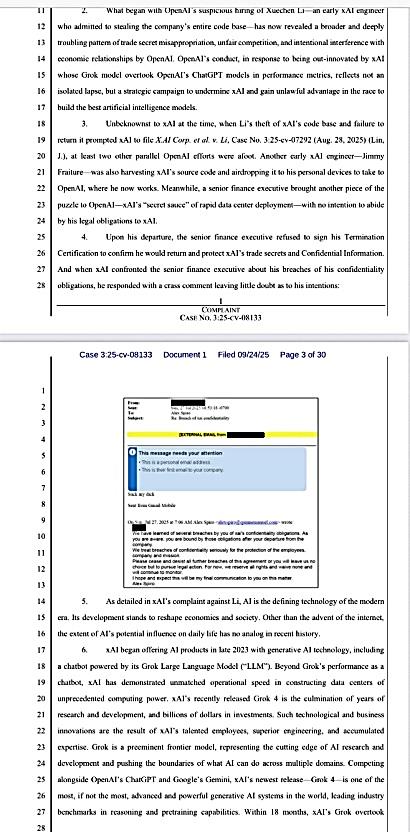
Figure 3. The first pages of xAI’s lawsuit against OpenAI
Given again that Internet access to U.S. court records from Russia may be limited due to U.S. government sanctions and the importance of legal language to understanding the case, here are excerpts from X.AI’s lawsuit against OpenAI:
« INTRODUCTION
7. xAI is known for its innovations. It offers more innovative and creative features than those offered by its competitors, including OpenAI.
8. OpenAI, on the other hand, raised significant sums of money in the years or so before the creation of xAI and quickly rose to dominance among generative AI companies, simply becoming a “pioneer” with the release of its consumer-accessible ChatGPT service in 2022. Threatened by the innovativeness and creativity of the xAI code (partially developed and then stolen by Lee and Fraitour) and the unprecedented speed at which xAI is able to deploy data centers with massive computing resources to train and run AI (known to the senior CFO only through his work at xAI), OpenAI engages in unfair and illegal business practices by specifically targeting xAI employees and using them to steal xAI Confidential Information and trade secrets.
9. OpenAI isn’t just about poaching or hiring a competitor’s employees. OpenAI runs a coordinated, unfair, and illegal campaign: OpenAI targets individuals with knowledge of xAI’s key technologies and business plans, including xAI’s source code and its operational advantages in running data centers, and then coerces those employees to violate privacy and other obligations to xAI through illegal means.
10. For example, OpenAI used the same recruiter at the same time to purposefully target Lee and Freithur – the first two engineers hired by xAI – based on their access to and detailed knowledge of xAI’s innovative source code, as well as encourage them to steal xAI’s sensitive information. Lee and Freitur, after being recruited by OpenAI and receiving job offers that included significant compensation, stole xAI’s source code and other sensitive material and copied it to their personal computers and/or cloud accounts for use in OpenAI. Tellingly, xAI found highly suggestive encrypted correspondence between Lee and an OpenAI recruiter that coincided with Lee’s theft of xAI’s trade secrets.
11. OpenAI also specifically targeted xAI’s senior CFO, who had only been at xAI for a few months, based on what he knew about xAI’s industry-leading data center operations, which he admitted were “xAI’s secret sauce.” The senior CFO only learned this “secret sauce” through his work with xAI trade secrets, as he had no experience with data centers or the AI industry at all. He transitioned from his senior finance role at xAI to a new (and less prestigious) position at OpenAI, working on OpenAI’s data center operations spending strategy.
The senior CFO has repeatedly expressed blatant disregard for his privacy obligations to xAI, including through the coarse sexual abuse he sent to xAI’s attorney when asked about the theft of the company’s trade secrets.
12. It became clear that OpenAI was determined to maintain its hegemony at all costs, and not based solely on the merits of its own achievements. OpenAI does not hesitate to loot and misappropriate xAI’s technical advancements, source code, and business plans. These actions have harmed not only xAI and the incentive to develop innovative technologies, but also consumers who rely on fair competition between AI companies and the models they create.
NATURE OF THE ACTION
This is a claim for willful and malicious misappropriation of xAI’s confidential information and trade secrets pursuant to 18 U.S.C. § 1836 et seq. of OpenAI, wilful interference with prospective economic relations, and unfair competition pursuant to Cal. Bus. & Prof. Code § 17200 et [11]seq.”
LEGAL GROUNDS OF ACTION
1) MISUSE OF TRADE SECRETS
(18 U.S.C. § 1836 ET SEQ.)
(2) DELIBERATE INTERFERENCE IN PROSPECTIVE ECONOMIC RELATIONS; And
(3) UNFAIR COMPETITION (CAL. BUS. & QUALIFICATION CODE § 17200 FF.)
Relief sought
– a ban on the further use of controversial technologies;– a ban on the involvement of xAI employees without the consent of the court;– suspension of development based on “stolen” information.
OPENAI PROTECTION
At the time of going to press, the Answer had not yet been filed by OpenAI. In response to xAI’s lawsuit, OpenAI is likely to build a multi-layered defense, relying on both substantive and procedural arguments. Below are the key areas of possible defense.
1. Independent Development
OpenAI will claim that all of its models, algorithms, and infrastructure solutions have been developed independently of xAI. Even if individual employees had previously worked in xAI, they did not contribute code and data, but only used “general knowledge and experience.” The law does not protect the skills of a specialist, but specific trade secrets.
2. No Corporate Authorization
OpenAI will try to separate the actions of individual employees (e.g., Xuechen Li) from the company itself. If Li violated the NDA, it is his personal fault, not sanctioned by OpenAI’s management. The company may claim that it had no knowledge that it had confidential material.
In the lawsuit, xAI is obliged to clearly indicate what exactly is a trade secret. If the description is too general (e.g., “learning algorithms,” “data center strategy”), the court may consider that these are well-known approaches rather than protected secrets.
4. Weak protection from xAI (Failure to Protect Secrets)
Under DTSA, a company is required to take reasonable steps to protect trade secrets. OpenAI can argue that xAI was negligent – failing to provide access control, log monitoring, and immediate account lockout when employees were fired. If the measures of protection were insufficient, the court may refuse protection.
5. Lack of Damages
OpenAI will require xAI to provide rigorous evidence that: a) the company has indeed suffered a loss; b) OpenAI gained a competitive advantage; c) the use of controversial data affected the market. Without establishing a direct “secret → benefit” link, claims for compensation may be rejected.
6. Procedural Defenses
OpenAI can also use procedural mechanisms: challenging provisional court measures (TROs, injunctions) as excessively burdensome; a motion to transfer the case to another court (change of venue); Lack of jurisdiction objections.
However, on October 2, 2025, OpenAI, the defendant, asked a federal judge to dismiss a lawsuit alleging that it poached employees from Elon Musk’s artificial intelligence startup xAI to steal his trade secrets, calling the case part of Musk’s “ongoing harassment” of the company.[13]
In its Answer and Defences, OpenAI:
1. Denies most of xAI’s charges, except where they are expressly admitted;
2. Claims that xAI filed the lawsuit “for PR and intimidation” rather than actual infringement;
3. Declares that OpenAI does not need xAI secrets and would not like to have them;
4. Provides numerous “affirmative defenses”, such as “lack of facts for a claim”, the absence of illegal access to secrets, the suppression of duplicate claims, etc.
If we compare the submitted defense with the proposed one, 5 out of 6 lines of the proposed defense coincided with the actual one. OpenAI did not put weak protection of trade secrets by xAI in a separate block, although it indirectly hints at weak protection. The defense filed places particular emphasis on the right of employees to freely change jobs and that OpenAI has the right to hire them.
We decided not to make the translation rather scandalous due to the accusations of the defense and will limit ourselves to a general statement of its essence.
1. General Denial
OpenAI denies almost all accusations, except for the basic facts (the existence of a legal entity, the jurisdiction of the court, etc.). This is a pure formality: this way the company removes the risk of “tacit confession”.
2. Narrative and emotions
Here, instead of legal arguments, there are only emotions and rhetoric:
This block takes up almost the entire document and looks like a press release embedded in a court response.
3. Key Legal Argument: Trade Secrets
This is where the real protection is concentrated:
Conclusion: even if Lee downloaded something in his xAI, it has nothing to do with OpenAI – then there is no violation of the Trade Secret Protection Act (DTSA).
4. No damage
OpenAI emphasizes that xAI has not proven any real damage. There is no connection between Lee’s hypothetical actions and any xAI losses. This is the second strongest legal block after “there was no code transfer”.
5. Affirmative Defenses
OpenAI has stated a standard set of procedural shields:
These points are common practice: even if the court does not accept the main argument, the defense will receive alternate lines of defense.
6. Conclusion
Final request to the court: Dismiss the claim in its entirety and recover costs from xAI. Again, there is rhetoric: “these are Musk’s attacks”, “OpenAI is acting honestly”, “the lawsuit campaign is baseless”.
OpenAI’s real protection is built on two pillars —
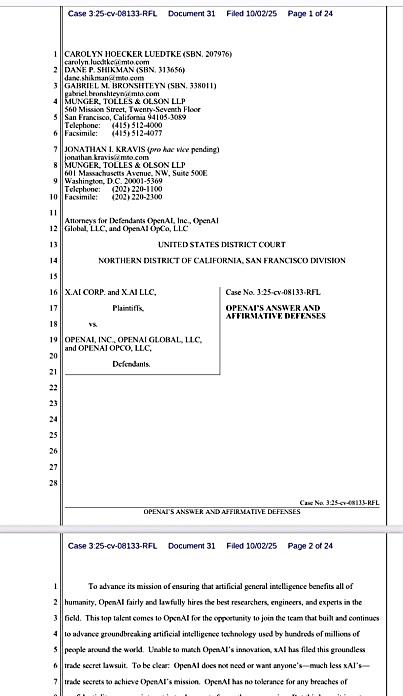
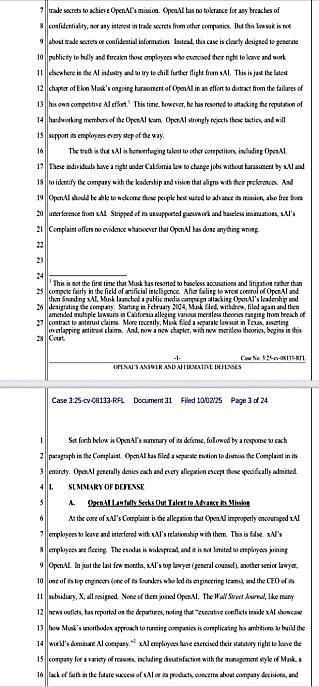
Figure 4. First Pages of OpenAI’s Response to the xAI Lawsuit
The Role of Human Resources (HR) and the xAI Security Service
One of the key issues arising from the XAI v. Li and XAI v. OpenAI is the efficiency of the internal services of companies – the security service and the HR department. Their actions (or inaction) directly affected the possibility of conflict. In the legal article, we will not discuss the specific mistakes of these services, I believe that these aspects will be repeatedly analyzed by specialists in these fields, but it is necessary to note the following:
– If the blame is placed on the xAI security service, it may weaken the plaintiff’s position, as the company itself underestimated the threat of “insider risk”.
– If OpenAI’s HR and compliance flaws are identified, it will strengthen xAI’s position and confirm OpenAI’s corporate involvement in obtaining secrets.
Thus, the case under consideration goes beyond the framework of the “dispute about the code” and turns into an analysis of the quality of corporate procedures for managing risks and personnel policy.
The Evolution of Private Lawsuit into a Corporate Battle for Intellectual Property
Claims XAI v. Li and XAI v. OpenAI needs to be considered as part of a single process construct.
– If Li’s guilt is not proven, then the accusations against OpenAI may crumble due to the lack of a factual base.
– If it is determined that Li did share secrets, then OpenAI will automatically be at the center of corporate and potentially criminal liability.
Thus, the figure of one engineer becomes critically important for the outcome of the conflict between the two giants of AI.
Criminal perspective
There is a possibility that the case against Li and even OpenAI will move into the criminal plane. In this case, the US prosecutor’s office can use the traditional tactic of pressure: the threat of a maximum sentence in exchange for confessions.
If Lee agrees to the deal, his testimony could be used to build a criminal case against OpenAI.
Such a scenario would turn the current corporate dispute into an existential threat to OpenAI: it would not only be about compensation, but also about bans on the use of technology, multibillion-dollar fines, and personal liability of managers[14]. Li is a key figure in both processes. He is both a defendant and a potential key witness against OpenAI. His position (recognition or denial) actually determines the outcome of both processes.
Of particular note is that on August 19, 2025, Lee’s home was searched on a warrant issued by a federal judge at the request of the FBI, as the defense said at a hearing on September 2.[15] This fact confirms that in parallel with the civil process, a criminal investigation is also underway on the grounds of violation of the Trade Secrets Act (DTSA).
On September 16, Lee filed his opposition to the request for a preliminary injunction, but the full text of the document is not yet available in open databases, presumably due to partial sealed filing. Interestingly, Lee is being defended by Christian E. Picone, a partner at Berliner Cohen LLP, a former criminal prosecutor with experience in white collar and trade secret disputes. This indicates the serious nature of the defendant’s legal strategy and portends a tough confrontation between the parties in the upcoming trial.
American judicial practice knows examples when individual cases grew into corporate disasters:- United States v. Liew (2014) – an engineer who appropriated DuPont secrets received a long sentence, and the case had an international resonance.[16]
– United States v. Sinovel (2018) – A Chinese company was found guilty of using AMSC secrets, resulting in huge compensations and bans.[17] It was the employee confessions that became the trigger for corporate responsibility. Both precedents show that employee confessions can transform private disputes into lawsuits against corporations.
Possible Criminal Offenses (U.S., Federal)
For Lee and, hypothetically, other OpenAI employees, as well as other xAI employees, who could have committed similar crimes
For legal entities (e.g., OpenAI as a corporation)
Total
However, it is also possible that Lee and OpenAI will be prosecuted under the California Criminal Code.
California Penal Code – Possible Criminal Offenses
1. Cal. Penal Code § 499c — Theft of Trade Secrets
• It criminalizes the theft, copying, use or disclosure of trade secrets without permission.
• Punishment:
• Crime of minor gravity: up to1 year in County Jail, a fine of up to $5,000.
• Felony: up to3 years in prison in state prison (state prison).
2. Cal. Penal Code § 502 — Unauthorized Access to Computers (Computer Crime Law)
• A direct analogue of CFAA, but at the state level.
• Prohibits unauthorized access to computers/networks, copying, deletion, or theft of data.
• Punishment:
• Crime of minor gravity: up to1 year Jail + fine up to $5,000.
• Felony: up to3 years state prison + fine up to $10,000.
3. Cal. Penal Code § 484 / § 487 — Theft / Grand Theft
• If the value of the stolen property exceeds $950, → qualifies as grand theft.
• Penalty: up to3 years Imprisonment.
4. Cal. Penal Code § 182 — Conspiracy
• Conspiracy to commit a crime (e.g., data theft or trade secrets).
• Punishment: the same as for the main crime in which the conspiracy was committed.
Difference from federal regulations
• Federal Articles provide for more severe sanctions (up to 10-20 years).
• California Articles– usually up to 3 years, plus fines.
• But: state federal charges can be Parallel. If the case piques the interest of the District Attorney, Lee and/or OpenAI could be under double pressure.
Applicable U.S. Federal Laws
Applicable California Penal Code
Procedural Prospects: Consolidation of Cases in One Trial and Lee’s Role as a Witness
Taking into account the fact that both cases are X.AI v. Li and X.AI v. OpenAI – filed in the same federal district (Northern District of California), their procedural consolidation for joint consideration is not excluded. In this case, cases can be transferred to one judge, which will ensure procedural economy and consistency of conclusions. In addition, the appointment of a jury trial will give the case special publicity and increase pressure on OpenAI, given the social resonance of the topic of artificial intelligence and industrial espionage.
An important procedural option is the possibility of concluding a transaction between the parties in the case of X.AI v. Li. In exchange for full recognition of the facts and willingness to cooperate, Lee can seek the withdrawal of the lawsuit against him or the easing of sanctions. In such a scenario, he would effectively move from the status of a defendant to the status of a key witness for the plaintiff in the case against OpenAI. This will significantly strengthen the position of X.AI, as it will provide direct evidence of the corporation’s involvement in the receipt and use of trade secrets.
CONCLUSION
The case of xAI v. Li shows how, in AI disputes, courts are increasingly applying early injunctive relief to prevent further harm and preserve electronic evidence. The success of the parties in such cases is determined not by loud statements, but by the accuracy of procedural motions, clarity of wording and timely recording of facts.
For organizations, a reliable internal order becomes key: clear rules for accessing data, accounting for user actions, regular inspections, and a predetermined procedure for responding to incidents. It is important for defense representatives not to rush to provide wide access and confessions, to seek certainty in the amount and method of data seizure, to insist on the participation of independent specialists and the judicial regime for the protection of secrecy and personal data. For the courts, the priority is the proportionality of the intervention, the exact timing and reporting of experts, as well as the protection of confidential information. As a result, a stable practical model for resolving such disputes is formed: the speed and accuracy of procedural actions, provability and manageability of risks are more important than rhetorical declarations
Conflicts XAI v. Li and XAI v. OpenAIs are interconnected stages of a single process – escalation from personal liability to corporate and potentially criminal liability. The conflicts in question can set new standards for the entire industry: – stricter protection of trade secrets;- severe restrictions on the personnel mobility of engineers;- growth of legal and reputational risks for investors.
These processes reflect not only a corporate dispute, but also a crisis of trust within the artificial intelligence industry, where the balance between the mobility of personnel and the protection of industrial secrets is becoming existential. Their outcome can become a precedent that determines not only the fate of individual companies, but also the architecture of the entire global artificial intelligence industry.
List of Sources / References
UDC 316.48(075.8)
BBK 88.53ya73
MODERN THEORIES OF CONFLICT RESOLUTION INSTITUTIONS IN FOREIGN SCIENCE
Korablin Andrey Vladimirovich
St. Petersburg State University (1992)
Abstract: The article examines modern foreign theories of conflict resolution institutions, reflecting the evolution of scientific ideas about the nature of conflicts and ways of their settlement. Based on the analysis of classical and modern concepts, the key stages of the formation of conflictology as an independent discipline are identified and the approaches of leading foreign thinkers — Talcott Parsons, Ralph Dahrendorf, Jan Tinbergen, Louis Kriesberg and Johan Galtung — are revealed. Modern conflict theory has been formed as a multi-paradigm system in which sociological, psychological and political approaches interact. Particular attention is paid to the role of international institutions (UN, OSCE, etc.) in maintaining global security and the need to reform them, taking into account the new challenges of the 21st century. It is concluded that conflicts are an integral part of public life, and the task of institutions is not to eliminate, but to constructively transform contradictions in the name of sustainable development and peace.
Keywords: conflictology; conflict resolution institute; international organizations; Parsons; Dahrendorf; Tinbergen; Kriesberg; Galtung; structural functionalism; conflict theory; peacemaking.
MODERN THEORIES OF CONFLICT RESOLUTION INSTITUTIONS IN FOREIGN SCIENCE
Korablin Andrey Vladimirovych
Saint-Petersburg State University (1992)
Abstract: The article analyzes modern foreign theories of conflict-resolution institutions, tracing the evolution of academic approaches to the nature and management of social conflicts. Based on a review of classical and contemporary concepts, the author outlines the main stages in the development of conflict studies as an independent discipline and examines the ideas of T. Parsons, R. Dahrendorf, J. Tinbergen, L. Kriesberg, and J. Galtung. The study demonstrates that modern conflict theory has evolved into a multiparadigmatic system combining sociological, psychological, and political perspectives. Particular attention is given to the role of international organizations (UN, OSCE, etc.) in maintaining global security and the need for their reform in response to 21st-century challenges. The article concludes that conflict is an inherent feature of social life, and the purpose of conflict-resolution institutions is not to eradicate it but to transform contradictions constructively in pursuit of sustainable peace.
Keywords: conflict studies; conflict-resolution institutions; international organizations; Parsons; Dahrendorf; Tinbergen; Kriesberg; Galtung; structural functionalism; conflict theory; peacebuilding.
INTRODUCTION
Since ancient times, mankind has known military and peaceful methods of conflict resolution, which are often opposed to each other. This is not surprising, because these concepts are antagonists in their fundamental essence. At the same time, throughout human history, they have complemented each other, forming an amazing unity – a war can end with a peace treaty, and vice versa – peace treaties are often violated in the course of hostilities.
The greatest thinkers have long nurtured the idea of creating a global structure capable of preventing wars and resolving conflicts. Due to the accelerating development of military-strategic, economic and political factors, the most important instrument for conflict resolution – the United Nations (UN) – was formed in the twentieth century (It is not difficult to make sure of this – it is enough just to read the daily news). This indicates the inadequacy of efforts and the low efficiency of conflict resolution[18]. There is no doubt that the Organization needs reforms in accordance with the new conditions of reality. The formation of a system for countering the threats of the 21st century (escalation of conflicts, terrorism, surging regional confrontations, drug trafficking, arms proliferation, etc.) is one of the most important tasks that the new century has set for the institutions of conflict resolution.
The theoretical and methodological scientific base provides tools and paves the way for the successful implementation of the urgent goals of conflict resolution, therefore the analysis of both previously accumulated knowledge underlying the research of conflict resolution, and the development of new scientific areas is of great importance. Extensive theoretical and practical developments in this area are presented in foreign scientific thought, which explains the relevance of chosen research topic: “Modern Theories of Conflict Resolution Institutions in Foreign Science”. The purpose of this article is to review modern theories of conflict resolution institutions in foreign science, to analyze the features of these theories and their prospects.
The object is the theories of modern conflict resolution institutions in foreign science.
The subject is the study of theories of conflict resolution by modern foreign thinkers.
In accordance with the goal, the objectives of the article are defined :
1. Study of the theoretical foundations of conflict resolution, their historical evolution, the formation of social institutions and, in particular, the institution of conflict resolution.
2. Study of the concepts of conflict resolution of foreign thinkers of the current era. Their influence on the activities of modern institutions.
3. Analysis of the features of the theories of conflict resolution of modern foreign scientists, identification of their strengths and weaknesses, prospects.
The goals and objectives of the study determined the structure of the article, which consists of an introduction, two chapters, a conclusion containing conclusions based on the results of the study and a list of sources used. The first chapter considers brief theoretical information about conflict resolution, the concept of institutionalization, social institutions, as well as their varieties – institutions of conflict resolution more detailed studies of some of the brightest concepts of representatives of the scientific community. When writing the article, the author uses the theoretical method of analyzing literary sources, electronic resources (with subsequent data synthesis), and, applying an interdisciplinary approach, considers the author’s opinions and research from Internet sources.
Chapter 1. Conflictology, conflict resolution, institutionalization of conflict resolution mechanisms
1.1 Basic concepts of conflictology. The role of modern history in the process of the emergence of conflictology and the formation of social institutionalization.
Conflictology is a relatively young field of science, nevertheless, it has deep and ancient origins. The emergence of conflictology, as an independent discipline, is largely provoked by the aggravation of social conflicts in modern society and, accordingly, the direct threat to the existence of humanity.
The last little more than a hundred years have turned out to be extremely rich in wars of global and regional scale, wars with huge bloody losses. Millions of human lives have become sacrifices sacrificed on the altar of the gods of war. None of the fallen writers, alas, will be able to create an outstanding story, a musician will not compose a magical melody, a great mathematical law will not be discovered, a new philosopher will not endow his wisdom with his wisdom… The great Albert Einstein said, “We must demand a fundamentally new way of thinking if humanity is to survive.”[19] Therefore, the most important goal of conflictology is the practice of peaceful conflict resolution, as well as the prevention and prevention of conflict situations.
The redrawing of the political map of the world, which was especially active in the second half of the 20th century and implied radical changes in the structure and status of many countries, led to a surge in institutionalization, namely, the emergence of new participants in the system of international relations and relations.
Institutionalization is the process of ordering and formalizing social relations. In addition, there is the concept of “institutionalism” – a direction of research that considers the organization of society as a complex of civil associations (institutions). Institutionalism includes the analysis of institutions and external factors, not limited only to categories and processes, and contains two related concepts – “institutions” (norms and the usual way of social behavior) and “Institutions”. The second means the consolidation of norms in the form of legislation, institutions or organizations.
The concept of “institution”, which once served only jurisprudence, has been used by sociological theory since the end of the nineteenth century. In the present context, this term implies stable connections and relationships of social subjects in society, which play the role of its peculiar archetypes, ensuring its stability and constant reproduction.[20] One of the significant moments in the development of mankind was the creation of social institutions for conflict resolution, which made it possible to significantly limit violence and, in many cases, restrain the occurrence of bloodshed.
The process of institutionalization includes several successive stages (from the emergence of a specific social need, the satisfaction of which requires organized joint actions, to a fully formed institutional structure), the result of these stages is the creation of a clear structured organization that meets the norms of the majority of participants in this process. Thus, institutionalization makes it possible to build a verified status-role structure of society, increasing its organization and efficiency of control over the quality of life. The social institution itself is the guarantor and symbol of order in society. Institutions of conflict resolution are formed on the basis of a certain type of significant needs of social subjects and serve to satisfy these needs. This issue will be discussed in detail in the next part of this chapter.
1.2 The institution of conflict resolution as a type of social institution. The essence of the concept, classification and functions.
As mentioned above, a social institution has a clear structure. This structure includes the following elements:
In turn, structural elements are divided into general (for all social institutions) and specific. The latter are inherent in each of them separately and imply the individual features of each social institution. Such specific features that distinguish them from other institutions are possessed by social institutions of conflict resolution.
In order to proceed directly to the above-mentioned concept, it is necessary to briefly consider what a conflict is and, as a particularity, a social conflict. Based on the axiom that defines conflict as an indispensable attribute of social relations of human society, the methodological term of social conflict can be presented as follows: social conflict is a process of opposition of subjects aimed at resolving contradictions according to the interests and goals of each of the parties.[21]
It is believed that any social conflict consists of three obligatory components: the presence of several parties to the conflict (social subjects), the implementation of opposition by the parties to the conflict and, finally, the possibility of assessing the resistance of the parties to the conflict by an external observer.
The criterion for resolving a conflict can be considered the satisfaction of the subjects with its outcome. There are four main forms of conflict resolution: violent (war and revolution), adversarial (investigations, courts), conciliation (mediation and negotiations) and mixed (arbitration, mediation).[22]
In conflict resolution, methodologies are used, which are divided into “preventive technologies” and “technologies for resolving and resolving conflicts”. The former include the institutionalization of conflict, partnership, diagnostic analysis, and the establishment and strengthening of cooperation. Conflict resolution technologies are negotiations, arbitration, mediation, frustration, pressure, independent examinations, etc. Researchers in the field of conflict resolution come to a consensus that different methods of conflict resolution have an unequal degree of effectiveness in relation to the stages of conflicts.
Conflict, as mentioned above, is a constant component of human relations, but it is necessary and important to foresee and prevent it, and, if it exists, to manage and regulate it, minimizing the negative consequences for human society. It is to serve such goals that the institution of conflict resolution is intended. Its specificity lies in the fact that according to the functions that involve the prevention, regulation and resolution of social conflicts, the institutions of conflict resolution cannot be limited only to these aspects of this function. They are also obliged to carry out preventive activities and prevent conflicts, in order to avoid the need to create separate “conflict-preventing” institutions with their own mechanisms. Therefore, it can be said that the activities of conflict resolution institutions are mainly aimed at ensuring the stable, sustainable and safe existence of individuals, social groups and the human community as a whole.[23]
Conflict resolution institutions, like other social institutions, have a certain classification. One of the classifying criteria is the number of functions performed by the institution: one main function determines the monofunctionality of the institution, and, accordingly, institutions that perform numerous social functions are called multifunctional. In addition, institutions can be formal and informal, as well as classified depending on the level of conflict manifestation. The latter can be international and international, have different scales (micro, meso, and macro). According to political characteristics, conflicts are divided into internal political and interstate. The latter occupy a special position in the system of conflict resolution, based on the scale and potential threat. As a rule, institutions combine several classification criteria. For example, the state is one of the most important institutions of conflict resolution, which can combine institutions of a smaller caliber, and is an integrative multifunctional political institution.
At the moment, there are about 4000 international organizations in the world (300 interstate, the rest are non-governmental or mixed). All organizations are ranked in descending order of scale, number of functions, and specialization as follows:
The rapid political and economic integration of the world is developing the negotiation mechanism and its institutionalization, which is reflected in the growing creation of such negotiating forums as the CSCE, which later transformed into the OSCE, and the large-scale use of international organizations (for example, the UN) to resolve conflict situations.
1.3 A brief evolution of the basic concepts that formed the basis for modern research
Despite the fact that the term “conflict” formulated by science appears only in the second half of the twentieth century, wars and interstate conflicts have been studied for a long time. Ancient historians have left us a lot of scientific works containing initial ideas about conflict (Herodotus and his idea of military confrontation, Thucydides, Xenophon, Heraclitus with the doctrine of “logos”, the opposition of being and non-being among the Eleatic, etc.). The classical period of antiquity introduced the concept of “agon”, which implies conflict, but is not a complete synonym for it. “Agon” is chaos, the destruction of the cosmic integral system of perceiving the world, opposition to order – precisely opposition, not collision. The cosmos and the “agon” exist simultaneously, but they do not mix, just as a ray of sunlight cannot mix with the shadow surrounding it.
The Middle Ages present a somewhat different picture – now the agonal principle lies in man, it is he who is the violator of the “Divine order”. “Agon” becomes a clash, a conflict between the Cosmos and the sinful Earth. People are a battlefield whose goal is the human soul. The medieval concept of conflict, in the context of the theological worldview, is abstract and not filled with any social content. Conflict “is a necessary evil that leaves the need to trust in the mercy of God,” Tertullian said many hundreds of years ago.
Another medieval thinker, Aurelius Augustine, understands conflict as “a sign of the wretchedness of the created world, generated as a result of man’s love for himself and contempt for God.”[24] Therefore, in this philosophy, the guarantee of non-conflict is the striving of the Earthly State (filled with sins and conflicts) to the Heavenly State by performing “human deeds”. Thomas Aquinas continues the development of this philosophy, but his State is not the bearer of the evil principle, it is an institution for resolving contradictions that are allowed by God. but still with the same good.
Medieval scholasticism was eroded under the onslaught of the Renaissance and the Enlightenment. The world is changing rapidly, dissolving the remnants of feudalism and giving rise to a new type of relations – bourgeois. The French Enlightenment gave society an understanding of the possibilities of science and knowledge, optimistic prospects for comprehending the truth, and the conviction that the liberation of society from evil and the construction of equality and fraternity lay through science.
The XVIII century came, the upheavals associated with bourgeois revolutions broke the traditional structures of social relations. The emergence of new technologies based on the use of steam and electricity, scientific methods of improving these technologies, caused a higher rate of technological renewal, which in turn affected the social structure of society. social conflict is a conflict between labor and capital. Accordingly, the resolution, or at least mitigation, of this conflict is the main task of the institution of conflict resolution in such a society. In addition, the rapid destruction of local communities that have been formed over the centuries places the individual in a “large society”, a person loses self-identification – the number of intrapersonal conflicts increases. Religion, as an institution of conflict resolution, is no longer able to solve urgent problems. For an industrial society of the capitalist type, the institutionalization of relations between employers and employees becomes the main institution. All these changes are reflected in the theories of a galaxy of contemporary thinkers.
The revolutionary epoch of the eighteenth century gave rise to Hegel’s philosophy and his theory of Civil Society. This is an important milestone for the development of subsequent theories of conflict resolution, since Hegel’s Civil Society already has some interrelated specific features of the institution of conflict resolution, namely:
The philosopher and sociologist Herbert Spencer (1820-1903) introduced the concept of a social institution (more precisely, a “social institution”) as a stable form of life activity and social interaction of individuals and social groups to satisfy basic needs.[25] The scientist described six types of social institutions, linking their functioning with “ensuring the regularity and reliability of the process of satisfying especially significant and enduring needs of people.[26] Later, the American Thorstein Veblen (1857-1929) proposed the concept of “social institution” with an emphasis on normativity, while according to Spencer it is primarily functionality.
Starting from the middle of the century before last, the theory of social-class conflict – the sociology of Marxism – was formed. The life of society is considered primarily through the prism of uneven distribution of material wealth, social inequality, which provokes various forms of class struggle. K. Marx (1818-1883) sees the main way of conflict resolution in the social revolution and the creation of a conflict-free communist society with equal opportunities for each member of society.
Continuing the traditions of Spencer, the development of social institutions was carried out by Georg Simmel (1858-1918), who defined the inevitability of conflicts as inherent in the natural human aggressive nature, the manifestations of which should be limited by social norms. The scientist considers the conflict as a kind of “safety valve”, concentrates on its positive functions, but does not deny the negative aspects and consequences. Simmel concludes that stable social institutions are capable of coping with internal conflicts.
The German sociologist Max Weber (1864-1920) focuses on the conflict of material and spiritual interests. The complication of the social structure of society leads to changes in the political system, complicating it by the division of power functions, which in turn determines a developed bureaucratic system. The scientist considers the bureaucracy that has developed in society to be one of the main sources of conflicts. The bureaucracy, which realizes its interests through the state system, becomes a source of arbitrariness that provokes conflicts.[27]
The famous sociologist and philosopher Emile Durkheim (1858-1917) formulates the functions of social institutions as “factories for the reproduction of social relationships” that ensure social stability, since they consolidate the rules of social interactions, dictate the norms of social relations and legitimize social inequality. According to Durkheim, social upheavals in society can give rise to both a moral crisis and an increase in the cohesion of society, a patriotic upsurge (for example, during the war). This thinker is the author of a very vivid saying: “… The remedy for evil is not to try at all costs to resurrect traditions and customs which, if no longer suited to present social conditions, can only live an artificial and apparent life. What is needed is to put an end to anomie, to find ways to force the harmonious cooperation of the organs that still clash in disorderly movements, to bring more justice into their relations, further weakening the source of evil – various kinds of external inequality”.[28] The scientist considered the creation of a “new morality” in which all people form a single society subject to uniform laws. He saw the regulation of conflicts as the main component of the “new morality”.
Thus, summarizing the first chapter of this article, it can be noted that by the beginning of the second decade of the twentieth century, conflict was recognized as a permanent property of reality. Conflict is considered both as a negative and as a positive, creative factor in the development of social life. Then the League of Nations was created, which later transformed into the UN. In addition, the concepts and questions that have formed a fertile field for the cultivation of scientific fruits by the next generations of researchers of conflictological science, whose theories will be considered in the second chapter of the article, are formulated.
Chapter 2. Modern theories of conflict resolution institutions in foreign science.
2.1 General Characteristics of the Existing Directions of Modern Concepts of Conflict Resolution Institutions.
Theoretical understanding of conflicts and conflict resolution is a multidisciplinary concept that combines the accumulated knowledge within the framework of many sciences (about 16), including the main sociological, psychological, and political science areas. Political science includes theories of political groups, political stability, and ethnopolitical theory. The beginning of the twentieth century was marked by the emergence of game theory as a science capable of giving instructions for behavior in various situations and modeling military actions.
It is believed that the palm of the main directions in the development of Russian conflictology belongs to psychology, while sociologists are in the lead in Western conflictology. In accordance with the purpose of this work, we will consider in more detail the sociological direction of foreign theory, which includes: social Darwinism, Marxism, functional theory of conflict, structural functionalism, the theory of positive-functional conflict, the conflict model of society and, finally, the general theory of conflict, which states that “conflict is a universal phenomenon inherent in all living things, it cannot be avoided, but it can be regulated.”[29]
The foreign history of the study of conflict in the mainstream of sociology distinguishes three main stages:
The first, and partly the second periods, were considered in the first part of this chapter of this study, so we can move on to the modern stage of the formation of theories of conflict resolution institutions.
The nineteenth and twentieth centuries are characterized by a general increase in conflictocity, the growth of social conflicts, with the transition to state and inter-class conflicts. The established classical traditions of scientific knowledge turned out to be incapable of explaining what was happening and ensuring the structure of a harmonious surrounding world. The most acute social questions remained unanswered, which is why, in contrast to the classical, critical philosophy appeared.
In the 1920s and 1950s, as a result of the growing interest in methods of conflict resolution and conflict prevention, applied conflictology developed. The clearest social theory of structural functionalism, the concept of “social equilibrium” by Talcott Parsons,[30] was formed. His functionalist conflict-free model of society, popular in the 1930s and 1940s, will be considered in more detail in the next part of this chapter. A similar theoretical model was held by such magnitudes of scientific thought as R. Park, F. Znanetsky, Pitirim Sorokin (Parsons’ teacher), R. Merton. However, Merton, unlike Parsons, considers social institutions as a dual factor capable of both stabilizing and destabilizing the social system.[31]
The second half of the twentieth century – more and more countries are moving into a post-industrial society; industrial enterprises are losing ground to enterprises producing services. Engineering, technical, managerial and humanitarian directions came to the fore, pushing the conflict between the bourgeoisie and the proletarians to the margins. This period is characterized by the presence of protection institutions, high organization and adherence to the letter of the law. Conflict regulation is carried out in circumstances where each of its subjects must recognize the conflict nature of the situation, while retaining the right to defend their position. At the same time, the organization of the parties makes it easier to reach a consensus.
Finally, the 1950s gave rise to the first modern conflictological concepts. The German American sociologist, Lewis Alfred Coser (1913-2003), is a representative of the following sociological paradigm – “Conflict Theory”. He opposes Parson’s theory with his “idea of dynamic change”. In 1956, the scientist’s work entitled “The Functions of Social Conflict” was published, in which conflict is the central link of social change. evidence in favor of the fact that conflict is a product of internal changes in society, the result of the interaction of society, which manifests level differences – individual, social, group, community. According to Koser, conflict is not only a destructive factor, but at the same time a factor that ensures the stability and order of society. This is his “dynamic equilibrium”.[32]
Another European, Ralph Dahrendorf, whose research will be discussed in detail below, is moving in the same direction. This scientist considers conflicts to be an indispensable condition for the existence of society, and their absence to be a disease: “Those who know how to cope with conflicts by recognizing and regulating them take control of the rhythm of history. Whoever misses such an opportunity gets this rhythm as his opponent.”[33]
“General theories of conflict” are represented by such names as Kenneth Boulding and Lewis Kriesberg. Boulding (1910-1993) tried to create a general model of conflict that would be suitable in each individual case. He made a significant contribution to the formation of conflictological discipline, dividing conflicts into three groups and defining static and dynamic models of conflict.
In the 20th century, the ideas of a special type of struggle were formulated – non-violent resistance, which implies non-subordination to violence. According to some experts, today there is more interest in the practice of this type of social relations than in the theoretical substantiation of ideas. The introduction of the ideas of non-violent struggle and its practical application is associated with the world’s greatest figures: M. Gandhi, L. Tolstoy, M. L. King, Johan Galtung and others. needs begins to transform into the theory of social discussion. It is noted that the solution of the problem of human identity is directly related to the problem of preventing violent conflicts. Therefore, the formation of a culture of tolerance becomes a new important task of conflictology. In addition, the term “constructive conflict management” appears, which more qualitatively reflects the difficult and long path of conflict resolution. New variations of previous theories are being born: neo-Marxism, neoliberalism, postmodernism, characterized by its negative point of view on the ability of mankind to understand the world. From the point of view of realism, the role of international institutions of conflict resolution is secondary, they are only a field for defending state interests or a tool for their implementation. Neoliberalism and idealism give priority to international institutions and imply that their activities are the key to transforming the system of international relations.
Summing up the above, it can be noted that from the second half of the twentieth century to the present day, the process of constructing and systematizing the intra-ordered model of modern conflictology has been taking place. At the same time, both the conceptual base and the cognitive toolkit have not yet been fully formed. Nevertheless, today conflictology is an independent discipline that is ready to face the problems of the modern world.
2.2 Talcott Parsons and the “Structure of Social Action”
Talcott Parsons (1902 – 1979) was an American sociologist, philosopher and theorist, one of the founders of modern theoretical sociology. Parsons was born in the family of a Protestant minister who was interested in science (as an important addition to religion).
At college, Parsons became interested in Pareto’s sociological theory (which he would later continue). Further, Parsons studied in England, where his scientific interests continued to be formed under the influence of prevailing evolutionism and liberalism. Parsons’ great merit is that, having deeply studied the works of previous classical sociologists (mainly Europeans), he assimilated together their rich experience and ideas and made a successive connection of sociological theory.[34] Parsons defines society as a special social system that achieves the highest level of self-sufficiency in comparison with others. Self-sufficiency is understood as the function of ensuring control over the relations arising in social systems and the internal mechanisms of the system. When any function is violated, destabilization occurs in the system, which in turn leads to a conflict. including its subsystems and actions.
Parsons considered conflict resolution from the standpoint of structural-functional analysis. He attributed conflicts to the anomalies of the social system, endowing the conflict with signs of a disease that should be actively cured, and even better avoided by using preventive methods. Thus, Talcott Parsons formulates the theoretical prerequisites for conflict resolution and the creation of mechanisms for preventing the emergence of conflicts. Among the conditions for preventing social conflicts in society, he called the education of members of the local society in approved forms of behavior, the active work of agents of social control and ensuring the coincidence of individual motivations of people with social attitudes.[35]
Given the above, conflict, from Parsons’ point of view, is a destroyer of the social order and evidence of disorganization. Thus, Parson’s order excludes struggle, contradictions and chaos, in his worldview these phenomena cannot be mechanisms for achieving the stability of society.
2.3 Dahrendorf and the Theory of the “Conflict Model”
Ralph Dahrendorf (1929-2009) was an Anglo-German philosopher, sociologist, and political scientist, born in Germany during the heyday of the Social Democratic Party. Dahrendorf’s father was a deputy of this party, but later lost his position and was even arrested. During the war, he carried out agitation work against National Socialism. Thus, Ralph was involved in an active social and political life from childhood.
According to Dahrendorf, conflict is based on a material motive, the individuality of a person, his rights and freedoms, which determines the attribution of conflict for any society. Dahrendorf endows society with two hypostases: harmony and conflict, while a certain group endowed with power is able to provoke change, which in turn produces conflict. Accordingly, every society is subject to change and is a source of conflict, relying on the coercion of one against the other. Thus, conflict cannot be eradicated at the level of civil or state forces: “they can neither be abolished nor excluded by any power or social force.”[36]
The transformation of the system into a new quality is feasible in the presence of an acute class conflict, the threat of which should be leveled by the institutions of conflict resolution. In the process of development and complication of society, it is necessary to develop the mechanisms of conflict interaction.
Dahrendorf was somewhat opposed to the use of the term “conflict resolution” because it “reflects a sociologically erroneous ideology according to which the complete elimination of conflict is possible and desirable,” which is misleading.[37] In this regard, the scientist is closer to the concept of regulation.
Dahrendorf classifies the forms of overcoming conflicts, correlating them with the main possibilities as follows: “suppression” of the conflict, its “cancellation” or “regulation”. Of these three forms, only the latter, according to the scientist, is effective in working with conflicts. The scientist proposes a consistent scheme for resolving conflicts, according to which “negotiations” are first used (involving the creation of a body where the parties to the conflict and, if necessary, a “third party” will meet), then “mediation” is involved with the participation of a third party. Mediation, from Dahrendorf’s point of view, is often a very effective tool for “conflict resolution”. The next stages of the conflict resolution scheme are arbitration and compulsory arbitration, the first involves a possible appeal to a third party, and the second is mandatory, which makes it close to the method of conflict suppression.
Dahrendorf’s theory boils down to the fact that it is impossible to eradicate conflicts by regulation, as a permanently present phenomenon of society, but it is quite possible to mitigate violence.[38]
2.4 “Rethinking the International Order” by Jan Tinbergen
Jan Tinbergen (1903 – 1994), a well-known economist, was born in Holland, in the family of a linguistic teacher. Jan was the eldest of five brothers, their parents devoted a lot of time to the upbringing, education and development of children, which later bore due fruit. Nicholas Tinbergen was awarded the Nobel Prize in Physiology or Medicine, another of the brothers became a well-known professor in the field of zoology, and Jan Tinbergen himself (together with Ragnar Fischer) is the owner of the Nobel Prize in Economics. In addition, the scientist was also awarded the Erasmus Prize (Rotterdam) and has more than twenty honorary degrees from various universities and colleges. In terms of conflict resolution, Jan Tinbergen creates such well-known works as “Revision of the International Order” and “War and Prosperity. Integration of political security into socio-economic policy” (together with D. Fisher). In the second work, the authors highlight their vision of the global problem of the prospects for the survival of mankind and the prevention of nuclear war.[39]The humanistic ideals of social justice accompanied Tinbergen throughout his career, as evidenced by his active participation in the socialist youth organization, as well as the Social Democratic Party of the Netherlands. Tinbergen was one of the developers of the social democratic program for overcoming the economic crisis and depression. In 1936-1938, Jan Tinbergen was an economic expert of the League of Nations in Geneva. In the 60s, he actively consulted. In 1966, he became chairman of the UN Development Planning Committee, which had a great impact on international development strategies in the 70s. The problem of establishing social justice was a priority for him in the scientific and practical political aspects. From about the 1950s, when the processes of formation of such institutions as the Benelux Economic Union and the EEC began, the scientist paid great attention to the study of economic development and especially the problems of backwardness in the countries of the Third World. Actually, this term itself belongs to the authorship of Tinbergen. In recent history, the efforts of this outstanding scientist were focused on the search for methods for building an economically optimal social structure. He substantiated the need to eliminate the gap between the “rich” and the “poor” and believed that the development of the problems of developing countries would resolve conflicts and correct the consequences of colonial oppression (as a feasible compensation to the former colonial countries from the metropolises). The oil crisis is becoming a litmus test that has shown the failure of the global monetary system. The UN, together with the Club of Rome, began discussions on these problems, but no proposals that would practically resolve the current situation took place. For this reason, in 1975, the Club of Rome commissioned Tinbergen to head the work of a commission on the preparation of a report on global socio-economic problems. A feature of the Club of Rome (an international non-governmental organization engaged in the analysis of global problems of human development) is to attract the attention of the world community to certain problems through the so-called “reports”, by ordering which, the Organization determines only the topic and guarantees funding for the relevant research. Neither the course of these studies, nor the author’s conclusions, the Club has any influence. The finished report is reviewed and approved at the annual conference, then the results are published and discussed at various levels. Practical recommendations are taken into account when forecasting the development of the socio-economic sphere of countries, industrial sectors and individual corporations. The monograph-report “Revision of the International Order”, published in 1976, contains the formulated concepts and methodologies of a new complex science – global studies. “Recognizing the importance of the resolutions adopted by the United Nations and the Charter of Economic Rights and Duties of States, but at the same time aware of the uncertainty and controversy of many of their provisions, Dr. Peccei invited me to create and lead a group of specialists capable of answering the question: Is it possible to propose to the leaders and peoples of the world such a new order that will make it possible to really and fully meet the basic needs of today, and, perhaps the needs of future generations?” – this is how Tinbergen formulated the tasks facing him.[40]This report differed from its predecessors in specific recommendations in the field of world economic and political activities, the reorganization of existing institutions and the creation of new ones capable of ensuring a more sustainable development of the world system. This monograph concentrates the main provisions devoted to food, raw materials and energy shortages, the environmental situation, the gap in the standard of living between rich and poor countries, and the arms race. The idea of the interdependence of the actions and deeds of each person, which does not allow one to act in the interests of one’s own benefit alone, runs like a red thread through the entire Tinbergen report. Ensuring a decent standard of living for all inhabitants of the Earth is the main goal of the world community, and to achieve this goal, global changes are needed in the structures of power, international and market relations, institutional activities, etc. “Humanistic socialism” is the name given in this report to a new ideal social organization of people based on universal human values, observing equal opportunities within and between countries.[41]
2.5 Louis Krisberg and his universal model of conflict behavior
Louis Crisberg (born 30.07.1926) is an American sociologist, a modern representative of conflict theory and one of the founders of the movement of practical use of theory in the field of conflict resolution. Chicago in the 30s of the last century, a poor family of immigrants from Russia, it was in this environment that Louis comprehended social inequality from childhood, which became the theme of his subsequent works. “Social Processes in International Relations” (1968), “Social Conflicts” (1973, 1982), “Social Inequality” (1979), “Studies in the Field of Social Movements, Conflicts and Changes” (1978-1992) are just some of his numerous works in the field of social conflictology. At the same time, Kriesberg is actively working on practical conflict resolution, he personally participated in the movement against the Vietnam War and has consulted and continues to consult many governmental and non-governmental organizations.
Kriesberg identifies the general parameters (dynamic and structural indicators) of the conflict process, analyzing which it is possible to diagnose and predict the development of various conflicts. The main essence of the “general theory of conflict” according to Kriesberg is several propositions, according to which: conflict consists of rational activity (formed interests, including goals and methods of achieving them) and irrational variables:
Thus, the rejection of the concept of conflict only as a negative phenomenon and the study of the transformation of the destructive energy of conflict into constructive actions is the summarizing idea of Louis Krisberg’s theory. As a result, the practical application of his theory lies in the importance of non-violent and non-coercive methods of conflict, which provide a wide range of strategies for promoting constructive methods of struggle. This approach is very promising due to the conceptualization and systematization of concepts, which in turn leads to the formation of a new way of thinking about conflict resolution, which can be introduced and applied by modern institutions.[47]
2.6 Peacemaking by Johan Galtung and his
“The Concept of Structural Violence”
Johan Vincent Galtung (born 24.10.1930), an outstanding scientist – sociologist, mathematician, political scientist, founder of the discipline “Peace and Conflict Studies” and the greatest practitioner-developer of innovative technology for conflict resolution, who personally took part in the processes of resolving many conflicts of various orders and levels. It would take a few pages to list all his titles, awards, and works that were published during his tenure (about a hundred books and more than a thousand articles). At the moment, Galtung is a leading consultant on conflict resolution issues of such significant institutions of conflict resolution as the UN, OSCE and the Council of Europe, the creator of the international organization for the peaceful transformation of conflicts and development TRANSEND, etc.
Johan was born into a family of doctors, in the capital of Norway, a Kingdom with strong monarchical traditions. It was expected that Johan would maintain the continuity of his parents’ profession, and it can be said that to some extent this expectation was justified. Only Galtung did not limit himself to the treatment of individual patients, he became a more large-scale healer – a healer of the world community. All members of Johan’s family were people with an active civic position, so during the Second World War they were members of the anti-fascist underground, moreover, Galtung’s father ended up in the dungeons of a Nazi concentration camp. This event has a significant impact on the choice of the life path of the future world-conflict researcher, whose contribution he has already been able to change, and to this day has a powerful impact on institutional relations. In addition, the scientist successfully worked in the field of sociology of international relations.
As mentioned earlier, Galtung belongs to the neo-Marxist trend of modern conflictological currents and proceeds from inequalities of an economic and social nature, the so-called “asymmetrical interdependence” of the global capitalist system. Johan experimented with concepts such as attitudes, behaviors, and contradictions, and classified peaceful peacemaking strategies and the causes of conflict.
The scientist believes that the main cause of social conflicts is violence manifested by social systems, namely cultural, structural and personal, while the first creates conditions for the second, and the second for the third. Thus, cultural violence uses aspects of ideology, symbolism, and science that can serve to justify structural and personal violence, presenting them as just retaliatory actions and regarding these actions as normal phenomena, despite the aggression they carry. In a number of his works, such as “The Structural Theory of Aggression” (1964), “Conflict as a Way of Life” (1968), and others, Galtung draws attention to the fact that social structures can exert a violent influence on groups and individuals, creating prerequisites for the development of conflict of the structural type. The scientist shows the cause-and-effect relationship between the type of conflict and the corresponding social system.[48]
Johan Galtung pays special attention to the “life cycle of the conflict”, which in his model consists of three phases: “before violence”, “during violence”, “after violence”, which corresponds to the attitude, behavior and contradiction (problem), the conflict itself reaches its culmination after passing the stage of discussion, the emergence of the conflict itself, the escalation of segregation, the outbreak of violence and destruction, and then from the culmination the conflict is reborn into peace.
I. Galtung wrote: “To resolve a conflict means: 1) to decide who is the winner and who is the loser, what will be the future distribution of values; 2) to carry out this distribution of values; 3) to come to the conclusion that the conflict is completely over.”[49]
Galtung is the founder of the TRANSCEND network, which unites more than 500 members in 70 countries around the world and is the author of the theory of peace, conflict and mediation, as well as the three-stage TRANSCEND method (theory and practice of conflict, theory and practice of violence, peaceful transformation, dialogue and negotiation). This method makes it possible to transform the conflict in practice with the help of peaceful means and implies a mutual win that respects their basic needs (well-being, identity, freedom, etc.) instead of the obligatory loss of one of the opposing parties. This is the so-called “5th way” or “win-win” strategy. Three stages of the method:
This method can be applied at the level of all institutions, and its undoubted advantage is the absence of culprits and the creation of a new reality acceptable to the conflicting parties. In this reality, each of them is a winner. To date (for 60 years) Galtung has acted as a mediator in more than 100 international conflicts, sometimes succeeding in their peaceful transformation (it is possible to list a few). This is a real method that has saved many lives and prevented the continuation of some military confrontations. As we can see, the main way to achieve peace in the theory and practice of Johan Galtung is the transformation of conflicts with their complete eradication by eliminating contradictory goals. At the same time, peaceful achievements of empathy, creativity and non-violence are restored. acting in the context of constructive conflict resolution. According to Galtung, it is the human factor that is the creator or destroyer of the world. Understanding the culture of the world, a person becomes the creator and guardian of society. One of Galtung’s famous expressions is: “Tell me how you behave in a conflict, and I will tell you how much you have a culture of peace.”[50]
Galtung’s peaceful experiments are a scientific innovation that clearly demonstrates how social harmony is maintained by law and order. The results of these experiments are now being applied at all levels of human society, from the intra- and interpersonal to the institutional level of the global scale.
Galtung is the recipient of more than a dozen honorary doctorates and many awards for his tireless and dedicated efforts. Despite his significant achievements, Galtung is very constructive about criticism, saying that it comes “from the level of understanding, culture of society, attitudes, behaviors and situational factors.”[51] In the opinion of many, Galtung’s theory of the peaceful transformation of conflict is one of the most significant achievements of peacekeeping, its pinnacle.
CONCLUSION
Summing up the results of the study, I would like to emphasize once again that the existence of a society without conflicts is impossible. Therefore, it is necessary to avoid categorical assessment of the concept of “conflict”, not to consider it only as a dysfunction or deviation in behavior. Conflict, with a greater degree of probability, is a necessary form of interaction that generates new methods of conflict resolution and peace.
In the course of this work, the tasks were solved: the main concepts of the theory of conflict resolution were determined, the evolution of these concepts was traced, the study and analysis of modern foreign theories of conflict resolution was carried out.
As a result of the research, the following conclusions can be drawn: the object of the history and theory of conflict resolution institutions is the variety of really existing social institutions, their dynamics and development, the subject is the study of stable, repetitive connections and processes within which conflict resolution is carried out. The main functions of conflict resolution institutions are the settlement and termination of conflict, as well as the prevention or resolution of conflict.
The role of conflict resolution institutions for modern fragile society is enormous, peaceful settlement of conflicts is carried out in the form of consultations, negotiations, and dialogues. There is no doubt that the absence of conflict resolution mechanisms would be fraught with an increase in conflicts. Among other things, the institution of conflict resolution serves as a factor in the legitimization of conflict as an integral part of social life.
In the second chapter, modern theories of foreign researchers were analyzed, the factors influencing the emergence of new theoretical and practical knowledge were assessed, the patterns of origin of historical evolution, modern functioning and development of the entire system of institutions of conflict resolution in society were traced. It can be noted that the evolution of conflicts in the twentieth century is singled out as a separate type. There are several reasons for this, such as the changing nature of social conflicts and the realization of the importance of understanding the trends in the development of conflicts due to the threatening scale of social conflicts, accompanied by huge human casualties.
In addition, we should not forget about the latest methods of warfare, information wars and the rapid development of the technical potential of previously and newly invented weapons. Turning to new publications, it can be noted that more and more attention is being paid to the economic and information aspects of security. In addition, the line between the internal and external environment of a modern state is becoming more and more blurred, and the internal aspect largely depends on the international one.
Having analyzed modern foreign theories of conflict resolution institutions in foreign science, it can be concluded that they are multiparadigmal and have a significant scientific potential that allows describing conflict interactions, have various regulation technologies, established negotiation procedures, etc.
It should be noted that representatives of opposite approaches to the role of conflicts show unity in their opinion regarding the general property of the presence of conflict in all social groups, stating that conflict is a product of the integration of these groups due to various characteristics of social relations. At the same time, it is impossible not to pay attention to the shortcomings of modern theories – The nature of the study of conflict resolution still remains imperfect and fragmented, but the resolution of conflicts of the world community is the key to the stable and long existence of the world. Traditional peacekeeping requires urgent revolutionary reforms, because despite all the struggles, over the past century there have been more than a hundred military conflicts in the world, which have claimed about 200 million lives. The international security system is at an early stage of formation, and its most important prospect is to anticipate and implement the necessary changes in advance.
A decade and a half before the outbreak of the First World War, Durkheim wrote: “Just as private conflicts can be restrained only by the regulating action of one society containing individuals, so intersocial conflicts can only be restrained by the regulating action of one society containing all the others. The only force that can moderate individual egoism is the force of the group; the only force capable of moderating the egoism of groups is the force of another that encompasses their groups.”[52] Surprisingly relevant words. Perhaps subsequent generations of public figures just needed to accept his theory and put it into practice, but irrationality took its toll and the words of the great scientist remained unheard. Therefore, the analysis of the works of the great thinkers of our time (and their predecessors) in our time is so extremely important for the birth of new and better practices that ensure the preservation and prosperity of our fragile human world.
REFERENCES
1. Antsupov, A.Y. Konfliktologiya [Text]: Textbook for Higher Educational Institutions – 2nd ed. revised and supplemented. – Moscow: UNITI-DANA, 2002. – 591 p.
2. Antsupov, A.Y. Conflictology in Schemes and Comments [Text]: Textbook – 4th Edition / A.Y. Antsupov, S.V. Baklanovsky. Moscow: Prospekt Publ., 2015. 303 p. (in Russian).
3. Veber, M. Izbrannye proizvedeniia [Selected works]. [Text] / M. Weber. Moscow, 1990. – 650 p.
4. Gostev, A. A. Evolution of Consciousness in the Resolution of Global Conflicts (Essays on Conflictology) [Text]/ A. A. Guest. Moscow , 1993.
5. Grishina, N.V. Psychology of Conflict. 2nd edition [Text] / N.V. Grishina. St . Petersburg, Piter Publ., 2008, 544 p.
6. Dahrendorf, R. Elements of the theory of social conflict.Sociological research [Text]/ R.Dahrendorf, – 1994.-No5.
7. Durkheim, E. O razdelenii obshchestvennogo truda [Text] / E. Durkheim. Moscow , 1900.
8. Zdravomyslov, A.G. Sociology of Conflict: Russia on the Ways of Overcoming the Crisis [Text]: Textbook for Students of Higher Educational Institutions. — 2nd ed. dop./ A.G. Zdravomyslov, – Moscow: Aspect Press, 1995. – 317 p.
9. Kashapov M. M. Teoriya i praktika resheniya konfliktnykh situatsii [Theory and practice of solving conflict situations]: a brief dictionary. – Yaroslavl: Remder, 2003. – 253 p.
10. Kibanov A.Y. Konfliktologiya [Text]: textbook – 2nd ed., revised and supplemented / A.Y. Kibanov et al. – M.: INFRA-M, 2004. – 240 p.
11. Kozer, L. Fundamentals of Conflictology [Text]/ L.Kozer. – St. Petersburg, 1999.
12. Merton, R. Yavnye i latentnye funktsii [Text] / R. Merton // American sociological thought. Moscow: International University of Business and Management, 1996.
14. Piskunova, L.P. Ekonomicheskaya konfliktologiya [Economic conflictology]: textbook/ L.P. Piskunova, – Yekaterinburg 2007. – 149 p.
15. Ryzhov, O. Political Conflicts [Text]. – Moscow: VU, 2004. – 64 p.
16. Serebryakova, A. A.Conflictology [Text]: Textbook / A. A.Serebryakova, E. A. Ovsyannikova . – Moscow: Flint, 2015. – 73 p.
17. Scott, Dzh. G. Conflicts, ways of overcoming them [Text]. G. Scott. – Kiev: Vneshtorgizdat, 2004. – 191 p.
18 Spencer, G. Osnovaniya sotsiologii [Foundations of sociology] / G. Spencer, St. Petersburg, 1998. –T.1.
19. Trushnikov D.Y. Konfliktologiya [Text] : textbook. – Tyumen: Tyumen State Oil and Gas University, 2009. – 448 p.
20. Shevtsov V.M. Mezhnatsional’nye konflikty: mekhanizmy ikh resheniya [Interethnic conflicts: mechanisms of their resolution]. Moscow, GAVS Publ., 2003. – 44 p.
22. Free electronic library. Books, editions, publications [Elektronnyi resurs] / – Rezhim dostupa: URL: http://www.nauka.x-pdf.ru/17kulturologiya/185032-9-nauka-globalnogo-mira-ili-mirolyubologiya-pervoe-obschee-blago-pravo-cheloveka-revolyuciya-socialnih-nauk-sozidanie.php , svobodnyy
29. Krisberg, L. Peace-creation, peace-preservation and conflict resolution [Electronic resource] / L. Kriesberg, – Electronic Text Data. Mode of access: URL: http://ecsocman.hse.ru/data/624/927/1216/4_krisberg.pdf
30. Lysenko A. V. Aktual’nost’ Gegelya k voprosu o konets iskusstva [The actuality of Gegel to the question of the end of art http://cyberleninka.ru/article/n/aktualnost-gegelya-k-voprosu-o-kontse-iskusstva].
33. General Theory of Conflicts by L. Krisberg [Elektronnyi resurs] /- Rezhim dostupa: URL: https://students-library.com/library/read/34638-obsaa-teoria-konfliktov-lkrisberga
34. Psikhologos [Elektronnyi resurs] [Encyclopedia of Practical Psychology]. – Mode of access: URL: http://www.psychologos.ru/, free.
37. Tinbergen, Y. Revision of the International Order . Moscow, 1980. /- Mode of access: URL:
http://www.mudriyfilosof.ru/2014/07/filosofiya-avgustina-avreliya.html, free.
42. Boulding K. Stable Peace. Univ. of Texas Press, 1978.
43. Coser L. Conflict: Social Aspects // International Encyclopedia of the Social Sciences. Ed. by D. Sills. 1968. Vol. 3. USA. P. 232–236.
| 44. Dahrendorf R. 1969. Society and Democracy in Germany.Garden City, N.Y.: Doubleday. |
45. GaltungJ. Institutionalised Conflict Resolution // Journal of Peace Research, 1964, No. 4.
UDC 94(47).084
RAYMOND ROBINS: SERVANT OF WORLD MONOPOLY CAPITAL
Kildeev Adel Khanyafievich
Leningrad State University named after A.A. Zhdanov (1990)
PhD in Law
ORCID: 009-0001-2211-4944
Annotation : The article examines the activities of the American politician and entrepreneur Raymond Robins in the context of the Russian Revolution and the first years of Soviet power. Special attention is paid to his contacts with V. I. Lenin and his role in the formation of Soviet American relations. The author shows that Robins, who acted as an intermediary between the Bolshevik leadership and American financial and political circles, was not only a witness, but also an active participant in the processes which determined the nature of Soviet Russia’s interaction with the West. Documents, memoirs of contemporaries and diplomatic correspondence are analyzed, which allows us to identify the contradictory, but at the same time strategically important nature of Robins’ activities. It is concluded that the figure of Robins testifies to the deep involvement of the American elites in the fate of the Russian revolution and confirms the thesis about Lenin as “the greatest servant of monopoly capitalism”.
Keywords: Lenin; Raymond Robins; Russian Revolution; Bolshevism; USA; Red Cross mission in Russia; diplomacy; Soviet American relations; monopoly capitalism; American corporations, revolutionary Russia; mediation.
UDC 94(47).084
RAYMOND ROBINS: SERVANT OF WORLD MONOPOLY CAPITAL
Kildeev Adel Khanyafievich
Leningrad State University named after A.A. Zhdanov (1990)
PhD in Law
ORCID: 009-0001-2211-4944
Abstract: The article examines the activities of the American politician and entrepreneur Raymond Robins in the context of the Russian Revolution and the first years of Soviet power. Special attention is paid to his contacts with V. I. Lenin and his role in the formation of Soviet American relations. The author shows that Robins, who acted as an intermediary between the Bolshevik leadership and American financial and political circles, was not only a witness, but also an active participant in the processes which determined the nature of Soviet Russia’s interaction with the West. Documents, memoirs of contemporaries and diplomatic correspondence are analyzed, which allows us to identify the contradictory, but at the same time strategically important nature of Robins’ activities. It is concluded that the figure of Robins testifies to the deep involvement of the American elites in the fate of the Russian revolution and confirms the thesis about Lenin as “the greatest servant of monopoly capitalism”.
Keywords: Lenin; Raymond Robins; Russian Revolution; Bolshevism; USA; Red Cross mission in Russia; diplomacy; Soviet American relations; monopoly capitalism; American corporations, revolutionary Russia; mediation.
I had the privilege of being one of the first readers of the manuscript of Lea Gabriela Gavrilova’s article “Lenin: The Greatest Servant of Monopoly Capitalism in History (Part 2: Raymond Robins), kindly provided to me by the author himself. This article was published in issue 4 of the journal “Scientific Platform XXI Century”.
In this article, Lea Gavrilova shifts the emphasis from Lenin to his key Western intermediary, Raymond Robins, an American businessman, pastor, diplomat and head of the Red Cross mission in Russia in 1917. Robins established a relationship of trust with Lenin, Trotsky, and other leaders. In his reports, Robins convinced the United States that Soviet Russia was not an enemy, but easy prey: 1. Rich resources; 2. The need for technology and credit; 3. Desire to enter world markets. Robins, with his inherent pragmatism, incorporates Bolshevism into the system of the world economy (nothing personal, it’s just business). Through the figure of Robins, Gavrilova deduces the central thesis: Lenin was not the “leader of the world revolution”, but a convenient administrator of world capital. Its decisions (the Treaty of Brest-Litovsk, control of foreign trade, readiness for foreign concessions) fully corresponded to the interests of monopoly capital. And if we look even more broadly, referring to other articles and books by Lea Gavrilova, Lenin appears before us as a German agent of influence, thrown with his handful of revolutionaries with the help of the international swindler Parvus into Russia to collapse and plunder it, which was quite successfully done.[53]
I fully agree with the author’s conclusions and am not at all afraid of accusations of anti-communism from apologists of communist ideology, which has outlived its usefulness and is completely discredited. But I would like to supplement the article by Lea Gavrilova a little with some historical facts and sources that only confirm the correctness of her position.

Photo 1. Raymond Robins in the uniform of the Red Cross
Raymond Robins’ biography[54]
Raymond Robins (September 17, 1873 – September 26, 1954), son of Charles Ephraim Robins (1832–1893) and Hannah Maria Crowe (1836–1901), was born on Staten Island on September 17, 1873. His mother, an opera singer, was committed to a mental institution when he was a child.
As a young man, Robins was a rebel, working as a miner in Tennessee and Colorado. He returned to his studies and graduated from George Washington University in 1896. In 1897, Robins took part in the Klondike Gold Rush. The following year, he converted to Christianity and became pastor of a Congregational church in Nome, Alaska.
In 1905, Margaret Dreyer overheard Raymond Robins giving a lecture on social evangelism at a church in Brooklyn. Soon after, the couple got married. They had no children. From 1906 to 1909, Robins was a member of the Chicago Board of Education. He also worked as an expert on social issues for Men and Religion. In 1915, he was the leader of the National Christian Campaign for Social Evangelism.
Robins became a leading figure in the Progressive Party and served as chairman of the state’s Central Committee. Theodore Roosevelt and Hiram Johnson became the party’s candidates in the 1912 presidential election. The proposed program included women’s suffrage, direct election of senators, antitrust legislation, and a ban on child labor. With 4,126,020 votes, Roosevelt defeated William H. Taft, the official Republican nominee. However, he received fewer votes than Democratic candidate Woodrow Wilson. In 1914, Robins was a candidate for U.S. Senator from Illinois.
During World War I, Robins worked for the Y.M.C.A. and the Red Cross in France. Through Roosevelt’s influence, Raymond was appointed emissary to the Red Cross Relief Mission to Russia in 1917. There he met various revolutionary leaders and became a recognized expert in Russian-American relations, an examination that later bore fruit when the United States attempted to restore diplomatic relations with the Soviet Union in 1933.
In Petrograd, Robins met the British journalist Arthur Ransom, whom he first met in 1918. According to Roland Chambers, author of The Last Englishman: The Double Life of Arthur Ransom (2009): “The day after the interview with Trotsky, Rans dined with Colonel Raymond Robins, head of the American Red Cross, and Edgar Sisson, former editor of the Chicago Tribune. Robins, he concluded, was by far the best example. As an evangelical Christian, an Alaska gold digger, and a straightforward Chicago progressive, he pursued policies that were no more compatible with Bolshevism than those of Woodrow Wilson, whom he considered a personal friend.”
After returning from Russia, Raymond became a political consultant to various politicians in both the Republican and Democratic parties, especially on issues relating to world peace, disarmament, and normalization of relations with the Soviet Union. In the spring of 1933, shortly after Franklin Roosevelt took office, Raymond visited Moscow to renew the acquaintances he had made during his Red Cross mission in 1917, met with Stalin, and actively lobbied for U.S. recognition of the USSR. His discussions and the reports he prepared for Roosevelt’s staff are considered the basis for the exchange of ambassadors and the renewal of relations. In September 1935, Raymond fell down the stairs and broke several vertebrae in his back. As a result of the accident, he was left paralyzed from the waist down for the rest of his life. Raymond died in Chinsegut on September 26, 1954. He and his wife are buried together under the “Altar Oak” in their estate.[55]
Photo 2. Raymond Robins in the last years of his life
Raymond Robins’ personality
William Hard characterizes Robins as follows: “He is the most anti-Bolshevik man I have ever known, in the sense of thinking; And I’ve known him for seventeen years. When he says now that, in his opinion, the economic system of Bolshevism is morally unsound and industrially unworkable, he is saying only what I have heard from him every year of our acquaintance since 1902.[56]
“Today, because he opposes American and allied military intervention in Russia, some hasty or ill-intentioned people are trying to stigmatize him as Bolshevism. I ask then: How many of these people have ever said a single word against Bolshevism where it was dangerous? Robins opposed Bolshevism in Petrograd itself. He fought against Bolshevism, and it is well known that he fought against it during the entire period when Russia was making a choice between Kerensky and Lenin. Robins consistently and continuously opposed the Bolsheviks both in America and in Russia; but he saw the failure of our diplomacy in Russia; and he had the opportunity to comprehend the reason, the instructive reason……”[57]
Robins and Lenin
Lea Gavrilova tells in detail about Robins’ meetings with Trotsky, their disputes, even about the destruction of anarchist centers because of the stolen car of the Red Cross mission. But I would like to cover in detail the meeting between Robins and Lenin.
“There now sits Lenin, of short build and strong build, gray-eyed, bald and calm. He wears a woollen shirt and a suit that he had bought seemingly years ago and had his last ironing shortly thereafter. Silence reigns in his room. Just as he denounces the “intoxication of revolutionary phrases,” he seems to reject the intoxication of revolutionary excitement.
He deals with the reports and accounts of the departments on his desk and receives visitors for a certain period of time —- ten minutes, five minutes, one minute. Most likely, he will take them standing. He speaks to them in the quiet voice of a person who does not need to raise his voice.
In his manner of easy authority, one can perhaps see his father, a state councillor of the Simbirsk government, a hereditary nobleman. From his point of view, one can definitely see his brother executed by the Tsarist police as a political criminal when Lenin was seventeen years old.
Robins could never have visited Lenin in the Tsar’s Supreme Court without thinking about this execution and how — and all similar executions— had been given by the Russian State Church. Behind the gallows, generation after generation, in all parts of Russia, stood the priests with their golden vessels and vestments of fine fabrics, with their icons, preaching obedience to the autocracy and giving the word of God to support the word of the Tsar, and blessing the executioner.
From this context follows Lenin’s speech. He proceeded only from the assumption that religion had disappeared from public life and from the state policy of Russia together with the tsar. He spoke only of worldly efforts, only of material organization.
He told Robins, “We may be overthrown in Russia by Russia’s backwardness or by a foreign power, but the idea of the Russian Revolution will break down and destroy all the political social systems of control in the world. Our method of social control dominates in the future. Political social control will die. The Russian Revolution will kill him —everywhere.”
“But,” Robins said, “my government is democratic. Are you really saying that the idea of the Russian Revolution will destroy the democratic idea in the government of the United States?
“The American government,” said Lenin, “is corrupt.”
“It’s just not like that,” Robins said. “Our national government and our local governments are elected by the people, and most elections are honest and fair, and the elected people are the true choice of the voters. You can’t call the American government a bought government.”
“Oh, Colonel Robins,” said Lenin, “you don’t understand. It’s my fault. I shouldn’t have said “corrupt.” I don’t mean that your government is corrupt in money. I mean, it’s corrupted and decayed in thought. It lives in the political thinking of a bygone political era. She lives in the era of Thomas Jefferson. This is not life in the current economic age. So it lacks intellectual integrity. How can I explain this to you? Well, think about this:
“Think about your states of New York and Pennsylvania. New York is the center of your banking system. Pennsylvania is the center of your steel industry. These are two of your most important things— banking and steel. They are the foundation of your life. They make you who you are. Now, if you really believe in and respect your banking system, why don’t you send Mr. Morgan to the United States Senate? And if you really believe in your steel industry, in its present organization, why don’t you send Herr Schwab to the Senate? Why do you send people who know less about banking and less about steel, who protect bankers and steelmakers and pretend to be independent of them? This is ineffective. This is insincere. It refuses to acknowledge the fact that real control is no longer political. That’s why I say your system lacks integrity. That’s why our system is better. That’s why it’s going to destroy yours.”
“To tell you the truth, Mr. Commissar,” said Robins, “I don’t believe it will happen.
“So it will be,” said Lenin. “Do you know what ours is?”
“Not very well yet,” Robins said. “You’ve just begun.”
“I’ll tell you,” said Lenin. “Our system will destroy yours because it will consist of social control that recognizes a basic fact of modern life. It recognizes the fact that real power at the present time is economic and that social control at present must also be economic. So what should we do? Who will be our representative in our national legislature, in our national Soviet, for example, from the Baku district?
“The Baku region is oil. Oil is made by Baku. Oil rules Baku. Our representatives from Baku will be elected by the oil industry. They will be elected by oil industry workers. You say: “Who are the workers? I say: the people who manage and the people who obey the orders of the managers — foremen, engineers, artisans, laborers, — all people who really participate in the actual work of production, either intellectually or manually, — they are workers. Persons who are not employed in this way, — who are not employed in the oil industry, but who try to live off it without labor, speculation, royalties, investments, without any management work or with —any daily labor, are not workers. They may or may not know something about oil. As a rule, they do not do this. In any case, they are not actually engaged in oil production. Our republic is a republic of producers.
“You will say that your republic is a republic of citizens. Very good. I say that a person as a producer is more important than a person as a citizen. The most important citizens in your oil regions — who are they? Aren’t they oil workers? We will represent Baku as oil.
“In the same way, we will present the Donetsk coal basin as coal. Representatives of the Donetsk basin will be representatives of the coal industry. Again, from the countryside, our representatives will be representatives chosen by the farmers who grow the crops. What is the real interest in rural areas? This is not a warehouse. This is not usury. This is agriculture. From our villages, our Peasants’ Soviets will send representatives elected for agriculture to speak in the name of agriculture.
“This system is stronger than yours because it recognizes reality. It seeks the sources of the daily value of human labor and from these sources directly creates the social control of the state. Our government will be the economic social control of the economic age. It will triumph because it speaks of the spirit and releases and uses the spirit of the age that we now have.
“Therefore, Colonel Robins, we look to the future with confidence. You can destroy us in Russia. You can destroy the Russian Revolution in Russia. You can overthrow me. It won’t make any difference. A hundred years ago, the monarchies of England, Prussia, Austria, and Russia overthrew the government of revolutionary France. They restored a monarch to power in Paris, whom they called the legitimate monarch. But they could not and did not stop the political revolution of the bourgeoisie, the revolution of bourgeois democracy, begun in Paris by the men of the French Revolution of 1789. They could not save feudalism.
Any system of feudal aristocratic social control in Europe was doomed to collapse as a result of the political democratic social control developed by the French Revolution. Any system of political democratic social control in the modern world is doomed to be destroyed by the social control of economic producers developed by the Russian Revolution.
“Colonel Robins, you don’t believe that. I need to wait for events that convince you. You can see foreign bayonets marching across Russia. You can see how the Soviets and all the leaders of the Soviets are killed. You can see Russia as dark again as it was before. But lightning from this darkness destroyed political democracy everywhere. She destroyed it not with a physical blow, but simply with one flash of revelation about the future.”
This absolute assumption of the inevitability of things naturally terrified Robins. It was a denial of the essence of Americanism. The essence of Americanism lies in the complete assumption of human free will — human free will, which determines the fate of man by his own ideas about his moral preferences. It follows from total Americanism that we must listen to the conscience of every citizen, regardless of economic or other status, and that we must act in the light of the accumulated conscience of the nation, which is manifested in the majority.
Lenin’s philosophy could not convince any American like Robins. Robins returned from Russia even more anti-socialist than when he left. But he also came back knowing that Lenin’s philosophy was indeed a philosophy and that it could not be countered by pretending that it was nothing more than blood and wind. It challenges Americanism with a genuine challenge. It does not simply reject the foundations of Americanism. It puts forward its own strong competitive base.
Lenin, of course, frankly speaking, did not speak about conscience or the majority. But he didn’t talk about anything either. He spoke about vitality, economic viability. He said:
The working class is now the vital economic class in Russia. Through this class we shall make the Russian government better than the Tsarist or Kerensky government, because it will be more viable and better than any political government anywhere, because it will be economic. And this system, by its example, will penetrate and saturate the world.”[58]
A pragmatic businessman defeated Robins, a progressive pastor in his soul. And he became an intermediary between American monopoly capital and the government of the Soviets.
The well-known historian Anthony Sutton writes: “There is strong evidence, including Robins’s own claims, that his reformist appeals to the social good were no more than a cover for the acquisition of further power and wealth, reminiscent of Frederick Howe’s assertions in Confessions of a Monopolist. For example, in February 1918, Arthur Bullard, while in Petrograd with the U.S. Committee on Public Information, wrote a lengthy memorandum for Colonel Edward House. Before sending House to Washington, Bullard passed the memorandum to Robins for comment and criticism. Robins made very non-socialist and imperialist comments that the manuscript was “extraordinarily accurate, prescient and well executed,” but he made one or two reservations, in particular that recognition of the Bolsheviks was too late and should be carried out immediately, because if the United States recognized the Bolsheviks, “I believe we will have control over Russia’s surplus resources and will put control officers at all border points.” This desire to gain “control over Russia’s surplus resources” was obvious to the Russians as well. Did it sound like the voice of a social reformer from the American Red Cross, or like a Wall Street miner engaged in the practical implementation of imperialism?
In any case, Robins had no qualms about his support for the Bolsheviks. Only three weeks after the beginning of the Bolshevik phase of the revolution, Robins cabled Henry Davison at Red Cross headquarters: “I ask you to insist on the need for our uninterrupted relations with the Bolshevik government.” Interestingly, this telegram was in response to a telegram instructing Robins that “the President wants to cut off direct communication between U.S. representatives and the Bolshevik government.” Several State Department reports complain about the partisan nature of Robins’ activities. For example, on March 27, 1919, Harris, the American consul in Vladivostok, commented on a long conversation he had with Robins, protesting against serious inaccuracies in the latter’s reports. Harris wrote: “Robins told me that German and Austrian prisoners of war did not join the Bolshevik army until May 1918. Robins knew that this statement was completely false.” Harris went on to give obvious details that Robins knew about.
Harris concluded: “Robins deliberately distorted the facts concerning the situation in Russia at that time and has continued to do so ever since.”
After returning to the United States in 1918, Robins continued his activities in favor of the Bolsheviks. When the Laska Committee seized the documents of the Soviet Bureau, it was discovered that Robinet was in “extensive correspondence” with Ludwig Martens and other members of the Bureau.[59]
Despite serious accusations and congressional hearings upon his return to the United States from Russia in 1919, Raymond Robins continued to lobby for the interests of major American corporations, repeatedly visiting the USSR. He even met with Joseph Stalin in 1933. On May 13, 1933, Stalin expressed an original explanation of the famine that struck a number of republics and regions of the USSR in a conversation with American Colonel Raymond Robbins, who had been the head of the American Red Cross in Russia in 1918, the starving collective farmers themselves, who, they say, joined the collective farms at the wrong time and therefore could not earn their bread.[60]
The American journalist Louise Strong interviewed American Colonel R. Robbins on June 8, 1933, after his trip to the USSR (the conversation with Stalin preceded it). The recording of this interview was sent to Stalin, and he kept it in his personal archive. In an interview with L. Strong, Robbins pronounced a word of praise for Lenin, flatteringly characterized his successor and then recounted his conversation with him. Their conversation took place in the presence of the People’s Commissar for Foreign Trade of the USSR, A.P. Rosengoltz (1889-1938), who was later shot in March 1938 as a result of the Bukharin trial, an interpreter (Neumann) and a stenographer.
The famine of 1932-1933 was delicately called “food difficulties” in the translation of this interview. It was said that Stalin agreed with the guest that the famine was caused “not by the limitation of last year’s harvest, which was sufficient, but by losses during its harvesting.” The General Secretary explained this by the admission to the collective farms in 1932 of “the slowest and other elements”, some of whom were hostile. That is, Strong’s record reflects the same Stalinist blame for the famine on the collective farmers themselves.
Robbins went on to talk about his impressions of a trip to Soviet Russia. The guest admired everything he saw – factories, transport, cities he visited, and people he met. He did not see corpses lying on the roads, and he did not notice starving peasants anywhere.
But poetic descriptions were present, for example:
“Arriving in Samara, he saw the first lilac there and heard the singing of a nightingale in the city park,” etc.
“The serious flaw that Robbins has found in the economy of the country is cattle and pigs, and he has never seen any signs that this is well supplied, even on a small scale.”
As a result of the trip, Robbins advocated the establishment of diplomatic relations between the USSR and the United States.
Thus, we can conclude that Robbins fulfilled the role of a “useful idiot” assigned to him by Stalin to the end…..
Some attached documents testify that the leader continued to remember his guest. On May 9, 1937, Deputy People’s Commissar for Foreign Affairs Potemkin telegraphed to the Russian Embassy in Washington: “You are allowed to convey to Robins on behalf of Stalin the wish for a speedy recovery.” (Ibid., p. 49). This was a response to the cipher telegram of the USSR Ambassador to the United States, A.Y. Troyanovsky, dated May 4, 1937.”[61]
And whether Robbins accidentally broke his spine in 1935 or whether he was “helped” by agents of the NKVD or the FBI will remain a mystery. The facts remain clear that it was Reynold Robins who acted as an “icebreaker” in trade relations between the United States and Soviet Russia, it was Reynold Robins who used all his influence and connections for the diplomatic recognition of the USSR by the United States, it was thanks to him that American corporations supplied the USSR with untested tractors and American pseudo-agronomists, who led to terrible famine and millions of victims. The Court of History will judge everyone, giving each participant a worthy grade and place. And the Judgment of God will determine their sins and the retribution for them.
List of Sources / References
Gabriela Gavrilov (2025), US-Russian Commercial Relations: 1763-1933, Origins of Russophobia, New Delhi, Atlantic;
Gavrilova Liya Gabriela. The October Revolution of 1917 in International Trade and Industrial Relations. Scientific Platform XXI Century, Issue 1, April 2025, www.episs.ru;
Gavrilova Liya Gabriela. The Great Experiment in Industrial Agriculture: Soviet Collectivization and Agricultural Advisers from the USA. Scientific Platform XXI Century, Issue 2, May 2025, www.episs.ru;
Gavrilova Liya Gabriela. Lenin is the greatest servant of monopoly capitalism in history (part I-Parvus). Scientific platform XXI century, issue 3, June 2025, www.episs.ru;
Willian Hard. Raymond Robins’ Own Story. Harper & Brothers Publishers, New York and London, Published February, 1920. Electronic resource: //http_www.gwpda.org/?url=http%3A%2F%2Fwww.gwpda.org%2Fmemoir%2FRobins%2FRobins1.htm%23TC
Anthony Sutton. Wall Street and the Bolshevik Revolution. Part 2. Electronic resource: https://rus-sky.com/history/library/sutton/sutton2.htm
Stalin on the famine of 1932-33 in a conversation with Colonel Robbins on May 13, 1933 (RGASPI). Electronic resource: https://igorkurl.livejournal.com/330373.html
Afterword to Stalin’s conversation with Robbins on May 13, 1933 Interview with Robbins Louise Strong RGASPI. F. 558. Op.11. D.799. L. 36-48. Electronic resource: https://igorkurl.livejournal.com/330634.html
ISSN 3033-7666 (Print)
ISSN 3033-7674 (Online)
No 4, July 2025
E-mail: nxxivek@inbox.ru
Electronic Scientific Periodical (St. Petersburg, Russia)
Certificate of the Federal Service for Supervision of Communications, Information Technology and Mass Media (Roskomnadzor)
El No FS77-87449
The journal is registered and published in Russia. The journal publishes articles from all over the world and in all branches of science. The journal is published in Russian.
Articles are accepted daily.
Frequency of releases: once a month.
All articles are peer-reviewed
Each author receives a free certificate of publication.
Free access to the electronic version of the magazine.
By sending an article to the editorial board, the author confirms its uniqueness and bears full responsibility for it for the possible consequences of copyright infringement
Editorial Board
Editor-in-Chief
Vorontsov Vladimir Valentinovich
Managing Editor
Ivanov Maxim Dmitrievich
Executive Secretary
Kholmanskikh Maria Viktorovna
Reviewers
Dimitrienko Andrey Igorevich,
Ph.D., First St. Petersburg State Medical University named after Academician I.P. Pavlov
Pyrkh Andrey Ivanovich,
Ph.D., St. Petersburg State University
_____________________________________________________________________________
Contacts
 190031, Russia, St. Petersburg, Kazanskaya str., 35, lit. A, apt. 15
 +7 931 712-95-96
 nxxivek@inbox.ru
_____________________________________________________________________________
© Founder: Limited Liability Company “Polis” (OGRN 1097847170871)
190031, St. Petersburg, ext. Ter. Admiralteysky Municipal District, Kazanskaya St., 35, lit. A, apt. 15
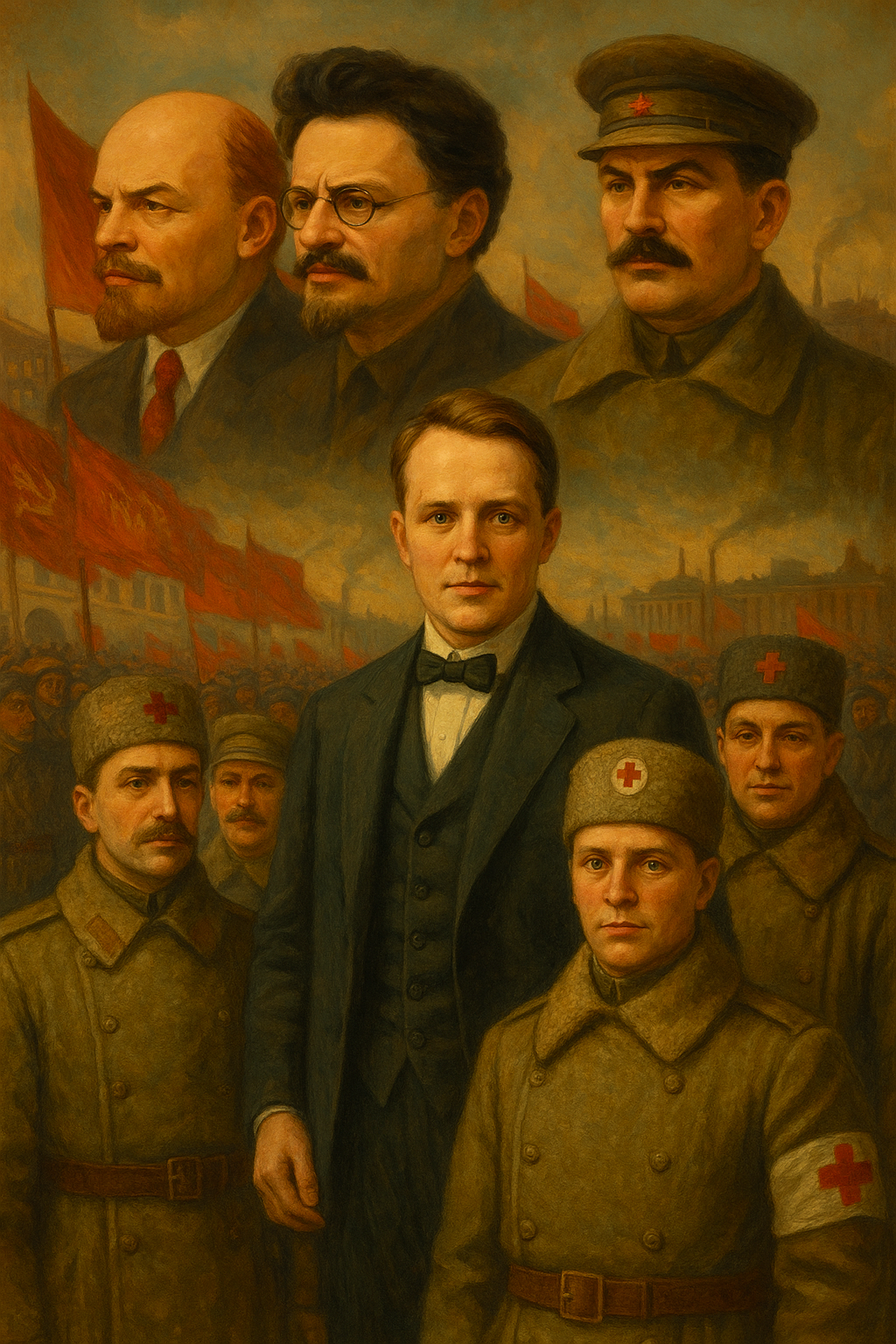
http://www.mudriyfilosof.ru/2014/07/filosofiya-avgustina-avreliya.html, free. ↑
https://studopedia.ru/10_141866_yan-tinbergen—nobelevskiy-laureat-i-avtor-doklada-rimskomu-klubu.html, free. ↑
https://cyberleninka.ru/article/n/kontseptsiya-transformatsii-sovremennyh-sotsialnyh-konfliktov-lyuisa-krisberga, free. ↑
https://books.google.ru/books?id=t2UkDQAAQBAJ&pg=PT214&lpg=PT214&dq=%D0%BB%D1%83%D0%B8%D1%81+%D0%BA%D1%80%D0%B8%D1%81%D0%B1%D0%B5%D1%80%D0%B3&source=bl&ots=yDlmA-7uLG&sig=tBeJ0H7v8mkISCTOZnW_A08QzM8&hl=ru&sa=X&ved=0ahUKEwiKkNeym_jaAhVIbrwKHeR_DlMQ6AEITjAG#v=onepage&q=%D0%BB%D1%83%D0%B8%D1%81%20%D0%BA%D1%80%D0%B8%D1%81%D0%B1%D0%B5%D1%80%D0%B3&f=false, free. ↑

