Articles that inspire and inform!
Publisher of POLIS LLC
Address: 190000, Saint Petersburg,
35/15 Kazanskaya Street
Publisher of POLIS LLC
Address: 190000, Saint Petersburg,
35/15 Kazanskaya Street

ISSN 3033-7666 (Print)
ISSN 3033-7674 (Online)
No 8, November 2025
CERTIFICATE OF THE FEDERAL SERVICE FOR SUPERVISION IN THE FIELD OF COMMUNICATIONS,
INFORMATION TECHNOLOGY AND MASS COMMUNICATIONS (ROSKOMNADZOR)
Эл № ФС77-87449
ELECTRONIC SCIENTIFIC PERIODICAL EDITION (ST. PETERSBURG, RUSSIA)
16+
The journal is registered and published in Russia
The journal publishes articles in all scientific fields
The journal is published in Russian and English
All articles are peer-reviewed
Free access to the electronic version of the journal
By sending an article to the editorial board, the Author confirms its uniqueness and bears full responsibility for it
Editorial staff
Editor-in-Chief
Vorontsov, Vladimir Valentinovich
Managing Editor
Ivanov, Maxim Dmitrievich
Executive Secretary
Kholmanskikh, Maria Viktorovna
Reviewers
Pyrkh, Andrey Ivanovich,
Ph.D., St. Petersburg State University
Dimitrienko, Andrey Igorevich,
Ph.D., First St. Petersburg State Medical University named after Academician I.P. Pavlov
_____________________________________________________________________________
Contacts
 190031, Russia, St. Petersburg, Kazanskaya str., 35, lit. A, apt. 15
 +7 931 712-95-96
 nxxivek@inbox.ru
_____________________________________________________________________________
© Founder: Limited Liability Company “Polis” (OGRN 1097847170871)
190031, St. Petersburg, ext. Ter. Admiralteysky Municipal District, Kazanskaya St., 35, lit. A, apt. 15
Content
Cover image generated by LLM GPT-5, copyright ©: Adel Kildeev © 2025, Adel Kildeev © 2025, permission to use the images by the journal has been obtained.
Kildeev Adel. Yakov Sverdlov – the gray cardinal of Lenin…………………………..3
Kildeev Adel. Legal regulation of the mining industry in Peru, Chile and the Russian Federation: a comparative analysis……………..……….……………………….……16
Korablin Andrey Vladimirovich. In Memory of Professor Yuri Kirillovich Tolstoy…..…………………………………………………………………………….32
УДК: 94 (47):323.2:929
YAKOV SVERDLOV – THE GRAY CARDINAL OF LENIN
Kildeev Adel
Zhdanov A. Leningrad State University (1990)
Philosophiæ Doctor in Law
ORCID: 0009-0001-2211-4944
Abstract: The article is devoted to the political biography of Yakov Mikhailovich Sverdlov (1885–1919), one of the most influential and at the same time the most radical figures of the early Soviet state. On the basis of documentary sources and critical historiography, his path from participation in underground combat groups and the organization of terrorist actions to the leadership of the party apparatus, the All-Russian Central Executive Committee and the system of punitive bodies is revealed. Its key role in unleashing mass terror, creating mechanisms of repression, escalating violence in the countryside and the political decision to liquidate the Royal Family is shown. The reasons for the rapid growth of his influence, connections with foreign structures and the ambiguous circumstances of his death are analyzed.
Keywords: Yakov Sverdlov, Bolshevism, political history of Russia, the revolution of 1917, the All-Russian Central Executive Committee, the Cheka, the Red Terror, relations between Lenin and Sverdlov, the murder of the Romanovs, the Soviet apparatus of power, the inner-party struggle.
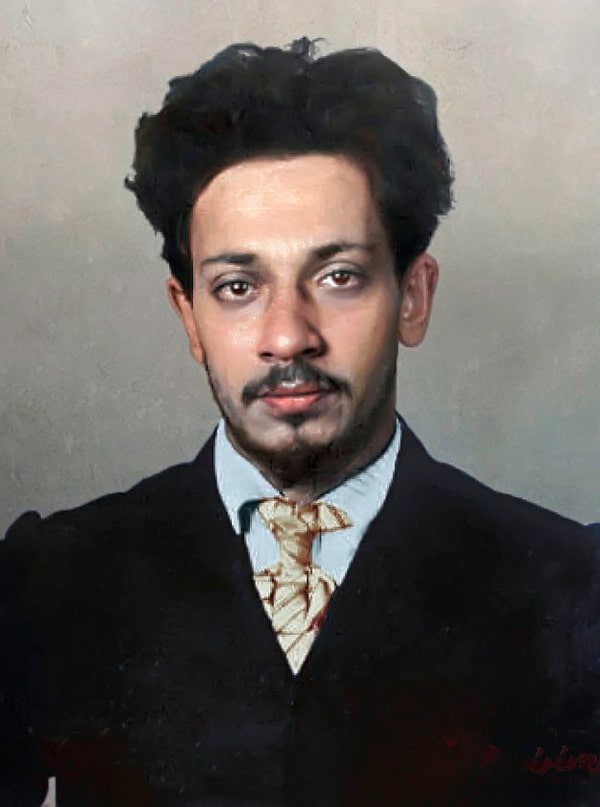
Y.M. Sverdlov in his youth
1. Nationality, origin and social environment
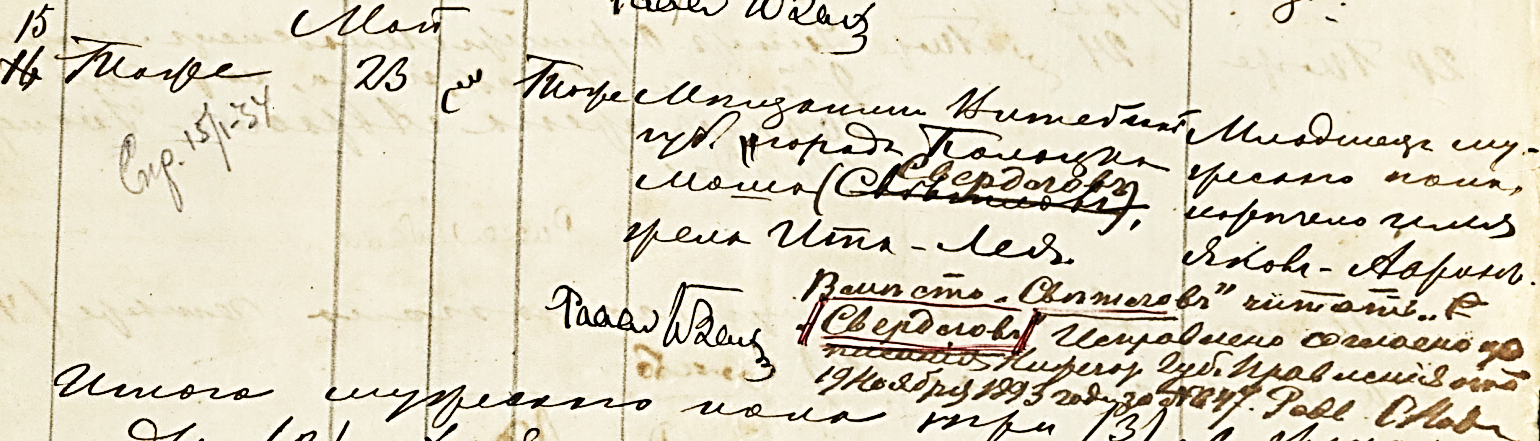
Entry No 15, made by the official rabbi of Nizhny Novgorod B.I. Zakhoder in the Metrical Book of the Jewish Rabbi of Nizhny Novgorod for 1885 with a record of the birth of Yakov-Aaron Sverdlov on May 23, 1885 in Nizhny Novgorod “a male baby, named Yakov-Aaron”. Parents: a bourgeois of the Vitebsk province of the city of Polotsk Mosha Svetlov (crossed out and written above “Sverdlov”) and his wife Ita-Leia. Below is a postscript: “instead of “Svetlov” read “Sverdlov”. Corrected in accordance with the order of the Nizhny Novgorod provincial government of November 19, 1893 for No 647. Rabbi S. Y. Nadelman.” The rite of circumcision was performed by Itzhok Podisko.
Yakov-Aаron Moiseevich Sverdlov was born on May 22 (June 3), 1885 in Nizhny Novgorod. He grew up and was brought up in a simple Jewish family. His father, Moisey Izrailevich, worked as an engraver, and also owned a printing house. His mother, Elizaveta Solomonovna, was engaged in housekeeping. In addition to Yakov, two more girls and 3 boys were born in the Sverdlov family. The future revolutionary graduated from 4 classes of the local gymnasium, but after that he was forced to quit his studies, since his father no longer had the means to pay for the education of his sons. By that time, Yakov’s mother had died, after her death, Moisey Izrailevich Sverdlov converted to Orthodoxy and married Maria Alexandrovna Kormiltseva for the second time, in this marriage two more sons were born. As a teenager, Yakov and his brothers began to work. However, Yakov did not go to work at the factory, like many of his peers. He became an apprentice pharmacist.
The Sverdlov family, however, did not belong to the “poor” traditionally present in Soviet biography. The Sverdlov family had stable handicraft and credit-cooperative ties in Nizhny Novgorod. Other relatives of Sverdlov on the maternal side had connections with the banking structures of the Volga region. Thus, the social origin of the future Bolshevik leader was much more complex than the official Soviet version.
At the beginning of the twentieth century, Movsha Sverdlov took as his apprentice engraver a young man named Hershel Gershelevich Yehuda, who later turned into Genrikh Genrikhovich Yagoda, the future bloody head of the OGPU. Yagoda, despite the fact that he robbed his master twice, managed to become related to the Sverdlov family, marrying Yankel’s niece, Ida Averbakh.[1]
The figure of Zinovy (Yeshua-Solomon) Peshkov, Y. M. Sverdlov’s paternal brother and godson of A. M. Gorky, who later became an officer of the French army and a diplomat, and who fought against the Soviet regime, deserves special mention. Historian Roy Medvedev in his essay “The Sverdlovs. The Glory and Tragedy of One Family” writes about him as follows: “Zinovy, the godson of Maxim Gorky, met the October Revolution with hostility. During the Civil War, Zinovy visited Soviet Russia more than once as an emissary of the French government and intelligence.” Zinovy served in Omsk as an adviser to the headquarters of Admiral Kolchak. In early 1919, a French military emissary sent a telegram to his brother threatening to hang Yakov and Lenin for what they had done to Russia. After the Siberian campaign ended with the victory of the Red Army, Zinovy went to the disposal of General Wrangel, but only found the evacuation of his army from the Crimea to Turkey.[2]
As for Yakov’s second brother, Veniamin (Benjamin, Ben, Beni) Sverdlov, he left for the United States before the revolution and opened a bank there. After the revolution, American political agents gave the following information about V. M. Sverdlov: “The Office of Special Agents of the New York Branch. Ministry of Foreign Affairs (confidential). Mr. Bannerman Chief Special Agent. Washington.
Reilly has business relations with Veniamin Mikhailovich Sverdlov. On January 15, 1916, Sverdlov arrived in the United States aboard the steamer St. Paul. He brought with him a sealed package from Colonel Belyaev, a Russian, addressed to General Germonius, who was connected with some Russian delegations in the United States. Sverdlov was engaged in revolutionary activities in Russia in the past. He lived in England for four years and visited Russia in 1915. He knows Siberia well.
While in the U.S., he worked at the Flint & C office at 120 Broadway, which owned the building. He is the brother of a prominent communist from Soviet Russia – Sverdlov. While in London, in a private conversation, he said that he was going with two people to New York to buy ammunition, but would sail to America separately from these persons.
He received about one thousand dollars for the trip. He arrived in Flint & Co. with the recommendations of his partner T. Marshall from London, whose interests were financed by money received from the sale of Ural oil. At the beginning of the war, Marshall and Sverdlov often had information about the movement of troops, military operations in England and Russia.”[3]
2. Early revolutionary activity (1902–1917)
According to official historiography, since 1902, at the age of 15, Sverdlov joined the work of the RSDLP, occupying mainly organizational positions. A couple of years later, he became a professional revolutionary, conducting successful Bolshevik propaganda in various cities. And what exactly did the young Yakov do in the RSDLP? We will now omit the official historiography, its value is equal to the value of the Short Course of the History of the Military-Industrial Complex (Bolsheviks), just as fabricated and fake.
The reasons that led Sverdlov to the revolution are vague. The tired lie about “official Russian anti-Semitism” is refuted by Sverdlov himself, who wrote in one of his letters: “I personally have never known national oppression, I have never been persecuted as a Jew.”[4] No, the reason for Sverdlov’s revolutionary spirit was hatred, and a hatred that was deep and ancient, a feeling that his father undoubtedly cultivated in young Yakov. Hatred for Russia, the Russian people.
What revolutionary organizations did Sverdlov join? This question is very confusing and mysterious, as, by the way, is the whole life of Sverdlov. According to the official Soviet canonical biography of Sverdlov, he acted as a member of the Bolshevik Party from the very beginning. However, there is no evidence that Sverdlov was a member of the RSDLP before 1917.
In his leaflets, he signed himself as a “social democrat”, or “group of social democrats”. Most likely, in those years, Sverdlov had nothing to do with the Bolsheviks. He represented the interests of secret organizations in the West, specifically the inhabitants of the skyscraper on Broadway-120, the same Schiff, Leibe, Colonel House, and so on. It was this force that organized entire armed groups of its fighters in Russia.
In the Urals, on the eve of the revolution of 1905, Sverdlov created an organization called the Combat Detachment of People’s Armament (BONV), which became one of the most criminal and bloody organizations of the revolution of 1905-07. This organization was formally subordinate to the combat center, which included M. Lurie, E. S. Kadomtsev, and M. I. Gubelman (Yaroslavsky).
But in fact, the absolute master in it was Sverdlov, who acted under the nicknames “Comrade Andrei” and “Mikhailovich”. In BONV, “as in the classical mafia or in the Masonic orders, several levels of initiation into the secret of the organization were created. Sverdlov was the leader of all anti-government actions in the Urals.
The head of the Perm Okhrana department wrote to his superiors that “Comrade Andrei” or “Mikhailovich” “after the announcement of the Most Merciful Manifesto on October 17, 1905, led all the riots that took place in Yekaterinburg and constantly presided over and oratored at all the meetings of a revolutionary nature that took place there…”[5]
In the leadership of the militants, Sverdlov relied on monstrous cruelty. When one of the members of the organization, Ivan Bushenov, expressed disapproval of Sverdlov’s methods, he said in an ominously calm voice: “Do you, Vanyusha, want to make a revolution in white gloves? Without blood, without shots, without defeats?”[6]
All members of the Yekaterinburg organization of the RSDLP who did not agree with Sverdlov’s bloody methods were in one way or another pushed out of business.
Many accomplices in the Yekaterinburg crime of 1918 went through the Sverdlovsk school. He gladly attracted criminals and any anti-social element to his ranks. O. A. Platonov cites the memoirs of the Social Democrat N. A. Chedyntsev, who was in prison with Sverdlov: “Sverdlov does not disdain to enter into friendly relations with inveterate criminals. Whispers to them. He agrees on something.”[7]
“Desperate Urkagans,” writes E. Khlystalov, “with aces of diamonds on their backs, were afraid of the frail bespectacled Sverdlov. He did not forgive insults. In the surviving photograph, Sverdlov is sitting in a prison cell on a bunk bed in front of the thieves in law, folding his legs in the Turkish way, according to the thieves’ tradition.[8]
Of course, at that time Sverdlov acted independently, without relying on any Bolshevik structures, which actually did not exist in the Urals at that time.
It was during the years of the first Russian revolution that Yakov Sverdlov created and organized his own forces in the Urals, which would play an important role in organizing the murder of the Royal Family.
After the defeat of the revolution, in 1906, Sverdlov was arrested and sentenced to two years in prison. In March 1910, Sverdlov was exiled to the Narym Territory for a period of three years. In the same year, he wrote a petition to replace his period of stay in exile with exile abroad, which is very similar to returning to his own people after completing the task.
Sverdlov was refused, and he was exiled to Narym, where he met Sh. I. Goloshchekin, who later became Sverdlov’s closest accomplice in organizing the Yekaterinburg crime.
In July of the same 1910, Sverdlov escaped from exile, he was caught, returned back, he escaped again, he was again caught and exiled for five years to the Turukhansk region, where he met I. V. Stalin.
By the way, mutual rejection immediately arose between Sverdlov and Stalin. In the Turukhansk region, Sverdlov was caught by the February “revolution”. In March 1917, he left Turukhansk for Krasnoyarsk. There, according to Sverdlov’s official Soviet biography, he “exposes the Menshevik-SR compromisers.” In this regard, the researcher German Nazarov writes very correctly: “Who among the Bolsheviks in Krasnoyarsk knew Sverdlov, who had been in exile with short breaks for about seven years?
It is known that in the Bolshevik faction of the RSDLP in the days of the February Revolution there were 14,000 workers, almost 6,200 employees, a little more than 1,800 peasants and 1,500 representatives of other social strata.
In a number of cities and regions of the country, especially in non-industrial centers, the Bolsheviks were members of joint organizations with the Mensheviks. And in Krasnoyarsk there were almost none.”[9]
After spending a very short time in Krasnoyarsk, Sverdlov left for Petrograd, and then for Yekaterinburg. After staying in the city for only two weeks, Sverdlov organized a single party organization there.
According to Sverdlov himself, he showed ebullient energy in Ekaterinburg, and the Bolshevik party organization grew during April from several hundred to 14 thousand members.[10]
This raises great doubts. First, why did the workers rush so massively into the ranks of the Bolsheviks, an organization more than small and unpopular in those days? Secondly, from the documents of that era, it is nowhere seen that Sverdlov associated himself as a Bolshevik-Leninist.
He was even elected to the All-Russian April Conference of the RSDLP(B), not as a Bolshevik, but as “the favorite of the Ural workers.” It seems that Sverdlov arrived in Yekaterinburg to unite his bandits from 1905 into a legal organization.
Thus, with all his activities, Sverdlov rendered great assistance to the revolution. At the same time, being under the banner of social democracy, Sverdlov pursued his own far-reaching goals, known only to a small circle of people.
To do this, he used a Bolshevik signboard. Sverdlov’s Soviet biographers Gorodetsky and Sharapov, apparently without suspecting it, very aptly characterized this activity of Sverdlov: “For a decade and a half until October 1917, Sverdlov worked in Russia.
He did not have a chance to attend a single party congress, although he was an all-Russian worker. His work before the revolution was invisible, according to the apt definition of Lunacharsky. This was precisely the daily work that gradually prepared the revolution.”[11]
Returning to Petrograd again, Sverdlov participated in the 7th April Conference of the RSDLP(b), where he met Lenin for the first time. At the conference, Sverdlov was elected secretary of the Central Committee, which caused sharp opposition from Lenin.
Trotsky writes that later, when Lenin “appreciated” Sverdlov, he said: “But at first we were against his introduction into the Central Committee, we underestimated the man to such an extent! There were considerable disputes on this score, but from below we were corrected at the Congress and turned out to be completely right.”[12]
In fact, it is still unclear who “corrected” Lenin and persuaded him, or forced him, to include Sverdlov in the party leadership. Perhaps these are the forces that brought Lenin, the German spy, to power. But it was from this moment that the rapid career growth of Yakov Sverdlov began.
Being neither a major organizer and theoretician of the party, nor an outstanding orator, the thirty-two-year-old Sverdlov immediately and firmly moved to the forefront of the Bolshevik leadership.
Although, from his report to the Sixth Party Congress, it is obvious that he was poorly versed in the party alignment of forces and even did not know well who the Bolsheviks were, this word is never found in Sverdlov’s report. Sverdlov was more oriented towards the so-called “Mezhraiontsy”, among whom were Trotsky, Lunacharsky, Ioffe, Manuilsky. Sverdlov was clearly promoted by some force to which neither Lenin nor most of the Bolsheviks had a direct relation.
From the very beginning, Sverdlov’s dictatorial habits manifest themselves. He clearly set himself the task of becoming the first person in the party. It came to the point that Sverdlov ignored Lenin. Together with Trotsky, he did everything to prevent Lenin from entering the premises of the Smolny on the eve of the October Revolution.
4. Chairman of the All-Russian Central Executive Committee: Actual Role in Management
On October 27 (November 9), 1917, on the second day after the coup, at the first meeting of the All-Russian Central Executive Committee, L. V. Kamenev (Rosenfeld) was elected Chairman. But Kamenev did not stay in his position for a very long time. Eleven days later, he was removed from his post, in connection with “a disorganizing policy and insubordination to the Central Committee.” On November 8 (21), 1917, Lenin, unexpectedly for everyone, proposed Sverdlov’s candidacy for the post of chairman of the All-Russian Central Executive Committee.
From that moment on, Sverdlov acquired a de facto equal position with Lenin, and in some issues, of course, he had more power than Lenin. Karl Radek (Sobelson) recalled: “When I arrived in Petrograd in November 1917 and talked with Vladimir Ilyich about the state of affairs abroad, I asked him with whom to talk about all the work, he answered me simply: “With Sverdlov.”[13]
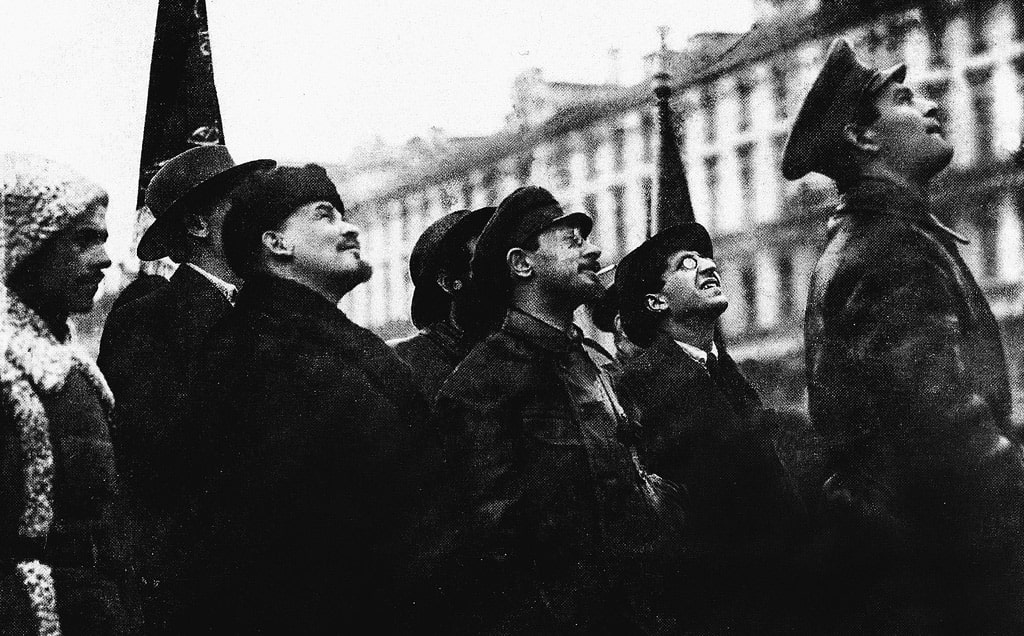
Lenin and Sverdlov
It is no accident that Lenin, delivering a speech in memory of Sverdlov on March 18, 1919, said the following: “None of those who knew intimately, who observed the constant work of Yakov Mikhailovich, can doubt that in this sense Yakov Mikhailovich is irreplaceable. The work which he did alone in the field of organizing, selecting people, appointing them to responsible posts in all the various specialties — this work will now be within our power only if you put forward whole groups of people for each of the large branches in which Comrade Sverdlov was in charge alone, who, following in his footsteps, would be able to approach the point where what one person was doing.”[14]
Interestingly, it was Sverdlov who was perceived by many foreign circles as the most influential person in the Soviet hierarchy. And this was not at all caused by the fact that he officially held the post of head of the Soviet state.
Almost all the leading powers of the world, with the exception of Germany, Austria-Hungary and Turkey, did not recognize the Bolshevik regime. But, nevertheless, some of them, immediately after the October Revolution, hastened to assure the leaders of this regime of their respect. In March 1918, U.S. President Wilson sent a telegram of greetings to Sverdlov to the Congress of Soviets that opened in Moscow. In essence, it was the recognition by the U.S. government of the Bolshevik regime as the legitimate Russian government.
But, what the Frenchman Noulens took as an “unsuccessful initiative” of President Wilson, in fact, was an expression of support from the same Broadway-120 protégés in Russia. But it was not only the American president who singled out Sverdlov from the total number of Soviet figures. The main thing is that Sverdlov had already been appointed to replace Lenin by businessmen from Wall Street.
The German ambassador, despite the fact that Lenin and not Sverdlov was a creature of Germany, nevertheless “conducted the most important business mainly with Sverdlov, and not with Lenin. Mirbach was given a detailed report of the Extraordinary Commission on a daily basis, which gave it a complete picture of what was happening in the country.”[15]
Despite this, Sverdlov behaved even with Mirbach as an authoritative ruler. Mirbach himself wrote to Berlin about his impression of the meeting with Sverdlov during the presentation of his credentials: “The presentation of my credentials took place not only in the simplest, but also in the coldest. In his response, the Chairman expressed the expectation that I would “be able to remove the obstacles that still stand in the way of genuine peace”. There was a hint of indignation in these words. At the end of the official ceremony, he did not invite me to sit down and did not deign to give me a private conversation.”[16]
“With each passing month,” writes Y. G. Felshtinsky, “Sverdlov’s power grew stronger and stronger. Chairman of the All-Russian Central Executive Committee, member of the Central Committee, secretary of the Central Committee, Sverdlov gradually concentrated all party work in his hands.
His signature appears under documents more often than others. From July 1918, he signed with the titles: Secretary of the Central Committee of the Russian Communist Party (Bolsheviks) or even just “Secretary”; “for the secretary” is signed by K. Novgorodtseva, Sverdlov’s wife; more and more often letters are sent to the localities in the name of the “Secretariat of the Central Committee” (and not the Central Committee, as was customary before August 1918 and after September 1918).[17]
On April 8, 1918, Sverdlov virtually single-handedly abolished the national Russian white-blue-red flag, approved as the state flag by Emperor Nicholas II at the beginning of the First World War, and approved as a new one a red cloth with Masonic-occult symbols: a pentagram and a hammer.
5. Relations with the Cheka and the policy of repression
Formally, the Cheka was subordinate to the Council of People’s Commissars and Dzerzhinsky. But the political line of the Cheka in 1918 was largely determined by Sverdlov as chairman of the All-Russian Central Executive Committee, which is recorded in a number of documents.[18]
Sverdlov personally approved the leaders of the regional Cheka; coordinated punitive measures; supported the introduction of emergency powers. It was Sverdlov who played a key role in the transition from targeted repressions to the systemic “red terror”.
It is Sverdlov who introduces the terrifying Chekist leather uniform. Sverdlov himself, according to Trotsky, “walked in leather from head to toe, i.e. from boots to a leather cap.”
On July 6, under the most mysterious circumstances, the German ambassador, Count Mirbach, was killed. Adventurer V. N. Orlov, who posed as a White counterintelligence officer who illegally operated in the Cheka in 1918 and for unknown reasons had close ties with the Bolshevik leadership, recalled: “In July 1918, when I was interrogating agents in the Cheka building, a messenger brought a telegram addressed to Dzerzhinsky, who was next to me. He read it quickly, turned pale as death, jumped to his feet, and, exclaiming, “They’re acting again without consulting me!” rushed out of the room. What happened? The whole Cheka was agitated. Shouts, exclamations, calls merged into a single hubbub! Dzerzhinsky hurried to the Kremlin. What happened for the sake of all that is holy? The next day we learned the news. The imperial family was shot without the knowledge of the Cheka! Independently, on the instructions of Sverdlov and one of the top bosses in the Central Committee of the Communist Party!
According to the general opinion in the Cheka, in the Revolutionary Tribunal and the Kremlin, the decision to kill was made and implemented by the authorities of Sverdlov. He carried out the preparations in secret from his comrades and only after the execution did he present them with a fait accompli.”[19] On the very eve of the murder, in July 1918, Sverdlov became an ardent supporter of the widespread use of the death penalty.[20]
In May 1918, Sverdlov initiated the beginning of a fratricidal war in the countryside. In his report “On the Tasks of the Soviets in the Countryside,” Sverdlov said: “We must most seriously pose to ourselves the question of stratification in the countryside, the question of the creation in the countryside of two opposing hostile forces, and set ourselves the task of opposing the poorest strata of the population in the countryside to the kulak elements. Only if we succeed in splitting the countryside into two irreconcilably hostile camps, if we can stir up the same civil war there that was going on not so long ago in the towns, if we succeed in rousing the rural poor against the rural bourgeoisie, only then can we say that we are doing to the countryside what we have been able to do for the towns. (…) I have no doubt that we will be able to raise the work in the countryside to the proper level.”[21] And the work was put “at the proper level”: scenes of unprecedented arbitrariness and violence began in the villages.
Sverdlov clearly sought to seize power. He clearly became the main protégé of the world backstage, the person who was supposed to become the leader of a new state formation that would arise in the place of Russia. The murder of the Royal Family seemed to give Sverdlov the “green light” to prepare a new, and, as he assumed, final victorious round of the struggle for power.
On August 26, 1918, Sverdlov sent a letter to the Vologda Committee of the Russian Communist Party (Bolsheviks), signing it with a new title: “Chairman of the Central Committee of the Russian Communist Party Y. Sverdlov.”[22] This was the time when it was Sverdlov, not Lenin, who was called the “Red Tsar”.
6. The attempt on Lenin’s life and the growth of Sverdlov’s influence
Sverdlov’s role during the assassination attempt on Lenin on August 30, 1918 is very confusing and strange.
The Russian researcher V. E. Shambarov directly points to Sverdlov’s attempt to kill Lenin in order to completely seize power. “If you look at who benefited from the elimination of Lenin at that moment, Sverdlov benefited the most. After the assassination attempt, Sverdlov was the first to arrive at the Kremlin. Sverdlov’s wife reports that that same evening he occupied Lenin’s office, crushing the Council of People’s Commissars, the Central Committee, and the All-Russian Central Executive Committee.”[23]
R. Medvedev writes the same in his article: “When Lenin was seriously wounded by the SR Kaplan, Sverdlov became the de facto head of the Soviet state for several weeks.”[24]
It is Sverdlov who conducts a hasty investigation into the “case” of F. Kaplan, and it is on his order that Kaplan is quickly shot and burned in a barrel on the territory of the Kremlin. By the way, this method of covering up traces in the Sverdlovsk way, that is, the burning of corpses, unwittingly leads us to Ganina Yama.
Of course, Sverdlov was not able to act alone. It was in those days that Sverdlov unleashed a monstrous terror against the Russian people, which he called the “red terror” and it was under the rule of Sverdlov that the Cossacks (mass repressions against the Cossacks and their families) were carried out.
Sverdlov was very close to the “red coronation”. The fact that it was Sverdlov who was to become the head of the “new Khazaria” was openly said by such a well-known Jewish communist as Louis Aragon: “Yakov Mikhailovich Sverdlov,” he wrote, “is the most loyal comrade of Lenin, who became the first chairman of the Central Executive Committee, that is, the first head of the new Soviet state, and who, to the misfortune of the whole world, was to die of the Spanish flu at the age of thirty-four. I said ‘to the misfortune of the whole world’ because, of course, if he had survived, Sverdlov, not Stalin, would have succeeded Lenin.”[25]
In case of failure, Sverdlov was ready to disappear from the blood-soaked country at any moment. It is quite possible that this was part of the plans of their foreign masters. Drained of blood, robbed and dismembered, Russia was supposed to receive a protégé of the secret forces of the West. Who it would be: the Bolshevik leader, or the White general – in general did not matter to them.
The main thing is that both continue to ensure control over Russia for the West, pumping out natural and material resources from it. Hints of such a decision can be heard in a letter from J. Schiff, which he wrote to the editor of the Paris newspaper La Tribune Juive: “It is obvious,” he wrote, “that if we do not help those elements who are fighting so heroically today in Russia to defeat the forces of anarchy and disorder that have established themselves today as the Russian government, and if we do not contribute to the establishment of a genuinely democratic government in place of these forces, which alone can save Russia, the present regime, which cannot be eternal, will be replaced by a reactionary power, as intolerable as the Romanovs, whose autocracy has brought so much poverty and suffering to the Russian people.”[26]
But Lenin, having miraculously survived the assassination attempt, struck back at Sverdlov. On March 3, 1919, Sverdlov, after returning from the city of Oryol, where, according to one official version, he caught a cold while speaking at a rally, and according to another, he was beaten to death by workers, died suddenly, and died in severe agony, in constant delirium (The official version is the Spanish flu (Izvestia of the All-Russian Central Executive Committee, March 17, 1919).
However, numerous researchers note anomalies:
absence of autopsy;
lack of investigation;
incomplete documentation;
the rapid transfer of powers to Stalin;
closed nature of the funeral.
Five years later, Lenin followed Sverdlov and power completely passed into the hands of Stalin. Look for who benefits…
On July 27, 1935, the People’s Commissar of the NKVD G.G. Yagoda handed over to the General Secretary of the Central Committee of the All-Union Communist Party (Bolsheviks) I.V. Stalin the following secret note: “Sov. secretly. Secretary of the Central Committee of the All-Union Communist Party (Bolsheviks) Comrade Stalin. In the inventory warehouses of the commandant of the Moscow Kremlin, the fireproof cabinet of the late Yakov Mikhailovich Sverdlov was kept locked. The keys to the wardrobe were lost.
On July 26 of this year, we opened this cabinet and it turned out:
1. Gold coins of the tsarist mintage in the amount of one hundred eight thousand five hundred and twenty-five (108,525) rubles.
2. There are seven hundred and five (705) pieces of gold, many of them with precious stones.
3. Seven blank forms of passports of the tsarist sample.
4. Seven passports completed in the following names:
a) Sverdlov Yakov Mikhailovich
b) Gurevich-Cecilia Olga
c) Grigorieva Ekaterina Sergeevna
d) Princess Baryatinskaya Elena Mikhailovna
e) Polzikov Sergey Konstantinovich
f) Romanyuk Anna Pavlovna
g) Klenochkin Ivan Grigorievich
5. One-year passport in the name of Adam Antonovich Goren
6. A German passport in the name of Elena’s Steel.
In addition, royal credit notes were found for only seven hundred and fifty thousand (750,000) rubles.
People’s Commissar of Internal Affairs of the USSR (Yagoda)
July 27, 1935
No56568”.[27]
7. Conclusion
Yakov Sverdlov is a figure who stood at the foundation of Soviet statehood. He was not only Lenin’s “gray cardinal,” but the structural architect of power, the man who created an apparatus that outlived both him and Lenin. His brief political biography demonstrates the transition of the revolution from ideology to apparatus; the formation of a centralized management model; the mechanisms of violence as an instrument of policy; conflict between two types of leadership – ideological and administrative.
For the analysis of the nature of the Bolshevik power, the figure of Sverdlov is key. And in an alternative version of history, he could well have led the Soviet state, eliminating all the other leaders: Trotsky, Stalin, Zinoviev, Kamenev, Bukharin, and arranging an even greater genocide of the Russian people than even Comrade Stalin. But history does not have a subjunctive mood, and it should not be patriotic, as Mr. Medinsky claims, but should be true. Only then it is a real historical science, and not propaganda.
References
Электронный ресурс: https://vk.com/@dusharussckaya-chernoe-semeistvo-yakov-sverdlov-i-ego-bratya
Электронный ресурс: https://history1752.su/zinovij-peshkov-on-zhe-sverdlov-on-zhe/
Городецкий Е., Шарапов Ю. Свердлов. ЖЗЛ, – М., 1971.
Литературная Россия, № 11, март 2002 г.
Платонов О. А. Терновый венец России. История цареубийства. – М., Энциклопедия русской цивилизации, 2001.
Кубань, № 2, 1991
Яков Михайлович Свердлов. Сборник воспоминаний и статей. – М., 1926
Ленин В. И. Полн. Собр. Соч. Издание 5е, т. 38.
Вильтон Р. Последние дни Романовых. – М., 1999
Вопросы истории, 1978.
Фельштинский Ю. Г. Вожди в Законе. – М., «Терра», 1999
Лацис М. Я. Два года в ЧК. – М., 1921
Орлов Владимир. Двойной агент. Записки русского контрразведчика. – М.: Современник, 1998.
Свердлов Я. М. Избранные произведения. – М., 1976.
Известия ЦК КПСС, № 5, 1989, с. 155
Шамбаров В. Е. Оккультные корни Октябрьской революции. – М.: Алгоритм, 2006.
Ленинское знамя, 12 ноября 1989 г.
Пархомовский М. Сын России, генерал Франции. Об удивительной жизни Зиновия Алексеевича Пешкова и необыкновенных людях, с которыми он встречался. – М., 1989.
Источник. Документы по русской истории, 1994, № 1.
UDC: 622:349.6
LEGAL REGULATION OF THE MINING INDUSTRY IN PERU, CHILE AND THE RUSSIAN FEDERATION: A COMPARATIVE ANALYSIS
Kildeev Adel Khanyafievich
A.A. Zhdanov Leningrad State University (1990)
PhD in Law
ORCID: 0009-0001-2211-4944
Abstract: The article provides a comparative analysis of the legal regulation of mining activities in Peru, Chile and the Russian Federation. The legal nature of the right to subsoil use, the procedure for obtaining it and negotiability, as well as fiscal conditions and mechanisms of state investment guarantees are considered. It is shown that the concession models of Peru and Chile provide greater flexibility and predictability for investors, while the Russian system preserves the administrative nature of access to subsoil. Conclusions are made about the impact of these differences on the investment attractiveness and efficiency of projects.
Keywords: subsoil use; concession; royalties; mining law; investment attractiveness; fiscal regime; Peru; Chile; Russian Federation; ownership of subsoil; stabilization of the tax regime.
Use of artificial intelligence
In preparing this article, artificial intelligence tools — the ChatGPT (OpenAI, 2025) and Gemini (Google DeepMind, 2025) models — were used exclusively for technical and editorial support: language optimization, link structuring, and terminology unification. All scientific conclusions, interpretations and analytical generalizations belong to the author and reflect the results of his own research work.
Chapter 1. Introduction
The mining industry is a key element of economic development and public policy, determining the nature of the use of natural resources, the structure of exports and investment dynamics. However, the systems of legal regulation of subsoil use vary significantly from country to country. These differences determine the parameters of access to the mineral resource base, the degree of protection of property rights and the possibility of attracting capital to mining projects.
Chile and Peru are developing models focused on the civil negotiability of mining rights, where registration mechanisms, transparent procedures for the acquisition and transfer of concessions, and the availability of security instruments (including mortgages for mining rights in Chile) play a key role. In both jurisdictions, the state retains control over the subsoil and may revise the terms of use for environmental protection or fiscal policy purposes. However, these decisions are usually made within the framework of procedural regulatory mechanisms, which reduces the level of uncertainty for private capital.
In the Russian Federation, access to subsoil is also regulated by a licensing system, including geological survey, exploration and production. The state retains the ability to change the conditions of subsoil use, including the revocation of licenses or the revision of development parameters, including on environmental and social grounds. These tools are not unique to Russia, but the degree of administrative discretion and the practical dependence of the project’s viability on relations with the regulator may have a more significant impact on the investor’s risk assessment.
Thus, in all three countries under consideration, the state exercises control over the subsoil, including the potential possibility of termination or change of mining rights. The differences lie not in the fact of state participation itself, but in the scale of procedural certainty, the level of institutional predictability and the availability of mechanisms for protecting the property interests of investors. A comparison of the legal regulatory regimes of the mining sector in Peru, Chile and the Russian Federation makes it possible to determine which conditions create greater sustainability of capital investments, and which create additional regulatory risks, as well as to develop proposals for improving Russian legislation in the field of subsoil use.
Chapter 2. Legal Framework for Access to Subsoil and the Content of Subsoil Use Rights in Peru
The legal regime for the use of mineral resources in Peru is based on a combination of state sovereignty over the subsoil and the private nature of the mining concession, which is recognized as an alienable property right subject to registration and circulation.
2.1. Constitutional Provisions
According to Article 66 of the Political Constitution of the Republic of Peru (1993),[28] natural resources located in the subsoil are under the sovereign management of the state. The state may grant private persons the right to use them on the basis of a concession, which must be formalized and operate in accordance with the procedure established by law.
This is a fundamental element of the Peruvian model: the state does not transfer ownership of the subsoil, but transfers the right to extract and appropriate minerals, which has a property value, can be the subject of a transaction, pledge and investment valuation.
2.2. Basic Law on Subsoil Use
The basic regulatory document is the General Mining Act (Texto Único Ordenado de la Ley General de Minería, D.S. Nº 014-92-EM).[29]
It fixes the stages and forms of implementation of mining activities:
The general principle is formulated in Articles 8-11 of the Law:
A mining concession is a property right that can be:
Thus, Peruvian law does not consider concession as a mere administrative authorization, but as an asset with economic value and legal negotiability.
2.3. What does the subsoil use right consist of?
A law is a package of powers, which is formalized in the following stages:
2.4. State registration of rights (INGEMMET)
The transfer of rights to a concession is subject to mandatory registration with the National Geological, Mining and Metallurgical Institute
(INGEMMET — Instituto Geológico, Minero y Metalúrgico).
Registration performs three functions:
The registry system is a key element of predictability: legal protection is provided not by personal ties with the state, but by presence in the register.
2.5. Obligations of a subsoil user and grounds for termination of rights
A concession entails obligations established by law:
The right may be terminated only on the grounds provided for by law, for example:
Each termination is formalized by an administrative act subject to appeal in court.
Thus, termination is not arbitrary – it must be procedurally and documented.
2.6. Ecology and permits
2.7. Fiscal Regime and Taxation of Mining Activities in Peru
The fiscal model in Peru is based on a combination of income tax, royalties, gross margin tax, as well as the possibility of concluding stabilization agreements for large projects. The regime is mixed: it includes both fixed tax liabilities and variable elements depending on the profitability of the project.
2.7.1. Derecho de vigencia (annual payment for the area)
2.7.2. Income Tax (Impuesto a la Renta – IR)
2.7.3. Mining Royalties (Regalía Minera)
Royalties are calculated not from the volume of production, but from operating profit (operating margin) – this distinguishes Peru from countries where royalties are taken “from the head” (royalty ad valorem).
The rate varies from 1% to 12%, depending on the profitability of the project:
This is called the Escala de Regalía (sliding scale).
2.7.4. Mining Profit Tax (Impuesto Especial a la Minería – IEM)
This tax also operates on a progressive scale, but is based on operating profit before taxes:
Together with Regalía Minera, this tax forms a double system of state participation in profits.
2.7.5. Supplementary Rent Tax (Gravamen Especial a la Minería – GEM)
Applicable to companies that have a stabilization agreement (Contratos de Estabilidad Jurídica y Tributaria).
The rate is 2%–13.12%, also on a progressive scale of profitability.
Thus, companies without agreements only pay IR + Regalía + IEM, while companies with stabilization pay IR + Regalía + GEM.
2.7.6. Stabilization agreements (Contratos de Estabilidad Jurídica)
Peru provides foreign investors with the opportunity to fix the tax regime for up to 10-15 years.
This is especially important for projects with a large CAPEX.
A stabilization contract guarantees:
Agreements are concluded through ProInversión (investment agency), as a rule, for projects with a CAPEX of 10-50 million USD and above.
2.7.7. Small and artesian sector
For entities undergoing formalization (see REINFO), a simplified regime is applied:
This is done for the purpose of bringing artisanal miners out of the shadows.
2.7.8. Fiscal regime of Peru:
2.8. Termination and Protection of Rights
2.9. The problem of illegal miners and simplified legalization of mining in Peru
One of the serious problems of the Peruvian mining sector is the significant presence of illegal miners. According to various estimates, from 40% to 50% of all small mining enterprises in the country operate outside the legal framework. These illegal miners do not pay royalties, income taxes, social and pension contributions, which creates significant losses for the state. Moreover, illegal mining is often associated with criminal structures and can be used for money laundering. Not only politicians and journalists, but also numerous lawyers[30], even Canadians, have long been talking about this problem.[31]
To cope with this situation, the Peruvian government has introduced a mechanism for temporary legalization. As part of this mechanism, illegal miners can be issued special temporary permits for mining. These permits allow them to operate without the full procedure provided for ordinary licenses, including simplified environmental requirements and administrative procedures.
For example, under the decree on the formalization of small-scale mining, the Peruvian authorities can grant temporary permits to illegal miners for up to a certain period, provided that they begin the process of transition to full legalization. This approach allows the state to gradually bring a significant part of the production “out of the shadows” and receive at least partial revenues to the budget.
As such, this simplified legalization mechanism has become an important part of Peru’s strategy to combat illegal mining and to broaden the tax base in the mining sector. However, according to official data from the Ministry of Energy and Mines, as of November 2024, only 2,108 of the 86,000 miners registered in the Integrated Registry for Formalization of Mining, or REINFO, have completed this process, which is only 2.4%.[32]
Additional specification of the mechanism:
In accordance with Ley N° 27651 (Ley de Formalización y Promoción de la Pequeña Minería y Minería Artesanal)[33] and D.S. N° 013-2012-EM, the formalization of illegal miners is carried out within the framework of the Proceso de Formalización Minera Integral. This process includes several consecutive stages:
Validity and termination of a temporary permit
Economic consequences for the state and the market
2.10. Land relations and easements in the implementation of mining rights
In the countries of the Andean model, the right of subsoil use and ownership of land are legally separated, which requires separate regulation of access to the surface. In Peru, access to the surface is provided through:
Practice shows that in most cases issues are resolved through negotiations, and the state intervenes only in case of difficulties. An easement can be established forcibly if the public significance of the project is proven.
Chapter 3. Legal Basis of Access to Subsoil and Content of Subsoil Use Rights in Chile
The legal regime in Chile is based on the recognition of the state’s public dominium on the subsoil with the simultaneous existence of a proprietary right to subsoil use (derecho real minero), which belongs to the concessionaire and has the properties of private property. This is a key conceptual feature of the Chilean model, which distinguishes it from administrative and licensing regimes.
3.1. Constitutional and legislative foundations
These norms establish:
3.2. Stages of law formation
| Stage | Powers | Term | Purpose |
| Concesion de Exploracion | Exploration, drilling, temporary infrastructure | Usually up to 2 years | Assessment of the prospects of the site |
| Mensura-Concesion de Explotacion | Industrial production, processing, export | Indefinitely subject to compliance with obligations | Commercial development |
Key point:
After the mensura, the right becomes perpetual as long as the concessionaire pays the patent and complies with the law.
3.3. Registration and negotiability of rights
The subsoil use right is registered with the Conservador de Minas and can be:
That is, in Chile , mining law is not a permit, but an asset. This is the main factor in investment attractiveness.
3.4. Environmental assessment
The assessment is carried out in the SEIA system (Servicio de Evaluación de Impacto Ambiental):
3.5. Fiscal model
• Corporate tax: 27%.• Royalties (IEAM): 5%-14% of operating margin.• Patente Minera: • Dividend tax: 35% (subject to reduction under double tax treaties).
3.6. Stabilization of the tax regime
Chile allows tax stability agreements for 6-12 years for large projects. Grounds: DL 600 (Estatuto de Inversión Extranjera) – Valid in updated form after 2016
3.7. Termination of the right
Base:
The procedure is strictly judicial, which ensures a high level of investor protection.
3.8. Access to land and the regime of mountain easements in Chile
In Chile, the subsoil use right, formalized in the form of Concesión Minera Mensura, has direct executive force. According to Articles 121 to 129 of the Código de Minería, the concessionaire has the right to demand immediate access to the surface necessary for the conduct of mining operations. Upon presentation of the title of Mensura and the approved development plan (Plano de la Faena), public authorities, including the Carabineros de Chile, can provide access to the site without prior court order. I myself witnessed such direct intervention by the Carabinieri of Chile, when a local farmer refused to let geologists into the mine on the road through his land.
The issue of compensation to the owner of the land is considered separately and does not prevent the exercise of the right to extraction. This mode reduces operational risks and ensures high predictability of access to the subsoil use facility.
Chapter 4. Legal Basis for Access to Subsoil and the Content of the Subsoil Use Right in the Russian Federation
In the Russian Federation, the right to subsoil use is based on a licensing regime, where the right to use subsoil has the nature of an administrative permit, and not a property right.
4.1. Constitutional and legislative foundations
Legal nature: a license for the use of subsoil is an administrative right to a certain type of work; is not an independent property/property right, the turnover is limited by public law.
4.2. Stages of granting the right
| Type of license | Content | Features |
| Geological study | Geological exploration, drilling, geophysics | Temporality |
| Exploration and Evaluation | Calculation of reserves, putting on the state balance sheet (GKZ/TKZ) | Stock expertise is mandatory |
| Mining | Industrial development | Industrial Safety Regime (Rostekhnadzor) |
Licenses are issued by type of work and for a specific subsoil area:
The right does not become a property asset. It cannot be freely transferred.
4.3. Turnover and financing
4.4. Land vs subsoil and access
4.5. Ecology and safety
4.6. Fiscal model
MET in Russia is a basic tax, calculated either:
For gold, the MET rate = 6% of the value of the mined metal (in accordance with the price on the London Stock Exchange at the time of sale), if there are no exemptions.
For silver – 6%
For copper – 8% (may vary with benefits)
For non-ferrous metal ores, it is 4–8%, depending on the group.
4.7. Termination and protection of rights
The procedure is administrative, judicial control is possible, but the degree of regulatory discreteness is higher than in Peru and Chile.
Chapter 5. Conclusion
For clarity, let’s summarize the above data in a comparative table
COMPARISON TABLE
| Parameter | Peru | Chile | RUSSIA | |
| The Nature of Law | Concession as a property right | Derecho real minero (property law) | Administrative license | |
| Negotiability | Transfer/sale/pledge is allowed upon registration | Free Transmission; mortgage allowed (Hipoteca Minera) |
|
|
| Sign up | INGEMMET (Public Registry) | Conservador de Minas (public register) | State registers of licenses (limited civil circulation) | |
| Stages of work | Exploration → Production | Exploration (Short) → Mensura → Mining (Indefinite) | Separate licenses: study, exploration, production | |
| Access to land | Through easements/agreements with the owner of the land | Through easements/court procedures | Through separate land regimes and mining allotment | |
| Environmental Treatments | DIAS/EIA scale-dependent | SEIA and Public Consultation |
|
|
| Pledge of Right | Yes
(at INGEMMET) |
Yes (Hipoteca Minera) | No | |
| Royalty | 1–12% (Progressive) | 5–14% (progressive) | MET fixed | |
| Corp. tax | 29.5% | 27% | 20% | |
| Fee | $3/ha/year | 0.56–16$/ha/year | There is no analogue, a one-time fee when obtaining a license | |
| Preferential treatment | Yes | Yes | In some cases, yes |
A comparative analysis of the legal regimes of Peru, Chile and the Russian Federation shows that the Russian legislation in the field of subsoil use is inferior in flexibility and investment attractiveness to the regimes of Peru and Chile. Chile and Peru provide clear, cost-effective mechanisms for State involvement, while providing concessionaires with greater property security and the flexibility to attract financing.
In the Russian Federation, the right to subsoil use is administrative, and key financial mechanisms, such as the mineral extraction tax, are not tied to the real profitability of the project, which increases the entry threshold and reduces the competitiveness of new enterprises. Combined with more difficult climatic conditions and restrictions on year-round production in a number of regions, this leads to a decrease in the overall performance of the industry and a decrease in the tax base.
Russian lawyers have repeatedly written about the shortcomings in the legal regulation of the subsoil use system. As A.A. Shitik writes: “The existing system of subsoil use in the Russian Federation takes into account the interests not so much of society and the state, but of the owners of subsoil mining organizations. In recent years, the Russian state has begun to actively consolidate its ownership rights in a number of subsoil user organizations, to make positive changes to the regulatory framework for subsoil use and to acts on technical control, to establish new effective regulations and standards, at the same time, the remaining inconsistency and gaps in domestic legislation increase risk and uncertainty in the activities of business entities and corruption in the activities of state bodies”.[37]
A comparison of the legal models of Peru, Chile and the Russian Federation allows us to conclude that the content of the subsoil use right is fundamentally different. In the countries of the Andean group, a mining concession is qualified not as a temporary permit, but as a proprietary and negotiable right assigned to a specific subject and allowing civil law forms of disposal. This design provides stability of title, predictability of business activities and the possibility of long-term planning of field development.
A key advantage of the Peruvian and Chilean models is the perpetual nature of the concession, which exists as long as the concessionaire duly fulfills the obligations established by law and the regulator for the development of the site. This right can be alienated, inherited, contributed to the authorized capital, pledged as collateral for loans, which forms a full-fledged market of subsoil use rights and integrates mining assets into the financial system. As a result, the concession turns into a liquid investment asset, and the subsoil user becomes a full-fledged economic participant capable of raising capital on market terms.
The Russian model, on the contrary, retains the predominance of the administrative-permissive approach and considers subsoil use as a temporary, limited and dependent on state discretion. Such a structure limits the turnover of assets, reduces the investment attractiveness of projects and leads to an increase in transaction and institutional costs. In the context of the global redistribution of interests in the field of mining, the models of Peru and Chile are turning out to be more adaptive, focused on sustainable, long-term development of resources, rather than on short-term exploitation.
Thus, the experience of the Andean countries demonstrates that strengthening the material nature of a mining concession, ensuring its negotiability and including subsoil use in the system of civil circulation create prerequisites for the formation of a stable, predictable and attractive industry for investors. This vector can be considered as a guideline for further improvement of the legislation of the Russian Federation in the field of subsoil use.
References
1. Political Constitution of the Republic of Peru (1993). Electronic resource https://www.constituteproject.org/constitution/Peru_2021
2. Texto Único Ordenado de la Ley General de Minería, D.S. Nº 014-92-EM Electronic resource: https://www.gob.pe/institucion/osinergmin/normas-legales/741037-014-92-em
3. John Crabtree, Anna Wilson, and Aaron Quiñón Cárdenas. Extending legal security in the Peruvian mining sector. The formalization of informal miners./ Extending_legal_security_in_the_Peruvian_mining_se.pdf
4. SandraMcKay. Critical minerals or criminal miners? The (in)formalization of artisanal and small-scale copper mining in Peru. Electronic resource: https://www.sciencedirect.com/science/article/pii/S2214790X2500200X
5. Electronic resource: https://www.upi.com/Top_News/World-News/2025/07/03/peru-mining-gold-criminals-registration-miners/7081751568296
6. Ley de Formalización y Promoción de la Pequeña Minería y Minería Artesanal. Electronic resource: extension://mjdgandcagmikhlbjnilkmfnjeamfikk/https://www.minam.gob.pe/wp-content/uploads/2017/04/Ley-N%C2%B0-27651.pdf
7. The Constitution of Chile (1980, with subsequent editions). Electronic resource: https://www.constituteproject.org/constitution/Chile_2021
8. Código de Minería. Electronic resource:https://www.bcn.cl/leychile/navegar?idNorma=29668&idParte=8681010&idVersion=1983-12-13
9. Ley Orgánica Constitucional sobre Concesiones Mineras (1981). Electronic resource:extension://mjdgandcagmikhlbjnilkmfnjeamfikk/https://www.lexoffice.cl/pdfs/ley18097.pdf
10. Shitik, A.A. Legal Regulation of Relations in the Field of Subsoil Use. Electronic resource: https://moluch.ru/archive/309/69736
УДК: 001.92:94(470):929
IN MEMORY OF PROFESSOR YURI KIRILLOVICH TOLSTOY
Korablin Andrey Vladimirovich
St. Petersburg State University
Law Faculty (1992)
Abstract: The article is dedicated to the memory of the outstanding Russian civil lawyer, Academician of the Russian Academy of Sciences Yuri Kirillovich Tolstoy (1927–2025), who had a significant impact on the development of Russian civil law in the second half of the 20th and early 21st centuries. The essay examines the main stages of his biography, scientific formation and teaching, as well as his contribution to the formation of modern civil doctrine. Particular attention is paid to his works on property rights, the theory of legal entities, housing and inheritance law, participation in the preparation of the fundamental textbook “Civil Law” and his influence on several generations of lawyers. The material is based on the autobiographical texts of Y.K. Tolstoy and analyzes the significance of his scientific heritage in the context of the evolution of the Russian legal school.
Keywords: Y.K. Tolstoy; civil law; Russian civil law; property rights; legal entities; housing law; inheritance law; law school; St. Petersburg State University; academic tradition.
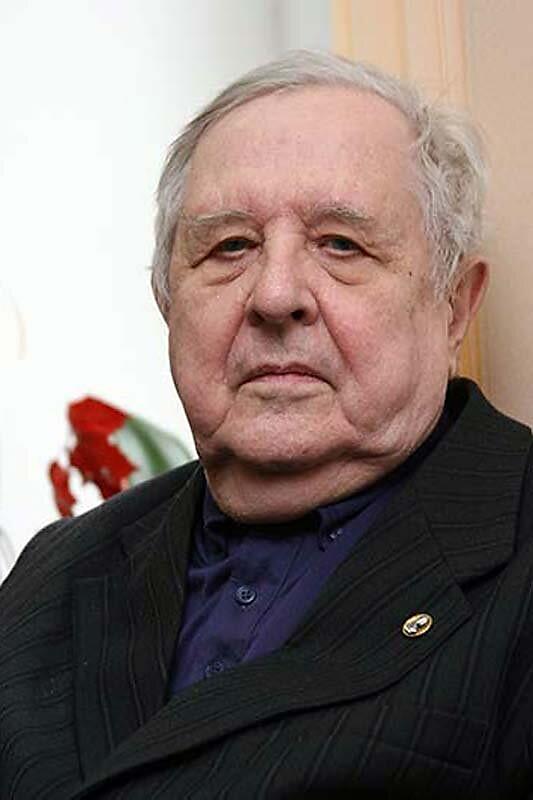
Y.K. Tolstoy
(24.09.1927 — 10.11.2025)
On November 10, 2025, at the age of 99, Yuri (Georgy) Kirillovich Tolstoy, an outstanding Russian civil lawyer, academician of the Russian Academy of Sciences, professor of the Department of Civil Law of the Faculty of Law of St. Petersburg State University, one of the most authoritative representatives of Russian civil law of the second half of the twentieth and early twenty-first centuries, died.[38] Doctor of Law, Honorary Professor of St. Petersburg University, Honored Scientist of the Russian Federation, Full Cavalier of the Order of Merit for the Fatherland, Honorary Worker of Justice of Russia, awarded the Anatoly Koni Medal.
Biography and academic path
In his autobiographical book “From the Experience”, Y.K. Tolstoy wrote about himself: “The author of these “minds of cold observations and hearts of sorrowful notes” is Tolstoy Georgy (Yuri) Kirillovich, born in 1927, a native of Leningrad, Doctor of Law, Professor of St. Petersburg State University. Russian, non-partisan, married, I have a son Svyatoslav, who was born in 1976, and three granddaughters – Anastasia, Alexandra and Elizaveta. I am considered a specialist in the field of civil and entrepreneurial (economic) law, as well as the theory of law. In addition to working at the Department of Civil Law, for more than 20 years he was Deputy Editor-in-Chief of the journal “Jurisprudence”. I have over 200 scientific works (monographs, textbooks, manuals, articles, brochures, etc.). His main research interests are focused on the improvement of civil legislation, property rights, housing legislation, and the theory of law. For more than 10 years he was a member of the Expert Council of the Higher Attestation Commission for Philosophical and Legal Sciences, a member of the Committee of Constitutional Supervision of the USSR (from the date of its foundation to its self-dissolution).
I am a member of the Council for the Codification and Improvement of Civil Legislation under the President of the Russian Federation.
A descendant of the Tolstoy dynasty. It is believed that our branch comes from Alexei Konstantinovich Tolstoy, although he himself was childless. In our family there were Catherine’s naval commander, the winner of the Battle of Chesme, Admiral Spiridov, and the actor of the Alexandrinsky Theater Yuriev. In addition to Russian, I have Ukrainian blood in my veins (my maternal grandfather Glushkov is Ukrainian), German (my paternal great-grandmother is German), French (my maternal great-grandmother is a Russified Frenchwoman from the Benois family – Elizaveta Alexandrovna Baranova) and Armenian (my great-grandfather on my mother’s side is Armenian Sanjanov, artillery general of the Russian army, one of the participants in the Russian-Turkish war). As in almost all noble families, I also have Tatar blood, as evidenced by the photos of my father and his sisters (my aunts). I am proud of my international origin. That is why I consider the interethnic strife that arose after the collapse of the Soviet Union, which is often accompanied by bloodshed, to be especially savage. I perceive them as a tragedy.
He was born in the family of an engineer, his mother taught foreign languages. In general, in my family, in addition to statesmen and military men, there were engineers (great-grandfather on my father’s side, grandfather on my mother’s side), a lawyer (grandfather on my father’s side).
My paternal grandmother graduated from the University of Lausanne (Switzerland), knew five foreign languages, taught them and was a translator.
I was baptized as George, but I am published as Yuri, so my colleagues know me more as Yuri.
He lost his parents at an early age. My mother died of tuberculosis at the age of 26, when I was one and a half years old, and my father passed away in 1933 at the age of 30, when I was not yet six years old. He was brought up by relatives, first on his father’s side, and then on his mother’s side. He graduated from high school with a gold medal in 1945. In the same year, he entered the Faculty of Law of the University, graduated with honors in 1950, and entered graduate school. In 1953 he defended his Ph.D. thesis, and in 1970 – his doctoral dissertation. Since 1956 – Associate Professor, since 1972 – Professor. My teacher was our greatest lawyer, Academician A. V. Venediktov.
In 2000, he was elected a corresponding member, and in 2003 – an academician of the Russian Academy of Sciences.
He married late, in 1975. Wife: Victoria Petrovna Tolstaya, born in 1939, a survivor of the siege, a music teacher at a pedagogical school, and later a teacher of the history of St. Petersburg in a secondary school. Now he is retired.
He has never been a member of the party (CPSU or any other). He refused to join the party, since each such offer was accompanied by promises of promotion. And it was disgusting. In general, I have felt and still do not trust those who have joined and are joining this or that party, not counting on the meager resources of their intellect.”[39]
Scientific contribution
The works of Yuri Kirillovich Tolstoy occupy a special place in the development of modern Russian civil law. In his studies of the 1950s and 1970s, he paid special attention to the systematics of property rights, the nature of legal entities, the grounds for the emergence and termination of civil law obligations.
Main works:
Property rights in the USSR. Leningrad, 1955. On the Theory of Legal Relations. Leningrad, 1959. Fundamentals of Civil Legislation. Leningrad, 1962. New Civil Code of the RSFSR.Leningrad, 1974. (co-author). Soviet Housing Law. Leningrad, 1967. Soviet housing legislation. Leningrad, 1974. Housing Law: Textbook. Allowance. Moscow, 1996, 2007, Civil Law: Textbook: in 3 ch. Moscow, 1997-2003 (co-author and co-editor). Inheritance Law: Textbook. allowance. Moscow, 1999. From the experience. St. Petersburg, 1999. Pages of memoirs: S.M. Korneev. V.A. Dozortsev, M.I. Piskotin. Moscow, 2004. Pages of memoirs: B.B. Cherepakhin, O.S. Ioffe. Moscow, 2007.
2. Textbook “Civil Law”
Tolstoy was one of the editors and authors of the three-volume textbook “Civil Law” (1997-2003), a key educational complex that withstood many reprints and had a significant impact on several generations of students and young professionals.
He wrote chapters on:
property rights and property rights (Chapters 16–22),
housing law (Chapter 34),
obligations for causing harm (Chapter 50),
obligations from unjust enrichment (Chapter 51),
inheritance law (Chapters 62-65).
These materials were distinguished by consistency, attention to sources and a desire for the internal logic of legal constructions.
2. Research of legal entities
In the polemics of the 1950s about the essence of state legal entities, Tolstoy formulated one of the most well-known concepts in Russian science – the “director’s theory”, within the framework of which the director was considered as the main bearer of the legal personality of the organization. This theory played an important role in shaping the doctrinal discussion that followed.
3. Training
Over the decades of teaching, Tolstoy became the scientific supervisor of major legal scholars, including well-known civil lawyers, teachers and authors of modern textbooks. His students were V.V. Putin, D.A. Medvedev, A.A. Ivanov, A.I. Bastrykin and many other prominent lawyers. His lectures were distinguished by clarity of structure and attention to the details of dogmatics. Close comradely relations connected Y.K. Tolstoy with professors O.S. Ioffe, A.A. Sobchak, A.P. Sergeev.
4. Public and expert activities
In 1990–1991, G. K. Tolstoy was a member of the Committee for Constitutional Supervision of the USSR, a body that preceded modern constitutional justice. He participated in the discussion of the problems of codification of civil legislation, was a member of the Presidential Council for Legal Reform. In 2001, he became a laureate of the Prize of the Government of the Russian Federation in the field of education for his participation in the creation of a fundamental training course in civil law.
Memory
Professor Yuri (Georgy) Kirillovich Tolstoy left a significant scientific legacy, which is of great value for researchers of civil law, teachers and practicing lawyers. His works continue to be used in the academic process, and the influence on the development of Russian civil law remains significant.
I would like to conclude this essay with the poems of Y.K. Tolstoy himself:
When weakened hands can scarcely cling
To once-familiar, trusted quill,
Do not lament your suffering —
Prepare to meet the hour still.
Set all your papers into place,
Remove what must not longer stay;
Let faithful books, in silent grace,
Console your soul in their own way.
As Pushkin did, survey once more
Your steadfast friends of many years,
Who gaze with sadness as before:
“Forsake us not — incline thine ears!”
Though not the loudest voice in choir,
You walked your path through storm and spite;
And when life’s flame burned ever drier,
You still pressed on toward the light.
No lofty sage you claimed to be,
But open-hearted, kind to all;
You bent not to life’s tempests free —
Now here, now there, at fate’s soft call.
So into whose devoted hand
Shall all you treasured be conveyed,
When parting comes, as Heaven planned,
As long ago by Him was said?
— Yu. K. Tolstoy[40]
References
Electronic resource: https://www.kommersant.ru/doc/8193197
Electronic resource: https://www.litres.ru/book/uriy-kirillovich-tolstoy/iz-perezhitogo-69442840/chitat-onlayn
Electronic resource: https://dzen.ru/a/WsJIul9JZ_9JYBSt; https://science.mail.ru/news/39396-umer-professor-spbgu-yurij-tolstoj/
ISSN 3033-7666 (Print)
ISSN 3033-7674 (Online)
No 8, November 2025
E-mail: nxxivek@inbox.ru
Electronic Scientific Periodical (St. Petersburg, Russia)
Certificate of the Federal Service for Supervision of Communications, Information Technology and Mass Media (Roskomnadzor)
Эл № ФС77-87449
The journal is registered and published in Russia. The journal publishes articles from all over the world and in all branches of science. The journal is published in Russian.
Articles are accepted daily.
Frequency of releases: once a month.
All articles are peer-reviewed
Each author receives a free certificate of publication.
Free access to the electronic version of the magazine.
By sending an article to the editorial board, the author confirms its uniqueness and bears full responsibility for it for the possible consequences of copyright infringement
Editorial Board
Editor-in-Chief
Vorontsov Vladimir Valentinovich
Managing Editor
Ivanov Maxim Dmitrievich
Executive Secretary
Kholmanskikh Maria Viktorovna
Reviewers
Dimitrienko Andrey Igorevich,
Ph.D., First St. Petersburg State Medical University named after Academician I.P. Pavlov
Pyrkh Andrey Ivanovich,
Ph.D., St. Petersburg State University
_____________________________________________________________________________
Contacts
 190031, Russia, St. Petersburg, Kazanskaya str., 35, lit. A, apt. 15
 +7 931 712-95-96
 nxxivek@inbox.ru
_____________________________________________________________________________
© Founder: Limited Liability Company “Polis” (OGRN 1097847170871)
190031, St. Petersburg, ext. Ter. Admiralteysky Municipal District, Kazanskaya St., 35, lit. A, apt. 15