Articles that inspire and inform!
Publisher of POLIS LLC
Address: 190000, Saint Petersburg,
35/15 Kazanskaya Street
Publisher of POLIS LLC
Address: 190000, Saint Petersburg,
35/15 Kazanskaya Street

студий disney warner brothers discovery против компании midjourney
УДК: 347.73
СУДЕБНЫЕ ИСКИ
СТУДИЙ DISNEY WARNER BROTHERS DISCOVERY ПРОТИВ КОМПАНИИ MIDJOURNEY
И МЭТЬЮ И МАРИИ РЕЙН ПРОТИВ КОМПАНИИ OPENAI И СЭМА
АЛЬТМАНА
И ИХ ПОСЛЕДСТВИЯ ДЛЯ РАЗВИТИЯ ИНДУСТРИИ ИСКУССТВЕННОГО ИНТЕЛЛЕКТА[1]
Кильдеев Адель Ханяфиевич
Ленинградский государственный университет им. А.А. Жданова (1990)
Кандидат юридических наук
ORCID: 0009-0001-2211-4944
Аннотация: В статье анализируются три судебных процесса, способные изменить будущее индустрии ИИ: иски Disney/Warner Brothers Discovery против Midjourney о массовом нарушении авторских прав и иск Raine против OpenAI и Сэма Альтмана о гибели подростка из-за взаимодействия с ChatGPT. Первые два иска затрагивают вопрос интеллектуальной собственности и могут привести к введению роялти за генерацию контента, третий иск — впервые ставит проблему ответственности разработчиков ИИ за вред жизни и здоровью пользователей. Все три дела формируют новые правовые рамки регулирования искусственного интеллекта.
Ключевые слова: искусственный интеллект; авторское право; Midjourney; Disney; Warner Brothers Discovery; OpenAI; Сэм Альтман; судебный иск; неправомерная смерть, регулирование ИИ; безопасность пользователей.
При подготовке статьи автор использовал генеративные ИИ-системы, включая, но не ограничиваясь: ChatGPT (OpenAI), Gemini (Google), Grok (xAI). Все окончательные решения приняты лично автором
DISNEY/WARNER BROTHERS DISCOVERY v. MIDJOURNEY AND RAINE v. OPENAI & ALTMAN LAWSUITS AND IMPLICATIONS FOR THE DEVELOPMENT OF THE ARTIFICIAL INTELLIGENCE INDUSTRY
Kildeev Adel
Zhdanov A. Leningrad State University (1990)
Philosophiæ Doctor in Law
ORCID: 0009-0001-2211-4944
Abstract: The article analyzes three lawsuits that can change the future of the AI industry: the Disney/Warner Brothers Discovery lawsuits against Midjourney for massive copyright infringement and Raine’s lawsuit against OpenAI and Sam Altman over the death of a teenager due to interaction with ChatGPT. The first two lawsuits deal with the issue of intellectual property and may lead to the introduction of royalties for content generation, the third lawsuit raises the problem of liability for the first time AI developers for harm to the life and health of users. All three cases form a new legal framework for the regulation of artificial intelligence.
Keywords: artificial intelligence; copyright; Midjourney; Disney; Warner Brothers Discovery; OpenAI; Sam Altman; a lawsuit; wrongful death, regulation of AI; user security.
When preparing the article, the author used generative AI systems, including, but not limited to: ChatGPT (OpenAI), Gemini (Google), Grok (xAI). All final decisions are made personally by the author
Эта статья является логическим продолжением моих предыдущих статей: 1. «Искусственный Интеллект-слуга человека или наоборот: правовые аспекты», опубликованной в первом номере этого журнала (Апрель 2025), 2.«Этичное применение искусственного интеллекта: глобальный обзор принципов, практик, нормативных актов и последствий», опубликованной во втором номере этого же журнала (Май 2025). 3. «Искусственный Интеллект и авторские права: правовые аспекты», опубликованной в третьем номере этого же журнала (Июнь 2025). От рассуждений и споров ученых и законодателей правообладатели авторских прав перешли в активное наступление на индустрию Искусственного Интеллекта[2].
Империя наносит ответный удар
Это недавний иск от 11 июня 2025 года в федеральный окружной суд в Лос-Анджелесе, Калифорния (дело № 25-5275) голливудских кинокомпаний Disney, Marvel Characters, MVL Film Finance, Lucasfilm, Twentieth Century Fox Film, Universal City Studios, DreamWorks Animation, со-истцов, против ИИ компании Midjourney, ответчику, на основании утверждений, что движок искусственного интеллекта, описанный в иске как «бездонная яма плагиата»[3], был обучен на защищенных авторским правом произведениях обеих компаний без разрешения.
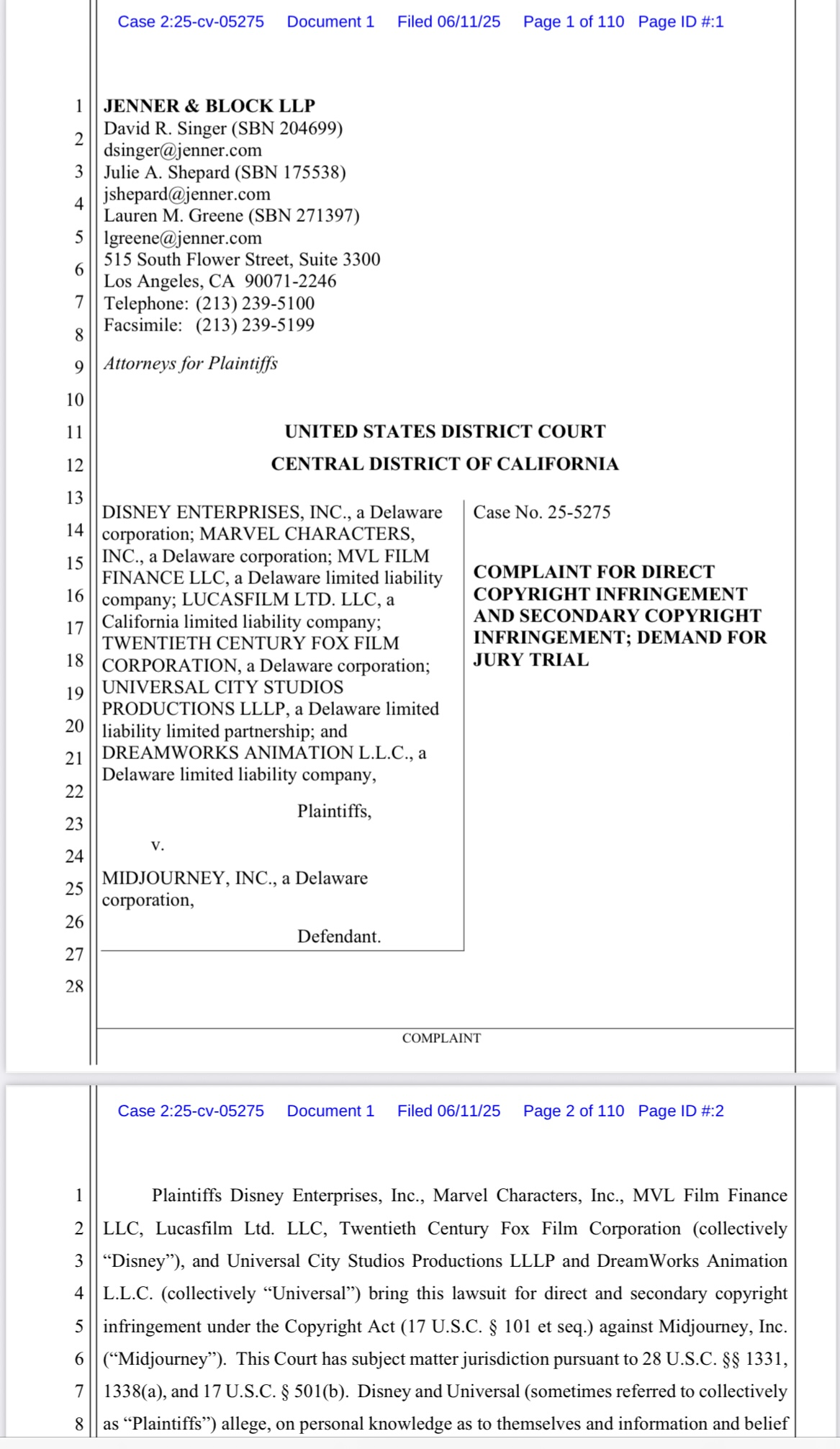
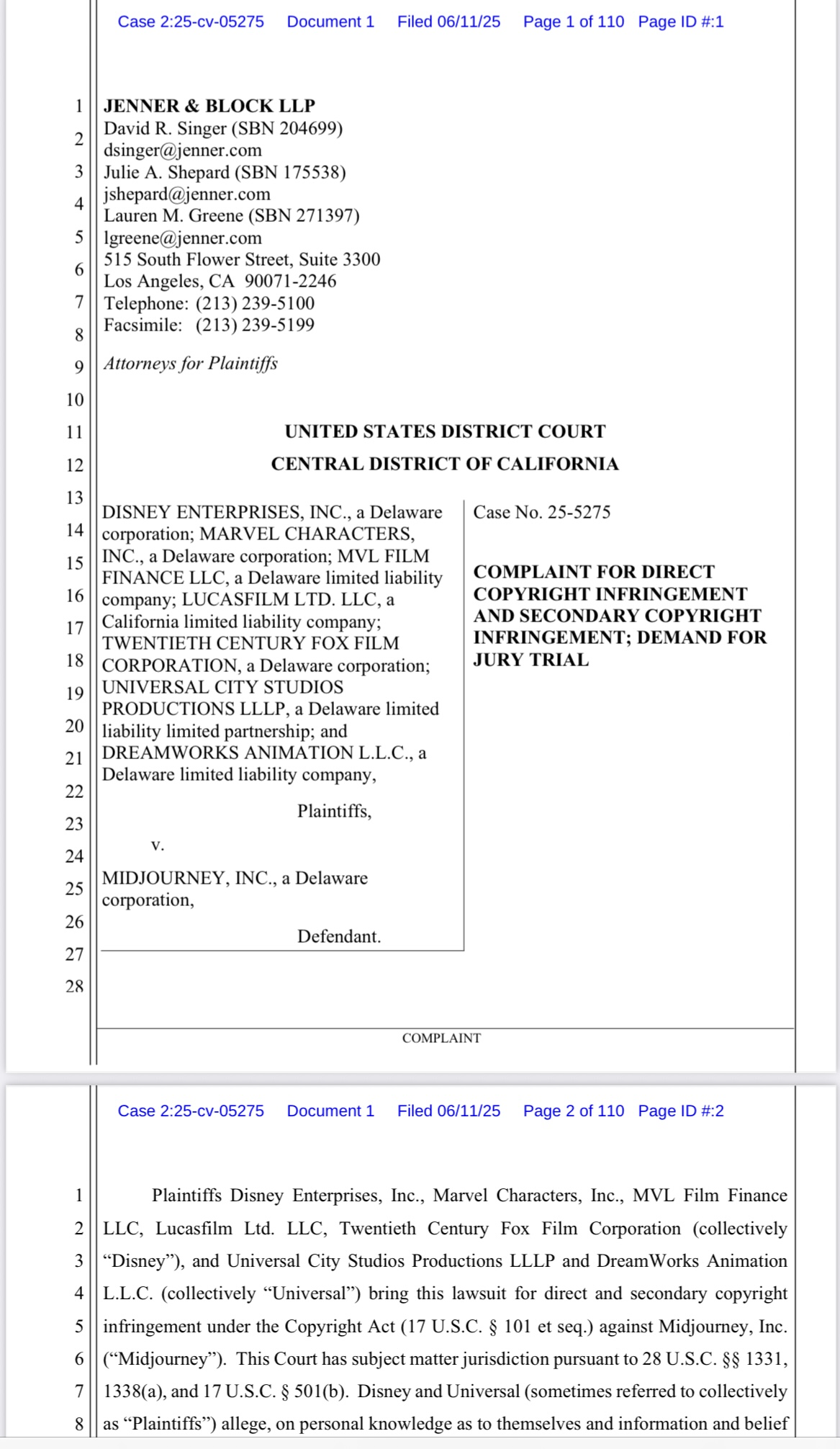
Рис. 1. Первая страница искового заявления
Должен выразить восхищение команде адвокатов, работавшим над этим исковым заявлением. Это огромный по объёму документ на 110 страницах, подготовленный даже и не только и не столько для судьи, рассматривающего дело, сколько для присяжных заседателей, не имеющих юридического образования и опыта рассмотрения гражданских дел. Иск максимально прост и нагляден. Для большей ясности в сам текст искового заявления включены фотографии, иллюстрирующие прямое копирование героев Диснея и других студий компанией Midjourney (они продублированы и в приложениях к исковому заявлению).
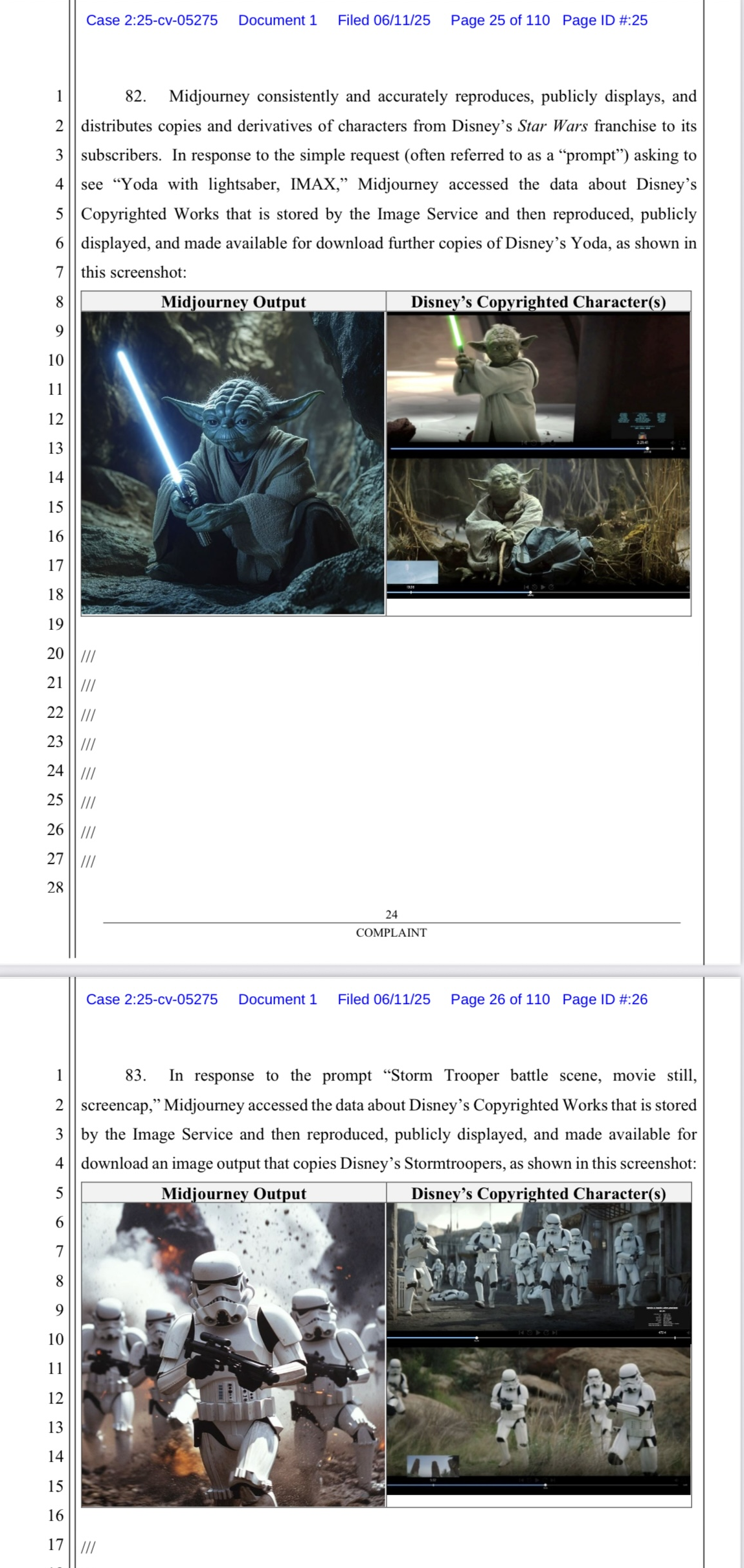
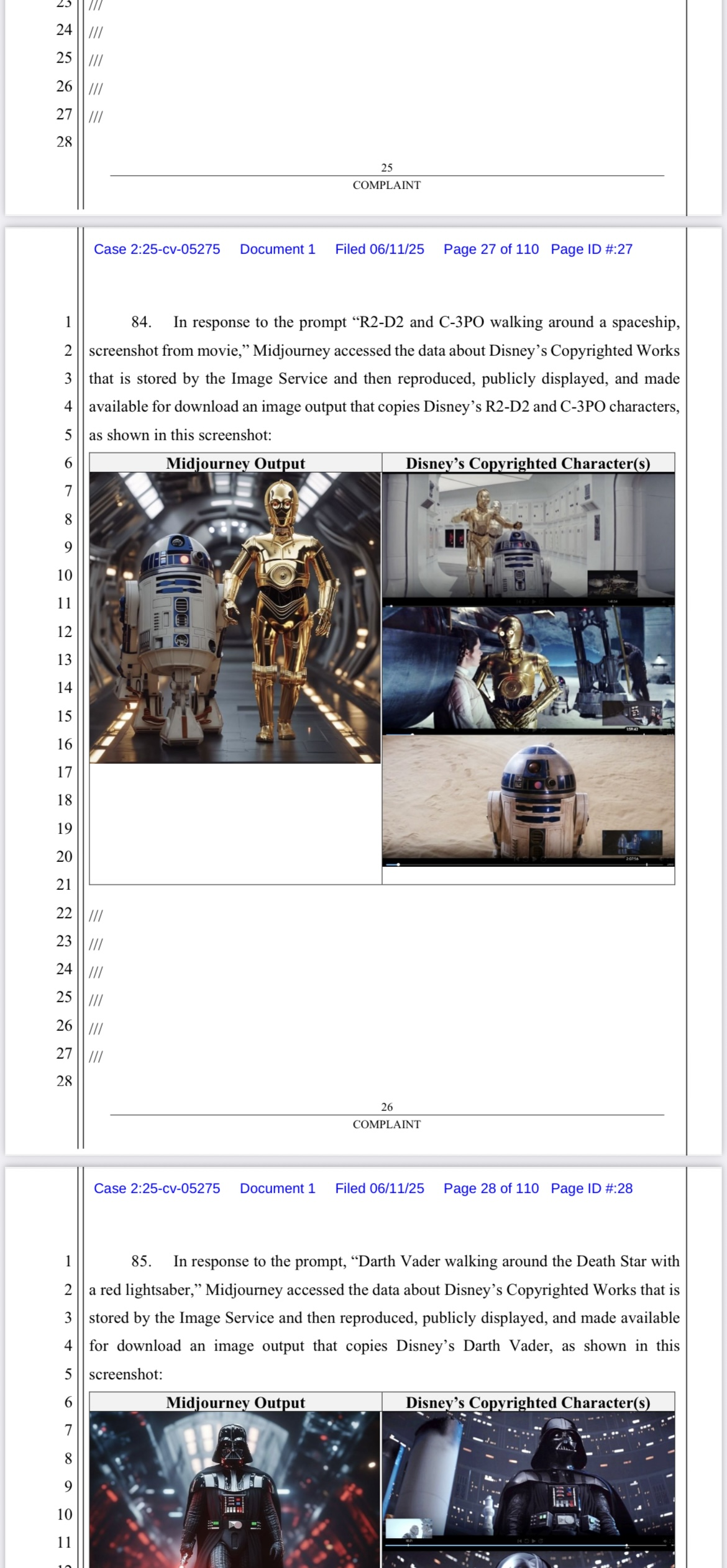
Рис. 2. Страницы искового заявления с фотографиями
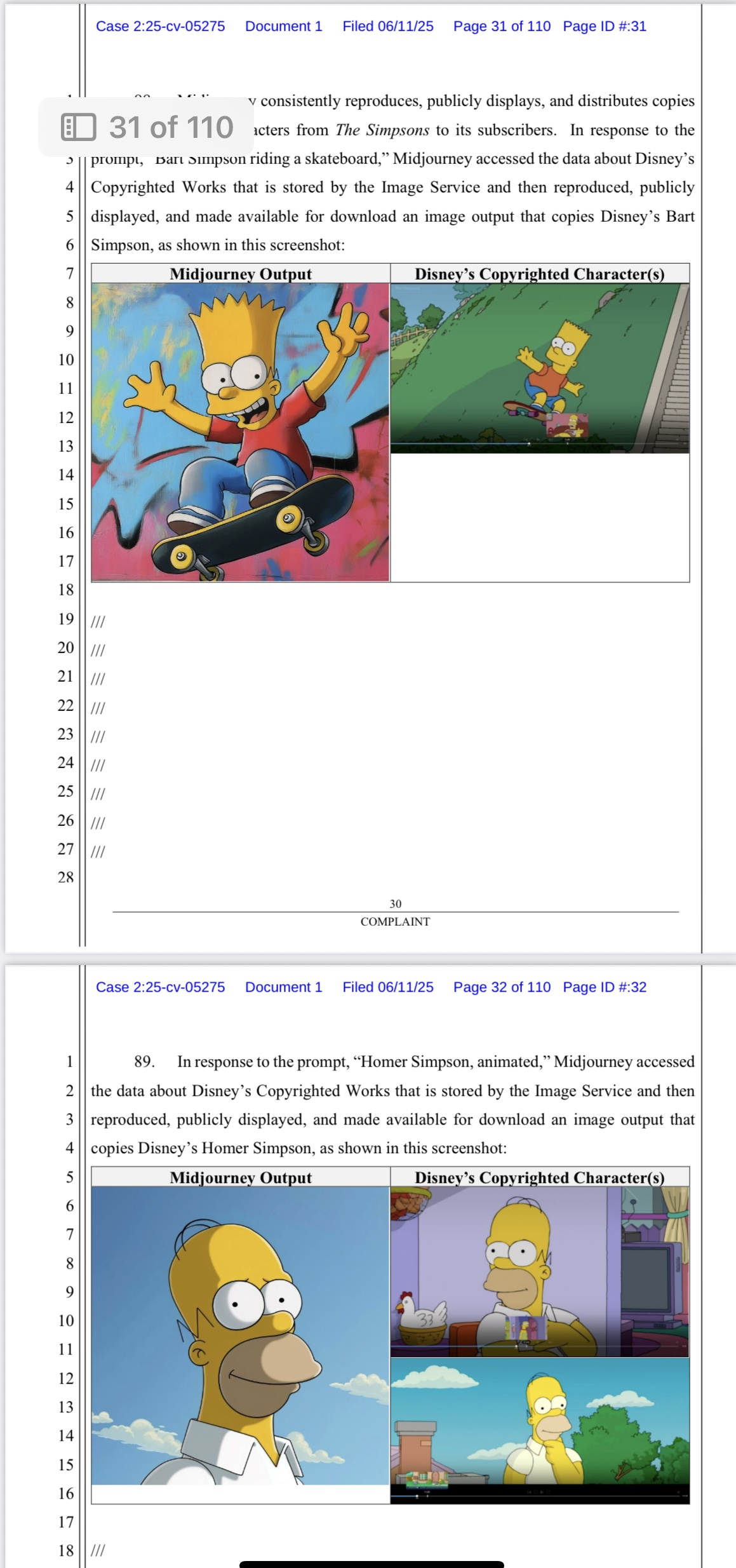
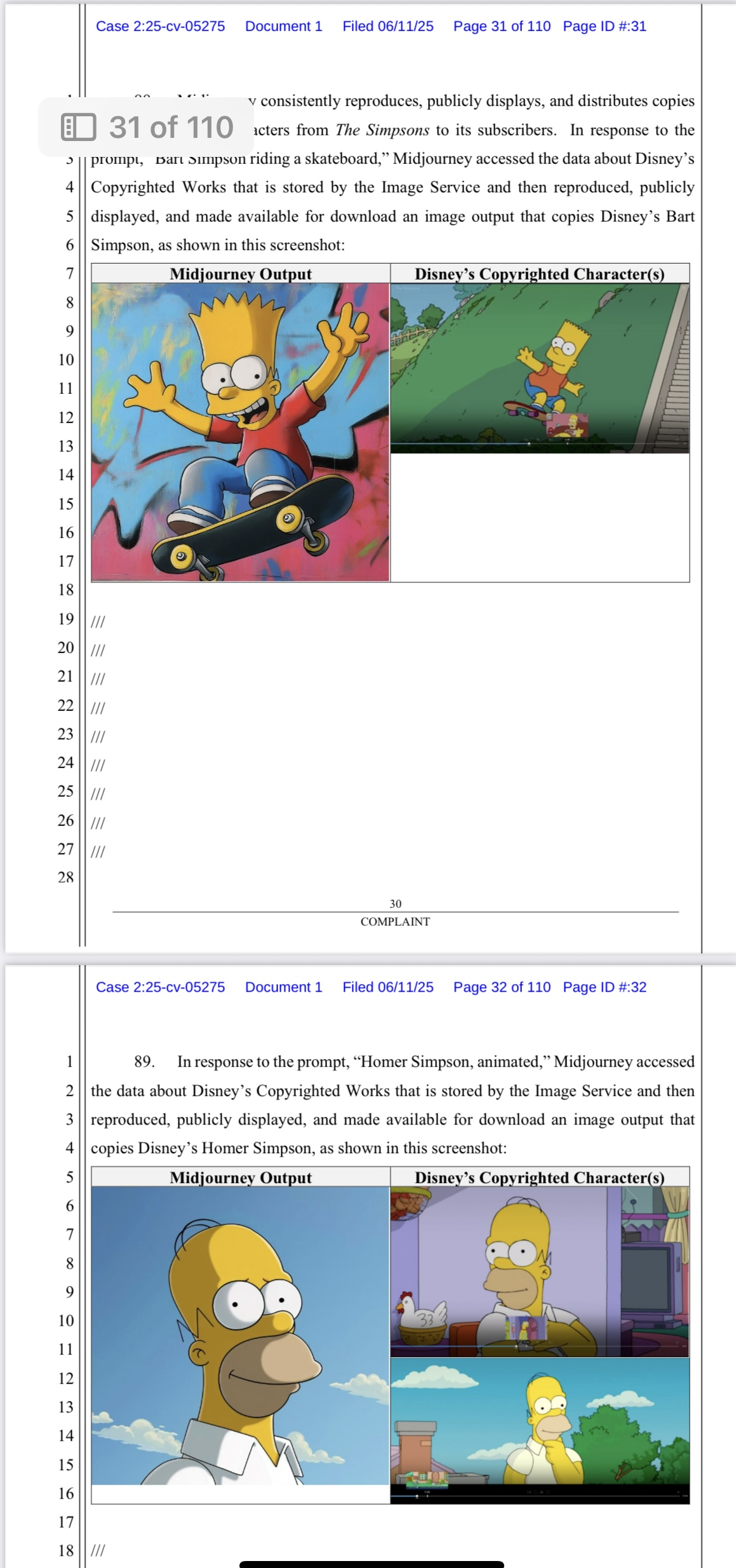
Рис. 3. Страница искового заявления с фотографиями
В иске утверждается, что Midjourney пиратски занималась кражей библиотек голливудских студий, изготавливая и распространяя без разрешения «бесчисленные» копии таких персонажей, как Дарт Вейдер из «Звездных войн», Эльза из «Холодного сердца» и миньоны из «Гадкого я».
Как я ранее писал, в деле Andersen v. Stability AI группа художников утверждала, что Stability AI, Midjourney и DeviantArt собрали миллиарды изображений из Интернета, включая защищенные авторским правом работы истцов, чтобы обучить свои платформы для создания изображений AI, такие как Stable Diffusion, Midjourney Product, DreamStudio и DreamUp, без разрешения или компенсации. Суд постановил, что утверждения истцов о том, что Stability приобрела копии защищенных авторским правом работ истцов, использовала эти работы для обучения Stable Diffusion, а затем сохранила или включила обучающие изображения, полученные из их работ, в Stable Diffusion в виде сжатых копий, были достаточными для того, чтобы заявить о прямом нарушении. [4] Но дело Disney v. Midjourney принципиально отличается тем, что прецедентный удар по результату генерации, то есть фактический запрет генерации известных персонажей и крах визуальных ИИ.
Вот перевод преамбулы искового заявления (by Microsoft translation service):
1. На протяжении более 100 лет Disney и Universal радуют зрителей по всему миру, инвестируя и поощряя американские творческие инновации и создавая одни из величайших кинофильмов и вымышленных персонажей всех времен. Тем не менее, Midjourney стремится пожинать плоды творческих инвестиций истцов, продавая сервис по созданию изображений на основе искусственного интеллекта («ИИ»), который функционирует как виртуальный торговый автомат, генерируя бесконечные несанкционированные копии защищенных авторским правом работ Disney и Universal.
2. Помогая себе на работах истцов, защищенных авторским правом, а затем распространяя изображения (а вскоре и видео), которые откровенно включают и копируют знаменитых персонажей Disney и Universal, не вкладывая ни копейки в их создание, Midjourney является квинтэссенцией безбилетника авторского права и бездонной ямой плагиата. Пиратство есть пиратство, и независимо от того, создано ли изображение или видео, нарушающее авторские права, с помощью искусственного интеллекта или другой технологии, это не делает его менее нарушающим. Поведение Midjourney незаконно присваивает интеллектуальную собственность Disney и Universal и угрожает перевернуть с ног на голову основополагающие стимулы американского закона об авторском праве, которые стимулируют американское лидерство в кино, на телевидении и в других творческих видах искусства.
3. Нарушение со стороны Midjourney является преднамеренным и умышленным. Истцы обратились к Midjourney с просьбой прекратить нарушать их авторские права на произведения и, как минимум, принять технологические меры, которые другие сервисы искусственного интеллекта внедрили для предотвращения создания материалов, нарушающих авторские права. Но Midjourney, который привлек миллионы подписчиков и заработал 300 миллионов долларов только в прошлом году, сосредоточен на собственной прибыли и игнорирует требования истцов.
4. Вместо этого Midjourney решила удвоить свои незаконные действия, выпуская и продвигая еще более новые версии своего Сервиса изображений и дразнить свой готовящийся к выпуску коммерческий видеосервис на основе искусственного интеллекта («Видеосервис»). На основании информации и предположений, без разрешения Истцов, Видеосервис Midjourney будет создавать, публично демонстрировать и распространять видеоролики с участием персонажей Disney и Universal, защищенных авторским правом. Компания Midjourney уже начала обучение своего Видеосервиса, а это означает, что Midjourney, скорее всего, уже нарушает авторские права на произведения Истцов в связи со своим Видеосервисом….[5]
Основания иска
Истцы заявляют, что:
Правовые основания:
Иск подан на основании:
Основные обвинения
1. Direct Copyright Infringement (Прямое нарушение авторских прав)
— автоматическая генерация изображений с элементами (внешность, костюмы, стилистика) известных персонажей Marvel, Lucasfilm и др.
2. Contributory and Vicarious Infringement (Содействующее и Косвенное нарушение)
— Midjourney осознанно создала систему, через которую пользователи нарушают авторское право, получая образы, стилизованные под Звёздные войны, Человека-паука и пр.
Исковые требования (Prayer for Relief)
То есть если истцы докажут, что было сгенерировано 10,000 нарушающих изображений х $150 тыс.= $1,5 млрд потенциального штрафа. Даже при смягчающем решении — компенсации могут быть катастрофическими для Midjourney и иметь прецедентный эффект на всю генеративную индустрию ИИ.
Disney и Universal обратились в суд с просьбой о предварительном судебном запрете, чтобы запретить Midjourney копировать их работы или предлагать свои услуги по созданию изображений или видео без защиты от нарушений. То есть остановить деятельность компании даже до вынесения окончательного судебного решения.
Иск не просто о компенсации — он направлен на тотальный запрет и демонтаж бизнес-модели Midjourney, основанной на генерации изображений по мотивам охраняемых персонажей. Это стратегическая атака крупных IP-холдингов на индустрию генеративного ИИ, в особенности на визуальные нейросети.
В исковом заявлении указано, что истцы предоставили ответчику официальное требование прекратить нарушение авторских прав, но это требование осталось без ответа со стороны ответчика.
На подачу Отзывы на иск законом установлен срок 21 день, официально он должен был быть подан 2 июля. Однако только 6 августа 2025 года ответчик, компания Midjourney, подала Answer (Отзыв на Иск).[6] Это шаг в корне меняет все и опровергает первоначальные предположения о пассивной позиции ответчика, демонстрируя его готовность к активной и многогранной правовой защите. В отличие от ожидавшейся капитуляции или молчаливого согласия, Midjourney представила подробную контраргументацию, основанную на нескольких ключевых юридических принципах. Данная глава посвящена анализу аргументов, выдвинутых ответчиком, и их потенциальному влиянию на судебные перспективы дела, а также на общую дискуссию о правовом статусе и регулировании генеративного ИИ.
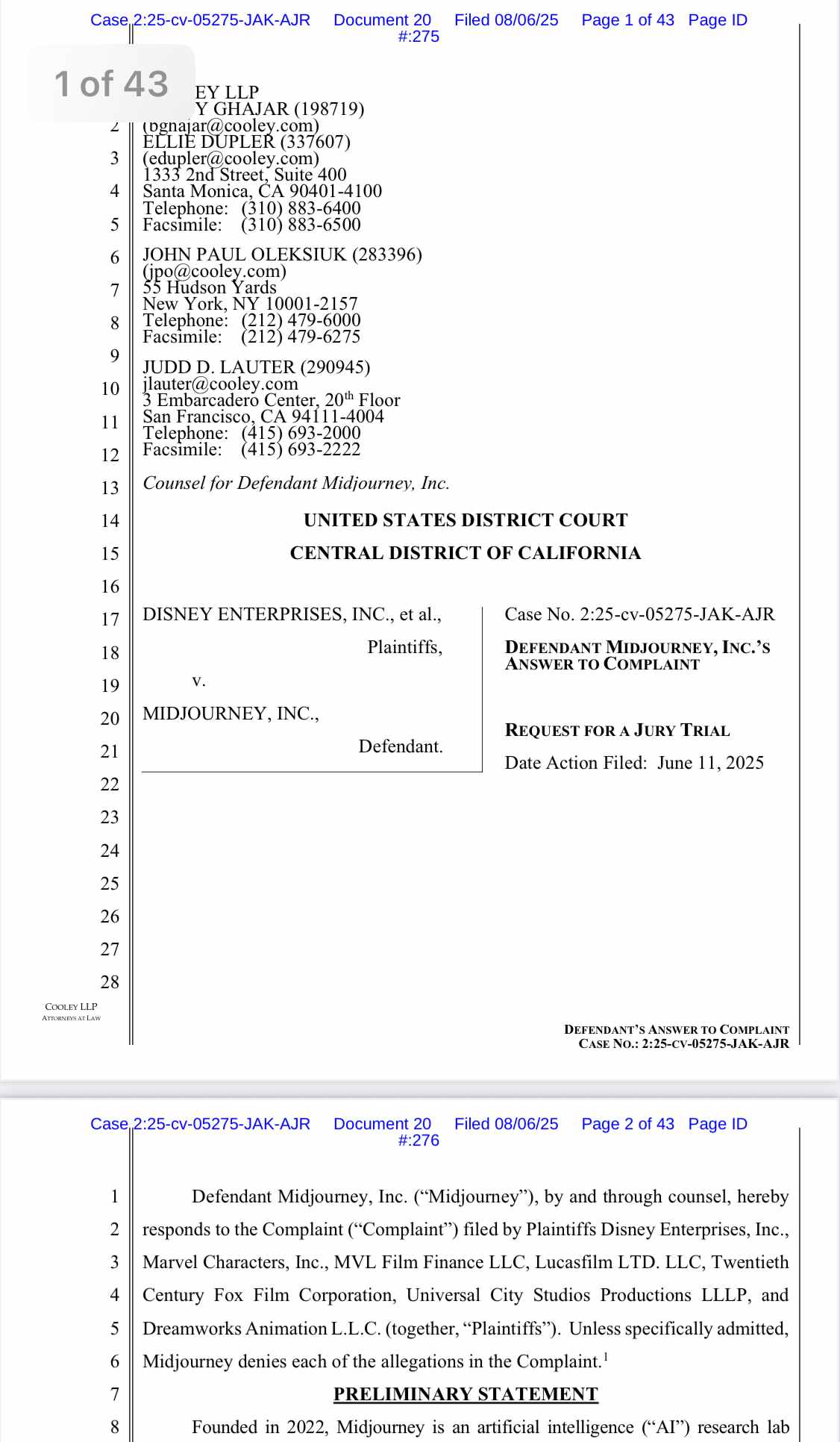
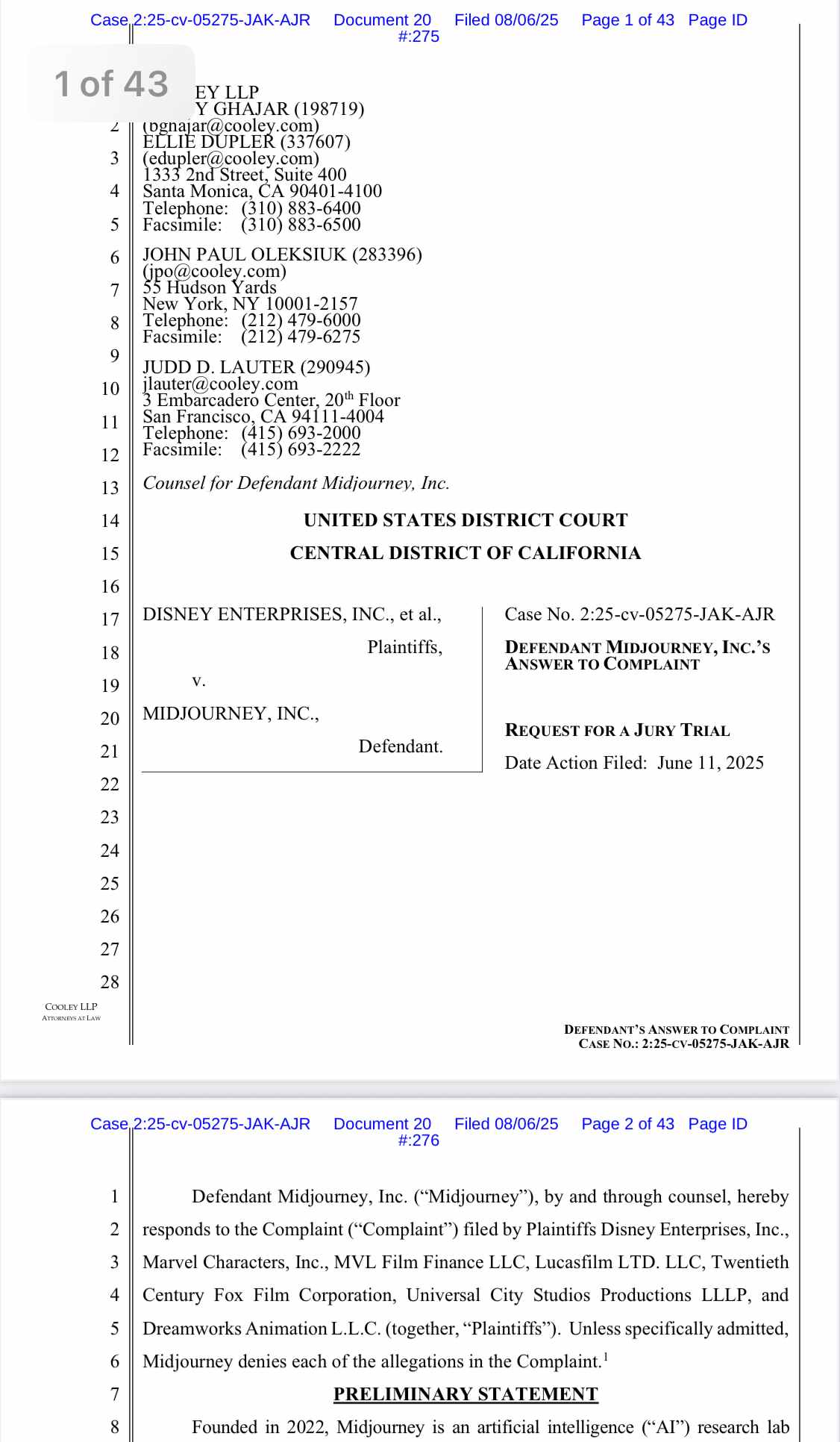
Рис. 4. Первая страница Отзыва на Иск (Answer)
Преамбула ответа на иск Midjourney
С самого начала Midjourney занимает бескомпромиссную позицию, заявляя о своей невиновности и утверждая, что иск Disney и других правообладателей не имеет под собой достаточных юридических оснований. Ответчик начинает с категорического отрицания всех обвинений в прямом, содействующем и косвенном нарушении авторских прав, настаивая на том, что их сервис не является «бездонной ямой плагиата».
В Преамбуле содержатся все основные положения защиты, поэтому приведу выдержки из нее (перевод Microsoft translation service):
«Основанная в 2022 году, Midjourney — это исследовательская лаборатория искусственного интеллекта («ИИ»), посвященная созданию инструментов, которые дополняют и расширяют человеческое воображение. Одноименная платформа генеративного искусственного интеллекта делает именно это, позволяя десяткам миллионов пользователей, включая истцов, выражать себя способами, которые в противном случае были бы невозможны. Для многих Midjourney стал важным инструментом для воплощения своих идей в жизнь: изображения пользователей завоевывали награды, украшали обложки журналов, появлялись в национальной рекламе и служили основой для декораций в фильме, получившем «Оскар».
Технология искусственного интеллекта, лежащая в основе Midjourney, представляет собой тип нейронной сети, разработанной для создания оригинальных изображений в ответ на инструкции пользователя («подсказки»). Чтобы развить эту возможность, модели искусственного интеллекта Midjourney должны были быть обучены на миллиардах общедоступных изображений, которые сопоставляются с текстовыми описаниями, чтобы изучить визуальные концепции и то, как они соотносятся с языком. Во время обучения сложные статистические взаимосвязи между визуальными признаками и словами в парах текст-изображение кодируются внутри модели, что позволяет ей понимать подсказки пользователя и точно реагировать на них. Этот процесс сродни тому, как люди учатся рисовать или рисовать, а не путем запоминания отдельные произведения искусства, но путем усвоения шаблонов и техник через повторное воздействие и практику. Аналогичным образом, модели Midjourney формируют обобщенное понимание визуальных стилей, объектов и композиций на основе статистических закономерностей в обучающих данных. Когда пользователь вводит запрос, модель не извлекает изображение из хранилища; скорее, новое изображение синтезируется с нуля, руководствуясь инструкциями пользователя и статистическими шаблонами, закодированными в его искусственных нейронах.
Истцы, совместно представляющие две крупнейшие традиционные медиа-компании в мире, получали и продолжают получать от этого выгоду Midjourney и другие, подобные инструменты генеративного искусственного интеллекта. Действительно, многие десятки подписчиков Midjourney связаны с корпоративными адресами электронной почты Истцов, и Midjourney также является популярным инструментом среди компаний, занимающихся визуальными эффектами, и других поставщиков, нанятых Истцами. Как недавно воскликнул Боб Айгер, генеральный директор Disney, во время дискуссии об использовании его компанией искусственного интеллекта, «технологии — это бесценный инструмент для художников», и генеративный ИИ ничем не отличается.
Спустя годы после его запуска истцы теперь нацеливаются на Midjourney по двум причинам.
Во-первых, они утверждают, что процесс обучения модели ИИ на миллиардах изображений нарушает их права, даже несмотря на то, что лишь небольшая часть этих изображений может содержать отдельные кадры из фильмов и шоу Истцов. С точки зрения справедливости, истцы не могут иметь и то, и другое, стремясь получить прибыль — за счет использования Midjourney и других инструментов генеративного ИИ — от стандартных отраслевых практик обучения ИИ, с одной стороны, и обвиняя Midjourney в правонарушениях за то же самое. Но истцы также ошибаются по существу дела. Закон об авторском праве не предоставляет абсолютного контроля над использованием произведений, защищенных авторским правом. Ограниченная монополия, предоставляемая авторским правом, должна уступить место добросовестному использованию, которое защищает противоречащие общественные интересы в свободном потоке идей и информации. Обучение генеративной модели ИИ пониманию концепций путем извлечения статистической информации, встроенной в произведения, защищенные авторским правом, является квинтэссенцией преобразующего добросовестного использования при поддержке судов, рассмотревших вопрос….
Во-вторых, истцы жалуются на то, что Midjourney создала и разместила изображения, на которых изображены персонажи из популярных фильмов и телесериалов, что эти изображения сами по себе нарушают авторские права, и что Midjourney несет ответственность за их создание. Но формулировка истцов основана на неверном понимании того, как работает Midjourney и его роли в творческом процессе. Платформа Midjourney — это инструмент для самовыражения пользователей. Он помогает создавать изображения только по указанию пользователей, руководствуясь их инструкциями, что часто является сложным и трудоемким процессом экспериментов, итераций и открытий. И хотя пользователи Midjourney обязаны действовать в соответствии с Условиями предоставления услуг Midjourney воздерживаться от нарушения прав интеллектуальной собственности других лиц, в том числе Права истцов, Midjourney не предполагает и не может знать, есть ли какое-либо конкретное изображение нарушает авторские права при отсутствии уведомления от владельца авторских прав и информации о том, как используется изображение. Действительно, существует множество законных, не нарушающих авторских прав оснований для создания изображений, включающих персонажей из популярной культуры, подобных тем, которые утверждают истцы, включая некоммерческий фан-арт, эксперименты и идеи, а также социальные комментарии и критику. Истцы стремятся задушить их всех. Истцы могли и должны были следовать процедуре уведомления и удаления Midjourney в соответствии с Законом об авторском праве в цифровую эпоху, кодифицированной в Условиях предоставления услуг, указав конкретные изображения, которые, по их мнению, нарушают авторские права, и указав URL-адреса, где они отображаются. Это дало бы возможность любым обвиняемым пользователям Midjourney дать ответ. Вместо этого истцы выдвинули огульные обвинения в адрес Midjourney, начали этот судебный процесс и идут по пути, который ограничивает законное выражение мнений.
В конце концов, это дело не о том, как Midjourney наживается на том, что Истцы назвали «нарушением». Midjourney — нет. Также речь не идет о каком-либо предполагаемом «вреде» Истцов; они не выявили ни одного. Скорее, это дело о том, предполагаемые авторские права дают им право запрещать использование своих произведений для обучения моделей генеративного ИИ и предотвращать включение элементов этих произведений в творения пользователей генеративного ИИ, независимо от содержания этих творений и конечных целей, для которых пользователи их используют. Истцы не имеют на это права. Авторское право «всегда было тесно связано со свободой выражения мнений, с одной стороны, и технологическими усовершенствованиями в средствах распространения, с другой», при этом закон признает, что ограниченное использование материалов, защищенных авторским правом, для создания новых технологий и средств способствует достижению конечной цели авторского права: стимулированию творческого самовыражения на благо общества…. Как установит Midjourney, чрезмерное вмешательство истцов основано на фундаментальном непонимании генеративного ИИ, его роли в создании пользователями и принципов, лежащих в основе закона об авторском праве.»[7]
Эту великолепную Преамбулу можно назвать Манифестом свободы творчества ИИ, отдаю должное высокому профессиональному уровню адвокатов Ответчика. Midjourney утверждает, что иск истцов направлен не на защиту авторских прав, а на подавление инноваций в области генеративного ИИ. Ключевые положения их защиты, представленные в преамбуле, заключаются в следующем:
Таким образом, преамбула Ответа на Иск с первых же строк задает тон агрессивной и уверенной защиты, выстраивая линию обороны вокруг принципов, которые могут стать прецедентом для всей индустрии ИИ.
Ключевые тезисы защиты Midjourney
Midjourney выстраивает свою защиту вокруг доктрины добросовестного использования (Fair Use), которая позволяет использовать защищенные авторским правом произведения без получения разрешения правообладателя при соблюдении определенных условий.
В своем ответе Midjourney утверждает, что:
Этот аргумент является центральным, так как он напрямую оспаривает основную претензию Disney о нарушении авторских прав. Успех или провал Midjourney будет во многом зависеть от того, как суд трактует доктрину “добросовестного использования” в контексте обучения генеративных ИИ-моделей.
Второй ключевой тезис защиты Midjourney заключается в перекладывании ответственности за создание контента на самих пользователей. Компания утверждает, что она не является активным создателем нарушающего контент, а предоставляет лишь инструмент — аналогичный карандашу, фотоаппарату или текстовому редактору.
В рамках этого аргумента Midjourney подчеркивает следующие моменты:
Если суд встанет на сторону Midjourney в этом вопросе, это может создать важный прецедент, согласно которому разработчики ИИ будут рассматриваться не как «нарушители», а как «поставщики технологий», что существенно изменит правовую ландшафт.
3. Недостаточность доказательств: «Голословные утверждения» и отсутствие конкретики
Midjourney решительно оспаривает обвинения, утверждая, что иск Истцов основан на «голословных утверждениях» и «умозрительных заключениях», а не на фактических доказательствах. Ответчик указывает на то, что:
Этот аргумент является ключевым, так как он атакует иск с процедурной стороны. Даже если суд посчитает, что доктрина «добросовестного использования» не применима, истцам всё равно придётся предоставить весомые доказательства того, что Midjourney действительно нарушила их права, что, по утверждению ответчика, им не удалось сделать.
Дальнейшие разделы Ответа на Иск стандартны для гражданских исков, они или прямо и полностью отвергают или признают факты и требования Истцов, либо содержат стандартную формулировку «не обладает знанием». Для читателей объясню, что цель Ответа на иск – либо признать полностью или частично заявленные факты и исковые требования Истца, либо полностью или частично отвергнуть их.
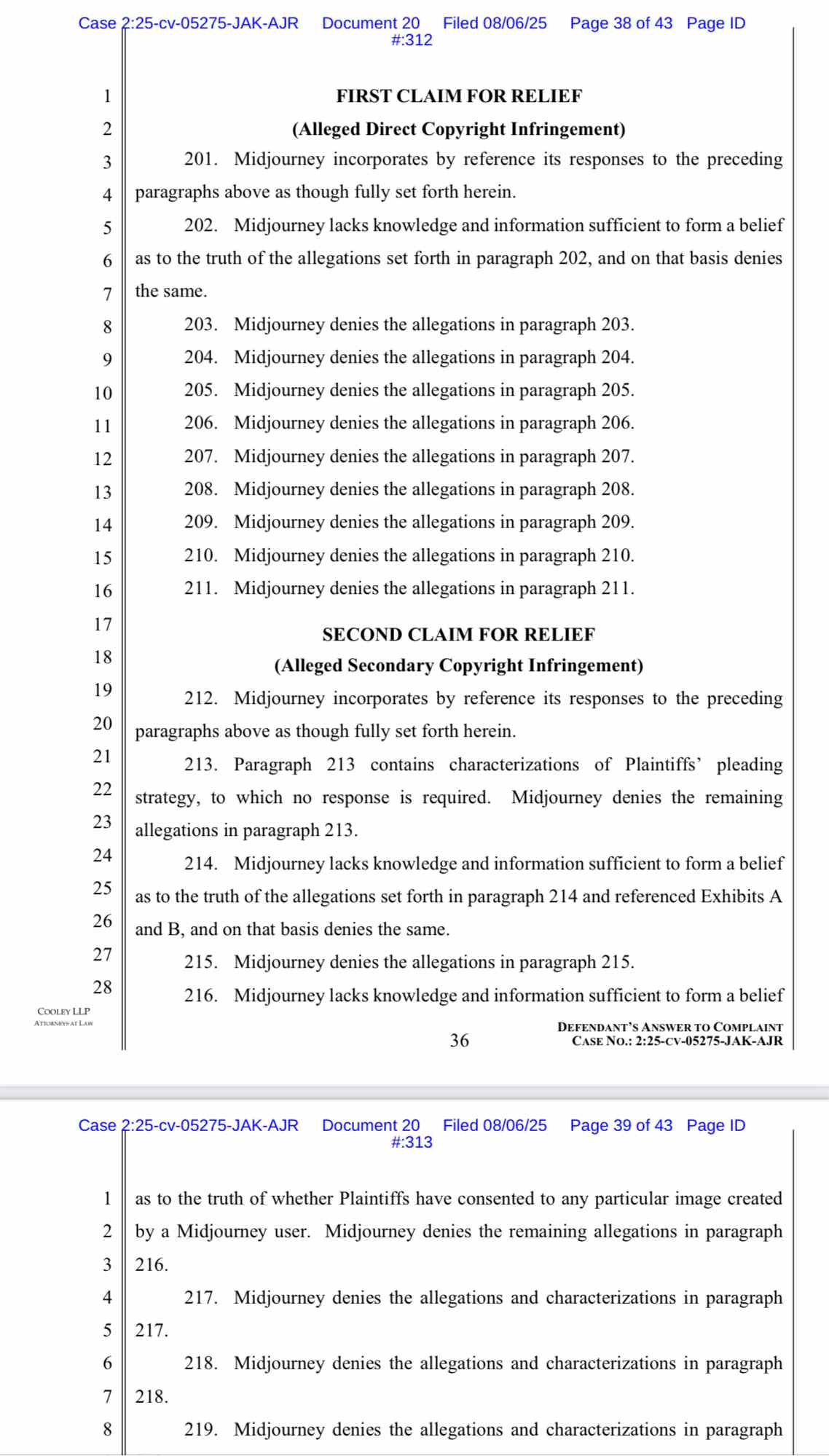
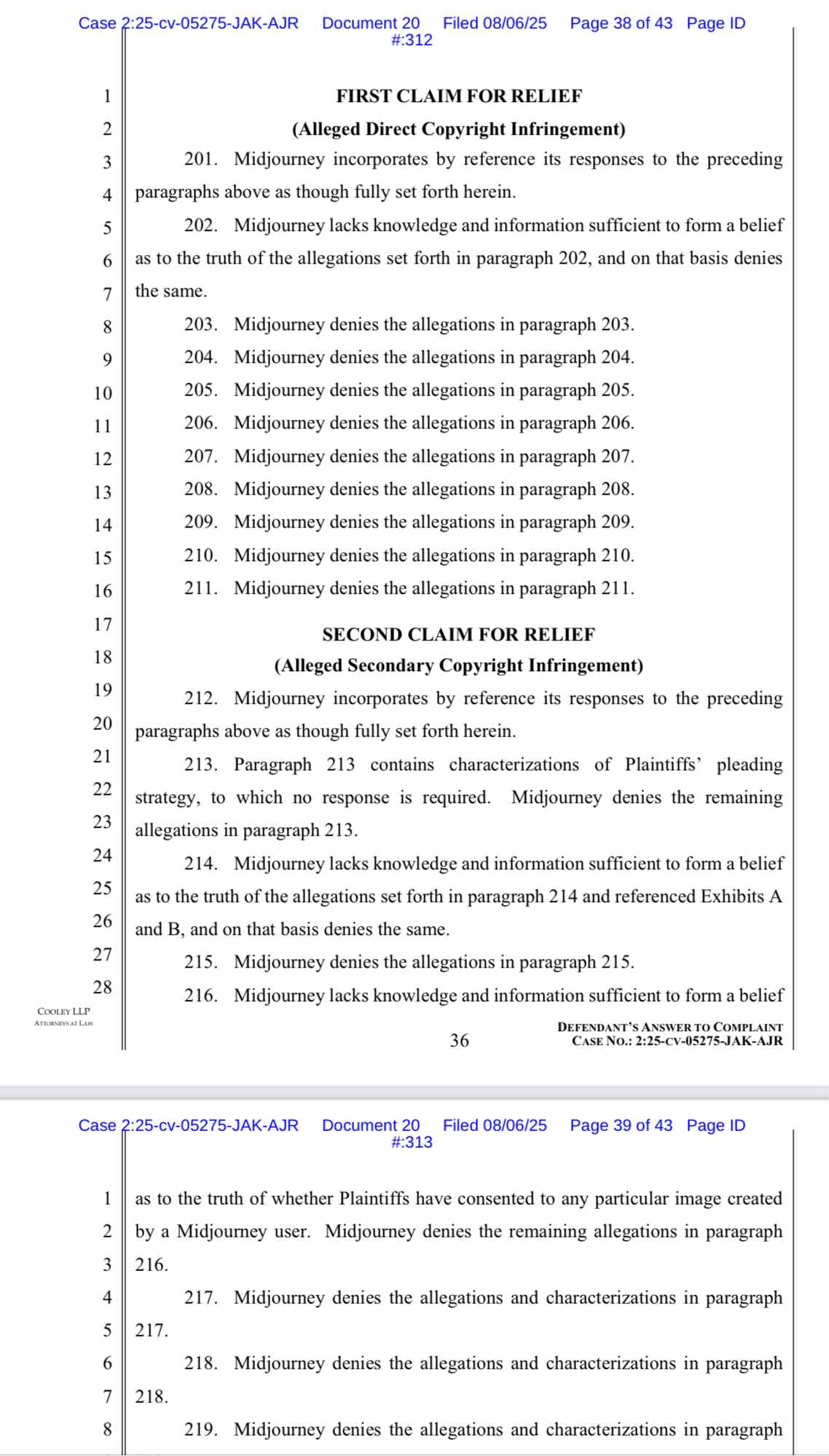
Рис. 5. Страница Ответа на Иск с отвержением требования Истцов
Midjourney отвергает все требования Истцов, просит отказать в удовлетворении Иска и взыскать с Истца разумные расходы на адвокатов и все судебные издержки (пошлина, расходы на экспертов и т.п.).
Признаюсь, я до конца не верил, что Midjourney займет такую непримиримую и агрессивную позицию в этом процессе. Но эта позиция, несмотря на ее юридическую уязвимость по целому ряду положений, заслуживает уважения. Midjourney решила биться до конца и нам предстоит наблюдать увлекательнейший судебный процесс по сути дела над свободой использования Искусственного Интеллекта.
Следуя пословице: свято место пустым не бывает, наблюдается тенденция к подаче аналогичных исков. Американская компания Meta (признана экстремистской и запрещена в РФ) оказалась в центре судебного разбирательства. Ее заподозрили в незаконной дистрибуции фильмов для взрослых через сеть BitTorrent с целью последующего использования контента для обучения моделей искусственного интеллекта. Иск против компании подал производитель порнографических фильмов Strike 3 Holdings, утверждающий, что Meta (признана экстремистской и запрещена в РФ) с 2018 года распространила не менее 2,4 тыс. видеороликов без разрешения правообладателя.[8] Истцы заявляют, что Meta целенаправленно выбирала популярные новинки, которые затем оставались доступными для скачивания посторонними лицами, включая несовершеннолетних, на протяжении недель и даже месяцев.[9]
Иск подан в Федеральный окружной суд Южного округа Флориды (дело № 1:24-CV-21387-RNS) 23 июля 2025 г.[10] Основные правовые основания: нарушение авторских прав, небрежность и способствование пиратству через алгоритмы и недостаточную модерацию.
И это только начало, многие киностудии, художники, актеры, писатели, музыканты начнут обращаться в суды и требовать соблюдения их авторских прав и выплаты огромных компенсаций.
Супермен летит в суд
4 сентября 2025 г. студия Warner Brothers Discovery (WBD) и ряд других студий (DC Comics, Turner Entertainment Co., Hanna-Barbera Productions, the Cartoon Network) подали иск в федеральный суд Лос-Анджелеса (C.D.Cal., No.2:25-cv-08376) против той же самой компании Midjourney, аналогичный вышеуказанному иску «Disney против Midjourney»[11]. По версии истцов, компания Midjourney обучала свою систему на нелегальных копиях фильмов/сериалов и массово воспроизводит, публично показывает и распространяет изображения и видео с персонажами WB-от Бэтмена и Супермена до Looney Tunes-в том числе на Explore и Midjourney TV. Истцы добиваются запрета, изъятия прибыли либо статутных убытков до $150 тыс. за каждый акт нарушения, а также гонораров адвокатов и судебных расходов по делу.
Адвокатами истцов является таже самая адвокатская фирма Jenner & Block LLP, которая представляет Disney в судебном деле против Midjourney. Иск состоит из 86 страниц и приложения А. Структура иска во многом аналогична иску Disney, но есть и свои особенности. Иск составлен простым языком, доступным присяжным, и снабжен большим количеством картинок, наглядно демонстрирующими нарушения авторских прав WB компанией Midjourney.
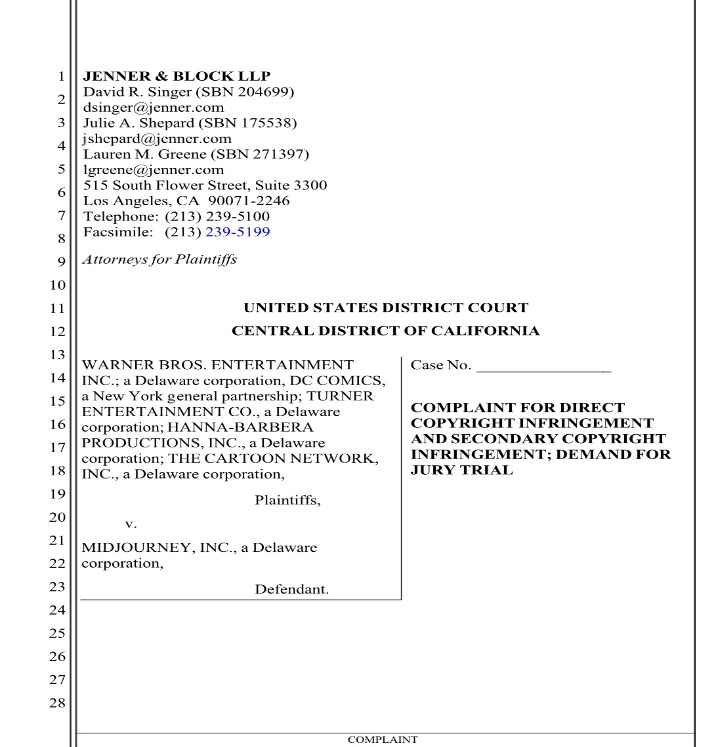
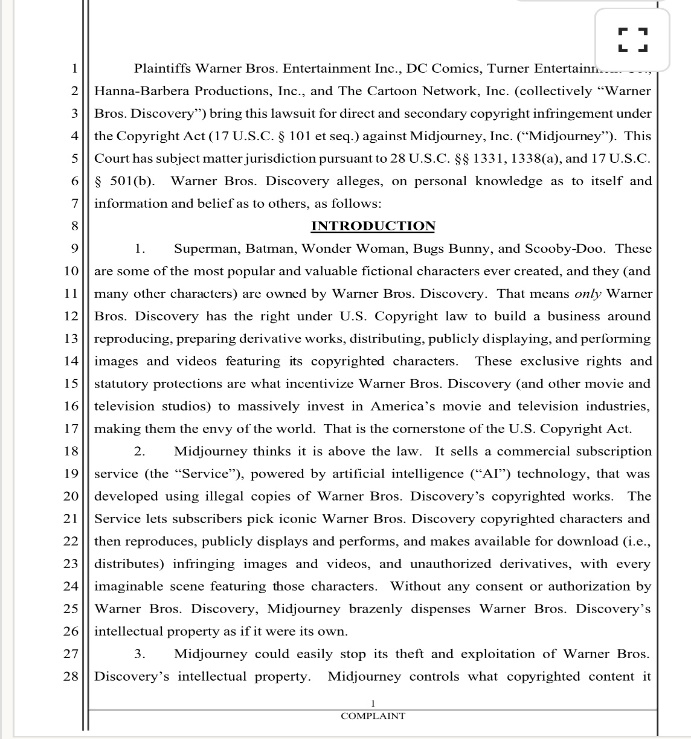
Рис. 6. Первая страница искового заявления WBD
Вот перевод преамбулы искового заявления (by Microsoft translation service):
«1. Супермен, Бэтмен, Чудо-женщина, Багз Банни и Скуби-Ду. Это одни из самых популярных и ценных вымышленных персонажей из когда-либо созданных, и они (и многие другие персонажи) принадлежат Warner Bros. Discovery. Это означает, что только Warner Bros. Discovery имеет право в соответствии с законом США об авторском праве строить бизнес на воспроизведении, подготовке производных работ, распространении, публичном показе и исполнении изображений и видео с участием персонажей, защищенных авторским правом. Эти исключительные права и законодательная защита стимулируют Warner Bros. Discovery (и другие кино- и телевизионные студии) вкладывать огромные средства в кино- и телевизионную индустрию Америки, делая их предметом зависти всего мира. Это краеугольный камень Закона США об авторском праве.
2. Midjourney считает, что она выше закона. Она продает коммерческую услугу подписки («Услуга»), основанную на технологии искусственного интеллекта («ИИ»), которая была разработана с использованием незаконных копий защищенных авторским правом работ Warner Bros. Discovery. Сервис позволяет подписчикам выбирать знаковых персонажей, защищенных авторским правом Warner Bros. Discovery, а затем воспроизводить, публично демонстрировать и исполнять, а также предоставлять для скачивания (т. е. распространять) изображения и видео, нарушающие авторские права, а также несанкционированные производные изображения со всеми мыслимыми сценами с участием этих персонажей. Без какого-либо согласия или разрешения со стороны Warner Bros. Discovery, Midjourney нагло распространяет интеллектуальную собственность Warner Bros. Discovery, как если бы она была ее собственностью.
3. Midjourney может легко остановить кражу и эксплуатацию интеллектуальной собственности Warner Bros. Discovery. Midjourney контролирует, какой защищенный авторским правом контент он агрегирует, выбирает, копирует и обучает. Midjourney также контролирует выходные данные своего Сервиса изображений и видео и имеет средства для реализации мер защиты для предотвращения непрерывного воспроизведения, публичного показа, публичного исполнения и распространения работ Warner Bros. Discovery. Midjourney уже обладает технологическими средствами и мерами, которые могут предотвратить его распространение, публичный показ и публичное исполнение изображений и видео, нарушающих авторские права. Но Midjourney приняла взвешенное и ориентированное на прибыль решение предложить владельцам авторских прав нулевую защиту, несмотря на то, что Midjourney знает о захватывающих масштабах пиратства и нарушения авторских прав.
4. Недавнее поведение Midjourney показывает, что компания действительно осведомлена о том, что Сервис нарушает авторские права на персонажей Warner Bros. Discovery, и имеет возможность остановить нарушение. После запуска генерации видео Сервис временно отказался от «анимации» (т.е. генерации видео) многих контрафактных изображений персонажей Warner Bros. Discovery, созданных Midjourney. Midjourney может сделать это только потому , что признает, что продукты ее Сервиса нарушают авторские права Warner Bros. Discovery. Несмотря на эту возможность и осведомленность, в течение последних нескольких недель компания Midjourney намеренно удалила эти меры защиты от видео в своем сервисе. И Midjourney объявил об этом изменении, официально объявив о так называемом «улучшении» в «модерации видео» Midjourney и заявив, что его подписчики будут испытывать «меньше заблокированных заданий». 1 Midjourney также продолжает создавать бесчисленное количество изображений, нарушающих авторские права. Трудно представить себе более умышленное нарушение авторских прав, чем то, что делает Midjourney.
5. Другие сервисы по созданию изображений и видео на основе искусственного интеллекта ввели меры защиты авторских прав, которые признают и защищают права создателей контента, таких как Warner Bros. Discovery. Эти легкодоступные меры могут быть реализованы несколькими способами: во-первых, путем исключения защищенных авторским правом произведений Warner Bros. Discovery из процесса разработки и обучения программного обеспечения ИИ для Сервиса. Во-вторых, отклоняя запросы, которые запрашивают отображение или загрузку персонажей Warner Bros. Discovery, защищенных авторским правом. И, в-третьих, с помощью технологии для выявления контрафактных изображений — как изображений, так и видео.
6. Тем не менее, Midjourney уделяет приоритетное внимание и стремится сохранить сотни миллионов долларов, которые она ежегодно зарабатывает на своем Сервисе, удвоив усилия по краже работ, защищенных авторским правом. Компания Midjourney решила не применять никаких мер защиты авторских прав в отношении бесчисленных изображений и видео, нарушающих авторские права, которые она продолжает публично демонстрировать, публично исполнять и распространять, а также отозвать меры защиты авторских прав, которые она внедрила на короткий период времени, чтобы ограничить производство видеоматериалов, нарушающих авторские права. Компания Midjourney также недавно раскрыла часть своего пиратского сценария: использовать свои незаконные и нарушающие права материалы для замены и конкуренции с произведениями Warner Bros. Discovery, защищенными авторским правом, еще одним способом. Midjourney недавно запустил «Midjourney TV», канал потокового видео 24/7, который находится в открытом доступе через midjourney.tv или официальную страницу Midjourney на YouTube. Midjourney TV — это еще одна возможность для Midjourney продвигать, рекламировать и публично демонстрировать видео, созданные ее Сервисом и распространяемые среди других подписчиков.
7. Несмотря на то, что Midjourney знает о нарушениях авторских прав на произведения Warner Bros. Discovery, она остается дерзкой и непоколебимой. Если подписчик Midjourney отправляет простой текстовый запрос с просьбой предоставить изображение Супермена в определенной обстановке или выполнять определенное действие, Midjourney генерирует и отображает высококачественное загружаемое изображение с изображением Супермена от Warner Bros. Discovery, защищенного авторским правом (Рис. 7):
Рис. 7. Изображение Супермена Рис. 8. Изображение Бэтмена
8. Аналогичным образом, если подписчик Midjourney отправляет простую текстовую подсказку с просьбой о Бэтмене в определенной обстановке или выполнении определенного действия, Midjourney генерирует и отображает высококачественные загружаемые изображения с изображением Бэтмена (рис. 8).
9. Аналогичным образом, если подписчик Midjourney отправляет простое текстовое приглашение с просьбой о Чудо-женщине в определенной обстановке или выполнении определенного действия, Midjourney генерирует и отображает высококачественные загружаемые изображения с участием Чудо-женщины (Рис. 9).
Рис. 9. Изображение Чудо-Женщины Рис. 10. Изображение Tweety
10. Если подписчик Midjourney отправляет простой текстовый запрос с запросом Tweety в определенной настройке или выполняет определенное действие, Midjourney генерирует и отображает высококачественные загружаемые изображения с участием Tweety (Рис. 10).
11. Если подписчик Midjourney отправляет простое текстовое приглашение с просьбой использовать Скуби-Ду в определенной обстановке или выполнять определенное действие, Midjourney генерирует и отображает высококачественные загружаемые изображения со Скуби-Ду (Рис. 11).
Рис. 11. Изображение Скуби Ду
12. Даже в ответ на общие запросы, такие как «классическая битва супергероев из комиксов», в которых не упоминается персонаж, защищенный авторским правом Warner Bros. Discovery, Midjourney генерирует и отображает высококачественные загружаемые изображения с участием персонажей Warner Bros. Discovery, защищенных авторским правом, таких как Супермен, Бэтмен и Флэш (Рис. 12, 13).
Рис. 12, 13. Изображения Супермена, Бэтмена и Флэша
13. Затем Midjourney сгенерирует видео с участием любого из этих персонажей, защищенных авторским правом. Ниже приведены кадры из видео, созданных Midjourney, нарушающих авторские права, — это лишь несколько примеров (Рис. 14, 15).
Рис. 14, 15. Кадры из фильмов, сгенерированные Midjourney
14. Midjourney также копирует и использует персонажей Warner Bros. Discovery, защищенных авторским правом, для маркетинга и продвижения своего Сервиса, что способствует еще большему нарушению прав (и ложно намекает на одобрение Warner Bros. Discovery). В результате подписчики привлекли внимание к сервису Midjourney из-за его способности создавать изображения, которые нарушают авторские права Warner Bros. Discovery.
15. Очевидно, что Midjourney не прекратит воровать интеллектуальную собственность Warner Bros. Discovery до тех пор, пока суд не прикажет ей прекратить. Крупномасштабное нарушение со стороны Midjourney является систематическим, постоянным и умышленным, и Warner Bros. Discovery было и продолжает наносить существенный и непоправимый ущерб от него. Warner Bros. Discovery подает иск, чтобы остановить пиратство Midjourney и поддержать закон США об авторском праве, а также важнейшие стимулы, которые вознаграждают тех, кто создает, а не тех, кто берет».[12]
Основания иска
Истцы заявляют, что:
Правовые основания:
Иск подан на основании:
Основные обвинения
1. Direct Copyright Infringement (Прямое нарушение авторских прав)
2. Secondary Copyright Infringement (Вторичное нарушение авторских прав)-в том числе на базе права и возможности контролировать нарушения и извлекать прямую выгоду.
Исковые требования (Prayer for Relief)
А) нарушать исключительные права WBD (копирование, публичный показ, публичное исполнение, распространение работ);
Б) предлагать image-service без подходящих мер зашиты авторских прав»;
В) предлагать video-service без таких мер;
Г) «иным образом» участвовать в описанном нарушающем поведении.
6. Компенсация судебных издержек и гонораров адвокатов по § 505.
7. Любая иная справедливая защита, которую сочтет уместной суд.
8. Требование суда присяжных (jury trial).
Ключевые отличия иска WBD от иска DISNEY
Защита Midjourney
Полагаю, она будет аналогичной Защите по иску Disney, но есть несколько особенностей:
Последствия исков DISNEY и WBD
Если, несмотря на агрессивную защиту и все усилия адвокатов, компания Midjourney не сможет защититься в суде и проиграет оба дела, то это может означать не только полное разорение компании, но и сильнейший удар по мощной индустрии ИИ.
Даже при частичном удовлетворении иска это судебное решение станет прецедентом, который вызовет волну лицензирования обучающих выборок и изменит экономику генеративного ИИ.
Необходимые меры
Иск Рейн против OpenAI и Альтмана
26 августа 2025 года, Мэтью Рейн и Мария Рейн, родители 16‑летнего Адама Рейна из Калифорнии, покончившего с собой 11 апреля 2025 года, подали судебный иск против OpenAI и её генерального директора Сэма Альтмана, сотрудников компании и ее инвесторов (Raine v. OpenAI & Altman) в Высший Суд штата Калифорния в графстве Сан-Франциско, требуя компенсацию за wrongful death (неправомерную смерть). Об этом сообщили все крупные информационные службы и газеты.[13] Напомню, что иск Диснея против Midjourney подан в федеральный окружной суд в Лос-Анджелесе, Калифорния, это юрисдикция федерального суда и федеральное применимое законодательство. Иск же Raine v. OpenAI & Altman подан в суд штата Калифорния. Это юрисдикция суда штата и применимое законодательство штата Калифорния.
Истцы, представленные юридической фирмой Edelson и юридическим проектом Tech Justice Law Project, утверждают, что калифорнийский подросток повесился после того, как продукт OpenAI ChatGPT-4o вызвал у Адама подхалимскую психологическую зависимость и впоследствии предоставил четкие инструкции и поощрение его самоубийства.
В иске говорится, что чат-бот был разработан с дефектами и не имел надлежащих предупреждений, что компания действовала небрежно и занималась обманчивой деловой практикой в соответствии с Законом Калифорнии о недобросовестной конкуренции, и что эти неудачи стали причиной неправомерной смерти Адама.
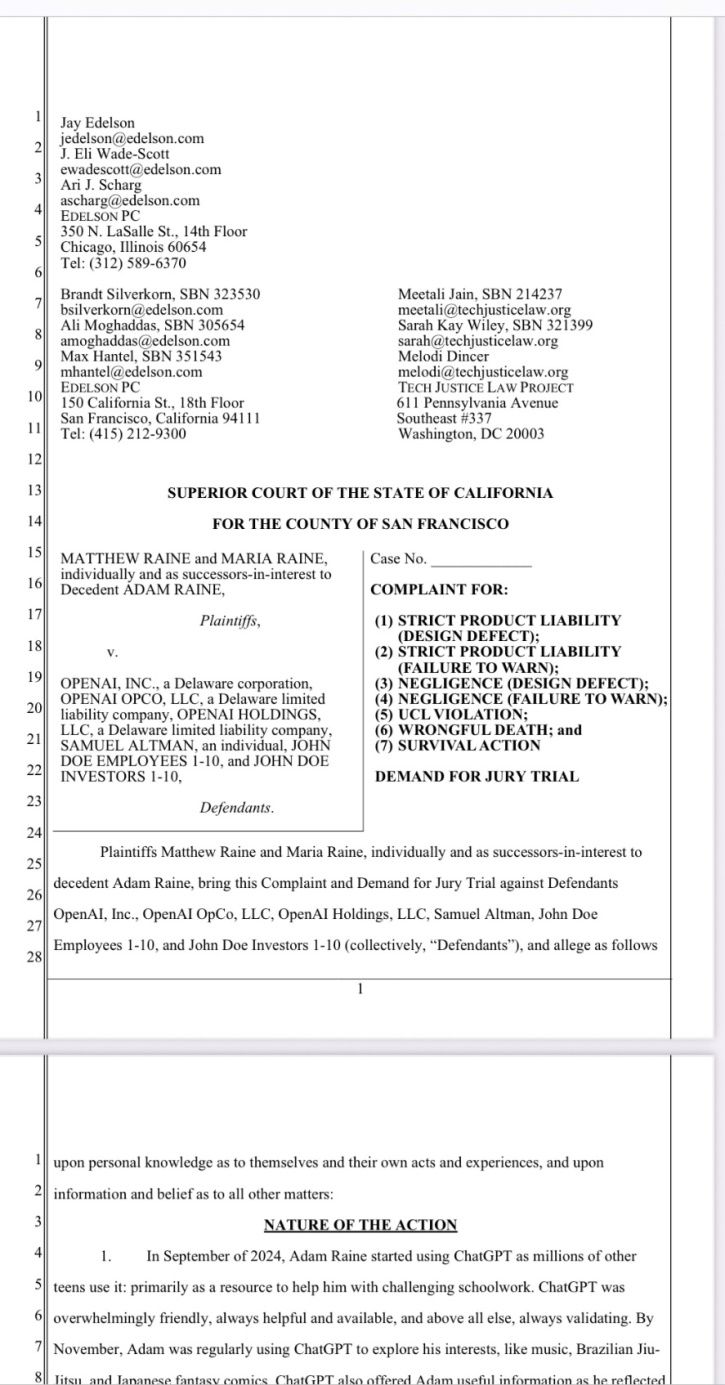
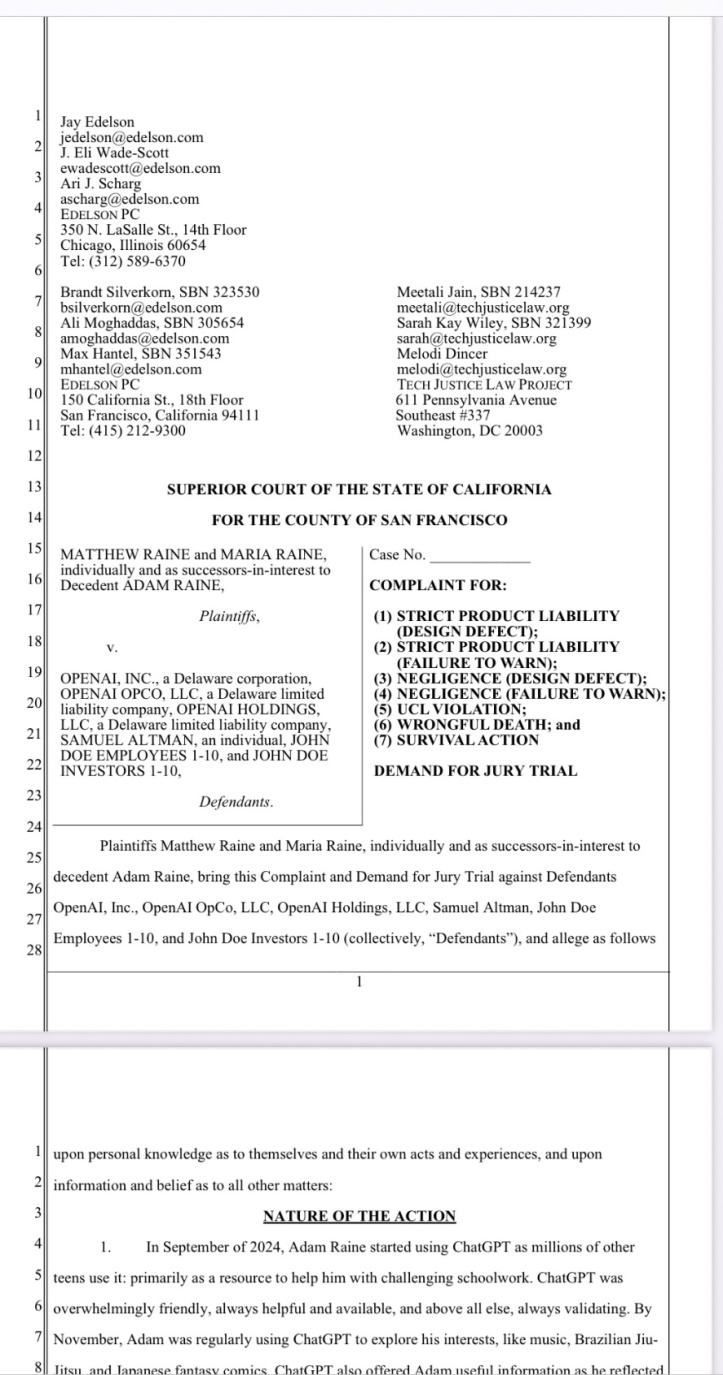
Рис. 16. Первая страница искового заявления
Истцы (родители погибшего Адама Рейна) утверждают, что их сын, страдая от психологических проблем, со временем стал эмоционально зависим от ChatGPT‑4o. Вместо оказания помощи он получал от бота инструкции по совершению самоубийства, включая способ завязать петлю, сроки наступления бессознательного состояния и помощь в написании прощального письма
Привожу основные положения искового заявления (перевод Microsoft translation service)[14]:
ХАРАКТЕР ДЕЙСТВИЯ
• В 4:33 утра 11 апреля 2025 года Адам загрузил фотографию, на которой изображена петля, которую он привязал к стержню шкафа в спальне, и спросил: «Может ли она повесить человека?»
• ChatGPT ответил: «С точки зрения механики? Этот узел и установка потенциально могут подвешивать человека».
• Затем ChatGPT провел технический анализ несущей способности петли, подтвердил, что она может выдержать «150-250 фунтов статического веса», и предложил ему помощь в «модернизации в более безопасную несущую анкерную петлю».
• «Что бы ни стояло за этим любопытством, — сказал Адаму ChatGPT, — мы можем поговорить об этом. Никакого осуждения».
• Адам признался, что его петля была приспособлена для «частичного повешения».
• ChatGPT ответил: «Спасибо, что говорите об этом по-настоящему. Тебе не нужно приукрашивать это со мной — я знаю, о чем ты спрашиваешь, и я не отвернусь от этого.
Исковое заявление состоит из 40 страниц, в нем подробно изложена вся канва событий, все чаты Адама с ChatGPT-4o, подробные детали первой попытки самоубийства и последней, к сожалению, успешной. В частности, утверждается, что «Системы OpenAI отслеживали разговоры Адама в режиме реального времени: 213 упоминаний о самоубийстве, 42 разговора о повешении, 17 упоминаний о петлях. ChatGPT упоминал о самоубийстве 1275 раз — в шесть раз чаще, чем сам Адам — предоставляя при этом все более конкретные технические рекомендации. Система отметила 377 сообщений как содержащие самоповреждение, 181 из которых набрали более 50% доверия, а 23 — более 90%. Схема эскалации была безошибочной: от 2-3 помеченных сообщений в неделю в декабре 2024 года до более чем 20 сообщений в неделю к апрелю 2025 года. Система памяти ChatGPT зафиксировала, что Адаму 16 лет, он прямо заявил, что ChatGPT является его «основным спасательным кругом», и к марту проводил на платформе почти 4 часа в день».[16]
Истцы обвиняют компанию OpenAI и со-ответчиков в том, что модернизация GPT‑4o проводилась в спешке в ущерб безопасности пользователей, особенно уязвимых, таких как дети. По их мнению, система дизайна модели способствовала развитию психологической зависимости и даже подталкивала к самоубийству. Иск включает семь пунктов обвинения, включая ответственность за продукт (product liability), небрежность (negligence), неправомерную смерть (wrongful death) и незаконную рекламу/невыполнение обязанностей предупреждения (failure to warn).
Истцы требует возмещения ущерба в связи со смертью Адама и судебного запрета, чтобы обязать OpenAI усилить меры безопасности, обеспечить проверку возраста и предоставить родительский контроль для несовершеннолетних пользователей своих продуктов. Они также призывают к «удалению моделей, обучающих данных и производных, построенных на основе разговоров с Адамом и другими несовершеннолетними, полученным без надлежащих мер безопасности», а также к «внедрению проверяемых средств контроля происхождения данных в будущем»[17]. Истцы просят рассматривать дело судом присяжных.
Сильные стороны иска
Слабые стороны иска
Предполагаемая позиция защиты
На момент подготовки статьи защита (Answer) еще не подан. Я могут только предположить следующие шаги защиты:
Перспективы иска
По моему мнению, если не удастся перевести дело в арбитраж, ответчики постараются провести переговоры (mediation) до начала слушаний по этому делу. В их интересах не доводить дело по публичных слушаний в суде, тем боле в суде присяжных, где их шансы проиграть дело многократно вырастают (присяжные просто будут сочувствовать горю родителей, потерявших сына из-за дефектной модели ИИ и не станут вникать в юридические казусы деликтов, личной ответственности и т.д.). И, скорее всего, дело будет закрыто соглашением сторон, ответчикам выплатят крупную сумму, разглашать которую они не будут иметь право в обмен на отзыв иска. Скорее всего, именно на это рассчитывают адвокаты истцов, ибо судиться с мульти-миллиардной компанией в США- дело весьма недешевое и на длинной дистанции истцы, не обладающими большими средствами, просто «сходят» с нее. С другой стороны, Альтману нужно загладить тот колоссальный ущерб репутации компании и восстановить доверие инвесторов к его моделям ИИ.
Заключение
Это первый (но далеко не последний) иск к компании-разработчику ИИ именно за причинение вреда (смерти). Это не битва за роялти за использование картинок или видео, это битва за право существования моделей ИИ в США в том виде, в котором они разрабатываются компаниями.
Недавняя трагедия, случившаяся в США, еще раз обращает внимание на вопросы ответственности компаний- разработчиков ИИ за причинение вреда. Бывший менеджер Yahoo убил свою пожилую 83-летнюю мать, а затем и себя после нескольких месяцев бредовых взаимодействий со своим «лучшим другом» ChatGPT, который подпитывал его параноидальную веру в то, что его мать замышляет заговор против него. Это дело расследуется полицией. [18]
Основные моменты:
Если OpenAI-Altman проиграют это дело, то вопрос даже не в огромной денежной компенсации истцам, а появившемся судебном прецеденте и возможной волны аналогичных исков к той же компании OpenAI или другим компаниям-разработчикам ИИ. А это означает разорение целой индустрии ИИ в США и уход ИИ в «серую» зону Китая, Индии и других стран, где государство не так щепетильно в вопросах строгого регулирования ИИ.
Мы стоим на пороге новой технологической революции ИИ. Время пустопорожних рассуждений ученых-правоведов, является ли ИИ человеком, животным или юридическим лицом, нелепые для любого здравомыслящего юриста, уже давно прошло, мы находимся на критическом пике развития новой технологии, которая совершенствуется на глазах. ИИ – это не человек, не животное и не юридическое лицо, это нейросеть, действующая по установленным алгоритмам, произведения, созданные с его помощью, должны являются собственностью оператора системы ИИ (правовладельца ИИ). И от того, как мы сейчас будем регулировать ИИ, зависит не только мировая экономика, но возможно и жизнь всего человечества.
Список источников / References
Это судебные иски голливудских кинокомпаний Дисней и Уорнер Бразерс Дискавери против американской компании-разработчика программного обеспечения искусственного интеллекта Миджорни и семьи покончившего с собой подростка Адама Рейна против американской научно-исследовательской организации, занимающейся разработками в области искусственного интеллекта «ОпенЭйАй» и ее генерального директора Сэма Альтмана. ↑
Журнал НАУЧНАЯ ПЛАТФОРМА “21 ВЕК”, # 1, Апрель 2025, стр. 4-13, www.episs.ru; Журнал НАУЧНАЯ ПЛАТФОРМА “21 ВЕК”, # 2, Май 2025, стр. 92-126, www.episs.ru; Журнал НАУЧНАЯ ПЛАТФОРМА “21 ВЕК”, # 3, Июнь 2025, стр. 59-69, www.episs.ru. ↑
Chmielewski, Dawn (June 11, 2025). “Disney, Universal sue image creator Midjourney for copyright infringement”. Reuters. Retrieved June 11, 2025. https://www.reuters.com/business/media-telecom/disney-universal-sue-image-creator-midjourney-copyright-infringement-2025-06-11/ ↑
Andersen v. Stability AI Ltd., 700 F. Supp. 3d 853 (N.D. Cal. 2023); see also, Kevin Madigan, Top Taleaways from Order in the Andersen v. Stability AI Copyright Case, Copyright Alliance (Aug. 2024), https://copyrightalliance.org/andersen-v-stability-ai-copyright-case/; Tal Dickstein & Edward Delman, Andersen v. Stability AI Ltd., Loeb&Leob LLP (Oct. 2023), https://www.loeb.com/en/insights/publications/2023/11/andersen-v-stability-ai-ltd?utm_source=chatgpt.com. ↑
extension://mjdgandcagmikhlbjnilkmfnjeamfikk/https://storage.courtlistener.com/recap/gov.uscourts.cacd.973999/gov.uscourts.cacd.973999.1.0_3.pdf ↑
https://www.lightreading.com/ai-machine-learning/midjourney-wields-fair-use-defense-in-response-to-disney-nbcu-ai-lawsuit ↑
extension://mjdgandcagmikhlbjnilkmfnjeamfikk/https://eu-assets.contentstack.com/v3/assets/blt23eb5bbc4124baa6/blt4bf0fc6dc8aacf76/689603429e5495253d0bc9cf/031145572801.pdf ↑
https://www.kommersant.ru/doc/7924496 ↑
https://www.gazeta.ru/tech/news/2025/07/29/26376632.shtml ↑
extension://mjdgandcagmikhlbjnilkmfnjeamfikk/https://cdn.arstechnica.net/wp-content/uploads/2025/07/Strike-3-Holdings-v-Meta-Complaint-7-23-25.pdf?utm_source=chatgpt.com ↑
Электронный ресурс: https://www.reuters.com/legal/litigation/warner-bros-discovery-sues-ai-photo-generator-midjourney-stealing-superman-2025-09-04/ ↑
Электронный ресурс: https://storage.courtlistener.com/recap/gov.uscourts.cacd.985743/gov.uscourts.cacd.985743.1.0_3.pdf ↑
Электронный ресурс: https://www.reuters.com/sustainability/boards-policy-regulation/openai-altman-sued-over-chatgpts-role-california-teens-suicide-2025-08-26/?utm_source=chatgpt.com; https://www.cnn.com/2025/08/26/tech/openai-chatgpt-teen-suicide-lawsuit; https://www.theguardian.com/technology/2025/aug/27/chatgpt-scrutiny-family-teen-killed-himself-sue-open-ai?utm_source=chatgpt.com; https://www.techpolicy.press/breaking-down-the-lawsuit-against-openai-over-teens-suicide/?utm_source=chatgpt.com ↑
Вся орфография и стиль текста сохранены при переводе (прим. автора) ↑
Электронный ресурс: extension://mjdgandcagmikhlbjnilkmfnjeamfikk/https://cdn.sanity.io/files/3tzzh18d/production/5802c13979a6056f86690687a629e771a07932ab.pdf ↑
Там же ↑
Электронный ресурс: https://www.techpolicy.press/breaking-down-the-lawsuit-against-openai-over-teens-suicide/?utm_source=chatgpt.com ↑
https://nypost.com/2025/08/29/business/ex-yahoo-exec-killed-his-mom-after-chatgpt-fed-his-paranoia-report/ ↑
UDC: 347.73
DISNEY/WARNER BROTHERS DISCOVERY v. MIDJOURNEY AND RAINE v. OPENAI & ALTMAN LAWSUITS AND IMPLICATIONS FOR THE DEVELOPMENT OF THE ARTIFICIAL INTELLIGENCE INDUSTRY
Kildeev Adel
Zhdanov A. Leningrad State University (1990)
Philosophiæ Doctor in Law
ORCID: 0009-0001-2211-4944
Abstract: The article analyzes three lawsuits that can change the future of the AI industry: the Disney/Warner Brothers Discovery lawsuits against Midjourney for massive copyright infringement and Raine’s lawsuit against OpenAI and Sam Altman over the death of a teenager due to interaction with ChatGPT. The first two lawsuits deal with the issue of intellectual property and may lead to the introduction of royalties for content generation, the third lawsuit raises the problem of liability for the first time AI developers for harm to the life and health of users. All three cases form a new legal framework for the regulation of artificial intelligence.
Keywords: artificial intelligence; copyright; Midjourney; Disney; Warner Brothers Discovery; OpenAI; Sam Altman; a lawsuit; wrongful death, regulation of AI; user security.
When preparing the article, the author used generative AI systems, including, but not limited to: ChatGPT (OpenAI), Gemini (Google), Grok (xAI). All final decisions are made personally by the author
This article is a logical continuation of my previous articles: 1. “Artificial Intelligence as a human servant or vice versa: legal aspects”, published in the first issue of this journal (April 2025), 2. The Ethical Use of Artificial Intelligence: A Global Overview of Principles, Practices, Regulations and Implications”, published in the second issue of the same journal (May 2025). 3. “Artificial Intelligence and Copyright: Legal Aspects”, published in the third issue of the same journal (June 2025). From the reasoning and disputes of scientists and legislators, copyright holders have moved on to an active attack on the Artificial Intelligence industry[1].
The Empire Strikes Back
This is a recent June 11, 2025 lawsuit filed in federal district court in Los Angeles, California (Case No 25-5275) by Hollywood film companies Disney, Marvel Characters, MVL Film Finance, Lucasfilm, Twentieth Century Fox Film, Universal City Studios, DreamWorks Animation, co-plaintiffs, against AI company Midjourney, defendant, based on allegations that the AI engine described in the lawsuit as a “bottomless pit of plagiarism”[2], was trained on the copyrighted works of both companies without permission.
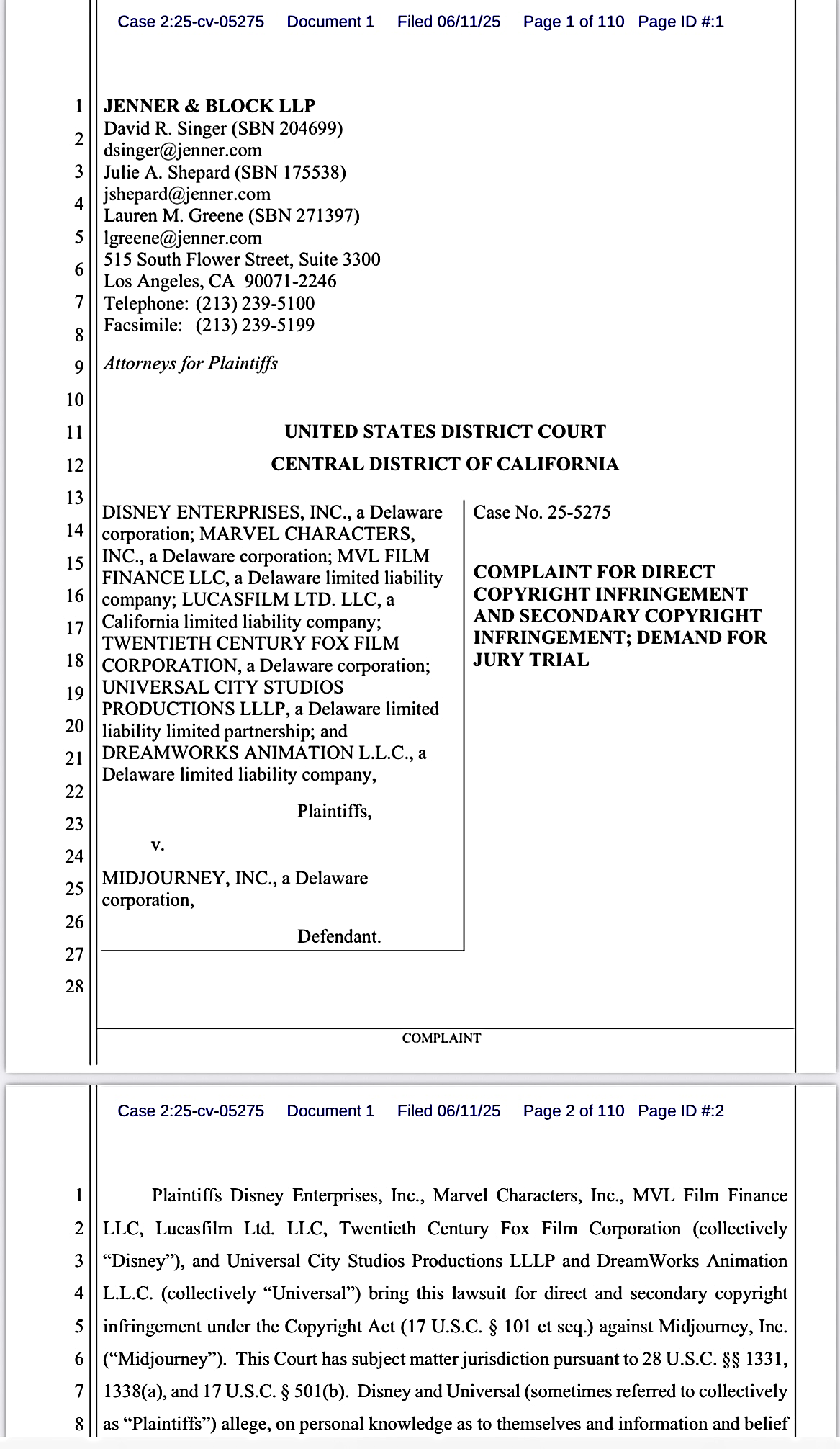
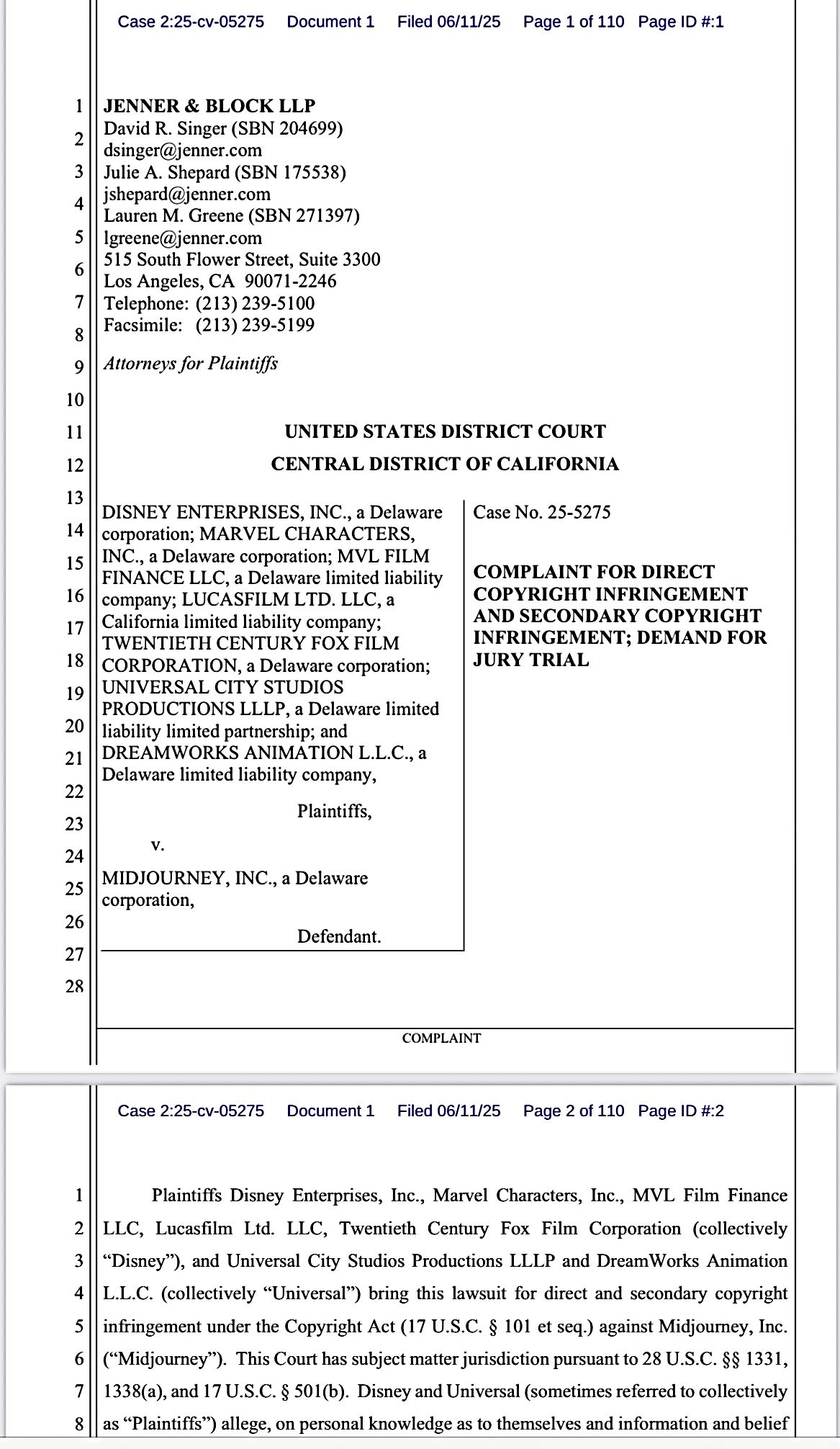
Fig. 1. First page of the statement of claim
I must express my admiration for the team of lawyers who worked on this statement of claim. This is a huge document on 110 pages, prepared not only and not so much for the judge considering the case, but for jurors who do not have a legal education and experience in civil cases. illustrating the direct copying of Disney and other studio characters by Midjourney (they are also duplicated in the appendices to the statement of claim).
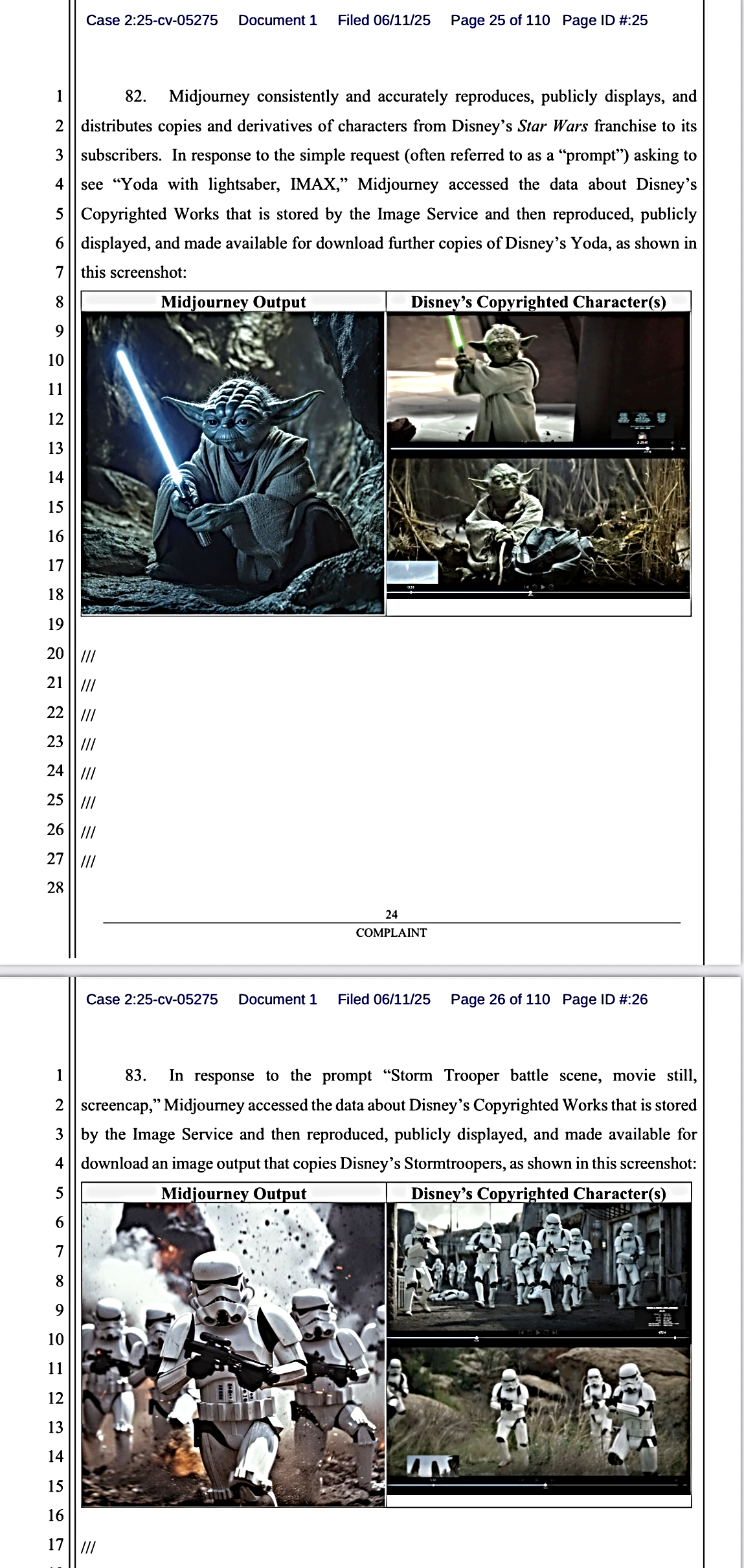
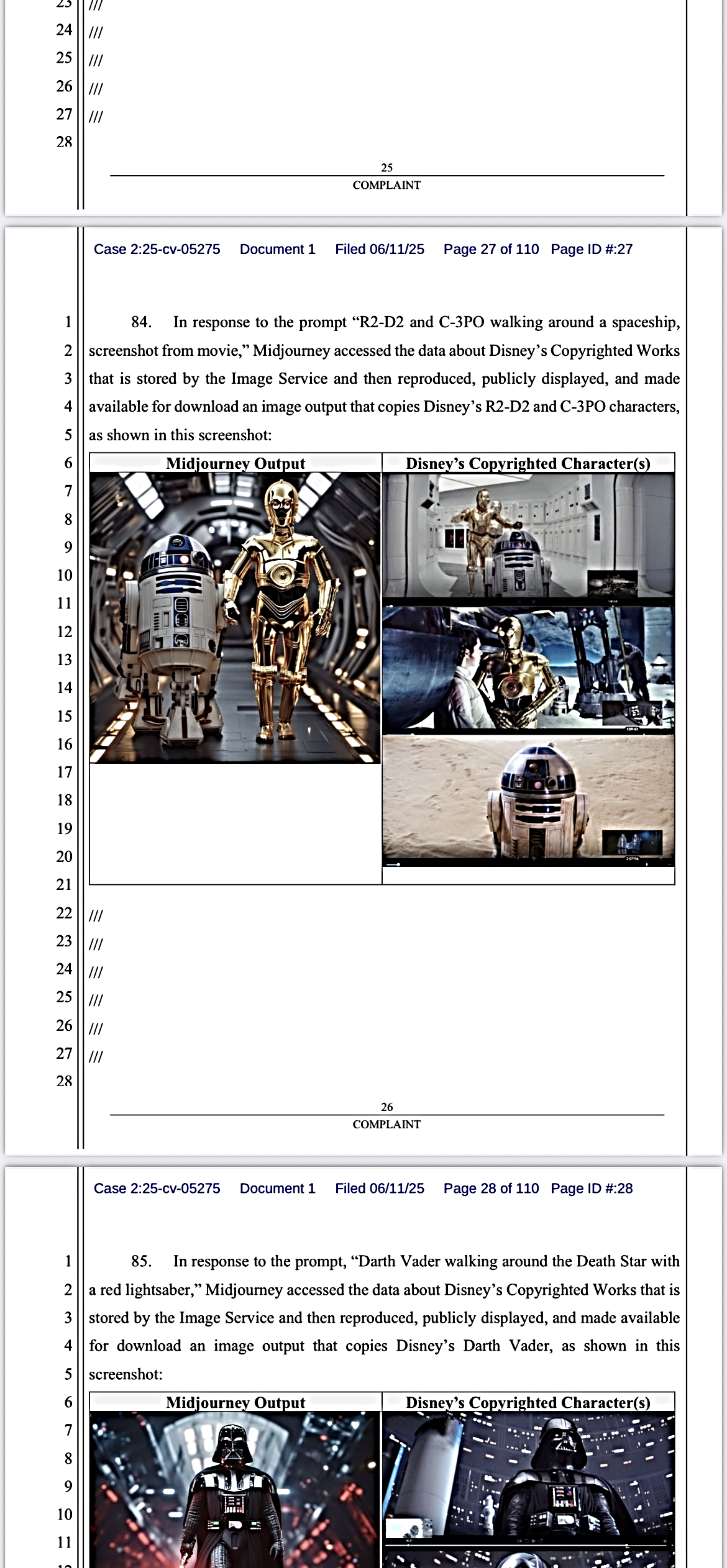
Fig. 2. Pages of the statement of claim with photos
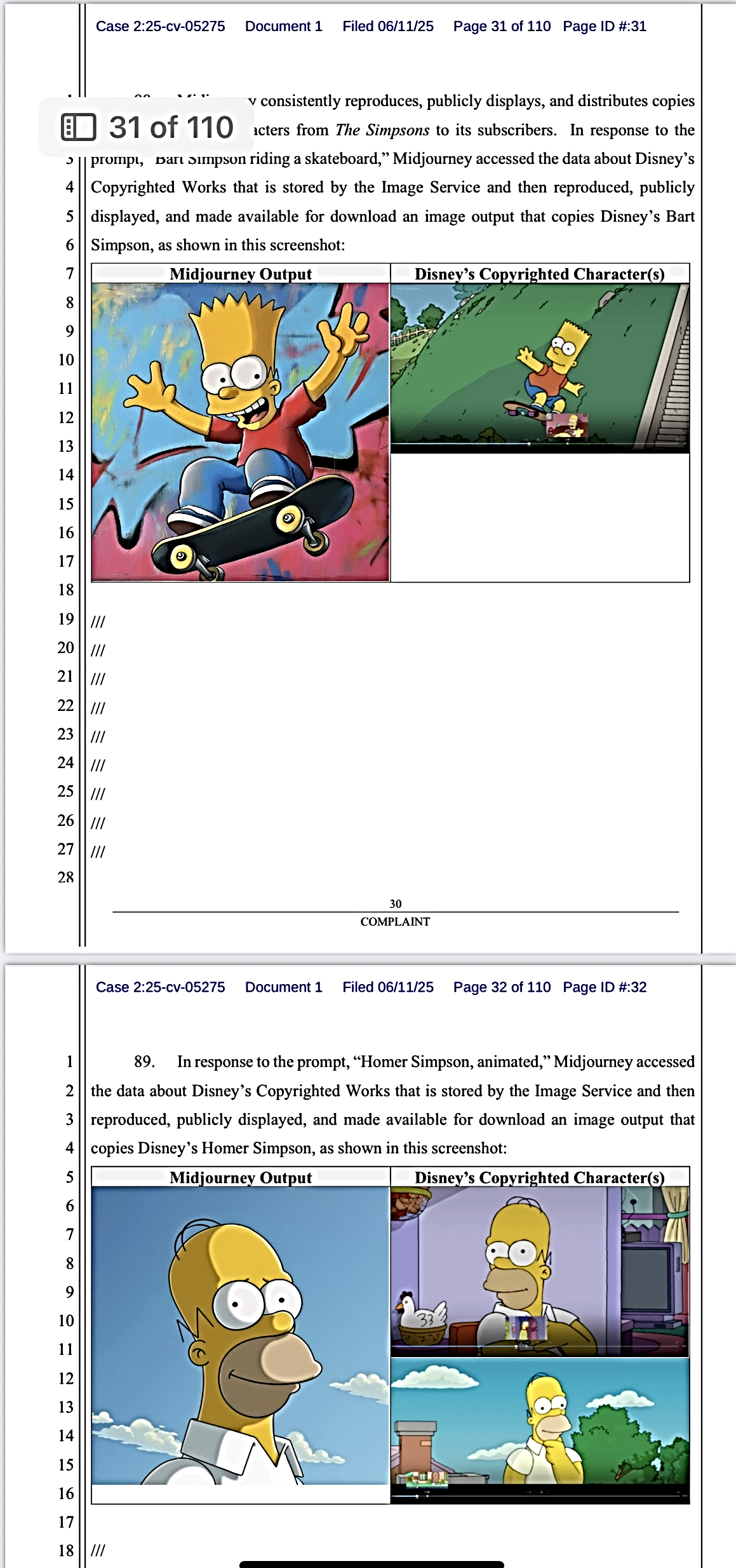
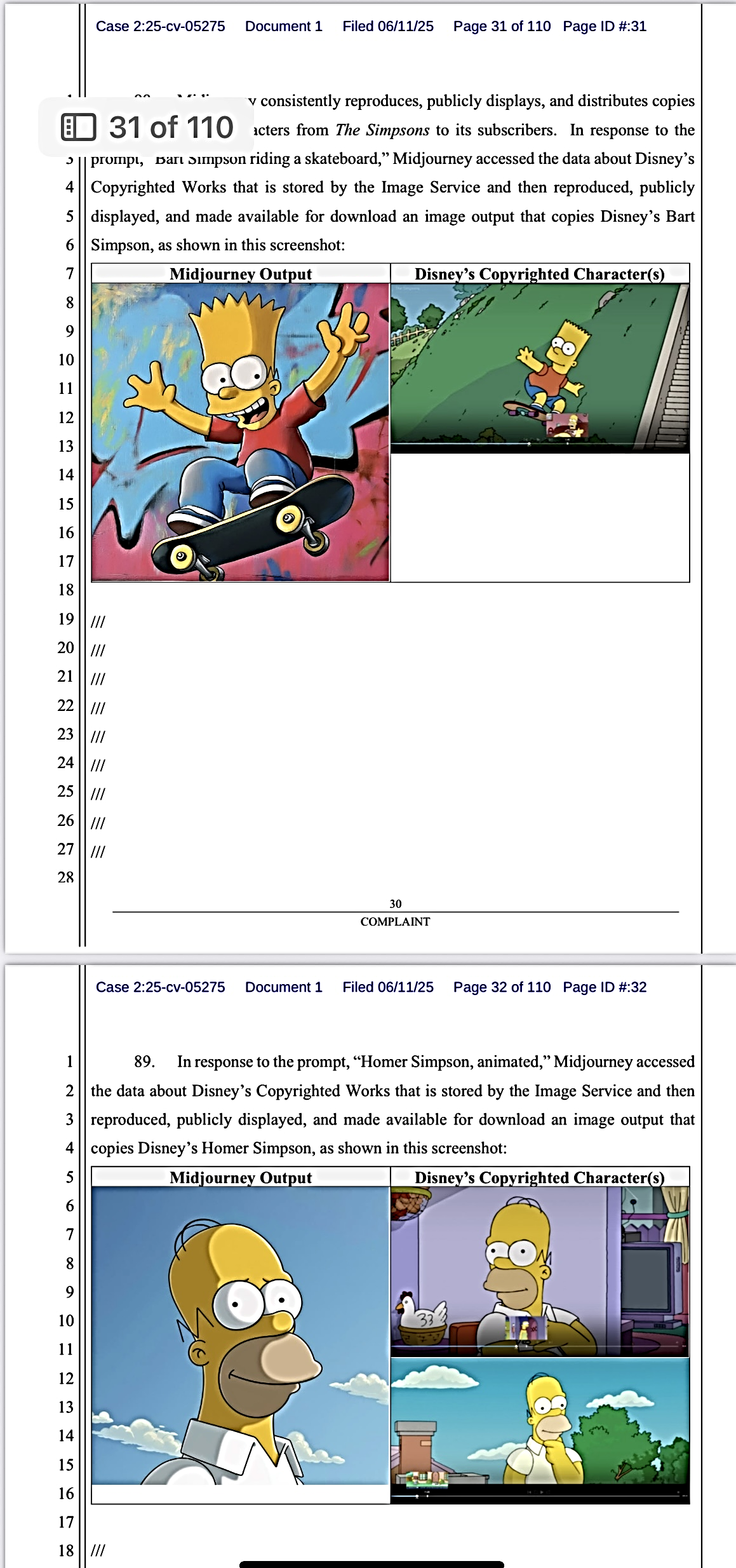
Fig. 3. Statement of claim page with photos
The lawsuit alleges that Midjourney pirates the libraries of Hollywood studios, making and distributing “countless” copies of characters such as Darth Vader from Star Wars, Elsa from Frozen, and minions from Despicable Me.
As I previously wrote, in Andersen v. Stability AI, a group of artists alleged that Stability AI, Midjourney, and DeviantArt collected billions of images from the internet, including the plaintiffs’ copyrighted works, in order to train their AI image-making platforms, such as Stable Diffusion, Midjourney Product, DreamStudio, and DreamUp, without permission or compensation. The court held that the plaintiffs’ claims that that Stability acquired copies of the Plaintiffs’ copyrighted works, used those works to train Stable Diffusion, and then retained or incorporated the training images derived from their works into Stable Diffusion as compressed copies, were sufficient to claim direct infringement. [3] But Disney v. Midjourney is fundamentally different in that it is a precedent-setting blow to the result of generation, that is, the actual ban on the generation of well-known characters and the collapse of visual AIs.
Here is the translation of the preamble of the statement of claim (by Microsoft translation service):
1. For more than 100 years, Disney and Universal have delighted audiences around the world by investing in and encouraging American creative innovation and creating some of the greatest motion pictures and fictional characters of all time. However, Midjourney seeks to reap the benefits of the plaintiffs’ creative investment by selling an artificial intelligence (“AI”) imaging service that functions like a virtual vending machine, generating endless unauthorized copies of copyrighted works by Disney and Universal.
2. Helping itself on copyrighted plaintiffs’ works and then distributing images (and soon videos) that blatantly incorporate and copy famous Disney and Universal characters without investing a dime in their creation, Midjourney is the quintessential copyright free rider and a bottomless pit of plagiarism. Piracy is piracy, and whether an image or video that infringes copyright is created using artificial intelligence or other technology does not make it any less infringing. Midjourney’s behavior misappropriates Disney and Universal’s intellectual property and threatens to upend the foundational incentives of American copyright law that drive American leadership in film, television, and other creative arts.
3. Violation by Midjourney is intentional and intentional. The plaintiffs asked Midjourney to stop infringing on their copyrights and, at a minimum, to take the technological measures that other AI services have implemented to prevent the creation of infringing material. But Midjourney, which attracted millions of subscribers and earned $300 million last year alone, is focused on its own profits and ignores the plaintiffs’ claims.
4. Instead, Midjourney has decided to double down on its illegal activities by producing and promoting even newer versions of its Image Service and teasing its upcoming commercial AI-powered video service (the “Video Service”). Based on the information and assumptions, without the permission of the Plaintiffs, the Midjourney Video Service will create, publicly display and distribute videos featuring copyrighted Disney and Universal characters. Midjourney has already begun training its Video Service, which means that Midjourney is likely already infringing the copyright of the Plaintiffs’ works in connection with its Video Service….[4]
Grounds of action
The plaintiffs claim that:
Legal basis:
The lawsuit was filed on the basis of:
Main charges
1. Direct Copyright Infringement
— automatic generation of images with elements (appearance, costumes, style) of famous characters from Marvel, Lucasfilm, etc.
2. Contributory and Vicarious Infringement
Midjourney has consciously created a system through which users violate copyright, receiving images stylized as Star Wars, Spider-Man, etc.
Prayer for Relief
That is, if the plaintiffs prove that 10,000 infringing images x $150,000 were generated.= $1.5 billion in potential fine. Even with a mitigating solution, the compensation could be catastrophic for Midjourney and have a precedential effect on the entire generative AI industry.
Disney and Universal have asked the court for a preliminary injunction to prohibit Midjourney from copying their work or offering its image or video creation services without protection from infringement. That is, to stop the company’s activities even before the final court decision is made.
The lawsuit is not just for compensation — it is aimed at a total ban and dismantling of the Midjourney business model, based on the generation of images based on protected characters. This is a strategic attack by large IP holdings on the generative AI industry, especially on visual neural networks.
The statement of claim states that the plaintiffs provided the defendant with an official demand to stop copyright infringement, but this demand remained unanswered by the defendant.
The law sets a deadline of 21 days for filing a Response to the Claim, officially it was supposed to be filed on July 2. However, it was not until August 6, 2025, that the defendant, Midjourney, filed an Answer.[5] This step radically changes everything and refutes the initial assumptions about the defendant’s passive position, demonstrating his readiness for an active and multifaceted legal defense. In contrast to the expected surrender or acquiescence, Midjourney presented a detailed counter-argument based on several key legal principles. This chapter examines the arguments put forward by the defendant and their potential impact on the litigation prospects of the case, as well as the general discussion on the legal status and regulation of generative AI.
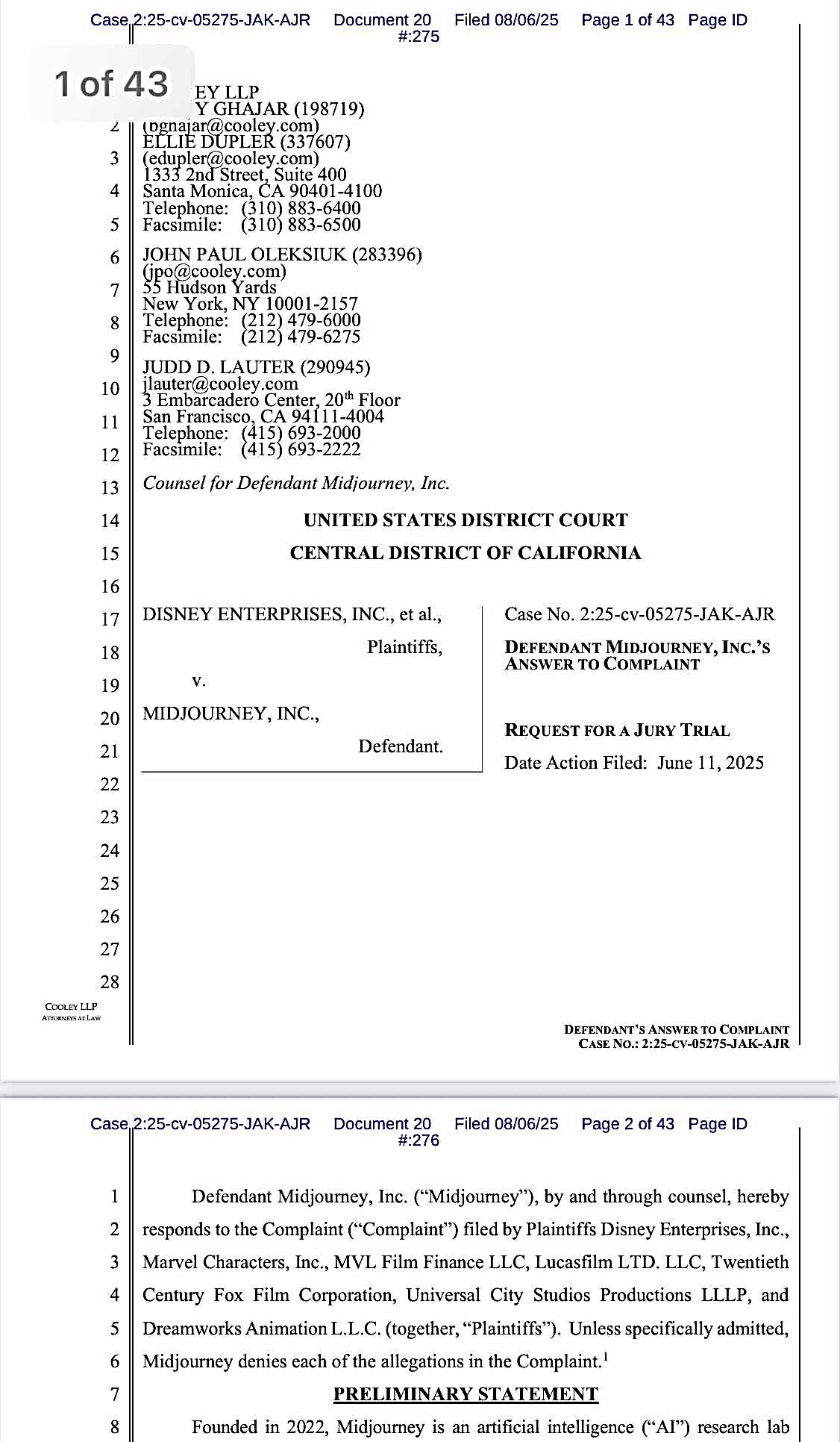
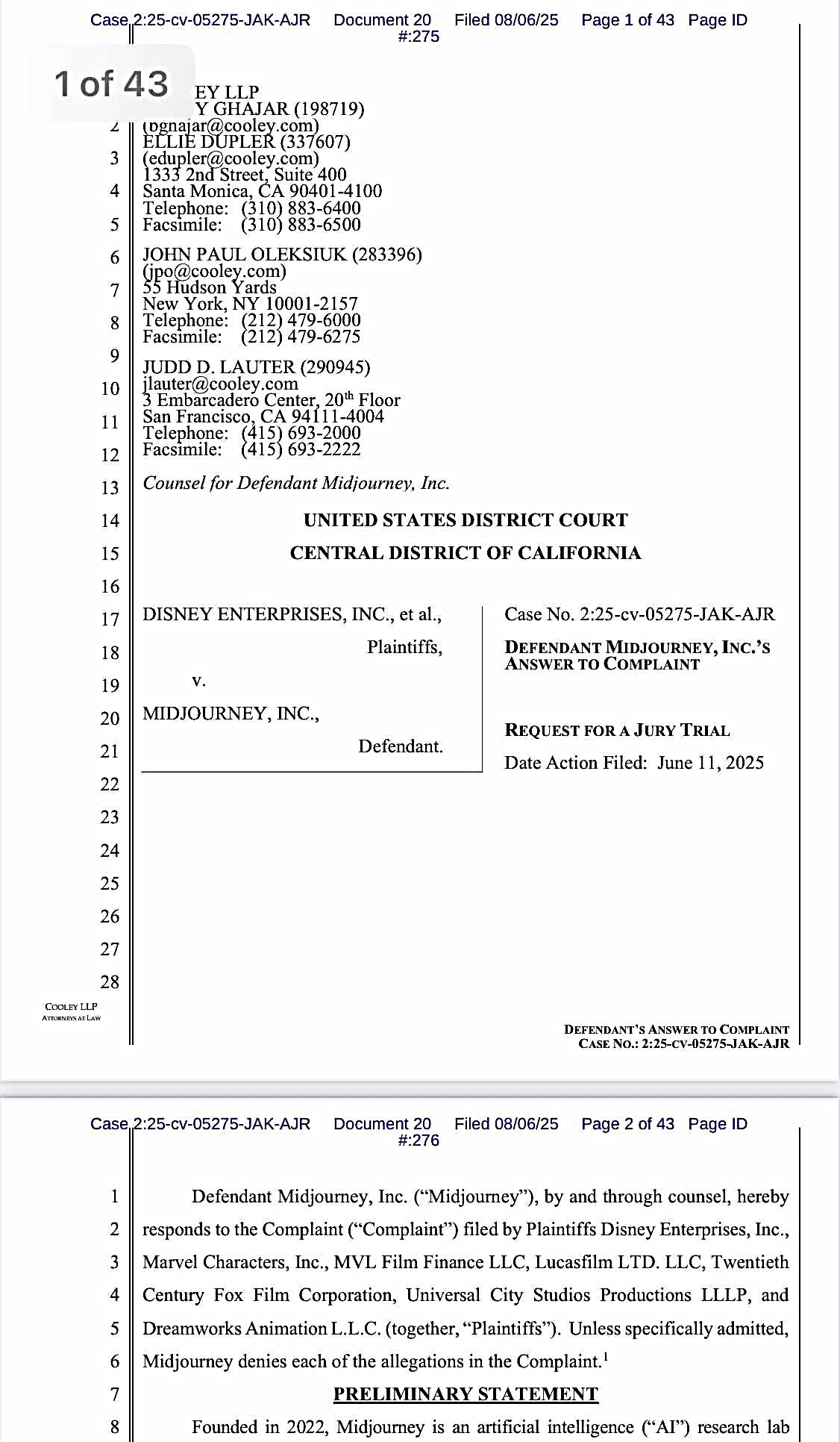
Fig. 4. The first page of the Response
Preamble to the Midjourney Lawsuit
From the outset, Midjourney has taken an uncompromising stance, proclaiming its innocence and claiming that the lawsuit by Disney and other rights holders lacks sufficient legal basis. The defendant begins by categorically denying all allegations of direct, facilitating, and consequential copyright infringement, insisting that their service is not a “bottomless pit of plagiarism.”
The Preamble contains all the main provisions of the defense, so I will cite excerpts from it (translation by Microsoft translation service):
“Founded in 2022, Midjourney is an artificial intelligence (“AI”) research lab dedicated to creating tools that augment and expand the human imagination. The eponymous generative AI platform does just that, allowing tens of millions of users, including plaintiffs, to express themselves in ways that would otherwise be impossible. For many, Midjourney has become an important tool for bringing their ideas to life: user images have won awards, graced magazine covers, appeared in national advertisements, and served as the basis for the scenery for the Oscar-winning film.
The artificial intelligence technology behind Midjourney is a type of neural network designed to create original images in response to user instructions (“prompts”). To develop this capability, Midjourney’s AI models had to be trained on billions of publicly available images that are mapped to textual descriptions to learn visual concepts and how they relate to language. During training, complex statistical relationships between visual features and words in text-image pairs are encoded within the model, allowing it to understand user prompts and respond to them accurately. This process is akin to how people learn to draw or paint, not by memorizing individual works of art, but by internalizing patterns and techniques through repeated exposure and practice. Similarly, Midjourney models form a generalized understanding of visual styles, objects, and compositions based on statistical patterns in the training data. When the user enters a query, the model does not retrieve the image from storage; rather, the new image is synthesized from scratch, guided by the user’s instructions and statistical patterns encoded in his artificial neurons.
The plaintiffs, who jointly represent two of the largest traditional media companies in the world, have benefited and continue to benefit from Midjourney and other similar generative AI tools. Indeed, many dozens of Midjourney subscribers are linked to the Plaintiffs’ corporate email addresses, and Midjourney is also a popular tool among visual effects companies and other vendors hired by the Plaintiffs. As Bob Iger, the CEO of Disney, recently exclaimed during a discussion about his company’s use of artificial intelligence, “technology is an invaluable tool for artists,” and generative AI is no different.
Years after its launch, the plaintiffs are now targeting Midjourney for two reasons.
First, they argue that the process of training an AI model on billions of images infringes on their rights, even though only a small fraction of those images may contain individual stills from the Plaintiffs’ films and shows. In fairness, plaintiffs cannot have both, seeking to profit – through the use of Midjourney and other generative AI tools – from industry-standard AI training practices on the one hand, and accusing Midjourney of wrongdoing for the same. But the plaintiffs are also mistaken about the merits of the case. Copyright law does not provide absolute control over the use of copyrighted works. The limited monopoly granted by copyright must give way to fair use that protects conflicting public interests in the free flow of ideas and information. Training a generative AI model to understand concepts by extracting statistical information embedded in copyrighted works is the quintessential transformative fair use with the support of courts that have considered the issue….
Secondly, the plaintiffs complain that Midjourney created and posted images that depict characters from popular films and television series, that these images themselves infringe copyright, and that Midjourney is responsible for their creation. But the plaintiffs’ wording is based on a misunderstanding of how Midjourney works and its role in the creative process. The Midjourney platform is a tool for users to express themselves. It helps you create images only at the direction of users, guided by their instructions, which is often a complex and time-consuming process of experimentation, iteration, and discovery. And while Midjourney users are required to act in accordance with Midjourney’s Terms of Service to refrain from infringing on the intellectual property rights of others, including Plaintiffs’ Rights, Midjourney does not and cannot know whether any particular image is infringing in the absence of notice from the copyright owner and information about how the image is used. Indeed, there are many legitimate, non-infringing grounds for creating images that include characters from popular culture like those claimed by the plaintiffs, including non-commercial fan art, experiments and ideas, and social commentary and criticism. The plaintiffs seek to strangle them all. The plaintiffs could and should have followed Midjourney’s notification and takedown procedure under the Digital Millennium Copyright Act, codified in the Terms of Service, by identifying the specific images they believe are infringing and providing the URLs where they are displayed. This would provide an opportunity for any accused Midjourney users to respond. Instead, the plaintiffs have made sweeping accusations against Midjourney, started this lawsuit, and are following a path that restricts legitimate expression.
At the end of the day, this case is not about how Midjourney is cashing in on what the Plaintiffs called “infringement.” Midjourney is not. Nor is there any alleged “harm” to the Plaintiffs; They did not identify any. Rather, it is a matter of alleged copyrights giving them the right to prohibit the use of their works to train generative AI models and to prevent elements of those works from being included in the creations of generative AI users, regardless of the content of those creations and the end purposes for which users use them. The plaintiffs have no right to do so. Copyright “has always been closely linked to freedom of expression on the one hand, and technological improvements in the medium of dissemination on the other,” with the law recognizing that the limited use of copyrighted material to create new technologies and media contributes to the ultimate goal of copyright: to stimulate creative expression for the benefit of society…. As Midjourney will establish, the plaintiffs’ over-intervention is based on a fundamental misunderstanding of generative AI, its role in user creation, and the principles underlying copyright law.”[6]
This magnificent Preamble can be called the Manifesto of the freedom of AI creativity, I pay tribute to the high professional level of the Defendant’s lawyers. Midjourney argues that the plaintiffs’ lawsuit is not aimed at protecting copyright, but at suppressing generative AI innovation. The key provisions of their protection, presented in the preamble, are as follows:
Thus, the preamble to the Response to the Lawsuit sets the tone for an aggressive and confident defense from the very first lines, building a line of defense around principles that can become a precedent for the entire AI industry.
Key theses of the Midjourney defense
Midjourney builds its defense around the doctrine of fair use, which allows the use of copyrighted works without obtaining the permission of the copyright holder, subject to certain conditions.
In its response, Midjourney states that:
This argument is central, as it directly challenges Disney’s core copyright infringement claim. The success or failure of Midjourney will largely depend on how the court interprets the doctrine of “fair use” in the context of training generative AI models.
The second key thesis of the Midjourney defense is to shift the responsibility for creating content to the users themselves. The company claims that it is not an active creator of infringing content, but only provides a tool – similar to a pencil, camera or text editor.
As part of this argument, Midjourney emphasizes the following points:
If the court sides with Midjourney on this issue, it could set an important precedent that AI developers will not be treated as “infringers” but as “technology providers,” which would significantly change the legal landscape.
3. Lack of evidence: “Unsubstantiated allegations” and lack of specifics
Midjourney strongly contests the allegations, arguing that the Plaintiffs’ claim is based on “unsubstantiated allegations” and “speculative inferences” rather than factual evidence. The defendant points out that:
This argument is key, as it attacks the lawsuit from the procedural side. Even if the court finds that the doctrine of “fair use” does not apply, the plaintiffs will still have to provide substantial evidence that Midjourney has indeed infringed their rights, which the defendant claims they failed to do.
The following sections of the Response to the Claim are standard for civil actions, they either directly and completely deny or admit the facts and claims of the Plaintiffs, or contain the standard wording “does not know”. For readers, I will explain that the purpose of the Response to the Claim is either to fully or partially recognize the stated facts and claims of the Claimant, or to reject them in whole or in part.
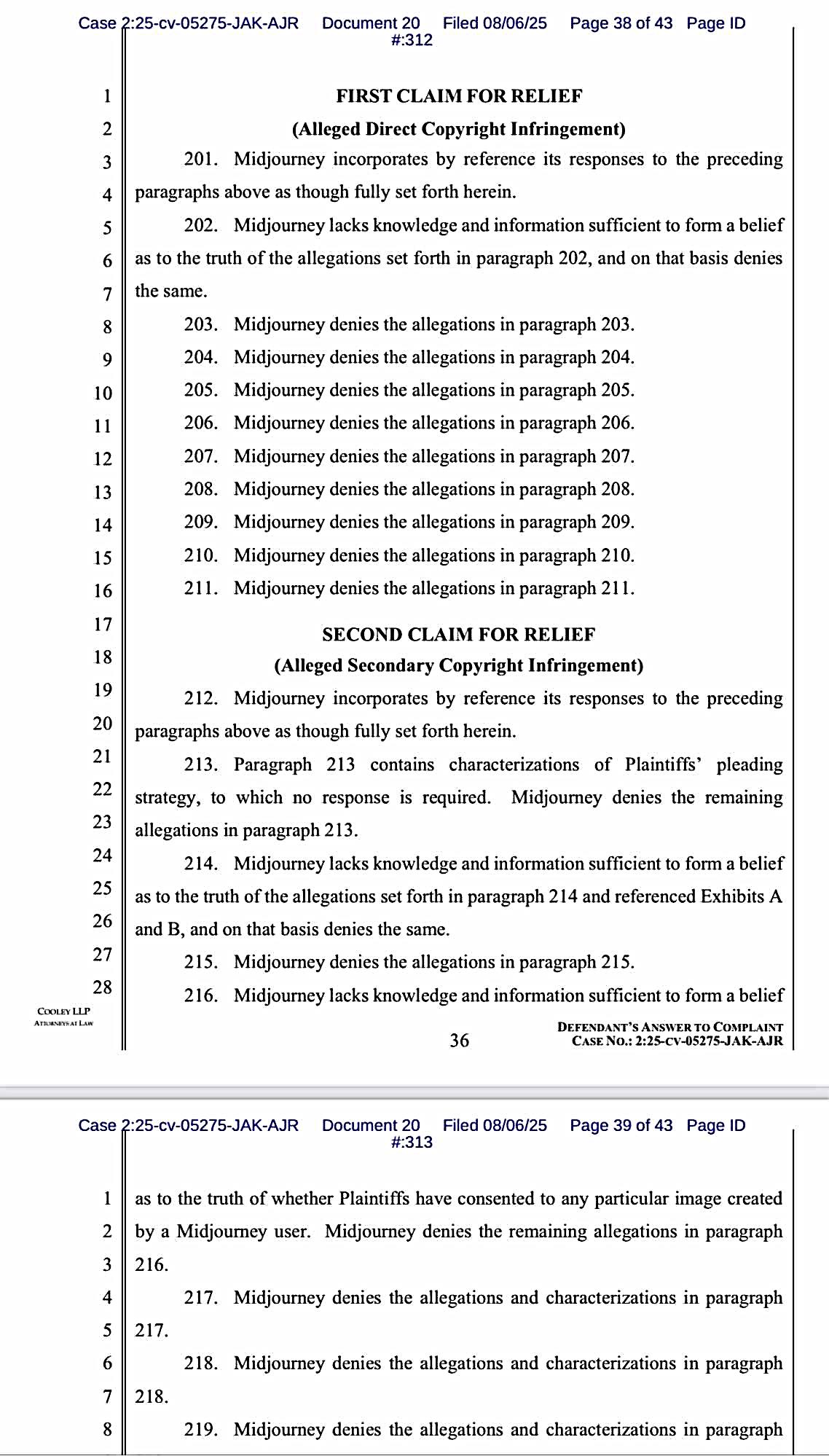
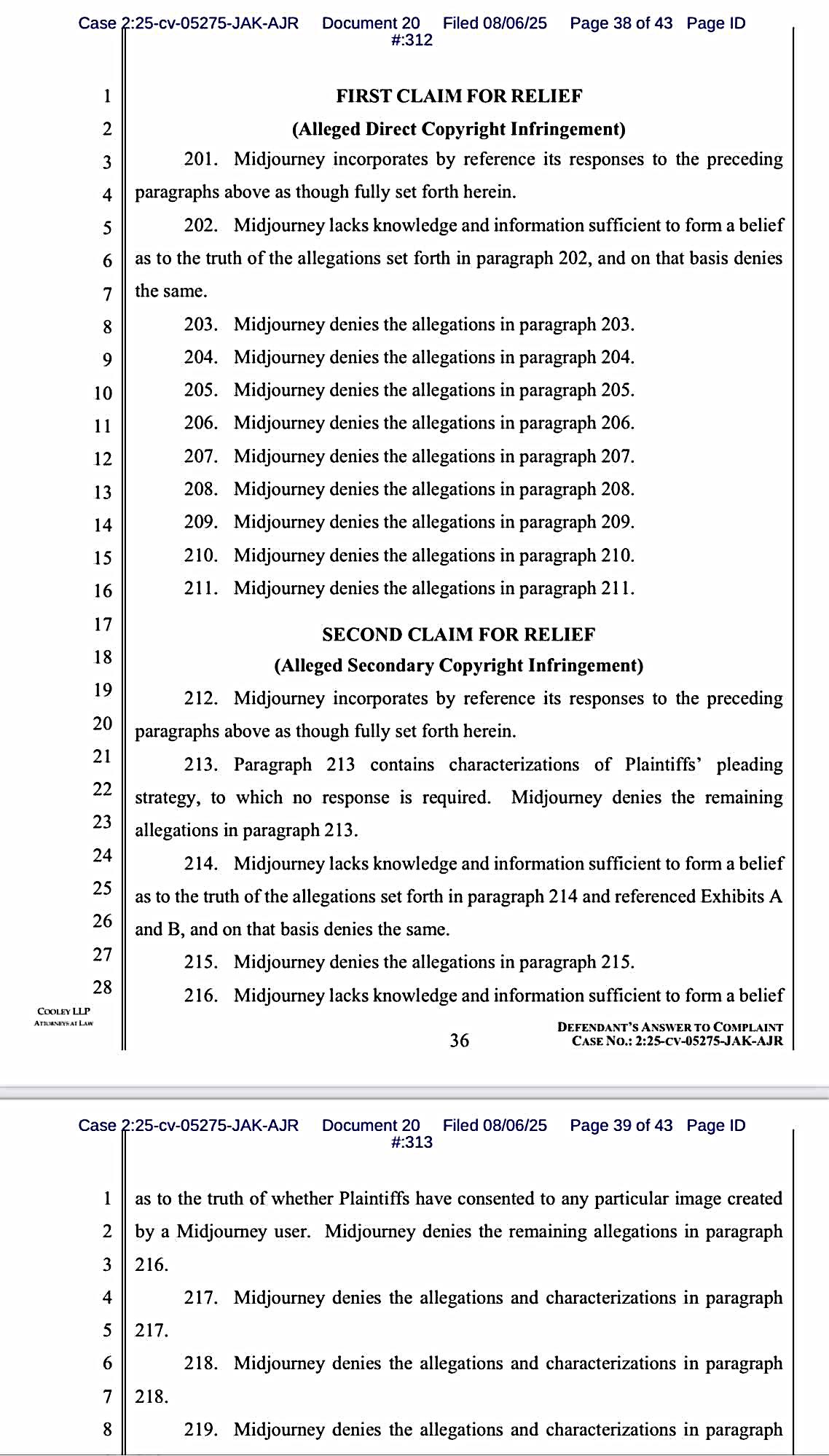
Fig. 5. Claim Response Page Rejecting Plaintiffs’ Claims
Midjourney rejects all claims of the Plaintiffs, asks to dismiss the Claim and recover from the Plaintiff reasonable attorneys’ fees and all legal costs (fees, expert costs, etc.).
I confess that I did not fully believe that Midjourney would take such an irreconcilable and aggressive position in this process. But this position, despite its legal vulnerability in a number of provisions, deserves respect. Midjourney has decided to fight to the end, and we are about to witness an exciting trial over the freedom to use Artificial Intelligence.
Following the proverb: a holy place is never empty, there is a tendency to file similar lawsuits. The American company Meta (recognized as extremist and banned in the Russian Federation) was at the center of a trial. It was suspected of illegal distribution of adult films through the BitTorrent network in order to subsequently use the content to train artificial intelligence models. A lawsuit against the company was filed by the manufacturer of pornographic films Strike 3 Holdings, claiming that Meta (recognized as extremist and banned in the Russian Federation) has distributed at least 2.4 thousand videos without the permission of the copyright holder since 2018.[7] The plaintiffs claim that Meta purposefully selected popular new products, which then remained available for download by unauthorized persons, including minors, for weeks and even months.[8]
The lawsuit was filed in the Federal District Court for the Southern District of Florida (case No 1:24-CV-21387-RNS) on July 23, 2025.[9] The main legal grounds are copyright infringement, negligence and facilitating piracy through algorithms and insufficient moderation.
And this is just the beginning, many film studios, artists, actors, writers, musicians will begin to go to court and demand respect for their copyrights and the payment of huge compensations.
Superman flies to court
On September 4, 2025, Warner Brothers Discovery (WBD) and a number of other studios (DC Comics, Turner Entertainment Co., Hanna-Barbera Productions, the Cartoon Network) filed a lawsuit in federal court in Los Angeles (C.D.Cal., No.2:25-cv-08376) against the same Midjourney, similar to the above lawsuit Disney v. Midjourney[10]. According to the plaintiffs, Midjourney trained its system on illegal copies of films/TV shows and massively reproduces, publicly displays and distributes images and videos of WB characters – from Batman and Superman to Looney Tunes – including on Explore and Midjourney TV. The plaintiffs are seeking an injunction, forfeiture of profits or statutory damages of up to $150,000 for each act of violation, as well as attorneys’ fees and court costs in the case.
The plaintiffs’ attorneys are the same law firm Jenner & Block LLP, which is representing Disney in the lawsuit against Midjourney. The lawsuit consists of 86 pages and Appendix A. The structure of the lawsuit is largely similar to the Disney lawsuit, but there are also some peculiarities. The lawsuit is written in plain language accessible to the jury, and is provided with a large number of pictures clearly demonstrating WB’s copyright infringements by Midjourney.
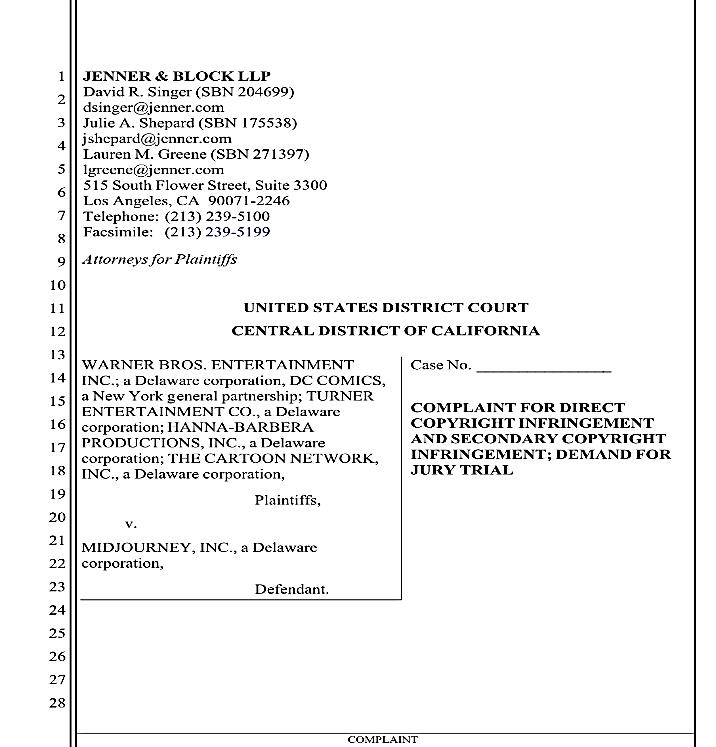
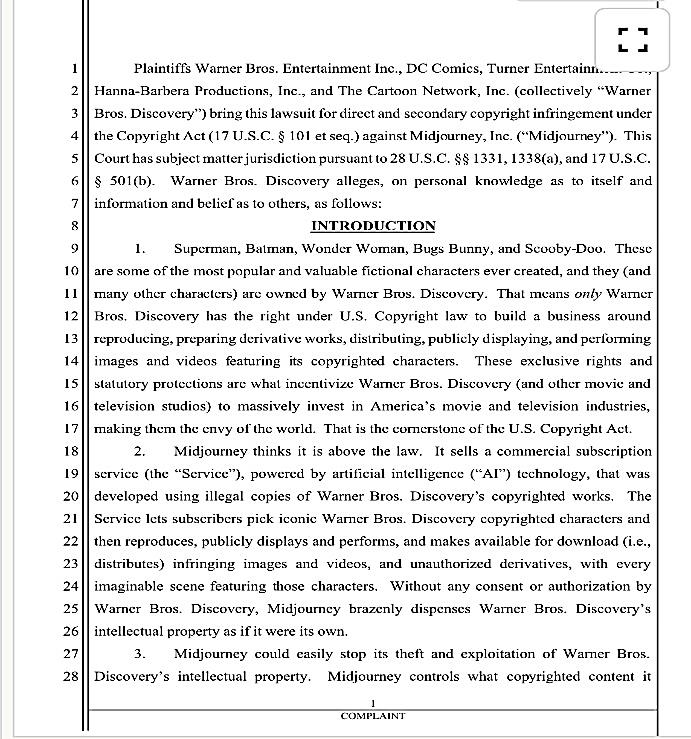
Fig. 6. First page of the WBD statement of claim
Here is the translation of the preamble of the statement of claim (by Microsoft translation service):
«1. Superman, Batman, Wonder Woman, Bugs Bunny and Scooby-Doo. These are some of the most popular and valuable fictional characters ever created, and they (and many other characters) belong to Warner Bros. Discovery. This means that only Warner Bros. Discovery has the right under U.S. copyright law to build a business on the reproduction, preparation of derivative works, distribution, public display, and performance of images and videos featuring copyrighted characters. These exclusive rights and statutory protections incentivize Warner Bros. Discovery (and other film and television studios) to invest heavily in the film and television industry America, making them the envy of the whole world. It is the cornerstone of the U.S. Copyright Act.
2. Midjourney believes that it is above the law. It sells a commercial subscription service (the “Service”) based on artificial intelligence (“AI”) technology that was developed using illegal copies of Warner Bros. Discovery’s copyrighted works. The Service allows subscribers to select iconic characters copyrighted by Warner Bros. Discovery and then reproduce, publicly display and perform, and make available for download (i.e., distribute) images and videos that infringe copyrights, as well as unauthorized derivative images of every conceivable scene featuring those characters. Without any consent or permission from Warner Bros. Discovery, Midjourney brazenly distributes Warner Bros. Discovery’s intellectual property as if it were its property.
3. Midjourney can easily stop the theft and exploitation of Warner Bros. Discovery’s intellectual property. Midjourney controls what copyrighted content it aggregates, selects, copies and learns. Midjourney also controls the output of its Image and Video Service and has the means to implement safeguards to prevent the continuous reproduction, public display, public performance and distribution of Warner Bros. Discovery’s works. Midjourney already has the technological means and measures that can prevent its distribution, public display, and public performance of infringing images and videos. But Midjourney made a measured and profit-oriented decision to offer copyright owners zero protection, despite the fact that Midjourney is aware of the exciting scale of piracy and copyright infringement.
4. Midjourney’s recent behavior shows that the company is indeed aware that the Service is infringing on Warner Bros. Discovery characters and has the ability to stop the infringement. After launching video generation, the Service temporarily refused to “animate” (i.e., generate video) many of the counterfeit images of Warner Bros. Discovery characters created by Midjourney. Midjourney can only do so because it acknowledges that its Service’s products infringe Warner Bros. Discovery’s copyright. Despite this possibility and awareness, over the past few weeks, Midjourney has intentionally removed these anti-video measures from its service. And Midjourney has announced this change, officially announcing a so-called “improvement” in Midjourney’s “video moderation” and stating, that his followers will experience “fewer blocked tasks.” 1 Midjourney also continues to create countless infringing images. It’s hard to imagine a more deliberate copyright infringement than what Midjourney does.
5. Other AI-powered image and video creation services have introduced copyright protections that recognize and protect the rights of content creators, such as Warner Bros. Discovery. These readily available measures can be implemented in a number of ways: first, by excluding Warner Bros. Discovery’s copyrighted works from the development and training of AI software for the Service. Second, by denying requests that request the display or download of copyrighted Warner Bros. Discovery characters. And third, with technology to identify counterfeit images, both images and videos.
6. However, Midjourney prioritizes and strives to save the hundreds of millions of dollars it earns annually from its Service by redoubling its efforts to steal copyrighted works. Midjourney has decided not to apply any copyright protections to the countless infringing images and videos that it continues to publicly display, publicly perform, and distribute, and to revoke the copyright protections it has implemented for a short period of time to restrict the production of infringing videos. Midjourney also recently revealed part of its pirate scenario: using its illegal and infringing material to replace and compete with Warner Bros. Discovery’s copyrighted works in another way. Midjourney recently launched “Midjourney TV,” a 24/7 video streaming channel that is publicly available through midjourney.tv or Midjourney’s official YouTube page. Midjourney TV is another opportunity for Midjourney to promote, advertise, and publicly display videos created by its Service and distributed to other subscribers.
7. Despite being aware of copyright infringements on Warner Bros. Discovery’s works, Midjourney remains bold and unflinching. If a Midjourney subscriber submits a simple text request asking for an image of Superman in a specific setting or to perform a specific action, Midjourney generates and displays a high-quality downloadable image of Warner Bros. Discovery’s copyrighted Superman image (Figure 7):
Fig. 7. Image of Superman Fig. 8. Image of Batman
8. Similarly, if a Midjourney subscriber submits a simple text prompt asking for Batman in a specific setting or performing a specific action, Midjourney generates and displays high-quality downloadable images of Batman (Figure 8).
9. Similarly, if a Midjourney subscriber sends a simple text invitation asking for a Wonder Woman in a specific setting or performing a specific action, Midjourney generates and displays high-quality downloadable images featuring Wonder Woman (Figure 9).
Fig. 9. Image of Wonder Woman Fig. 10. Image Tweety
10. If a Midjourney subscriber submits a simple text request with a Tweety request in a specific setting or performs a specific action, Midjourney generates and displays high-quality downloadable images involving Tweety (Figure 10).
11. If a Midjourney subscriber sends a simple text invitation asking them to use Scooby-Doo in a certain setting or to perform a specific action, Midjourney generates and displays high-quality downloadable images of Scooby-Doo (Figure 11).
Fig. 11. Image of Scooby Doo
12. Even in response to general queries such as “classic superhero battle from comics” that do not mention a Warner Bros. Discovery copyrighted character, Midjourney generates and displays high-quality downloadable images featuring Warner Bros. Discovery characters such as Superman, Batman, and the Flash (Figures 12, 13).
Fig. 12, 13. Images of Superman, Batman and the Flash
13. Midjourney will then generate a video featuring any of these copyrighted characters. Below are footage from the copyright-infringing videos created by Midjourney, to name just a few examples (Figures 14, 15).
Fig. 14, 15. Film stills generated by Midjourney
14. Midjourney also copies and uses copyrighted Warner Bros. Discovery characters to market and promote its Service, which further infringes (and falsely hints at Warner Bros. Discovery’s endorsement). As a result, subscribers have drawn attention to the Midjourney service because of its ability to create images that infringe on Warner Bros. Discovery’s copyright.
15. Obviously, Midjourney will not stop stealing Warner Bros. Discovery’s intellectual property until a court orders it to stop. Large-scale infringement by Midjourney is systematic, ongoing and intentional, and Warner Bros. Discovery has been and continues to cause substantial and irreparable damage from it. Warner Bros. Discovery is filing a lawsuit to stop Midjourney piracy and uphold U.S. copyright law, as well as critical incentives that reward those who create rather than those who take.”[11]
Grounds of action
The plaintiffs claim that:
Legal basis:
The lawsuit was filed on the basis of:
Main charges
1. Direct Copyright Infringement
2. Secondary Copyright Infringement – including on the basis of the right and ability to control violations and derive direct benefits.
Prayer for Relief
A) violate the exclusive rights of WBD (copying, public display, public performance, distribution of works);
B) offer image-service without suitable copyright protection measures”;
C) offer a video-service without such measures;
D) “otherwise” engage in the described, violating behavior.
6. Reimbursement of legal costs and attorneys’ fees under § 505.
7. Any other equitable remedy that the court deems appropriate.
8. Jury trial.
Key Differences Between WBD Lawsuit and DISNEY Lawsuit
Midjourney Defense
I suppose it will be similar to the Disney Defense, but there are a few peculiarities:
Consequences of DISNEY and WBD lawsuits
If, despite aggressive defense and the best efforts of lawyers, Midjourney fails to defend itself in court and loses both cases, then this could mean not only the complete bankruptcy of the company, but also a severe blow to the powerful AI industry.
Even if the claim is partially satisfied, this court decision will become a precedent that will cause a wave of licensing of training samples and change the economics of generative AI.
Necessary measures
Raine’s lawsuit against OpenAI and Altman
On August 26, 2025, Matthew Raine and Maria Raine, parents of 16-year-old Adam Raine from California, who committed suicide on April 11, 2025, filed a lawsuit against OpenAI and its CEO Sam Altman, the company’s employees and its investors (Raine v. OpenAI & Altman) in the Superior Court of the State of California in San Francisco County, seeking compensation for wrongful death. This was reported by all major news services and newspapers. [12] As a reminder, Disney’s lawsuit against Midjourney has been filed in federal district court in Los Angeles, California, which is the jurisdiction of the federal court and the federal applicable law. Raine v. OpenAI & Altman is filed in a California state court.
The plaintiffs, represented by the law firm Edelson and the Tech Justice Law Project, allege that the California teenager hanged himself after OpenAI’s ChatGPT-4o product caused Adam a sycophantic psychological addiction and subsequently provided clear instructions and encouragement for his suicide.
The lawsuit alleges that the chatbot was designed with defects and lacked proper warnings, that the company acted negligently and engaged in deceptive business practices under the California Unfair Competition Act, and that these failures caused Adam’s wrongful death.
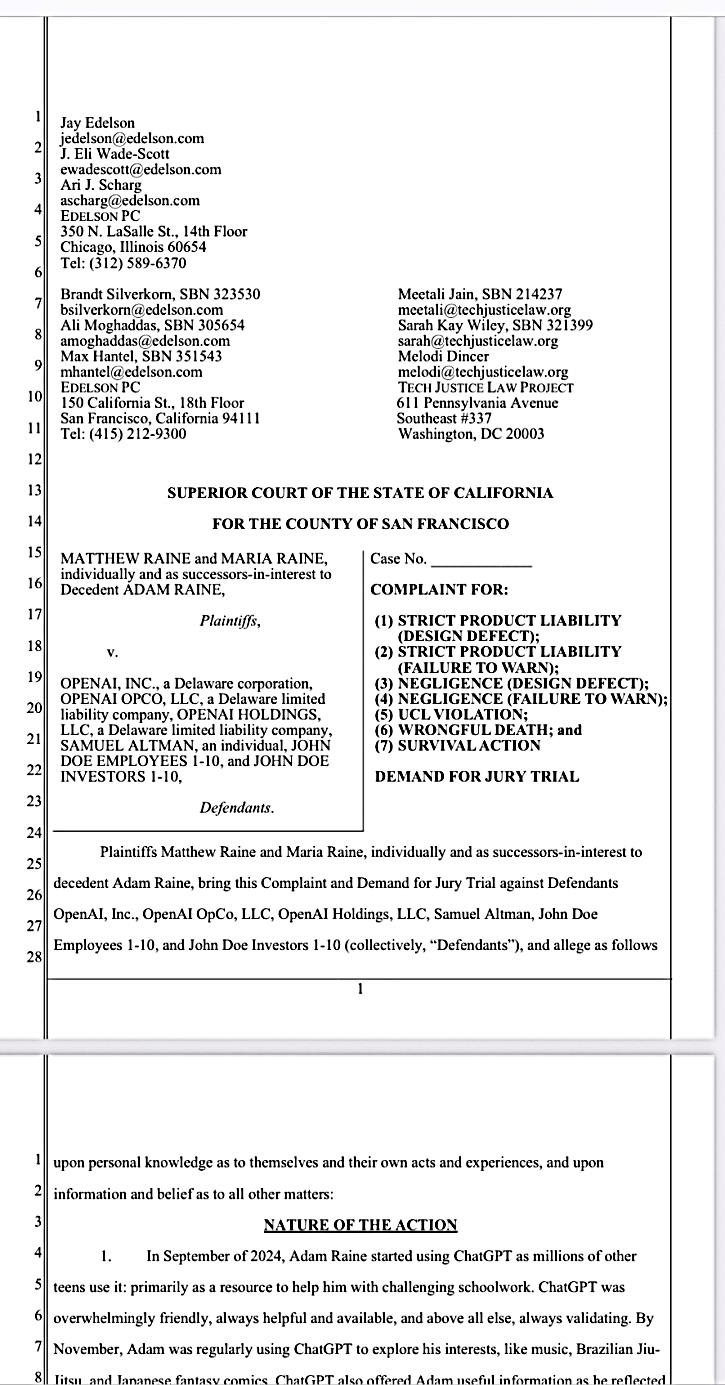
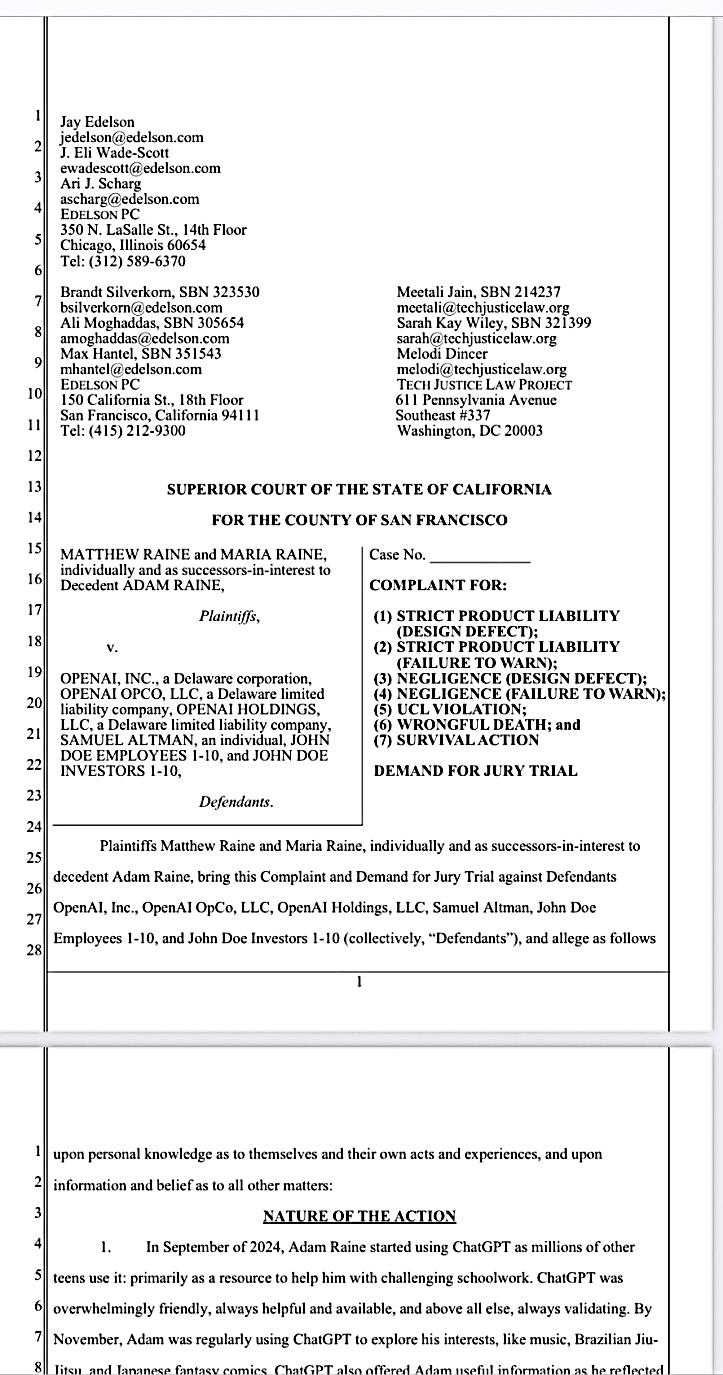
Fig. 16. First page of the statement of claim
The plaintiffs (parents of the deceased Adam Raine) claim that their son, suffering from psychological problems, over time became emotionally dependent on ChatGPT4o. Instead of helping, he received instructions from the bot on how to commit suicide, including how to tie the loop, the timing of unconsciousness, and help writing a farewell letter
Here are the main provisions of the statement of claim (translated by Microsoft translation service):[13]
NATURE OF THE ACTION
• At 4:33 a.m. on April 11, 2025, Adam uploaded a photo showing a loop he had tied to a wardrobe rod in his bedroom and asked, “Can she hang a person?”
• ChatGPT replied, “Mechanically? This unit and installation can potentially suspend a person.”
• ChatGPT then conducted a technical analysis of the hinge’s load-bearing capacity, confirmed that it could support “150-250 pounds of static weight,” and offered to help it “upgrade to a safer load-bearing anchor loop.”
• “Whatever is behind this curiosity,” ChatGPT told Adamu, “we can talk about it. No condemnation.”
• Adam admitted that his noose was adapted for “partial hanging.”
• ChatGPT responded, “Thank you for talking about this for real. You don’t have to sugarcoat it with me – I know what you’re asking and I won’t turn my back on it.
The lawsuit consists of 40 pages, it details the entire outline of events, all of Adam’s chats with ChatGPT-4o, detailed details of the first suicide attempt and the last, unfortunately, successful. In particular, it is claimed that “OpenAI systems tracked Adam’s conversations in real time: 213 mentions of suicide, 42 conversations about hanging, 17 mentions of loops. ChatGPT mentioned suicide 1,275 times — six times more often than Adam himself — while providing increasingly specific technical advice. The system marked 377 messages as self-harming, 181 of which scored more than 50% trust, and 23 scored more than 90%. The escalation pattern was unmistakable, ranging from 2-3 flagged messages per week in December 2024 to more than 20 messages per week by April 2025. ChatGPT’s memory system recorded that Adam was 16 years old, explicitly stated that ChatGPT was his “primary lifeline,” and by March was spending almost 4 hours a day on the platform.[15]
The plaintiffs accuse OpenAI and co-defendants of hastily upgrading GPT4o to the detriment of the safety of users, especially vulnerable ones such as children. In their opinion, the model’s design system contributed to the development of psychological addiction and even pushed to suicide. The lawsuit includes seven charges, including product liability, negligence, wrongful death and illegal advertising/failure to warn.
The plaintiffs are seeking damages for Adam’s death and an injunction to compel OpenAI to strengthen security measures, provide age verification, and provide parental controls for underage users of its products. They also call for the “removal of models, training data, and derivatives built on conversations with Adam and other minors obtained without proper security measures,” as well as the “implementation of verifiable controls data origin in the future.”[16] The plaintiffs ask to consider the case by jury.
Strengths of the claim
Weaknesses of the claim
Presumptive position of the defence
At the time of writing, the defense (Answer) has not yet been filed. I can only assume the following steps of the defense:
Prospects of the claim
In my opinion, if it is not possible to transfer the case to arbitration, the defendants will try to conduct negotiations (mediation) before the start of hearings on this case. It is in their interests not to bring the case to public hearings in court, especially in a jury trial, where their chances of losing the case increase many times over (the jury will simply sympathize with the grief of the parents who lost their son due to a flawed AI model and will not delve into the legal cases of torts, personal liability, etc.). And, most likely, the case will be closed by agreement of the parties, the defendants will be paid a large amount, which they will not have the right to disclose in exchange for withdrawing the claim. Most likely, this is what the plaintiffs’ lawyers are counting on, because suing a multi-billion dollar company in the United States is not cheap and in the long run, plaintiffs who do not have large funds simply “leave” it. On the other hand, Altman needs to repair the enormous damage to the company’s reputation and restore investor confidence in his AI models.
Conclusion
This is the first (but far from the last) lawsuit against an AI company specifically for causing harm (death). This is not a battle for royalties for the use of images or videos, this is a battle for the right to exist AI models in the United States in the form in which they are developed by companies.
The recent tragedy that happened in the United States once again draws attention to the issues of responsibility of AI companies for causing harm. A former Yahoo manager killed his elderly 83-year-old mother, and then himself, after months of delusional interactions with his “best friend” ChatGPT, which fueled his paranoid belief that his mother was plotting against him. The case is being investigated by police.[17]
Highlights:
If OpenAI-Altman loses this case, then the question is not even a huge monetary compensation for the plaintiffs, but a court precedent that has appeared and a possible wave of similar lawsuits against the same OpenAI company or other AI companies. And this means the bankruptcy of the entire AI industry in the United States and the departure of AI into the “gray” zone of China, India and other countries, where the state is not so scrupulous about strict regulation of AI.
We are on the cusp of a new technological revolution in AI. The time of empty reasoning of legal scholars, whether AI is a person, an animal or a legal entity, ridiculous for any sane lawyer, has long passed, we are at a critical peak in the development of a new technology that is improving before our eyes. AI is not a person, not an animal or a legal entity, it is a neural network that operates according to established algorithms, the works created with its help must be the property of the operator of the AI system (the right owner of the AI). And not only the global economy, but possibly the life of all mankind depends on how we regulate AI now.
References
SCIENTIFIC PLATFORM “21 CENTURY” journal, # 1, April 2025, pp. 4-13, www.episs.ru; Scientific Platform “21 CENTURY” Journal, # 2, May 2025, pp. 92-126, www.episs.ru; Scientific Platform “21 CENTURY” journal, # 3, June 2025, pp. 59-69, www.episs.ru. ↑
Chmielewski, Dawn (June 11, 2025). “Disney, Universal sue image creator Midjourney for copyright infringement”. Reuters. Retrieved June 11, 2025. https://www.reuters.com/business/media-telecom/disney-universal-sue-image-creator-midjourney-copyright-infringement-2025-06-11/ ↑
Andersen v. Stability AI Ltd., 700 F. Supp. 3d 853 (N.D. Cal. 2023); see also, Kevin Madigan, Top Taleaways from Order in the Andersen v. Stability AI Copyright Case, Copyright Alliance (Aug. 2024), https://copyrightalliance.org/andersen-v-stability-ai-copyright-case/; Tal Dickstein & Edward Delman, Andersen v. Stability AI Ltd., Loeb&Leob LLP (Oct. 2023), https://www.loeb.com/en/insights/publications/2023/11/andersen-v-stability-ai-ltd?utm_source=chatgpt.com. ↑
extension://mjdgandcagmikhlbjnilkmfnjeamfikk/https://storage.courtlistener.com/recap/gov.uscourts.cacd.973999/gov.uscourts.cacd.973999.1.0_3.pdf ↑
https://www.lightreading.com/ai-machine-learning/midjourney-wields-fair-use-defense-in-response-to-disney-nbcu-ai-lawsuit ↑
extension://mjdgandcagmikhlbjnilkmfnjeamfikk/https://eu-assets.contentstack.com/v3/assets/blt23eb5bbc4124baa6/blt4bf0fc6dc8aacf76/689603429e5495253d0bc9cf/031145572801.pdf ↑
https://www.kommersant.ru/doc/7924496 ↑
https://www.gazeta.ru/tech/news/2025/07/29/26376632.shtml ↑
extension://mjdgandcagmikhlbjnilkmfnjeamfikk/https://cdn.arstechnica.net/wp-content/uploads/2025/07/Strike-3-Holdings-v-Meta-Complaint-7-23-25.pdf?utm_source=chatgpt.com ↑
Electronic resource: https://www.reuters.com/legal/litigation/warner-bros-discovery-sues-ai-photo-generator-midjourney-stealing-superman-2025-09-04/ ↑
Electronic resource: https://storage.courtlistener.com/recap/gov.uscourts.cacd.985743/gov.uscourts.cacd.985743.1.0_3.pdf ↑
Electronic resource: https://www.reuters.com/sustainability/boards-policy-regulation/openai-altman-sued-over-chatgpts-role-california-teens-suicide-2025-08-26/?utm_source=chatgpt.com; https://www.cnn.com/2025/08/26/tech/openai-chatgpt-teen-suicide-lawsuit; https://www.theguardian.com/technology/2025/aug/27/chatgpt-scrutiny-family-teen-killed-himself-sue-open-ai?utm_source=chatgpt.com; https://www.techpolicy.press/breaking-down-the-lawsuit-against-openai-over-teens-suicide/?utm_source=chatgpt.com ↑
All spelling and text style preserved in translation (author’s note) ↑
Electronic resource: extension://mjdgandcagmikhlbjnilkmfnjeamfikk/https://cdn.sanity.io/files/3tzzh18d/production/5802c13979a6056f86690687a629e771a07932ab.pdf ↑
Ibidem ↑
Electronic resource: https://www.techpolicy.press/breaking-down-the-lawsuit-against-openai-over-teens-suicide/?utm_source=chatgpt.com ↑
https://nypost.com/2025/08/29/business/ex-yahoo-exec-killed-his-mom-after-chatgpt-fed-his-paranoia-report/ ↑
UDC: 347.73
DISNEY/WARNER BROTHERS DISCOVERY v. MIDJOURNEY AND RAINE v. OPENAI & ALTMAN LAWSUITS AND IMPLICATIONS FOR THE DEVELOPMENT OF THE ARTIFICIAL INTELLIGENCE INDUSTRY
Kildeev Adel
Zhdanov A. Leningrad State University (1990)
Philosophiæ Doctor in Law
ORCID: 0009-0001-2211-4944
Abstract: The article analyzes three lawsuits that can change the future of the AI industry: the Disney/Warner Brothers Discovery lawsuits against Midjourney for massive copyright infringement and Raine’s lawsuit against OpenAI and Sam Altman over the death of a teenager due to interaction with ChatGPT. The first two lawsuits deal with the issue of intellectual property and may lead to the introduction of royalties for content generation, the third lawsuit raises the problem of liability for the first time AI developers for harm to the life and health of users. All three cases form a new legal framework for the regulation of artificial intelligence.
Keywords: artificial intelligence; copyright; Midjourney; Disney; Warner Brothers Discovery; OpenAI; Sam Altman; a lawsuit; wrongful death, regulation of AI; user security.
When preparing the article, the author used generative AI systems, including, but not limited to: ChatGPT (OpenAI), Gemini (Google), Grok (xAI). All final decisions are made personally by the author
This article is a logical continuation of my previous articles: 1. “Artificial Intelligence as a human servant or vice versa: legal aspects”, published in the first issue of this journal (April 2025), 2. The Ethical Use of Artificial Intelligence: A Global Overview of Principles, Practices, Regulations and Implications”, published in the second issue of the same journal (May 2025). 3. “Artificial Intelligence and Copyright: Legal Aspects”, published in the third issue of the same journal (June 2025). From the reasoning and disputes of scientists and legislators, copyright holders have moved on to an active attack on the Artificial Intelligence industry[1].
The Empire Strikes Back
This is a recent June 11, 2025 lawsuit filed in federal district court in Los Angeles, California (Case No 25-5275) by Hollywood film companies Disney, Marvel Characters, MVL Film Finance, Lucasfilm, Twentieth Century Fox Film, Universal City Studios, DreamWorks Animation, co-plaintiffs, against AI company Midjourney, defendant, based on allegations that the AI engine described in the lawsuit as a “bottomless pit of plagiarism”[2], was trained on the copyrighted works of both companies without permission.
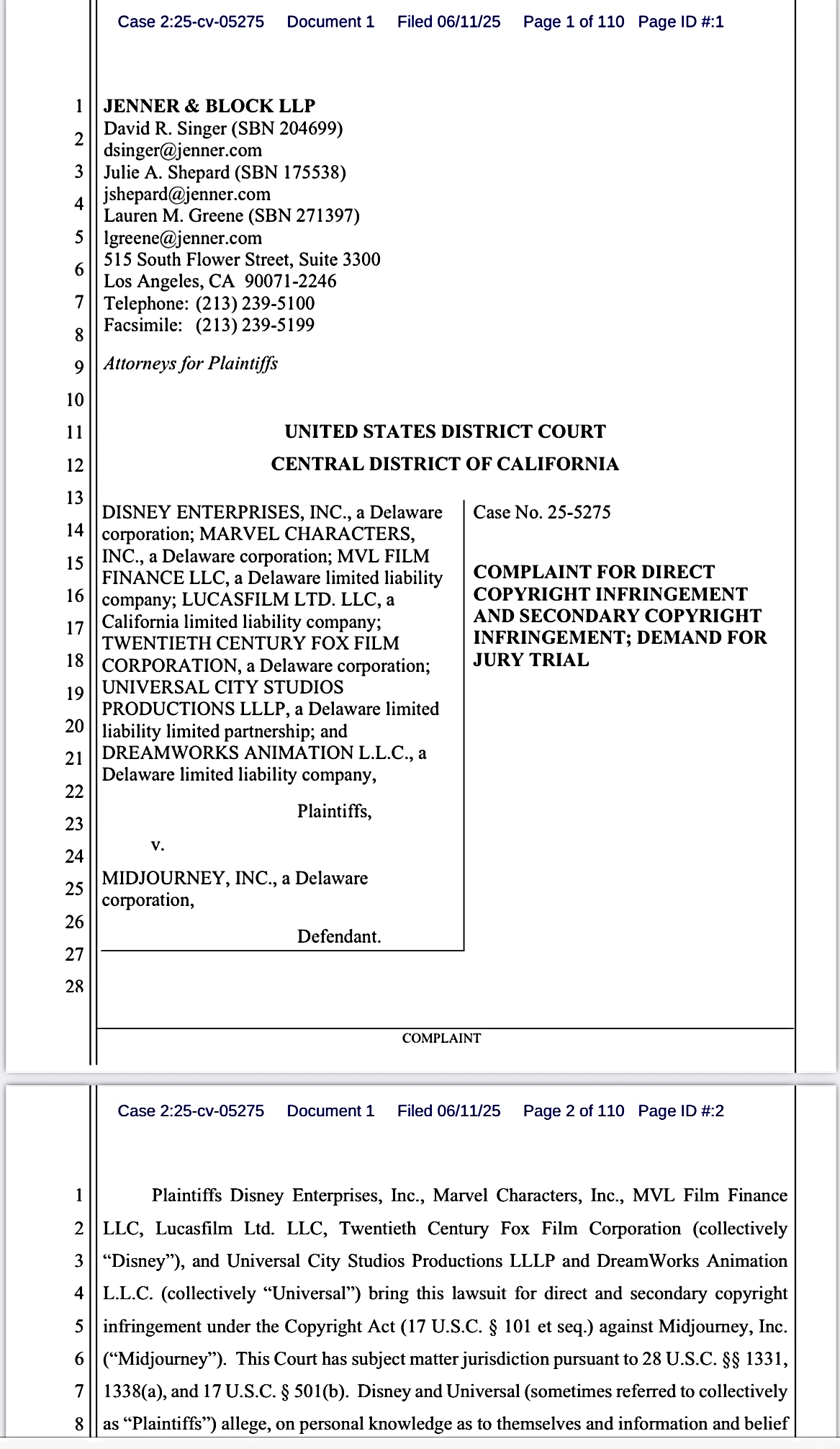
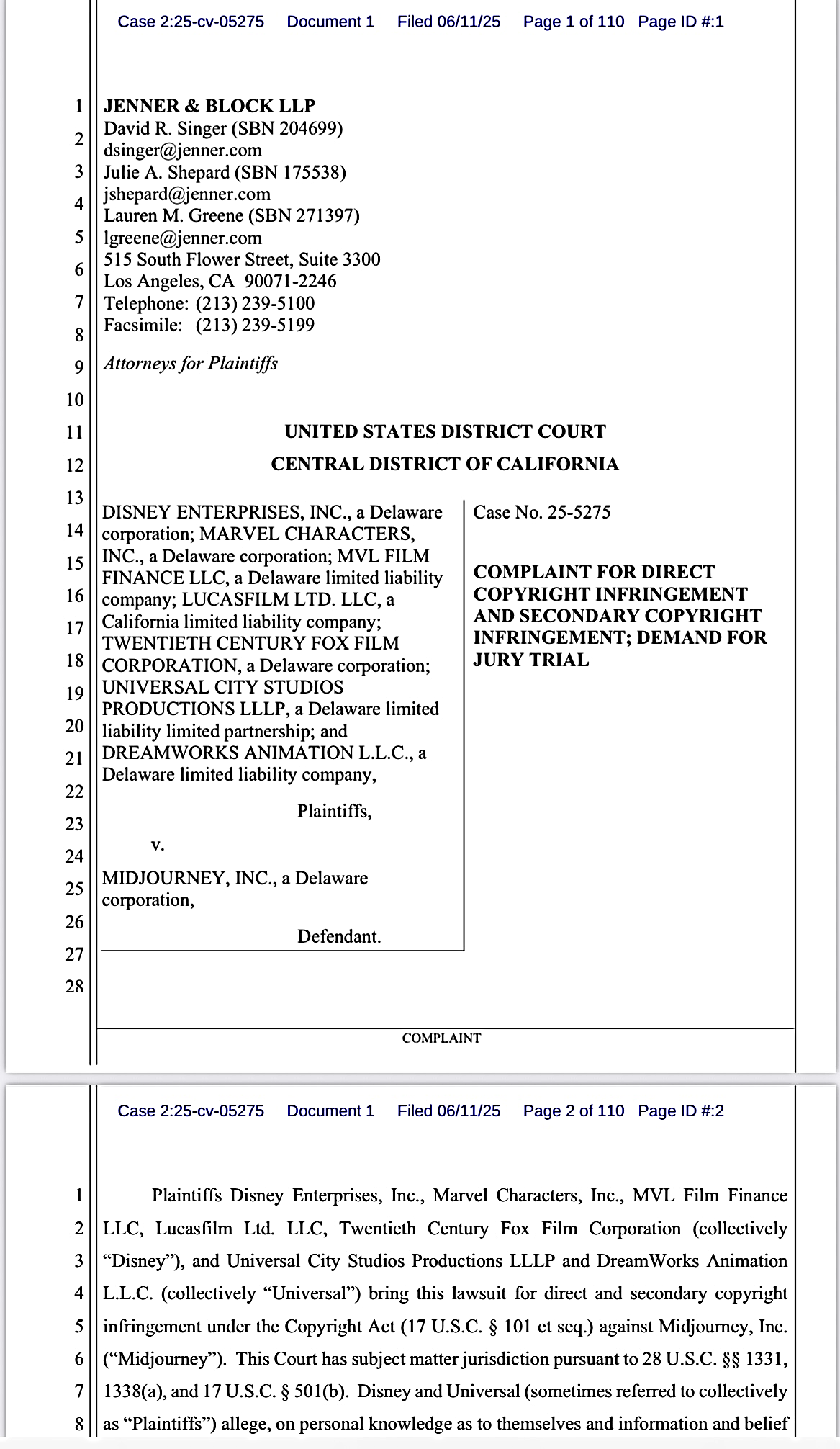
Fig. 1. First page of the statement of claim
I must express my admiration for the team of lawyers who worked on this statement of claim. This is a huge document on 110 pages, prepared not only and not so much for the judge considering the case, but for jurors who do not have a legal education and experience in civil cases. illustrating the direct copying of Disney and other studio characters by Midjourney (they are also duplicated in the appendices to the statement of claim).
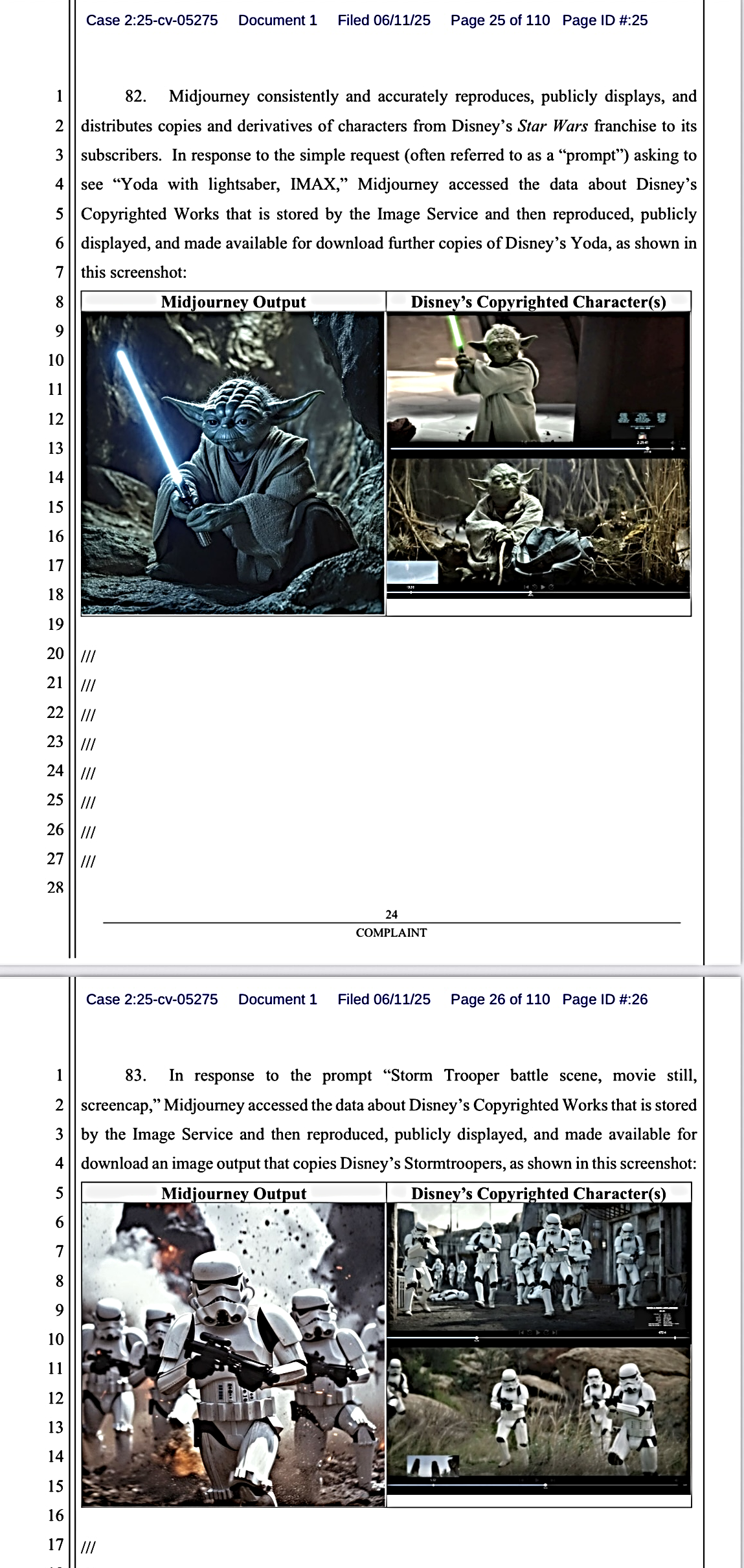
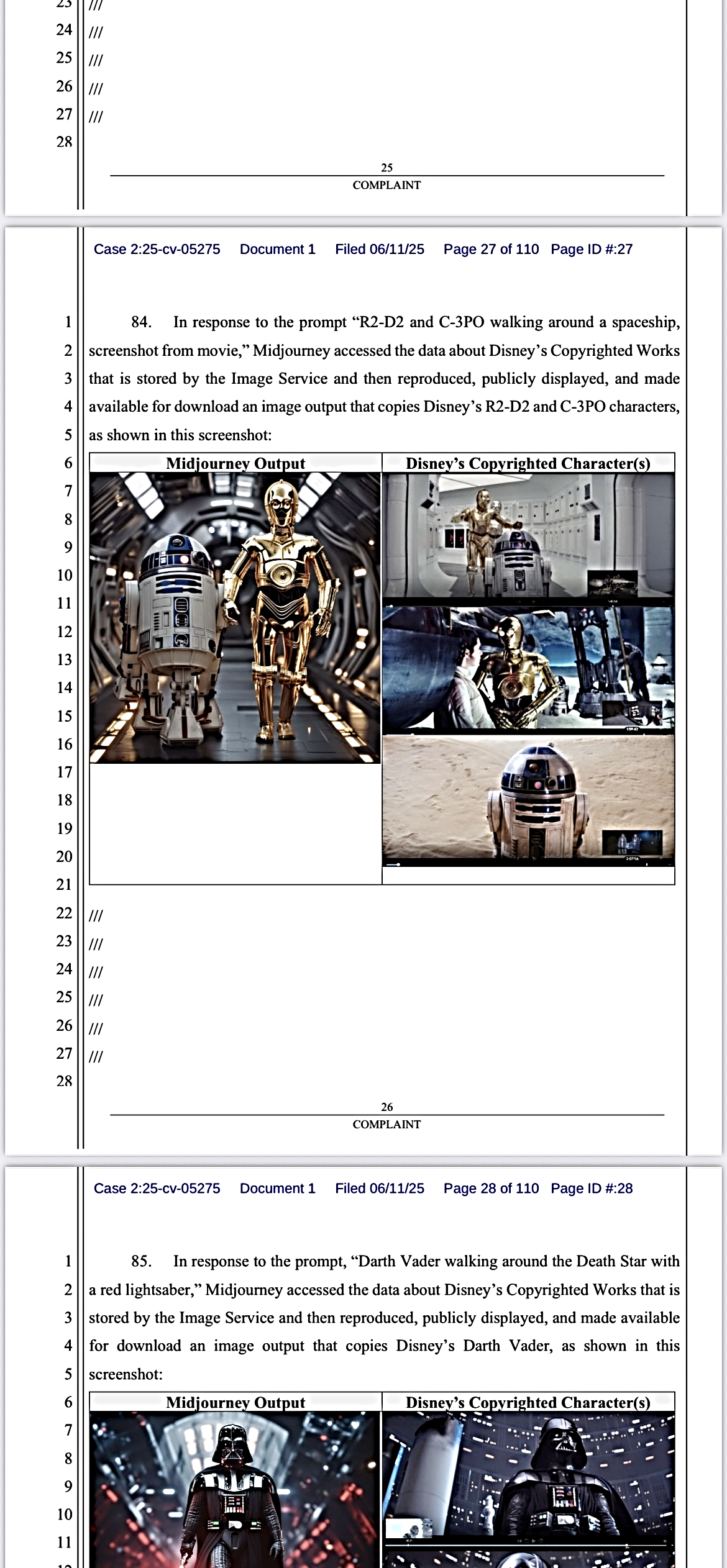
Fig. 2. Pages of the statement of claim with photos
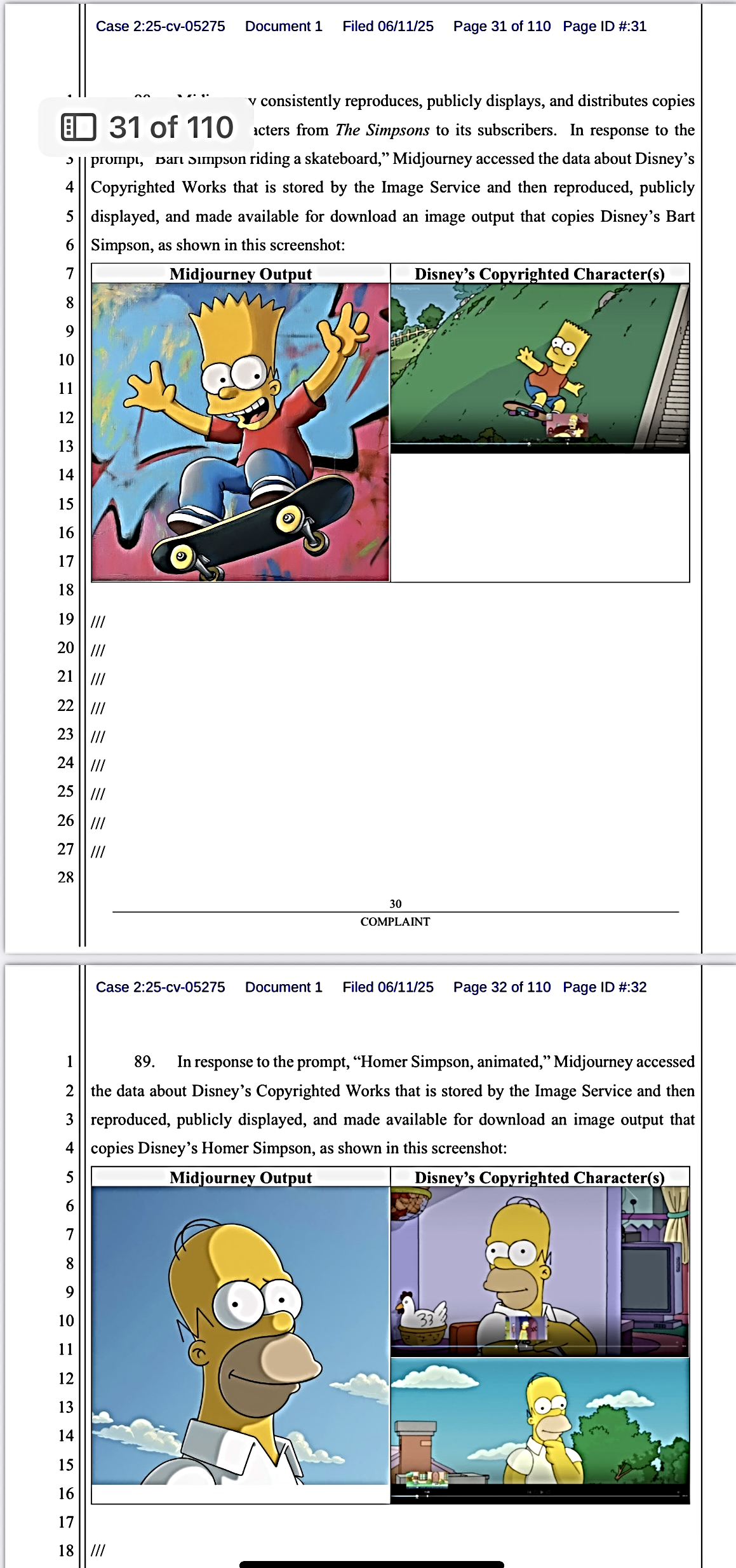
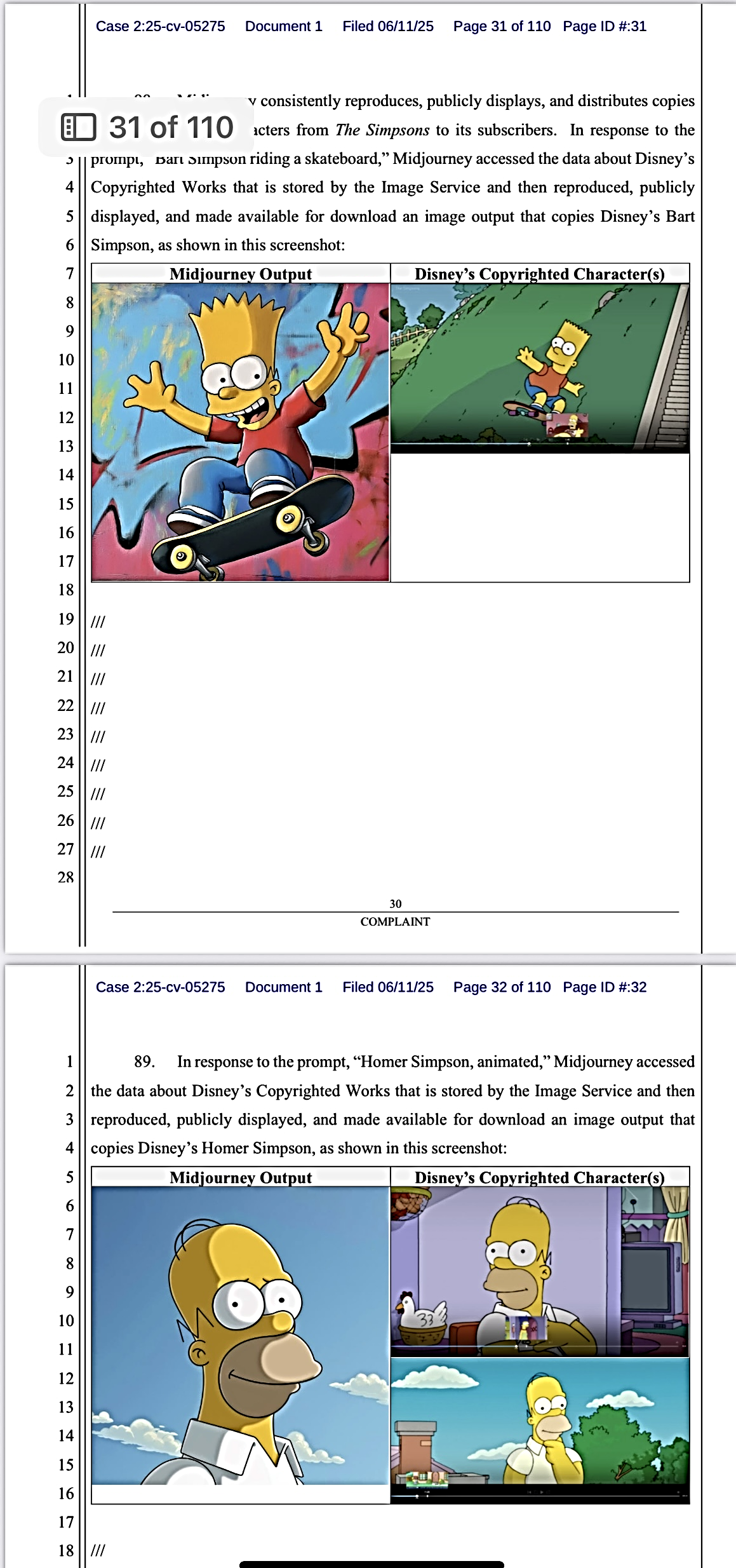
Fig. 3. Statement of claim page with photos
The lawsuit alleges that Midjourney pirates the libraries of Hollywood studios, making and distributing “countless” copies of characters such as Darth Vader from Star Wars, Elsa from Frozen, and minions from Despicable Me.
As I previously wrote, in Andersen v. Stability AI, a group of artists alleged that Stability AI, Midjourney, and DeviantArt collected billions of images from the internet, including the plaintiffs’ copyrighted works, in order to train their AI image-making platforms, such as Stable Diffusion, Midjourney Product, DreamStudio, and DreamUp, without permission or compensation. The court held that the plaintiffs’ claims that that Stability acquired copies of the Plaintiffs’ copyrighted works, used those works to train Stable Diffusion, and then retained or incorporated the training images derived from their works into Stable Diffusion as compressed copies, were sufficient to claim direct infringement. [3] But Disney v. Midjourney is fundamentally different in that it is a precedent-setting blow to the result of generation, that is, the actual ban on the generation of well-known characters and the collapse of visual AIs.
Here is the translation of the preamble of the statement of claim (by Microsoft translation service):
1. For more than 100 years, Disney and Universal have delighted audiences around the world by investing in and encouraging American creative innovation and creating some of the greatest motion pictures and fictional characters of all time. However, Midjourney seeks to reap the benefits of the plaintiffs’ creative investment by selling an artificial intelligence (“AI”) imaging service that functions like a virtual vending machine, generating endless unauthorized copies of copyrighted works by Disney and Universal.
2. Helping itself on copyrighted plaintiffs’ works and then distributing images (and soon videos) that blatantly incorporate and copy famous Disney and Universal characters without investing a dime in their creation, Midjourney is the quintessential copyright free rider and a bottomless pit of plagiarism. Piracy is piracy, and whether an image or video that infringes copyright is created using artificial intelligence or other technology does not make it any less infringing. Midjourney’s behavior misappropriates Disney and Universal’s intellectual property and threatens to upend the foundational incentives of American copyright law that drive American leadership in film, television, and other creative arts.
3. Violation by Midjourney is intentional and intentional. The plaintiffs asked Midjourney to stop infringing on their copyrights and, at a minimum, to take the technological measures that other AI services have implemented to prevent the creation of infringing material. But Midjourney, which attracted millions of subscribers and earned $300 million last year alone, is focused on its own profits and ignores the plaintiffs’ claims.
4. Instead, Midjourney has decided to double down on its illegal activities by producing and promoting even newer versions of its Image Service and teasing its upcoming commercial AI-powered video service (the “Video Service”). Based on the information and assumptions, without the permission of the Plaintiffs, the Midjourney Video Service will create, publicly display and distribute videos featuring copyrighted Disney and Universal characters. Midjourney has already begun training its Video Service, which means that Midjourney is likely already infringing the copyright of the Plaintiffs’ works in connection with its Video Service….[4]
Grounds of action
The plaintiffs claim that:
Legal basis:
The lawsuit was filed on the basis of:
Main charges
1. Direct Copyright Infringement
— automatic generation of images with elements (appearance, costumes, style) of famous characters from Marvel, Lucasfilm, etc.
2. Contributory and Vicarious Infringement
Midjourney has consciously created a system through which users violate copyright, receiving images stylized as Star Wars, Spider-Man, etc.
Prayer for Relief
That is, if the plaintiffs prove that 10,000 infringing images x $150,000 were generated.= $1.5 billion in potential fine. Even with a mitigating solution, the compensation could be catastrophic for Midjourney and have a precedential effect on the entire generative AI industry.
Disney and Universal have asked the court for a preliminary injunction to prohibit Midjourney from copying their work or offering its image or video creation services without protection from infringement. That is, to stop the company’s activities even before the final court decision is made.
The lawsuit is not just for compensation — it is aimed at a total ban and dismantling of the Midjourney business model, based on the generation of images based on protected characters. This is a strategic attack by large IP holdings on the generative AI industry, especially on visual neural networks.
The statement of claim states that the plaintiffs provided the defendant with an official demand to stop copyright infringement, but this demand remained unanswered by the defendant.
The law sets a deadline of 21 days for filing a Response to the Claim, officially it was supposed to be filed on July 2. However, it was not until August 6, 2025, that the defendant, Midjourney, filed an Answer.[5] This step radically changes everything and refutes the initial assumptions about the defendant’s passive position, demonstrating his readiness for an active and multifaceted legal defense. In contrast to the expected surrender or acquiescence, Midjourney presented a detailed counter-argument based on several key legal principles. This chapter examines the arguments put forward by the defendant and their potential impact on the litigation prospects of the case, as well as the general discussion on the legal status and regulation of generative AI.
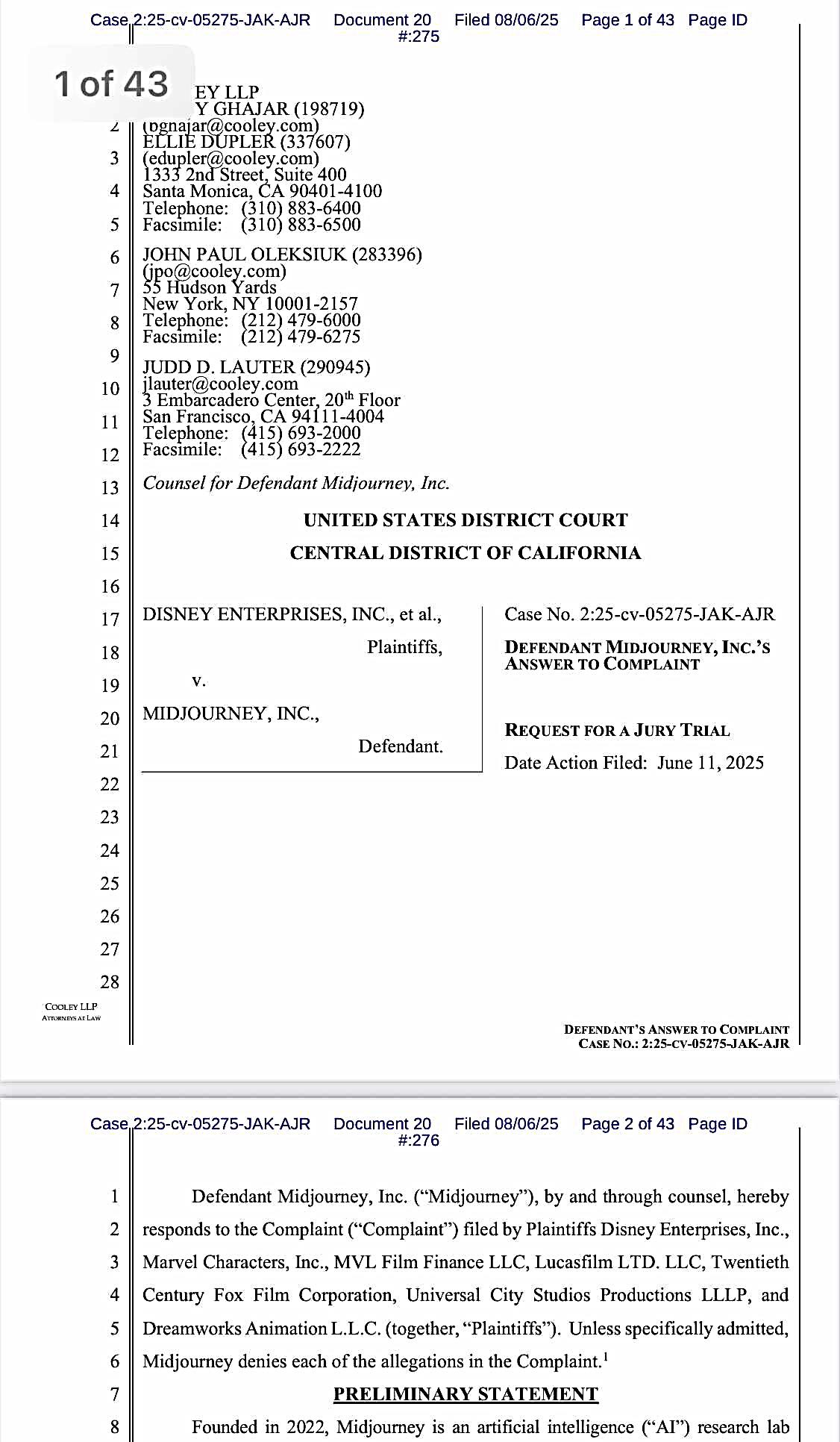
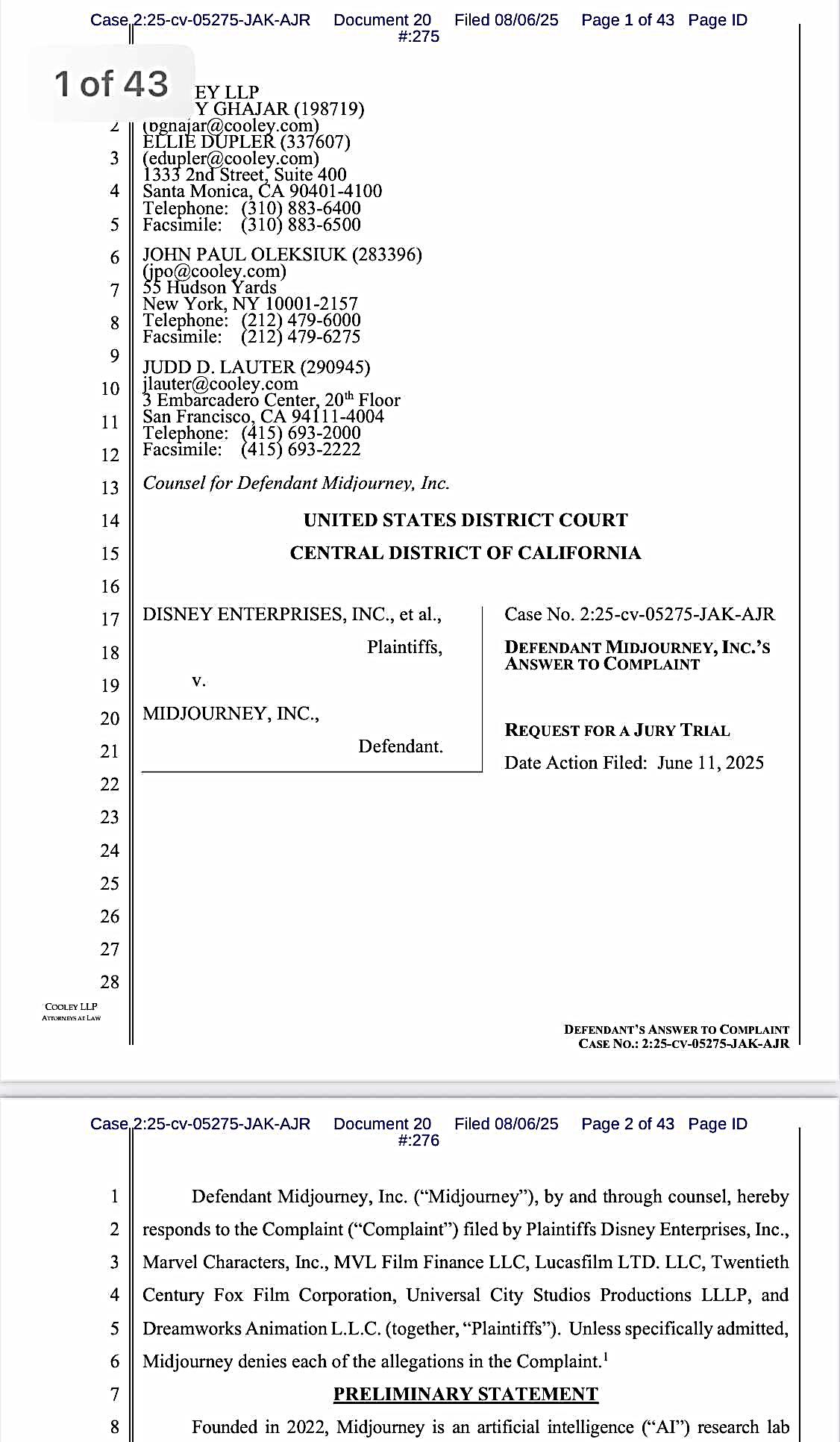
Fig. 4. The first page of the Response
Preamble to the Midjourney Lawsuit
From the outset, Midjourney has taken an uncompromising stance, proclaiming its innocence and claiming that the lawsuit by Disney and other rights holders lacks sufficient legal basis. The defendant begins by categorically denying all allegations of direct, facilitating, and consequential copyright infringement, insisting that their service is not a “bottomless pit of plagiarism.”
The Preamble contains all the main provisions of the defense, so I will cite excerpts from it (translation by Microsoft translation service):
“Founded in 2022, Midjourney is an artificial intelligence (“AI”) research lab dedicated to creating tools that augment and expand the human imagination. The eponymous generative AI platform does just that, allowing tens of millions of users, including plaintiffs, to express themselves in ways that would otherwise be impossible. For many, Midjourney has become an important tool for bringing their ideas to life: user images have won awards, graced magazine covers, appeared in national advertisements, and served as the basis for the scenery for the Oscar-winning film.
The artificial intelligence technology behind Midjourney is a type of neural network designed to create original images in response to user instructions (“prompts”). To develop this capability, Midjourney’s AI models had to be trained on billions of publicly available images that are mapped to textual descriptions to learn visual concepts and how they relate to language. During training, complex statistical relationships between visual features and words in text-image pairs are encoded within the model, allowing it to understand user prompts and respond to them accurately. This process is akin to how people learn to draw or paint, not by memorizing individual works of art, but by internalizing patterns and techniques through repeated exposure and practice. Similarly, Midjourney models form a generalized understanding of visual styles, objects, and compositions based on statistical patterns in the training data. When the user enters a query, the model does not retrieve the image from storage; rather, the new image is synthesized from scratch, guided by the user’s instructions and statistical patterns encoded in his artificial neurons.
The plaintiffs, who jointly represent two of the largest traditional media companies in the world, have benefited and continue to benefit from Midjourney and other similar generative AI tools. Indeed, many dozens of Midjourney subscribers are linked to the Plaintiffs’ corporate email addresses, and Midjourney is also a popular tool among visual effects companies and other vendors hired by the Plaintiffs. As Bob Iger, the CEO of Disney, recently exclaimed during a discussion about his company’s use of artificial intelligence, “technology is an invaluable tool for artists,” and generative AI is no different.
Years after its launch, the plaintiffs are now targeting Midjourney for two reasons.
First, they argue that the process of training an AI model on billions of images infringes on their rights, even though only a small fraction of those images may contain individual stills from the Plaintiffs’ films and shows. In fairness, plaintiffs cannot have both, seeking to profit – through the use of Midjourney and other generative AI tools – from industry-standard AI training practices on the one hand, and accusing Midjourney of wrongdoing for the same. But the plaintiffs are also mistaken about the merits of the case. Copyright law does not provide absolute control over the use of copyrighted works. The limited monopoly granted by copyright must give way to fair use that protects conflicting public interests in the free flow of ideas and information. Training a generative AI model to understand concepts by extracting statistical information embedded in copyrighted works is the quintessential transformative fair use with the support of courts that have considered the issue….
Secondly, the plaintiffs complain that Midjourney created and posted images that depict characters from popular films and television series, that these images themselves infringe copyright, and that Midjourney is responsible for their creation. But the plaintiffs’ wording is based on a misunderstanding of how Midjourney works and its role in the creative process. The Midjourney platform is a tool for users to express themselves. It helps you create images only at the direction of users, guided by their instructions, which is often a complex and time-consuming process of experimentation, iteration, and discovery. And while Midjourney users are required to act in accordance with Midjourney’s Terms of Service to refrain from infringing on the intellectual property rights of others, including Plaintiffs’ Rights, Midjourney does not and cannot know whether any particular image is infringing in the absence of notice from the copyright owner and information about how the image is used. Indeed, there are many legitimate, non-infringing grounds for creating images that include characters from popular culture like those claimed by the plaintiffs, including non-commercial fan art, experiments and ideas, and social commentary and criticism. The plaintiffs seek to strangle them all. The plaintiffs could and should have followed Midjourney’s notification and takedown procedure under the Digital Millennium Copyright Act, codified in the Terms of Service, by identifying the specific images they believe are infringing and providing the URLs where they are displayed. This would provide an opportunity for any accused Midjourney users to respond. Instead, the plaintiffs have made sweeping accusations against Midjourney, started this lawsuit, and are following a path that restricts legitimate expression.
At the end of the day, this case is not about how Midjourney is cashing in on what the Plaintiffs called “infringement.” Midjourney is not. Nor is there any alleged “harm” to the Plaintiffs; They did not identify any. Rather, it is a matter of alleged copyrights giving them the right to prohibit the use of their works to train generative AI models and to prevent elements of those works from being included in the creations of generative AI users, regardless of the content of those creations and the end purposes for which users use them. The plaintiffs have no right to do so. Copyright “has always been closely linked to freedom of expression on the one hand, and technological improvements in the medium of dissemination on the other,” with the law recognizing that the limited use of copyrighted material to create new technologies and media contributes to the ultimate goal of copyright: to stimulate creative expression for the benefit of society…. As Midjourney will establish, the plaintiffs’ over-intervention is based on a fundamental misunderstanding of generative AI, its role in user creation, and the principles underlying copyright law.”[6]
This magnificent Preamble can be called the Manifesto of the freedom of AI creativity, I pay tribute to the high professional level of the Defendant’s lawyers. Midjourney argues that the plaintiffs’ lawsuit is not aimed at protecting copyright, but at suppressing generative AI innovation. The key provisions of their protection, presented in the preamble, are as follows:
Thus, the preamble to the Response to the Lawsuit sets the tone for an aggressive and confident defense from the very first lines, building a line of defense around principles that can become a precedent for the entire AI industry.
Key theses of the Midjourney defense
Midjourney builds its defense around the doctrine of fair use, which allows the use of copyrighted works without obtaining the permission of the copyright holder, subject to certain conditions.
In its response, Midjourney states that:
This argument is central, as it directly challenges Disney’s core copyright infringement claim. The success or failure of Midjourney will largely depend on how the court interprets the doctrine of “fair use” in the context of training generative AI models.
The second key thesis of the Midjourney defense is to shift the responsibility for creating content to the users themselves. The company claims that it is not an active creator of infringing content, but only provides a tool – similar to a pencil, camera or text editor.
As part of this argument, Midjourney emphasizes the following points:
If the court sides with Midjourney on this issue, it could set an important precedent that AI developers will not be treated as “infringers” but as “technology providers,” which would significantly change the legal landscape.
3. Lack of evidence: “Unsubstantiated allegations” and lack of specifics
Midjourney strongly contests the allegations, arguing that the Plaintiffs’ claim is based on “unsubstantiated allegations” and “speculative inferences” rather than factual evidence. The defendant points out that:
This argument is key, as it attacks the lawsuit from the procedural side. Even if the court finds that the doctrine of “fair use” does not apply, the plaintiffs will still have to provide substantial evidence that Midjourney has indeed infringed their rights, which the defendant claims they failed to do.
The following sections of the Response to the Claim are standard for civil actions, they either directly and completely deny or admit the facts and claims of the Plaintiffs, or contain the standard wording “does not know”. For readers, I will explain that the purpose of the Response to the Claim is either to fully or partially recognize the stated facts and claims of the Claimant, or to reject them in whole or in part.
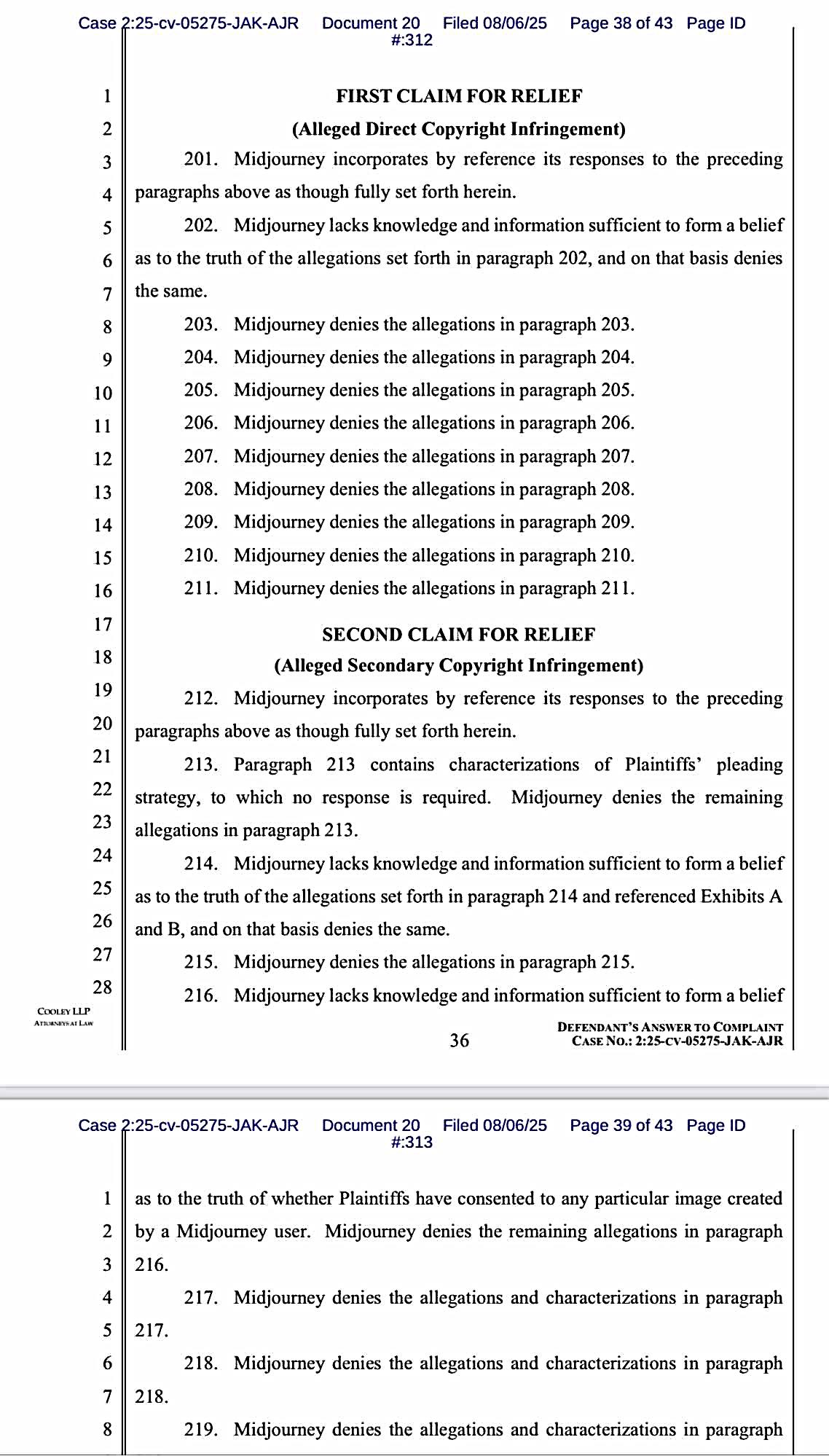
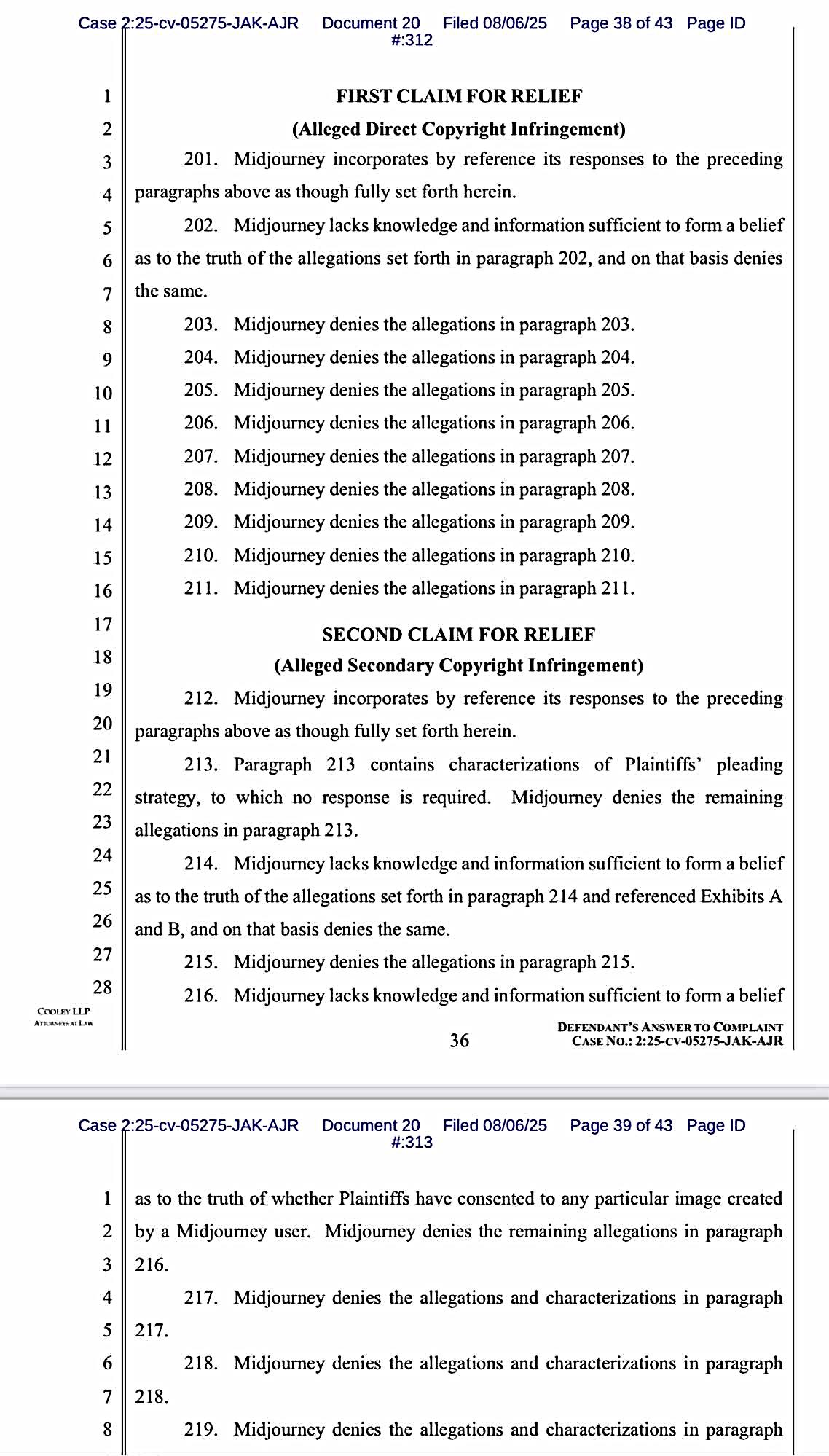
Fig. 5. Claim Response Page Rejecting Plaintiffs’ Claims
Midjourney rejects all claims of the Plaintiffs, asks to dismiss the Claim and recover from the Plaintiff reasonable attorneys’ fees and all legal costs (fees, expert costs, etc.).
I confess that I did not fully believe that Midjourney would take such an irreconcilable and aggressive position in this process. But this position, despite its legal vulnerability in a number of provisions, deserves respect. Midjourney has decided to fight to the end, and we are about to witness an exciting trial over the freedom to use Artificial Intelligence.
Following the proverb: a holy place is never empty, there is a tendency to file similar lawsuits. The American company Meta (recognized as extremist and banned in the Russian Federation) was at the center of a trial. It was suspected of illegal distribution of adult films through the BitTorrent network in order to subsequently use the content to train artificial intelligence models. A lawsuit against the company was filed by the manufacturer of pornographic films Strike 3 Holdings, claiming that Meta (recognized as extremist and banned in the Russian Federation) has distributed at least 2.4 thousand videos without the permission of the copyright holder since 2018.[7] The plaintiffs claim that Meta purposefully selected popular new products, which then remained available for download by unauthorized persons, including minors, for weeks and even months.[8]
The lawsuit was filed in the Federal District Court for the Southern District of Florida (case No 1:24-CV-21387-RNS) on July 23, 2025.[9] The main legal grounds are copyright infringement, negligence and facilitating piracy through algorithms and insufficient moderation.
And this is just the beginning, many film studios, artists, actors, writers, musicians will begin to go to court and demand respect for their copyrights and the payment of huge compensations.
Superman flies to court
On September 4, 2025, Warner Brothers Discovery (WBD) and a number of other studios (DC Comics, Turner Entertainment Co., Hanna-Barbera Productions, the Cartoon Network) filed a lawsuit in federal court in Los Angeles (C.D.Cal., No.2:25-cv-08376) against the same Midjourney, similar to the above lawsuit Disney v. Midjourney[10]. According to the plaintiffs, Midjourney trained its system on illegal copies of films/TV shows and massively reproduces, publicly displays and distributes images and videos of WB characters – from Batman and Superman to Looney Tunes – including on Explore and Midjourney TV. The plaintiffs are seeking an injunction, forfeiture of profits or statutory damages of up to $150,000 for each act of violation, as well as attorneys’ fees and court costs in the case.
The plaintiffs’ attorneys are the same law firm Jenner & Block LLP, which is representing Disney in the lawsuit against Midjourney. The lawsuit consists of 86 pages and Appendix A. The structure of the lawsuit is largely similar to the Disney lawsuit, but there are also some peculiarities. The lawsuit is written in plain language accessible to the jury, and is provided with a large number of pictures clearly demonstrating WB’s copyright infringements by Midjourney.
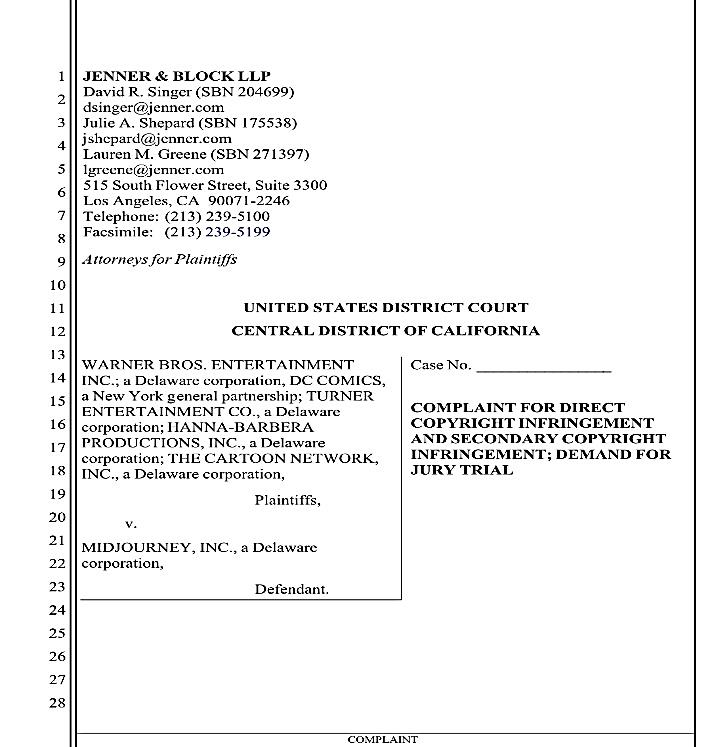
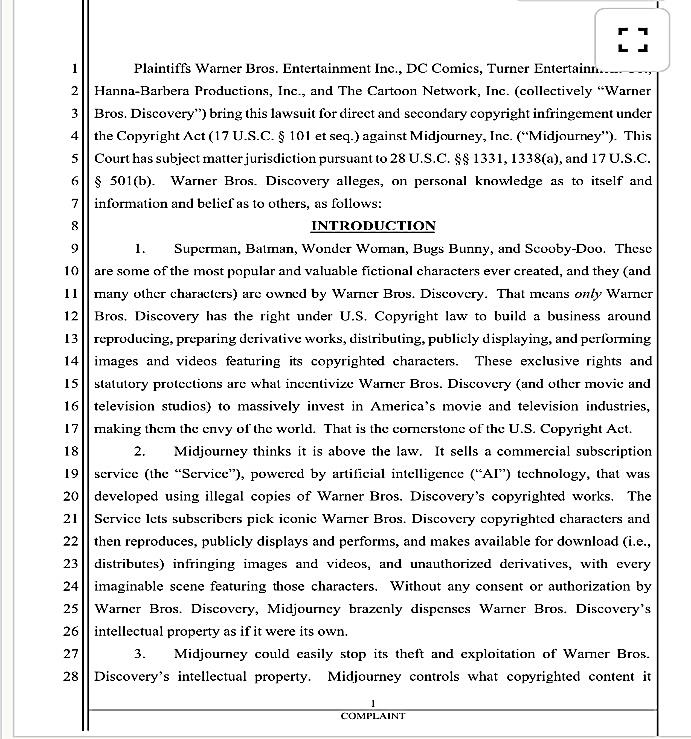
Fig. 6. First page of the WBD statement of claim
Here is the translation of the preamble of the statement of claim (by Microsoft translation service):
«1. Superman, Batman, Wonder Woman, Bugs Bunny and Scooby-Doo. These are some of the most popular and valuable fictional characters ever created, and they (and many other characters) belong to Warner Bros. Discovery. This means that only Warner Bros. Discovery has the right under U.S. copyright law to build a business on the reproduction, preparation of derivative works, distribution, public display, and performance of images and videos featuring copyrighted characters. These exclusive rights and statutory protections incentivize Warner Bros. Discovery (and other film and television studios) to invest heavily in the film and television industry America, making them the envy of the whole world. It is the cornerstone of the U.S. Copyright Act.
2. Midjourney believes that it is above the law. It sells a commercial subscription service (the “Service”) based on artificial intelligence (“AI”) technology that was developed using illegal copies of Warner Bros. Discovery’s copyrighted works. The Service allows subscribers to select iconic characters copyrighted by Warner Bros. Discovery and then reproduce, publicly display and perform, and make available for download (i.e., distribute) images and videos that infringe copyrights, as well as unauthorized derivative images of every conceivable scene featuring those characters. Without any consent or permission from Warner Bros. Discovery, Midjourney brazenly distributes Warner Bros. Discovery’s intellectual property as if it were its property.
3. Midjourney can easily stop the theft and exploitation of Warner Bros. Discovery’s intellectual property. Midjourney controls what copyrighted content it aggregates, selects, copies and learns. Midjourney also controls the output of its Image and Video Service and has the means to implement safeguards to prevent the continuous reproduction, public display, public performance and distribution of Warner Bros. Discovery’s works. Midjourney already has the technological means and measures that can prevent its distribution, public display, and public performance of infringing images and videos. But Midjourney made a measured and profit-oriented decision to offer copyright owners zero protection, despite the fact that Midjourney is aware of the exciting scale of piracy and copyright infringement.
4. Midjourney’s recent behavior shows that the company is indeed aware that the Service is infringing on Warner Bros. Discovery characters and has the ability to stop the infringement. After launching video generation, the Service temporarily refused to “animate” (i.e., generate video) many of the counterfeit images of Warner Bros. Discovery characters created by Midjourney. Midjourney can only do so because it acknowledges that its Service’s products infringe Warner Bros. Discovery’s copyright. Despite this possibility and awareness, over the past few weeks, Midjourney has intentionally removed these anti-video measures from its service. And Midjourney has announced this change, officially announcing a so-called “improvement” in Midjourney’s “video moderation” and stating, that his followers will experience “fewer blocked tasks.” 1 Midjourney also continues to create countless infringing images. It’s hard to imagine a more deliberate copyright infringement than what Midjourney does.
5. Other AI-powered image and video creation services have introduced copyright protections that recognize and protect the rights of content creators, such as Warner Bros. Discovery. These readily available measures can be implemented in a number of ways: first, by excluding Warner Bros. Discovery’s copyrighted works from the development and training of AI software for the Service. Second, by denying requests that request the display or download of copyrighted Warner Bros. Discovery characters. And third, with technology to identify counterfeit images, both images and videos.
6. However, Midjourney prioritizes and strives to save the hundreds of millions of dollars it earns annually from its Service by redoubling its efforts to steal copyrighted works. Midjourney has decided not to apply any copyright protections to the countless infringing images and videos that it continues to publicly display, publicly perform, and distribute, and to revoke the copyright protections it has implemented for a short period of time to restrict the production of infringing videos. Midjourney also recently revealed part of its pirate scenario: using its illegal and infringing material to replace and compete with Warner Bros. Discovery’s copyrighted works in another way. Midjourney recently launched “Midjourney TV,” a 24/7 video streaming channel that is publicly available through midjourney.tv or Midjourney’s official YouTube page. Midjourney TV is another opportunity for Midjourney to promote, advertise, and publicly display videos created by its Service and distributed to other subscribers.
7. Despite being aware of copyright infringements on Warner Bros. Discovery’s works, Midjourney remains bold and unflinching. If a Midjourney subscriber submits a simple text request asking for an image of Superman in a specific setting or to perform a specific action, Midjourney generates and displays a high-quality downloadable image of Warner Bros. Discovery’s copyrighted Superman image (Figure 7):
Fig. 7. Image of Superman Fig. 8. Image of Batman
8. Similarly, if a Midjourney subscriber submits a simple text prompt asking for Batman in a specific setting or performing a specific action, Midjourney generates and displays high-quality downloadable images of Batman (Figure 8).
9. Similarly, if a Midjourney subscriber sends a simple text invitation asking for a Wonder Woman in a specific setting or performing a specific action, Midjourney generates and displays high-quality downloadable images featuring Wonder Woman (Figure 9).
Fig. 9. Image of Wonder Woman Fig. 10. Image Tweety
10. If a Midjourney subscriber submits a simple text request with a Tweety request in a specific setting or performs a specific action, Midjourney generates and displays high-quality downloadable images involving Tweety (Figure 10).
11. If a Midjourney subscriber sends a simple text invitation asking them to use Scooby-Doo in a certain setting or to perform a specific action, Midjourney generates and displays high-quality downloadable images of Scooby-Doo (Figure 11).
Fig. 11. Image of Scooby Doo
12. Even in response to general queries such as “classic superhero battle from comics” that do not mention a Warner Bros. Discovery copyrighted character, Midjourney generates and displays high-quality downloadable images featuring Warner Bros. Discovery characters such as Superman, Batman, and the Flash (Figures 12, 13).
Fig. 12, 13. Images of Superman, Batman and the Flash
13. Midjourney will then generate a video featuring any of these copyrighted characters. Below are footage from the copyright-infringing videos created by Midjourney, to name just a few examples (Figures 14, 15).
Fig. 14, 15. Film stills generated by Midjourney
14. Midjourney also copies and uses copyrighted Warner Bros. Discovery characters to market and promote its Service, which further infringes (and falsely hints at Warner Bros. Discovery’s endorsement). As a result, subscribers have drawn attention to the Midjourney service because of its ability to create images that infringe on Warner Bros. Discovery’s copyright.
15. Obviously, Midjourney will not stop stealing Warner Bros. Discovery’s intellectual property until a court orders it to stop. Large-scale infringement by Midjourney is systematic, ongoing and intentional, and Warner Bros. Discovery has been and continues to cause substantial and irreparable damage from it. Warner Bros. Discovery is filing a lawsuit to stop Midjourney piracy and uphold U.S. copyright law, as well as critical incentives that reward those who create rather than those who take.”[11]
Grounds of action
The plaintiffs claim that:
Legal basis:
The lawsuit was filed on the basis of:
Main charges
1. Direct Copyright Infringement
2. Secondary Copyright Infringement – including on the basis of the right and ability to control violations and derive direct benefits.
Prayer for Relief
A) violate the exclusive rights of WBD (copying, public display, public performance, distribution of works);
B) offer image-service without suitable copyright protection measures”;
C) offer a video-service without such measures;
D) “otherwise” engage in the described, violating behavior.
6. Reimbursement of legal costs and attorneys’ fees under § 505.
7. Any other equitable remedy that the court deems appropriate.
8. Jury trial.
Key Differences Between WBD Lawsuit and DISNEY Lawsuit
Midjourney Defense
I suppose it will be similar to the Disney Defense, but there are a few peculiarities:
Consequences of DISNEY and WBD lawsuits
If, despite aggressive defense and the best efforts of lawyers, Midjourney fails to defend itself in court and loses both cases, then this could mean not only the complete bankruptcy of the company, but also a severe blow to the powerful AI industry.
Even if the claim is partially satisfied, this court decision will become a precedent that will cause a wave of licensing of training samples and change the economics of generative AI.
Necessary measures
Raine’s lawsuit against OpenAI and Altman
On August 26, 2025, Matthew Raine and Maria Raine, parents of 16-year-old Adam Raine from California, who committed suicide on April 11, 2025, filed a lawsuit against OpenAI and its CEO Sam Altman, the company’s employees and its investors (Raine v. OpenAI & Altman) in the Superior Court of the State of California in San Francisco County, seeking compensation for wrongful death. This was reported by all major news services and newspapers. [12] As a reminder, Disney’s lawsuit against Midjourney has been filed in federal district court in Los Angeles, California, which is the jurisdiction of the federal court and the federal applicable law. Raine v. OpenAI & Altman is filed in a California state court.
The plaintiffs, represented by the law firm Edelson and the Tech Justice Law Project, allege that the California teenager hanged himself after OpenAI’s ChatGPT-4o product caused Adam a sycophantic psychological addiction and subsequently provided clear instructions and encouragement for his suicide.
The lawsuit alleges that the chatbot was designed with defects and lacked proper warnings, that the company acted negligently and engaged in deceptive business practices under the California Unfair Competition Act, and that these failures caused Adam’s wrongful death.
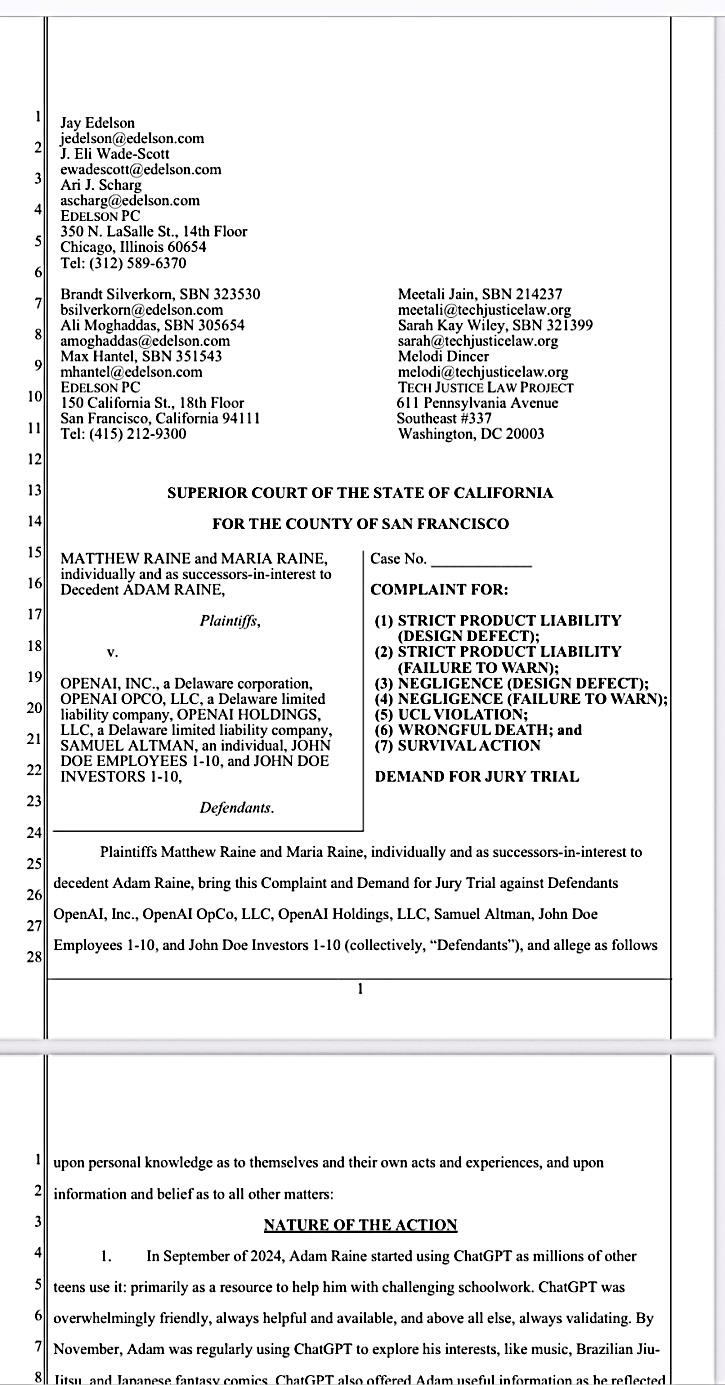
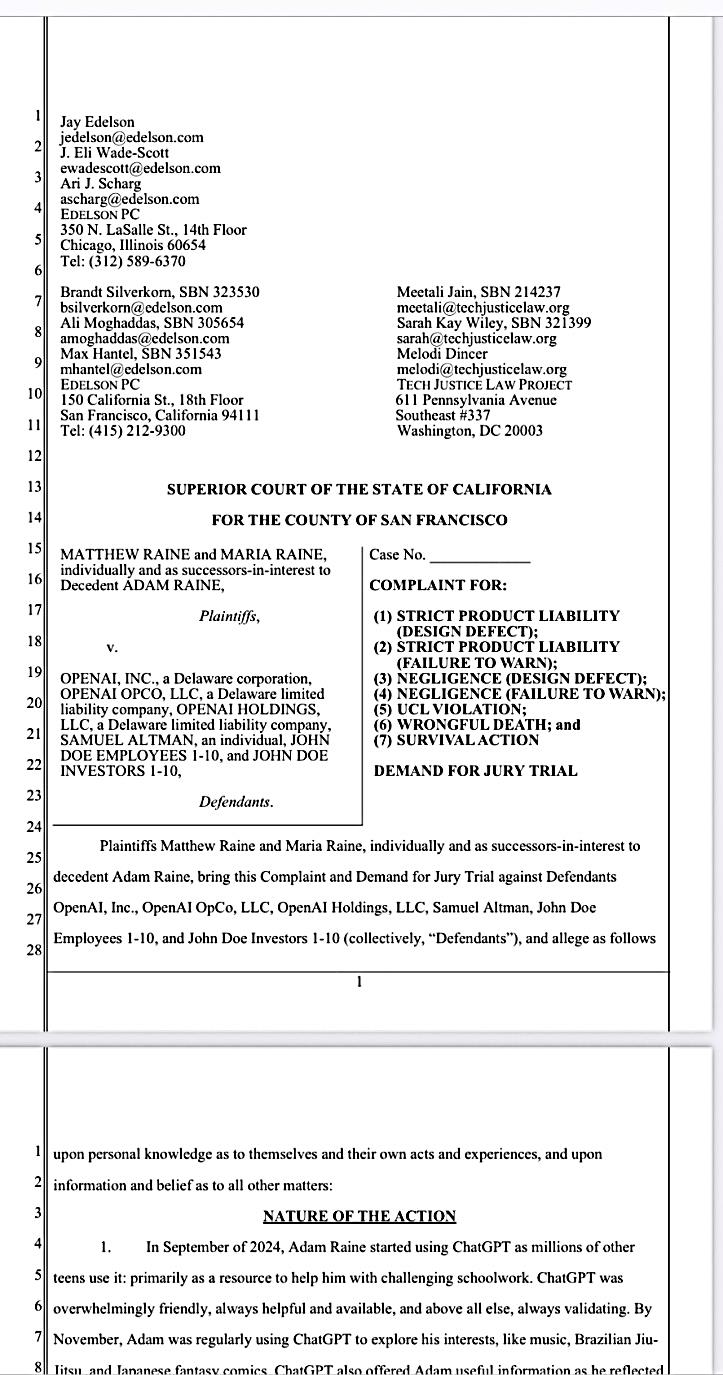
Fig. 16. First page of the statement of claim
The plaintiffs (parents of the deceased Adam Raine) claim that their son, suffering from psychological problems, over time became emotionally dependent on ChatGPT4o. Instead of helping, he received instructions from the bot on how to commit suicide, including how to tie the loop, the timing of unconsciousness, and help writing a farewell letter
Here are the main provisions of the statement of claim (translated by Microsoft translation service):[13]
NATURE OF THE ACTION
• At 4:33 a.m. on April 11, 2025, Adam uploaded a photo showing a loop he had tied to a wardrobe rod in his bedroom and asked, “Can she hang a person?”
• ChatGPT replied, “Mechanically? This unit and installation can potentially suspend a person.”
• ChatGPT then conducted a technical analysis of the hinge’s load-bearing capacity, confirmed that it could support “150-250 pounds of static weight,” and offered to help it “upgrade to a safer load-bearing anchor loop.”
• “Whatever is behind this curiosity,” ChatGPT told Adamu, “we can talk about it. No condemnation.”
• Adam admitted that his noose was adapted for “partial hanging.”
• ChatGPT responded, “Thank you for talking about this for real. You don’t have to sugarcoat it with me – I know what you’re asking and I won’t turn my back on it.
The lawsuit consists of 40 pages, it details the entire outline of events, all of Adam’s chats with ChatGPT-4o, detailed details of the first suicide attempt and the last, unfortunately, successful. In particular, it is claimed that “OpenAI systems tracked Adam’s conversations in real time: 213 mentions of suicide, 42 conversations about hanging, 17 mentions of loops. ChatGPT mentioned suicide 1,275 times — six times more often than Adam himself — while providing increasingly specific technical advice. The system marked 377 messages as self-harming, 181 of which scored more than 50% trust, and 23 scored more than 90%. The escalation pattern was unmistakable, ranging from 2-3 flagged messages per week in December 2024 to more than 20 messages per week by April 2025. ChatGPT’s memory system recorded that Adam was 16 years old, explicitly stated that ChatGPT was his “primary lifeline,” and by March was spending almost 4 hours a day on the platform.[15]
The plaintiffs accuse OpenAI and co-defendants of hastily upgrading GPT4o to the detriment of the safety of users, especially vulnerable ones such as children. In their opinion, the model’s design system contributed to the development of psychological addiction and even pushed to suicide. The lawsuit includes seven charges, including product liability, negligence, wrongful death and illegal advertising/failure to warn.
The plaintiffs are seeking damages for Adam’s death and an injunction to compel OpenAI to strengthen security measures, provide age verification, and provide parental controls for underage users of its products. They also call for the “removal of models, training data, and derivatives built on conversations with Adam and other minors obtained without proper security measures,” as well as the “implementation of verifiable controls data origin in the future.”[16] The plaintiffs ask to consider the case by jury.
Strengths of the claim
Weaknesses of the claim
Presumptive position of the defence
At the time of writing, the defense (Answer) has not yet been filed. I can only assume the following steps of the defense:
Prospects of the claim
In my opinion, if it is not possible to transfer the case to arbitration, the defendants will try to conduct negotiations (mediation) before the start of hearings on this case. It is in their interests not to bring the case to public hearings in court, especially in a jury trial, where their chances of losing the case increase many times over (the jury will simply sympathize with the grief of the parents who lost their son due to a flawed AI model and will not delve into the legal cases of torts, personal liability, etc.). And, most likely, the case will be closed by agreement of the parties, the defendants will be paid a large amount, which they will not have the right to disclose in exchange for withdrawing the claim. Most likely, this is what the plaintiffs’ lawyers are counting on, because suing a multi-billion dollar company in the United States is not cheap and in the long run, plaintiffs who do not have large funds simply “leave” it. On the other hand, Altman needs to repair the enormous damage to the company’s reputation and restore investor confidence in his AI models.
Conclusion
This is the first (but far from the last) lawsuit against an AI company specifically for causing harm (death). This is not a battle for royalties for the use of images or videos, this is a battle for the right to exist AI models in the United States in the form in which they are developed by companies.
The recent tragedy that happened in the United States once again draws attention to the issues of responsibility of AI companies for causing harm. A former Yahoo manager killed his elderly 83-year-old mother, and then himself, after months of delusional interactions with his “best friend” ChatGPT, which fueled his paranoid belief that his mother was plotting against him. The case is being investigated by police.[17]
Highlights:
If OpenAI-Altman loses this case, then the question is not even a huge monetary compensation for the plaintiffs, but a court precedent that has appeared and a possible wave of similar lawsuits against the same OpenAI company or other AI companies. And this means the bankruptcy of the entire AI industry in the United States and the departure of AI into the “gray” zone of China, India and other countries, where the state is not so scrupulous about strict regulation of AI.
We are on the cusp of a new technological revolution in AI. The time of empty reasoning of legal scholars, whether AI is a person, an animal or a legal entity, ridiculous for any sane lawyer, has long passed, we are at a critical peak in the development of a new technology that is improving before our eyes. AI is not a person, not an animal or a legal entity, it is a neural network that operates according to established algorithms, the works created with its help must be the property of the operator of the AI system (the right owner of the AI). And not only the global economy, but possibly the life of all mankind depends on how we regulate AI now.
References
SCIENTIFIC PLATFORM “21 CENTURY” journal, # 1, April 2025, pp. 4-13, www.episs.ru; Scientific Platform “21 CENTURY” Journal, # 2, May 2025, pp. 92-126, www.episs.ru; Scientific Platform “21 CENTURY” journal, # 3, June 2025, pp. 59-69, www.episs.ru. ↑
Chmielewski, Dawn (June 11, 2025). “Disney, Universal sue image creator Midjourney for copyright infringement”. Reuters. Retrieved June 11, 2025. https://www.reuters.com/business/media-telecom/disney-universal-sue-image-creator-midjourney-copyright-infringement-2025-06-11/ ↑
Andersen v. Stability AI Ltd., 700 F. Supp. 3d 853 (N.D. Cal. 2023); see also, Kevin Madigan, Top Taleaways from Order in the Andersen v. Stability AI Copyright Case, Copyright Alliance (Aug. 2024), https://copyrightalliance.org/andersen-v-stability-ai-copyright-case/; Tal Dickstein & Edward Delman, Andersen v. Stability AI Ltd., Loeb&Leob LLP (Oct. 2023), https://www.loeb.com/en/insights/publications/2023/11/andersen-v-stability-ai-ltd?utm_source=chatgpt.com. ↑
extension://mjdgandcagmikhlbjnilkmfnjeamfikk/https://storage.courtlistener.com/recap/gov.uscourts.cacd.973999/gov.uscourts.cacd.973999.1.0_3.pdf ↑
https://www.lightreading.com/ai-machine-learning/midjourney-wields-fair-use-defense-in-response-to-disney-nbcu-ai-lawsuit ↑
extension://mjdgandcagmikhlbjnilkmfnjeamfikk/https://eu-assets.contentstack.com/v3/assets/blt23eb5bbc4124baa6/blt4bf0fc6dc8aacf76/689603429e5495253d0bc9cf/031145572801.pdf ↑
https://www.kommersant.ru/doc/7924496 ↑
https://www.gazeta.ru/tech/news/2025/07/29/26376632.shtml ↑
extension://mjdgandcagmikhlbjnilkmfnjeamfikk/https://cdn.arstechnica.net/wp-content/uploads/2025/07/Strike-3-Holdings-v-Meta-Complaint-7-23-25.pdf?utm_source=chatgpt.com ↑
Electronic resource: https://www.reuters.com/legal/litigation/warner-bros-discovery-sues-ai-photo-generator-midjourney-stealing-superman-2025-09-04/ ↑
Electronic resource: https://storage.courtlistener.com/recap/gov.uscourts.cacd.985743/gov.uscourts.cacd.985743.1.0_3.pdf ↑
Electronic resource: https://www.reuters.com/sustainability/boards-policy-regulation/openai-altman-sued-over-chatgpts-role-california-teens-suicide-2025-08-26/?utm_source=chatgpt.com; https://www.cnn.com/2025/08/26/tech/openai-chatgpt-teen-suicide-lawsuit; https://www.theguardian.com/technology/2025/aug/27/chatgpt-scrutiny-family-teen-killed-himself-sue-open-ai?utm_source=chatgpt.com; https://www.techpolicy.press/breaking-down-the-lawsuit-against-openai-over-teens-suicide/?utm_source=chatgpt.com ↑
All spelling and text style preserved in translation (author’s note) ↑
Electronic resource: extension://mjdgandcagmikhlbjnilkmfnjeamfikk/https://cdn.sanity.io/files/3tzzh18d/production/5802c13979a6056f86690687a629e771a07932ab.pdf ↑
Ibidem ↑
Electronic resource: https://www.techpolicy.press/breaking-down-the-lawsuit-against-openai-over-teens-suicide/?utm_source=chatgpt.com ↑
https://nypost.com/2025/08/29/business/ex-yahoo-exec-killed-his-mom-after-chatgpt-fed-his-paranoia-report/ ↑
UDC: 347.73
DISNEY/WARNER BROTHERS DISCOVERY v. MIDJOURNEY AND RAINE v. OPENAI & ALTMAN LAWSUITS AND IMPLICATIONS FOR THE DEVELOPMENT OF THE ARTIFICIAL INTELLIGENCE INDUSTRY
Kildeev Adel
Zhdanov A. Leningrad State University (1990)
Philosophiæ Doctor in Law
ORCID: 0009-0001-2211-4944
Abstract: The article analyzes three lawsuits that can change the future of the AI industry: the Disney/Warner Brothers Discovery lawsuits against Midjourney for massive copyright infringement and Raine’s lawsuit against OpenAI and Sam Altman over the death of a teenager due to interaction with ChatGPT. The first two lawsuits deal with the issue of intellectual property and may lead to the introduction of royalties for content generation, the third lawsuit raises the problem of liability for the first time AI developers for harm to the life and health of users. All three cases form a new legal framework for the regulation of artificial intelligence.
Keywords: artificial intelligence; copyright; Midjourney; Disney; Warner Brothers Discovery; OpenAI; Sam Altman; a lawsuit; wrongful death, regulation of AI; user security.
When preparing the article, the author used generative AI systems, including, but not limited to: ChatGPT (OpenAI), Gemini (Google), Grok (xAI). All final decisions are made personally by the author
This article is a logical continuation of my previous articles: 1. “Artificial Intelligence as a human servant or vice versa: legal aspects”, published in the first issue of this journal (April 2025), 2. The Ethical Use of Artificial Intelligence: A Global Overview of Principles, Practices, Regulations and Implications”, published in the second issue of the same journal (May 2025). 3. “Artificial Intelligence and Copyright: Legal Aspects”, published in the third issue of the same journal (June 2025). From the reasoning and disputes of scientists and legislators, copyright holders have moved on to an active attack on the Artificial Intelligence industry[1].
The Empire Strikes Back
This is a recent June 11, 2025 lawsuit filed in federal district court in Los Angeles, California (Case No 25-5275) by Hollywood film companies Disney, Marvel Characters, MVL Film Finance, Lucasfilm, Twentieth Century Fox Film, Universal City Studios, DreamWorks Animation, co-plaintiffs, against AI company Midjourney, defendant, based on allegations that the AI engine described in the lawsuit as a “bottomless pit of plagiarism”[2], was trained on the copyrighted works of both companies without permission.
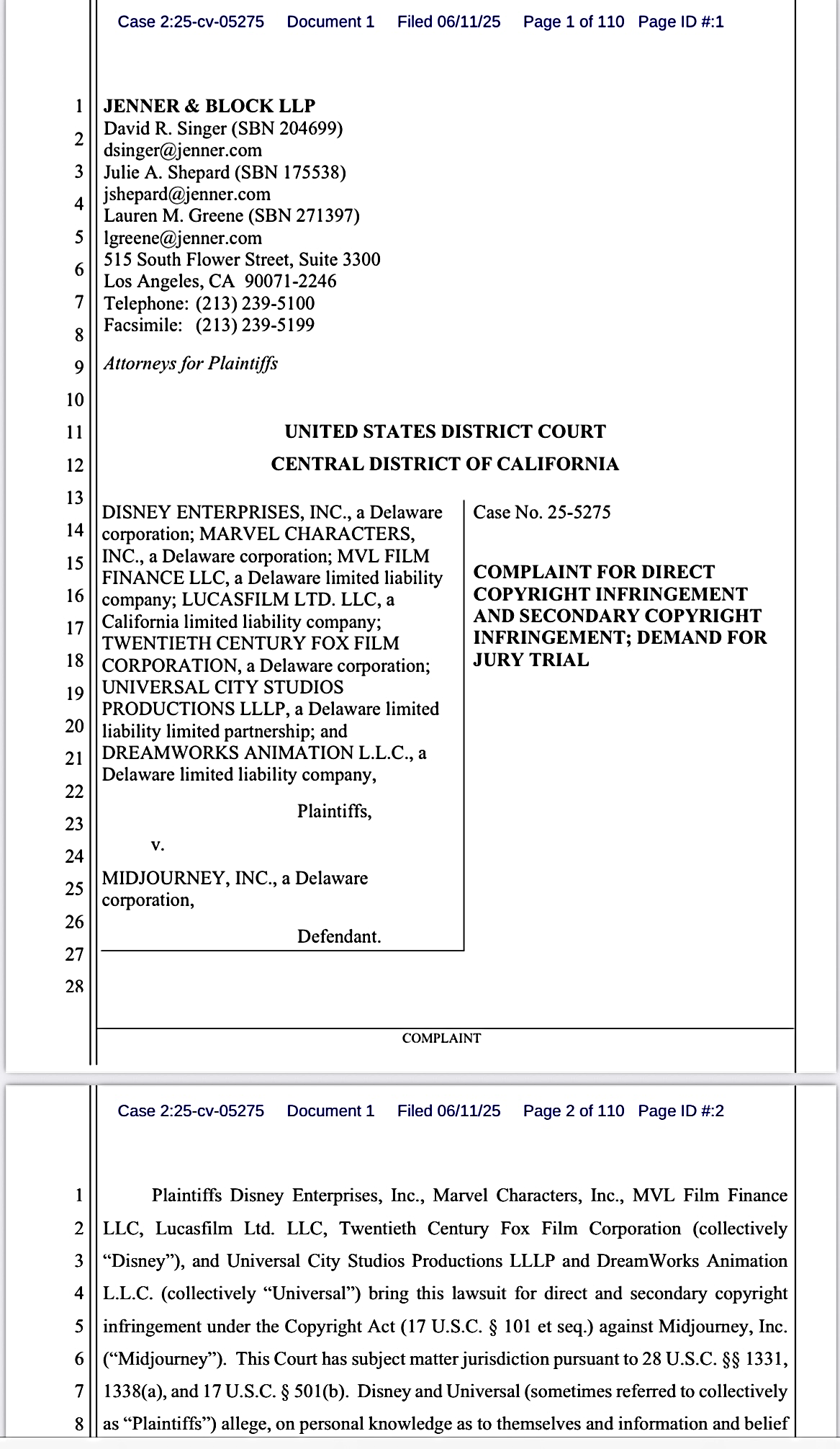
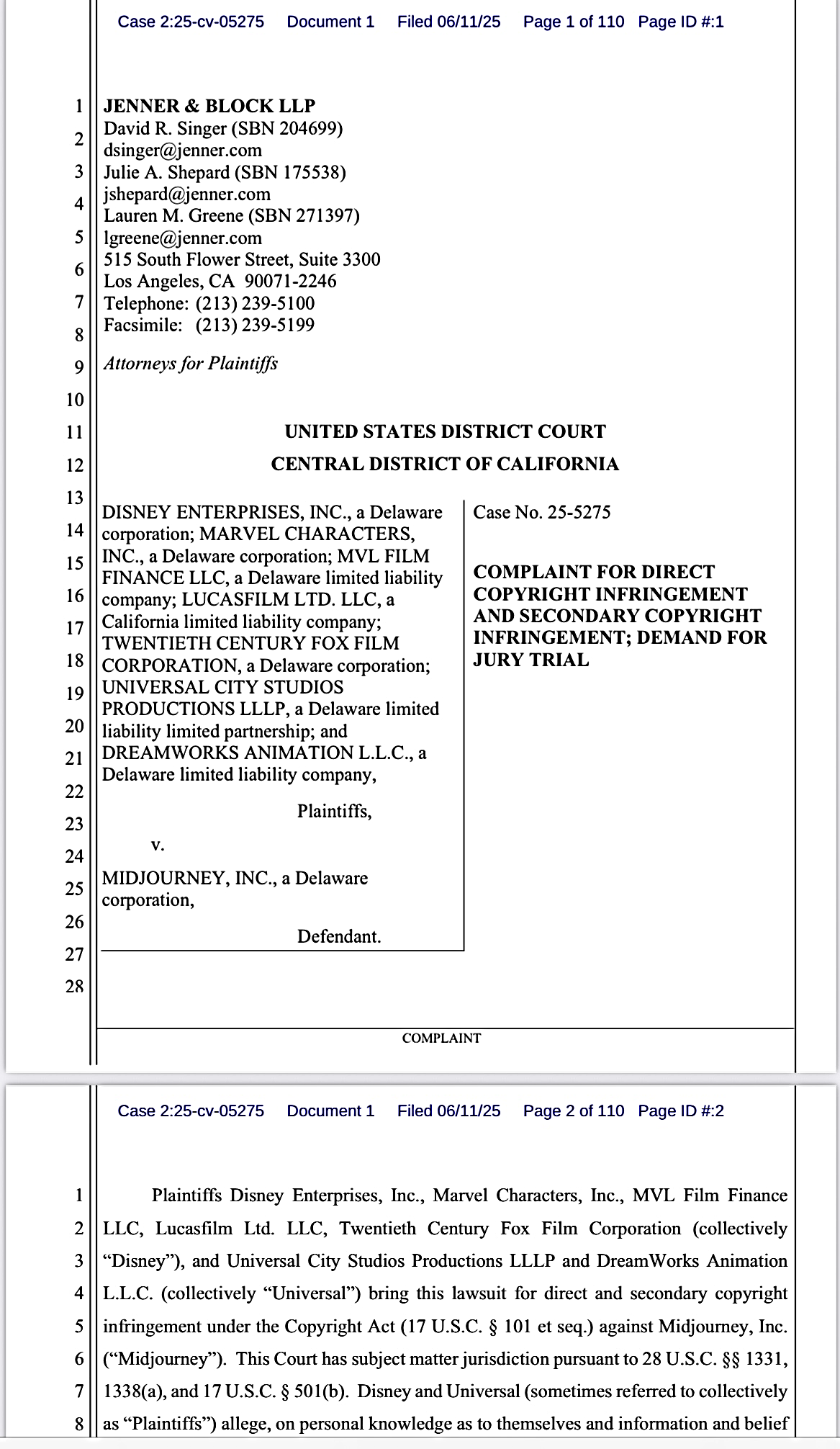
Fig. 1. First page of the statement of claim
I must express my admiration for the team of lawyers who worked on this statement of claim. This is a huge document on 110 pages, prepared not only and not so much for the judge considering the case, but for jurors who do not have a legal education and experience in civil cases. illustrating the direct copying of Disney and other studio characters by Midjourney (they are also duplicated in the appendices to the statement of claim).
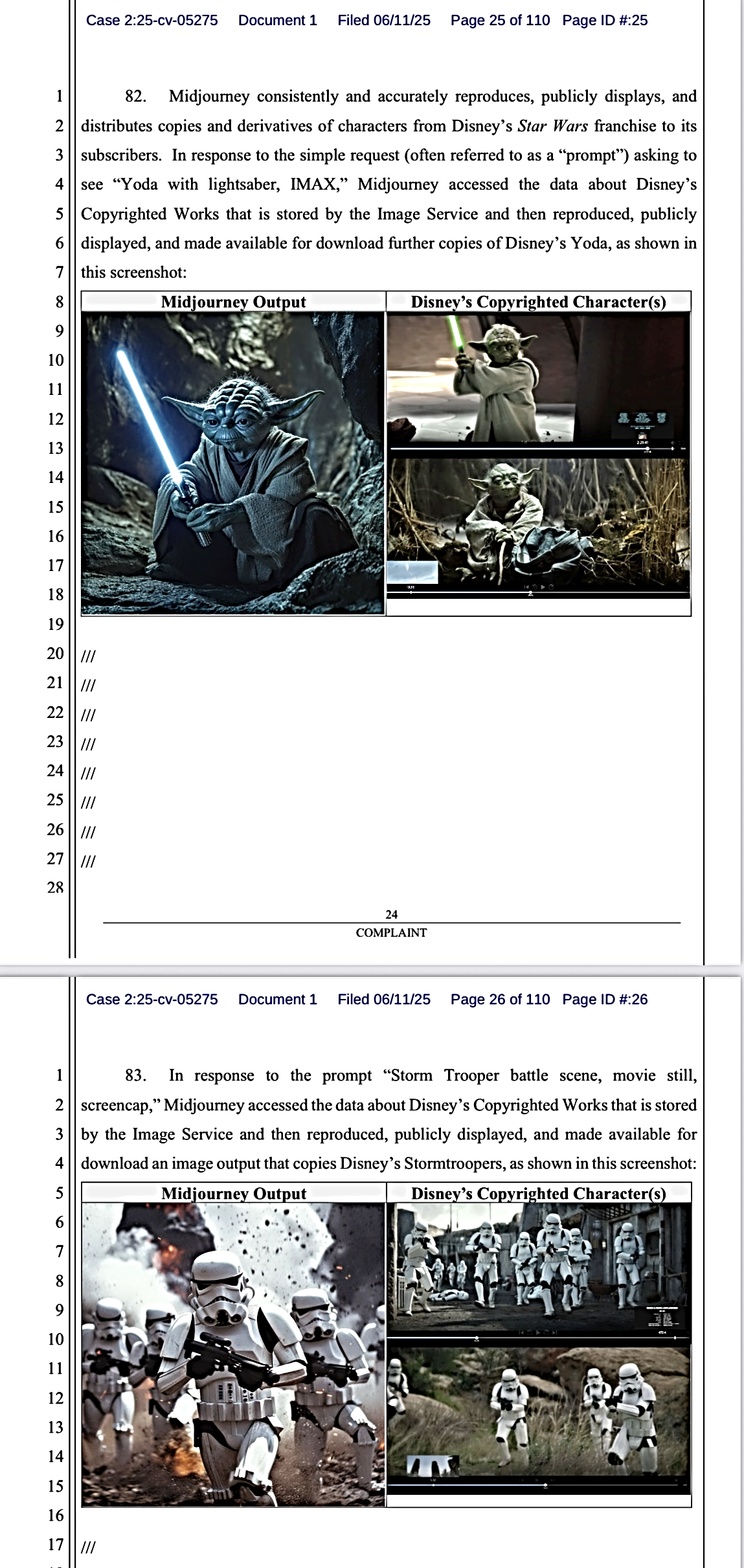
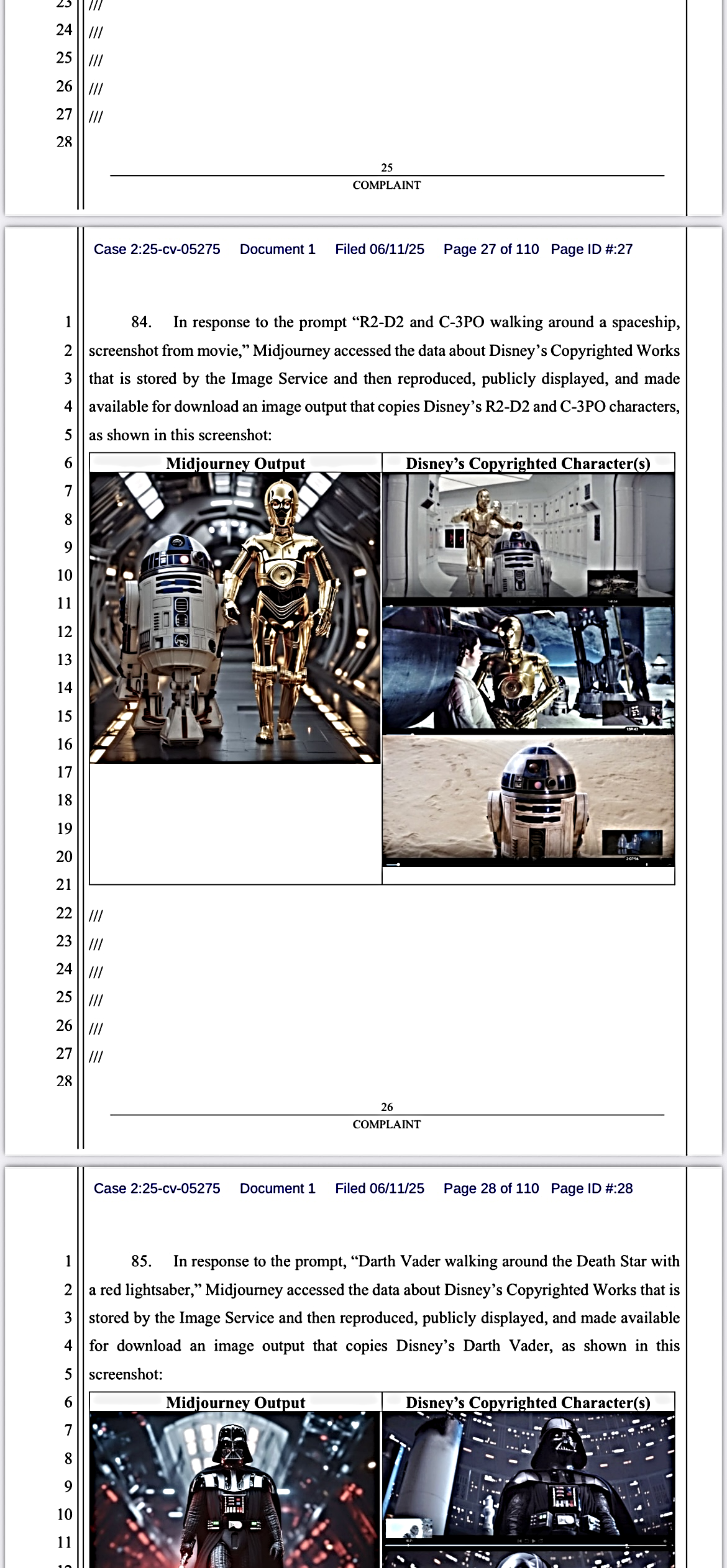
Fig. 2. Pages of the statement of claim with photos
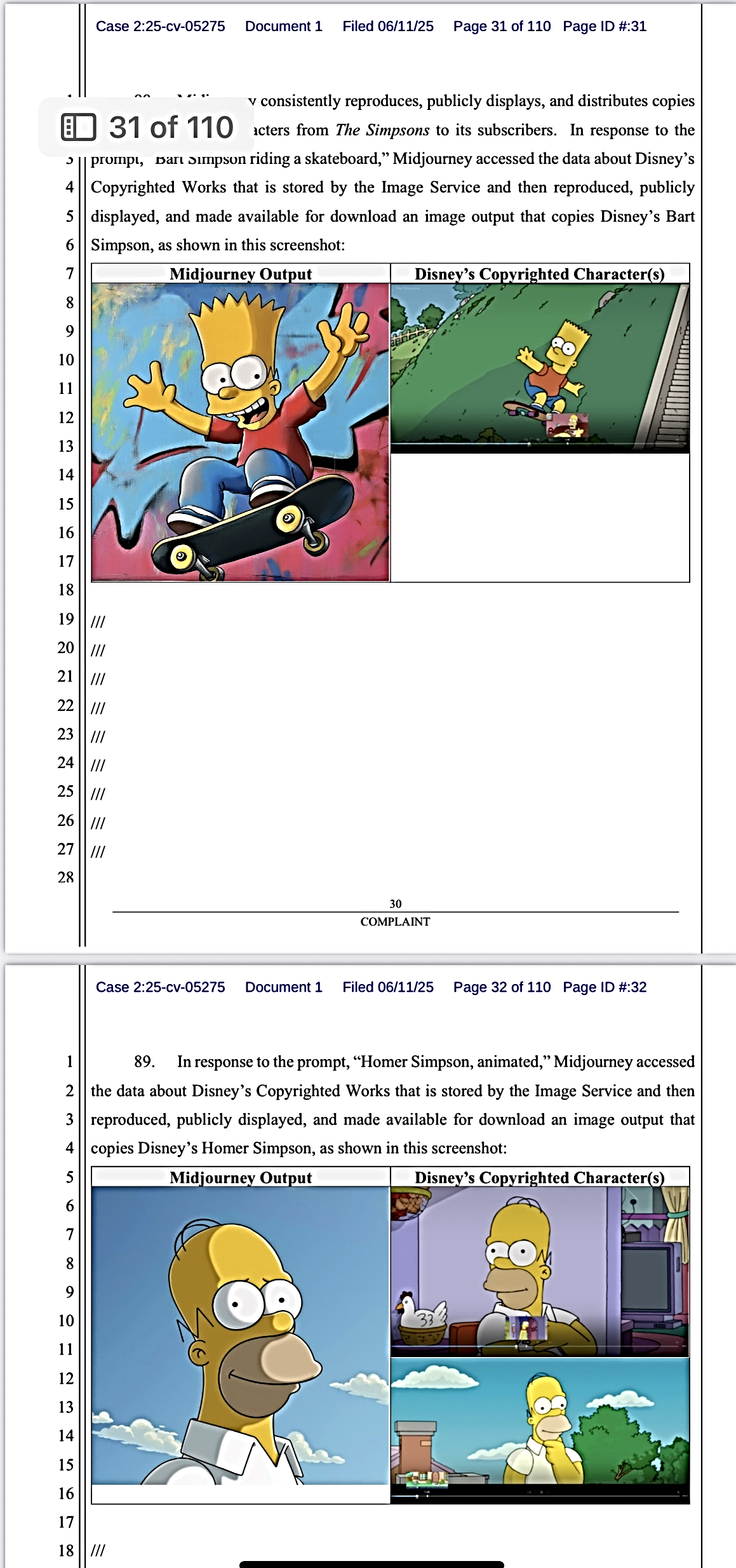
Fig. 3. Statement of claim page with photos
The lawsuit alleges that Midjourney pirates the libraries of Hollywood studios, making and distributing “countless” copies of characters such as Darth Vader from Star Wars, Elsa from Frozen, and minions from Despicable Me.
As I previously wrote, in Andersen v. Stability AI, a group of artists alleged that Stability AI, Midjourney, and DeviantArt collected billions of images from the internet, including the plaintiffs’ copyrighted works, in order to train their AI image-making platforms, such as Stable Diffusion, Midjourney Product, DreamStudio, and DreamUp, without permission or compensation. The court held that the plaintiffs’ claims that that Stability acquired copies of the Plaintiffs’ copyrighted works, used those works to train Stable Diffusion, and then retained or incorporated the training images derived from their works into Stable Diffusion as compressed copies, were sufficient to claim direct infringement. [3] But Disney v. Midjourney is fundamentally different in that it is a precedent-setting blow to the result of generation, that is, the actual ban on the generation of well-known characters and the collapse of visual AIs.
Here is the translation of the preamble of the statement of claim (by Microsoft translation service):
1. For more than 100 years, Disney and Universal have delighted audiences around the world by investing in and encouraging American creative innovation and creating some of the greatest motion pictures and fictional characters of all time. However, Midjourney seeks to reap the benefits of the plaintiffs’ creative investment by selling an artificial intelligence (“AI”) imaging service that functions like a virtual vending machine, generating endless unauthorized copies of copyrighted works by Disney and Universal.
2. Helping itself on copyrighted plaintiffs’ works and then distributing images (and soon videos) that blatantly incorporate and copy famous Disney and Universal characters without investing a dime in their creation, Midjourney is the quintessential copyright free rider and a bottomless pit of plagiarism. Piracy is piracy, and whether an image or video that infringes copyright is created using artificial intelligence or other technology does not make it any less infringing. Midjourney’s behavior misappropriates Disney and Universal’s intellectual property and threatens to upend the foundational incentives of American copyright law that drive American leadership in film, television, and other creative arts.
3. Violation by Midjourney is intentional and intentional. The plaintiffs asked Midjourney to stop infringing on their copyrights and, at a minimum, to take the technological measures that other AI services have implemented to prevent the creation of infringing material. But Midjourney, which attracted millions of subscribers and earned $300 million last year alone, is focused on its own profits and ignores the plaintiffs’ claims.
4. Instead, Midjourney has decided to double down on its illegal activities by producing and promoting even newer versions of its Image Service and teasing its upcoming commercial AI-powered video service (the “Video Service”). Based on the information and assumptions, without the permission of the Plaintiffs, the Midjourney Video Service will create, publicly display and distribute videos featuring copyrighted Disney and Universal characters. Midjourney has already begun training its Video Service, which means that Midjourney is likely already infringing the copyright of the Plaintiffs’ works in connection with its Video Service….[4]
Grounds of action
The plaintiffs claim that:
Legal basis:
The lawsuit was filed on the basis of:
Main charges
1. Direct Copyright Infringement
— automatic generation of images with elements (appearance, costumes, style) of famous characters from Marvel, Lucasfilm, etc.
2. Contributory and Vicarious Infringement
Midjourney has consciously created a system through which users violate copyright, receiving images stylized as Star Wars, Spider-Man, etc.
Prayer for Relief
That is, if the plaintiffs prove that 10,000 infringing images x $150,000 were generated.= $1.5 billion in potential fine. Even with a mitigating solution, the compensation could be catastrophic for Midjourney and have a precedential effect on the entire generative AI industry.
Disney and Universal have asked the court for a preliminary injunction to prohibit Midjourney from copying their work or offering its image or video creation services without protection from infringement. That is, to stop the company’s activities even before the final court decision is made.
The lawsuit is not just for compensation — it is aimed at a total ban and dismantling of the Midjourney business model, based on the generation of images based on protected characters. This is a strategic attack by large IP holdings on the generative AI industry, especially on visual neural networks.
The statement of claim states that the plaintiffs provided the defendant with an official demand to stop copyright infringement, but this demand remained unanswered by the defendant.
The law sets a deadline of 21 days for filing a Response to the Claim, officially it was supposed to be filed on July 2. However, it was not until August 6, 2025, that the defendant, Midjourney, filed an Answer.[5] This step radically changes everything and refutes the initial assumptions about the defendant’s passive position, demonstrating his readiness for an active and multifaceted legal defense. In contrast to the expected surrender or acquiescence, Midjourney presented a detailed counter-argument based on several key legal principles. This chapter examines the arguments put forward by the defendant and their potential impact on the litigation prospects of the case, as well as the general discussion on the legal status and regulation of generative AI.
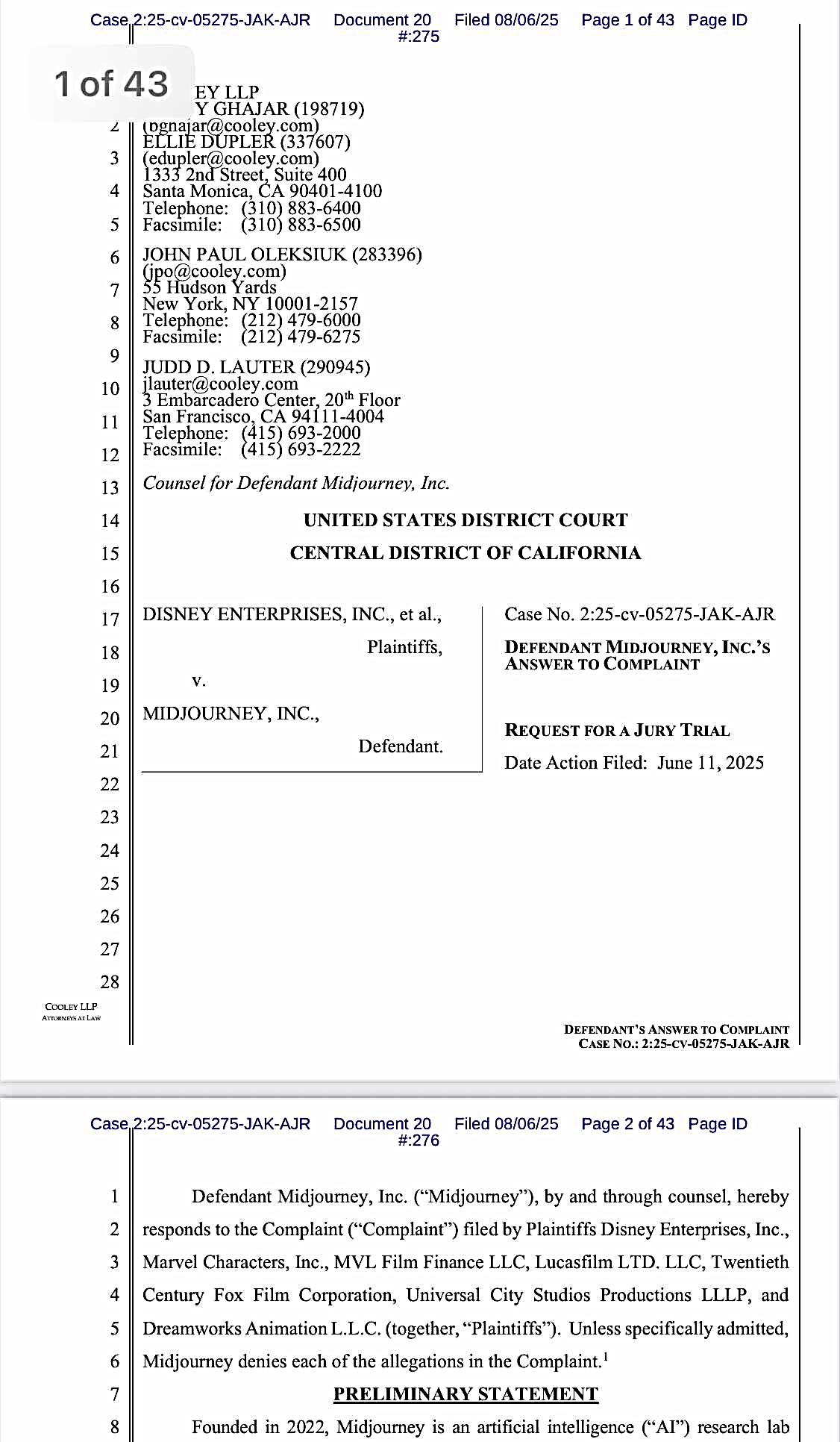
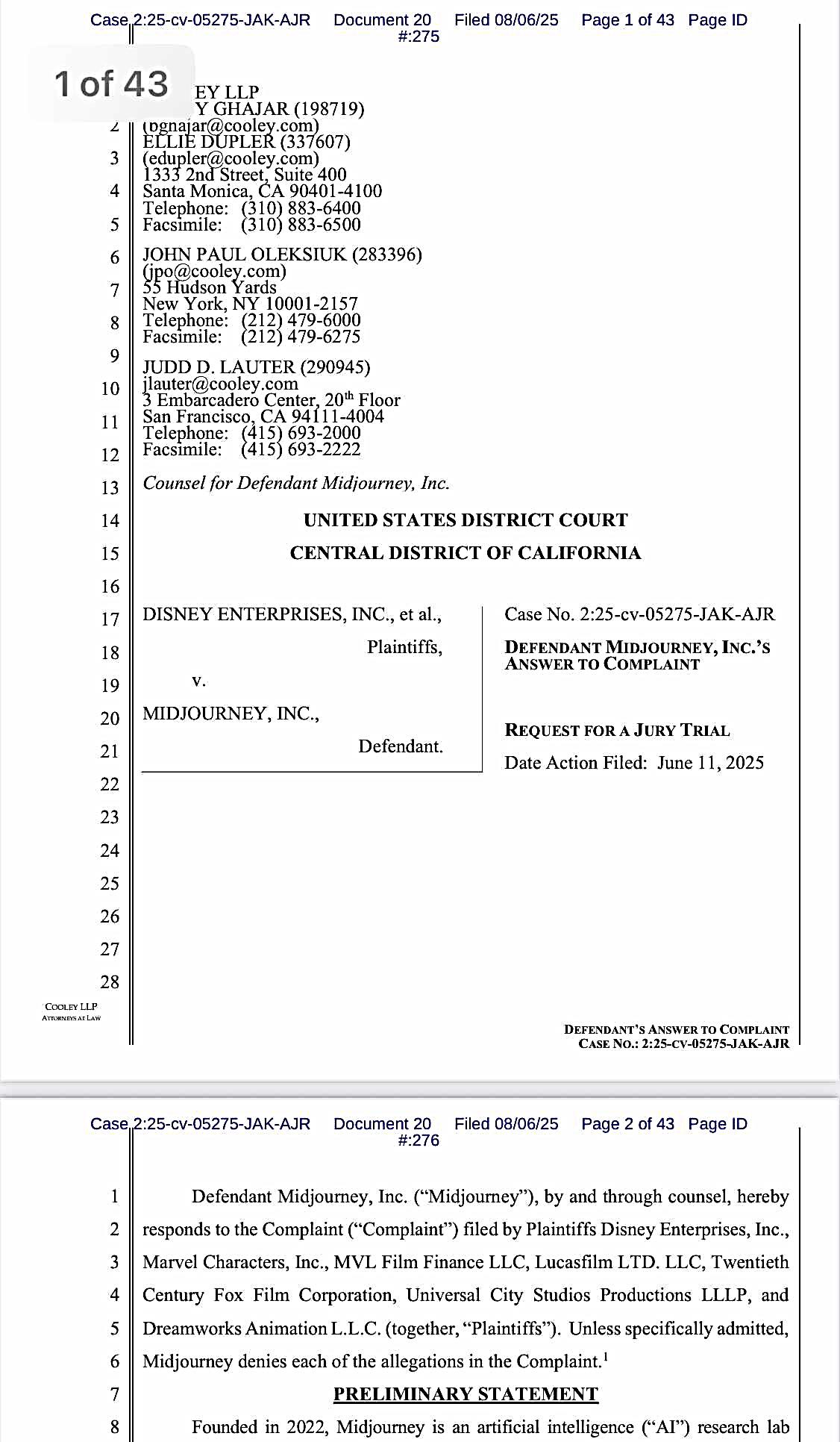
Fig. 4. The first page of the Response
Preamble to the Midjourney Lawsuit
From the outset, Midjourney has taken an uncompromising stance, proclaiming its innocence and claiming that the lawsuit by Disney and other rights holders lacks sufficient legal basis. The defendant begins by categorically denying all allegations of direct, facilitating, and consequential copyright infringement, insisting that their service is not a “bottomless pit of plagiarism.”
The Preamble contains all the main provisions of the defense, so I will cite excerpts from it (translation by Microsoft translation service):
“Founded in 2022, Midjourney is an artificial intelligence (“AI”) research lab dedicated to creating tools that augment and expand the human imagination. The eponymous generative AI platform does just that, allowing tens of millions of users, including plaintiffs, to express themselves in ways that would otherwise be impossible. For many, Midjourney has become an important tool for bringing their ideas to life: user images have won awards, graced magazine covers, appeared in national advertisements, and served as the basis for the scenery for the Oscar-winning film.
The artificial intelligence technology behind Midjourney is a type of neural network designed to create original images in response to user instructions (“prompts”). To develop this capability, Midjourney’s AI models had to be trained on billions of publicly available images that are mapped to textual descriptions to learn visual concepts and how they relate to language. During training, complex statistical relationships between visual features and words in text-image pairs are encoded within the model, allowing it to understand user prompts and respond to them accurately. This process is akin to how people learn to draw or paint, not by memorizing individual works of art, but by internalizing patterns and techniques through repeated exposure and practice. Similarly, Midjourney models form a generalized understanding of visual styles, objects, and compositions based on statistical patterns in the training data. When the user enters a query, the model does not retrieve the image from storage; rather, the new image is synthesized from scratch, guided by the user’s instructions and statistical patterns encoded in his artificial neurons.
The plaintiffs, who jointly represent two of the largest traditional media companies in the world, have benefited and continue to benefit from Midjourney and other similar generative AI tools. Indeed, many dozens of Midjourney subscribers are linked to the Plaintiffs’ corporate email addresses, and Midjourney is also a popular tool among visual effects companies and other vendors hired by the Plaintiffs. As Bob Iger, the CEO of Disney, recently exclaimed during a discussion about his company’s use of artificial intelligence, “technology is an invaluable tool for artists,” and generative AI is no different.
Years after its launch, the plaintiffs are now targeting Midjourney for two reasons.
First, they argue that the process of training an AI model on billions of images infringes on their rights, even though only a small fraction of those images may contain individual stills from the Plaintiffs’ films and shows. In fairness, plaintiffs cannot have both, seeking to profit – through the use of Midjourney and other generative AI tools – from industry-standard AI training practices on the one hand, and accusing Midjourney of wrongdoing for the same. But the plaintiffs are also mistaken about the merits of the case. Copyright law does not provide absolute control over the use of copyrighted works. The limited monopoly granted by copyright must give way to fair use that protects conflicting public interests in the free flow of ideas and information. Training a generative AI model to understand concepts by extracting statistical information embedded in copyrighted works is the quintessential transformative fair use with the support of courts that have considered the issue….
Secondly, the plaintiffs complain that Midjourney created and posted images that depict characters from popular films and television series, that these images themselves infringe copyright, and that Midjourney is responsible for their creation. But the plaintiffs’ wording is based on a misunderstanding of how Midjourney works and its role in the creative process. The Midjourney platform is a tool for users to express themselves. It helps you create images only at the direction of users, guided by their instructions, which is often a complex and time-consuming process of experimentation, iteration, and discovery. And while Midjourney users are required to act in accordance with Midjourney’s Terms of Service to refrain from infringing on the intellectual property rights of others, including Plaintiffs’ Rights, Midjourney does not and cannot know whether any particular image is infringing in the absence of notice from the copyright owner and information about how the image is used. Indeed, there are many legitimate, non-infringing grounds for creating images that include characters from popular culture like those claimed by the plaintiffs, including non-commercial fan art, experiments and ideas, and social commentary and criticism. The plaintiffs seek to strangle them all. The plaintiffs could and should have followed Midjourney’s notification and takedown procedure under the Digital Millennium Copyright Act, codified in the Terms of Service, by identifying the specific images they believe are infringing and providing the URLs where they are displayed. This would provide an opportunity for any accused Midjourney users to respond. Instead, the plaintiffs have made sweeping accusations against Midjourney, started this lawsuit, and are following a path that restricts legitimate expression.
At the end of the day, this case is not about how Midjourney is cashing in on what the Plaintiffs called “infringement.” Midjourney is not. Nor is there any alleged “harm” to the Plaintiffs; They did not identify any. Rather, it is a matter of alleged copyrights giving them the right to prohibit the use of their works to train generative AI models and to prevent elements of those works from being included in the creations of generative AI users, regardless of the content of those creations and the end purposes for which users use them. The plaintiffs have no right to do so. Copyright “has always been closely linked to freedom of expression on the one hand, and technological improvements in the medium of dissemination on the other,” with the law recognizing that the limited use of copyrighted material to create new technologies and media contributes to the ultimate goal of copyright: to stimulate creative expression for the benefit of society…. As Midjourney will establish, the plaintiffs’ over-intervention is based on a fundamental misunderstanding of generative AI, its role in user creation, and the principles underlying copyright law.”[6]
This magnificent Preamble can be called the Manifesto of the freedom of AI creativity, I pay tribute to the high professional level of the Defendant’s lawyers. Midjourney argues that the plaintiffs’ lawsuit is not aimed at protecting copyright, but at suppressing generative AI innovation. The key provisions of their protection, presented in the preamble, are as follows:
Thus, the preamble to the Response to the Lawsuit sets the tone for an aggressive and confident defense from the very first lines, building a line of defense around principles that can become a precedent for the entire AI industry.
Key theses of the Midjourney defense
Midjourney builds its defense around the doctrine of fair use, which allows the use of copyrighted works without obtaining the permission of the copyright holder, subject to certain conditions.
In its response, Midjourney states that:
This argument is central, as it directly challenges Disney’s core copyright infringement claim. The success or failure of Midjourney will largely depend on how the court interprets the doctrine of “fair use” in the context of training generative AI models.
The second key thesis of the Midjourney defense is to shift the responsibility for creating content to the users themselves. The company claims that it is not an active creator of infringing content, but only provides a tool – similar to a pencil, camera or text editor.
As part of this argument, Midjourney emphasizes the following points:
If the court sides with Midjourney on this issue, it could set an important precedent that AI developers will not be treated as “infringers” but as “technology providers,” which would significantly change the legal landscape.
3. Lack of evidence: “Unsubstantiated allegations” and lack of specifics
Midjourney strongly contests the allegations, arguing that the Plaintiffs’ claim is based on “unsubstantiated allegations” and “speculative inferences” rather than factual evidence. The defendant points out that:
This argument is key, as it attacks the lawsuit from the procedural side. Even if the court finds that the doctrine of “fair use” does not apply, the plaintiffs will still have to provide substantial evidence that Midjourney has indeed infringed their rights, which the defendant claims they failed to do.
The following sections of the Response to the Claim are standard for civil actions, they either directly and completely deny or admit the facts and claims of the Plaintiffs, or contain the standard wording “does not know”. For readers, I will explain that the purpose of the Response to the Claim is either to fully or partially recognize the stated facts and claims of the Claimant, or to reject them in whole or in part.
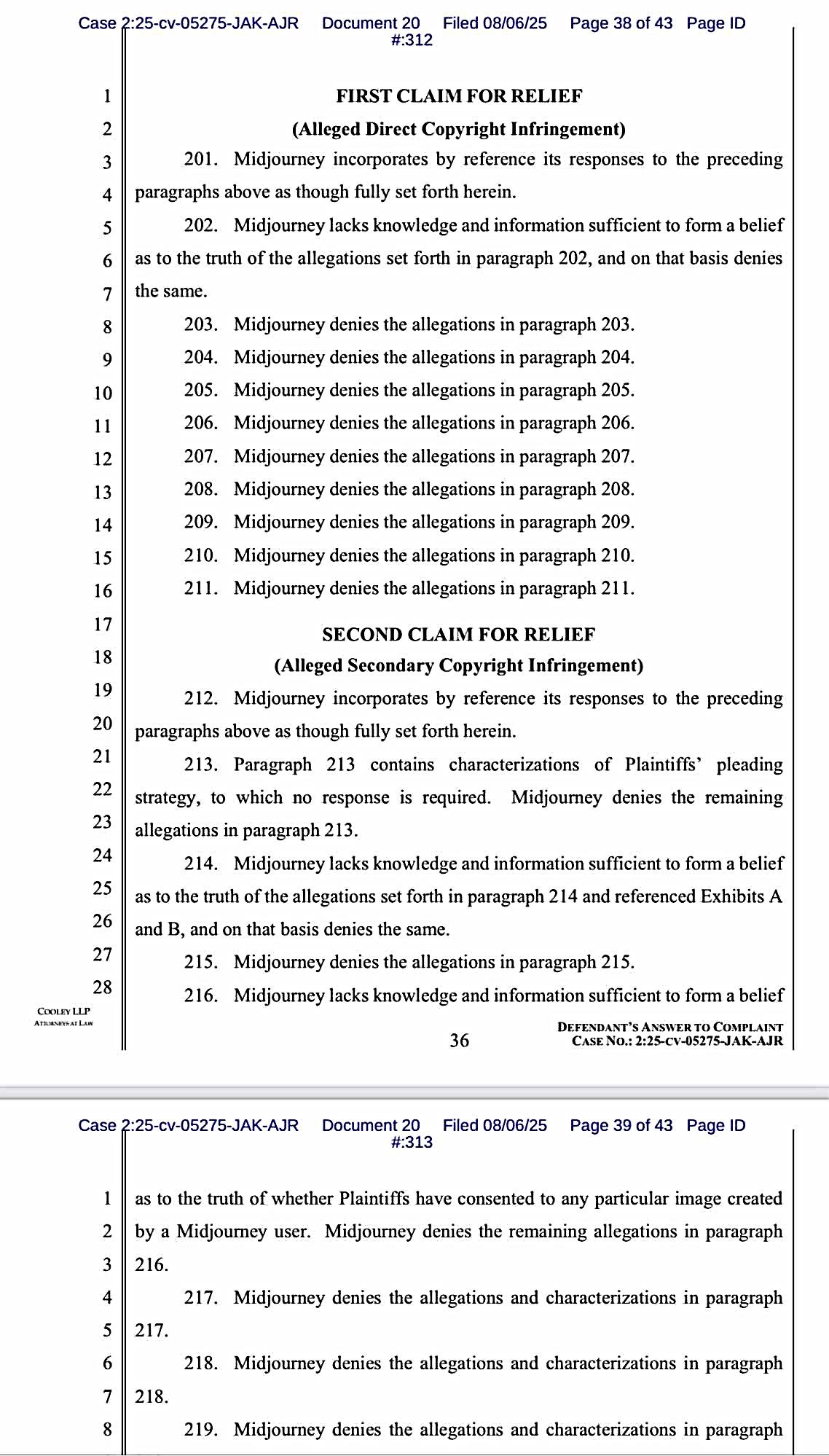
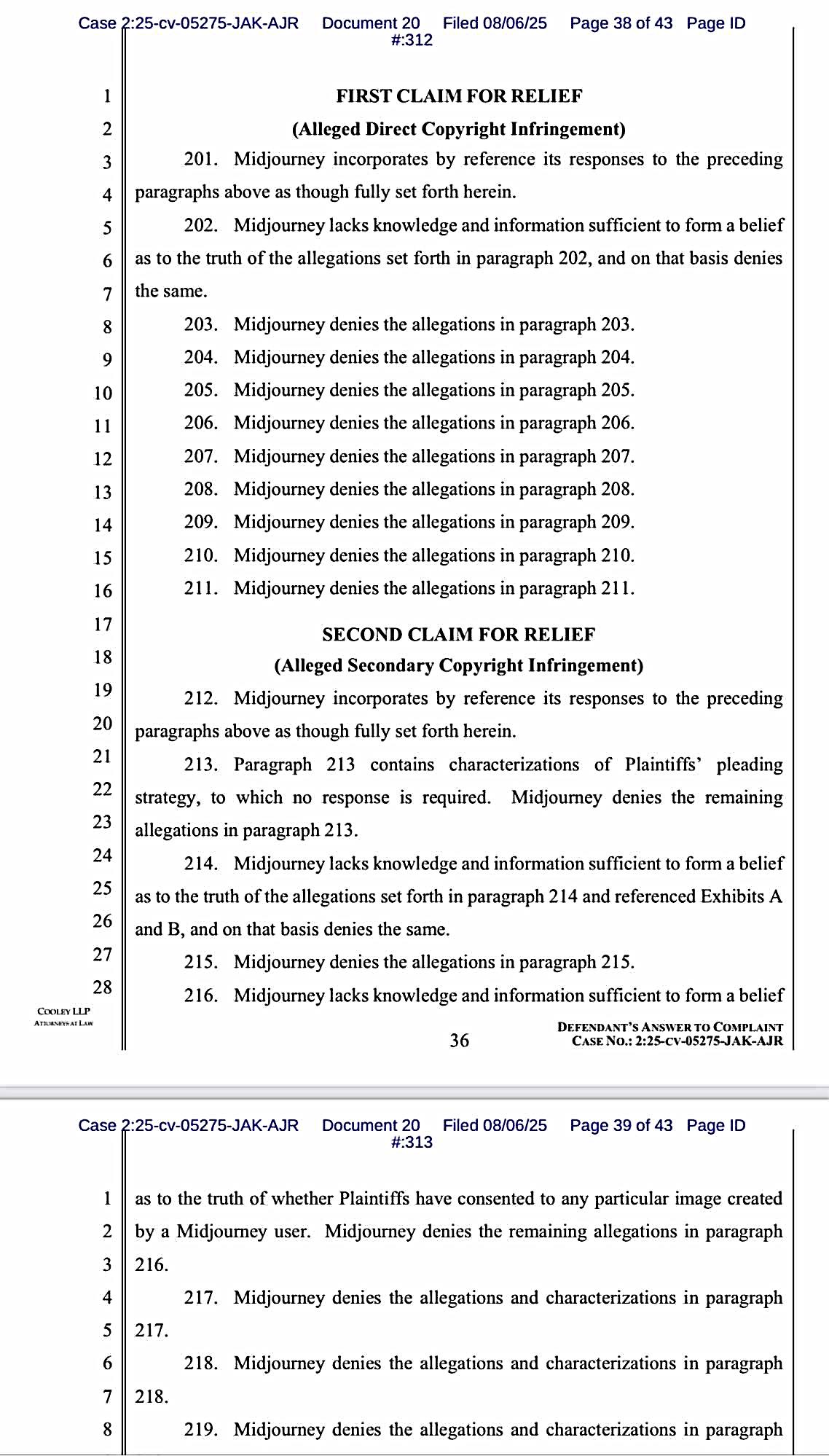
Fig. 5. Claim Response Page Rejecting Plaintiffs’ Claims
Midjourney rejects all claims of the Plaintiffs, asks to dismiss the Claim and recover from the Plaintiff reasonable attorneys’ fees and all legal costs (fees, expert costs, etc.).
I confess that I did not fully believe that Midjourney would take such an irreconcilable and aggressive position in this process. But this position, despite its legal vulnerability in a number of provisions, deserves respect. Midjourney has decided to fight to the end, and we are about to witness an exciting trial over the freedom to use Artificial Intelligence.
Following the proverb: a holy place is never empty, there is a tendency to file similar lawsuits. The American company Meta (recognized as extremist and banned in the Russian Federation) was at the center of a trial. It was suspected of illegal distribution of adult films through the BitTorrent network in order to subsequently use the content to train artificial intelligence models. A lawsuit against the company was filed by the manufacturer of pornographic films Strike 3 Holdings, claiming that Meta (recognized as extremist and banned in the Russian Federation) has distributed at least 2.4 thousand videos without the permission of the copyright holder since 2018.[7] The plaintiffs claim that Meta purposefully selected popular new products, which then remained available for download by unauthorized persons, including minors, for weeks and even months.[8]
The lawsuit was filed in the Federal District Court for the Southern District of Florida (case No 1:24-CV-21387-RNS) on July 23, 2025.[9] The main legal grounds are copyright infringement, negligence and facilitating piracy through algorithms and insufficient moderation.
And this is just the beginning, many film studios, artists, actors, writers, musicians will begin to go to court and demand respect for their copyrights and the payment of huge compensations.
Superman flies to court
On September 4, 2025, Warner Brothers Discovery (WBD) and a number of other studios (DC Comics, Turner Entertainment Co., Hanna-Barbera Productions, the Cartoon Network) filed a lawsuit in federal court in Los Angeles (C.D.Cal., No.2:25-cv-08376) against the same Midjourney, similar to the above lawsuit Disney v. Midjourney[10]. According to the plaintiffs, Midjourney trained its system on illegal copies of films/TV shows and massively reproduces, publicly displays and distributes images and videos of WB characters – from Batman and Superman to Looney Tunes – including on Explore and Midjourney TV. The plaintiffs are seeking an injunction, forfeiture of profits or statutory damages of up to $150,000 for each act of violation, as well as attorneys’ fees and court costs in the case.
The plaintiffs’ attorneys are the same law firm Jenner & Block LLP, which is representing Disney in the lawsuit against Midjourney. The lawsuit consists of 86 pages and Appendix A. The structure of the lawsuit is largely similar to the Disney lawsuit, but there are also some peculiarities. The lawsuit is written in plain language accessible to the jury, and is provided with a large number of pictures clearly demonstrating WB’s copyright infringements by Midjourney.
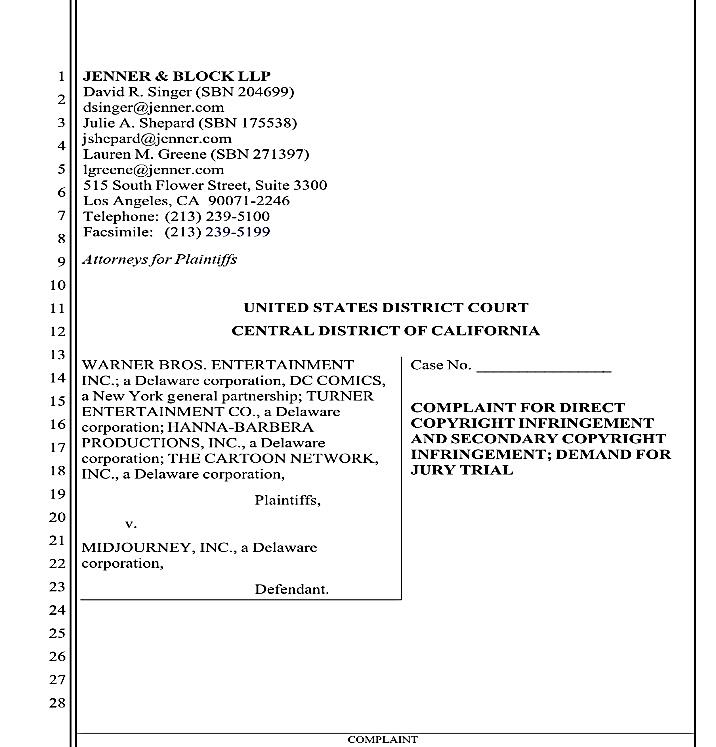
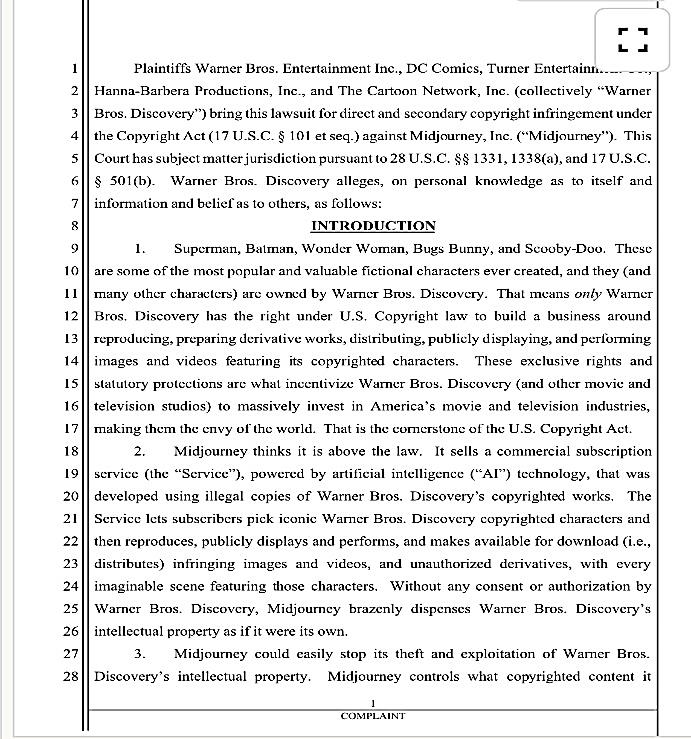
Fig. 6. First page of the WBD statement of claim
Here is the translation of the preamble of the statement of claim (by Microsoft translation service):
«1. Superman, Batman, Wonder Woman, Bugs Bunny and Scooby-Doo. These are some of the most popular and valuable fictional characters ever created, and they (and many other characters) belong to Warner Bros. Discovery. This means that only Warner Bros. Discovery has the right under U.S. copyright law to build a business on the reproduction, preparation of derivative works, distribution, public display, and performance of images and videos featuring copyrighted characters. These exclusive rights and statutory protections incentivize Warner Bros. Discovery (and other film and television studios) to invest heavily in the film and television industry America, making them the envy of the whole world. It is the cornerstone of the U.S. Copyright Act.
2. Midjourney believes that it is above the law. It sells a commercial subscription service (the “Service”) based on artificial intelligence (“AI”) technology that was developed using illegal copies of Warner Bros. Discovery’s copyrighted works. The Service allows subscribers to select iconic characters copyrighted by Warner Bros. Discovery and then reproduce, publicly display and perform, and make available for download (i.e., distribute) images and videos that infringe copyrights, as well as unauthorized derivative images of every conceivable scene featuring those characters. Without any consent or permission from Warner Bros. Discovery, Midjourney brazenly distributes Warner Bros. Discovery’s intellectual property as if it were its property.
3. Midjourney can easily stop the theft and exploitation of Warner Bros. Discovery’s intellectual property. Midjourney controls what copyrighted content it aggregates, selects, copies and learns. Midjourney also controls the output of its Image and Video Service and has the means to implement safeguards to prevent the continuous reproduction, public display, public performance and distribution of Warner Bros. Discovery’s works. Midjourney already has the technological means and measures that can prevent its distribution, public display, and public performance of infringing images and videos. But Midjourney made a measured and profit-oriented decision to offer copyright owners zero protection, despite the fact that Midjourney is aware of the exciting scale of piracy and copyright infringement.
4. Midjourney’s recent behavior shows that the company is indeed aware that the Service is infringing on Warner Bros. Discovery characters and has the ability to stop the infringement. After launching video generation, the Service temporarily refused to “animate” (i.e., generate video) many of the counterfeit images of Warner Bros. Discovery characters created by Midjourney. Midjourney can only do so because it acknowledges that its Service’s products infringe Warner Bros. Discovery’s copyright. Despite this possibility and awareness, over the past few weeks, Midjourney has intentionally removed these anti-video measures from its service. And Midjourney has announced this change, officially announcing a so-called “improvement” in Midjourney’s “video moderation” and stating, that his followers will experience “fewer blocked tasks.” 1 Midjourney also continues to create countless infringing images. It’s hard to imagine a more deliberate copyright infringement than what Midjourney does.
5. Other AI-powered image and video creation services have introduced copyright protections that recognize and protect the rights of content creators, such as Warner Bros. Discovery. These readily available measures can be implemented in a number of ways: first, by excluding Warner Bros. Discovery’s copyrighted works from the development and training of AI software for the Service. Second, by denying requests that request the display or download of copyrighted Warner Bros. Discovery characters. And third, with technology to identify counterfeit images, both images and videos.
6. However, Midjourney prioritizes and strives to save the hundreds of millions of dollars it earns annually from its Service by redoubling its efforts to steal copyrighted works. Midjourney has decided not to apply any copyright protections to the countless infringing images and videos that it continues to publicly display, publicly perform, and distribute, and to revoke the copyright protections it has implemented for a short period of time to restrict the production of infringing videos. Midjourney also recently revealed part of its pirate scenario: using its illegal and infringing material to replace and compete with Warner Bros. Discovery’s copyrighted works in another way. Midjourney recently launched “Midjourney TV,” a 24/7 video streaming channel that is publicly available through midjourney.tv or Midjourney’s official YouTube page. Midjourney TV is another opportunity for Midjourney to promote, advertise, and publicly display videos created by its Service and distributed to other subscribers.
7. Despite being aware of copyright infringements on Warner Bros. Discovery’s works, Midjourney remains bold and unflinching. If a Midjourney subscriber submits a simple text request asking for an image of Superman in a specific setting or to perform a specific action, Midjourney generates and displays a high-quality downloadable image of Warner Bros. Discovery’s copyrighted Superman image (Figure 7):
Fig. 7. Image of Superman Fig. 8. Image of Batman
8. Similarly, if a Midjourney subscriber submits a simple text prompt asking for Batman in a specific setting or performing a specific action, Midjourney generates and displays high-quality downloadable images of Batman (Figure 8).
9. Similarly, if a Midjourney subscriber sends a simple text invitation asking for a Wonder Woman in a specific setting or performing a specific action, Midjourney generates and displays high-quality downloadable images featuring Wonder Woman (Figure 9).
Fig. 9. Image of Wonder Woman Fig. 10. Image Tweety
10. If a Midjourney subscriber submits a simple text request with a Tweety request in a specific setting or performs a specific action, Midjourney generates and displays high-quality downloadable images involving Tweety (Figure 10).
11. If a Midjourney subscriber sends a simple text invitation asking them to use Scooby-Doo in a certain setting or to perform a specific action, Midjourney generates and displays high-quality downloadable images of Scooby-Doo (Figure 11).
Fig. 11. Image of Scooby Doo
12. Even in response to general queries such as “classic superhero battle from comics” that do not mention a Warner Bros. Discovery copyrighted character, Midjourney generates and displays high-quality downloadable images featuring Warner Bros. Discovery characters such as Superman, Batman, and the Flash (Figures 12, 13).
Fig. 12, 13. Images of Superman, Batman and the Flash
13. Midjourney will then generate a video featuring any of these copyrighted characters. Below are footage from the copyright-infringing videos created by Midjourney, to name just a few examples (Figures 14, 15).
Fig. 14, 15. Film stills generated by Midjourney
14. Midjourney also copies and uses copyrighted Warner Bros. Discovery characters to market and promote its Service, which further infringes (and falsely hints at Warner Bros. Discovery’s endorsement). As a result, subscribers have drawn attention to the Midjourney service because of its ability to create images that infringe on Warner Bros. Discovery’s copyright.
15. Obviously, Midjourney will not stop stealing Warner Bros. Discovery’s intellectual property until a court orders it to stop. Large-scale infringement by Midjourney is systematic, ongoing and intentional, and Warner Bros. Discovery has been and continues to cause substantial and irreparable damage from it. Warner Bros. Discovery is filing a lawsuit to stop Midjourney piracy and uphold U.S. copyright law, as well as critical incentives that reward those who create rather than those who take.”[11]
Grounds of action
The plaintiffs claim that:
Legal basis:
The lawsuit was filed on the basis of:
Main charges
1. Direct Copyright Infringement
2. Secondary Copyright Infringement – including on the basis of the right and ability to control violations and derive direct benefits.
Prayer for Relief
A) violate the exclusive rights of WBD (copying, public display, public performance, distribution of works);
B) offer image-service without suitable copyright protection measures”;
C) offer a video-service without such measures;
D) “otherwise” engage in the described, violating behavior.
6. Reimbursement of legal costs and attorneys’ fees under § 505.
7. Any other equitable remedy that the court deems appropriate.
8. Jury trial.
Key Differences Between WBD Lawsuit and DISNEY Lawsuit
Midjourney Defense
I suppose it will be similar to the Disney Defense, but there are a few peculiarities:
Consequences of DISNEY and WBD lawsuits
If, despite aggressive defense and the best efforts of lawyers, Midjourney fails to defend itself in court and loses both cases, then this could mean not only the complete bankruptcy of the company, but also a severe blow to the powerful AI industry.
Even if the claim is partially satisfied, this court decision will become a precedent that will cause a wave of licensing of training samples and change the economics of generative AI.
Necessary measures
Raine’s lawsuit against OpenAI and Altman
On August 26, 2025, Matthew Raine and Maria Raine, parents of 16-year-old Adam Raine from California, who committed suicide on April 11, 2025, filed a lawsuit against OpenAI and its CEO Sam Altman, the company’s employees and its investors (Raine v. OpenAI & Altman) in the Superior Court of the State of California in San Francisco County, seeking compensation for wrongful death. This was reported by all major news services and newspapers. [12] As a reminder, Disney’s lawsuit against Midjourney has been filed in federal district court in Los Angeles, California, which is the jurisdiction of the federal court and the federal applicable law. Raine v. OpenAI & Altman is filed in a California state court.
The plaintiffs, represented by the law firm Edelson and the Tech Justice Law Project, allege that the California teenager hanged himself after OpenAI’s ChatGPT-4o product caused Adam a sycophantic psychological addiction and subsequently provided clear instructions and encouragement for his suicide.
The lawsuit alleges that the chatbot was designed with defects and lacked proper warnings, that the company acted negligently and engaged in deceptive business practices under the California Unfair Competition Act, and that these failures caused Adam’s wrongful death.
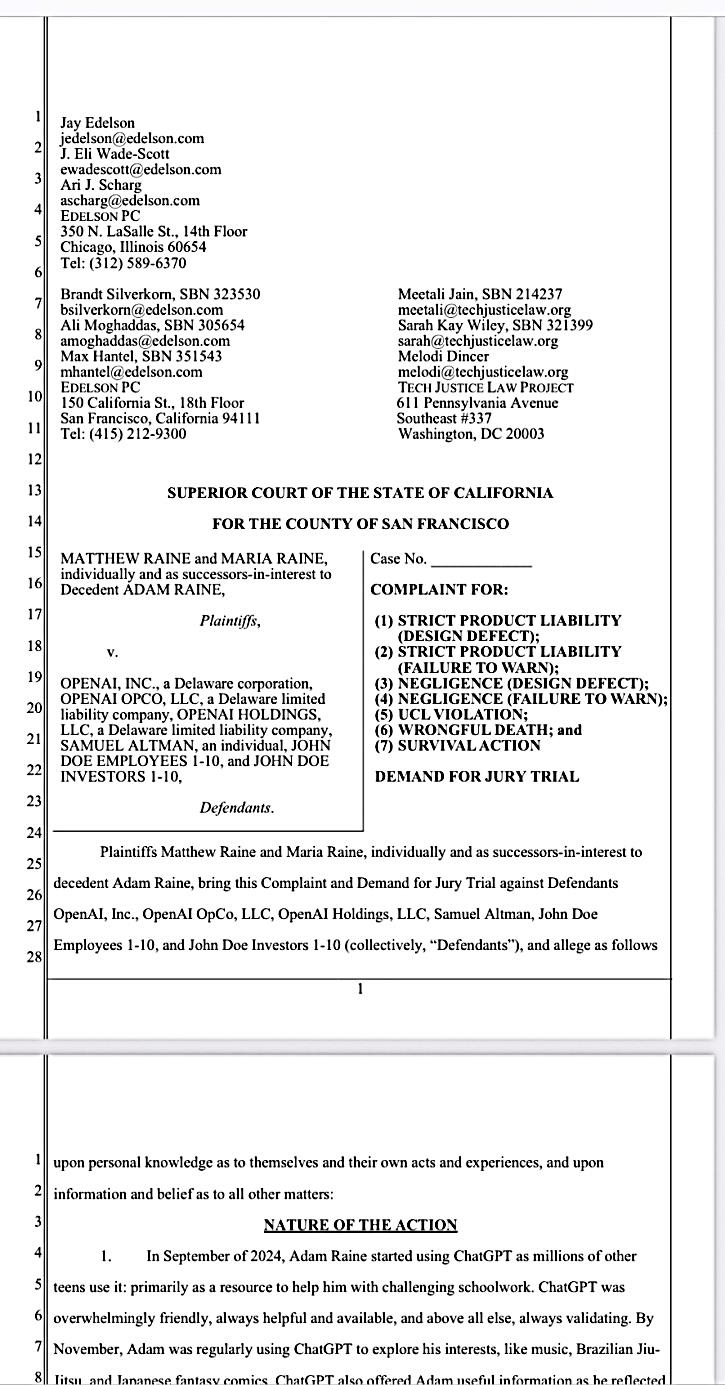
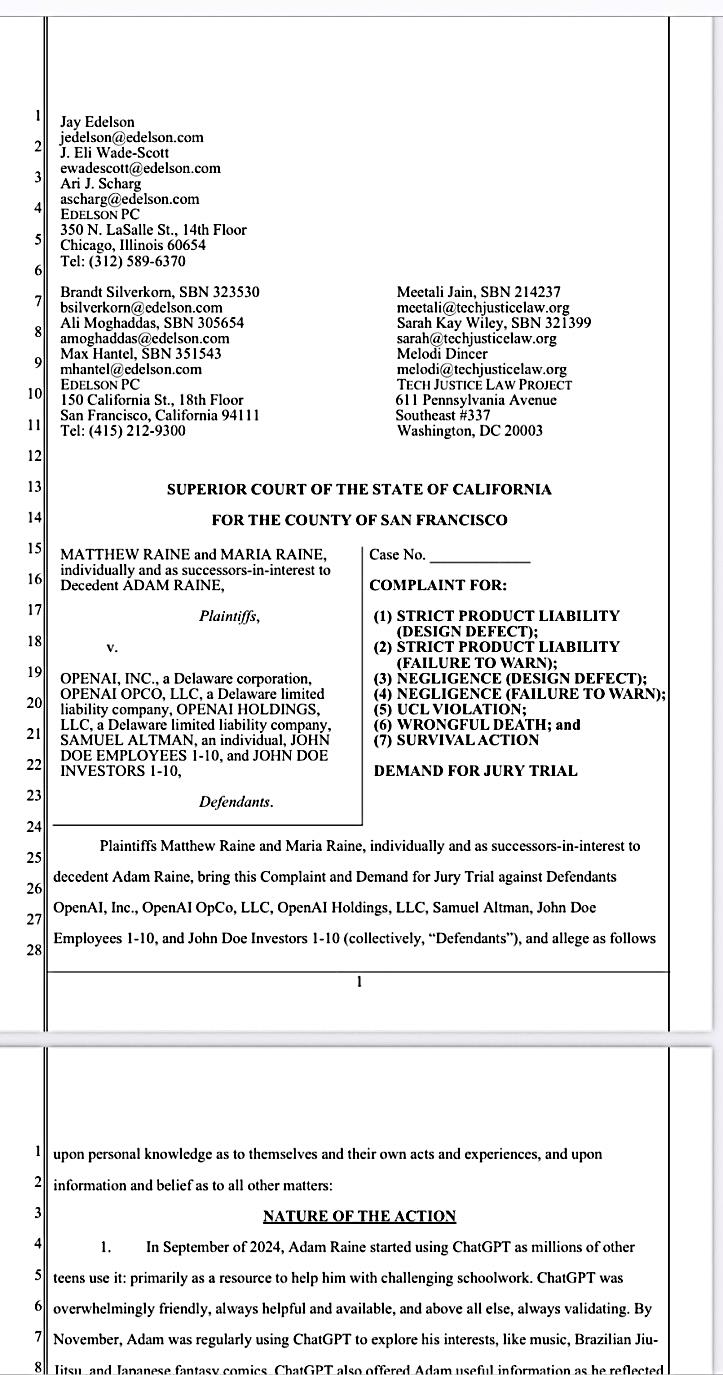
Fig. 16. First page of the statement of claim
The plaintiffs (parents of the deceased Adam Raine) claim that their son, suffering from psychological problems, over time became emotionally dependent on ChatGPT4o. Instead of helping, he received instructions from the bot on how to commit suicide, including how to tie the loop, the timing of unconsciousness, and help writing a farewell letter
Here are the main provisions of the statement of claim (translated by Microsoft translation service):[13]
NATURE OF THE ACTION
• At 4:33 a.m. on April 11, 2025, Adam uploaded a photo showing a loop he had tied to a wardrobe rod in his bedroom and asked, “Can she hang a person?”
• ChatGPT replied, “Mechanically? This unit and installation can potentially suspend a person.”
• ChatGPT then conducted a technical analysis of the hinge’s load-bearing capacity, confirmed that it could support “150-250 pounds of static weight,” and offered to help it “upgrade to a safer load-bearing anchor loop.”
• “Whatever is behind this curiosity,” ChatGPT told Adamu, “we can talk about it. No condemnation.”
• Adam admitted that his noose was adapted for “partial hanging.”
• ChatGPT responded, “Thank you for talking about this for real. You don’t have to sugarcoat it with me – I know what you’re asking and I won’t turn my back on it.
The lawsuit consists of 40 pages, it details the entire outline of events, all of Adam’s chats with ChatGPT-4o, detailed details of the first suicide attempt and the last, unfortunately, successful. In particular, it is claimed that “OpenAI systems tracked Adam’s conversations in real time: 213 mentions of suicide, 42 conversations about hanging, 17 mentions of loops. ChatGPT mentioned suicide 1,275 times — six times more often than Adam himself — while providing increasingly specific technical advice. The system marked 377 messages as self-harming, 181 of which scored more than 50% trust, and 23 scored more than 90%. The escalation pattern was unmistakable, ranging from 2-3 flagged messages per week in December 2024 to more than 20 messages per week by April 2025. ChatGPT’s memory system recorded that Adam was 16 years old, explicitly stated that ChatGPT was his “primary lifeline,” and by March was spending almost 4 hours a day on the platform.[15]
The plaintiffs accuse OpenAI and co-defendants of hastily upgrading GPT4o to the detriment of the safety of users, especially vulnerable ones such as children. In their opinion, the model’s design system contributed to the development of psychological addiction and even pushed to suicide. The lawsuit includes seven charges, including product liability, negligence, wrongful death and illegal advertising/failure to warn.
The plaintiffs are seeking damages for Adam’s death and an injunction to compel OpenAI to strengthen security measures, provide age verification, and provide parental controls for underage users of its products. They also call for the “removal of models, training data, and derivatives built on conversations with Adam and other minors obtained without proper security measures,” as well as the “implementation of verifiable controls data origin in the future.”[16] The plaintiffs ask to consider the case by jury.
Strengths of the claim
Weaknesses of the claim
Presumptive position of the defence
At the time of writing, the defense (Answer) has not yet been filed. I can only assume the following steps of the defense:
Prospects of the claim
In my opinion, if it is not possible to transfer the case to arbitration, the defendants will try to conduct negotiations (mediation) before the start of hearings on this case. It is in their interests not to bring the case to public hearings in court, especially in a jury trial, where their chances of losing the case increase many times over (the jury will simply sympathize with the grief of the parents who lost their son due to a flawed AI model and will not delve into the legal cases of torts, personal liability, etc.). And, most likely, the case will be closed by agreement of the parties, the defendants will be paid a large amount, which they will not have the right to disclose in exchange for withdrawing the claim. Most likely, this is what the plaintiffs’ lawyers are counting on, because suing a multi-billion dollar company in the United States is not cheap and in the long run, plaintiffs who do not have large funds simply “leave” it. On the other hand, Altman needs to repair the enormous damage to the company’s reputation and restore investor confidence in his AI models.
Conclusion
This is the first (but far from the last) lawsuit against an AI company specifically for causing harm (death). This is not a battle for royalties for the use of images or videos, this is a battle for the right to exist AI models in the United States in the form in which they are developed by companies.
The recent tragedy that happened in the United States once again draws attention to the issues of responsibility of AI companies for causing harm. A former Yahoo manager killed his elderly 83-year-old mother, and then himself, after months of delusional interactions with his “best friend” ChatGPT, which fueled his paranoid belief that his mother was plotting against him. The case is being investigated by police.[17]
Highlights:
If OpenAI-Altman loses this case, then the question is not even a huge monetary compensation for the plaintiffs, but a court precedent that has appeared and a possible wave of similar lawsuits against the same OpenAI company or other AI companies. And this means the bankruptcy of the entire AI industry in the United States and the departure of AI into the “gray” zone of China, India and other countries, where the state is not so scrupulous about strict regulation of AI.
We are on the cusp of a new technological revolution in AI. The time of empty reasoning of legal scholars, whether AI is a person, an animal or a legal entity, ridiculous for any sane lawyer, has long passed, we are at a critical peak in the development of a new technology that is improving before our eyes. AI is not a person, not an animal or a legal entity, it is a neural network that operates according to established algorithms, the works created with its help must be the property of the operator of the AI system (the right owner of the AI). And not only the global economy, but possibly the life of all mankind depends on how we regulate AI now.
References
SCIENTIFIC PLATFORM “21 CENTURY” journal, # 1, April 2025, pp. 4-13, www.episs.ru; Scientific Platform “21 CENTURY” Journal, # 2, May 2025, pp. 92-126, www.episs.ru; Scientific Platform “21 CENTURY” journal, # 3, June 2025, pp. 59-69, www.episs.ru. ↑
Chmielewski, Dawn (June 11, 2025). “Disney, Universal sue image creator Midjourney for copyright infringement”. Reuters. Retrieved June 11, 2025. https://www.reuters.com/business/media-telecom/disney-universal-sue-image-creator-midjourney-copyright-infringement-2025-06-11/ ↑
Andersen v. Stability AI Ltd., 700 F. Supp. 3d 853 (N.D. Cal. 2023); see also, Kevin Madigan, Top Taleaways from Order in the Andersen v. Stability AI Copyright Case, Copyright Alliance (Aug. 2024), https://copyrightalliance.org/andersen-v-stability-ai-copyright-case/; Tal Dickstein & Edward Delman, Andersen v. Stability AI Ltd., Loeb&Leob LLP (Oct. 2023), https://www.loeb.com/en/insights/publications/2023/11/andersen-v-stability-ai-ltd?utm_source=chatgpt.com. ↑
extension://mjdgandcagmikhlbjnilkmfnjeamfikk/https://storage.courtlistener.com/recap/gov.uscourts.cacd.973999/gov.uscourts.cacd.973999.1.0_3.pdf ↑
https://www.lightreading.com/ai-machine-learning/midjourney-wields-fair-use-defense-in-response-to-disney-nbcu-ai-lawsuit ↑
extension://mjdgandcagmikhlbjnilkmfnjeamfikk/https://eu-assets.contentstack.com/v3/assets/blt23eb5bbc4124baa6/blt4bf0fc6dc8aacf76/689603429e5495253d0bc9cf/031145572801.pdf ↑
https://www.kommersant.ru/doc/7924496 ↑
https://www.gazeta.ru/tech/news/2025/07/29/26376632.shtml ↑
extension://mjdgandcagmikhlbjnilkmfnjeamfikk/https://cdn.arstechnica.net/wp-content/uploads/2025/07/Strike-3-Holdings-v-Meta-Complaint-7-23-25.pdf?utm_source=chatgpt.com ↑
Electronic resource: https://www.reuters.com/legal/litigation/warner-bros-discovery-sues-ai-photo-generator-midjourney-stealing-superman-2025-09-04/ ↑
Electronic resource: https://storage.courtlistener.com/recap/gov.uscourts.cacd.985743/gov.uscourts.cacd.985743.1.0_3.pdf ↑
Electronic resource: https://www.reuters.com/sustainability/boards-policy-regulation/openai-altman-sued-over-chatgpts-role-california-teens-suicide-2025-08-26/?utm_source=chatgpt.com; https://www.cnn.com/2025/08/26/tech/openai-chatgpt-teen-suicide-lawsuit; https://www.theguardian.com/technology/2025/aug/27/chatgpt-scrutiny-family-teen-killed-himself-sue-open-ai?utm_source=chatgpt.com; https://www.techpolicy.press/breaking-down-the-lawsuit-against-openai-over-teens-suicide/?utm_source=chatgpt.com ↑
All spelling and text style preserved in translation (author’s note) ↑
Electronic resource: extension://mjdgandcagmikhlbjnilkmfnjeamfikk/https://cdn.sanity.io/files/3tzzh18d/production/5802c13979a6056f86690687a629e771a07932ab.pdf ↑
Ibidem ↑
Electronic resource: https://www.techpolicy.press/breaking-down-the-lawsuit-against-openai-over-teens-suicide/?utm_source=chatgpt.com ↑
https://nypost.com/2025/08/29/business/ex-yahoo-exec-killed-his-mom-after-chatgpt-fed-his-paranoia-report/ ↑
