Articles that inspire and inform!
Publisher of POLIS LLC
Address: 190000, Saint Petersburg,
35/15 Kazanskaya Street
Publisher of POLIS LLC
Address: 190000, Saint Petersburg,
35/15 Kazanskaya Street



ISSN 3033-7666 (Print)
ISSN 3033-7674 (Online)
№ 3, июнь 2025 года
Home
CERTIFICATE OF THE FEDERAL SERVICE FOR SUPERVISION IN THE FIELD OF COMMUNICATIONS,
INFORMATION TECHNOLOGY AND MASS COMMUNICATIONS (ROSKOMNADZOR)
El No FS77-87449
ELECTRONIC PERIODICAL SCIENTIFIC PUBLICATION
(ST. PETERSBURG, RUSSIA)
16+
The journal is registered and published in Russia
The journal publishes articles in all scientific fields
The journal is published in Russian
All articles are peer-reviewed
Free access to the electronic version of the journal
By sending an article to the editorial board, the Author confirms its uniqueness and bears full responsibility for it
Editorial staff
Editor-in-Chief
Vorontsov Vladimir Valentinovich
Managing Editor
Ivanov Maxim Dmitrievich
Executive Secretary
Kholmanskikh Maria Viktorovna
Reviewers
Pyrkh Andrey Ivanovich,
Ph.D., St. Petersburg State University
Dimitrienko Andrey Igorevich,
Ph.D., First St. Petersburg State Medical University named after Academician I.P. Pavlov
_____________________________________________________________________________
Contacts
 190031, Russia, St. Petersburg, Kazanskaya str., 35, lit. A, apt. 15
 +7 931 712-95-96
 nxxivek@inbox.ru
_____________________________________________________________________________
© Founder: Limited Liability Company “Polis” (OGRN 1097847170871)
190031, St. Petersburg, ext. Ter. Admiralteysky Municipal District, Kazanskaya St., 35, lit. A, apt. 15
Contents
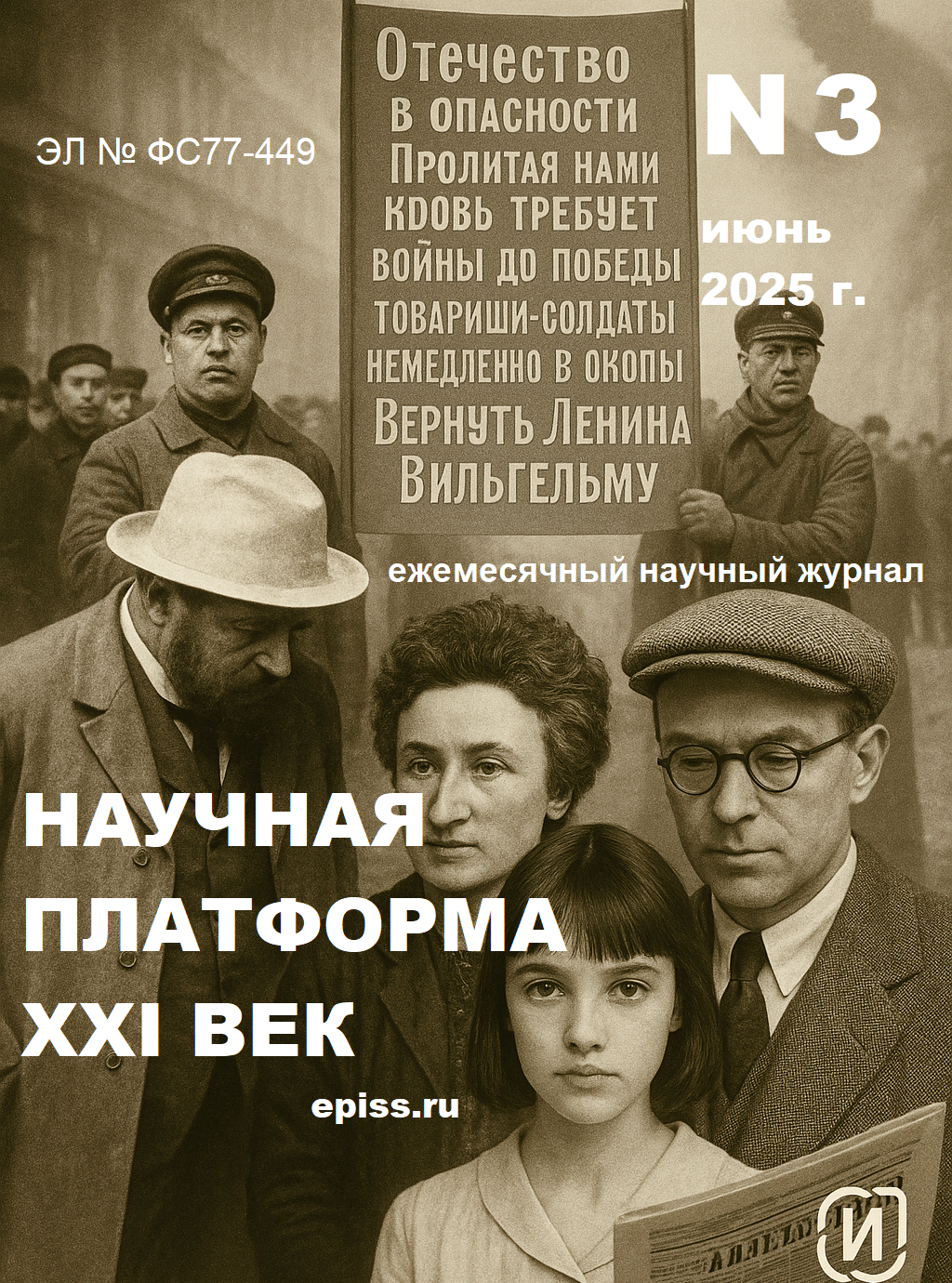
Photo collage on the cover: background – demonstration of disabled soldiers in Petrograd on April 16, 1917; bottom left to right: Parvus, Rosa Luxemburg, image of Dolores Haze from the novel “Lolita”, Vladimir Nabokov.
From edition……………………………………………………………………..……………3
Korablin Vladimir Aleksandrovich
The Defense of Vladimir Nabokov
(analytical studies of the novel “Lolita”)…………………………………………..4
Kildeev Adel
Afterword to the article by V.A.Korablin “Defense of Vladimir Nabokov”……..29
Gavrilov Lea Gabriela
Lenin is the greatest servant of monopolistic capitalism in history.
(Part I: Parvus)…………………………………………………..……………….32
Kildeev Adel
Artificial intelligence and copyright: legal aspects………………………………59
From edition
In this issue of the magazine, we would like to offer the reader an article by the lawyer Vladimir Alexandrovich Korablin (1933-2001), who passed away almost a quarter of a century ago, dedicated to the novel “Lolita” by Vladimir Nabokov.
In the modern era, the issues of sexual morality are more acute than ever. What do we see now in the West? Unnatural models of sexual behavior imposed from childhood. Undisguised propaganda of what only yesterday was called sexual perversions. The very denial of the division of humanity on the basis of sex into women and men. In Nabokov’s novel “Lolita” there is not even a tenth of what can be seen now in a Western children’s cartoon. And, nevertheless, sanctimonious discussions about the immorality of Nabokov’s novel continue.
V. A. Korablin read the novel “Lolita” back in Soviet times, when hypocrisy of a different kind flourished. In order to defame a literary work, Soviet officious literary critics used a rather hackneyed technique: they transferred the deviant behavior of the heroes of the novel to the author himself, accusing him of being a pervert. In the article we are publishing, V. A. Korablin acts in his professional capacity – as a lawyer of Vladimir Nabokov as a writer and as a person. Vladimir Alexandrovich Korablin wrote this article in 2000 and did not have time to publish it. Unfortunately, he died soon after. The manuscript was handed over to our editorial office by his son, Andrey Vladimirovich Korablin.
Editor-in-Chief V. V. Vorontsov
UDC 82-311.2 UDC 82-51
THE DEFENSE OF VLADIMIR NABOKOV
(ANALYTICAL STUDIES OF THE NOVEL “LOLITA”)
|
Korablin Vladimir Alexandrovich |
A.A. Zhdanov Leningrad State University
Faculty of Law (1962 г.)
Abstract: The article analyzes the work of Vladimir Nabokov through the prism of his legal and moral “defense” from accusations of amoralism, aesthetic egoism and political detachment. The author examines Nabokov’s artistic strategy as a system of intellectual self-defense, in which style, play and structure become forms of resistance to ideological violence and vulgar sociologism , as well as the writer’s relations with criticism, censorship and the domestic reader. Korablin proposes to see in Nabokov not a fugitive from reality, but an independent thinker defending the sovereignty of the aesthetic.
Keywords: Vladimir Nabokov, literary criticism, aestheticism, Lolita, ethical relativism, self-irony, ideology and literature, freedom of creativity, censorship, defense of the aesthetic, Nabokov and Russia, polemics with criticism.
INTRODUCTION
Ten years ago, the well-known writer Vladimir Dudintsev in his article “The Color of Our Clothes” (Literaturnaya Gazeta, August 17, 1988. No 33 /5203/ p. 11) wrote: “Nabokov comes too close and too hastily to what is the very last thing to know. According to the laws of nature. Disgusting old man! I look at his portrait – he gave me the key to understanding his face through Lolita… In every writer there is always something of his characters.”
In the same issue of Literaturnaya Gazeta, in the article “Vladimir Nabokov:
“Between Two Banks” (Round Table), literary critic Dmitry Urnov says: “Nabokov is like one of Dostoevsky’s characters, say, Stavrogin (from the novel “Demons”), who himself became a writer, and wrote a number of novels from Stavrogin’s position.”
On the pages of this article, I, a professional lawyer, will have to defend the honor and dignity of the great writer, scientist and nobleman Vladimir Nabokov, protect it from those literary critics, writers and readers who did not understand the novel, could not understand its ideas, identified the image of Humbert with the personality of the author of the novel “Lolita”.
The novel, I believe, is based on a case history or several case histories of patients like Humbert who suffer from deviations in the field of eroticism. It can be assumed that Nabokov wrote the novel at the request of the Association of Psychoanalysts. Very often on the pages of the novel terms found in the scientific works of Sigmund Freud and his students are used dislike for the material from which the work was built, and it turned out to be a classic sex-pathological novel. In the afterword to the novel, the author wrote: “The book moved slowly, with many interruptions… Once or twice I almost burned an unfinished draft, and I remember when I had already carried my Joanita Dark almost to the evening shadow of the incinerator, crookedly standing on the lawn of the yard, when I was stopped by the thought that the spirit of the executed book would wander through my files for the rest of my days.”[1]
PART I
The hero of the novel Humbert is a rather complex personality. He is a scientist, the author of textbooks written by him on orders from universities. His last textbook was published on the day of his arrest. He lectured at universities, taught English, and had acquaintances among psychiatrists. Until the age of thirteen, Humbert grew up as a quite normal cheerful child. In his young years, he dreamed of becoming a psychiatrist. When he was three years old, his mother died on a picnic from lightning. Riviera. Humbert studied at an English school, received excellent grades, and went in for sports. Before meeting the “original girl”, Lolita’s predecessor – Annabella, he was a completely normal, slightly spoiled child. Therefore, the cause of his disease cannot be attributed to the shortcomings of upbringing or innate predisposition. He knows about his illness, the cause and the beginning of its occurrence, he is familiar with the method of psychoanalysis. Humbert understands that he needs to be treated, but at the same time does not want to part with his sexual obsession – love for girls between the ages of twelve and fourteen.
Humbert, while in custody for the molestation of the young Lolita and for the murder of the screenwriter Quilty, who kidnapped his underage lover from him, looking at his freedom through the latticed window of a prison cell, writes a diary (sometimes at the end of the novel the author Nabokov no longer calls it a diary, but a novel). Humbert’s diary resembles a detailed summary of a defense speech. In it, every now and then he mentally addresses the jury, tries to mitigate his guilt in their eyes, sometimes philosophically, somewhat playfully, seeks to justify the nature of his attraction to the “nymphets”. For a psychotherapist, this diary would be a medical history.
Already on the first page of the novel, the author gives a clue to Humbert’s illness: “Did she (Lolita) have any predecessors? How could they be… I will say more: there would have been no Lolita if I had not fallen in love with one distant summer of one primordial girl in a certain principality by the sea” (p. 1 of the novel).
Humbert fondly recalls his first, short, tragically cut short love for young Annabella: “She had a honey-colored skin, thin hands, cropped brown hair, long eyelashes, a big bright mouth” – and this is how I see Lolita, – he adds (p. 3 of the novel). Annabella was a charming girl, a few months younger than thirteen-year-old Humbert. Her parents were old friends of Humbert’s aunt, were very scrupulous about decency. The author writes that the brains of young people were tuned in to the tone of intelligent European teenagers of that time and that environment. She dreamed of being a nurse in some Asian country, he dreamed of being a famous spy. Suddenly they fell in love with each other – madly, clumsily, shamelessly, painfully… At some point, they managed to stay alone on the beach away from the strict eyes of their parents, in a secluded place, they wanted to make love…, but suddenly two bearded tourists came out of the water with exclamations, scared off the young ones. A few days earlier, late one evening, Annabella had managed to deceive her parents’ vigilance, and in the grove behind the villa on the ruins of the stone wall, the young lovers had a moment when they were ready были подарить друг другу самые глубокие чувства, but from the side of the house I heard the voice of Annabella’s mother, calling her daughter home. Soon Annabella and her parents left this fabulous resort, full of love and exciting expectations… And four months later, Annabella died of typhus. Humbert asks himself: “Was it not from the brilliance of that distant summer that a crack began through my whole life… I am sure, however, that in a magical and fatal way, Lolita began with Annabella. I also know that Annabella’s death consolidated the dissatisfaction of that delirious summer and became an obstacle to all other love during the cold years of my youth” (p. 5 of the novel). “This mimosa thicket, the mist of stars, the chills, the honeydew, and all my torment remained with me, and this girl with her feet smoothed by the sea and a fiery tongue haunted me from that time on, until finally, twenty-four years later, I dispelled the delusion by resurrecting her into another,” he continues his reflections on the cause of the illness that brought him to a prison cell (p.7 of the novel).
His constant sexual dissatisfaction with adult women led him to create the theory of the “nymphet”. This theory arose as a weak attempt to justify his attraction to young girls. According to his theory, a “nymphet” is a girl between the ages of nine and fourteen, who for some many times older than men with Humbert’s deviations serves as a true pleasure, they experience a nymphical, i.e. demonic essence. according to Humbert, girls are prematurely mature. He believes that Annabella was not a nymphet for him, as they were the same age at the time. “What is needed here is an age difference of 10, 30 or even 40 years” (pp. 8-9 of the novel). Humbert treats his theory of the “nymphet” with some sarcasm: if there were no nymphets, then “we initiates, we solitary sailors, we nympholepts, would have gone mad long ago” (p. 8 of the novel). “On the outside, he had so-called normal relations with earth-born women, whose breasts were pumpkins or pears, but inside he was burned in the hellish furnace of concentrated lust, aroused in me by every nymphet he met” (p. 9 of the novel), that is, he did not receive real sexual satisfaction from adult women. He “was seized by fear, then shame, suffocated by social prohibitions. Psychoanalytics lured with pseudo-liberation from libidophilia” (p. 10 of the novel). Pay attention to the fact that on the pages of the novel we constantly encounter terminology characteristic of psychoanalytic literature. There is no doubt that the author of the novel was well aware of Sigmund Freud’s theory of psychoanalysis and, I believe, could use several case histories of “nymphetic patients”. Nabokov is not only a writer, but also a scientist who enriched psychiatric science on a global scale. I think that after the publication of the novel “Lolita”, psychiatrists have a new term in the diagnosis:
“nymphetic disease” in the clinical picture of Humbert’s disease.
In Humbert, on the one hand, the attraction to nymphets was constantly fighting, on the other hand, he was tormented by a moral prohibition, as well as the fear that he was constantly being watched by the police. “I have often asked myself,” he reasoned, “what happened to them afterwards, to these nymphets. In our cast-iron-lattice world of cause and effect, could not the shudder I stole from them affect their future?.. But will this not affect her later, have I not somehow spoiled her in her future fate by involving her image in my secret voluptuousness? Oh, this has been and will be the subject of great and terrible doubts!” He adds to his thought: “I have found out, however, what they turn into, these charming, maddening nymphets, when they grow up” (p. 12 of the novel). At the same time, he remembered the underage prostitute Monica, whom he met in Paris (pp. 12-13 of the novel).
In order to get rid of vicious and dangerous urges, Humbert decided to get married. His wasted father had died by this time, leaving a small fortune (p.15 of the novel). He chose to marry Valeria, a woman of thirty years old, the daughter of a Polish doctor, with whom he had been treated for a heart disease for some time. it suited Valeria, who, in spite of her small size, pretended to be a little girl, in spite of her thirty years. She was an ersatz nymphet, giving Humbert no real sexual satisfaction. After a brief wedding ceremony at the town hall, Humbert forced Valeria to change into a simple child’s nightgown. By morning, Valeria was hysterical from the bullying. This marriage lasted for four years. He says about his marriage to Valeria: “I turned to her unleavened flesh only occasionally, only in moments of extreme need, extreme despair” (p. 17 of the novel). It should be noted right away that Valeria is the first victim of Humbert’s disease. After four years of painful married life (there were no children in the marriage), Valeria told her husband that there was another person in her life, that she was unhappy in her marriage and wanted to divorce as soon as possible.
Recalling the nymphet adventures, Humbert writes in his diary that he dreamed of enjoying the nymphet, the little sister of his university classmate, and then shooting himself (p. 20 of the novel). From this we can conclude that his passion for the nymphet is dearer to him than his own life, and therefore he can be aggressive towards the victim of his desires.
After the death of his uncle, Humbert received an inheritance of $3,000 a year on the condition that he move to the United States, where he would work for his uncle’s firm. After moving to New York, he completed the first volume of the Comparative History of French Literature at the suggestion of the university. The work took him two years, he worked fifteen hours a day. In the dusty heat, however, he looked out for nymphets playing in Central Park. The decline of mental strength led him to a psychotherapeutic sanatorium for a year and a half. Then he returned to work and soon fell ill again (p. 23 of the novel).
In order to oust feelings and attraction to nymphets from consciousness, Humbert was on a polar voyage for twenty months, joking with a sigh that there were no nymphets among the Eskimos (p. 24 of the novel). But this “isolation” from nymphets did not help his health. Because of sexual dissatisfaction, he again had to fight for his health (“melancholy, confusion of mind”). He played tricks on psychiatrists, leading them away from the phenomenon that led to their illness, offering them “false memories”, “spied scenes of parental cohabitation, and not allowing them to even remotely guess about the real misfortune of their patient” (p. 25 of the novel). that he “knew how to make the patient believe that he was a witness to his own conception” (p. 25 of the novel). By bribing a nurse, Humbert gained access to the archives of the hospital. From his medical history, he learned that he was considered a “potential homosexual” and an “absolute impotent.” This amused him very much and he even spent an extra month in a sanatorium (p. 25 of the novel).
On leaving the sanatorium, Humbert decided to rest in a village or in some “sleepy town” where he could continue his literary activity. He was offered to see a room in Mrs. Haze’s house. Humbert did not like either the hostess herself or the squalid furnishings in the house, and he was about to leave the house when he suddenly saw Mrs. Haze’s daughter. “It was the same child (as Annabella), the same thin, honey-colored shoulders, the same silky, flexible, naked back, the same blond cap of hair, the half-developed breasts that he caressed on that immortal day…, saw again the lovely sunken belly, recognized the dark brown spot on her side… A quarter of a century since then, the life lived has narrowed” (p. 29 of the novel). At that moment, Humbert remembered with a smile the doctor who was destined to cure him of all diseases (p. 29 of the novel). “This Lolita, my Lolita,” continued Humbert in a state of euphoria, “must have completely eclipsed her prototype. I only want to emphasize that the revelation on the American veranda was only a consequence of that “principality by the sea” in my suffering adolescence. Everything that happened between these two events amounted to a series of blind searches and delusions and false beginnings of joy. Everything that these two beings had in common made them one for me. I have no illusions, though. My judges will see in the above only the contortions of a madman” (p. 30 of the novel). The author of the novel again emphasizes through the experiences of his hero that if there had been no Annabella in his childhood, there would have been no Lolita. Humbert had been looking for Annabella for twenty-four years and found her in the form of Lolita. “The emptiness of my soul has managed to absorb all the charms and compare them with the features of my dead bride” (p. 30 of the novel) – he ends his obsession. The search for thirteen-year-old Annabella, the first love in the life of young Humbert, which became an obsession, lasted more than twenty years Humbert:
“We loved with a premature love, distinguished by that frenzy that so often breaks the life of mature people. I was a tough boy and survived; but the poison remained in the wound” (p. 9 of the novel).
Let me remind you that Humbert’s mother died tragically when he was three years old, his father had mistresses and his own hotel. Therefore, young Humbert had no one to share with him about the “poison in the wound” that tormented him after Annabella’s death.
In his younger years, with the help of a psychotherapist, the disease could be cured. But over the years, the disease has become persistent. In the preface to the novel, written by the author himself, it is categorically stated:
“If our mad memoirist had gone to a competent psychopathologist in that fateful summer of 1947 , no trouble would have happened. All this is true, but then there would be no this book.” From this statement, it should be concluded that “Lolita” is an educational novel from the field of sexual pathology. There is nothing superfluous in the novel, everything is subordinated to the beginning and cause of Humbert’s disease, the course of the disease, which has a destructive power for society and the carrier of the disease himself.
If we translate the symptoms of Humbert’s erotic suffering into the medical language of psychoanalysis, we will see that Sigmund Freud called such a painful state an “affective experience” generated by a “traumatic scene” – in this case, the dissatisfaction of the adolescent’s sexual feelings, his libido did not find an outlet, the death of his beloved girl “fixed the dissatisfaction… and became an obstacle to any other love” (for the clinical picture, the author’s quote is taken, since it is unlikely that even the most experienced psychiatrist would find such an accurate and concise term to define the patient’s condition). Sigmund Freud uses the term “fixation” in a similar clinical picture, which means “delay, stuckness” at one of the stages of sexual development, the impossibility of another form of sexual life.
So, let us continue the clinical picture of the sick Humbert in the language of psychoanalysis: Humbert has been suffering from memories of incomplete feelings since the age of thirteen. These peculiar symbols of memories of love for Annabella over a long period of his life led Humbert to be sexually attracted to girls between the ages of twelve and fourteen. They were “Annabella’s deputies” until he “finally, twenty-four years later, dispelled the delusion by resurrecting her in another” (Lolita). (And in this case, for
clinical picture, it is more expedient to use the exact term of the author of the novel). Lolita completely ousted from Humbert’s mind the image of his first lover, thirteen-year-old Annabella. Freud believes that “such a fixation of mental life on pathogenic traumas is one of the most important characteristic features of neurosis. Pathogenic experiences of patients, psychic traumas are equivalent to bodily injuries”,[2] and the treatment is long and sometimes unpredictable, since it is necessary that the patient wants to be cured, and Humbert, on the one hand, understands that he is sick and needs to be treated, and on the other hand, he resists treatment, fearing to lose the pleasant obsession with nymphets. suffering in the field of eroticism, said: “Instead of willingly telling us about their sex life, they try with all their might to hide it. People are generally insincere in sexual matters… The combination of scrupulousness and voluptuousness determines the sexual behavior of the majority of cultured people” (3. Freud Upom. Work, p. 34). In psychoanalytic research, patients often transfer feelings of hostility to the doctor. This is fully true of Humbert, as already mentioned earlier in this article. Sharing his observations of patients suffering in the field of eroticism, Sigmund Freud believes that “people fall ill if they cannot really satisfy their erotic need because of external obstacles or because of an internal lack of adaptability. Sexual need and its deprivation are a factor that plays a role in the mechanism of neurosis” (S. Freud, op. work, p. 41). On the way of attraction to nymphets is criminal law and morality. But instincts are stronger than Humbert’s “I”, they are these instincts, sometimes paralyzing his mind. The struggle of “drives” with “prohibitions” is the cause of the disease of his nervous system.
Lolita did not lead Humbert to healing. One young girl was replaced by another young girl. The disease remained. Neither criminal, nor moral, nor religious prohibitions could stop Humbert’s attraction to young girls. Perhaps it is incurable? The author of the novel seems to pose the question to psychotherapists: “Could you cure the eccentric patient Humbert?”
In one of the articles, Sigmund Freud expresses his opinion in which cases a psychotherapist should refuse to treat patients:
1) if patients do not have a certain education and a relatively trustworthy character;
2) if patients do not want to be treated, but agree to treatment only because of the request of relatives;
3) if patients are not able to be educated;
4) if the patients are at the age of 50 years and older, since at this age the plasticity is lost and the personality does not lend itself to education.
As for young men, they respond perfectly to the effects of treatment (S. Freud, op. work, p. 54).
It can be concluded that the very educated and still relatively young Humbert has no contraindications to treatment – only “resistance”, which is quite common with this kind of patients. “There is no other bliss on earth like the bliss of not an undead nymphet,” says Humbert (p. 149 of the novel). It is very difficult for him to part with this “bliss.” The psychotherapist has a very difficult task in overcoming the resistance of the patient, “shrouded in a shell of lies.”
The author of the novel believes in the method of treatment with the use of psychoanalysis. In the preface to the novel “Lolita” it is said: “If our mad memoirist had gone to a competent psychopathologist in that fateful summer of 1947 , no trouble would have happened.” This important statement has already been referred to above in the pages of the article. Humbert also believes in treatment by the method of psychoanalysis and this is confirmed by the following evidence. called sublimation. Through sublimation, sexual energy is transformed into various types of activity that are acceptable to the individual and society. A variety of sublimation is sports, intellectual work, creativity (3. Freud, up. work, p. 579). Let me remind you again that Humbert worked for two years on the first volume of the Comparative History of French Literature, working fifteen hours a day, but in Central Park in New York, in his spare time, he “looked out for nymphets”. Sexual dissatisfaction contributed to the loss of strength. Humbert was forced to go to a psychoanalytic sanatorium for treatment for a year and a half did not help. He ironically calls himself “sublimated Humbert” (p. 264 of the novel).
In psychotherapy, there is another method of treatment – “isolation”, which consists in the fact that the patient moves away from the psychotraumatic situation and from the emotional experiences associated with it (3. Freud, up. work, p. 579). Humbert was on a polar voyage for twenty months, and from his observations he came to the conclusion that there were no nymphets among the Eskimos. And this method of “isolation” did not help him to oust the attraction to nymphets from his consciousness. He fell ill again and had to be treated again in a psychotherapeutic sanatorium. which he receives from love for nymphets, so he misleads doctors about his illness, ironically ridicules them.
There is another method of treatment in psychoanalysis: the doctor aims to eliminate the symptoms of the disease with the help of hypnosis – “to force the patient to transfer to the mental state in which the symptom first appeared”, i.e. to restore in his emotional memory the “traumatic situation”, “to reproduce this pathogenic moment with signs of strong emotional excitement”. In this state, the symptom that once led to the onset of the disease will be removed. and the return of the symptom will no longer be possible (see 3. Freud, up. work, p. 19, 58).
The educated Humbert, who dreamed of becoming a psychiatrist in his youth, is also familiar with this method: “Another experienced psychiatrist who is now studying my work (diary) – and whom Dr. Humbert has managed to immerse, I hope, in a state of rabbit hypnosis – would undoubtedly very much like the narrator to take his Lolita to the seashore and there find at least the “ratification” of this urge, namely, the deliverance from the “subconscious” delusion of an incomplete nursery romance with the original little Miss Lee” (Annabella) (p. 150 of the novel). The reader who does not know the basics of Freudianism has no idea that this ironic statement of the sick Humbert refers to к одному из методов лечения психоаналитическим method with the use of hypnosis, and the patient warns in advance that he will “resist” this treatment in order to avoid the loss of nymphetic pleasure.
So, from the analysis of the clinical picture, it follows that Humbert wants to be treated, but strenuously resists. Therefore, he is a very difficult patient to heal. This, in brief, is the clinical picture of Humbert’s disease from the point of view of psychoanalysis.
In Vladimir Nabokov’s work, Humbert’s disease is presented in artistic images and in constantly changing tones of colors. However, without knowledge of the basics of psychoanalysis, it is difficult to understand the language as well as the idea of the novel, and most readers are carried away by erotic scenes, ignoring psychoanalytic opuses. There are many Western literary works and movies in which the characters suffer from painful symptoms that are destructive, while these symptoms of illness are actually eliminated in a psychotherapeutic way. Love, for example, as a carnal feeling, is very complex. It can be quite organic, normal, of course, not without experiences inherent in the human psyche, and in some cases there are people who have an “obsession with love”. Such painful love, as a rule, turns into a destructive force. This also applies to jealousy. Jealousy can be natural, for the sake of preserving the relationship of lovers, or it can be pathological and also turn into a destructive force. In our Great Medical Encyclopedia, unfortunately, I did not find “obsessive states” (phobias) of “love” and “jealousy”. But the symptoms of pathological love and pathological jealousy can be eliminated in a psychotherapeutic way. And people should be aware of this.
In the article, constant footnotes are made indicating the pages of the novel so that the reader is convinced that the author of the novel tried to help the “humberts” understand their disease, to gain courage and patience in the matter of their treatment and to save lolitas from molestation, and in general to warn some people against tragedies, the consequence of which in this case is sexual ailments.
I talked about the novel with many people, among whom were engineers, historians, lawyers, writers, actors, even with one famous theater director and teacher of the theater institute, but all of them believed that “Lolita” was a wonderful novel about the love of a twelve-year-old girl (nymphet) for an adult thirty-seven-year-old man. At the same time, they proceeded from Pushkin’s principle – “All ages are submissive to love.” Unfortunately, such evaluations of the novel stem from our ignorance of at least the elementary foundations of psychoanalysis. In Soviet literature, starting from 1936, when science, culture and literature were divided into Soviet and bourgeois, it was positively forbidden to refer to the works of Sigmund Freud in the field of psychoanalysis, opinions were allowed only in the form of criticism of his teaching. When criticizing Freudism, scientists did not even often refer to his specific works, indicating pages, etc., distorted his scientific views on psychiatry. in the textbook on the Theory of State and Law, the subtitle to one of the chapters, “Freudian Concepts of Law,” was marked in bold type, although Sigmund Freud never wrote about law, as I later learned from his writings. It was then that I went to the Public Library on the Fontanka for the first time out of curiosity, where, having familiarized myself with the catalog, I began to read the works of Sigmund Freud in microfilms (a microfilm is a photographic film of a work). Students of medical institutes, as well as students of the law and philosophy faculties of the university, it was enough to present a student card. Other students were deprived of this opportunity to use the works of Sigmund Freud. The ban on the use of the works of Sigmund Freud led to the fact that several generations of our citizens were not familiar with psychoanalysis as a method of studying mental processes and a method of treating neuroses, as well as with psychoanalysis as a philosophical direction.
The preface to the novel frankly says: “As a description of a clinical case, Lolita is undoubtedly destined to become one of the classic works of psychiatric literature, and we can guarantee that in ten years the term “nymphets” will be in dictionaries and
newspapers.”
It is clear from the language of the writer, and the language of a person is always individual, that the preface was written not by Doctor of Philosophy John Ray, but by the author of the novel Vladimir Nabokov himself. To prove this, he himself
Vladimir Nabokov, “On the Book Entitled Lolita” (Afterword to the 1958 American Edition ), wrote: “After my performance as John Ray, who is pleasant in all respects , the character in Lolita who writes the ‘preface’ to it, any comment proposed on my behalf may seem to the reader – it may even seem to me – imitation of Vladimir Nabokov, who is analyzing his book” (p. 289 novels). The novel was created for educational purposes, it became an excellent artistic advertisement in the field of psychotherapy.
Now it seems that everything, or almost everything, has been said about Humbert’s disease. And then, together with the reader, we need to follow the destructive forces of this disease.
PART II
Humbert, having settled in the house of Mrs. Haze, keeps a diary of his observations of Lolita. He secretly studies the skin of her naked parts of the body, her gait, characteristic of twelve-year-old girls. He understands that writing a diary is madness, but the “piercing pleasure”, Humbert believes, prevails, and he keeps daily notes of his observations of Lolita. This inflamed his passion even more. that he was “sick with lust.” “I’m afraid I’ll get nervous breakdown again if I stay in this house, under the constant pressure of unbearable temptation” (p. 34 of the novel). He is disturbed by dreams: “Sometimes I attempt murder in my dreams” (p. 37 of the novel). Humbert’s dream is not accidental. He wants to eliminate Lolita’s mother (psychotherapists believe that the dream is a product of the psychic activity of the dreamer himself). When Lolita left for the summer holidays, Humbert searches Lolita’s closet for her underwear to satisfy his sexual desires. “I especially remember,” he writes in his diary, ” one pink fabric, worn, holey, slightly smelling of something pungent along the seam. It was in it that I swaddled Humbert’s huge, tense heart” (p. 55 of the novel). At one point in his diary, Humbert writes that he “slept with Lolita’s sock.” In psychiatry, this is called fetishism.
Humbert decided to marry Lolita’s mother: “I would be able to snuggle up to her (Lolita) three times a day – every day. All my worries would evaporate. I would have become a healthy person” (p. 59 of the novel). In his mind’s eye, he saw himself giving a strong sleeping pill to both mother and daughter at the same time, in order to caress the latter all night: “So Humbert Vyvoren dreamed and sorcered,” says the author of the diary about himself, and continued to develop his ideas of mastering Lolita: “I will force the big Geyziha to allow me to communicate with the little one, threatening the poor lady who adores me that I will leave her if she forbids me to play with my lawful stepdaughter” (p. novel). The author of the work treats his hero not only with irony, but also with a sense of hostility.
Humbert was afraid of the embarrassment of his lack of feelings for Charlotte Haze. “Again and again, the cunning Humbert conjured up a semblance of Charlotte as seen through the keyhole of the male imagination. Her body was sleek and slender, no one disputed that, and perhaps I could prop myself up with the thought that she was Lolita’s elder sister – unless I imagined her heavy hips, rounded knees, luxurious breasts, rough pink neck skin (“rough” compared to silk and honey) and all the other features of that deplorable and boring called: “A beautiful woman” (p. 61 of the novel). We see that Humbert’s view of female beauty is deformed due to nymphetic disease. For him, a beautiful woman is “a deplorable and boring concept.” The ideal of beauty for him is a “nymphet.” Developing an obsession with the possession of Lolita, Humbert continued: “We drank something , whiskey or gin, and it helped me to imagine my daughter while I caressed my mother” (p. 64 of the novel). twitched from neuralgia” (p. 65 of the novel).
Lolita’s mother dreamed of “sending her daughter to a good boarding house with strict discipline and a solid program of religious education after the summer camp. And then – Beardsley College” (p. 71 of the novel). We see that Lolita had a pretty good future ahead of her, if not for the sexual maniac Humbert, who corrupted her, left her a complete orphan, without a home and without means of subsistence.
Almost from the first days of Humbert’s appearance in Charlotte’s house, Haze Humbert has been thinking about her physical elimination. Left alone, he plunges into sad and sadistic thoughts: “If Charlotte were Valeria (Humbert’s first wife), I would know how to act in this case – yes, “act” is just the right word: in the good old days, it was enough for me to start turning out the fragile hand of fat Valeria (the one who which she had injured when falling off her bicycle) in order for her to change her mind instantly, but in relation to Charlotte all this was unthinkable – the cold-blooded American Charlotte frightened me” (p. 71 of the novel).
While swimming in the lake, the idea of killing his wife Charlotte is born in Humbert’s mind. “I knew I just had to get a little behind, get more air into my lungs, then grab her ankle and dive headlong underwater with the captive corpse.” However, the “law-abiding” Humbert renounces the criminal intention. “Had I gone through this ordeal, her ghost would have haunted me all my life.” 72-75 of the novel). But the reader sees from the further content of the novel that Charlotte still dies through the fault of Humbert.
The idea of possessing Lolita became obsessive for Humbert. He no longer had other thoughts and activities, he stopped working. The lives of Charlotte and her daughter Lolita, as well as their health, were already in danger.
While waiting for Lolita from summer camp, Humbert began to test sleeping pills on his wife. “I need the assurance that when my lovely girl returns, I will have the opportunity that night, and then night after night, until St. Catherine takes her from me. Algebra” (as Humbert ironically called the boarding house where Lolita was supposed to study) to put two living creatures to sleep so thoroughly that no sound and no touch could interrupt their sleep. During the month of July I experimented with various sleeping pills, testing them on Charlotte, a great lover of pills. The last dose I gave her (she thought it was a weak bromine preparation for anointing the nerves) brought her down for four whole hours. I ran the radio at full blast. He directed the brightest beam of a phallic-shaped flashlight into her face. He pushed, rubbed, pinched, poked – and nothing disturbed the rhythm of her calm and powerful breathing. However, from such a simple thing as a kiss on the collarbone, she woke up immediately, fresh and grasping, like an octopus (I barely escaped).
Having deceived the doctor, Humbert obtained a new medicine, “intended not for neurasthenics, who can be calmed down even with a sip of water, if you take it skillfully, but only for great sleepless artists who need to die for a few hours in order to live through the ages. I like to fool doctors” (p. 82 of the novel).
How much humor the author of the novel has here, even at the moment of the final tragic denouement, which is about to come for Charlotte, and then for her daughter. Nabokov gives a description of events in a cheerful tone, so that the process of cognition of sexual illness would not be tiresomely boring for the reader, would not turn into “sleeping pills”, as once many of our neurasthenics suffering from insomnia read “The History of the CPSU” or “Capital” by K. Marx at night. For some, one page was enough to fall asleep. However, few people imagined what harm to health and society Marx’s “pills” would cause. But one should not be distracted from the analysis of this literary work, unusual in its nature and ideological content.
Humbert’s disease is not harmless. Aggression and thoughts of molestation are directed only at minors. In parentheses, I note that our Criminal Code refers to minors as everyone under the age of fourteen. According to part three of paragraph “c” of Article 131 of the Criminal Code of the Russian Federation, rape of a victim who has not reached the age of fourteen is punishable by imprisonment for a term of eight to fifteen years.
If the perpetrator has brought a woman of any age into a helpless state (poured a large dose of sleeping pills or drugs into food or
wine to achieve one’s goal, then such actions are qualified as rape. The court may also refer to a helpless state as a minor. The same approach to assessment and punishment in cases of a sexual nature is in other civilized countries.
With pills of strong sleeping pills, Humbert went home in a good mood. At home, he found his wife Charlotte with a face distorted with anger. It turned out that she had read his diary. Charlotte was feverishly writing letters. Humbert understood that the content of the letters was the discovery that his wife had made for herself. She left the house. In the bedroom, from under the pillow, Humbert took out the diary hidden by his wife. At this time, the phone rang. Humbert was informed that his wife had been hit by a car. He ran out of the house. At the site of the tragic crash that was going to happen one way or another, lay the mutilated corpse of Charlotte, who had been run over and then dragged several feet by a car as she ran across the street to drop the letters in a mailbox on a street corner. These letters were picked up and handed to Humbert by a girl. Immediately in his pocket, he turned them to shreds.
Humbert persuaded Charlotte’s friends not to inform Lolita, who was at summer camp, of her mother’s death, that after the funeral he, as a father, would tell her about everything himself and take her on some fun trip
After this tragic event, Humbert happily reasoned: “I had only one thing in my mind and blood, namely, the consciousness that in just a few hours the warm, fair-haired, and all, all my Lolita in my arms would shed tears, and I would begin to dry them with kisses sooner than her eyes would be filled with them” (p. 86 of the novel).
Humbert admits that he “vaguely discerned his own vile contribution to Charlotte’s death.” And then, the young Lolita was left without the protection of her parents, an orphan. A molester with a morbid sexual imagination, using a powerful sleeping pill, seduced a twelve-year-old girl. True, he writes in his diary that she was no longer a virgin, and even seduced him herself. it is a draft of Humbert’s defense speech in a jury trial. Like any criminal of this kind, Humbert tries to dissolve his guilt in the guilty behavior of the victim of the crime herself. And as a consequence of this, Humbert says: “Finally, the sexist in me (a huge and insane monster) would have nothing against the presence of some depravity in his victim” (p.111 of the novel). We do not know Lolita’s testimony about her seduction by her stepfather. Goodbye to the dreams of the late mother about a wonderful boarding school, college, etc. She found herself in the tenacious clutches of the lustful Humbert, and then – the sexual maniac playwright Quilty.
On the pages of the novel, you, the reader, will not find Lolita’s love for her stepfather Humbert. When Humbert finally found Lolita, who had run away from him, she was already married, pregnant, confessed to him that she had never loved him, so she ran away from him with the same maniac – a lover of nymphets.
Humbert understands the criminality of his plan, but he is no longer able to stop. He mentally reasons: “… In a few minutes – let’s say
Twenty, say, half an hour, I’ll unlock the door of room 342 and find my nymphet, my beauty and bride, in the dungeon of the crystal dream. the country, the continent, the hemisphere and the entire globe… After all, Lolita was only twelve years old, and no matter what adjustments I made for the environment and the era (even taking into account the unbridled American school-age children), it seemed to me that the depraved games between these frisky teenagers took place later, and in a different environment” (p. 110 of the novel). However, the fear of punishment does not stop Humbert, the mind is no longer able to overcome sexual passion. “It’s mine, mine, the key is in my fist, the fist is in my pocket, it’s mine! By means of incantations and calculations, to which I had devoted so many insomnias, I gradually removed all the superfluous turbidity and, applying layer after layer of transparent paints, brought them to a complete picture. In this picture she appeared to me naked – there was nothing on her except one sock, and a bracelet with key rings; “She was lying stretched out where my magic potion (sleeping pills) had knocked her down” (S. 111 of the novel).
After having sexual intercourse with Lolita, Humbert recalls his condition: “It was already about ten in the morning. Passion calmed down, and a terrible consciousness of misfortune descended on me… the everyday reality of a dull, neuralgic day, which made your temples ache” (p. 123 of the novel)… “There, in the hall, she sat, deeply immersed in a blood-red leather chair,” he continued his gloomy thoughts of a penitent criminal. “It was very peculiar, this feeling: a languid, disgusting constraint – as if I were sitting next to a small shadow of someone I had killed” (p. 125 of the novel). After committing the crime, Humbert is constantly disturbed and disturbed by something: the noise of the elevator door, the work of the toilet in the next room, the noise of the car. He even sees nature and cities as ugly: “Outside the window was a damp black night of a sour New England spring” (p. 187 novel); “We will leave this parched, inflamed, sparkling city” (p. 224 of the novel). Humbert hates all the people around him. As a criminal, he assumes that everyone can suddenly find out the secret of his relationship with the young Lolita. The language of the scientist Humbert eventually becomes vulgar, words characteristic of people of the criminal world appear in the lexicon. There is an active process of decomposition of his personality: “My guide to the hospital was a little old woman, like a portable witch”, “I told an unsmiling blonde secretary, a lousy bitch, that my daughter was “generally sixteen”, “At some point I was very rude to a very young and very impudent sister with hypertrophy of the ass and agate eyes”, “Then a ripe young whore ran in again with her usual gait, stinking of urine and garlic” – he characterizes the nurse, “A couple of idiotic green parrots occupying a cage in the waiting room” (p.
221, 224 novels). In his diary, preparing for the speech, Humbert wrote:
“Virgin cold ladies of the jury! … It was she who seduced me” (p. 118 of the novel). Vladimir Nabokov gives the reader only a diary, without remarks, but from this diary we see the victim Lolita’s assessment of the actions that Humbert committed. Lolita calls Humbert a “cretin”, a “reptile”. “I was a fresh daisy, and look what you did to me. In fact, I should have called the police and told them that you raped me. Oh, you dirty, dirty old man!” … “She began to complain, sucking in the air with a hiss, that ‘everything hurts inside her’, that she could not sit, that I had turned something around in her” (p. 126 of the novel). Therefore, rape took place.
In the second part of the novel, which consists mainly of travels in the United States, the author tells how Humbert corrupted Lolita both physically and morally. To make Lolita susceptible to love, Humbert gave her small gifts, then began to give her money. Then he went even further: he began to interpret books about girls and upbringing in his own way. “A normal girl usually makes every effort to please her father. She feels in him the forerunner of a desirable, elusive man. A wise mother (and your poor mother would have been wise if she had lived) encourages communication between father and daughter, because she understands that the girl derives her dream of courtship and marriage from communication with her father… Among the Sicilians, sexual intercourse between father and daughter is accepted as something natural, and the girl who participates in this intercourse is not looked upon with condemnation by the social order to which she belongs” (p. 133 of the novel). “And finally,” Humbert continued, “let’s see what happens if you, a young girl accused of seducing an adult under the roof of a respectable hotel, went to the police with a complaint that I stole and raped you. Suppose they believe you. A minor who has allowed an adult to know her bodily exposes her victim to the accusation of “formal rape” or of the “sin of sodomy of the second degree,” depending on the method; and the maximum punishment for this is ten years in prison… But what happens to you then, my orphan?.. You fall under the care of the Department of Public Charity… While I am languishing behind bars, you, a happy child, will be offered a choice between several abodes, in general quite similar to each other: a disciplinary school, a reformatory institution, an orphanage for street youths, or one of those excellent asylums for juvenile delinquents where girls knit all sorts of things and sing hymns, and get pancakes in rancid lard on Sundays.” “Don’t you think that under the circumstances, Dolores Haze must remain faithful to her old dad? … I managed to establish as a basis that we must share both the secret and the guilt with her” (p. 134 of the novel). Continuing his reasoning, Humbert says:
“Using the geography of the United States, I spent hours trying to give the impression that we were living a ‘full life’, that we were rolling down the
direction to some extraordinary pleasure” (p. 135 of the novel). In this way they traveled for a whole year. Then the clumsiness and absurdity of the journey of the thirty-seven-year-old Humbert with his twelve-year-old mistress is described.
In his diary, Humbert boastfully and cynically admits: “Thanks, perhaps, to the daily exercise of love, she radiated, despite her very childish appearance, an inexplicably languid glow, which brought garage owners, individual messengers, tourists, boors in luxurious cars into a state of fitful lust” (p. 142 of the novel), i.e. Lolita became a twelve-year-old woman.
She wanted to meet her peers, but the jealous Humbert would not let her go even for a step. He took great pleasure in stopping at the schools, watching the girls leave the school. She heaped rude abuse on Humbert for demanding to caress him, “while blue-eyed brunettes in blue panties, redheads in green sleeveless jackets, and boyish-looking smoky blondes in faded paper trousers passed by in the radiance of the sun” (p. novel). Humbert did not give Lolita coffee in bed in the morning until she had performed his morning “duties” (p. 148 of the novel). He becomes more and more cynical and irritable. Humbert makes an unequivocal hint that he was the trainer of a “confused and crouching animal” in relation to Lolita. “What black stars burst in the heart of the trainer” when he obliges the young animal to carry out his orders (p. 152 of the novel). Humbert can no longer restrain the flow of his cynicism: “I have managed to get her to render me so many sweet favors – the list of them would have caused the greatest amazement of a theoretical teacher” (p. 156 of the novel). He confesses that after a year of living with him, Lolita sobbed every night when she thought he was asleep (p. novel). When Humbert began to experience financial difficulties, he rented a small apartment and arranged for Lolita to enter a gymnasium. Humbert immediately foresaw the pleasure he would get from his bed in his study, with powerful binoculars, at the statistically inevitable percentage of nymphets among the girls playing around Dolly (Lolita) during the big break. 161 novels).
He paid a week’s salary to Lolita, on the condition that she would perform her main duties three times a day (p. 165 of the novel). “I thought I had the right to tenderly demand from her an additional kiss or even a whole assortment of overtime caresses, when I knew that she especially liked one or another of the pleasures peculiar to her age. However, it was not easy with her. She was too apathetic in earning her three kopecks (and then three nickels) a day, and in other cases she knew how to bargain cruelly when it was in her power to deny me some special kind of life-ruining, strange, slow, paradisiacal poisons, without which I could not live more than a few days in succession, and which, in view of the fundamental nature of unspeakable languor, I could not obtain by force. Well considering the magic and power of her soft mouth, she managed – in one school year! – to increase the premium for this particular service to three or even four dollars!” (p. 165-166 of the novel). From this cynical revelation one can easily conclude that sexual acts against the young Lolita were committed in all forms pleasing to the sophisticated Humbert. He called Lolita “a spoiled slave girl” (p. 170 of the novel). Humbert then found the money she earned for sexual services from Lolita and took it for himself, after which she accused him of stealing. “My greatest fear was not that she would ruin me, but that she would raise enough money to run away,” says Humbert (p. 166 of the novel). Even during Lolita’s illness, the sadistic Humbert could not restrain his sexual desires for her: “At first she had a high fever, and I could not refuse the heat of unexpected pleasures, but to tell the truth, a very lethargic girl moaned, coughed and shivered with chills in my persistent embrace” (p. 180 of the novel). that Lolita was pretending to avoid his caresses. She had a temperature of 40.2 degrees. “I knew that in hysterical nymphets the temperature rises to fantastic degrees, even higher than the point at which ordinary people die” (p. 220 of the novel). Humbert’s jealousy of Lolita’s school friends led to the fact that she was forced to leave school and go on a trip with Humbert again.
Lolita, taking advantage of her illness, escaped from the hospital, but found herself in the clutches of the debauched playwright Quilty. At the hospital, Humbert was told that her uncle had taken her away in a black Cadillac. Humbert was terribly shocked. “One simple thought stood naked in front of me: the main thing is to stay free. Had I taken any rash step, I would have had to explain all the details of my criminal life. Therefore, I pretended to be stupefied from drinking,” Humbert explained his condition (p. 227 of the novel).
“I would be a rogue to say that the shock I felt when I lost Lolita cured me forever of my passion for young girls. Now I have fallen in love with Lolita with a different love, it’s true, but my cursed nature cannot change because of this. On the playgrounds, on the sea and lake coasts, my gloomy, thievish gaze was involuntarily looking for a glimpse of the naked legs of a nymphet, or other cherished signs of Lolita’s maids and confidantes with bouquets of roses,” Humbert frankly admitted that he was unable and unwilling to radically change his erotic desires (pp. 237-238 novel). Even before Lolita’s flight from him, Humbert in his discourse sometimes “passed during the day from one pole of madness to another – from the idea that Lolita would soon be fourteen, and he would have to get rid of the a difficult teenager, whose magical nymphet will have evaporated by that time, to the thought that with some diligence and luck, it may be possible in the near future to make her produce the most elegant nymphet with my blood in her veins, Lolita the Second,” and began to count how old he would be by the time Lolita II was nine (p. 156 of the novel).
Turning to the jury in his mind, Humbert, not without some irony and with his characteristic sense of cynicism, seems to deliver his defense speech: “Gentlemen of the jury, gracious sovereigns and equally gracious sovereigns! Most of those accused of misdemeanors against morality (he does not call child molestation a crime), who drearily crave at least some trembling, sweetly moaning, physical, but not necessarily limited relations with a teenage girl – these are all harmless, worthless, passive, timid strangers, asking only one thing from society – namely, that it would enable them to follow the generally innocent, aberration, as they say, inclinations, and to indulge in privately small, pleasantly burning and unpleasantly wet acts of sexual perversion, without the police or neighbors rudely attacking them. We are not sexual monsters! We do not rape, as brave soldiers do. We are miserable, docile, well-mannered people with dog-like eyes, who have adapted enough to restrain their impulses in the presence of adults, but who are ready to give many, many years of our lives for one opportunity to touch a nymphet. I emphasize that we are not murderers in any sense. Poets do not kill. (During the monologue, he remembered his second victim – his wife Charlotte, who died through his fault). Oh, my poor Charlotte, do not look at me with hatred from your eternal paradise in the midst of an eternal alchemical mixture of asphalt, rubber, metal and stone” (p. 76 of the novel).
Humbert says that he was afraid of the emptiness that was formed as a result of Lolita’s escape from him. Loneliness inflamed him, he believed that sudden madness could “succumb to an accidental temptation when meeting a schoolgirl returning home in some alley” (p. 238 of the novel), i.e. Humbert understood that in his condition he could become an aggressive rapist against young girls.
The sublimated Humbert, as he called himself in the pages of his diary, found Rita, who was twice Lolita’s age and ten years younger than Humbert, as an “ersatz” nymphet. She weighed only one hundred and five pounds. “She only made me very slightly sensitive, but I still decided to do a test… She was so kind, this Rita, so sociable that out of pure compassion she could have given herself up to any pathetic personification of nature – an old broken tree or a widowed porcupine. When we met, her third husband had recently divorced her…, and her seventh official lover had recently left her… Her brother, a politician with an udder-like face who wore suspenders and a hand-dyed tie, was the mayor and soul of the city of Grainball” (pp. 238-239
novel). Humbert believed that Charlotte was Hegel in comparison with her in terms of intellectual merit. He explained to Rita that he wanted to find his runaway lover and kill her cat. Humbert traveled with Rita in search of Lolita for more than two years. Rita in some features resembled a nymphet to Humbert. “The strangely childish concavity of her back, the rice skin, the slow, languid, pigeon-like kisses – all this protected me from trouble… from the straitjacket” (p. 239 of the novel). Some time after their acquaintance, Rita went to prison for theft, but Humbert managed to expel her from there.
The process of not only physical, but also moral decay of Humbert under the influence of nymphetic disease continues. Having become a criminal himself, he is drawn to those who are also potentially inclined to commit crimes.
There are moments when Humbert repents of his sins. He remembered that about two years ago he had turned to a clever confessor with his vices. “Alas, I have not succeeded,” Humbert admits, “in rising above the simple human fact that whatever spiritual consolation I may have received, whatever lithophanic eternity may have been prepared for me, nothing could have made my Lolita forget all the wild, filthy things to which my lust had forced her…, that the behavior of the maniac who deprived the childhood of a North American young girl, Dolores Haze, has neither price nor weight in the context of eternity” (pp. 262-263 of the novel)… “I often noticed that living as we lived in a separate world of evil, we felt a strange embarrassment when I tried to talk to her about something abstract (which she and an older friend, she and a parent, she and a normal lover, me and Annabelle, Lolita and a sublimated, licked, analyzed, deified Harold Haze could talk about), about art, about poetry, about dots on Hopkins’ trout or Baudelaire’s shaved head, about God and Shakespeare, about any real object… “I was a five-legged monster” (p. 264 of the novel). “My stereotyped Lolita, during our unheard-of, immoral cohabitation, gradually came to the conclusion that even the most unhappy family life is preferable to the parody of incest – and in the end I could not give anything better than this to my homeless girl” (pp. 266-267 of the novel). He was like “a crust of dried dirt that clung to her childhood” (p. 252 of the novel).
Again, the author of the novel reminds us that neither the appeal to religion, nor his own moral condemnation of his desires for nymphets, nor the attempt to transfer morbid sexual desires to Humbert’s last woman Rita, who was for him the “ersatz” of the nymphet, nor the fear of punishment for crime – nothing can stop Humbert from painfully pleasant, destructive attraction to young girls.
Humbert unexpectedly received a letter from Lolita. In the letter, she said that she was married, expecting a child, that she was going crazy because there was nothing to get rid of debts. My husband’s name is Dick, he is a mechanic, he was promised
service in Alaska, but she did not give her home address, she was still afraid of Humbert’s madness, asked to sell her old things and give her at least some money.
Humbert parted with Rita forever and again rushed on the road in search of Lolita. He finally managed to find her. About three years had passed since she had run away from him.
“Grew two inches. Pink-rimmed glasses. Newly combed hair, new ears… She was frankly and incredibly belly. Her face seemed to have shrunk, her freckles turned pale, her cheeks sunk; the bare arms and shins had lost all their tan, so that hairs became noticeable on them… She looked like Botticelli’s reddish Venus – the same soft nose, the same smoky charm.” Humbert was ready to shoot her husband Dick. She explained that her husband knew nothing about their story, he thought she was Humbert’s daughter (pp. 249-252 of the novel).
Of her lover, with whom she had run away, she said that he was a jolly man, and that he was laughing when she confessed to him about her relationship with Humbert. She found herself on his splendid ranch. Her lover, a playwright, had promised to take her to Hollywood in September to see if she was fit for a cameo in a film based on his play. “There, in the ranch, life consisted mainly of drinking and drugs. He was a perfect monster sexually. He had girls and boys, a few grown men, and he wanted them to do God knows what together naked while filming. She refused and was chased away” (p. 256 of the novel). Then she worked in small roadside restaurants when she met Dick (p. 258 of the novel). Lolita seemed to Humbert “hopelessly withered at the age of seventeen” (p. 257 of the novel). He handed her an envelope containing four hundred dollars and a check for three thousand six hundred dollars, explained that it was the net income from the rental of her mother’s house, and that the attorney would send her a full statement of her financial position. Lolita thought that, as before, for money, she would have to “sleep with him in a hotel” (p. 258 of the novel). Having parted forever with his third victim , Lolita, Humbert went to the castle of the playwright Quilty to settle scores for her kidnapping.
Repentant Humbert transferred all his property to Lolita’s name. He understood that the end of his life was coming – chaotic, depraved and painful. So the author of the novel, Vladimir Nabokov, decided to deal with two child molesters.
Finally, Humbert reached this “castle of terror” with a huge tower. He took out a loaded pistol. “Focus,” Humbert said , “on the thought of Dolly Haze, whom you kidnapped.”
«Not true!” Quilty shouted, “you’re talking nonsense. I saved her from a perverted scoundrel. I am not responsible for other people’s molestation. What nonsense! This pleasure trip was, I confess, a stupid joke, but you got the girl back?.. And besides, I’ve had a splendid vacation for her. She met wonderful people in Texas…” (p. 176 of the novel).
Claire Quilty was murdered. Humbert says of his condition after the crime: “I did not feel any relief, on the contrary, I was weighed down by an even more painful burden than that which I had hoped to get rid of…” “This is the end of the cunning spectacle staged for me by Claire Quilty,” he thought (pp. 282-283 of the novel).
Yes, the end of the “cunning performance” in which the author Vladimir Nabokov played the role of Humbert; he played according to the canons of epic theater – the theater of performance (or the theater of Bertolt Brecht), without completely merging with the image, critically, with a sense of humor, as if watching Humbert from the outside during his acting. For the truthfulness of the story, Nabokov used an autobiographical literary device, which made it possible to merge the image of Humbert with the author of the novel. being under the influence of a magical literary device, they believe that Humbert and Nabokov are one and the same person. But the performer of the role of Arturo Ui or Richard III is not Ui himself or Richard III. Nabokov, who played the role of Humbert, is not Humbert himself in real life.
The playwright Bertolt Brecht often used “songs” (choruses and solo songs) in his plays. Songs sometimes comment on events taking place on the stage, contributing to their critical assessment by the audience. Nabokov in the scene of the murder of the playwright Quilty introduced a kind of “song” in verse. In this “song” there is “Quilty’s sentence”, says Humbert, but as the content of the poems shows, it is a sentence to Humbert himself:
“Because you took the sinner by surprise…,
When naked Adam I stood
Before the Federal Law
And with all its stinging stars –
For taking advantage of it
By my sin, when
I molted helplessly, wet, tender,
Hoping for a good change,
Imagining a marriage in a mountainous state,
And a whole brood of Lolita…
For taking advantage of this
The foundation of my innocence,
For what you took away by deception,
The possibility of redemption is with me;
For taking her
At the age when boys
They play with their cannon…
For what you stole
At her patron…,
I took the bored doll,
And pulling it to pieces,
He threw his head away. Therefor
For all that you have done,
For all that I have not done,
” You must die!” (pp. 278-279 of the novel).
This poetic form, reminiscent of the “song”, is not an imitation of Bertolt Brecht, but serves as a hint for the reader to unravel the “cunning performance” – that it is played in the novel according to the rules of epic theater.
In the afterword to Lolita, Vladimir Nabokov wrote: “The novel consists of an alternation of erotic scenes. Intermediate places should be only semantic seams, logical bridges of the simplest construction, short paragraphs devoted to exposition and explanation, which the reader will probably miss.” And then he continued: “There are, I know, bright personalities who recognize “Lolita” as a meaningless book, because it is instructive.” (p. 292-293 in the afterword to the novel).
That is why there was a desire to write this article in defense of Vladimir Nabokov, because many readers and critics ignored the “semantic seams” of the novel and consider the book not instructive, and the author is a person “with a sexual flaw”. But let’s get back to the novel.
After the fourth victim , the murder of the playwright Quilty, Vladimir Nabokov, having taken off the mask of Humbert, which he had been pretty tired of, no longer addressed the jury, but the reader: “There was an airy flutter of collected sounds, which did not cease for a minute as I ascended to the granite shelf on which I stood, wiping my vile mouth. And suddenly I realized that all these sounds belonged to the same genus, and that no other sounds except them rose from the streets of the transparent town. Reader! The melody I heard was made up of the sounds of the children playing, only of them, and the air was so crystal that in the gloomy confluence of voices, both majestic and miniature, detached and at the same time magically close, straightforward and wonderfully mysterious, the ear sometimes distinguished, as if released, an almost articulate burst of bright laughter, or the rattle of a lapta or the rattle of a toy cart, but everything was too far below. so that the eye could notice any movement on the streets thinly etched on copper. Standing on a high slope, I could not get enough of this musical vibration, these outbursts of individual exclamations against the background of even rumbling, and then it became clear to me that the piercing and hopeless horror was not that Lolita was not with me, but that her voice was not in this chorus” (pp. 285-286 of the novel). This monologue by the humanist Vladimir Nabokov, addressed to readers, says that the novel ultimately carries deeply moral tasks in order to improve society.
In the afterword to the novel, Vladimir Nabokov wrote that the autobiographical device helped him merge with his model (see the afterword to the novel, p. 289). Therefore, the author of the novel has to be consistent in the literary device he has chosen. He again put on the mask of Humbert: “So, here is my story… When I began, fifty-six days ago, to write Lolita, first in the asylum for psychopaths where my sanity was tested, and then in this well-heated, though somewhat grave-like, dungeon , I assumed that I would use my notes in full at the trial to save, not my head, of course, but my soul” (p.
In the afterword to the novel, the author Vladimir Nabokov gives some explanations. “Humbert, whom I invented , is a foreigner and an anarchist; And I disagree with him in many ways , not only in the matter of nymphets” (see the afterword to the novel, p. 294). In the preface to the novel, written by Nabokov, he veiledly admits that he was wearing a mask. “This mask – through which two hypnotic eyes seem to burn – had to remain in place according to the wishes of its wearer.” This is how an autobiographical literary device was conceived and used throughout the novel. In the preface to Humbert, the author sometimes calls him “Humbert Humbert” (a man without a name): “There is no doubt that he is disgusting, that he is base, that it is a vivid example of moral leprosy, that it combines ferocity and playfulness, which may testify to the deepest suffering, but do not give attractiveness to some of its outpourings. His eccentricity, of course, is a bit heavy… He is abnormal. He’s not a gentleman.” “Humbert Humbert died in prison, from a blockage of the cardiac aorta, a few days before the start of his trial.” This is how the author of the novel presented us with the fifth victim – the victim of the consequences of nymphetic disease. If Dr. Humbert Humbert had carefully read the novel “Lolita”, he would have reacted differently to his treatment for the “sexual defect”. Again, in the preface, the author of the novel says: “As a work of fiction, Lolita goes far beyond penitential confession,… we must recognize its moral effect on the serious reader, for this painful analysis of a single case also contains a general morality.”
CONCLUSION
So, the present research has shown that the novel “Lolita” is built on the description of a clinical case in artistic images, has cognitive value in the field of psychiatry. The novel calls on Humberts of all stripes to seriously and persistently treat their sexual ailments. This is necessary for the preservation of morality, health, and sometimes the life of lolitas. And, secondly, there is no evidence that Vladimir Nabokov painted Humbert from himself. This is not a self-portrait. the opinion expressed in the press of an offensive nature of the writer Vladimir Dudintsev, and after him – of the literary critic Dmitry Urnov addressed to the writer Vladimir Nabokov, has no foundation. This opinion of theirs was published in 1988, i.e. 12 years ago, and to please the communist ideologists of that time, the authors wanted to “touch the stray calves” of the great Russian writer who wrote in the West.
List of Sources / References
AFTERWORD TO V. A. KORABLIN’S ARTICLE
“THE DEFENSE OF VLADIMIR NABOKOV”
Kildeev Adel Khanyafievich
Leningrad State University named after A.A. Zhdanov (1990)
PhD in Law
ORCID: 009-0001-2211-4944
The author of the article “The Defense of Vladimir Nabokov” Vladimir Alexandrovich Korablin (1933 – 2001) graduated from the Faculty of Law of Leningrad State University.
He worked as an investigator of the prosecutor’s office, has been practicing law for more than thirty years. In his youth, he was fond of the theater. He worked as an actor at the Voronezh Theater for Young Spectators, studied at the directing faculty at the Leningrad Theater Institute.
For the first time I read the novel “Lolita” in “samizdat” in 1981 or 1982. The idea of writing an article in defense of Vladimir Nabokov arose back in 1988 after a speech in Literaturnaya Gazeta by writer Vladimir Dudintsev and literary critic Dmitry Urnov, who wrote not so much about the novel Lolita, but about the personality of the author of the novel. But I thought that literary critics would do it better than the author of this article. However, since the publication of the novel “Lolita” in our country, there has not been a single analytical study of this very complex literary work.
Practical work in the courts, as well as some knowledge in the field of theatrical art and psychoanalysis, helped to penetrate into the depths of the novel “Lolita”, “to read its semantic seams”.
When analyzing the novel “Lolita”, the method of work on criminal and civil cases was used. To prove his arguments, the author of the article often made references to the pages of the novel “Lolita”, and for a comparative analysis of the clinical picture of Humbert’s disease – to the pages of the works of S. Freud. When working on criminal and civil cases, lawyers refer to “case sheets” for the same purposes. The novel “Lolita” was like a criminal case. The defense of the writer Vladimir Nabokov was carried out according to all the rules of judicial protection: the arguments in defense were given only from the “materials of the case” (the novel, the preface and the afterword), no speculations or interpretations of the subtext, so that it would not be necessary to summon the writer who believes in immortality to find out the authenticity or correctness of his thoughts set forth in the novel. There is no appeal to the judges. This is intentional because the strictest and most picky judges are readers!
In the article, it was indisputably possible to prove that “Lolita” is a sex-pathological novel, that the image of Humbert is not a self-portrait of Nabokov; the writer Nabokov used an autobiographical device in the novel, he himself played the role of Humbert in the “cunning performance” according to the canons of epic theater (theater of performance). This all follows from the text of the novel, the preface and the afterword. Finally, the last: the attitude of the writer Nabokov to psychoanalysis, the founder of which is the famous scientist S. Freud. In the preface, written by the author of the novel himself, Vladimir Nabokov, it is said: “If our mad memoirist had gone to a competent psychopathologist in that fateful summer of 1947, no trouble would have happened. All this is true, but then there would be no such book.” Firstly, this statement of the author of the novel suggests that he believes in healing by the method of psychoanalysis (at that time, the newly ill thirteen-year-old Humbert could easily be cured if a “competent psychopathologist” undertook it). Secondly, the author of the novel says that if there had been no clinical case, “there would have been no this book.” Dr. Humbert Humbert is a collective image. There are many pedophiles on our planet who cause great physical and moral harm to human society. The hero of the novel, Humbert, remembered a familiar gymnasium teacher, Gaston, a homosexual, caressed by boys: “He contrasts with my own case. I need him now for protection” (p.165 of the novel), that is, Humbert tried to justify himself, at least morally, that he was not the only one suffering from a “sexual defect”. Many of them can probably be cured. Humbert could not be cured, as he strenuously resisted treatment. Others, perhaps, after reading the novel “Lolita”, will find the courage in themselves and begin serious treatment. Nabokov himself says in the preface to the novel: “As a description of a clinical case, Lolita is undoubtedly destined to become one of the classics of psychiatric literature, and it can be guaranteed that in ten years the term ‘nymphets’ will be in dictionaries and newspapers. As a work of fiction, Lolita goes far beyond penitential confession; but much more important than its scientific significance and artistic value we must recognize its moral effect on the serious reader, for this painful analysis of a single case contains a general morality.”
In the afterword to the novel Lolita, Nabokov speaks of his hatred of all symbols and allegories, based partly on his old hostility to the shamanism of Freudianism and partly on his aversion to the generalizations invented by literary mythomaniac and sociologists. At the same time, he gives an example:
“One, having leafed through the first part of Lolita, defined its theme as follows: ‘Old Europe corrupting young America’, while the other saw in the book ‘Young America corrupting old Europe’ (see in the afterword to the novel, p.292).
Serious, thoughtful, pedantic Nabokov, being in his creative studio among “unsuitable limbs and unfinished torsos”, in his reasoning considered any dilettantism, including in the field of literary criticism, to be “shamanism”. Nabokov believes that a “competent psychopathologist” would have cured the young Humbert. This confirms that the author of “Lolita” believed in the possibilities of psychoanalysis as an integral part of medicine in the healing of certain diseases.
Nabokov admits that “the novel contains not a few references to the physiological urges of a perverted person” (afterword to the novel, p. The hero of the novel, Humbert, made attempts to cure himself of these “urges” to young girls. However, in no case should it be assumed that the novel “Lolita” is addressed specifically to patients suffering from pedophilia. The novel “Lolita” is built on Freudian concepts in the field of sexual pathology, has not only great artistic, but also great cognitive value for the reader. I believe that many readers after reading the article “The Defense of Vladimir Nabokov” will want to re-read the novel “Lolita” in order to take part in revealing the mystery of this interesting book together with the author of the proposed article.
UDC 94(47).084
LENIN: HISTORY GREATEST SERVANT OF MONOPOLY CAPITALISM
(PART I: PARVUS)
(Lea) Gabriela Gavrilov
Emerson College, Boston, Massachusetts (1996)
MA Journalism
Catholic University, Washington, D.C. (1985) +
University of Warsaw, Poland (1983 – 1984)
BA Political Science / Economics
ggavrilov100@yahoo.com
http://orcid.org/0009-0008-9246-9646
Edited translation from English by Microsoft Translation service
Аbstract. The author argues that the “leader of the world proletariat” Vladimir Ilyich Lenin was in fact the greatest agent of monopoly capitalism in history. The preparation of the revolution in Russia was done by Lenin in symbiosis with his German counterpart Israel Gelfand (best known under the pseudonym Parvus.) It was Parvus who recommended the German government to bet on the Bolshevik Party led by Lenin as the only political force capable of seizing power in Russia, leading Russia out of the world war on the side of the Entente and transferring Russia’s resources to the hands of German industrial and financial circles. It was Parvus who organized Lenin’s unhindered passage to Russia through the territory of the German Empire.
One of Lenin’s first acts as head of the Soviet government was to create concessions as a means of transferring Russian resources to the tycoons of Western capital. In the era of “war communism” (1918-1921), Lenin destroyed the Russian entrepreneurs proper, nationalizing all kinds of private, joint-stock and other enterprises and reorganizing them into state industrial syndicates, over which he gave control to Western bankers and capitalists. With the help of the monopoly of foreign trade, Lenin allowed the largest Western corporations to gain access to the Russian economy, devoid of internal competition and closed to other capitalists who were not part of the narrow circle of customers of the revolution. In the end, Lenin transformed Russia from a country with an open market economy into a totalitarian state with a state monopoly on all resources and types of business, whose economy was run by selected foreign corporations. This not only slowed down the development of Russia’s developing economy, but also limited the economic growth of its many neighbors and at the same time led to them entering into commercial relations with Western European and American firms that already dominated world trade.
This article is devoted directly to the destructive activities of Israel Gelfand (Parvus), who embodied the collective will of foreign financial, industrial and military-political circles that brought Lenin to power. Parvus hoped that as a sign of gratitude, Lenin would give him all the finances of Russia after the coup. Lenin acted in a truly Leninist way: he simply deceived him. Parvus received nothing.
Keywords: Lenin, Parvus, Gelfand, Kaiser’s Germany, imperialism, monopoly capitalism, the First World War, the Soviet monopoly of foreign trade.
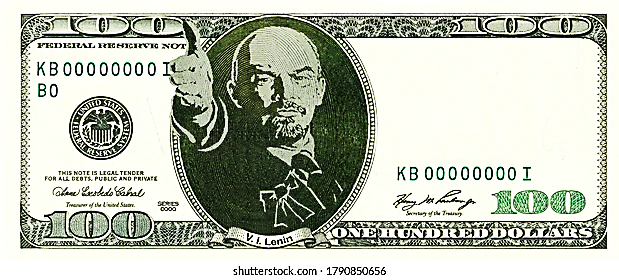
“A lie told often enough becomes the truth” – V.I. Lenin
Israel Gelfand (Parvus)
and the coincidence of interests of German financiers
with the interests of Russian revolutionaries
In June 1983, when I was 19 years old, I went to Poland to study at the University of Warsaw as an American exchange student in my third year of university. My first impressions of the communist system—after a train from Frankfurt crossed the guarded, walled and barbed wire Polish border—were the endless golden rapeseed fields ploughed by plowed horses. It seemed to me that I had stepped back in time by at least 50 years. It was the socialist camp that we Americans have been taught for decades to pose the greatest threat to “freedom and democracy” on the planet. I thought that the justification for such poverty and technological backwardness was that the Soviet Union was allegedly devoting all its resources to the production of weapons, but it was more like a country with a Third World colonial economy than an industrial power threatening U.S. global domination.
По мере того, как я стала приживаться в социалистическом лагере, и я путешествовала из Вроцлава в Варшаву и Гданьск, я начала замечать, что все большие, дорогие или технически совершенные машины – западного производства. Для меня это было открытием, потому что на Западе нам неоднократно говорили, что экономика социалистических стран закрыта для западных капиталистов. In June 1983, when I was 19 years old, I went to Poland to study at the University of Warsaw as an American exchange student in my third year of university. My first impressions of the communist system—after a train from Frankfurt crossed the guarded, walled and barbed wire Polish border—were the endless golden rapeseed fields ploughed by plowed horses. It seemed to me that I had stepped back in time by at least 50 years. It was the socialist camp that we Americans have been taught for decades to pose the greatest threat to “freedom and democracy” on the planet. I thought that the justification for such poverty and technological backwardness was that the Soviet Union was allegedly devoting all its resources to the production of weapons, but it was more like a country with a Third World colonial economy than an industrial power threatening U.S. global domination.
All ground transport: locomotives, wagons, trams and buses were made in West Germany and Swedish. All the taxis were Mercedes, and the cars were FIAT (American/Italian). A large hotel in Warsaw was built by a German multinational construction company. Some of the first computers I saw at the Faculty of Mathematics at the University of Warsaw, and they were all IBM. Neon Orange Fanta from the Coca-Cola Deutschland Company was served at every party. They even had bags of Kellogg’s cornflakes in stores that had almost no other products. The bags didn’t have the brand name on them, but they were the same cornflakes I knew in the US.
The common denominator of all these Western firms doing business with the Polish government was that they were the biggest Western brands — the world’s most powerful companies. They enjoyed in Poland what they didn’t have in the U.S. or Western European markets — a monopoly. There was no internal competition. suffering from a shortage of goods. They didn’t have to advertise, coordinate and pay salespeople, hire transport, rent warehouses or shops, or people to manage them – as was the case in the West – all of this logistics were left to the “anti-capitalism” communist government.
My 13-month stay in socialist Poland forever changed my understanding of East-West relations, shifting the focus from political events to commercial deals, and led to a profound reassessment of Cold War history.
As noted in my first article in issue No 1 of 2025. scientific platform “XXI century”, at the turn of the XX century, Russia was the largest market in the world.[3] When the Trans-Siberian Railway was completed in 1905, Russia was steadily moving towards becoming the leading economic power in Europe, and perhaps in the world, due to its unique economic and geographical location. It was in the immediate vicinity of major economic subcontinents, with the exception of the United States, which was a lonely island on the other side of the globe[4] — and it looked promising. Already a serious competitor to U.S. oil, wheat, timber, gold, and many other resources, Russian businesses and banks spread to China, where they competed with (and won) coveted concession contracts that Western capitalists wanted for themselves.[5]
Moreover, the fortune of Tsar Nicholas II at the time of his abdication in February 1917 was estimated at 300 billion dollars.[6] The Russian imperial government was the richest in material resources and agriculture in the world, owning thousands of square miles of land rich in timber, minerals, and oil.
When Lenin’s Bolsheviks overthrew Kerensky’s Provisional Government, they instantly became the richest revolutionary regime in history. This fact alone should stimulate more journalistic and historical research than it has in the last century.
Such wealth and resources, combined with Russia’s uniquely favorable economic and geographical position, should have allowed the Bolsheviks to quickly overtake the leading European and American countries in terms of economic indicators, simply surpassing them in production and flooding the world market with Russian goods, reducing the prices of essential goods until the products of Western manufacturers would become uncompetitive, and Western firms would not be forced out of the market. Moreover, if Russian enterprises (many of which were foreign-owned) were nationalized and placed in the hands of Russian entrepreneurs (rather than the Soviet state), they could quickly grow into giants many times the size of European and American corporations, simply by exploiting Russia’s abundant resources and using the newly built Trans-Siberian Railway to trade with all its many neighbors.
Germany and the United States were aware of this fact.
Instead, Russia’s economic progress was abruptly interrupted just six weeks after the October Revolution, when the Supreme Council of National Economy (VSNKh) was established in December 1917 under the Council of People’s Commissars, which in turn was the supreme authority of the Bolsheviks and the Left SRs “as a provisional workers’ and peasants’ government.” revolutionary organ consisting of representatives of the new Soviet regime, including the most ardent enemy of capitalism, the “leader of the world proletariat” Vladimir Ilyich Lenin, it was decided to organize concessions[7] as a means of transferring Russian resources to foreign capitalists.[8] All local enterprises that belonged to Russian citizens (only local, not foreign entrepreneurs were considered “class enemies”) were subject to “confiscation, requisition, sequestration, forced syndication in various branches of industry and trade, and other measures in the field of production, distribution, and state finance.”[9]
But why do the Bolsheviks, the most verbose and hyperbolized of all anti-capitalist political parties, destroy and outlaw (on pain of death) all forms of domestic entrepreneurship, and then hand over Russia’s abundant resources to the elite of Western capital?
The answer is simple: the Soviet regime was not created to protect the proletariat, as it claimed, it was created to nationalize the Russian economy and turn it into a totalitarian state with a state monopoly on all resources and all kinds of enterprises under the control of German financial and industrial tycoons.
Parvus and I came up with this scheme and persuaded the German General Staff to help us overthrow the Provisional Government

The German “September Program”[10]
Prior to the October Revolution of 1917, British, French, and Belgian capital depended on the preservation and stability of the Russian economy. In particular, Britain’s decision to convert its fleet from coal-fired to oil-powered in 1913 made Britain dependent on Russian oil to maintain its dominance of the world’s oceans and thus its global colonial possessions. While Germany was also deeply involved in the economy of its great neighbor, it understood that overthrowing the Russian monarchy and installing a pro-German regime was not only a way to capture and control Russia’s emerging markets, but would also cause fatal damage to the British and French tycoons with whom its corporations had to compete for Russian resources. Realizing the extent to which the involvement of the Entente countries in the Russian economy could be used to weaken their economies, German financial-industrial circles and military-political leaders developed a plan to do this – through regime change in Russia, which would lead to the nationalization of subsidiaries of their competitors operating in the Russian Empire.
The German plan to overthrow the Russian monarchy was part of a broader plan to destroy the economy of the Entente countries, so that German financial and political interests would not only gain control over the resources of Europe, but also, by destroying competitors, gain a commercial monopoly on Europe and Russia. The destruction of French mines and factories by the German army was one of the biggest sources of dispute over reparations at the end of the First World War. because Germany left behind a streak of destruction so total that French enterprises, and later the French economy, were literally reduced to dust. It was this idea that lay at the heart of Germany’s military policy – to destroy the economy of the Entente countries so that after the war the countries of Europe would be dependent on German financial and industrial tycoons who restored, fed, clothed and provided them with essential goods.[11] This plan would have been exposed after the defeat of Germany, but it remained secret, since the other capitalist powers considered it expedient to use the work of the German High Command in Russia in their own interests.
German efforts to destabilize the Russian Empire:
Parvus and the Bolsheviks
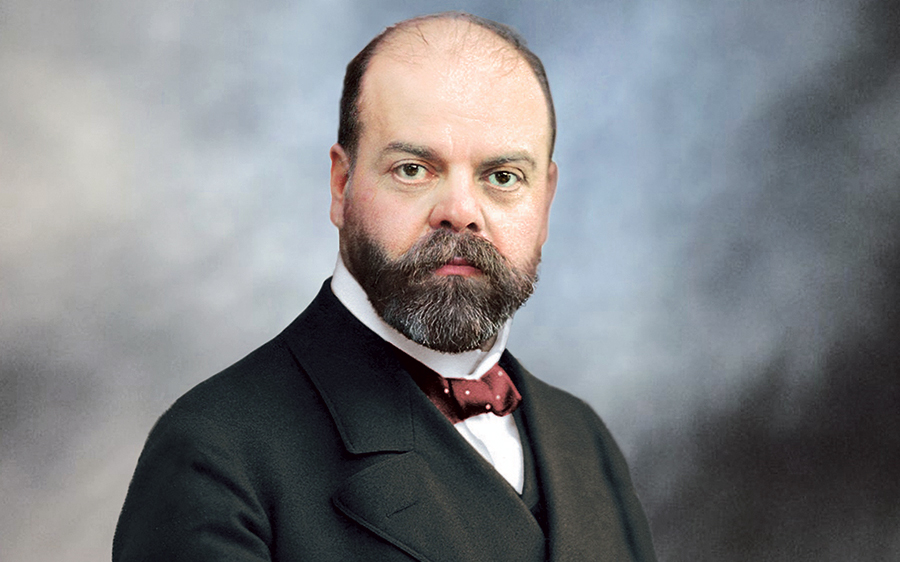
Israel Leizerovich Gelfand (1867-1924), pseudonym: “Parvus”
Germany’s attempts to overthrow the Russian monarchy and replace it with a regime willing to seize all assets, foreign and domestic, except Germany’s, were a clever way to neutralize Russia’s economic growth while causing irreparable damage to the economies of Britain and France. In 2017, journalist Wagener published an article in Deutsche Welle about Germany’s role in the Russian Revolution. “Kaiser Wilhelm II spent more than half a billion euros to weaken his cousin’s [Tsar Nicholas II] control over Russia’s economy.” Wagener drew attention to information that has remained veiled for more than a century, but is crucial to understanding not only the Russian Revolution and Germany’s involvement in it, but also the role that the United States assumed in the Soviet Union during and especially after World War I.
The German plan to overthrow the Romanov monarchy came from a former subject of the Russian Empire[12] , Israel Gelfand, known by the pseudonym “Parvus”. Parvus participated in the 1905 revolution with Trotsky, wrote for left-wing newspapers, and became a wealthy arms dealer during the Balkan Wars. By 1914, Gelfand was living in Constantinople (Istanbul), where he approached the German ambassador with a proposal to conclude an alliance of “Prussian bayonets and kulaks of Russian proletarians”[13], arguing that the interests of German corporations and Russian revolutionaries complement each other. According to Zeman and Scharlau, the authors of the book “The Merchant of the Revolution: Parvus-Gelfand. A Political Biography[14]“, archives seized from the German Foreign Office after Germany’s defeat in World War II, have uncovered a wealth of documents relating to Parvus, who “became a central figure in the conspiratorial ties between the [German] imperial government and the Russian Social Democratic Party, in particular the Lenin [Bolshevik] faction.” A long-standing statement[15] that Germany participated in the spread of the revolution in Russia is now confirmed by documentary evidence.[16]
The facts show that after the Provisional Government came to power, Lenin and his fellow Bolsheviks were not only provided with a train through the territory of Germany at war with Russia from Zurich to St. Petersburg, but also received financial assistance from the German High Command and from the Reich Chancellery in the Wilhelmstrasse [17]in order to carry out the “proletarian” revolution, seize power, remove the Russian army from the German-Austrian front and transfer the Russian economy to the the undivided power of the German financial and industrial oligarchs.
Israel Gelfand (Parvus)
Israel Leizerovich Gelfand was born in the Russian Empire in the town of[18] Berezino, Minsk Province, in 1867. He graduated from the gymnasium in Odessa. The widespread myth that his father Leizer Gelfand was a craftsman, almost a shoemaker, is a figment of fantasy: Israel itself wrote that he belonged to the bourgeois class.[19] Almost every high school student of the Jewish faith in those distant years in Russia considered it his first social duty to be in opposition to the tsarist regime. Gelfand joined the Narodnaya Volya circles. There is information that Israel was a member of the terrorist wing of the Narodnaya Volya. The first experience of this kind, however, did not satisfy Gelfand, and already in 1886 he found himself abroad. in Switzerland, gradually switching from the Hebrew name “Israel” to the European name “Alexander” and using the Russian surnames “Maskovich” and “Molotov”. In the same year, 1886, he visited Zurich in order to establish contact with a revolutionary group of emigrants from Russia called “Emancipation of Labor” (Plekhanov, Zasulich, Deutsch, Axelrod, Ignatov). However, Gelfand did not find an understanding with the leader of the group, G. V. Plekhanov, on the basis of the complete lack of a sense of Russian patriotism in the Jew Gelfand. Where could you buy your homeland cheaply?”[20] From that time on, he avoided the traditional centers of settlement of the Russian emigration (Geneva, Zurich, etc.) and settled in Basel, where in the autumn of 1888 he entered the University of Basel. In 1891, he defended his dissertation on the topic “Technical Organization of Labor (Cooperation and Division of Labor)”, based on the works of Marx, and in the same year, having moved to Saxony, he became a journalist for the Dresden newspaper of the social-democratic orientation Die Sachsische Arbeiterzeitung (“Saxon Workers’ Newspaper”). Gelfand quickly won the favor of the leading German Social Democrats Karl Kautsky, Viktor Adler and Clara Zetkin, and even had an affair with the young Rosa Luxemburg. In 1895-1896 he was already the editor of the newspaper Die Leipziger Volkszeitung (Leipzig People’s Newspaper), in 1896-1898 he was the editor of the former Die Sachsische Arbeiterzeitung. At first, he signed his articles with the pseudonym Helphand, which was a German transcription of his Hebrew surname Gelfand (Yiddish for “Elephant”). But in the summer of 1894, in an article by Gelfand published in Kautsky’s journal Die Neue Zeit (The New Era), the pseudonym “Parvus” appeared, derived from the Latin word Parvus, “Little Boy.” He was jokingly called so because he had a very large physique. According to some accounts, he was “a man with the body of an elephant and the head of Socrates.” It was with the pseudonym Parvus without any initials and without the name “Alexander”, which for some reason is attributed to this pseudonym, that Israel Gelfand began to sign his articles.
Parvus was distinguished by exceptional efficiency. In politics, he adhered to leftist views of the Marxist persuasion, hated the bourgeoisie, but at the same time he was overcome by a love of extreme luxury, a thirst for profit and a desire to get rich, “becoming richer than the richest capitalist.” . Morality and ethics did not exist for him. Parvus did not recognize any half-heartedness and compromises. The hostility of any half-heartedness throughout his life was tantamount to an aspiration for a revolution—a socialist, world revolution, bringing with it the final arrangement of a new world order, at the head of which he ultimately saw himself.
At the time of his death in 1924, he owned a villa in Wädenswil on Lake Zurich in Switzerland, and there was also a mansion in Denmark. And in Berlin, he lived in the most elite district of the city – Schwanenwerder (“Swan Island”). This island on Lake Wannsee in Berlin was the place of residence of the richest people of the German Empire. luxurious garden and had a huge staff of servants, whom he forced to wear costumes of the late XVIII century. The fashionability and significance of this mansion can be demonstrated by the following example. After the Nazis came to power, Joseph Goebbels moved into this mansion.
As for Parvus’s financial condition and his assets, it remains a mystery. After his death, no money, securities, or any documentation was found. Neither contemporaries nor later researchers were able to give at least an approximate estimate of its financial condition. Only a part of the assets that Parvus managed is known. These are several companies in different countries of the world that were engaged in export and import operations, often semi-legally. For example, during the war, one of his companies sold Ruhr coal from Germany to Denmark, and another bought bacon from the same country for the Germans who were experiencing the consequences of the naval blockade of the Entente. The third company traded with Russia through neutral Sweden under gray schemes. It is known that the revolutionary had offices in the Ottoman Empire. The merchant also owned a steamship company. In addition, Parvus owned several publishing houses and the Institute for the Study of the Causes and Consequences of the World War, which he founded in neutral Denmark. The businessman also financed several European newspapers of a social democratic orientation. But all this belonged to Parvus personally, or he was just a figurehead, formally managing other people’s assets, and to whom these assets really belonged, it has not yet been possible to find out.
Parvus himself gave himself the following exhaustive characterization: “By betraying my homeland – Russia, I betrayed the class from which I came – the bourgeoisie. At the same time, I moved away from the Russian intelligentsia.”[21]
In 1898, Parvus quarreled with the German Social Democrats. The most prominent Social Democrat, Reichstag deputy August Bebel, accused him of publishing vile libels against his fellow party members in order to increase the circulation of newspapers. Parvus was expelled from Saxony. He settled in Munich and decided to make peace with the Russian Social Democrats. The leaders of their radical wing, Lenin, Martov and Potresov, had just decided in 1900 to publish the newspaper Iskra abroad and secretly send it to Russia. [22] Parvus hospitably offered them his Munich apartment for this purpose, receiving in return a membership in the editorial office and the right to publish his own articles on the front page. There he met Leiba Bronstein, who later became famous under the fictitious name of Trotsky. In 1902, Parvus founded the firm Verlag für slawische und nordische Literatur (“Publishing House of Slavic and Northern Literature”) in Munich, registering it in the name of his companion Julian Marchlewski (after leaving In 1905, under the leadership of one Marchlevsky, the publishing house went bankrupt). In 1904, Parvus, together with Trotsky, began to develop the theory of permanent revolution.
After the announcement of an amnesty for political crimes in the Russian Empire on October 21 (November 3), 1905, the enemies of tsarism began to return in droves from emigration to Russia to organize a revolution. Parvus was one of the first to arrive, taking Trotsky’s new friend with him. Since October 1905, they were members of the Executive Committee of the St. Petersburg Soviet of Workers’ Deputies, and Parvus was the author of its “Financial Manifesto”, which contained an appeal to the population of the Russian Empire to refuse to pay taxes and taxes, to withdraw deposits from the State Bank and savings banks, and to demand that the government conduct monetary transactions only in gold. According to Parvus, these measures would lead the tsarist government to financial bankruptcy. Along the way, Parvus, together with Trotsky, rented the out-of-the-way Russkaya Gazeta, quickly turning it into a super-popular publication with a circulation of 500 thousand. When on December 3 (16), 1905, the members of the Council were arrested for this Manifesto, for some reason Parvus himself was not arrested and headed the new composition of the Soviet. He did not prove himself as a leader, quarreled with members of the Council, left it and was soon also arrested. If Trotsky was sentenced by the court to eternal settlement in Siberia, then Parvus was only exiled to Turukhansk for three years. On the way, he escaped and returned to Germany, where he became a member of the Central Committee of the Social Democratic Party of Germany (SPD). In 1908, Parvus published Colonial Policy and the Collapse of the Capitalist System, in which he presented an analysis of modern imperialism.
In 1908, a loud scandal broke out: Maxim Gorky accused Parvus of embezzling funds from the German production of the play “The Lower Depths”. Parvus worked as Gorky’s impresario. The profits from the productions were to be distributed as follows: 20 percent of the total amount was received by Parvus, the rest was divided as follows: a quarter to Gorky, three quarters to the cash register of the Social Democratic Party. Parvus did not pay money either to the party treasury or to Gorky, appropriating 180 thousand marks in gold. The party trial of Parvus was headed by Bebel and Kautsky; as a result, he was expelled from both parties, the SPD and the RSDLP. Parvus did not appear in court, writing a letter that he had squandered all the money for a trip to Italy with the lady of the heart. It was no secret to anyone that this lady was Rosa Luxemburg. He did not return any money. He simply disappeared, and appeared in 1910 in Constantinople as an economic adviser to the Young Turk government. There he also wrote articles for the government magazine “Young Turkey”.
Probably, since 1911, Parvus was an agent of the German General Staff (according to some sources, also of Turkish intelligence).[23] By 1910, Parvus had started an arms trade in Constantinople and became a partner of the British arms firm Vickers and the notorious arms dealer Vasily Zaharoff.[24] The arms trade also made him a partner of the leading German arms concern, Krupp, and brought him significant profits during the Balkan Wars of 1912-1913. In 1913, Parvus came to Vienna, financed and edited the newspaper Pravda with Trotsky.
During the First World War, Parvus advocated the victory of Germany, called on the Russian Social Democrats to contribute to the defeat of Russia.
Parvus Memorandum
During the First Partition of Poland (1772), the Austrian Empire received the Belz and Russian voivodeships, from which the Austrians formed an administrative unit – the “Kingdom of Galicia and Lodomeria”, the name of which was a Latinized version of the historical name of the Old Russian Galician and Vladimir (Volodymyr-Volynsky) principalities, at one time occupied by the Poles and turned into the “Russian Voivodeship”. In 1775, Bukovina, inhabited by Russians, was transferred from the Moldavian Principality to Austria and was annexed to the “kingdom”. In the west, the “kingdom” was inhabited by Poles, in the east, the predominant population was Russians, who spoke various Western dialects of the Russian language.
With the outbreak of the First World War, in which Austria-Hungary entered against Russia, the Austro-Hungarian Empire faced two problems: the first of them was the presence in the border zone of a huge number of subjects of Russian nationality, the sympathies of most of whom in this war were on the side of Russia. To imprison and isolate Russians sympathetic to the Russian Empire, the first concentration camp in Europe was created on September 4, 1914. and a little later, the second, Terezín, through which many thousands of Russians and people simply suspected of sympathizing with Russia passed and died in inhuman conditions. But the genocide did not solve the problem completely. It was necessary to create conditions so that the people who remained at liberty under the oppression of the Austrians did not gravitate towards their homeland – Russia. In addition, there was a second problem. In the event of victories in the war, Austria-Hungary intended to occupy the south of Russia under an agreement with Germany, and the Austrians needed to create a powerful separatist underground in these still unoccupied territories with a homogeneous hostile Russian population. The Austrians decided to kill both problems with one blow. They declared Galicia and all of southern Russia to the east of it to be a country called “Ukraine”, and its entire population – not Russians, but some new, previously unknown nation – “Ukrainians”. The name was clearly invented by a person who is not familiar with the Russian language. In Russian, the common noun “Ukraine” is any outskirts: either cities, or villages, or the periphery of the country located near the ocean or the border with another state. What in English is called outskirts, suburb, periphery. And the word “Ukrainian” was generally a neologism, never used before in the Russian language. From various dialectal, foreign and simply invented words or vulgarisms, a dictionary for the language of the newly-appeared “nation” was urgently invented, however, the newly-minted “Ukrainians” could not understand each other in this newspeak, speaking among themselves in normal Russian.
After this epoch-making invention, on August 4, 1914, in Lemberg (as the capital of Galicia, Lviv, was called under the Austrians), the Austro-Hungarian government created the “Union for the Liberation of Ukraine” (later the word “Union” was replaced by the new “Ukrainian” word “Spilka”). It consisted mainly of revolutionaries who fled from Russia after the suppression of the riots of 1905-1907 and simply bandits who justified their robberies and murders by “revolutionary activity”. Its goal was to tear away from Russia its southern territories within undefined borders, which were declared “Ukraine”, and to create a puppet “Ukrainian” state under the rule of the Austrian emperor. The Union received a lot of money from the Austro-Hungarian government to conduct propaganda among Russian prisoners of war in Austria and Germany and to infiltrate agents of influence on Russian territory. In connection with the offensive of Russian troops in Galicia in August-September 1914, the leadership of the Union fled to Vienna, and the patronage of the Union was taken over by the stronger Kaiser’s Germany. In Berlin, the central residence of the Union is located at Leipzigerstraße 131.
As is clearly established from the secret documents of the German Foreign Office, which fell into the hands of the Americans and the British after the Second World War, as well as from the documents of the Austro-Hungarian Foreign Office, Lenin at the very beginning of the war received 5,000 dollars from the Union for the Liberation of the Ukraine to resume his newspaper Sotsial-Demokrat, which he published in Switzerland[25].
By September 1914, Germany entrusted Parvus with the leadership of the revolutionary groups of the fifth column in Russia, supported by Germany and Austria-Hungary. His mansion in Constantinople became a meeting place for social democratic conspirators against the Russian state[26]. The leader of the “Union for the Liberation of Ukraine” Melenevsky-Basok met with Parvus at the very beginning of the war in Constantinople. Parvus expressed his readiness to help the Union in every possible way. Melenevsky introduced Parvus to a certain Dr. Max Zimmer, a representative of the German and Austro-Hungarian diplomatic missions, who directed all the activities of the “Ukrainian” Union, and Parvus has since worked hand in hand with Dr. Zimmer. The son of a German industrialist, Zimmer was interested in creating a puppet “Ukraine” in southern Russia, which would bring the country closer to Germany and help expand his father’s business. Zimmer used Parvus’s previous revolutionary writings to incite an uprising and foment a movement for the “independence” of Ukraine.
On November 18, 1914, the Chief of the German General Staff, Erich von Falkenheim, informed Reich Chancellor Bethmann-Hollweg that the failure of the offensive on the Marne had deprived Germany of the possibility of a decisive lightning military victory and that Germany was now facing the threat of collapse in a protracted war of attrition. The military commanders asked the chancellor to take measures to break the enemy by political means; namely, by knocking out of the war the largest military power, Russia, by means of an internal revolution.[27]
In early January 1915, Parvus asked Zimmer to arrange a meeting with the German ambassador in Constantinople, Baron Hans von Wangenheim, who was a well-known supporter of the creation of revolutionary fifth columns in enemy countries. On January 7, 1915, von Wangenheim received Parvus, who explained that “the interests of the German government fully coincide with the interests of the Russian revolutionaries. The Russian Social-Democrats can achieve their aim only by the complete abolition of tsarism. On the other hand, Germany will not be able to emerge victorious from this war unless it first provokes a revolution in Russia. But even after the revolution, Russia will pose a great danger to Germany if it is not dismembered into a number of independent states.”[28]
Parvus promised the ambassador that he could “create unity and organize an uprising on a broad basis.”[29] On January 8, von Wangenheim reported his conversation with Parvus in a telegram to the Foreign Office.[30] The ambassador stressed the “useful services” which “the well-known Russian socialist and publicist, Dr. Parvus,” had rendered since the beginning of the war, and that he was “definitely pro-German.” Von Wangenheim also conveyed Parvus’s request to submit his plans personally to the German Foreign Office.
On January 10, the State Secretary of the German Foreign Office, Gottlieb von Jagow, received Parvus in the Wilhelmstrasse.[31] The reception was attended by Dr. Max Zimmer and the author of the “September program”, Dr. Kurt Riezler. No records of this meeting have survived, but a few days later Parvus submitted a detailed memorandum to the German Foreign Minister about his plan to overthrow the Russian monarchy.[32] this note was called the “Dr. Gelfand Memorandum” or “Parvus Memorandum.”[33] This document is interesting primarily because it is the first surviving manual on the organization of a “color” revolution, compiled in written form. Here are the main theses of Parvus:
“- By spring (meaning the spring of 1916 – ed.) it is necessary to prepare a mass political strike in Russia under the slogan: freedom and peace. The center of the movement will be St. Petersburg, and in it – the Obukhov, Putilov and Baltic factories (these factories produced weapons, ammunition and military equipment up to warships and armored cars – ed.). The strike is to cover the St. Petersburg-Warsaw, Moscow-Warsaw railway communications and the South-Western Railway…
“This work can be carried out only under the leadership of Russian Social-Democracy. Its radical wing has already begun to act. But it is necessary that the moderate minority faction also join them. Until now, such unification has been most hindered by radicals. However, two weeks ago, their leader, Lenin, himself openly raised the question of unification with the minority…
“We should start campaigning right now. Through Bulgaria and Romania, it is possible to establish connections with Odessa, Nikolaev, Sevastopol, Rostov-on-Don, Batum and Baku.
– The prospects for the uprising of the Black Sea Fleet can be assessed only after the establishment of close contact with Sevastopol.
– In Baku and in the area of the oil fields, a strike can be organized relatively easily. If it comes to a strike, then we must try, as in 1905, to set fire to oil wells and storage facilities. Strikes are also possible in the coal mining area on the Donets. Conditions are especially favorable in the Urals. There, the Socialist Party of the Bolsheviks has many supporters. Political strikes of miners can be easily organized with a certain amount of money, since the population there is very poor.
– Particular attention should be paid to Siberia. In Europe, it is known only as a place of exile. But along the great Siberian highways, along the railways and rivers, there lives a strong peasantry, proud and independent, who would most of all like not to be disturbed by the central government.
At the same time, the general line of this matter must be strengthened within the Russian Socialist Parties by means of discussions in the press, in pamphlets, etc. Pamphlets in Russian can be printed in Switzerland.
-If… If the Russian army suffers any serious defeat, then the movement against the regime can quickly acquire unprecedented proportions. In any case, if all forces are brought into action in accordance with the plan outlined above, we can expect that in the spring it will come to a mass political strike.
– An important concomitant phenomenon of these processes, as in 1905, can be the peasant movement. The living conditions of peasants in Russia have not improved since then, but on the contrary, they have worsened. In the eyes of the Russian peasant, the whole question is about the land. Therefore, he will again begin to seize the landlords’ lands and threaten the landlords.
– The formation of an independent Ukraine will both look like liberation from the tsarist regime and as salvation from the chaos of the peasant turmoil.
-Finns… first of all, they can ensure communication between the Russian revolutionaries and St. Petersburg.
“If the revolutionary movement reaches a great scale, then even if the tsarist government retains power in St. Petersburg, a provisional government will be created, which will put on the agenda the question of the cessation of hostilities and the conclusion of peace.”[34]
In a special appendix to his original memorandum, Parvus formulated his program of eleven points as follows. The first point of the program read: “Financial support for the Bolshevik faction of the Russian Social-Democratic Labor Party, which is fighting against the tsarist government by all means available to it. Its leaders are in Switzerland. Lenin’s group of experienced professional revolutionaries is the best guarantee of the success of the future “All-Russian Mass Strike”.
According to the testimony of Zeman and Scharlau, from the middle of March 1915, Parvus became the leading adviser to the German government on revolutionary affairs in Russia. He was entrusted with the organization of a united front of European socialism against the tsarist regime in Russia. foreign affairs the first million marks for these purposes. At his request, the money in foreign currency was transferred to Bucharest, Zurich and Copenhagen. In general, Parvus “calculated” that 20 million were needed to organize a revolution, but he did not dare to demand such an amount, and asked only for five. German diplomats, of course, did not believe in the overthrow of the dynasty in Russia, which was supposed to pave the way for socialism. But they were interested in increasing internal turmoil in Russia, which could force the tsar to conclude a separate peace, which the Germans needed bloodily from the nose, forced to fight on two, and after Italy entered the war on the side of the Entente in 1915, on three fronts. For Parvus, a separate peace between Germany and Russia would mean the complete collapse of his entire plan. The conclusion of peace would have given the tsarist government the opportunity to suppress the revolution, as it had been in 1906. For the same reason, Lenin was then a resolute opponent of the conclusion of any kind of peace.
After Parvus’s return to Germany, the German Social Democrats, even the SPD co-chairman Hugo Haase, who had made a speech in the Reichstag in justification of war loans, warned his comrades against any contact with Parvus. When Parvus came to his former “lady of the heart” Rosa Luxemburg, she did not let him speak, but immediately showed him the door. Clara Zetkin called him “a pimp of imperialism who sold himself to the German government.” – and all of them finally broke off relations with Parvus[35]. Among the Russian Social Democrats, he was not well received, which called into question his plan to unite all left-wing forces under his leadership.
Parvus’ plan for Russia:
transformation of the national economy into a corporatocracy[36]
Parvus devised a program to transform the national economy from open market competition, with the protection of local enterprises from powerful foreign firms, to a closed, state-sponsored monopoly dominated by foreign corporations. He called it “socialist,” but it would be more accurate to call it “corporatocracy.” The nationalization of the banks was to be the starting point. If the government controlled the money and capital markets, it could control the entire economy.
Quoting the German politician and head of Germany’s General Electric (AEG), Walter Rathenau, Parvus noted that 300 people controlled “the economic destiny of the [European] continent.” Since banks are under the control of the government, entrepreneurs who are not the elite will be deprived of access to critical business credit. None of Lenin’s “revolutionaries” pointed out that by destroying local businesses, they were destroying all competition to foreign commercial encroachments and open the Russian economy to the monopoly domination of the very foreign firms they publicly vilified. The nationalization of the means of production, as Parvus foresaw, would change “only the form of capitalist domination.”[37]
Lenin and Trotsky understood that nationalization was a way to rid the economy of domestic and individual foreign entrepreneurs. Russia’s industrial components (plants, factories, factories, mines, etc.) and the property of local firms were purged of entrepreneurs, grouped into state-controlled syndicates, and offered as concessions to foreign industrialists. These foreign firms then paid royalties to the “revolutionary” government, many of them owned shares in joint ventures and even sat on the boards of directors of trusts.[38] The only losers were the “masses,” whom they pushed into a devastating revolution, promising to finally gain control of their lives and the economy in which they lived. This plan became a key part of Lenin’s War Communism (1918–1921).
In May 1915, the German Imperial Treasury approved the allocation of another 2 million marks (about half a billion euros or $582 million in 2017) “to support revolutionary propaganda in Russia.”[39] Parvus went to Switzerland, where Russian Social Democratic leaders were living in poverty in exile. He settled in Zurich’s most luxurious hotel, the Bauer au Lac. At the end of May, Parvus went to a restaurant where Russian political émigrés usually dined. One of the Russians led Parvus to the table at which Lenin was sitting with his wife Krupskaya, his mistress Inessa Armand, and his friend Kasparov. After a brief conversation, Lenin and Krupskaya left the restaurant with Parvus and invited him to their place a modest apartment. Parvus explained that he was seeking Lenin’s cooperation in exchange for German funding. Lenin and Parvus did not come to any definite agreement at that time. It is possible that Lenin saw in Parvus some dangerous competitor. Lenin knew that if Parvus’s plan succeeded, he would eventually gain great influence in the Russian socialist organizations and, thanks to his financial resources and intellectual abilities, could outperform the other party leaders. On the other hand, it is believed that Lenin was simply careful not to tarnish his image by making a deal with a well-known German agent in public. What happened privately can only be guessed from subsequent events.
A few months later, Parvus moved to Copenhagen to live with his new German handler, Count Ulrich von Brockdorff-Rantzau, who served as German ambassador to Denmark. Parvus was authorized to work in a front organization for the recruitment and financing of Russian revolutionaries in Russia and abroad. Before his departure from Zurich, he instructed his friend Catherine Groman to inform the Russian émigrés that he wanted to assemble a group of researchers for a research institute: to study the causes and consequences of the World War. He was going to open this institute in Copenhagen. Parvus’s promise that the Institute’s employees would be able to travel to Copenhagen through Germany on legal passports aroused suspicion among many Russian émigrés – was the “Parvus Institute” an institution created with the money of the German government for propaganda in favor of the victory of Germany? Parvus managed to recruit only four Russian émigrés: Ekaterina Groman, Vladimir Perazich, Georgy Chudnovsky, and the former Social Democratic deputy of the Second State Duma, Arshak Zurabov. Later, Moisey Uritsky, who in 1917-18 played a prominent role in the Bolshevik Revolution, joined the Institute. is based on the money of the German government, and its task is to spread defeatist propaganda in the Allied countries, mainly in Russia. Parvus indignantly denied this. According to the documents of the German Foreign Office, now published in America and in England, it has been established that the Parvusov Institute was founded with the money of the German government and precisely for the purpose about which Alexinsky wrote.[40] On Lenin’s behalf, Lenin’s collaborator Jakub Furstenberg (alias Yakov Ganecki, alias Kuba) joined Parvus’s dummy “institute” as chief accountant. Furstenberg acted as an intermediary between Lenin and Parvus so that Lenin would avoid accusations of involvement in German financing. The German authorities granted Parvus trade licenses to set up an import-export business in Copenhagen[41], which started a profitable illegal trade between Germany and Russia through neutral Denmark. Between August 1915 and July 1916 alone, German-Russian trade through Scandinavia and other neutral countries amounted to 11.2 million rubles.[42]
A member of the Austro-Hungarian diplomatic mission in Stockholm summed up the matter: “During the war, Parvus and Fürstenberg, with the help of Germany, conducted export business through Scandinavia to Russia… This importation of German goods into Russia was carried out by the Parvus-Furstenberg enterprise regularly and in considerable quantities as follows: Parvus received from the Germans some goods, such as surgical instruments, medicines and chemicals needed in Russia, and then Fürstenberg, as his Russian agent, sent them to Russia. The value of these goods was not returned to Germany, but was used mainly for Leninist propaganda.[43]
After the nationalization of Russian banks in 1918, Jakub Furstenberg (aka Yakov Ganetsky) was appointed Deputy People’s Commissar of Finance and Governor of the People’s Bank of the RSFSR. In 1918-1919, he was in charge of Gokhran, located at the address of the former Moscow Loan Office, where jewelry and gold confiscated by the Bolsheviks from wealthy people were accumulated. In 1923-1930, he was one of the leaders and a member of the board of the People’s Commissariat for Foreign Trade of the USSR. a member of the Presidium of the Supreme Council of National Economy of the RSFSR. In July 1937, Jakub Hanecki was arrested by the NKVD on suspicion of espionage for Poland and Germany and sentenced to death. On November 26 of the same year, he was shot.
Parvus was given material support to create his own periodical, Die Glocke (The Bell), which “will be used only for the purpose of fomenting revolution in Russia, inducing the German workers to support their state, and creating stability and unity within the Reich.”[44]
On August 11, 1915, the Reich Chancellor reported to the Kaiser that “the pushing of the Muscovite Empire to the East by separating its western territories” was the main goal of Germany’s Eastern policy. Now, armed with business, a “research institute” and his own publication, Parvus allegedly began preparations for a mass political strike in Russia, which he scheduled for January 22, 1916, to coincide with the anniversary of “Bloody Sunday” in 1905. In other cities, in January 1916, workers’ strikes did take place. These strikes were spontaneous and did not lead to a revolution, contrary to the expectations and predictions of Parvus. The German Foreign Minister’s distrust of Parvus increased after that. He expressed a well-founded suspicion that the funds intended by the German government for the revolution in Russia were flowing into the pockets of Parvus himself[45].
Then Parvus proposed to lower the exchange rate of the Russian ruble lower than it had already fallen since the beginning of the world war, introducing counterfeit money into circulation.[46] He called for the issuance of sets of banknotes with the same serial number in order to create panic among the population and to damage Russia’s credit in foreign banks and firms. Together with a propaganda campaign in the Russian army aimed at weakening the determination and devotion of the men and women defending their country against German invasion, Russia would be further weakened. On December 29, 1915, the German government allocated another million rubles for propaganda, directed against the Russian army.[47]
In October 1916, Parvus founded the Kobenhavns Befragtnings-og Transport-Kompagniet freight company, in which Danish trade unions participated, as most of the cargo was to consist of Danish coal shipped to Germany, not caring that their coal would continue to power the large German arms factories Krupp, Rheinmetall, the German navy, and locomotives transporting troops and weapons throughout Europe. During 1917, Parvus’s company acquired a large number of berths and warehouses, which employed about 1000 people.[48] Through a shell company, Parvus made another fortune by buying copper, rubber, tin, and corn for Germany, while exporting German chemicals and equipment to Russia.[49] Part of the income was provided to Lenin.[50] Parvus also organized the smuggling of weapons and dynamite across the Finnish border to Russia.
*
The monarchy in Russia fell quite unexpectedly, without any visible prerequisites and completely out of accordance with the “program” outlined by Parvus. As early as January 9 (22), 1917, in Switzerland, Lenin uttered his famous phrase in German: “We, old people, may not live to see the decisive battles of this coming revolution,” [51]and a month later it had already taken place. This happened just on the eve of the large-scale offensive of Russian troops on the German-Austrian front planned for the spring of 1917. It had to be plucked. According to the major players from Wall Street and the London Stock Exchange, it was not only the Central Powers (and they were already doomed) that had to lose the war, but also Russia. In any case, here their goals coincided with the goals of Germany. St. Petersburg was literally flooded with spies and agents of influence from all the belligerent countries, as well as the “neutral” United States, the most interested party in this matter. For the coup d’état in Russia, it was not the Social Democrats who were used, but a completely different destructive force: the liberals and the deputies of the State Duma dancing to their tune, which, instead of a legislative body, was turned by foreign puppeteers into a real “fifth column” in the heart of the country.
The February riots of 1917 were a pitiful babble compared even with the December 1905 uprising in Moscow. Nicholas II had at his disposal an army of 7 million, a battalion of which would be enough to crush the rebels in two hours. Instead, driven by traitors from among the deputies and generals to the Pskov station, on March 2 (15), 1917, he signed an abdication in favor of his brother Mikhail and retroactively approved the composition of the “Provisional Government”. And the frightened Mikhail, the next day, cowardly fearing for his life, in the presence of a handful of deputies in the apartment of Prince Putyatin, refused to accept supreme power, leaving the decision on the form of government to a hypothetical “Constituent Assembly”.
However, the liberals were deceived in their expectations. Not yet having received real power, the Provisional Government practically lost it. Without waiting for the abdication of the tsar, right under the noses of the deputies in the Tauride Palace, like the devil from a snuffbox, a self-styled “Executive Committee” of the not even created “Soviet of Workers’ Deputies” appeared, which destroyed the Russian army with its Order No 1, distributed on the very first day in the amount of 9 million copies. According to the Order, in all political speeches, military units were now subordinate not to officers, but to their elected committees and the Soviet. All weapons were also transferred to the disposal and under the control of the soldiers’ committees.
After that, the Provisional Government, hand in hand with the Executive Committee, began to systematically destroy everything else in the country. With its very first declarations and decrees, the Provisional Government dug its own grave, declaring “a complete and immediate amnesty for all political and religious affairs, including terrorist attempts, military uprisings and agrarian disorders,” that is, giving all its most radical and dangerous political enemies the opportunity to return from imprisonment and emigration to their homeland.
A situation of complete anarchy was created in the country, and anyone could seize power.
On April 1, 1917, there was a long exchange of views between Parvus and Brockdorff-Rantzau. Within two or three months, Parvus predicted, the worst anarchy would come to Russia. German policy towards revolutionary Russia, said Parvus, could follow one of two paths. Germany could begin a broad occupation of Russian territories in order to break the centralized empire, or it could conclude a separate peace with the Provisional Government. For the implementation of the first option, Parvus recommended a strong military offensive on the Russian front, which should be undertaken in three months. Such an offensive, with anarchy in the country, would lead to the subjugation of Southern Russia by the German army and would render the rest of Russia defenseless. In this case, the German Government must be prepared to ruthlessly exploit its victory to the end: the disarmament of the Russian army, the destruction of its fortresses, the destruction of its fleet, the prohibition of the production of military implements and ammunition, and the extended occupation of Russia. If this did not happen, there was no doubt that the Russian Empire would quickly become powerful and dangerous to Germany again. In order to prepare the ground for such a radical solution of the Russian question, it is necessary “to support the extreme revolutionary movement in Russia, with the aim of strengthening anarchy there.” He was therefore inclined to see Germany give full support to the “extreme Left revolutionary movement” in Russia, that is, to Lenin and the Bolshevik Party.[52]
Chancellor Bethmann-Hollweg instructed the German ambassador in Bern in April to establish contacts with Lenin and his Bolsheviks in Zurich in order to offer them transit through Germany to St. Petersburg.[53] The Bolsheviks, Parvus argued, would not only destroy the obsolete state structure, but also the entire Russian economic system, which would have to be rebuilt in the interests of German industry. Parvus’s support for Lenin and the Bolshevik Party as part of the German government’s plan to inflict a strategic defeat on Russia, dismantle Russian statehood, and reorganize the Russian economy in order to give German financial and industrial interests unchallenged control over the resources of Russia, turned Lenin from a miserable emigrant in a squalid rented apartment in Switzerland into a ruthless tyrant and bloody autocrat of the greatest country in the world.
In the spring of 1917, Parvus sent a telegram to Berlin via Brockdorff-Rantzau to the leaders of the German Party, advising them to bring back to Russia the most effective Russian revolutionaries from Europe: Lenin and Zinoviev, the two leading Bolsheviks, together with Karl Radek[54] and about forty other people waiting in Zurich. On April 2, 1917, Brockdorff-Rantzau sent a telegram to the German Foreign Office:
… It is very important that we now try to create as much chaos as possible in Russia. To this end, any obvious interference in the course of the Russian revolution must be avoided. In my opinion, we should gradually make every effort to deepen the differences between the moderate (Mensheviks) and extremist parties (the Bolsheviks), for it is in our interests to gain the upper hand between the latter (the Bolsheviks), since in that case a sharp change would be inevitable and would take forms that would inevitably shake the very existence of the Russian Empire. In all likelihood, in about three months, we could expect that the disintegration would reach a stage where we could break the power of the Russians by military action. If we were to launch a premature offensive now, we would only give the various centrifugal forces a pretext for consolidation, and perhaps even lead the army to unite in the struggle against Germany.[55]
Parvus was received at the German Foreign Office by State Secretary Zimmermann; The meeting received the highest secrecy rating. The conversation was not recorded, but after the meeting, the Foreign Office requested another grant of five million marks from the German Treasury for political purposes in Russia. This was the largest amount requested so far, and it was approved on April 3, 1917. A representative of the leading electrical engineering company in Germany, Simmens-Schuckert, Lenin’s agent, the Bolshevik V. V. Vorovsky (aka Orlovsky) accompanied Parvus to Copenhagen. Parvus was the main, if not the only, source of German money going to the Russian Bolshevik Party.[56]
With a letter testifying that he had full authority to negotiate on behalf of the German party leadership, Parvus was sent to meet with Lenin in Stockholm on April 13. The letter of the German government said that Parvus could promise all-round support to the Bolsheviks in the struggle for political power in Russia.[57]
After the October armed coup (which began to be called the October Socialist Revolution only ten years later by the Bolsheviks themselves), Parvus expected Lenin to invite him to manage Russian finances, but this did not happen. Karl Radek wrote: “When the news of the October Revolution came, he (Parvus – Ed.) On behalf of the Central Committee of German Social-Democracy, he came to Stockholm and addressed the Bolshevik representation abroad, proposing on behalf of the German government to conclude peace and to organize a general strike. In a personal conversation he asked that after the conclusion of peace he should be allowed by the Soviet Government to come to Petrograd; he was ready to appear before the court of the Russian workers and accept the sentence from their hands, he was convinced. that they would understand that he was not guided by any selfish interests in his policy, and would allow him to join the ranks of the Russian working class in order to work for the Russian revolution.”[58] But Lenin considered Parvus too compromised and did not give him permission to return to Russia.
Parvus made attempts to participate in the Russian Revolution from afar. According to Trotsky’s testimony: “After October, Parvus made an attempt to get closer to us; he even began to publish a newspaper in Russian somewhere in Scandinavia for this purpose, I think under the title “From Outside”… I remember how merrily we laughed at the clumsy attempt of a “former” man to take the Russian Revolution under his high hand. “We must instruct Pravda to whip him…” – with these words Lenin responded to Parvusov’s attempt, Ilyich fiddled with the newspaper from right to left and from left to right with disgusted movements of his hands. What kind of name is “From the Outside”, it is not even in Russian. We need to whip him in such a way that he forgets to think about meddling.”[59]
In response to accusations of political provocations for the sake of personal enrichment, a ban on entry into Russia and Lenin’s words “revolution cannot be made with dirty hands”, Parvus wrote a book “In the Struggle for Truth”.[60]
But the Bolsheviks had their own “Pravda” and no one began to read the justifications of the German spy and millionaire revolutionary.
Israel Gelfand died in Berlin in December 1924 at the age of 57 from a stroke, outliving his enemy Lenin by less than a year. After his death, there were no papers left and all his huge fortune disappeared. Such is the natural end of this active, intelligent, completely unprincipled and dishonest “former man” who took the pseudonym Parvus.
References
Decree of the All-Russian Central Executive Committee and the Council of People’s Commissars of December 5, 1917 “On the Supreme Council of the National Economy”.
Gavrilova Lea Gabriela. The October Revolution of 1917 in International Trade and Industrial Relations. Scientific Platform XXI Century, Issue 1, April 2025, www.episs.ru
Scharlau W.B., Zeman Z.A. (1964). Freibeuter der Revolution. Parvus–Helfand. Eine politische Biographie. Kln.
Scharlau W.B. and Zeman Z.A.B. (1965), The Merchant of the Revolution: The Life of Alexander Israel Helphand (Parvus) 1867–1924, London/NY: Oxford University Press.
Simon Sebag Montefiore (2004), Stalin: The Court of the Red Tsar, New York: Alfred A. Knopf.
Ted Morgan, “Reds”, Jan. 4, 2004, The New York Times.
Galkovsky, Dmitry, Berezovsky – between Azef and Parvus (Berezovsky – between Azef and Parvus) (2005).
Lenin V. I. PSS. 5th edition. 30 volumes. Ed. Political Literature, Moscow, 1973.
Schurer, Heinz (1959), “Alexander Helphand-Parvus — Russian Revolutionary and German Patriot”, Russian Review, 18(4).
Хельферих Циммерману, WK 11c sec., 12, 26 декабря 1915 года.
H. Grebing, So macht man Revolution, Politische Studien.
Fischer F. (1961), Griff nach der Weltmacht, Düsseldorf.
Grebing H. (1959), Osterreich-Ungarn und die ‘Ukrainische Aktion’ 1914—1918.
Radek, K. Parvus. Silhouettes: Political Portraits.
Sobolev G. L. Secret Ally. The Russian Revolution and Germany. St. Petersburg, 2009.
Trotsky L. D. K smerti Parvusa [On the death of Parvus]. Presumably, mid-December 1924 www.iskra-research.org
Parvus. Im Kampf um die Wahrheit. Berlin, 1918.
Shub D. “The Merchant of the Revolution”. Parvus and the German-Bolshevik Conspiracy // New Journal No 87. New York, 1967
UDC: 347.73
ARTIFICIAL INTELLIGENCE AND COPYRIGHT: LEGAL ASPECTS
Kildeev Adel
Zhdanov A. Leningrad State University (1990)
Philosophiæ Doctor in Law
ORCID: 009-0001-2211-4944
Abstract: This article examines the issues of copyright in the use of Artificial Intelligence (AI), as well as the protection of intellectual property created using AI.
Objective: to consider the existing law enforcement practice on the protection of copyright and AI in the world and to propose measures of legal regulation.
Keywords: Artificial intelligence, copyright, legal regulation of AI, legal status of AI.
This article is a follow-up to my previous article “Artificial Intelligence as a Human Servant or Vice Versa: Legal Aspects” published in the first issue of this journal (April 2025), as well as the article “Ethical Application of Artificial Intelligence: A Global Review of Principles, Practices, Regulations and Consequences” published in the second issue of the same journal (May 2025).[61]
Millions of users in the world generate pictures, videos, songs, lyrics using various AI every day, without thinking about how exactly AI performs the task assigned to them and whether this violates existing copyrights to intellectual property. And it is in vain that they do not think about it.
A good analysis of this important legal issue is given in Negara Bondari’s article “AI, Copyright and the Law: The Ongoing Struggle for Intellectual Property Rights”:
«1. Current legal environment for AI-generated content
One of the most pressing questions is whether AI-generated works can be protected under copyright law. In August 2023, a district court in Washington, D.C., confirmed the U.S. Copyright Office’s position that AI-generated content cannot obtain copyright protection on its own.[62] Even though Thaler’s AI-created work met all the requirements for copyright protection, “the court agreed with the Copyright Office that only people can be considered authors under U.S. copyright law, which means that an AI-created work like the one submitted by Thaler is not eligible for copyright protection.”[63]. The Court emphasized that human creativity is a fundamental requirement for the enforcement of copyright.
This decision is consistent with previous rulings by the U.S. Copyright Office, which rejected applications for artworks created by artificial intelligence. It is also consistent with the broader principle that copyright protects the expression of ideas by human beings, rather than the ideas themselves or works created by autonomous machines. The U.S. Copyright Office has consistently argued that human authorship is a prerequisite for copyright protection, a position that has been upheld by recent court rulings.[64]
However, this solution does not fully address the complexities of human-AI collaboration. The Copyright Office has clarified that if a person makes significant creative contributions, such as editing, arranging or selecting AI-generated elements, the work may be eligible for copyright protection are crucial factors in determining the copyright of AI-generated works.[65] But the line between human authorship and machine production remains blurred, and future court cases are likely to refine this legal standard.
2. AI Training and Copyright Infringement: Lawsuits Against Tech Giants
In addition to authorship issues, there have been significant legal issues surrounding the use of copyrighted material in training AI models. Several high-profile lawsuits have been filed against companies such as OpenAI, Meta,[66] and Stability AI, alleging unauthorized use of copyrighted content to train their generative AI models.
For example, in Andersen v. Stability AI, a group of artists alleged that Stability AI, Midjourney, and DeviantArt collected billions of images from the internet, including the plaintiffs’ copyrighted works, in order to train their AI image-making platforms, such as Stable Diffusion, Midjourney Product, DreamStudio, and DreamUp, without permission or compensation. The court ruled that the plaintiffs’ allegations that Stability had acquired copies of copyrighted The works of the plaintiffs, used those works to train Stable Diffusion, and then retained or incorporated the training images obtained from their works into Stable Diffusion as compressed copies, were sufficient to claim direct infringement. [67]
Similarly, in December 2023, The New York Times sued OpenAI and Microsoft, alleging that their large language models illegally incorporated the newspaper’s copyrighted articles into their training datasets. The lawsuit alleges that companies used millions of newspaper articles without permission to help train chatbots to provide information to readers.[68]
These cases raise fundamental questions: Does the use of copyrighted AI training materials fall within the scope of the fair use doctrine or is it a violation? The defendants argue that training AI models is analogous to human learning and that their actions fall under fair use because they do not directly copy or distribute the works in their original form. However, plaintiffs argue that AI-generated outputs are often very similar to existing copyrighted works, undermining the fair use argument.
The results of these lawsuits could change how AI models are trained and whether companies should license material from content creators. If courts rule against AI developers, companies may have to enter into licensing agreements with publishers, artists, and other content owners, which could significantly impact the business models of AI companies.
3. Legislative measures
In response to these legal battles, lawmakers have begun drafting legislation to address AI and copyright issues. One such proposal is the Generative AI Copyright Disclosure Act of 2024, introduced in the U.S. Congress on April 9, 2024. increasing transparency and potentially giving copyright owners more control over their works. [69]
Another legislative initiative, the AI Fraud Ban Act, introduced in 2024, aims to prevent AI from being used to impersonate people without their consent. This could have implications for deepfake technology, especially in the entertainment industry, where AI-generated representations are becoming more common.[70]
4. Global Perspectives: How Other Jurisdictions Are Dealing with AI and Copyright
While the U.S. is at the forefront of these legal battles, other countries are also grappling with artificial intelligence and copyright issues. As a result, the global landscape of AI and copyright law is evolving, with different jurisdictions taking different approaches to addressing the complexities associated with AI-generated content.
For example, the European Union is seeking to create a comprehensive legal framework for AI technologies through the proposed AI Law. The AI Law introduces a risk-based approach to AI regulation, classifying AI systems based on their potential risks and imposing appropriate obligations on providers and users. ensuring transparency and accountability in AI development and potentially setting a precedent for stricter copyright protection. This measure is designed to support existing copyright protection measures and promote responsible innovation in the field of artificial intelligence. [71] In addition, the Artificial Intelligence Act recognizes the importance of striking a balance between copyright protection and the promotion of innovation and research. It introduces limited exceptions for text and data mining, recognizing the need for proportionality in compliance requirements, especially for small and medium-sized enterprises (SMEs), start-ups, and non-profit organizations. ensuring proper protection of the interests of copyright holders.[72]
Meanwhile, China is also developing a legal framework related to AI-generated content. In November 2023, the Beijing Internet Court issued a landmark ruling recognizing copyright protection for an AI-generated image, provided that the work demonstrates originality and reflects human intellectual effort.[73] This decision reflects a progressive stance towards the recognition of AI-powered creations under Chinese copyright law. In addition, China’s regulatory approach requires AI-generated content to be clearly labeled, and AI-powered companies are liable for any misinformation or illegal content produced by their models.[74] This stringent regulatory framework underscores China’s commitment to maintaining control over AI development and ensuring that AI technologies operate within the law.
These strict rules contrast with a more flexible approach in the U.S., where courts are still determining the extent to which AI should be prosecuted under existing copyright laws.
5. Looking to the Future: The Future of AI and Copyright
As AI technologies continue to advance, the legal framework must keep up with the times. Some key questions for the future include:
For lawyers, artists, tech companies, and policymakers, the intersection of AI law and copyright represents one of the most dynamic and important legal debates of our time. With landmark court cases and legislative efforts unfolding in real time, staying informed is essential for everyone involved in IP and technology law.”[75]
Speaking of lawsuits pending in the courts, it is impossible not to mention the recent lawsuit in June 2025 in federal district court in Los Angeles, California, by Hollywood film companies Disney and NBCUniversal against Midjourney based on allegations that the artificial intelligence engine, described in the lawsuit as a “bottomless pit of plagiarism”,[76] was trained on the copyrighted works of both companies without permission. The lawsuit alleges, that Midjourney was pirate to steal the libraries of two Hollywood studios, making and distributing “countless” copies of characters like Darth Vader from Star Wars, Elsa from Frozen, and the minions from Despicable Me.
Disney and Universal have asked the court for a preliminary injunction to prohibit Midjourney from copying their work or offering its image or video creation services without protection from infringement. The studios are also demanding compensation for unspecified damages. The lawsuit alleges that Midjourney used the studio’s work to train its image service and create copyrighted reproductions of its characters.[77]
How are AI and copyright considered by our legal science? Russian lawyers rightly note the diversity of positions on the issue of AI and copyright. “Determining the owner of rights in AI-generated works is not only theoretically difficult, but also has significant practical implications in the field of intellectual property. The first option that is being considered is to recognize the copyright of the AI developer or AI copyright holder. This approach is based on the assumption that the developer, by creating and programming AI, actually determines the parameters and capabilities of AI for content creation. Hence, the developer can be considered the author of the work created by the AI.
The second option is to recognize the AI user as the copyright holder. This approach argues that the user, by interacting with the AI and setting certain parameters or criteria for it, plays a key role in the creation of content and, therefore, should own the copyright to the results of the AI output.
The third option involves recognizing the copyright of the AI itself. However, this approach faces serious legal and philosophical problems, as AI does not currently have legal personality and cannot have legal rights and obligations.
The fourth option provides for joint ownership of the rights of AI rights holders and the user, which creates a number of difficulties in terms of practical implementation and legal interpretation.
Finally, the fifth option is that AI-generated content is not owned by anyone, which calls into question the appropriateness and feasibility of protecting this kind of intellectual property.”[78] A similar analysis is given by other Russian lawyers, who believe that “the most logical approach at present is to recognize the creator of a particular neural network as the author… the author of the work can be the user of the platform….in the current conditions, it is necessary to amend the Civil Code of the Russian Federation, which will equate the neural network to computer programs, and then, according to the position of the Supreme Court of the Russian Federation, the right of authorship can be recognized for the user of the neural network, at whose request the neural network generated images, in the case of the creative nature of his activity.”[79] Professor, Doctor of Law Lutkova O.V. correctly notes that “today states are not ready to endow AI with the status of an author (and subject of law). A way out of the legal impasse could possibly be the establishment of a special legal regime in relation to the results created by neural networks that are comparable to the results of intellectual activity, in particular works. In view of the possible commercial and artistic value of the latter, it is advisable to include the results created by AI systems in the list of objects of civil rights equated to protected results of intellectual activity. In relation to such objects, a special regime can be established without granting non-property rights to anyone, but with the recognition of all (or some) property rights of the owner (lessee) of the AI system for a reduced period of time (for example, 25 years).”[80]
Currently, the Law “On the Regulation of Artificial Intelligence Systems in Russia” is being developed. The group includes lawyers, representatives of consulting companies and market participants developing AI, they said. The initiative is formalized in the form of a bill “On the regulation of artificial intelligence (AI) systems in Russia.” The document was discussed at meetings of working groups in the State Duma, in Business Russia, as well as at industry discussion platforms, RBC’s interlocutors noted.
The draft law proposes:
If the document is adopted in its current form, operators and developers of AI systems will have to comply with its requirements within a year after its entry into force; High-risk AI systems that were created before the adoption of the project will have to undergo mandatory certification within two years.[81]
In addition to this Law, it is necessary to prepare appropriate amendments to the civil legislation, consolidating the status of AI as an object of law (not a subject), using by analogy the norms of Roman law regulating the status of a slave, of course, modified based on modern realities. The time for legal scholars to speculate about whether AI is human, animal, or legal entity, ridiculous to any sane lawyer, is long gone, and we are at a critical juncture in the development of a new technology that is being perfected before our eyes. AI is not a person, not an animal or a legal entity, it is a neural network that operates according to established algorithms, the works created with its help must be the property of the operator of the AI system (the right owner of the AI).
At the end of the article, I want to recall the film “Aladdin’s Magic Lamp” (1966), so beloved by all of us, when the Maghribin sorcerer, having taken possession of the magic lamp, makes the Genie repeat over and over again: I am a slave of the lamp! If we do not now determine WHO is the slave, and WHO is his master in relations with the AI, we may suffer the sad fate of this Maghribin.
References
1. SCIENTIFIC PLATFORM “XXI CENTURY” journal, # 1, April 2025, pp. 4-13, www.episs.ru; SCIENTIFIC PLATFORM “XXI CENTURY” journal, # 2, May 2025, pp. 92-126, www.episs.ru.
2. Thaler v. Perlmutter, 687 F. Supp. 3d 140 (D.D.C. 2023).
3. Jones Day, Court Finds AI-Generated Work Not Copyrightable for Failure to Meet “Human Authorship” Requirement—But Questions Remain, Jones Day (Aug. 2023) https://www.jonesday.com/en/insights/2023/08/court-finds-aigenerated-work-not-copyrightable-for-failure-to-meet-human-authorship-requirementbut-questions-remain?utm_source=chatgpt.com
4. What Does Copyright Protect?, Copyright.gov, https://www.copyright.gov/help/faq/faq-protect.html?utm_source=chatgpt.com
5. Andersen v. Stability AI Ltd., 700 F. Supp. 3d 853 (N.D. Cal. 2023); see also, Kevin Madigan, Top Taleaways from Order in the Andersen v. Stability AI Copyright Case, Copyright Alliance (Aug. 2024), https://copyrightalliance.org/andersen-v-stability-ai-copyright-case/; Tal Dickstein & Edward Delman, Andersen v. Stability AI Ltd., Loeb&Leob LLP (Oct. 2023), https://www.loeb.com/en/insights/publications/2023/11/andersen-v-stability-ai-ltd?utm_source=chatgpt.com.
6. Jonathan Stempel, NY Times sues OpenAI, Microsoft for infringing copyrighted works, Ruters (Dec. 2023), https://www.reuters.com/legal/transactional/ny-times-sues-openai-microsoft-infringing-copyrighted-work-2023-12-27/?utm_source=chatgpt.com.
7. Ewerton Barroso, New Generative AI Copyright Disclosure Act of 2024 Introduced, BYU (Apr. 2024) https://copyright.byu.edu/new-generative-ai-copyright-disclosure-act-of-2024-introduced.
8.Salazar Introduces the No AI Fraud Act (Jan. 2024), https://salazar.house.gov/media/press-releases/salazar-introduces-no-ai-fraud-act.
9. EU AI Act: first regulation on artificial intelligence, Topics European Parliament (Jun 2024), https://www.europarl.europa.eu/topics/en/article/20230601STO93804/eu-ai-act-first-regulation-on-artificial-intelligence?utm_source=chatgpt.com.
10. EU AI Act: shaping Copyright compliance in the age of AI Innovation, KEA (Mar. 2024), https://keanet.eu/eu-ai-act-shaping-copyright-compliance-in-the-age-of-ai-innovation/?utm_source=chatgpt.com.
11.Yuqian Wang & Jessie Zhang, Beijing Internet Court Grants Copyright to AI-Generated Image for the First Time, Wolters Kluwer (Feb. 2024), https://copyrightblog.kluweriplaw.com/2024/02/02/beijing-internet-court-grants-copyright-to-ai-generated-image-for-the-first-time/?utm_source=chatgpt.com.
12. Cheryl Yu & Barbara Li, AI explained: AI regulations and PRC court decisions in China, ReedSmith (Oc. 2024), https://www.reedsmith.com/en/perspectives/2024/10/ai-explained-ai-regulations-and-prc-court-decisions-in-china?utm_source=chatgpt.com.
16. Vashenyak N.E. Artificial Intelligence and Copyright: International Experience, Ethical Dilemmas and the Way of Regulation in Russia. International Scientific Journal “Bulletin of Science” No3 (72) VOLUME 3. MARCH 2024. https://cyberleninka.ru/article/n/iskusstvennyy-intellekt-i-avtorskie-prava-mezhdunarodnyy-opyt-eticheskie-dilemmy-i-put-regulirovaniya-v-rossii/viewer
17. Pleshakov E.A., Prosvirnina M.M. Problem of authorship of works created by a neural network. Education and Law No7. 2023. https://cyberleninka.ru/article/n/problema-avtorstva-proizvedeniya-sozdannogo-neyrosetyu/viewer
18. Lutkova O.V. Legal Regulation of Participation of Artificial Intelligence and Other Generators in the Process of Creating Results Comparable to Works. Vestnik of Kutafin University (MSAL) No9, 2023.
19. Russia will discuss a ban on AI with a “threatening level of risk” — RBC https://www.rbc.ru/technology_and_media/11/04/2025/67f7dc399a79477fdd97bf30


ISSN 3033-7666 (Print)
ISSN 3033-7674 (Online)
No 3, June 2025
E-mail: nxxivek@inbox.ru
Electronic Scientific Periodical
(St. Petersburg, Russia)
Certificate of the Federal Service for Supervision of Communications, Information Technology and Mass Media (Roskomnadzor)
El No FS77-87449
The journal is registered and published in Russia. The journal publishes articles from all over the world and in all branches of science. The journal is published in Russian.
Articles are accepted daily.
Frequency: as the material is typed.
All articles are peer-reviewed
Each author receives a free certificate of publication.
Free access to the electronic version of the magazine.
By sending an article to the editorial board, the author confirms its uniqueness and bears full responsibility for it for the possible consequences of copyright infringement
Editorial Group
Editor-in-Chief
Vorontsov Vladimir Valentinovich
Managing Editor
Ivanov Maxim Dmitrievich
Reviewers
Dimitrienko Andrey Igorevich,
Ph.D., First St. Petersburg State Medical University named after Academician I.P. Pavlov
Pyrkh Andrey Ivanovich,
Ph.D., St. Petersburg State University
_____________________________________________________________________________
Contacts
 190031, Russia, St. Petersburg, Kazanskaya str., 35, lit. A, apt. 15
 +7 931 712-95-96
 nxxivek@inbox.ru
_____________________________________________________________________________
© Founder: Limited Liability Company “Polis” (OGRN 1097847170871)
190031, St. Petersburg, ext. Ter. Admiralteysky Municipal District, Kazanskaya St., 35, lit. A, apt. 15
Author’s note. Vladimir Nabokov “Lolita”, Perspektiva Publishing House, 1990, Leningrad. In the future, links will be given to the pages of this novel. Such an approach to the study leads to objectivity and will allow the reader to check the correctness of the arguments presented by references to specific pages of the novel. ↑
Sigmund Freud, “Psychoanalytic Studies”, Minsk, “Belarus”, 1991, pp. 9-12, 33-34. Further in the text there will be a link to the mentioned work with an indication of the pages. ↑
Gavrilova Liya Gabriela. The October Revolution of 1917 in international trade and industrial relations. Scientific Platform XXI Century, Issue 1, April 2025, pp. 48-89, www.episs.ru ↑
The U.S. depended on commercial shipping, which at the time sailed the oceans at a maximum speed of 27 knots = 31 mph (49 km/h), to deliver surplus production to world markets. ↑
In 1895, the Russo-Asiatic Bank won a contract for the construction and operation of the Chinese Eastern Railway in Manchuria. This angered a consortium of firms called the U.S.-China Development Co., headed by American railroad magnate E.H. Harriman, who lost the bid. (See G. Gavrilov, U.S.-Russian Commercial Relations 1763-1933, (2025), Chapter 5, The Free Face of Russian-American Relations: U.S. Commercial Plans in Manchuria and the Open Door Policy 1899-1904). ↑
This is equivalent to $6.717 trillion in 2024. ↑
Concessions are government contracts for the construction, supply and/or operation of a specific resource extraction enterprise, construction of a plant or infrastructure project, etc., granted to a private firm. ↑
Simon Sebag Montefiore (2004), Stalin: Court of the Red Tsar, New York: Alfred A. Knopf. ↑
Decree of the All-Russian Central Executive Committee and the Council of People’s Commissars of December 5, 1917 “On the Supreme Council of the National Economy”. ↑
The “September Program” (in German: Septemberprogramm) is the name of the project of the Reich Chancellor of Germany Theobald von Bethmann-Hollweg of September 9, 1914, in which military goals were formulated by German Empire at the beginning of the First World War. It says the following verbatim about Russia: “Questions… about the goals to be achieved in relation to Russia will be considered later.” It is not entirely clear why the author titled this chapter this way (editor’s note). ↑
Ibidem. ↑
Cm. Note. 2. ↑
W.Scharlau, Z.Zeman. Merchant of Revolution: Alexander Helphand. — Oxford University Press, 1965. ↑
Scharlau W.B., Zeman Z.A. Freibeuter der Revolution. Parvus–Helfand. Eine politische Biographie. Kln. 1964. ↑
Winston Churchill alluded to Germany’s hand in “Lenin’s injection into Russia” in 1918, saying, “Lenin was sent to Russia by the Germans in the same way that you might send a vial containing a culture of typhus or cholera to be poured into the plumbing of a large city, and it worked with astonishing accuracy.” ↑
Op. Cit. ↑
Until 1945, the government (Reich Chancellery) of Germany was located in Berlin on Wilhelmstrasse. ↑
Shtetl (Yiddish שטעטל, English Shtetl or Shtetel) are small towns that existed before World War II in Eastern Europe with a predominantly Ashkenazi Jewish population. This term is used in the context of the former Eastern European Jewish communities as limited islands among the surrounding non-Jewish population (ed.). ↑
Parvus. In the fight for the truth. Berlin, 1918, p. 7. ↑
Ibid. ↑
Ibid. ↑
Ted Morgan, “The Reds,” January 4, 2004, The New York Times. ↑
Sobolev G. L. Secret Ally. The Russian Revolution and Germany. St. Petersburg, 2009. P. 116. ↑
Galkovsky, Dmitry, Berezovsky – between Azef and Parvus (2005). ↑
Shub D. “The Merchant of the Revolution”. Parvus and the German-Bolshevik Conspiracy // New Journal No 87. New York, 1967, p. 302. ↑
Galkovsky, Dmitry, Berezovsky – between Azef and Parvus (2005). ↑
Ibidem. ↑
Ibidem. ↑
Ibidem. ↑
Zeman (1958), Documents from the Archives of the German Foreign Office (Document No 1), London: Oxford University Press. ↑
Until 1945, it was recognized as the center of the German government, first of the Kingdom of Prussia and then of the united German Reich. ↑
W. В. Scharlau, Z. A. Zeman. Buccaneers of the Revolution: Parvus Helphand. Eine politische Biographie. — Cologne, 1964, pp. 361-374. ↑
Zeman and Scharlau, the merchant of the revolution. ↑
This document is in the archives of the German Foreign Office: Auswartiges Amt, Weltkrieg, 11 sec. Band 5, A 8629. The memorandum is not dated, but registered in the journal of the Ministry with the date of March 9, 1915. Parvus–Helfand. Eine politische Biographie. Kln. 1964. S. 361–374. ↑
Shub D. “The Merchant of the Revolution”. Parvus and the German-Bolshevik Conspiracy // New Journal No 87. New York, 1967, pp. 305-306. ↑
The title of the chapter does not correspond to its content (editor’s note). ↑
Zeman and Scharlau, the merchant of the revolution. ↑
See my 11-page “Scheme of Foreign Participation in Soviet Industrial Trusts” at the end of Chapter 1, ” U.S.-Russian Commercial Relations 1763-1933: The Origins of Russophobia” (2025). ↑
Ibidem. ↑
Ibidem. ↑
Ibidem. ↑
Ibidem. ↑
H. Grebing, How to Make Revolution, Political Studies, стр. 234. ↑
F. Fischer (1961), Griff nach der Weltmacht, Düsseldorf, p. 238. ↑
Shub D. “The Merchant of the Revolution”. Parvus and the German-Bolshevik Conspiracy // New Journal No 87. New York, 1967, p. 311. ↑
Zeman and Scharlau, the merchant of the revolution. ↑
Ibidem. ↑
“Zeman and Scharlau, Merchant of the Revolution“; Helferich Zimmermann, WK 11c sec., 12, 26 December 1915. ↑
Ibidem. ↑
H. Grebing (1959), Austria-Hungary and the ‘Ukrainian Action’ 1914-1918, pp. 270-283. ↑
PSS V. I. Lenina, 5th edition. 30 volumes. Ed. Political Literature, Moscow, 1973. P. 328. Written in German earlier than January 9 (22), 1917 First published on January 22, 1925 in the newspaper “Pravda” No18. Translated from German. ↑
Ibidem. ↑
Ibidem. ↑
The author’s statement is rather doubtful. Radek was a subject of Austria-Hungary and upon arrival in Russia was subject to immediate arrest and internment. In addition, it is incredible that Parvus could have addressed the leaders of the German Social-Democracy with such a telegram at all. The leader of the German Social Democracy, Philipp Scheidemann, who supported the policy of the German government during the war, wrote in the first volume of his memoirs published in 1928: “I later learned that the trip of Lenin and his friends through Germany to Russia was organized by Dr. Gelfand-Parvus, who informed only a few people about it. ↑
Zeman and Scharlau, the merchant of the revolution. ↑
Ibidem. ↑
Ibidem. ↑
Radek, K. Parvus. Silhouettes: Political Portraits, p. 252. ↑
Leon Trotsky. To the death of Parvus. Presumably, mid-December 1924 www.iskra-research.org ↑
Parvus. In the fight for the truth. Berlin, 1918. ↑
Scientific Platform “21 CENTURY” journal, # 1, April 2025, pp. 4-13, www.episs.ru; Scientific Platform “21 CENTURY” journal, # 2, May 2025, pp. 92-126, www.episs.ru. ↑
Thaler v. Perlmutter, 687 F. Supp. 3d 140 (D.D.C. 2023). ↑
Jones Day, Court Finds AI-Generated Work Not Copyrightable for Failure to Meet “Human Authorship” Requirement—But Questions Remain, Jones Day (Aug. 2023)
https://www.jonesday.com/en/insights/2023/08/court-finds-aigenerated-work-not-copyrightable-for-failure-to-meet-human-authorship-requirementbut-questions-remain?utm_source=chatgpt.com ↑
See generally, What Does Copyright Protect?, Copyright.gov, https://www.copyright.gov/help/faq/faq-protect.html?utm_source=chatgpt.com ↑
Andersen v. Stability AI Ltd., 700 F. Supp. 3d 853 (N.D. Cal. 2023); see also, Kevin Madigan, Top Taleaways from Order in the Andersen v. Stability AI Copyright Case, Copyright Alliance (Aug. 2024), https://copyrightalliance.org/andersen-v-stability-ai-copyright-case/;
Tal Dickstein & Edward Delman, Andersen v. Stability AI Ltd., Loeb&Leob LLP (Oct. 2023),
https://www.loeb.com/en/insights/publications/2023/11/andersen-v-stability-ai-ltd?utm_source=chatgpt.com. ↑
Meta is recognized as extremist. Its activities are prohibited on the territory of Russia. ↑
Cm. before. Link ↑
Jonathan Stempel, NY Times sues OpenAI, Microsoft for infringing copyrighted works, Ruters (Dec. 2023),
https://www.reuters.com/legal/transactional/ny-times-sues-openai-microsoft-infringing-copyrighted-work-2023-12-27/?utm_source=chatgpt.com. ↑
Ewerton Barroso, New Generative AI Copyright Disclosure Act of 2024 Introduced, BYU (Apr. 2024) https://copyright.byu.edu/new-generative-ai-copyright-disclosure-act-of-2024-introduced. ↑
Salazar Introduces the No AI Fraud Act (Jan. 2024), https://salazar.house.gov/media/press-releases/salazar-introduces-no-ai-fraud-act. ↑
EU AI Act: first regulation on artificial intelligence, Topics European Parliament (Jun 2024), https://www.europarl.europa.eu/topics/en/article/20230601STO93804/eu-ai-act-first-regulation-on-artificial-intelligence?utm_source=chatgpt.com. ↑
EU AI Act: shaping Copyright compliance in the age of AI Innovation, KEA (Mar. 2024), https://keanet.eu/eu-ai-act-shaping-copyright-compliance-in-the-age-of-ai-innovation/?utm_source=chatgpt.com. ↑
Yuqian Wang & Jessie Zhang, Beijing Internet Court Grants Copyright to AI-Generated Image for the First Time, Wolters Kluwer (Feb. 2024), https://copyrightblog.kluweriplaw.com/2024/02/02/beijing-internet-court-grants-copyright-to-ai-generated-image-for-the-first-time/?utm_source=chatgpt.com. ↑
Cheryl Yu & Barbara Li, AI explained: AI regulations and PRC court decisions in China, ReedSmith (Oc. 2024), https://www.reedsmith.com/en/perspectives/2024/10/ai-explained-ai-regulations-and-prc-court-decisions-in-china?utm_source=chatgpt.com. ↑
Chmielewski, Dawn (June 11, 2025). “Disney, Universal sue image creator Midjourney for copyright infringement”. Reuters. Retrieved June 11, 2025. https://www.reuters.com/business/media-telecom/disney-universal-sue-image-creator-midjourney-copyright-infringement-2025-06-11/ ↑
Disney and Universal sue Midjourney for AI copyright infringement https://www.cnbc.com/2025/06/11/disney-universal-midjourney-ai-copyright.html ↑
Vashenyak N.E. Artificial Intelligence and Copyright: International Experience, Ethical Dilemmas and the Way of Regulation in Russia. International Scientific Journal “Bulletin of Science” No3 (72) VOLUME 3. MARCH 2024, pp. 172-173. https://cyberleninka.ru/article/n/iskusstvennyy-intellekt-i-avtorskie-prava-mezhdunarodnyy-opyt-eticheskie-dilemmy-i-put-regulirovaniya-v-rossii/viewer ↑
Pleshakov E.A., Prosvirnina M.M. Problem of authorship of works created by a neural network. Education and Law No7. 2023, pp. 409-411. https://cyberleninka.ru/article/n/problema-avtorstva-proizvedeniya-sozdannogo-neyrosetyu/viewer ↑
Lutkova O.V. Legal Regulation of the Participation of Artificial Intelligence and Other Generators in the Process of Creating Results Comparable to Works. Bulletin of Kutafin University (MSAL) No9, 2023, p.116. ↑
Russia will discuss a ban on AI with a “threatening level of risk” — RBC https://www.rbc.ru/technology_and_media/11/04/2025/67f7dc399a79477fdd97bf30 ↑
