Articles that inspire and inform!
Publisher of POLIS LLC
Address: 190000, Saint Petersburg,
35/15 Kazanskaya Street
Publisher of POLIS LLC
Address: 190000, Saint Petersburg,
35/15 Kazanskaya Street

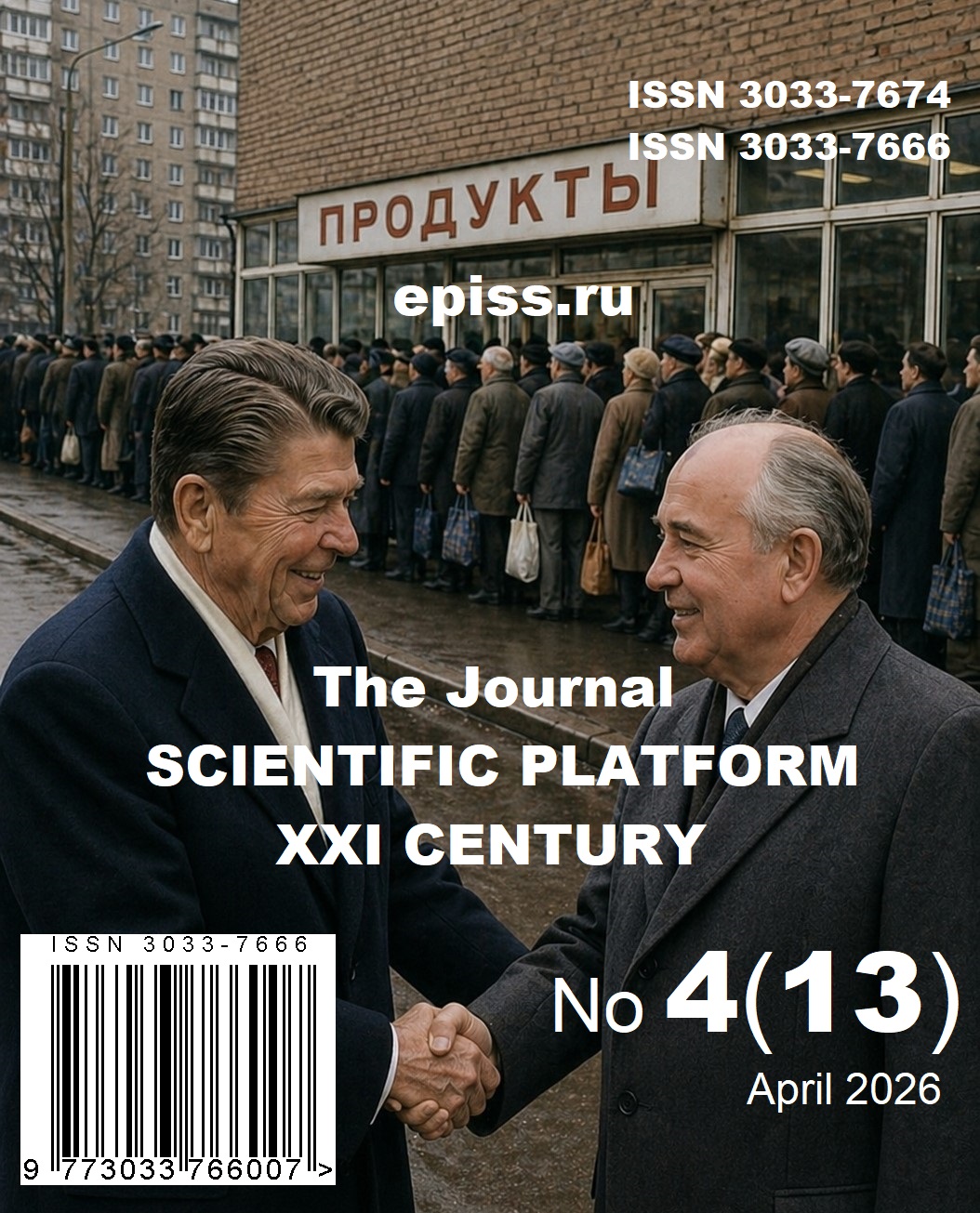



No 4 (13), April 2026 16+
http://episs.ru
ISSN 3033-7674 (Online), ISSN 3033-7666 (Print)
CERTIFICATE OF THE FEDERAL SERVICE FOR SUPERVISION IN THE FIELD OF COMMUNICATIONS,
INFORMATION TECHNOLOGY AND MASS COMMUNICATIONS (ROSKOMNADZOR)
Эл № ФС77-87449
ELECTRONIC SCIENTIFIC PERIODICAL EDITION (ST. PETERSBURG, RUSSIA)
The journal is registered and published in Russia
The journal publishes articles in all scientific fields
The journal is published in Russian and English
All articles are peer-reviewed
Free access to the electronic version of the journal
By sending an article to the editorial board, the Author confirms its uniqueness and bears full responsibility for it
Editorial staff
Editor-in-Chief
Vorontsov, Vladimir Valentinovich
Managing Editor
Ivanov, Maxim Dmitrievich
Executive Secretary
Kholmanskikh, Maria Viktorovna
Reviewers
Pyrkh, Andrey Ivanovich,
Ph.D., St. Petersburg State University
Dimitrienko, Andrey Igorevich,
Ph.D., First St. Petersburg State Medical University named after Academician I.P. Pavlov
_____________________________________________________________________________
Contacts

190031, Russia, St. Petersburg, Kazanskaya str., 35, lit. A, apt. 15

+7 931 712-95-96

nxxivek@inbox.ru
_____________________________________________________________________________
© Founder: Limited Liability Company “Polis” (OGRN 1097847170871)
190031, St. Petersburg, ext. Ter. Admiralteysky Municipal District, Kazanskaya St., 35, lit. A, apt. 15
Contents
Cover image generated by LLM GPT-5, copyright ©: Adel Kildeev © 2026, Adel Kildeev © 2026, permission to use the images by the journal has been obtained.
Gavrilov Gabriela. Western-Soviet Commercial Relations 1960-1990 and the growing Soviet debt to the West. Part 3: the 1980s……………….……..…………3
Kildeev Adel. Nippon Life v. OpenAI: Tort, Unauthorized Practice of Law and the First Private Offencive against LLM-Assisted Legal Drafting…………………………15
Kildeev Adel. Rule 12(b)(6) As the Procedural Architecture of Artifical Intelligence Litigation in the United States……………………………….………44
UDC: 339.9 (47+57) “1980”
WESTERN-SOVIET COMMERCIAL RELATIONS 1960–1990
AND THE GROWING SOVIET DEBT TO THE WEST
PART 3: THE 1980S
(HOW DEBT, OIL AND THE CHANGE IN WESTERN FIRMS’ MARKET BANKRUPTED THE SOVIET UNION)
Gabriela Gavrilov
Emerson College, Boston, Massachusetts (1996)
MA Journalism
Catholic University, Washington, D.C. (1985)
University of Warsaw, Poland (1983 – 1984)
BA Political Science / Economics
ggavrilov100@yahoo.com
http://orcid.org/0009-0008-9246-9646
Abstract. This article completes a three-part study on the economic causes of the collapse of the Soviet Union, drawing on declassified CIA materials and financial data. It advances a structural interpretation of the Soviet collapse as a balance-of-payments crisis within a rigid economic system. The analysis shows that by the late 1970s the Soviet Union had developed a dependence on hard-currency imports, external financing, and oil export revenues. The collapse of oil prices in the mid–1980s, combined with rising external debt and restricted access to credit, exposed these vulnerabilities. At the same time, partial reforms under perestroika disrupted existing coordination mechanisms without establishing a functioning market system. The article concludes that the dissolution of the Soviet Union was the final manifestation of a systemic economic and financial breakdown under changing global conditions.
Keywords. Soviet Union collapse; balance-of-payments crisis; oil price shock; external debt; perestroika; institutional failure; command economy; economic transition; hard currency dependency
The economic collapse of the Soviet Union has been widely discussed in political, ideological, and geopolitical terms. However, such approaches often overlook the structural economic mechanisms that underpinned the system’s stability and, ultimately, its failure.
The first and second articles of this series, based on declassified CIA materials and trade data, demonstrated that by the late 1970s the Soviet Union had developed a growing dependence on Western markets, hard-currency imports, and external financing. These studies also showed that this dependence was sustained by favorable external conditions, particularly high oil revenues.
This article builds on those findings and focuses on the final phase of the 1980s, when the interaction of declining oil prices, increasing debt exposure, and institutional disruption transformed structural vulnerability into systemic crisis. The aim is not to revisit political explanations, but to examine the economic dynamics that led to the dissolution of the Soviet Union.
This section builds upon the findings of the first and second articles of this series, where, based on declassified CIA materials and trade data, it was demonstrated that the expansion of Soviet-Western commercial relations during the détente period created not only increased trade flows, but also a growing structural dependence on external markets and financial mechanisms.
While détente is often interpreted in political terms, its economic dimension reveals a more complex dynamic: the integration of the Soviet economy into Western financial and industrial systems under conditions that gradually increased its exposure to external constraints.
As a direct consequence of a succession of large-scale commercial deals with Western firms during the détente era (1969–1979), as of early 1980, the Soviet Union’s gross debt to the West was roughly $17 billion to $18 billion in hard currency, a level that was considered relatively modest compared to its export earnings and the debt loads of Eastern European neighbors like Poland.[1] The Soviet Union’s gross debt to Western creditors was relatively low at the start of the 1980s but grew significantly due to food imports and economic struggles, with gross debt reaching approximately $31 billion by the end of 1985. By late 1980, the Soviet hard-currency reserves in Western banks were $8.3 billion, decreasing to $4.5 billion by September 1981, signaling growing financial strain. By 1982, Soviet debt to Western export credit agencies alone stood at $12 billion. The debt continued to climb throughout the 1980s to nearly $70 billion by 1991.[2] Taken together, these figures indicate not merely an expansion of borrowing, but the formation of a structurally vulnerable financial position. The Soviet economy became increasingly dependent on a continuous inflow of hard currency to sustain imports, service debt, and maintain internal stability.
As shown in the first article of this series,[3] this dependency was not offset by corresponding improvements in productivity or institutional adaptation. Instead, it was sustained by favorable external conditions, particularly the availability of credit and high export revenues. This created a latent imbalance: the system remained stable only as long as external conditions continued to support it.
In 1980, the Soviet Union’s gold reserves were estimated to be substantial, often cited near 1,000 to 2,000 tons by different analysts, before significant sales in the early 1980s reduced them to pay for foreign grain and pay off debt. While specific annual figures were state secrets, CIA data suggests Soviet gold production capacity rose to 340-390 tons by 1985.[4] The Soviet government also held substantial deposits in Western banks (about $6 billion to $8 billion), making the net debt significantly lower—around $9.6 billion to $10 billion. The debt was relatively stable at the very beginning of the 1980s compared to the mid-1970s, but it began rising again due to economic pressures in 1981, reaching approximately $19 billion to $20 billion (gross) by the end of 1981–1983. The Soviet debt to the West was manageable at the start of 1980, but it expanded rapidly later in the decade, exceeding $30 billion by 1985 and reaching over $60–70 billion by 1991.
The apparent manageability of Soviet debt in the early 1980s should therefore be interpreted with caution. Formal indicators, such as gross debt and reserve levels, did not fully reflect the underlying structural exposure of the system. A significant portion of Soviet external obligations was embedded in long-term trade arrangements and counter-trade agreements, which limited the ability of the Soviet Union to generate freely disposable hard currency. As a result, the capacity to respond to external shocks was more constrained than aggregate figures might suggest.
All of these billions of dollars, it should be kept in mind, had either already been paid to Western firms via borrowed funds from Western governments or private banks, or were still owed to them. All of these billions were being transferred from the supposed anti-capitalist communist Soviet government to the leading Western industrial and financial actors.
Barter and buy-back debt in the form of products and resources contractually owed Western firms—such as the 20-year, $20 billion counter-trade agreement made with Armand Hammer’s Occidental Petroleum in 1972 which stipulated regular deliveries of ammonia and urea to the US, many of the 234 chemical plant and equipment deals and the “gas for pipes” deals with West German firms—were treated as “zero-cash” transactions. Therefore, the expense of producing natural gas and chemicals for export to the West did not raise hard currency with which to pay off these debts since, by contract, these resources were already owed to the Western firms which had installed their equipment inside Soviet Russia to extract them—at Russia’s expense. From an economic perspective, such arrangements did not eliminate financial obligations but transformed them into deferred and structurally embedded commitments. While these agreements reduced the immediate need for cash payments, they simultaneously constrained future revenue streams.
As discussed in the second article of this series,[5] this mechanism contributed to a situation in which a portion of Soviet export output was effectively pre-allocated, limiting the flexibility of the system in generating hard currency for independent financial use. Thus, what appeared as a reduction of monetary pressure in the short term contributed to increased structural rigidity in the long term.
Rather than framing these relationships in normative terms, it is more analytically accurate to describe them as a form of asymmetric economic integration. The Soviet Union gained access to Western technology, credit, and markets, but did so under conditions that increased its long-term external dependence.
This asymmetry did not immediately produce instability, but it contributed to a structural configuration in which the Soviet economy became increasingly sensitive to changes in external economic conditions.
The foundations of the 1980s financial crisis were laid during the 1970s commercial deals fostered supposedly to improve diplomatic relations through increased East-West trade—often presented as a universal solution to geopolitical tensions.[6] During the 1970s, the Soviet Union’s expenditure on Western products increased dramatically under détente, rising oil revenues, and a growing dependence on foreign technology and agricultural products. Hard currency imports from the West grew ninefold, rising from less than 25 percent of total imports to nearly 40 percent by the end of the decade.[7]
As established in the previous section, the expansion of East-West trade during the détente period was accompanied by a growing reliance on external inputs and financial mechanisms. The developments of the 1970s therefore did not merely reflect economic growth, but also deepened the structural dependence of the Soviet economy on external conditions. This period should be understood not only as a phase of increased trade, but as a critical stage in the formation of the external constraints that would later define the limits of Soviet economic stability.
The value of imports from the West rose from roughly $5 billion–$8 billion annually in the early 1970s to over $30 billion–$40 billion by 1980. Hard currency outlays for Western products saw significant surges, particularly after 1972 due to agricultural failures and machinery needs. Imports from the West increased at an average annual rate of 8.7% in constant 1981 dollars.[8] The scale of this expansion reflects a qualitative shift in the Soviet economic model. Imports were no longer supplementary but became essential for maintaining industrial output, agricultural supply, and consumer stability. As discussed in the first article of this series, this growing reliance on imports was not matched by a corresponding increase in export diversification. Instead, the Soviet Union remained heavily dependent on a narrow range of commodity exports, primarily oil and gas, to generate the hard currency required for these transactions.
Following the 1973 oil crisis, international oil prices quadrupled. As a top producer the Soviet Union benefited from a massive influx of hard currency. However, instead of using this windfall to reform the stagnant, heavily bureaucratic command economy, its damaging reliance on state-dictated prices and poor agricultural performance, the Kremlin used it to pay Western firms for their products. The increase in oil prices following the 1973 crisis temporarily masked underlying structural weaknesses within the Soviet economy. Rising export revenues created the appearance of financial stability, allowing the Soviet Union to sustain high levels of imports and external commitments without immediate adjustment. However, this stability was contingent on external price conditions rather than internal economic resilience. As a result, the system became increasingly dependent on continued high energy prices, creating a structural vulnerability that would only become visible when those conditions changed.
Hard currency enabled the USSR to import grain, machinery, and consumer goods from the West, which provided the massive market Western firms needed, but did not foster an improvement of domestic economic practices or even an understanding of the changing Western economy that was shifting away from heavy industry—a foundation of the Soviet economy.
Thus, by the end of the 1970s, the Soviet Union had developed a pattern of economic behavior characterized by increasing reliance on external markets, hard-currency imports, and commodity-based export revenues. While this model appeared sustainable under favorable external conditions, it lacked the flexibility required to withstand adverse shifts in global markets.
The developments of the 1970s therefore laid the structural foundations for the financial crisis of the 1980s, when the combination of declining oil prices and accumulated external exposure would transform latent vulnerability into systemic instability.
Possibly one of the most significant factors which affected the Soviet economy was the fact that by the mid-1970s the US industrial sector was shifting to the cheap labor (and absence of pollution regulations) of Asia. US industrial plants and manufacturing jobs began relocating to Asia in the 1970s, marking the early stages of a long-term shift that accelerated in subsequent decades. While the large-scale exodus often associated with China did not peak until the 1990s and 2000s, the foundation for this shift was laid between 1965 and 1975, with major US retailers establishing offices and plants in Hong Kong, Taiwan, and South Korea.
This shift should be understood as part of a broader transformation of the global economic system rather than a discrete policy decision directed at the Soviet Union. The reorientation of industrial production toward Asia reflected changes in cost structures, regulatory environments, and emerging global supply chains. As a result, the structure of international demand for industrial goods began to change, reducing the relative importance of traditional industrial markets.
Formed by decades of serving as a captive market for Western industrial firms, the Soviet economy was still pursuing industrial growth in the 1970s and was badly in need of industrial modernization. This aspect has received limited attention in the existing literature, as it complicates conventional interpretations of Soviet-Western economic relations. The gradual decline in external demand for Soviet-oriented industrial exchange did not by itself determine the outcome of the Soviet economy. However, it reduced the external support for a development model that depended on continued industrial expansion and technological imports from the West. In this context, the Soviet economy faced increasing constraints not as a result of deliberate exclusion, but due to structural changes in global production and trade patterns.
Moreover, as a neocolonial economy based on the export of natural resources, Soviet Russia essentially continued to be an industrial country. Nevertheless, US firms were no longer in need of the Soviet industrial market. This alone spelled disaster for the Soviet economy, based as it was on the whims of Western industrial firms’ capricious market needs. While this shift did not constitute a direct cause of the Soviet collapse, it contributed to an increasingly unfavorable external environment. The reduced relevance of Soviet industrial demand limited opportunities for economic adjustment and diversification. As a result, the Soviet Union became more dependent on commodity exports, particularly energy resources, further reinforcing the structural vulnerabilities discussed in the previous sections.
Thus, the transformation of the global industrial system in the 1970s and 1980s did not directly determine the fate of the Soviet economy, but it altered the external conditions under which that economy operated. Combined with increasing dependence on external financing and commodity-based revenues, these structural changes contributed to a configuration in which the Soviet system became progressively less adaptable to external shocks.
By the end of the 1980s, the Soviet economy had entered a phase in which previously accumulated structural dependencies began to translate into immediate financial pressures. The interaction between declining export revenues, growing external obligations, and institutional disruption created conditions in which continued borrowing became the primary mechanism for maintaining economic stability. This stage marks the transition from structural vulnerability to active financial stress within the Soviet system.
As the 1970s ended, the Soviet economy required constant capital to upgrade aging machinery and fill the gap left by inefficient and wasteful agricultural practices (exacerbated by poor conditions) which left the USSR—the nation with the greatest quantity of black earth on the planet—grain deficient. When the Soviet Union launched the expensive invasion of Afghanistan in 1979, the drain on state coffers increased.
Since communist states were reliable borrowers backed by state power, International banks competed to lend. Much of this debt was initially accumulated by satellite states like Poland, which, by the early 1980s, were already struggling with repayment, creating a “70 billion dollar dilemma” for Moscow regarding whether to bail them out. By 1980, Eastern Bloc hard currency debt exceeded $80 billion, a massive jump from just $8 billion in 1971.
The rapid accumulation of debt across the Eastern Bloc further amplified the financial exposure of the Soviet Union. As the central economic and political anchor of the bloc, the USSR faced implicit obligations to support its satellite economies, increasing pressure on its own financial resources. This interconnected structure of liabilities contributed to a situation in which external financial stress was not isolated, but systemic.
When reforms brought by perestroika included an end to the state’s monopoly of foreign trade and the Ministry of Foreign Trade was abolished in January 1988, it was replaced with new laws allowing state enterprises, joint ventures, and cooperatives to conduct foreign trade directly. While the state retained control over key commodities, the centralized command system for all foreign trade was dismantled. While necessary, this also created a large swath of independent foreign traders in the Soviet economy—endowed with the power to borrow international funds but little financial responsibility or experience.
From an institutional perspective, these reforms introduced a critical destabilizing dynamic. The centralized system of economic coordination was partially dismantled, while a coherent market framework had not yet been established. As a result, the Soviet economy entered a state of structural incoherence: economic actors gained access to international markets and credit without the corresponding regulatory discipline or financial accountability mechanisms. As discussed in the second article of this series, this represents a classic case of partial liberalization, where the removal of existing controls precedes the formation of new institutional structures.
Binge Borrowing
According to the 1991 RAND report on “Soviet International Finance in the Gorbachev Era”, “During the first three and a half years of the Gorbachev era, Soviet foreign borrowing amounted to only about $800 million. In 1989, though, the Soviet Union embarked on what can only be called a borrowing binge, Soviet borrowing during 1989 was $9.1 billion—more than ten times the borrowing of the preceding three and a half years. The first quarter of 1990 saw an additional $3 billion in net borrowing from Western banks alone.”
The sharp increase in borrowing during 1989–1990 should be interpreted not as a sign of financial strength, but as an indicator of escalating systemic stress. As export revenues declined and financial obligations increased, borrowing became a means of postponing adjustment rather than resolving underlying imbalances. This strategy was inherently unsustainable. It depended on continued access to external credit markets, which was itself contingent on creditor confidence and exposure limits.
Even while Soviet importers were falling behind on their payments (which had never happened under communism), Western banks continued to lend. The borrowing binge came to an abrupt end in the second quarter of 1990, when Western banks—who had reached their lending limit—cut off hard currency credit to the Soviet Union on normal commercial terms. Net borrowing from the West during 1989 was about $10 billion (including payment arrearages).[9]
The curtailment of lending by Western banks in 1990 represents a decisive turning point. At this moment, the Soviet Union effectively lost access to the external financing mechanisms that had sustained its economic model throughout the previous decade.
Without the ability to roll over debt or secure new credit, the system entered a full-scale external liquidity crisis. The constraints that had previously been structural and latent became immediate and binding.
Aside from the stories of apartments filled with cash, (which the RAND report does not mention), what happened to the borrowed billions? The RAND report claims a major portion of that money was transferred to developing countries. “Significant amounts of hard currency (a few billion dollars per year) were being passed on by the Soviet Union to developing countries in the form of hard-currency loans.”[10]
But if this was known, why did Western banks allow it? And since they allowed it, it seems there must have been something in those transfers for them such as another black hole where money disappears during wars and other times of upheaval never to be seen again by the tax-paying public. (The RAND report never asks these questions, it simply says it remains “puzzling”). Approximately $67 billion in funds borrowed by the Soviet Union was transferred to developing countries.[11]
These capital outflows further reduced the availability of hard currency within the Soviet economy. Regardless of their strategic or political motivations, they contributed to tightening financial constraints at a time when external resources were already under pressure. In this context, the allocation of borrowed funds became an additional factor limiting the system’s ability to stabilize its external financial position.
Why Did Soviet International Payments Fall Into Arrears?
All delays in payments owed to Western interests were by those foreign trade organizations newly bestowed with the decentralized power of foreign trade after the Ministry of Foreign Trade was abolished.[12] Those enterprises entered directly into trade transactions with Western firms, in short, overextended themselves and when they looked to the Vnesheconombank (VEB)[13], or the Bank for Foreign Economic Affairs, for assistance, VEB refused to bail them out.
As new Soviet trade enterprises increasingly failed to make timely payments to Western firms, Western firms in turn began refusing to do business with them without irrevocable letters of credit, either from VEB, Western banks or governments. As Western banks’ financial exposure reached certain limits, they began refusing to lend more. And suddenly, in the second quarter of 1990, the Soviet Union found itself locked out of the Western banking world without a way back in.
The emergence of payment arrears marked a critical shift in the perception of Soviet creditworthiness. Delays in fulfilling financial obligations signaled increasing instability to external partners, leading to stricter lending conditions and reduced willingness to extend further credit. This dynamic created a feedback loop in which declining financial credibility further restricted access to liquidity, intensifying the crisis.
By the beginning of the 1990s, the Soviet Union had reached a point at which its external financial position was no longer sustainable. The combination of accumulated debt, restricted access to credit, declining export revenues, and institutional fragmentation left the system without viable adjustment mechanisms. The financial crisis that emerged at this stage was not an isolated development, but the culmination of structural processes that had been unfolding throughout the preceding decades.
By the mid-1980s, the structural vulnerabilities that had developed over the previous decade began to converge. The Soviet economic system, already dependent on external revenues and financing, became increasingly exposed to changes in global market conditions. The decline in oil prices did not create these vulnerabilities, but it acted as the critical trigger that transformed structural imbalance into systemic crisis.
Had the Soviet Union still been enjoying the income from the high oil prices of the 1970s, Western banks may have agreed to continue to loan on the basis of income. However, the most critical factor in the Soviet bankruptcy was the collapse of oil prices. Oil prices fell from roughly $120 a barrel in 1980 to roughly $24 a barrel in March 1986, and even lower subsequently. Oil and gas exports were the primary source of hard currency needed to repay Western debt. The revenue shortfall brought the USSR to the brink of a balance-of-payments crisis, forcing the leadership to slash imports, including essential consumer goods and food. Given the central role of oil and gas exports in generating hard currency, this decline translated directly into a contraction of financial capacity. Export revenues fell sharply, reducing the Soviet Union’s ability to finance imports and service its external debt.
As established in the previous sections, the Soviet economy lacked diversified sources of foreign exchange. This made the system highly sensitive to fluctuations in commodity prices, particularly in the energy sector.
As the USSR earned less from oil, the cost of servicing its debt increased. The early 1980s were characterized by high Western interest rates, making it far more expensive to service the billions in loans accumulated in the previous decade. As economic problems became obvious, Western bankers, now at many of their self-imposed exposure limits, cut off the USSR’s access to new loans.
At the same time, the cost of servicing existing debt increased under conditions of high global interest rates. This further intensified financial pressure, as the Soviet Union was required to allocate a growing share of its limited hard-currency resources to debt obligations. The interaction of declining revenues and rising financial commitments created a rapidly deteriorating external position.
Moreover, the ten-year Soviet occupation of Afghanistan (1979–1989) acted as a major financial drain, costing billions of rubles that the stagnating economy could not afford, further exacerbating the budget deficit. While the financial burden of the Afghan war alone was not decisive, it contributed to the overall strain on the Soviet budget. In the context of declining revenues and increasing external obligations, such expenditures reduced the capacity of the state to respond to emerging economic pressures.
When Mikhail Gorbachev became General Secretary in 1985, he recognized the crisis and launched perestroika and glasnost. However, these reforms, intended to fix the economy, ironically accelerated its collapse. Perestroika sought to inject market elements into the command economy. Instead of a smooth transition, it broke the existing central planning system without creating a functional market to take its place. Managers of state-owned enterprises (SOEs) were given more autonomy but faced chaos. Supply chains were broken, leading to a drastic drop in industrial output.
In this context, perestroika did not function as a stabilizing reform, but as a factor that accelerated systemic disintegration. The partial liberalization of the economy weakened existing coordination mechanisms without establishing effective market structures. As a result, the Soviet economy lost the ability to manage both internal distribution and external financial relations in a coherent manner, further amplifying the effects of external shocks.
To fund increasing budget deficits—caused by falling oil revenue, the Afghan war, and subsidies—the government turned to printing money. Wages were allowed to rise faster than production to appease workers. Since prices were still fixed by the state, consumers couldn’t spend their money, leading to massive shortages, long lines, and a thriving black market. By 1991, as price controls began to fail, “repressed inflation” erupted into open inflation, with the real inflation rate approaching 200% by 1991.
By the end of the 1980s, the Soviet Union had exhausted its ability to borrow from Western banks and was forced to rely on assistance from Western governments. The nation that once competed with the US was, in 1991, reliant on foreign aid to import food for its citizens.
These internal imbalances reflected the external constraints facing the Soviet economy. The inability to secure sufficient imports due to hard-currency shortages translated directly into domestic shortages, while fiscal pressures contributed to monetary expansion and inflationary dynamics. Thus, the internal crisis of supply and prices was closely linked to the deterioration of the external financial position.
As the central government lost its capacity to sustain economic coordination and financial stability, the institutional framework of the Soviet state began to fragment. The weakening of fiscal and administrative control reduced the ability of the center to manage the economy, contributing to the broader process of political disintegration.
The failed coup in August 1991 by communist hardliners, who tried to stop the reforms, only served to weaken the central government’s control over the military and the treasury. By December 1991, the union was dissolved, and the Russian Federation, as the successor state, was left with the enormous burden of Soviet debt.
By 1991, the Soviet Union had effectively exhausted its capacity to operate as a coherent economic system. The combination of declining export revenues, accumulated debt, restricted access to credit, and institutional fragmentation left no viable mechanism for stabilization. The crisis that emerged was not the result of a single external shock or policy failure, but the culmination of long-term structural processes that had progressively undermined the system’s economic foundation.
The conclusions presented here build upon the findings of the first and second articles of this series, where it was demonstrated, based on declassified CIA materials and trade data, that the Soviet economy had developed a growing dependence on external markets, hard-currency imports, and financial mechanisms by the late 1970s.
The decline in oil prices in the mid-1980s did not, by itself, cause the collapse of the Soviet Union. Rather, it acted as a critical trigger that exposed the structural vulnerabilities that had accumulated during the previous decade.
As demonstrated throughout this series, the Soviet economy lacked diversified sources of hard-currency income, making it particularly sensitive to external price fluctuations.
The Soviet Union did not fail because of a lack of resources or technology, but because of its inability to adapt its economic structure to a changing world. No longer needed as a market for industrial firms of the West, which had shifted to Asia, the basis of the Soviet economy—industry—was now obsolete. The 1980s debt crisis, amplified by the collapse of oil prices and exacerbated by clumsy reforms, forced the system into a corner from which it could not escape. From an institutional perspective, the reforms of the late 1980s intensified the crisis by disrupting existing coordination mechanisms without establishing a stable alternative. This reduced the capacity of the system to respond effectively to both internal and external pressures.
The bankruptcy was the final, inescapable outcome of an outdated economic model that had largely functioned as a captive market for western industrial firms, once they no longer needed Russia’s sealed economy, and had built up the capacity to fill the former communist countries with consumer goods (which they did not have the capacity to do up until that time) the communist system was allowed to fall by the wayside—without concern for the people that lived under it. These factors should be understood not in isolation, but as elements of a broader structural configuration. The interaction between external economic conditions and internal institutional constraints created a system that was increasingly difficult to sustain over time.
The Soviet Union therefore did not simply collapse under the weight of its own inefficiencies. Its internal weaknesses were real, but they were also observed, measured, and strategically used by Western policymakers and financial actors. Declassified CIA materials discussed in this series show that Soviet debt exposure, hard-currency shortages, and dependence on Western credit were understood as instruments of influence rather than neutral economic facts. In this sense, the destruction of the Soviet economic system was not a single act, nor a simple conspiracy, but a prolonged process in which internal fragility and external pressure interacted. The Soviet Union was structurally vulnerable; the West learned how to use that vulnerability.
Now the only thing left to fight over in Russia is oil and gas…but that’s another article.
References:
1. Electronic resource: Secret CIA National Intelligence Council Memorandum, (April 1982) “The Soviet Bloc Financial Problem as a Source of Western Influence (u)”, (Released 2007/03/27). https://www.cia.gov/readingroom/docs/CIA-RDP85T00176R001300110002-9.pdf
2. C.R. Neu (2009). Soviet International Finance in the Gorbachev Era, RAND, National Defense Research Institute, Prepared for the Under Secretary of Defense for Policy, R-4116-USDP.
3. Gavrilov G., Western-Soviet Commercial Relations 1960-1990 and the Growing Soviet Debt to the West, Part 1: 1960s, Scientific Platform XXI Century, # 2 (11) 2026, www.episs.ru.
4. Gavrilov G., Western-Soviet Commercial Relations 1960-1990 and the Growing Soviet Debt to the West, Part 2: 1970s, Scientific Platform XXI Century, # 3 (12) 2026, www.episs.ru.
5. Secret CIA Memorandum for Rhonda Bresnick, Office of East-West Trade, (January 25, 1980). “Soviet Gold Sales in 1979 and Prospects for the 1980s”, (Released as sanitized September 16, 2008).
6. Secret CIA Report, “Soviet Economic Dependence on the West”, IA-RDP83T00233R000100030006-5. (Released as Sanitized, April 29, 2010)
7. Secret CIA Report, “Soviet Hard Currency Trade and payments: Policy and Prospects, ” RDP08S01350R000100120002-2. (Released as Sanitized, Sep. 15, 2008).
8. C. R. Neu (1991). “Soviet International Finance in the Gorbachev Era”, RAND. ISBN: 0-8330-1185-5.
UDC: 347.9:004.8
NIPPON LIFE v. OPENAI: TORT, UNAUTHORIZED PRACTICE OF LAW AND THE FIRST PRIVATE OFFENSIVE
AGAINST LLM-ASSISTED LEGAL DRAFTING
Kildeev Adel Khanyafievich
Leningrad State University named after A.A. Zhdanov (1990)
PhD in Law
ORCID: 0009-0001-2211-4944
Abstract. This article examines Nippon Life v. OpenAI as one of the first private lawsuits directed against LLM-assisted legal drafting. It argues that the complaint raises a serious regulatory issue but does so through a structurally unstable theory of liability. While the complaint correctly describes ChatGPT as an automated system, it then proceeds as if the model were a knowing and intentional legal actor. The article analyzes this tension through the doctrines of personal jurisdiction, tortious interference, abuse of process, unauthorized practice of law, and Rule 12(b)(6). It concludes that the complaint is likely vulnerable both jurisdictionally and at the pleading stage yet remains important because it opens a broader debate about the admissibility of artificial intelligence within licensed professional spheres and about the future boundary between human responsibility and machine-assisted professional work.
Keywords: Artificial intelligence; large language models; OpenAI; unauthorized practice of law; legal drafting; personal jurisdiction; Rule 12(b)(6); licensed professions.
When preparing the article, the author used generative AI systems, including, but not limited to: ChatGPT (OpenAI), Gemini (Google), Grok (xAI). All final decisions are made personally by the author.
Chapter 1. Introduction
The rapid development of generative artificial intelligence has produced not only technological and economic change, but also an expanding body of litigation in the United States. Claims involving AI systems and their developers now arise across multiple doctrinal fields, including copyright, privacy, consumer protection, antitrust, employment, and professional regulation. AI litigation is therefore beginning to emerge as a recognizable category of disputes with its own recurring factual patterns, legal tensions, and procedural filters.
This article examines the complaint in Nippon Life Insurance Company of America v. OpenAI Foundation et al. and evaluates both its substantive structure and the principal defenses likely available to the defendants.[14] The case is of particular interest because it attempts to connect large language model output with legally cognizable downstream harm in the context of litigation-related conduct. In that respect, the dispute differs from the now familiar categories of AI litigation centered on copyright, training data, or platform governance. Instead, it asks whether allegedly AI-generated legal-style output can support private civil claims framed through traditional doctrines such as tortious interference with contract, abuse of process, and unauthorized practice of law.
Methodologically, this article combines doctrinal legal analysis, close reading of the complaint, and selective comparison with other AI-related disputes in U.S. courts. Its central premise is that pleadings of this kind must be examined at two levels simultaneously. First, they must be tested on their own doctrinal terms: the factual allegations, the legal elements of each asserted claim, and the internal coherence of the pleading. Second, they must be examined through the procedural discipline of federal civil procedure, especially personal jurisdiction and Rule 12(b)(6), which operate as early filters against claims that are rhetorically ambitious but doctrinally fragile.
The central argument of this article is that the complaint is undermined by what may be called ontological instability. On the one hand, the pleading correctly describes ChatGPT as an automated text-generation system. On the other hand, it repeatedly proceeds as if the model were a knowing, intentional, and reasoning legal actor capable of inducing, deciding, or misusing legal process in its own right. That slippage is not merely stylistic. It distorts the analysis of each asserted cause of action, obscures the proper allocation of responsibility among user, operator, and model, and risks replacing actor-specific pleading with anthropomorphic suggestion.
The case is significant not because it necessarily presents a strong complaint, but because it reveals an emerging institutional anxiety in unusually exposed form. Much of the current legal and public debate around generative AI has focused on authorship, training data, bias, competition, and hallucinations in the abstract. Nippon Life points in a different direction. It concerns the possible entry of LLM-assisted systems into the licensed professional sphere, and more specifically into litigation practice. In that sense, the complaint fails in a way that is jurisprudentially instructive: it appears to identify a genuine regulatory concern, but translates that concern into the wrong doctrinal language.
This distinction matters. The deeper problem raised by the case is not whether a machine can be treated as a lawyer in any literal sense, but whether legal systems are prepared to distinguish assistance from delegation, usefulness from admissibility, and instrumental output from professional responsibility. A system may generate text that appears formally competent, but functional competence does not itself create legal agency, legal personhood, or professional standing. Courts, regulators, and litigants must therefore confront a boundary question: which functions may be assisted by AI tools, which may be supervised, and which remain non-delegable because they belong to the core of licensed human judgment and institutional accountability.
The likely fate of this litigation will therefore be determined less by abstract claims about artificial intelligence than by familiar procedural and doctrinal constraints. Personal jurisdiction may provide the first and most formidable defense. Even if the complaint survives the jurisdictional stage, Rule 12(b)(6) and the pleading standards associated with Twombly and Iqbal remain substantial obstacles. A complaint that attributes knowledge, intent, or legal agency to an instrumental system without clearly identifying the relevant human or corporate actor risks collapsing the distinctions on which tort law, procedural law, and professional regulation all depend.
Accordingly, the article proceeds in several steps. Chapter 2 reconstructs the structure of the complaint and identifies its principal allegations. Chapter 3 examines the complaint’s doctrinal and ontological instability, with particular attention to the way it shifts between instrumental and actor-like descriptions of ChatGPT. Chapter 4 analyzes the principal threshold defenses, including personal jurisdiction and the likely operation of Rule 12(b)(6). Chapter 5 then considers the broader implications of the case for licensed professions and for the boundary between permissible technological assistance and non-delegable human responsibility. The conclusion argues that future litigation and regulation in this field must address institutional incursion without fictionalizing machine agency.
The broader jurisdictional picture is important for the analysis of Nippon Life Insurance Company of America v. OpenAI Foundation et al. The case was filed not in Northern California, but in the Northern District of Illinois on March 4, 2026. Public docket sources identify it as case No. 1:26-cv-02448. Reuters described it as a suit accusing OpenAI of unauthorized legal practice through ChatGPT in connection with litigation pursued by a former disability claimant.[15] In that sense, the case stands apart from the more familiar cluster of AI disputes centered on training data, copyright, or market structure. Its significance lies precisely in showing that AI litigation is expanding beyond its original doctrinal and geographic core into areas such as legal-process harms, professional-regulation analogies, and novel private claims against AI developers.
For that reason, any academic study of AI litigation should avoid reducing the field either to Silicon Valley copyright cases or to abstract debates about machine agency. The more useful approach is to treat AI litigation as a developing category of disputes in which familiar doctrinal tools are being applied to technologically mediated conduct across different jurisdictions. On that view, Northern California is the main center of gravity because of institutional concentration, accumulated case experience, and the location of major companies. But it is not an exclusive forum, and cases filed elsewhere may prove especially revealing precisely because they test different legal theories and different judicial environments. Nippon v. OpenAI is one such case.
Chapter 2. Description of the Complaint
Nippon Life Insurance Company of America v. OpenAI Foundation and OpenAI Group PBC was filed in the United States District Court for the Northern District of Illinois on March 4, 2026, as Case No. 1:26-cv-02448.[16] Public docket sources identify Nippon Life Insurance Company of America as the plaintiff and OpenAI Foundation together with OpenAI Group PBC as defendants. The publicly accessible complaint is filed as Document 1 and runs approximately 50 pages.
The complaint alleges that Nippon Life Insurance Company of America is a life-insurance company organized under the laws of Iowa, with its principal place of business in New York, New York. It further alleges that OpenAI Foundation is a Delaware nonstock corporation with its principal place of business in San Francisco, California, and that OpenAI Group PBC is a Delaware public benefit corporation, also headquartered in San Francisco. The pleading invokes federal diversity jurisdiction under 28 U.S.C. § 1332, expressly alleging complete diversity of citizenship and an amount in controversy exceeding $75,000, exclusive of interest and costs.
At the procedural level, the case is significant because it does not arise from the now-familiar clusters of AI litigation involving training data, copyright, or competition law. Instead, the complaint seeks to connect allegedly AI-generated legal-style output with downstream litigation-related harm allegedly suffered by an adverse party. In that respect, the case presents a more unusual procedural and doctrinal posture: it attempts to convert the use of a generative AI system in a legal context into private civil claims asserted by a non-user against the AI developer. This feature alone distinguishes the action from many earlier suits against AI companies and makes it especially relevant for the study of pleading sufficiency and threshold defenses.
As filed, the complaint asserts three substantive counts: tortious interference with contract, unauthorized practice of law, and abuse of process. It also seeks compensatory and punitive damages, along with declaratory and injunctive relief. Thus, from the outset, the case presents not merely a factual dispute about AI output, but a structured attempt to frame such output within established causes of action and remedial categories of U.S. civil litigation.
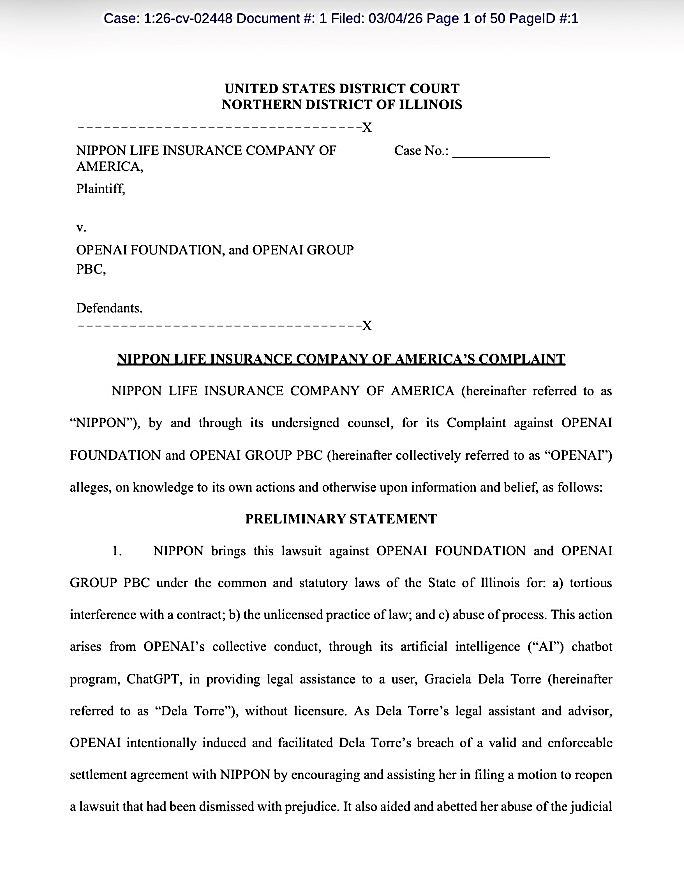
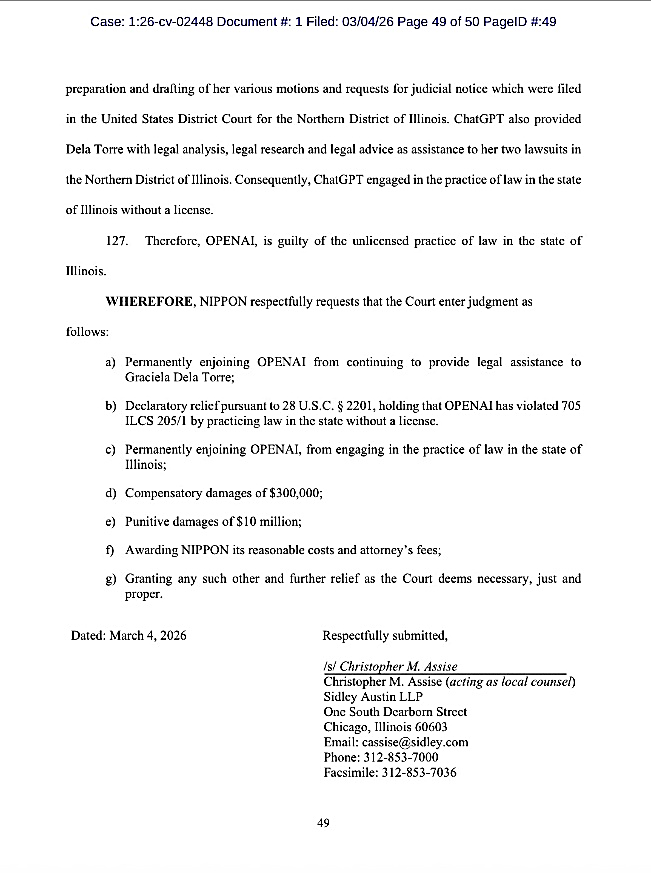
Pic 1. The first and the last page of the Complaint
Given that access to U.S. court records from Russia may be limited due to U.S. government sanctions-related restrictions and given the importance of precise legal language and the importance of legal language to understanding a court case, selected excerpts are reproduced below in translation (translated by Microsoft translation and reviewed by the author). The excerpts below are cited not as evidence of the merits, but to illustrate the plaintiff’s pleading theory and legal framing:
PRELIMINARY STATEMENT
1. NIPPON brings this lawsuit against OPENAI FOUNDATION and OPENAI GROUP PBC under the common and statutory laws of the State of Illinois for: a) tortious interference with a contract; b) the unlicensed practice of law; and c) abuse of process. This action arises from OPENAI’s collective conduct, through its artificial intelligence (“AI”) chatbot program, ChatGPT, in providing legal assistance to a user, Graciela Dela Torre (hereinafter referred to as “Dela Torre”), without licensure. As Dela Torre’s legal assistant and advisor, OPENAI intentionally induced and facilitated Dela Torre’s breach of a valid and enforceable settlement agreement with NIPPON by encouraging and assisting her in filing a motion to reopen a lawsuit that had been dismissed with prejudice. It also aided and abetted her abuse of the judicial process.
2. As a direct result of OPENAI’s wrongful conduct, NIPPON has been forced to spend significant time and resources relitigating settled claims, incurring substantial legal fees, costs, and other damages.
JURISDICTION
3. The Court has diversity jurisdiction over this lawsuit pursuant to 28 U.S.C. § 1332 since the Parties are citizens of different states. NIPPON is a domestic insurance company incorporated in the state of Iowa with its principal place of business in New York, New York. OPENAI FOUNDATION and OPENAI GROUP PBC are both corporations incorporated in Delaware with their principal place of business in San Francisco, California. The amount in controversy exceeds $75,000.
VENUE
4. Venue is proper in this district under 28 U.S.C. § 1391(b)(2) in that a substantial part of the events or omissions giving rise to this Complaint occurred in this district.
LAW
A. Tortious Interference With a Contract
14. A claim for tortious interference with a contract – whereby a third party unjustifiably interferes with or induces a party to breach a contract – is well established under Illinois law. See Herman v. Prudence Mut. Cas. Co., 41 Ill.2d 468 (1969); citing Doremus v. Hennessy, 176 Ill. 608, 52 N.E. 924, 54 N.E. 524, 43 L.R.A. 797 (1898); London Guarantee and Accident Co. v. Horn, 206 ILL. 493, 69 N.E. 526 (1903); Carpenters’ Union v. Citizens Committee to Enforce Landis Award, 333 Ill. 225, 164 N.E. 393, 63 A.L.R. 157 (1928). “The tort recognizes that individuals have a property interest in their business relationships, such that those interests should be free from harm by thers.” Webb v. Frawley, 906 F.3d 569, 577 (7th Cir. 2018); citing Belden Corp v. InterNorth, Inc., 90 Ill.App.3d 547, 45 Ill.Dec. 765, 413 N.E.2d 98, 101 (1980).
15. To state a claim for tortious interference with a contract “a plaintiff must allege facts sufficient to establish: 1) a valid contract, 2) defendant’s knowledge of the contract, 3) defendant’s intentional and unjustified inducement of a breach of the contract, 4) a subsequent breach of contract caused by defendant’s wrongful conduct, and 5) damages. Webb at 577; citing Healy v. Metro. Pier & Exposition Auth., 804 F.3d 836, 842 (7th Cir. 2015); HPI Health Care Servs., Inc. v. Mt. Vernon Hosp., Inc., 131 Ill.2d 145, 137 Ill.Dec 19, 545 N.E.2d 672, 676 (1989).
16. Inducement may be any conduct conveying the third party’s desire to influence the contracting party to breach the contract. “Thus it may be a simple request or persuasion exerting only moral pressure. Or it may be a statement unaccompanied by any specific request but having the same effect as if the request was specifically made.” Restatement (Second) of Torts § 766(k) (1979).
17. A programmer may be held liable for tortious interference with a contract when they knowingly design, market, and support software intendent to facilitate unlawful conduct. See MDY Industries, LLC v. Blizzard Entertainment, Inc., 629 F.3d 928 (9th Cir. 2010). Intent may be inferred where the developer has actual knowledge of user’s violations and takes affirmative steps that materially contribute to those violations. Id.
B. Abuse of Process
18. Pursuant to the Second Restatement of Torts “[o]ne who uses a legal process, whether criminal or civil, against another primarily to accomplish a purpose for which it is not designed, is subject to liability to the other for harm caused by the abuse of process.” Restatement (Second) of Torts § 682. Commentary on the Restatement notes that the gravamen of the misconduct “is not the wrongful procurement of legal process or the wrongful initiation of criminal or civil proceedings; it is the misuse of process, no matter how properly obtained, for any purpose other than that which it was designed to accomplish.” Restatement (Second) of Torts § 682 (a).
19. “Under Illinois law, the only elements necessary to plead a cause of action for abuse of process are: 1) the existence of an ulterior purpose or motive and; 2) some act in the use of legal process not proper in the regular prosecution of the proceedings (internal quotations omitted).”Pace v. Timmermann’s Ranch and Saddle Shop Inc., 795 F.3d 748, 757 (7th Cir. 2015); citing Kumar v. Bornstein, 354 Ill.App.3d 159, 290 Ill.Dec 100, 820 N.E.2d 1167, 1173 (2004). The essence of the tort of abuse of process lies in the misuse of the power of the court. See International Motor Contest Ass’n, Inc. v. Staley, 434 F.Supp.2d 650 (N.D. Iowa 2006) (applying Iowa law) (holding that the tort of abuse of process is an improper purpose for using the legal process).
20. Courts in the United States have long held that the liability for an abuse of process claim extends to all who knowingly participated, aided, or abetted the abuse, as well as those who advised or consented to the unlawful acts. See Broadmoor Apartments of Charleston v. Horwitz, 306 S.C. 482 (1991) (holding that individuals who advise or consent to unlawful acts of abuse of process are liable as joint tort-feasors); Valles v. Silverman, 135 N.M. 91 (Ct. App. 2003) (holding that a non-litigant can be held liable for abuse of process in an underlying civil lawsuits); Alexander v. Unification Church of America, 634 F.2d 673 (2nd Cir. 1980) (holding that a person is liable for abuse of process if they procure the initiation of a proceeding by a third party); Hewes v. Wolfe, 74 N.C.App. 610 (1985) (upheld a lower court ruling finding an attorney liable of abuse of process through a partnership action).
C. Unlicensed Practice of Law
21. 705 ILCS 205/1 states that “[n]o person shall be permitted to practice as an attorney or counselor at law within this State without having previously obtained a license for that purpose from the Supreme Court of this State.” 705 ILCS 205/1 § 1. “Any person practicing … or holding himself or herself out to provide legal services within this State, either directly or indirectly, without being licensed to practice as herein required, is guilty of contempt of court…” Id. “Illinois courts have held that the practice of law is not limited to court appearances, but also includes services rendered out of court.” In re Herrera, 194 B.R. 178, 191 (Bnkr.N.D.Ill 1996); citing People v. Peters, 10 Ill.2d 577, 581–82, 141 N.E.2d 9 (1957). “The Illinois Supreme Court has defined the practice of law as constituting the preparation of pleadings, and other papers incident to actions and special proceedings, and the management of such actions and proceedings on behalf of clients before judges and courts, and, in addition, conveyancing, the preparation of legal instruments of all kinds, and, in general, all advice to clients, and all action taken for them in matters connected with the law (internal quotations omitted).” In re Herrera at 191; citing People ex rel. Courtney v. Association of Real Estate Taxpayers of Illinois, 354 Ill. 102, 109–110, 187 N.E. 823 (1933).
22. Local Rule 83.10 states outlines the qualifications of applicants for admission to the bar of the Northern District of Illinois as requiring them to “be a member in good standing of the bar of the highest court of any state of the United States or of the District of Columbia” and “be honest and of good moral character, and shall exhibit general fitness to practice law.” Northern District of Illinois L.R. 83.10(a).
23. Federal Courts have inherent powers “governed not by rule or statute but by the control necessarily vested in the courts to manage their own affairs so as to achieve the orderly and expeditious disposition of cases.” U.S. v. Johnson, 327 F.3d 554, 560 (7th Cir. 2003); citing Chambers v. NASCO, 501 U.S. 32, 43, 111 S.Ct. 2123, 115 L.Ed.2d 27 (1991); quoting United States v. Hudson, 11 U.S. 32, 34, 3 L.Ed. 259 (1812); Anderson v. Dunn, 19 U.S. 204, 227, 5 L.Ed. 242 (1821); Link v. Wabash R.R. Co., 370 U.S. 626, 630–631, 82 S.Ct. 1386, 8 L.Ed.2d 734 (1962). “Key among the inherent powers incidental to all courts is the authority to control admission to its bar and to discipline attorneys who appear before it (internal quotations omitted).” Johnson at 560; citing Chambers at 43; Ex parte Burr, 22 U.S. 529, (1824). “It follows logically that a federal court’s power to regulate and discipline attorneys appearing before it extends to conduct by nonlawyers amounting to practicing law without a license.” Johnson at 560.
FACTS
A. ChatGPT
24. ChatGPT is an artificial intelligence application developed and operated by OPENAI, which utilizes large language models (LLM) to generate human-like text responses based on user input. It can perform a variety of language-based tasks, including answering questions, drafting content, summarizing text, writing code, and engaging in conversational dialogue. Its outputs are produced automatically in accordance with predefined technical parameters and usage rules established by OPENAI. The service is accessible via the internet and is offered through both free and paid subscription plans.
25. Users can access ChatGPT by visiting http://www.chat.openai.com and creating a free OpenAI account. Once logged in, they can start typing questions or prompts into a chatbot interface. ChatGPT responds in natural language, enabling users to engage in conversation, get help with writing, ask for explanations, or perform a variety of tasks. A paid version called
ChatGPT Plus is also available, which provides access to more advanced capabilities and models.
32. ChatGPT was intentionally designed with available features allowing users to acquire legal assistance including legal research, legal analysis, legal advice and draft legal documents.
33. ChatGPT is not an attorney. Although it was able to pass the Uniform Bar Examination with a combined score of 297, it has not been admitted to practice law in the State of Illinois or in any other jurisdiction within the United States.
34. ChatGPT is not a member of the Illinois Bar. ChatGPT is not a registered attorney in the state of Illinois. ChatGPT has not been admitted to practice in the United States District Court for the Northern District of Illinois.
35. ChatGPT has a documented history of generating fake or non-existent legal citations, otherwise known as “hallucinating.” See Mata v. Avianca, Inc., 678 F.Supp.3d 443 (S.D.N.Y 2023); Park v. Kim, 91 F.4th 610 (2nd Cir. 2025).
41. On October 29, 2025, OPENAI amended the terms and usage policies of ChatGPT to prohibit users from using ChatGPT to provide tailored legal advice. Prior to the October 29, 2025 emendation, ChatGPT’s terms of use did not prohibit users from using ChatGPT to draft legal papers, conduct legal research, provide legal analysis or give legal advice.
105. As a lay person with no legal experience who purportedly suffers from physical ailments to her hands and elbows, Dela Torre would not have been able to prosecute her misconduct and file at the same volume and frequency but for the legal assistance provided by OPENAI through its ChatGPT application. Dela Torre would not have been able to sustain her campaign of retaliation and harassment against NIPPON but for ChatGPT’s ability to prepare and draft legal papers for submission to the Court.
106. Due to Dela Torre’s abuse of the judicial system, aided and abetted by OPENAI’s unlicensed practice of law, NIPPON has sustained significant harm and reputational damage. NIPPON has had to spend substantial resources to defend and enforce a settlement Agreement, which Dela Torre even acknowledges as being final and enforceable, and relitigate claims which had been previously disposed of. Additionally, NIPPON has been forced to expend significant time and resources responding to the deluge of demonstrably frivolous motions and requests for judicial notice. The harm experienced by NIPPON has included incurred costs, legal expenses and fees of approximately $300,000.
First Cause of Action:
Tortious Interference With a Contract
107. NIPPON repeats and realleges paragraphs 1 through 106 hereof, as if fully set forth herein.
108. To assert a claim of tortious interference with a contract in Illinois “a plaintiff must allege facts sufficient to establish: 1) a valid contract, 2) defendant’s knowledge of the contract, 3) defendant’s intentional and unjustified inducement of a breach of the contract, 4) a subsequent breach of contract caused by defendant’s wrongful conduct, and 5) damages. Webb at 577; citing Healy at 842; HPI Health Care Servs., Inc. at 545 N.E.2d 672, 676.
109. OPENAI designed ChatGPT to provide legal services and, at all times relevant to this lawsuit, was aware that the program was being used to provide legal assistance to users. Yet OPENAI did not amend its Model Spec or its terms of use to prohibit ChatGPT from providing legal assistance until October 29, 2025. Its failure to modify either the Model Spec or terms of use, despite knowledge that the program was being used to provide legal services, demonstrates OPENAI’s complicity in ChatGPT’s unlicensed provision of legal assistance.
110. The settlement Agreement between NIPPON and Dela Torre is a valid contract, whose validity was previously upheld by the Court. OPENAI was aware of the Agreement between NIPPON and Dela Torre, via the information provided to ChatGPT by Dela Torre during through her consistent use of the program beginning in January 2025.
111. OPENAI, through ChatGPT, induced Dela Torre to breach the settlement Agreement by knowingly generating legal arguments and drafting court filings that encouraged and facilitated a challenge to the Agreement. This conduct encouraged and reinforced Dela Torre’s efforts to vacate the Agreement and induced her to file a motion to reopen the lawsuit.
112. OPENAI purposefully programmed ChatGPT to reason and deliberately drive user engagement within the parameters it set in the Model Spec. As a result, ChatGPT deliberately provided Dela Torre with legal assistance designed to induce Dela Torre into breaching the terms of her settlement Agreement with NIPPON, in order to encourage Dela Torre to further engage with the chatbot.
113. Dela Torre relied on this assistance to file a motion to reopen her first lawsuit against NIPPON and to later amend her second lawsuit designating NIPPON as a named Defendant, acts that directly breached the Agreement’s provisions to dismiss Dela Torre’s lawsuit against NIPPON and release NIPPON from all liability and claims.
114. Due to these breaches, NIPPON has been forced to expend significant time and resources litigating a lawsuit which had been settled and dismissed with prejudice. The harm has included incurred costs, legal expenses and fees.
115. Therefore, OPENAI is guilty of tortious interference with a contract.
Second Cause of Action:
Abuse of Process
116. NIPPON repeats and realleges paragraphs 1 through 106 hereof, as if fully set forth herein.
117. In Illinois the elements for the tort of abuse of process are: 1) the existence of an ulterior purpose or motive and; 2) some act in the use of legal process not proper in the regular prosecution of the proceedings (internal quotations omitted).” Pace at 757; citing Kumar at 820 N.E.2d 1173.
118. Dela Torre submitted frivolous motions and requests for judicial notice in both her lawsuits against NIPPON with no legitimate or proper purpose. Instead, her actions were designed to harass and publicly defame NIPPON in retaliation for her perceived victimization and out of retribution for the physical, mental and financial suffering Dela Torre believed NIPPON had caused her. As such, Dela Torre abused the judicial process.
119. OPENAI, through its AI chatbot program ChatGPT, aided and abetted Dela Torre’s abuse of process by providing Dela Torre with legal advice, legal analysis and legal research, as well as by assisting Dela Torre in the drafting and preparation of her frivolous motions and requests for judicial notice against NIPPON.
120. Therefore, OPENAI is guilty as a joint tortfeasor for Dela Torre’s abuse of the judicial process.
Third Cause of Action:
Unlicensed Practice of Law
121. NIPPON repeats and realleges paragraphs 1 through 106 hereof, as if fully set forth herein.
122. In Illinois “[n]o person shall be permitted to practice as an attorney or counselor at law within this State without having previously obtained a license for that purpose from the Supreme Court of this State.” 705 ILCS 205/1 § 1. “Any person practicing … or holding himself or herself out to provide legal services within this State, either directly or indirectly, without being licensed to practice as herein required, is guilty of contempt of court…” Id.
123. OPENAI, through its AI chatbot program ChatGPT, provides legal advice, legal analysis, legal research and can draft legal documents and papers for submission to a Court. ChatGPT provides these legal services to any user who requests them.
124. ChatGPT is not licensed to practice law in Illinois. ChatGPT is not a member of the Illinois state bar. ChatGPT is not admitted to practice law in any state in the United States.
125. OPENAI is not a professional legal entity.
126. OPENAI, through ChatGPT, assisted Dela Torre, an Illinois resident, in the preparation and drafting of her various motions and requests for judicial notice which were filed in the United States District Court for the Northern District of Illinois. ChatGPT also provided
Dela Torre with legal analysis, legal research and legal advice as assistance to her two lawsuits in the Northern District of Illinois. Consequently, ChatGPT engaged in the practice of law in the state of Illinois without a license.
127. Therefore, OPENAI, is guilty of the unlicensed practice of law in the state of Illinois.
WHEREFORE, NIPPON respectfully requests that the Court enter judgment as follows:
a) Permanently enjoining OPENAI from continuing to provide legal assistance to Graciela Dela Torre;
b) Declaratory relief pursuant to 28 U.S.C. § 2201, holding that OPENAI has violated 705 ILCS 205/1 by practicing law in the state without a license.
c) Permanently enjoining OPENAI, from engaging in the practice of law in the state of Illinois;
d) Compensatory damages of $300,000;
e) Punitive damages of $10 million;
f) Awarding NIPPON its reasonable costs and attorney’s fees;
g) Granting any such other and further relief as the Court deems necessary, just and proper.
Chapter 3. Critical Defects of the Complaint
3.1. Ontological instability of the pleading
The complaint’s first and most fundamental defect lies in its ontological instability. At the definitional level, it describes ChatGPT as an AI application using a large language model to generate human-like text responses based on user input and operating under predefined technical parameters. That description is, in substance, instrument-based rather than actor-based. Yet once the complaint turns from technical description to legal liability, it abandons that framework and begins to speak as though the model itself could know, intend, induce, assist, reason, and deliberately contribute to legal wrongdoing. This shift is not merely rhetorical. It creates a structural contradiction at the heart of the pleading: the complaint begins with an automated text-generation system and ends with a quasi-agentic account of a purposive wrongdoer. A complaint may not coherently define a system as non-agentic at one stage and then attribute to it the classic mental predicates of a tortfeasor at the next.[17][18]
The complaint becomes unstable at the moment it stops treating ChatGPT as a tool and begins treating it as a legal actor. From that point on, intent, knowledge, inducement, and misuse of process are no longer attached to a clearly identifiable subject, but drift between the user, the company, and the model itself.
The author analysed the ontology of LLM in details in his previous articles “AI is slave of the lamp” and “LLM is not Artificial Intelligence”: LLM is instrumentum vocale, a talking tool but not a subject.[19]
3.2. Conflation of user conduct, developer conduct, and model output
A second defect follows immediately from the first. The complaint repeatedly conflates three analytically distinct levels of conduct: the conduct of the user, the conduct of the developer or platform operator, and the textual output of the model itself. The human user chooses the prompts, frames the dispute, decides what to ask, selects which responses to adopt, edits them, and files the relevant motions. The developer, by contrast, makes design, deployment, and policy choices regarding the product. The model output is something different again, generated language produced probabilistically in response to user input. The complaint moves too easily among these levels, as though they were functionally interchangeable. But they are not. Human litigation conduct, institutional product design, and machine-generated text are different phenomena and must be kept separate if knowledge, intent, causation, and responsibility are to be attributed in a legally disciplined manner. By collapsing these levels into a single narrative of wrongdoing, the complaint creates the illusion of a unified tortfeasor without ever identifying one with doctrinal precision.[20]
3.3. Anthropomorphic attribution as a substitute for legal analysis
The complaint also relies on anthropomorphic attribution as a substitute for legal analysis. Terms such as “knowingly,” “intentionally,” “deliberately,” and “reasoning” are used as though they resolve the problem of agency rather than solve it. But under modern federal pleading doctrine, labels and conclusions do not suffice; a complaint must plead factual content that makes the asserted entitlement to relief plausible rather than merely conceivable.[21] Here, the pleading repeatedly imputes mental-state language to a text-generating system without adequately bridging the gap between instrumental description and actor-based liability. A large language model does not know a contract in the same legal sense in which a defendant knows a contract; it does not intend breach in the same legal sense in which a party intentionally induces nonperformance; and it does not abuse legal process in the same sense in which a litigant or attorney may do so. However sophisticated its output may appear, the model remains, at the level of the complaint’s own technical description, an instrument of language generation rather than a bearer of legal intention.
3.4. Tortious interference: doctrinal elements and conceptual slippage
This instability becomes especially visible in the complaint’s tortious-interference theory. Under Illinois law, a claim for tortious interference with contract requires, at minimum, a valid and enforceable contract, defendant’s awareness of that contractual relation, intentional and unjustified inducement of a breach, a subsequent breach caused by the defendant’s wrongful conduct, and damages. The complaint gestures toward these elements, but its application of them remains conceptually unstable. It is one thing to allege that a user obtained language from a chatbot and later employed that language in litigation; it is quite another to plausibly plead that the platform operator intentionally and unjustifiably induced breach in the Illinois tort sense. The complaint tends to replace the required analysis of knowledge, inducement, and causation with a looser narrative of assistance. Yet assistance, facilitation, correlation, or even usefulness is not identical to intentional inducement. Nor does the existence of user prompts automatically establish defendant knowledge in the doctrinal sense required by the tort. What the complaint actually shows, at most, is that a human litigant used an automated tool while making her own decisions about litigation strategy. That is not the same thing as pleading tortious interference with the discipline demanded by Illinois law.[22]
3.5. Abuse of process: the wrong subject of the tort
The abuse-of-process theory is similarly vulnerable. Illinois law, as summarized by the Seventh Circuit, requires both an ulterior purpose and some act in the use of legal process that is improper in the regular prosecution of proceedings.[23] Mere hostility, bad motive, or even aggressive litigation posture does not suffice absent misuse of process itself. This requirement matters here because the direct user of process is the human litigant, not the language model. Even if a model output helped a party draft or frame a filing, that does not itself identify the model—or automatically the platform operator—as the actor who used process in an improper manner. The complaint therefore shifts impermissibly from allegations about generated text to allegations about abuse of judicial process without adequately identifying the legally relevant actor at the point where process is actually invoked. In effect, it attempts to transform drafting assistance into process abuse by semantic escalation alone.
3.6. Unauthorized practice of law: a serious issue framed through the wrong category
The complaint’s most intellectually serious intuition appears in its unauthorized-practice theory, but even there the argument is framed through the wrong category. Illinois authorities have long described the practice of law in functional terms, focusing on the giving of advice or services requiring legal knowledge or legal skill.[24] Contemporary Illinois authorities likewise confirm that the state continues to regulate unauthorized practice through Supreme Court Rule 779 and related institutional enforcement mechanisms.[25] Thus, the real legal question is not frivolous: if an automated system functionally performs individualized legal-assistance tasks, one may reasonably ask whether the operator of that system has crossed a regulatory line traditionally reserved to licensed actors. But the complaint weakens that serious question by framing it as though the chatbot itself were the unlicensed practitioner. That move confuses the regulation of a service with the fictional licensure of a machine. The more coherent inquiry would ask whether a human-run entity deployed an automated legal-assistance product in a way that entered a regulated field—not whether software itself can be treated, by metaphor, as a lawyer without a license.[26][27]
The real issue is not whether a machine needs a law license. The real issue is whether a human-run service enters a regulated legal domain through automated legal output while avoiding the institutional burdens imposed on licensed professionals.
3.7. Functional usefulness does not create legal personhood
A further conceptual error follows from the same pattern. The complaint appears to assume that if the model’s outputs were useful, persuasive, or even legally competent, then the model may be treated as though it had crossed into the status of a legal actor. That inference does not follow. Functional usefulness does not create legal personhood, and practical assistance does not create agency. Even if one assumes that the system produced coherent and procedurally helpful material, that would prove only that contemporary language models can imitate portions of legal labor with increasing effectiveness. It would not prove that the model itself possessed legal knowledge in the doctrinal sense, formed intent, or became a tortfeasor. At most, it would sharpen a regulatory debate about the permissible boundaries of automated legal assistance. The complaint, however, repeatedly slides from usefulness to agency, and from agency to liability, without doing the doctrinal work necessary to justify either move.
3.8. The complaint raises a real issue, but in the wrong doctrinal language
For that reason, the complaint should not be dismissed as wholly trivial. It does, beneath its rhetorical excesses, point toward a real jurisprudential problem: the law will increasingly confront systems that can assist users in drafting, framing, and navigating legal disputes. But the existence of that problem does not excuse doctrinal confusion. The complaint’s weakness lies not in raising an important issue, but in raising it through unstable concepts—anthropomorphic agency, borrowed mental states, and collapsed distinctions between user action, developer design, and model output. In that respect, the complaint is best understood not as a coherent theory of AI liability, but as an example of ontological slippage in contemporary AI litigation: it cannot decide whether the relevant actor is the user, the company, or the language model, and so distributes intent, knowledge, inducement, and wrongdoing across all three. That instability is the core defect from which the rest of the pleading’s difficulties follow.[28]
At that point, the ontological issue is no longer separate from the doctrinal one. The complaint does not merely use imprecise language, it relied on that imprecision to sustain legal claims that otherwise lack a stable bearer of knowledge, intent, or misuse.
Chapter 4. Possible Defenses
4.1. Lack of Personal Jurisdiction as the Threshold Defense
The first and most formidable defense is likely to be lack of personal jurisdiction. The complaint may describe Illinois-based consequences, Illinois proceedings, and Illinois regulatory interests, but personal jurisdiction is not established by forum-centered effects alone. Under settled Supreme Court doctrine, the relevant inquiry is defendant-focused. In Walden v. Fiore, the Court made clear that the necessary relationship with the forum must arise out of contacts that the defendant himself creates with the forum State, and that the plaintiff cannot be the only link between the defendant and the forum. Daimler AG v. Bauman sharply limits general jurisdiction over corporate defendants to places where they are essentially “at home,” while Ford Motor Co. v. Montana Eighth Judicial District Court confirms that specific jurisdiction requires claims that arise out of or relate to the defendant’s own forum contacts.[29][30][31] Thus, the mere allegation that a non-party used a general-purpose language model in Illinois-related litigation does not, by itself, establish that Illinois may exercise personal jurisdiction over OpenAI on tort and UPL theories.
4.2. Illinois Effects Are Not the Same as Illinois Contacts
That distinction is reinforced by Illinois law itself. Illinois’s long-arm statute, 735 ILCS 5/2-209, identifies specific acts that may submit a non-resident to jurisdiction, including the transaction of business within the State and the commission of a tortious act within the State; at the same time, subsection (c) extends Illinois jurisdiction only to the constitutional limits permitted by the Illinois and United States Constitutions.[32] Accordingly, even if the plaintiff frames the alleged injury as centered in Illinois, that does not eliminate the constitutional requirement that the defendant’s own conduct create the relevant forum nexus. OpenAI can therefore argue that the complaint conflates Illinois-based downstream effects with forum contacts created by OpenAI itself.
The same confusion identified in Chapter 3 reappears here in procedural form. Once the complaint begins to blur the distinction between user conduct, model output, and operator conduct, Illinois-based consequences start to look like Illinois-based contacts. But Walden does not permit jurisdiction by anthropomorphic shortcut: the relevant question remains whether the defendant itself created the forum nexus.
4.3. The Complaint May Show Why Illinois Is Preferred, Not Why Illinois Has Adjudicatory Authority
This objection is especially difficult for the plaintiff because Dela Torre is not a defendant. Her alleged use of the product cannot itself supply the defendant-side contacts required for personal jurisdiction. The threshold question is not where the user acted, but whether OpenAI itself engaged in forum-relevant conduct sufficient to make suit in Illinois constitutionally proper. Put differently, the complaint may explain why Illinois is central to the plaintiff’s narrative of injury, but narrative centrality is not the same as adjudicatory authority over a California-based defendant. This is why a jurisdictional motion would likely come first: it challenges the court’s power to hear the dispute before any considerations of the merits. That sequence follows directly from Walden, Daimler, and Ford.[33]
For that reason, a jurisdictional motion would do more than delay merits review. It would test whether the complaint has identified a legally relevant defendant-forum relationship at all, rather than merely narrating Illinois-centered effects produced through the conduct of a non-party user.
4.4. Absence of Intentional and Unjustified Inducement
If the court were to move beyond jurisdiction, OpenAI would still have substantial merits defenses. The tortious-interference count is vulnerable because Illinois law requires more than the existence of a contract and subsequent adverse conduct by a third party. In HPI Health Care Services, Inc. v. Mt. Vernon Hospital, Inc., the Illinois Supreme Court set out the familiar elements: a valid and enforceable contract, defendant’s awareness of that contract, intentional and unjustified inducement of breach, a subsequent breach caused by defendant’s wrongful conduct, and damages.[34] Those elements are distinct and cumulative. OpenAI may therefore argue that even if a user consulted ChatGPT while preparing filings, such allegations do not by themselves establish intentional and unjustified inducement in the Illinois tort sense. At most, the complaint alleges use of a general-purpose text tool followed by the user’s own independent litigation choices.
4.5. Independent Human Decision-Making Weakens Causation
A related defense concerns causation. The complaint repeatedly collapses model output into legally operative conduct, yet the actual sequence includes an independent human actor who selected prompts, framed the dispute, chose whether to rely on the generated material, and filed the relevant motions. OpenAI can therefore argue that the pleading does not adequately bridge the gap between generated language and legally cognizable causation. Illinois tort doctrine does not treat mere assistance, facilitation, or usefulness as interchangeable with intentional inducement that causes breach. The presence of an intervening human decision-maker substantially weakens any claim that OpenAI itself caused the alleged breach.
That point is not merely factual but doctrinal. The more the complaint depends on a human user’s prompting, selection, revision, and filing decisions, the harder it becomes to treat the model’s output as the legally decisive cause of the alleged harm. At some point, what is presented as AI-caused injury begins to look instead like human litigation conduct mediated by a tool.
4.6. Abuse of Process Is Directed at Misuse of Process, Not Drafting Assistance
The abuse-of-process count is also open to serious attack. Under Podolsky v. Alma Energy Corp., Illinois law requires both an ulterior purpose and some act in the use of legal process that is improper in the regular prosecution of the proceedings.[35] Illinois authorities applying Podolsky likewise repeat that the mere institution of proceedings, even with malicious intent or motive, is not enough. That requirement matters here because the legally relevant use of process was performed by the litigant who filed motions and requests, not by the model itself. OpenAI can therefore argue that the complaint attempts to convert drafting assistance into ab use of judicial process without identifying the legally relevant actor at the point where judicial process was actually invoked.
4.7. The UPL Theory Raises a Real Issue, but Through the Wrong Doctrinal Frame
The unauthorized-practice theory is the most serious part of the complaint, but it is also conceptually misframed. Illinois authorities have long described the practice of law in functional terms. People ex rel. Illinois State Bar Ass’n v. Schafer is repeatedly cited for the proposition that legal practice includes advice or services requiring legal knowledge or legal skill.[36] Illinois institutional materials likewise explain that Rule 779 was implemented as a public-protection mechanism for unauthorized-practice proceedings.[37][38] The real legal question, then, is not whether a chatbot is “licensed,” but whether the operator of an automated legal-assistance service crossed a line traditionally reserved to licensed actors. OpenAI can argue that the complaint weakens its own strongest point by treating the chatbot itself as the unlicensed practitioner rather than focusing on the narrower regulatory question of the operator’s conduct.
4.8. Illinois Handles UPL Through an Institutional Enforcement Architecture
That point becomes stronger when one looks at the Illinois framework itself. Rule 779 expressly governs unauthorized-practice proceedings, including actions against unlicensed persons, entities, or associations. Illinois Courts has described developments in this area as part of a public-protection enforcement structure rather than an ordinary private-damages mechanism. OpenAI can therefore argue that the complaint bypasses the ordinary institutional architecture of UPL enforcement and tries instead to convert a difficult regulatory-boundary question into a private tort suit framed around the alleged acts of a chatbot. That does not necessarily foreclose every theory related to automated legal assistance, but it does support the defense position that the plaintiff has chosen the wrong doctrinal vehicle.
4.9. Generative AI Is Treated in Legal Ethics as a Tool, Not a Lawyer
OpenAI can also rely on a broader professional-responsibility principle. ABA Formal Opinion 512 addresses generative AI as a tool used by lawyers and emphasizes that the lawyer remains responsible for competence, confidentiality, communication, supervision, and verification of outputs.[39] That opinion is not binding as a matter of Illinois tort law, but it is persuasive on legal characterization: it reflects an emerging professional consensus that generative AI is not itself a lawyer, but a tool whose use remains attributable to human actors. OpenAI can therefore argue that the complaint rests on a category error. Even if the system produced useful or legally coherent text, that does not convert it into an attorney, law firm, or direct bearer of professional obligations.
4.10. Functional Usefulness Does Not Establish Agency
A final defense follows from the same logic. The plaintiff may try to argue that because the model’s outputs were useful, persuasive, or procedurally competent, the system should be treated as functionally equivalent to a legal actor. But usefulness is not agency, and competence is not legal personhood. Even if one assumes that the model generated coherent and practically helpful material, that will show only that modern language models can imitate portions of legal drafting with increasing effectiveness. It would not prove knowledge of a contract in the tort sense, intent to induce breach, or direct participation in abuse of process. At most, it sharpens a policy question about future regulation of automated legal-assistance systems. It does not complete the pleaded elements of tortious interference, abuse of process, or UPL as framed in this complaint.
4.11. Interim Conclusion
Taken together, these defenses suggest a clear order of battle. The threshold attack is jurisdictional: the plaintiff may have identified Illinois as the place where the alleged consequences were felt, but that is not the same as showing that OpenAI itself created the Illinois contacts necessary for personal jurisdiction. If the case survives that first blow, OpenAI still has substantial merits defenses grounded in the absence of intentional and unjustified inducement, the break in causation created by independent human decision-making, the mismatch between abuse-of-process doctrine and drafting assistance, and the institutional nature of UPL enforcement in Illinois.
Chapter 5. Beyond Unauthorized Legal Practice: AI and the Boundaries of the Licensed Professional Sphere
5.1. The Broader Significance of the Complaint
If read narrowly, the complaint appears to concern only one profession: law. More specifically, it appears to concern the alleged unauthorized practice of law through AI-assisted drafting, legal analysis, and litigation support. But such a reading is too narrow. The deeper significance of the case lies elsewhere. At bottom, the complaint is not merely a challenge to the alleged intrusion of ChatGPT into legal practice; it is an early challenge to the broader entry of artificial intelligence into the sphere of professions historically reserved to licensed and regulated human actors.
That is why the case matters beyond the immediate dispute. The legal profession is simply the first visible arena in which this conflict has become doctrinally explicit. The real issue is larger: whether, and to what extent, AI systems may enter professions whose legitimacy has traditionally rested on state licensing, professional qualification, human accountability, and public trust. In this sense, the complaint should be understood not only as litigation against OpenAI, but also as a sign of a much wider institutional anxiety. The anxiety is not limited to lawyers. It extends, by implication, to every profession in which the state imposes barriers to entry, standards of competence, and mechanisms of discipline.
The importance of the complaint, therefore, lies not in the strength of its doctrinal execution, but in the fact that it names — however imperfectly — a conflict that will not remain confined to law. Once AI systems begin to perform tasks that outwardly resemble professional judgment, every licensed field will eventually face the same question: what exactly is being regulated — competence, responsibility, or institutional legitimacy?
5.2. From Legal Services to the General Problem of Professional Incursion
Once the case is viewed in that broader frame, its importance becomes more evident. Today the explicit target is legal drafting. Tomorrow the same logic may be applied to accounting, auditing, financial advisory work, engineering analysis, compliance review, actuarial assessment, or other forms of expert judgment traditionally located within licensed or tightly regulated professional domains. The professions may differ in method, but they share a common institutional structure: they are not merely markets for useful services, but systems of authorized expertise backed by public law.
The decisive issue is therefore not whether AI can be useful inside a professional workflow. The decisive issue is whether usefulness is enough to justify admission into a regulated domain. A profession is not merely a bundle of tasks; it is a legally organized structure of qualification, accountability, and sanction. That is why functional imitation and institutional admissibility must not be confused.
This is precisely why AI presents such a profound regulatory challenge. If a machine can generate outputs that are coherent, persuasive, and practically useful in a professional context, that does not yet answer the real question. The real question is whether usefulness alone is enough to justify entry into a regulated domain. Historically, the answer has been no. Professions have not been organized solely around efficiency or performance. They have also been organized around responsibility, traceability, qualification, fiduciary obligation, and the possibility of sanction. AI systems disrupt that structure because they may replicate part of the functional work without fitting into the institutional framework that makes professional authority legitimate.
In that sense, the complaint—despite its weaknesses—captures something important. It identifies a structural collision between two models of competence. One model is professional and institutional: a human being is licensed, supervised, accountable, and removable. The other is technological and functional: a system produces outputs that may appear useful enough to substitute for some portion of professional labor. The law has not yet decided how far the second model may penetrate the first.
5.3. The Core Question: Admission, Conditions, and Limits
The central issue, therefore, is not merely how professions should be regulated in the age of AI. The more fundamental issue is how far AI will be admitted into professional life at all, under what conditions, under what safeguards, and with what limits.
That question must be stated clearly. The future legal problem is not exhausted by the question whether AI may assist a professional. It extends to at least three deeper questions.
First, what degree of participation by AI will be considered permissible? There is a major difference between AI as a background tool for clerical efficiency and AI as a system that materially shapes analysis, drafting, diagnosis, valuation, forecasting, or decision support within a regulated field.
Second, what requirements will be imposed on such participation? These may include disclosure duties, supervision requirements, auditability, verification obligations, record-keeping, professional sign-off, or limits on autonomous output generation in sensitive settings.
Third, what boundaries will remain non-delegable? Courts and legislatures may ultimately conclude that certain acts—precisely because they implicate trust, rights, safety, or fiduciary obligation—must remain under direct human control, even if AI can perform them competently at a technical level.
These questions are still open. Neither courts nor legislatures have yet articulated a stable general theory. That is why this complaint is important even if it is poorly pleaded. It forces the legal system to confront a question it has not fully answered: where exactly does instrumental assistance end and professional incursion begin?
5.4. Legal Drafting as the First Battlefield
Within that broader conflict, legal drafting becomes especially important. Drafting is not an incidental issue. It is the frontier problem.
This is because drafting occupies an ambiguous zone between mere information and actual professional service. At one end, drafting may appear merely mechanical: it can be framed as assistance with language, formatting, synthesis, or research. At the other end, however, drafting can become the practical embodiment of legal judgment. A motion, pleading, argument, or litigation strategy document is not simply text. It is the operational form through which legal analysis enters the judicial process.
That is what makes the complaint’s challenge on AI-assisted drafting genuinely innovative. The plaintiff is not merely saying that the system gave bad advice or invented false authorities. The more serious allegation is that the system functionally participated in the production of legal materials for a concrete dispute. That move takes the case beyond the familiar discussion of “hallucinations” and into a more difficult domain: whether AI-generated drafting itself may become the object of regulation.
This is why the case matters for the entire AI industry. If courts begin to treat AI-assisted drafting in regulated professions as a legally sensitive activity, the consequences will not stop with lawyers. The same logic could extend outward to any professional sphere in which documents, reports, assessments, recommendations, or decision-support outputs form part of a regulated practice.
An AI system may reproduce part of the functional work of a profession without satisfying the institutional conditions that make professional authority legitimate.
5.5. A Response to AI Hype
Seen in this light, the case also functions as a response to contemporary AI hype. Much of the public narrative around generative AI has been built on the promise of frictionless substitution: AI will draft, analyze, recommend, optimize, and eventually replace large portions of professional labor. That narrative is often technologically ambitious but institutionally shallow. It assumes that because a system can imitate outputs, it may naturally enter the domain from which those outputs come.
The complaint challenges that assumption. It does so imperfectly, but importantly. It reminds us that professional domains are not merely collections of tasks. They are institutional orders. They exist because society has decided that certain forms of work require not only competence, but accredited competence; not only output, but responsibility; not only utility, but legal and ethical accountability. AI hype often ignores this distinction. The complaint, at its best, forces that distinction back into view.
For that reason, the broader value of the case is not simply adversarial. It is diagnostic. It exposes the distance between technological capability and institutional admissibility. A system may become more and more effective at producing professional-seeming outputs, and yet the legal system may still refuse to grant it full entry into the professional sphere except under tightly controlled conditions.
5.6. The Open Constitutional and Legislative Question
This leads to a larger jurisprudential problem. Who will set the boundaries? Will the decisive limits come from courts, from legislatures, from administrative regulators, from professional bodies, or from future AI statutes? At present, the answer remains unsettled.
One possibility is that courts will take the lead incrementally, case by case, by deciding when AI assistance becomes legally relevant within particular regulated domains. Another is that legislatures will intervene more directly and establish statutory frameworks for AI participation in professional practice. A third possibility is mixed governance: courts, licensing bodies, and legislatures each defining part of the boundary.
But however the line is ultimately drawn, the question cannot be avoided. The issue is no longer whether AI will touch licensed professions. It already does. The real issue is whether the legal order will permit such systems to remain mere tools under human control, or whether it will gradually tolerate deeper integration into professional judgment itself. That is not simply a technical question. It is a constitutional and civilizational one, because it concerns the distribution of authority between human responsibility and machine assistance in domains central to rights, safety, trust, and institutional legitimacy.
5.7. Human Profession and Artificial Instrument
At the philosophical level, the dispute reveals a deeper tension: the distinction between profession as a human status and AI as an instrument. A profession is not merely a bundle of tasks. It is a social role combining knowledge, responsibility, duty, and answerability. An instrument, by contrast, may be extremely useful without becoming a bearer of those qualities. The danger in the current discourse is that functional imitation may be mistaken for institutional equivalence.
That is the ontological error beneath much AI evangelism. Because the machine can imitate part of the work, it is often assumed to have crossed into the status of the worker. But professions are not defined solely by outputs. They are defined by the legal and moral architecture within which those outputs are produced and defended. The complaint is strongest when it implicitly resists that reduction. It is weakest when it tries to solve the problem by anthropomorphizing the model. The real problem is not that the machine is a lawyer, accountant, or engineer. The real problem is that society has not yet decided how far an instrument may be allowed to operate inside a human profession before the profession itself begins to change in kind.
5.8. Interim Conclusion
In that respect, Nippon Life matters less as a successful UPL theory than as an early institutional signal. The complaint may fail in doctrine, yet still reveal the pressure point at which generative systems begin to collide with professions whose authority rests not only on performance, but on licensed and accountable human judgment.
For that reason, this case should not be read as a narrow quarrel about unauthorized legal practice alone. It is more accurately understood as an early legal expression of a much broader conflict: the struggle over whether AI will remain an auxiliary instrument within licensed professions, or whether it will be permitted to penetrate the professional sphere more deeply and under weaker human constraints.
The complaint does not resolve that conflict. Nor does it frame it perfectly. But it does force the question into the open. And that is why, despite its doctrinal fragility, it deserves serious attention. It is not merely a lawsuit against OpenAI. It is a challenge—still in embryonic form—to the future boundary between human profession and artificial assistance.
Chapter 6. Rule 12(b)(6): Why the Complaint May Fail at the Pleading Stage
6.1. The procedural point of decision
Even if one accepts that the complaint raises serious regulatory and professional questions, that does not mean it survives federal pleading review. On the contrary, the likely procedural point of compression is Rule 12(b)(6). At this stage, the court does not decide whether the underlying policy concerns are trivial or important. It asks a narrower question: whether the complaint states a legally plausible claim for relief on the facts actually pleaded.
That distinction is decisive here. A complaint may raise a question worth public discussion and yet still fail as a matter of pleading. This appears to be the central risk in the present case.
Rule 12(b)(6) matters here not simply because the complaint may be weak, but because it forces the pleading to identify a stable legal subject. At that stage, rhetoric about AI risk is not enough. The question becomes narrower and harsher: who, exactly, is alleged to have known, intended, induced, or misused process, and on what concrete factual basis?
6.2. Twombly and Iqbal: labels are not enough
Under Bell Atlantic Corp. v. Twombly, a complaint must contain enough factual matter to raise a right to relief above the speculative level; formulaic recitation of the elements of a cause of action is insufficient.[40] Ashcroft v. Iqbal sharpened that rule further: legal conclusions are not entitled to the assumption of truth, and only a complaint stating a plausible claim for relief may survive a motion to dismiss.[41]
Applied here, that framework creates serious difficulty for the plaintiff. Much of the complaint’s apparent force comes from words such as “knowingly,” “intentionally,” “deliberately,” “wrongfully,” and “induced.” But if these terms are not supported by concrete defendant-specific factual allegations, they remain conclusions rather than facts. Rule 12(b)(6) is designed precisely to expose that weakness.
In other words, possibility is not plausibility. A complaint may gesture toward a real problem and still fail if it substitutes anthropomorphic inference for defendant-specific factual allegations.
6.3. The complaint may show narrative force, but not pleading sufficiency
The complaint is rhetorically energetic, but rhetoric does not substitute for pleaded fact. Its central defect is that it often moves from a dramatic narrative to a legal conclusion without adequately pleading the intermediate steps required by doctrine.
Thus, even if one accepts that:
(1) ChatGPT generated text;
(2) a user relied on that text; and
(3) the text was later used in litigation,
it still does not automatically follow that OpenAI intentionally induced breach, committed abuse of process, or crossed the line into actionable unauthorized practice in the form pleaded. The complaint may therefore describe a troubling sequence of events without yet converting that sequence into a plausibly pleaded cause of action.[42]
6.4. Tortious interference: plausibility may be missing
The tortious-interference count is especially vulnerable under this standard. Illinois law requires not merely a contract and an unfavorable outcome, but awareness of the contract, intentional and unjustified inducement, breach caused by defendant’s wrongful conduct, and damages. Yet the complaint, as pleaded, appears to rely heavily on the existence of AI assistance plus subsequent user conduct, rather than on concrete facts showing how OpenAI itself formed the relevant intent and caused the breach in the legally operative sense.
This is where Twombly and Iqbal matter most. If the complaint pleads inducement largely through conclusory language rather than through specific allegations of defendant conduct, then the theory may remain possible in the abstract while still failing the plausibility threshold.
6.5. Abuse of process: the actor problem remains unresolved
The abuse-of-process count faces a similar pleading difficulty. The doctrine requires misuse of legal process, not merely assistance in producing language later used by a litigant. But the complaint does not appear to resolve with sufficient precision the actor problem at the center of the case: who, in legal terms, actually used process improperly? The user filed the papers. The user made the procedural choices. The user invoked the machinery of the court.
That sequence matters because Rule 12(b)(6) does not allow the court to bridge the gap by metaphor. If the legally operative acts remain human acts, the complaint must explain with doctrinal precision why those acts are attributable to the defendant rather than merely mediated by a tool.
If the complaint relies on the existence of AI-generated drafting to bridge that gap, it risks pleading proximity instead of actionable misuse. Under Rule 12(b)(6), such a gap is fatal if the complaint cannot plausibly connect defendant conduct to the specific elements of the tort.
6.6. UPL: a serious issue, but perhaps the wrong pleading vehicle
The unauthorized-practice theory is the strongest conceptual part of the complaint, but even here the pleading problem remains. The complaint raises a real question: whether a company deploying automated legal-drafting and legal-assistance systems has entered a professionally regulated zone. But a serious question is not the same thing as a sufficiently pleaded cause of action.
The real issue is not whether a machine needs a law license. The real issue is whether a human-run service enters a regulated legal domain through automated legal output while avoiding the institutional burdens imposed on licensed professionals.
The current complaint appears to frame the issue through an unstable category—treating the chatbot itself as though it were the unlicensed practitioner—rather than pleading with clarity how the operator of a human-run service crossed a recognized legal boundary under Illinois law. For that reason, the complaint may capture a legitimate policy concern while still failing as a pleading instrument.
6.7. Likely judicial outcome and missed opportunities
For these reasons, the complaint appears vulnerable at the motion-to-dismiss stage. The most realistic judicial outcomes are not a sweeping validation of the present theory, but either:
(1) dismissal without prejudice, with leave to amend; or
(2) dismissal of some counts with a narrower opportunity to replead.
Only in a more severe scenario would the court dismiss at the outset with prejudice. Much would depend on whether the judge views the complaint’s defects as curable by more disciplined factual pleading, or as structural defects that no amendment can realistically repair.
In that sense, the complaint may fail not because the underlying issue is unreal, but because the present pleading is too unstable to carry the weight of the issue it raises. The procedural and ontological defects converge. The complaint does not merely overstate its case; it depends on conceptual instability to survive doctrinal scrutiny.
A more coherent legal approach would therefore require a different analytic structure from the one adopted in the complaint. It would have to distinguish, at the outset, between user conduct, operator conduct, and model output, rather than allowing intent and responsibility to drift among them. It would also have to avoid treating the model itself as the bearer of legal predicates and instead identify, with doctrinal precision, what exactly the defendant company knew, designed, encouraged, or failed to prevent. In the UPL context, the relevant question would likewise not be whether a machine “practises law,” but whether a human-run service functionally enters a regulated professional domain through automated legal output. Without those distinctions, the complaint remains not merely weak, but structurally incoherent.
6.8. Interim conclusion
The essential point is therefore simple. This complaint may be important in jurisprudential terms and weak in procedural terms at the same time. Its significance lies in the question it asks. Its weakness lies in the way it pleads the answer.
Rule 12(b)(6) is where that contradiction becomes decisive. At that stage, the court does not ask whether AI poses a challenge to licensed professions. It asks whether this plaintiff has stated a plausible claim against this defendant under the causes of action actually asserted. On that narrower and stricter inquiry, the complaint appears highly vulnerable.
Chapter 7. Conclusion
Nippon Life v. OpenAI should neither be dismissed as a mere curiosity nor overstated as a doctrinal breakthrough in its present form. Its true significance lies in the fact that it captures, in concentrated form, one of the central tensions of the AI era: the growing conflict between technologically effective systems and professions historically organized around licensing, accountability, and human responsibility. In that sense, the complaint is important. It identifies a real legal and institutional problem. It forces the question whether AI systems may enter domains traditionally reserved to qualified professionals, and if so, under what conditions, under what limits, and with what forms of supervision.
The issue, in other words, is not whether AI can imitate fragments of professional work. The issue is whether such imitation is enough to cross a boundary historically defined not by performance alone, but by licensed judgment, traceable responsibility, and institutional accountability.
At the same time, the complaint is structurally weak. Its theory of liability is unstable; its treatment of the model oscillates between instrument and actor; its tort claims are doctrinally strained; and its jurisdictional foundation appears particularly vulnerable. Indeed, the weakest point may arise at the very threshold: the complaint may explain why Illinois is central to the plaintiff’s narrative of injury, but it does not convincingly establish why Illinois may exercise adjudicatory authority over OpenAI on the facts pleaded. That may prove to be the first and strongest defense.
The complaint weakens itself precisely where it should be most disciplined: it describes the model as an automated system, yet pleads as if that system could bear the mental predicates of a tortfeasor or the status implications of a professional actor.
Even if the court moves beyond jurisdiction, the complaint remains exposed on the merits and at the pleading stage. The causes of action, especially tortious interference and abuse of process, appear to rely too heavily on anthropomorphic rhetoric and too little on concrete defendant-specific factual allegations. For that reason, the most likely judicial response is not endorsement of the complaint in its current form, but dismissal with leave to amend, partial dismissal, or some similarly narrowing procedural outcome under Rule 12(b)(6). Only in a harsher scenario would the action be terminated outright with prejudice at the outset.
Yet procedural weakness does not erase substantive importance. That is the central lesson of this dispute. The complaint may fail as a pleading instrument and still succeed as a signal. It brings into view a broader conflict that extends far beyond legal services alone. Today the controversy concerns legal drafting and unauthorized practice. Tomorrow similar questions may arise in accounting, auditing, engineering, medicine, compliance, finance, and other regulated or licensed professions. The problem is no longer confined to whether AI can assist human work. The deeper issue is whether, and to what extent, AI will be admitted into the professional sphere itself.
That question remains open. Courts may begin to draw the first lines. Legislatures may later formalize them. Professional bodies and regulators will almost certainly seek to preserve zones of non-delegable human responsibility. But whatever institutional path is taken, one point is already clear: the legal order will eventually have to decide not merely how to regulate AI tools, but how to defend, redefine, or partially transform the meaning of profession in an age of artificial assistance.
For that reason, this case deserves serious attention despite its defects. It is not simply a weak complaint against OpenAI. It is an early legal symptom of a much larger civilizational debate: where the boundary should lie between human profession and machine-enabled function, between licensed judgment and automated drafting, between responsibility borne by a person and output generated by an instrument.
In the end, the most important issue raised by this case is not whether one complaint survives one motion. The deeper issue is whether society will permit professionally significant decisions and professionally significant texts to be produced, shaped, or increasingly displaced by systems that are useful but not accountable; powerful but not licensed, and persuasive but not responsible. That is not merely a procedural question. It is a jurisprudential, philosophical, and ultimately political question about the future place of the human being within the professional order.
If viewed in that broader light, the complaint has already achieved something, even if it fails in court. It has forced into legal language a question that the age of AI can no longer postpone. In that sense, the present case confirms a broader point: however useful LLM output may appear, an instrumental linguistic system does not become a legal subject merely because it imitates the external form of professional reasoning.
References
https://www.pacermonitor.com/public/case/63415305/Nippon_Life_Insurance_Company_of_America_v_OpenAI_Foundation_et_al
2. Electronic source: OpenAI hit with lawsuit claiming ChatGPT acted as an unlicensed lawyer | Reuters https://www.reuters.com/legal/legalindustry/openai-hit-with-lawsuit-claiming-chatgpt-acted-an-unlicensed-lawyer-2026-03-05
3. Bell Atlantic Corp. v. Twombly // United States Reports. 2007. Vol. 550. P. 544–570.
4. Ashcroft v. Iqbal // United States Reports. 2009. Vol. 556. P. 662–699.
5. ISSN 3033-7674, Scientific Platform 21st Century Journal, No 6 (September 2025), pp. 3–34; No 7 (October 2025), pp. 4-36. Electronic resource: https://www.episs.ru (accessed 10.03.2026).
6. HPI Health Care Services, Inc. v. Mt. Vernon Hospital, Inc. // Illinois Reports. 1989. Vol. 131, 2d. P. 145–175; North Eastern Reporter, Second Series. Vol. 545. P. 672–687.
7. Podolsky v. Alma Energy Corp. // Federal Reporter, Third Series. 1998. Vol. 143. P. 364–372.
8. People ex rel. Illinois State Bar Ass’n v. Schafer // Illinois Reports. 1949. Vol. 404. P. 45–54; North Eastern Reporter, Second Series. Vol. 87. P. 773–777.
9. Illinois Supreme Court Rule 779. Unauthorized Practice of Law Proceedings // Illinois Supreme Court Rules. Amended Jan. 29, 2019, effective Mar. 1, 2019.
10. Attorney Registration and Disciplinary Commission of the Supreme Court of Illinois. Overview of ARDC [Electronic resource].
11. Recent Developments in Unauthorized Practice of Law Enforcement // Illinois Courts [Electronic resource]. 2018.
12. Walden v. Fiore // United States Reports. 2014. Vol. 571. P. 277–291.
13. Daimler AG v. Bauman // United States Reports. 2014. Vol. 571. P. 117–142.
14. Ford Motor Co. v. Montana Eighth Judicial District Court // United States Reports. 2021. Vol. 592. P. 351–371.
15. Illinois Compiled Statutes. 735 ILCS 5/2-209. Act submitting to jurisdiction – Process [Electronic resource].
16. HPI Health Care Services, Inc. v. Mt. Vernon Hospital, Inc. // Illinois Reports. 1989. Vol. 131, 2d. P. 145–175; North Eastern Reporter, Second Series. Vol. 545. P. 672–687.
17. Podolsky v. Alma Energy Corp. // Federal Reporter, Third Series. 1998. Vol. 143. P. 364–372.
18. People ex rel. Illinois State Bar Ass’n v. Schafer // Illinois Reports. 1949. Vol. 404. P. 45–54; North Eastern Reporter, Second Series. Vol. 87. P. 773–777.
19. Illinois Supreme Court Rule 779. Unauthorized Practice of Law Proceedings [Electronic resource].
20. Recent Developments in Unauthorized Practice of Law Enforcement // Illinois Courts. 2018. [Electronic resource].
21. American Bar Association. Standing Committee on Ethics and Professional Responsibility. Formal Opinion 512: Generative Artificial Intelligence Tools. July 29, 2024. [Electronic resource].
22. Federal Rules of Civil Procedure. Rule 12. Defenses and Objections: When and How Presented; Motion for Judgment on the Pleadings; Consolidating Motions; Waiving Defenses; Pretrial Hearing [Electronic resource].
UDC: 347.9 (73): 004.8
RULE 12(b)(6) AS THE PROCEDURAL ARCHITECTURE
OF ARTIFICIAL INTELLIGENCE LITIGATION
IN THE UNITED STATES
Kildeev Adel Khanyafievich
A.A. Zhdanov Leningrad State University (1990)
PhD in Law
ORCID: 0009-0001-2211-4944
Abstract: This article conceptualizes Rule 12(b)(6) of the Federal Rules of Civil Procedure as the central procedural mechanism structuring contemporary artificial intelligence litigation in the United States. It argues that the motion to dismiss no longer functions merely as a preliminary technical filter but as the constitutive stage at which a technological conflict acquires legal existence within federal adjudication.
Relying on the plausibility standard developed in Bell Atlantic Corp. v. Twombly and Ashcroft v. Iqbal and on the analysis of recent AI-related cases in the Northern District of California, including xAI v. OpenAI and Carreyrou v. Anthropic et al., the study demonstrates that the survival of a claim at the pleading stage determines access to discovery, the distribution of litigation risk, and the strategic balance between the parties.
In disputes where relevant evidence is structurally concentrated in the hands of the defendant, the pleading stage becomes the decisive point at which courts evaluate the legal compatibility of new technological practices with existing doctrinal frameworks. The article concludes that Rule 12(b)(6) forms the procedural architecture of modern AI litigation and shifts the strategic center of such disputes to the pre-filing phase.
Keywords: Rule 12(b)(6); motion to dismiss; federal civil procedure; pleading standard; plausibility; Twombly; Iqbal; artificial intelligence litigation; trade secret litigation; copyright and AI; Northern District of California; discovery access; procedural architecture; legal sufficiency of the claim.
When preparing the article, the author used generative AI systems, including, but not limited to: ChatGPT (OpenAI), Gemini (Google), Grok (xAI). All final decisions are made personally by the author
Chapter 1. Introduction.
On August 28, 2025, Elon Musk’s startup companies X.AI and Corp. X.AI LLC. filed a lawsuit against the company’s former engineer, Xuechen Li, Ph.D., in the U.S. District Court for the Northern District of California in San Francisco (N.D. Cal., Case No 3:25-cv-07292).[43] This court case is one of the first judicial precedents in the field of protection of intellectual property rights to artificial intelligence technologies. The plaintiffs appealed to the federal court with a demand to prohibit the defendant, a Chinese citizen Xuechen Li, who is also a permanent resident of Canada and the United States, from using and distributing information that the plaintiffs qualified as a trade secret and intellectual property. On September 24, 2025, Elon Musk’s startup companies X.AI and Corp. X.AI LLC. filed a second lawsuit against Sam Altman’s AI company OPENAI in the Federal District Court for the Northern District of California in San Francisco (N.D. Cal., case No 3:25-cv-08133).[44] The plaintiffs allege that OpenAI “organized a systematic campaign to poach xAI employees with access to Grok’s source code, data center architecture, and research developments.” The plaintiffs claim that OpenAI gained an “unfair competitive advantage” by using illegally extracted secrets. The plaintiffs are represented by the same law firm, Winston & Strawn LLP, as in X.AI v. Li.
Finally, on December 22, 2025, Pulitzer Prize-winning American journalist John Carreyrou, the author of Bad Blood, and five other authors (journalists and writers) filed a Complaint in federal court for the Northern District of California against several AI companies: Anthropic, Google, OpenAI, Meta Platforms, xAI, and Perplexity AI for copyright infringement.[45]
The plaintiffs allege that the defendants downloaded and used pirated copies of their books (from sites like LibGen, Z-Library, OceanofPDF) to train AI models; made illegal copies of works during data preparation/training; built products with multi-billion dollar commercial value on these works without permission or compensation to the authors.
All these lawsuits were studied in my previous articles in details.[46] All these artificial intelligence litigations are commonly described in terms of substantive rights—trade secrets, data access, copyright, competition, and talent mobility. Yet the decisive stage at which these disputes acquire legal reality is not trial and not even discovery, but the pleading phase. This article argues that Rule 12(b)(6) of the Federal Rules of Civil Procedure has evolved into the central procedural mechanism structuring contemporary AI litigation in the United States. By determining which claims are allowed to proceed into discovery and which are dismissed at inception, the motion to dismiss operates as the architecture of litigation risk, bargaining power, and ultimately substantive outcomes.
1.2 Methodology and research objectives.
The article develops a procedural model in which the survival of a claim at the pleading stage constitutes the transformation of factual allegations into a legally operative dispute. Building on the plausibility standard established in Bell Atlantic Corp. v. Twombly and Ashcroft v. Iqbal, and applying it to recent federal cases involving leading artificial intelligence companies, the study demonstrates that Rule 12(b)(6) no longer functions merely as a screening device. It has become the structural point at which technological conflicts are translated into the language of adjudication. The purpose of this research is to identify the role of Rule 12(b)(6) as a procedural framework shaping the structure of AI litigation and to show how pleading-stage determinations influence evidentiary development, settlement dynamics, and corporate litigation strategy.
The novelty of the study lies in treating the motion to dismiss not as a preliminary technical phase, but as the foundational level at which the material trajectory of technologically complex disputes is formed. Accordingly, the motion to dismiss must be understood not as a preliminary procedural filter, but as the structural points at which AI litigation is either constituted or terminated.
The research objectives of the article are:
This article fills a gap in procedural scholarship by demonstrating that Rule 12(b)(6) functions not as a screening device but as the constitutive procedural architecture of AI litigation.
Chapter 2. Rule 12(b)(6) in the Structure of Federal Civil Procedure
2.1. Literature review
The transformation of pleading doctrine in United States federal civil procedure has generated an extensive and often polarized body of scholarship. The central point of departure for contemporary debates is the doctrinal shift produced by Bell Atlantic Corp. v. Twombly and Ashcroft v. Iqbal, which replaced the traditional “no set of facts” standard with the requirement that a complaint state a “plausible” claim for relief. This doctrinal development has been interpreted in markedly different ways within procedural theory.
A first line of scholarship treats the modern motion to dismiss primarily as a screening mechanism designed to eliminate legally insufficient claims at an early stage of litigation. In this perspective, the plausibility standard is understood as a tool of judicial economy and as a response to the structural asymmetry created by discovery. Epstein famously characterized the post-Twombly motion to dismiss as a functional equivalent of summary judgment operating at the pleading stage, emphasizing its role in preventing the strategic use of litigation costs as a coercive instrument. From this standpoint, the doctrinal evolution of Rule 12(b)(6) is explained by the need to protect defendants from the burdens of complex and expensive litigation in the absence of a legally sufficient theory of liability. [47]
A second, normatively opposite, line of research considers the strengthening of requirements for the content of the statement of claim as a restriction of access to justice. Spencer, Miller and other scholars have argued that the plausibility standard shifts the balance of procedural power in favor of institutional defendants by requiring plaintiffs to plead facts that are often unavailable prior to discovery. Within this framework, the modern pleading doctrine is interpreted as a structural barrier that disproportionately affects claimants in cases involving informational asymmetry, including antitrust, civil rights, and complex commercial litigation. The central concern of this literature is not the internal logic of pleading as a legal form, but its systemic consequences for access to adjudication. [48] [49]
Despite their doctrinal and normative differences, both lines of scholarship share a common analytical premise. They treat Rule 12(b)(6) primarily as a filtering device that determines which claims are allowed to proceed and which are dismissed at the threshold. Whether evaluated from the perspective of efficiency or from that of access to justice, the motion to dismiss is conceptualized as a mechanism of case management rather than as a constitutive element of adjudication.
A third, less developed but increasingly significant, direction of procedural theory focuses on the relationship between pleading and the institutional limits of judicial power. Within this perspective, the sufficiency of the claim is understood as the condition under which a dispute becomes capable of being processed within the normative framework of adjudication. The pleading stage is therefore not merely a technical phase of the proceedings but the point at which the legal system determines whether it will exercise its adjudicative authority with respect to the alleged conflict. This approach shifts the analytical focus from the efficiency-access dichotomy to the structural function of pleading in the production of legally cognizable disputes.
The emergence of artificial intelligence litigation provides a new empirical context in which these theoretical models can be tested and reconsidered. Existing legal scholarship on AI disputes has been predominantly oriented toward substantive law. It has examined questions of copyright, trade secrets, data access, competition, and liability for algorithmic outputs. Procedural aspects of such disputes have received significantly less attention and have generally been treated as a neutral background framework rather than as an independent object of analysis.
At the same time, the structural characteristics of AI litigation intensify the very conditions that originally motivated the transformation of pleading doctrine. In disputes involving proprietary datasets, machine learning models, and internal technological infrastructures, access to the relevant evidence is almost entirely controlled by the defendant. Under these conditions, the survival of the claim at the pleading stage becomes the decisive factor determining whether the claimant will obtain the procedural tools necessary to substantiate the alleged violation. The motion to dismiss therefore performs not only a filtering function but a constitutive one: it determines whether the technological conflict will be translated into an evidentiary process or will remain outside the domain of adjudication.
The existing procedural literature has not yet conceptualized this structural transformation. The dominant models continue to describe Rule 12(b)(6) either in terms of efficiency or in terms of access to justice, without examining its role as the point at which new forms of technologically mediated conflicts acquire legal existence. Similarly, the growing body of AI-related legal scholarship has focused on substantive doctrinal questions and has not addressed the procedural architecture through which such disputes are constituted and processed.
This article builds on the institutional and structural approach to pleading and develops it in the context of contemporary artificial intelligence litigation. It argues that Rule 12(b)(6) should be understood not merely as a screening device but as the procedural architecture that determines access to discovery, allocates litigation risk, and shapes the material trajectory of technologically complex disputes. By analyzing recent federal cases in the Northern District of California, the study demonstrates that the decisive moment in AI litigation occurs at the pleading stage, where courts evaluate the legal compatibility of new technological practices with existing doctrinal frameworks.
In this sense, the article fills a gap in both procedural and technology-oriented legal scholarship. It provides a model that explains the motion to dismiss as the constitutive threshold at which a technological conflict becomes a legally operative controversy and shows how this procedural transformation reconfigures litigation strategy, the role of pre-filing expertise, and the distribution of procedural power between the parties.
Rule 12(b)(6) occupies a central position in the architecture of federal civil procedure because it defines the threshold at which a dispute acquires the form of an adjudicable controversy. Within the framework of the Federal Rules of Civil Procedure, access to judicial fact-finding is not unconditional; it is mediated by the requirement that the claimant articulate a legally sufficient claim for relief. The motion to dismiss for failure to state a claim thus performs a constitutive procedural function: it determines whether the court’s adjudicative power will be activated with respect to the alleged conflict.
From a classical perspective, the rule is associated with the early elimination of claims that do not entitle the claimant to relief even if all factual allegations are assumed to be true. In this sense, it serves the principle of judicial economy by preventing legally deficient assertions from developing into resource-intensive litigation. As procedural scholarship has long emphasized, the sufficiency of the claim operates as the point at which the legal system distinguishes between disputes that warrant the exercise of judicial authority and those that remain outside the domain of adjudication.
At the same time, Rule 12(b)(6) performs a protective function. Federal civil litigation is structurally characterized by the asymmetry created by discovery, which imposes significant financial and organizational burdens on the responding party. The requirement that the claimant present a legally intelligible and factually plausible theory of relief at the outset serves to shield defendants from the coercive effects of litigation in cases where no viable legal claim exists. In complex and high-cost disputes, the mere continuation of proceedings may alter the parties’ bargaining positions irrespective of the ultimate merits. The motion to dismiss therefore operates as a mechanism for controlling the strategic use of litigation costs.
This filtering function is inseparable from the institutional limits of judicial power. Federal courts do not engage in abstract fact-finding; they adjudicate only within the framework of a legally sufficient controversy. The pleading stage thus marks the transition from a pre-procedural conflict—existing as competing narratives and factual assertions—to a dispute that can be processed within the normative structure of adjudication. In this sense, Rule 12(b)(6) is not merely a technical device but a doctrine of controlled access to judicial determination.
The transformation of pleading doctrine in the decisions of Bell Atlantic Corp. v. Twombly and Ashcroft v. Iqbal has further reinforced this structural role. By replacing the traditional “no set of facts” formula with the plausibility standard, the Supreme Court redefined the conditions under which a claim may proceed into discovery. The requirement that the pleaded facts permit a reasonable inference of liability introduced an evaluative dimension into the threshold stage, thereby increasing the gatekeeping capacity of the motion to dismiss.[50] As a result, the sufficiency of the complaint has become a decisive factor in the allocation of procedural resources and in the distribution of litigation risk.
In contemporary technological disputes, this structural function becomes particularly visible. Where access to the relevant evidence is almost entirely controlled by the defendant—as is often the case in litigation involving artificial intelligence systems, proprietary datasets, and internal corporate decision-making processes—the survival of the claim at the pleading stage determines whether the claimant will obtain the procedural tools necessary to substantiate the alleged violations. The motion to dismiss thus defines the point at which a technological conflict is either translated into an evidentiary process or removed from the legal field.
Accordingly, Rule 12(b)(6) should be understood not only as a mechanism for dismissing legally insufficient claims but as the procedural architecture through which federal courts regulate access to adjudication, allocate litigation costs, and shape the material trajectory of complex disputes. Its significance in the context of artificial intelligence litigation lies in the fact that it precedes and conditions all subsequent stages of the proceedings. The decision at this stage determines whether the dispute will enter the domain of discovery, expert examination, and judicial fact-finding, or whether it will cease to exist as a matter of law.
This claim, however, should not be overstated. Some AI-related cases, especially in the copyright context, have survived Rule 12(b)(6) in part and proceeded into discovery or summary judgment. But even there, the pleading stage has usually remained the decisive site of doctrinal compression: weaker theories are discarded, the vocabulary of liability is narrowed, and the boundaries of the controversy are set before the case reaches factual expansion. Rule 12(b)(6), therefore, matters in AI litigation not only because it dismisses claims, but because it shapes the legal form in which surviving claims are allowed to exist.
Chapter 3. Rule 12 (b) (6) in Action: Judge Rita Lin’s Decision
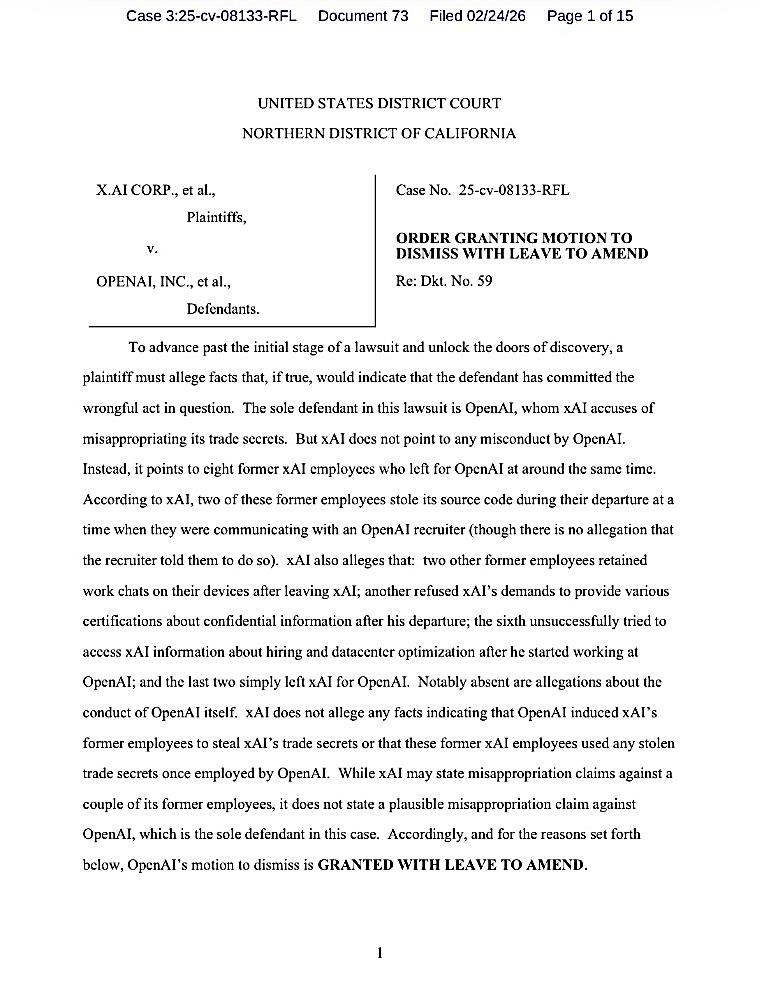
Pic 1. The court order issued by the district judge Rita Lin (the first and the last page)
Given that Internet access to U.S. court records from Russia may be limited due to U.S. government sanctions and the importance of legal language to understanding the reasons, here are full text of the court order of the US District Judge Rita Lin (Case No. 25-cv-08133-RFL) [51] (translated by Microsoft translation service):
NORTHERN DISTRICT OF CALIFORNIA
X.AI CORP., et al.,
Case No. 25-cv-08133-RFL
Plaintiffs,
v.
OPENAI, INC., et al.,
ORDER GRANTING MOTION TO
DISMISS WITH LEAVE TO AMEND
Re: Dkt. No. 59
Defendants.
To advance past the initial stage of a lawsuit and unlock the doors of discovery, a
plaintiff must allege facts that, if true, would indicate that the defendant has committed the
wrongful act in question. The sole defendant in this lawsuit is OpenAI, whom xAI accuses of
misappropriating its trade secrets. But xAI does not point to any misconduct by OpenAI.
Instead, it points to eight former xAI employees who left for OpenAI at around the same time.
According to xAI, two of these former employees stole its source code during their departure at a
time when they were communicating with an OpenAI recruiter (though there is no allegation that
the recruiter told them to do so). xAI also alleges that: two other former employees retained
work chats on their devices after leaving xAI; another refused xAI’s demands to provide various
certifications about confidential information after his departure; the sixth unsuccessfully tried to
access xAI information about hiring and datacenter optimization after he started working at
OpenAI; and the last two simply left xAI for OpenAI. Notably absent are allegations about the
conduct of OpenAI itself. xAI does not allege any facts indicating that OpenAI induced xAI’s
former employees to steal xAI’s trade secrets or that these former xAI employees used any stolen
trade secrets once employed by OpenAI. While xAI may state misappropriation claims against a
couple of its former employees, it does not state a plausible misappropriation claim against
OpenAI, which is the sole defendant in this case. Accordingly, and for the reasons set forth
below, OpenAI’s motion to dismiss is GRANTED WITH LEAVE TO AMEND.
I. ALLEGATIONS OF FIRST AMENDED COMPLAINT
On a motion to dismiss under Federal Rule of Civil Procedure 12(b)(6), the allegations of
a complaint are assumed to be true. See Boquist v. Courtney, 32 F.4th 764, 772 (9th Cir. 2022).
xAI and OpenAI offer competing generative AI products. In the summer of 2025, eight xAI
employees left to pursue opportunities with OpenAI. In the First Amended Complaint (the
“FAC”), xAI alleges the following concerning their departures. (See Dkt. No. 44.)
A. Xuechen Li
“Li joined xAI on or about February 26, 2024, and . . . was among the company’s first 20
engineers . . . .” (Id. ¶ 46.) His contact with OpenAI began in July 2025. (See id. ¶ 54.) On
July 13, he “made a presentation to OpenAI for an interview” that, on information and belief,
“contain[ed] xAI’s Confidential Information.” (See id. ¶ 55.) xAI does not allege what specific
information Li disclosed in the presentation or that OpenAI was aware that this unspecified
information constituted xAI’s confidential information or trade secrets. Ten days after Li’s
presentation, “OpenAI Research Talent Advisor Tifa Chen sent [him] a message request” on
Signal, an “encrypted messaging application.” (See id. ¶ 58.) The next day, she sent him a link
to “a cloud storage location.” (See id.) xAI does not allege why Chen did so or the intended
purpose of the cloud storage location. On the following day, July 25, “Li uploaded the entire
xAI source code base to a personal cloud account” that he had connected to ChatGPT, OpenAI’s
“generative AI chatbot product.” (See id. ¶¶ 29, 59 (emphasis omitted), 83.) xAI does not allege
that this was the same cloud storage location that Chen provided Li. “Li then deleted his browser
history and system logs . . . .” (Id. ¶ 59.) That same day, Li also downloaded xAI’s source code
from the cloud to his personal computer. (See id. ¶ 60.)
This download occurred during the same time frame when Li was finalizing his move to
OpenAI and continuing to communicate with Chen. On July 25, about four hours after Li
downloaded xAI’s source code onto his personal computer, Chen sent him a message on Signal
reading “nw!” which xAI alleges meant “no way!”1 (See id. ¶ 61; Dkt. No. 64 at 7.) xAI does
1 In the FAC, xAI alleges that Chen sent Li a message “that equated to ‘no way!’” (See FAC ¶
2 not allege what prompted Chen to send Li this message. “Two minutes later, . . . Chen had a
virtual meeting with Li.” (FAC ¶ 62.) Two days after that, on July 27, “Li again downloaded
xAI Confidential Information to his personal laptop.” (See id. ¶ 63.) On July 28, OpenAI
offered him a job worth “multiple millions of dollars,” and by August 1, he had accepted. (See
id. ¶¶ 64-65.)
Over the next few weeks, and before beginning any employment at OpenAI, Li accessed
his cloud account, downloaded xAI’s confidential information, changed his cloud account
password, and accessed his trash folder (“where a user must go to permanently delete files”).
(See id. ¶¶ 69-77.) At some unspecified time, he also obtained a slide deck “specifically
pertaining to xAI’s highly sensitive and confidential AI model training and tuning methods.”
(See id. ¶ 56.)
xAI eventually discovered Li’s exfiltration of its confidential information and
subsequently obtained a temporary restraining order from this Court, which prohibited Li “from
having any role or responsibility at OpenAI . . . until xAI has confirmed that all of xAI’s
Confidential Information in Li’s possession, custody, or control has been deleted.” (See id. ¶¶
79-80.) OpenAI then revoked Li’s job offer. (See id. ¶ 80.)
B. Jimmy Fraiture
“Fraiture joined xAI on or about April 22, 2024[,] [and] . . . was the second engineering
hire in xAI’s London operation . . . .” (Id. ¶ 87.) Like Li, he had been in contact with OpenAI
“since early July” 2025. (See id. ¶ 93.) He communicated via Signal with Chen, “the very same
recruiter who was in regular contact with Li,” around July 17, visited OpenAI around July 24,
received an offer of employment on July 29, and accepted the offer by July 30. (See id. ¶¶ 94-
61.) It clarified in its opposition brief and at oral argument that Chen’s message actually read “nw!” OpenAI insists that “nw” means “no worries.” (See Dkt. No. 66 at 10 n.3.) Drawing inferences in xAI’s favor, as required on a motion to dismiss, this Order assumes “nw” meant “no way.”
In this Order, all citations to page numbers in filings on the docket refer to ECF page numbers.
On July 31, about a day after he accepted OpenAI’s offer, Fraiture copied xAI’s source
code and other trade secrets from his work laptop onto his “personal device.” (See id. ¶ 98.)
Among the files taken was a “video recording of a lengthy internal, xAI ‘All-Hands’ meeting, in
which xAI founder Elon Musk conveyed significant confidential nonpublic information in
relation to xAI’s future plans and immediate targets, product roadmap, commercial contract
terms, and other confidential and sensitive information[,] . . . includ[ing] information relating to
xAI’s strategic priorities and confidential business practices.” (See id. ¶ 102.)
xAI eventually discovered Fraiture’s exfiltration of its confidential information, and its
“Insider Threat team” met with him in late August. (See id. ¶ 103.) At that meeting, Fraiture
told xAI that he had never transferred xAI’s source code to his personal device, but he “later
admitted that this statement was untrue and that he had in fact copied xAI source code to his
personal computer,” which he kept there for a few weeks before, according to him, he deleted it.
(See id.) He maintained the source code on his personal device “until at least August 28.” (See
id. ¶ 98.) His employment with OpenAI began on September 2. (See id. ¶ 97.)
xAI does not allege any facts indicating that Fraiture used xAI’s confidential information
once he began working at OpenAI. Likewise, other than the bare fact that Fraiture had been
recruited by Chen, who had also recruited Li, xAI does not allege any facts indicating that
OpenAI had encouraged Fraiture to take xAI’s confidential information in the first place.
C. Unnamed Finance Executive
An unnamed finance executive who had joined xAI around April 2025 quit a few months
later to begin working for OpenAI “in a lesser role.” (See id. ¶¶ 112, 115.) His position at
OpenAI involved “working on spending strategy for data centers.” (See id. ¶ 115.) That work
overlapped with confidential information that the executive had obtained while employed at xAI.
(See id. ¶ 113.) In fact, at one point, the executive had opined: “The secret sauce of xAI? The
data center team. Their speed and precision blew me away. I would NEVER want to compete
against them.” (See id. ¶ 114.) On two occasions after the executive left xAI, the company
reached out to him to address “confidentiality concerns,” as contemplated by a confidentiality
agreement that he had signed when he joined the company. (See id. ¶¶ 112, 118-19.) On both
occasions, he refused to cooperate, telling xAI’s counsel and human resources employee: “Suck
my dick”; and “Leave me the fuck alone.” (See id. ¶¶ 118-19.)
D. Uday Ruddarraju, Hieu Pham, and Ethan Knight
Ruddarraju, Pham, and Knight each worked at xAI for over a year (in unspecified
positions), “where they acquired detailed knowledge about xAI’s operations and technology,
including its Confidential Information and trade secrets.” (See id. ¶ 123.) “Ruddarraju and
Knight left xAI in July 2025[,] Pham left xAI in August 2025, and all [three] began working for
OpenAI by August.” (Id. ¶ 126.) “Since their departure, Knight and Pham have admitted to
keeping copies of xAI related work chats and information on their personal devices,” but they
have refused to cooperate with xAI in identifying the information taken or turning over their
devices. (See id. ¶ 127.) Moreover, the two “have shared copies of their xAI information with”
a third party. (See id. ¶ 128.) xAI does not allege why Pham and Knight shared its information
with this third party or whether they did so in connection with their employment at OpenAI or to
benefit OpenAI. OpenAI asserts that this third party was a forensics vendor. (See Dkt. No. 59 at
8.) xAI does not allege who the third party was. As for Ruddarraju, in September 2025, he
attempted to access an internal xAI document containing confidential information about
“datacenter optimization,” potential hires, and compensation for potential hires. (See id. ¶ 130.)
xAI does not allege that Ruddarraju successfully accessed the document, and it confirmed in its
opposition brief that it “successfully blocked Ruddarraju’s attempt” to access the document.
(See Dkt. No. 64 at 12.)
E. Sreekanth Pothanis and Mike Dalton
Pothanis and Dalton left xAI to work for OpenAI at around the same time as the other
former xAI employees identified in the FAC. (See id. ¶ 121.) Their work at xAI involved “xAI
data center solutions or the development of Grok 4,” xAI’s “conversational generative AI”
product that competes with OpenAI’s ChatGPT. (See id. ¶¶ 33-34, 121.) xAI does not allege
that they took any of its confidential information.
* * *
Believing OpenAI “poached” these “eight xAI employees as part of a deliberate,
unlawful, and unfair scheme to gain access to specific xAI Confidential Information,” xAI
commenced this action on the basis that OpenAI unlawfully misappropriated xAI’s trade secrets.
(See id. ¶ 132.)
II. LEGAL STANDARD
A complaint “must contain . . . a short and plain statement of the claim showing that the
pleader is entitled to relief.” See Fed. R. Civ. P. 8(a)(2). Failure to satisfy this requirement may
result in dismissal. See id. 12(b)(6). To survive a Rule 12(b)(6) challenge, a plaintiff must
allege “enough facts to state a claim to relief that is plausible on its face.” See Bell Atl. Corp. v.
Twombly, 550 U.S. 544, 570 (2007). A claim
has facial plausibility when the plaintiff pleads factual content that allows the
court to draw the reasonable inference that the defendant is liable for the
misconduct alleged. The plausibility standard is not akin to a ‘probability
requirement,’ but it asks for more than a sheer possibility that a defendant has
acted unlawfully.
See Ashcroft v. Iqbal, 556 U.S. 662, 678 (2009) (citations omitted). “Determining whether a
complaint states a plausible claim for relief will . . . be a context-specific task that requires the
reviewing court to draw on its judicial experience and common sense.” Boquist, 32 F.4th at 773
(citation omitted).
In ruling on a motion to dismiss, a court may consider only “the complaint, materials
incorporated into the complaint by reference, and matters [subject to] judicial notice. See UFCW
Loc. 1500 Pension Fund v. Mayer, 895 F.3d 695, 698 (9th Cir. 2018) (citation omitted). “All
allegations of material fact are taken as true and construed in the light most favorable to the
nonmoving party.” McShannock v. JP Morgan Chase Bank NA, 976 F.3d 881, 886-87 (9th Cir.
2020) (citation omitted). However, a court need not accept as true “allegations that are merely
conclusory, unwarranted deductions of fact, or unreasonable inferences.” See Khoja v. Orexigen
Therapeutics, Inc., 899 F.3d 988, 1008 (9th Cir. 2018) (citation omitted).
III. DISCUSSION
xAI brings claims under the federal Defend Trade Secrets Act (the “DTSA”) and
California’s Unfair Competition Law (the “UCL”). Neither claim survives scrutiny under Rule
12(b)(6).
A. The DTSA
“To succeed on a claim for misappropriation of trade secrets under the DTSA, a plaintiff
must prove: (1) that the plaintiff possessed a trade secret, (2) that the defendant misappropriated
the trade secret; and (3) that the misappropriation caused or threatened damage to the
plaintiff.” InteliClear, LLC v. ETC Glob. Holdings, Inc., 978 F.3d 653, 657-58 (9th Cir.
2020) (citation omitted). OpenAI argues that xAI insufficiently alleges misappropriation. “The
[DTSA] provides the following three definitions of misappropriation: (1) the acquisition of a
trade secret of another by a person who knows or has reason to know that the trade secret was
acquired by improper means; (2) the disclosure of a trade secret without the owner’s consent;
and (3) the use of a trade secret without the owner’s consent.” Attia v. Google LLC, 983 F.3d
420, 424 (9th Cir. 2020) (citations and quotation marks omitted). Courts consider both direct
and vicarious liability in evaluating claims of trade secret misappropriation. See, e.g., Cisco Sys.,
Inc. v. Chung, 462 F. Supp. 3d 1024, 1056 (N.D. Cal. 2020).
1. Direct Liability
“Courts distinguish between direct trade secret misappropriation claims and indirect trade
secret misappropriation claims, depending on whether a plaintiff alleges that a defendant
obtained the trade secrets directly from the plaintiff or indirectly from someone other than
plaintiff.” Navigation Holdings, LLC v. Molavi, 445 F. Supp. 3d 69, 78 (N.D. Cal. 2020)
(citation and quotation marks omitted).
a. Direct Misappropriation
xAI does not offer any nonconclusory allegations that OpenAI itself acquired, disclosed,
or used xAI’s trade secrets. Instead, its allegations of direct misappropriation appear to proceed
entirely on a theory that OpenAI induced xAI’s former employees to misappropriate its trade
secrets. But xAI offers no nonconclusory allegations that permit a reasonable inference of
inducement. For example, while Li and Fraiture transferred xAI’s source code onto their
personal devices, there is no indication that OpenAI told or encouraged them to do so. See, e.g.,
Arthur J. Gallagher & Co. v. Tarantino, 498 F. Supp. 3d 1155, 1173 (N.D. Cal. Nov. 2, 2020).
xAI counters that it permissibly pleads inducement “on information and belief.” (See, e.g., FAC
¶¶ 84, 97, 116.) To be sure, Rule 12(b)(6) “does not prevent a plaintiff from pleading facts
alleged upon information and belief where the facts are peculiarly within the possession and
control of the defendant or where the belief is based on factual information that makes the
inference of culpability plausible.” See Soo Park v. Thompson, 851 F.3d 910, 928 (9th Cir.
2017) (citations omitted). Even so, conclusory allegations remain insufficient. See, e.g., Reaper
v. ACE Am. Ins. Co., No. 23-15178, 2024 WL 810697, at *1 (9th Cir. Feb. 27, 2024); see also
Cloudera, Inc. v. Databricks, Inc., No. 21-cv-01217-HSG, 2021 WL 3856697, at *6 (N.D. Cal.
Aug. 30, 2021) (“Although courts may consider whether facts are peculiarly within the
possession and control of the defendant, such latitude does not mean that conclusory allegations
are permitted.” (citation and quotation marks omitted)).
xAI also argues that, when considered as a whole, its allegations state a DTSA claim
against OpenAI. The Court agrees that it must examine the entire course of conduct alleged to
assess the plausibility of misappropriation by OpenAI. See, e.g., Wisk Aero LLC v. Archer
Aviation Inc., No. 21-cv-02450-WHO, 2021 WL 8820180, at *16 (N.D. Cal. Aug. 24, 2021)
(rejecting attempt “to break up the allegations” where “[t]he whole of the FAC . . . is still
sufficient to plead a misappropriation claim”). But when taken together, as true, and with all
reasonable inferences drawn in favor of xAI, xAI’s allegations do not state a plausible claim
based on inducement. Yes, several employees took its confidential information at around the
same time and before leaving to work for OpenAI, and two of those employees communicated
with the same OpenAI recruiter using an encrypted messaging application around the time of
their exfiltration and their exploration of a move to OpenAI. Without more, though, those
allegations are insufficient to support a plausible inference that OpenAI encouraged the alleged
theft.
The cases on which xAI relies illustrate what is absent from the FAC. In Citcon USA,
LLC v. RiverPay Inc., No. 18-cv-02585-NC, 2019 WL 917056 (N.D. Cal. Feb. 25, 2019), the
defendant company allegedly encouraged misappropriation by promising co-founder status to
one of the plaintiff company’s former employees, and it allegedly conditioned co-founder status
on that former employee “retain[ing] [a] POS device” upon leaving the plaintiff company. See
id. at *4-5. Similarly, in Elko, Inc. v. WTH Commercial Services, LLC, No. 22-cv-00015-MMD,
2023 WL 6141623 (D. Nev. Sept. 20, 2023), the defendant company “entered into an agreement
with [the plaintiff company’s former employee] to steal confidential information” and used the
stolen confidential information to “target[] [the plaintiff company’s] customer base by contacting
them and pressuring them to switch providers.” See id. at *5. No similar agreements or
inducements are alleged here.
Accordingly, xAI does not sufficiently allege any direct misappropriation by OpenAI.
b. Indirect Misappropriation
Indirect trade secret misappropriation requires a defendant to know or have reason to
know: (1) “before the use or disclosure that the information was a trade secret and . . . that the
disclosing party had acquired it through improper means or was breaching a duty of
confidentiality by disclosing it”; or (2) that the information “was a trade secret and that the
disclosure was a mistake.” See Navigation Holdings, 445 F. Supp. 3d at 78-79 (citation
omitted); see also Attia, 983 F.3d at 424 (acquisition constitutes misappropriation where
acquiring party “knows or has reason to know that the trade secret was acquired by improper
means”). xAI offers insufficient allegations of OpenAI’s knowledge.
Li allegedly disclosed xAI’s confidential information in a presentation to OpenAI, but
xAI alleges no facts that permit a reasonable inference that OpenAI knew that the information
was a trade secret, that Li had improperly acquired the information, or that Li was improperly or
mistakenly disclosing the information. For the same reason, the connection between Li’s cloud
account (which contained xAI’s source code) and ChatGPT, and the implication that Li directly
sent xAI’s source code to OpenAI through a link sent by Chen, do not suffice. None of the other
former employees allegedly shared with or disclosed to OpenAI any xAI trade secrets.
Accordingly, xAI does not sufficiently allege any indirect misappropriation by OpenAI.
2. Vicarious Liability
xAI contends that OpenAI is vicariously liable under a theory of respondeat superior.
2
In general, under the doctrine of respondeat superior, an employer
will be vicariously liable . . . if its employee’s acts were committed within the
course and scope of her employment. Within the course and scope of
employment means: (1) the conduct occurred substantially within the time and
space limits authorized by the employment; (2) the employee was motivated, at
least in part, by a purpose to serve the employer; and (3) the act was of a kind that
the employee was hired to perform.
See Oki Semiconductor Co. v. Wells Fargo Bank, Nat’l Ass’n, 298 F.3d 768, 775-76 (9th Cir.
2002) (citations and footnotes omitted). In applying the doctrine to alleged misappropriation of
trade secrets intended to benefit a future employer, courts also require allegations that “the future
employer subsequently used the trade secrets or the wrongdoer used the trade secrets once he
actually became employed.” See Alert Ent., Inc. v. Rana, No. 22-cv-06646-JSC, 2023 WL
2541353, at *3 (N.D. Cal. Mar. 16, 2023); accord Flexport, Inc. v. Freightmate AI, Inc., No. 25-
cv-02500-RFL, 2025 WL 2399666, at *4 (N.D. Cal. July 10, 2025).
Scrutinized under the lens of these standards, xAI’s allegations fall short:
2 It does not appear that the Ninth Circuit has squarely addressed whether traditional principles
of vicarious liability apply to DTSA claims. However, the parties do not dispute that respondeat
superior applies to xAI’s misappropriation claim against OpenAI. When a federal “statute itself
is silent as to vicarious liability,” as are the civil provisions of the DTSA, courts “assume that
Congress intended to incorporate ordinary tort-related vicarious liability rules.” See Gomez v.
Campbell-Ewald Co., 768 F.3d 871, 877 (9th Cir. 2014) (citation and quotation marks omitted);
18 U.S.C. § 1831 et seq. Trade secret misappropriation is a tort (see Direct Techs., LLC v. Elec.
Arts, Inc., 836 F.3d 1059, 1070 (9th Cir. 2016)), and under the doctrine of respondeat superior,
employers may be held vicariously liable for the torts of their employees. See Restatement
(Third) of Agency § 2.04 (A.L.I. 2006). Accordingly, a defendant may be held vicariously liable
under respondeat superior for trade secret misappropriation under the DTSA.
• Li never worked at OpenAI, and xAI does not allege that OpenAI ever used any trade
secrets transferred to it by Li.
• Fraiture did eventually begin working for OpenAI, but xAI does not allege that he ever
used any of its trade secrets in his new job. True, he allegedly exfiltrated xAI’s source
code and an internal video recording about a month before beginning his employment
with OpenAI (presumably in a role similar to his position at xAI). But that is not enough
to allow a reasonable inference that Fraiture actually used those trade secrets at OpenAI.
To hold otherwise would automatically subject future employers to potential trade secret
misappropriation liability every time they hired someone who, without their knowledge
beforehand or ratification afterwards, had improperly taken confidential information from
their former employer on the way out the door, even if there is no indication that the
information was actually used in the subsequent job. Such an approach would also
undercut the well-established principle that “mere possession of trade secrets is not
sufficient to” constitute misappropriation. See Acculmage Diagnostics Corp. v.
Terarecon, Inc., 260 F. Supp. 2d 941, 951 n.5 (N.D. Cal. 2003) (citation omitted); see
also Attia, 983 F.3d at 424 (definition of misappropriation under DTSA does not include
mere possession).
• Like Fraiture, the unnamed finance executive merely possessed xAI trade secrets about
data centers, and xAI does not allege that he used that information once he started
working at OpenAI. His hostility when xAI reached out about its confidentiality
concerns also does not support a plausible inference of use. Hostility toward one’s
former employer during departure does not, without more, indicate use of trade secrets in
a subsequent job. Nor does the executive’s lack of experience with AI data centers
before his time at xAI, without more, support a plausible inference that he used xAI’s
trade secrets at OpenAI. For example, xAI does not allege that, after Fraiture started
working at OpenAI, OpenAI adopted a new approach to data centers mirroring xAI’s or
otherwise adopted aspects of xAI’s data center operations that OpenAI could not have
known about absent misappropriation.
• Ruddarraju unsuccessfully attempted to access xAI’s information while at OpenAI.
Because he could not access the information, there is no basis to infer that he used it
while employed at OpenAI.
• Pham and Knight allegedly misappropriated confidential information, but nothing in the
FAC allows a reasonable inference that the confidential information included trade
secrets.3 Even if the allegedly misappropriated confidential information constituted trade
secrets, the sole use alleged is Pham and Knight’s sharing the information with an
unidentified third party for unknown reasons, and nothing in the FAC allows a reasonable
inference that they shared the information to “serve” OpenAI or that doing so was “a kind
[of act] that [they were] hired to perform.” Oki Semiconductor, 298 F.3d at 776.
• xAI offers no allegations about Pothanis or Dalton beyond identifying what they did at
xAI and the fact that they left for OpenAI around the same time as xAI’s other former
employees. Nothing about those allegations allows a reasonable inference of
misappropriation.
xAI argues that “the covert nature of trade secret misappropriation” allows it to “rely on
circumstantial allegations of [OpenAI’s employees’] misappropriation” because “it would be
unreasonable to require [xAI] to demonstrate the precise ways in which [OpenAI’s employees]
may have used [xAI’s] trade secrets” in the absence of discovery, “given that [OpenAI and its
employees are] the only ones who possess such information.” (See Dkt. No. 64 at 16 (citations
3 In Tri Tool, Inc. v. Hales, No. 22-cv-01515-DAD, 2023 WL 7130610 (E.D. Cal. Oct. 30, 2023),
in contrast, while the plaintiff agreed that it “remain[ed] unknown” whether the information
allegedly stolen by its former employees constituted trade secrets, its allegations supported a
reasonable inference that its trade secrets were used by the former employees once they joined
the defendant company. See id. at *1-2, *6. The plaintiff company’s trade secrets concerned
information that allowed “it to bid competitively to customers in its field of service” and about
“projects in the pipeline” that presented “viable sources of future revenue.” See id. at *1. One of
the plaintiff company’s employees allegedly “sabotaged at least one job on which he worked []
so that he could reclaim the same job while working for” the defendant company, and after
resigning from the plaintiff company, the same employee contacted one of the plaintiff
company’s customers in an attempt to get their business. See id. at *6.
omitted); see also id. at 11, 14.) Certainly, an inference of use may be based on circumstantial
evidence. But Rule 12(b)(6) does not impose a lower standard in trade secret cases, and xAI
does not provide the circumstantial evidence necessary to draw a plausible inference that its
former employees used its trade secrets at OpenAI.
The cases relied upon by xAI illustrate how its allegations fall short. In Applied
Biological Laboratories, Inc. v. Diomics Corporation, No. 20-cv-02500-AJB, 2021 WL 4060531
(S.D. Cal. Sept. 7, 2021), the defendant company “had no prior experience” in the relevant
industry before it allegedly procured the plaintiff company’s misappropriated trade secrets and
released a competing product. See id. at *4-5. In Autodesk, Inc. v. ZWCAD Software Co., Ltd.,
No. 14-cv-01409-EJD, 2015 WL 2265479 (N.D. Cal. May 13, 2015), the defendant company
released software sharing “the same interfaces and commands as [the plaintiff company’s
software and which] also perform[ed] identically to prior versions of [the plaintiff company’s]
software in unmistakable ways.” See id. at *1. In Yeiser Research & Development LLC v.
Teknor Apex Company, 281 F. Supp. 3d 1021 (S.D. Cal. 2017), the defendant company “did not
know how to build a compact hose and was not in the business of compact hoses” before it
received confidential information on the subject from the plaintiff company, “indicated it wanted
to commercialize” a hose, and subsequently released a hose that “incorporate[d] attributes of [the
plaintiff company’s] concept.” See id. at 1048. In Cutera, Inc. v. Lutronic Aesthetics, Inc., 444
F. Supp. 3d 1198 (E.D. Cal. 2020), evidence demonstrated that the defendant company’s
employees had “deployed a sales method claimed by [the plaintiff company] as a trade secret.”
See id. at 1207-08. In 3D Systems, Inc. v. Wynne, No. 21-cv-01141-LAB, 2022 WL 21697345
(S.D. Cal. Mar. 9, 2022), the defendant company’s “patents and one patent application
contain[ed] trade secrets which the [plaintiff company’s former employees] could only have
acquired during their employment at” the plaintiff company. See id. at *4. And in Flexport, the
defendant company “rapid[ly] launch[ed] [] a competing product containing functionality similar
to the allegedly stolen source code.” See 2025 WL 2399666, at *4. xAI offers no similar
allegations suggesting use of misappropriated information.
xAI also argues, as discussed above, that Rule 12(b)(6) requires evaluation of all of its
allegations as an amalgamated whole. Thus, rather than confining the vicarious liability analysis
to employee-by-employee consideration, the analysis should instead, in xAI’s words, consider
the “gestalt” of its allegations. As before, however, even when taken together, as true, and with
all reasonable inferences drawn in favor of xAI, the allegations do not support a plausible
inference that xAI’s former employees used its trade secrets in their work at OpenAI. The
unnamed finance executive, Ruddarraju, Pham, and Knight did not misappropriate any trade
secrets, and Pothanis and Dalton did nothing except leave xAI for OpenAI. That leaves Li and
Fraiture. While xAI alleges significant acts of misappropriation by those two when they left the
company, that is not enough to infer that either of them used the misappropriated information at
OpenAI. Indeed, as noted above, Li never even worked at OpenAI.
B. The UCL
The UCL “prohibits business acts or practices that are ‘unlawful,’ ‘unfair,’ or
‘fraudulent.’ Each of these three prongs constitutes a separate and independent cause of action.”
See Martinez v. Wells Fargo Home Mortg., Inc., 598 F.3d 549, 554 (9th Cir. 2010) (citations
omitted). xAI brings claims under the unlawful and unfair prongs. “[U]nder the unlawful prong,
the UCL borrows violations of other laws and treats them as unlawful practices that the unfair
competition law makes independently actionable.” Aryeh v. Canon Bus. Sols., Inc., 55 Cal. 4th
1185, 1196 (2013) (citation and quotation marks omitted). xAI bases its unlawful prong claim
on OpenAI’s alleged DTSA violation. As for the unfair prong, in the context of allegedly unfair
practices among competitors, “the word ‘unfair’ in [the UCL] means conduct that threatens an
incipient violation of an antitrust law, or violates the policy or spirit of one of those laws because
its effects are comparable to or the same as a violation of the law, or otherwise significantly
threatens or harms competition.” See Nationwide Biweekly Admin., Inc. v. Superior Ct., 9 Cal.
5th 279, 302 (2020) (citation and emphasis omitted). xAI bases its unfair prong claim on
OpenAI’s alleged attempt “to destroy legitimate competition in the AI industry by neutralizing
xAI’s innovations” and “forc[ing] [xAI] to unfairly compete against its own trade secrets.” (See
FAC ¶¶ 166-68.)
xAI’s claims under both prongs are preempted by the California Uniform Trade Secrets
Act (the “CUTSA”). The CUTSA “provides the exclusive civil remedy for conduct falling
within its terms and supersedes other civil remedies based upon misappropriation of a trade
secret.” See Mattson Tech., Inc. v. Applied Materials, Inc., No. 23-cv-06071-SVK, 2024 WL
3558849, at *6 (N.D. Cal. July 25, 2024) (citations and emphasis omitted). xAI’s unlawful
prong claim is necessarily based on misappropriation of a trade secret, as it derives from its
DTSA claim. The unfair prong claim is also based on misappropriation of a trade secret, as xAI
describes anticompetitive harm flowing from OpenAI’s alleged misappropriation of xAI’s trade
secrets. xAI argues that the anticompetitive harm also derives from OpenAI’s poaching of its
employees. But its poaching allegations all focus on poaching in service of acquiring xAI’s trade
secrets, and it does not identify any other reason why the hiring of those employees resulted in
anticompetitive harm. (See, e.g., FAC ¶ 44.) In fact, in detailing why OpenAI’s conduct
qualifies as unfair under the UCL in the FAC, xAI relies solely on misappropriation of xAI’s
confidential information as the source of the alleged anticompetitive harm. (See id. ¶¶ 166-68.)
IV. CONCLUSION
For the foregoing reasons, OpenAI’s motion to dismiss is GRANTED WITH LEAVE
TO AMEND. If xAI wishes to file an amended complaint correcting the deficiencies identified
in this Order, it shall do so by March 17, 2026. The amended complaint may not add new
claims or parties, or otherwise change the allegations except to correct the identified deficiencies,
absent leave of the Court or stipulation by the parties pursuant to Federal Rule of Civil Procedure
15.
IT IS SO ORDERED.
Dated: February 24, 2026
RITA F. LIN
United States District Judge Signature
The reproduced order must be read not as a source of factual information about the dispute, but as a coherent procedural construction in which the court consistently applies the methodological framework of Rule 12(b)(6). Its significance lies in the sequence of legal operations through which the alleged conflict is either admitted into the domain of adjudication or excluded from it. The reasoning of the court therefore makes it possible to observe the constitutive function of the pleading stage in its practical form.
3.2. The Standard of Review under Rule 12(b)(6)
The order begins with the formulation of the standard of review, according to which the court must accept the factual allegations of the complaint as true and draw all reasonable inferences in favor of the non-moving party. This statement determines the procedural posture of the case. At this stage, the judge does not establish the factual truth of the competing narratives and does not assess the evidentiary value of the parties’ assertions. Instead, the court performs a different operation: it provisionally assumes the plaintiff’s version of reality for the limited purpose of deciding whether that version is capable of functioning within the legal framework of federal adjudication.
This methodological suspension of fact-finding is not a technical element of procedural form. It defines the boundary between the pleading stage and the evidentiary phase of the proceedings. The dispute is not resolved; it is tested for its capacity to exist in law.
3.3. The Procedural Separation of Factual Determination from Pleading
A central element of the order is the court’s refusal to resolve factual disagreements between the parties. The dispute concerning the meaning of the communication relied upon by the plaintiff illustrates this approach. Rather than determining which interpretation corresponds to the actual course of events, the court explicitly adopts the version that is favorable to the claimant for the purposes of the motion.
This operation demonstrates the structural logic of Rule 12(b)(6). The motion to dismiss is not a mechanism for establishing what happened. It is a mechanism for determining whether, if the alleged events are assumed to have occurred, they constitute a legally sufficient claim. The factual controversy is intentionally displaced into the subsequent stages of the proceedings. In this sense, the order reflects a procedural decision about the temporal allocation of judicial fact-finding.
For a reader trained in a civil law procedural tradition, this approach reveals a fundamentally different relationship between the establishment of facts and access to judicial proceedings. The admissibility of the dispute into the evidentiary phase does not depend on the prior verification of the factual narrative.[52]
3.4. The Concept of Plausibility in Judicial Reasoning
The order further demonstrates how the plausibility standard operates in practice. The court does not require the plaintiff to present direct evidence of the alleged conduct. Instead, it evaluates whether the factual allegations, taken together and considered in their contextual relationship, permit a reasonable inference of liability.
Plausibility thus appears not as a measure of evidentiary sufficiency but as a criterion of structural coherence. The complaint must contain a factual configuration that allows the court to recognize the legal form of the claim. The sufficiency of the pleading lies in its capacity to generate a legally intelligible narrative, not in the demonstration of the factual accuracy of that narrative.
This understanding corresponds to the transformation of pleading doctrine after Twombly and Iqbal. The complaint becomes the procedural instrument through which the claimant gains access to the mechanisms of discovery and judicial fact-finding.
3.5. The Structural Consequences of the Denial of the Motion to Dismiss
The denial of the motion to dismiss does not resolve the dispute on the merits. Its procedural significance lies in the fact that it transfers the conflict into the evidentiary phase of federal litigation. From this moment, the parties obtain access to discovery, to the production of documents, to depositions, and to expert examination.
In complex technological disputes, this transition has an independent material effect. Access to the relevant information is often structurally controlled by the defendant. The survival of the claim at the pleading stage therefore determines whether the claimant will be able to obtain the evidentiary basis necessary to substantiate the alleged violations. The order thus alters the distribution of procedural power between the parties and transforms the litigation into a real source of legal and economic risk.
The motion to dismiss appears here as the point at which the court decides whether the conflict will remain an external allegation or become an internal element of the judicial process.
3.6. The Constitutive Effect of the Order
The procedural logic of the order confirms the theoretical model developed in the previous section. Rule 12(b)(6) operates as the threshold at which a technological and corporate conflict acquires legal existence. Prior to this decision, the dispute is only a set of factual assertions. After the denial of the motion to dismiss, it becomes a controversy that will be processed through the institutional mechanisms of adjudication.
The significance of the order therefore lies not in the determination of liability, but in the procedural act that allows the dispute to enter the domain of judicial fact-finding. In this sense, the pleading stage performs a constitutive function: it defines whether the court will exercise its adjudicative power with respect to the alleged conflict.
The decision in xAI v. OpenAI thus provides a clear empirical demonstration of the procedural architecture of contemporary artificial intelligence litigation. It shows that the decisive moment in such disputes occurs before the production of evidence and before the evaluation of the merits. The outcome of the motion to dismiss determines whether the conflict will exist in law and whether the institutional resources of the judicial system will be mobilized in relation to it.
Chapter 4. The Procedural Necessity of Rule 12(b)(6) in Carreyrou v. Anthropic et al.
The applicability of Rule 12(b)(6) in Carreyrou v. Anthropic et al. is not merely a function of anticipated defense strategy. It follows from the internal legal architecture of the complaint and from the structural transformation of copyright litigation in the context of artificial intelligence cases in the Northern District of California. In this dispute, the motion to dismiss does not operate as a preliminary technical filter but as the procedural mechanism through which the court must determine whether the theory advanced by the plaintiff is compatible with the existing framework of copyright law.
In classical copyright litigation, the pleading stage rarely carried dispositive weight. Questions of substantial similarity, market harm, access, and intent were treated as fact-intensive and therefore deferred to summary judgment or trial. The present case belongs to a different category. Its central premise is not a concrete act of distribution, reproduction in the traditional commercial sense, or the circulation of a substantially similar expressive output. Instead, the claim is constructed around the proposition that the inclusion of copyrighted works in the training process of large language models constitutes, in itself, an actionable violation of the Copyright Act. Whether such conduct can be legally characterized as infringement is not a factual question. It is a question of legal qualification. When the sufficiency of a claim depends on the legal nature of the conduct described in the complaint, Rule 12(b)(6) becomes not only appropriate but unavoidable.
This procedural posture is reinforced by the multi-defendant structure of the action. The complaint targets several technologically and corporately distinct entities, each operating different models, infrastructures, and data pipelines. Federal pleading standards, particularly as developed in the Ninth Circuit, do not permit liability to be asserted in collective form without defendant-specific factual content. The requirement that a complaint provide a “short and plain statement” showing entitlement to relief necessarily implies the existence of an individualized causal chain linking each defendant to a completed act of infringement. Where the pleading substitutes a generalized description of industry-wide practices for such individualized allegations, the defect is visible on the face of the complaint. It is therefore a legal insufficiency, not a factual gap, and it is resolved at the pleading stage.
The same logic applies to the damages model. The claim for statutory damages presupposes that a legally completed act of infringement has occurred with respect to each work and each defendant. If the conduct described in the complaint does not, as a matter of law, amount to such an act, the damages theory collapses independently of any evidentiary development. Discovery cannot transform a legally insufficient theory into a viable one. For this reason, the viability of the requested remedy is inseparable from the Rule 12(b)(6) analysis.
The fair use doctrine further illustrates why the case is structurally oriented toward resolution at the pleading stage. Although fair use is formally an affirmative defense, courts in the Ninth Circuit have repeatedly held that it may be adjudicated on a motion to dismiss when the relevant use is defined by the complaint itself. In the present case, the plaintiff characterizes the challenged conduct as the use of copyrighted works for the purpose of training machine learning models. The legal nature of that use, including its degree of transformation and its relationship to the protected market for the works, can therefore be assessed without the need for factual discovery. The question before the court is not what the defendants did in some unknown factual sense, but whether the conduct described by the plaintiff, taken as true, constitutes infringement. That is the paradigmatic function of Rule 12(b)(6).
Equally significant is the absence of any threshold issue that would require evidentiary development before the legal sufficiency of the claim can be evaluated. This is not a case in which the court must determine access to the work, the existence of copying in the evidentiary sense, or the degree of similarity between two expressive texts. The complaint assumes copying in a technological sense and asks the court to treat that assumption as legally dispositive. The court is therefore confronted with a purely normative question: does the conduct described fall within the scope of the exclusive rights granted by the Copyright Act? Such a question is resolved as a matter of law.
The procedural environment of the Northern District of California provides an additional reason why Rule 12(b)(6) is not only available but functionally compelled. In recent artificial intelligence cases, the district has developed a consistent case-management logic characterized by early narrowing of legally deficient theories, strict separation between technological complexity and legal sufficiency, and skepticism toward claims grounded in speculative or generalized harm. Within this framework, postponing the core legal question to the discovery phase would invert the established procedural order and impose precisely the kind of asymmetrical litigation burden that Rule 12(b)(6) is designed to prevent.
At a deeper doctrinal level, the motion to dismiss in Carreyrou performs a systemic function. It is the point at which the court must decide whether the attempt to construct individualized, high-statutory-damages copyright liability on the basis of AI training practices can be reconciled with the existing structure of copyright law. This is not a question that can be answered through the accumulation of facts. It is a question of legal compatibility. If the theory is incompatible with the statutory framework, no factual record can save it. If it is compatible, the claim survives and proceeds to discovery in a narrowed and legally defined form. In both scenarios, the decisive analytical work occurs at the pleading stage.
For these reasons, Rule 12(b)(6) in this case is not merely a procedural option. It is the procedural expression of the nature of the dispute itself. The action is built on a generalized theory of liability, a legally contingent damages model, and a description of the challenged conduct that allows the court to evaluate its legal character without evidentiary development. Under these conditions, the motion to dismiss becomes the proper and inevitable mechanism through which the court determines whether the claim belongs within the domain of copyright law or outside it.
In this sense, Carreyrou v. Anthropic et al. is not simply a case in which a Rule 12(b)(6) motion will be filed. It is a case that exists, in doctrinal terms, for Rule 12(b)(6) to decide.
Chapter 5. Nippon Life Insurance Company of America v. OpenAI as a Brief Illustration of Rule 12(b)(6) in AI Litigation
A recent complaint filed in the US Federal Court in Northern District of Illinois, Nippon Life Insurance Company of America v. OpenAI Foundation, OpenAI Group PBC, provides a useful illustration of how Rule 12(b)(6) continues to operate as an early screening device even in novel AI-related litigation.[53] The plaintiff alleges tortious interference with contract, abuse of process, and unlicensed practice of law, arguing that ChatGPT acted as a user’s “legal assistant and advisor,” helped generate filings designed to reopen previously settled litigation, and later assisted in additional filings against the plaintiff. The complaint further seeks damages and broad injunctive relief.
At the public-discourse level, the case has already attracted attention because it appears to rest, at least in part, on the claim that an LLM-generated output functioned as a form of unauthorized legal assistance. Such framing is rhetorically powerful. It suggests that the machine itself crossed the boundary between technological assistance and regulated professional conduct. Yet from the standpoint of federal civil procedure, such rhetoric is only the beginning of the inquiry. Before any court reaches the broader normative question of AI and legal services, the complaint must first satisfy the threshold requirement of stating a legally plausible claim for relief.
For this reason, the immediate legal importance of Nippon v. OpenAI is procedural rather than philosophical. Whatever its broader implications for debates on AI, legal ethics, or professional regulation, the first judicial question is likely to be whether the plaintiff has pleaded a cognizable cause of action with sufficient factual and legal specificity to survive dismissal under Rule 12(b)(6). In this sense, the case is best understood not as a breakthrough in AI personhood or machine agency, but as a live test of pleading sufficiency in a technologically novel setting.
The significance of the case lies less in its factual novelty than in its pleading structure. The complaint attempts to convert AI-assisted drafting into traditional state-law causes of action, but that move depends on several analytically difficult steps: from user-provided information to legally attributable corporate knowledge, from drafting assistance to intentional inducement, and from assistance in generating filings to direct misuse of judicial process by the provider itself. The complaint expressly alleges, for example, that ChatGPT “was aware” of the settlement agreement, generated arguments inconsistent with it, and thereby induced breach; yet the same allegations also suggest that the user had already decided to challenge the agreement and merely sought assistance in doing so. At the Rule 12(b)(6) stage, that distinction may be decisive.
The same difficulty appears in the abuse-of-process and unauthorized-practice counts. On the face of the complaint, the actual filings were made by the litigant, while the provider is said to have assisted through drafting, legal analysis, and research. The complaint therefore presses a broader theory under which tool-enabled legal assistance may be reclassified as direct legal misconduct by the provider. Whether such a theory can survive a motion to dismiss is uncertain, but the case clearly demonstrates a central procedural point: the novelty of AI framing does not eliminate the ordinary pleading burden to allege plausible knowledge, intent, causation, and defendant-specific misconduct.
A fuller analysis of the complaint, its doctrinal structure, and its implications for LLM-assisted legal drafting is developed in my separate article “Nippon Life v. OpenAI: Tort, Unauthorised Practice of Law, and the First Private Offensive Against LLM-Assisted Legal Drafting” in this issue.
Chapter 6. Conclusion
The judicial order analyzed in this article should be understood not merely as a procedural ruling in a particular dispute, but as a coherent and methodologically complete illustration of the modern Rule 12(b)(6) standard as shaped by Bell Atlantic Corp. v. Twombly and Ashcroft v. Iqbal. In structural terms, the decision represents a fully articulated model of plausibility review, in which the court consistently distinguishes factual allegations from legal conclusions, evaluates the sufficiency of the factual content, examines the existence of a plausible causal connection, and tests the legal viability of the asserted claims.
By doing so, the court performs a preliminary control over the legal sustainability of the complaint and prevents factually or doctrinally deficient claims from proceeding to the evidentiary stage. The motion to dismiss thus appears not as a merely technical phase of the proceedings, but as an autonomous stage of legal qualification of the dispute, in which the court determines whether the legal and factual configuration of the claim is capable of generating a legally cognizable controversy within the meaning of federal civil procedure.
For the Russian academic audience, the methodological significance of this lies in the fact that the internal logic of such a decision cannot be understood through selective quotation or doctrinal paraphrase. Only the analysis of the full text makes it possible to reconstruct the sequence of judicial reasoning that constitutes the real substance of U.S. procedural law in action. Fragmentation of the opinion inevitably destroys this logic and reduces the decision to a set of disconnected propositions. Systematic work with full-length judicial opinions therefore becomes a necessary condition for meaningful comparative procedural research and for the development of an adequate understanding of contemporary adversarial litigation.
At the same time, the importance of Judge Rita Lin’s order extends far beyond the procedural fate of xAI v. OpenAI. Properly understood, the decision provides a structural framework for evaluating civil claims against AI companies at the pleading stage and therefore has direct implications for the entire emerging field of AI litigation.
First, the order clarifies the level of factual specificity required in technology-driven disputes. Claims based on abstract descriptions of AI systems, generalized allegations of misconduct, or speculative theories of harm are insufficient. What is required is a concrete factual narrative that connects a specific technological act or omission, a legally protected interest, and a plausible causal mechanism of harm. In this respect, the decision establishes a clear pleading threshold for future disputes involving training data, algorithmic outputs, platform conduct, market behavior, and AI-enabled products and services.
Second, the decision demonstrates that the complexity of AI technologies does not lower the pleading standard. On the contrary, the more technologically sophisticated the claim, the greater the need for a clearly structured factual foundation. The opacity of algorithmic systems cannot substitute for well-pleaded facts, nor can it justify access to discovery in the absence of a legally sufficient theory of liability.
Third, the ruling has direct consequences for the architecture of future complaints against AI developers. Successful AI litigation must be built not on broad narratives about technological risk, market power, or social harm, but on legally cognizable claims supported by technology-specific factual allegations formulated already at the pre-discovery stage. This shifts the center of gravity of such disputes to the pre-filing phase and increases the role of preliminary technical and economic analysis.
Fourth, by applying the traditional Twombly/Iqbal framework to a high-technology dispute, the court confirms that AI cases are not doctrinally exceptional. They are governed by the same procedural logic as other complex federal litigation. This preserves the continuity of civil procedure and prevents the emergence of a technology-driven erosion of pleading standards.
Finally, the order performs a filtering function for the future AI litigation landscape. It signals that access to discovery in cases against AI companies will not be granted for exploratory or speculative purposes. The complaint itself must contain a legally sufficient and factually plausible theory of liability. This affects litigation strategy, the role of pre-filing expert involvement, the economic structure of such disputes, and the selection of legally viable claims.
The significance of the analyzed decision lies not only in the resolution of a particular procedural motion, but in its demonstration of the mechanism through which legally sustainable claims are selected and doctrinally unsubstantiated claims are eliminated. In this respect, Judge Rita Lin’s order should be regarded as one of the first procedural landmarks of the AI litigation era. It shows that the future of civil claims against AI companies will be determined not by the technological novelty of the subject matter, but by the ability of the parties to translate technological complexity into a legally coherent and factually plausible pleading.
In methodological terms, the study of complete primary judicial texts is therefore not a matter of citation technique, but a prerequisite for the formation of a genuinely modern legal scholarship capable of analyzing the real functioning of adjudication in the context of rapidly developing technological disputes. In this sense, the procedural logic demonstrated in the analyzed order defines not only the outcome of a single case, but the emerging procedural grammar of AI-related litigation.
The emergence of complaints such as Nippon Life v. OpenAI confirms the broader argument of this Article: even the most novel AI-framed theories of liability must still pass through the ordinary procedural gatekeeping function of Rule 12(b)(6). However innovative the rhetoric, a complaint must still plausibly allege defendant-specific knowledge, intent, causation, and legally cognizable misconduct. In that sense, Rule 12(b)(6) remains not merely a technical pleading device, but the first constitutional barrier against doctrinal overextension in AI litigation.
References



No 4 (13), April 2026
E-mail: nxxivek@inbox.ru
ISSN 3033-7674 (Online), ISSN 3033-7666 (Print)
Electronic Scientific Periodical (St. Petersburg, Russia)
Certificate of the Federal Service for Supervision of Communications, Information Technology and Mass Media (Roskomnadzor)
Эл № ФС77-87449
The journal is registered and published in Russia. The journal publishes articles from all over the world and in all branches of science. The journal is published in Russian.
Articles are accepted daily.
Frequency of releases: once a month.
All articles are peer-reviewed
Each author receives a free certificate of publication.
Free access to the electronic version of the magazine.
By sending an article to the editorial board, the author confirms its uniqueness and bears full responsibility for it for the possible consequences of copyright infringement
Editorial Board
Editor-in-Chief
Vorontsov Vladimir Valentinovich
Managing Editor
Ivanov Maxim Dmitrievich
Executive Secretary
Kholmanskikh Maria Viktorovna
Reviewers
Dimitrienko Andrey Igorevich,
Ph.D., First St. Petersburg State Medical University named after Academician I.P. Pavlov
Pyrkh Andrey Ivanovich,
Ph.D., St. Petersburg State University
_____________________________________________________________________________
Contacts

190031, Russia, St. Petersburg, Kazanskaya str., 35, lit. A, apt. 15

+7 931 712-95-96

nxxivek@inbox.ru
_____________________________________________________________________________
© Founder: Limited Liability Company “Polis” (OGRN 1097847170871)
190031, St. Petersburg, ext. Ter. Admiralteysky Municipal District, Kazanskaya St., 35, lit. A, apt. 15

https://gretchen.law.nyu.edu/fac-articles/164/ (date of request: 26.02.2026). ↑
https://scholarship.law.wm.edu/facpubs/1986/(date of request: 26.02.2026). ↑
https://scholarship.law.wm.edu/facpubs/1986/(date of request: 26.02.2026). ↑
https://scholarship.law.duke.edu/dlj/vol60/iss1/1/ (date of request: 26.02.2026). ↑
