Articles that inspire and inform!
Publisher of POLIS LLC
Address: 190000, Saint Petersburg,
35/15 Kazanskaya Street
Publisher of POLIS LLC
Address: 190000, Saint Petersburg,
35/15 Kazanskaya Street

UDC 94(47).084
LENIN: HISTORY GREATEST SERVANT OF MONOPOLY CAPITALISM
(PART II: RAYMOND ROBINS)
(Lea) Gabriela Gavrilov
Emerson College, Boston, Massachusetts (1996)
MA Journalism
Catholic University, Washington, D.C. (1985) +
University of Warsaw, Poland (1983 – 1984)
BA Political Science / Economics
ggavrilov100@yahoo.com
http://orcid.org/0009-0008-9246-9646
Abstract. Lea Gavrilov’s article is devoted to a little-known, but key figure in the history of early Soviet-American cooperation, Raymond Robins, a representative of the US Red Cross, who in 1917–1918 became an unofficial mediator between the Bolshevik government and Western circles. Based on archival sources and memoirs, the article reveals how Robins, acting outside of diplomatic channels, became a spokesman for the interests of transnational capital and played a significant role in legitimizing the Bolshevik regime at an early stage. The work continues the line of research on cooperation between Soviet Russia and Western elites, begun in the author’s previous articles.
Key words: Raymond Robins, Vladimir Lenin, Red Cross, American mission, transnational capital, diplomacy, revolution of 1917, Soviet Russia, USA, economic interests.
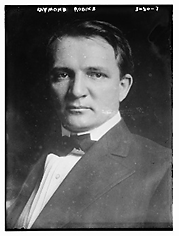
Raymond Robins, circa 1915.
In an effort to preserve its investment, the House of Morgan sent William B. Thompson and Raymond Robins
to Russia to salvage everything they could from Morgan’s investments.
– K. Büsing, The House of Morgan and Its Investments in Russia, 1905-1918
If I were asked which historical figure I would most like to talk to, I would answer: Raymond Robins (1873-1954).
Raymond Robins has never been mentioned in his six years of studying history in higher education and is not in the top 500 most interesting historical figures. But that’s the point.
Raymond Robins managed to elude the world’s historical record, despite setting the tone for official U.S.-Soviet relations and leaving a very well-documented account of his work through his testimony at the U.S. Senate Hearings on Bolshevik Propaganda in 1919, held in Washington, D.C., from February 11 to March 10, 1919, and published for public consumption shortly thereafter.
According to his testimony, Robins was the only American (still revealed) who met with Lenin and Trotsky almost daily at Smolny between December 1917 and June 1918. During these lengthy meetings, Robins changed Lenin’s nationalization decree, making an exception for American firms, advised the State Department to recognize Lenin as “the responsible head of the Soviet government, which is a compelling request for America’s cooperation in the internal restructuring of economic life,”[1] advised Lenin not to ratify the Brest-Litovsk Peace Treaty, ordered Trotsky to send a train loaded with food and medicine through starving Ukraine to Romania for a kind of eavesdropping if Trotsky demonstrated due loyalty to the U.S. government, and also checked whether he had the authority to carry out the act. Robins also ordered Chicherin and Dzerzhinsky to blow up twenty-six anarchist centers in Moscow after they stole his luxury Pierce Arrow tourist car to show him “where the power is in Moscow.” He negotiated with the U.S. to buy Russian platinum, a vital war material needed to produce munitions over which Russia had a near-monopoly, which was done by American businessman Charles Preston under the guise of a Red Cross employee, and brought Lenin’s “Plan for Russian-American Trade Relations” back to Washington when he returned from his eleven-month stay in revolutionary Russia. Robins also presented the “Report on American Economic Cooperation with Russia,” in which he recommended that the Wilson administration accept Lenin’s economic plan.[2]
Why does mainstream history avoid drawing attention to a person with such a resume?
American Red Cross Mission in Russia,
August 1917 – June 1918
The American Red Cross mission was led by William Boyce Thompson, a wealthy American copper magnate, founder of the Newmont Mining Company, financier and director of the Federal Reserve Bank of New York, and his friend, Morgan’s partner, Henry. Davidson. While Davidson remained in Washington, D.C., Thompson headed the mission to Russia. Thompson was appointed a “colonel” of the Red Cross, although he did not have a real military rank that the New York Federal Reserve had allowed Thompson to be absent from its post as its director for several months. Most of the funding for the trip came from Thompson, in addition to American Red Cross funding from J.P. Morgan and Mrs. E.H. Harriman[3] , as well as from other financially significant American businessmen (often through the names of their wives).
The second man in the Red Cross Mission was Raymond Robins, a forty-four-year-old Anaconda Copper magnate who, just a few months earlier, had spoken about Russia’s commercial potential at a businessmen’s convention in Boston. Robins had been appointed a “major” of the Red Cross[4] and wore a U.S. military uniform with insignia on his shoulders and a cap. none of whom was lower than major.
The American Red Cross mission to Russia (1917-1918) consisted of twenty-five businessmen and financiers, three translators, eleven medical professionals, two film directors, one legal adviser, and one transportation expert.
According to the well-known Russia expert George F. Kennan, in his seminal 1958 work “Russia Emerging from the War, Soviet-American Relations 1917-1920,” members of the Red Cross mission were advised to make a concerted effort not to do anything that could complicate their relations with U.S. diplomatic personnel in Russia. The role of the U.S. ambassador was to introduce them to the members of the new Provisional Government and the ministers who would be able to negotiate business deals. Kennan also noted that the American Red Cross mission in Russia is a charitable mission in name only. The chairman of the American Red Cross War Council was none other than Morgan’s senior partner, Henry. Davison, and despite the use of the name of the Red Cross, “these people did not go to Russia to distribute hot food and bandages.”[5]
In fact, the Red Cross name was brazenly used as a cover to promote business goals related to Morgan. The main (if not the only) goal of the mission leaders was to keep Russia in a costly (and profitable) war with Germany, expand business domestically, and maintain the flow of Russian military orders for American factories and demand for loans to Wall Street.[6] Thus, the mission did not have clearly defined responsibilities, such as building or equipping hospitals. Thompson wanted to support Kerensky’s new government, support his army on the eastern front, and force the German armies to wage a war on two fronts.[7]
The American Red Cross mission in Russia also included:[8] James W. Andrews of Liggett & Myers Tobacco.[9] Financier Louis Barr, vice president of Chase Securities Co. and Chase National Bank, was there to support the Russian government in making purchases from these and other U.S. companies with loans. Henry S. Brown was head of public affairs or not, as the mission was not widely publicized, most likely to avoid scrutiny. which could lead to questions about why so many businessmen were part of the Red Cross mission. W. Burke Cochran of the McCann Co. advertising firm was there to arrange for American propaganda to spread throughout Russia so that Russians would feel threatened by Germany to the point where they would be moved enough to continue sacrificing themselves for a European war.
Deputy Commissioner Henry Horne, vice president of the New Haven Railroad,[10] was another railroad expert to assist the new Russian government in choosing the number and types of U.S. rolling stock, locomotives, and wagons on which they should spend their U.S. loans.
Basil Miles, who had been secretary of the Root Mission, was now assigned to the Red Cross Mission. Miles’ work with the Root Mission led to a plan to facilitate Russian purchases of U.S. goods and services Russian goods for their payment.[11] In other words, Russian resources were to be exchanged for American goods through this new organization.[12]
William G. Nicholson and his boss Harold H. Swift of Swift & Co., a major U.S. processed meat company, were there to sell processed foods, especially canned meat, to Russia and set up subsidiary processing plants.
Engineering consultants George C. Whipple and Malcolm Pirney of Hazen, Whipple & Fuller joined the mission to formally express their interest in upcoming infrastructure rehabilitation projects, especially the construction of water treatment plants, after the end of the war. Interestingly, while before leaving for Russia, civil engineers were given the opportunity to meet with the director of the Federal Reserve System of New York State, William B. Thompson, chairman of the Henry Red Cross. Davidson and lead sponsor J. Morgan, the chief medical officer of the mission, Dr. Billings, was ignored. Billings, still feeling the pain of rejection, realized that he and his seven assistants were not drivers for the Red Cross mission in Russia.
Red Cross Majors Allen Wardell and H.B. Redfield, both of Stetson, Jennings & Russel, as well as Whipple and Pirnie, joined the mission to register their engineering company’s interest in developing new infrastructure projects as part of Russia’s post-war reconstruction. Wardell was a particularly important member of the Mission only because he was the son of Thomas Wardell, the longtime treasurer of Standard Oil, who signed the famous Standard Oil trust agreement for John D. Rockefeller.
“Major” Thomas D. Thatcher, a partner at the law firm of Simpson, Thacher & Bartlett and a judge of the New York Court of Appeals specializing in mergers and acquisitions, joined the mission as legal counsel for those companies that wanted to sign business contracts with the new Russian government.
Frederick M. Kors of the Russian division of the New York Life Insurance Co. of National City Bank will work to raise money for further war loans for the new Russian government.
“Major” Stanley Washburn was a war correspondent for the London Times. From 1904 to 1906, Washburn was a war correspondent for the Chicago Daily News during the Russo-Japanese War and the Russian Revolution. During the Russo-Japanese War, Washburn was attached to Nogi Maresuke’s Third Japanese Army. Washburn was later sent to cover World War I as a war correspondent for Colliers Weekly and the London Times. It was first attached to the Russian army from 1914 to 1916, and then to the Romanian and French armies.[13]He[14] had talked to General Brusilov about the Russian general’s offensive the previous year, which had not only forced Germany to halt its offensive against British and French forces at Verdun to defend its positions in the east, but had also broken the back of the Austro-Hungarian army.[15]
Colonel James A. Ruggles, the U.S. military attaché, was there to meet with General William W. Judson, the U.S. ambassador’s military attaché and head of the U.S. military mission in Petrograd, and to study what U.S. military supplies the Russians would need to stay in the war against Germany.
Henry C. Emery, manager of the Guaranty Trust branch in Petrograd, acted as the mission’s financial advisor. He was also the U.S. representative to the Inter-Allied Priorities Council, which worked with the General Staff of the Russian Armed Forces (Rate) in the management of contracts for military supplies.[16]
Finally, Frank Billings, M.D., and Dr. W.S. Thayer were on board, but both left a month later in disgust, finding that the mission was for business rather than humanitarian aid[17]; while business and financial members remained in Russia for the next eleven months, until June 1918.
Russian-born Alexander Gumberg[18] left Odessa for New York as a teenager and now served as an interpreter for the Red Cross Mission. Gumberg was also the former editor of the Russian émigré newspaper Novy Mir in Manhattan. During this time, Trotsky was also living in Manhattan and writing articles for Gumberg’s edition before the February Revolution.
Two other Americans joined the group later, as they were already in Petrograd: Boris Reinstein, a U.S. citizen, was to serve as an interpreter for the Mission. Reinstein had been a bomb maker during the 1905 Russian Revolution. He later immigrated to Buffalo, New York, where he became a pharmacist. Earlier in 1917, he had been part of a group of Russians from New York. returning to Russia with Leon Trotsky.[19] As head of the Soviet Bureau of International Revolutionary Propaganda, which employed American journalist John Reed[20], Reinstein also helped broker business deals for American tycoon Arman Hammer[21], whose New York-based Allied Drug Company sold drugs to war-torn Russia. An American citizen, Boris Reinstein later became Vladimir Lenin’s private secretary.
Charles R. Crane of the Petrograd Westinghouse Electric plant joined the group in Petrograd where he had a residence as he ran his father’s air brake factory adjacent to the Westinghouse plant. He was part of Mission Root[22] and will now be part of the Red Cross Mission.
Even the well-known Russian historian George Kennan admitted that several doctors included in the mission were shocked to be brought on board only for show and to stay in Russia for only a month, while thirty businessmen stayed for months, and in the case of Robins and Gumberg, for a year.
The Red Cross Mission arrives in Petrograd, August 7, 1917.
The following is based on the testimony of Raymond Robins at the U.S. Senate Hearings on Bolshevik Propaganda in the Subcommittee on the Judicial System, U.S. Senate, 65th Congress, 3rd Session, pursuant to Resolutions S. 439 and 469, February 11, 1919 to March 10, 1919, as well as other sources noted.
By the time the Red Cross mission arrived in Petrograd on August 7, 1917, there had already been a change of leadership in Russia, as they had left Washington a month earlier. The riots over Miliukov’s note[23] led to more victims, Prince Lvov resigned, and his successor as prime minister was Minister of War Alexander Kerensky.
The head of the Red Cross mission, Thompson, made a luxurious entry into Petrograd in his Rolls-Royce tourist car, while the mission members checked into the world-famous Hotel D’Europe and spent most of their time enjoying the Bolshoi Ballet and opera from the newly vacated Imperial Box.[24],[25]
Over the course of three days, Robins, Thompson, and General William Judson were given a meeting with Minister-Chairman Alexander Kerensky and Provisional Government Minister Mikhail Tereshchenko on August 10. The leaders of the mission made it clear to Kerensky that the United States wanted Russia to remain in the war against Germany and Austria-Hungary. During the meeting, Thompson took out a telegram, which he placed on the table, and approached Kerensky. explaining: “I have a telegram which I wrote to my personal friends at the J. Morgan” in Manhattan, with a request for the immediate allocation of 425,000 rubles for the purchase of Russian war bonds. In this regard, I propose to create a syndicate that will buy bonds for 10 million rubles and personally take over 10 percent of the purchase of the syndicate.”[26] The stunning offer to buy Russian government bonds was to finance the purchase of weapons, ammunition, and military supplies[27] from Western companies. Thompson immediately subscribed to 500,000 rubles worth of Russian freedom bonds, organized to raise money in Russia to pay U.S. firms for war materials and supplies.[28]
In early October, Thompson transferred $1 million from his J.P. Morgan account to the Petrograd branch of National City Bank linked to Morgan for use in the Public Information Committee’s propaganda campaign. Some of the money was hidden by buying works of art and a pair of Imperial hunting dogs[29] for Thompson, who drove with them through Petrograd in the company of beautiful women in a Red Cross Rolls-Royce.
Raymond Robins’ testimony about his role in the mission
According to Raymond Robins’ testimony at the Senate hearings on Bolshevik propaganda held in 1919, Robins was assigned to the mission by a letter from former President Theodore Roosevelt, in whose campaign Robins worked, which was sent to J.P. Morgan’s partner Henry. Davidson, head of the Red Cross Military Council. As part of the mission, Robins was tasked with investigating issues relating to “food supplies and war refugees in Siberia, southern Russia, and the grain regions of Ukraine,” as well as determining “where the strength lies,” since “the collection and distribution of food was fundamental to the preservation of the army” and Russia’s continued involvement in the European war.
During his first weeks in Russia, with his “pockets full of Kerensky letters,” wherever Robins monitored the food supply chain, he reported that credentials from the Provisional Government were met with ridicule, and instead he was told to “meet with the chairman of the Soviet, who had real power.” Local Soviets willingly cooperated in ensuring the transportation of food, while the Provisional Government could not organize anything on its own. According to Robins, it was “a new form of social control in revolutionary Russia.”
In Robins’ view, the new social control was created by two factors: first, the urban revolutionaries [financed largely by Germany], who were embodied in the person of Leon Trotsky, the former chairman of the Petrograd Soviet in 1905, and second, the rural world, which had more than 200 years of tradition in Russia as self-governing local communities that elected their own officials and controlled local communal lands. roads, sanitation and other decisions of the local administration. “As soon as the autocracy was overthrown from above,” said Robins, “the village of the world overnight grew into a district, provincial and, finally, all-Russian[30] magnitude.” While the Provisional Government sat on this power without using it, the Soviets incorporated it into their system of power.
All-Russian State Conference, Moscow, August 12–15
(25–28 N.S.) 1917
The following is based on the testimony of Raymond Robins at the U.S. Senate Hearings on Bolshevik Propaganda before the Subcommittee on the Judicial System, U.S. Senate, 65th Congress, 3rd Session, pursuant to Resolutions S. 439 and 469, February 11, 1919 to March 10, 1919. Originally published in my book Fire in the Steppe, a Historical Novel of Russia and the United States, Book II: 1917-1918“, (2020), Kleio Press.
Robins and his Russian-American interpreter, businessman Alexander Gumberg, attended meetings between the Provisional Government and the Petrograd Soviet at the Mariinsky Palace, where the Tsar’s Council of the Empire had met just a few months earlier.
Led by Trotsky, the Bolsheviks refused to stand up, applaud, or applaud when Allied representatives sitting on the diplomatic box were saluted. They then refused to stand during the salute honoring the Russian Republic, which inspired other congressmen to shout “Traitors” and “German mercenaries!” until Trotsky got up and left, followed by the rest of his delegation.[31]
Robins described the conference as follows, placing power and legitimacy on the Bolsheviks:
There were 1,500 delegates representing all the different groups of Russia: the bourgeoisie, as they call it, businessmen, landlords, masters of industry, peasants, Cossacks, the army, the navy, the bankers, the barons, everyone except the autocracy. with the note we heard all over Russia, spoke coherently, knowing what she wanted and how she intended to achieve it. Of the 1,500 delegates in the center of the main floor of the large assembly, there were 300 delegates from the workers, soldiers, and peasants of the Soviets of Russia. They knew what they wanted. They had a coherent note. They were trying to take away the land and give it to the working peasants, they were going to organize workers’ control over the factories, they were going to put into practice the formulas of a revolutionary, socialist Russia, in which they had been brought up for 40 or 50 years. At this conference, on the last day of the conference, there was an obvious rupture between Kornilov, the commander-in-chief of the armies at the front, and Kerensky. With. It broke out at the end of that last day with harsh words between some of the Cossack officers and Kerensky, and a clash at the congress which amounted to almost a riot, showing a bitter antagonism between the two groups; between 7 per cent and 93 per cent; between the workers and peasants below, and the old order and power in Russia. When we returned to Petrograd, Kerensky was not strengthened by the conference in Moscow. In fact, he was weakened.
After returning from the Moscow Conference , the question was raised as to how to finance American propaganda in Russia. Thompson promised to transfer a million dollars from his bank in New York to an account at the National City Bank in Petrograd to pay writers, buy newspapers, printing presses, paper, and pay agitators to go out into the communities and advocate for the continuation of the war in Europe. Spreading so much propaganda in Russia in favor of his own goals was a large enterprise, but there was no administration that could create and distribute it, nor an American or Allied bureau. Robins insisted that all propaganda in Russia should be presented as grassroots and local, and that it should be consistent with Russia’s revolutionary principles. He wanted to enlist the support of Russia’s most beloved revolutionary, Madame Breshkowskaya. Robins claimed to have known her for 12 years. She had recently returned to Petrograd after more than forty years of exile and was now living in the Winter Palace in the Grand Duke’s apartments, which overlooked the Neva and the Peter and Paul Fortress, where she had previously been imprisoned. Robins was excited and thought that if they could attract this “icon of the revolution” to their goals, they would have more influence than all the allies combined.
Thompson agreed that they should organize the Committee on Public Information (CRPD) and appoint Madame Breshkowskay as its chairman; and fill her posts with as many participants in the revolution as possible in order to ensure her credibility.[32]
They devised a plan: Thompson would purchase a printing press and begin producing vast amounts of pamphlet literature of revolutionary appeal. A YMCA representative would also organize soldiers’ clubs that would be filled with pro-war propaganda and sponsor pro-war speakers, establish pro-war news bureaus, and form a network of 100 newspapers dedicated to indoctrinating the Russian public with pro-war sentiment.[33] This would have been an expensive undertaking, and they agreed that they could not start with less than 6 million rubles. They also could not go through the usual diplomatic and government channels[34] , as they were too transparent and there were too many questions.
Thompson provided “a loan from the Petrograd branch of the National City Bank in the amount of 12,000,000 rubles from his account in the bank of J. Morgan in New York.[35] The U.S. government then received a telegram through the Red Cross asking for a million dollars within 10 days and $3,000,000 a month for three months to develop the enterprise.[36]
Their connections with the Russian General Staff (Stavka) enabled them to send paid agitators to the barracks, regiments, and companies of the Army and Navy, as well as to the villages, to try to convince the soldiers, sailors, and townspeople that Russia must send more men to fight in the European war, or else she risked losing her democracy to the German industrialists. propagandizing “a new gospel of struggle against the German militaristic autocracy; not to serve the Allies, but to serve and save the revolution”[37] in the barracks and villages. They had more than 800 men, men and women, who tried to speak to the revolutionary groups, the army and the peasants in the villages about how absolutely necessary it was to return to the front and defeat the German military autocracy in order to save their revolution,[38] so that American businesses could continue to reap huge profits, created by the European war.
Robins asserted that “it was proposed to understand how far the German program of defeatism had penetrated into the barracks and among the soldiers.”[39] To this end, Robins hired men to recruit spies among the Russian military in order to ascertain the prevailing mood in the barracks around Petrograd.[40]
Robins sent men to the camps around Petrograd to ascertain the mood of the soldiers and sailors toward the war. There were reports that most Russian soldiers believed that the war between Germany, the Central Powers, and the Allies was simply a war for world markets between rival capitalisms; that the real war, a war worth fighting for, was a class war for economic power.[41] Robins decided to personally immerse himself in the situation and agreed to enter as many barracks as possible in order to speak directly to the Russian soldiers through his interpreters.
For thirty minutes, Robins spoke about the American political system, saying, “You’re going to organize democracy here, and that’s how we did it in America — municipal, state, national.” He explained the American party system and customs and the funny stories and facts [42]associated with them (which has since become a for-profit industry deeply indebted to American youth).
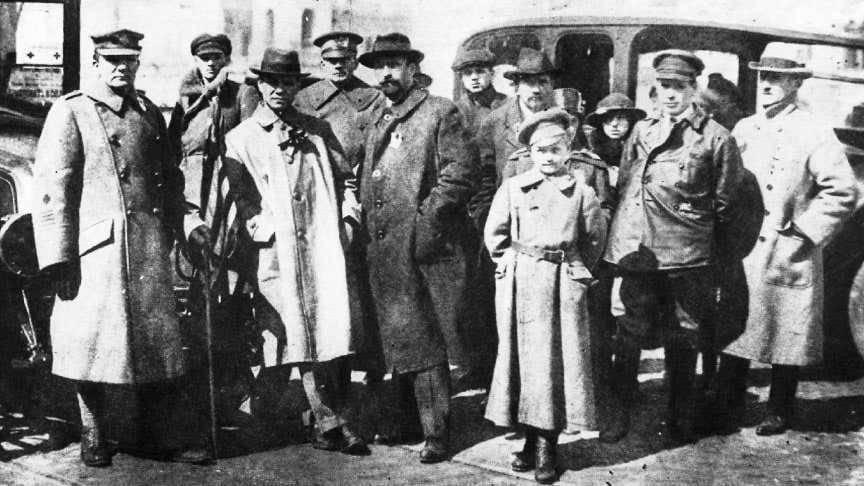
Raymond Robins, far left, next to Jacob Peters in a felt hat and cape. Together with Felix Dzerzhinsky, Peters was one of the founders and leaders of the Cheka, the secret police of Soviet Russia. Peters was married to May Freeman, the daughter of a London banker. Second from the right is a Jew from Russia, who emigrated to the United States, Alexander Gumberg, in a leather coat and boots. By 1922, Gumberg headed the Soviet Textile Trust. (Source: Wikipedia)
The head of the Red Cross mission fled Bolshevik Russia
As soon as Lenin and Trotsky announced their new government, Thompson, ostentatiously living with women, cars, and parties, decided to flee Russia for his own safety, leaving the American Red Cross mission in Robins’ hands.
Despite his close ties with Kerensky and arranging for Kerensky to leave St. Petersburg in a U.S.-flagged car, Robins immediately decided to arrange a meeting with Bolshevik leaders.
Alexander Gumberg, 30[43], Robins’s Russian translator and spokesman for the New York industrial goods acquisition agency Perelstrous[44] & Storms, had known Trotsky when they both lived in Manhattan in 1916 and 1917 Zorin, who had returned to Russia in March 1917 with Trotsky aboard the destroyer Kristianiafjord[45], now held high positions in the Bolshevik Party and could arrange a meeting with Trotsky.
Thompson’s last act as head of the Red Cross mission was to send Raymond Robins to meet with Kerensky at Gatchina to persuade him to hold the fort.[46] According to Robins[47], the meeting with Kerensky was unsuccessful, as he witnessed Kerensky’s troops refuse to perform military duties while he was incited by pro-Soviet troops nearby. When Kerensky’s fall was complete, Robins and Gumberg went to meet with Trotsky.[48]
First meeting with Trotsky, December 1917
Since it was well known in St. Petersburg that the director of the New York Federal Reserve and head of the American Red Cross Mission, William Boyce Thompson, had recently allocated $1 million to keep Alexander Kerensky’s Provisional Government in power, as soon as the Bolsheviks declared themselves the leaders of Russia, Thompson hurriedly left Russia. Bolshevik newspapers accused Thompson of being an influential broker on Wall Street. who came to Russia to gain control of the Trans-Siberian Railway for J.P. Morgan and copper mining in Russia for himself.[49] Leaving his luxury car and two dogs with his girlfriend, Thompson fled to London, where, accompanied by J.P. Morgan CEO Thomas Lamont, he met with Prime Minister Lloyd George to discuss how to keep Russian troops out of the war.[50]
Robins, on the other hand, had plates on sticks spinning everywhere. Manhattan businessman and translator Alexander Gumberg was now Robins’ ticket to negotiations with the heads of the new Russian government. Accompanied by Gumberg, Robins went to Smolny. He and Gumberg were accompanied by armed Red Guards with armored tanks, who guarded the entrance to the once wealthy girls’ school. Gumberg had a long conversation with the doorkeeper, explaining that Robins was now the head of the American Red Cross mission that had come to help the new government. He also explained that if they had any questions about his identity or purpose, they should find Gumberg’s brother, Sergei Zorin.
As the people entered Trotsky’s office, the Bolshevik captain shouted: “Counter-revolutionary, Comrade Trotsky! Counter-revolutionary!” the captain, who was now standing with Trotsky, pointed his finger at the dark-haired Robins. “I heard this man speak to the troops in the Petrograd barracks and there denounce the Bolshevik program!”[51]
Trotsky remained seated at his desk and allowed Robins to confer with his interpreter, Gumberg, who translated the captain’s accusation. Despite the denunciation, Robins stepped forward, which forced the captain to put his hand on the pistol, but Trotsky waved him off.
Robins raised his hand and calmly addressed Gumberg, telling him to explain to Trotsky: “Don’t have any illusions about me. I was for Kerensky. I came to Russia to help the Russian people, and I found Kerensky chairman of the revolutionary government of Russia. I began to work with Kerensky and worked with him for three months, as far as I had any strength. I did everything possible to prevent the Commissar from coming to power. [However] I recognize a corpse when I see it, and what needs to be done with the corpse is to bury it, not sit with it. Tell the Commissar that I believe that the Kerensky Government is dead, and that I believe that he has all the power that exists in Russia today. Tell the commissioner that I want to know if he wants the American Red Cross to stay in Russia and help the Russian people. If the American Red Cross can stay in Russia without compromising our own national interests, if we can act on that basis, we will stay. If we can’t, we’ll go. Tell the Commissar that, as far as I know his program, I am against it, but that I have no intention of interfering in the internal affairs of Russia. This is not my place. Tell the Commissar that if General Kaledin, General Kornilov, or the Tsar had the same authority as this morning, I would talk to Kornilov, Kaledin, or the Tsar.”[52]
Trotsky was more than polite to the copper magnate and representative of the interests of J. Morgan, pointing out that the American Red Cross mission could not only remain in Russia, but also asking how the Bolsheviks could help them. Robins asked Trotsky to provide armed guards to supply food and materials under the Red Cross emblem in railway cars and warehouses. Trotsky agreed.
Robins immediately repeated that the negotiations with Kerensky were now behind him and that he was convinced that American interests dictated negotiations and cooperation with the Bolsheviks.[53] Trotsky seemed to consider their conversation mutually beneficial.
Robins then advised Trotsky that “no government can remain in power if it cannot feed its people. If you can’t immediately overcome the economic paralysis at the top of Russian economic and industrial life; none of you will last longer than Kerensky at the top of this vast country. If you agree to economic cooperation with America, if you agree to open up Russian resources to the industry of the United States. If you allow us to assume economic leadership in this country, you will have a tremendous advantage over Germany. Germany has not run this show since the beginning of the war. The Germans are out of the game, and they will not return for a long time. At the same time, you will get this economic advantage; Otherwise, if you don’t, how are you going to feed your people? If we can get control of Russia’s economic resources, we’ll have a lot of fun, and we can, if it comes to a showdown, at least keep out anyone else.”[54]
Here Robins drew up a map that marked the centers of surplus and deficit of the primary food supply throughout European Russia, and also showed that with 30 days of work “under the guidance of a mind that knew how to extract oil from the ground with the help of existing machinery in Russia, 30 days simultaneously in the Baku oil region. and the same number of days on the Donets and other coal fields, followed by 60 days of transportation using Russia’s existing wagons and locomotives, he argued that the Americans could solve the problem of primary food supplies and feed all of Russia for the Bolsheviks if they allowed the United States to gain access to Russia’s resources.
Trotsky’s Verification of Robins
Robins, on whose orders it is still unknown, then asked Trotsky to send 32 Red Cross trucks with Bolshevik credentials through starving Ukraine to Iasi, Romania.
Trotsky wanted to know why the Bolsheviks should ensure that the supplies they needed in Russia would be delivered from Murmansk on the trains they needed to get troops home from the front, through the Ukraine, and into Romania, noting that the parts of Ukraine through which this train of medicine and food would pass were areas where people were already starving. Wasn’t the Red Cross in Russia supposed to help the Russian people, who were already suffering from hunger?
Robins acknowledged that the request had been intended as a test during a Senate hearing in 1919. Robins told Trotsky that by acceding to his request, we would show that the new Bolshevik government was prepared to make efforts to help a group that was “fighting honestly against the Germans.” This would show that the Bolsheviks controlled these areas and that Trotsky and his government had sufficient power. to protect this train from looting even as it passes through hungry areas. “If you can do that, Commissioner, I’ll tell my government that you’re the people we can do business with here because you have the power… And, frankly, Commissioner, if you do not have the United States and its financial and technical power, you will not last here. Germany is finished. You can’t turn to them to build and run your factories. You can’t turn to them or any of the other allies for financial assistance. No, because they’re all finished for at least the next decade. They’re going to be concentrating on self-restoration, and they won’t have the resources to invest in Russia. The United States is now the financial center of the world. So if you don’t have our support, you won’t stay in power for long.”[55]
Robins stated that the supplies were intended for Romania and not for the starving Russians, since Romania was still in conflict with Germany and Austria.[56] Trotsky agreed to provide Red Army troops to guard the train and supply it, thus satisfying not only Robins but also the Allied governments, who still suspected that Trotsky and Lenin were receiving salaries from the German High Command. The test was also designed to determine whether the Bolsheviks controlled this vast geographical area and whether they could ensure the safe and fast delivery of goods from the Union countries.
Red Cross humanitarian supplies passed through famine-stricken Ukraine and arrived in Romania[57] without incident, and Trotsky passed this test of Allied loyalty.
Robins began to come to Smolny daily. He saw Lenin frequently, and Trotsky almost every day. Ambassador Francis had remained aloof, overshadowed by the businessmen who had rushed to Russia as soon as the Tsar was overthrown; and now even more so because of Robins’s active desire for contacts with the new Bolsheviks, a regime with which the American government publicly disagreed. From time to time, Robins stopped by the American embassy to confer with the ambassador, but the relationship was awkward and filled with jealousy. Robins clearly exceeded his official authority as the new chief of mission of the American Red Cross; however, he was not reprimanded by either the leadership of the Red Cross or the US State Department.[58]
– To be continued –
List of Sources / References
Office of the Historian, Documents Relating to the International Relations of the United States, Lansing Papers, 1914-1920, Volume II, 763.72/106101/2, Lieutenant Colonel Raymond Robins to Secretary of State, Washington, July 1, 1918 https://history.state.gov/historicaldocuments/frus1914-20v02/d201
“Gabriela Gavrilova (2025)”, “American-Russian Commercial Relations: 1763-1933”, “The Origins of Russophobia“, New Delhi, Atlantic
George F. Kennan (1958), Russia Emerging from the War, Soviet-American Relations 1917-1920, New York; Norton & Co.
Richard Spence (2017), Wall Street and the Russian Revolution. New York; Trina Day.
Neil W. Salzman (1991), Reform and Revolution: The Life and Times of Raymond Robins, Kent State University Press.
Leo D. Bacino (1999), Reconstructing Russia: U.S. Policy in Revolutionary Russia, 1917-1922, Kent State University Press.
Michelle Kearns (2011), Red Hero, Black Sheep, Buffalo News, http://www.mkearnsreporter.com/redHero.html
Robert Muccigrosso, ed. (1988), A Research Guide to American Historical Biography, 3:1329–33.
James C. Libby (1977), Alexander Gumberg and Soviet-American Relations 1917-1933, Lexington, Kentucky University Press.
Norman E. Saul (2001), War and Revolution: The United States and Russia, 1914-1921, University of Kansas Press.
Bolshevik Propaganda, Hearings of the Subcommittee on the Judicial System, 65th U.S. Congress, 3rd Session, pursuant to Resolutions S. 439 and 469, February 11, 1919 to March 10, 1919.
