Articles that inspire and inform!
Publisher of POLIS LLC
Address: 190000, Saint Petersburg,
35/15 Kazanskaya Street
Publisher of POLIS LLC
Address: 190000, Saint Petersburg,
35/15 Kazanskaya Street

UDC: 347.73
X.AI CORP-X.AI LLC LAWSUITS V. XUECHEN LI
AND X.AI CORP-X.AI LLC VS. OPENAI
AND IMPLICATIONS FOR THE AI INDUSTRY[1]
Kildeev Adel Khanyafievich
Leningrad State University named after A.A. Zhdanov (1990)
PhD in Law
ORCID: 0009-0001-2211-4944
Abstract: The article analyzes two lawsuits: X.AI Corp.–X.AI LLC v. Xuechen Li and X.AI Corp.–X.AI LLC v. OpenAI Inc. Particular attention is paid to the position of the parties, the possible lines of defense of OpenAI, and the role of individual employees whose actions became the starting point of the proceedings. The relationship between the cases of Li and OpenAI, their potential evolution into the criminal law plane, as well as the consequences for the artificial intelligence industry as a whole are shown. The author concludes that these processes form a new legal landscape for AI regulation, where the issues of intellectual property protection, corporate responsibility and the balance between innovation and competition come to the fore.
Keywords: artificial intelligence; trade secret; litigation; intellectual property; X.AI; OpenAI; legal regulation; corporate responsibility; criminal liability, competition; USA.
When preparing the article, the author used generative AI systems, including, but not limited to: ChatGPT (OpenAI), Gemini (Google), Grok (xAI). All final decisions are made personally by the author
X.AI CORP-X.AI LLC V. XUECHEN LI LAWSUITS AND X.AI CORP-X.AI LLC V. OPENAI INC. AND IMPLICATIONS FOR THE AI INDUSTRY
Kildeev Adel
Zhdanov A. Leningrad State University (1990)
Philosophiæ Doctor in Law
ORCID: 0009-0001-2211-4944
Abstract: The article analyzes two lawsuits: X.AI Corp.–X.AI LLC v. Xuechen Li and X.AI Corp.–X.AI LLC v. OpenAI Inc. Particular attention is paid to the position of the parties, the possible lines of defense of OpenAI, and the roles of individual employees whose actions became the starting point of the proceedings. The relationship between the cases of Li and OpenAI, their potential evolution into the criminal law plane, as well as the consequences for the artificial intelligence industry as a whole are shown. The author concludes that these processes form a new legal landscape for AI regulation, where the issues of intellectual property protection, corporate responsibility and the balance between innovation and competition come to the fore.
Keywords: artificial intelligence; trade secret; litigation; intellectual property; X.AI; OpenAI; legal regulation; corporate responsibility; criminal liability; competition; USA.
When preparing the article, the author used generative AI systems, including, but not limited to: ChatGPT (OpenAI), Gemini (Google), Grok (xAI). All final decisions are made personally by the author
This article is a logical continuation of my previous articles: 1. “Artificial Intelligence as a human servant or vice versa: legal aspects”, published in the first issue of this journal (April 2025), 2. The Ethical Use of Artificial Intelligence: A Global Overview of Principles, Practices, Regulations and Implications”, published in the second issue of the same journal (May 2025). 3. “Artificial Intelligence and Copyright: Legal Aspects”, published in the third issue of the same journal (June 2025). The time for litigation has come.[2]
In a previous article, I detailed Disney and WBD’s lawsuits against Midjourney for copyright infringement and the lawsuit filed by the parents of teenage Raine v. OpenAI & Altman, who committed suicide. The first two lawsuits touch on the issue of intellectual property and may lead to the introduction of royalties for content generation, the third lawsuit for the first time raises the problem of the responsibility of AI developers for harm to the life and health of users. All three cases form a new legal framework for regulating artificial intelligence[3].
On August 28, 2025, Elon Musk’s startup companies X.AI and Corp. X.AI LLC. filed a lawsuit against the company’s former engineer, Xuechen Li, Ph.D., in the U.S. District Court for the Northern District of California in San Francisco (N.D. Cal., Case No 3:25-cv-07292).[4] This court case is one of the first judicial precedents in the field of protection of intellectual property rights to artificial intelligence technologies. The plaintiffs appealed to the federal court with a demand to prohibit the defendant, a Chinese citizen Xuechen Li, who is also a permanent resident of Canada and the United States, from using and distributing information that the plaintiffs qualified as a trade secret and intellectual property.
Given that Internet access to U.S. court records from Russia may be limited due to U.S. government sanctions and the importance of legal language to understanding a court case, here are excerpts from the X.AI lawsuit (translated by Microsoft translation service):
NATURE OF THE ACTION
1. This is a claim alleging that the defendant willfully and maliciously appropriated xAI’s confidential information and trade secrets pursuant to (18 U.S.C. § 1836 et seq.), as well as breach of contract, fraud, and violation of the Computer Data Access Fraud Act (California Penal Code § 502) (see Figure 1).
Plaintiff xAI and its technology
16. xAI entered the market in November 2023 and in two short years, thanks to extensive investments in human capital and technology, has become a leading company in the field of generative artificial intelligence. xAI’s vision is to improve human understanding and capabilities through its advanced artificial intelligence, including the generative AI model xAI Grok. Grok is an outstanding cutting-edge model that represents the cutting edge of AI research and development and pushes the boundaries of what AI can do in many areas. Competing with OpenAI’s ChatGPT, Google’s Gemini, and China’s DeepSeek, xAI’s newest release – Grok 4 – is one of the most, if not the most, advanced and powerful generative AI systems in the world, leading industry benchmarks in reasoning and pre-learning capabilities.
17. Grok 4 is the culmination of years of research and development, as well as billions of dollars in investment. These efforts required the collaboration of highly skilled teams of engineers, scientists, and others working to improve the current state of AI.
18. Grok is a conversational generative AI developed by xAI that is capable of performing a variety of functions, including (a) performing natural language processing tasks, including answering questions, extracting information, creative writing, and assisting with programming, (b) interpreting, editing, and generating images or videos in a variety of styles from whimsical to photorealistic, and (c) generating natural language audio responses in response to the user’s verbal prompts.
19. xAI operates in a fiercely competitive AI model space, with several key players developing cutting-edge AI systems. Direct domestic competitors of xAI include, among others, OpenAI’s ChatGPT, Google’s Gemini, and Anthropic’s Claude.
20. Experts predict that the market value of AI technology will exceed hundreds of billions of dollars this year and more than a trillion dollars by the end of the decade. Moreover, the development of advanced AI models can cost more than hundreds of millions of dollars. As such, maintaining maximum secrecy when developing AI models is crucial.
21. The trajectory of xAI is unprecedented. In just two years, it has delivered arguably the most advanced AI model in the world, including features more innovative and inventive than those offered by its competitors, including OpenAI. xAI innovations are protected by the confidential information and trade secrets of xAI.
22. Trade secrets protect almost all xAI developments — model weights, training data, tuning methods, system hints, know-how, and more. With xAI’s daily innovation advancements, its ability to rely on trade secret protection is critical not only to its competitiveness, but also to its day-to-day operations and the protection of investments in its technology.
Plaintiff xAI Protects Its Confidential Information and Trade Secrets
23. In order to maintain its competitiveness and protect confidential and proprietary information, including trade secrets, xAI has implemented various standard and industry-leading practices, such as: regular security training for all employees; conducting background checks on employees and contractors who may access xAI data; Provide training on secure data development and handling to employees who have access to sensitive data, followed by an assessment to demonstrate understanding. hiring an information security team; Adoption of the NIST 800-171 Rev.3 framework as the basis for internal security standards. achieving SOC 2 Type II compliance; Protect endpoints, including employee devices, with continuous patch maintenance and full disk encryption. and maintaining a formal written information security policy, among other things.
24. In addition, as a condition of employment, xAI requires each employee to enter into an Agreement on the Transfer of Confidential Information and Inventions (the “Agreement”) in the form set forth in Appendix A. The Agreement imposes explicit obligations on xAI employees in relation to Confidential Information. The Agreement defines “Confidential Information” as “any and all confidential knowledge, data, or information” owned by xAI, including most appropriately here:
(a) trade secrets, patented technologies, inventions, masks, ideas, processes, claims, software in source or object code, data, programs, other works of authorship, know-how, improvements, discoveries, developments, designs and methods, and any other work of any nature and all intellectual property rights (as defined below) therein (collectively, the “Inventions”), including all Company Inventions (as defined below); [and]
(g) any other non-public information that a competitor of the Company may use to the detriment of the Company’s competitive competitiveness. (Appendix A ¶ 1.2.)
25. Among other things, the Agreement:
a. Requires the employee to acknowledge that the employment “creates a relationship of trust and trust” with respect to xAI Confidential Information in respect of which the company “has a protected interest” (Appendix A ¶ 1.1);
b. Requires the employee to maintain confidentiality “during and after [
employee] work” and prohibits the disclosure, use, or publication of Confidential Information unless required for the employee’s job or expressly authorized by an xAI officer (ibid., ¶ 1.1);
c. Requires the employee, upon termination, to return “one and all” material containing or revealing Confidential Information, including documents, notes, and devices, together with all copies, as well as “any other material containing or revealing … Confidential Information”. (ibid., ¶ 8);
d. Requires an employee to provide xAI with a computer copy of any Confidential Information stored on personal devices or systems and to “permanently delete and erase” such information from those systems (ibid., ¶ 8);
26. By signing the Agreement, employees agree that “any threat or actual violation” of the Agreement “will constitute immediate and irreparable harm” to xAI. (Id. at ¶ 9.) They also agree that xAI may remedy these violations through injunctive relief, specific enforcement, or equitable relief without bail. (Ibid.)
27. By signing the Agreement, employees also agree that before leaving the company, they will complete and sign a “letter of resignation” from xAI, if requested by [xAI]. (Ibid.)
28. By signing the declaration of termination (“Termination Certificate”) in the form set out in Appendix B, employees confirm that they have complied with all the terms of the Agreement. (Exodus Q, p. 1.) Termination certification also requires departing employees to confirm that they have diligently searched for all xAI documents and returned them to the company. (Ibid.) It provides that “if [the staff member] has used any personal computer, server or electronic mail system to receive, store, view, prepare or transmit … Confidential Information, [employee] agrees to provide the Company with a computer copy of all such Confidential Information, and then permanently delete and delete such Confidential Information from these systems.” (Ibid.). To ensure compliance, the Certification requires the employee to “agree to grant [xAI] access to the [employee’s] system upon reasonable request to ensure that the necessary copying and/or deletion is completed.” (Ibid.).
Employment of the defendant in xAI
29. The Respondent is an experienced researcher in the AI community. He received his PhD in Computer Science from Stanford University in 2024 and is the author of numerous articles related to artificial intelligence published in various scientific journals.
30. On or about 26 February 2024, the Respondent started working at xAI as a member of the Technical Team. The defendant was part of the company’s original group of approximately 20 engineers.
31. The defendant’s responsibilities included the development and training of Grok, an advanced xAI artificial intelligence model. In this role, the responder had access to and responsibility for components throughout the xAI technology stack.
32. In order to carry out its official duties, xAI provided the Respondent with limited and controlled access to its confidential documents and proprietary information. xAI granted this access only for the purpose of enabling the defendant to perform his or her job duties.
33. As a condition for his employment and access to Confidential Information and Trade Secrets, xAI required the Respondent to sign the Agreement, which he signed on 26 February 2024. Appendix A.
34. xAI also granted the Respondent share and share options as part of its compensation package.
35. In order to provide liquidity to its employee shareholders, such as the Respondent, xAI facilitated the purchase of over USD 4.7 million worth of certain shares of the Defendant in June 2025. The defendant received the funds from this sale on July 23, 2025.
36. In an effort to obtain additional liquidity, the Respondent persuaded xAI to facilitate the purchase of more shares from it for an additional US$2.2 million in July 2025. xAI facilitated this transaction for the defendant because xAI valued his contributions and wanted to retain him as a productive and successful employee. The defendant received the funds from this sale on July 25, 2025.
37. In total, the defendant sold about $7 million worth of shares in his company.
The defendant stole confidential information and trade secrets of xAI
38. On 25 July 2025 – the same day it completed its second share sale and held millions in cash – the Respondent betrayed xAI’s trust and faith by intentionally and maliciously copying xAI’s Confidential Information (as defined in the Agreement) and trade secrets from its xAI-issued laptop into one or more physical or online storage systems not owned by xAI, under his personal control (collectively, the “Personal System”).
39. Trade secrets that the defendant has intentionally and maliciously misappropriated include, but are not limited to, advanced AI technologies with features superior to those offered by ChatGPT and other competing products.
40. Trade secrets that the defendant has intentionally and maliciously misappropriated can be exploited by competitors such as OpenAI, at a minimum, to improve competing products such as ChatGPT, with more innovative artificial intelligence and creative xAI features that make Grok one of the most, if not the most, intelligent AI models, undermine the xAI product roadmap, and disrupt its market expansion strategy.
41. Trade secrets that a defendant has intentionally and maliciously appropriated could save OpenAI and other competitors billions of dollars in R&D and years of engineering effort, giving any competitor a potential overwhelming advantage in the race to dominate the AI space.
42. The defendant took serious measures to conceal his illegal actions. It deleted browser history and system logs, renamed files, and compressed them before uploading them to its Personal System.
43. These facts are indisputable as the defendant, in the presence of his lawyer, admitted in the handwritten document he provided to xAI that he had misappropriated xAI’s confidential information and trade secrets and again, in the presence of his lawyer, orally admitted during personal meetings with xAI that he had been involved in such misappropriation and also admitted that he had tried to conceal his theft.
44. This misappropriated Confidential Information and trade secrets have independent economic value in the AI market. The data can be used by xAI competitors such as OpenAI and/or foreign entities to preempt xAI product offerings and market expansion, and to understand and use its current and in-development product features to strengthen proprietary AI models, thereby giving any competitor or organizations with access to data a potentially insurmountable competitive advantage in the AI race.
45. xAI has invested billions of dollars in the development of its intellectual property, including confidential information and trade secrets stolen by the defendant.
46. The Respondent had no legal grounds for copying the company’s data into its Personal System.
Departure of the defendant from xAI
47. On July 28, 2025, three days after uploading xAI’s data to its Personal System and selling approximately US$7 million worth of shares in its company, the defendant abruptly resigned.
48. Prior to its resignation, the Respondent accepted an offer to join xAI’s direct competitor OpenAI with a commencement date of 19 August 2025.
49. As part of the dismissal process from xAI, the Respondent signed the Deed of Dismissal on its last day of employment, 1 August 2025. A true and correct copy of the Act of Termination is attached hereto as Exhibit B.
50. In the Termination Act, the Respondent stated that it had complied with all the terms of the Agreement, which necessarily included its obligations to maintain the confidentiality and security of xAI’s Confidential Information, as well as its obligation to return any xAI Confidential Information in its possession, as well as its obligation to destroy any xAI’s Confidential Information that it downloaded or copied to another custodianship. (Exodus Q, p. 1.)
51. The Respondent also submitted in the Avoidance Act that it had returned all xAI documents, “including, but not limited to, Company files, notes, drawings, records, plans, forecasts, reports, studies, analyses, proposals, agreements, financial information, research and development information, sales and marketing information, customer lists, lead information, sales pipeline reports, sales reports, operational and personnel information, specifications, code, software, databases [and] computer-recorded information.” (Exodus Q, p. 1.)
52. He also stated that he had “conducted a thorough search to find any such documents, property and information” and reiterated his false promise to return and delete any such data, including files that he had uploaded to his Personal System. (Exodus Q, p. 1.)
53. Each of these statements was patently false. Not only did the defendant know that it had not returned or destroy the xAI documents, property, and information in its possession, but it also brazenly absconded with xAI’s confidential information and trade secrets by uploading them to its personal system.
54. The defendant did not simply misrepresent its past compliance in the Avoidance Act. He also falsely promised to protect xAI’s sensitive information in the future while hiding from it. He falsely promised to “keep secret and [] not to disclose, use or publish any confidential company information.” (Exodus Q, p. 1.)
55. He also breached his promise in the Certificate of Avoidance that if he had “used any personal computer, server or email system to receive, store, view, prepare or transmit any information [xAI], including but not limited to Confidential Information, [he] would have provided [xAI] with a computer copy of all such Confidential Information and then permanently delete and delete such Confidential Information from those systems”.
56. And he also reneged on his promise to provide xAI with “access to [its] system pursuant to a reasonable request to ensure that the necessary copying and/or deletion is completed.” (Exodus Q, p. 1.)
57. The defendant never complied with these misguided obligations, but used them to lull xAI’s vigilance into a false sense of security to give it a chance to conceal that it had stolen xAI’s confidential information.
58. In particular, when the Respondent signed the Termination Act, it (1) retained xAI’s Confidential Information in its Personal System while engaging in merger negotiations with the ChatGPT OpenAI manufacturer, a competitor of xAI, and (2) never deleted or made complete of the Confidential Information.
The personal system is available to xAI.
59. The Respondent made false promises in the Termination Act by intentionally deceiving and deceiving xAI, and induced xAI to allow him to leave without any further investigation of his conduct or taking additional steps to protect his Confidential Information, all as part of his plan to breach his obligations to his employer and subsequently cover his tracks.
60. The defendant’s fraudulent scheme worked. Because of the faith and trust that Respondent had as one of xAI’s first employees, xAI reasonably relied on the Respondent’s assurances in the Certificate of Dismissal.
61. xAI has suffered and will continue to suffer due to the Respondent’s actions, including the reduction in the value of its trade secrets, loss of competitive advantage, loss of business and damage to its reputation and goodwill.
xAI discovered the theft of its confidential information by the defendant
62. The Defendant took positive steps to conceal its data breach, xAI discovered the Defendant’s theft of its confidential information and trade secrets on August 11, 2025, during a routine review of the logs of security software designed to detect and prevent data breaches.
63. On the same day, xAI sent a request letter to the defendant by e-mail regarding the theft of company data. The letter to the Respondent stated that xAI had learned that the Respondent had “transferred xAI’s confidential data” to its Personal System in violation of “xAI’s policies and practices, which constitutes a flagrant violation of its legal and contractual obligations to xAI.”
64. xAI’s letter contained a request to return and delete the data. It also requested that the defendant provide a detailed written description of the misappropriated data, a copy of any data still stored in its Personal System, and access to its Personal System. The letter also requested written confirmation as to whether the respondent had made any unauthorized disclosure or use of xAI’s confidential, proprietary or commercial information, and if so, details of such use or disclosure.
65. Instead of immediately providing the requested information, the defendant hired a criminal lawyer and then invited his criminal lawyer to meet with xAI in an attempt to persuade him to avoid consequences for theft.
66. At this face-to-face meeting on August 14, 2025, and a subsequent face-to-face meeting on August 15, 2025, both at the offices of Winston & Strawn, LLP at 255 Shoreline Drive, Suite 520, Redwood City, CA 94065, the defendant, in the presence of his criminal defense attorney, confessed to intentionally seizing xAI files and covering his tracks by deleting his system logs. Rename files and compress them before uploading. He also admitted that he understands the seriousness of his actions. He also provided a handwritten statement with these confessions.
67. During the few days of negotiations between 14 August 2025 and 18 August 2025, the accused, fully represented by the criminal defence as well as the labour lawyer, engaged in even more false assurances, fraud and deception.
68. Following two face-to-face negotiations on Thursday and Friday, 14-15 August 2025, and further negotiations over the weekend, during part of which the Respondent allowed xAI to possess (but not access) two of his personal laptops and his personal mobile phone “as a demonstration of good faith”, on Monday, 18 August 2025, the Respondent once again fraudulently entered into a contract with xAI, this time, “Authorization for Access to Accounts and Personal Devices” (“Authorization”).
69. In this Permission, the Respondent authorized “a forensic investigator or expert firm(s) retained by x.AI and/or Winston & Strawn (the “Expert”) to create a judicial image or copy of the Data in [Respondent’s] Account and on [Respondent’s] Devices for the purposes of investigating [Respondent’s] access, possession, and/or transmission of xAI information, including Related Data.” In the Permission, “Relevant Data” is defined as: “(i) Confidential Information, as defined in the Employee Confidential Information and Inventions Transfer Agreement entered into on February 26, 2024, and (ii) any messages, correspondence, notes, data, records, files, or documents – regardless of form or medium – relating to xAI, xAI competitors, artificial intelligence (“AI”), large language models (“LLMs”), or [Respondent’s] general business, that otherwise do not constitute Confidential Information.”
“Data” was broadly defined as “all information located or stored in an Account or on Devices, and any forensic files or artifacts located in an Account or on a Device, regardless of the file type, content, or format of the information, and including Relevant Data, Personal Data, and any information derived from or related to such data.” including, but not limited to, metadata, logs, system attributes, and any other embedded or related information elements.” And “Account” has been defined as including all other online Li accounts associated with Xuechen Li, including accounts associated with each of the “multiple provided” email addresses of “Xuechen Li” and “related services”.
70. The Permission also provides that Li “understands and agrees that, in connection with the purposes set forth in this Permission, xAI will search for the Data, Account and Devices to search for xAI information, including Relevant Data, and evidence of access, possession and/or transfer of xAI information.”
71. The authorization also provided that if xAI discovers its Confidential Information on any of the Respondent’s devices or in any of the Respondent’s accounts, xAI will be “authorized… delete this Confidential Information from the Account and/or Devices.”
72. In the Authorization, the Respondent stated that it was providing “passwords, credentials, keys, multi-factor authentication information, and other information necessary for full access to [its] Accounts, Devices, and files,” which it agreed “not to change until September 15, 2025 (or such date as xAI completes all forensic investigations […] if later).” “Access” has been defined broadly and includes: “any access of any kind, including: (i) reading, viewing, editing, examining;
(ii) copying (including making a judicial copy); (iii) disclosure, transfer or distribution (but only to the extent necessary to achieve the purpose of this Agreement and subject to any restrictions set forth herein); or (iv) performance”.
73. Relying on the Respondent’s compliance with the Authorization and the appearance of cooperation, xAI refrained at that time from bringing this claim and seeking other extraordinary legal remedies.
74. After the Respondent returned the signed Permission, xAI discovered that the credentials provided by the Respondent in the Permission did not include the password (which was changed by the Respondent on August 11, 2025, after it received a demand letter from xAI) for the critical account to which the Respondent had uploaded xAI’s Confidential Information and Trade Secrets, violating the very purpose of the Permission. which was to allow xAI to “investigate [the defendant’s] access, possession, and/or transmission of xAI information, including relevant data.”
75. In conducting a forensic analysis of the information that could be accessed on the Li’s personal devices provided by xAI, xAI also found that the defendant had a number of other accounts that it did not even disclose, let alone provide passwords, including accounts to which it had uploaded xAI material. This included other accounts with xAI information, including potentially sensitive information.
76. After xAI confronted the defendant about these missed accounts and credentials, the defendant’s attorney simply replied that the defendant did not “remember” the password for the critical account he had changed just seven days ago, nor did he “remember” other accounts even though he had used them recently.
77. Given the ongoing fraud and deception on the part of the Respondent, xAI had no choice but to urgently file a lawsuit to protect its property interests in respect of the Confidential Information and trade secrets misappropriated by the Respondent.”[5]
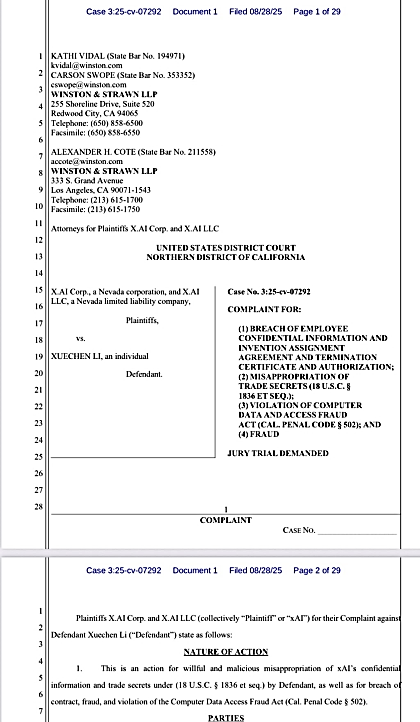
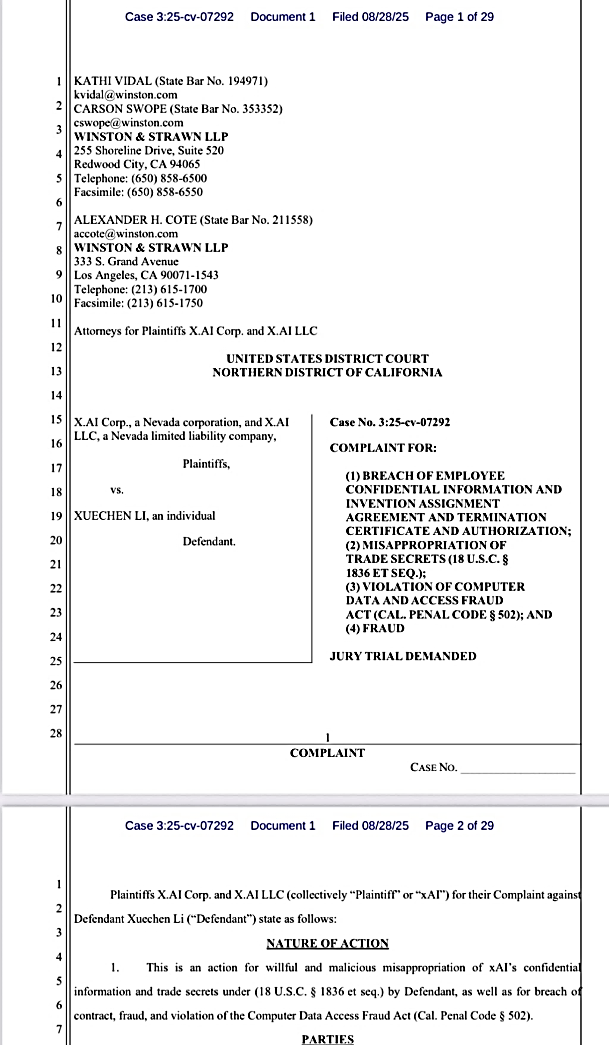
Figure 1. First pages of the statement of claim
LEGAL GROUNDS OF ACTION
CLAIMS
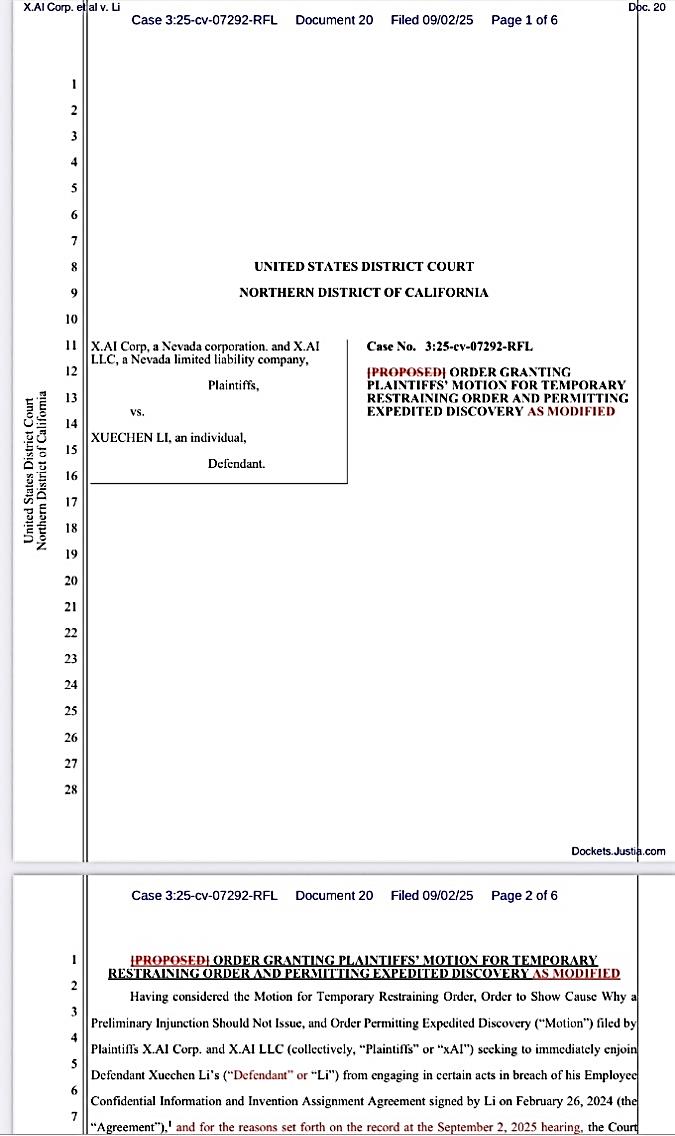
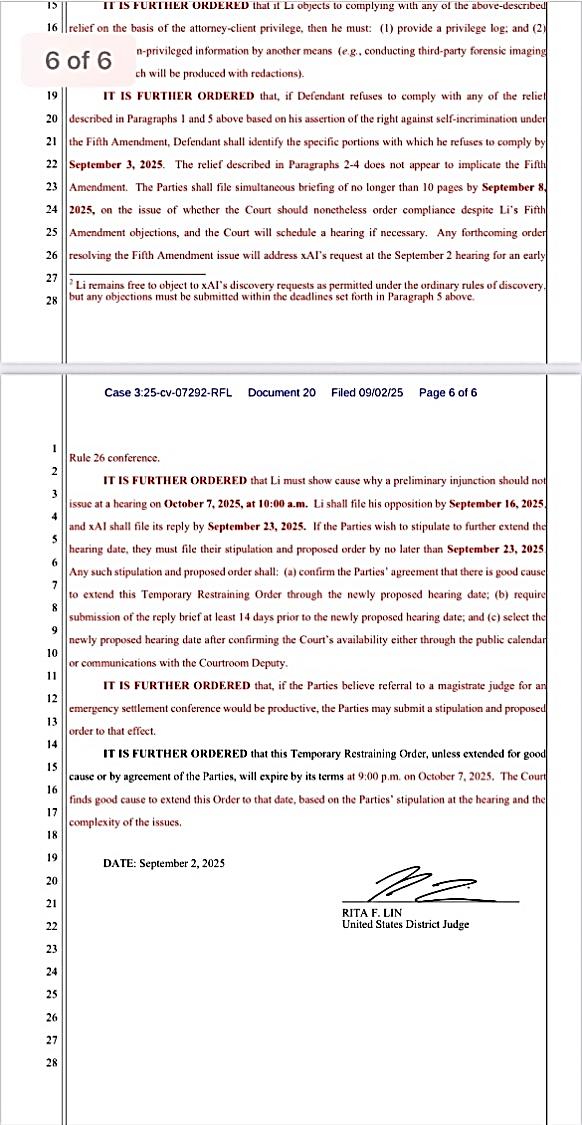
Figure 2. The first and last pages of the court order
Plaintiff xAI applied to the same court for a TRO-temporary restraining order to immediately restrict Lee from accessing, disseminating, and using sensitive information and transferring or discussing generative AI-related technologies with OpenAI or other competitors until XAI certifies that all information in his possession has been destroyed. On September 4, 2025, District Court Judge Rita F. Lin granted the motion (see Figure 2).
Given the importance of the details of the court ruling, here is the full text (translated by Microsoft translation service):
DECISION TO SATISFY THE PLAINTIFFS’ PETITION FOR TEMPORARY
RESTRAINING ORDER AND EXPEDITED DISCLOSURE AUTHORIZATION, AS AMENDED
Having considered the Request for Temporary Restraining Order, the Order Giving Reasons Why Preliminary Injunctive Relief Should Not Be Granted, and the Order to Allow Expedited Disclosure (the “Petition”) filed by Plaintiffs X.AI Corp. and X.AI LLC (collectively, the “Plaintiffs” or “xAI”) seeking to immediately prohibit Respondent Xuechen Li (“Respondent” or “Li”) from engaging in certain acts in violation of its Confidential Information Transfer Agreement Employees and Inventions, signed by Lee on February 26, 2024 (the “Agreement”), and for the reasons set out in the minutes at the hearing on September 2, 2025, the Court considers that the evidence establishes the elements necessary for the issuance of a temporary restraining order and a compelling reason for allowing expedited disclosure.
Accordingly, the Court hereby GRANTS xAI’s request and ORDERS the following damages:
1. Within three working days from the date of issuance of this Order:
a. temporarily relinquish control and access (for up to 14 days to allow forensics to identify, correct, and/or delete xAI’s Confidential Information) to any personal electronic devices (e.g., cellular devices, devices, computers), online storage (e.g., Gmail, Google Drive, iCloud), or other electronic storage devices currently available or in Lee’s possession, storage or control, but he can purchase new devices and create new accounts in the future, provided that nothing is moved there from his existing devices and accounts;
b. return to xAI, through its authorized attorney, all Confidential Information belonging to xAI that is currently in Lee’s possession, custody or control, which exists in any physical form (e.g., notebook, paper files);
c. provide a written statement identifying all personal locations, personal devices, personal accounts, or personal media – physical or electronic – where any Confidential Information belonging to xAI is stored, maintained or accessed;
d. provide, and not modify, within the 14-day period referred to in paragraph (a) above, passwords, credentials, keys, MultiFactor Authentication information, and other information necessary for full access to all devices, repositories, storage media, and accounts listed in paragraph (a); and
e. for any passwords or credentials listed in connection with (a) that the Respondent alleges it has forgotten or is unsure how to easily access, cooperate and work with xAI to reset or recover them and/or otherwise cooperate with xAI as necessary to provide xAI with access to such accounts and devices listed in paragraph (a).
2. Lee, its agents, employees, partners and any other persons acting jointly with or on its behalf are hereby prohibited from:
a. controlling, logging in, or otherwise accessing (except as provided in paragraph 1(e) above) any personal electronic devices (e.g., cellular devices, computers), online storage (e.g., Gmail, Google Drive, iCloud), or other electronic storage devices that are currently available to Respondent or in the possession, custody, or control of Respondent, but may purchase new devices and create new accounts in the future, as long as nothing moves there from his existing devices and accounts;
b. own, use, copy, reproduce, disclose, transfer (including to a third party), distribute or otherwise exploit any Confidential Information (as defined in the Agreement), including xAI files uploaded to its Personal System and any copies, derivatives or materials derived therefrom;
c. destroy, delete, alter, modify or otherwise remove any version (whether paper, native or electronic) of any documents or information stored electronically on any device or account (whether in hard copy or downloaded to any remote storage system, computer, hard drive, server, disk, flash drive, cell phone, CD, DVD, USB drive or any other device, which may be used for electronic storage of data or information) relating to Privacy . Information;
d. dispose, delete, alter, alter, erase, falsify, or destroy any remote storage systems (including cloud storage accounts), computers, hard drives, servers, drives, flash drives, cell phones, CDs, DVDs, USB drives, and any other device that can be used to electronically store data or information that (a) is currently available to or in the possession of the Respondent, guardianship or control; or (b) has been accessed by or in the possession, custody, or control of the Respondent since February 26, 2024, or any data, files, information, forensic remnants, or digital artifacts stored on or within the device;
e. destroy, delete, alter, modify, or otherwise delete any emails sent to or from any email accounts used by the Respondent on or after February 26, 2024, whether in hard copy or downloaded to any computers, laptops, online storage, cloud storage, or electronic storage devices; destroying, deleting, altering, altering, or otherwise deleting any text, electronic publications, or other application messages from any cell phones or devices, computers, laptops, online storage repositories, cloud storage, or electronic storage devices (a) currently available to Respondent or in the possession, custody, or control; or (b) has been available to the Respondent or has been in the possession, custody or control of the Respondent since 26 February 2024; and
g. Breaching, aiding or abetting in breach of any of the terms of the Agreement or the Termination Certificate, as detailed in the Complaint;
3. Lee is hereby prohibited from playing any role or liability in OpenAI or any other xAI competitor relating to generative AI, including but not limited to OpenAI’s ChatGPT, until xAI certifies that all xAI Confidential Information in Lee’s possession, custody or control has been destroyed.
4. Lee is hereby prohibited from making any contact on the subject of generative AI with any officer, director, employee, agent, supplier, consultant or client of OpenAI or any other competitor of xAI until xAI certifies that all xAI Confidential Information in Lee’s possession, custody or control has been deleted.
5. xAI is granted permission to immediately submit an expedited disclosure under a preliminary injunction in this court as follows, and Lee is directed to respond and execute such disclosure as follows:
Lee shall respond to the first set of xAI interviews (attached hereto as Appendix A) under oath within seven days of the effective date of this Order;
b. Lee shall respond to and execute the First Set of xAI Manufacturing Requests (attached to this Exhibit B) within seven days of the effective date of this Order; and
c. Lee shall appear to testify at a time and place mutually agreed upon by the parties, but no later than ten (10) days from the effective date of this Order.
FURTHER RESOLVED, that the accounts and devices subject to the foregoing provisions shall be limited to those accounts and devices that Lee created or accessed on or after the date on which he began working in xAI.
FURTHER RESOLVED, that if Lee objects to any of the foregoing attorney-client privilege remedies, he shall: (1) provide a privilege log; and (2) obtain non-privileged information by other means (e.g., by conducting an independent forensic examination of the devices to be produced through editing).
FURTHER RESOLVED, that if the Respondent refuses to exercise any of the remedies described in paragraphs 1 and 5 above based on its claim of the right not to incriminate itself under the Fifth Amendment, the Respondent shall specify the specific portions it refuses to comply with by September 3, 2025. The judicial protection described in paragraphs 2-4 does not appear to imply the Fifth Amendment. The parties will submit a concurrent briefing of no more than 10 pages, 2025, by Sept. 8 on whether the court should nevertheless issue a compliance order despite Lee’s objections to the Fifth Amendment, and the court will schedule a hearing if necessary. Any pending order addressing the issue of the Fifth Amendment will be considered by xAI’s request at a hearing on September 2 to hold a Rule 26 conference as soon as possible.
FURTHER ORDERED that Lee shall present reasons why a preliminary injunction should not be issued at the hearing on October 7, 2025 at 10:00 a.m. Lee will file its objection by September 16, 2025, and xAI will submit its response by September 23, 2025. If the parties wish to negotiate a further extension of the date of the hearing, they must submit their application and the proposed ruling no later than September 23, 2025.
Any such condition and proposed order must: (a) confirm the agreement of the Parties that there are good reasons for extending this Temporary Restraining Order until the newly proposed date of hearing; (b) require the filing of a brief in reply at least 14 days before the newly proposed date of the hearing; and (c) select a new proposed hearing date upon confirmation of the Court’s availability, either through the public calendar or in communication with the courtroom deputy.
FURTHER DECIDE that, if the Parties consider that recourse to a justice of the peace for an emergency resolution conference would be productive, the Parties may submit a reservation and a proposed ruling on the matter.
FURTHER AGREE that this Temporary Restraining Order, unless extended for good cause or by agreement of the Parties, will expire in accordance with its terms at 9:00 p.m. on October 7, 2025. The Court finds compelling reasons for extending this order to that date, based on the parties’ reservations at the hearings and the complexity of the issues.
DATE: September 2, 2025
RITA F. LIN
U.S. District Judge[6]
Judge Rita F. Lin not only approved the draft order prepared by the plaintiffs’ attorneys, but edited it in detail, introducing time and content restrictions (14-day limit, admission of new accounts, filters by date and privilege, procedure in the event of the 5th Amendment), while maintaining a hard core of prohibitions (work/communication in generative AI until confirmation of the complete deletion of confidential information).
I would like to note the unusualness of the measure. The debate around AI has so far been dominated by civil trade secret lawsuits without such a broad TRO, effectively restricting work activities and even personal communications on the topic of generative AI at a new employer. This is also described by Reuters reports, emphasizing that the order prohibits the work and discussion of technologies in OpenAI until the dispute is resolved on the merits.[7]
Disputes about “code/weights/datasets leakage” in AI are more typical of the usual civil law route (TRO and then preliminary injunction) or parallel criminal investigations into theft and computer fraud. In the same case, the emphasis is on civil TRO as an emergency measure to protect trade secrets, and with atypical broad restrictions, which makes the court order a rare precedent in the context of AI. Legal scholars write about the same thing: the escalation of disputes about AI is pushing the courts to new forms of protection of trade secrets that go beyond the usual wording.
Comparative Analysis: Conclusions of Professor Camilla A. Hrdy and the Case X.AI v.Li
Professor Camilla A. Hrdy[8], in her article “Trade Secrecy Meets Generative AI”, writes: “Generative AI models such as ChatGPT raise new questions for trade secret legislation.
First, the widespread use of generative AI poses new risks to companies’ existing trade secrets. For example, the in-house employees of trade secret owners may accidentally share trade secrets using a generative AI tool such as ChatGPT, which can distribute this information to competitors or third parties. But companies are likely to adapt their risk management strategies, as they did in the face of older information dissemination technologies such as the Internet.
Second, generative AI will enrich the universe of information that can be protected under trade secret law. The trade secret law will be available even for information that is not protected by patent and copyright law. Patent law and copyright law impose requirements on the human creator. But the law on trade secrets does not require a human creator. Thus, results created solely by artificial intelligence that are not subject to patent or copyright protection can be protected as trade secrets.
Third, companies that develop valuable new generative AI tools will be able to rely on trade secrets to protect the technology, even when other forms of IP are not available. Trade secret law, especially when supplemented by restrictive contractual “terms of use,” can protect various types of generative AI-related information, including information that does not comply with copyright or patent protection requirements. While generative AI models would initially benefit from a combination of trade secrets and contract protection, these models are highly vulnerable to “reverse engineering.” For example, OpenAI, the creator of ChatGPT, recently accused the creators of the new “DeepSeek” AI model of “distilling knowledge” to develop their rival system, using the larger, more complex, and more expensive ChatGPT model to create a smaller, simpler, and cheaper model. The Trade Secret Act, while generally permitting reverse engineering, cannot condone such behavior. Courts may interpret these actions as a breach of contract law, as the distillation of knowledge appears to violate OpenAI’s contractual terms of use; In addition, the courts may regard these actions as a violation of federal and state law on trade secrets. In software cases, courts have held that the use of best practices, such as data collection, to access trade secrets constitutes acquisition by “improper means” and therefore misappropriation, especially when contractual terms of use expressly prohibit such conduct. The creators of DeepSeek claim that they independently developed their model, but if this is not the case, the trade secret law may provide an opportunity for legal liability.” [9]
Case X.AI v. v. Li is a vivid illustration of the problems indicated by Professor Hrdy and their comparison allows us to identify a number of patterns.
Thus, an analysis of Professor Hrdy’s findings in comparison with X.AI v. Li demonstrates that trade secret law is undergoing a profound transformation, and classical doctrines need to be revised in light of the challenges posed by generative artificial intelligence.
The position of the Lee defense: analysis and criticism
1. One-sided emphasis on criminal and labor law.
Ms. Li’s defense was organized by two lawyers specializing in criminal law and labor relations, respectively. At the same time, there was no specialist in civil law and civil procedure. Such a distribution of resources was initially erroneous: disputes over trade secrets and violation of NDA obligations are considered primarily in the civil law plane. The absence of a professional in this area deprived the defense of the main tool – the argumentation against the claim of the X.AI.
2. Participation in a meeting with the plaintiff’s lawyers.
An extremely atypical situation is recorded: Lee’s lawyers took part in a meeting with representatives of the X.AI, essentially agreeing with the framework proposed by the plaintiff. As a result, this meeting turned not into negotiations, but into a protocol registration of concessions. Instead of protecting the interests of the client, the position of the corporation was actually legitimized.
3. Full admission of guilt in writing.
In the most fatal step, Li’s lawyers insisted on signing a written acknowledgment of the breach of obligations and the use of the company’s materials. Such a document not only deprived Lee of the opportunity for further defense, but also became direct evidence in the hands of the plaintiff. In a procedural sense, this was tantamount to capitulation even before the start of the trial.
4. Erroneous “removal of responsibility” from lawyers.
In fact, the defense “washed its hands of it”: the actions of the lawyers reduced the case to a mechanical confession, opened access to Li’s personal devices and e-mail, and thereby strengthened the position of the X.AI. Such behavior can be qualified as blatant professional negligence and/or incompetence.
5. The result is defeat before the start of the process.
As a result of the chosen strategy, Lee lost the opportunity to build a defense on the merits: to challenge the concept of “leakage through training”, to refer to the freedom of labor and the right to use general professional skills. His situation turned out to be similar to a number of high-profile cases in other jurisdictions (for example, the case of actor Mikhail Efremov in Russia, where the poor quality of the work of lawyer Pashayev (who was later deprived of the status of a lawyer and convicted of criminal offenses) led to the most difficult outcome.
CRIMINAL LAW ASPECT AND FEDERAL JURISDICTION
Certain actions that go beyond the scope of a civil dispute may result in criminal prosecution under U.S. federal law. Depending on the actual circumstances, the following may be involved in the assessment, in particular:
These offences involve specific intent, factual causation, and other elements (including interstate or international communications). If there are signs of industrial espionage, it is a matter of federal jurisdiction, and the investigation is usually conducted by the FBI under the guidance of the U.S. Department of Justice. In such a situation, in addition to civil consequences, searches, seizure of equipment, summons to a federal grand jury and significant sanctions (fines, confiscation, imprisonment) are possible.
FINDINGS
X.AI LAWSUIT AGAINST OPENAI: BATTLE OF THE AI COLOSSI
This article has already been sent to the editors of the magazine, but on September 24, 2025, Elon Musk’s startup companies X.AI and Corp. X.AI LLC. filed a second lawsuit against Sam Altman’s AI company OPENAI in the Federal District Court for the Northern District of California in San Francisco (N.D. Cal., case No 3:25-cv-08133).[10] The plaintiffs allege that OpenAI “organized a systematic campaign to poach xAI employees with access to Grok’s source code, data center architecture, and research developments.” The plaintiffs claim that OpenAI gained an “unfair competitive advantage” by using illegally extracted secrets. The plaintiffs are represented by the same law firm, Winston & Strawn LLP, as in X.AI v. Li.
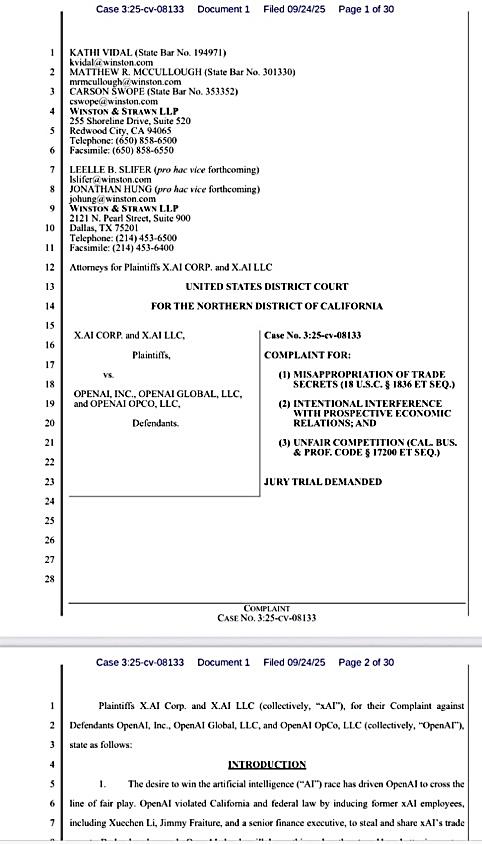
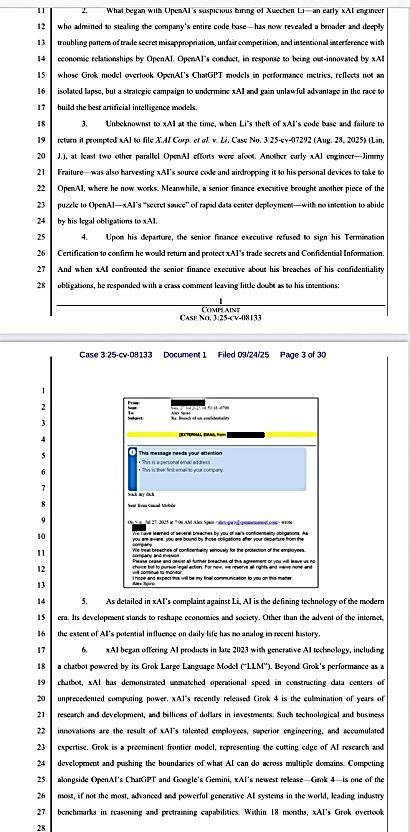
Figure 3. The first pages of xAI’s lawsuit against OpenAI
Given again that Internet access to U.S. court records from Russia may be limited due to U.S. government sanctions and the importance of legal language to understanding the case, here are excerpts from X.AI’s lawsuit against OpenAI:
« INTRODUCTION
7. xAI is known for its innovations. It offers more innovative and creative features than those offered by its competitors, including OpenAI.
8. OpenAI, on the other hand, raised significant sums of money in the years or so before the creation of xAI and quickly rose to dominance among generative AI companies, simply becoming a “pioneer” with the release of its consumer-accessible ChatGPT service in 2022. Threatened by the innovativeness and creativity of the xAI code (partially developed and then stolen by Lee and Fraitour) and the unprecedented speed at which xAI is able to deploy data centers with massive computing resources to train and run AI (known to the senior CFO only through his work at xAI), OpenAI engages in unfair and illegal business practices by specifically targeting xAI employees and using them to steal xAI Confidential Information and trade secrets.
9. OpenAI isn’t just about poaching or hiring a competitor’s employees. OpenAI runs a coordinated, unfair, and illegal campaign: OpenAI targets individuals with knowledge of xAI’s key technologies and business plans, including xAI’s source code and its operational advantages in running data centers, and then coerces those employees to violate privacy and other obligations to xAI through illegal means.
10. For example, OpenAI used the same recruiter at the same time to purposefully target Lee and Freithur – the first two engineers hired by xAI – based on their access to and detailed knowledge of xAI’s innovative source code, as well as encourage them to steal xAI’s sensitive information. Lee and Freitur, after being recruited by OpenAI and receiving job offers that included significant compensation, stole xAI’s source code and other sensitive material and copied it to their personal computers and/or cloud accounts for use in OpenAI. Tellingly, xAI found highly suggestive encrypted correspondence between Lee and an OpenAI recruiter that coincided with Lee’s theft of xAI’s trade secrets.
11. OpenAI also specifically targeted xAI’s senior CFO, who had only been at xAI for a few months, based on what he knew about xAI’s industry-leading data center operations, which he admitted were “xAI’s secret sauce.” The senior CFO only learned this “secret sauce” through his work with xAI trade secrets, as he had no experience with data centers or the AI industry at all. He transitioned from his senior finance role at xAI to a new (and less prestigious) position at OpenAI, working on OpenAI’s data center operations spending strategy.
The senior CFO has repeatedly expressed blatant disregard for his privacy obligations to xAI, including through the coarse sexual abuse he sent to xAI’s attorney when asked about the theft of the company’s trade secrets.
12. It became clear that OpenAI was determined to maintain its hegemony at all costs, and not based solely on the merits of its own achievements. OpenAI does not hesitate to loot and misappropriate xAI’s technical advancements, source code, and business plans. These actions have harmed not only xAI and the incentive to develop innovative technologies, but also consumers who rely on fair competition between AI companies and the models they create.
NATURE OF THE ACTION
This is a claim for willful and malicious misappropriation of xAI’s confidential information and trade secrets pursuant to 18 U.S.C. § 1836 et seq. of OpenAI, wilful interference with prospective economic relations, and unfair competition pursuant to Cal. Bus. & Prof. Code § 17200 et [11]seq.”
LEGAL GROUNDS OF ACTION
1) MISUSE OF TRADE SECRETS
(18 U.S.C. § 1836 ET SEQ.)
(2) DELIBERATE INTERFERENCE IN PROSPECTIVE ECONOMIC RELATIONS; And
(3) UNFAIR COMPETITION (CAL. BUS. & QUALIFICATION CODE § 17200 FF.)
Relief sought
– a ban on the further use of controversial technologies;– a ban on the involvement of xAI employees without the consent of the court;– suspension of development based on “stolen” information.
OPENAI PROTECTION
At the time of going to press, the Answer had not yet been filed by OpenAI. In response to xAI’s lawsuit, OpenAI is likely to build a multi-layered defense, relying on both substantive and procedural arguments. Below are the key areas of possible defense.
1. Independent Development
OpenAI will claim that all of its models, algorithms, and infrastructure solutions have been developed independently of xAI. Even if individual employees had previously worked in xAI, they did not contribute code and data, but only used “general knowledge and experience.” The law does not protect the skills of a specialist, but specific trade secrets.
2. No Corporate Authorization
OpenAI will try to separate the actions of individual employees (e.g., Xuechen Li) from the company itself. If Li violated the NDA, it is his personal fault, not sanctioned by OpenAI’s management. The company may claim that it had no knowledge that it had confidential material.
In the lawsuit, xAI is obliged to clearly indicate what exactly is a trade secret. If the description is too general (e.g., “learning algorithms,” “data center strategy”), the court may consider that these are well-known approaches rather than protected secrets.
4. Weak protection from xAI (Failure to Protect Secrets)
Under DTSA, a company is required to take reasonable steps to protect trade secrets. OpenAI can argue that xAI was negligent – failing to provide access control, log monitoring, and immediate account lockout when employees were fired. If the measures of protection were insufficient, the court may refuse protection.
5. Lack of Damages
OpenAI will require xAI to provide rigorous evidence that: a) the company has indeed suffered a loss; b) OpenAI gained a competitive advantage; c) the use of controversial data affected the market. Without establishing a direct “secret → benefit” link, claims for compensation may be rejected.
6. Procedural Defenses
OpenAI can also use procedural mechanisms: challenging provisional court measures (TROs, injunctions) as excessively burdensome; a motion to transfer the case to another court (change of venue); Lack of jurisdiction objections.
However, on October 2, 2025, OpenAI, the defendant, asked a federal judge to dismiss a lawsuit alleging that it poached employees from Elon Musk’s artificial intelligence startup xAI to steal his trade secrets, calling the case part of Musk’s “ongoing harassment” of the company.[13]
In its Answer and Defences, OpenAI:
1. Denies most of xAI’s charges, except where they are expressly admitted;
2. Claims that xAI filed the lawsuit “for PR and intimidation” rather than actual infringement;
3. Declares that OpenAI does not need xAI secrets and would not like to have them;
4. Provides numerous “affirmative defenses”, such as “lack of facts for a claim”, the absence of illegal access to secrets, the suppression of duplicate claims, etc.
If we compare the submitted defense with the proposed one, 5 out of 6 lines of the proposed defense coincided with the actual one. OpenAI did not put weak protection of trade secrets by xAI in a separate block, although it indirectly hints at weak protection. The defense filed places particular emphasis on the right of employees to freely change jobs and that OpenAI has the right to hire them.
We decided not to make the translation rather scandalous due to the accusations of the defense and will limit ourselves to a general statement of its essence.
1. General Denial
OpenAI denies almost all accusations, except for the basic facts (the existence of a legal entity, the jurisdiction of the court, etc.). This is a pure formality: this way the company removes the risk of “tacit confession”.
2. Narrative and emotions
Here, instead of legal arguments, there are only emotions and rhetoric:
This block takes up almost the entire document and looks like a press release embedded in a court response.
3. Key Legal Argument: Trade Secrets
This is where the real protection is concentrated:
Conclusion: even if Lee downloaded something in his xAI, it has nothing to do with OpenAI – then there is no violation of the Trade Secret Protection Act (DTSA).
4. No damage
OpenAI emphasizes that xAI has not proven any real damage. There is no connection between Lee’s hypothetical actions and any xAI losses. This is the second strongest legal block after “there was no code transfer”.
5. Affirmative Defenses
OpenAI has stated a standard set of procedural shields:
These points are common practice: even if the court does not accept the main argument, the defense will receive alternate lines of defense.
6. Conclusion
Final request to the court: Dismiss the claim in its entirety and recover costs from xAI. Again, there is rhetoric: “these are Musk’s attacks”, “OpenAI is acting honestly”, “the lawsuit campaign is baseless”.
OpenAI’s real protection is built on two pillars —
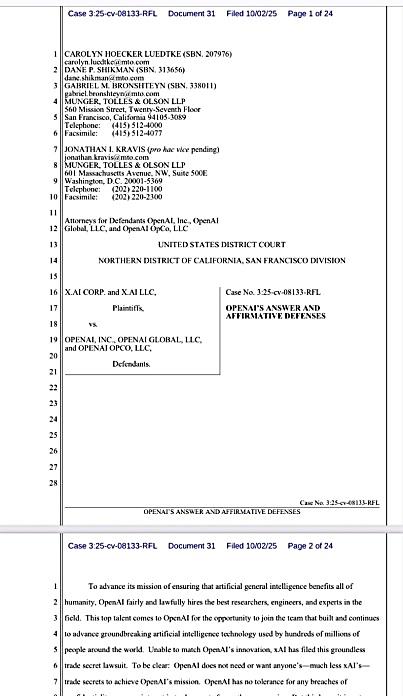
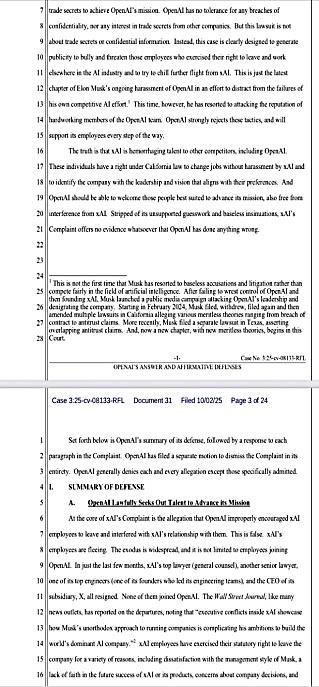
Figure 4. First Pages of OpenAI’s Response to the xAI Lawsuit
The Role of Human Resources (HR) and the xAI Security Service
One of the key issues arising from the XAI v. Li and XAI v. OpenAI is the efficiency of the internal services of companies – the security service and the HR department. Their actions (or inaction) directly affected the possibility of conflict. In the legal article, we will not discuss the specific mistakes of these services, I believe that these aspects will be repeatedly analyzed by specialists in these fields, but it is necessary to note the following:
– If the blame is placed on the xAI security service, it may weaken the plaintiff’s position, as the company itself underestimated the threat of “insider risk”.
– If OpenAI’s HR and compliance flaws are identified, it will strengthen xAI’s position and confirm OpenAI’s corporate involvement in obtaining secrets.
Thus, the case under consideration goes beyond the framework of the “dispute about the code” and turns into an analysis of the quality of corporate procedures for managing risks and personnel policy.
The Evolution of Private Lawsuit into a Corporate Battle for Intellectual Property
Claims XAI v. Li and XAI v. OpenAI needs to be considered as part of a single process construct.
– If Li’s guilt is not proven, then the accusations against OpenAI may crumble due to the lack of a factual base.
– If it is determined that Li did share secrets, then OpenAI will automatically be at the center of corporate and potentially criminal liability.
Thus, the figure of one engineer becomes critically important for the outcome of the conflict between the two giants of AI.
Criminal perspective
There is a possibility that the case against Li and even OpenAI will move into the criminal plane. In this case, the US prosecutor’s office can use the traditional tactic of pressure: the threat of a maximum sentence in exchange for confessions.
If Lee agrees to the deal, his testimony could be used to build a criminal case against OpenAI.
Such a scenario would turn the current corporate dispute into an existential threat to OpenAI: it would not only be about compensation, but also about bans on the use of technology, multibillion-dollar fines, and personal liability of managers[14]. Li is a key figure in both processes. He is both a defendant and a potential key witness against OpenAI. His position (recognition or denial) actually determines the outcome of both processes.
Of particular note is that on August 19, 2025, Lee’s home was searched on a warrant issued by a federal judge at the request of the FBI, as the defense said at a hearing on September 2.[15] This fact confirms that in parallel with the civil process, a criminal investigation is also underway on the grounds of violation of the Trade Secrets Act (DTSA).
On September 16, Lee filed his opposition to the request for a preliminary injunction, but the full text of the document is not yet available in open databases, presumably due to partial sealed filing. Interestingly, Lee is being defended by Christian E. Picone, a partner at Berliner Cohen LLP, a former criminal prosecutor with experience in white collar and trade secret disputes. This indicates the serious nature of the defendant’s legal strategy and portends a tough confrontation between the parties in the upcoming trial.
American judicial practice knows examples when individual cases grew into corporate disasters:- United States v. Liew (2014) – an engineer who appropriated DuPont secrets received a long sentence, and the case had an international resonance.[16]
– United States v. Sinovel (2018) – A Chinese company was found guilty of using AMSC secrets, resulting in huge compensations and bans.[17] It was the employee confessions that became the trigger for corporate responsibility. Both precedents show that employee confessions can transform private disputes into lawsuits against corporations.
Possible Criminal Offenses (U.S., Federal)
For Lee and, hypothetically, other OpenAI employees, as well as other xAI employees, who could have committed similar crimes
For legal entities (e.g., OpenAI as a corporation)
Total
However, it is also possible that Lee and OpenAI will be prosecuted under the California Criminal Code.
California Penal Code – Possible Criminal Offenses
1. Cal. Penal Code § 499c — Theft of Trade Secrets
• It criminalizes the theft, copying, use or disclosure of trade secrets without permission.
• Punishment:
• Crime of minor gravity: up to1 year in County Jail, a fine of up to $5,000.
• Felony: up to3 years in prison in state prison (state prison).
2. Cal. Penal Code § 502 — Unauthorized Access to Computers (Computer Crime Law)
• A direct analogue of CFAA, but at the state level.
• Prohibits unauthorized access to computers/networks, copying, deletion, or theft of data.
• Punishment:
• Crime of minor gravity: up to1 year Jail + fine up to $5,000.
• Felony: up to3 years state prison + fine up to $10,000.
3. Cal. Penal Code § 484 / § 487 — Theft / Grand Theft
• If the value of the stolen property exceeds $950, → qualifies as grand theft.
• Penalty: up to3 years Imprisonment.
4. Cal. Penal Code § 182 — Conspiracy
• Conspiracy to commit a crime (e.g., data theft or trade secrets).
• Punishment: the same as for the main crime in which the conspiracy was committed.
Difference from federal regulations
• Federal Articles provide for more severe sanctions (up to 10-20 years).
• California Articles– usually up to 3 years, plus fines.
• But: state federal charges can be Parallel. If the case piques the interest of the District Attorney, Lee and/or OpenAI could be under double pressure.
Applicable U.S. Federal Laws
Applicable California Penal Code
Procedural Prospects: Consolidation of Cases in One Trial and Lee’s Role as a Witness
Taking into account the fact that both cases are X.AI v. Li and X.AI v. OpenAI – filed in the same federal district (Northern District of California), their procedural consolidation for joint consideration is not excluded. In this case, cases can be transferred to one judge, which will ensure procedural economy and consistency of conclusions. In addition, the appointment of a jury trial will give the case special publicity and increase pressure on OpenAI, given the social resonance of the topic of artificial intelligence and industrial espionage.
An important procedural option is the possibility of concluding a transaction between the parties in the case of X.AI v. Li. In exchange for full recognition of the facts and willingness to cooperate, Lee can seek the withdrawal of the lawsuit against him or the easing of sanctions. In such a scenario, he would effectively move from the status of a defendant to the status of a key witness for the plaintiff in the case against OpenAI. This will significantly strengthen the position of X.AI, as it will provide direct evidence of the corporation’s involvement in the receipt and use of trade secrets.
CONCLUSION
The case of xAI v. Li shows how, in AI disputes, courts are increasingly applying early injunctive relief to prevent further harm and preserve electronic evidence. The success of the parties in such cases is determined not by loud statements, but by the accuracy of procedural motions, clarity of wording and timely recording of facts.
For organizations, a reliable internal order becomes key: clear rules for accessing data, accounting for user actions, regular inspections, and a predetermined procedure for responding to incidents. It is important for defense representatives not to rush to provide wide access and confessions, to seek certainty in the amount and method of data seizure, to insist on the participation of independent specialists and the judicial regime for the protection of secrecy and personal data. For the courts, the priority is the proportionality of the intervention, the exact timing and reporting of experts, as well as the protection of confidential information. As a result, a stable practical model for resolving such disputes is formed: the speed and accuracy of procedural actions, provability and manageability of risks are more important than rhetorical declarations
Conflicts XAI v. Li and XAI v. OpenAIs are interconnected stages of a single process – escalation from personal liability to corporate and potentially criminal liability. The conflicts in question can set new standards for the entire industry: – stricter protection of trade secrets;- severe restrictions on the personnel mobility of engineers;- growth of legal and reputational risks for investors.
These processes reflect not only a corporate dispute, but also a crisis of trust within the artificial intelligence industry, where the balance between the mobility of personnel and the protection of industrial secrets is becoming existential. Their outcome can become a precedent that determines not only the fate of individual companies, but also the architecture of the entire global artificial intelligence industry.
List of Sources / References
