Articles that inspire and inform!
Publisher of POLIS LLC
Address: 190000, Saint Petersburg,
35/15 Kazanskaya Street
Publisher of POLIS LLC
Address: 190000, Saint Petersburg,
35/15 Kazanskaya Street

RUSSIA’S EMERGING ECONOMY AND AMERICAN OLIGARCHS
Gabriela Gavrilov
Emerson College, Boston, Massachusetts (1996)
MA Journalism
Catholic University, Washington, D.C. (1985) +
University of Warsaw, Poland (1983 – 1984)
BA Political Science / Economics
ggavrilov100@yahoo.com
http://orcid.org/0009-0008-9246-9646
Abstract. This article reexamines the political economy of the Cold War, challenging the prevailing interpretation of the period as a binary ideological confrontation between capitalism and communism. Drawing on archival sources, corporate records, government documents, and existing scholarship, it argues that the Cold War functioned as a managed economic system characterized by structural interdependence between Western transnational corporations and the Soviet centrally planned economy.
The study demonstrates that the Soviet economic model did not isolate the country from global capitalism but transformed it into a captive industrial and resource market for Western firms through industrial concessions, technology transfers, and long-term commercial contracts. By eliminating domestic entrepreneurship, the centrally planned economy created conditions uniquely favorable to large foreign corporations.
The article further analyzes the role of corporate–state hybrid institutions, particularly the U.S. Commerce Department’s Business Council, in shaping policy beyond democratic accountability. Finally, by contrasting the absence of sanctions during the Cold War with their extensive use against post-Soviet Russia, the study reframes sanctions as instruments of competitive containment rather than moral enforcement.
Key words. Cold War political economy; Soviet economy; transnational corporations; industrial colonization; oligarchy; corporate-state relations; Business Council; sanctions policy; global capitalism; economic power
Introduction
The economic history of the twentieth century is commonly framed as a binary confrontation between capitalism and communism, market mechanisms and central planning, private enterprise and state control. Within this dominant narrative, the Cold War is interpreted as a prolonged ideological, political, and economic struggle between two fundamentally incompatible systems.
However, this explanatory framework fails to account for a significant body of historical evidence documenting sustained, large-scale commercial, technological, and financial cooperation between Western transnational corporations and the Soviet centrally planned economy throughout the Cold War period. This contradiction has traditionally been described as a “policy conflict” or an anomaly, rather than examined as a coherent and rational economic structure.
The present article challenges this conventional interpretation. Drawing on archival materials, corporate records, government documents, and existing scholarship, it argues that the Cold War functioned not merely as an ideological confrontation, but as a managed economic system in which ideological opposition masked deep structural interdependence. In this system, the Soviet centrally planned economy operated as a captive industrial and resource market for Western firms, while Western governments justified unprecedented levels of military spending by invoking a threat that their own corporations materially helped to sustain.
Research Objectives
The primary objective of this study is to reassess the political economy of the Cold War by examining the role of Western transnational corporations in shaping, sustaining, and benefiting from the Soviet economic system.
Specifically, the article seeks to:
Methodology and Scope
Methodologically, the article employs historical-structural analysis, combining archival research with political economy theory. Primary sources include corporate records, government publications, trade statistics, and contemporaneous policy documents, supplemented by secondary scholarship on transnational corporations, Cold War economics, and industrial planning.
The temporal scope of the study extends from the early years of the Soviet regime through the dissolution of the Soviet Union, with particular emphasis on the period from the 1920s to the late Cold War. While the analysis focuses on the Soviet Union, its conclusions have broader implications for understanding interactions between market economies and centrally planned systems in other historical and contemporary contexts.
Structure of the Article
The first section outlines the exclusion of Russia’s economy from its regional neighbors and the establishment of Western industrial concessions under the Soviet regime. The second section examines the structural compatibility between market economies and central planning, reframing this relationship as industrial colonization. The third section analyzes corporate influence on state policy through institutions such as the Business Council. The final section evaluates the implications of this system for Cold War historiography, sanctions policy, and contemporary global economic governance.
The Exclusion of Russia’s Economy from its Neighbors
Contrary to everything we have been taught about East-West relations during the past century, my recent book, US-Russian Commercial Relations 17863-1933 (2025, Atlantic) revealed that at the turn of the 20th Century, the grandest Western corporations utilized the yoke of communism to subdue Russia’s emerging economy, destroy any competition which could have arisen from that resource rich nation and transform it into a private captive market for their exploitation.
Instead of a vibrant Russian economy enriching the neighboring economies of China and East Asia, India[1], the Middle East, Africa, the Mediterranean, Eastern Europe, Scandinavia and even distant South America, the Bolsheviks[2] declared a commercial no-man’s land in 1917. By 1921, they had annihilated Russia’s domestic entrepreneurs, absorbed all of its enterprises into state-controlled industrial trusts, removed the ruble from the global economy, and closed Russia’s borders prohibiting access to the resource-rich Eurasian landmass. This not only stunted Russia’s emerging economy, it constrained the economic growth of its numerous neighbors and simultaneously led—if not forced—them into commercial relationships with West European and US firms which already dominated global commerce.
Had West European and US firms also been banned from the Soviet market; all nations and their commercial entrepreneurs would have largely suffered equally. However, just weeks after the 1917 Communist Revolution, as the Bolsheviks were actively purging the Russian economy of domestic and some Western enterprises, Lenin and Trotsky approved the creation of a system of commercial concessions as the vehicle to present Russia’s resources to Western firms.[3],[4] In May 1918, Lenin’s Plan for Russian-American Commercial Relations was delivered to US President Wilson.
By 1922, International General Electric, along with ASEA (Allmänna Svenska Elektriska Aktiebolaget), Siemens, AEG (Allgemeine Elektricitäts-Gesellschaft AG), and RCA (Radio Corporation of America) founded one of the first Soviet Industrial Trusts composed of the enterprises, properties and even the employees of their former Russian and foreign competitors. These founding members of the Soviet Main Department of Electrical Engineering Structures (Electrostroi) were then awarded massive government contracts to design, build and equip some of the world’s largest and most ambitious electric power stations under Lenin’s Electrification Campaign (1922-1929). Between 1924 and 1930, as the head of International GE, Gerard Swope, sat on the Soviet Main Department of Electrical Engineering Structures (Electrostroi) GE enjoyed sales of at least $25 million[5] worth of equipment to the Soviet government alone.
Once the Soviet Union was brought up to speed with sufficient electrical infrastructure and power generating capacity by Western electrical firms in order to support an unprecedented industrialization campaign, the 1st 5-Year Plan was announced in 1928. Programmed to span from October 1928 to October 1932, the Plan was a comprehensive blueprint for the tendering[6] of some of the largest and most numerous industrial concessions ever offered by a single nation exclusively to the West’s grandest industrial firms.
Some four months prior to the commencement of the Soviet 1st 5-Year Plan, the groundwork for the industrial concessions to be included under the Plan was completed and summarized for the benefit of American businessmen in the June 1928 issue of the Soviet Union Review[7] in an article entitled “Concession Possibilities in the Soviet Union”.[8] In an unprecedented concession offering to foreign firms, the Soviet First 5-Year Plan proposed to “mobilize during the five years over 86 billion rubles ($43 billion[9]) from the national income” to pay for their services, materials and products. Over 18 billion rubles ($9.18 billion[10]) alone would be mobilized in 1929–1930 for the financing of that economic program[11] and made available to foreign firms interested in building Soviet industry.
While massive economic growth was touted as the goal of the plan, it’s likely that the true objective was advancing the pecuniary link with western firms. Under the planned construction of numerous industrial plants by western firms, Soviet heavy industry projected a 350-percent increase in output[12] with a 50-percent increase in overall industrial production.[13] Much of the industrial production was meant to serve the economies of the western industrial nations with resources such as coal, timber and agricultural products and the money received for these resources was not to be spent on Russia itself, but instead returned to western firms for the purchase of more western products.[14] No industrial concessions under the Plan would be received by any domestic company, as they had all be disbanded by the Bolsheviks ten years prior; the Soviet 5-Year Plan was exclusively for foreign firms.
Following Stalin’s purchase of some $43.5[15] million worth of US agricultural machinery between 1927 and 1929, a delegation of US agricultural experts headed by former Department of Agriculture head Milburn L. Wilson and industrial farming advocate Thomas D. Campbell, arrived in Soviet Russia to advise the State Association of Grain Farms of the Soviet Union (Zernotrust)—upon whose board sat University of California Agricultural Engineer Edward James Stirniman—on technical advice and industrial farming methods. The US delegation submitted their reports to the Soviet Grain Trust in September 1929 and by December, Stalin announced that Agricultural Collectivization and de-Kulakization Campaigns would be implemented along with the 1st 5-Year Plan.
Under the newly established publicly vehemently anti-capitalist communist government, US agri-machinery firm representatives ran the largest Soviet collective farms, US and European oil companies were allowed to buy up the nationalized properties of their former competitors, US Engineer George K. Scrymgoeur of Albert Kahn Architectural Associates of New York chaired Gosproektstroi (the building committee of VSNKh – The Supreme Council of National Economy), and the grandest US architectural and engineering firms signed multi-billion-dollar contracts with the State Institute for the Design of Metallurgical Plants (Gipromez) to design, build and outfit hundreds of industrial enterprises called for under the 1st and 2nd 5-Year Plans (through 1937).
The words of the Soviet regime were anti-capitalist, but it’s actions were deeply tied to elite Western firms.
By the middle of the First 5-Year Plan, however, non-performance of Western agricultural machinery and industrial farming techniques failed to produce the quantities of grain Stalin had planned on selling to pay Western firms for their industrial plants, equipment and technical assistance contracts. As the Soviet regime exported what grain was produced in order to make timely payments to Western firms, the nation was drawn into one of history’s deadliest manmade famines by 1930.
Instead of capitalizing on the acute fragility of the fledgling communist government at this time to effect a regime change (as it has done so many times around the world), the US chose this moment to grant official diplomatic recognition to Stalin and his government, thus strengthening the communist regime and by doing so making it easier for it to obtain credits to purchase Western goods and services. Thus, the communist yoke remained on the shoulders of the Russian nation and elite firms continued to enjoy massive contracts in the Soviet market without domestic competition, tariffs to protect it or environmental, quality or labor regulations to inhibit commercial deals or operations.
This was not limited to the 1920s, or 1930s, or even the $11.3 billion[16] worth of US Lend-Lease equipment sold to the Soviet Union between 1941-1945 during WWII. Billions of dollars’ worth of commercial trade between Western firms and the Soviet Union continued through the 1950s, 1960s, 1970s, and 1980s; right up to the dissolution of the Soviet Union in 1991.
Limited Resources & Limited Markets = Cut Throat Competition
Since limited possibilities of market expansion at home compels elite transnational corporations to look for opportunities abroad[17] they have to compete with foreign firms for foreign markets. This means, emerging firms from emerging markets—such as Russia’s firms—pose serious competitive threats to the West’s grandest firms.
Since both resources and markets are finite, the company with the greatest access to the largest quantity of a resource and the biggest share of a market wins—to the detriment of all other competing firms.
If, for example, a Russian petroleum firm refuses to share its market with a powerful Western petroleum firm, the denial of access to that critical resource and subsequent loss of market share, spells immediate disaster for the Western firm (or firms). If Western firms are denied access to such massive resources as Russia enjoys, Russian petroleum resources in the sole hands of Russian firms are vast enough to quickly tip the commercial balance in favor of Russian firms. This type of global financial power swing in favor of Russian firms would spell disaster for Western firms, their governments and the global commercial status quo of the past century and quarter. (For more in-depth information, see: Chapter 23: 1922 Genoa Conference: Russia’s Petroleum Resources, in my US-Russian Commercial Relations: 1763-1933 (2025, Atlantic)).
Not surprisingly, says Fischer, the world’s top 100 TNCs have attained considerable economic and even political influence. General Motors, Royal Dutch Shell, Exxon, AT&T, Wal-Mart, Coca-Cola, IBM, Siemens, Alcatel, Philips, McDonald’s, Microsoft, Lufthansa, to name a few, are familiar names to policymakers, economists and business scholars in developing and industrialized countries alike. These corporations fully use their financial clout during negotiations with recipient countries, particularly for establishing operations in any location of their choice.[18]
Seventy Years of Western “Policy Conflict”
Anthony Sutton’s three volume study, Western Technology and Soviet Economic Development 1917-1965, completed under the auspices of the Hoover Institution, documented the massive amount of Western trade with the Soviet Union while that country and its communist ideology was the focal point of a perceived global threat to ‘freedom and democracy’. Between 1961-1965, Sutton points out that, the US had funneled between $49 billion and $54 billion a year[19] into the coffers of the same US military “defense” firms that were doing business with the Soviet government—to counter that ‘Soviet military threat’ they were creating. By 1985, US military spending had risen to $272.16 billion a year and rose again to $295.55 billion in 1986.[20]
Sutton stated:
“Western creation of a viable Soviet industrial structure is therefore also a Western guarantee of a viable Soviet weapons system. This Western economic support ensures that weapons systems may be developed and brought into production because the output of the industrial sector is the input of the military sector”…[21]
Put simply: Western firms created the Soviet military threat in order to dupe the Western public into paying massive amounts for “defense” against that threat. The same western firms that were enjoying western military contracts were also providing the Soviet Union and communist bloc countries with industrial equipment and knowhow which often directly and nearly always indirectly contributed to their military prowess.
Sutton reiterated this conclusion repeatedly in the final chapters of his Vol. 3, 1945-1965:
“Despite the fact that “the United States alone apparently requires annual defense expenditures in excess of $80 billion (1969) to counter the [Soviet military] threat … rationality suggests, therefore, that either our policy regarding technical transfers to the Soviet Union is in error or our inflated annual defense expenditure is unnecessary. … Either there is no valid rationale for much of our trade with the Soviets … or there is no valid rationale for defense against the Soviets. … The factors to be considered in highlighting this policy conflict are, first, the direct supply of military goods from the West to the USSR; second, the supply of technology and equipment for Soviet production of military goods; third, the strategic implications of the technical transfers as seen by both the Soviets and the West; and fourth, the failure of Western export control and the reason for that failure”.[22]
But was it a “policy conflict” as Sutton supposed? Could seventy years of hidden commercial trade in dual-use products and services to a group of nations designated as our greatest military and ideological threat to garner massive military contracts to counter those threats constitute a “policy conflict” or was it a deliberate policy of the most powerful Western corporations to maintain their global dominance and financial power?
It was, and still is, a business practice perfected in the 1700’s by the German arms manufacturer Krupp to sell arms to all sides of a conflict to maximize profits and to keep the threat of war alive through ownership of media outlets which publish inflammatory reports aimed at terrifying the public and the politicians which can approve government funding for military contracts. By the time WWI commenced, arms sales to rival nations were just business as usual.
Corporate Deals Not “Aid and Comfort” to Soviet Government
Sutton pointed out that “the term ‘strategic’ has a limited definition in the West.” All technology, goods, and trade are strategic in the full sense of the word. This is common sense. In 1950, the US enacted 10 USC 903b: Art. 103b. which states that giving aid and comfort to any enemy is considered treason.
Any person who-
(1) aids, or attempts to aid, the enemy with arms, ammunition, supplies, money, or other things; or
(2) without proper authority, knowingly harbors or protects or gives intelligence to, or communicates or corresponds with or holds any intercourse with the enemy, either directly or indirectly.
While 10 USC 903b: Art. 103b. applies to the citizenry at large, it apparently was never meant to apply to US firms seeking lucrative contracts with the Soviet Union or other communist countries which were considered “the enemy” for over four decades. Or possibly it was meant to be aimed at the employees of US firms to prevent the loss of a big sale if one of their employees sold proprietary information on their own in a spy-deal. Not one of the hundreds of US firms engaging in millions of dollars’ worth of trade with the Soviet government during over four decades of Cold War were ever brought up on charges of “aiding the enemy”.
Only After the Fall of Communism were Sanctions Applied
If the US had been truly serious about countering the ‘soviet threat’ of nuclear war and to ‘freedom and democracy’ all over the world during the Cold War, then all it would have had to do is refuse to recognize the Soviet regime and refuse to allow any global financial institutions to deal with it and especially forbid any US corporations to design, build and outfit all of its industrial plants. Yet the US never did that. A blockade or set of sanctions were never applied or even considered during 70 years of communism. Only after the Fall of communism, once Russian enterprises became capitalist commercial behemoths themselves and challenges to Western firms, were sanctions applied.
Then in 2014, the US pressured Europe and other nations and global financial institutions to freeze the financial assets of post-Soviet Russian enterprises in a massive, coordinated effort against the now capitalist Russia. Where was this massive, coordinated effort during the 42 years of the Cold War? Where were the comprehensive export controls on US- and foreign-made items creating a total embargo during the Cold War that has been applied to today’s capitalist Russia?
Where was this coordinated implementation and enforcement of controls on the export and reexport to, and transfer within, Russia and Belarus, which have created nearly a complete embargo on goods to capitalist Russia today during the Cold War?
For decades US children were taught to ‘duck and cover’ under our school desks on the threat that the Kremlin would launch its hundreds of intercontinental ballistic missiles on us while our parents and neighbors were digging fallout shelters and filling them with canned goods to survive the nuclear holocaust? (The gullibility of the general public never ceases to amaze!) Where were these coordinated sanctions while we were spending hundreds of billions a year on military buildup to counter this horrific threat that we lived under for decades?
The sanctions did not happen then, because Soviet military buildup was too profitable for Western military contractors on two fronts: 1) contracts with the Soviet government and 2) contracts with Western governments to counter the Soviet military threat they were helping to create. The perceived threat to ‘freedom and democracy’, stimulated congressional approval of massive military spending and kept US taxpayers concerned enough to foot the bill.
The Market Mechanism and Central Planning: Industrial Colonization
The conduct of trade between Western ‘market mechanism’ and communist ‘central planning’ economies has been asserted as anomalous. The dichotomy between the ideological foundation of the ‘free market’ where supply and demand purportedly guide the use and distribution of resources and central planning where a central authority makes all decisions regarding what to produce, how to produce it, and how to distribute it is utilized as an example of why the two systems are incompatible. However, they are in fact, not only highly compatible, but dependent upon each other—although the centrally planned economy is subservient to the market economy.
The market economy depends upon expanding and captive markets which the centrally planned economy serves. The planned economy depends upon the continual transfer of technology from the market and the royalties from extractive projects set up by market enterprises. In this version of colonialism, the markets of the west organized colonial exploitation of the planned economies not only through extractive projects such as mining and lumber, as under traditional colonialism, but also through massive sales of industrial equipment.
The most notable dichotomy between traditional colonialism and the industrial colonialism that was utilized through communism, is the use of a Judasocracy[23]—a subservient regime with a populist ideology, not unlike previous third world dictatorships. –This exposes modern humanity as far from modern, but still very much enslaved by the chains of manufactured ignorance in the ‘information age’.
American Oligarchy: The Commerce Department’s Business Council
“In 1933”, writes historian Kim McQuade, “[a] corporate government had, in effect, been erected on top of the political one [in the United States]…Founded by Secretary of Commerce Daniel C. Roper and investment banker Sidney Weinberg, The Business Council was in the federal government but not of it.[24] Instead of civil servants, The Business Council was…elite, overwhelmingly made up of big business CEOs …with between 60 and 200 active members…which represented only presidents or board chairmen of the largest corporations.”[25]
Along with Secretary of Commerce Roper, co-founder Sidney James Weinberg was a long-time leader of the Wall Street firm Goldman Sachs. Nicknamed “Mr. Wall Street” by The New York Times[26] and the “director’s director” by Fortune magazine, Weinberg sat on the boards of the Ford Motor Company, General Electric, Sears Roebuck[27], Continental Can, National Dairy Products Corporation (now Kraft/Mondelez International)[28], B.F. Goodrich, and General Foods Corporation.[29]
According to the Detroit Free Press, The Business Council was designed “for corporate titans to offer counsel and advice to the federal government.”[30] Membership was by invitation-only and limited to 200 CEOs of leading multinational businesses personally selected by fellow members.[31]
As part of the Commerce Department, The Business Council was also part of the Executive Branch of the US government and endowed with its powers. The Executive Branch conducts diplomacy with other nations and the President has the power to negotiate and sign treaties, which the Senate ratifies. The President can issue executive orders, which direct executive officers or clarify and further existing laws. The US business elite created The Business Council inside the Commerce Department to advise the US President and government agencies on policies, formulation of laws and Acts of Congress on both the domestic and international front solely on the merit of their wealth and corporate power. Formed during the Great Depression, The Business Council established various committees to discuss the Securities Exchange Act of 1934, the Banking Act of 1935 and the Social Security Act.[32]
Today, 92 years later, The Business Council remains powerful. The Business Council website states, “The Business Council is an association of the Chief Executive Officers of the world’s most important business enterprises.”[33]
In 1961, after working as part of the Executive Branch for 28 years, The Business Council was redesignated as independent from the Department of Commerce.[34] Nonetheless, in 2009, then-President Barack Obama asserted, “Every President since Franklin Delano Roosevelt has sought the advice of The Business Council.” The Business Council is located at 1801 Pennsylvania Avenue in Washington, D.C., just one block from the White House. It is not currently listed under the structure of the US Department of Commerce—due to its independent designation.
The first Chair of the Council was General Electric president Gerard Swope. Swope had lived in the Soviet Union while General Electric had participated in the founding of the Soviet Electrical Trust (Electrostroi). Swope sat on the board of Electrostroi and then signed massive contracts with the Soviet regime to build and outfit numerous electric power generating plants throughout Soviet Russia during Lenin’s Electrification Campaign (1922-1929). At about the same time, Swope was also a director of the National Broadcasting Company (NBC), the RCA Phototone Company, the RCA Victor and the RCA Radiotron Companies. He was also a director of fourteen other Western companies associated with the electric power industry.[35]
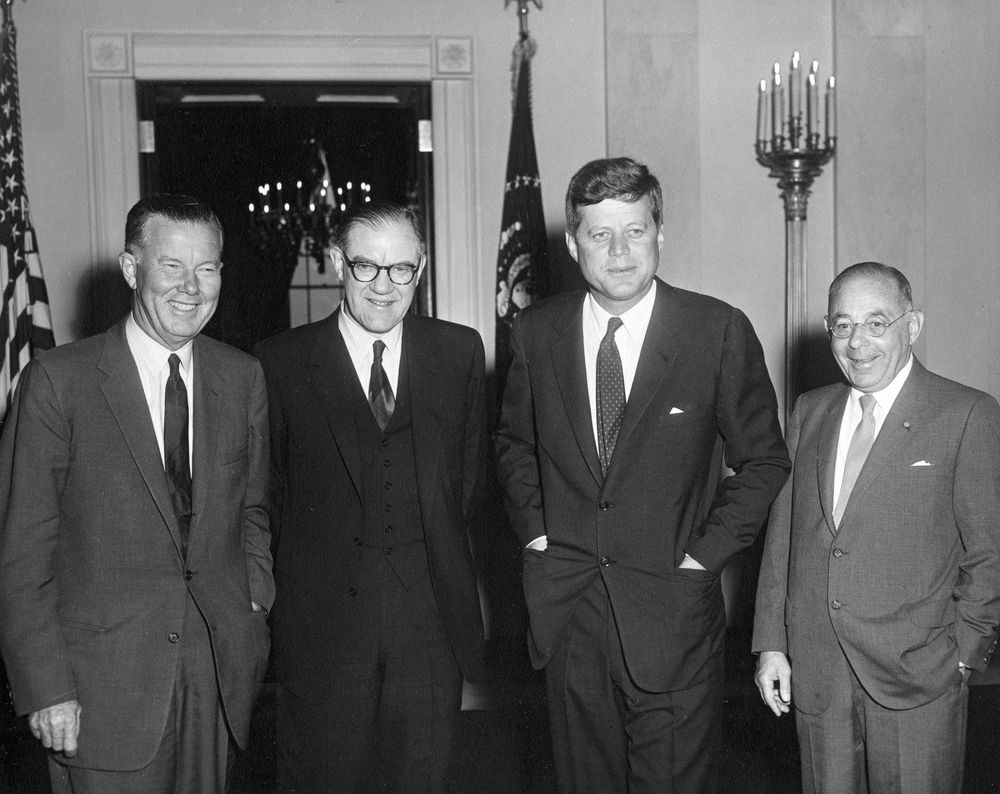
Fig. 1. President John F. Kennedy with members of The Business Council in the White House,
Washington, D.C., 21 September 1961.
(left to right) Leonard F. McCollum; Roger Blough; President Kennedy; Sidney J. Weinberg.
Public Domain. Source: https://en.wikipedia.org/wiki/Sidney_Weinberg#/ media/
File:JFK_&_ Business_Council.jpg
Chairs of the Commerce Department’s Business Council[36]
Bold denotes firms with significant known deals with Soviet government.
* denotes firms which also participated in Soviet Industrial Trusts during 1920s and 1930’s.
1933: Gerard Swope, General Electric*
1934: S. Clay Williams, RJ Reynolds Tobacco[37]
1934–35: Henry P. Kendall, Kendall Company (produced textiles for US government during WWI)
1936: George H. Mead, Mead Corporation (Paper and Pulping Plants)
1937–39: W. Averell Harriman, Brown Brothers & Co. (Ambassador to the Soviet Union (1943-1946))
1940–41: William L. Batt, War Production Board
1942–43: R. R. Deupree, Procter & Gamble
1944–45: Thomas B. McCabe, Scott Paper
1946: George M. Humphrey, National Steel Corp.
1947–48: John L. Collyer, Goodrich Corporation
1949–50: James S. Knowlson, Stewart-Warner
1951–52: Robert T. Stevens, JP Stevens & Co.
1953: John D. Biggers, Libbey-Owens-Ford (Auto Glass)
1954–55: Harold Boeschenstein, Owens Corning
1956–57: Eugene Holman, Standard Oil of New Jersey (today ExxonMobil)*
1958–59: Stephen Bechtel, Jr., Bechtel
1960–61: Ralph J. Cordiner, General Electric*
1961–62: Roger Blough, US Steel*
1963–64: F. R. Kappel, AT&T
1965–66: W.B. Murphy, Campbell Soup Co.
1967–68: Albert L. Nickerson, Mobil (today ExxonMobil)* as its parent Standard Oil
1969–70: Fred J. Borch, General Electric*
1971–72: William M. Batten, JCPenney
1973–74: David Packard, Hewlett-Packard
1975–76: Edmund W. Littlefield, General Electric*
1977–78: John D. deButts, AT&T
1979–80: Reginald H. Jones, General Electric*
1981–82: Walter B. Wriston, Citicorp (founded as National City Bank of New York and first US bank to have offices in Russia, part of Citigroup, Citibank)
1983–84: Clifton C. Garvin, Jr., Exxon (today ExxonMobil)* as its parent Standard Oil
1985–86: Ruben F. Mettler, TRW (aerospace, electronics, automotive, and credit reporting)
1987–88: Stephen Bechtel, Jr., Bechtel
1989–90: Roger B. Smith, General Motors*
1991–92: John F. Welch, Jr., General Electric*
1993–94: Robert E. Allen, AT&T
1995–96: Edgar S. Woolard, Jr., DuPont*
1997–98: Larry Bossidy, AlliedSignal
1999-00: Ralph S. Larsen, Johnson & Johnson
2001–02: William T. Esrey, Sprint Corp. (Sprint did business in the USSR in the late 1980s and early 1990s, forming a joint venture with Soviet telecommunications authorities, Telenet U.S.S.R.; later Sprint Networks U.S.S.R.)
2003–04: Charles O. Holliday, Jr., Bank of America
2005–06: Jeffrey R. Immelt, General Electric*
2007–08: W. James McNerney, Jr., Boeing
2009–10: James W. Owens, Caterpillar*
2011–12: Jamie Dimon, JPMorgan Chase
2013–14: Andrew Liveris, Dow Chemical*
2015–16: Jeff Bezos, Amazon
2017-18: Henry R. Kravis, Kohlberg Kravis Roberts
2019-20: John Donahoe, Nike
2021-22: Satya Nadella, Microsoft
2023-25: Gail K. Boudreaux, Elevance Health, Inc.
2025-26: Brian Cornell, Target
Russian Billionaires v. The Business Council
The US media has heavily criticized Russia’s current government as being an oligarchy. ‘Russian oligarchs’ have been the focus of US news media since Russia’s first billionaires were publicly announced in 1997, when Forbes magazine included four Russians on its annual ‘World’s Billionaires’ list. The first Russian billionaires finally emerged after seventy years of living under the yoke of communism which (as explained in my recent book) the grandest Western corporations utilized to subdue Russia’s emerging economy, destroy any competition which could have arisen from the domestic economy of the resource rich nation, transform it into a private captive market for their exploitation, and cut it off from its eastern neighbors. Moreover, the first Russian billionaires finally emerged after over a century of Western billionaires ruling the world.
Forbes even published its first ‘Richest Heirs of Russian Billionaires List’ on 19 May 2016, listing the babies and children of wealthy Russians, immediately making them targets for global kidnappers and other predators. Has Forbes ever published an article naming the babies and children of US billionaires and their net worth?
Meanwhile, this North American oligarchy embodied in The Business Council—which has operated for 92
years—has remained conveniently out of the news.
There is so little about The Business Council available anywhere other than its modest website, that anyone interested in it is left to speculate what some 200 CEO’s of the world’s grandest corporations plan and formulate
for the US President month after month and year after year. It would be interesting to discover why our “free press”—so important to maintain an informed public in order to sustain a vibrant democracy—has consistently
ignored this significant organization for nearly a century. Sharing many of the same US firms who participated
in the Soviet Industrial Trusts, The Business Council is surely a prominent, if not driving force in the US government’s formation of national and international policy. Yet, Russian billionaires continue to dominate global headlines.
The World’s Leading TNCs
Looked at from another perspective, the world’s leading transnational corporations reveal where the real global power financial lies:
Top Companies by Market Capitalization (late 2025)
Top Companies by Revenue (Fortune Global 500, mid-2025)
Top Companies by Profit (Forbes/Visual Capitalist, 2025)
None of these firms are Russian.
Table 1. Country Performance 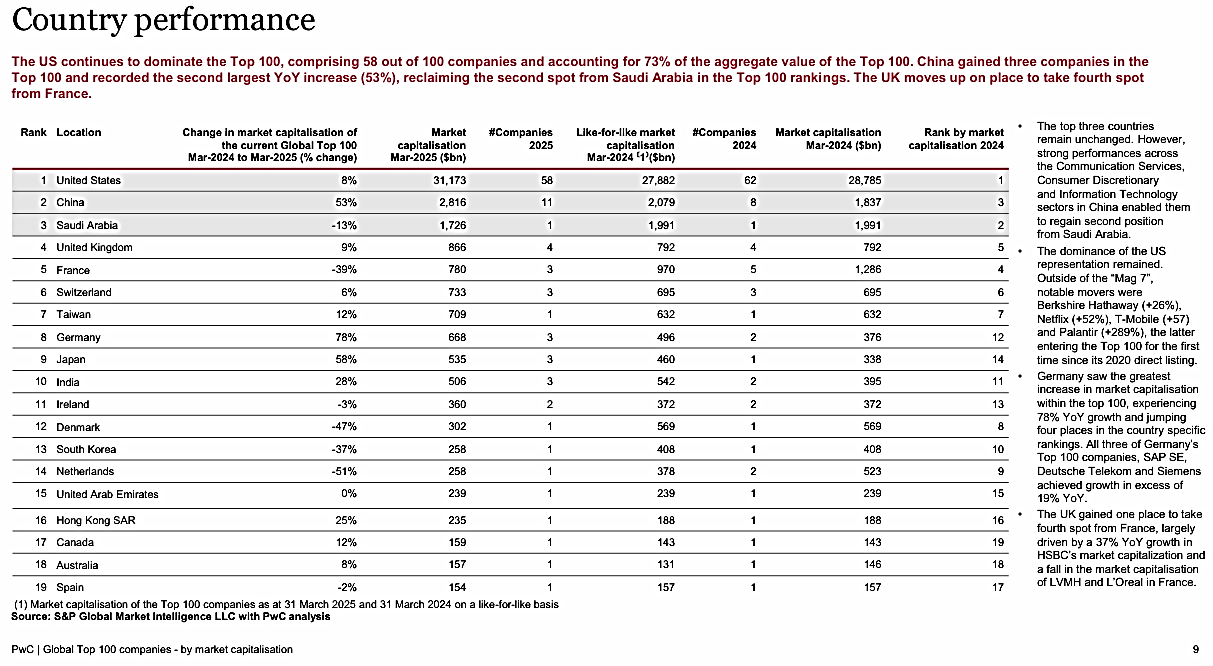
Of the Top 100 firms in the world listed by PwC, not one was Russian. Yet Russia—even after over a century of devastating wars fought on its soil, famines, the 70-year yoke of communism, dismantling of former territories, sanctions and persistent global condemnation—remains unparallelled in its vast quantity of resources and central geocommercial location to other rich nations of the world. And that is why Russia remains the pariah of nations. Until it is knocked back behind the Urals (as the head of the American Red Cross Mission to Russia, Raymond Robins, advised Lenin to do in January 1918[38]), the Slavic people completely divided and divided again, and its territory only inhabits the bitter parts of frozen Siberia, will it cease to threaten the world’s elite firms’ control of the global commercial system. A Russia finally free to prosper, unencumbered by all of the above, is much too dangerous for these top global corporations to allow.
US Sanctions on Russia: A Notable Double Standard
Since 2014, the US has imposed sanctions against hundreds of individuals and businesses (as well as shipping vessels and aircraft) the Russian Federation. Following the US, the European Union has applied eleven rounds of sanctions against the Russian Federation. The sanctions are wide-ranging, targeting individuals, banks, businesses, monetary exchanges, bank transfers, exports, and imports.[39],[40],[41] Sanctions include severing Russian banks from the international payment network SWIFT[42]—leaving only limited accessibility to ensure continued payment for Russian gas shipments to Europe.[43] In order to prevent it from offsetting the impact of sanctions[44],[45],[46] the assets of the Russian Central Bank, including $630 billion in foreign-exchange reserves were also frozen.[47] By 1 March 2022, $1 trillion of Russia’s assets had been frozen by international sanctions.[48] Western countries and others imposed sanctions on Russia after a speech by Vladimir Putin which he declared Russia recognized the independence of the Donetsk and Luhansk Republics on 21 February 2022.
With the commencement of attacks on 24 February 2022, a large number of other countries began applying sanctions with the aim of devastating the Russian economy.[49]
While I, in no way condone any war—since all it does is fill the pockets of arms dealers and later construction firms at the expense of the sufferings of millions of people and the destruction of their emerging businesses—the level of double standards applied to Russia is notable.
Has anyone, for example, asked why no one in the international community has even attempted to apply any sanctions against the US during any of its following military involvements, some of which continue today?
The list of US military involvements over the past 20 years:
• 2003-2011: Iraq War (a.k.a. Second Gulf War). US-led force invaded Iraq and carried out the overthrow of the government of Saddam Hussein. The conflict persisted as an insurgency which rose against US-led forces and the newly established Iraqi government. US forces were withdrawn in 2011.
In 2014, the US became re-engaged in Iraq, leading a new coalition under Combined Joint Task Force Operation Inherent Resolve, as the conflict evolved into the ongoing Islamic State insurgency.
• 2010–Present: The US continues to launch drone strikes on suspected al-Qaeda, al-Shabaab, and ISIS positions in Yemen.
• 2011: Military intervention in Libya: US and coalition forces enforce U.N. Resolution 1973 by bombing Libyan forces.
• 2011: US forces assassinate Osama Bin Laden in Pakistan.
• 2011: US Drone strikes on al-Shabaab militants begin in Somalia marked the 6th nation in which such strikes have been carried out: Afghanistan, Pakistan, Iraq, Yemen] and Libya.
• 2011–Present: Uganda: US Combat troops sent in as advisers to Uganda.
• 2012: US troops deployed to Jordan to contain the Syrian civil war inside Syria’s borders.
• 2012: Turkey: 400 troops and two batteries of Patriot missiles sent to Turkey. (Note: US missiles placed in Turkey in 1960, disturbed Soviet Union that US missiles were too close to the Soviet border and led Khrushchev to build missiles bases in Cuba which touched off the Cuban Missile Crisis when the US government refused to allow Soviet missiles so close to the US.)
• 2013: Mali: US forces assisted the French in Operation Serval with air refueling and transport aircraft.
• 2013: Korean crisis
March 15 – US added 14 more Ground-Based Interceptor (GBI) missiles to its ballistic missile system, at Fort Greely, Alaska, boosting the total number of GBI missiles from 30 to the 44.
March 26 – The US again dispatched B-52 bombers from Guam to overfly South Korean territory as part of the ongoing Foal Eagle exercise. These were considered routine flights intended to demonstrate the US’s capability of maintaining a “continuous bomber presence” in the region.
April 3 – US Army Terminal High Altitude Area Defense (THAAD) advanced ballistic missile battery deployed to Guam.
• 2013: Navy SEALs conducted a raid in Somalia and possibly killed a senior Al-Shabaab official, simultaneously another raid took place in Tripoli, Libya, where US forces captured Abu Anas al Libi.
• 2014–Present: Iraq War: Hundreds of US troops deployed to protect assets of US multinational firms’ continue to fight in Iraq. The US Navy began a series of airstrikes against Islamic State-aligned forces throughout northern Iraq. (Private firms benefiting from these military operations should foot the bill instead of US taxpayers.)
• 2014: Failed US attempt to rescue James Foley and other hostages being held by ISIL. US air strikes were conducted on ISIL while US Delta teams parachuted to an ISIL prison. Main roads were blocked to prevent any ‘target’ from escaping. When no hostages were found, US troops began house to house searches. By this time, ISIL militants arrived in the area. Heavy fighting occurred until the US troops abandoned their mission due to the hostages being nowhere in the area.
• 2014–Present: US aircraft bomb Islamic State al-Qaeda, al-Nusra Front and Khorasan positions in Syria.
• 2015: 30 April, US warships arrive in the Strait of Hormuz after Iran’s seizure of the commercial vessel MV Maersk Tigris for debts unpaid to an Iranian company. Iran detained the ship because of a decade-long legal dispute between the Danish shipping company Maersk and an Iranian firm. The Iranian company accused Maersk of default and claims $4m in damages. Maersk was able to get the case dismissed in 2007. However, an appeals court later ordered Maersk to pay $163,000. (Nevertheless, US taxpayers footed the bill for US warships and troops to defend the Danish multinational company.)
• 2015–Present: In October, US deployed troops to Cameroon.
• 2017: Tomahawk missiles launched from US naval vessels hit a Syrian airbase in Homs Governorate in response to a chemical weapons attack against civilians south-west of Idlib.
• 2018: US leads missile strikes on targets in Damascus in response to the Douma chemical attack against civilians in April 2018.
• 2019: Operation Sentinel: US leads a multinational maritime force to increase surveillance of and security in commercial waterways in the Middle East to ensure free navigation for international commercial shipping firms. (Private firms benefiting from these military operations should foot the bill instead of US taxpayers.)
2020s
• 2020: Following US retaliation for an attack by the pro-Iranian Kata’ib Hezbollah, Iraqi forces attack US embassy on 31 December 2019. US Marines and aircraft were then dispatched from Kuwait to the embassy. An additional 4,000 US troops were mobilized to the region, including some 750 from the 82nd Airborne Division. By 2 January 2020, the US launched an airstrike on a convoy, killing Iranian Quds Force Major-General Qasem Soleimani and Iraqi militia leader.
• 2021: On 25 February, the US military carried out an airstrike on a site believed to have been occupied by Iranian-backed Iraqi militias operating from across the border in eastern Syria.
• 2021: In June, the US launched airstrikes on Iranian-backed militias on both sides of the Iraq–Syria border.
• 2021: US military intervention in Somalia (2007–present): In July, US begins military airstrikes on al Shabab in Somalia.
• 2021: In October, the US orders airstrike in northwestern Syria which killed senior al-Qaeda leader Abdul Hamid al-Matar as part of ongoing anti-terrorism operations in the region.
• 2022: On July, US drone operators assassinate al-Qaeda leader Ayman al-Zawahiri in Afghanistan.
• 2023: Operation Prosperity Guardian: On 18 December, US Defense Secretary Lloyd Austin announced formation of an international maritime security force under to counter threats by Houthi forces against international maritime commerce. (Appropriately named “Prosperity Guardian” for the private multinational firms benefiting from US taxpayers footing the bill for such protection.)
We Live in a Permanent War Economy
The US has worn out the claim that it alone is uniquely capable of judging ‘freedom and democracy’ for the world. It has utilized this claim to justify its hundreds of violent acts over the past century and quarter. Acts that we as US taxpayers are forced to pay for. Supposedly, our citizen views are represented by our Congresspeople, however in light of the poor quality of our news media which fails to bring to our attention so many important issues, together with the overwhelming financial power of corporate lobbying, our Congress is no longer (if it ever was) a true representative of the people.
There has been no Due Process involved in any of these violent acts. Everything has been done under the National Emergencies Act enacted on 14 September 1976, formalized the sweeping ‘emergency’ powers of the President. Since passage of the National Emergencies Act in 1976, every US President has declared multiple national emergencies. As of January 2025, 85 National Emergencies have been declared; 41 have expired and another 44 are currently in effect, each having been renewed annually by the president.
The US Constitution states only one command twice. The Fifth Amendment states that no one shall be “deprived of life, liberty or property without due process of law.” The Fourteenth Amendment, ratified in 1868,
reiterates the same eleven words, under the Due Process Clause. These words have as their central promise an assurance that all levels of the US government must operate within the law and provide fair procedures. Due Process was acquired from Clause 39 of the British Magna Carta which stated: “No man of what state or condition he be, shall be put out of his lands or tenements nor taken, nor disinherited, nor put to death, without he be brought to answer by due process of law”. When English and American law gradually diverged, due process was not upheld in England but became incorporated in the US Constitution.
Yet the National Emergencies Act sweeps the Constitutional Due Process provision (as well as many others) under the carpet.
*
The author requests that the reader imagine not only the effect of the restriction of the Soviet Russian economy from the access of the majority of its neighbors (especially consumer commerce), but couple that with the knowledge that while Russia’s eastern neighbors were deprived of commercial enterprise with the Eurasian landmass, the grandest Western firms were secretly enjoying some of the largest industrial orders of their history from the Soviet government for the following seven decades. In fact, the Soviet Russian economy was an exclusive captive market of the privileged blue-chip firms of the West, while remaining cut off from the emerging economies around it—stunting their growth as well and forcing their reliance on Western firms.
Other formerly communist nations, especially China, have experienced similar destruction of their economies and domestic entrepreneurs, nationalization of enterprises and the entrance of multinationals into their economies that Russia has.
One should also bear in mind the increased financial power these multinational corporations not only maintained but gained by clandestinely cornering the massive Soviet industrial market and those of other communist nations while other emerging economies and their entrepreneurs were barred from that market. These blue-chip firms were able to return to their domestic—and other foreign—markets and ruin, buy out, or absorb their competitors as if the power they won through corning the communist economies reflected superior products and technology and more skillful ‘honorable’ business practices.
By far, the hardest thing to imagine is what the global economy would look like if this warped system had not been allowed to flourish and continue to skew our world for well over a century. Once that vision emerges, we will be able to rebuild it.
Conclusions
This article allows the following conclusions to be drawn.
1. Cold War as an economic system, not an ideological conflict
The evidence demonstrates that the Cold War cannot be adequately explained as a confrontation between capitalism and communism. Instead, it functioned as a managed economic system, in which ideological antagonism concealed long-term structural cooperation between Western transnational corporations and the Soviet centrally planned economy.
2. Communism as a mechanism of industrial colonization
The Soviet model did not eliminate market mechanisms but reconfigured them in favor of Western firms. By dismantling domestic entrepreneurship and monopolizing access to resources, the centrally planned economy created a captive market uniquely suited to large Western corporations, free from local competition, tariffs, labor protections, and environmental constraints.
3. Structural asymmetry between market and planned economies
While often portrayed as incompatible, market economies and centrally planned economies proved to be highly complementary. The planned economy depended on Western technology, equipment, and expertise, while Western firms depended on secure, exclusive access to Soviet resources and large-scale industrial contracts. This asymmetry rendered the planned economy structurally subordinate.
4. Corporate influence beyond democratic accountability
The historical role of organizations such as the Commerce Department’s Business Council demonstrates the existence of a corporate governance layer operating parallel to formal democratic institutions. This layer exercised sustained influence over domestic and foreign policy without public scrutiny, electoral accountability, or meaningful transparency.
5. The myth of “policy conflict”
The long-standing coexistence of massive Western military spending justified by the “Soviet threat” and simultaneous large-scale commercial cooperation with the Soviet Union indicates not a policy contradiction, but a coherent profit-driven strategy. The concept of “policy conflict” obscures the economic rationality underlying this arrangement.
6. Sanctions as a tool of competitive containment, not moral enforcement
The historical absence of comprehensive sanctions during the Cold War, contrasted with their aggressive application after the collapse of communism, suggests that sanctions function primarily as instruments of market control. They are deployed not against ideological adversaries, but against emerging competitors capable of challenging established corporate dominance.
References
Simon Sebag Montefiore (2004), Stalin: the Court of the Red Tsar, New York: Alfred A. Knopf.
Saul G. Bron (1930), Soviet Economic Development and American Business, Results of the First Five Year Plan and Further Perspectives, New York: Horace Liveright.
“Collectivization and Industrialization”. Library of Congress. Retrieved 17 April 2014.
Joshua Keefe (2009). “Stalin and the Drive to Industrialize the Soviet Union”. http://www.inquiriesjournal.com/articles/1684/stalin-and-the-drive-to-industrialize-the-soviet-union.
“Foreign Trade Policy of the USSR”, Report of Foreign Trade Commissar Rozengoltz.
Soviet Union Review, XI (6).
Paul Fischer (2000), Foreign Direct Investment in Russia, A Strategy for Industrial Recover, London: MacMillan Press Ltd.
Electronic resource: https://www.macrotrends.net/global-metrics/countries/usa/united-states/military-spending-defense-budget
Anthony Sutton (1973), Western Technology and Soviet Economic Development 1945-1965, Volume 3 of three volume set, Stanford University, Standford, CA: Hoover Institution Press.
Kim McQuaid (1994). Uneasy Partners, Big Business in American Politics 1945-1990, The Johns Hopkins University Press.
Alden Whitman (24 July 1969). “Sidney J. Weinberg, Known as ‘Mr. Wall Street,’ Is Dead at 77”, The New York Times.
Charles D. Ellis (2009). The Partnership: The Making of Goldman Sachs. New York: Penguin Books.
Carol Cain (13 Oct. 2018). “Gilbert’s Growing Profile Puts Him in Exclusive Business Company”. Detroit Free Press.
Electronic resource: New York Times Obituary, 12 November 1957, “Gerard Swope, 84, Ex-G.E. Head, Dies”. https://archive.nytimes.com/www.nytimes.com/learning/general/onthisday/bday/1201.html
Electronic resource: Ingrid Melander and Gabriela Baczynska (24 Feb. 2022), “EU targets Russian economy after ‘deluded autocrat’ Putin invades Ukraine”. Reuters.
Electronic resource: “Western Countries Agree To Add Putin, Lavrov To Sanctions List”. (25 Feb. 2022), Radio Free Europe/Radio Liberty.
Electronic resource: “China State Banks Restrict Financing for Russian Commodities”. (25 February 2022) Bloomberg News.
“China State Banks Restrict Financing for Russian Commodities”. (25 Feb. 2022), Bloomberg News.
Kate Davidson and Aubree Eliza Weaver (28 Feb. 2022). “The West declares economic war on Russia”.
Politico.
Charles Riley (1 March 2022). “The West’s $1 trillion bid to collapse Russia’s economy”. CNN.
“Tracking sanctions against Russia”. (March 9, 2022). Reuters
Soviet Union Review, XI (6), pp. 123–127; ↑
autocrat’ Putin invades Ukraine”. Reuters. ↑
Politico. ↑
