Articles that inspire and inform!
Publisher of POLIS LLC
Address: 190000, Saint Petersburg,
35/15 Kazanskaya Street
Publisher of POLIS LLC
Address: 190000, Saint Petersburg,
35/15 Kazanskaya Street

UDC: 347.9 (73): 004.8
RULE 12(b)(6) AS THE PROCEDURAL ARCHITECTURE
OF ARTIFICIAL INTELLIGENCE LITIGATION
IN THE UNITED STATES
Kildeev Adel Khanyafievich
A.A. Zhdanov Leningrad State University (1990)
PhD in Law
ORCID: 0009-0001-2211-4944
Abstract: This article conceptualizes Rule 12(b)(6) of the Federal Rules of Civil Procedure as the central procedural mechanism structuring contemporary artificial intelligence litigation in the United States. It argues that the motion to dismiss no longer functions merely as a preliminary technical filter but as the constitutive stage at which a technological conflict acquires legal existence within federal adjudication.
Relying on the plausibility standard developed in Bell Atlantic Corp. v. Twombly and Ashcroft v. Iqbal and on the analysis of recent AI-related cases in the Northern District of California, including xAI v. OpenAI and Carreyrou v. Anthropic et al., the study demonstrates that the survival of a claim at the pleading stage determines access to discovery, the distribution of litigation risk, and the strategic balance between the parties.
In disputes where relevant evidence is structurally concentrated in the hands of the defendant, the pleading stage becomes the decisive point at which courts evaluate the legal compatibility of new technological practices with existing doctrinal frameworks. The article concludes that Rule 12(b)(6) forms the procedural architecture of modern AI litigation and shifts the strategic center of such disputes to the pre-filing phase.
Keywords: Rule 12(b)(6); motion to dismiss; federal civil procedure; pleading standard; plausibility; Twombly; Iqbal; artificial intelligence litigation; trade secret litigation; copyright and AI; Northern District of California; discovery access; procedural architecture; legal sufficiency of the claim.
When preparing the article, the author used generative AI systems, including, but not limited to: ChatGPT (OpenAI), Gemini (Google), Grok (xAI). All final decisions are made personally by the author
Chapter 1. Introduction.
On August 28, 2025, Elon Musk’s startup companies X.AI and Corp. X.AI LLC. filed a lawsuit against the company’s former engineer, Xuechen Li, Ph.D., in the U.S. District Court for the Northern District of California in San Francisco (N.D. Cal., Case No 3:25-cv-07292).[1] This court case is one of the first judicial precedents in the field of protection of intellectual property rights to artificial intelligence technologies. The plaintiffs appealed to the federal court with a demand to prohibit the defendant, a Chinese citizen Xuechen Li, who is also a permanent resident of Canada and the United States, from using and distributing information that the plaintiffs qualified as a trade secret and intellectual property. On September 24, 2025, Elon Musk’s startup companies X.AI and Corp. X.AI LLC. filed a second lawsuit against Sam Altman’s AI company OPENAI in the Federal District Court for the Northern District of California in San Francisco (N.D. Cal., case No 3:25-cv-08133).[2] The plaintiffs allege that OpenAI “organized a systematic campaign to poach xAI employees with access to Grok’s source code, data center architecture, and research developments.” The plaintiffs claim that OpenAI gained an “unfair competitive advantage” by using illegally extracted secrets. The plaintiffs are represented by the same law firm, Winston & Strawn LLP, as in X.AI v. Li.
Finally, on December 22, 2025, Pulitzer Prize-winning American journalist John Carreyrou, the author of Bad Blood, and five other authors (journalists and writers) filed a Complaint in federal court for the Northern District of California against several AI companies: Anthropic, Google, OpenAI, Meta Platforms, xAI, and Perplexity AI for copyright infringement.[3]
The plaintiffs allege that the defendants downloaded and used pirated copies of their books (from sites like LibGen, Z-Library, OceanofPDF) to train AI models; made illegal copies of works during data preparation/training; built products with multi-billion dollar commercial value on these works without permission or compensation to the authors.
All these lawsuits were studied in my previous articles in details.[4] All these artificial intelligence litigations are commonly described in terms of substantive rights—trade secrets, data access, copyright, competition, and talent mobility. Yet the decisive stage at which these disputes acquire legal reality is not trial and not even discovery, but the pleading phase. This article argues that Rule 12(b)(6) of the Federal Rules of Civil Procedure has evolved into the central procedural mechanism structuring contemporary AI litigation in the United States. By determining which claims are allowed to proceed into discovery and which are dismissed at inception, the motion to dismiss operates as the architecture of litigation risk, bargaining power, and ultimately substantive outcomes.
1.2 Methodology and research objectives.
The article develops a procedural model in which the survival of a claim at the pleading stage constitutes the transformation of factual allegations into a legally operative dispute. Building on the plausibility standard established in Bell Atlantic Corp. v. Twombly and Ashcroft v. Iqbal, and applying it to recent federal cases involving leading artificial intelligence companies, the study demonstrates that Rule 12(b)(6) no longer functions merely as a screening device. It has become the structural point at which technological conflicts are translated into the language of adjudication. The purpose of this research is to identify the role of Rule 12(b)(6) as a procedural framework shaping the structure of AI litigation and to show how pleading-stage determinations influence evidentiary development, settlement dynamics, and corporate litigation strategy.
The novelty of the study lies in treating the motion to dismiss not as a preliminary technical phase, but as the foundational level at which the material trajectory of technologically complex disputes is formed. Accordingly, the motion to dismiss must be understood not as a preliminary procedural filter, but as the structural points at which AI litigation is either constituted or terminated.
The research objectives of the article are:
This article fills a gap in procedural scholarship by demonstrating that Rule 12(b)(6) functions not as a screening device but as the constitutive procedural architecture of AI litigation.
Chapter 2. Rule 12(b)(6) in the Structure of Federal Civil Procedure
2.1. Literature review
The transformation of pleading doctrine in United States federal civil procedure has generated an extensive and often polarized body of scholarship. The central point of departure for contemporary debates is the doctrinal shift produced by Bell Atlantic Corp. v. Twombly and Ashcroft v. Iqbal, which replaced the traditional “no set of facts” standard with the requirement that a complaint state a “plausible” claim for relief. This doctrinal development has been interpreted in markedly different ways within procedural theory.
A first line of scholarship treats the modern motion to dismiss primarily as a screening mechanism designed to eliminate legally insufficient claims at an early stage of litigation. In this perspective, the plausibility standard is understood as a tool of judicial economy and as a response to the structural asymmetry created by discovery. Epstein famously characterized the post-Twombly motion to dismiss as a functional equivalent of summary judgment operating at the pleading stage, emphasizing its role in preventing the strategic use of litigation costs as a coercive instrument. From this standpoint, the doctrinal evolution of Rule 12(b)(6) is explained by the need to protect defendants from the burdens of complex and expensive litigation in the absence of a legally sufficient theory of liability. [5]
A second, normatively opposite, line of research considers the strengthening of requirements for the content of the statement of claim as a restriction of access to justice. Spencer, Miller and other scholars have argued that the plausibility standard shifts the balance of procedural power in favor of institutional defendants by requiring plaintiffs to plead facts that are often unavailable prior to discovery. Within this framework, the modern pleading doctrine is interpreted as a structural barrier that disproportionately affects claimants in cases involving informational asymmetry, including antitrust, civil rights, and complex commercial litigation. The central concern of this literature is not the internal logic of pleading as a legal form, but its systemic consequences for access to adjudication. [6] [7]
Despite their doctrinal and normative differences, both lines of scholarship share a common analytical premise. They treat Rule 12(b)(6) primarily as a filtering device that determines which claims are allowed to proceed and which are dismissed at the threshold. Whether evaluated from the perspective of efficiency or from that of access to justice, the motion to dismiss is conceptualized as a mechanism of case management rather than as a constitutive element of adjudication.
A third, less developed but increasingly significant, direction of procedural theory focuses on the relationship between pleading and the institutional limits of judicial power. Within this perspective, the sufficiency of the claim is understood as the condition under which a dispute becomes capable of being processed within the normative framework of adjudication. The pleading stage is therefore not merely a technical phase of the proceedings but the point at which the legal system determines whether it will exercise its adjudicative authority with respect to the alleged conflict. This approach shifts the analytical focus from the efficiency-access dichotomy to the structural function of pleading in the production of legally cognizable disputes.
The emergence of artificial intelligence litigation provides a new empirical context in which these theoretical models can be tested and reconsidered. Existing legal scholarship on AI disputes has been predominantly oriented toward substantive law. It has examined questions of copyright, trade secrets, data access, competition, and liability for algorithmic outputs. Procedural aspects of such disputes have received significantly less attention and have generally been treated as a neutral background framework rather than as an independent object of analysis.
At the same time, the structural characteristics of AI litigation intensify the very conditions that originally motivated the transformation of pleading doctrine. In disputes involving proprietary datasets, machine learning models, and internal technological infrastructures, access to the relevant evidence is almost entirely controlled by the defendant. Under these conditions, the survival of the claim at the pleading stage becomes the decisive factor determining whether the claimant will obtain the procedural tools necessary to substantiate the alleged violation. The motion to dismiss therefore performs not only a filtering function but a constitutive one: it determines whether the technological conflict will be translated into an evidentiary process or will remain outside the domain of adjudication.
The existing procedural literature has not yet conceptualized this structural transformation. The dominant models continue to describe Rule 12(b)(6) either in terms of efficiency or in terms of access to justice, without examining its role as the point at which new forms of technologically mediated conflicts acquire legal existence. Similarly, the growing body of AI-related legal scholarship has focused on substantive doctrinal questions and has not addressed the procedural architecture through which such disputes are constituted and processed.
This article builds on the institutional and structural approach to pleading and develops it in the context of contemporary artificial intelligence litigation. It argues that Rule 12(b)(6) should be understood not merely as a screening device but as the procedural architecture that determines access to discovery, allocates litigation risk, and shapes the material trajectory of technologically complex disputes. By analyzing recent federal cases in the Northern District of California, the study demonstrates that the decisive moment in AI litigation occurs at the pleading stage, where courts evaluate the legal compatibility of new technological practices with existing doctrinal frameworks.
In this sense, the article fills a gap in both procedural and technology-oriented legal scholarship. It provides a model that explains the motion to dismiss as the constitutive threshold at which a technological conflict becomes a legally operative controversy and shows how this procedural transformation reconfigures litigation strategy, the role of pre-filing expertise, and the distribution of procedural power between the parties.
Rule 12(b)(6) occupies a central position in the architecture of federal civil procedure because it defines the threshold at which a dispute acquires the form of an adjudicable controversy. Within the framework of the Federal Rules of Civil Procedure, access to judicial fact-finding is not unconditional; it is mediated by the requirement that the claimant articulate a legally sufficient claim for relief. The motion to dismiss for failure to state a claim thus performs a constitutive procedural function: it determines whether the court’s adjudicative power will be activated with respect to the alleged conflict.
From a classical perspective, the rule is associated with the early elimination of claims that do not entitle the claimant to relief even if all factual allegations are assumed to be true. In this sense, it serves the principle of judicial economy by preventing legally deficient assertions from developing into resource-intensive litigation. As procedural scholarship has long emphasized, the sufficiency of the claim operates as the point at which the legal system distinguishes between disputes that warrant the exercise of judicial authority and those that remain outside the domain of adjudication.
At the same time, Rule 12(b)(6) performs a protective function. Federal civil litigation is structurally characterized by the asymmetry created by discovery, which imposes significant financial and organizational burdens on the responding party. The requirement that the claimant present a legally intelligible and factually plausible theory of relief at the outset serves to shield defendants from the coercive effects of litigation in cases where no viable legal claim exists. In complex and high-cost disputes, the mere continuation of proceedings may alter the parties’ bargaining positions irrespective of the ultimate merits. The motion to dismiss therefore operates as a mechanism for controlling the strategic use of litigation costs.
This filtering function is inseparable from the institutional limits of judicial power. Federal courts do not engage in abstract fact-finding; they adjudicate only within the framework of a legally sufficient controversy. The pleading stage thus marks the transition from a pre-procedural conflict—existing as competing narratives and factual assertions—to a dispute that can be processed within the normative structure of adjudication. In this sense, Rule 12(b)(6) is not merely a technical device but a doctrine of controlled access to judicial determination.
The transformation of pleading doctrine in the decisions of Bell Atlantic Corp. v. Twombly and Ashcroft v. Iqbal has further reinforced this structural role. By replacing the traditional “no set of facts” formula with the plausibility standard, the Supreme Court redefined the conditions under which a claim may proceed into discovery. The requirement that the pleaded facts permit a reasonable inference of liability introduced an evaluative dimension into the threshold stage, thereby increasing the gatekeeping capacity of the motion to dismiss.[8] As a result, the sufficiency of the complaint has become a decisive factor in the allocation of procedural resources and in the distribution of litigation risk.
In contemporary technological disputes, this structural function becomes particularly visible. Where access to the relevant evidence is almost entirely controlled by the defendant—as is often the case in litigation involving artificial intelligence systems, proprietary datasets, and internal corporate decision-making processes—the survival of the claim at the pleading stage determines whether the claimant will obtain the procedural tools necessary to substantiate the alleged violations. The motion to dismiss thus defines the point at which a technological conflict is either translated into an evidentiary process or removed from the legal field.
Accordingly, Rule 12(b)(6) should be understood not only as a mechanism for dismissing legally insufficient claims but as the procedural architecture through which federal courts regulate access to adjudication, allocate litigation costs, and shape the material trajectory of complex disputes. Its significance in the context of artificial intelligence litigation lies in the fact that it precedes and conditions all subsequent stages of the proceedings. The decision at this stage determines whether the dispute will enter the domain of discovery, expert examination, and judicial fact-finding, or whether it will cease to exist as a matter of law.
This claim, however, should not be overstated. Some AI-related cases, especially in the copyright context, have survived Rule 12(b)(6) in part and proceeded into discovery or summary judgment. But even there, the pleading stage has usually remained the decisive site of doctrinal compression: weaker theories are discarded, the vocabulary of liability is narrowed, and the boundaries of the controversy are set before the case reaches factual expansion. Rule 12(b)(6), therefore, matters in AI litigation not only because it dismisses claims, but because it shapes the legal form in which surviving claims are allowed to exist.
Chapter 3. Rule 12 (b) (6) in Action: Judge Rita Lin’s Decision
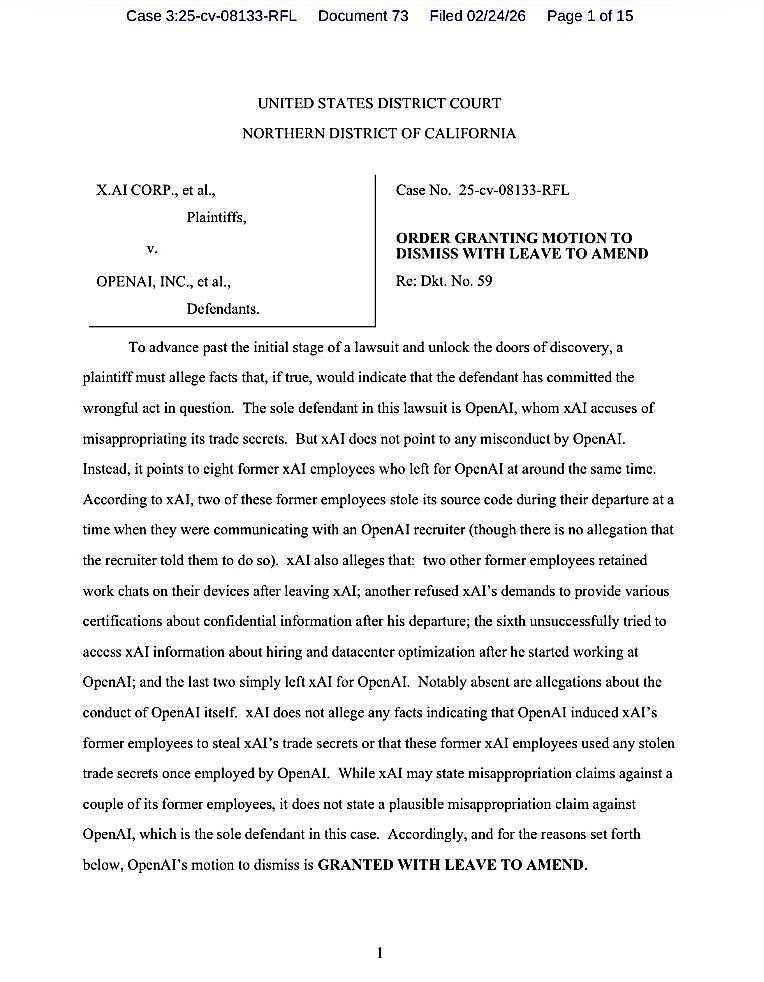
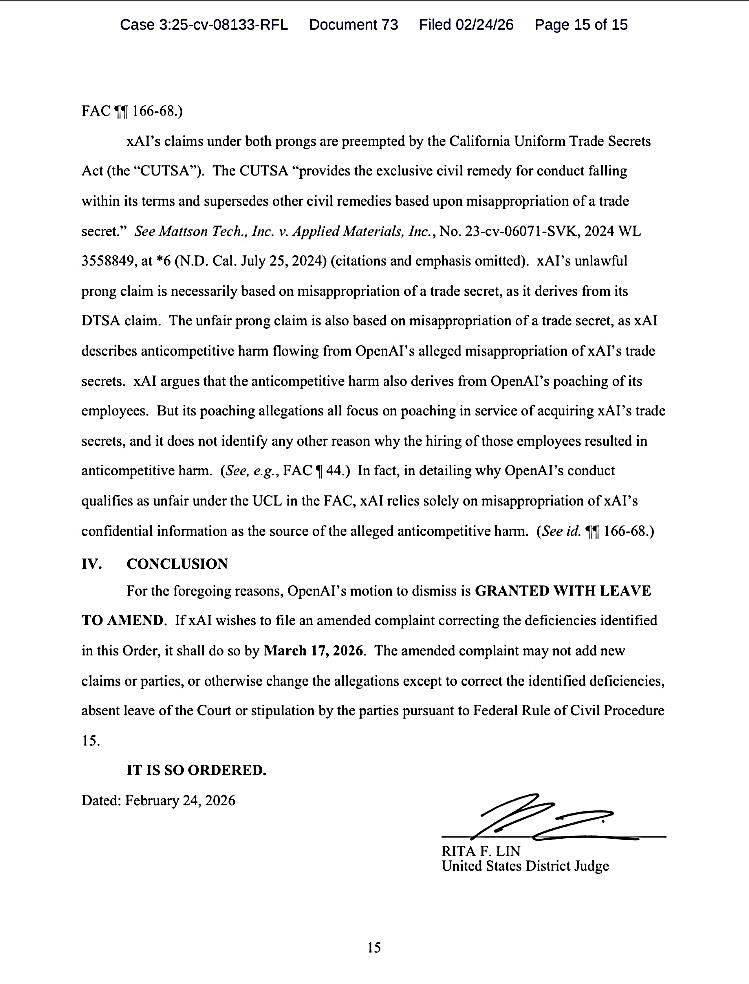
Pic 1. The court order issued by the district judge Rita Lin (the first and the last page)
Given that Internet access to U.S. court records from Russia may be limited due to U.S. government sanctions and the importance of legal language to understanding the reasons, here are full text of the court order of the US District Judge Rita Lin (Case No. 25-cv-08133-RFL) [9] (translated by Microsoft translation service):
NORTHERN DISTRICT OF CALIFORNIA
X.AI CORP., et al.,
Case No. 25-cv-08133-RFL
Plaintiffs,
v.
OPENAI, INC., et al.,
ORDER GRANTING MOTION TO
DISMISS WITH LEAVE TO AMEND
Re: Dkt. No. 59
Defendants.
To advance past the initial stage of a lawsuit and unlock the doors of discovery, a
plaintiff must allege facts that, if true, would indicate that the defendant has committed the
wrongful act in question. The sole defendant in this lawsuit is OpenAI, whom xAI accuses of
misappropriating its trade secrets. But xAI does not point to any misconduct by OpenAI.
Instead, it points to eight former xAI employees who left for OpenAI at around the same time.
According to xAI, two of these former employees stole its source code during their departure at a
time when they were communicating with an OpenAI recruiter (though there is no allegation that
the recruiter told them to do so). xAI also alleges that: two other former employees retained
work chats on their devices after leaving xAI; another refused xAI’s demands to provide various
certifications about confidential information after his departure; the sixth unsuccessfully tried to
access xAI information about hiring and datacenter optimization after he started working at
OpenAI; and the last two simply left xAI for OpenAI. Notably absent are allegations about the
conduct of OpenAI itself. xAI does not allege any facts indicating that OpenAI induced xAI’s
former employees to steal xAI’s trade secrets or that these former xAI employees used any stolen
trade secrets once employed by OpenAI. While xAI may state misappropriation claims against a
couple of its former employees, it does not state a plausible misappropriation claim against
OpenAI, which is the sole defendant in this case. Accordingly, and for the reasons set forth
below, OpenAI’s motion to dismiss is GRANTED WITH LEAVE TO AMEND.
I. ALLEGATIONS OF FIRST AMENDED COMPLAINT
On a motion to dismiss under Federal Rule of Civil Procedure 12(b)(6), the allegations of
a complaint are assumed to be true. See Boquist v. Courtney, 32 F.4th 764, 772 (9th Cir. 2022).
xAI and OpenAI offer competing generative AI products. In the summer of 2025, eight xAI
employees left to pursue opportunities with OpenAI. In the First Amended Complaint (the
“FAC”), xAI alleges the following concerning their departures. (See Dkt. No. 44.)
A. Xuechen Li
“Li joined xAI on or about February 26, 2024, and . . . was among the company’s first 20
engineers . . . .” (Id. ¶ 46.) His contact with OpenAI began in July 2025. (See id. ¶ 54.) On
July 13, he “made a presentation to OpenAI for an interview” that, on information and belief,
“contain[ed] xAI’s Confidential Information.” (See id. ¶ 55.) xAI does not allege what specific
information Li disclosed in the presentation or that OpenAI was aware that this unspecified
information constituted xAI’s confidential information or trade secrets. Ten days after Li’s
presentation, “OpenAI Research Talent Advisor Tifa Chen sent [him] a message request” on
Signal, an “encrypted messaging application.” (See id. ¶ 58.) The next day, she sent him a link
to “a cloud storage location.” (See id.) xAI does not allege why Chen did so or the intended
purpose of the cloud storage location. On the following day, July 25, “Li uploaded the entire
xAI source code base to a personal cloud account” that he had connected to ChatGPT, OpenAI’s
“generative AI chatbot product.” (See id. ¶¶ 29, 59 (emphasis omitted), 83.) xAI does not allege
that this was the same cloud storage location that Chen provided Li. “Li then deleted his browser
history and system logs . . . .” (Id. ¶ 59.) That same day, Li also downloaded xAI’s source code
from the cloud to his personal computer. (See id. ¶ 60.)
This download occurred during the same time frame when Li was finalizing his move to
OpenAI and continuing to communicate with Chen. On July 25, about four hours after Li
downloaded xAI’s source code onto his personal computer, Chen sent him a message on Signal
reading “nw!” which xAI alleges meant “no way!”1 (See id. ¶ 61; Dkt. No. 64 at 7.) xAI does
1 In the FAC, xAI alleges that Chen sent Li a message “that equated to ‘no way!’” (See FAC ¶
2 not allege what prompted Chen to send Li this message. “Two minutes later, . . . Chen had a
virtual meeting with Li.” (FAC ¶ 62.) Two days after that, on July 27, “Li again downloaded
xAI Confidential Information to his personal laptop.” (See id. ¶ 63.) On July 28, OpenAI
offered him a job worth “multiple millions of dollars,” and by August 1, he had accepted. (See
id. ¶¶ 64-65.)
Over the next few weeks, and before beginning any employment at OpenAI, Li accessed
his cloud account, downloaded xAI’s confidential information, changed his cloud account
password, and accessed his trash folder (“where a user must go to permanently delete files”).
(See id. ¶¶ 69-77.) At some unspecified time, he also obtained a slide deck “specifically
pertaining to xAI’s highly sensitive and confidential AI model training and tuning methods.”
(See id. ¶ 56.)
xAI eventually discovered Li’s exfiltration of its confidential information and
subsequently obtained a temporary restraining order from this Court, which prohibited Li “from
having any role or responsibility at OpenAI . . . until xAI has confirmed that all of xAI’s
Confidential Information in Li’s possession, custody, or control has been deleted.” (See id. ¶¶
79-80.) OpenAI then revoked Li’s job offer. (See id. ¶ 80.)
B. Jimmy Fraiture
“Fraiture joined xAI on or about April 22, 2024[,] [and] . . . was the second engineering
hire in xAI’s London operation . . . .” (Id. ¶ 87.) Like Li, he had been in contact with OpenAI
“since early July” 2025. (See id. ¶ 93.) He communicated via Signal with Chen, “the very same
recruiter who was in regular contact with Li,” around July 17, visited OpenAI around July 24,
received an offer of employment on July 29, and accepted the offer by July 30. (See id. ¶¶ 94-
61.) It clarified in its opposition brief and at oral argument that Chen’s message actually read “nw!” OpenAI insists that “nw” means “no worries.” (See Dkt. No. 66 at 10 n.3.) Drawing inferences in xAI’s favor, as required on a motion to dismiss, this Order assumes “nw” meant “no way.”
In this Order, all citations to page numbers in filings on the docket refer to ECF page numbers.
On July 31, about a day after he accepted OpenAI’s offer, Fraiture copied xAI’s source
code and other trade secrets from his work laptop onto his “personal device.” (See id. ¶ 98.)
Among the files taken was a “video recording of a lengthy internal, xAI ‘All-Hands’ meeting, in
which xAI founder Elon Musk conveyed significant confidential nonpublic information in
relation to xAI’s future plans and immediate targets, product roadmap, commercial contract
terms, and other confidential and sensitive information[,] . . . includ[ing] information relating to
xAI’s strategic priorities and confidential business practices.” (See id. ¶ 102.)
xAI eventually discovered Fraiture’s exfiltration of its confidential information, and its
“Insider Threat team” met with him in late August. (See id. ¶ 103.) At that meeting, Fraiture
told xAI that he had never transferred xAI’s source code to his personal device, but he “later
admitted that this statement was untrue and that he had in fact copied xAI source code to his
personal computer,” which he kept there for a few weeks before, according to him, he deleted it.
(See id.) He maintained the source code on his personal device “until at least August 28.” (See
id. ¶ 98.) His employment with OpenAI began on September 2. (See id. ¶ 97.)
xAI does not allege any facts indicating that Fraiture used xAI’s confidential information
once he began working at OpenAI. Likewise, other than the bare fact that Fraiture had been
recruited by Chen, who had also recruited Li, xAI does not allege any facts indicating that
OpenAI had encouraged Fraiture to take xAI’s confidential information in the first place.
C. Unnamed Finance Executive
An unnamed finance executive who had joined xAI around April 2025 quit a few months
later to begin working for OpenAI “in a lesser role.” (See id. ¶¶ 112, 115.) His position at
OpenAI involved “working on spending strategy for data centers.” (See id. ¶ 115.) That work
overlapped with confidential information that the executive had obtained while employed at xAI.
(See id. ¶ 113.) In fact, at one point, the executive had opined: “The secret sauce of xAI? The
data center team. Their speed and precision blew me away. I would NEVER want to compete
against them.” (See id. ¶ 114.) On two occasions after the executive left xAI, the company
reached out to him to address “confidentiality concerns,” as contemplated by a confidentiality
agreement that he had signed when he joined the company. (See id. ¶¶ 112, 118-19.) On both
occasions, he refused to cooperate, telling xAI’s counsel and human resources employee: “Suck
my dick”; and “Leave me the fuck alone.” (See id. ¶¶ 118-19.)
D. Uday Ruddarraju, Hieu Pham, and Ethan Knight
Ruddarraju, Pham, and Knight each worked at xAI for over a year (in unspecified
positions), “where they acquired detailed knowledge about xAI’s operations and technology,
including its Confidential Information and trade secrets.” (See id. ¶ 123.) “Ruddarraju and
Knight left xAI in July 2025[,] Pham left xAI in August 2025, and all [three] began working for
OpenAI by August.” (Id. ¶ 126.) “Since their departure, Knight and Pham have admitted to
keeping copies of xAI related work chats and information on their personal devices,” but they
have refused to cooperate with xAI in identifying the information taken or turning over their
devices. (See id. ¶ 127.) Moreover, the two “have shared copies of their xAI information with”
a third party. (See id. ¶ 128.) xAI does not allege why Pham and Knight shared its information
with this third party or whether they did so in connection with their employment at OpenAI or to
benefit OpenAI. OpenAI asserts that this third party was a forensics vendor. (See Dkt. No. 59 at
8.) xAI does not allege who the third party was. As for Ruddarraju, in September 2025, he
attempted to access an internal xAI document containing confidential information about
“datacenter optimization,” potential hires, and compensation for potential hires. (See id. ¶ 130.)
xAI does not allege that Ruddarraju successfully accessed the document, and it confirmed in its
opposition brief that it “successfully blocked Ruddarraju’s attempt” to access the document.
(See Dkt. No. 64 at 12.)
E. Sreekanth Pothanis and Mike Dalton
Pothanis and Dalton left xAI to work for OpenAI at around the same time as the other
former xAI employees identified in the FAC. (See id. ¶ 121.) Their work at xAI involved “xAI
data center solutions or the development of Grok 4,” xAI’s “conversational generative AI”
product that competes with OpenAI’s ChatGPT. (See id. ¶¶ 33-34, 121.) xAI does not allege
that they took any of its confidential information.
* * *
Believing OpenAI “poached” these “eight xAI employees as part of a deliberate,
unlawful, and unfair scheme to gain access to specific xAI Confidential Information,” xAI
commenced this action on the basis that OpenAI unlawfully misappropriated xAI’s trade secrets.
(See id. ¶ 132.)
II. LEGAL STANDARD
A complaint “must contain . . . a short and plain statement of the claim showing that the
pleader is entitled to relief.” See Fed. R. Civ. P. 8(a)(2). Failure to satisfy this requirement may
result in dismissal. See id. 12(b)(6). To survive a Rule 12(b)(6) challenge, a plaintiff must
allege “enough facts to state a claim to relief that is plausible on its face.” See Bell Atl. Corp. v.
Twombly, 550 U.S. 544, 570 (2007). A claim
has facial plausibility when the plaintiff pleads factual content that allows the
court to draw the reasonable inference that the defendant is liable for the
misconduct alleged. The plausibility standard is not akin to a ‘probability
requirement,’ but it asks for more than a sheer possibility that a defendant has
acted unlawfully.
See Ashcroft v. Iqbal, 556 U.S. 662, 678 (2009) (citations omitted). “Determining whether a
complaint states a plausible claim for relief will . . . be a context-specific task that requires the
reviewing court to draw on its judicial experience and common sense.” Boquist, 32 F.4th at 773
(citation omitted).
In ruling on a motion to dismiss, a court may consider only “the complaint, materials
incorporated into the complaint by reference, and matters [subject to] judicial notice. See UFCW
Loc. 1500 Pension Fund v. Mayer, 895 F.3d 695, 698 (9th Cir. 2018) (citation omitted). “All
allegations of material fact are taken as true and construed in the light most favorable to the
nonmoving party.” McShannock v. JP Morgan Chase Bank NA, 976 F.3d 881, 886-87 (9th Cir.
2020) (citation omitted). However, a court need not accept as true “allegations that are merely
conclusory, unwarranted deductions of fact, or unreasonable inferences.” See Khoja v. Orexigen
Therapeutics, Inc., 899 F.3d 988, 1008 (9th Cir. 2018) (citation omitted).
III. DISCUSSION
xAI brings claims under the federal Defend Trade Secrets Act (the “DTSA”) and
California’s Unfair Competition Law (the “UCL”). Neither claim survives scrutiny under Rule
12(b)(6).
A. The DTSA
“To succeed on a claim for misappropriation of trade secrets under the DTSA, a plaintiff
must prove: (1) that the plaintiff possessed a trade secret, (2) that the defendant misappropriated
the trade secret; and (3) that the misappropriation caused or threatened damage to the
plaintiff.” InteliClear, LLC v. ETC Glob. Holdings, Inc., 978 F.3d 653, 657-58 (9th Cir.
2020) (citation omitted). OpenAI argues that xAI insufficiently alleges misappropriation. “The
[DTSA] provides the following three definitions of misappropriation: (1) the acquisition of a
trade secret of another by a person who knows or has reason to know that the trade secret was
acquired by improper means; (2) the disclosure of a trade secret without the owner’s consent;
and (3) the use of a trade secret without the owner’s consent.” Attia v. Google LLC, 983 F.3d
420, 424 (9th Cir. 2020) (citations and quotation marks omitted). Courts consider both direct
and vicarious liability in evaluating claims of trade secret misappropriation. See, e.g., Cisco Sys.,
Inc. v. Chung, 462 F. Supp. 3d 1024, 1056 (N.D. Cal. 2020).
1. Direct Liability
“Courts distinguish between direct trade secret misappropriation claims and indirect trade
secret misappropriation claims, depending on whether a plaintiff alleges that a defendant
obtained the trade secrets directly from the plaintiff or indirectly from someone other than
plaintiff.” Navigation Holdings, LLC v. Molavi, 445 F. Supp. 3d 69, 78 (N.D. Cal. 2020)
(citation and quotation marks omitted).
a. Direct Misappropriation
xAI does not offer any nonconclusory allegations that OpenAI itself acquired, disclosed,
or used xAI’s trade secrets. Instead, its allegations of direct misappropriation appear to proceed
entirely on a theory that OpenAI induced xAI’s former employees to misappropriate its trade
secrets. But xAI offers no nonconclusory allegations that permit a reasonable inference of
inducement. For example, while Li and Fraiture transferred xAI’s source code onto their
personal devices, there is no indication that OpenAI told or encouraged them to do so. See, e.g.,
Arthur J. Gallagher & Co. v. Tarantino, 498 F. Supp. 3d 1155, 1173 (N.D. Cal. Nov. 2, 2020).
xAI counters that it permissibly pleads inducement “on information and belief.” (See, e.g., FAC
¶¶ 84, 97, 116.) To be sure, Rule 12(b)(6) “does not prevent a plaintiff from pleading facts
alleged upon information and belief where the facts are peculiarly within the possession and
control of the defendant or where the belief is based on factual information that makes the
inference of culpability plausible.” See Soo Park v. Thompson, 851 F.3d 910, 928 (9th Cir.
2017) (citations omitted). Even so, conclusory allegations remain insufficient. See, e.g., Reaper
v. ACE Am. Ins. Co., No. 23-15178, 2024 WL 810697, at *1 (9th Cir. Feb. 27, 2024); see also
Cloudera, Inc. v. Databricks, Inc., No. 21-cv-01217-HSG, 2021 WL 3856697, at *6 (N.D. Cal.
Aug. 30, 2021) (“Although courts may consider whether facts are peculiarly within the
possession and control of the defendant, such latitude does not mean that conclusory allegations
are permitted.” (citation and quotation marks omitted)).
xAI also argues that, when considered as a whole, its allegations state a DTSA claim
against OpenAI. The Court agrees that it must examine the entire course of conduct alleged to
assess the plausibility of misappropriation by OpenAI. See, e.g., Wisk Aero LLC v. Archer
Aviation Inc., No. 21-cv-02450-WHO, 2021 WL 8820180, at *16 (N.D. Cal. Aug. 24, 2021)
(rejecting attempt “to break up the allegations” where “[t]he whole of the FAC . . . is still
sufficient to plead a misappropriation claim”). But when taken together, as true, and with all
reasonable inferences drawn in favor of xAI, xAI’s allegations do not state a plausible claim
based on inducement. Yes, several employees took its confidential information at around the
same time and before leaving to work for OpenAI, and two of those employees communicated
with the same OpenAI recruiter using an encrypted messaging application around the time of
their exfiltration and their exploration of a move to OpenAI. Without more, though, those
allegations are insufficient to support a plausible inference that OpenAI encouraged the alleged
theft.
The cases on which xAI relies illustrate what is absent from the FAC. In Citcon USA,
LLC v. RiverPay Inc., No. 18-cv-02585-NC, 2019 WL 917056 (N.D. Cal. Feb. 25, 2019), the
defendant company allegedly encouraged misappropriation by promising co-founder status to
one of the plaintiff company’s former employees, and it allegedly conditioned co-founder status
on that former employee “retain[ing] [a] POS device” upon leaving the plaintiff company. See
id. at *4-5. Similarly, in Elko, Inc. v. WTH Commercial Services, LLC, No. 22-cv-00015-MMD,
2023 WL 6141623 (D. Nev. Sept. 20, 2023), the defendant company “entered into an agreement
with [the plaintiff company’s former employee] to steal confidential information” and used the
stolen confidential information to “target[] [the plaintiff company’s] customer base by contacting
them and pressuring them to switch providers.” See id. at *5. No similar agreements or
inducements are alleged here.
Accordingly, xAI does not sufficiently allege any direct misappropriation by OpenAI.
b. Indirect Misappropriation
Indirect trade secret misappropriation requires a defendant to know or have reason to
know: (1) “before the use or disclosure that the information was a trade secret and . . . that the
disclosing party had acquired it through improper means or was breaching a duty of
confidentiality by disclosing it”; or (2) that the information “was a trade secret and that the
disclosure was a mistake.” See Navigation Holdings, 445 F. Supp. 3d at 78-79 (citation
omitted); see also Attia, 983 F.3d at 424 (acquisition constitutes misappropriation where
acquiring party “knows or has reason to know that the trade secret was acquired by improper
means”). xAI offers insufficient allegations of OpenAI’s knowledge.
Li allegedly disclosed xAI’s confidential information in a presentation to OpenAI, but
xAI alleges no facts that permit a reasonable inference that OpenAI knew that the information
was a trade secret, that Li had improperly acquired the information, or that Li was improperly or
mistakenly disclosing the information. For the same reason, the connection between Li’s cloud
account (which contained xAI’s source code) and ChatGPT, and the implication that Li directly
sent xAI’s source code to OpenAI through a link sent by Chen, do not suffice. None of the other
former employees allegedly shared with or disclosed to OpenAI any xAI trade secrets.
Accordingly, xAI does not sufficiently allege any indirect misappropriation by OpenAI.
2. Vicarious Liability
xAI contends that OpenAI is vicariously liable under a theory of respondeat superior.
2
In general, under the doctrine of respondeat superior, an employer
will be vicariously liable . . . if its employee’s acts were committed within the
course and scope of her employment. Within the course and scope of
employment means: (1) the conduct occurred substantially within the time and
space limits authorized by the employment; (2) the employee was motivated, at
least in part, by a purpose to serve the employer; and (3) the act was of a kind that
the employee was hired to perform.
See Oki Semiconductor Co. v. Wells Fargo Bank, Nat’l Ass’n, 298 F.3d 768, 775-76 (9th Cir.
2002) (citations and footnotes omitted). In applying the doctrine to alleged misappropriation of
trade secrets intended to benefit a future employer, courts also require allegations that “the future
employer subsequently used the trade secrets or the wrongdoer used the trade secrets once he
actually became employed.” See Alert Ent., Inc. v. Rana, No. 22-cv-06646-JSC, 2023 WL
2541353, at *3 (N.D. Cal. Mar. 16, 2023); accord Flexport, Inc. v. Freightmate AI, Inc., No. 25-
cv-02500-RFL, 2025 WL 2399666, at *4 (N.D. Cal. July 10, 2025).
Scrutinized under the lens of these standards, xAI’s allegations fall short:
2 It does not appear that the Ninth Circuit has squarely addressed whether traditional principles
of vicarious liability apply to DTSA claims. However, the parties do not dispute that respondeat
superior applies to xAI’s misappropriation claim against OpenAI. When a federal “statute itself
is silent as to vicarious liability,” as are the civil provisions of the DTSA, courts “assume that
Congress intended to incorporate ordinary tort-related vicarious liability rules.” See Gomez v.
Campbell-Ewald Co., 768 F.3d 871, 877 (9th Cir. 2014) (citation and quotation marks omitted);
18 U.S.C. § 1831 et seq. Trade secret misappropriation is a tort (see Direct Techs., LLC v. Elec.
Arts, Inc., 836 F.3d 1059, 1070 (9th Cir. 2016)), and under the doctrine of respondeat superior,
employers may be held vicariously liable for the torts of their employees. See Restatement
(Third) of Agency § 2.04 (A.L.I. 2006). Accordingly, a defendant may be held vicariously liable
under respondeat superior for trade secret misappropriation under the DTSA.
• Li never worked at OpenAI, and xAI does not allege that OpenAI ever used any trade
secrets transferred to it by Li.
• Fraiture did eventually begin working for OpenAI, but xAI does not allege that he ever
used any of its trade secrets in his new job. True, he allegedly exfiltrated xAI’s source
code and an internal video recording about a month before beginning his employment
with OpenAI (presumably in a role similar to his position at xAI). But that is not enough
to allow a reasonable inference that Fraiture actually used those trade secrets at OpenAI.
To hold otherwise would automatically subject future employers to potential trade secret
misappropriation liability every time they hired someone who, without their knowledge
beforehand or ratification afterwards, had improperly taken confidential information from
their former employer on the way out the door, even if there is no indication that the
information was actually used in the subsequent job. Such an approach would also
undercut the well-established principle that “mere possession of trade secrets is not
sufficient to” constitute misappropriation. See Acculmage Diagnostics Corp. v.
Terarecon, Inc., 260 F. Supp. 2d 941, 951 n.5 (N.D. Cal. 2003) (citation omitted); see
also Attia, 983 F.3d at 424 (definition of misappropriation under DTSA does not include
mere possession).
• Like Fraiture, the unnamed finance executive merely possessed xAI trade secrets about
data centers, and xAI does not allege that he used that information once he started
working at OpenAI. His hostility when xAI reached out about its confidentiality
concerns also does not support a plausible inference of use. Hostility toward one’s
former employer during departure does not, without more, indicate use of trade secrets in
a subsequent job. Nor does the executive’s lack of experience with AI data centers
before his time at xAI, without more, support a plausible inference that he used xAI’s
trade secrets at OpenAI. For example, xAI does not allege that, after Fraiture started
working at OpenAI, OpenAI adopted a new approach to data centers mirroring xAI’s or
otherwise adopted aspects of xAI’s data center operations that OpenAI could not have
known about absent misappropriation.
• Ruddarraju unsuccessfully attempted to access xAI’s information while at OpenAI.
Because he could not access the information, there is no basis to infer that he used it
while employed at OpenAI.
• Pham and Knight allegedly misappropriated confidential information, but nothing in the
FAC allows a reasonable inference that the confidential information included trade
secrets.3 Even if the allegedly misappropriated confidential information constituted trade
secrets, the sole use alleged is Pham and Knight’s sharing the information with an
unidentified third party for unknown reasons, and nothing in the FAC allows a reasonable
inference that they shared the information to “serve” OpenAI or that doing so was “a kind
[of act] that [they were] hired to perform.” Oki Semiconductor, 298 F.3d at 776.
• xAI offers no allegations about Pothanis or Dalton beyond identifying what they did at
xAI and the fact that they left for OpenAI around the same time as xAI’s other former
employees. Nothing about those allegations allows a reasonable inference of
misappropriation.
xAI argues that “the covert nature of trade secret misappropriation” allows it to “rely on
circumstantial allegations of [OpenAI’s employees’] misappropriation” because “it would be
unreasonable to require [xAI] to demonstrate the precise ways in which [OpenAI’s employees]
may have used [xAI’s] trade secrets” in the absence of discovery, “given that [OpenAI and its
employees are] the only ones who possess such information.” (See Dkt. No. 64 at 16 (citations
3 In Tri Tool, Inc. v. Hales, No. 22-cv-01515-DAD, 2023 WL 7130610 (E.D. Cal. Oct. 30, 2023),
in contrast, while the plaintiff agreed that it “remain[ed] unknown” whether the information
allegedly stolen by its former employees constituted trade secrets, its allegations supported a
reasonable inference that its trade secrets were used by the former employees once they joined
the defendant company. See id. at *1-2, *6. The plaintiff company’s trade secrets concerned
information that allowed “it to bid competitively to customers in its field of service” and about
“projects in the pipeline” that presented “viable sources of future revenue.” See id. at *1. One of
the plaintiff company’s employees allegedly “sabotaged at least one job on which he worked []
so that he could reclaim the same job while working for” the defendant company, and after
resigning from the plaintiff company, the same employee contacted one of the plaintiff
company’s customers in an attempt to get their business. See id. at *6.
omitted); see also id. at 11, 14.) Certainly, an inference of use may be based on circumstantial
evidence. But Rule 12(b)(6) does not impose a lower standard in trade secret cases, and xAI
does not provide the circumstantial evidence necessary to draw a plausible inference that its
former employees used its trade secrets at OpenAI.
The cases relied upon by xAI illustrate how its allegations fall short. In Applied
Biological Laboratories, Inc. v. Diomics Corporation, No. 20-cv-02500-AJB, 2021 WL 4060531
(S.D. Cal. Sept. 7, 2021), the defendant company “had no prior experience” in the relevant
industry before it allegedly procured the plaintiff company’s misappropriated trade secrets and
released a competing product. See id. at *4-5. In Autodesk, Inc. v. ZWCAD Software Co., Ltd.,
No. 14-cv-01409-EJD, 2015 WL 2265479 (N.D. Cal. May 13, 2015), the defendant company
released software sharing “the same interfaces and commands as [the plaintiff company’s
software and which] also perform[ed] identically to prior versions of [the plaintiff company’s]
software in unmistakable ways.” See id. at *1. In Yeiser Research & Development LLC v.
Teknor Apex Company, 281 F. Supp. 3d 1021 (S.D. Cal. 2017), the defendant company “did not
know how to build a compact hose and was not in the business of compact hoses” before it
received confidential information on the subject from the plaintiff company, “indicated it wanted
to commercialize” a hose, and subsequently released a hose that “incorporate[d] attributes of [the
plaintiff company’s] concept.” See id. at 1048. In Cutera, Inc. v. Lutronic Aesthetics, Inc., 444
F. Supp. 3d 1198 (E.D. Cal. 2020), evidence demonstrated that the defendant company’s
employees had “deployed a sales method claimed by [the plaintiff company] as a trade secret.”
See id. at 1207-08. In 3D Systems, Inc. v. Wynne, No. 21-cv-01141-LAB, 2022 WL 21697345
(S.D. Cal. Mar. 9, 2022), the defendant company’s “patents and one patent application
contain[ed] trade secrets which the [plaintiff company’s former employees] could only have
acquired during their employment at” the plaintiff company. See id. at *4. And in Flexport, the
defendant company “rapid[ly] launch[ed] [] a competing product containing functionality similar
to the allegedly stolen source code.” See 2025 WL 2399666, at *4. xAI offers no similar
allegations suggesting use of misappropriated information.
xAI also argues, as discussed above, that Rule 12(b)(6) requires evaluation of all of its
allegations as an amalgamated whole. Thus, rather than confining the vicarious liability analysis
to employee-by-employee consideration, the analysis should instead, in xAI’s words, consider
the “gestalt” of its allegations. As before, however, even when taken together, as true, and with
all reasonable inferences drawn in favor of xAI, the allegations do not support a plausible
inference that xAI’s former employees used its trade secrets in their work at OpenAI. The
unnamed finance executive, Ruddarraju, Pham, and Knight did not misappropriate any trade
secrets, and Pothanis and Dalton did nothing except leave xAI for OpenAI. That leaves Li and
Fraiture. While xAI alleges significant acts of misappropriation by those two when they left the
company, that is not enough to infer that either of them used the misappropriated information at
OpenAI. Indeed, as noted above, Li never even worked at OpenAI.
B. The UCL
The UCL “prohibits business acts or practices that are ‘unlawful,’ ‘unfair,’ or
‘fraudulent.’ Each of these three prongs constitutes a separate and independent cause of action.”
See Martinez v. Wells Fargo Home Mortg., Inc., 598 F.3d 549, 554 (9th Cir. 2010) (citations
omitted). xAI brings claims under the unlawful and unfair prongs. “[U]nder the unlawful prong,
the UCL borrows violations of other laws and treats them as unlawful practices that the unfair
competition law makes independently actionable.” Aryeh v. Canon Bus. Sols., Inc., 55 Cal. 4th
1185, 1196 (2013) (citation and quotation marks omitted). xAI bases its unlawful prong claim
on OpenAI’s alleged DTSA violation. As for the unfair prong, in the context of allegedly unfair
practices among competitors, “the word ‘unfair’ in [the UCL] means conduct that threatens an
incipient violation of an antitrust law, or violates the policy or spirit of one of those laws because
its effects are comparable to or the same as a violation of the law, or otherwise significantly
threatens or harms competition.” See Nationwide Biweekly Admin., Inc. v. Superior Ct., 9 Cal.
5th 279, 302 (2020) (citation and emphasis omitted). xAI bases its unfair prong claim on
OpenAI’s alleged attempt “to destroy legitimate competition in the AI industry by neutralizing
xAI’s innovations” and “forc[ing] [xAI] to unfairly compete against its own trade secrets.” (See
FAC ¶¶ 166-68.)
xAI’s claims under both prongs are preempted by the California Uniform Trade Secrets
Act (the “CUTSA”). The CUTSA “provides the exclusive civil remedy for conduct falling
within its terms and supersedes other civil remedies based upon misappropriation of a trade
secret.” See Mattson Tech., Inc. v. Applied Materials, Inc., No. 23-cv-06071-SVK, 2024 WL
3558849, at *6 (N.D. Cal. July 25, 2024) (citations and emphasis omitted). xAI’s unlawful
prong claim is necessarily based on misappropriation of a trade secret, as it derives from its
DTSA claim. The unfair prong claim is also based on misappropriation of a trade secret, as xAI
describes anticompetitive harm flowing from OpenAI’s alleged misappropriation of xAI’s trade
secrets. xAI argues that the anticompetitive harm also derives from OpenAI’s poaching of its
employees. But its poaching allegations all focus on poaching in service of acquiring xAI’s trade
secrets, and it does not identify any other reason why the hiring of those employees resulted in
anticompetitive harm. (See, e.g., FAC ¶ 44.) In fact, in detailing why OpenAI’s conduct
qualifies as unfair under the UCL in the FAC, xAI relies solely on misappropriation of xAI’s
confidential information as the source of the alleged anticompetitive harm. (See id. ¶¶ 166-68.)
IV. CONCLUSION
For the foregoing reasons, OpenAI’s motion to dismiss is GRANTED WITH LEAVE
TO AMEND. If xAI wishes to file an amended complaint correcting the deficiencies identified
in this Order, it shall do so by March 17, 2026. The amended complaint may not add new
claims or parties, or otherwise change the allegations except to correct the identified deficiencies,
absent leave of the Court or stipulation by the parties pursuant to Federal Rule of Civil Procedure
15.
IT IS SO ORDERED.
Dated: February 24, 2026
RITA F. LIN
United States District Judge Signature
The reproduced order must be read not as a source of factual information about the dispute, but as a coherent procedural construction in which the court consistently applies the methodological framework of Rule 12(b)(6). Its significance lies in the sequence of legal operations through which the alleged conflict is either admitted into the domain of adjudication or excluded from it. The reasoning of the court therefore makes it possible to observe the constitutive function of the pleading stage in its practical form.
3.2. The Standard of Review under Rule 12(b)(6)
The order begins with the formulation of the standard of review, according to which the court must accept the factual allegations of the complaint as true and draw all reasonable inferences in favor of the non-moving party. This statement determines the procedural posture of the case. At this stage, the judge does not establish the factual truth of the competing narratives and does not assess the evidentiary value of the parties’ assertions. Instead, the court performs a different operation: it provisionally assumes the plaintiff’s version of reality for the limited purpose of deciding whether that version is capable of functioning within the legal framework of federal adjudication.
This methodological suspension of fact-finding is not a technical element of procedural form. It defines the boundary between the pleading stage and the evidentiary phase of the proceedings. The dispute is not resolved; it is tested for its capacity to exist in law.
3.3. The Procedural Separation of Factual Determination from Pleading
A central element of the order is the court’s refusal to resolve factual disagreements between the parties. The dispute concerning the meaning of the communication relied upon by the plaintiff illustrates this approach. Rather than determining which interpretation corresponds to the actual course of events, the court explicitly adopts the version that is favorable to the claimant for the purposes of the motion.
This operation demonstrates the structural logic of Rule 12(b)(6). The motion to dismiss is not a mechanism for establishing what happened. It is a mechanism for determining whether, if the alleged events are assumed to have occurred, they constitute a legally sufficient claim. The factual controversy is intentionally displaced into the subsequent stages of the proceedings. In this sense, the order reflects a procedural decision about the temporal allocation of judicial fact-finding.
For a reader trained in a civil law procedural tradition, this approach reveals a fundamentally different relationship between the establishment of facts and access to judicial proceedings. The admissibility of the dispute into the evidentiary phase does not depend on the prior verification of the factual narrative.[10]
3.4. The Concept of Plausibility in Judicial Reasoning
The order further demonstrates how the plausibility standard operates in practice. The court does not require the plaintiff to present direct evidence of the alleged conduct. Instead, it evaluates whether the factual allegations, taken together and considered in their contextual relationship, permit a reasonable inference of liability.
Plausibility thus appears not as a measure of evidentiary sufficiency but as a criterion of structural coherence. The complaint must contain a factual configuration that allows the court to recognize the legal form of the claim. The sufficiency of the pleading lies in its capacity to generate a legally intelligible narrative, not in the demonstration of the factual accuracy of that narrative.
This understanding corresponds to the transformation of pleading doctrine after Twombly and Iqbal. The complaint becomes the procedural instrument through which the claimant gains access to the mechanisms of discovery and judicial fact-finding.
3.5. The Structural Consequences of the Denial of the Motion to Dismiss
The denial of the motion to dismiss does not resolve the dispute on the merits. Its procedural significance lies in the fact that it transfers the conflict into the evidentiary phase of federal litigation. From this moment, the parties obtain access to discovery, to the production of documents, to depositions, and to expert examination.
In complex technological disputes, this transition has an independent material effect. Access to the relevant information is often structurally controlled by the defendant. The survival of the claim at the pleading stage therefore determines whether the claimant will be able to obtain the evidentiary basis necessary to substantiate the alleged violations. The order thus alters the distribution of procedural power between the parties and transforms the litigation into a real source of legal and economic risk.
The motion to dismiss appears here as the point at which the court decides whether the conflict will remain an external allegation or become an internal element of the judicial process.
3.6. The Constitutive Effect of the Order
The procedural logic of the order confirms the theoretical model developed in the previous section. Rule 12(b)(6) operates as the threshold at which a technological and corporate conflict acquires legal existence. Prior to this decision, the dispute is only a set of factual assertions. After the denial of the motion to dismiss, it becomes a controversy that will be processed through the institutional mechanisms of adjudication.
The significance of the order therefore lies not in the determination of liability, but in the procedural act that allows the dispute to enter the domain of judicial fact-finding. In this sense, the pleading stage performs a constitutive function: it defines whether the court will exercise its adjudicative power with respect to the alleged conflict.
The decision in xAI v. OpenAI thus provides a clear empirical demonstration of the procedural architecture of contemporary artificial intelligence litigation. It shows that the decisive moment in such disputes occurs before the production of evidence and before the evaluation of the merits. The outcome of the motion to dismiss determines whether the conflict will exist in law and whether the institutional resources of the judicial system will be mobilized in relation to it.
Chapter 4. The Procedural Necessity of Rule 12(b)(6) in Carreyrou v. Anthropic et al.
The applicability of Rule 12(b)(6) in Carreyrou v. Anthropic et al. is not merely a function of anticipated defense strategy. It follows from the internal legal architecture of the complaint and from the structural transformation of copyright litigation in the context of artificial intelligence cases in the Northern District of California. In this dispute, the motion to dismiss does not operate as a preliminary technical filter but as the procedural mechanism through which the court must determine whether the theory advanced by the plaintiff is compatible with the existing framework of copyright law.
In classical copyright litigation, the pleading stage rarely carried dispositive weight. Questions of substantial similarity, market harm, access, and intent were treated as fact-intensive and therefore deferred to summary judgment or trial. The present case belongs to a different category. Its central premise is not a concrete act of distribution, reproduction in the traditional commercial sense, or the circulation of a substantially similar expressive output. Instead, the claim is constructed around the proposition that the inclusion of copyrighted works in the training process of large language models constitutes, in itself, an actionable violation of the Copyright Act. Whether such conduct can be legally characterized as infringement is not a factual question. It is a question of legal qualification. When the sufficiency of a claim depends on the legal nature of the conduct described in the complaint, Rule 12(b)(6) becomes not only appropriate but unavoidable.
This procedural posture is reinforced by the multi-defendant structure of the action. The complaint targets several technologically and corporately distinct entities, each operating different models, infrastructures, and data pipelines. Federal pleading standards, particularly as developed in the Ninth Circuit, do not permit liability to be asserted in collective form without defendant-specific factual content. The requirement that a complaint provide a “short and plain statement” showing entitlement to relief necessarily implies the existence of an individualized causal chain linking each defendant to a completed act of infringement. Where the pleading substitutes a generalized description of industry-wide practices for such individualized allegations, the defect is visible on the face of the complaint. It is therefore a legal insufficiency, not a factual gap, and it is resolved at the pleading stage.
The same logic applies to the damages model. The claim for statutory damages presupposes that a legally completed act of infringement has occurred with respect to each work and each defendant. If the conduct described in the complaint does not, as a matter of law, amount to such an act, the damages theory collapses independently of any evidentiary development. Discovery cannot transform a legally insufficient theory into a viable one. For this reason, the viability of the requested remedy is inseparable from the Rule 12(b)(6) analysis.
The fair use doctrine further illustrates why the case is structurally oriented toward resolution at the pleading stage. Although fair use is formally an affirmative defense, courts in the Ninth Circuit have repeatedly held that it may be adjudicated on a motion to dismiss when the relevant use is defined by the complaint itself. In the present case, the plaintiff characterizes the challenged conduct as the use of copyrighted works for the purpose of training machine learning models. The legal nature of that use, including its degree of transformation and its relationship to the protected market for the works, can therefore be assessed without the need for factual discovery. The question before the court is not what the defendants did in some unknown factual sense, but whether the conduct described by the plaintiff, taken as true, constitutes infringement. That is the paradigmatic function of Rule 12(b)(6).
Equally significant is the absence of any threshold issue that would require evidentiary development before the legal sufficiency of the claim can be evaluated. This is not a case in which the court must determine access to the work, the existence of copying in the evidentiary sense, or the degree of similarity between two expressive texts. The complaint assumes copying in a technological sense and asks the court to treat that assumption as legally dispositive. The court is therefore confronted with a purely normative question: does the conduct described fall within the scope of the exclusive rights granted by the Copyright Act? Such a question is resolved as a matter of law.
The procedural environment of the Northern District of California provides an additional reason why Rule 12(b)(6) is not only available but functionally compelled. In recent artificial intelligence cases, the district has developed a consistent case-management logic characterized by early narrowing of legally deficient theories, strict separation between technological complexity and legal sufficiency, and skepticism toward claims grounded in speculative or generalized harm. Within this framework, postponing the core legal question to the discovery phase would invert the established procedural order and impose precisely the kind of asymmetrical litigation burden that Rule 12(b)(6) is designed to prevent.
At a deeper doctrinal level, the motion to dismiss in Carreyrou performs a systemic function. It is the point at which the court must decide whether the attempt to construct individualized, high-statutory-damages copyright liability on the basis of AI training practices can be reconciled with the existing structure of copyright law. This is not a question that can be answered through the accumulation of facts. It is a question of legal compatibility. If the theory is incompatible with the statutory framework, no factual record can save it. If it is compatible, the claim survives and proceeds to discovery in a narrowed and legally defined form. In both scenarios, the decisive analytical work occurs at the pleading stage.
For these reasons, Rule 12(b)(6) in this case is not merely a procedural option. It is the procedural expression of the nature of the dispute itself. The action is built on a generalized theory of liability, a legally contingent damages model, and a description of the challenged conduct that allows the court to evaluate its legal character without evidentiary development. Under these conditions, the motion to dismiss becomes the proper and inevitable mechanism through which the court determines whether the claim belongs within the domain of copyright law or outside it.
In this sense, Carreyrou v. Anthropic et al. is not simply a case in which a Rule 12(b)(6) motion will be filed. It is a case that exists, in doctrinal terms, for Rule 12(b)(6) to decide.
Chapter 5. Nippon Life Insurance Company of America v. OpenAI as a Brief Illustration of Rule 12(b)(6) in AI Litigation
A recent complaint filed in the US Federal Court in Northern District of Illinois, Nippon Life Insurance Company of America v. OpenAI Foundation, OpenAI Group PBC, provides a useful illustration of how Rule 12(b)(6) continues to operate as an early screening device even in novel AI-related litigation.[11] The plaintiff alleges tortious interference with contract, abuse of process, and unlicensed practice of law, arguing that ChatGPT acted as a user’s “legal assistant and advisor,” helped generate filings designed to reopen previously settled litigation, and later assisted in additional filings against the plaintiff. The complaint further seeks damages and broad injunctive relief.
At the public-discourse level, the case has already attracted attention because it appears to rest, at least in part, on the claim that an LLM-generated output functioned as a form of unauthorized legal assistance. Such framing is rhetorically powerful. It suggests that the machine itself crossed the boundary between technological assistance and regulated professional conduct. Yet from the standpoint of federal civil procedure, such rhetoric is only the beginning of the inquiry. Before any court reaches the broader normative question of AI and legal services, the complaint must first satisfy the threshold requirement of stating a legally plausible claim for relief.
For this reason, the immediate legal importance of Nippon v. OpenAI is procedural rather than philosophical. Whatever its broader implications for debates on AI, legal ethics, or professional regulation, the first judicial question is likely to be whether the plaintiff has pleaded a cognizable cause of action with sufficient factual and legal specificity to survive dismissal under Rule 12(b)(6). In this sense, the case is best understood not as a breakthrough in AI personhood or machine agency, but as a live test of pleading sufficiency in a technologically novel setting.
The significance of the case lies less in its factual novelty than in its pleading structure. The complaint attempts to convert AI-assisted drafting into traditional state-law causes of action, but that move depends on several analytically difficult steps: from user-provided information to legally attributable corporate knowledge, from drafting assistance to intentional inducement, and from assistance in generating filings to direct misuse of judicial process by the provider itself. The complaint expressly alleges, for example, that ChatGPT “was aware” of the settlement agreement, generated arguments inconsistent with it, and thereby induced breach; yet the same allegations also suggest that the user had already decided to challenge the agreement and merely sought assistance in doing so. At the Rule 12(b)(6) stage, that distinction may be decisive.
The same difficulty appears in the abuse-of-process and unauthorized-practice counts. On the face of the complaint, the actual filings were made by the litigant, while the provider is said to have assisted through drafting, legal analysis, and research. The complaint therefore presses a broader theory under which tool-enabled legal assistance may be reclassified as direct legal misconduct by the provider. Whether such a theory can survive a motion to dismiss is uncertain, but the case clearly demonstrates a central procedural point: the novelty of AI framing does not eliminate the ordinary pleading burden to allege plausible knowledge, intent, causation, and defendant-specific misconduct.
A fuller analysis of the complaint, its doctrinal structure, and its implications for LLM-assisted legal drafting is developed in my separate article “Nippon Life v. OpenAI: Tort, Unauthorised Practice of Law, and the First Private Offensive Against LLM-Assisted Legal Drafting” in this issue.
Chapter 6. Conclusion
The judicial order analyzed in this article should be understood not merely as a procedural ruling in a particular dispute, but as a coherent and methodologically complete illustration of the modern Rule 12(b)(6) standard as shaped by Bell Atlantic Corp. v. Twombly and Ashcroft v. Iqbal. In structural terms, the decision represents a fully articulated model of plausibility review, in which the court consistently distinguishes factual allegations from legal conclusions, evaluates the sufficiency of the factual content, examines the existence of a plausible causal connection, and tests the legal viability of the asserted claims.
By doing so, the court performs a preliminary control over the legal sustainability of the complaint and prevents factually or doctrinally deficient claims from proceeding to the evidentiary stage. The motion to dismiss thus appears not as a merely technical phase of the proceedings, but as an autonomous stage of legal qualification of the dispute, in which the court determines whether the legal and factual configuration of the claim is capable of generating a legally cognizable controversy within the meaning of federal civil procedure.
For the Russian academic audience, the methodological significance of this lies in the fact that the internal logic of such a decision cannot be understood through selective quotation or doctrinal paraphrase. Only the analysis of the full text makes it possible to reconstruct the sequence of judicial reasoning that constitutes the real substance of U.S. procedural law in action. Fragmentation of the opinion inevitably destroys this logic and reduces the decision to a set of disconnected propositions. Systematic work with full-length judicial opinions therefore becomes a necessary condition for meaningful comparative procedural research and for the development of an adequate understanding of contemporary adversarial litigation.
At the same time, the importance of Judge Rita Lin’s order extends far beyond the procedural fate of xAI v. OpenAI. Properly understood, the decision provides a structural framework for evaluating civil claims against AI companies at the pleading stage and therefore has direct implications for the entire emerging field of AI litigation.
First, the order clarifies the level of factual specificity required in technology-driven disputes. Claims based on abstract descriptions of AI systems, generalized allegations of misconduct, or speculative theories of harm are insufficient. What is required is a concrete factual narrative that connects a specific technological act or omission, a legally protected interest, and a plausible causal mechanism of harm. In this respect, the decision establishes a clear pleading threshold for future disputes involving training data, algorithmic outputs, platform conduct, market behavior, and AI-enabled products and services.
Second, the decision demonstrates that the complexity of AI technologies does not lower the pleading standard. On the contrary, the more technologically sophisticated the claim, the greater the need for a clearly structured factual foundation. The opacity of algorithmic systems cannot substitute for well-pleaded facts, nor can it justify access to discovery in the absence of a legally sufficient theory of liability.
Third, the ruling has direct consequences for the architecture of future complaints against AI developers. Successful AI litigation must be built not on broad narratives about technological risk, market power, or social harm, but on legally cognizable claims supported by technology-specific factual allegations formulated already at the pre-discovery stage. This shifts the center of gravity of such disputes to the pre-filing phase and increases the role of preliminary technical and economic analysis.
Fourth, by applying the traditional Twombly/Iqbal framework to a high-technology dispute, the court confirms that AI cases are not doctrinally exceptional. They are governed by the same procedural logic as other complex federal litigation. This preserves the continuity of civil procedure and prevents the emergence of a technology-driven erosion of pleading standards.
Finally, the order performs a filtering function for the future AI litigation landscape. It signals that access to discovery in cases against AI companies will not be granted for exploratory or speculative purposes. The complaint itself must contain a legally sufficient and factually plausible theory of liability. This affects litigation strategy, the role of pre-filing expert involvement, the economic structure of such disputes, and the selection of legally viable claims.
The significance of the analyzed decision lies not only in the resolution of a particular procedural motion, but in its demonstration of the mechanism through which legally sustainable claims are selected and doctrinally unsubstantiated claims are eliminated. In this respect, Judge Rita Lin’s order should be regarded as one of the first procedural landmarks of the AI litigation era. It shows that the future of civil claims against AI companies will be determined not by the technological novelty of the subject matter, but by the ability of the parties to translate technological complexity into a legally coherent and factually plausible pleading.
In methodological terms, the study of complete primary judicial texts is therefore not a matter of citation technique, but a prerequisite for the formation of a genuinely modern legal scholarship capable of analyzing the real functioning of adjudication in the context of rapidly developing technological disputes. In this sense, the procedural logic demonstrated in the analyzed order defines not only the outcome of a single case, but the emerging procedural grammar of AI-related litigation.
The emergence of complaints such as Nippon Life v. OpenAI confirms the broader argument of this Article: even the most novel AI-framed theories of liability must still pass through the ordinary procedural gatekeeping function of Rule 12(b)(6). However innovative the rhetoric, a complaint must still plausibly allege defendant-specific knowledge, intent, causation, and legally cognizable misconduct. In that sense, Rule 12(b)(6) remains not merely a technical pleading device, but the first constitutional barrier against doctrinal overextension in AI litigation.
References
https://gretchen.law.nyu.edu/fac-articles/164/ (date of request: 26.02.2026). ↑
https://scholarship.law.wm.edu/facpubs/1986/(date of request: 26.02.2026). ↑
https://scholarship.law.wm.edu/facpubs/1986/(date of request: 26.02.2026). ↑
https://scholarship.law.duke.edu/dlj/vol60/iss1/1/ (date of request: 26.02.2026). ↑
