Articles that inspire and inform!
Publisher of POLIS LLC
Address: 190000, Saint Petersburg,
35/15 Kazanskaya Street
Publisher of POLIS LLC
Address: 190000, Saint Petersburg,
35/15 Kazanskaya Street

UDC: 347.78:004.8
TWO LAWSUITS AGAINST BIG TECH (META[1], SNAPCHAT, GOOGLE): HOW PARALLEL LAWSUITS IN THE UNITED STATES DESTROYED THE DEFENDANTS’ DEFENSE STRATEGY
Kildeev Adel
Zhdanov A. Leningrad State University (1990)
Philosophiæ Doctor in Law
ORCID: 0009-0001-2211-4944
Abstract. The article analyzes parallel lawsuits in the United States against the largest digital platforms (Meta, Snapchat, Google, TikTok) related to harm to the mental health of underage users. It is shown that these cases develop in various procedural forms, including federal multidistrict proceedings (MDL) and individual claims in state courts, but together form a single legal effect. Particular attention is paid to the court ruling of the California court, which rejected key defense arguments based on §230 of the Communications Decency Act and the First Amendment to the US Constitution.
It is substantiated that the subject of judicial review is not the publication activity and content of third parties, but the algorithmic and interface elements of digital platforms as objects that can cause predictable harm. The conclusion is made about the shift of responsibility to the framework of the classical doctrines of tort law of the US states and about the potential applicability of the formed judicial logic to civil liability cases of developers of artificial intelligence systems.
Keywords. Tort law; liability for defective products; digital platforms; algorithms; social networks; negligence; cause-and-effect relationship; § 230 of the Communication Decency Act; First Amendment to the U.S. Constitution; MDL; civil liability; Judicial practice of the United States.
In preparing the article, the author used generative AI systems, including, but not limited to: ChatGPT-5, Grok, Gemini. Language models were used by the author exclusively as auxiliary tools for analytical verification; the sources of the research are the normative acts and judicial practice of the United States. All legal positions, conclusions and interpretations contained in the article are the result of the author’s independent scientific work.
Chapter 1. Introduction
I have detailed Disney and WBD’s lawsuits against Midjourney for copyright infringement and the lawsuit filed by the parents of teenage Raine v. OpenAI & Altman, who committed suicide. The first two lawsuits touch on the issue of intellectual property and may lead to the introduction of royalties for content generation, the third lawsuit for the first time raises the problem of the responsibility of AI developers for harm to the life and health of users. All three cases form a new legal framework for regulating artificial intelligence.[2]
In 2023-2025, a number of lawsuits were initiated in the United States of America against major digital platforms, including Meta, Snapchat, Google (YouTube), and TikTok, related to the alleged negative impact of digital products on the mental health of minors. In academic publications and expert commentaries, these processes are often described as a single large-scale litigation conflict or as a direct consequence of the federal Multidistrict Litigation (MDL) procedure. Such an interpretation, however, does not reflect the actual procedural configuration of the disputes under consideration and leads to methodological simplifications. In fact, several separate litigation proceedings are developing in parallel with respect to these defendants, considered in different jurisdictions and based on different legal models of liability. These processes do not form a single case and are not in relations of procedural subordination but are partially based on a common evidentiary and expert base. Such a combination of independent but interrelated processes forms a cumulative procedural effect that significantly increases the legal risks for the defendants.
Judicial pressure on the largest digital platforms in the United States is formed in three independent procedural areas: federal (MDL), state (individual tort claims) and institutional (public law federal claims). The purpose of this article is to analyze this multi-level procedural structure and to identify how the cumulative effect of parallel litigation has led to the transformation and actual decrease in the effectiveness of traditional strategies for the procedural protection of defendants.
In 2022, a lawsuit was filed against the information platforms Meta[3], Snapchat and Google in the Federal Court for the Northern District of California (Case 4:22-MD-03047), the further procedural development of this dispute was carried out within the framework of the MDL procedure, during which the federal court considered issues of liability on the merits, including the applicability of section 230 of the Communications Integrity Act and constitutional guarantees of free speech.[4] At the same time, the plaintiff filed an independent lawsuit in the Superior Court of California, County of Los Angeles (Case 22STCV21355). In this case, the court dismissed the defendants’ request for a simplified decision, after which the parties reached an amicable agreement on the eve of the trial by jury. [5] While a settlement in state court does not create prejudicial effects on the federal court, it serves as an indicator of the substantive vulnerability of defendants’ defensive position and transforms the dynamics of federal litigation, especially in an MDL setting.
The significance of these lawsuits lies not in their procedural complexity, but in the substantive transformation of the claims presented: for the first time, Big Tech found itself in the position of potential liability for the properties of the design of its products. It was this circumstance, and not formal procedural factors, that predetermined the decision of the defendants to conclude an amicable agreement before the case was considered by the jury.
Chapter 2. Contents of a Complaint filed in federal court
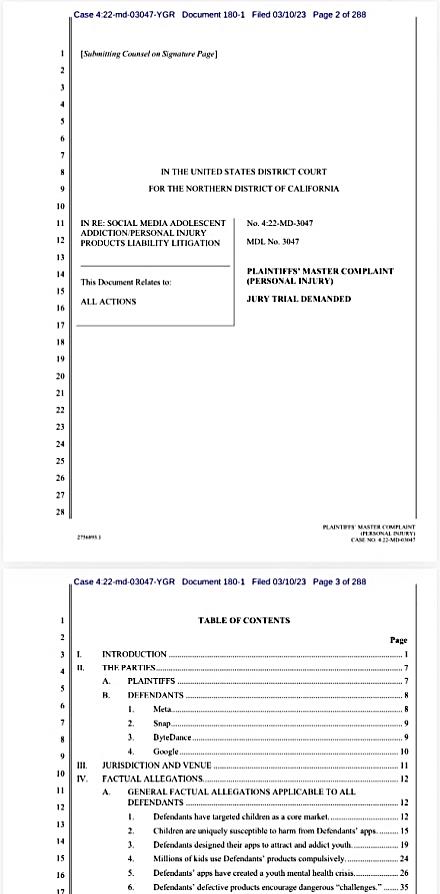
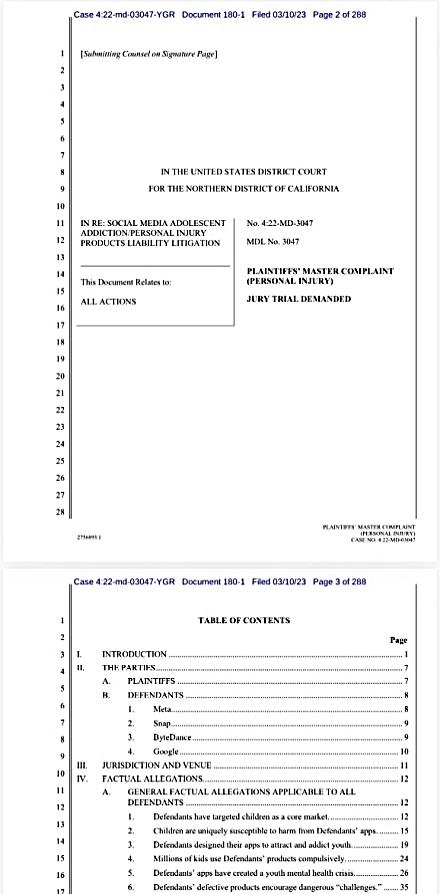
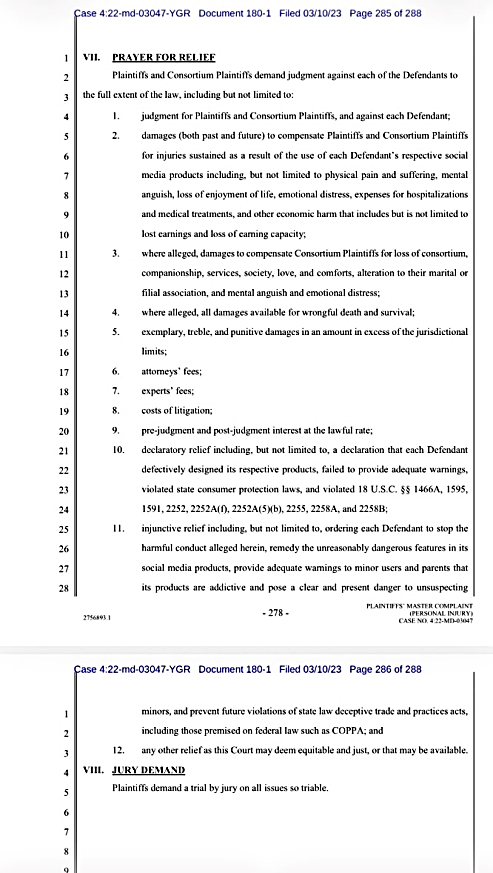
Figure 1. First and last pages of the Complaint
This statement of claim is a large and well-prepared legal document consisting of 287 pages of text and a significant number of images incorporated into the text of the statement of claim. The lawsuit immediately states the subject of the lawsuit: SOCIAL MEDIA ADOLESCENT ADDICTION/PERSONAL INJURY, PRODUCTS LIABILITY LITIGATION. And this is not a single lawsuit, but a class action (MASTER COMPLAINT), that is, other plaintiffs can join this lawsuit without filing their own separate lawsuits.
Given that Internet access to U.S. court records from Russia may be limited due to U.S. government sanctions and the importance of legal language to understanding the case, here are excerpts from the lawsuit (translated by Microsoft translation service):
«I. INTRODUCTION
1. American children are experiencing an unprecedented mental health crisis caused by the defendants’ addicted and dangerous social media products.
2. Over the past decade, Americans’ engagement with social media has grown exponentially, especially among our nation’s youth. This explosive growth in usage is not an accident.
This is the result of the defendants’ studied attempts to encourage young people to use their products – Instagram, Facebook, TikTok, Snapchat and YouTube – compulsively. Borrowing heavily from the behavioral and neurobiological techniques used by slot machines and used by the cigarette industry, the defendants consciously incorporated a number of design features into their products aimed at maximizing youth engagement to increase advertising revenue. Defendants know that children are at a developmental stage that makes them particularly vulnerable to the dependent effects of these traits. Defendants still target them to make additional profits.
3. The shortcomings of the defendants’ products vary depending on the platform, but they all exploit children and teenagers. These include, but are not limited to, an algorithmically generated, infinite feed so that users scroll in an induced “flow state”; “intermittent variable rewards” that manage the delivery of dopamine to enhance use; “trophies” to encourage overuse; metrics and graphs for using social comparisons; Constant notices that encourage repeated account checks due to production instability; insufficient, inherently illusory age verification protocols; and insufficient tools for parents to create the illusion of control.
4. The ubiquity of the defendants’ products in the lives and palms of our children, as well as the subsequent harm to them, can hardly be overestimated. Today, more than a third of 13- to 17-year-olds report using one of the accused’s apps “almost constantly” and admit it’s “too much.” However, more than half of these children report that they would find it difficult to reduce their use of social media. Instead of injecting coins into machines, children feed the platforms of the accused with an endless supply of attention, time, and data.
5. The election of the defendants brought exceptional corporate profits – and led to a huge tragedy. The suicide rate among young people has risen by an alarming 57%. Emergency room visits for anxiety disorders increased by 117%. In the decade leading up to 2020, the number of high school students reporting persistent sadness and hopelessness increased by 40%, and the number of those who attempted suicide increased by 36%. In 2019, one in five high school girls made a suicide plan. In 2021, one in three girls seriously considered a suicide attempt. Children, their parents, and caregivers across the country are struggling with the serious, long-term effects of anxiety, depression, addiction, eating disorders, self-harm, suicidal thoughts, and the loss of the ability to outlive their child.
6. This lawsuit is a continuation of a growing body of scientific research, including internal (previously hidden) research by the defendants, that draws a direct line between the defendants’ conscious, conscious design decisions and the youth mental health crisis sweeping our country.
Instagram, Facebook[6], TikTok, Snapchat and YouTube have changed the way our children think, feel and behave. Scattered “likes” replaced the intimacy of teenage friendships. Mindless scrolling has supplanted the creativity of the game and sports. Although the products of the accused are presented as “social,” they have contributed in a variety of ways to alienation, dissociation, and a host of subsequent mental and physical traumas.
7. The U.S. Surgeon General recently explained that children’s fight against big tech companies is “just an unfair fight.” “You have some of the best designers and product developers in the world who have created these products so that people make the most of their time on these platforms. And if we tell a child: use willpower to control how much time you spend, you’re putting the child up against the greatest product designers in the world.”
8. Over the past year, hundreds of personal injury harm lawsuits have been filed in courts across the country, alleging that defendants have misdesigned their platforms – in predictably dangerous ways and in violation of basic care duties – to cause harmful, unhealthy, and compulsive use in children. The plaintiffs in these cases are young people across the country whose sinking into the emptiness of social media has resulted in serious and sometimes fatal harm, as well as their parents and caregivers. The defendants are multibillion-dollar corporations that have developed dangerous products that hopelessly outperform parents’ fight for the health and safety of their children.
9. Plaintiffs file this primary complaint (personal injury complaint) (the “Claim”) as an administrative tool to set forth possible claims and facts that individual plaintiffs may assert in this class action against defendants. Unless otherwise indicated, plaintiffs make accusations about themselves based on personal knowledge, and charges based on information and beliefs usually obtained during the investigations of their lawyers.
* * *
10. Over the past decade, Defendants have relentlessly pursued a growth strategy at all costs, recklessly ignoring the impact of their products on children’s mental and physical health and well-being. In the race for a “valuable but untapped” market for teens and tweens users, each of the defendants has developed product features that promote repetitive and unsupervised use by children.
11. Adolescents and children are central to the defendants’ business models. These age groups are closely connected to the Internet, more often have accounts in social networks and more often devote their free time to using social networks. In addition, young people influence the behavior of their parents and younger siblings. As one defendant put it, “losing the teen presence in the U.S.” would mean “losing the pipeline” to growth. A few weeks later, the U.S. Surgeon General issued a recommendation “to underscore the urgent need to address the youth mental health crisis.” In a harsh criticism of the attack on our children, the Surgeon General acknowledged the defendants’ dangerous product intentions and the defendants’ denial of responsibility for the harm caused:
In these digital public spaces, which are privately owned and usually run for profit, there can be a tension between what’s best for a tech company and what’s best for an individual user or society. Business models are often built around maximizing user engagement, rather than protecting user health and ensuring safe and healthy user interactions.
[Tech companies] must take responsibility for creating a safe digital environment for children and young people. Today, most companies are not transparent about the impact of their products, making it difficult for parents and young people to make informed decisions, and for researchers to identify problems and solutions.
17. The statements of the Surgeon General were subsequently supported by President Biden himself. In his State of the Union addresses for 2022 and 2023, the president called on the country to “hold social media accountable for the national experiment they are conducting on our children for profit.” In a column dated January 11, 2023, President Biden emphasized this point: “The risks that Big Tech poses to ordinary Americans are obvious. The president noted that “millions of young people are facing bullying, violence, trauma and mental health” because of the defendants’ behavior and products, and reiterated that “we must hold social media companies accountable” for their role in this crisis.
18. These statements by President Biden and the Surgeon General are consistent with a significant body of peer-reviewed scientific literature documenting the harmful effects of the defendants’ apps on our children, including the various injuries sustained by the plaintiffs. This body of research shows that the defendants’ defectively designed products can cause the harms that plaintiffs experience: addiction, compulsive use, anxiety, depression, eating disorders, body dysmorphia, self-harm, sexual exploitation, suicidal ideation, other serious illnesses and injuries, and suicide. Overall, the rate of these disorders has increased significantly due to the widespread use of the respondents’ products by children in this country and around the world.
19. Defendants knew or should have known about the risks of such addiction – which at least one respondent euphemistically refers to as “problematic use”. They could change products to avoid harm. They could have warned the public and plaintiffs of the danger. Instead, the defendants put growth first.
20. Plaintiffs seek to recover damages from defendants and hold them accountable for personal injuries caused by their misconduct. This conduct includes: (a) developing defective products that cause serious injury to users; (b) insufficient warning of serious and reasonably foreseeable health risks from the use of the products; (c) failing to exercise reasonable care in, inter alia, the development, design, management, operation, testing, production, labeling, marketing, advertising, promotion, control, sale, supply and distribution of their products; and (d) regarding Meta’s willful concealment, misrepresentation, and obstruction of public awareness of the serious health risks of users of its products.
21. This action is brought on behalf of children who have suffered personal injuries – and in the event of death – personal representatives of their property (“Plaintiffs”) – due to their use of the products of the Defendants and, where applicable, their parents, guardians, spouses, children, siblings and immediate relatives who have suffered loss of the community or the Consortium and other injuries as a result of harm to the Plaintiffs (“Consortium Plaintiffs”) who are filing a short complaint form.
In accordance with the pending court order, all charges set forth in this action are deemed to have been admitted in any brief form of action against the defendants named therein.
22. The plaintiffs suffered various personal injuries due to the use of the defendants’ products. The plaintiffs and plaintiffs of the consortium suffered as a direct and immediate result of the defendants’ misconduct. These injuries include pain, suffering, disability, mutilation, disfigurement, death, increased risk of injury and other serious illnesses, loss of enjoyment of life, loss of community, aggravation or activation of pre-existing diseases, scarring, inconvenience, medical and treatment costs, loss of wages and disability, and other economic and non-economic losses (in particular any injuries identified in the summary complaint form). These losses are often permanent and ongoing in nature.
23. The plaintiffs expressly refute any contracts which they may have entered into with any of the defendants, or which the defendants may claim to have entered into with them before reaching the age of majority, because they did not have legal capacity to contract.”[7]
The plaintiff provides medical evidence of his claim in the statement of claim:
“2. Children are uniquely vulnerable to harm from defendants’ apps.
62. Young people are not only the most lucrative market for defendants, but they are also the most vulnerable to harm caused by defendants’ products.
63. “Everyone by nature responds to social approval.” Unlike adults, who “tend to have a fixed sense of self that relies less on peer feedback,” teens are in a “period of personal and social identity formation” that is now “dependent on social media.”
64. In order to understand the impact of responder apps on young people, it is helpful to understand some of the basics of the human brain.
65. The frontal lobes of the brain—especially the prefrontal cortex—control higher-order cognitive functions. This area of the brain plays a central role in planning and executive decision-making, including risk and reward assessment. It also helps suppress impulsive actions and “regulate emotional responses to social rewards.”
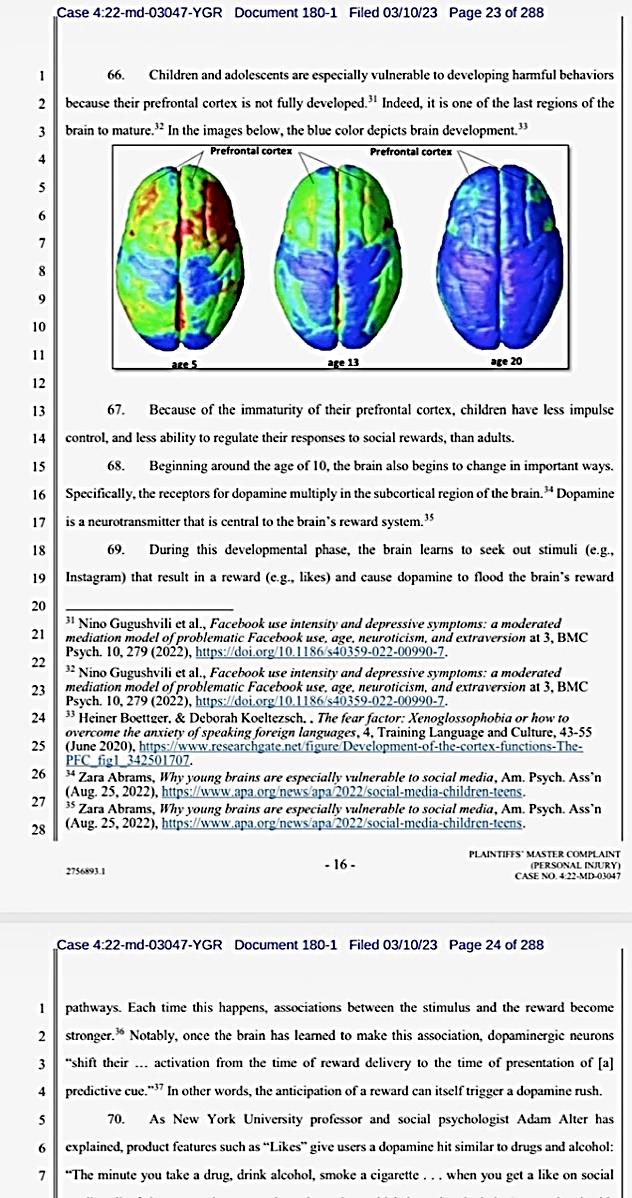
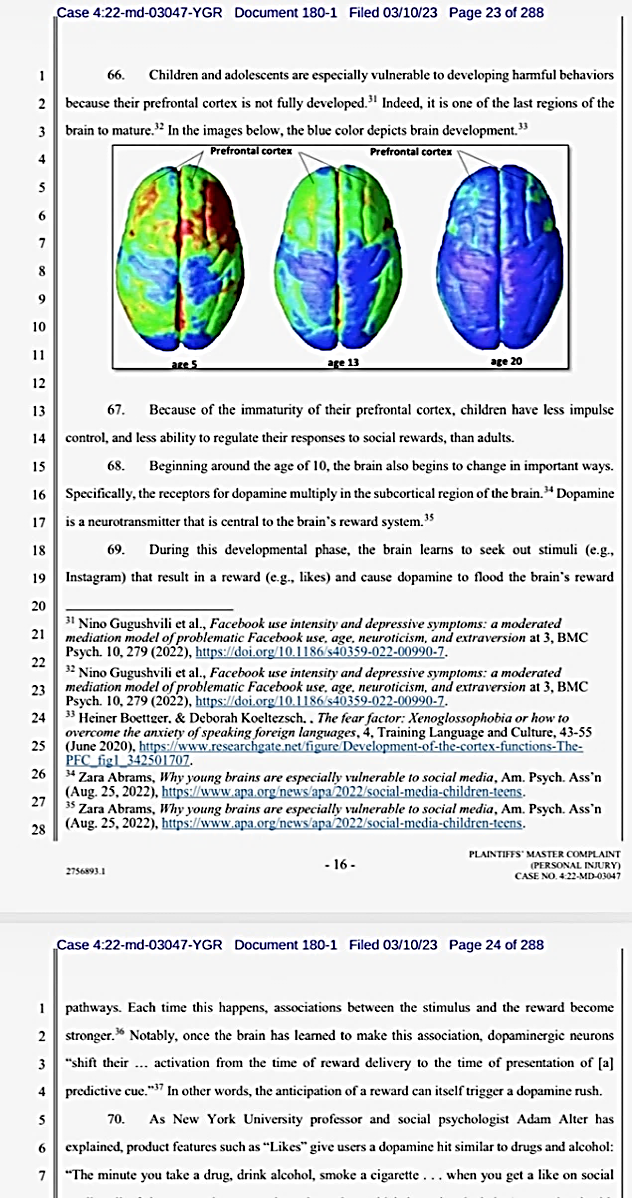
Figure 2. Medical evidence in the Complaint
The plaintiff firmly states:
“3. The defendants developed their apps to attract and engage young people.
76. Instagram, Facebook, TikTok, Snap, and YouTube use a variety of similarly flawed and dangerous features of products that are designed to encourage more use by young people—creating an unreasonable risk of compulsive use and addiction.44 For example, all five apps collect user data and use this information to generate and promote algorithmically tailored “feeds” of photos and videos.
And all five include ways to express and gain approval, such as likes, hearts, comments, shares, or shares. This section explains the psychological and social mechanisms used by these and other product defects.”
Chapter 3. Claims and legal grounds for action
The claims in KGM v. Meta, Snapchat, Google are being heard by the Federal District Court for the Northern District of California in multidistrict proceedings (MDL) pursuant to 28 U.S.C. § 1407.[8] At the same time, despite the federal procedural form of consideration, the claims filed by the plaintiffs are not based on federal substantive rules, but arise from the tort and consumer laws of the states. By virtue of the doctrine of Erie Railroad Co. v. Tompkins, the federal court in such cases applies the substantive law of the states in compliance with the federal rules of procedure.[9]
Procedural issues in the case are governed by the Federal Rules of Civil Procedure, including the requirements for the content of the statement of claim and the grounds for its dismissal at an early stage (Rule 8, Rule 12(b)(6)).[10] At the same time, the legal qualification of the filed claims is carried out on the basis of the common law of the states, primarily California, which is due to the place of centralized consideration of the MDL and the location of the key defendants.
As the main legal basis, the plaintiffs refer to the doctrine of product liability formulated in Restatement (Second) of Torts § 402A and developed in Restatement (Third) of Torts: Products Liability § 2.[11] Under these provisions, the manufacturer is liable if a product is defective in design or does not contain adequate warnings of reasonably foreseeable risks, and such risks could be mitigated by a reasonably feasible alternative design. The lawsuit argues that the defendants’ digital platforms can be considered “products” within the meaning of this doctrine, and algorithmic and interface solutions as elements of their design.
The plaintiffs qualify as design defects, in particular, algorithmically generated infinite content feeds, variable reward mechanisms, social metric systems (likes, ratings, followers), intrusive notifications, as well as formal and ineffective age verification mechanisms. According to the plaintiffs, these elements create an unreasonable and predictable risk of compulsive and addictive behavior in underage users, which allows them to be considered as a design defect in the sense of product liability.
At the same time, there are claims for failure to warn based on the same Restatement (Third) of Torts: Products Liability § 2. The plaintiffs point out that the defendants knew or should have known about the serious risks to the mental and physical health of minors, but did not disclose this information to users and their parents, did not warn about the possible consequences of using the products and, on the contrary, created the illusion of their safety and control.
In addition, the claim contains claims based on the doctrine of negligence, built on the classical model of American tort law, including the existence of a duty of care, breach, causation and damages. The plaintiffs allege that the defendants violated the duty of reasonable care in developing, testing, operating, and modifying their platforms by prioritizing increased engagement and advertising revenue over the safety of underage users. A key element of these requirements is the foreseeability test, which has traditionally been applied by state courts.
With respect to individual defendants, most notably Meta, the plaintiffs also invoke California unfair business practices, including California Business and Professions Code § 17200 and § 17500, which prohibit misleading business practices and false advertising.[12] Under these provisions, it is alleged that the defendants misrepresented the safety information of their products, created the illusion of effective parental controls, and concealed significant information about the health risks of underage users.
Thus, in the federal procedural form of consideration of the case, the substantive basis of the claim is a set of norms of tort and consumer law of the states, the application of which within the framework of multi-district proceedings potentially requires a complex analysis of the applicable law (choice-of-law analysis) in relation to various groups of plaintiffs. This circumstance is of fundamental importance for assessing the stability of the stated claims and predetermines the key role of the legal position of the defense, to the analysis of which it is advisable to proceed further.
Chapter 4. Additional Grounds for Civil Liability of the Defendants
4.1. Negligence
The defendants violated the duty of care to minor users under the Common Law of the United States, Restatement (Second) of Torts §§ 281, 282, 284, 302, 302B and Restatement (Third) of Torts: Liability for Physical and Emotional Harm § 7.
The defendants violated this duty by knowingly designing, implementing, and operating social media products with known addictive and dangerous characteristics, failing to provide adequate child protection measures, and failing to warn of known and foreseeable risks.
These actions are in a direct causal relationship with the harm caused to the Plaintiffs, including serious mental harm and death.
4.2. Negligent Undertaking
The defendants voluntarily assumed obligations to ensure the safety of minors, publicly declaring the existence of moderation, content filtering and other protective measures.
In accordance with Restatement (Second) of Torts § 323 and § 324A, a person who voluntarily assumed an obligation is liable for its negligent performance if such performance increased the risk of harm or created a false sense of security among the victims.
The defendants fulfilled these obligations formally and ineffectively, which directly contributed to the occurrence of damage.
4.3. Unfair and Deceptive Trade Practices
The Defendants’ actions constitute unfair and deceptive trade practices prohibited by 15 U.S.C. § 45(a) (Federal Trade Commission Act) and state consumer protection laws, including, but not limited to,
Cal. Bus. & Prof. Code §§ 17200–17210 (Unfair Competition Law) и
Cal. Civ. Code §§ 1750–1784 (Consumer Legal Remedies Act).
The defendants misled users and their legal representatives about the security of their products, hid significant risks, and commercially promoted platforms to minors without disclosing critical information.
4.4. Fraudulent Concealment and Misrepresentation
The defendants deliberately concealed and misrepresented material facts regarding the addictive nature of their products, the extent of the exploitation of minors, and the ineffectiveness of their stated protective mechanisms.
These actions are subject to the rules of the US state tort law on fraud (Common Law Fraud), Restatement (Second) of Torts §§ 525-549, as well as § 551, which establishes the obligation to disclose material facts in the presence of exclusive knowledge and foreseeable trust on the part of the victims.
4.5. Related Norms for the Protection of Minors (in Justification of Illegality and Causality)
The illegality of the Defendants’ behavior and the nature of the damage caused are confirmed, among other things, by the following federal norms:
4.6. Injunctive and Equitable Relief
Pursuant to 28 U.S.C. §§ 2201-2202 (Declaratory Judgment Act), 15 U.S.C. § 45(b) and principles of equity, Plaintiffs may seek injunctive relief, removal of hazardous characteristics of Defendants’ products, and other legal and equivalent relief.
Thus, the conduct of the Defendants constitutes a combination of negligence, negligence of a voluntarily assumed duty, unfair and deceptive trade practices, as well as deliberate concealment of material facts, which creates an independent and sufficient basis for civil liability and the application of injunctive relief.
Taking into account the established facts, the legal qualification of the actions of the Defendants and the nature of the harm caused, the Plaintiffs reasonably demand the application of a combination of compensatory, punitive and preventive legal remedies permissible under the civil and federal laws of the United States.
5.1. Compensatory Damages
The plaintiffs claim compensation damages in an amount sufficient to compensate for the damage caused, including physical, mental and emotional damage, economic losses, medical and rehabilitation costs, and other provable losses.
The legal possibility of recovering compensatory damages arises from the norms of the tort law of the US states and the general principles of civil liability enshrined in the Restatement (Second) of Torts.[13]
5.2. Штрафные (карательные) убытки (Punitive Damages)
С учётом сознательного, системного и социально опасного характера поведения Ответчиков, Истцы требуют взыскания штрафных (карательных) убытков, направленных на наказание и предотвращение аналогичных нарушений в будущем.
Взыскание punitive damages допустимо при доказанности злонамеренного безразличия (reckless disregard) к безопасности потерпевших, что соответствует подходу, закреплённому в Restatement (Second) of Torts § 908 и судебной практике США.[14]
5.3. Injunctive Relief
Plaintiffs are seeking injunctive relief aimed at eliminating sources of ongoing and future harm, including:
The legal possibility of applying an injunction is based on the Declaratory Judgment Act and the principles of the law of equity, which allow for the intervention of the court in the presence of irreparable harm and the public significance of the violations.[15]
5.4. Declaratory Relief
The Plaintiffs seek a judgment establishing the wrongfulness of the Defendants’ conduct, including an admission of negligence, unfair trade practices, and willful concealment of material facts.
A declarative decision is necessary to restore legal certainty and prevent the recurrence of similar violations.[16]
5.5. Disgorgement/Restitution
The Plaintiffs demand disgorgement of profits received by the Defendants as a result of unfair and deceptive practices, as well as the use of restitution as a measure to restore justice.
This measure directly follows from § 5 of the Federal Trade Commission Act and judicial practice in cases of systemic violations of consumer rights.[17]
5.6. Judicial Oversight and Independent Audit
Given the systemic nature of the violations identified, the Plaintiffs seek judicial oversight of the implementation of the measures ordered, including:
Such measures are in line with the practice of applying extended remedies for mass and structural violations.
5.7. Reimbursement of legal costs
Plaintiffs seek legal costs, including legal fees, expert fees, and other costs, in accordance with applicable federal and state law.[18]
The required measures of legal protection are not punitive and declarative, but systemic and preventive in nature and are aimed at eliminating sources of harm, restoring violated rights and protecting public interests, primarily the rights and safety of minors.
6. California Court Ruling
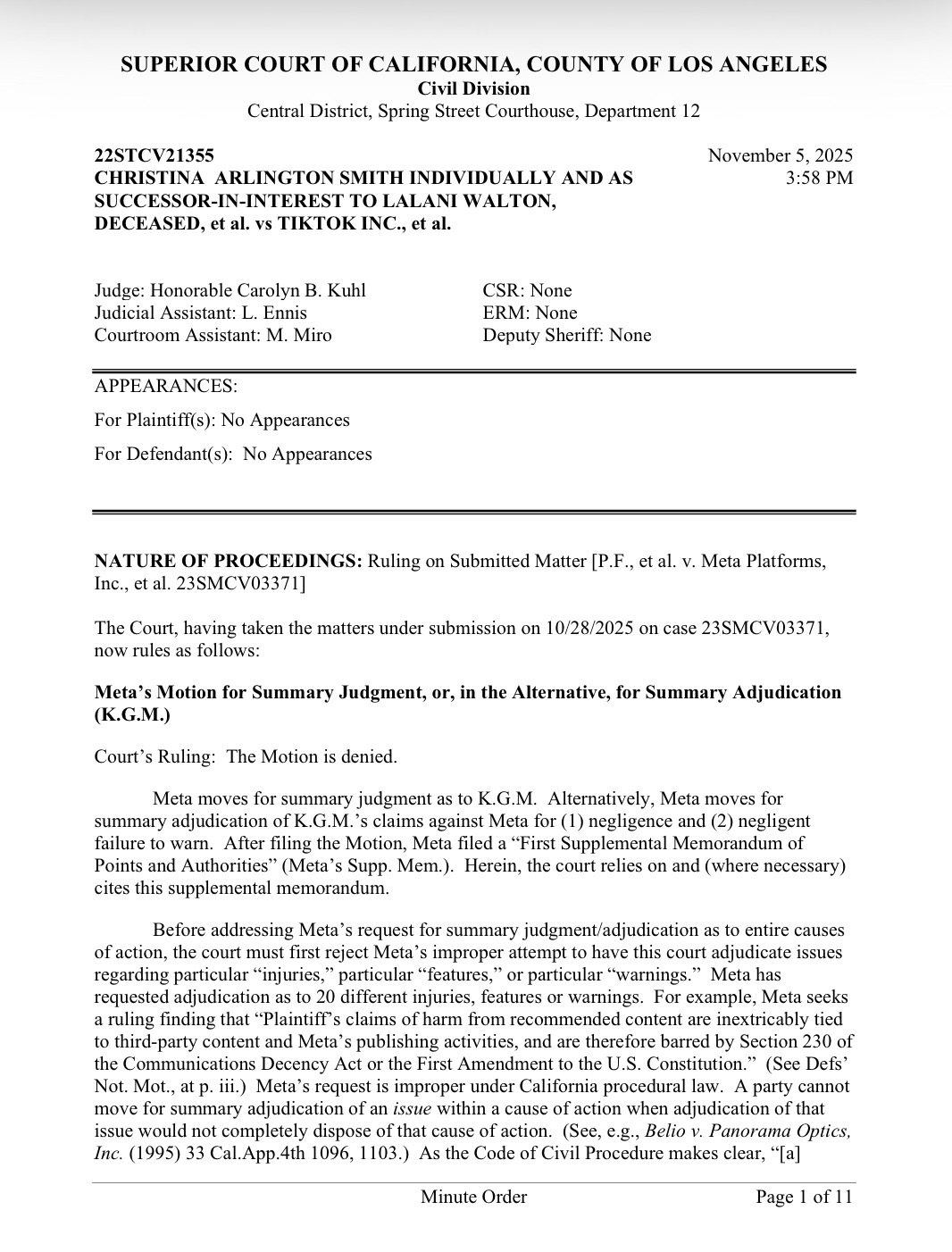
Fig.3 First page of the California Court’s ruling
In view of the fact that a significant part of the materials of the federal process is filed under seal, this article uses as the main source of analysis the available ruling of the court of the State of California, in which the court gave a detailed assessment of the essentially same legal arguments of the defendants. And given the fact that access to court materials may be limited to users from Russia due to the imposed sanctions, I give the text of the court ruling in my translation.
22STCV21355 November 5, 2025
CHRISTINA ARLINGTON SMITH INDIVIDUALLY AND AS
SUCCESSOR-IN-INTEREST TO LALANI WALTON,
DECEASED, et al. vs TIKTOK INC., et al.
3:58 PM
Judge: Honorable Carolyn B. Kuhl CSR: None
Judicial Assistant: L. Ennis ERM: None
Courtroom Assistant: M. Miro Deputy Sheriff: None
Minute Order Page 1 of 11
APPEARANCES:
For Plaintiff(s): No Appearances
For Defendant(s): No Appearances
NATURE OF PROCEEDINGS: Ruling on Submitted Matter [P.F., et al. v. Meta Platforms,
Inc., et al. 23SMCV03371]
The Court, having taken the matters under submission on 10/28/2025 on case 23SMCV03371, now rules as follows:
Meta’s Motion for Summary Judgment, or, in the Alternative, for Summary Adjudication (K.G.M.)
Court’s Ruling: The Motion is denied.
Meta moves for summary judgment as to K.G.M. Alternatively, Meta moves for summary adjudication of K.G.M.’s claims against Meta for (1) negligence and (2) negligent failure to warn. After filing the Motion, Meta filed a “First Supplemental Memorandum of Points and Authorities” (Meta’s Supp. Mem.). Herein, the court relies on and (where necessary) cites this supplemental memorandum.
Before addressing Meta’s request for summary judgment/adjudication as to entire causes of action, the court must first reject Meta’s improper attempt to have this court adjudicate issues regarding particular “injuries,” particular “features,” or particular “warnings.” Meta has requested adjudication as to 20 different injuries, features or warnings. For example, Meta seeks a ruling finding that “Plaintiff’s claims of harm from recommended content are inextricably tied to third-party content and Meta’s publishing activities and are therefore barred by Section 230 of the Communications Decency Act or the First Amendment to the U.S. Constitution.” (See Defs’ Not. Mot., at p. iii.) Meta’s request is improper under California procedural law. A party cannot move for summary adjudication of an issue within a cause of action when adjudication of that issue would not completely dispose of that cause of action. (See, e.g., Belio v. Panorama Optics, Inc. (1995) 33 Cal.App.4th 1096, 1103.) As the Code of Civil Procedure makes clear, “[a] motion for summary adjudication shall be granted only if it completely disposes of a cause of action, an affirmative defense, a claim for damages, or an issue of duty.” (Code Civ. Proc., § 437c, subd. (f)(1).)
Meta raises four main arguments in support of its claim that K.G.M.’s claims fail. First, Meta argues that Section 230 bars K.G.M.’s claims. Meta essentially re-litigates questions that were decided by this court when it ruled on Defendants’ pleading challenges. The court directs the reader to this court’s rulings as to Section 230. (See Ruling on Defendants’ Demurrer to Master Complaint and Three Short Form Complaints, Oct. 13, 2023 [an 89-page order addressing, inter alia, Defendants’ argument that Section 230 bars Plaintiffs’ claims in their entirety]; see also Court Ruling on Defendants’ Motion to Strike Third-Party Misconduct and Online Challenge Allegations from Identified Short-Form Complaints, July 19, 2024 [order addressing which types of features on the platforms cannot, as a result of Section 230, serve as a basis for Defendants’ liability].) Here, Meta has failed to present new argument or new authority persuading this court that it should revise its prior conclusions.
Meta argues that K.G.M.’s claims impermissibly seek to hold Meta liable as a publisher for harms stemming from the third-party content on Meta’s platforms. For example, Meta argues that K.G.M. cannot assert liability based on the “infinite scroll” design feature because this feature merely led Plaintiff to watch content. (See Meta’s Supp. Mem, at pp. 9-10.) However, the fact that a design feature like “infinite scroll” impelled a user to continue to consume content that proved harmful does not mean that there can be no liability for harm arising from the design feature itself. (See Ruling on Defendants’ Demurrer to Master Complaint and Three Short Form Complaints, Oct. 13, 2023, at p. 59 [harm from “infinite scroll” feature may give rise to a cause of action that is not barred by Section 230].) Here, there is evidence suggesting that the design feature of “infinite scroll” itself harmed K.G.M. Meta does not dispute that K.G.M. has testified that she suffered harm from using the “infinite scroll” feature. (See Meta’s Resp. K.G.M.’s Sep. St., at p. 113, Pl’s Fact No. 225.) Moreover, Meta does not object to this specific testimony. (See Def’s Objs., at p. 6, Obj. 13.) This evidence is sufficient to preclude a conclusion that there is no disputed question of fact as to whether K.G.M.’s claims are based on harm stemming from third-party content. Meta’s Section 230 argument does not justify an order granting the Motion.
Meta again argues, as it did in briefing the Defendants’ Motion to Strike certain allegations from particular Short-Form Complaints, that the “gravamen” of the claims asserted is injury caused by content of social media services. (See Court Ruling on Defendants’ Motion to Strike Third-Party Misconduct and Online Challenge Allegations from Identified Short-Form Complaints, July 19, 2024, at p. 24.) As discussed above, Meta certainly may argue to the jury that K.G.M.’s injuries were caused by content she viewed. But Plaintiff has presented evidence that features of Instagram that draw the user into compulsive viewing of content were a substantial factor in causing her harm. Courts have repeatedly “rejected use of a ‘but-for’ test that would provide immunity under [Section 230] solely because a cause of action would not otherwise have accrued but for the third-party content.” (Lee v. Amazon.com, Inc. (2022) 76 Cal.App.5th 200, 256.)
For similar reasons, K.G.M.’s testimony that she used Instagram and not Facebook because she liked the content she saw on Instagram does not require that the court (or the jury) ignore other evidence regarding K.G.M.’s usage of Instagram. The reason why K.G.M. initially used Instagram may be relevant to the cause of K.G.M.’s injury, but there also is evidence that the manner in which Instagram interacted with K.G.M. over time – the features that affected her continued use of the social media platform – contributed to K.G.M.’s injury.
Meta’s second argument is that the First Amendment bars K.G.M.’s claims because those claims “directly target Meta’s protected expressive activity—its choices about how to organize and present third-party speech—and would force Meta to alter the ways in which it curates and organizes content.” (Meta’s Supp. Mem., at p. 12.) This court already has considered Meta’s arguments based on the United States Supreme Court decision in Moody v. NetChoice, LLC (2024) 602 U.S. 707. As previously explained, “the allegedly addictive features of Defendants’ platforms (such as endless scroll) cannot be analogized to how a publisher chooses to make a compilation of information but rather are based on harm allegedly caused by design features that affect how Plaintiffs interact with the platforms regardless of the nature of the third-party content viewed.” (Ruling on Defendants’ Demurrer to Identified Amended Short-Form Complaints, Jan. 8. 2025, at p. 15, internal citations and quotation marks omitted.) As with the Section 230 argument, Meta claims that the First Amendment bars K.G.M.’s claims because it is the third-party content that caused K.G.M.’s harms. But, again, there is evidence in the record that K.G.M. was harmed by design features. The cause of K.G.M.’s harms is a disputed factual question that must be resolved by the jury.
Meta’s third main argument is that K.G.M. cannot prove the elements of her claim. With respect to the negligence cause of action, this argument is a restatement of Meta’s argument that K.G.M. is unable to show that design features caused her harm. As explained above, there is a factual dispute as to whether the design features caused K.G.M.’s harm. As for the claim for negligent failure to warn, Meta argues that the claim fails because K.G.M. cannot show that her harms would have been avoided or lessened had Meta issued the requested warnings. Meta notes that K.G.M. did not read Instagram’s terms of service before creating Instagram accounts. But K.G.M.’s claim also deals with the nature of the warnings. K.G.M. does not assert that Meta should have simply provided warnings hidden in the text of Instagram’s terms of service.
Plaintiffs’ “warnings expert” has offered his opinion that warnings should be “large” and “prominently placed.” (Meta’s Resp. Pl’s Sep. St., at pp. 62-63, Pl’s Fact No. 52.) It is undisputed that “[n]either K.G.M. nor her mother ever saw any statements or warnings about the safety of Instagram … .” (Meta’s Resp. Pl’s Sep. St., at pp. 122-123, Pl’s Fact No. 272.) The following fact is also undisputed:
K.G.M.’s mother only learned of the dangers of social media from a “60 Minutes” program long after her daughter had been using the apps. She testified that had she known of the harms earlier, she “would have neve given K.G.M. a phone and things would be different.”
(Meta’s Resp. Pl’s Sep. St., at p. 123, Pl’s Fact No. 273, internal brackets omitted.) Clearly, there are disputed questions of fact.
Meta’s fourth argument is that certain Meta-affiliated Defendants should be dismissed from this litigation because they had no involvement in K.G.M.’s injuries. Meta claims:
Only Meta Platforms, Inc. operates Instagram. SS ¶ 59. The other Meta Defendants—Meta Payments Inc. f/k/a Facebook Payments Inc., Siculus LLC f/k/a Siculus, Inc., Facebook Operations, LLC, Meta Platforms Technologies, LLC f/k/a Facebook Technologies, LLC, Facebook Holdings, LLC, and Instagram LLC (the “Non-Operating Defendants”)—do not. SS ¶¶ 60–62.
(Meta’s Supp. Mem., at p. 20.) In support of this argument, Meta cites to its own Responses and Objections to Plaintiffs’ Rule 30(b)(6) Written Questions to Meta Defendants. (Simonsen Decl. Ex. 8.) Plaintiff objects to this proffered evidence on the grounds that the person who verified the responses for Meta does not claim to have personal knowledge of the facts set forth in the Rule 30(b)(6) responses, and that Plaintiff has not had an opportunity to test the responses by cross examination in a deposition.
The court sustains the Plaintiff’s objection. Under California law, a party may not offer its own interrogatory responses as evidence – those responses only may be used to impeach the party that answered the interrogatories.
At the trial or any other hearing in the action, so far as admissible under the rules of evidence, the propounding party or any party other than the responding party may use any answer or part of an answer to an interrogatory only against the responding party.” (Code Civ. Proc., § 2030.410, italics added.) Thus, the responding party may not use its own interrogatory responses in its own favor. The trial court did not abuse its discretion in sustaining plaintiff’s objection to defendant’s use of its own interrogatory responses as evidence supporting its statement of undisputed facts.
(Great American Ins. Cos. v. Gordon Trucking, Inc. (2008) 165 Cal.App.4th 445, 450.)
At oral argument, Meta’s counsel argued that responses to a deposition by written questions conducted under Federal Rule of Civil Procedure section 31 should be treated like testimony given in a deposition rather than like interrogatory responses. Counsel cited in support of this proposition United States v. Salim (1988) 855 F.2d 944 (Salim). In that case, the court considered whether Federal Rule of Civil Procedure 15 allowed the submission in a criminal proceeding of a deposition conducted by French authorities. The court described the deposition taken in France as similar to a deposition on written questions conducted pursuant to Federal Rule of Civil Procedure 31. The court further noted that Rule 31 allows the submission of both direct and cross-examination questions in writing. (Id. at p. 951.) It was important to the court’s determination that the foreign deposition testimony was admissible in the criminal trial that the party who opposed admission of the evidence had had “ample opportunity to pose new questions to the witness after reviewing her responses to the earlier ones.” (Id. at p. 954.)
In the current posture of this case, this court did not supervise the discovery that Plaintiffs were allowed to take of Meta (the MDL court supervised that discovery), and the court is unaware of whether Plaintiffs had the opportunity to follow-up on the responses to the deposition by written questions in order to pose additional questions and to probe the reliability of Meta’s written responses. Further, unlike the circumstances in Salim, where the foreign deposition involved an identified individual, the testimony at issue here was taken pursuant to Federal Rule of Civil Procedure section 31(a)(4) – questions directed to an organization in accordance with Rule 30(b)(6) – and Meta was required to designate a person to testify about information known or reasonably available to the organization. Plaintiff objects that the person who verified the interrogatory responses did not claim personal knowledge. The Declaration verifying the responses was signed by Nicole Lopez, but nothing in the excerpt provided with Meta’s Motion indicates the title of the witness or gives any assurance that she possessed the requisite information necessary to qualify as a witness pursuant to Rule 30(b)(6), as required by Rule 31(a)(4). The court sustains Plaintiff’s objection to Exhibit 8 to the Simonsen Declaration.
Meta’s Motion for Summary Judgment as to the Meta-affiliated Defendants is therefore denied.
Defendants YouTube, LLC and Google LLC’s Motion for Summary Judgment, or, in the Alternative, for Summary Adjudication on Plaintiff K.G.M.’s Remaining Causes of Action
Court’s Ruling: The Motion is denied.
Google moves for summary judgment or summary adjudication as to K.G.M.’s remaining causes of action for negligence and negligent failure to warn. Google also moves for “summary adjudication” of the following four allegedly wrongful acts committed by Google:
1. Exposing Plaintiff to third-party content that she found objectionable via comments, content recommendations, and Autoplay;
2. Providing to Plaintiff the ability to receive (or not receive) comments and/or likes from third parties on her YouTube videos;
3. Presenting curated YouTube feeds that Plaintiff used to watch videos; and
4. Failing to implement “stricter age restrictions” on YouTube.
After filing the Motion, Google filed an Amended Memorandum of Points and Authorities (Google’s Am. Mem.). Herein, the court relies on and (where necessary) cites this amended memorandum.
As explained above in connection with Meta’s Motion, a request for this court to enter summary adjudication as to discrete issues (i.e., whether Google caused K.G.M. legally cognizable harm by presenting curated YouTube feeds) is procedurally improper. A party cannot move for summary adjudication of an issue within a cause of action when adjudication of that issue would not completely dispose of that cause of action. (See, e.g., Belio v. Panorama Optics, Inc. (1995) 33 Cal.App.4th 1096, 1103.) As the Code of Civil Procedure makes clear,
“[a] motion for summary adjudication shall be granted only if it completely disposes of a cause of action, an affirmative defense, a claim for damages, or an issue of duty.” (Code Civ. Proc., § 437c, subd. (f)(1).)
Google’s principal argument is that K.G.M.’s claims fail because they are barred by Section 230 and the First Amendment. In short, Google argues this court should conclude that there is no disputed question of material fact as to whether K.G.M. was harmed by design features, or instead harmed by non-actionable third-party content.
The parameters of the restrictions required by Section 230 and the First Amendment have been analyzed previously by this court and are outlined again above in discussing Meta’s Motion for Summary Judgment. K.G.M. has introduced evidence that her use of YouTube’s design features caused her harm. K.G.M. testified that she used YouTube, and that she believes that YouTube “contributed to [her] social media addiction.” (Olson Decl., Ex. 1, at 248:22-25.) She testified that YouTube’s “autoplay” feature contributed to her social media addiction. (Olson Decl., Ex. 1, at 249:16-20.) K.G.M. has testified that social media use “contributed to [her] anxiety and [her] depression and caused [her] to feel more insecure about [herself].” (Olson Decl., Ex. 1, at 252:3-5.) Moreover, K.G.M., like other Plaintiffs, also relies on evidence submitted by expert witness Bagot, who concludes that certain design features on Google’s platform YouTube were capable of causing the type of mental harms allegedly suffered by K.G.M. (See, e.g., Olson Decl., Ex. 37, at 62:7-15; see also Bagot Gen. Causation Rept., at p. 51 [addressing how “autoplay” contributes to a social media platform’s addictive nature].)
Although Google has challenged the admissibly of Bagot’s general causation testimony, this court has determined that Bagot may testify at trial. Ultimately, the critical question of causation is one that must be determined by the jury.
Google’s second principal argument is similar to its first. Google argues that K.G.M. “fails to carry her burden of creating a jury issue on causation.” (Google’s Am. Mem., at p. 21.)
Google is correct that “[t]he causation issues in this case are undeniably complex.” (Google’s Am. Mem., at p. 21.) Those “causation issues” must be resolved by a jury after all admissible evidence is presented at trial. Again, this court has already rejected Defendants’ argument that Bagot cannot provide testimony regarding causation at trial.
Google argues that the failure to warn claim fails because K.G.M. is unable to present any evidence to show that any warning would have prevented the harm suffered by K.G.M. However, this issue also must be decided by the jury. The following is undisputed for the purposes of this motion:
K.G.M.’s mother only learned of the dangers of social media from a “60 Minutes” program long after her daughter had been using the apps. She testified “I was not aware, I didn’t know if there was any dangers,” “I didn’t realize the harm it could do,” and that had she known of the harms earlier, she “would have never given K.G.M. a phone and things would be different.”
(YouTube’s Resp. Pl’s Sep. St., at p. 136, Pl’s Fact No. 226, internal brackets omitted.)
Motion for Summary Judgment or, in the Alternative, Summary Adjudication (filed by ByteDance against K.G.M.)
Court’s Ruling: The Motion is denied.
ByteDance moves for summary judgment or summary adjudication as to K.G.M.’s claims for negligence and negligent failure to warn relating to his use of TikTok.
As noted above in regard to the motions filed by other Defendants, this court cannot resolve discrete “issues.” This court can only grant the Motion if it determines that one or more of K.G.M.’s causes of action fail.
ByteDance argues that K.G.M.’s claims fail as a matter of law because there is no factual dispute that TikTok’s design features did not cause K.G.M. harm. In making this argument,
ByteDance suggests that the expert testimony of Bagot (1) is inadmissible, and (2) insufficiently demonstrates TikTok’s liability. This court has already determined that Bagot may provide causation testimony. Moreover, whether Bagot’s opinions regarding whether TikTok is capable of causing K.G.M.’s harms are sufficient to prove liability at trial is a factual question that must be determined by the jury. Testimony by Bagot as to design features that were employed on TikTok as well as on other social media platforms is directly relevant to the question of whether those design features cause the type of harms allegedly suffered by K.G.M. here. There is no dispute that K.G.M., when using TikTok, was exposed to these features. Indeed, it is undisputed here that K.G.M. has claimed that she was harmed from design features on TikTok, such as “endless scrolling.” (ByteDance’s Resp. Pl’s Sep. St., at p. 82, Pl’s Fact No. 164.) K.G.M. testified that TikTok’s endless scrolling feature made TikTok addictive and interfered with K.G.M.’s sleep. (ByteDance’s Resp. Pl’s Sep. St., at p. 82, Pl’s Fact No. 165.) The jury must therefore determine whether these design features on TikTok were the cause of K.G.M.’s harm.
Moreover, because the question of whether TikTok’s design features caused K.G.M.’s harm must be resolved by the jury, this court cannot grant summary adjudication under Section 230 or the First Amendment.
ByteDance insists that it could not be liable because K.G.M. already suffered mental health harms before she began using TikTok. However, the question of whether subsequent TikTok use contributed to or increased such harms is a factual question for the jury. The complicated factual question of whether TikTok’s design features were a substantial cause of any of K.G.M.’s harms cannot be decided by way of summary judgment.
ByteDance also argues that K.G.M.’s claim for negligent failure to warn fails. In short, ByteDance argues that K.G.M. cannot show that the failure to warn actually caused K.G.M.’s harms stemming from use of TikTok. This issue cannot be resolved through summary judgment. ByteDance stresses the fact that neither K.G.M. nor her mother read TikTok’s terms of service or privacy policy. But a claim for failure to warn might still be valid even if a harmed minor’s parents did not read certain documents issued by the defendant. K.G.M.’s expert has offered testimony suggesting that any warning from ByteDance, in order to be effective, could not merely be included among the text of TikTok’s terms of service. (See ByteDance’s Rep. Pl’s Sep. St., at p. 90, Pl’s Fact No. 183.) Here, ByteDance does not dispute that it failed to issue certain warnings, such as a warning that a minor’s use of TikTok’s endless scroll feature could cause certain mental health harm. A trier of fact might conclude from the available evidence that, if ByteDance had issued such warnings, such warnings may have served to eventually alert K.G.M. and/or her mother about the dangers associated with K.G.M.’s use of TikTok.
Defendant Snap Inc.’s Motion for Summary Judgment, or, in the Alternative, Summary Adjudication
Court’s Ruling: The Motion is denied.
Snap moves for summary judgment and/or adjudication on three grounds: (1) K.G.M. does not have admissible expert evidence showing that her use of Snapchat caused her alleged injuries; (2) K.G.M.’s experts’ opinions cannot support causation, even if admissible, because of the many other documented causes of K.G.M.’s claimed injuries; and (3) K.G.M.’s claims are preempted by Section 230, and barred by the First Amendment Before addressing these three arguments, the court must again make clear that it can only grant summary adjudication as to an entire cause of action. The court must therefore reject Snap’s invitation to adjudicate “aspects of K.G.M.’s claims.” (Snap’s Supp. Not. Mot., at p. 2.)
As explained above in connection with other Defendants’ motions, such a request is procedurally improper. Harm from one design feature on a social media platform does not give rise to a “separate and distinct cause of action” from a claim for harm caused by another design feature of that same social media platform.
The first, second, and third arguments made by Snap can be summarized together as follows: Snap believes that there is no evidence to show that Snapchat’s design features caused K.G.M.’s injuries. Snap’s Motion is denied because K.G.M. has submitted evidence to dispute Snap’s factual claims. It is undisputed that K.G.M. used Snapchat. And K.G.M.’s expert has concluded that Snapchat’s design features can cause the types of harms suffered by K.G.M. “In her general causation report, Dr. Bagot offers the opinion that Snapchat employs features such as intermittent reinforcement mechanisms (including Snap streaks), ephemeral messaging, infinite scroll, and appearance-altering filters and lenses that are specifically designed to maximize adolescent engagement, promote appearance-based social comparison, and increase the risk of psychiatric harms including anxiety, eating disorders, and compulsive use.” (Snap’s Reply Pl’s Sep. St., at p. 141, Pl’s Fact No. 222.) Because there is evidence that (1) K.G.M. used Snapchat,
and (2) Snapchat’s design features caused the types of harms allegedly suffered by K.G.M., a trier of fact could conclude that Snapchat’s design features caused K.G.M.’s alleged harms.
Snap’s causation arguments do not bar Plaintiff’s claims from proceeding to trial. Snap again argues that Section 230 and the First Amendment bar its liability. But these arguments already have been addressed by the court. In the Ruling on Defendants’ Demurrer to Master Complaint and Three Short Form Complaints, Oct. 13, 2023, the court affirmed that liability could be premised on appearance-altering tools and reward systems designed to keep users checking social media sites in ways that contribute to social pressure and anxiety. (Ruling, Oct. 13, 2023, at p. 60.) Snap cites the Ninth Circuit’s recent ruling in NetChoice, LLC .v Bonta (9th Cir. 2025) 152, F.4th 1002, 1016-1017 (NetChoice v. Bonta), as authority in support of its position. That case found that state legislation prohibiting social media platforms from displaying the number of likes that a user’s post has received regulated the content of a social media provider’s speech, and that regulation of “the like-count default setting is not the least restrictive way to advance California’s interest in protecting minors’ mental health.” (Id. at p. 19.) But in this litigation Plaintiffs have not sought to ban Snap from displaying the number of likes and have not premised liability on such display. Rather, Plaintiffs premise liability on notification features that allegedly manipulate the time spent by Plaintiffs on a Defendant’s social media platform. Nothing in the Ninth Circuit’s decision in NetChoice v. Bonta persuades this court that its prior rulings on the applicability of the First Amendment to the claims alleged in this case were incorrect.
A copy of this minute order will append to the following coordinated cases under JCCP5255:
22STCV21355 and 23SMCV03371.»[19]
The lawsuits against Meta[20], Snapchat, Google and TikTok indicate a qualitative shift in the legal regulation of digital platforms in the United States. For the first time, social media companies have found themselves in a situation in which their traditional strategy of procedural protection—based on references to Section 230 of the Communications Decency Act and the First Amendment to the U.S. Constitution—has ceased to serve as a universal immunity from civil liability.
Despite reaching a settlement with the plaintiff in California state court, the federal multidistrict (MDL) proceeding retains its own procedural existence and can continue regardless of the outcome of the case at the state level. The settlement agreement does not create prejudicial consequences for the federal court, but it has an important substantive significance: the defendants’ refusal to bring the case to the jury in the face of the rejection of their key motions objectively indicates the vulnerability of the defensive position and transforms the balance of procedural risks within the MDL.
The court ruling of the court of the state of California actually disavowed the basic concept of protecting Big Tech, based on the presentation of algorithmic and interface solutions as a form of protected “speech” or as a derivative of third-party content. Capable of causing foreseeable harm to underage users. The question of the causal relationship and the reality of the damage, as well as the issue of adequate compensation, was recognized by the court as controversial and subject to resolution by a jury.
Thus, these cases form a fundamentally new model of civil liability of digital platforms, within which it becomes impossible to “hide behind an algorithm”. This finding has implications far beyond the social media debate. Similar logic applies to companies developing and implementing artificial intelligence systems, including in cases considered by the author in previous studies. An algorithm, as an element of product design, does not eliminate the developer’s responsibility for foreseeable harm. In the context of emerging judicial practice, it is the data, architecture and functional solutions of the product that become a source of legal risk, for which companies will have to answer within the framework of the classical doctrines of tort law and the doctrine of products liability doctrine.
Postscript / Addendum (March 27, 2026): Jury Verdict in KGM v. Meta et al.
After the completion of this paper on January 27, 2026, a jury verdict was rendered in the case analyzed herein—KGM v. Meta Platforms, Inc., et al.—within the coordinated social media addiction litigation in the Superior Court of California, County of Los Angeles.
The jury found Meta Platforms and Google liable for harm suffered by the plaintiff, awarding damages on the basis of negligence and causation. Importantly, the case did not turn on the content of third-party speech, but on the design and functionality of the platforms themselves.
The findings reflect that the defendants’ product architecture—specifically, engagement-driven features such as algorithmic content delivery, infinite scrolling mechanisms, and other behavioral reinforcement systems—constituted a substantial factor in causing harm. The jury further accepted that such risks were foreseeable and not adequately mitigated or disclosed.
This development provides direct empirical confirmation of the central thesis advanced in this paper: namely, that U.S. litigation against digital platforms is undergoing a structural transition from content-based immunity toward design-based liability.
As demonstrated by the outcome in KGM, traditional defenses grounded in Section 230 of the Communications Decency Act and the First Amendment are increasingly insufficient where plaintiffs successfully frame claims in terms of product design, foreseeability of harm, and failure to warn.
Accordingly, the doctrinal trajectory identified in this paper—namely, the shift from “platform” to “engineered environment” as the relevant legal category—can now be observed not only at the level of pleadings and procedural strategy, but also in jury determinations on the merits.
The significance of this development lies not merely in the outcome of a single case, but in the transformation of the legal architecture governing digital platforms. What was previously argued as a theoretical requalification of liability has now been affirmed in practice.
This confirms that the analytical framework proposed in this paper possesses not only explanatory, but also predictive value.
References
Kildeev A.Kh. Disney and Warner Brothers Discovery lawsuits against Midjourney and Matthew and Maria Raine v. OpenAI and Sam Altman and their implications for the AI industry. Scientific Platform “21 CENTURY” journal, # 4, July 2025, www.episs.ru.
Electronic resource: TikTok settles just before social media addiction trial to begin https://www.bbc.com/news/articles/c24g8v6qr1mo, Request date-27.01.2026; Snap settles social media addiction lawsuit ahead of trial https://www.bbc.com/news/articles/c62ndl2ydzxo Request date-27.01.2026.
28 U.S.C. § 1407 — Multidistrict litigation.
Erie Railroad Co. v. Tompkins, 304 U.S. 64 (1938).
Federal Rules of Civil Procedure (Rules 8, 12(b)(6)).
Restatement (Second) of Torts § 402A; Restatement (Third) of Torts: Products Liability § 2.
California Business and Professions Code §§ 17200, 17500.
Restatement (Second) of Torts. § 901–§ 924. — St. Paul : American Law Institute, 1979.
Restatement (Second) of Torts. § 908. — St. Paul : American Law Institute, 1979.
Declaratory Judgment Act : 28 U.S.C. §§ 2201–2202.
Federal Trade Commission Act : 15 U.S.C. § 45(a), (b).
Federal Rules of Civil Procedure. Rule 54(d).
Electronic resource: extension://mjdgandcagmikhlbjnilkmfnjeamfikk/https://www.courthousenews.com/wp-content/uploads/2025/11/social-media-lawsuits-kgm-motion-denied.pdf?utm_source=chatgpt.com, Accessed on 28.01.2026.
