Articles that inspire and inform!
Publisher of POLIS LLC
Address: 190000, Saint Petersburg,
35/15 Kazanskaya Street
Publisher of POLIS LLC
Address: 190000, Saint Petersburg,
35/15 Kazanskaya Street

UDC: 339.9 (47+57) “1970”
WESTERN-SOVIET COMMERCIAL RELATIONS 1960-1990 AND THE GROWING SOVIET DEBT TO THE WEST, PART 2: THE 1970S
Gabriela Gavrilov
Emerson College, Boston, Massachusetts (1996)
MA Journalism
Catholic University, Washington, D.C. (1985) +
University of Warsaw, Poland (1983 – 1984)
BA Political Science / Economics
ggavrilov100@yahoo.com
http://orcid.org/0009-0008-9246-9646
Abstract. This article examines Western–Soviet commercial relations in the 1970s, focusing on government-backed export credits, technology transfers, and the early accumulation of Soviet external debt. Drawing primarily on declassified CIA economic intelligence reports, it demonstrates how large-scale imports of Western industrial plants and equipment transformed Soviet trade practices from cash and barter to systemic credit dependence. The article forms the second part of a three-part series analyzing the financial mechanisms that ultimately undermined the Soviet economic system. The 1970s represent the decisive phase in which credit-financed industrial imports became the dominant model of Soviet foreign trade.
Keywords Soviet debt; Cold War economics; export credits; technology transfer; CIA economic intelligence; Western-Soviet trade; industrial imports
1.Introduction
This is a new cycle of articles of the author, Gabriela Gavrilov, on the Soviet debt to the West countries during the 1960s, 1970s, and 1980s, which will eventually explain the financial reasons behind the Soviet Union’s fall. The current article is devoted to Western-Soviet commercial relations in 1970s.
Western-Soviet relations during the 1970s were defined by the dichotomy of détente coexisting with bloody proxy conflicts waged in developing countries, punctuated with some of the grandest commercial deals in market-command exchange history.
Cold War détente was a brief period of arms limitations negotiations and improved commercial relations between the US and the Soviet Union, spanning roughly from 1969 to 1979. This ‘thaw’ was presented to the Western public as an exciting and unique opportunity for the West, particularly the US, to commercially manage the Cold War, shifting from nuclear confrontation to commercial engagement. Trade engagement—the Western nostrum for all global ills—would reduce the risk of nuclear annihilation[1] by linking global economies and leveraging Western economic power to influence Soviet behavior. The idea propounded was that Soviet ‘adventurism’ would be ‘normalized’ once the Soviet government finally submitted to capitalist consumption through the purchase of the material products and technological methods which defined capitalism’s asserted superiority.
Unlike the 1960s, when Western credits complemented a still largely cash-based trade system, the 1970s marked the transition to a structurally new model of economic interaction. Industrial modernization was no longer financed through isolated agreements
Diplomatic milestones of the détente era include the 1968 signing of the Nuclear Non-Proliferation Treaty, Strategic Arms Limitation Talks (SALT), President Nixon’s 1972 visit to Moscow where the Anti-Ballistic Missile (ABM) Treaty and SALT I were signed, and the signing of the Helsinki Accords in 1975. Détente garnered a great deal of global media coverage and, as a result, served as a platform to justify increased trade.
The idea that greater East-West economic engagement would incentivize moderation of Soviet ideological convictions was used to assuage Congressional objections to increased trade. The political rapprochement of détente paved the way for massive trade deals for Western, particularly US firms, under the guise of improved relations. And it worked. Trade increased sevenfold between 1971 and 1973 alone, driven by large US grain exports and unprecedented sales of Western machinery. Following the 1972 U.S.-Soviet trade agreement, U.S.-USSR trade swelled from $218 million in 1971 to over $1.5 billion by 1973.
Those 1973 contracts were highlighted by a July 2 signing of a broad agreement on technology transfer with the Soviet Government by one of the US’s leading engineering and construction concerns, the Bechtel Corporation of San Francisco—a principal US military contractor. According to a New York Times article:
The agreement, which follows similar Soviet pacts with American corporations, is believed to be of particular interest to Moscow because of Bechtel’s involvement in key industrial projects in the United States, especially in the energy field. Bechtel has been looking into pipeline projects for Alaskan oil, into the feasibility of building nuclear plants on artificial islands off New York City and into the prospect of building and operating a commercial uranium enrichment plant. The accord with the Soviet Union ranges over cooperation in virtually all branches of heavy industry, from the use of managerial techniques in construction to metals and petrochemicals and the pipeline transportation of oil and gas.[2]
By March 1974, The New York Times announced:
The Kama River truck plant, biggest Soviet industrial project of the current detente era, has begun to have a tangible effect on economic life in the United States by providing sizable portions of the business of some American companies.
A comprehensive report on the East‐West trade project, made public by the Chase World Information Corporation, lists 65 contracts signed by the Russians with United States concerns, with eight companies doing more than $10‐million worth of business.
Unlike the 1960s, when Western credits complemented a still largely cash-based trade system, the 1970s marked the transition to a structurally new model of economic interaction. Industrial modernization was no longer financed through isolated agreements but through a coordinated system of government-backed export credits, syndicated bank loans, and long-term energy-for-technology arrangements. This shift transformed external borrowing from a supplementary instrument into a systemic condition for sustaining Soviet economic growth.
As a result, the quantitative expansion of trade was accompanied by a qualitative change in its financial architecture. Hard-currency liabilities grew at a significantly faster rate than export capacity, embedding long-term dependence on Western financial markets into the operational logic of the Soviet economy.
Contracts for Kamaz, as the Soviet truck plant is commonly known in a Russian acronym, represent a for as much as 60 or 70 percent of sales volumes of the companies involved in the project. The business obtained by one concern, the National Engineering Company of Chicago, amounts to 150 percent of its annual sales in recent years.
The bonanza represented by some $270‐million worth of machine tools and foundry equipment contracted for by the end of last year is far from over. Soviet purchasing officials in New York were reported last week to have sounded out at least 45 large and small companies for more than $150‐million in additional equipment.
This information had been compiled by Chase World Information in the first of a series of East‐West trade guides called “Kamaz, the Billion Dollar Beginning.” The report was distributed to subscribers of EastWest Markets, a subsidiary of the Chase Manhattan Bank, which had long played a key role in trade with the Soviet Union, including financing of the Kama River Truck project.[3]
In addition to listing orders placed in the United States, complete with technical specifications and delivery dates, the Chase report describes the Kama plant, its role in the Soviet economy and the city of Naberezhnye Chelny rising next to the project. The Kama River Truck Plant (Kamaz) cost between $3 billion to $4 billion to in 1970s US dollars. The massive project, which included the factory complex and a new city for 70,000 workers, featured over $1 billion in imported Western, largely American, machinery and technology.[4] Initiated in 1969, the first phase of the plant was largely functional by 1976.
The article continued with further details:
American orders for the Kama River project have been placed by a special New York purchasing commission, headed by Georgi S. Shchukin, a career foreign trade official. The commission has its offices in the General Motors Building, 767 Fifth Avenue.
By far the largest United States contractor thus far is the Swindell‐Dressler Company of Pittsburgh, which has orders totaling $42.6‐million, including engineering designs and some equipment for the truck plant’s large foundry. Swindell‐Dressler is a division of Pullman, Inc., a diversified multinational concern. The Kama contracts represent about 14 percent of Pullman’s annual sales in the engineering and construction field.
Other major suppliers are C‐E Cast Equipment of Cleveland, with $34.5‐million; Holcroft & Co. of Livonia, Mich., $19.9‐million; Ingersoll‐Rand of Rockfold, Ill., $19.2‐million, and the National Engineering Company of Chicago, $15.4‐million.
C‐E Cast Equipment’s contracts, for molding lines at the Kama plant, represent 70 per cent of its 1973 sales of about $50‐million. Holcroft is owned by the Thermo Electron Corporation. The Kama orders represent more than half of the corporation’s net sales in 1972.
Renault of France provided engineering for the engine factory. The Swindell‐Dressler Company of Pittsburgh designed the metal foundry. IBM and Honeywell, Inc., negotiated to supply the computers and automation equipment to make Kama the most up‐to‐date truck factory in the world (although there is no evidence that they won the contracts.)
While the superpowers negotiated on the global stage for arms control agreements, and closed massive commercial deals, they also engaged in proxy wars, “active measures”[5], disinformation, and continued human rights disputes in Developing Countries.
The US continued its bloody and expensive military campaign in Vietnam from 1965 through 1973, fearing a communist takeover of South Vietnam, which it believed would trigger a chain reaction (Domino Theory) throughout the region. Between 1965 and 1975, the US and its allies dropped more than 7.5 million tons of bombs on Vietnam, Laos, and Cambodia—double the amount dropped on Europe and Asia during World War II. Pound for pound, it remains the largest aerial bombardment in human history,[6] while the Soviet Union was the primary supplier of advanced military hardware to North Vietnam. The USSR provided roughly 65% of NVA tanks, 55% of rifles, and 95% of SAM systems to counter US air superiority. From 1965 to 1975, over 10,000 Soviet advisors and specialists trained personnel, maintained equipment, and operated air defense systems, contributing over $600 million annually in aid.[7]
In March 1975, Soviet-backed forces intervened in the Angolan Civil War, providing significant weaponry and logistical support to the Marxist People’s Movement for the Liberation of Angola (MPLA) during, challenging US and South African-supported factions, the National Union for the Total Independence of Angola (UNITA) and the National Front for the Liberation of Angola (FNLA). The USSR provided crucial supplies, including tanks and armored cars, to the MPLA, enabling them to seize control of the capital, Luanda, by July 1975.
By May 23, 1979, The New York Times reported that:
United States intelligence officials said today that a Soviet truck‐manufacturing plant built with American help was producing engines for military vehicles.
According to the officials, a Central Intelligence Agency officer, testifying at closed hearing of the House Armed Services subcommittee, confirmed a Secret Government report that said some of the 50,000 diesel engines produced annually at the truck plant were being installed in military vehicles.
Officials of the Defense Department and the Commerce Department said the apparent production of the engines for military use did not violate any existing trade understanding. They also said that the equipment sold to the Soviet Union for the construction of the truck plant had been considered to pose no significant security risks to the United States.[8]
In June 1979, Strategic Arms Limitation Talks (SALT) II treaty was signed in Vienna by Carter and Brezhnev, however increasing political tension [or pressure from military contractors] prevented its ratification by the US Senate. The Apollo-Soyuz Test Project, the first joint US-Soviet space flight, briefly warmed relations in July 1975.
When Soviet troops invaded Afghanistan in December 1979, détente was effectively ended. In response, the US imposed short-lived sanctions, a brief grain embargo, and boycotted of the 1980 Moscow Olympics.[9]
Taken together, these agreements reveal a consistent pattern. Western firms supplied entire industrial complexes and advanced equipment on credit, while repayment depended on future export revenues that were themselves tied to volatile commodity markets. The Soviet Union thus entered a development trajectory in which technological modernization and external indebtedness became structurally inseparable.
This model produced rapid growth in industrial capacity but did not generate a corresponding expansion of competitive hard-currency exports. The gap between import intensity and export performance was therefore covered by continuous refinancing.
During the 1970s, Soviet exports to the West increased by 55%, while imports from the West surged by 207%.[10] Unsurprisingly, the Soviet Union’s net hard currency debt to the West also increased dramatically, rising from roughly $1.8 billion in 1970 to nearly $19 billion by the end of 1980. The broader Eastern Bloc debt exceeded $80 billion.[11]
How did it happen?
1971
May 18-The New York Times reported that the US firm of Mack Trucks, Inc. reached a preliminary agreement with Soviet representatives in New York to supply $750 million worth of equipment for a Soviet truck manufacturing plant. This was the touted as the largest agreement in the history of Soviet-American trade despite the fact that Albert Kahn Architectural Associates had signed a $2 billion deal with the USSR in January 1930 for Soviet industrial buildings for the 1st and 2nd 5-Year Plans.[12]
June 1- Commerce Department approved licenses for the export of $85 million worth of American truck manufacturing equipment to the Soviet Union..
August 9- Commerce Department issued export licenses for another $162 million worth of US foundry equipment for a truck manufacturing complex in the Soviet Union despite the on-going war in Vietnam where the Soviets were supplying military vehicles to the communist North Vietnamese government and were used against American troops. The US government indicated that the licenses did not constitute approval of the larger Mack Truck deal which called for shipment of equipment designed for the manufacture of heavy (military) trucks.
September 15- Mack Trucks, Inc. announced that it cancelled the agreement to supply $750 million worth of truck manufacturing equipment to the Soviet Union. Commerce Department officials denied that the US government had blocked the deal explaining that the license applications were too vague and requested further information from the firm which they did not receive.
November 5- Agriculture Department announced authorization of the sale of $136 million worth of grain to the Soviet Union.
November 20- Secretary of Commerce Stans traveled to Moscow for exploratory talks on expanding Soviet-American trade. In order for the Soviet Union to acquire further American firms’ capital and technology it would need government (taxpayer) credits to pay US firms.
November 28- Elite business executives from the US and Western Europe met with Soviet leaders in Moscow to discuss joint ventures and other trade possibilities.
November 30- The Satra Corporation of New York concluded a barter agreement with the Soviet Government (in conjunction with other American companies) to supply $65 million worth of mining and drilling equipment to in return for $60 million worth of non-ferrous metals.
December 4- According to the Swiss newspaper Neue Zurcher Zeitung, sometime in November President Nixon (apparently secretly) approved licenses for shipment of $950 million worth of US truck manufacturing equipment for the giant Soviet Kama River truck manufacturing complex.
According to an October 1978 CIA Report “Soviet Chemical Equipment Purchases From the West: Impact on Production and Foreign Trade”, more than 100 turnkey chemical plants worth over $6.5 billion were purchased from Western firms between 1971 and 1977: $3.5 billion in chemical plant expenditures were concluded between 1971 and 1975 during the 9th 5-year Plan and an additional $3 billion or more during the following two years during the 10th 5-Year Plan.
1972
Following lengthy negotiations in 1972, the USSR agreed to pay $722 million of WWII Lend-Lease debt, (later reduced to $674 million). During World War II, the US government purchased military products and supplies, food, and oil from US companies with taxpayer funds to supply Allied nations, totaling over $50 billion. The United Kingdom received $31.4 billion, the Soviet Union received $11.3 billion, France received $3.2 billion, and China received $1.6 billion. (The Russian Federation completed the final payment in 2006. In comparison the UK also finalized it debt repayment in 2006.)
In early July 1972, the US negotiated an arrangement that allowed the Soviets to buy up to $750 million of American grain on credit, over a three-year timespan.[13] However, the Soviet government quickly exceeded its credit limit, spending the $750 million in only one month[14] and exceeding $1 billion worth of US grain by the end of the year after the USSR purchased some 25.2[15] million metric tons of US grain (primarily wheat, corn and soybeans) in a massive deal that accounted for one-fourth of the entire US wheat harvest.
Following this, a 1975 agreement allowed the USSR to purchase up to 8 million metric tons annually of US grain as the former bread basket of Europe, the nation with the most fertile earth on the planet had been reduced to purchasing its grains from US companies.[16]
1973
General Electric signed broad agreement for joint development of electric‐power generating technology with the Soviet Government on January 12, 1973. The contract provided for exchanges of specialists and production samples of turbines and other power equipment as well as for joint research and development programs. Although GE refused to divulge the contract worth, GE vice president Thomas O. Paine, described it as a “broad foundation that may ultimately lead to hundreds of millions of dollars’ worth of business”.[17]
1974
Between mid-1974 through mid-1976, the USSR received over $11 billion in credit from Western Europe, Japan and Canada.[18]
March 22—According to a Reuters news report published on the front page of The New York Times, on 22 March a West German steel cartel concluded a $1 billion[19] contract with the Soviet Union for the first phase of construction of yet another iron and steel plant. The German steel cartel of Krupp AG, Korf Stahl and Salzgitter AG signed the contract with the Soviet Ministry of Foreign Trade. Called the largest East-West industrial project since WWII, the total cost of the project was projected at $2.2 billion and would produce 4 million tons of iron-ore pellets and 2.7 million tons of steel products essential to producing Intercontinental Ballistic Missiles and other weapons of mass destruction. The German companies would also provide equipment, machinery and technology.
March 24—The New York Times of 24 March 1974, US tobacco giant Phillip Morris, Inc. signed a contract in Moscow to produce tobacco, chemicals and packing paper along with the exchange of scientific and technical information [apparently involved in producing and rolling cigarettes]. The contract was signed by Hugh Cullman, senior vice president of Phillip Morris and the Deputy Chairman of the Soviet State Committee for Science and Technology. No value of the contract was mentioned.
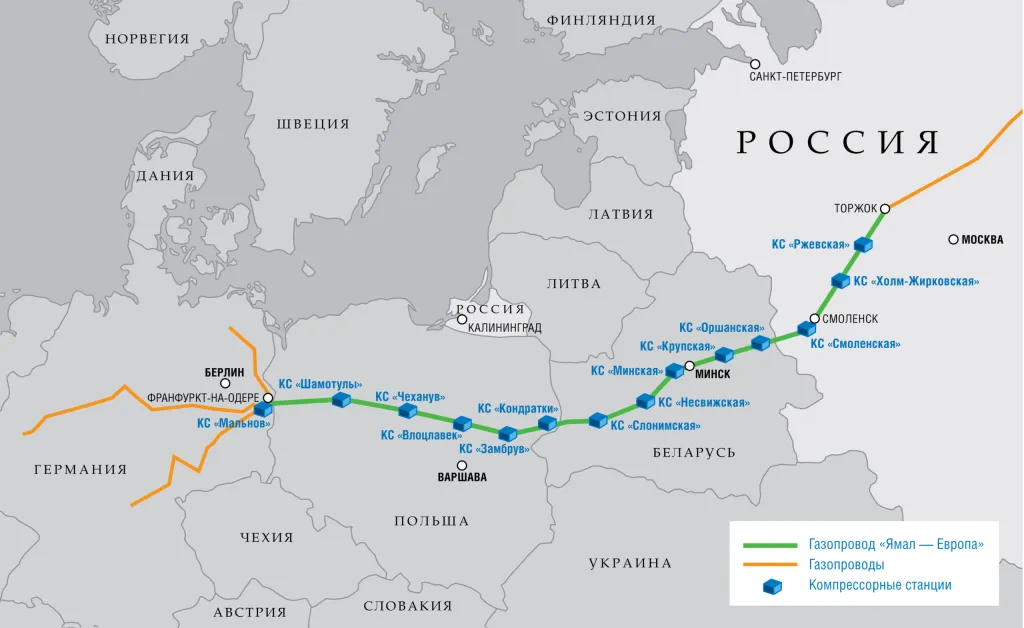
The Urengoy–Pomary–Uzhhorod pipeline (Druzhba pipeline) was part of the “gas in exchange for pipes program”. The Soviet-controlled bank “Ost-West Handelsbank” was opened in Frankfurt on 1 March 1973 to support the project.[20]
In 1975 alone, an estimated $900 million in imported pipe as part of various Soviet gas-for-pipe deals were financed through government-backed credits, mainly from Germany. The Yamal-Europe venture alone necessitated a consortium of 20 West German banks to provide $5.2 billion, and a group of French banks to lend another $4 billion. In all, Western financial organizations lent some $15 billion to cover the technology, equipment and construction for a supply of 40 billion cubic meters of natural gas annually, starting in 1986.[21]
According to a Top Secret CIA report, “During 1975, the USSR borrowed roughly $4.3 billion from Western commercial banks while at the same time reducing its holdings by $371 million. At the year’s end, total Soviet liabilities stood at $7.6 billion and net-liabilities (subtracting out Soviet assets held by Western banks) at $4.7 billion. According to the US Treasury and Federal Reserve statistics, US-based banks and their major foreign branches held $1 billion in claims against the USSR at the end of 1975. Almost 60% of these claims were held by foreign branches.”[22]
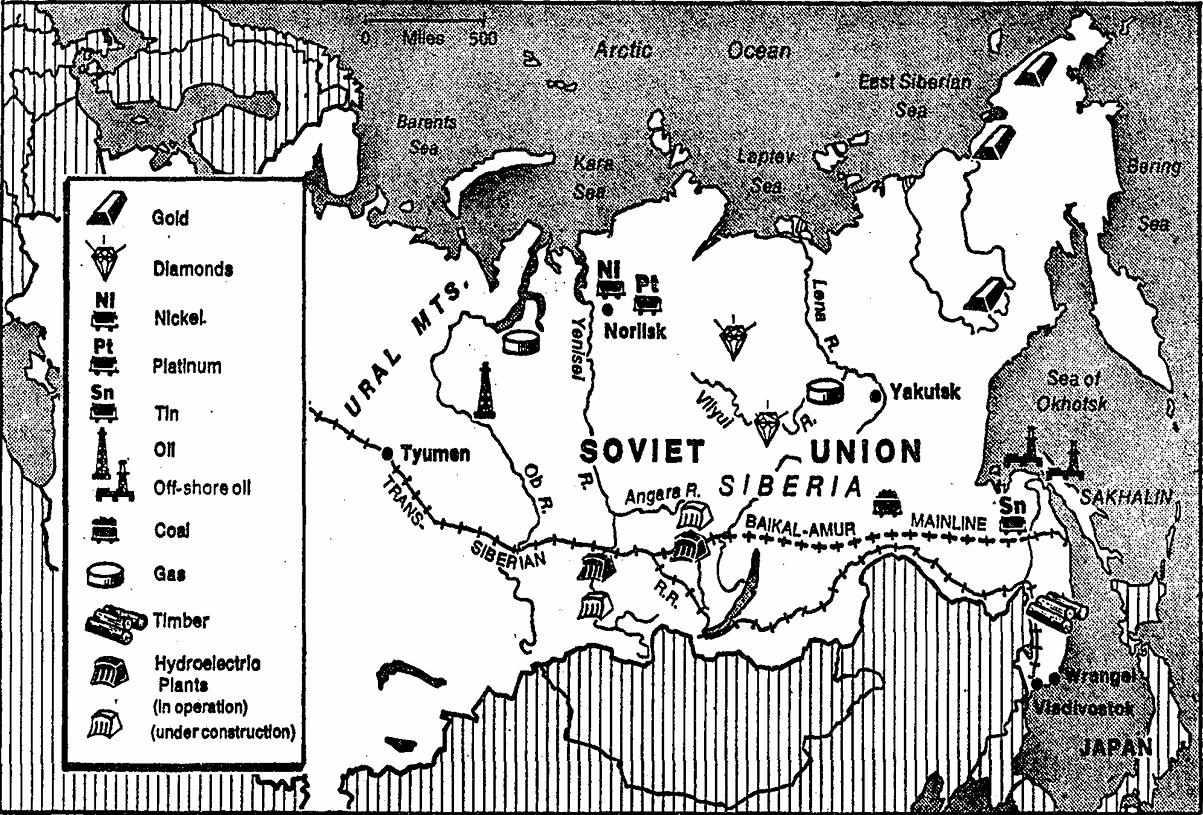
Map of eastern Soviet Russia’s exploitable resources by The New York Times for the article “Capitalist Aid Opening up Siberian Resources” of April 26, 1974.
“The vast natural riches of Siberia have become a fulcrum of growing economic relations between East and West, announced The New York Times in April 1974. “The region, extending across the northern third of Asia, from the Urals to the Pacific, already accounts for 75 to 80 percent of the Soviet Union’s energy resources, as coal, oil, natural gas and hydroelectric power, and of some high‐value metals like gold and tin as well as diamonds. Now, following the signing of a $1 billion agreement, some of those resources will be delivered to Japan and possibly later to the United States. … First, it requires the establishment of a vast infrastructure such as railroads, power supplies, housing and services. Second, construction costs are higher because of the hostile environment.” All would require additional credit from Western sources.
As Western companies and banks grew richer, enjoying their near monopoly access to the massive Soviet industrial markets, the Soviet Union, which had conveniently [for Western capitalists] outlawed domestic entrepreneurs, grew poorer.
| [Formerly] TOP SECRET CIA Report on Major Government-Backed Credit Agreements from Selected* Western Countries for Soviet Projects/Purchases (Millions US$) December 1974 – February 1976 | ||||||||
| Country | Credit Type | Credit Amount | Contract Value | Down-payment | Interest Rate | Term (Yrs) | Description | |
| Dec-74 | France | CL | 2,800 | 3,500 | 20% | 7.2 – 7.55 | 8.5 | Purchases of French products between 1975-1979. |
| Nov-75 | France | PA | 295 | 363 | 20% | 7.2 | 8.5 |
French share
of Iran Natural Gas Project. |
| Oct-74 | West Germany | PA | 293 | 375 | 20% | — | 6 | Trucks |
| Oct-74 | West Germany | PA | 577 | 700 | 15% | 6.75 | 8.5 | Pipe |
| Jan-76 | West Germany | PA | 464 | 546 | 15% | 7.35 | 8 | Pipe |
| Feb-75 | UK | CL | 2,270 | 2,838 | 20% | 7.0-7.35 | 8.5 |
Match Terms
of French CL |
| Jan-75 | Italy | PA | 560 | 650/3 | 15%/3 | 7.45 | 5 |
35% of $1.4 billion Pipe
Order |
| Apr-75 | Italy | PA | 257 | 320 | 20% | 7.345 | 8 | Chemical Plants |
| Sep-74 | Italy | CL | 900 | 1,058 | 15% | 7.55 | 8 | — |
| Jan-76 | Italy | PA | 200 | 235/3 | 15%/3 | 7.55/3 | 5 |
Addt’l Credit
for Jan-75 Pipe order. |
| Feb-76 | Japan | PA | 160 | 200 | 20% | 7.55 | 5 | Pipe |
| Feb-76 | Japan | PA | 221 | 260 | 15% | 7.55 | 8.5 | Ammonia Plant |
| Mar-76 | Japan | PA | 25 | — | — | 6.375 | — | Yakutsk Exploration |
| Feb-76 | US | PA | 25 | — | — | N.A. | — | Bank of America Loan for Yakutsk Exploration |
| Totals | 9,047 | 10,160 | ||||||
| * Does not include Finland, Sweden or Austria. | ||||||||
| CL – General Purpose Credit | ||||||||
| PA –Project Associated | ||||||||
| 3. Estimated | ||||||||
The decision to allow major US military contractor Dresser Industries to sell “plans and equipment and other items of advanced technology to manufacture high-quality drill bits including an electron-beam welder” to the Soviet Union in 1978 was made by the White House. The only reason why the decision was brought into the public light and not kept secret in mid-1976 was due to the conflict between the CIA and Department of Energy who believed that the plant provided significant military capabilities to the Soviet Union and the Commerce and Defense Departments who approved of the sale. President Jimmy Carter stepped into the debate to give presidential approval for Dresser Industries’ export. Carter also announced a government commitment to reduce export barriers and speed the licensing process for US corporations seeking similar export licenses.
A New York Times article explained that “the $158 million Dresser deal was only the first in a series of proposed sales involving oil equipment and other items of advanced technology.”[24]
| Soviet Bloc Hard Currency Debt | |||||
| Gross Hard Currency Debt ($US Millions) | Debt Service Ratio/1 | ||||
| 1970 | 1980 | 1970 | 1980 | ||
| USSR | 1,800 | 18,300 | 6 | 9 | |
| Poland | 1,103 | 26,000 | 19 | 101 | |
| East Germany | 1,416 | 14,500 | 14 | 55 | |
| Romania | 1,639 | 10,700 | 36 | 25 | |
| Czechoslovakia | 564 | 4,620 | 9 | 18 | |
| Hungary | 610 | 8,700 | 16 | 30 | |
| Bulgaria | 681 | 2,975 | 30 | 32 | |
| 1) Repayments of, and interest on, medium-and long-term debt as a share of hard currency exports. | |||||
| (Source: Secret CIA Memorandum, (April 8, 1983). Soviet Bloc Financial Problem as a Source of Western Influence, RDP83T00966R000100030026-0, Approved for Release 2008/06/17.) | |||||
In light of the rapidly expanding debt of the entire Soviet Bloc during the 1970s, the CIA reported that “Private sources of long-term credit to the Bloc have dried up,”[25] leaving many of the Bloc countries “unable to meet their hard currency obligations… These problems give the West an unusual opportunity to influence Soviet Bloc developments,” noting that “The main instruments of influence are the volume and terms of new government-guaranteed credits and the rescheduling of existing obligations.”
Why would the US, which spent $944.84 billion[26] on military contracts between 1970 and 1979 alone for the claimed purpose of protecting itself and the world from communism, allow the same firms and banks involved in Western defense contracts to lend money to the source of communism if the entire Cold War system wasn’t anything but a ruse to fleece the global public out of that money?
Why would the Soviet government, which claimed that its sole purpose was to protect its people from the evils of capitalism and which spent roughly $300 billion more on its military than the US between 1970 and 1981, not only engage in massive contracts with the grandest capitalist firms, but allow itself to become dangerously in debt to them and western governments, even jeopardizing its ability to continue its military spending, if the entire Cold War system wasn’t anything but a ruse?
As the CIA report states, “These [Soviet Bloc] countries all rely on the West for critical imports of food, steel, and high quality equipment.” But what the report doesn’t state is that the firms that were selling these ‘critical imports of food, steel, and high quality equipment’ were just as dependent upon Soviet Bloc markets.
“The expansion of East-West trade was aided by formal and informal encouragement by Western government,” states the CIA report, “including a loosening of export controls, and a massive expansion of credit. In the early 1970s, most of the Western credit was in the form of government-guaranteed loans for machinery and equipment sales.
By the second half of the decade, the center of gravity shifted from state export-credit agencies to private Western financial institutions. The USSR and the Eastern European countries became active borrowers on international capital markets, integrating themselves into the global financial system without possessing the institutional mechanisms required for a convertible currency economy.
This asymmetry explains why the question of credit conditions—interest rates, maturity, and rescheduling—acquired strategic importance and gradually evolved into a potential instrument of political and economic leverage.
As trade surged, however, and contracts multiplied, the USSR and the East European countries entered private Western financial markets on a much larger scale than before. …Western banks competed with each other for loans to the Eastern Bloc. By the end of 1980, Eastern Bloc hard currency debt exceeded $80 billion (compared with $8 billion in 1971).[27]
While the Soviet Union and Eastern Bloc countries were known as excellent loan risks for their demonstrated reliability for prompt payments, Western banks were all reaching, or had already reached, their self-imposed financial exposure limit with the Bloc by the end of the 1970s.
The CIA worried that “a strongly restrictive policy could trigger widespread debt default, which … [could] create risks for the stability of the international banking system.”[28] The rising debt, “high interest rates, bad crops, [and] lower oil prices’ [controlled by Western commodity markets] “led to a fundamental reassessment of the risk of lending to Soviet Bloc countries, which in turn has curtailed those countries’ access to Western private credit and made some of the remaining credit flows vulnerable to new negative developments. In the past few months [of early 1983], the possibility that Western governments might restrict or discourage credit to Eastern Europe has created added uncertainty in financial markets and has further discouraged bank lending.”[29]
Even after Poland’s 1981 private debt rescheduling agreement, the country had “next to no chance of generating a large trade surplus or obtaining enough debt relief and credits to cover a 1982 debt service burden of $10 billion.”[30]
“Soviet Bloc dependence on Western credits for food, equipment and technology gives the West the opportunity to use credits as an instrument of influence,” notes the CIA report. Indeed, and refusing to offer those credits in the first place would have bought the whole system down decades prior to 199—but would have deprived Western firms decades of enjoying monopoly access to the massive Soviet Bloc markets which were held under a system which outlawed domestic competition and kept the Russian ruble out of the global financial markets. With Russia and its allies crippled under the communist system, Western firms were free to rule the world and grow more powerful with each passing decade.
The West had ‘direct measures’ or levers which it could use to influence the flow of capital to the USSR and its allies:
The report pointed out however that “the greatest potential effects of Western government credit restrictions were of an indirect nature”. The report felt that it was “highly unlikely that Western banks would be willing to resume unguaranteed long-and medium-term lending if Western governments imposed…limits on government guaranteed credits.”
Had private banks not already reached, or nearly reached, their own financial exposure limits in the Bloc this statement would have been moot, as no government act, prohibition, or even law had previously influenced the behavior of private banks or elite firms when it came to business with the Soviet Union.
The expansion of East–West trade in the 1970s created a relationship of asymmetric interdependence. Western industrial and financial institutions obtained long-term access to a vast protected market, while the Soviet economy acquired the technology necessary to maintain military and industrial parity. However, the financial structure of this exchange placed the USSR in a position of growing hard-currency vulnerability.
By the end of the decade, the limits of Western bank exposure, rising interest rates, and the increasing cost of refinancing marked the end of the expansion phase. The credit-driven modernization model that had supported industrial growth during détente simultaneously generated the debt dynamics that would define the systemic crisis of the 1980s.
TO BE CONTINUED
References:
No Author (July 3, 1973). BECHTEL COMPANY SIGNS SOVIET PACT, The New York Times.
Theodore Shabad (March 5, 1974). “Soviet Truck Project Spurs U.S. Business”, The New York Times.
David K. Shipler (December 20, 1976). “Mammoth Truck Plant Slowly Comes to Life in Plains of Soviet Union”, The New York Times.
Electronic resource: Cooper Thomas, (2016?). “Bombing missions of the Vietnam War: A visual record of the largest aerial bombardment in history”. Esri’s StoryMaps team @ https://storymaps.arcgis.com/stories/2eae918ca40a4bd7a55390bba4735cd.
Electronic resource: CIA Report (No date). The Dimensions of Soviet Aid to North Vietnam, Approved for release (2009/04/09). https://www.cia.gov/readingroom/docs/CIA-RDP78T02095R000900030002-5.pdf
Richard Burt (May 24, 1979). “SOVIET ARMY LINKED TO U.S.‐AIDED PLANT”, The New York Times, Section A, page 12.
Electronic resource: https://history.state.gov/milestones/1969-1976/detente#:~:text=Between%20the%20late%201960s%20and,increased%20discussion%20on%20arms%20control.
Electronic resource: Maria Afonina (Sep. 21, 2022). “How the USSR traded with the West despite the Iron Curtain”, Gateway to Russia, https://www.gw2ru.com/business/2230-how-ussr-traded-with-west#:~:text=Machinery%2C%20equipmen t%2C%20and%20vehicles%20%E2%80%93%2040.7%25,materials%20and%20intermediate%20goods%20%E2%80%93%201.3%25
Electronic resource: Secret CIA Report (April 8, 1982). THE SOVIET BLOC FINANCIAL PROBLEM AS A SOURCE OF WESTERN INFLUENCE, Approved for release June 17, 2008. https://www.cia.gov/readingroom/docs/CIA-RDP83T00966R000100030026-0.pdf
Sonia Melnikova-Raich (2010), The Soviet Problem with Two ‘Unknowns’: How an American Architect and a Soviet Negotiator Jump-Started the Industrialization of Russia, Part 1: Albert Kahn.
Philip Shabecoff (July 9, 1972). “Moscow Agrees to Buy U.S. Grain for $750-Million”. The New York Times. p. 1. ISSN 0362-4331.
“America Gets the Shaft”. The Harvard Crimson. December 1, 2016.
Theodore Shabad (Jan. 13, 1973). “G.E. and Soviet Sign Pact For Technology Exchange”, The New York Times.
Top Secret CIA Report (Circa 1976/No Cover Page), USSR: Problems in Financing Hard Currency Trade Deficits, Annexes referred to in text not included. Released (no date).
Electronic resource: “Галина Аполлоновна Титова: В Сингапур я ездила разбираться десять лет” [Galina Apollonovna Titova: I went to Singapore to figure it out for ten years] (PDF). letopis.org (in Russian). Archived from the original (PDF) on 23 October 2023. (https://en.wikipedia.org/wiki/Urengoy%E2%80%93Pomary%E2%80%93Uzhhorod_pipeline)
Alexander L. Taylor, III (Fed. 16, 1981), “A Soviet Pipeline to the West”. TIME.
Top Secret CIA Report (Circa 1976/No Cover Page), USSR: Problems in Financing Hard Currency Trade Deficits, Annexes referred to in text not included. Released (no date).
Richard Burt (26 June 1978), “Carter Aides Favor Ban on Oil Equipment for Soviet”, The New York Times.
Secret CIA Memorandum, (April 8, 1983). “Soviet Bloc Financial Problem as a Source of Western Influence”, RDP83T00966R000100030026-0, Approved for Release 2008/06/17.)
The US is not mentioned as employing any such activities. ↑
